

Pollinator Post 6/30/25 (2)

It’s very low tide at 10:30 am at Crab Cove. I sit on the beach to enjoy the breezes and to watch a child explore the exposed mud flat.
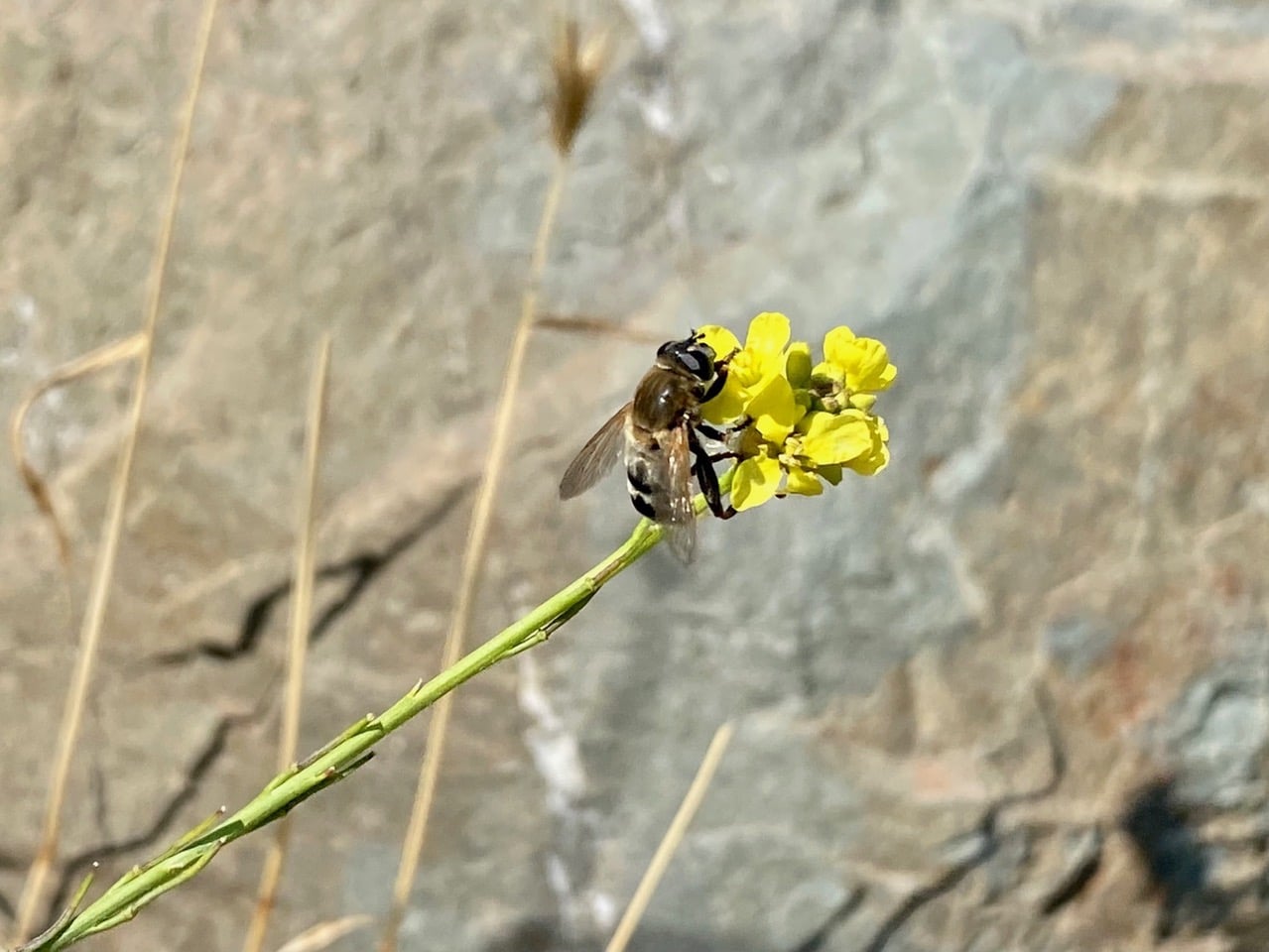


A large brown hover fly forages on a cluster of flowers of Wild Mustard. iNaturalist has helped identify it as the Dimorphic Sickleleg, Polydontomyia curvipes (family Syrpidae). The males of the species have a red abdomen, so our friend here is probably a female. Many hoverflies are Batesian mimics of bee/wasp, but the Sickleleg seems to have done away with the black-and-yellow theme, preferring a drab appearance, at least for the females. The genus is monotypic, comprising a single species.
There is little available information on the biology of this hover fly. Since the species is in the tribe Eristalini, its larvae are probably rat-tailed maggots that develop in aquatic or semi-aquatic habitats. A characteristic feature of rat-tailed maggots is a tube-like, telescoping breathing siphon located at its rear end. This acts like a snorkel, allowing the larva to breathe while submerged. When fully extended, the siphon can be several times the larva’s body length, giving rise to the common name of “rat-tailed maggot”. These larvae are often found in stagnant, oxygen-deprived water, with a high organic content.
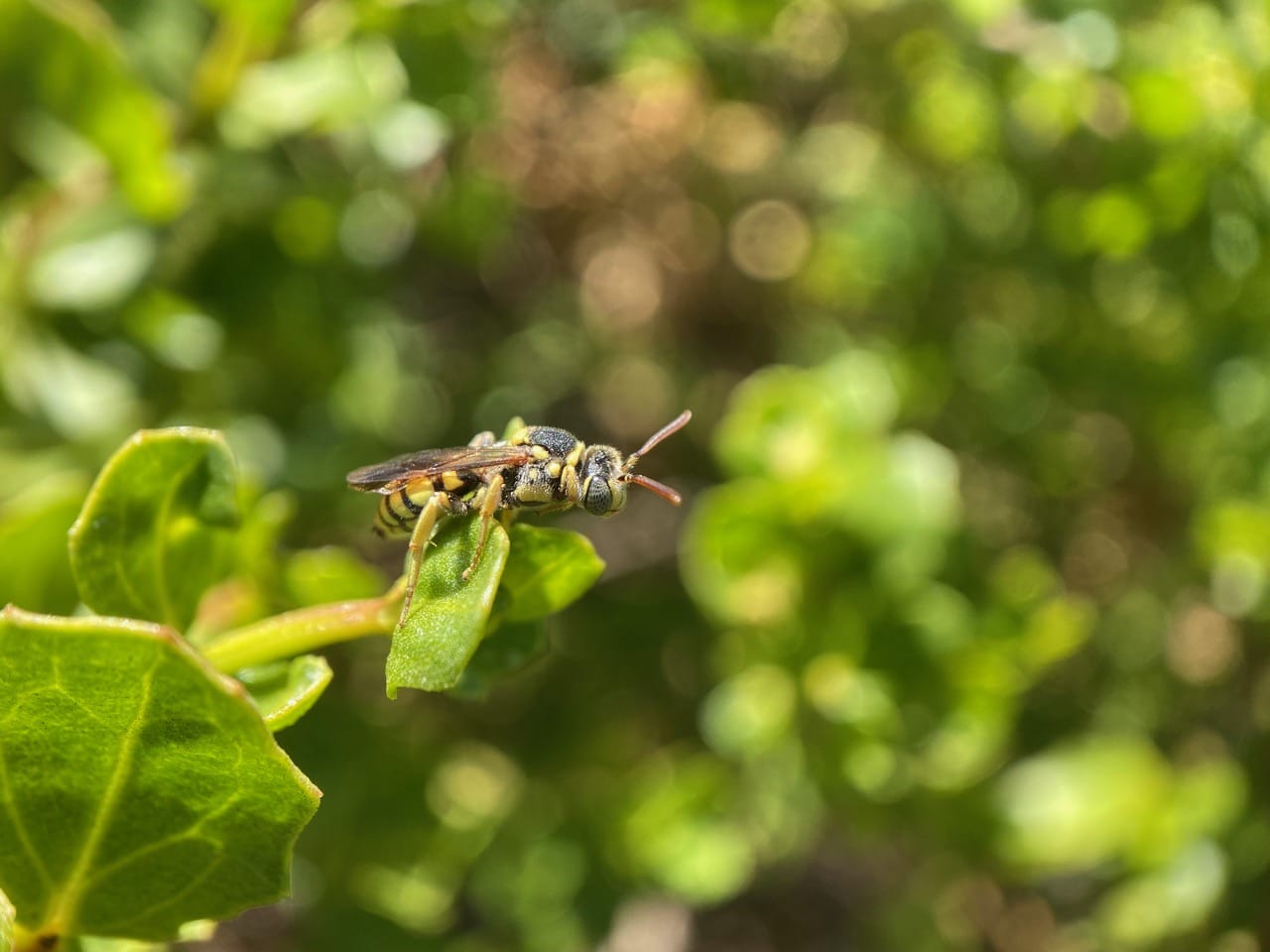
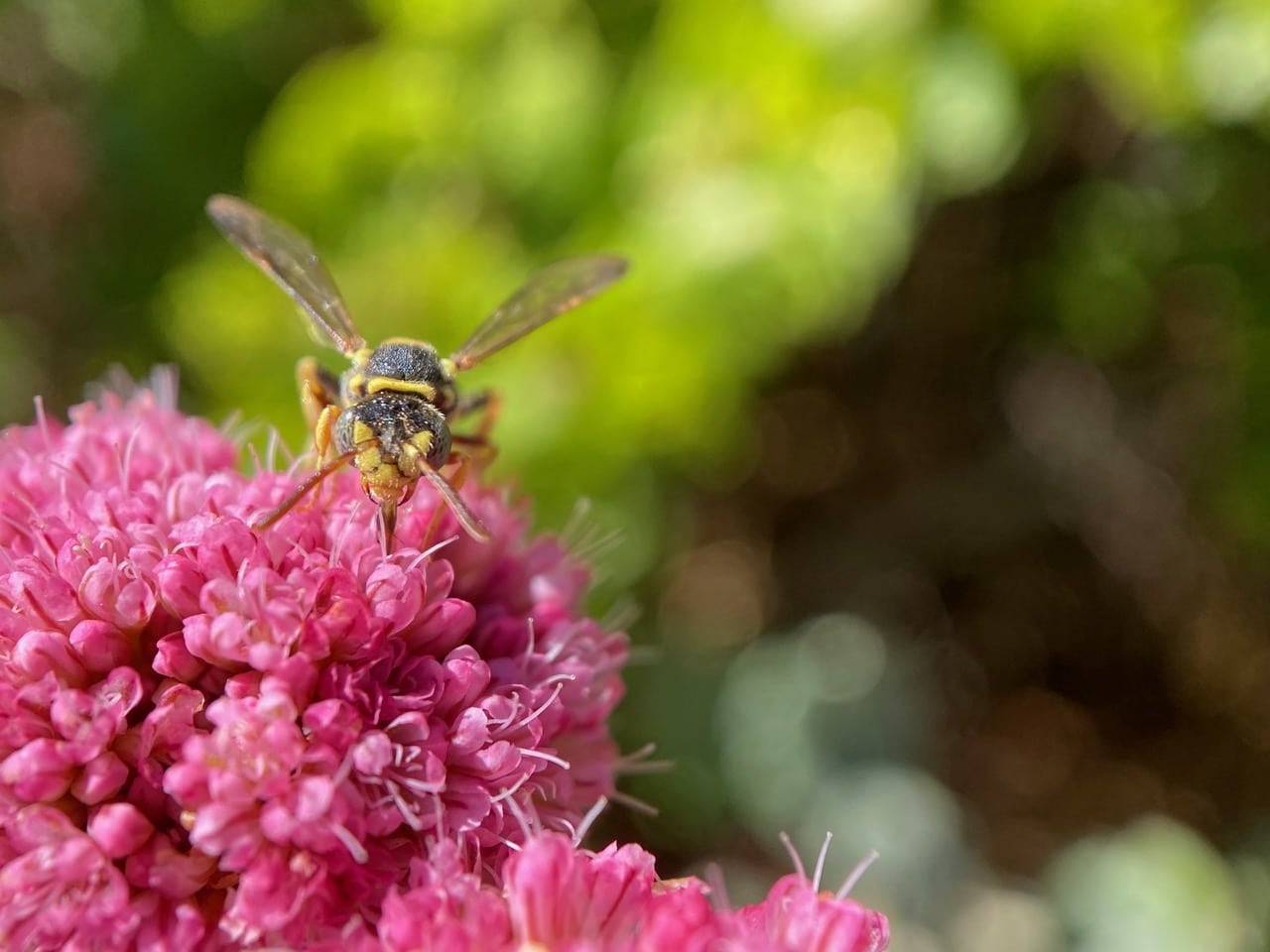
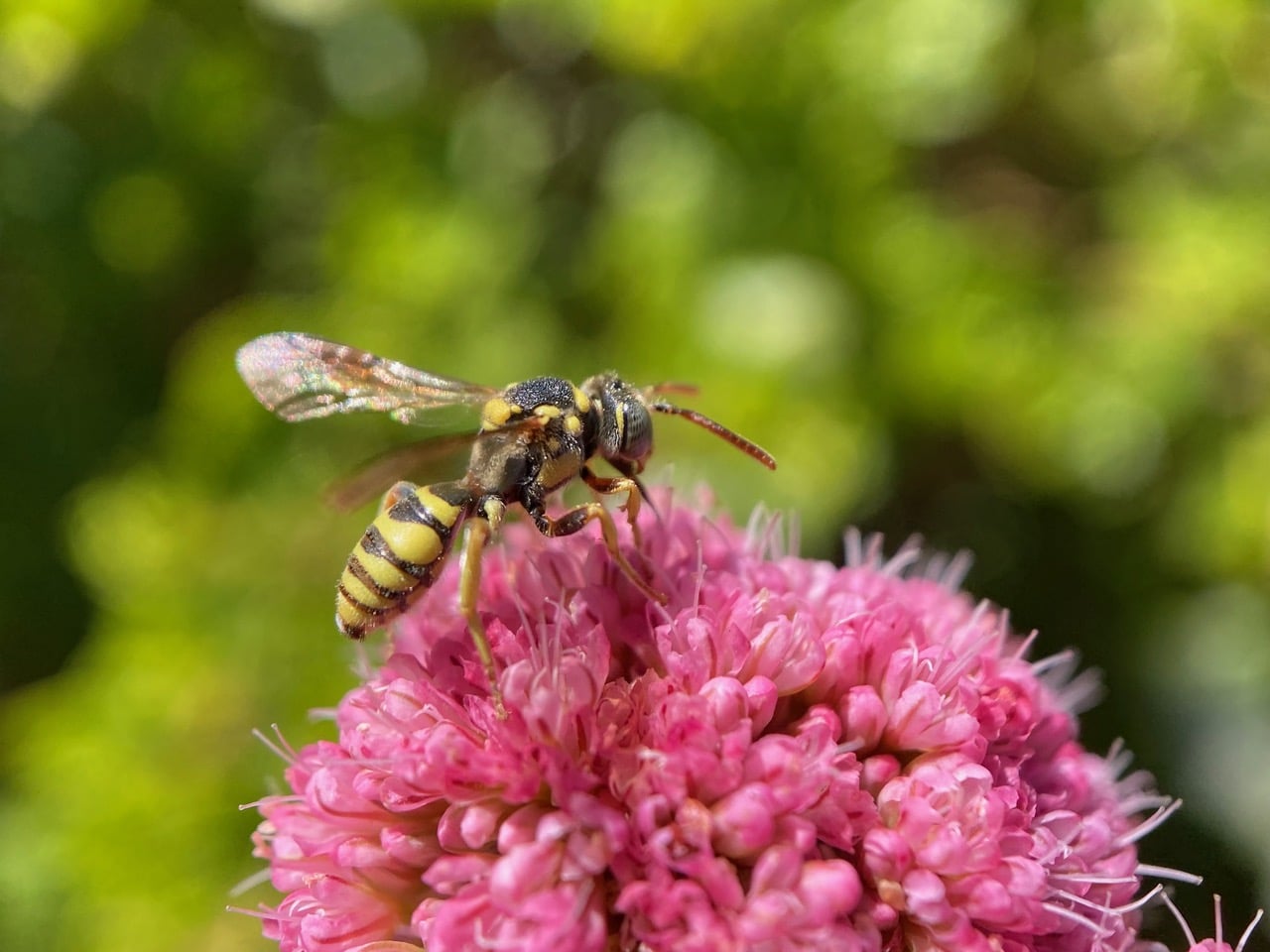
A little wasp-like insect is perched on Coyote Brush foliage overhanging a patch of Red-flowered Buckwheat, Eriogonum grande ssp. rubescens.
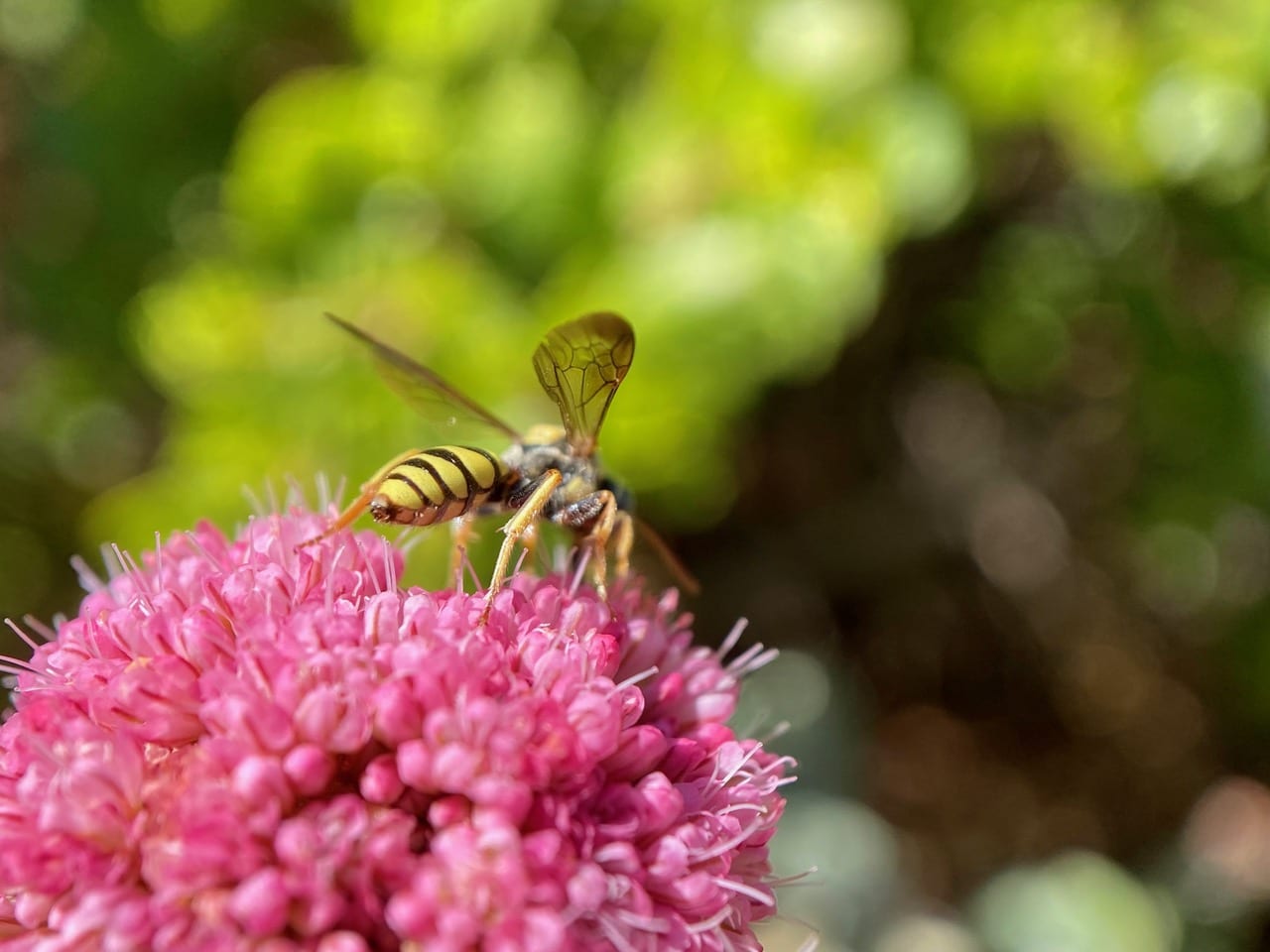
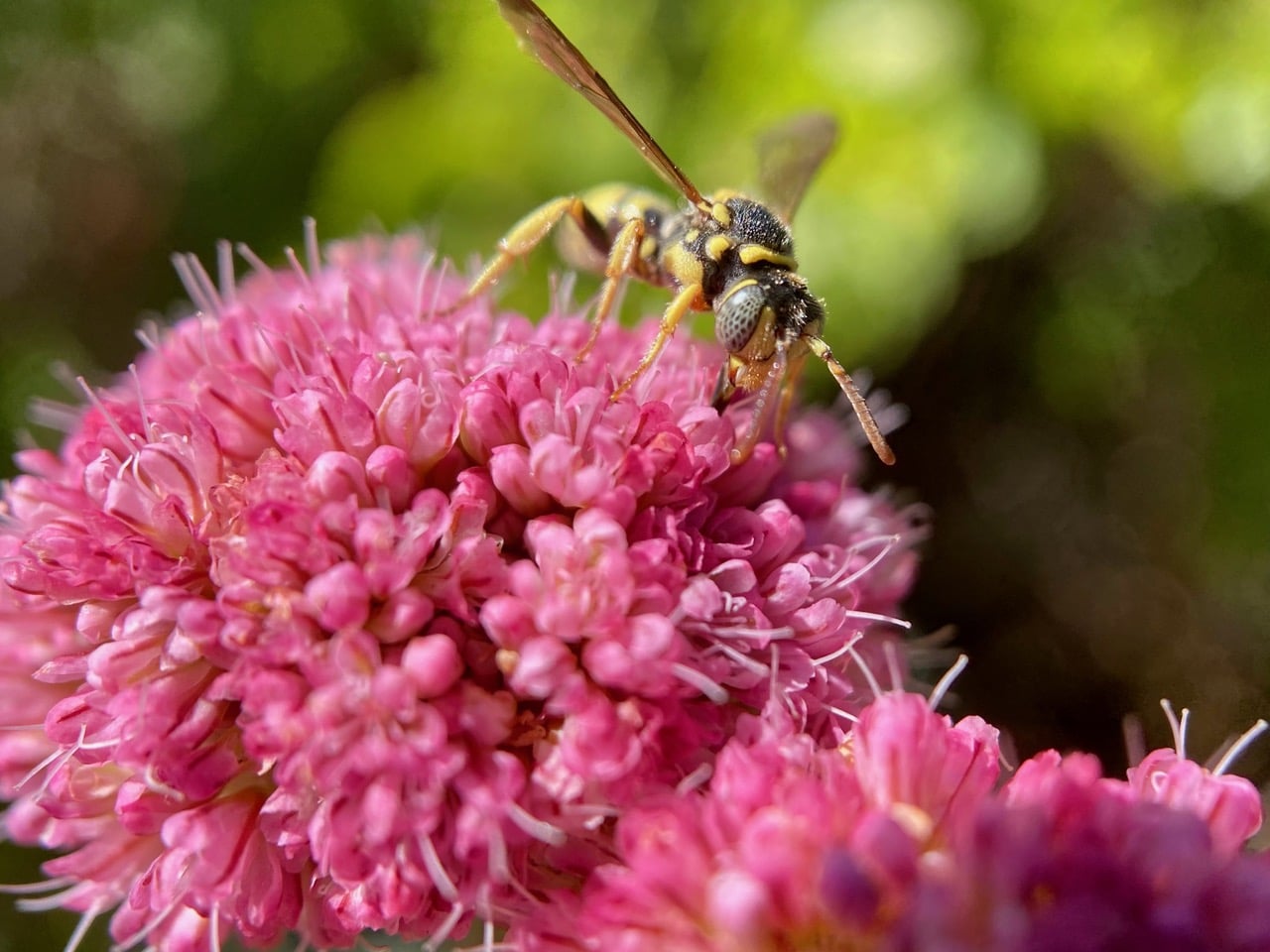
It finally lands on a cluster of the buckwheat flowers.
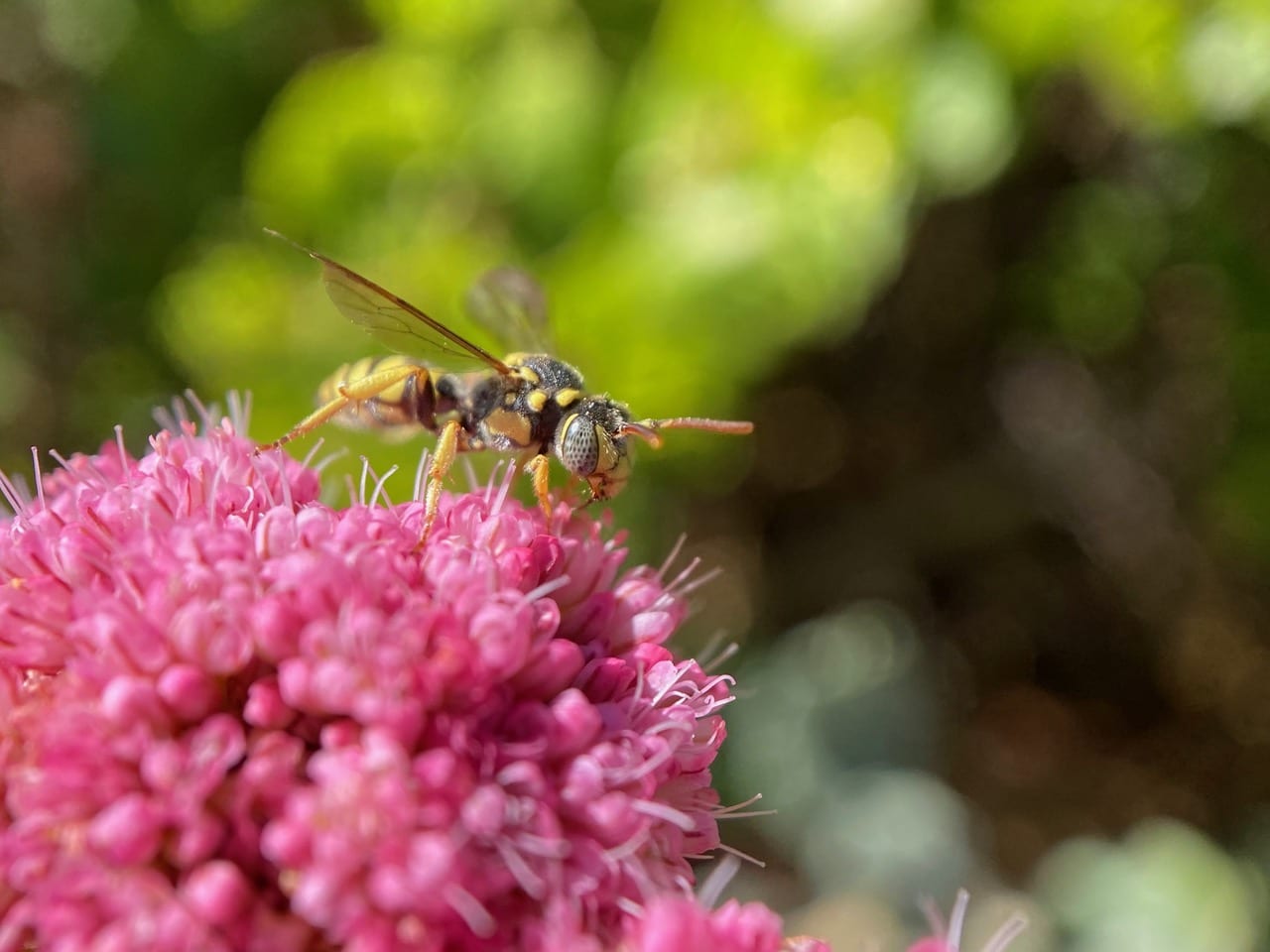
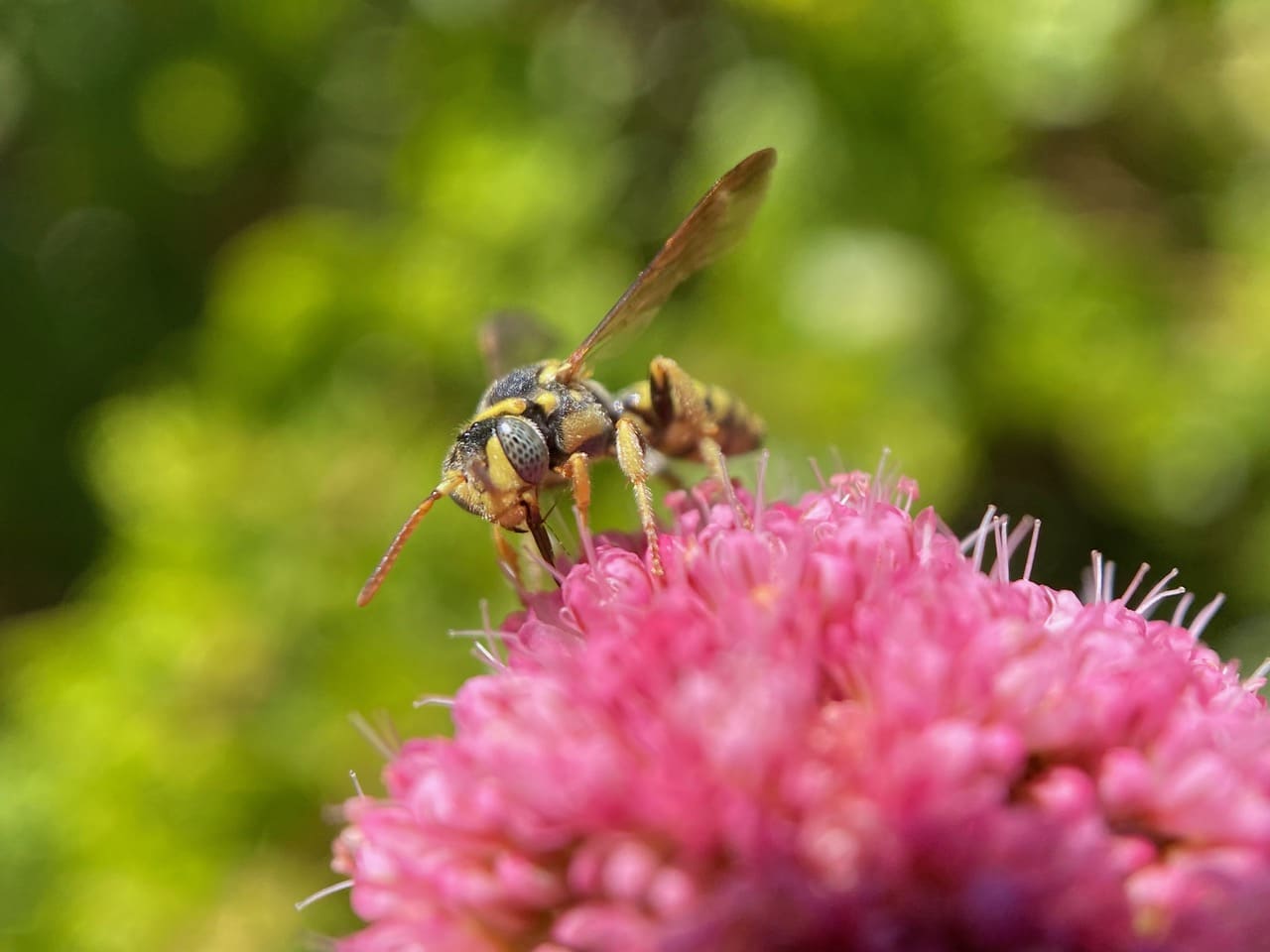
It has large, mottled gray-blue eyes. Hah, I think it is a Cuckoo Bee or Nomad Bee, Nomada sp. (family Apidae).
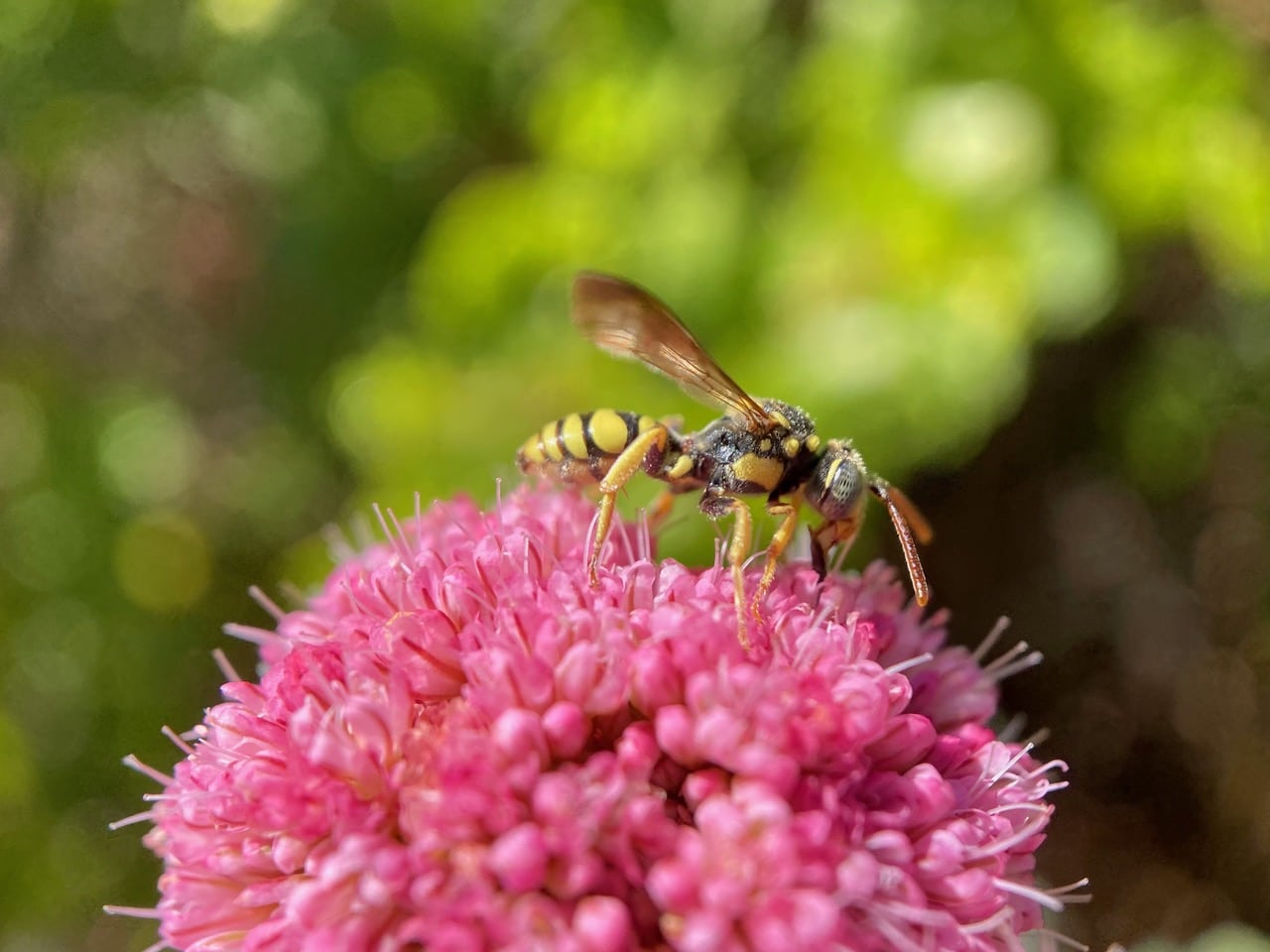
Its tongue extended, the Nomad Bee is taking nectar from the buckwheat flowers.
Nomad Bees in the genus Nomada is one of the largest genera in the family Apidae, and the largest genus of Cuckoo Bees. Nomada are kleptoparasites of many different types of ground-nesting bees as hosts, primarily the genus Andrena. They lack a pollen-carrying scopa, and are mostly hairless, as they do not collect pollen to feed their offspring. Adults visit flowers for nectar. The bees are extraordinarily wasp-like in appearance, often with yellow or white integumental markings on their abdomen.
Nomad Bees occur worldwide. All known species parasitize ground-nesting bees, and their habitats and seasonality correlate closely with their hosts. In early spring, females scout out their hosts, searching for nests to parasitize. The female Nomada sneaks into the host’s nest while the resident female is out foraging, then lays eggs in the nest. The parasite larva that hatches out kills the host offspring and feeds on the host’s provisions. This type of parasitism is termed brood parasitism. The parasites pupate in the host cell and finally emerge as adults the following season along with the hosts. Some known host bees include various Andrena species, Agapostemon, Melitta, Eucera, and Exomalopsis.
While we might shudder at the thought of cuckoo bees in our garden, the presence of cuckoo bees actually indicates a healthy population of their host bees, suggesting a diverse and thriving ecosystem. Parasitism is a natural part of many ecosystems, and cuckoo bees play a role in regulating the populations of their host species. Cuckoo bees, while not collecting pollen for their own young, still visit flowers for nectar and inadvertently pollinate plants in the process. Cuckoo bees are also a food source for other animals, further contributing to the food web.
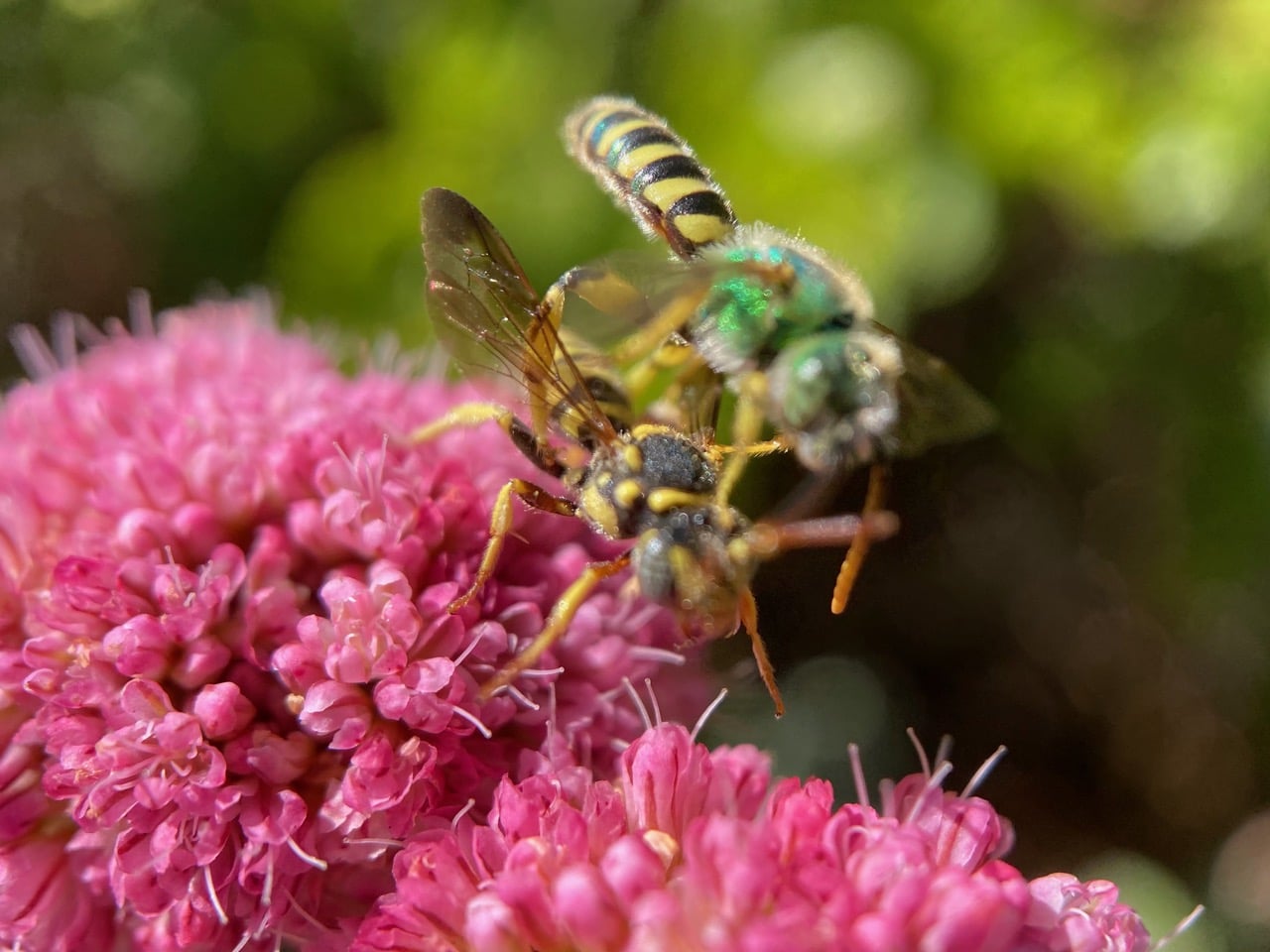
As I am taking a close-up of the Cuckoo Bee …
… it is suddenly dive-bombed by a male Fine Striped Sweat Bee, Agapostemon subtilior (family Halictidae). Wow, does the sweat bee recognize the Cuckoo Bee as a brood parasite, and is driving the nuisance out of the territory? Or is the aggression a general attempt to monopolize floral resources?
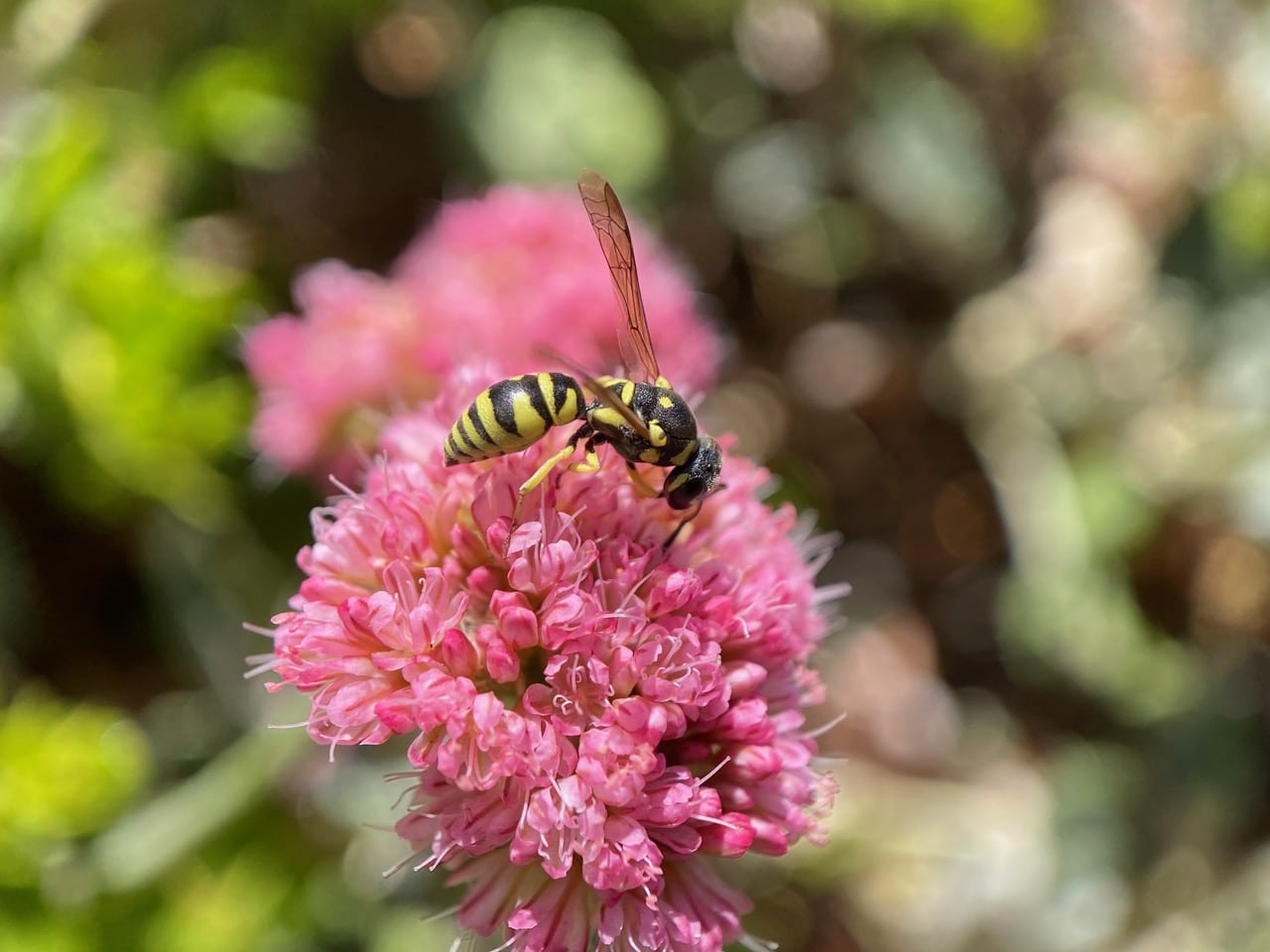
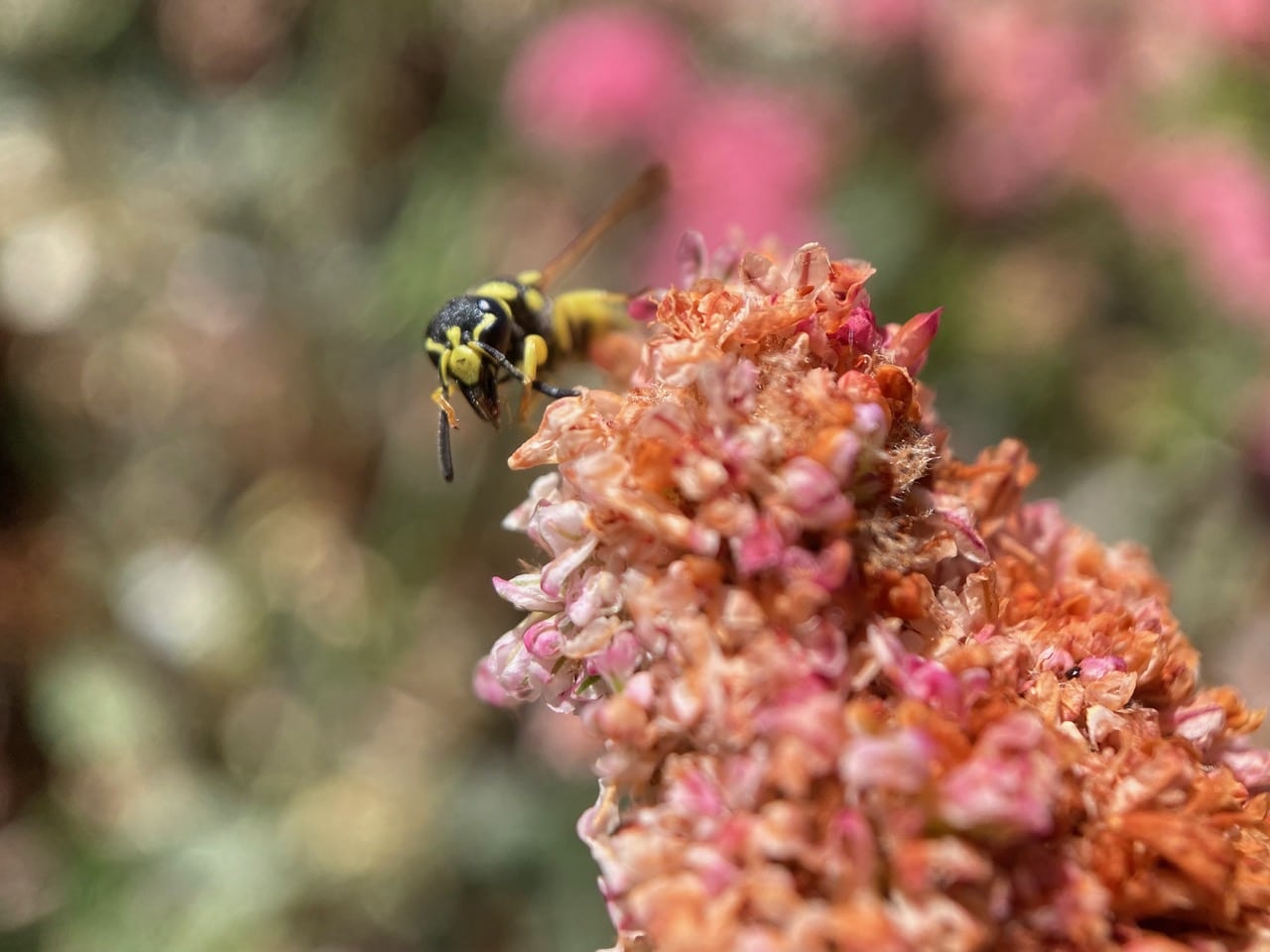
Hey, that’s a real wasp that is very similar in general appearance to the Nomad Bee.
The markings on the abdomen tell me that it is a Mason Wasp, Euodynerus annulatus (family Vespidae, subfamily Eumeninae).
The Mason Wasp, Euodynerus annulatus (family Vespidae, subfamily Eumininae) is a widespread species, found from coast to coast in the United States, south to Mexico, and north into Canada. The color and markings vary considerably among the various subspecies. These are sizable wasps, their fore wings measuring 8.5-10.5 mm. Males can be recognized by the hooked tips of the antennae, and their less robust appearance. Unlike the other Mason Wasps that use pre-existing cavities, or making mud nests, the females of this species excavate burrows. They also extend the tunnel above ground as a curved mud “chimney”. Several individual cells branch from the main burrow underground. The species seem to favor situations close to water, as the female regurgitate water to soften the soil during nest-building. The chimney might help protect against parasites, but it apparently serves as the source of mud pellets to make the final nest closure as well.
The female wasps provision their nests with moth caterpillars as food for their offspring. A single egg is suspended from a short thread attached to the wall of the cell before it is stocked with caterpillars. Usually several caterpillars are placed in each cell. When all cells are provisioned, the nest entrance is sealed. The turret or chimney is deconstructed entirely and the nest entrance made nearly invisible and flush with the surrounding soil. The wasp leaves to begin a new nest.
The wasp lifts its head and cleans both its antennae simultaneously – adorable! This is the first time I see this behavior.
Wasps possess specialized structures on their forelegs the function as antenna cleaners. These antenna cleaners or strigils, help wasps keep their antennae clean and functional by removing debris nd contaminants. The antenna cleaner typically consists of a notch in the basitarsus (the first segment of the foot) and a corresponding spur on the tibia (the segment above the foot). The wasp flexes its legs, slipping the antenna into the groove of the strigil. The spur on the tibia then acts like a scraper, removing debris as the antenna is pulled through. Keeping antennae clean is crucial for wasps to maintain optimal sensory function. Dirt and debris can interfere with the detection of scents and other environmental cues, and navigation.
While most hymenopterans (ants, bees, and wasps) have these antenna cleaners, the specific morphology and features can vary between different groups. Some may have multiple rows of projections on the spur, while others might have a single row.
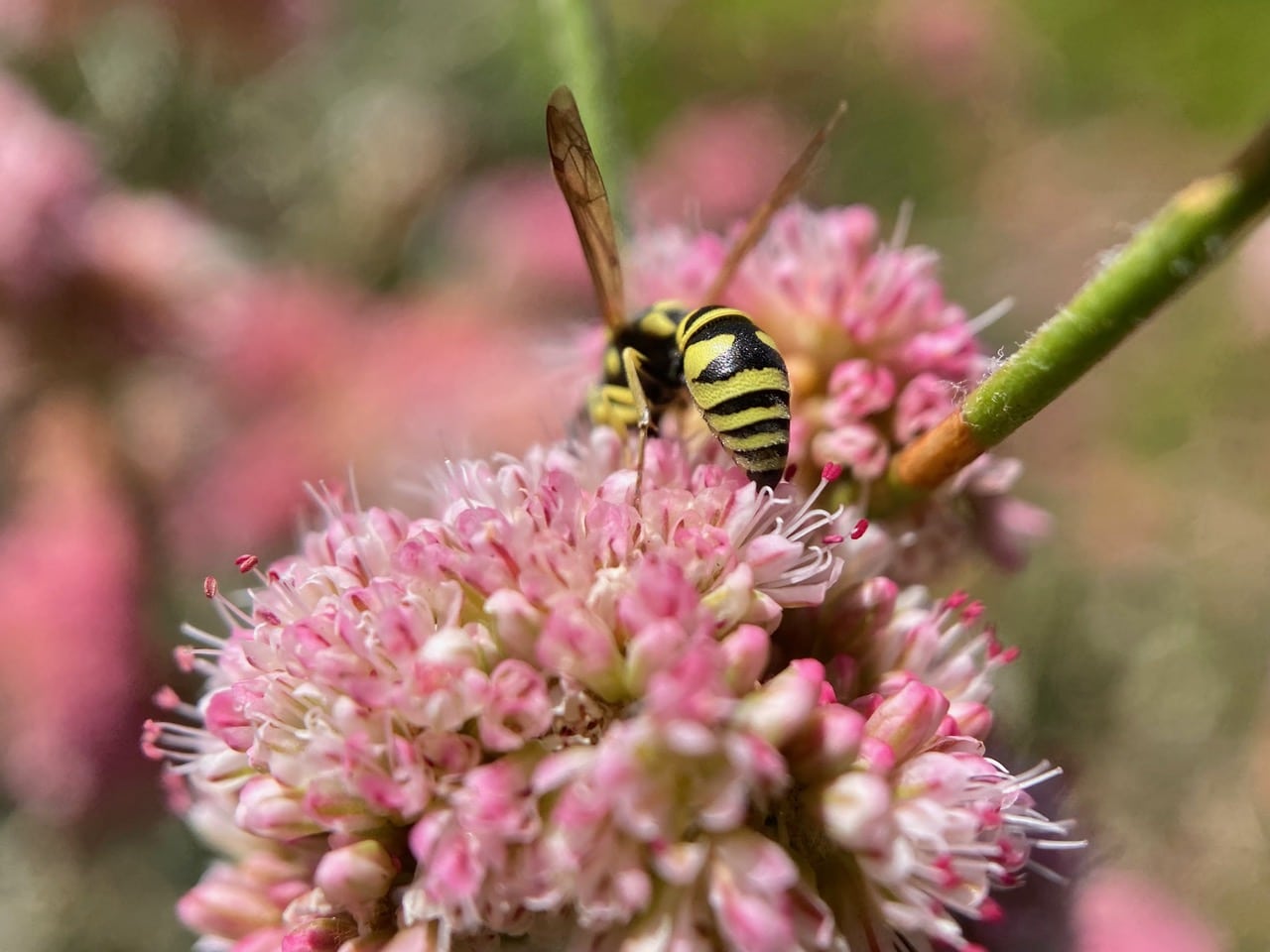
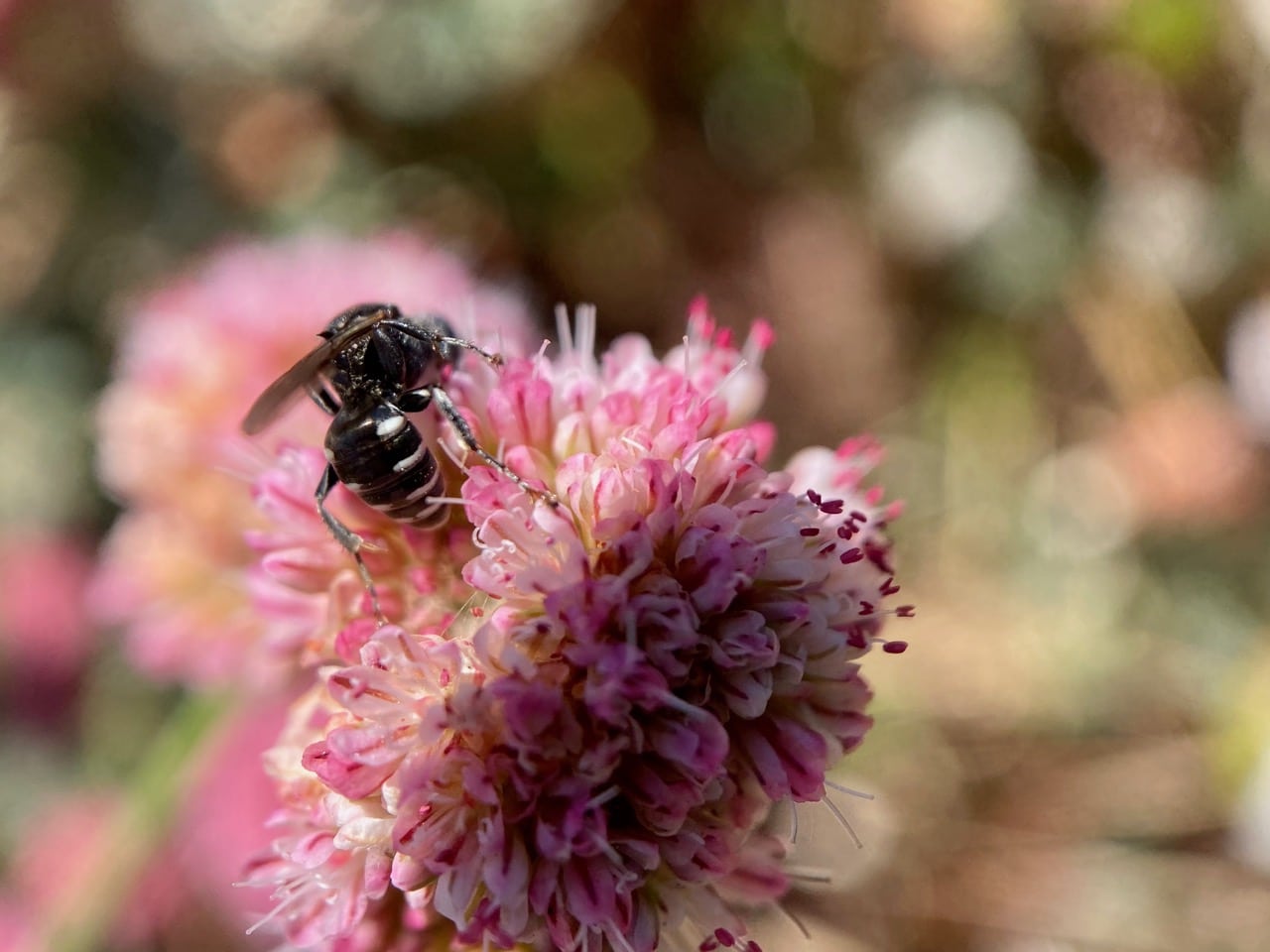
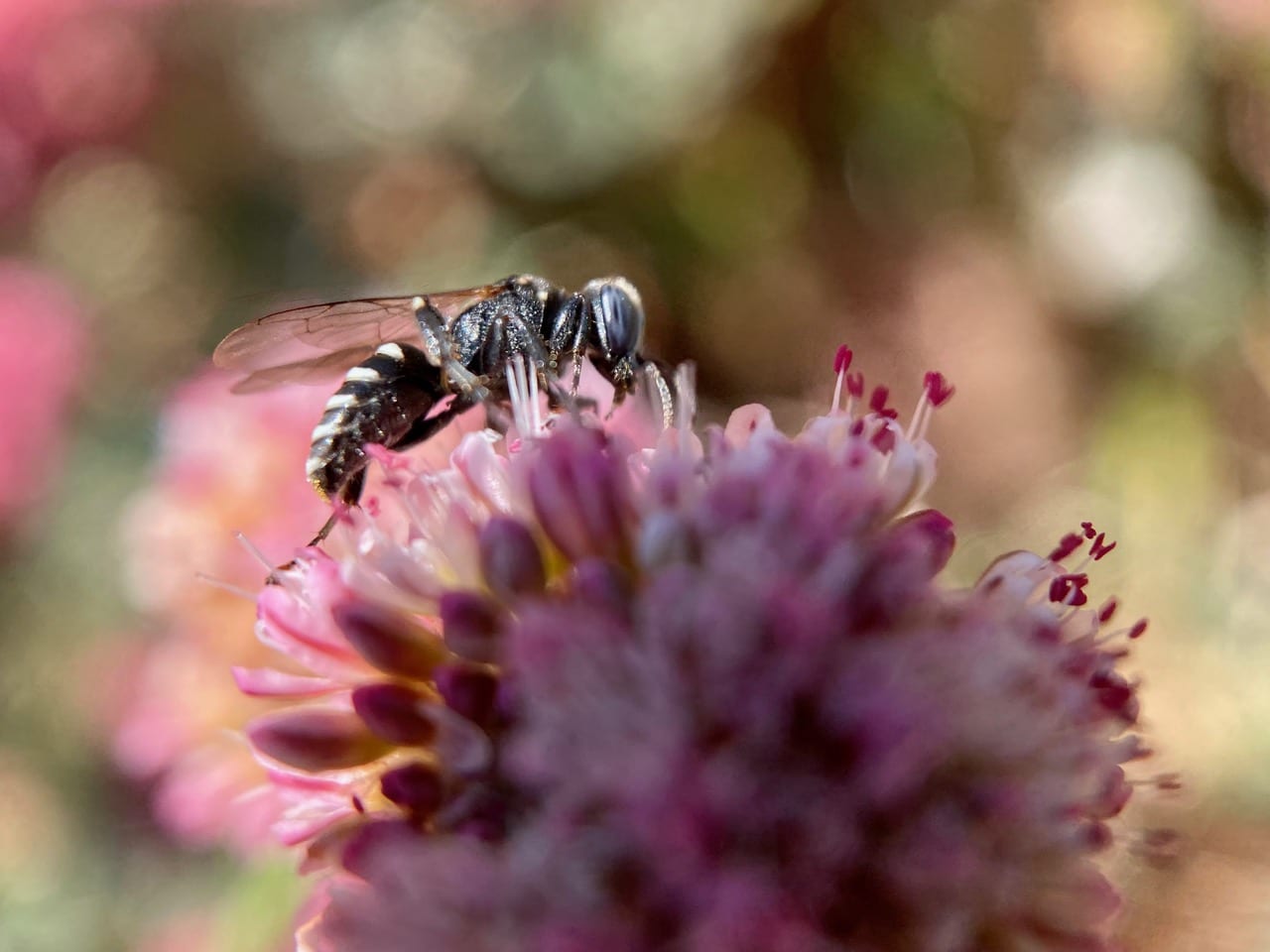
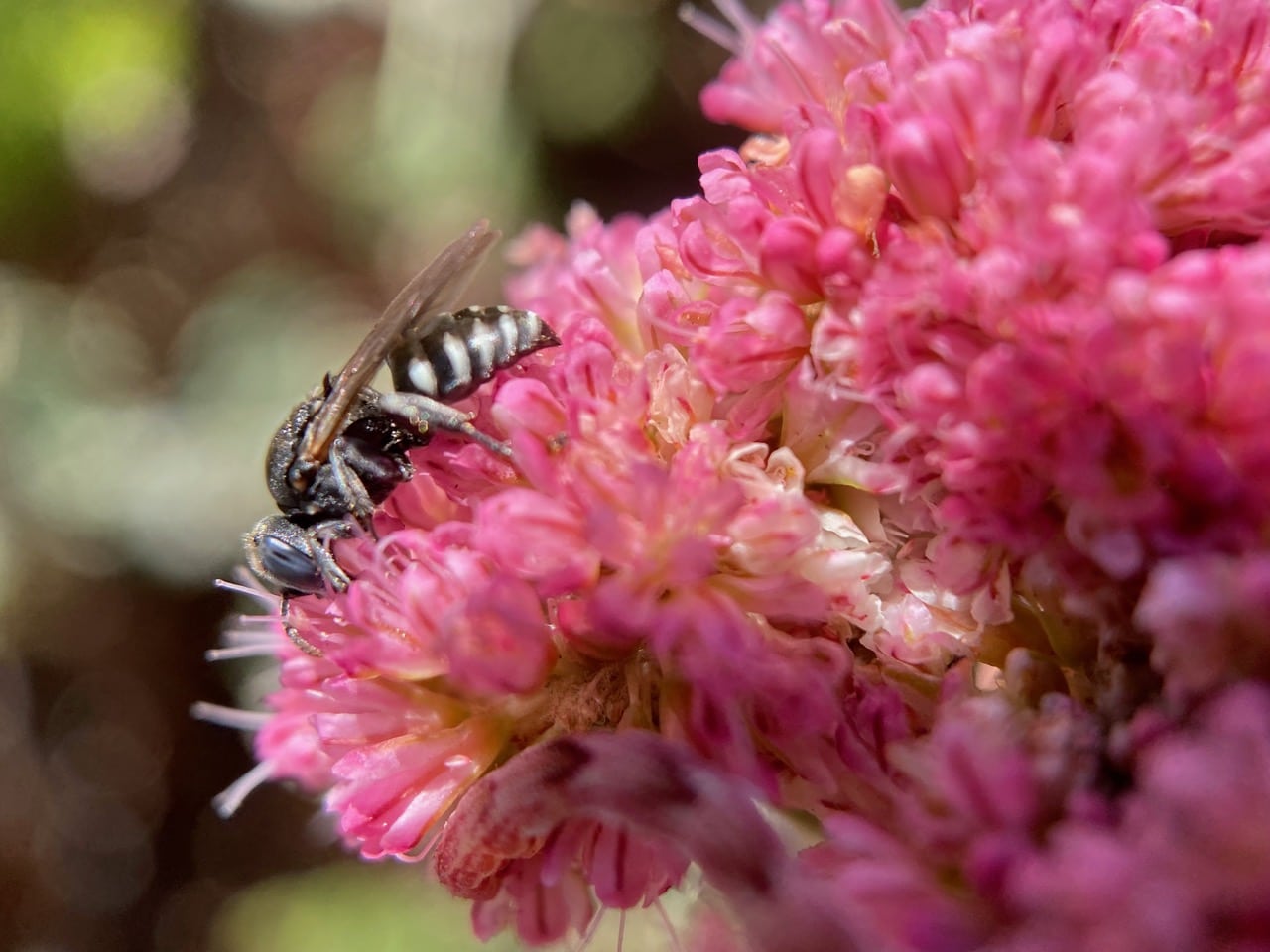
A small black insect with broken white bands on its abdomen is foraging on a cluster of buckwheat flowers.
It’s the Prong-backed Fly Hunter Wasp, Oxybelus uniglumis (family Crabronidae).
The Prong-backed Fly Hunter Wasp, Oxybelus uniglumis (family Crabronidae) occurs in northeastern North America. Its range also includes California and other western states. It is a small wasp, measuring 5-9 mm. The wasp nests in well-drained, sandy soil in a variety of habitats. A fully provisioned nest has one cell or at most a few cells. The female hunts various kinds of flies on the wing, captures one, then stings it, injecting venom to paralyze it. Rather than transporting the prey clutched beneath her like other small predatory wasps, she instead leaves her sting impaled in the fly while transporting it back to the nest. She lays a single egg on the first fly placed in a nest cell, then adds additional two to nine more flies before backfilling the nest. There is one generation per year, flying between May to early October.