

Pollinator Post 6/30 /23
 A female parasitoid wasp has landed on an inflorescence of California Phacelia, Phacelia californica. It is an old individual with frayed wings and a split ovipositor sheath (first I have ever seen). It is the same species as the ones I have photographed laying eggs on the phacelia flowers two weeks ago – family Braconidae, subfamily Agathidinae.
 The Braconidae are a family of parasitoid wasps. After the closely related Ichneumonidae, braconids make up the second-largest family in the order Hymenoptera, with about 17,000 recognized species. Females often have long ovipositors to lay eggs on or in their hosts. The larvae of most braconids are internal primary parasitoids of other insects, especially the larval stages of Coleoptera, Diptera, and Lepidoptera. Generally, the braconid life cycle begins when the female wasp deposits her eggs in the host insect, and the braconid larvae develop in the host body, eating it from the inside out. When the wasp larvae are ready to pupate, they may do so in or on the host insect. The new generation of adult braconid wasps emerges from their cocoons and begins the life cycle again.
Braconid wasps use a remarkable weapon to disable the defenses of their host insects – a virus. These parasitic wasps coevolved with polydnaviruses (read poly-DNA-virus), which they carry and inject into the host insects along with their eggs. The virus attacks the host’s immune system and renders it unable to encapsulate the wasp egg; it also halts the host’s development, so it can’t pupate and transform into an adult. Amazingly, the “bracovirus” also changes the host’s metabolism so that it can survive longer without food or water – thus ensuring a nurturing environment for all the young wasps to come.

The wasp repeatedly flexes its body, lifting its abdomen and fanning its wings as if grooming.

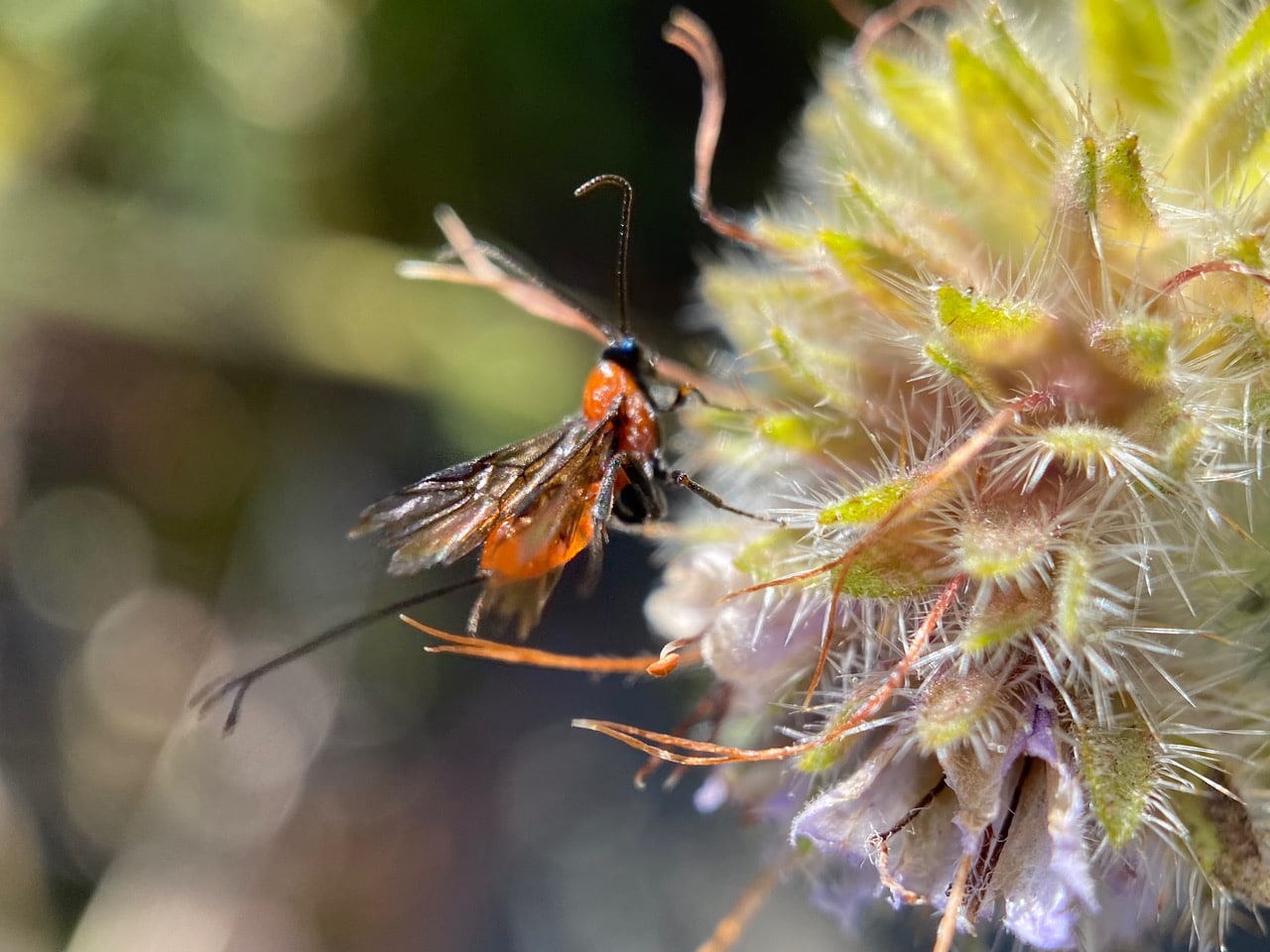


Finished, she flies away.

A Spotted Cucumber Beetle, Diabrotica undecimpunctata (family Chrysomelidae) is hanging off the edge of a phacelia inflorescence, feeding on pollen. These beetles seem to be everywhere today. The hot weather has really brought them out.
Members of the family Chrysomelidae are commonly known as Leaf Beetles. Adults and larvae feed on all sorts of plant tissues, and all species are fully herbivorous. Many are serious pests of cultivated plants, including food crops. Others are beneficial due to their use in biocontrol of invasive weeds. Chrysomelids are popular among insect collectors, as many are conspicuously colored, typically in glossy yellow to red or metallic blue-green hues, and some have spectacularly bizarre shapes. Photos of Leaf Beetles (Family Chrysomelidae) · iNaturalist
Native to North America, the Spotted Cucumber Beetle can be a major agricultural pest, causing damage to crops in the larval as well as adult stages of their life cycle. Larvae, sometimes known as rootworms feed on the roots of emerging plants. In the adult stage the beetles cause damage by eating the flowers, leaves, stems and fruits of the plant.
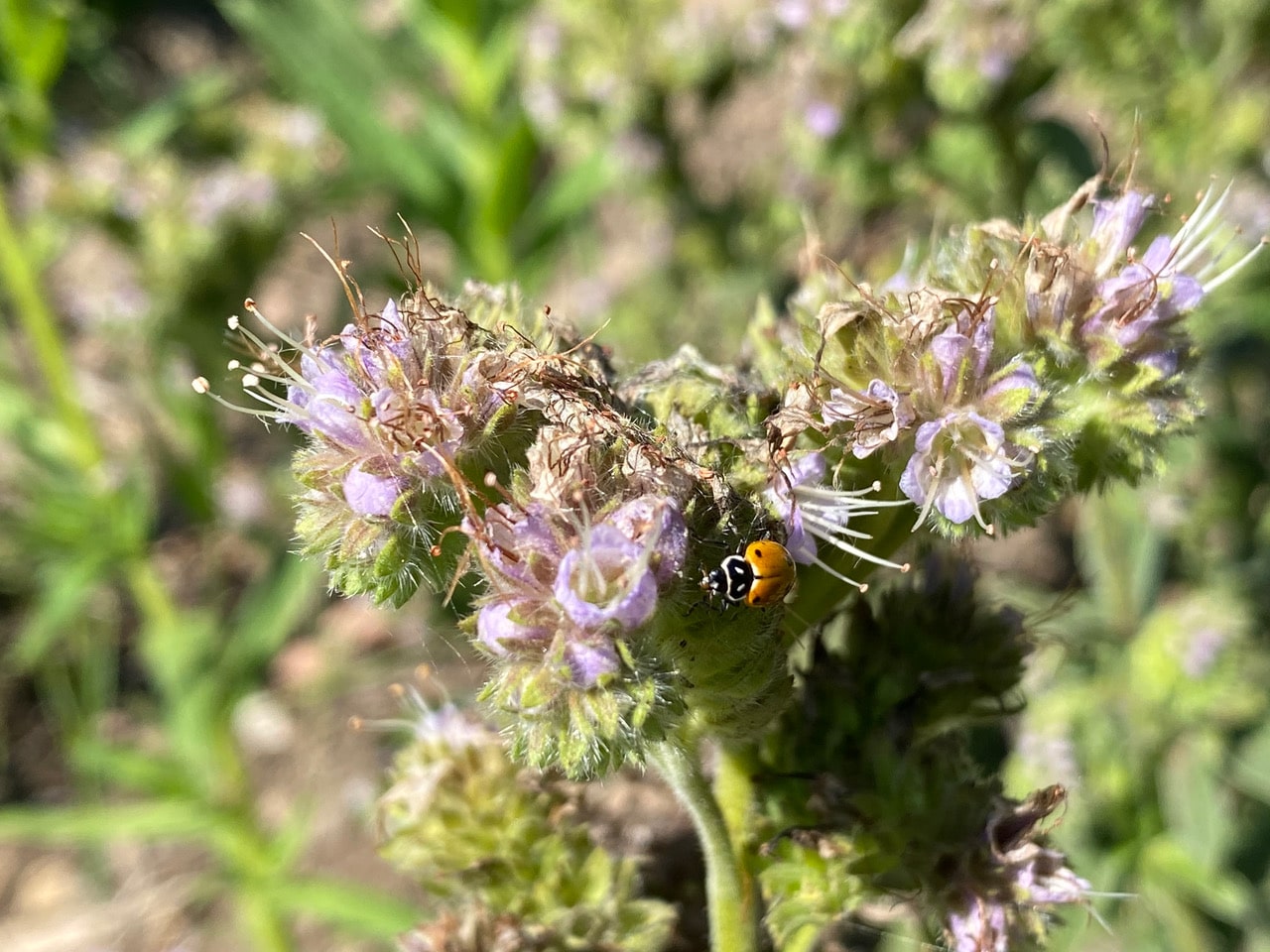
From a distance I see a spot of red on the tagged California Phacelia, but it isn’t Spidey, the old female Red-backed Jumping Spider I have come to know over a period of three weeks. This is the first time she’s absent from her hunting spot on top of this inflorescence. The last time I saw her three days ago, I had the feeling that her time was fast running out. Farewell, Spidey, thanks for giving me a glimpse into your wondrous world!
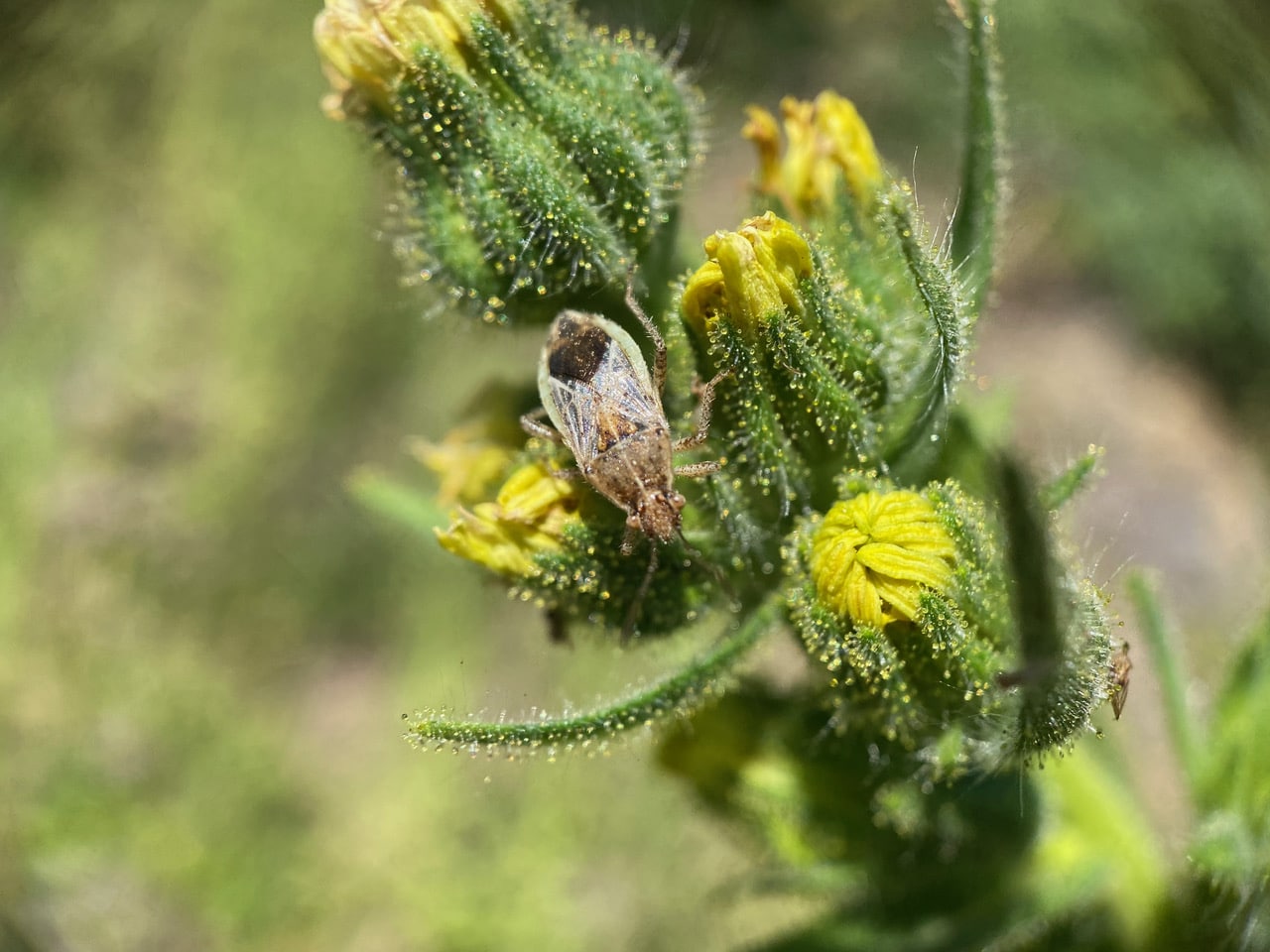
A Scentless Plant Bug (family Rhopalidae) navigates the sticky terrain of a Coast Tarweed, Madia sativa with ease.
Rhopalidae are a family of true bugs in the order Hemiptera. They differ from the related Coreids in lacking well-developed scent glands. All are plant feeders, using their piercing-sucking mouthparts. They live for the most part on weeds, and are not considered economically important.

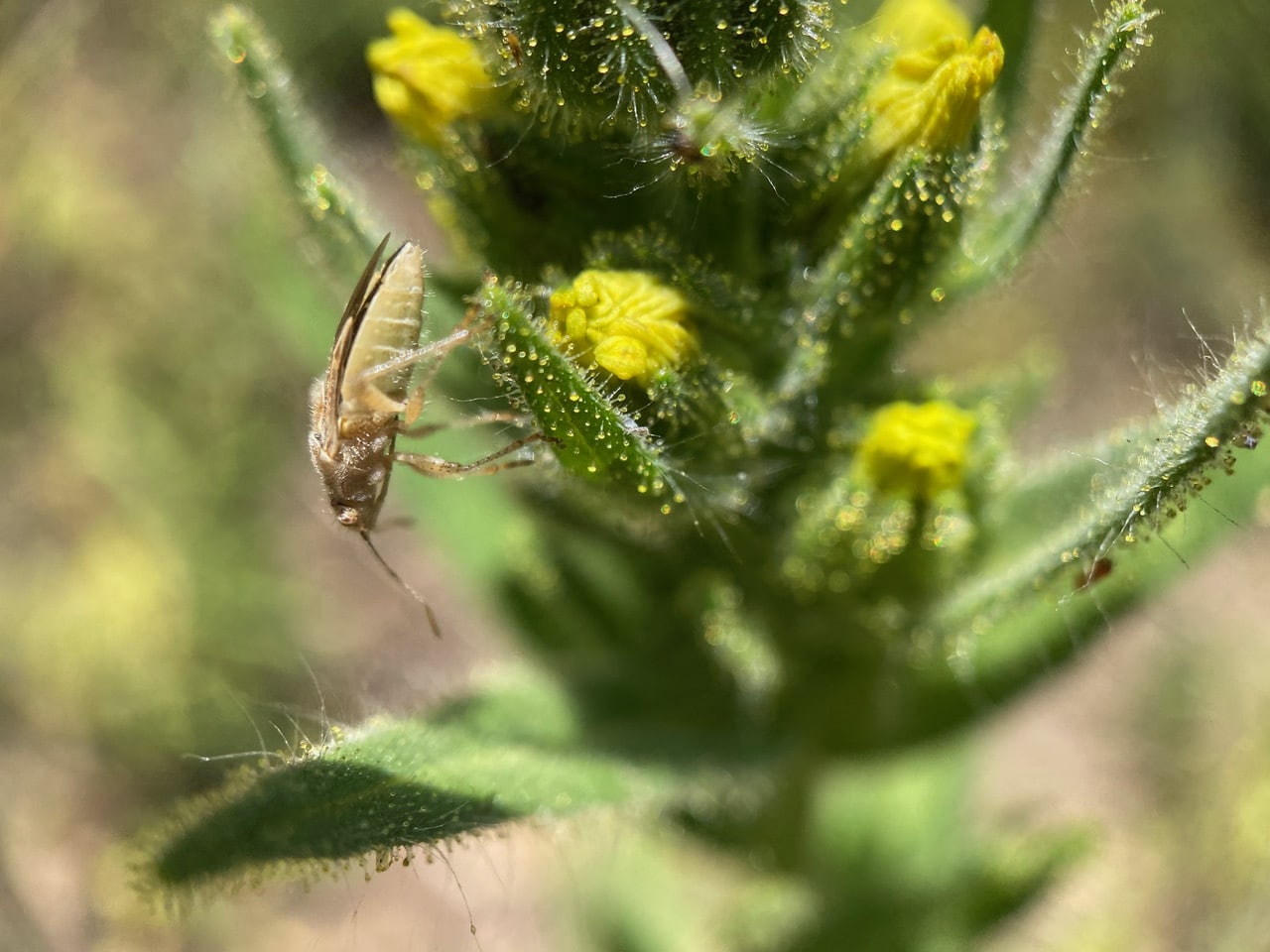
This side view of the Scentless Plant Bug shows its rostrum, the piercing-sucking mouthpart that is folded up under its body when not in use.
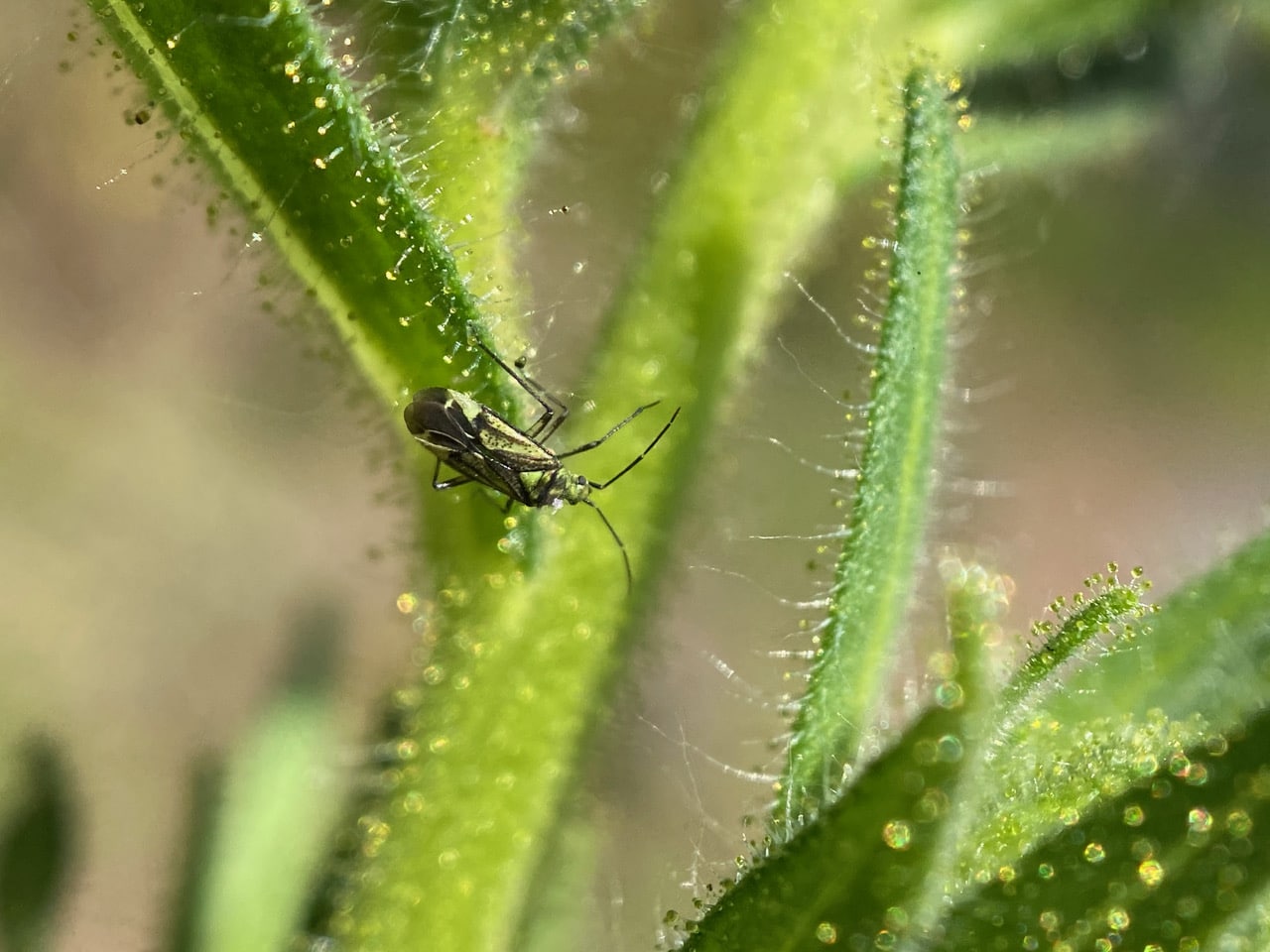 Here’s another true bug that is a specialist on sticky plants. The Plant Bug, Macrotylus essigi (family Miridae) seems perfectly at home on the tarweeds, navigating the sticky terrain with ease.
 Mirid bugs are also referred to as plant bugs or leaf bugs. Miridae is one of the largest family of true bugs in the order Hemiptera. Like other Hemipterans, Mirids have piercing, sucking mouthparts to extract plant sap. Some species are predatory. One useful feature in identifying members of the family is the presence of a cuneus; it is the triangular tip of the corium, the firm, horny part of the forewing, the hemielytron. The cuneus is visible in nearly all Miridae.

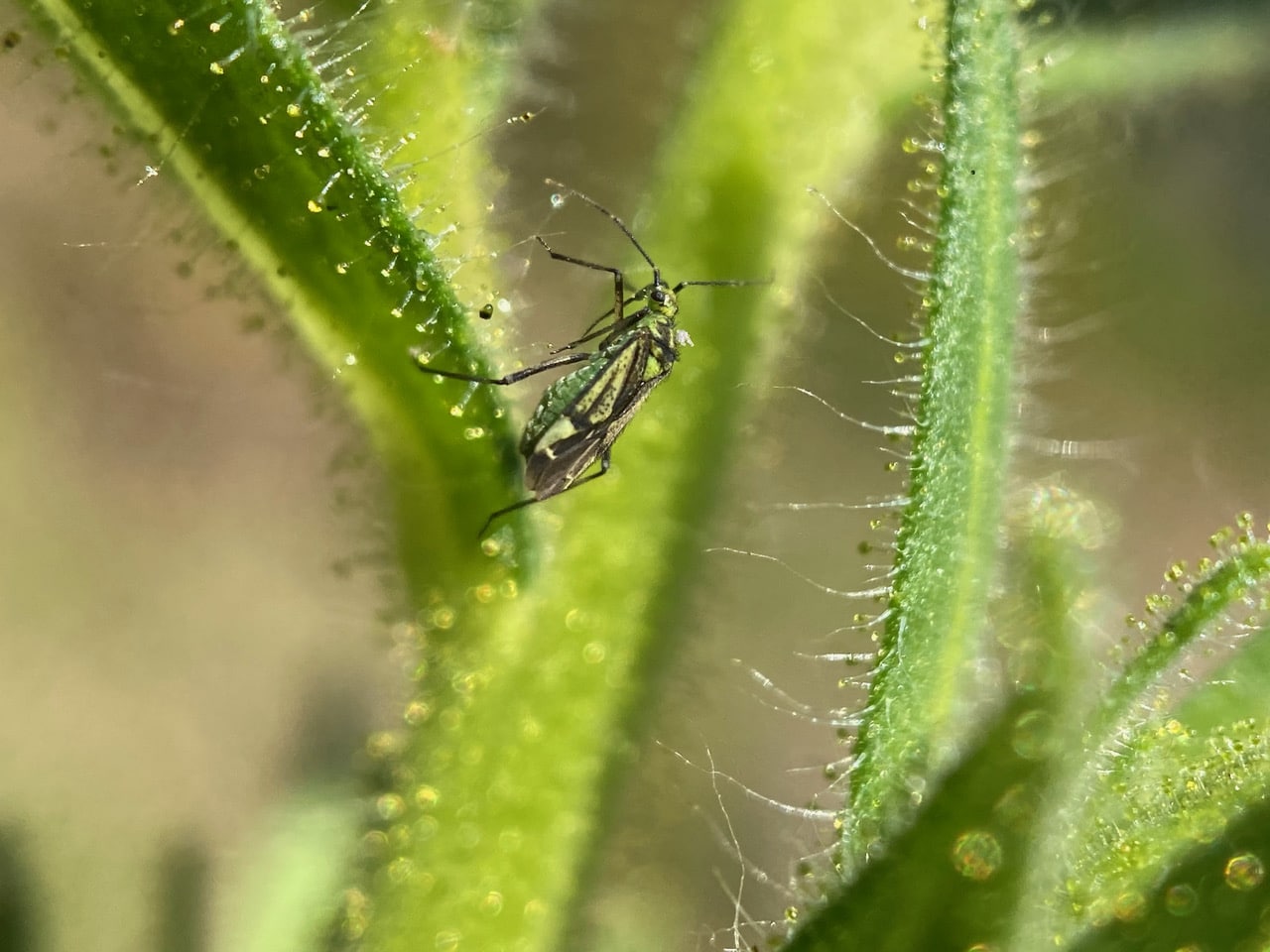
Many insects have evolved adaptations that allow them to thrive on the sticky plant surface. These insects tend to be long-legged – in some cases tip-toeing around the surface to carefully avoid getting trapped and in other cases slogging through with strong leg muscles. Some Mirid bugs have specialized hooks on their legs that enable them to latch on to trichomes near the tips so they can walk on top of the trichome canopy and avoid contact with sticky droplets at the tips. Some of these bugs also secrete an oily substance on the underside of their abdomen, so that if they do contact sticky exudates by accident, they can slough it off and move on without becoming entrapped.
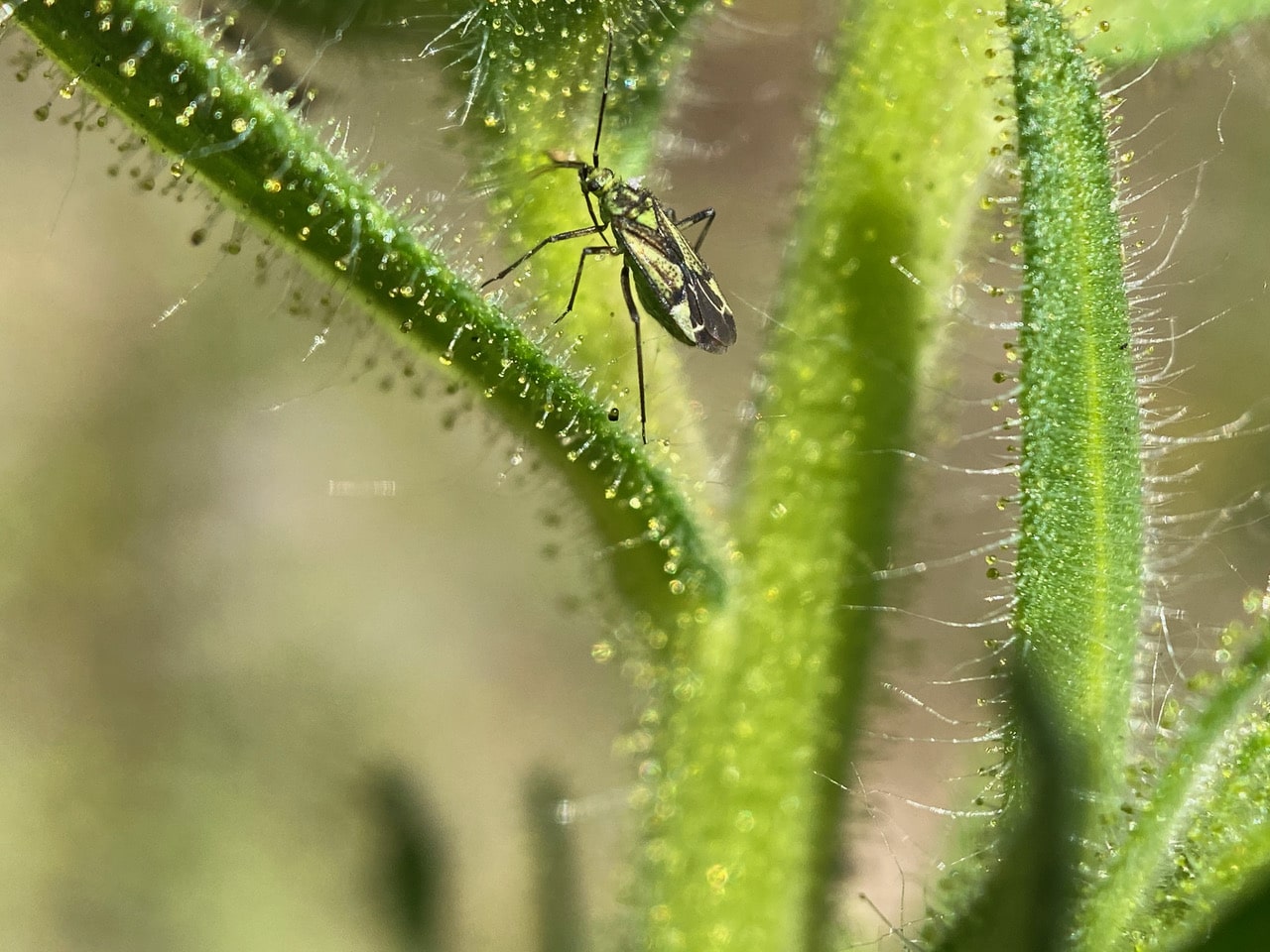
As in all Hemiptera (true bugs), the rostrum is folded under the body when not in use.
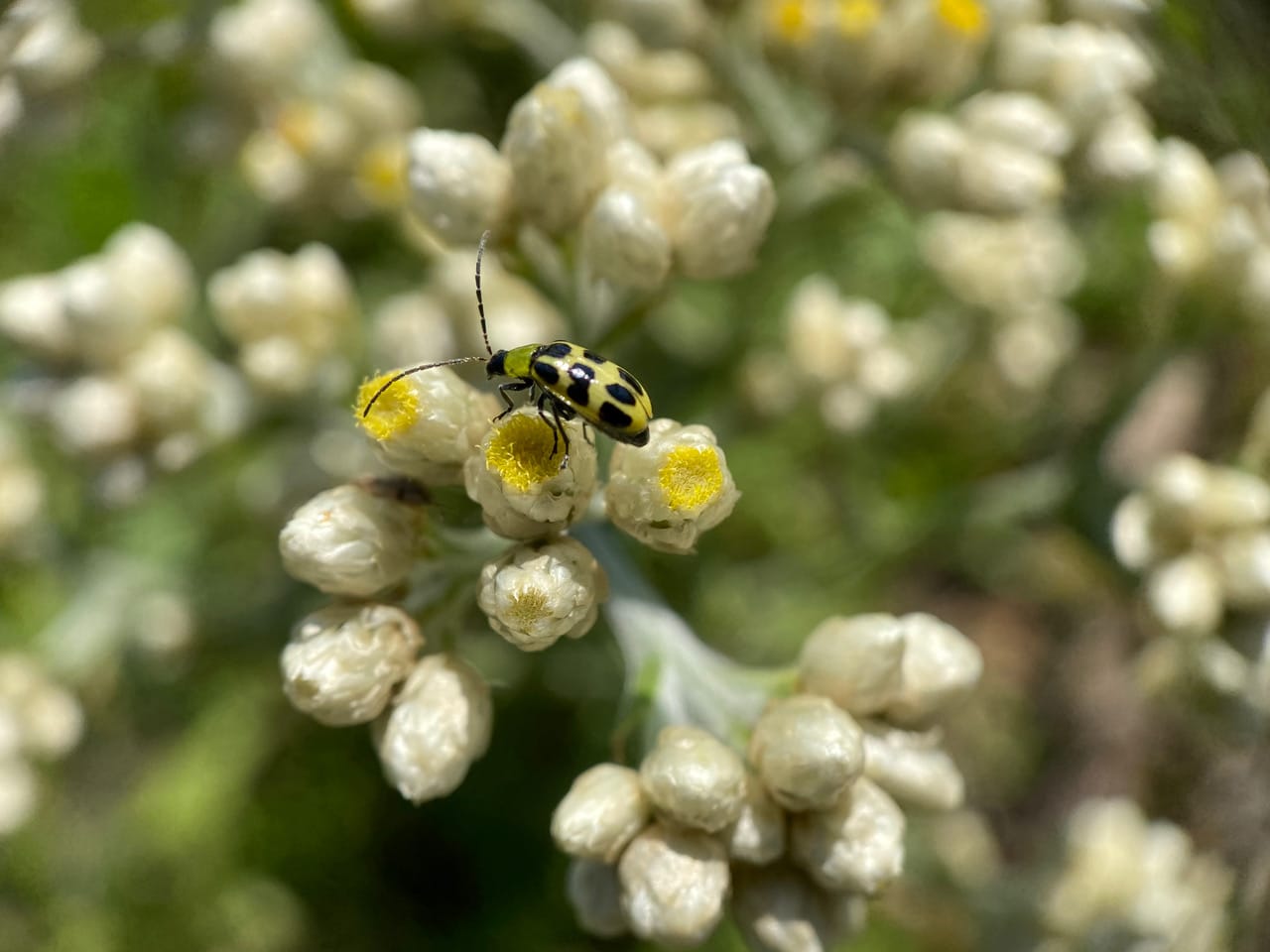
A Spotted Cucumber Beetle is foraging on the opened flowerheads of California Everlasting, Pseudognaphalium californicum.
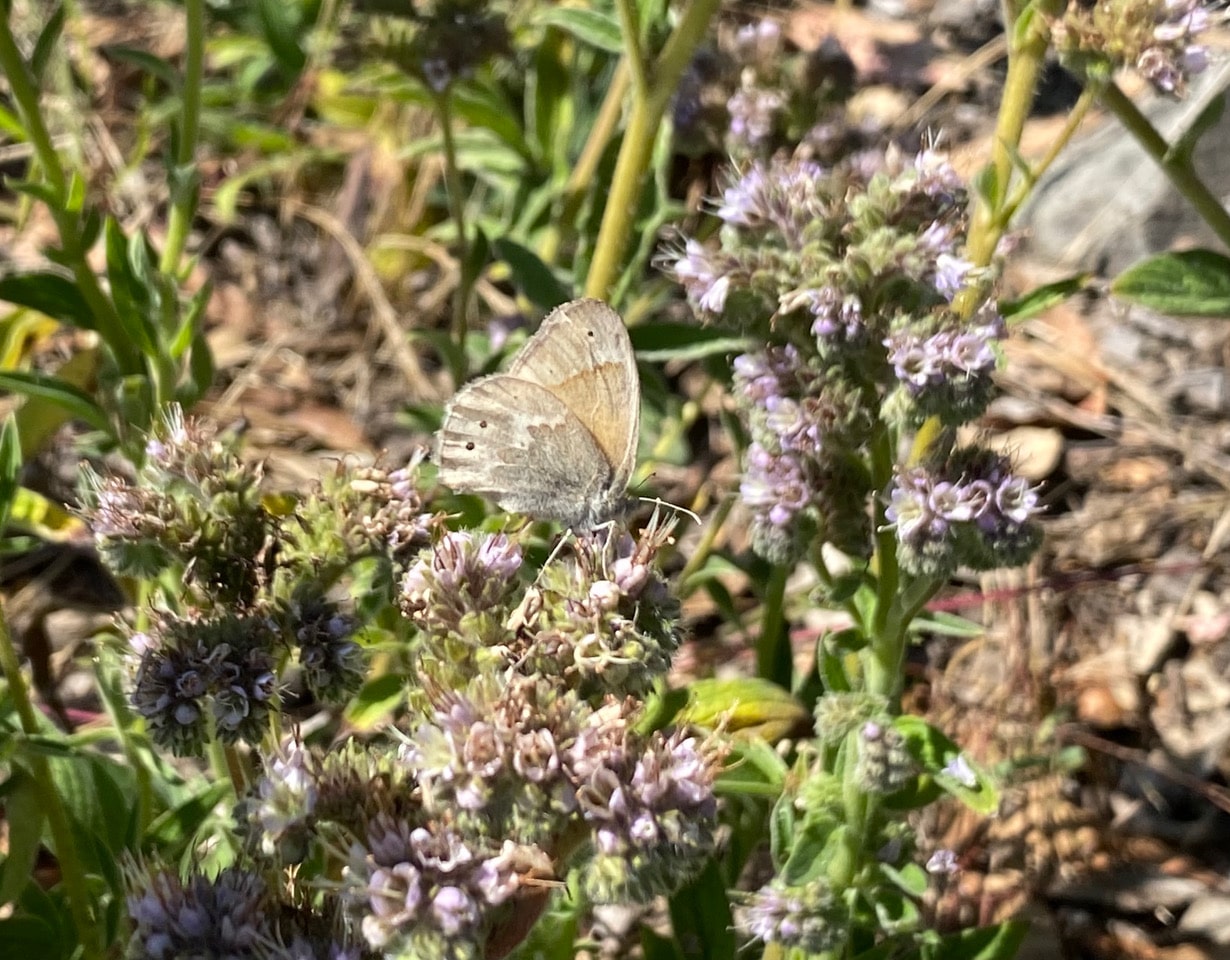
A California Ringlet, Coenonympha californica (family Nymphalidae) lands on an inflorescence of California Phacelia.
This is an extremely variable group that is in constant taxonomic revision. The species californica was formerly tullia. Various subspecies of californica occupy the western half of North America. The adults are pale buff with subtle patterns in light grays and browns, the color of dry grass. The butterflies are found in grassy, open areas in a wide variety of habitats, including fields, meadows, grasslands, and tundra. To seek females, males patrol above the tops of grasses with a bouncy flight. Larvae feed on various grasses and rushes; larvae hibernate in mats of dead grass.

I walk past a Wild Cucumber plant, Marah sp., inadvertently flushing up a vast number of Spotted Cucumber Beetles, Diabrotica undecimpunctata (family Chrysomelidae). The beetles did not get their common name for nothing. While they feed on a wide variety of plants, they seem to have a distinct affinity for members of the Cucurbitaceae. I look down on the ground and see many beetles still crawling over the devastated plant riddled with feeding scars.

In the midst of the devastation is an immature fruit that has been chewed open. It has been hollowed out, missing all seeds inside. Surely the beetles are not responsible for that? The spiky green fruit has a spherical shape, so the plant is probably a California Manroot, Marah fabacea.
The fruit of Marah fabacea is spherical, 4-5 cm in diameter, and covered with prickles. Unripe fruits are bright green, ripening to yellow. The fruit swells as it ripens until finally rupturing and releasing the large brown seeds. Sadly, this plant will not be reproducing this year. But it is a tough perennial with a massive tuberous root. It will send up a new plant after the rains next year.