

Pollinator Post 6/3/26 (2)
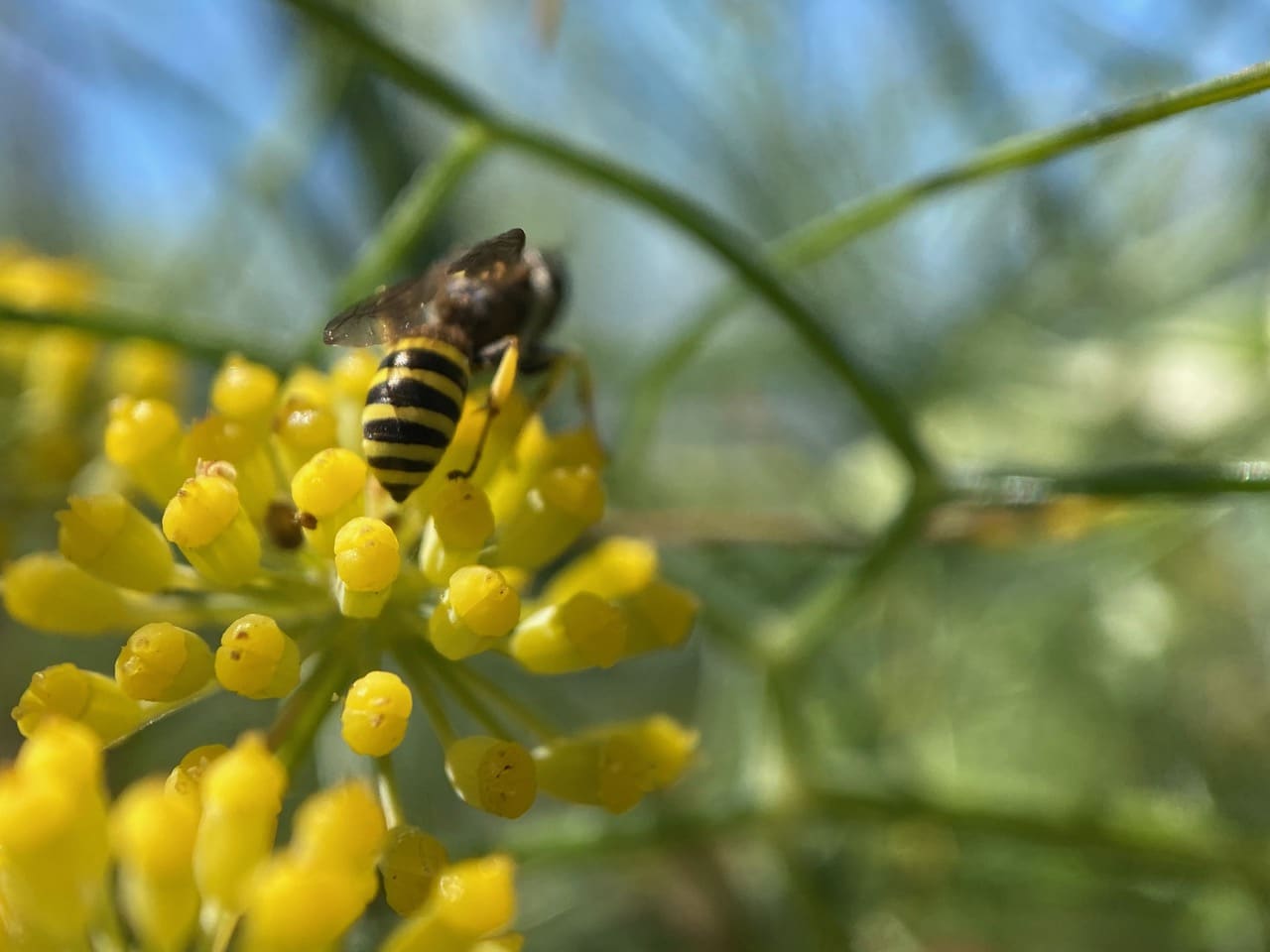
Another wasp on the Fennel flowers?
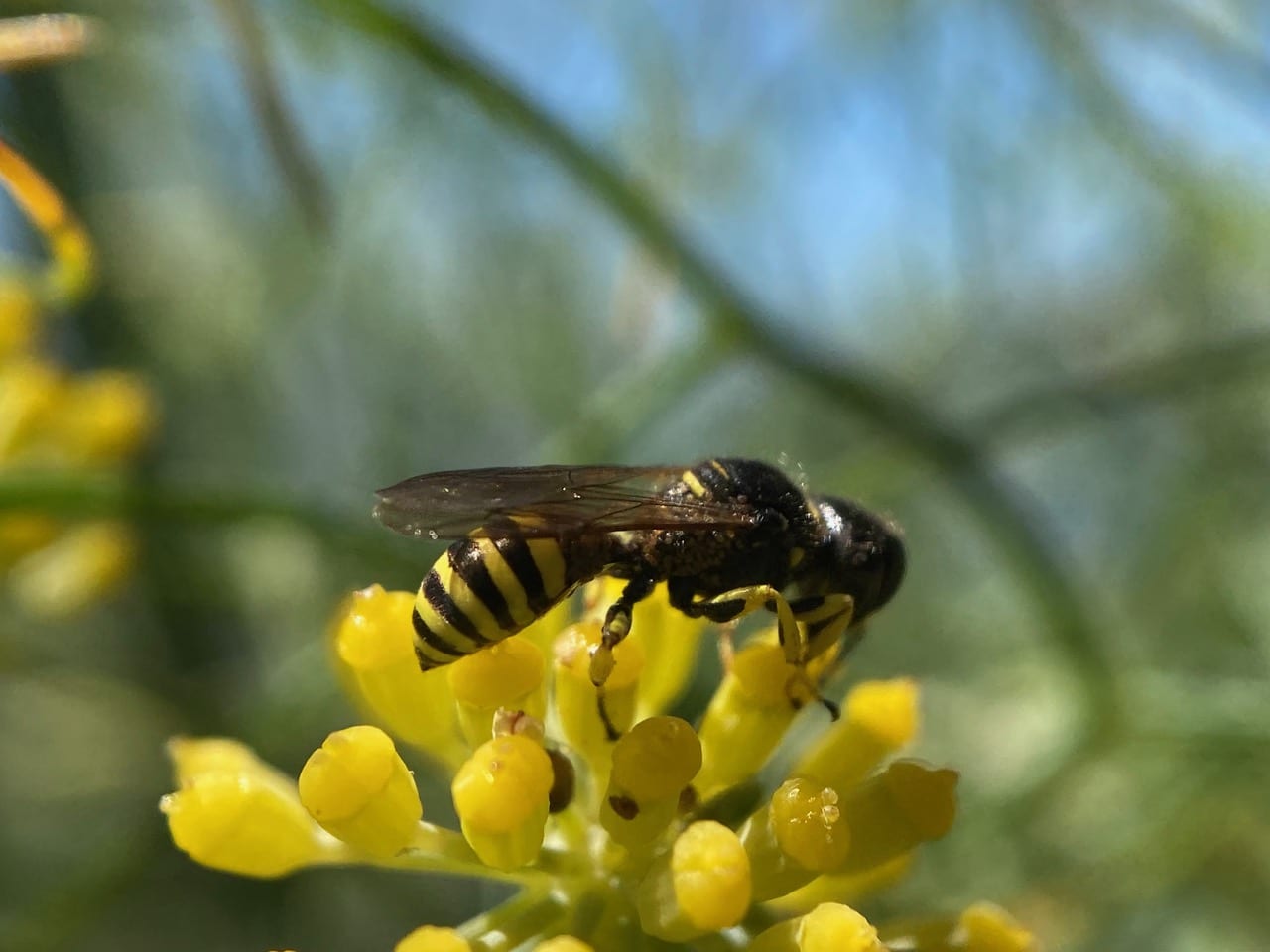
It has a big, boxy head. A Square-headed Wasp (family Crabronidae)?
The Crabronidae are a large family of solitary, predatory wasps comprising over 9,000 species worldwide. Often called Square-headed wasps, sand wasps, or digger wasps, they are highly beneficial insects that act as natural pest control by hunting a wide variety of insects to provision their nests. They are often entirely black, or black with yellow or white markings. They possess a short, collar-like pronoun and typically do not fold their wings at rest. Many species have a distinctive silvery or golden “mustache” of fine hairs and prominent yellow markings on their faces. When viewed face-on, their heads ofter appear remarkably square.
Unlike social wasps, Crabronid wasps do not form colonies or guard hives. Females construct individual nests in the ground, inside hollow plant stems, or within rotten wood. Females use venom to paralyze specific prey (such as aphids, leafhoppers, flies, beetles, or cicadas). They carry the paralyzed prey to their nest and lay an egg on it. When the larva hatches, it has a fresh, living food source. While larvae feed on animal prey, adult wasps derive all of their nutrition by visiting flowers to drink nectar, making them incidental pollinators.
Crabronid wasps are essential to ecological balance. By consuming vast numbers of garden and agricultural pests like beetles and aphids, they naturally regulate pest populations. Furthermore, since they rely on healthy ecosystems to nest and hunt, their presence is a great indicator of a thriving local habitat.
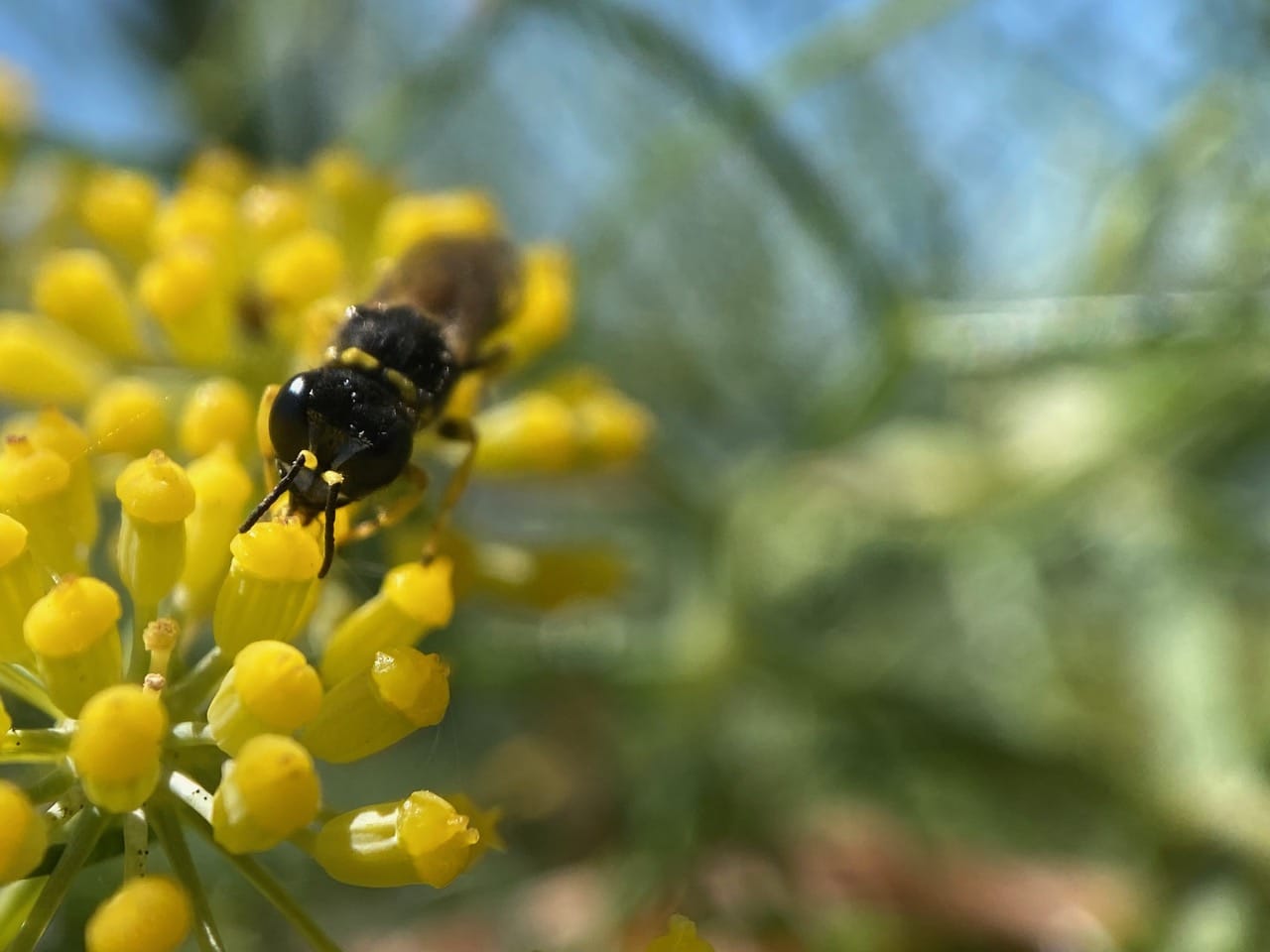
The wasp has huge eyes to match its large head. iNaturalist has helped identify it as a Large Ectemnius, Ectemnius cephalotes (family Crabronidae). A species new to me!
The Large Ectemnius, Actemnius cephalotes is native to Europe, but it has been naturalized in parts of North America, including California. They are found in well wooded areas, as well as open countryside especially near dead wood, or on umbellifer flowers (Apiaceae). The wasps are active June to early October.
Actemnius cephalotes do not dig in sand, but in rotting and decaying wood instead. Their mandibles are large with saw-like teeth allowing them to excavate into the wood. These wasps tend to nest in aggregations. Multiple females will share a single entrance but will remain solitary caring only for their own young in their own tunnels and cells. These wasps will create various tunnels with partitioned cells made of sawdust. Each cell may contain up to a dozen prey items. The males, as usual, are smaller and play no part in provisioning once mating has occurred.
With large compound eyes that excel at distance viewing the wasps hunt for flies (Diptera). They will hover and dart grabbing their prey with their legs and mandibles. A quick sting paralyzes the fly which is then brought back to the nest. Prey are stored in cells alongside their eggs. Stored flies are consumed by the larvae that hatch giving them the resources they need to develop into a mature wasp.
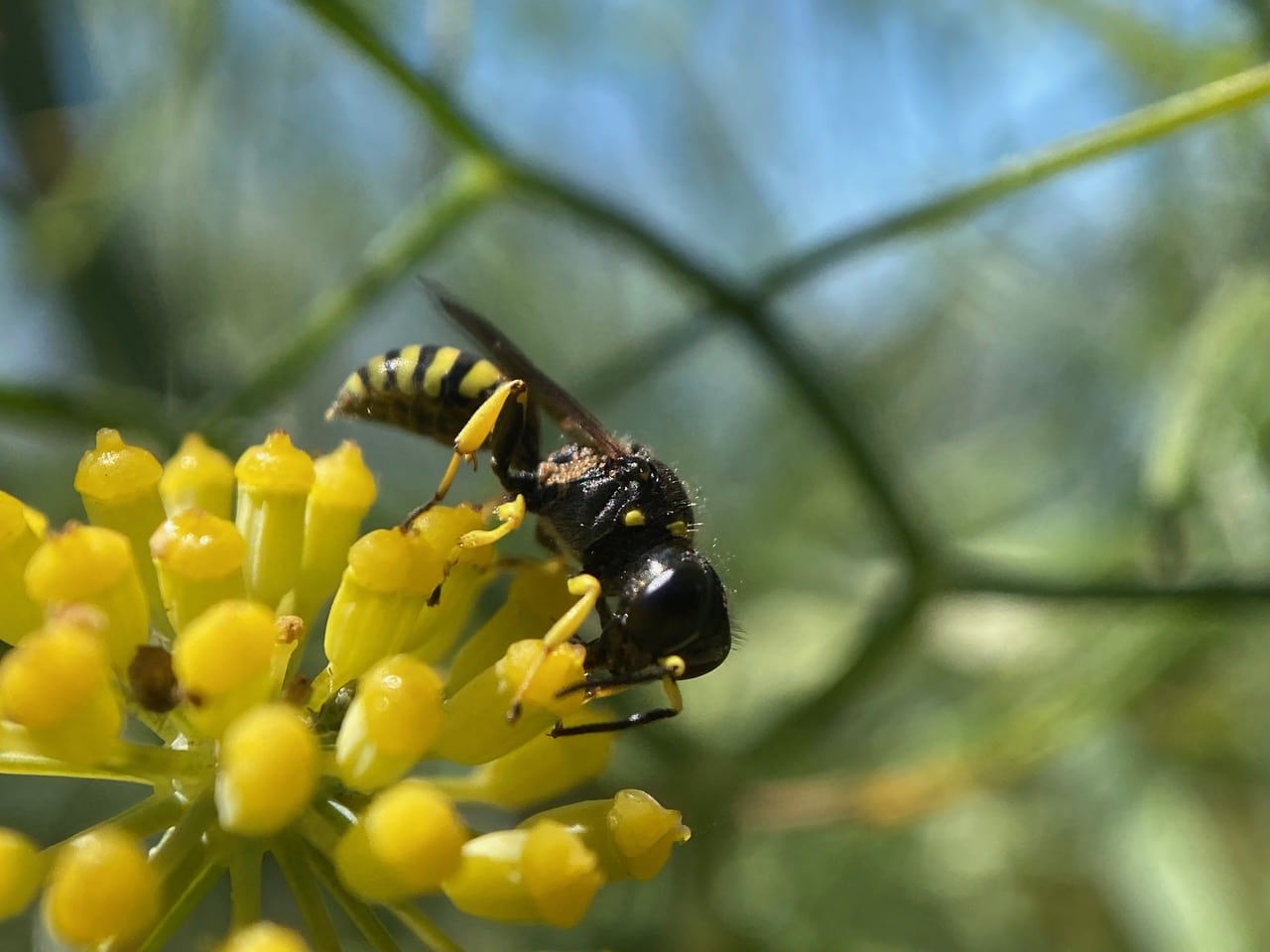
Do you see those tiny, mauve-colored phoretic mites under the wasp’s wing? I didn’t see them when I took the picture, of course. But I have since learned something new about these phoretic mites that hitch-hike on wasps.
A phoretic mite is a mite that temporarily attaches itself to another animal (a “carrier” or host) solely for transportation. The behavior is known as phoresy. Instead of feeding on the host, these mites use the carrier to travel from one ephemeral habitat (like decaying vegetation, animal dung, or a rotting carcass) to a new feeding ground. Phoresy is generally a commensalistic relationship, meaning the mite benefits from the ride without harming or feeding on the host.
To withstand the wind and movement of their carriers (often beetles, flies, or bees), many phoretic mites have evolved specialized claws, suckers, or flattened body shapes to cling tightly to specific areas, such as under the wings.
Phoretic mites on Crabronid wasps (such as Actemnius species) are harmless hitchhikers. The mites are looking for a ride to fresh nest cells stocked with prey (e.g. flies, aphids, caterpillars). Once the mites drop off in the wasp’s nest, they perform highly beneficial, often mutualistic tasks. Many eat nest debris like pollen dust, dead insect parts, and fungi, keeping the brood cell clean and sanitary. Some specialized mites will actively attack and kill the larvae of parasitic insects (like cuckoo wasps or parasitic flies) that try to invade the nest and eat the wasp larvae. Because these mites act as excellent housekeepers and bodyguards for their offspring, many wasps have evolved specific anatomical pockets called acarinaria. These specialized grooves or pouches safely hold the mites on the wasp’s body during flights.

The Large Actemnius rushes off before I could take a good picture of its remarkable head.
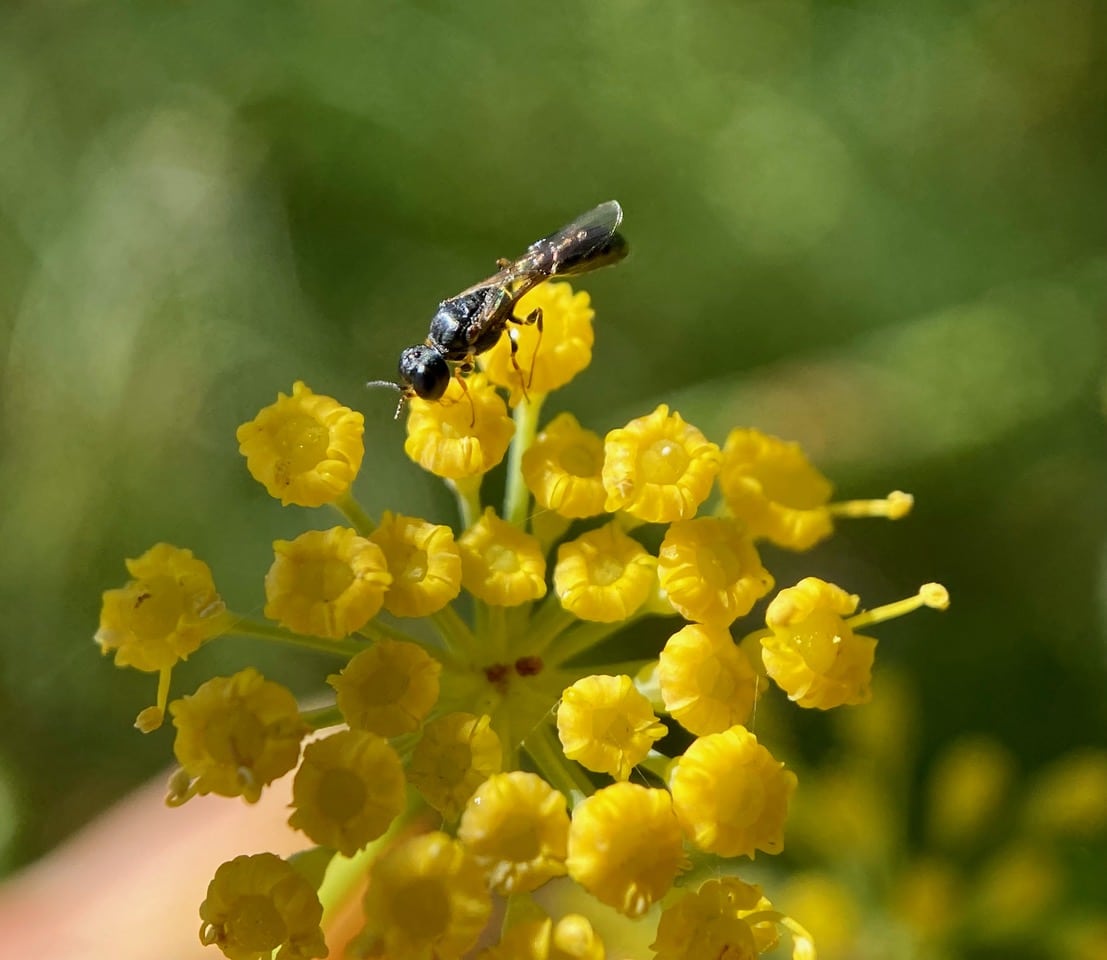
Hey, there’s yet another, smaller and less robustly built wasp on the Fennel flowers.
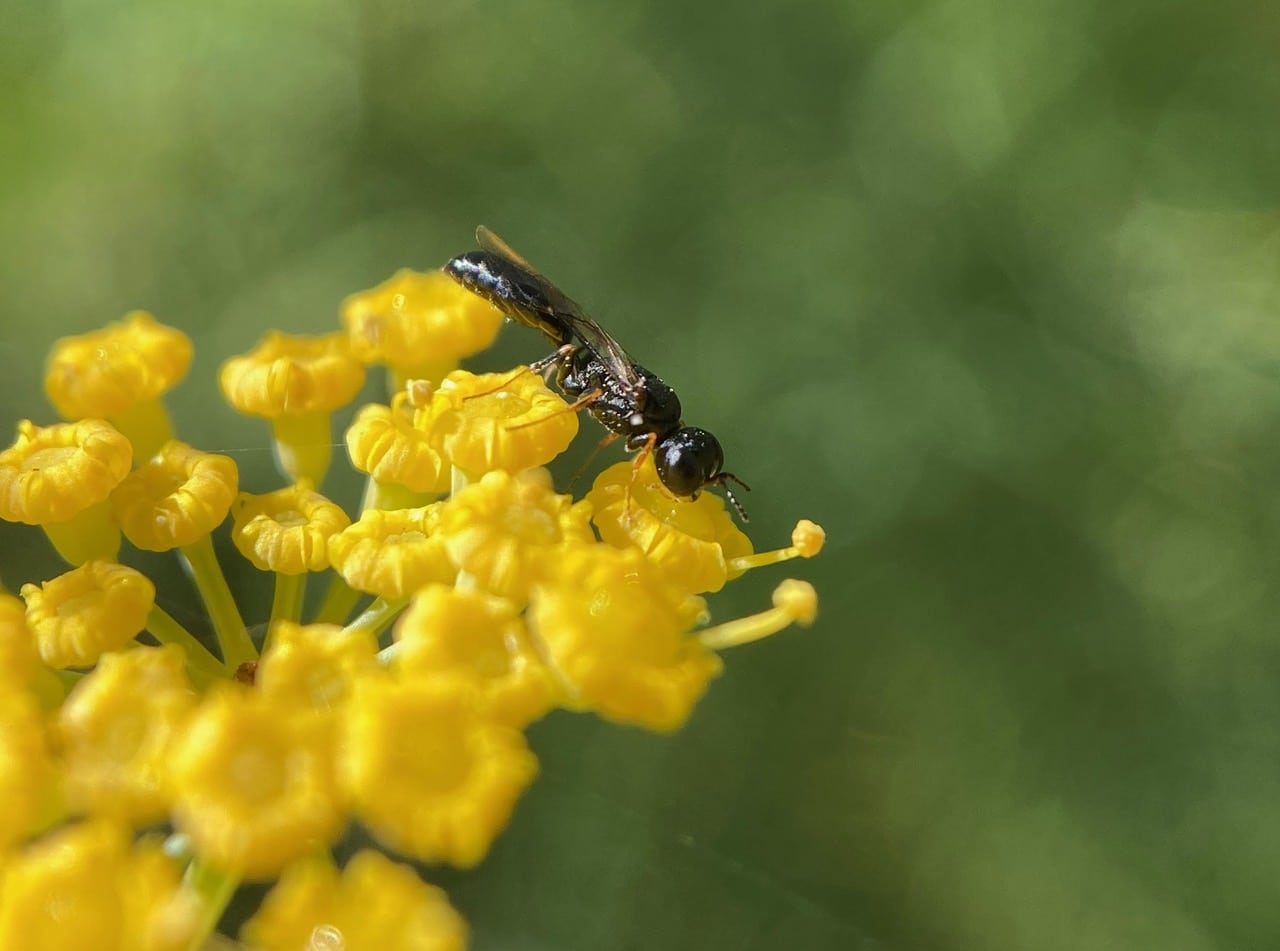
This slender wasp too has a large, boxy head. Another Square-headed Wasp (family Crabronidae)? iNaturalist has helped identify the wasp as an aphid wasp in the genus Stigmus (family Pemphredonidae). It was formerly placed in the subfamily Pemphredoninae of the family Crabronidae.


Stigmus wasps are solitary, predatory insects. The female wasp hunts live aphids to provision her young. She establishes her nests inside pre-existing hollow stems or by chewing out the soft pith of dead, dry twigs of plant such as Fennel.
Female Stigmus exclusively hunts aphids. She patrols vegetation, scanning for aphid colonies. Once she locates a suitable prey, she curls her abdomen forward under her body to deliver a precise sting. The venom paralyzed the aphid without killing it, keeping the “meat” fresh. The wasp clamps the paralyzed aphid in her mandibles and flies it back to her nest, sometimes taking several in a single day. The female stocks anywhere from 5 to 20 aphids in a single cell and lays a single egg on top of the pile, then caps the cell. When the wasp larva hatches, it feasts on the fresh (but helpless) aphids. Once it eats through the food supply, it pupates and eventually chews its way out of the twig as an adult wasp.


A face-on look at an Aphid Wasp, Stigmus sp. (family Pemphredonidae).

A small Plant Bug (family Miridae) is moving on a cluster of Wild Mustard flowers.

It is a Lygus Bug, in the genus Lygus (family Miridae). A close-up shows its cuneus, characteristic feature of the family Miridae.
One useful feature in identifying members of the family Miridae or plant bugs is the presence of a cuneus; it is the triangular tip of the corium, the firm, horny part of the forewing, the hemielytron. The cuneus is visible in nearly all Miridae.

Lygus Bugs are small (about 0.2 inch long), oval-shaped plant bugs (family Miridae), ranging in color from pale green to yellowish-brown or dark brown. They feature a prominent, triangular “V” shape in the center of their back and have long, spindly antennae. Nymphs are wingless, generally pale green, and resemble aphids but lack the backward-facing tubes (cornicles) on their abdomen. They are fast-moving and larger nymphs often have five black spots on their backs. Lygus Bugs are major agricultural pests. Both adults and nymphs use piercing-sucking mouthparts to feed on new growth, buds, and seeds. Their feeding causes severe plant damage, including flower drop, discolored leaves, and deformed fruits or seeds.

A different Mirid Bug is resting head-down on a fading inflorescence of Wild Mustard. It is a Potato Mirid, Closterotomus norwegicus. Note the cuneus on its forewings.
The Potato Bug originated in the Mediterranean region, but is now widespread worldwide. It is an adventive, polyphagous species of bugs belonging to the family Miridae, subfamily Mirinae. This cosmopolitan insect attacks a wide range of herbaceous plants and it is also partly predacious. In New Zealand it developed a taste for young potato plants, which probably accounts for its common name. Like other mirids, the bug possesses a sharp and hard needle-like piercing-sucking mouthparts capable of penetrating tough tissue and sucking nutrients. It feeding activities threatens pistachio nut production in California. The female bugs prefer to lay their eggs on native or introduced legumes, or weeds such as wild mustard and wild radish.

I stop to admire the ripening fruits on a wind-pruned California Coffeeberry, Frangula californica, one of the very few native plants along this shoreline trail.

But things are not all well with the plant. Some of its terminal leaves are heavily infested with what look like tiny aphids. They are mostly on the underside of the leaves.

iNaturalist has helped identify the aphids as Melon Aphids, Aphis gossypii (family Aphididae).
Melon Aphids, Aphis gossypii, also known as cotton aphids, are tiny (1.0-1.5 mm long), destructive pests that feed on the undersides of leaves. Ranging from light green to nearly black, they suck vital plant fluids, cause severe leaf curling, secrete sticky “honeydew” that leads to black sooty mold, and act as active vectors for plant viruses. Capable of cloning themselves, a single female produces dozens of live young, allowing populations to mature and reproduce in as little as 5-7 days. Natural predators include lady beetles, lacewings, and parasitic wasps.
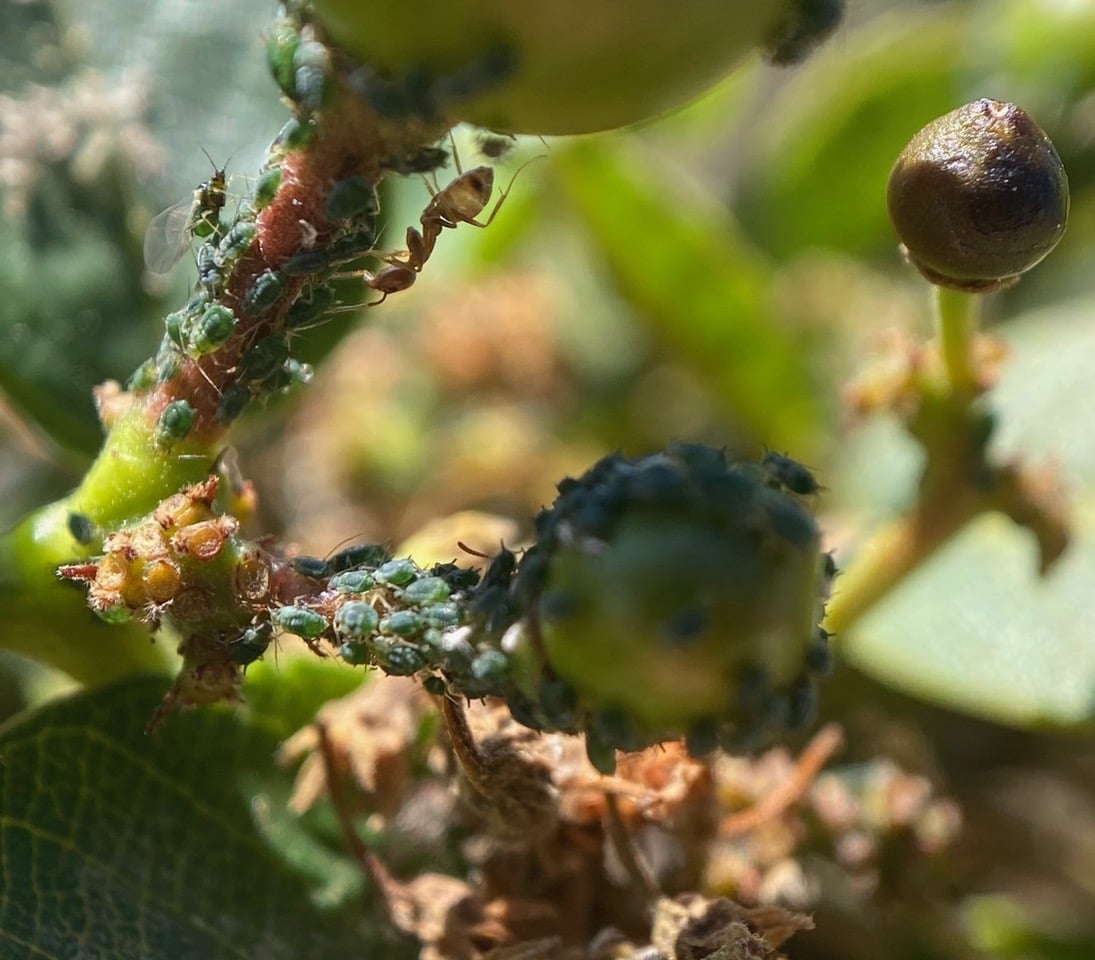
Argentine Ants are busy running around the colony, tending the aphids.
Ants and aphids share a well-known mutualistic relationship. The aphids produce honeydew, a sugary food for the ants; in exchange, the ants care for and protect the aphids from predators and parasites. Some ants will “milk” the aphids to make them excrete the sugary substance. The ants stroke the aphids with their antennae, stimulating them to release the honeydew. Aphid-herding ants make sure the aphids are well-fed and safe. When the host plant is depleted of nutrients, the ants carry their aphids to a new food source. If predatory insects or parasites attempt to harm the aphids, the ants will defend them aggressively. Some species of ants continue to care for aphids during winter. The ants carry the aphids to their nest for the winter months, and transport them to a host plant to feed the following spring.