

Pollinator Post 6/3/26 (1)
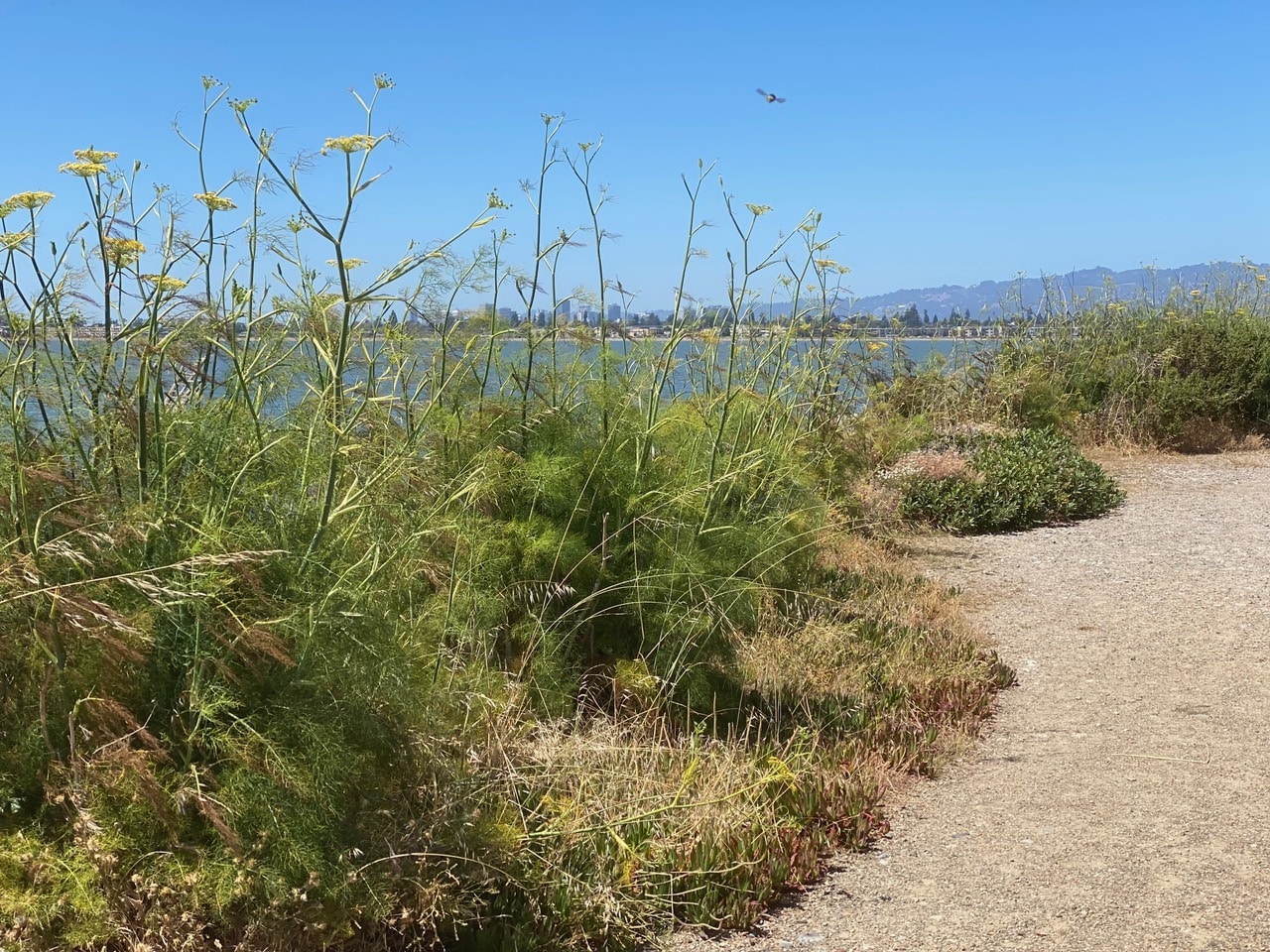
As I often do on my walks at Bay Farm, I linger at this short stretch of the shoreline trail to check on the two native plant species that are found here – the California Coffeeberry (Frangula californica), and Coyote Brush (Baccharis pilularis).

My attention is hijacked by the non-native Fennel, Foeniculum vulgare that has started to bloom here, offering bright yellow umbels of flowers.

An Anise Swallowtail butterfly flutters past me to land momentarily on the tender foliage of a Fennel.
The Anise Swallowtail, Papilio zelicaon (family Papilionidae), is a common swallowtail butterfly of western North America. It is found in fairly open country, most likely seen on bare hills or mountains, in fields oar at the roadside. Adult females lay eggs singly on the underside of host plant leaves. In the first two instars, the caterpillar is a bird poop mimic – dark brown, almost black, with an irregular white band at its middle. After that it becomes more green at each successive molt until, in the fifth (last) instar, it is predominantly green, with markings in black, orange, and light blue. Its major food plants are members of the carrot family, Apiaceae (including Angelica), and also some members of the citrus family, Rutaceae.

She checks out several of the outer branches and finally settles on a branch furthest away from me to lay her eggs.
Native to the Mediterranean, Fennel, Foeniculum vulgare belongs to the carrot family, Apiaceae which includes Anise Swallowtail’s original native host plants, such as Lomatium and Cow Parsnip. Since its introduction to North America, the plant has created a fascinating ecological shift. The butterfly has successfully adapted to using Fennel as a primary larval host plant. Because the invasive Fennel grows aggressively across disturbed areas, it provides a consistent, abundant food source that allows the butterflies to thrive in urban and suburban landscapes. While the plant supports multiple generations of butterflies from early spring through fall, land stewards and native plant conservationists still view Fennel as a threat to local biodiversity. In areas like the San Francisco Bay Area, native plants like Lomatium are crowded out by dense thickets of Fennel, which do not provide the proper habitat for other local insects.

I look at the young leaves of the same Fennel close to me and find several young Anise Swallowtail caterpillars, still in their bird poop disguise. This seems to be my typical observation with the butterfly – you either find lots of eggs and caterpillars on a host plant, or you find none at all. Mama butterfly is apparently very selective about which plant she lays her eggs on.
Female Anise Swallowtail butterflies select plants using a mix of smell, sight, and physical taste. They use their eyes to seek out young, tender green foliage and horizontally-oriented leaves, which are easier to land on and provide the best food for young caterpillars. The females have highly sensitive receptors that allow them to smell the specific chemical compounds of plants in the carrot family, Apiaceae – such as fennel, dill, parsley – from a distance. When a female lands, she relies on specialized chemical receptors located at the tips of her legs. She “drums” her legs against the plant to release its juices, verifying that the host is perfectly suited for her larvae to eat. Once a plant passes this strict chemical test, she deposits a single, small, pale yellowish-green egg directly onto the foliage.
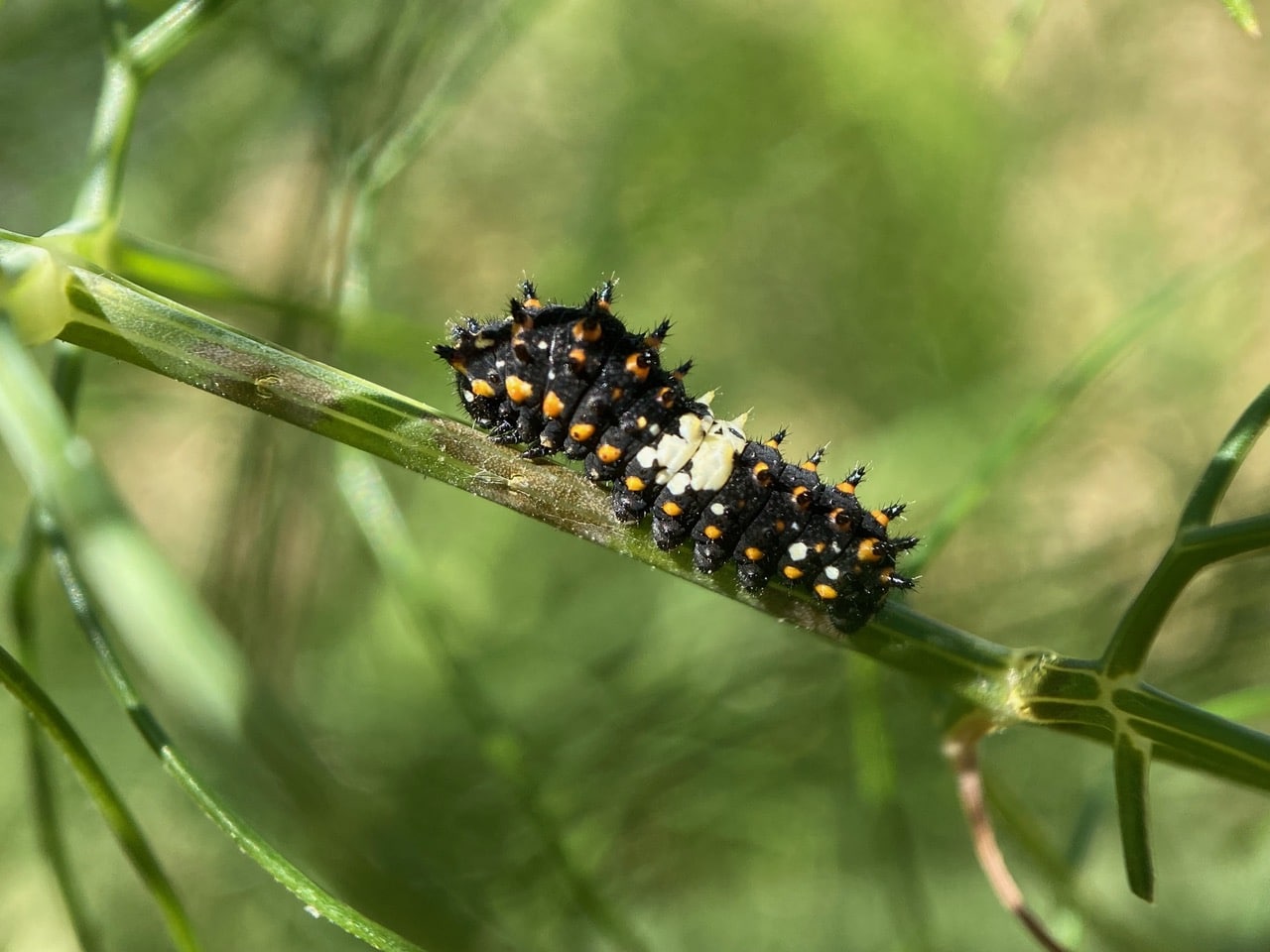
Close-up of one of the young caterpillars. The irregular white patch on the middle section of the body serves to break up the outline of the creature, while mimicking the white paste of uric acid of bird poop.

Ooh, here’s a mature Anise Swallowtail egg that has turned black and about to hatch!
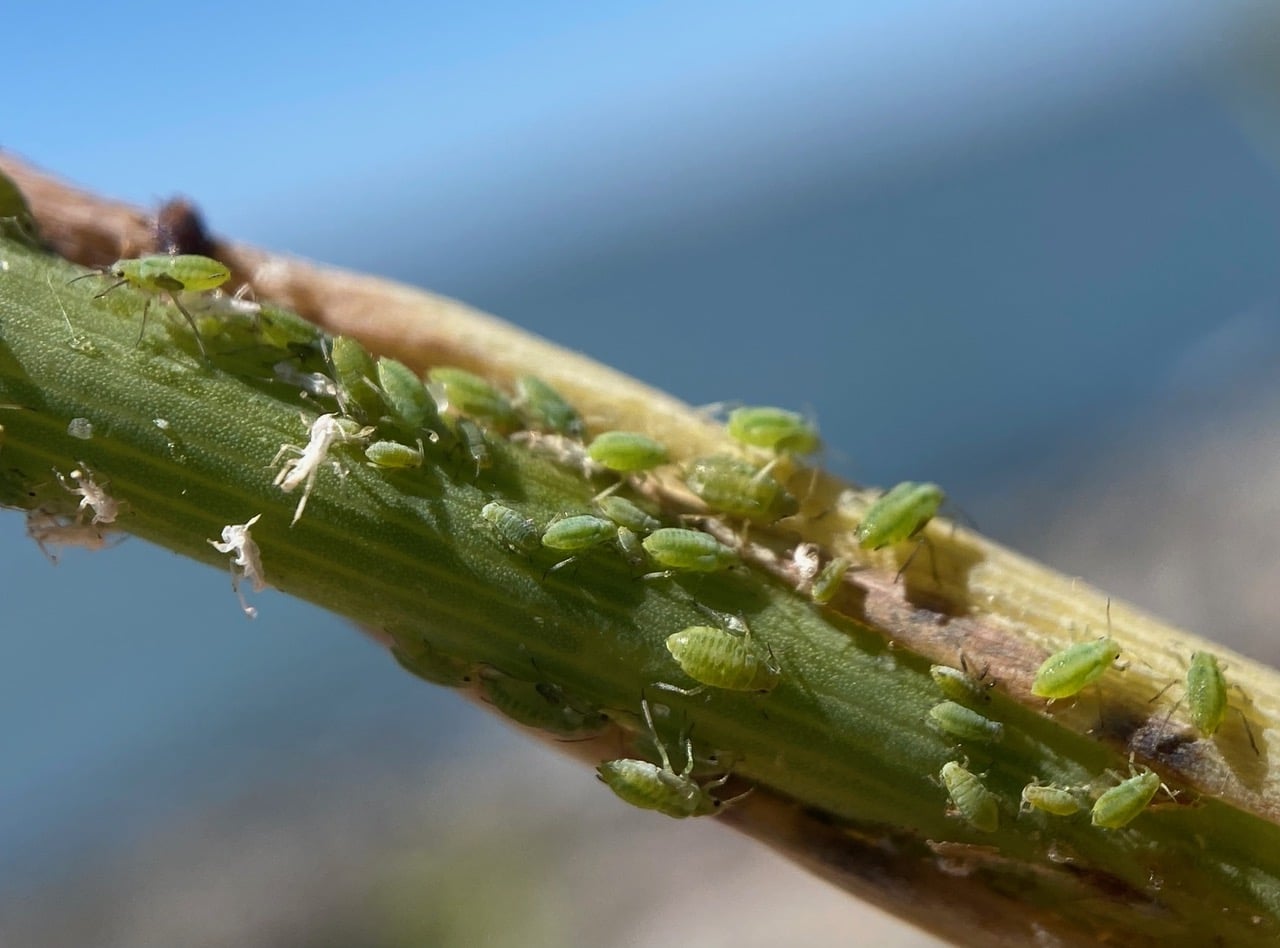
Other insects have made Fennel their home. These green aphids on the soft stem have been identified by iNaturalist as the Willow-Umbellifer Aphid, Cavariella sp. (family Aphididae).
Aphids (family Aphididae) are small sap-sucking insects in the order Hemiptera. Aphids usually feed passively on phloem of plants. Once the phloem vessel is punctured, the sap, which is under pressure, is forced into the aphid’s food canal. Aphids produce large amounts of a sugary liquid waste called “honeydew”. A fungus called sooty mold can grow on honeydew deposits that accumulate on leaves and branches, turning them black.
A typical life cycle involves flightless females giving live birth to female nymphs, – who may also be already pregnant, an adaptation called telescoping generations – without the involvement of males. Maturing rapidly, females breed profusely so that the population multiplies quickly. Winged females may develop later in the season, allowing the insects to colonize new plants. In temperate regions, a phase of sexual reproduction occurs in the autumn, with the insects often overwintering as eggs. The life cycle of some species involves an alternation between two species of host plants. Some species feed on only one type of plant, while others are generalists, colonizing many plant groups. Some ants have a mutualistic relationship with aphids, tending them for their honeydew and protecting them from predators.

More of the aphids are found in an immature inflorescence, almost indistinguishable from the crowded green flower buds. The alate (winged reproductive) has black head and thorax.
The Willow-umbellifer Aphids (genus Cavariella) are sap-sucking insects known for alternating their hosts between willows and various plants in the carrot family, Apiaceae. They spend the winter as eggs on willow trees (the primary host). In the spring, winged forms migrate to secondary hosts like carrots, parsnips, celery, fennel and wild hogweed. Unlike most aphids, they possess a unique supracaudal process (a small, conical “second tail” above their main tail). Wingless adults are oval-shaped. Winged adults feature a black head and thorax with a light green abdomen marked by dark bands.
While these aphids rarely multiply to numbers that cause physical damage directly to plants, they are notorious agricultural pests, acting as carriers of plant diseases.

An alate is perched on an umbel stalk. These winged females are the agents of dispersal for the aphid colonies.

Scattered among white exuvia (shed exoskeletons) of the aphids on the Fennel stem are several bloated straw-colored aphids. These are aphids that have been decimated by a parasitoid wasp. Aphid Mummy Wasps, Aphidius sp. (family Braconidae) are small wasps, typically less than 1/8 in. long. The female wasp lays a single egg in an aphid. When the egg hatches, the wasp larva feeds inside the aphid. As the larva matures the aphid is killed and becomes bloated and mummified, usually turning tan or golden in color. The adult wasp chews its way out of the mummy leaving a circular hole.
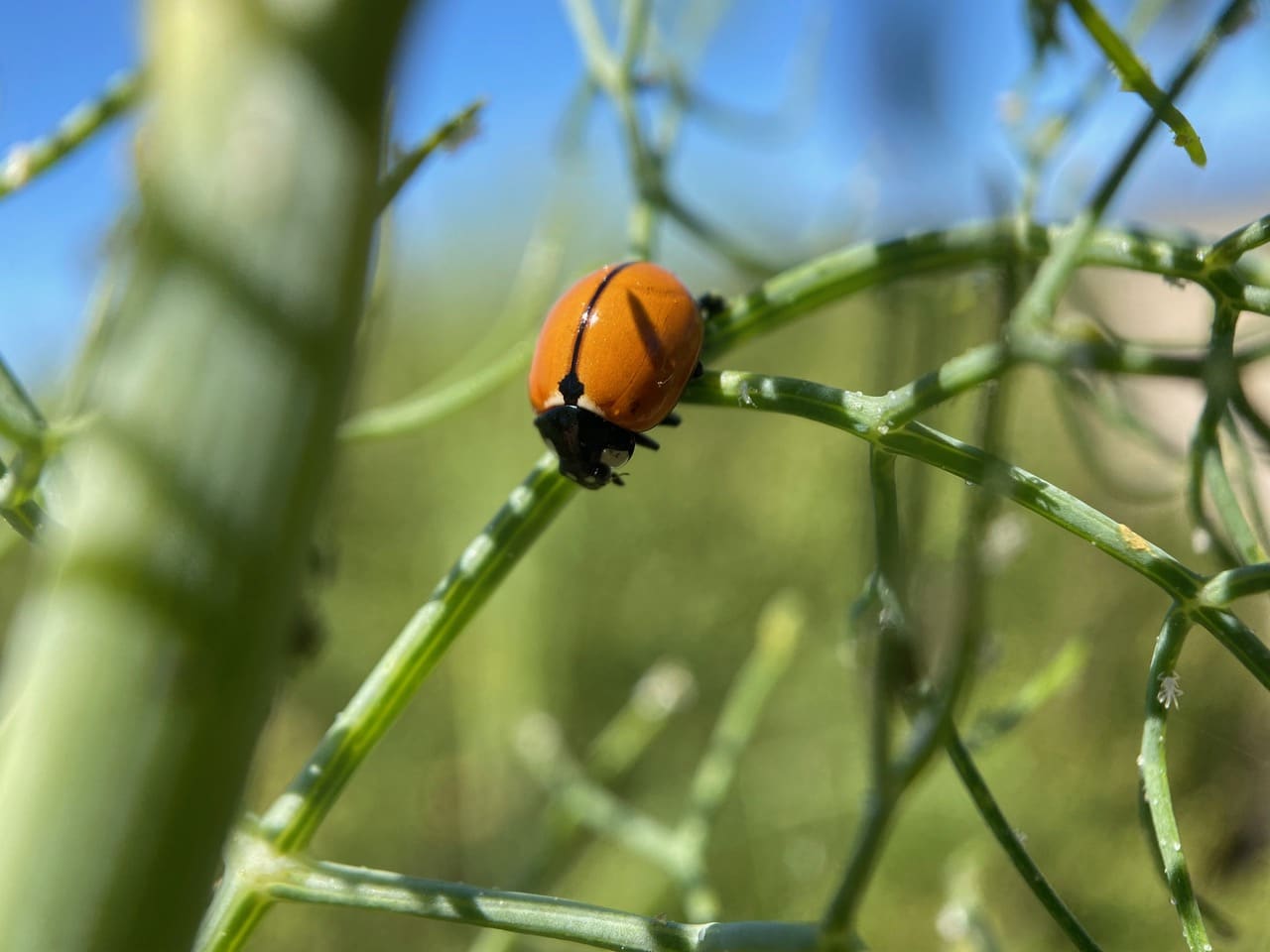
A California Lady Beetle is resting on the Fennel foliage.
The California Lady Beetle, Coccinella californica has a red elytra that is usually spotless. Pronotum is black with a white patch on each side. Head is black with two small white spots between the eyes. There is a black suture (where the wings meet, down the middle of the back). The species’ range is the coastal counties north of the Transverse Ranges. Both adults and larvae are voracious predators of aphids and other soft-bodied insects.

A Spotted Cucumber Beetle, Diabrotica undecimpunctata (family Chrysomelidae) is foraging among the Fennel buds.
The specific epithet undecimpunctata is a Latin-derived biological term that means “eleven-spotted”. Native to North America, the Spotted Cucumber Beetles are generalist feeders, consuming a wide variety of foods, although they have a preference for cucurbits (plants in the gourd family), causing damage to crops in the larval as well as adult stages of their life cycle. Larvae, sometimes known as rootworms feed on the roots of emerging plants. In the adult stage the beetles cause damage by eating the flowers, leaves, stems and fruits of the plant.
Various birds, mammals, and amphibians feed on the spotted cucumber beetle, while the beetle’s eggs are targeted by spiders, ground beetles, ants, and crickets.
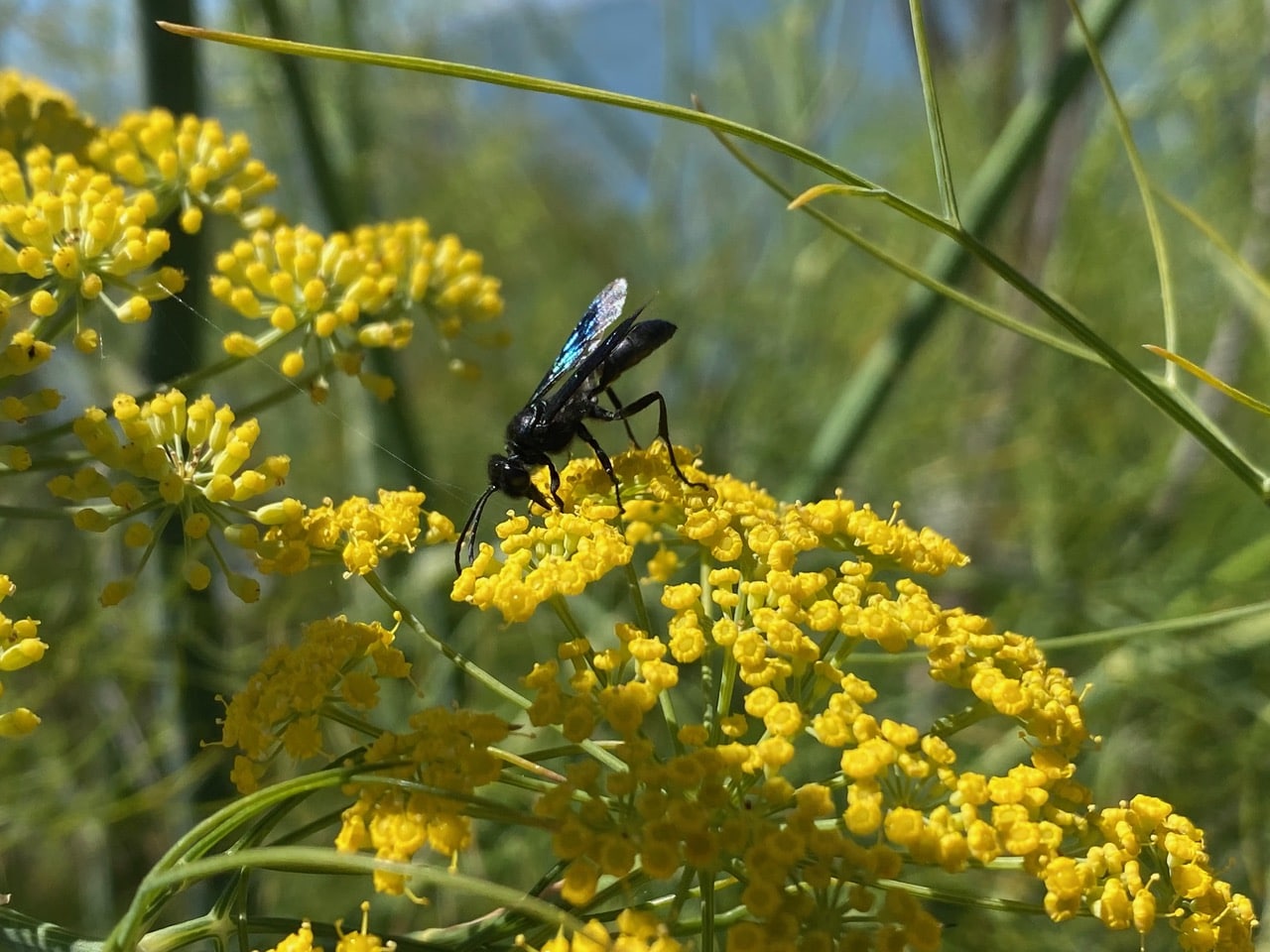
A large black wasp is busy flitting around the Fennel flowers seeking nectar. It is a male Thread-waisted Burrowing Wasp, Sphex lucae (family Sphecidae).
The Sphecidae are solitary wasps with elongated and narrow first abdominal segment, giving rise to the common name Thread-waisted Wasps. Sphex lucae is a widespread western species, ranging from WA in the north, south to CA, and east to TX. The species exhibits sexual dimorphism – females are black with a red abdomen, while the males are all black. Adults visit many types of flowers for nectar. Females hunt katydids and grasshoppers as food for their young. The wasp excavates a single-celled burrow in the soil in advance of hunting activities. She drags her paralyzed prey back to the burrow, laying a single egg on the victim. The nest entrance is then sealed and the process is repeated. Males of this species spend nights in sleeping aggregations in sheltered places such as beneath a rock overhang.
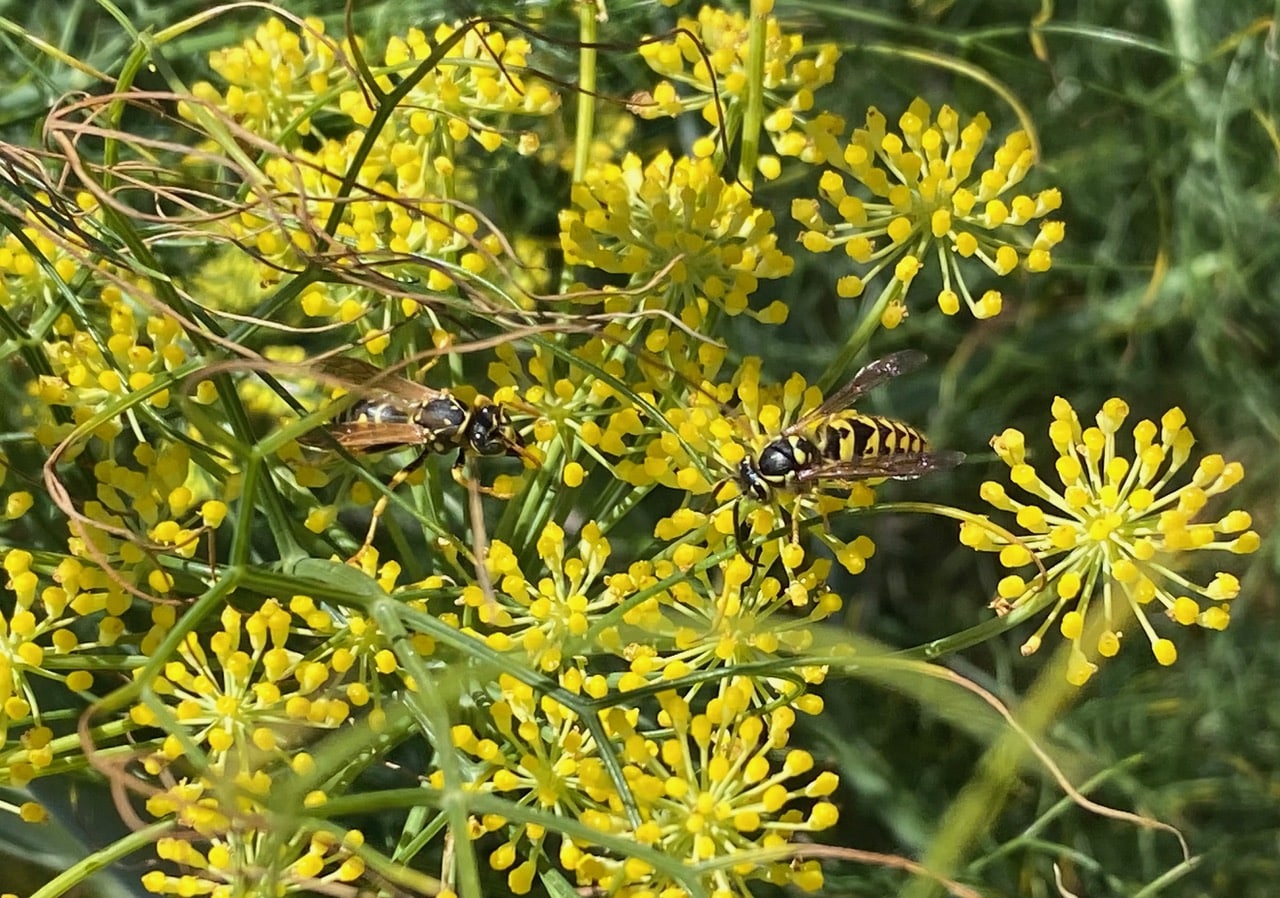
Blending in well with the yellow Fennel flowers are two wasps feeding side by side. The stocky one on the right with black antennae is a Yellowjacket, while the one on the left is a relative, the European Paper Wasp.
Yellowjacket is the common name for predatory social wasps of the genera Vespula and Dolicovespula (family Vespidae). Yellowjackets are social hunters living in colonies containing workers, queens, and males (drones). Colonies are annual with only inseminated queens overwintering. Queens emerge during the warm days of late spring or early summer, select a nest site, and build a small paper nest in which they lay eggs. They raise the first brood of workers single-handedly. Thereafter the workers take over caring for the larvae and queen, nest expansion, foraging for food, and colony defense. The queen remains in the nest, laying eggs. Later in the summer, males and queens are produced. They leave the parent colony to mate, after which the males quickly die, while fertilized queens seek protected places to overwinter. Parent colony workers dwindle, usually leaving the nest to die, as does the founding queen. In the spring, the cycle is repeated.
Yellowjackets have lance-like stingers with small barbs, and typically sting repeatedly. Their mouthparts are well-developed with strong mandibles for capturing and chewing insects, with probosces for sucking nectar, fruit, and other juices. Yellowjacket adults feed on foods rich in sugars and carbohydrates such as plant nectar and fruit. They also search for foods high in protein such as insects and fish. These are chewed and conditioned in preparation for larval consumption. The larvae secrete a sugary substance that is eaten by the adults. The cyclical exchange of food between adults and larvae is called trophallaxis.
The Western Yellowjackets typically build nests underground, often using abandoned rodent burrows. The nests are made from wood fiber that the wasps chew into a paper-like pulp. The nests are completely enclosed except for a small entrance at the bottom. The nests contain multiple, horizontal tiers of combs within. Larvae hang within the combs.
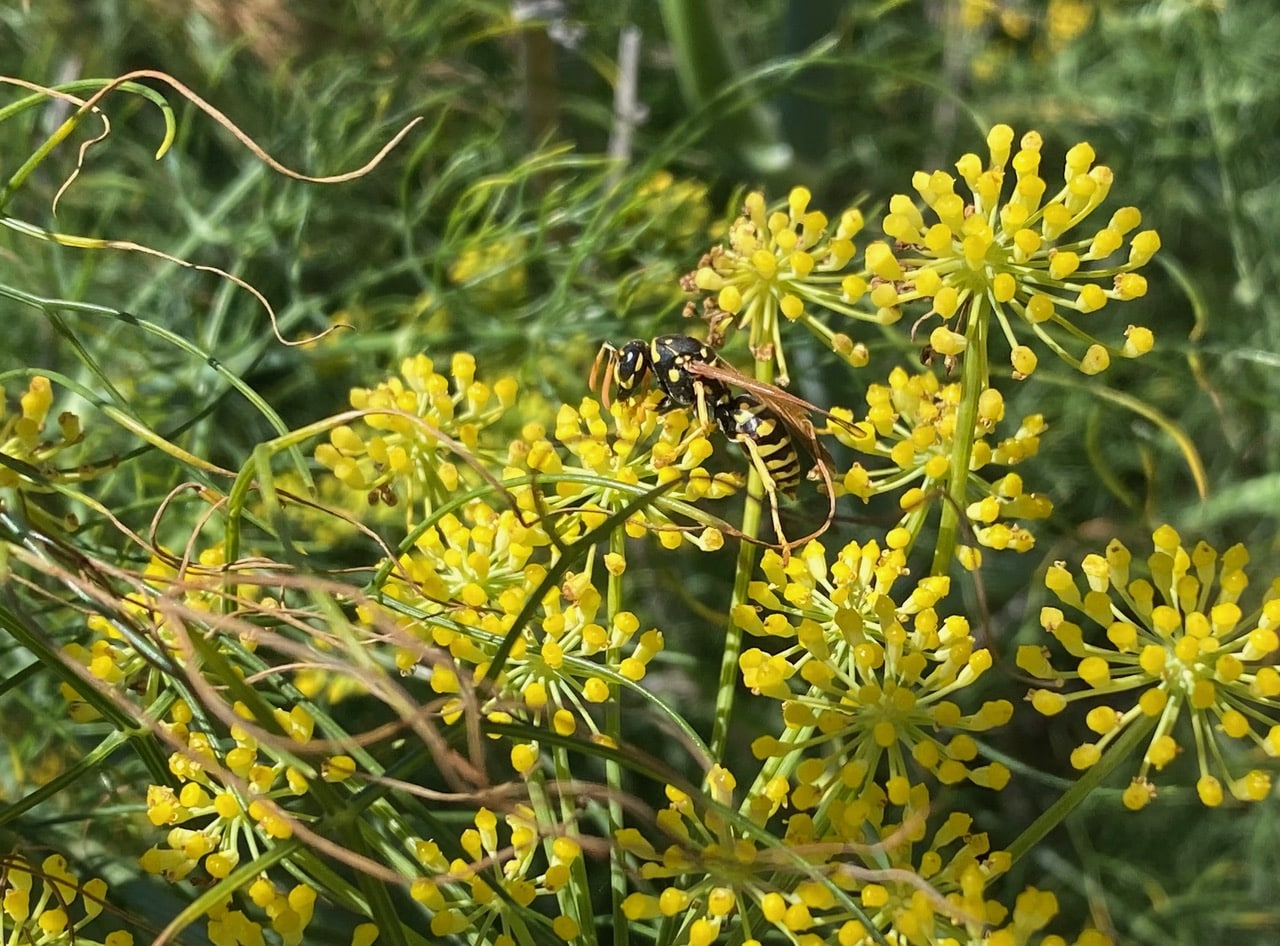
A European Paper Wasp, Polistes dominula (family Vespidae) is taking nectar from the Fennel flowers.
Native to Europe, the European Paper Wasp, Polistes dominula, is a social insect that produces an annual colony in a paper nest. Individual colonies are established anew each spring. The overwintering stage are mated females (queens). The overwintered queens emerge from sheltered spots in spring and search out sites to establish a new colony. Nests are constructed of paper, produced from chewed wood fibers of weathered fences, porch decks and other similar sources. Larvae are fed crushed insects, usually caterpillars. As the population increases, the original queen increasingly remains in the nest as new workers take over colony activities. A few of the wasps produced later in summer are males and increasing numbers of the females become sexually mature. Mating occurs and the mated females are the surviving overwintering stage. Males and non-reproductive females do not survive winter and the nest is abandoned by late fall. European Paper Wasps will sometimes feed on sweet materials, including honeydew produced by aphids. They may also feed on damaged ripe fruits. Because of their habit of hunting caterpillars, the wasps have become one of the most important natural controls of garden pests.

Often mistaken for Yellowjacket Wasps, the European Paper Wasps can be distinguished by their slender body, and their orange-tipped antennae. Yellowjackets have shorter, thicker bodies, and they have black antennae. Paper wasps dangle their long legs when they fly, while the yellowjackets tuck their legs under their bodies when they fly. Paper wasp nests resemble an open honeycomb or upside-down umbrella. They often build their nests on man-made structures such as eaves or lawn furniture. Yellowjacket nests are covered with a surrounding envelope of paper; the nests have a single opening that is often hard to see because the nest is underground.