

Pollinator Post 6/3/24 (2)
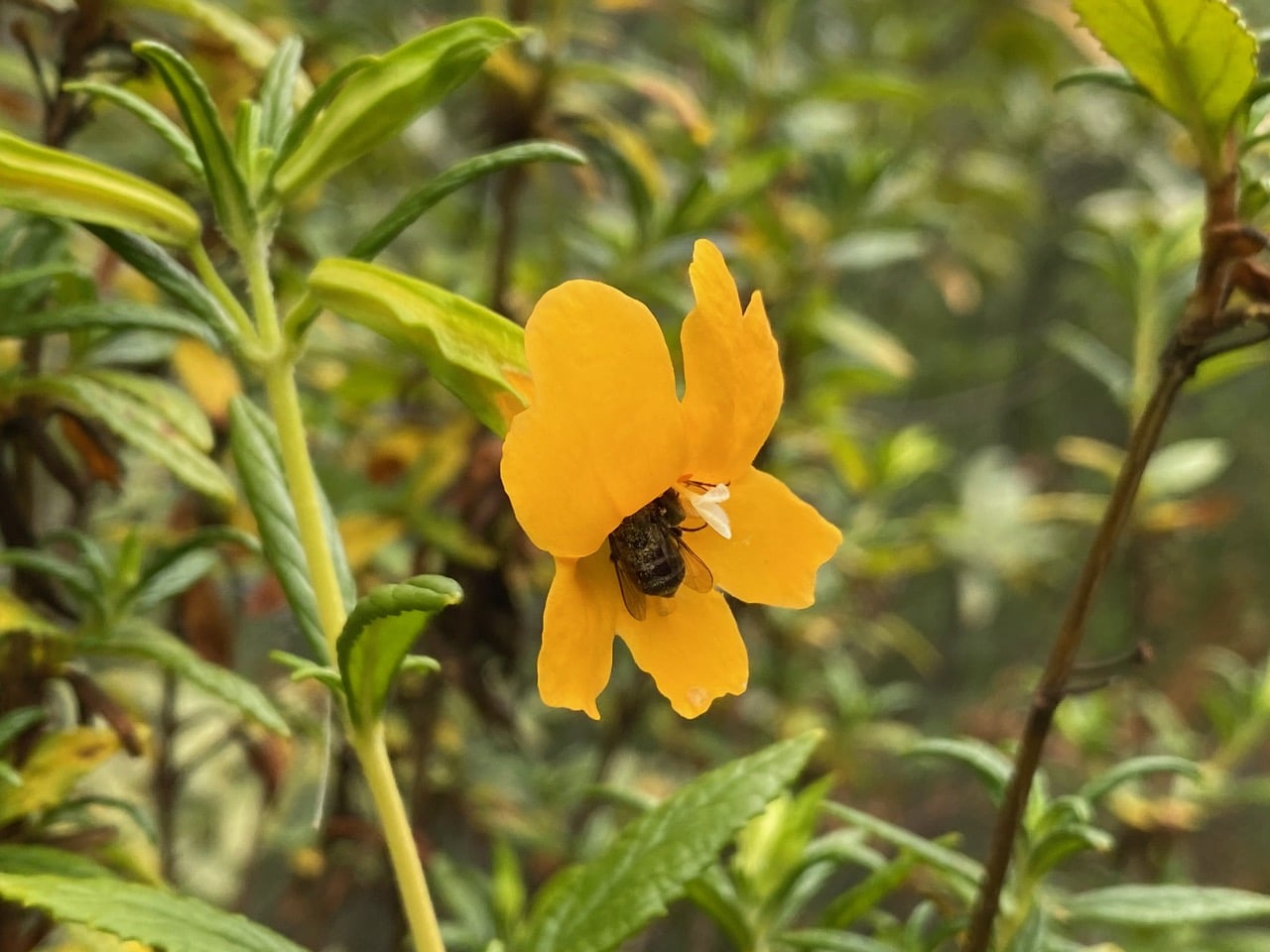
It’s already 10:30 am – rather surprising to see a Small-headed Fly, Eulonchus sp. (family Acroceridae) still sleeping in the Sticky Monkeyflower, Diplacus aurantiacus.
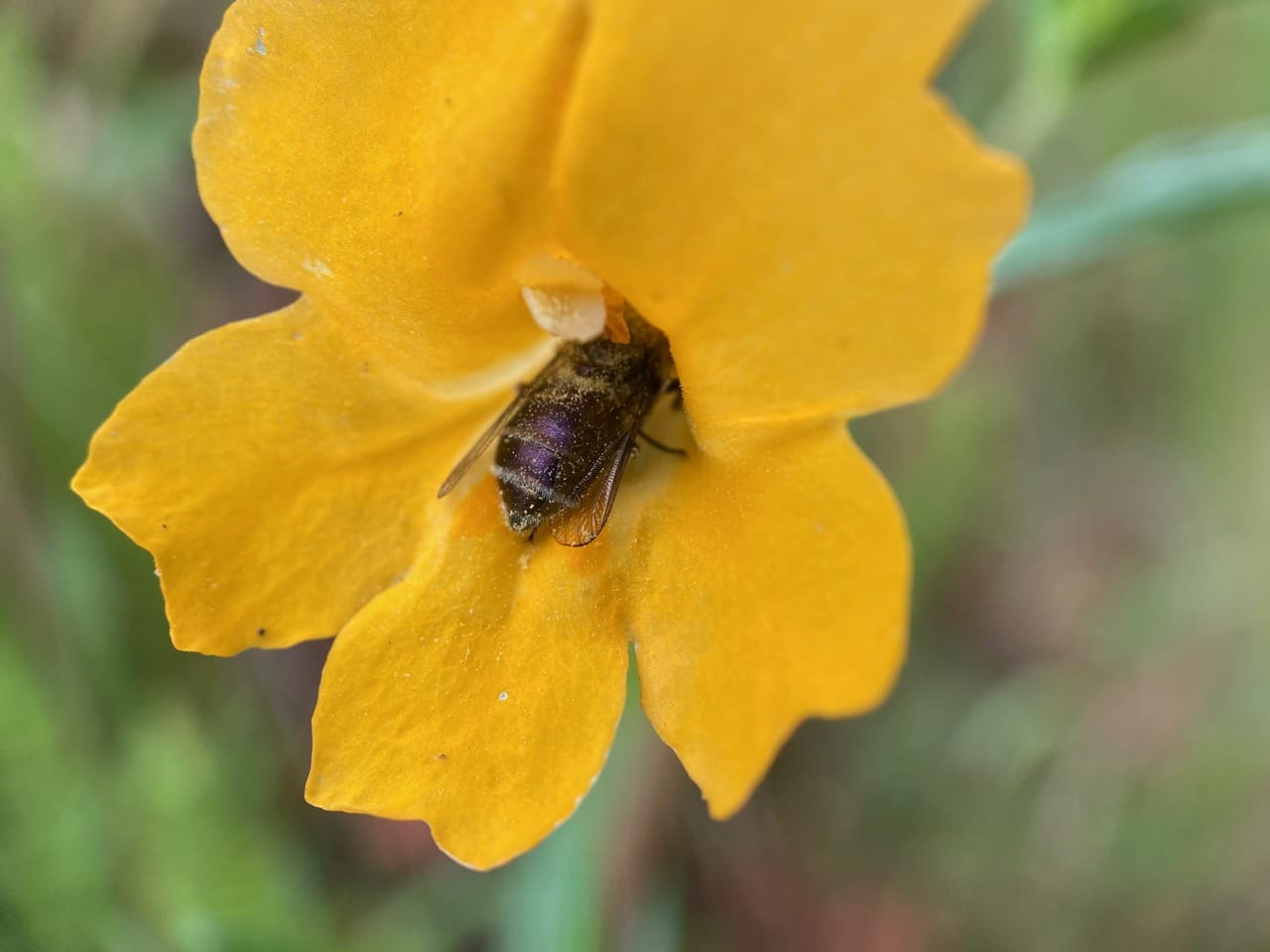
Here’s another one. These Sticky Monkeyflowers are in the shade, so they haven’t warmed up enough to wake up the overnighting guests. The Small-headed Flies are iridescent blue when seen in sunlight, but their beauty is not evident in the shade.

A small Soldier Beetle, Dichelotarsus cavicollis (family Cantharidae), (formerly Podabrus cavicollis) is foraging on a Sticky Monkeyflower.
The Soldier Beetles, family Cantharidae are relatively soft-bodied, straight-sided beetles. One of the first described species has a color pattern reminiscent of the red coats of early British soldiers, hence the common name. They are also known commonly as Leatherwings because of their soft elytra. Soldier beetles often feed on both nectar and pollen as well as predating on other small insects. The larvae are often active, and feed on the ground, hunting snails and other small creatures. Soldier beetles are generally considered beneficial insects by gardeners.

A Flower Longhorn Beetle, Leptalia macilenta is resting on a leaf of Sticky Moneyflower.
Flower Longhorn Beetles (family Cerambycidae, subfamily Lepturinae) are usually among the smaller members of their family. These beetles have a narrow body and very long legs. The thorax is markedly less wide than the wings, while the elytra tips are often pointed. They also share the family trait with other Cerambycids of having very long antennae. Sexual dimorphism is found in some species. The beetles are found on flowers where they feed on pollen and nectar, and are considered pollinators. They have a particular affinity for the umbel flowers of the carrot family, Apiaceae. The beetles spend their larval days as borers, just like other Cerambycids. However they are not considered pests, as they select trees that are stressed, dying, or dead.
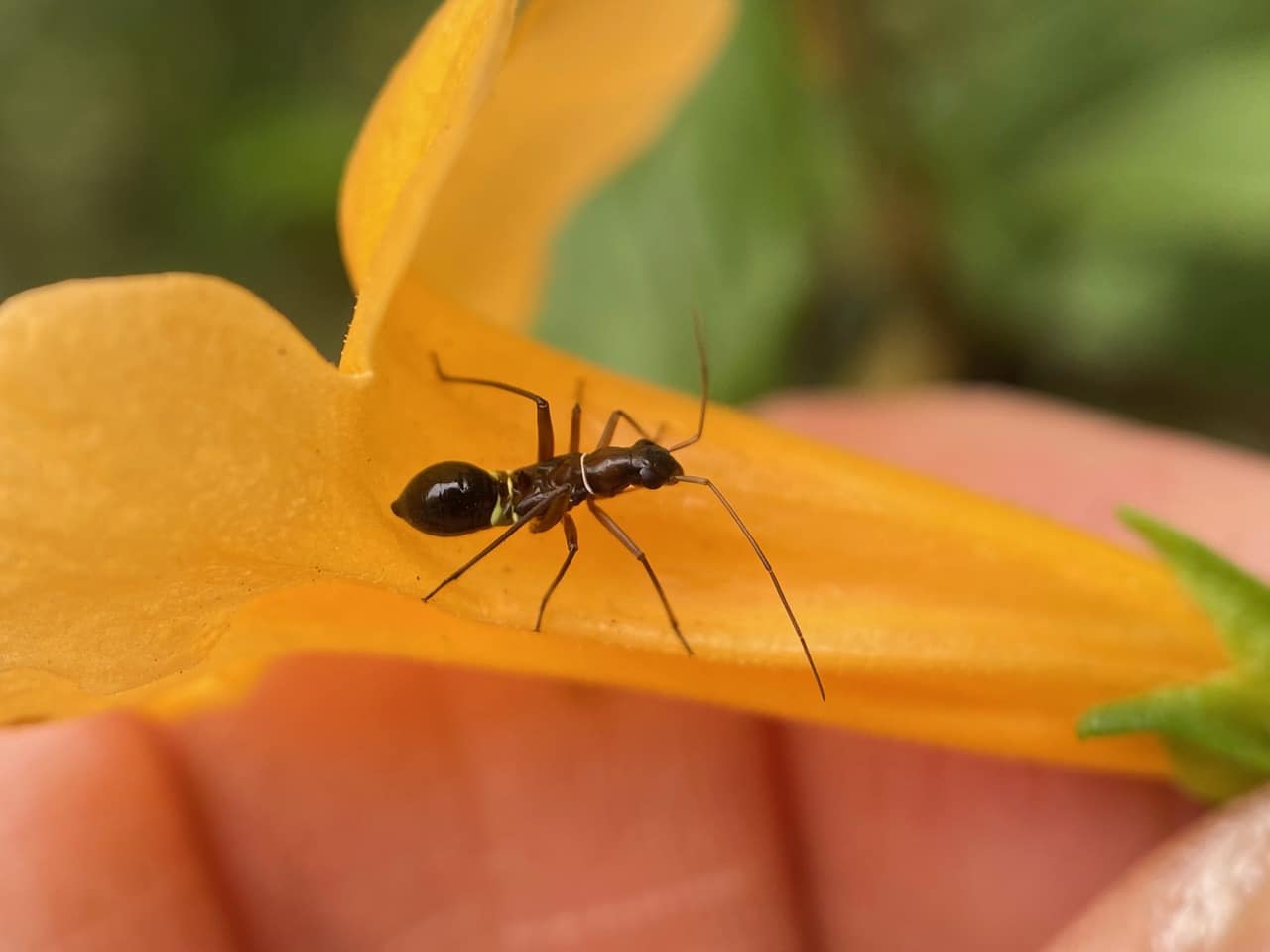
An ant-like insect crawls out of a Sticky Monkeyflower and runs to the back of the flower. Except for its long antennae and the yellow markings on its body, the insect could easily be mistaken for an American Winter Ant. It is in fact a young Plant Bug, Closterocoris amoenus (family Miridae), native to Central and North America. I see these ant-like nymphs every year, mostly on Sticky Monkeyflower. The adults also seem to have an affinity for the plant.
Mirid bugs are also referred to as plant bugs or leaf bugs. Miridae is one of the largest family of true bugs in the order Hemiptera. Like other Hemipterans, Mirids have piercing, sucking mouthparts to extract plant sap. Some species are predatory.
Ant mimicry or myrmecomorphy is mimicry of ants by other organisms. Ants are abundant all over the world, and potential predators such as birds and wasps normally avoid them as they are either unpalatable or aggressive. Spiders are the most common ant mimics. Additionally, many insects from a wide range of orders and families mimic ants to escape predation (protective mimicry), while others mimic ants anatomically and behaviorally to hunt ants in aggressive mimicry.
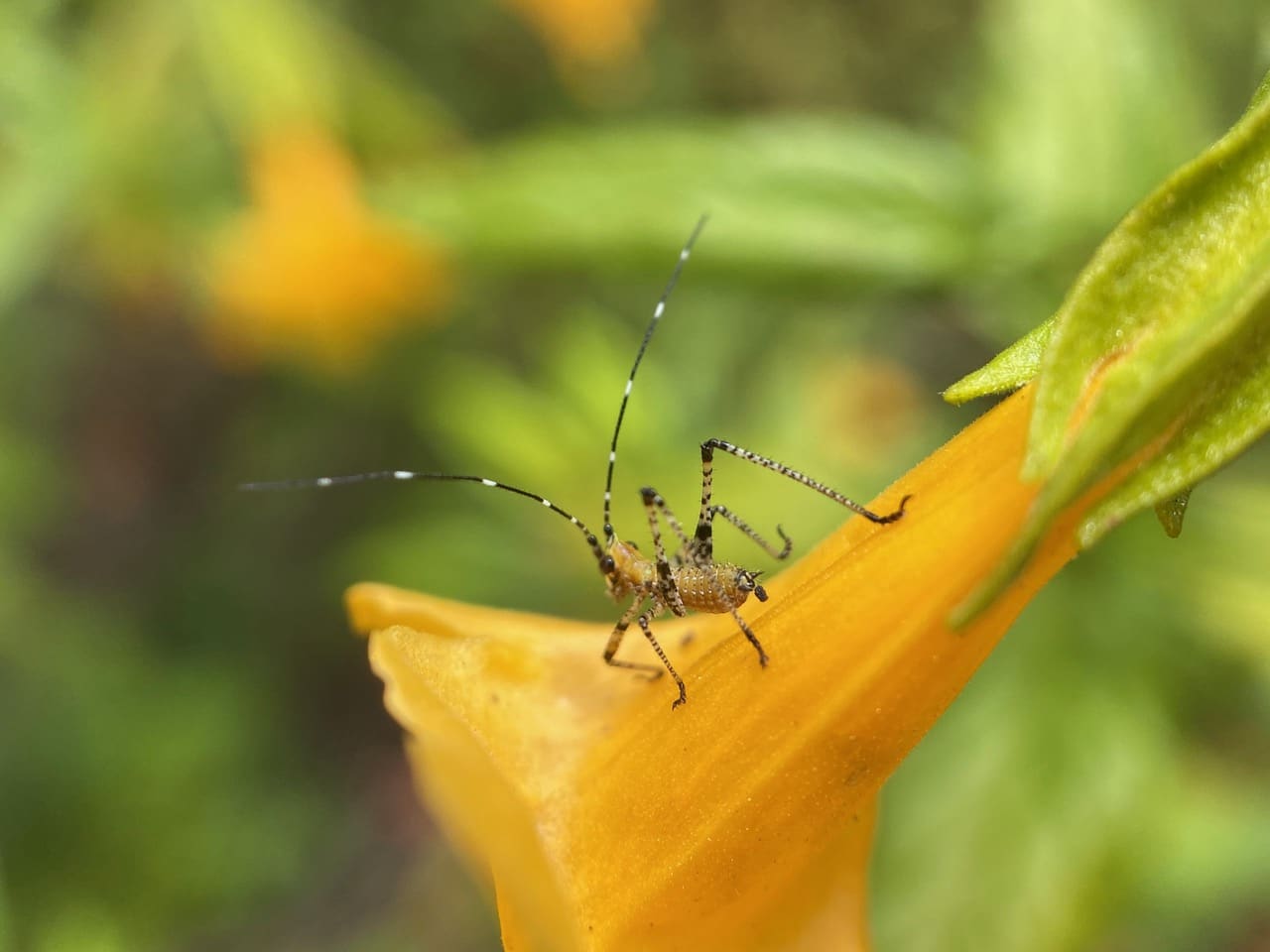
What a cutie! The young nymph of a Scudder’s Bush Katydid, genus Scudderia is posing atop a Sticky Monkeyflower. I am particularly charmed by its long, white-banded antennae.
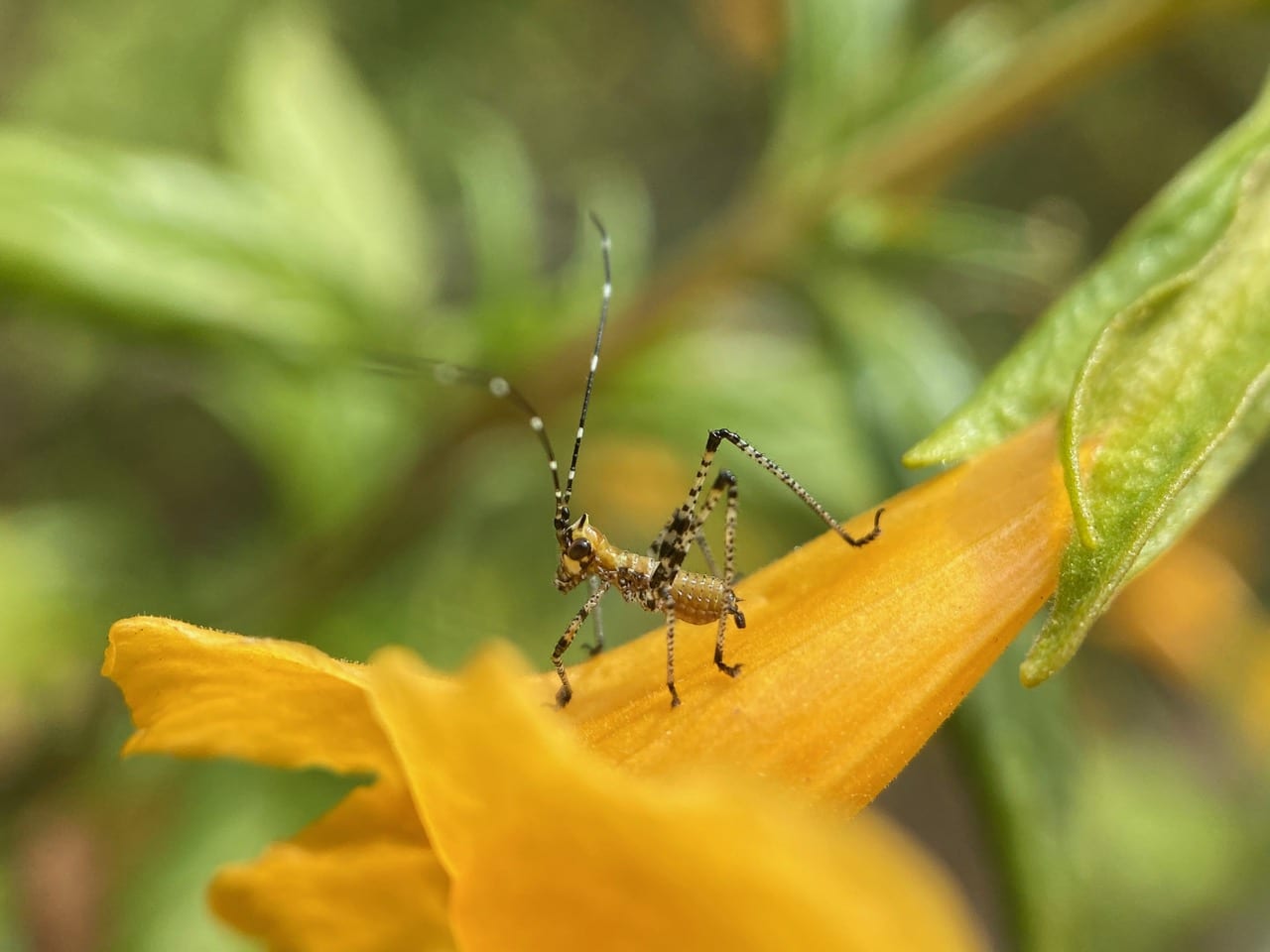
Scudderia is a genus of katydids in the family Tettigoniidae. They are sometimes called bush katydids and are 30-38 mm in length. They are mostly found in North America. They are herbivores, with nymphs feeding primarily on flowers and adults preferring woody deciduous plants.

A Malachite Beetle, Malachius auritus (subfamily Malachiinae, family Melyridae) is posing on the lower lip of a Sticky Monkeyflower.
The Malachite Beetle (subfamily Melachiinae) is a member of the family of Soft-winged Flower Beetles (family Melyridae). Most Melyrids are elongate-oval, soft-bodies beetles 10 mm or less in length. Members of the subfamily Malachiinae have peculiar orange structures along the sides of the abdomen which can be everted, but usually kept hidden. Most adults and larvae are predaceous. Omnivorous adult Melyrids are often found on flowers out in the open, where they feed on pollen, insect eggs, and flower-loving insects that land within their grasp. The larvae generally stay concealed under tree bark or leaf litter or soil, where they prey on other invertebrates.
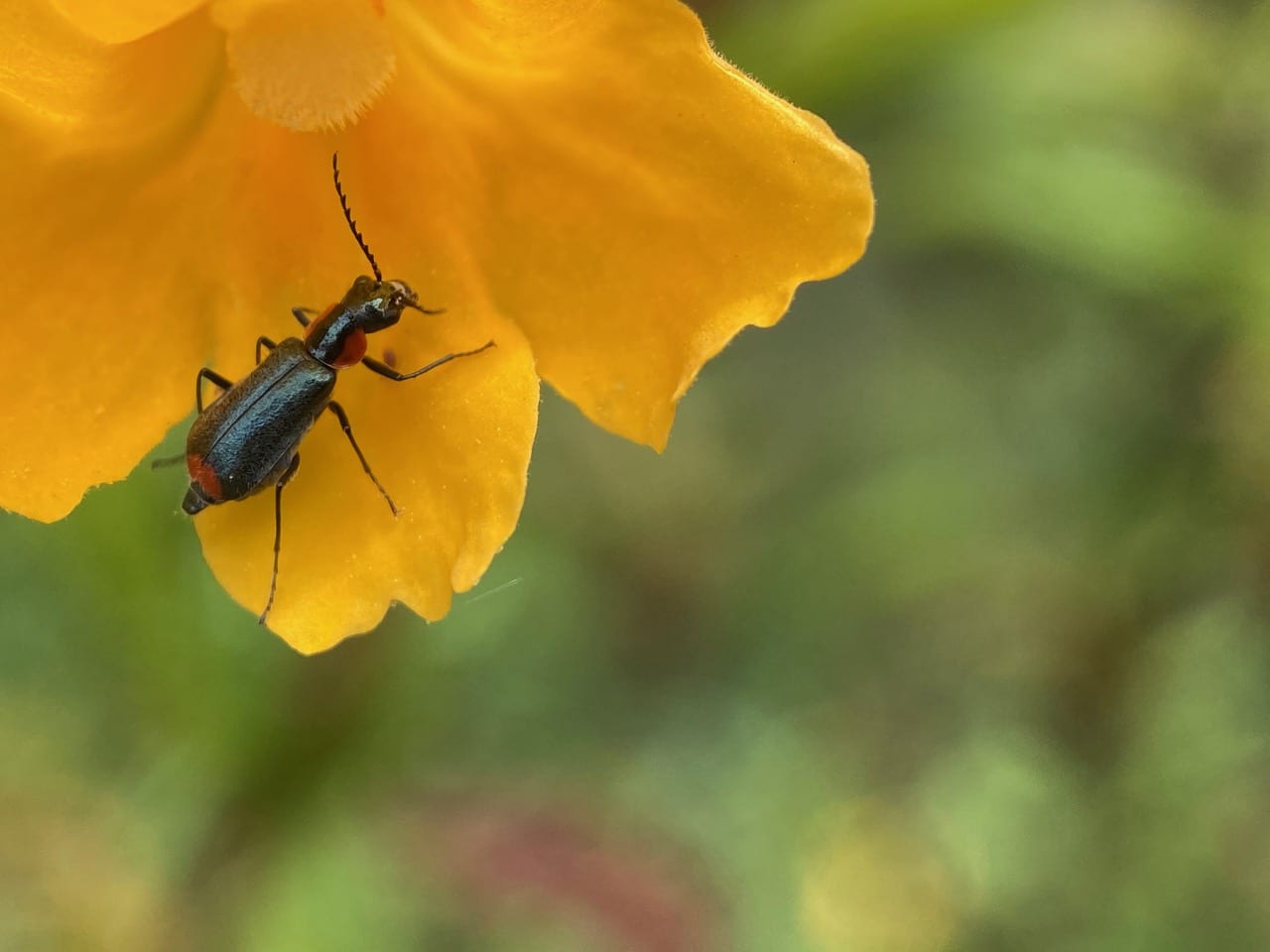
Note the beetle’s pectinate antennae. The segments of pectinate antennae are longer on one side, giving the antenna a comb-like appearance. The term pectinate derives from the Latin pectin, meaning comb. Pectinate antennae are found in some beetles and sawflies. Insect antenna forms – BugGuide.Net
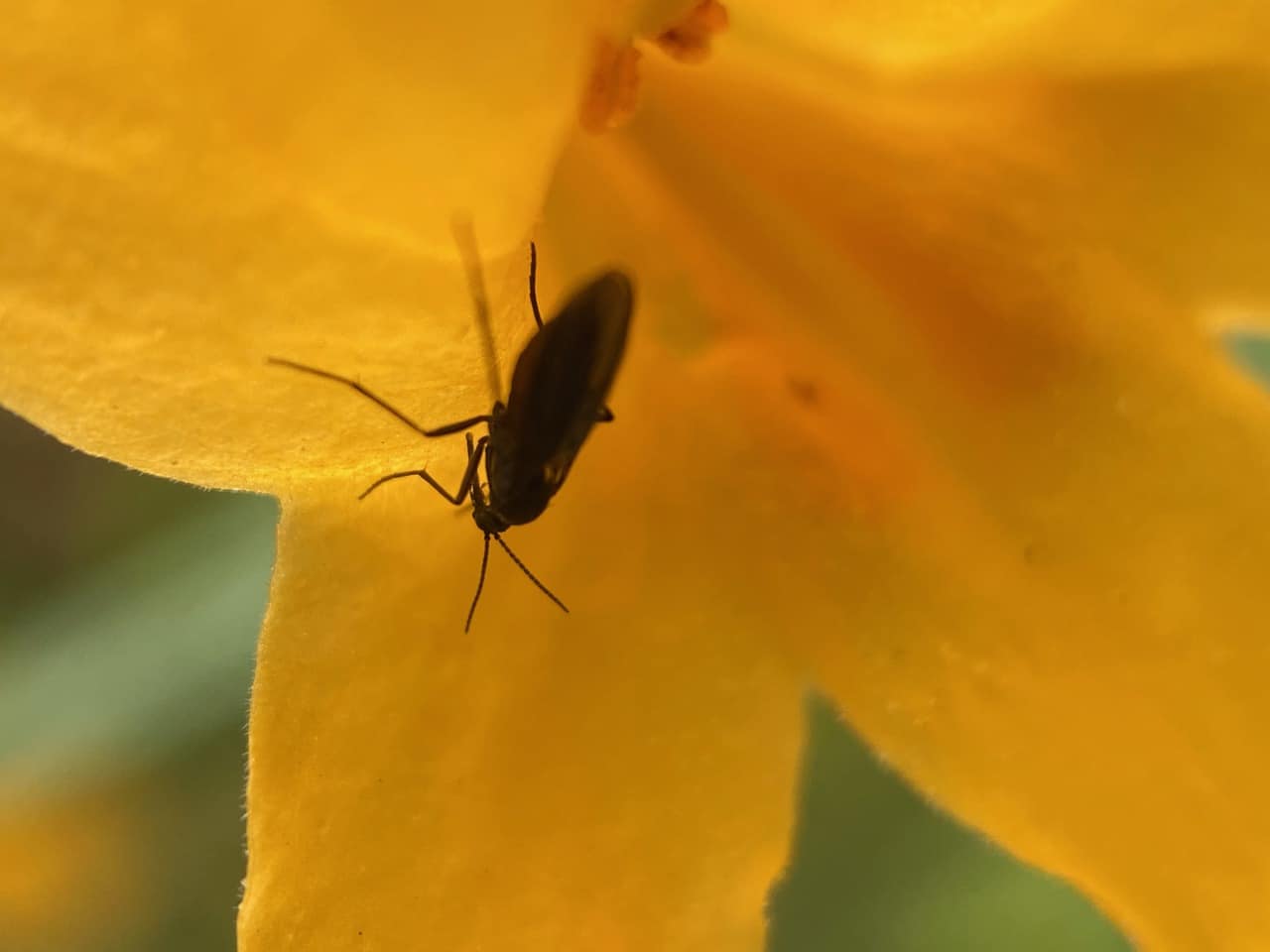
A small insect with dark wings is lingering outside a Sticky Monkeyflower.
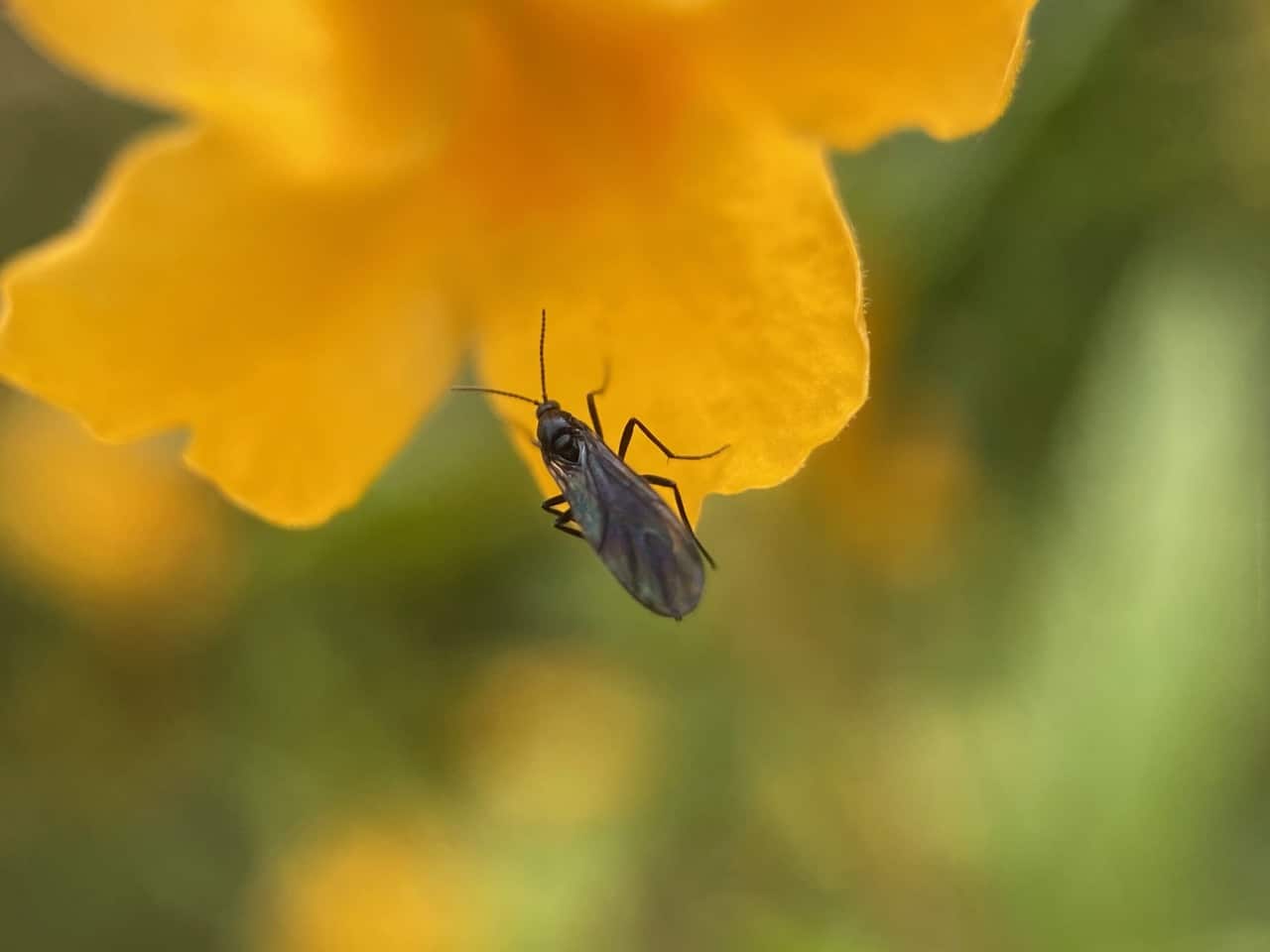
Ooh, I think it is a Dark-winged Fungus Gnat (family Sciaridae).
The Sciaridae are a family of flies, commonly known as Dark-winged Fungus Gnats. Commonly found in moist environments, they are known to be a pest of mushroom farms and are commonly found in indoor flowerpots. Adults are usually under 5 mm long. Most species live in forests, swamps, and moist meadows, where they live in the foliage. In moist shadowy areas, up to 70% of all dipteran species can be Sciaridae. Sciarid larvae often occur in decaying plant matter such as rotten wood or under the bark of fallen trees, but can also be found in animal feces or fungi. The larvae play an important role in turning forest leaf litter into soil. Adults emerge in unison from their larval homes in the soil and form large swarms, where mating takes place. The adults with their characteristic dancing flight do not bite. They only ingest liquids and live only long enough to mate and produce eggs.
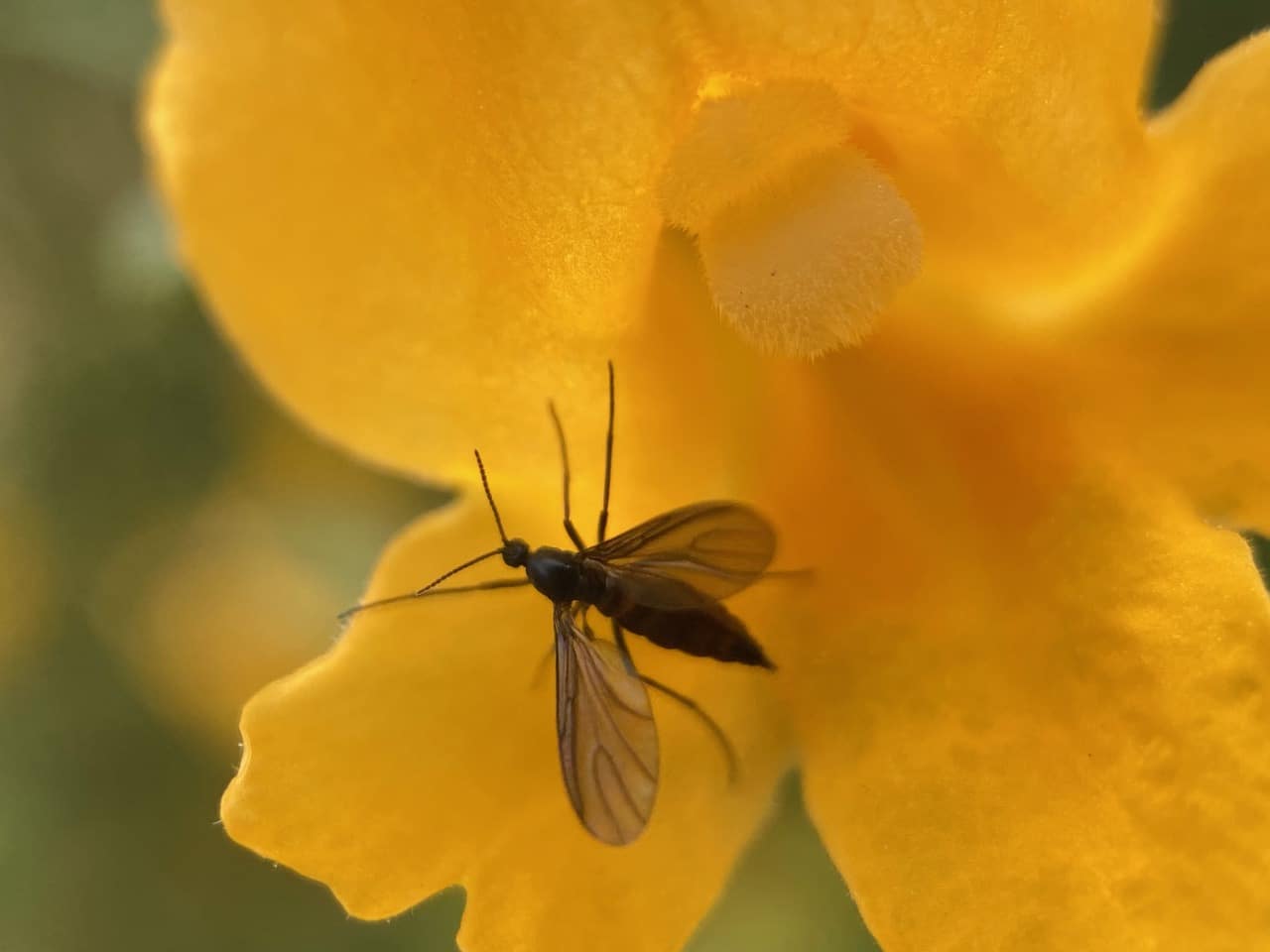
Judging by the shape of its abdomen, the gnat is a female.
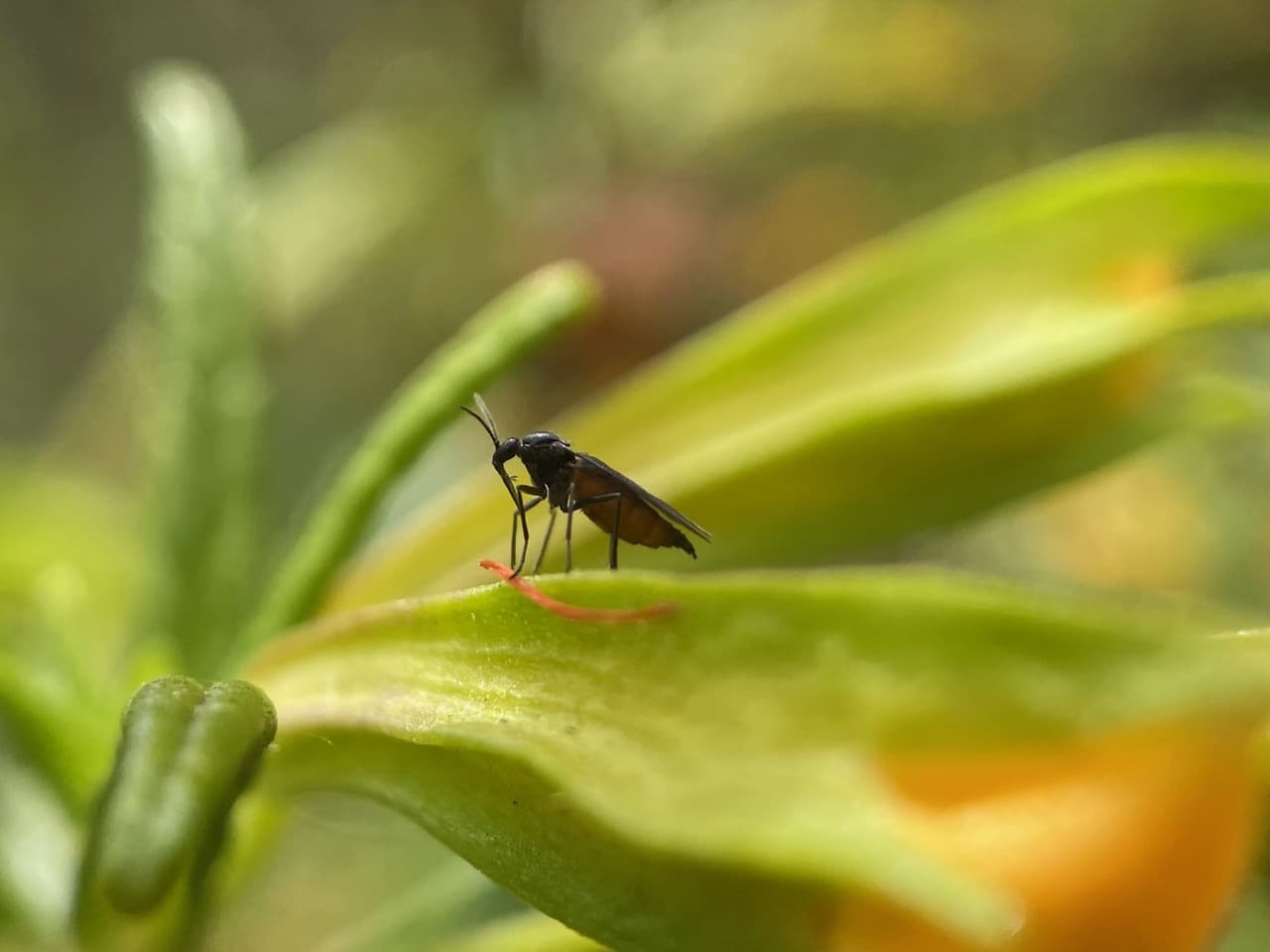
A Dark-winged Fungus Gnat is perched on the calyx of a Sticky Monkeyflower.
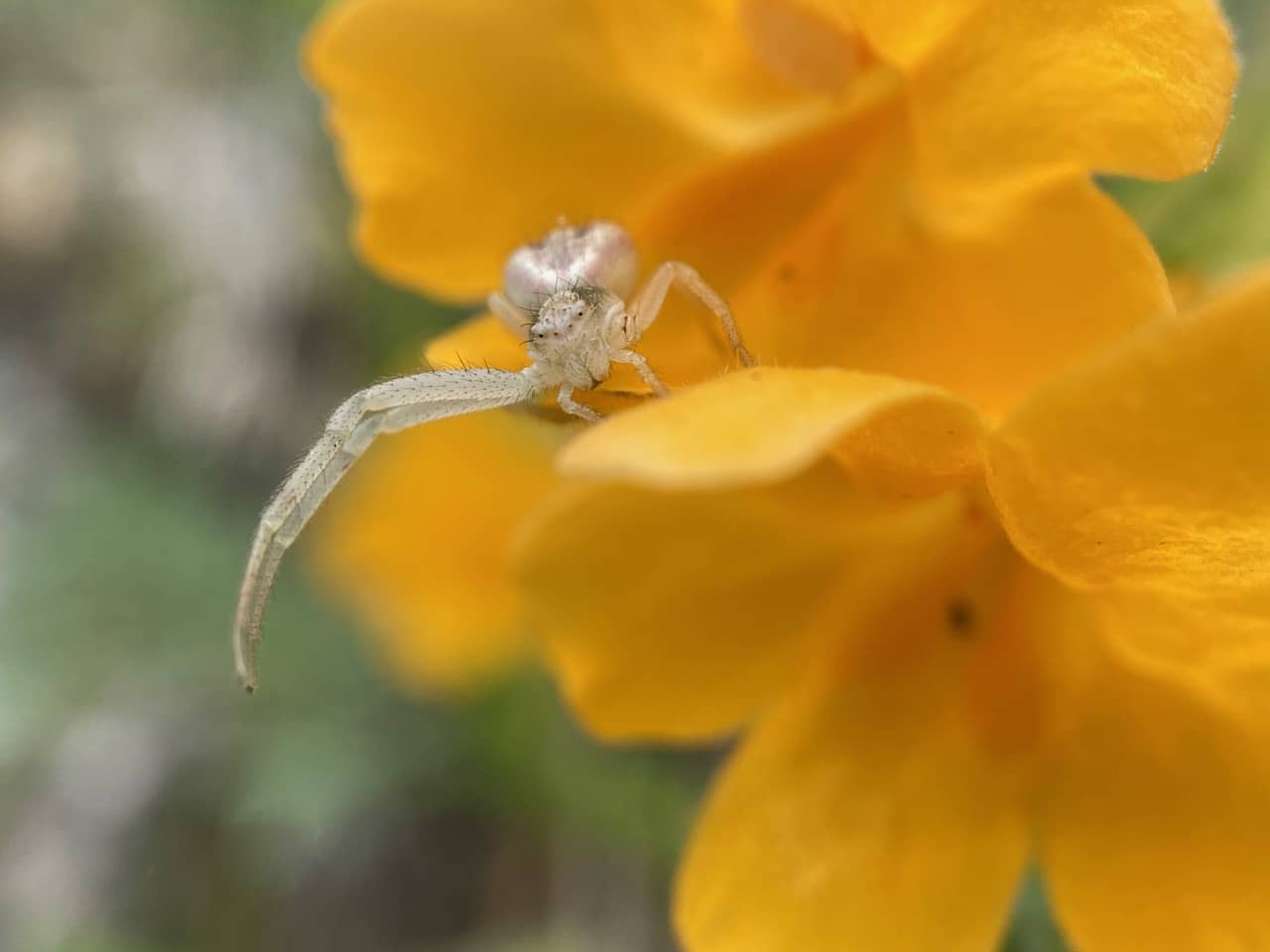
What a disturbing sight – a Crab Spider, Mecaphesa sp. (family Thomisidae) missing its two front legs on the same side. Crab Spiders do not spin webs to trap prey. They are ambush predators that sit and wait on or near flowers for an unsuspecting insect to come within reach of its two front pairs of extra long legs. What is this poor spider going to eat when it can’t grab its prey? It looks like a young spider, with a few more molts before reaching adulthood. There’s hope yet that it might be able to regenerate those lost limbs on subsequent molts, if it doesn’t die of starvation first.
A spider’s body is covered in a hard outer skin known as an exoskeleton. As the spider matures it has to shed its skin to allow for growth. A spider can go through 20 or more molts before it reaches its full, adult size. Not only does the shedding allow for growth, but it also allows for regeneration. It a spider loses a leg, it is able to grow a new leg provided it still has at least one more molt left in its life cycle. In most species the new leg is thinner and shorter than the original leg. It can take two or three molts until the regenerated limb matches the original in appearance.

There are two Small-headed Flies, Eulonchus sp. (family Acroceridae) in that Sticky Monkeyflower. They are not moving, so maybe they’re still asleep.

Here’s another Small-headed Fly sleeping in a Sticky Monkeyflower.
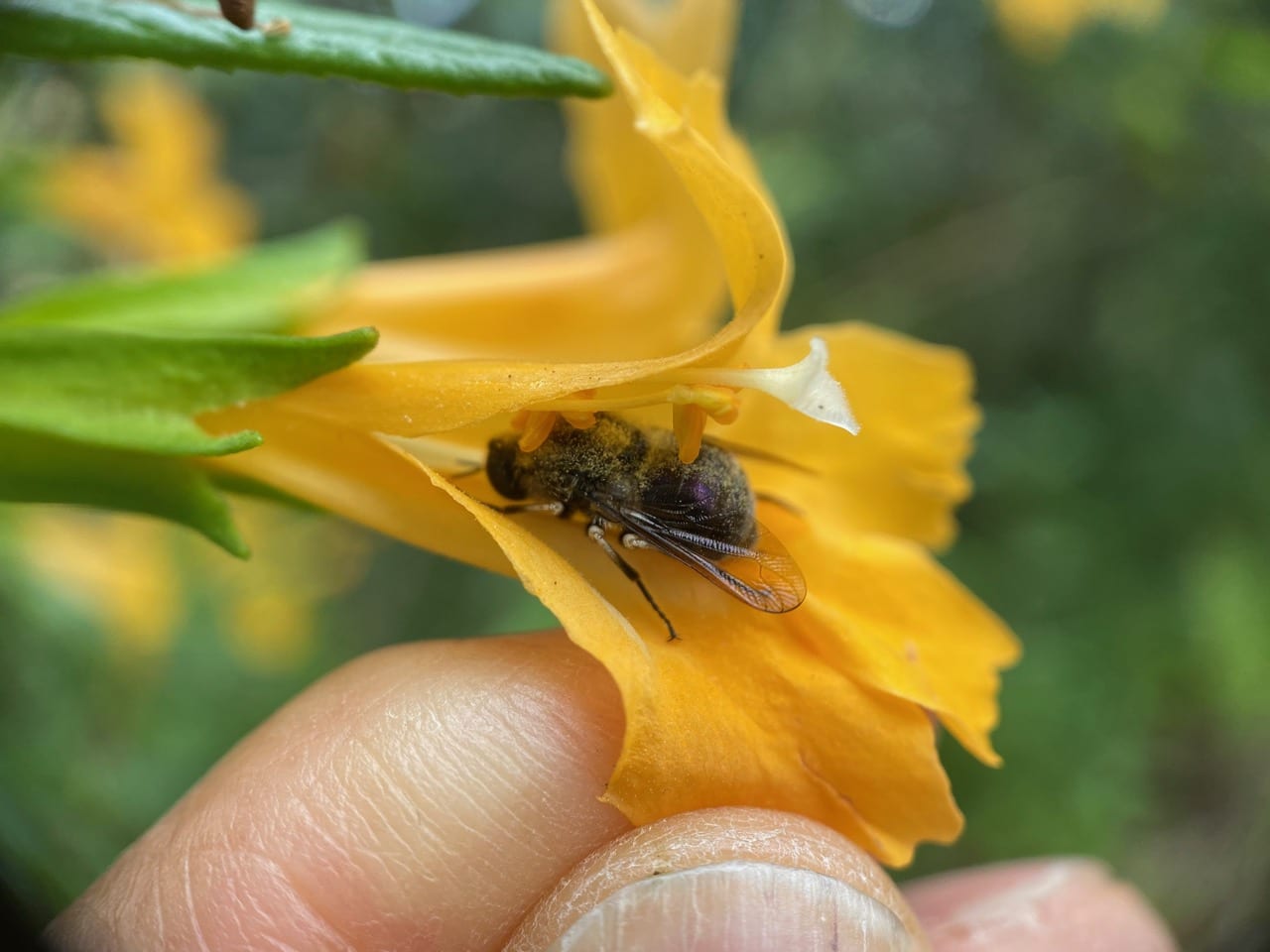
I learned from a naturalist friend years ago that these flies are so fast asleep in the morning that you can open up the flower to expose them without waking them. So I gently tear open the flower partially to reveal the fly inside. Sure enough, it does not stir!
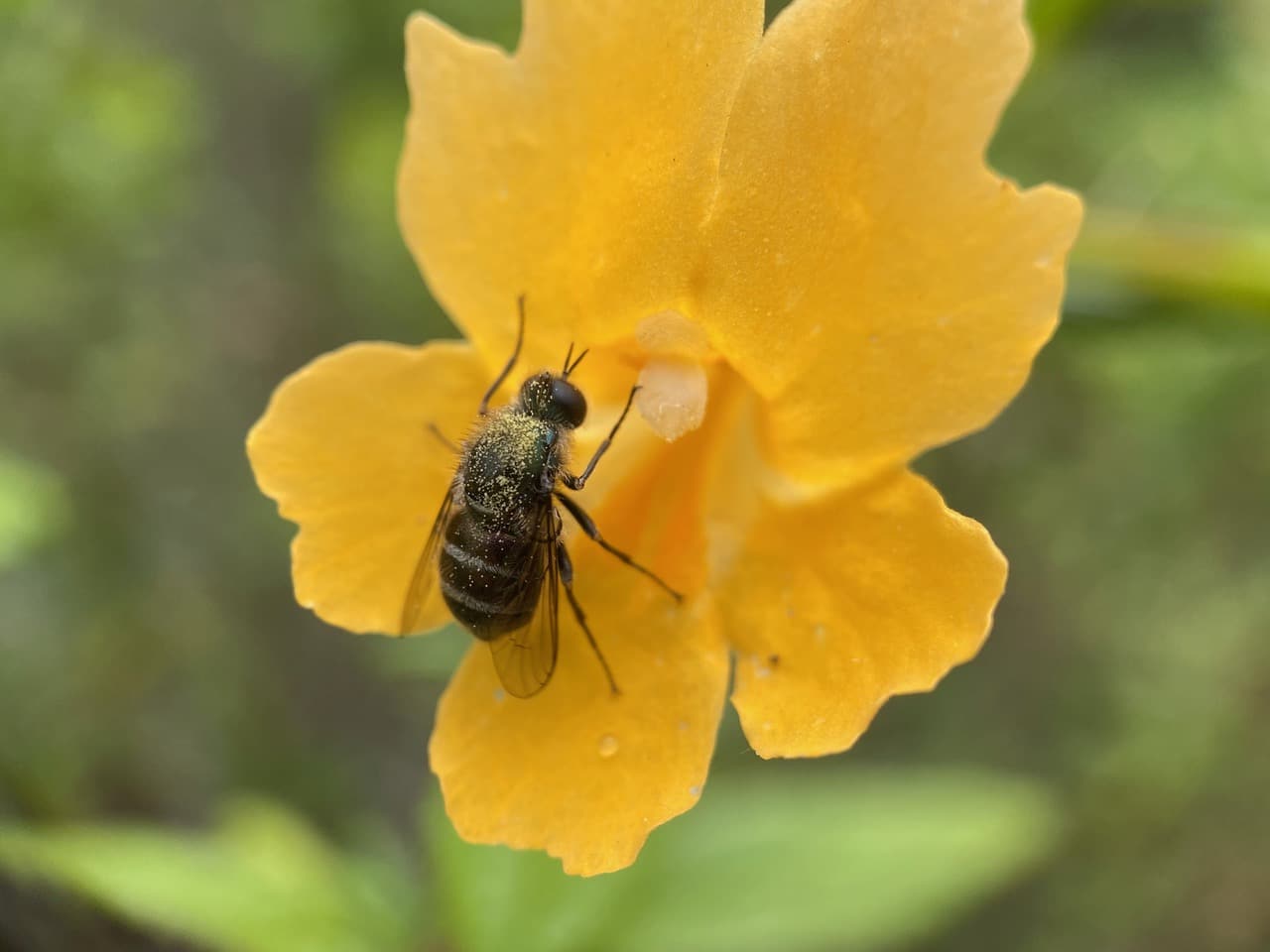
Here’s a Small-headed Fly perched motionless outside a Sticky Monkeyflower. I think it just woke up. Note that its back is dusted with pollen that has fallen from the stamens on the roof of the floral tube while the fly was sleeping inside.
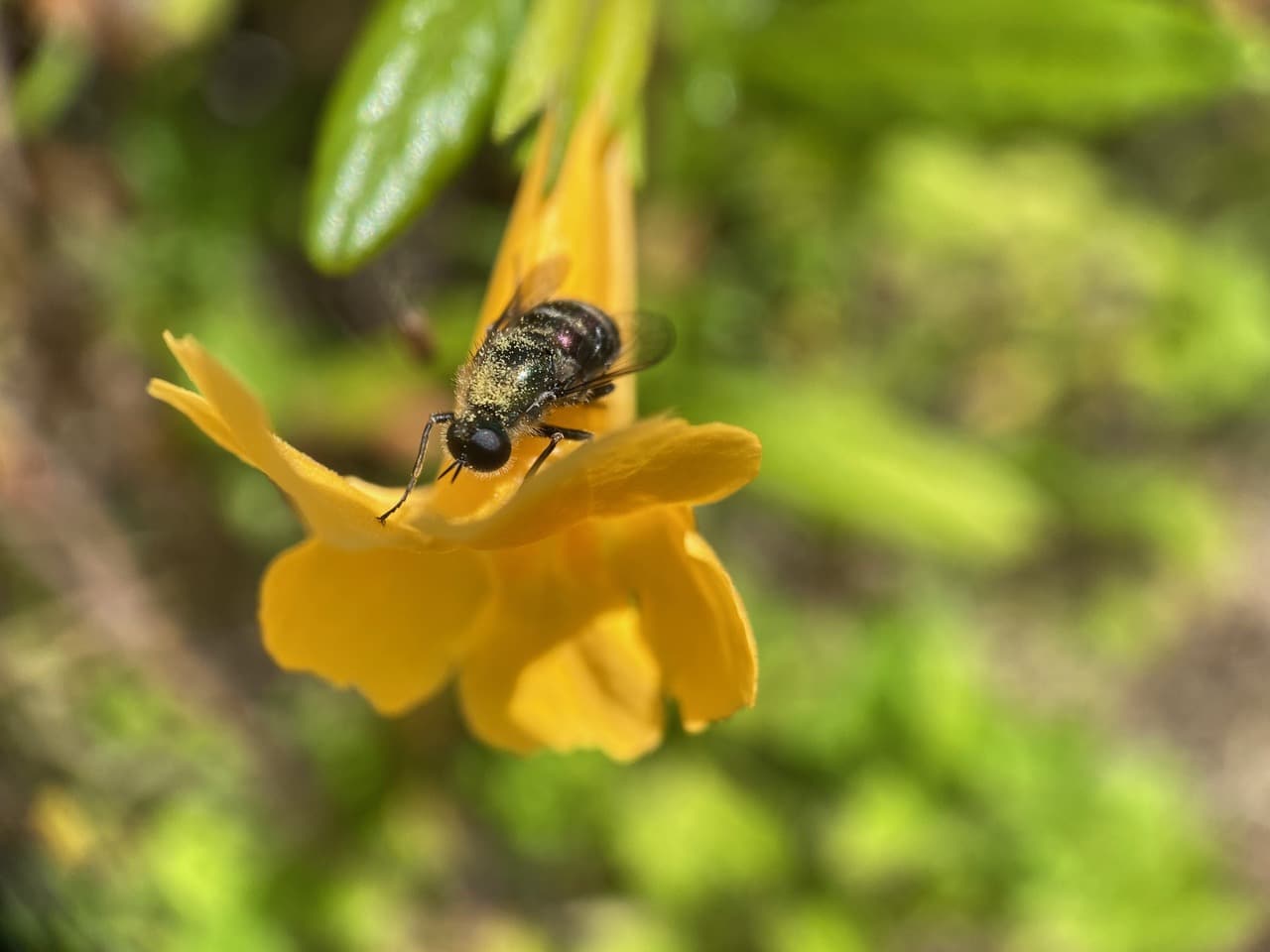
The fly flies to another flower and lands on top of the floral tube.
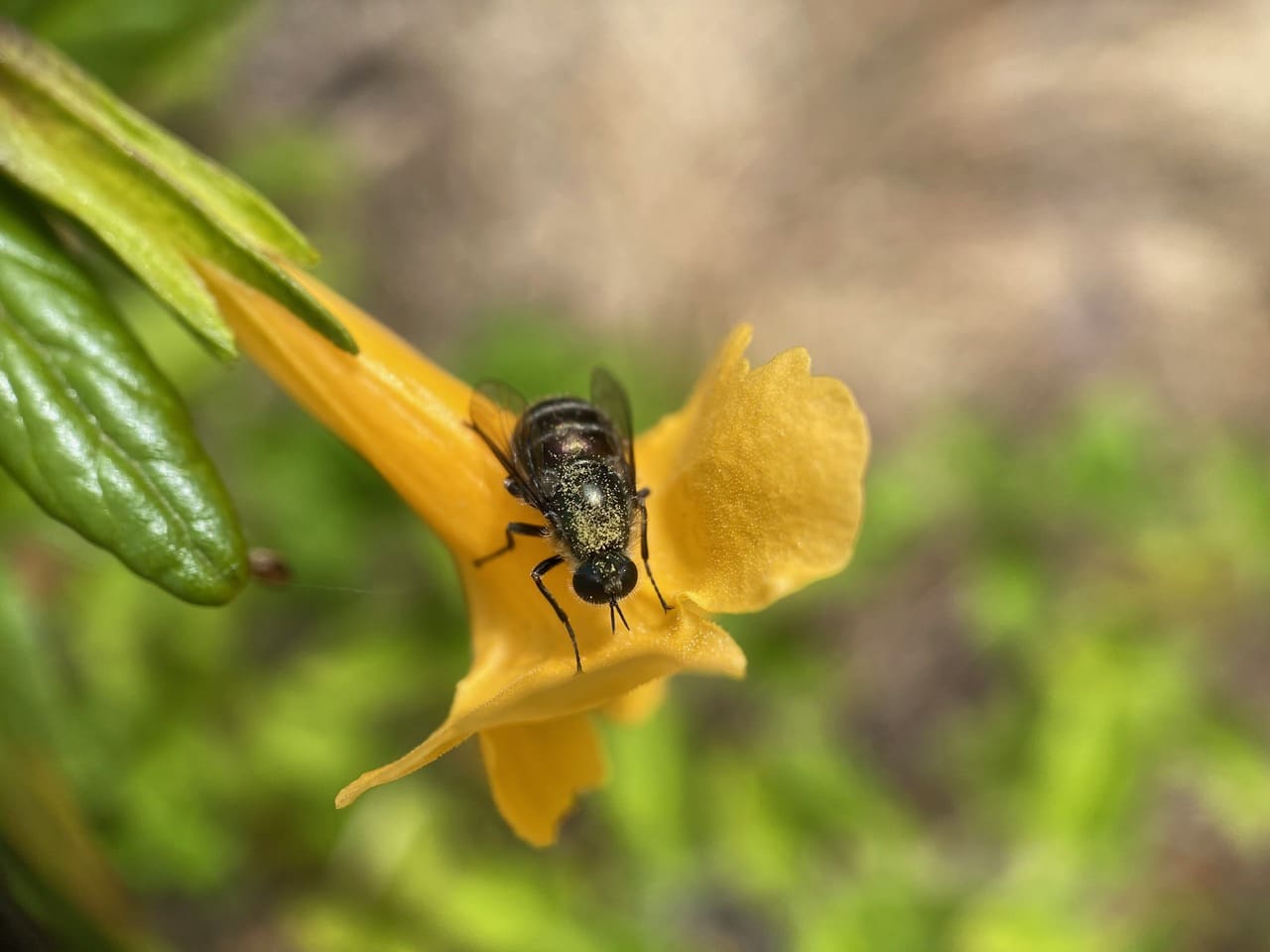
The fly is trying to soak up some sun so it can warm up and fly.
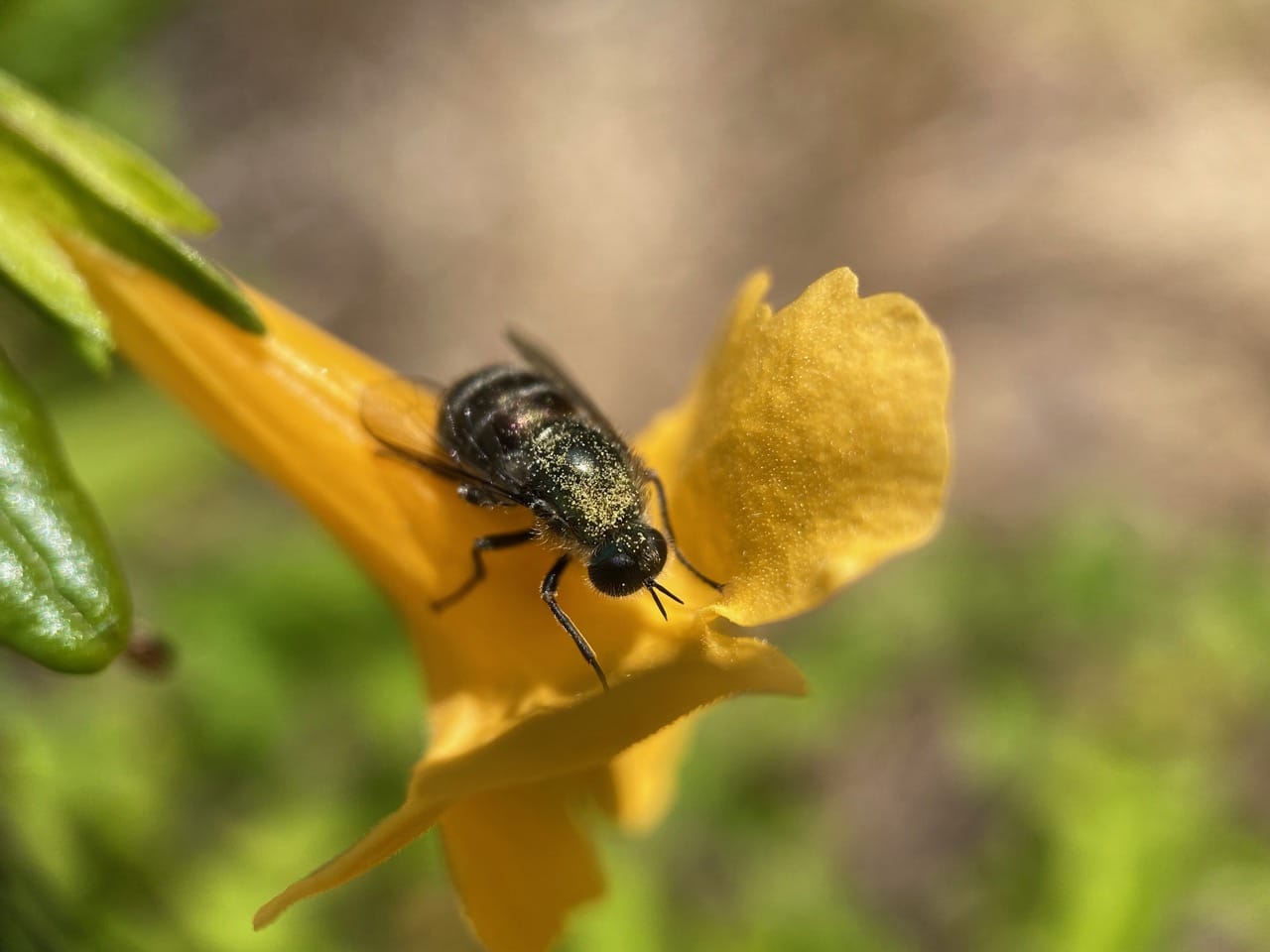
As far as is known, all Acroceridae are parasitoids of spiders. Not just any spiders, but the Mygalomorphs of a more ancient lineage. This Acrocerid species, most likely Eulonchus tristis is known to parasitize the California Turret Spiders. Females lay large numbers of eggs near their host nests. After hatching the young larvae, called planidia seek out the spiders. The planidia can move in a looping movement like an inchworm and can leap several millimeters into the air. When a spider contacts an Acrocerid planidium, the planidium grabs hold, crawls up the spider’s legs to its body, and forces its way through the body wall. Often, it lodges near the spider’s book lung, where it may remain for years before completing its development. Mature larvae pupate outside the host. The Acrocerid adults are nectar feeders with exceptionally long probosces which are folded on the underside of the body when not in use. Acrocerids are rare but can be locally abundant. They are believed to be efficient pollinators for some native plants, including the Sticky Monkeyflowers.
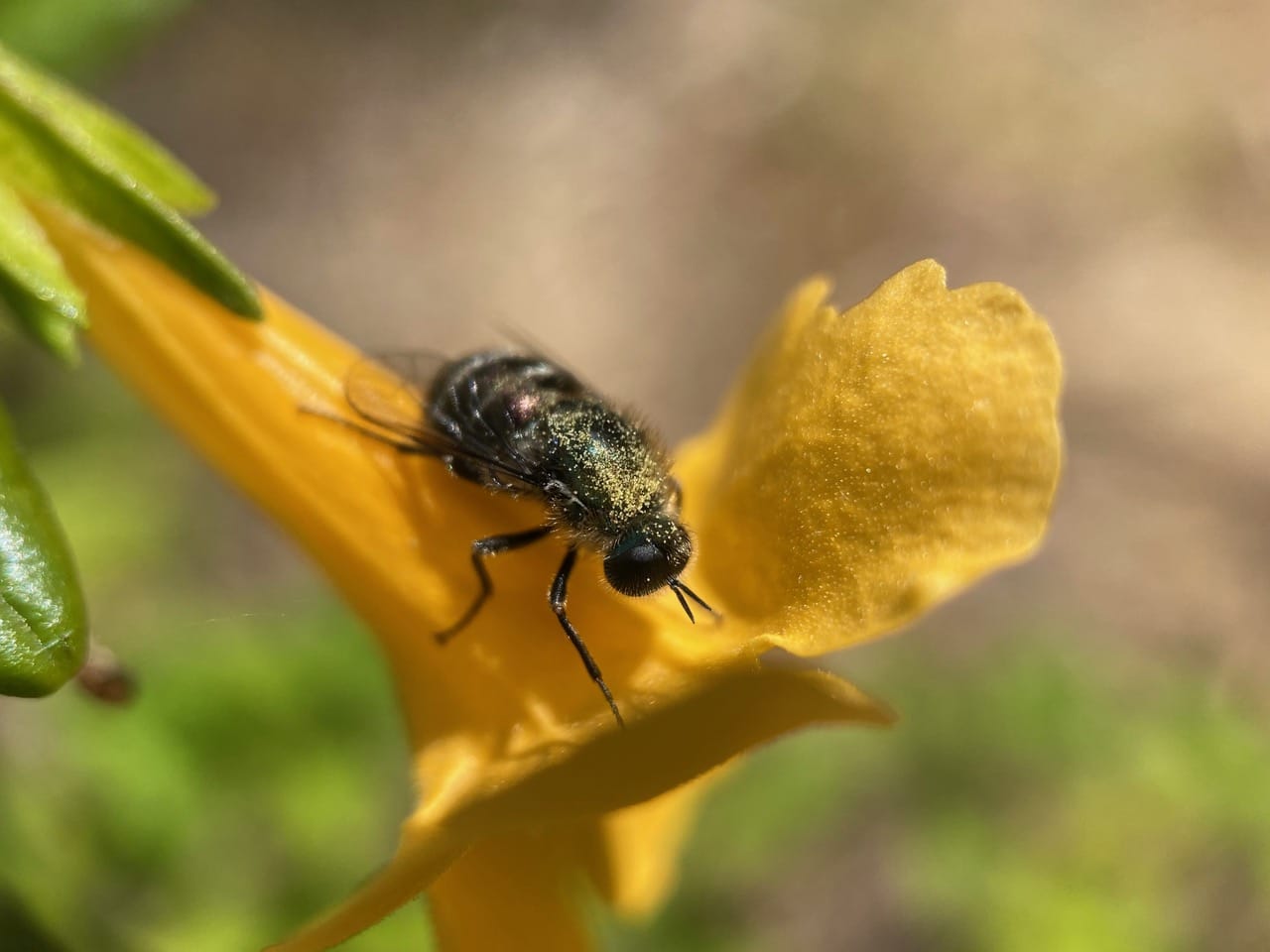
Closing in, I can see that its eyes are covered with short golden hairs.

Ooh, a fly has fallen victim to what looks like a Cobweb Spider at the entrance of a Sticky Monkeyflower. A tangle of faint silk lines has been laid by the spider to trap insects entering the flower.
Spiders in the family Teridiidae are called Cobweb Spiders. They make a messy, tangled scaffold with a central area consisting of a three-dimensional trellis of silk. From the web to the ground are vertical threads with sticky glue at the bottom. If an insect crawls against the thread it will break and the prey will hang in the air awaiting the attack of the spider. Although Cobweb Spiders are small, they are violent attackers that can take down prey much larger than themselves.
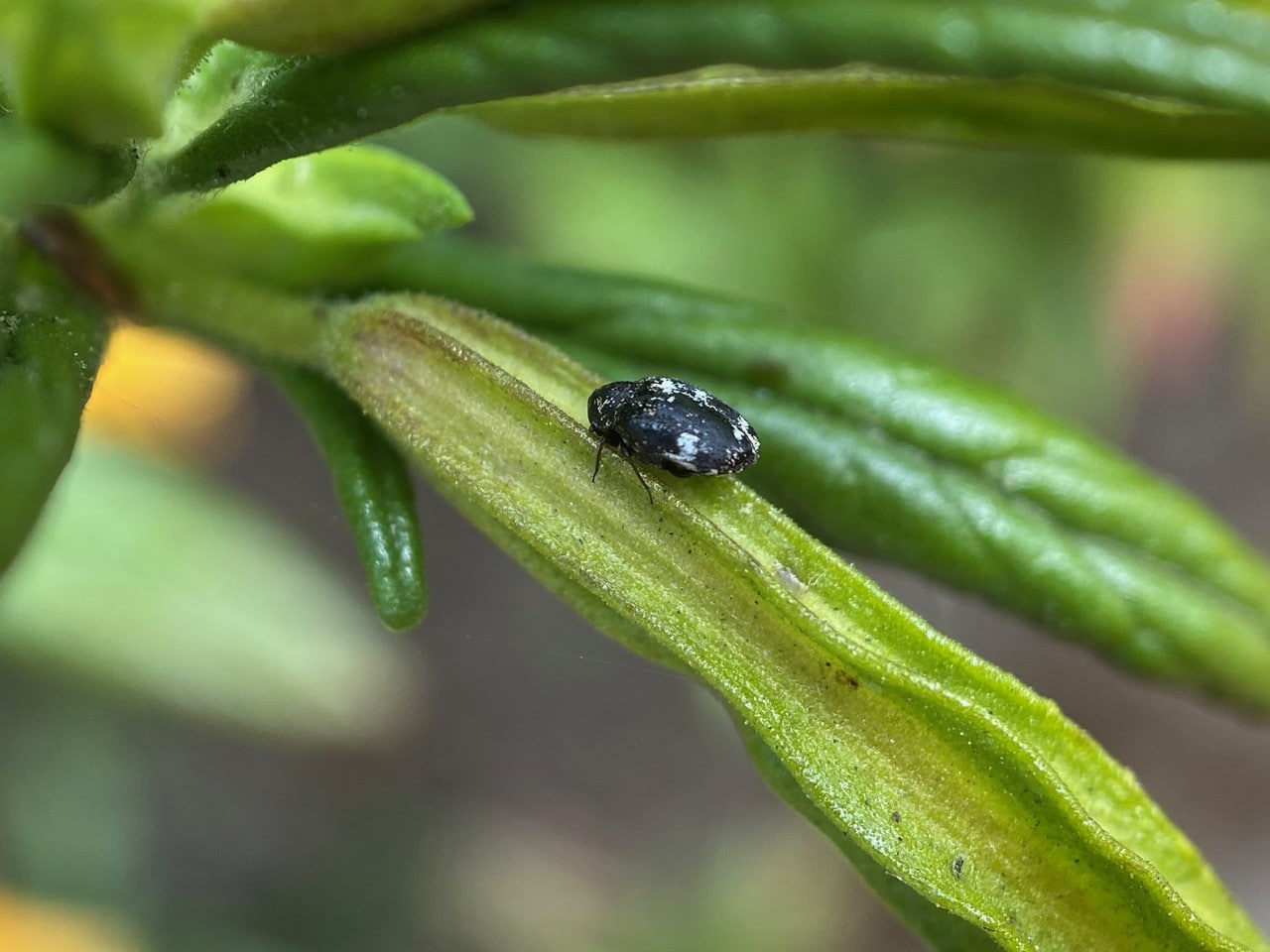
A Skin Beetle, Anthrenus lepidus (family Dermestidae) is resting on the calyx of a Sticky Monkeyflower. Rather surprising to see it here, as these beetles are normally seen among flowers feeding on pollen.
Dermestidae are a family of Coleoptera (beetles) that are commonly referred to as skin of carpet beetles. Ranging in size from 1 to 2 mm, the beetles typically have clubbed antennae that fit into deep grooves. Most Dermestids are scavengers that feed on dry animal or plant materials, such as skin or pollen, animal hair, feathers, dead insects and natural fibers. The larvae are used in taxidermy and by natural history museums to clean animal skeletons.
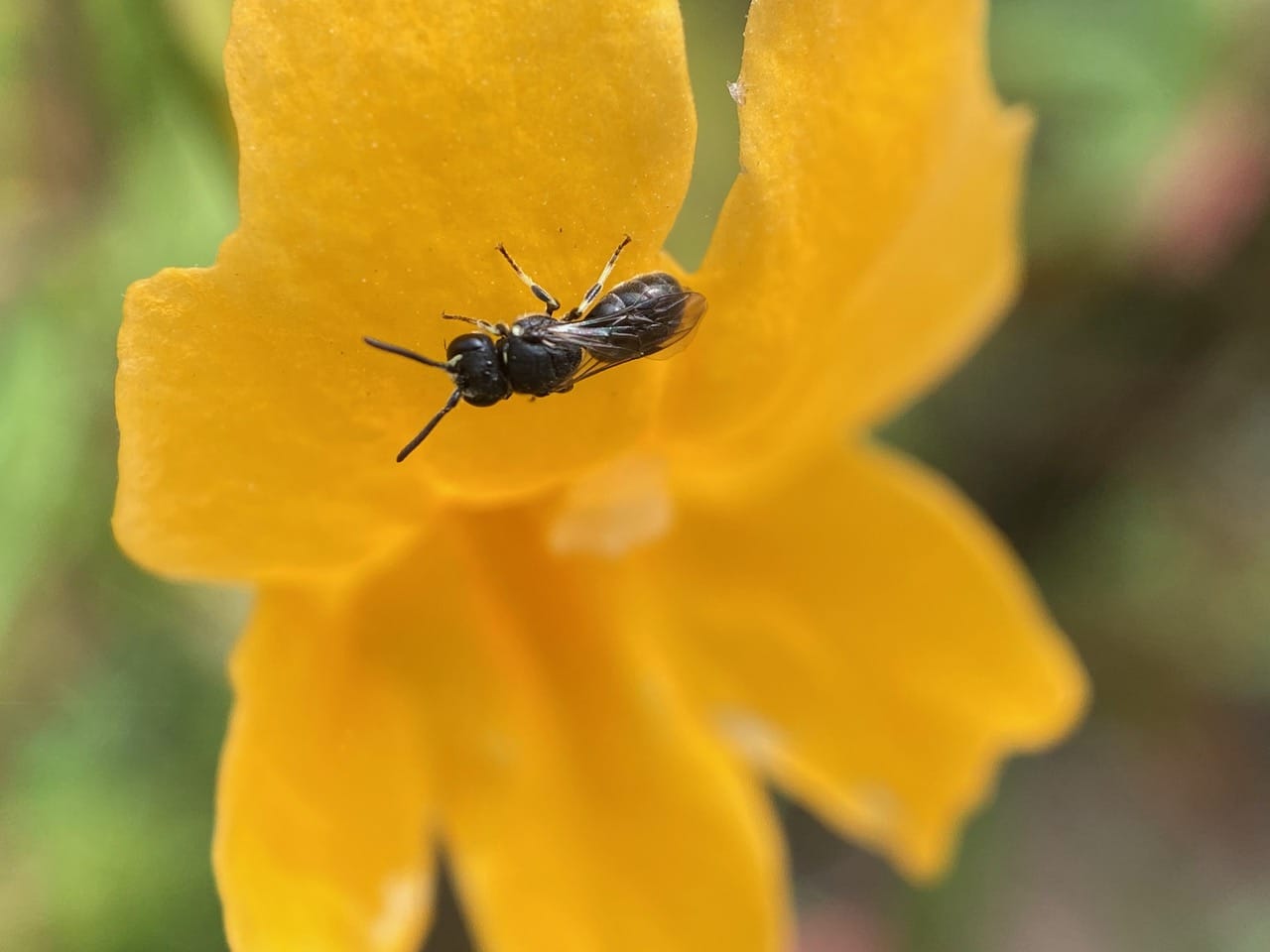
A small bee is crawling out of a Sticky Monkeyflower. From the yellow markings on its face and legs, I recognize it as a Masked Bee, Hylaeus sp. (family Colletidae).
Hylaeus (family Colletidae) are shiny, slender, hairless, and superficially wasp-like bees. They are small, 5 to 7 mm long, usually black with bright yellow or white markings on their face and legs. These markings are more pronounced on the males. Hylaeus do not carry pollen and nectar externally, they instead store their food in the crop and regurgitate it upon returning to their nests. They are primarily generalist foragers. Hylaeus are short-tongued, but their small body size enables them to access deep flowers. Hylaeus nest in stems and twigs, lining their brood cells with self-secreted cellophane-like material. They lack strong mandibles and other adaptations for digging, using instead pre-existing cavities made by other insects.

Here’s good look at the Masked Bee’s face as she lifts off from the upper petal.
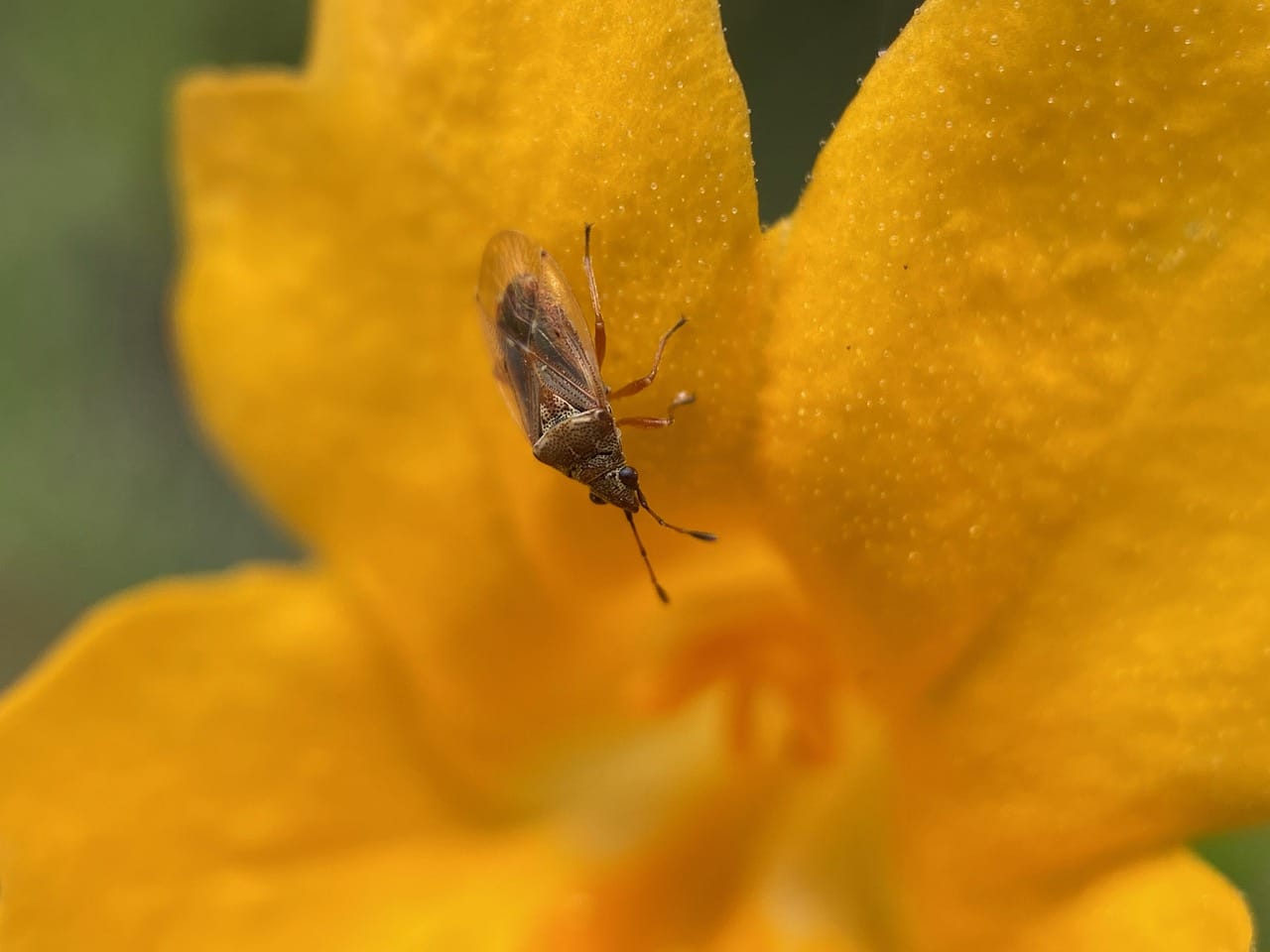
A Seed Bug, Kleidocerys franciscanus (family Lygaeidae) is walking on the upper lip of a Sticky Monkeyflower.
The family Lygaeidae is commonly referred to as seed bugs. However, while many of the species feed on seeds, some feed on sap or seed pods, others are omnivores and a few are carnivores. Lygaeidae are oval or elongate in body shape and have four-segmented antennae. They are distinguished from Miridae (plant bugs) by the presence of ocelli, or simple eyes.
Herbivorous bugs in the order Hemiptera feed on plants through a proboscis, a hypodermic-needlelike structure they use to probe into plant tissue and drink up plant fluids. Seeds are predigested with injected digestive enzymes, then sucked up through the same mouthparts.
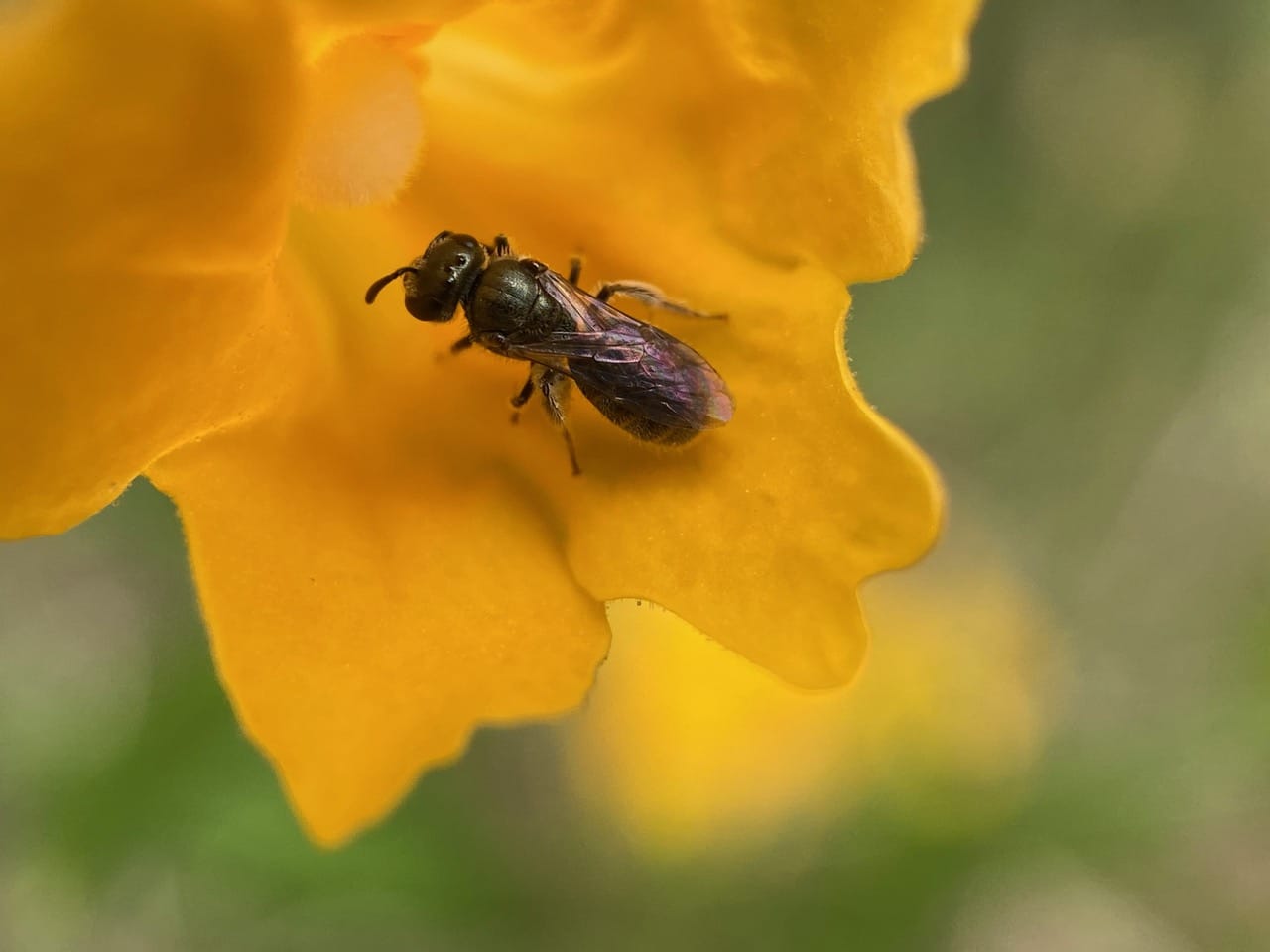
A shiny black bee is about to enter a Sticky Monkeyflower. She has very modest scopae on her hind legs. The bee is a Small Carpenter Bee, Ceratina sp. (family Apidae).
The Small Carpenter Bee genus Ceratina is closely related to the more familiar, and much larger Carpenter Bees (genus Xylocopa). Ceratina are typically dark, shiny, even metallic bees, with fairly sparse body hairs and a weak scopa on the hind leg. The shield-shaped abdomen comes to a point at the tip. Some species have yellow markings, often on the face.
Females excavate nests with their mandibles in the pith of broken or burned plant twigs and stems. While many species are solitary, a number are subsocial. Both male and female carpenter bees overwinter as adults within their old nest tunnels, emerging in the spring to mate. In the spring, this resting place (hibernaculum) is modified into a brood nest by further excavation. The female collects pollen and nectar, places this mixture (called bee bread) inside the cavity, lays an egg on the provision, and then caps off the cell with chewed plant material. Several cells are constructed end to end in each plant stem.

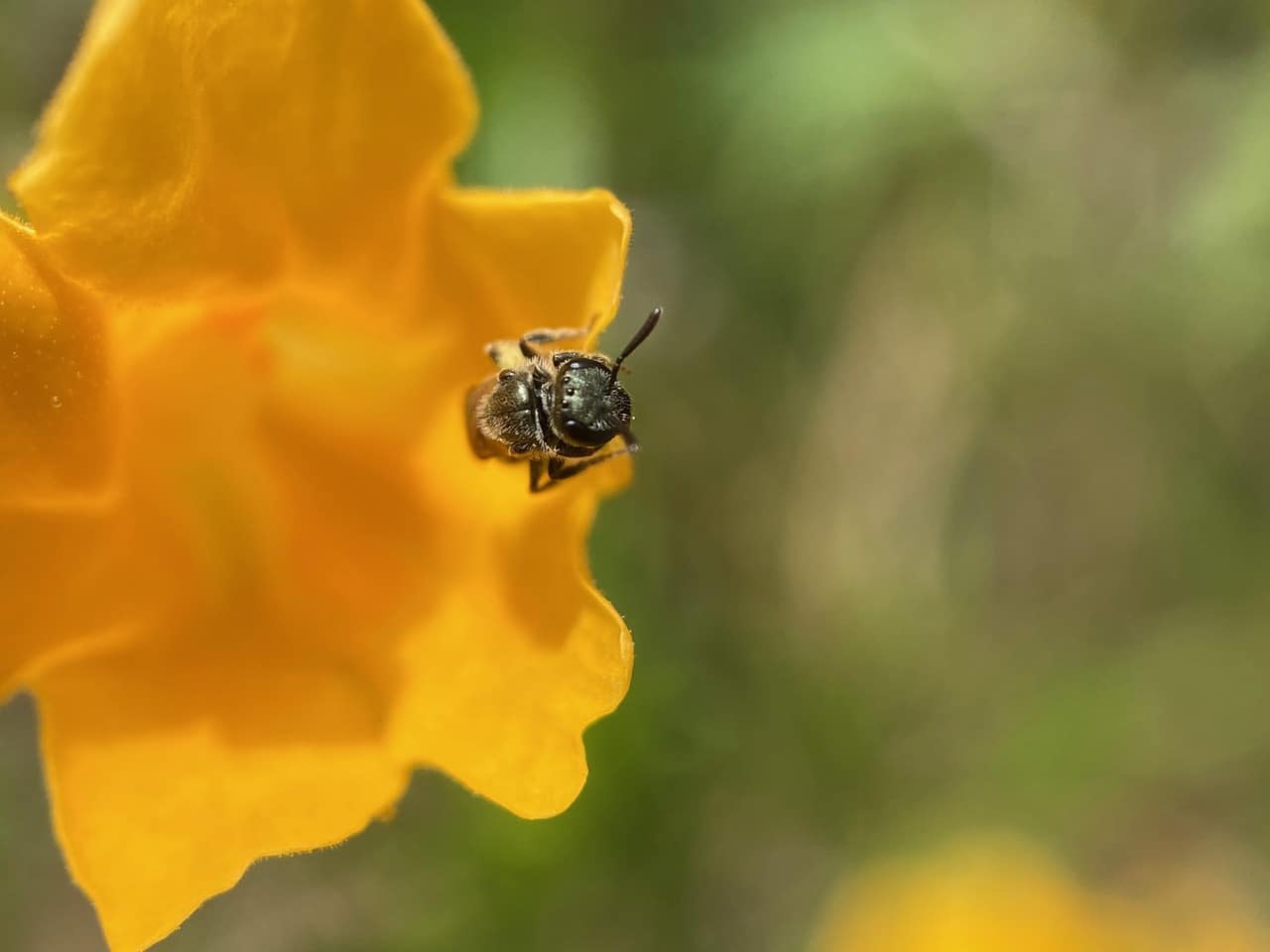
A little bee crawls out of a Sticky Monkeyflower, and looks out from the edge of a petal.
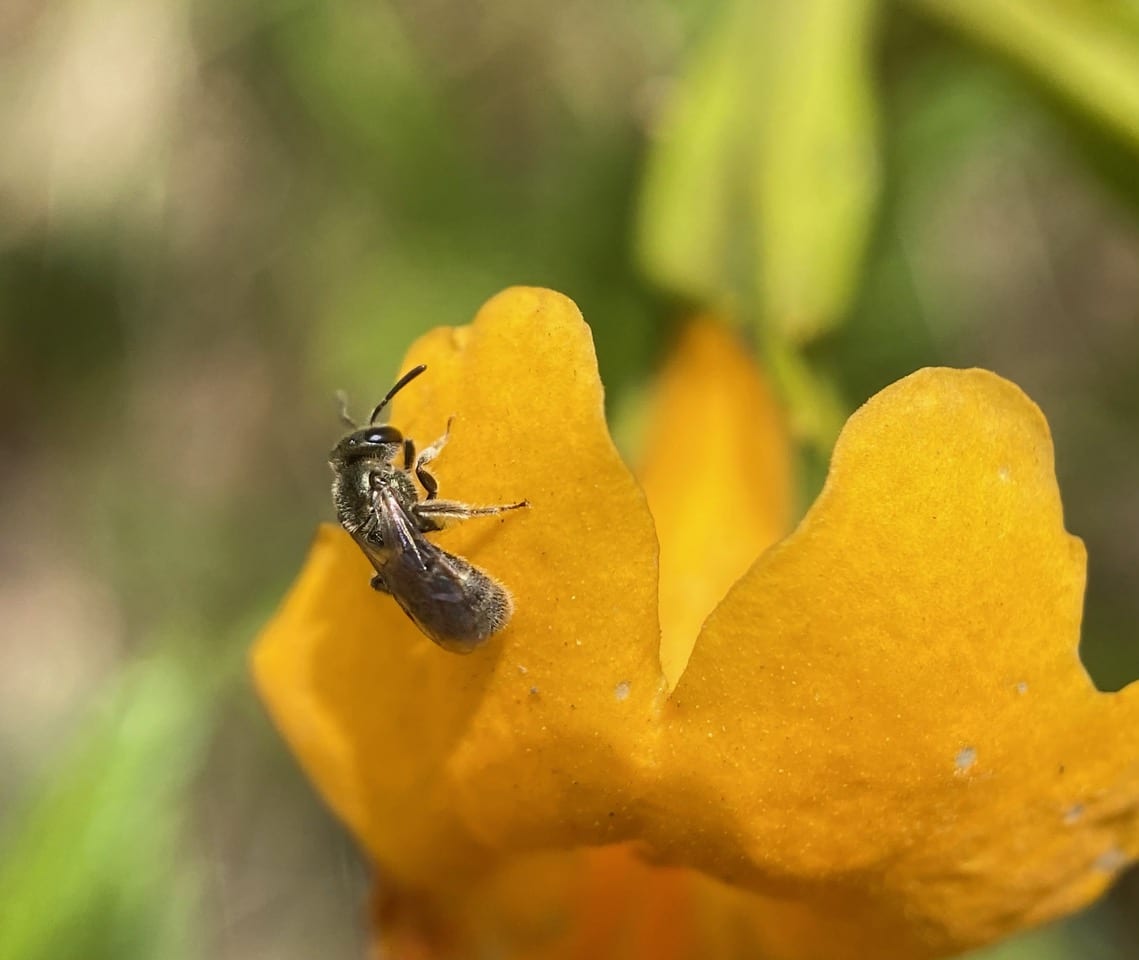
It is a Metallic Sweat Bee, Lasioglossum (Dialictus) sp. (family Halictidae).
Lasioglossum species are found worldwide, and they constitute the largest bee genus. The subgenus Dialictus are the most likely to be seen in the U.S., with over 300 species of these tiny metallic bees. The majority of Lasioglossum are generalists. Because they are so abundant throughout the flowering season, the bees are often important pollinators. Their sheer numbers are enough to achieve excellent pollination of many wild flowers, especially of plants in the Asteraceae, which have shallow floral tubes that are easily accessed by these minute bees.
Lasioglossum are closely related to the genera Halictus and Agapostemon. These genera are commonly called “sweat bees” because of their attraction to human sweat, which they drink for its salt content. Lasioglossum are dusky black to brown slender bees with bands of hair on their abdomen. Female Sweat Bees (family Halictidae) carry pollen in the scopae on their entire hind legs and underside of their abdomen.