

Pollinator Post 6/3/24 (1)

At Siesta Gate, a Yellow-faced Bumble Bee, Bombus vosnesenskii (family Apidae) lies motionless on a spent inflorescence of California Phacelia, Phacelia californica. It is 9:45 am and not yet hot. Could the bee be resting from exhaustion? She has not been gathering pollen – her pollen baskets are empty. Is she sick? Parasitized?
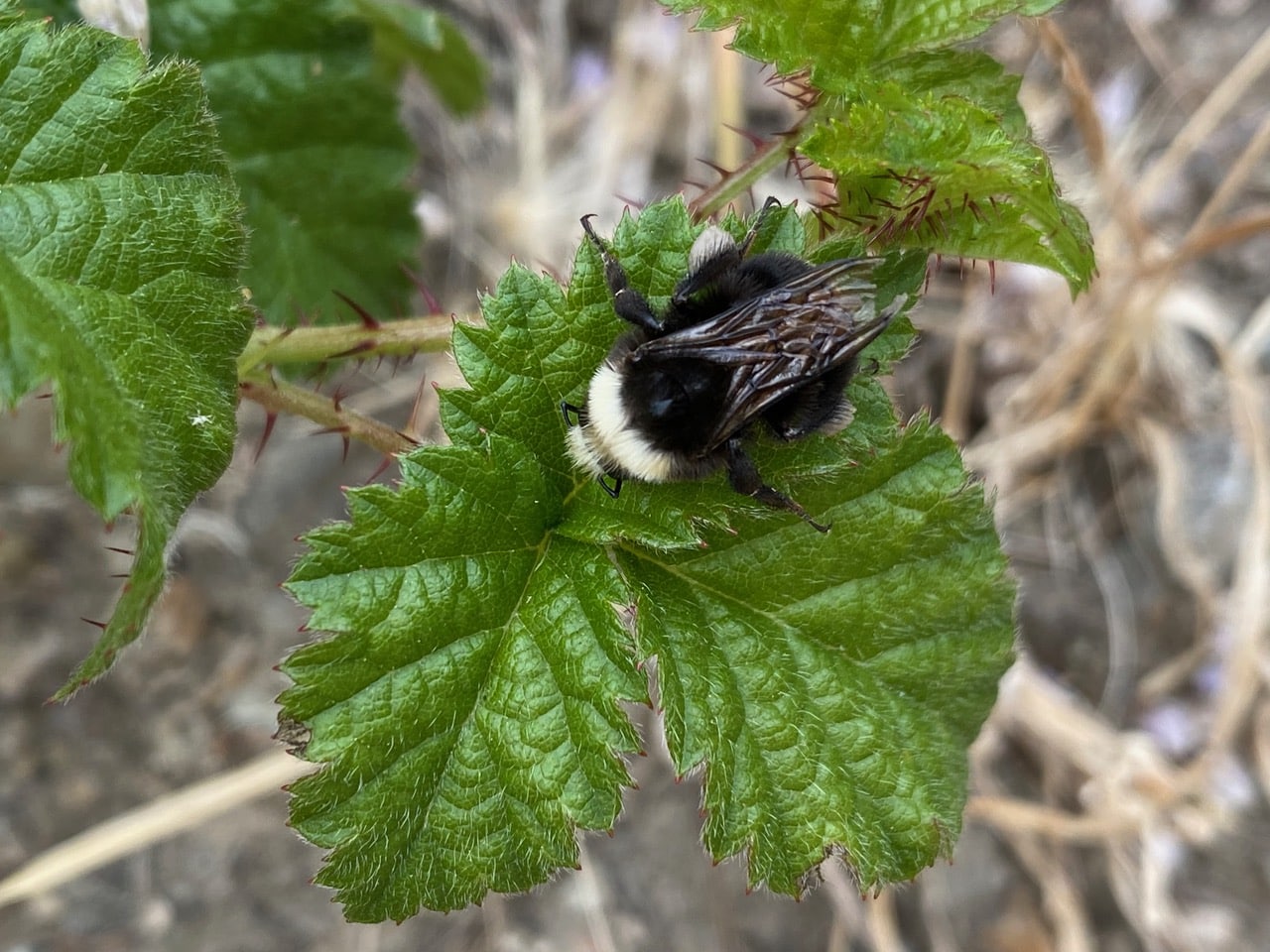
Here’s another Yellow-faced Bumble Bee draped over a leaf of Blackberry close by. Judging by the load in her pollen baskets, this bee has been gathering pollen from California Phacelia. Why are the bees moribund? They appear to be in good shape otherwise. As I look around, the bees begin to stir and move around, and eventually fly away. Maybe the bees do run out of energy sometimes.

I see many small bumble bees these days. Some are getting a little ragged, with balding thorax. Inevitably the workers are aging as the season progresses.

A Soldier Beetle, Cultellunguis americanus (family Cantharidae) is probing deep into the flowers of California Phacelia. I wonder what it is after – nectar, or small insects? These beetles are omnivores.
The Soldier Beetles, family Cantharidae are relatively soft-bodied, straight-sided beetles. One of the first described species has a color pattern reminiscent of the red coats of early British soldiers, hence the common name. They are also known commonly as Leatherwings because of their soft elytra.
Soldier beetles often feed on both nectar and pollen as well as predating on other small insects. The larvae are often active, and feed on the ground, hunting snails and other small creatures. Soldier beetles are generally considered beneficial insects by gardeners.

A small dark bee with metallic sheen lands on an inflorescence of California Phacelia. It is already loaded with pollen on its extensive scopae on the hindlegs.

It is a Metallic Sweat Bee, Lasioglossum (Dialictus) sp. (family Halictidae).
Lasioglossum species are found worldwide, and they constitute the largest bee genus. The subgenus Dialictus are the most likely to be seen in the U.S., with over 300 species of these tiny metallic bees. The majority of Lasioglossum are generalists. Because they are so abundant throughout the flowering season, the bees are often important pollinators. Their sheer numbers are enough to achieve excellent pollination of many wild flowers, especially of plants in the Asteraceae, which have shallow floral tubes that are easily accessed by these minute bees.
Lasioglossum are closely related to the genera Halictus and Agapostemon. These genera are commonly called “sweat bees” because of their attraction to human sweat, which they drink for its salt content. Lasioglossum are dusky black to brown slender bees with bands of hair on their abdomen.
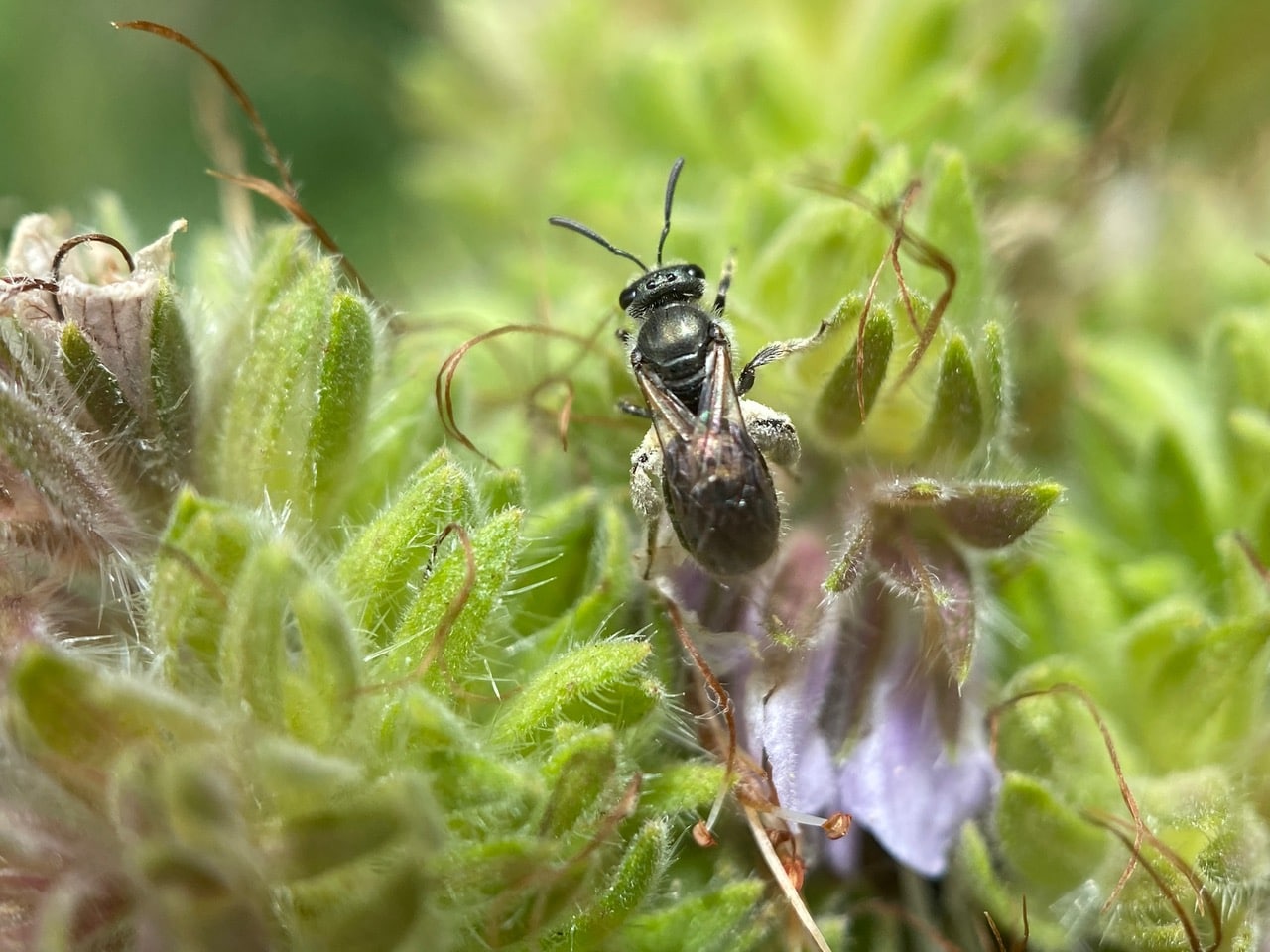
Dialictus is a subgenus of Sweat Bees belonging to the genus Lasioglossum. Most of the members of this subgenus have a subtly metallic appearance, and are small, about 3.4-8.1 mm in size. They are commonly found in Northern Hemisphere and are found in abundance in North America. As in the other members of the family Halictidae, the bees have very diverse forms of social structure, making them model organisms for studying the social behavior of bees.

A Meadow Spittlebug, Philaenus spumarius (family Aphrophoridae) is perched on a leaf of a California Mugwort, Artemisia douglasiana. The insect, also called a Froghopper, is the adult form of spittlebugs who made the foamy masses we have been seeing on the plants earlier in the season.
The Froghopper is a “true bug” in the order Hemiptera, family Aphrophoridae. Froghoppers are champion jumpers among insects, out-performing even the fleas. The bug can leap the human equivalent of a skyscraper without a running start! The muscles in its hind legs act like a “catapult” to release energy explosively. Its athletic prowess not withstanding, the Froghopper is better known for its young, the “spittle bugs”. The nymphs produce foamy white masses on plants within which they feed on plant sap. Froghoppers have piercing-sucking mouthparts, and feed on plant sap as both nymphs and adults. A recent report claims, “Froghoppers are the super-suckers of the animal world. The tiny insects produce negative pressures equivalent to people sucking a 100-meter-long straw.” So the little bug has two titles under its belt – champion jumper, and super-sucker!
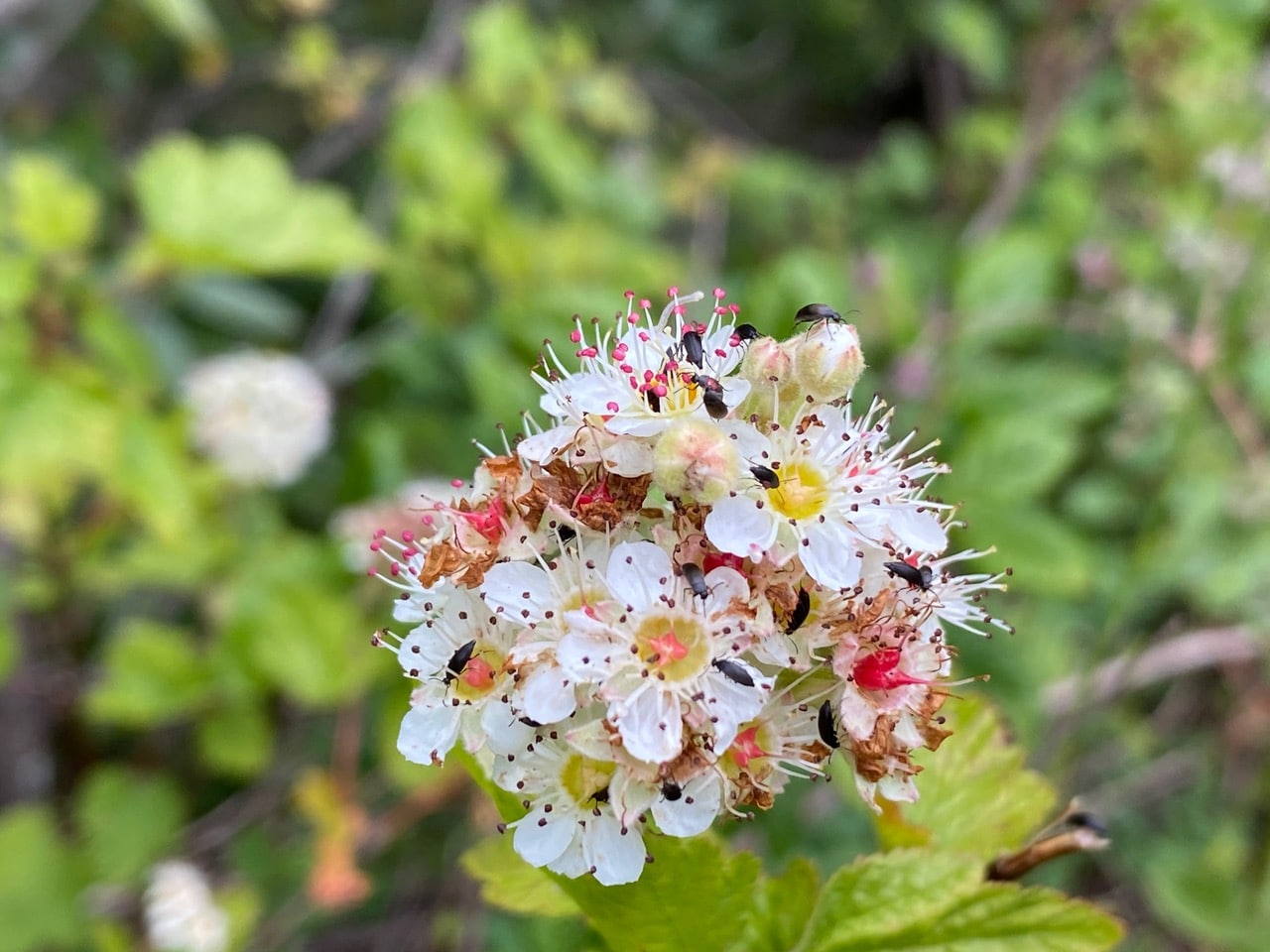
The inflorescence of Pacific Ninebark, Physocarpus capitatus is dotted with dark insects.
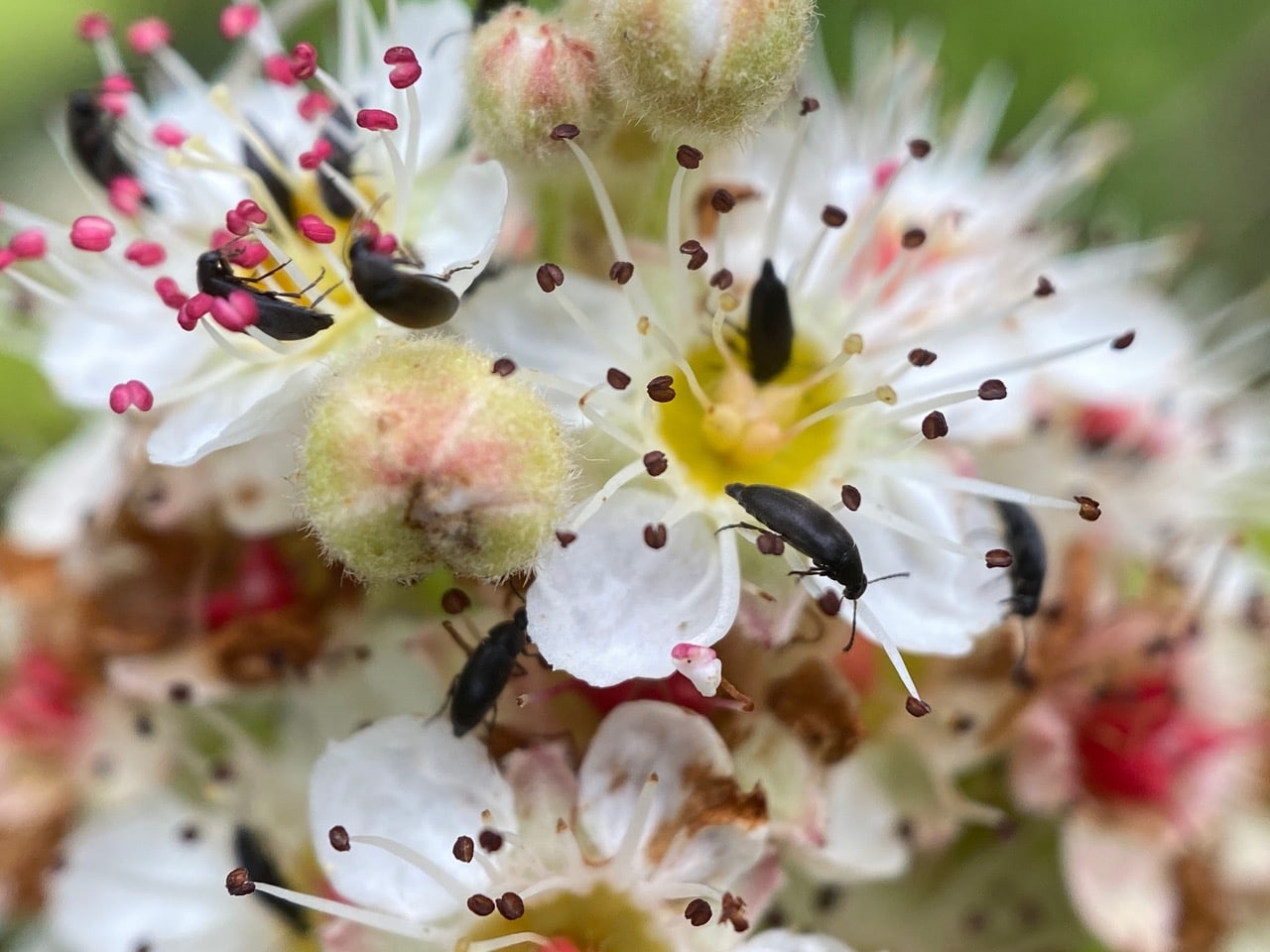
The insects are mostly False Flower Beetles (family Scraptiidae) foraging for pollen and nectar.
False Flower Beetles (family Scraptiidae) are commonly found in western North America. The adults are found on flowers, sometimes in large numbers, but are also found on foliage. The larvae are typically found under the bark of dead trees.

The large seed heads or “puff balls” of the Giant Mountain Dandelion, Agoseris grandiflora (family Asteraceae) are releasing their plumed seeds to the wind. The parachute-like plumes are pappuses, characteristic of plants in the sunflower family Asteraceae. The pappus is the modified calyx, the part of an individual floret that surrounds the base of the corolla tube in flower. It functions as a wind-dispersal mechanism for the seeds. The slightest breeze sends the plumed seeds flying.
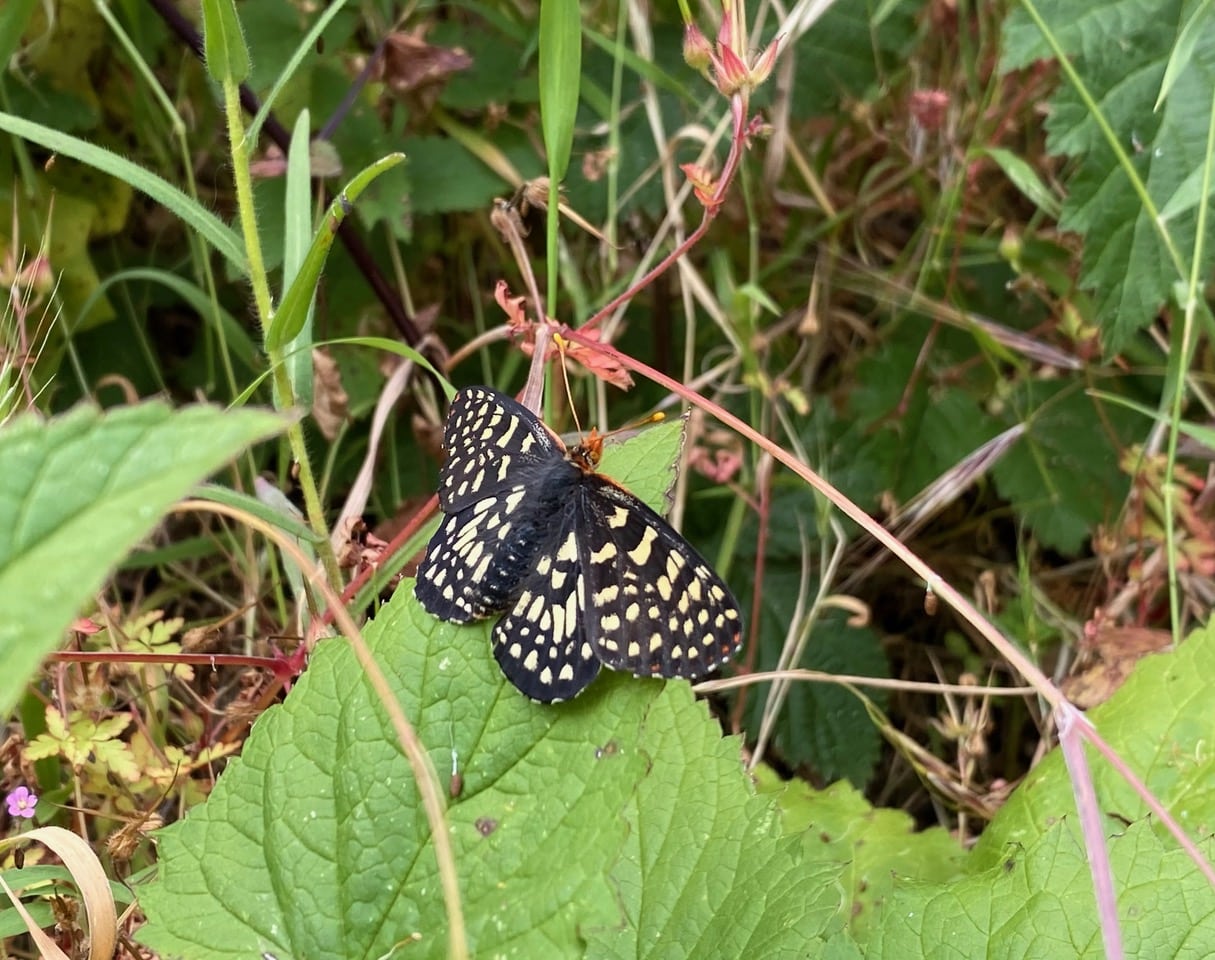
A Variable Checkerspot butterfly, Euphydryas chalcedona (family Nymphalidae) is perched on a leaf of California Bee Plant, Scrophularia californica, one of its favorite larval food plants. Is it about to lay eggs on the plant?
The Variable Checkerspot caterpillars have a wide-ranging appetite, feeding on a variety of plants, but they seem to gravitate to Bee Plant and Sticky Monkeyflower, Diplacus aurantiacus. These plants provide the caterpillars with iridoid glycoside, a chemical that imparts unpalatable taste to birds, protecting the caterpillars from predators. Larvae feed in large, loose groups on the host plants. Individuals overwinter (enter diapause or hibernation) as third or fourth instar larvae in sheltered sites under bark or dead branches, in hollow stems and in rock crevices. Pupation begins in early to mid April and the adult flight season begins between mid-April and May and continues into June. The adults feed exclusively on nectar, and have a life span of about 15 days.
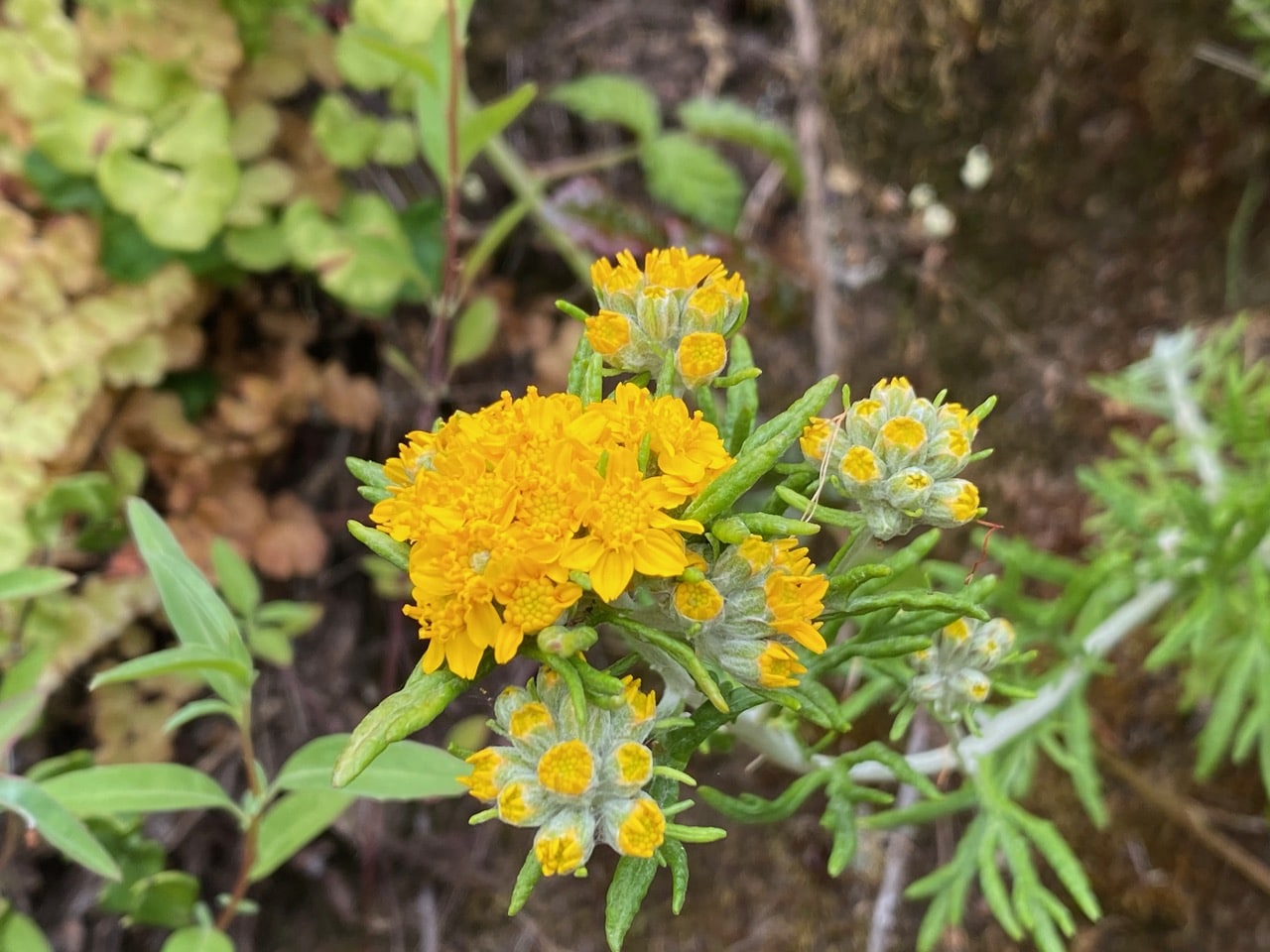
The Golden Yarrow, Eriophyllum confertiflorum has started to bloom on the rocky bank along Skyline Trail.
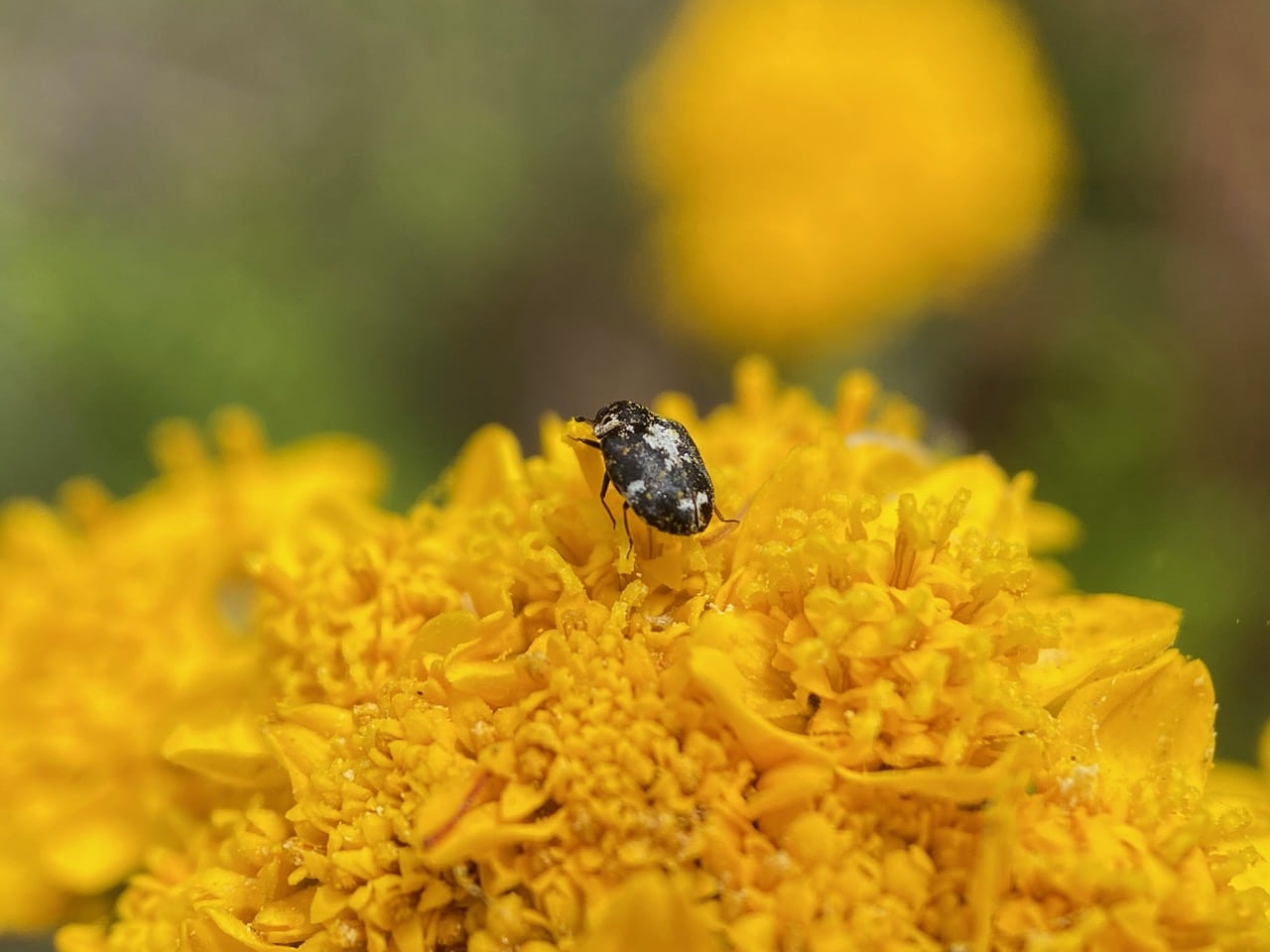
A Skin Beetle, Anthrenus lepidus (family Dermestidae) is feeding on pollen on an inflorescence of Golden Yarrow.
Dermestidae are a family of Coleoptera (beetles) that are commonly referred to as skin of carpet beetles. Ranging in size from 1 to 2 mm, the beetles typically have clubbed antennae that fit into deep grooves. Most Dermestids are scavengers that feed on dry animal or plant materials, such as skin or pollen, animal hair, feathers, dead insects and natural fibers. The larvae are used in taxidermy and by natural history museums to clean animal skeletons.
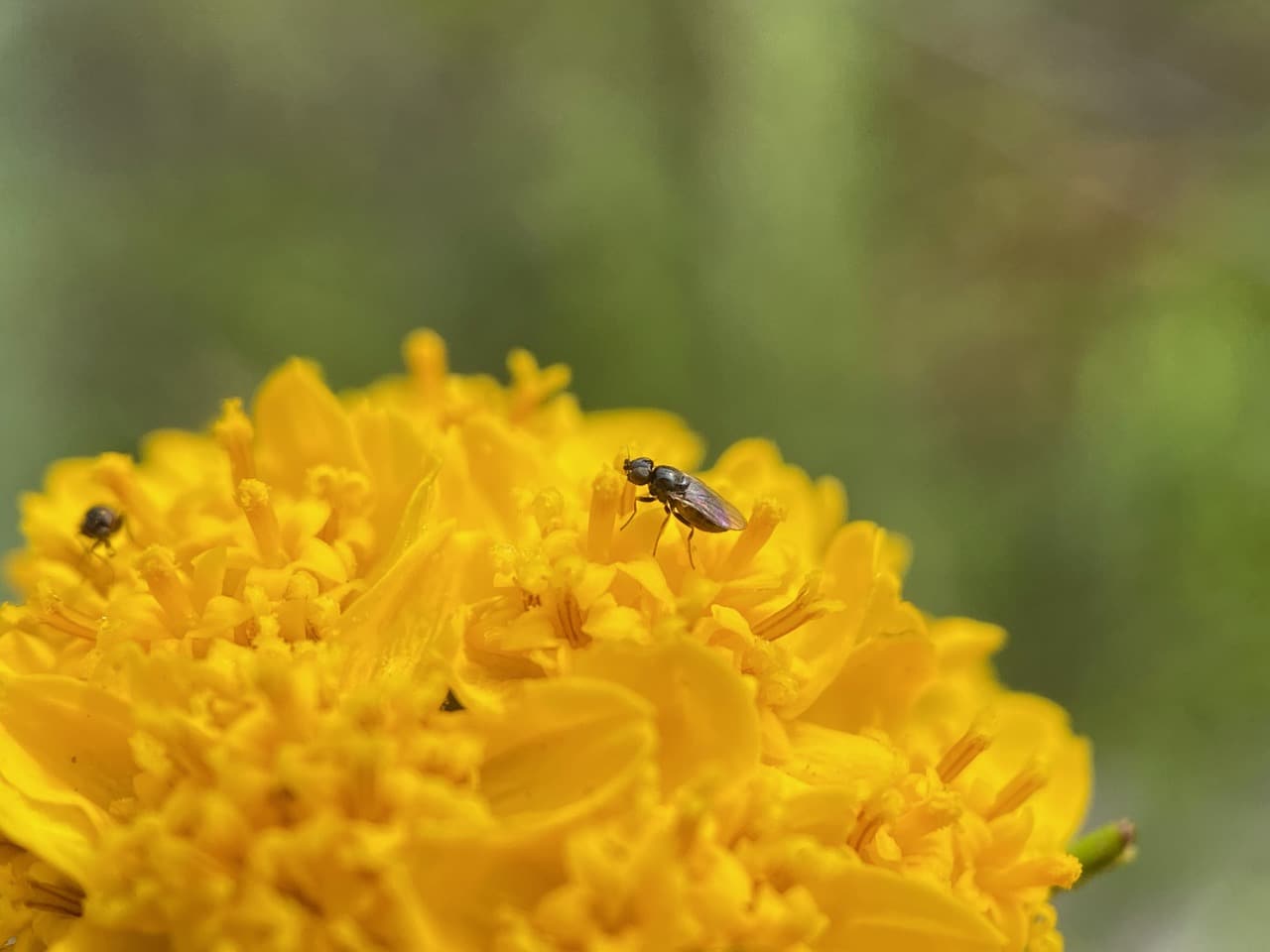
A few tiny flies, barely 2 mm long, are roaming the flowers of Golden Yarrow. They appear to be Leaf-miner Flies (family Agromyzidae).
The Agromyzidae are a family commonly referred to as the Leaf-miner Flies, for the feeding habits of their larvae, most of which are leaf miners on various plants. They are small flies, most species in the range of 2-3 mm. Agromyzidae larvae are phytophagous, feeding as leaf miners, less frequently as stem miners or stem borers. A few live on developing seeds, or produce galls. There is a high degree of host specificity. A number of species attack plants of agricultural or ornamental value, so are considered pests. The shape of the mine is often characteristic of the species and therefore useful for identification. Adults occur in a variety of habitats, depending on the larval host plants.
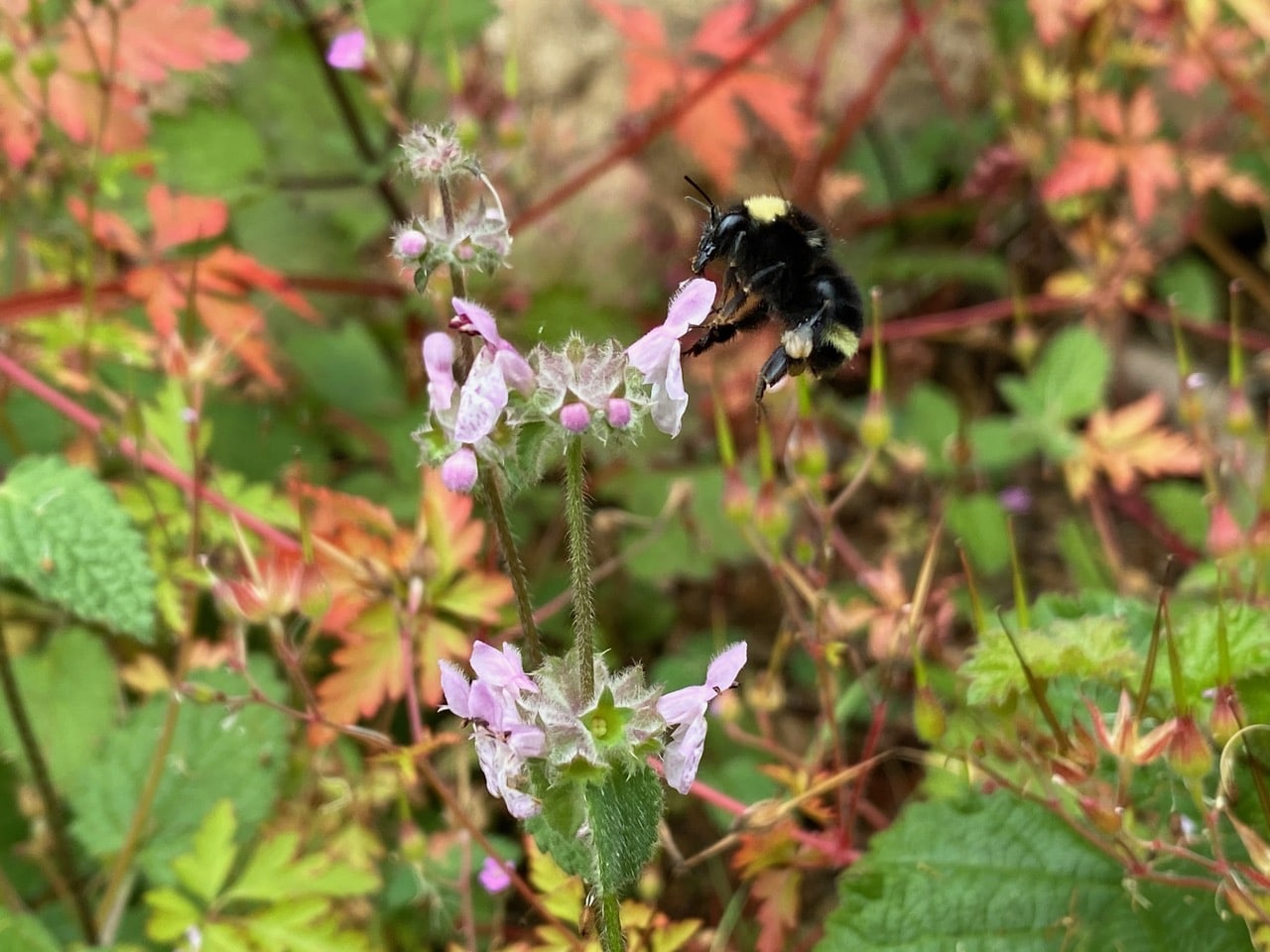
When I review this photo of a bumble bee foraging on a Wood Mint flower, Stachys ajugoides, I notice that it does not have a yellow face. Perhaps it is not a Yellow-faced Bumble Bee, Bombus vosnesenskii, but the rare California Bumble Bee, Bombus californicus (family Apidae)!
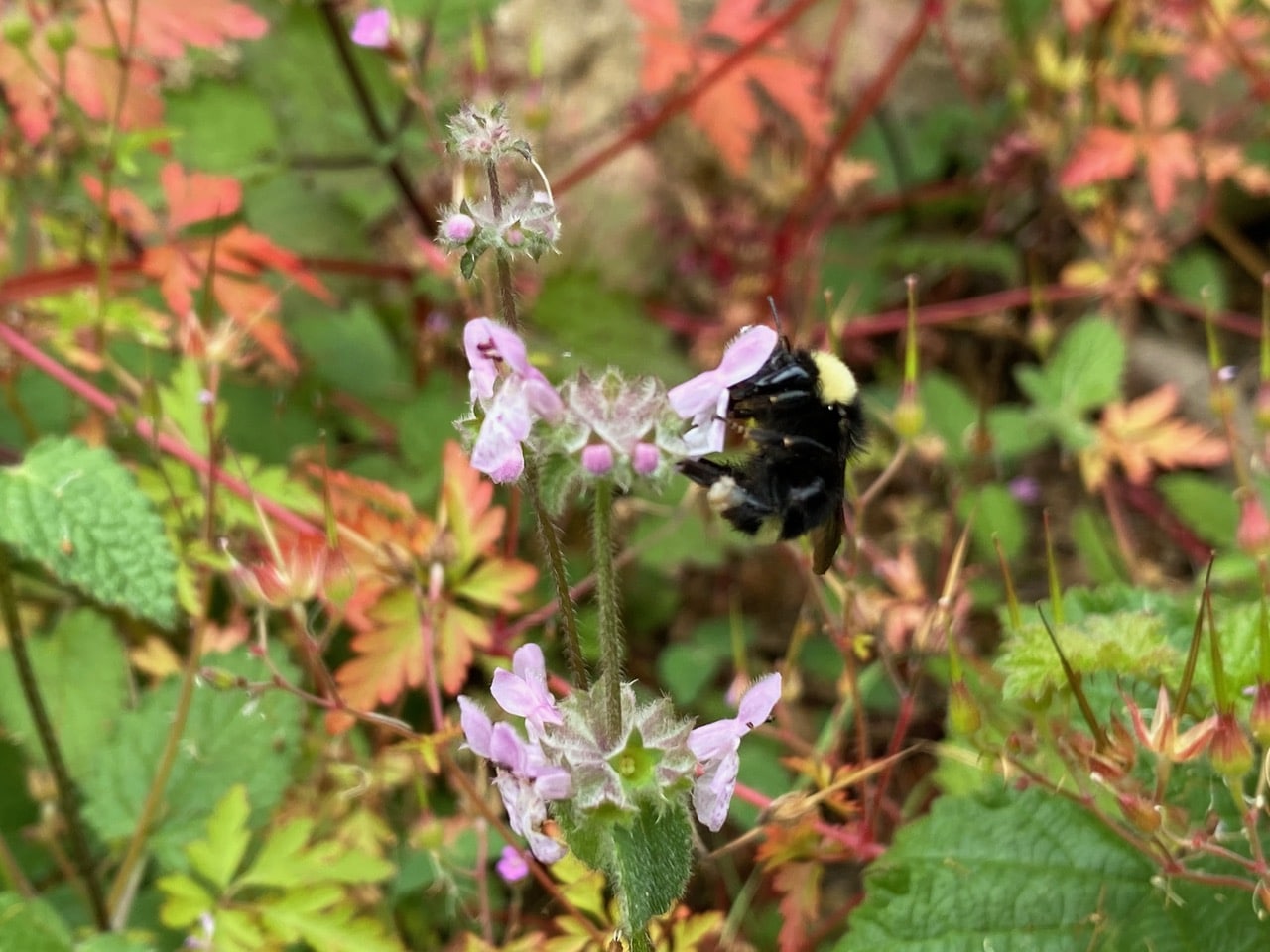
Here’s another picture of the same bee, showing that its head is all black. It is the first California Bumble Bee I have seen this year!
Bombus californicus, the California Bumble Bee, is found in Central and the western half of North America. The species is now classified as Vulnerable by the IUCN. It was the most common bumble bee in California until about the 1990s when its numbers and distribution began to decline. Many factors may have contributed to its decline, including invasive species, pesticide use, commercial bumble bee rearing, habitat destruction, and climate change.
Although morphologically the species is quite variable, the “typical” color pattern of female B. californicus is black with only a single strong yellow band anteriorly on the thorax, and another single yellow band near the apex of the abdomen. Males exhibit considerably more variation.
The California Bumble Bee is an important pollinator in alpine environments in its native range. They are social bees having a queen and workers. Their colonies last for one year. New queens overwinter, usually underground, and found new colonies from scratch the following year. Queens emerge from April through mid July. Workers are present from April to September. The species is known to pollinate sage, blueberry bushes, red clover, California poppies, and many other species of flowers.
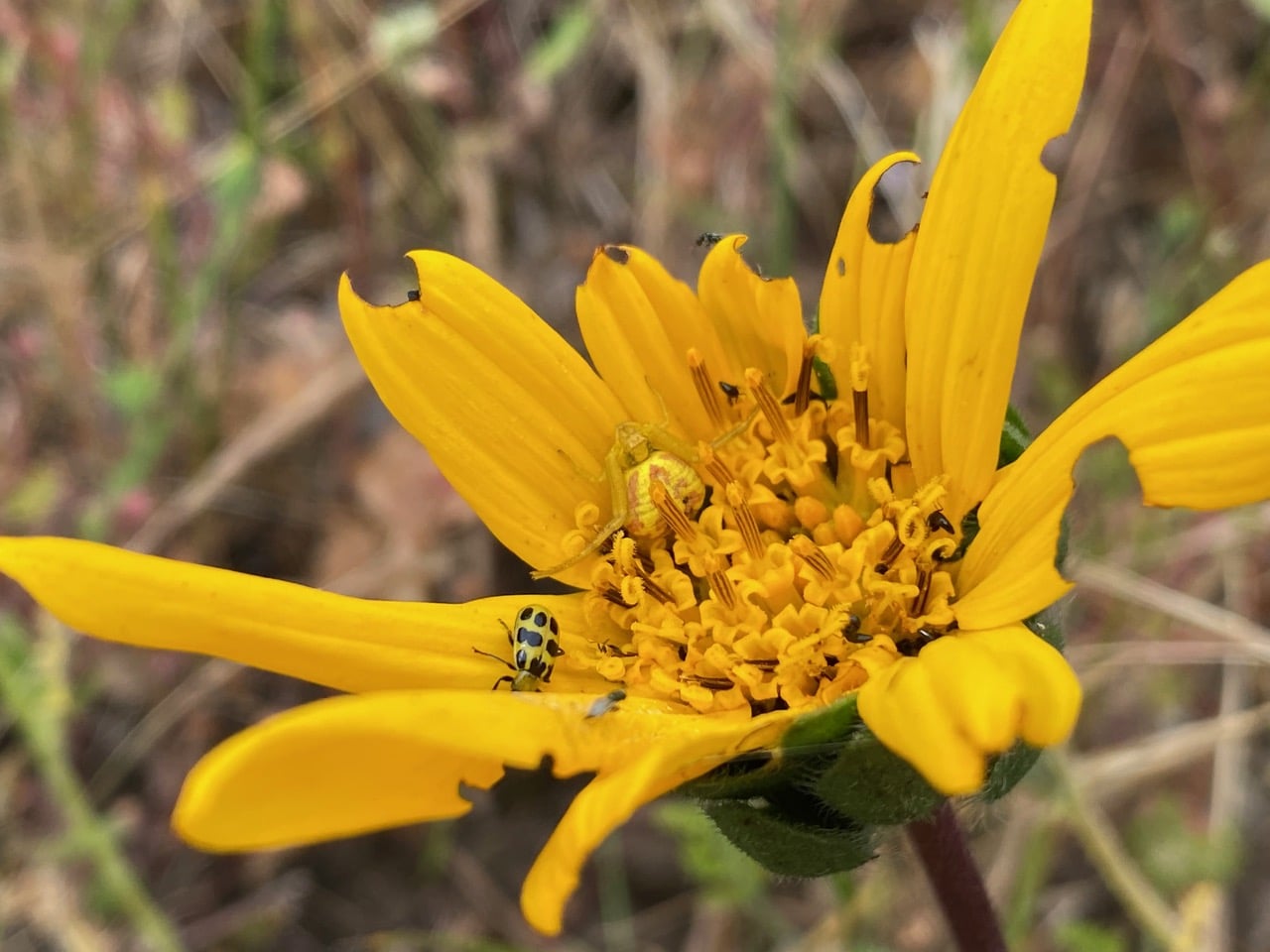 This is one of the last Narrowleaf Mule’s Ear, Wyethia angustifolia still in bloom. It seems all the insects have converged on the flowerhead. The Crab Spider, Mecaphesa sp. (family Thomisidae) must be having a field day!
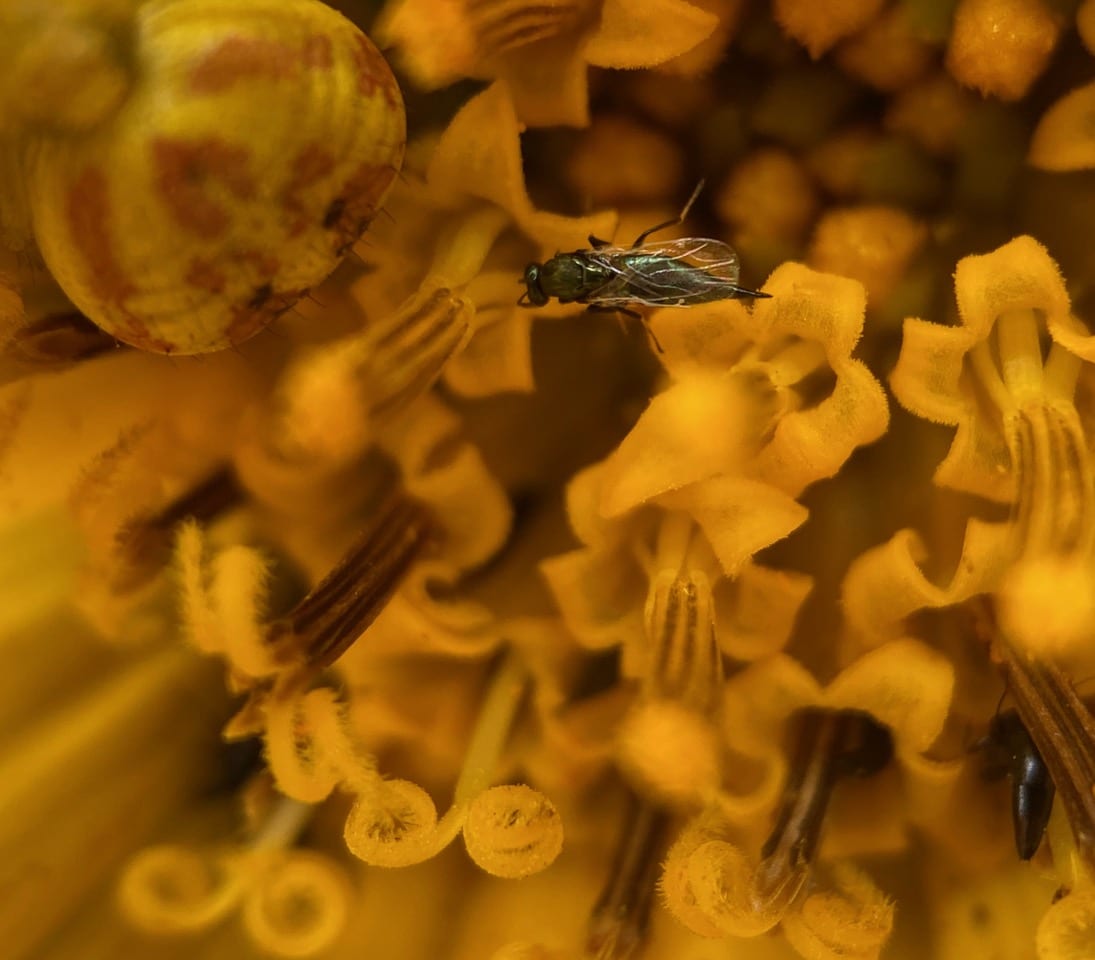
There’s even a tiny parasitoid wasp on the flowerhead. It has an elongated, pointed abdomen. Most likely a Chalcid wasp in the family Eulophidae, subfamily Tetrastichinae.
Most species of Chalcid Wasps are parasitoids of other insects, attacking the eggs or larval stage of their host, though many other life cycles are known. These hosts are to be found in at least 12 different insect orders including Lepidoptera (butterflies and moths), Diptera (true flies), Coleoptera (beetles), Hemiptera (true bugs), and other Hymenoptera, as well as two orders of Arachnida. When the host is itself a parasitoid, the wasps are referred to as hyperparasitoids. Generally beneficial to humans as a group, chalcidoids help keep various crop pests under control, and many species have been used as biocontrol agents.
Tetrastichinae is a subfamily of the Chalcid wasp family Eulophidae. They are found in almost any type of terrestrial habitat and have a worldwide distribution. Hosts of this subfamily are found in 100 families of insects in ten different orders, in addition to spider eggs, gall-forming mites, and even nematodes; a few species are partially or completely phytophagous (feeding on plants). Some larvae are inquilines with gall forming insects. The subfamily includes both ectoparasitic and endoparasitic species.

Those bizarre Rove Beetles (family Staphylinidae) are still there on the ravaged Wyethia flowerheads, more active than ever. I decide to take a video of them.
The family Staphylinidae is the largest family of North American beetles, with about 4000 species. Most are small and of cryptic habits and although common, the group as a whole is not well studied. Most rove beetles are predators of insects and other invertebrates, living in forest leaf litter and similar decaying plant matter. Some species are predaceous as both adults and larvae; the larvae of some species are parasitoids; many others are probably scavengers.
Rove Beetles are easily recognized by their slender, usually black or brown body, shortened front wings (elytra) that may look like pads on the abdomen, and behavior of curling the tip of the abdomen upwards when disturbed or running. Adults are usually strong flyers. Most species are nocturnal, but a few are active during the day.

A Minute Black Scavenger Fly (family Scatopsidae) is moving around on the ray petal of the Narrowleaf Mule’s Ear.
As implied by the family name, these flies are also called “dung midges”. They are generally small, sometimes minute, dark flies (from 0.6 to 5 mm) with short antennae. Adults are often found on flowers. The larvae of most species are unknown, but the few that have been studied have a rather flattened shaped and are terrestrial and saprophagous, feeding on decaying plant and animal matter.

That looks like a female Minute Black Scavenger Fly, with messed up wings. It might not have eclosed properly from the pupa.
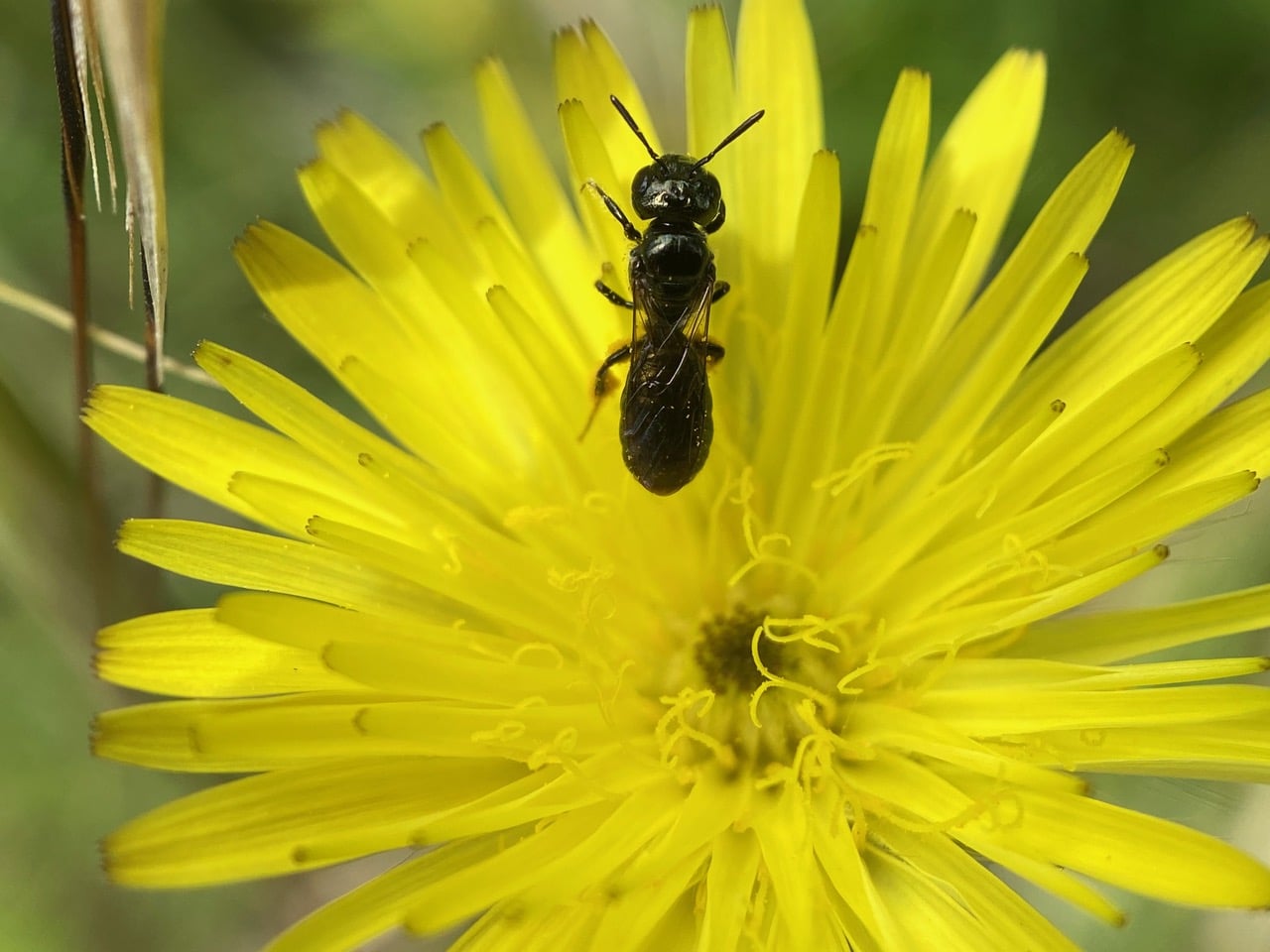
A Small Carpenter Bee, Ceratina sp. (family Apidae) is foraging on a flowerhead of Bristly Oxtongue, Picris echioides.
The Small Carpenter Bee genus Ceratina is closely related to the more familiar, and much larger Carpenter Bees (genus Xylocopa). Ceratina are typically dark, shiny, even metallic bees, with fairly sparse body hairs and a weak scopa on the hind leg. The shield-shaped abdomen comes to a point at the tip. Some species have yellow markings, often on the face.
Females excavate nests with their mandibles in the pith of broken or burned plant twigs and stems. While many species are solitary, a number are subsocial. Both male and female carpenter bees overwinter as adults within their old nest tunnels, emerging in the spring to mate. In the spring, this resting place (hibernaculum) is modified into a brood nest by further excavation. The female collects pollen and nectar, places this mixture (called bee bread) inside the cavity, lays an egg on the provision, and then caps off the cell with chewed plant material. Several cells are constructed end to end in each plant stem.
