

Pollinator Post 6/29/23
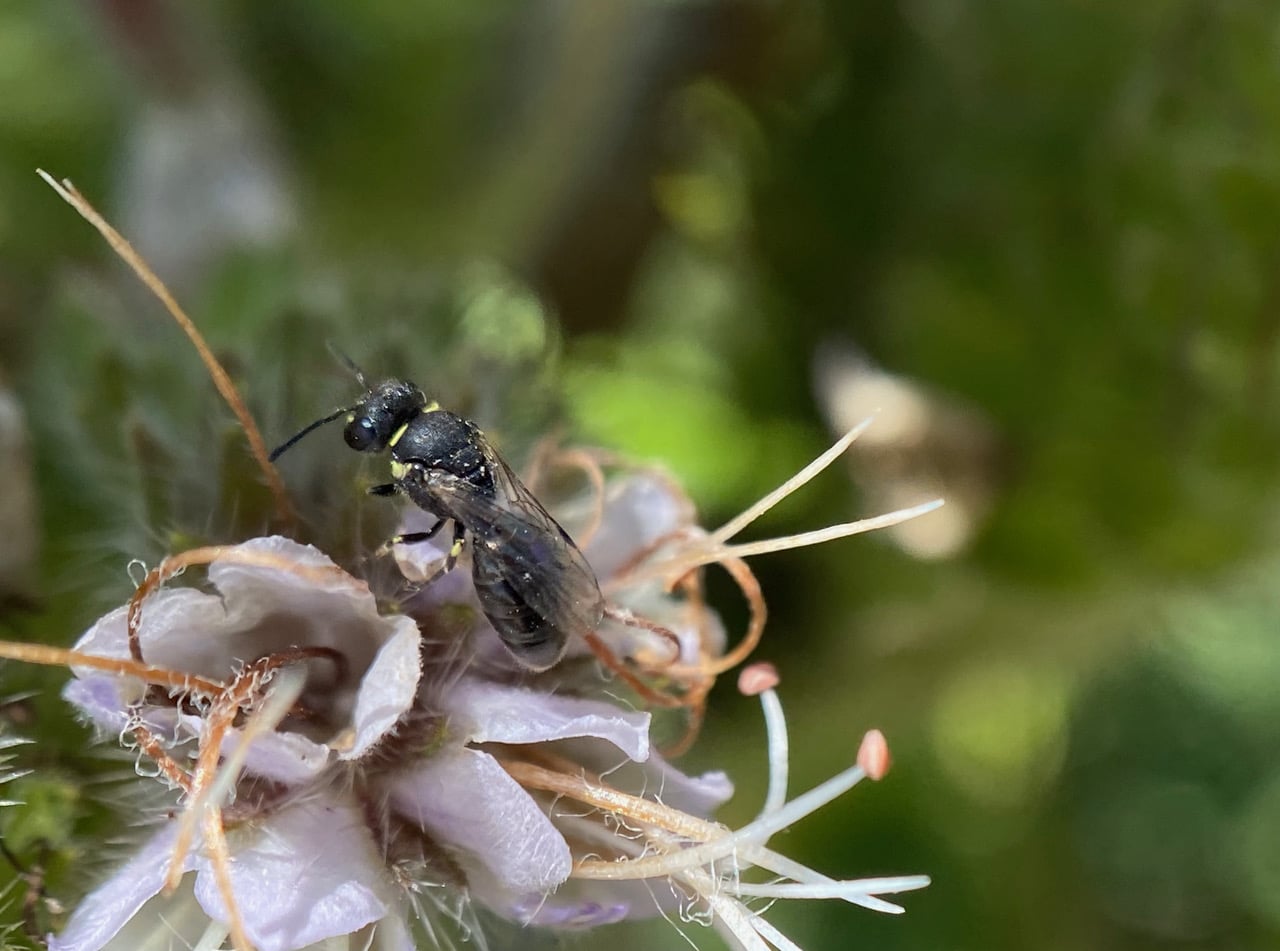
To avoid the excessive heat this afternoon, I choose to explore the shadier northern section of Skyline Trail. Swarms of tiny insects hover over the California Phacelia, Phacelia californica at the Steam Train entrance. Easily mistaken for midges, these are actually the Masked Bees, Hylaeus sp. (family Colletidae). I find that the activity of these tiny bees are very much dependent on temperature – the warmer, the more active they become. Their movements are so fast and frantic it’s almost impossible to photograph them today. The heat slows me down, but invigorates the insects – not a good combination!





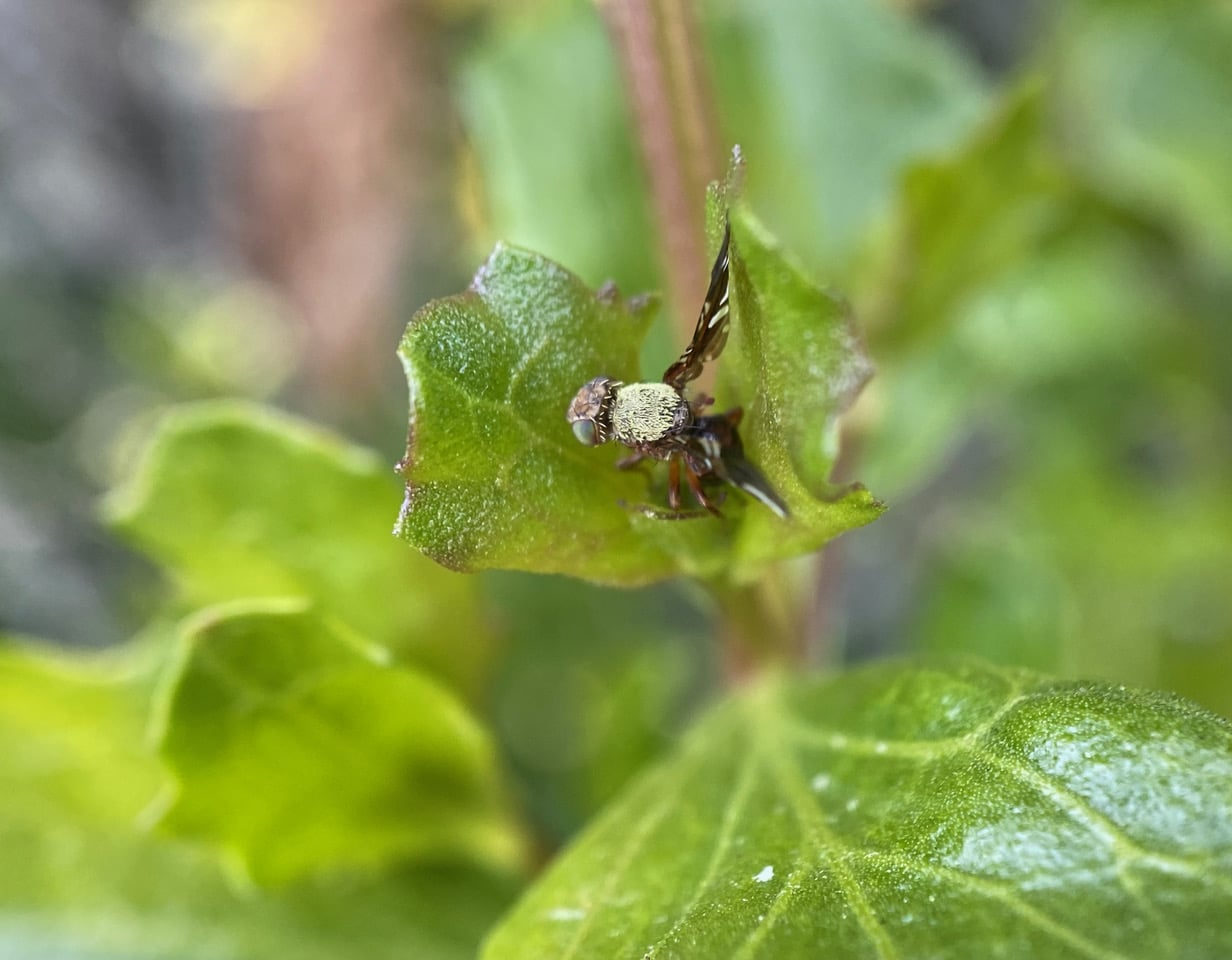

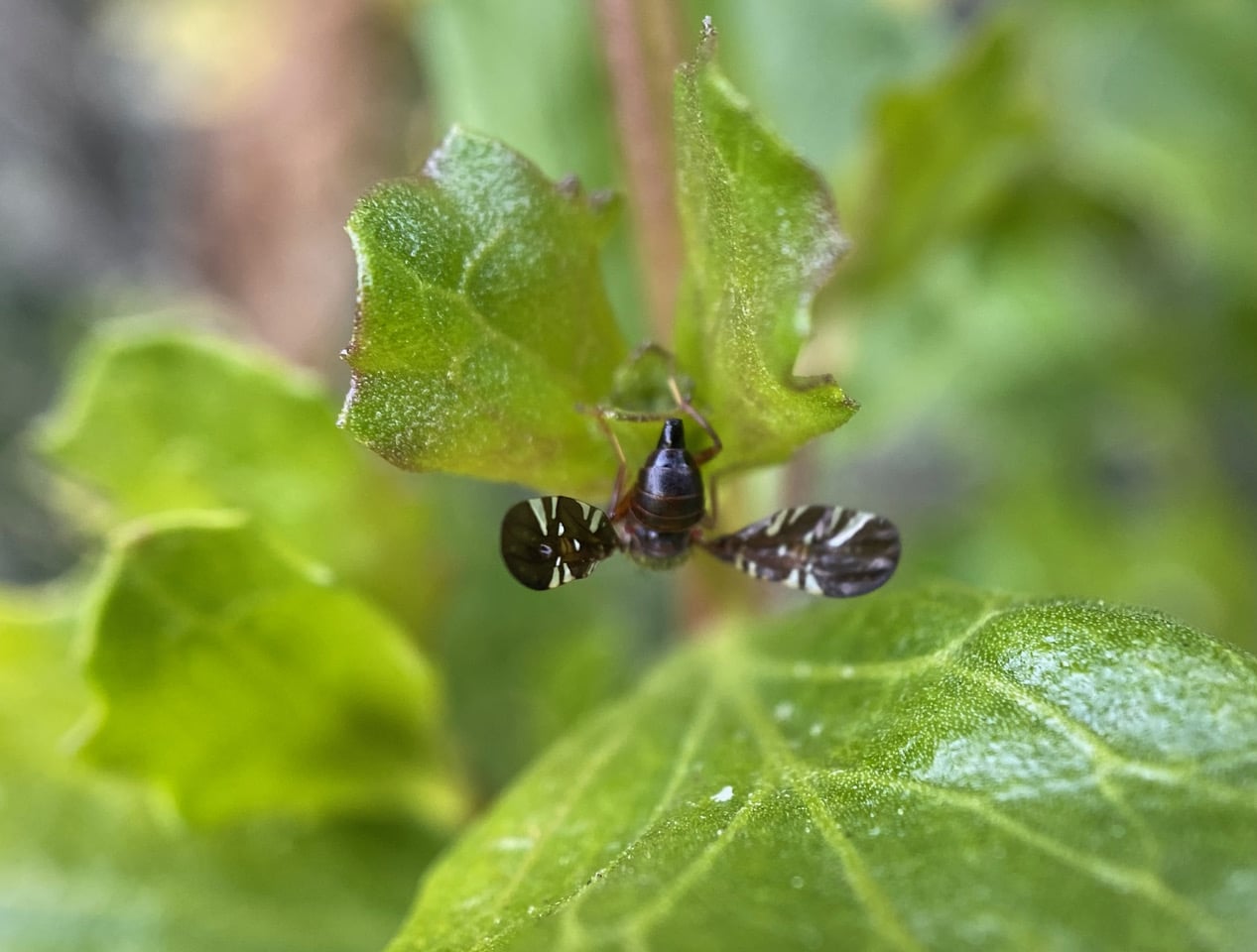
A small Plant Bug (family Miridae) is foraging on an inflorescence of California Phacelia.
Mirid bugs are also referred to as plant bugs or leaf bugs. Miridae is one of the largest family of true bugs in the order Hemiptera. Like other Hemipterans, Mirids have piercing, sucking mouthparts to extract plant sap. Some species are predatory. One useful feature in identifying members of the family is the presence of a cuneus; it is the triangular tip of the corium, the firm, horny part of the forewing, the hemielytron. The cuneus is visible in nearly all Miridae.

I wish I can feel as perky as this False Chinch Bug, Nysius raphanus (family Lygaeidae) in this heat. It is perched in the shade on a Coyote Brush.
Adults are grayish-brown, slender, and about 1/8 to 1/6 in. long. Like many other insects in the order Hemiptera, their forewings are partly thickened and partly membranous so when folded, the tips of the wings overlap, forming a fairly well-defined X on the back of the body.
Nysius raphanus is commonly found within grassy or weedy fields, pastures, and foothills. Each spring, once the plants in these areas dry up, the False Cinch Bug migrates to find new places to feed. When populations are high in wet years, the bugs can become a nuisance for gardeners and farmers.
False Cinch Bugs spend the winter as nymphs and adults, usually in uncultivated areas beneath debris or in plants, often feeding on mustards or other winter annual plants. As new spring plant growth increases, so do the populations of False Cinch Bugs. Adults lay eggs in soil cracks or loose soil around plants. After hatching, nymphs feed on weeds, especially mustards, molt three times, and develop into adults in about three weeks. There can be several generations a year.
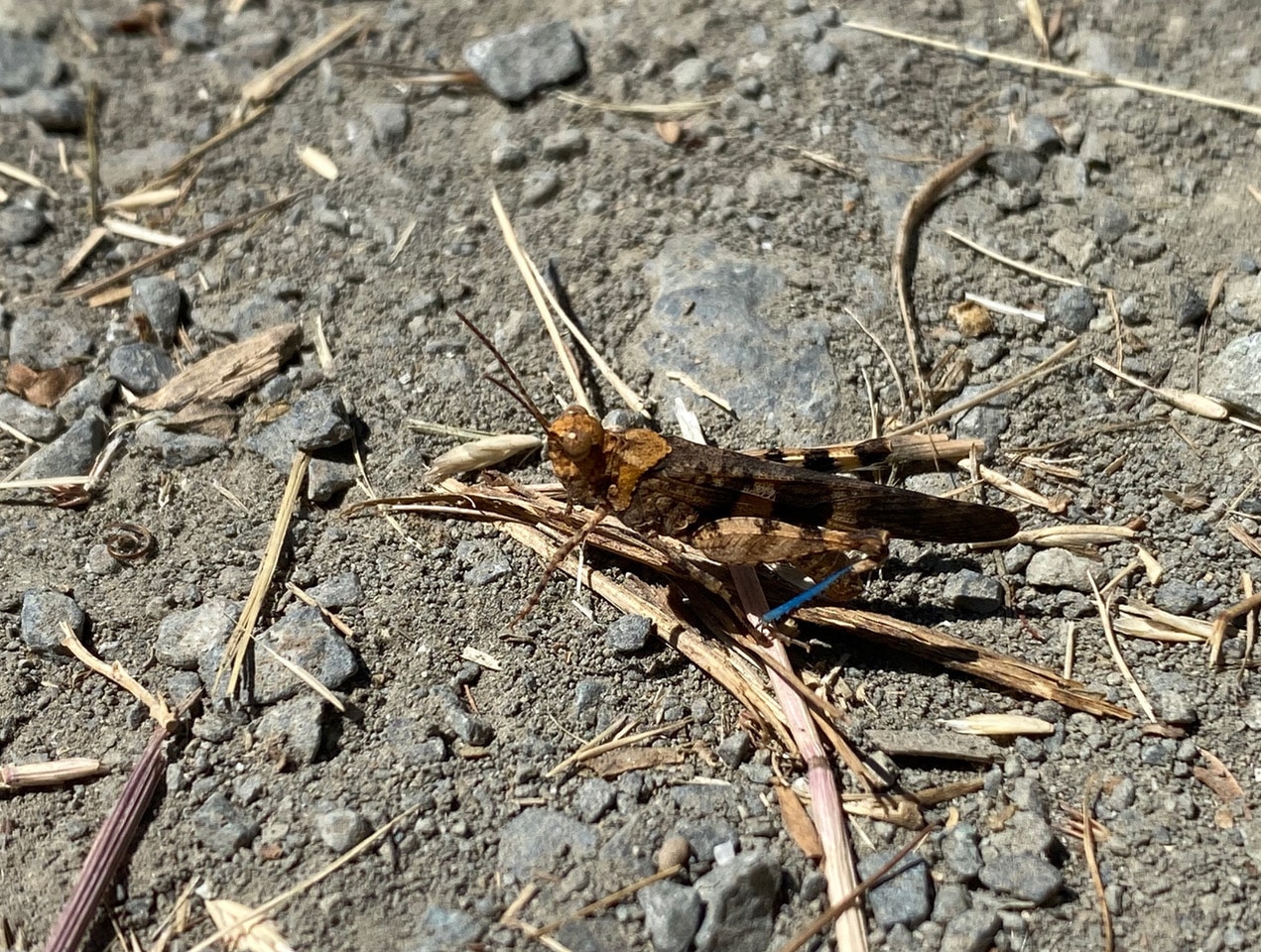
Grasshoppers are a sure sign of summer! With a crackling snap, this Fontana Grasshopper, Trimerotropis fontana (family Acrididae) lands on the trail in front of me. Note the blue tibia on its hind leg!
Grasshoppers belong to the family Acrididae, suborder Caelifera, order Orthoptera. They are ground-dwelling insects with powerful hind legs which allow them to escape from threats by leaping vigorously. They protect themselves from predators by camouflage; when detected, many species attempt to startle the predator with a brilliantly-colored wing-flash while jumping and launching into the air. A large grasshopper can jump about 20 body lengths, equivalent to a human jumping the length of a football field. Grasshoppers jump by extending their large back legs and pushing against the substrate with high force and high velocity, using a catapult mechanism to amplify the mechanical power produced by their muscle.
Most grasshoppers are polyphagous, eating vegetation from multiple plant sources. In general their preference is for grasses, including many cereals grown as crops. They eat large quantities of foliage both as adults and during their development, and can be serious pests of arid land and prairies. Grasshoppers thrive in warm sunny conditions, so drought stimulates an increase in grasshopper populations.
The sound I just heard is called crepitation. Crepitation is the sound produced by grasshoppers making a clicking or snapping noise with their wings when in flight, during courtship, territorial encounters or being disturbed.
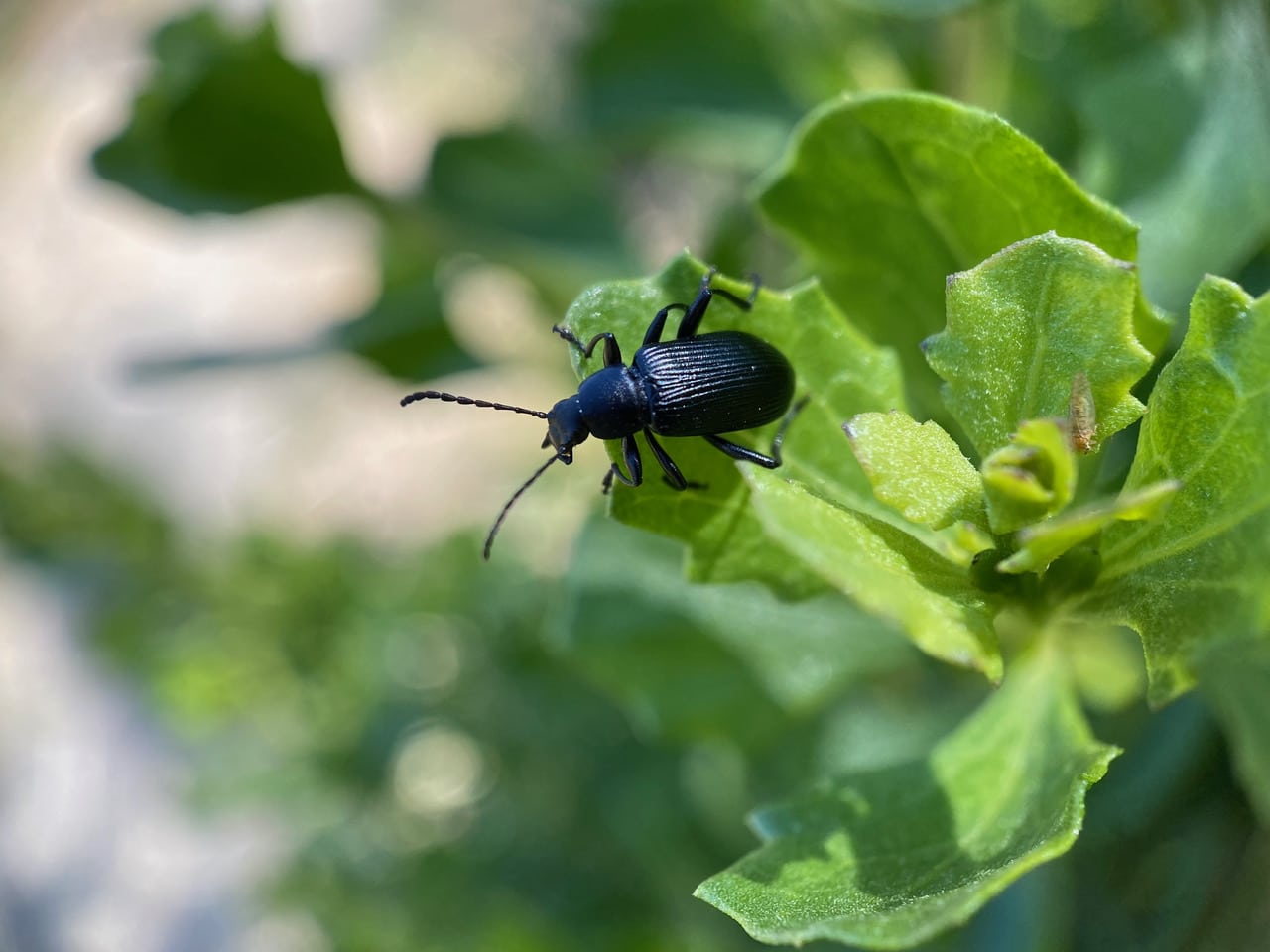
A Comb-clawed Darkling Beetle (subfamily Alleculinae, family Tenebrionidae) is perched on the top leaf of a Coyote Brush, Baccharis pilularis.
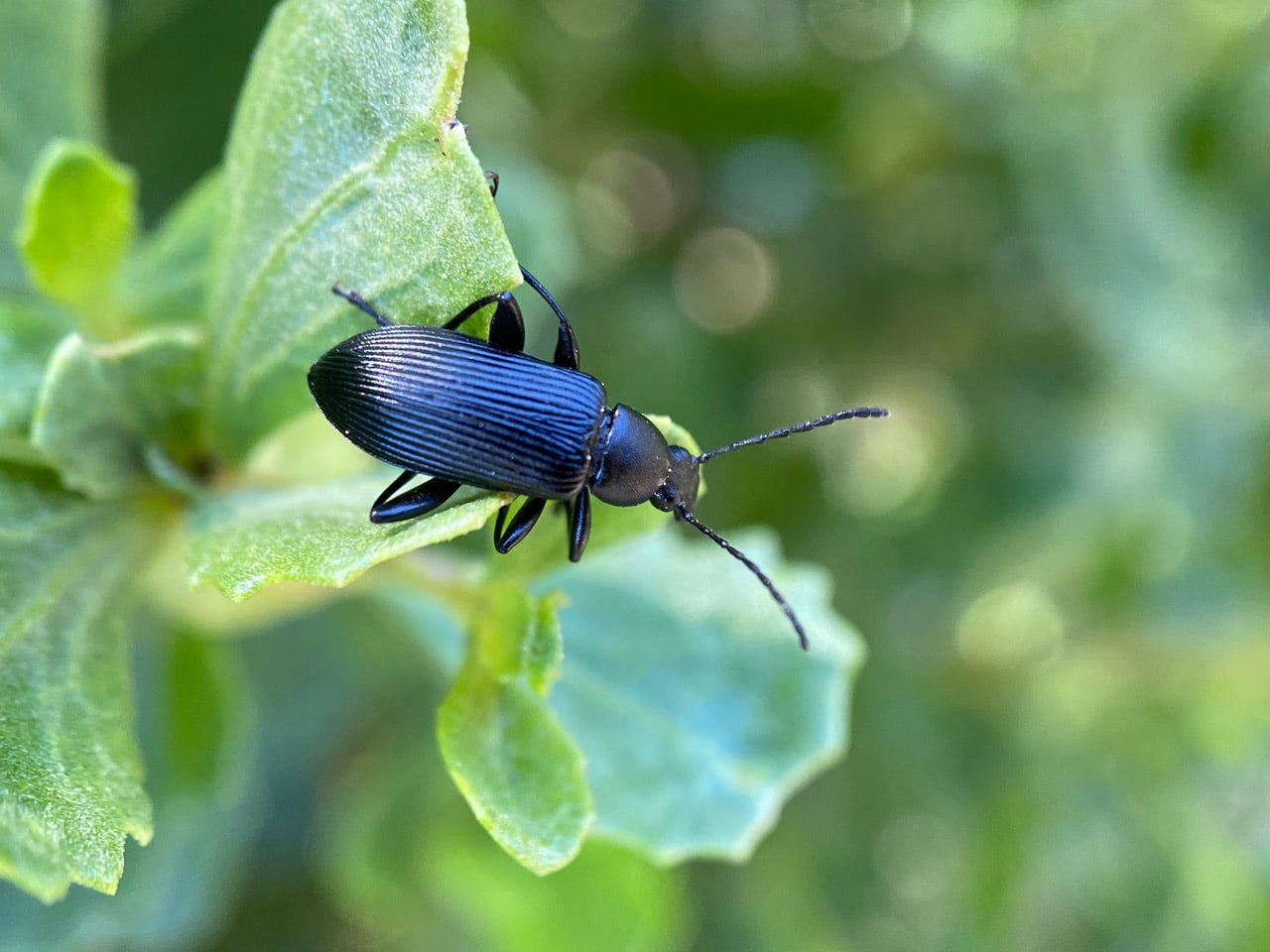
The same beetle seen from a different angle.
Comb-clawed Beetles (subfamily Alleculinae, family Tenebrionidae) are known for the comblike appearance of their claws (hind tarsi). Their oval bodies are typically a glossy brown or black in color. The adults are usually found on flowers or leaves, and the larvae in rotten wood or humus.
A Red-shouldered Stink Bug, Thyanta custator (family Pentatomidae) looks up at me from a Poison Oak leaf.
Pentatomidae is a family of insects belonging to the order Hemiptera or “true bugs”. As hemipterans, the pentatomids have piercing-sucking mouthparts, and most are phytophagous, including several species that are severe pests on agricultural crops.
All Pentatomids have 5-segmented antennae, and they generally have a large triangular scutellum in the center of the back. The body shape of adults is generally shield-shaped when viewed from above. The common name of Stink Bug refers to their ability to release a pungent defensive spray when threatened, disturbed, or crushed.
The Red-shouldered Stink Bug is a generalist feeder and is reported to be a minor pest on a variety of crops including beans, corn, peaches, and wheat.
Another Fontana Grasshopper, Trimerotropis fontana (family Acrididae) – this one is almost completely black!
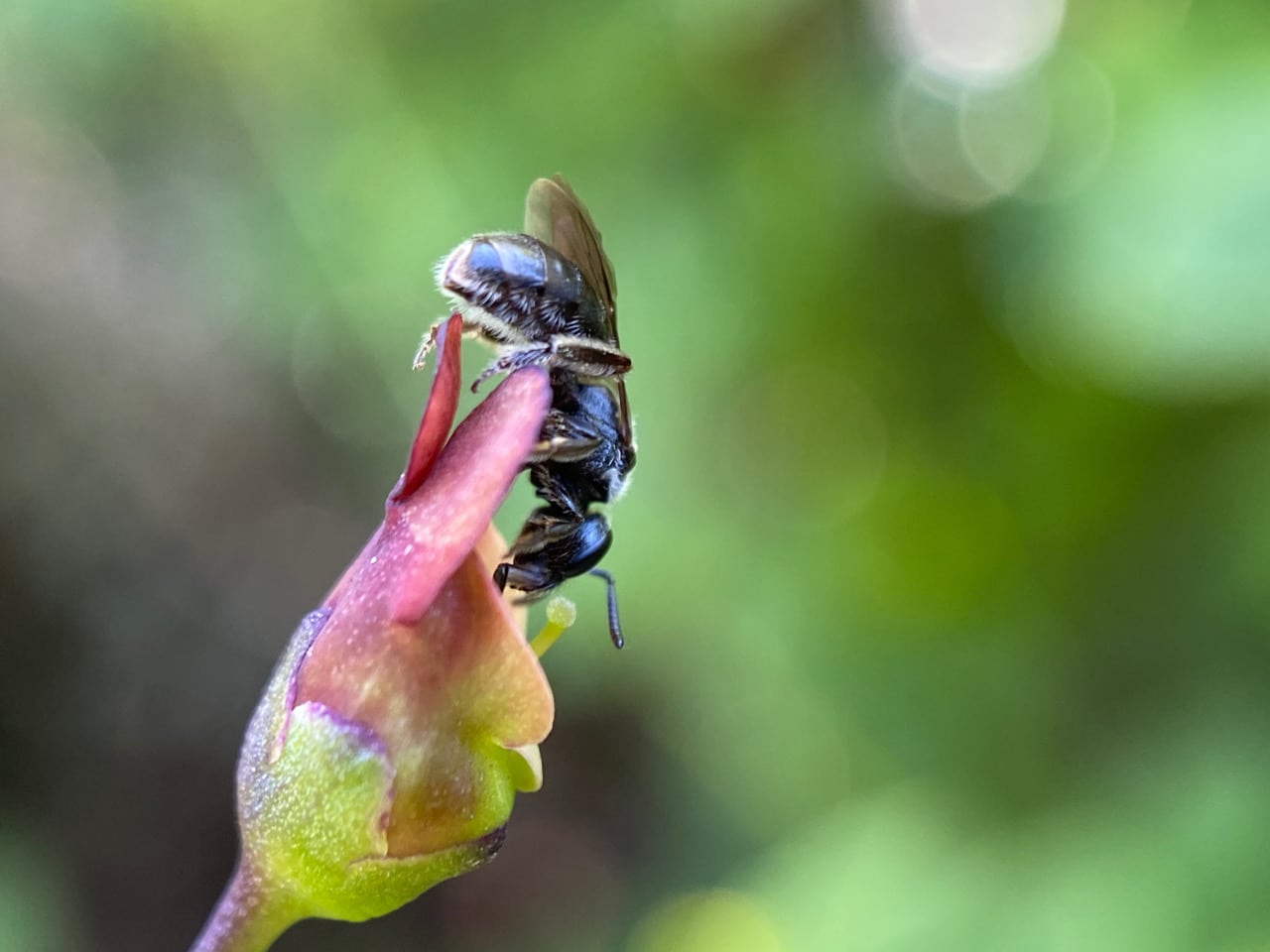
A tiny bee visits a California Bee Plant flower, Scrophularia californica. It has landed on the upper lip of the flower and has its proboscis extended to feed. Judging by the erect position of the style and stigma, the flower is in its female phase when no pollen is produced yet. The bee is here for the nectar and stays in this position for a while, never fully entering the corolla. The nectar is probably not located at the base of the flower, but is instead found on the “sterile stamen” on the inside of the upper lip of the flower.
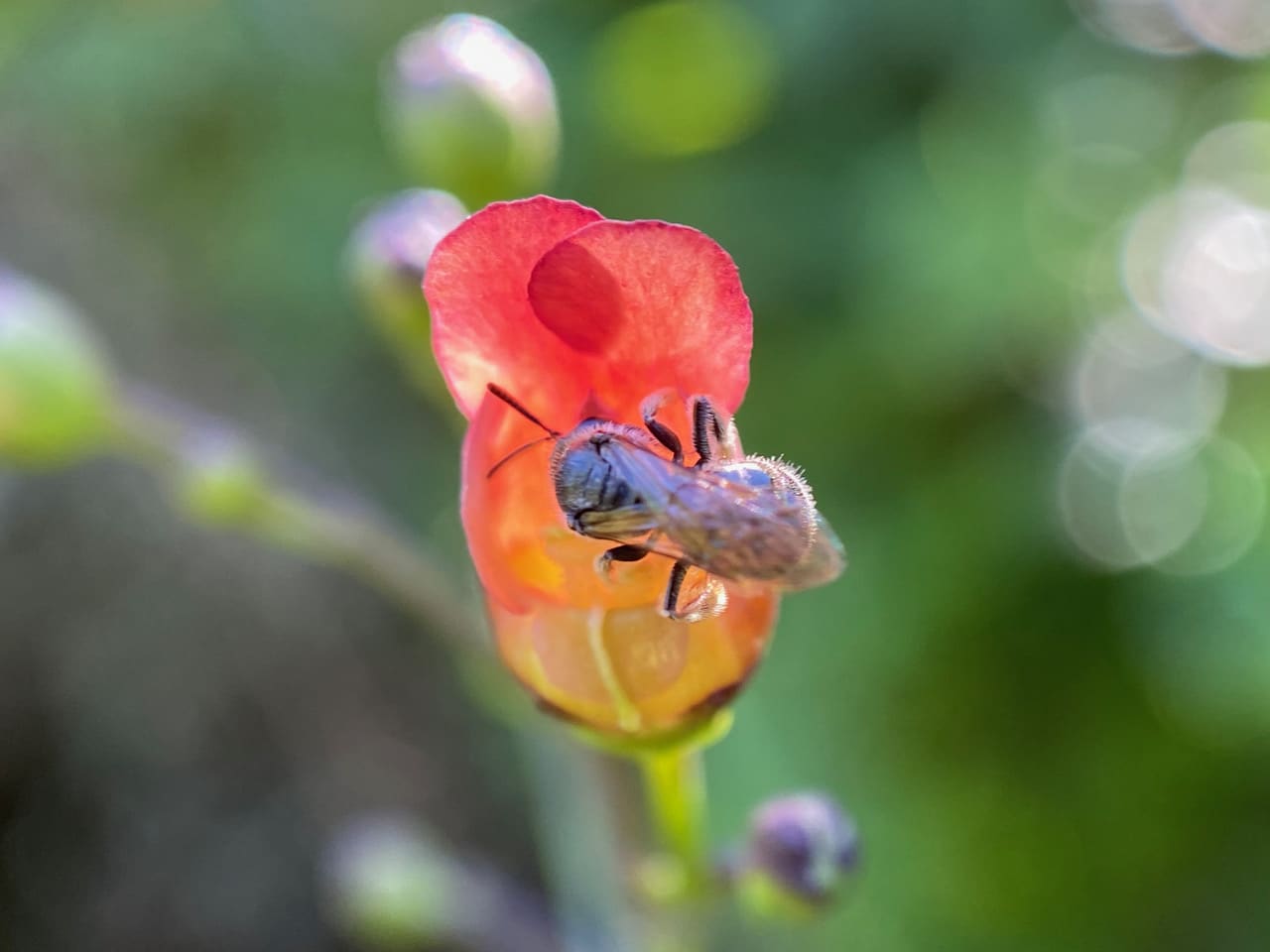
This is the same bee on a different, older flower (in its male phase). Note that the stigma and style have drooped out of the way. The bee does not need to enter the corolla to gather pollen as it is now presented by the fertile stamens at the front entrance.
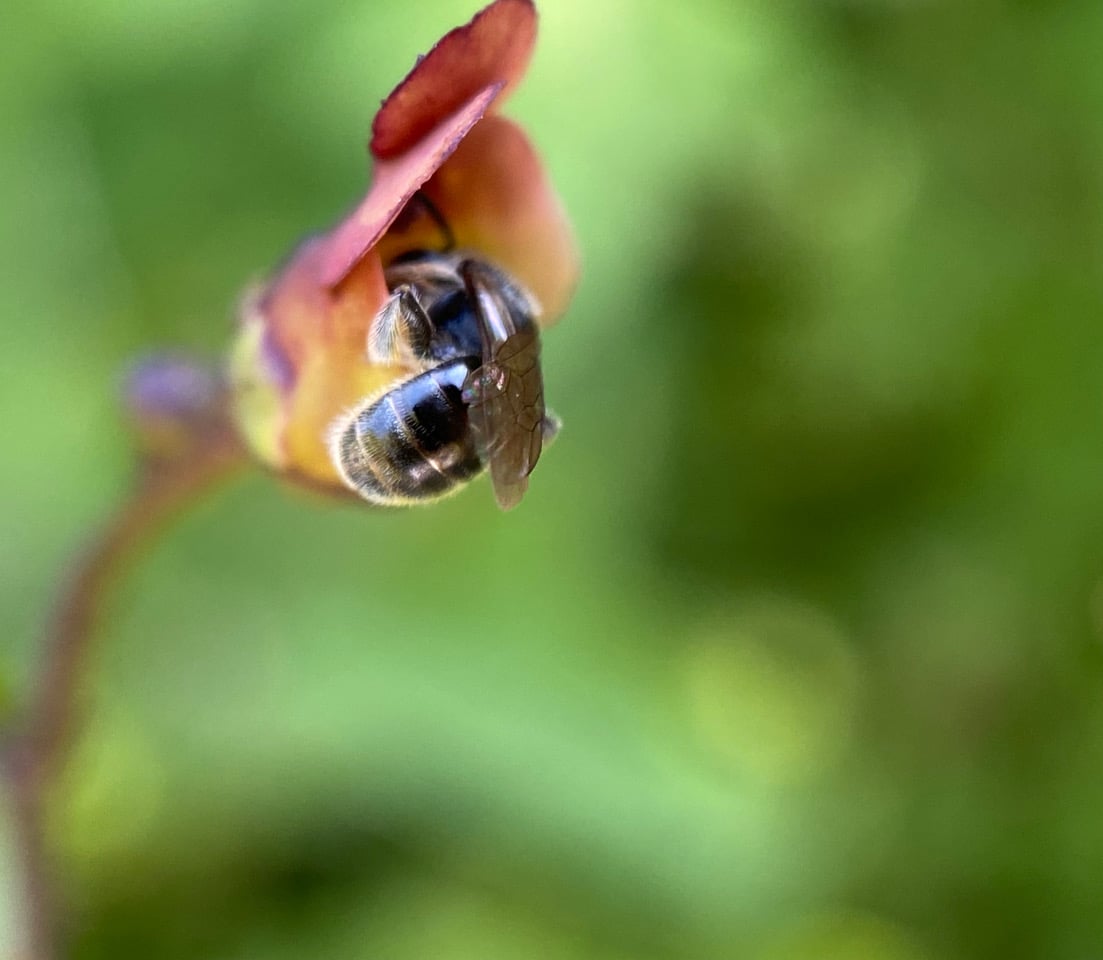
The abdomen of the little bee is shiny and subtly metallic. It is probably a metallic Sweat Bee, Lasioglossum (Dialictus)sp., family Halictidae.
Lasioglossum are closely related to the genera Halictus and Agapostemon. These genera are commonly called “sweat bees” because of their attraction to human sweat, which they drink for its salt content. Lasioglossum are dusky black to brown slender bees with bands of hair on their abdomen.
Dialictus is a subgenus of Sweat Bees belonging to the genus Lasioglossum. Most of the members of this subgenus have a subtly metallic appearance, and are small, about 3.4-8.1 mm in size. They are commonly found in Northern Hemisphere and are found in abundance in North America. As in the other members of the family Halictidae, the bees have very diverse forms of social structure, making them model organisms for studying the social behavior of bees.
The ubiquitous Spotted Cucumber Beetle, Diabrotica undecimpunctata (family Chrysomelidae) feeds on just about every plant in the garden, but this is the first time I see one on a Bee Plant flower. It stays in this position on the young flower for a while – taking nectar from the sterile stamen? I think the “sterile stamen” is actually a nectary, most active in the young flowers in female phase.
The flowers of Bee Plant are protogynous, meaning the female parts mature before the male parts. Dichogamy, the temporal separation of the sexes in flowers serves to preclude self-pollination.
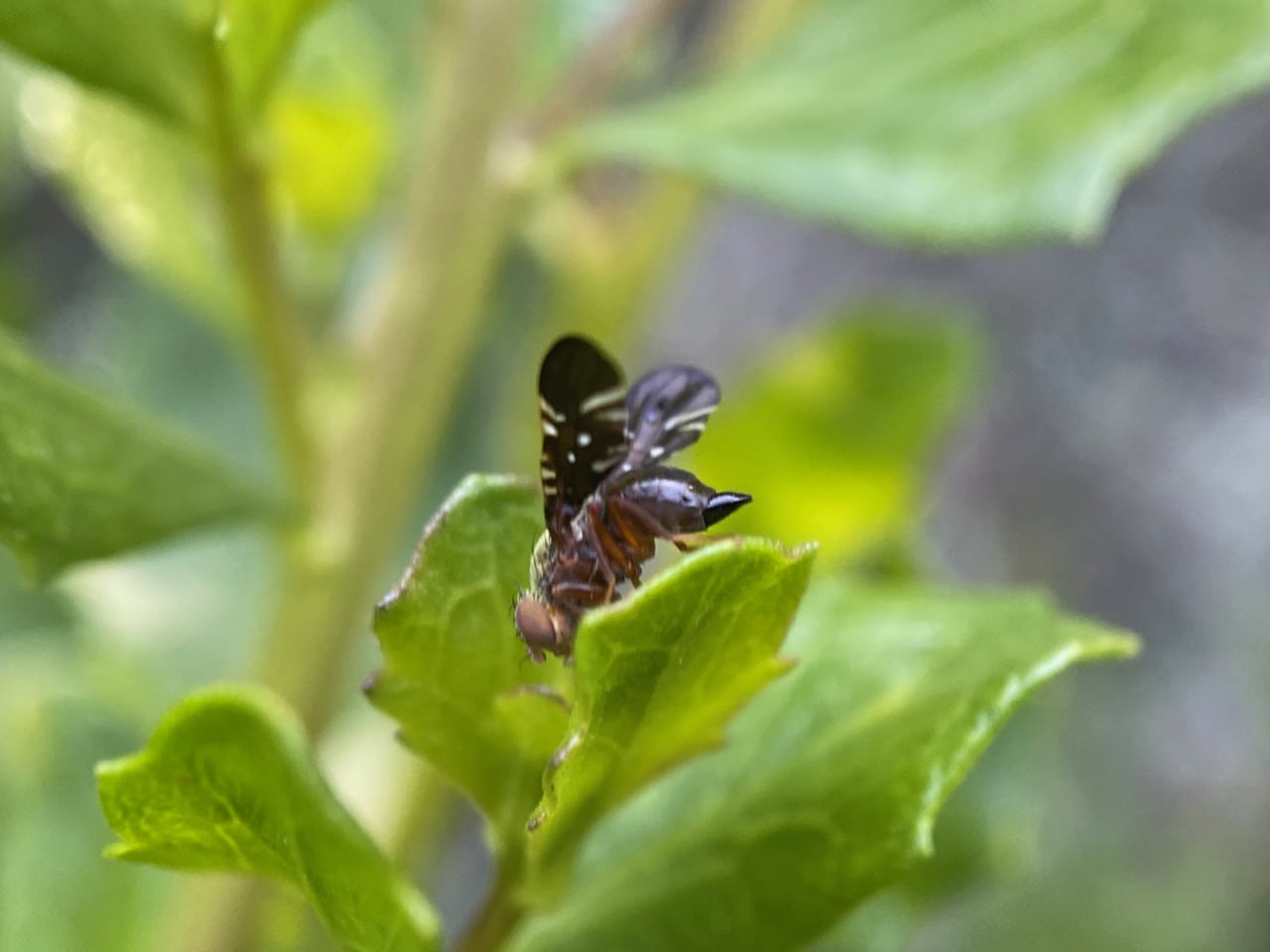
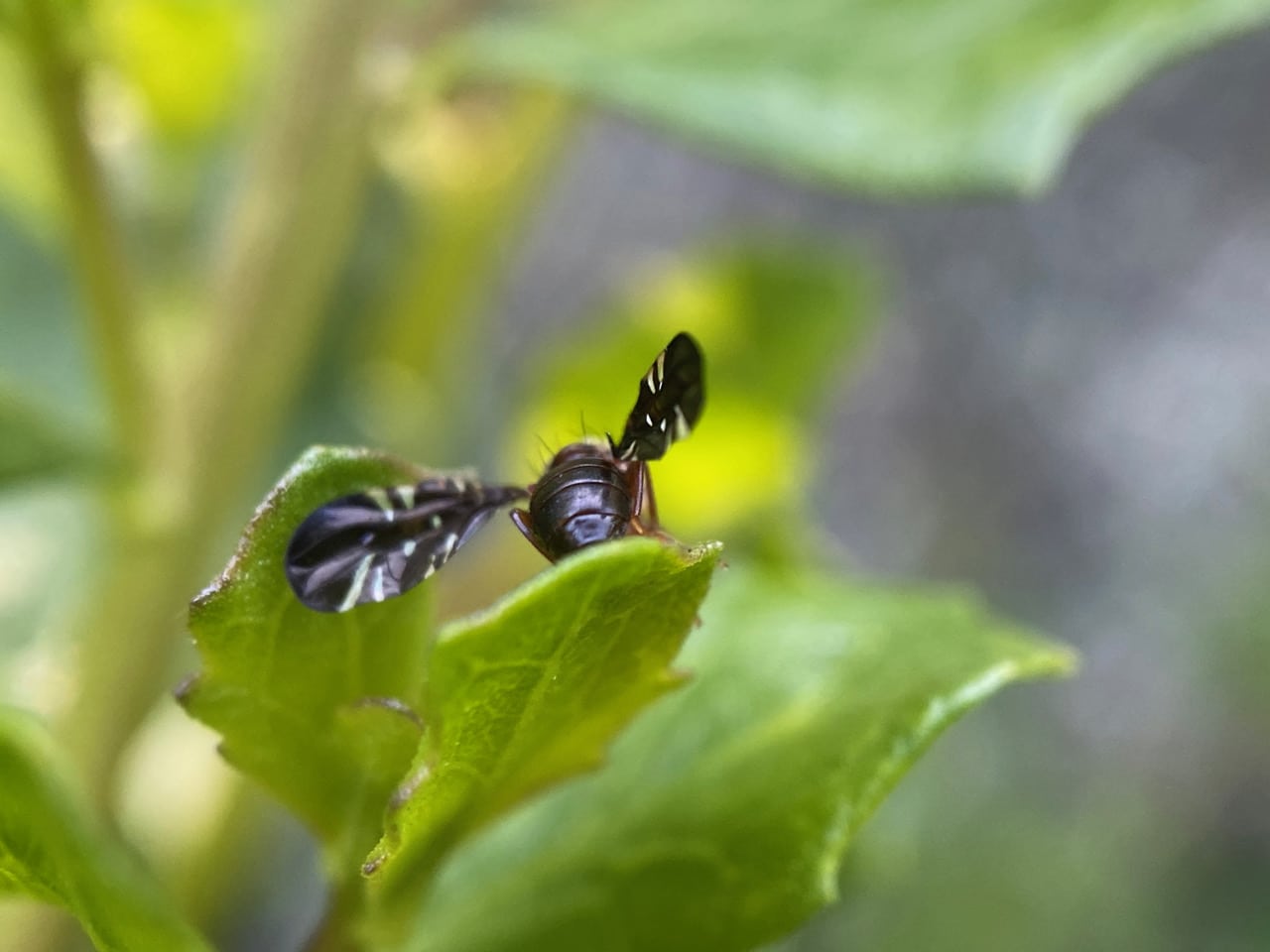
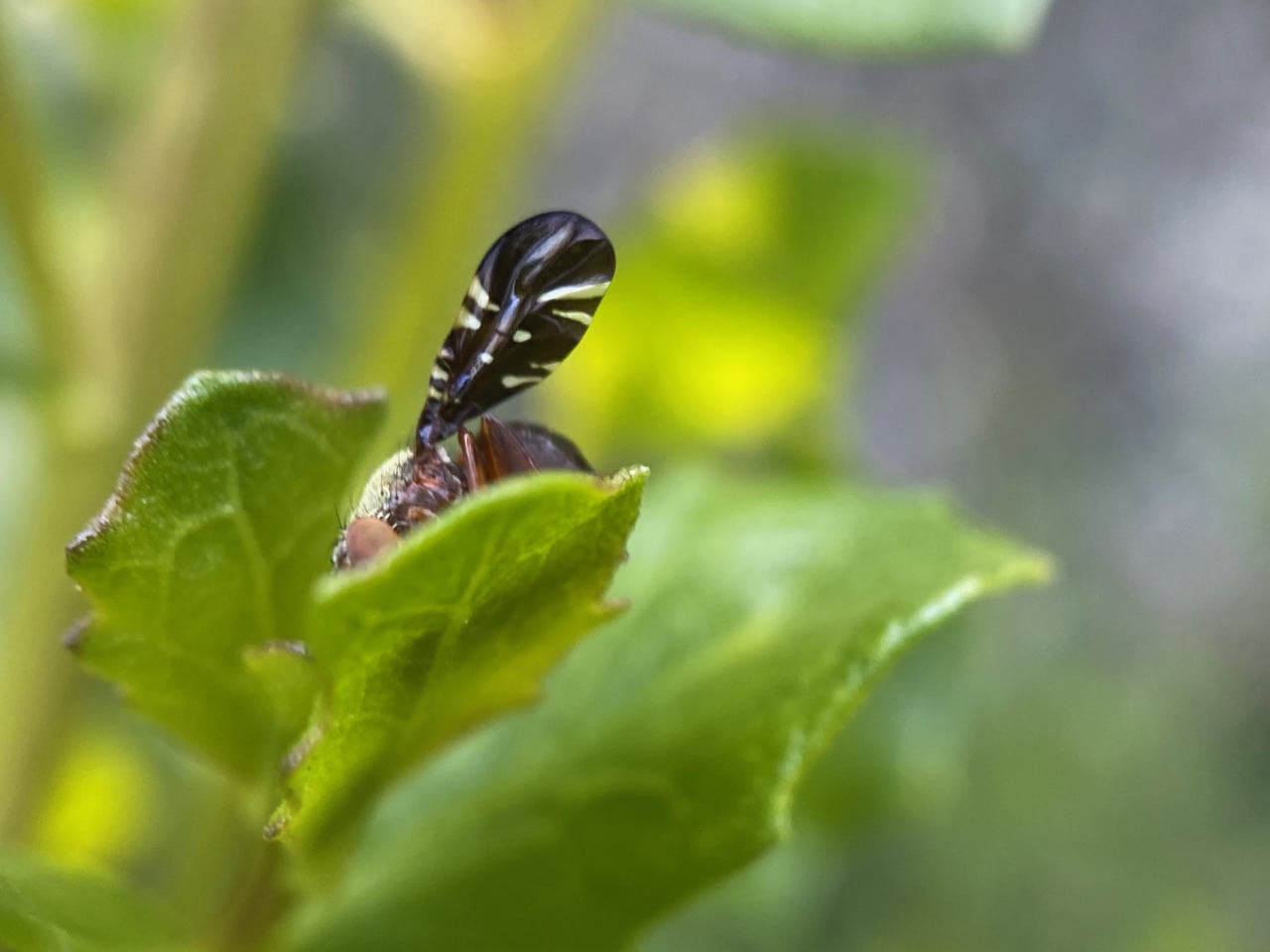
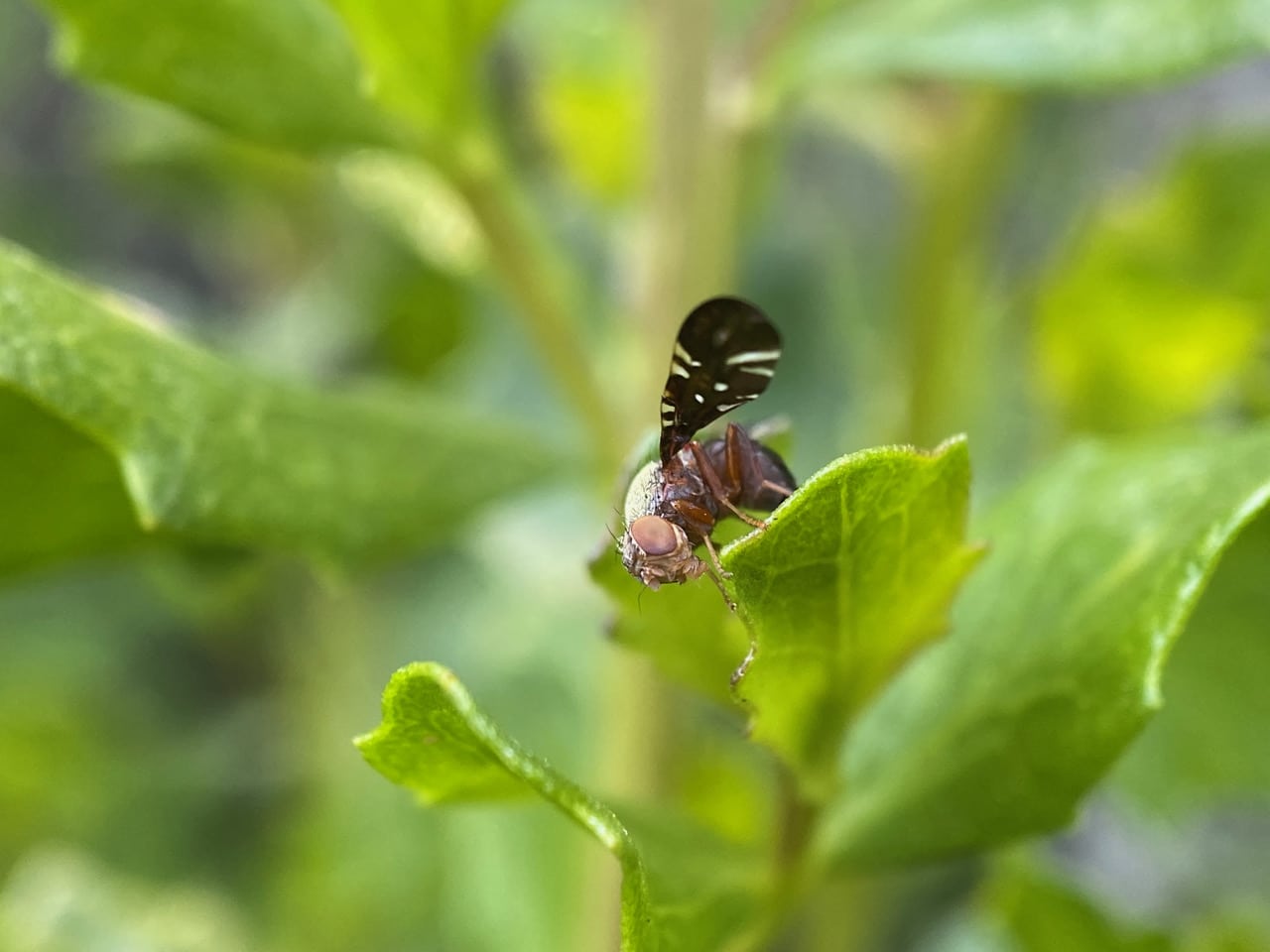
Ooh, a female Desert Broom Gallfly, Aciurina thoracica (family Tephritidae, fruit flies) is on a terminal leaf of Coyote Brush, Baccharis pilularis. Is she here to lay her eggs? The species is known to induce stem galls on Desert Broom, Baccharis sarothroides in southern Calfornia. The pointy black tip on her abdomen is an oviscape that protects the actual ovipositor when not in use.
The Fruit Fly mills around the foliage, slowly waving her picture wings in a figure-8 rotation.
Tephritids are small to medium-sized flies that are often colorful, and usually with picture wings. The larvae of almost all Tephritidae are phytophagous. Females deposit eggs in living, healthy plant tissues using their telescopic ovipositors, sometimes forming galls. Here the larvae find their food upon emerging. The larvae develop in leaves, stems, flowers, seeds, fruits, and roots of the host plant, depending on the species. Adults are often found on the host plant and feeding on pollen, nectar, rotting plant debris, or honeydew. Tephritid flies are of major economic importance as they can cause damage to fruit and other plant crops. On the other hand, some Tephritids are used as agents of biological control of noxious weeds.
Many species of Tephritidae perform an elaborate courtship display using their picture wings.
Asked why so many flies like to use Coyote Brush for their host plant, Spencer Pote, the Tephritidae expert on iNaturalist, in his wisdom replies, “I’m not sure why Baccharis is so attractive to flies! If only I could get a microphone small enough to ask them…”
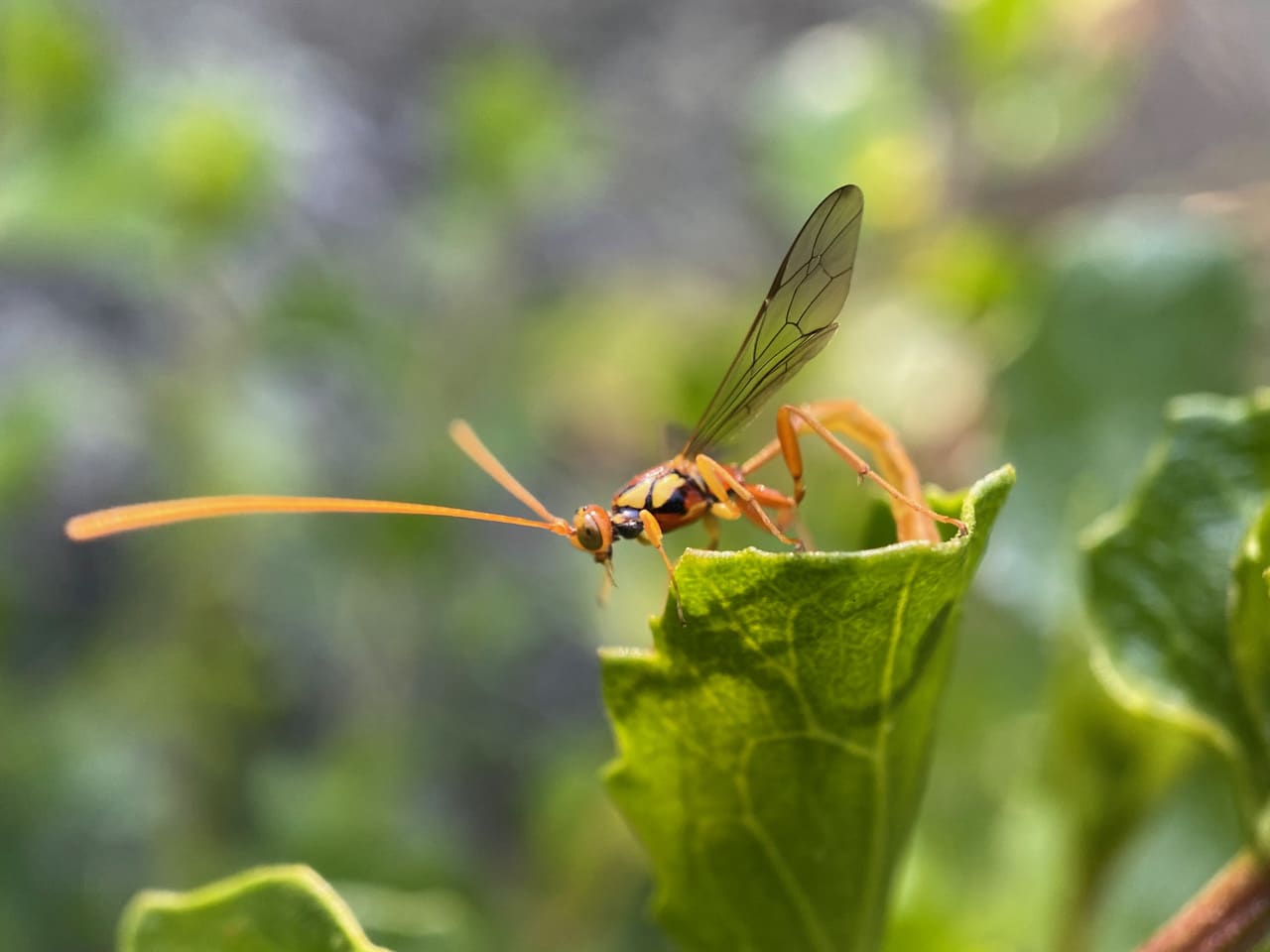
When I look up from the Fruit Fly, I am surprised to see an orange wasp moving on a nearby leaf. It is a parasitoid wasp, Grotea californica (family Ichneumonidae). As I look around, I find three more of these slender, long-legged wasps with long antennae flying around, occasionally landing on the Coyote Brush. What is going on?
The Ichneumonidae, also known as the Ichneumon Wasps, or Ichneumonids, are a family of parasitoid wasps. They are one of the most diverse groups within the Hymenoptera (the order that includes the ants, wasps and bees) with about 25,000 species and counting. Ichneumon Wasps attack the immature stages of insects and spiders, eventually killing their hosts. They play an important role in the ecosystem as regulators of insect populations.
The Ichneumon Wasps have longer antennae than typical wasps, with 16 segments or more as opposed to 13 or fewer. Ichneumonid females have an unmodified ovipositor for laying eggs. They generally inject eggs either directly into their host’s body or onto its surface, and the process may require penetration of wood. After hatching, the Ichneumonid larva consumes its still living host. The most common hosts are larvae or pupae of Lepidoptera (butterflies and moths), Coleoptera (beetles) and Hymenoptera. Adult Ichneumonids feed on plant sap and nectar. Females spend much of their active time searching for hosts while the males are constantly on the look out for females. Many Ichneumonids are associated with specific prey, and Ichneumonids are considered effective biological controls of some pest species.
The larvae of Grotea californica are known to parasitize members of the genus Ceratina, the Small Carpenter Bees.
Another Fruit Fly, Aciurina thoracica (family Tephritidae) is wedged vertically between the young leaves on the top of a stem. Is it a female laying eggs?
The fly finally gets out of that tight spot.
Yes, indeed it is a female!
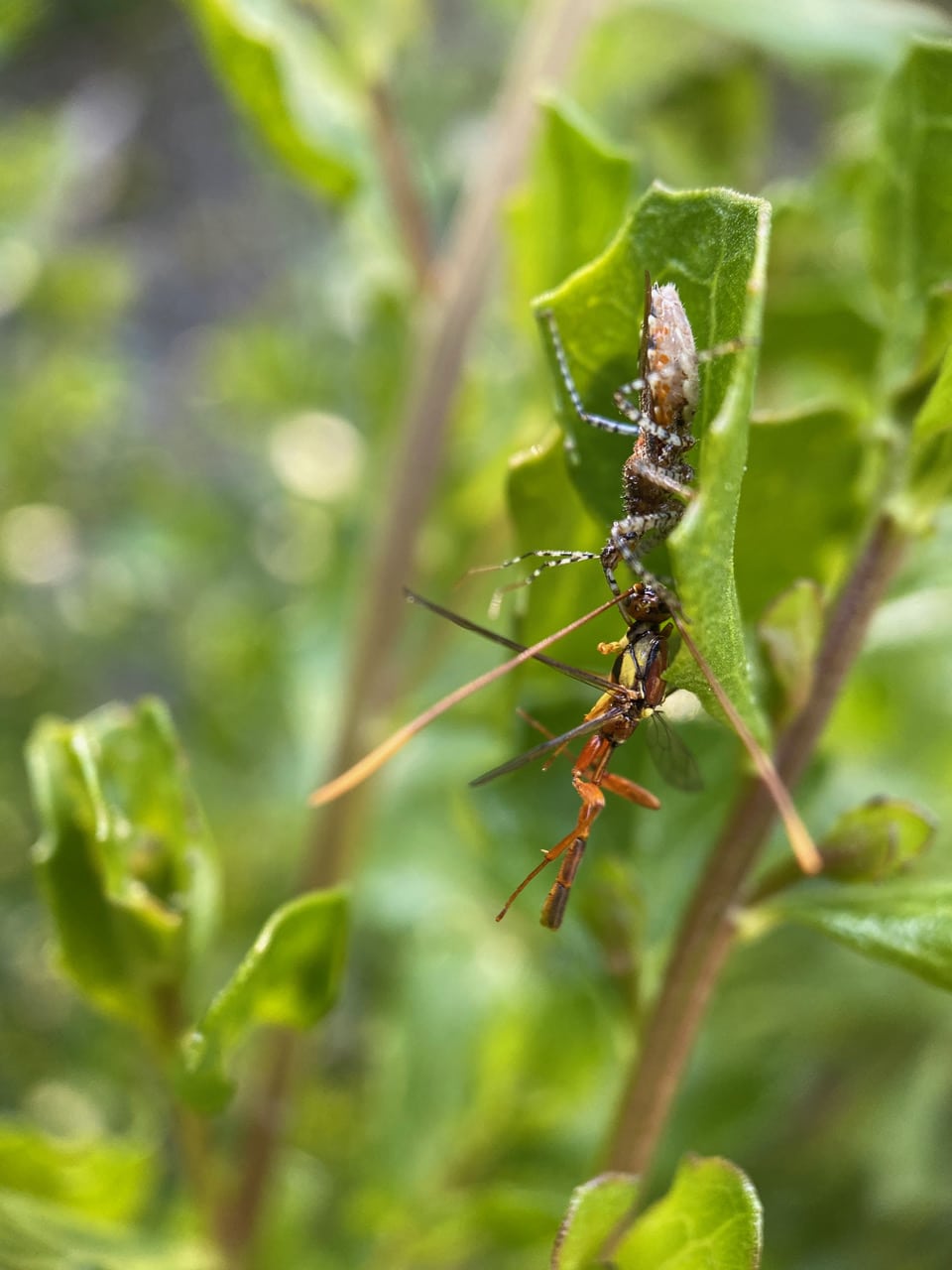
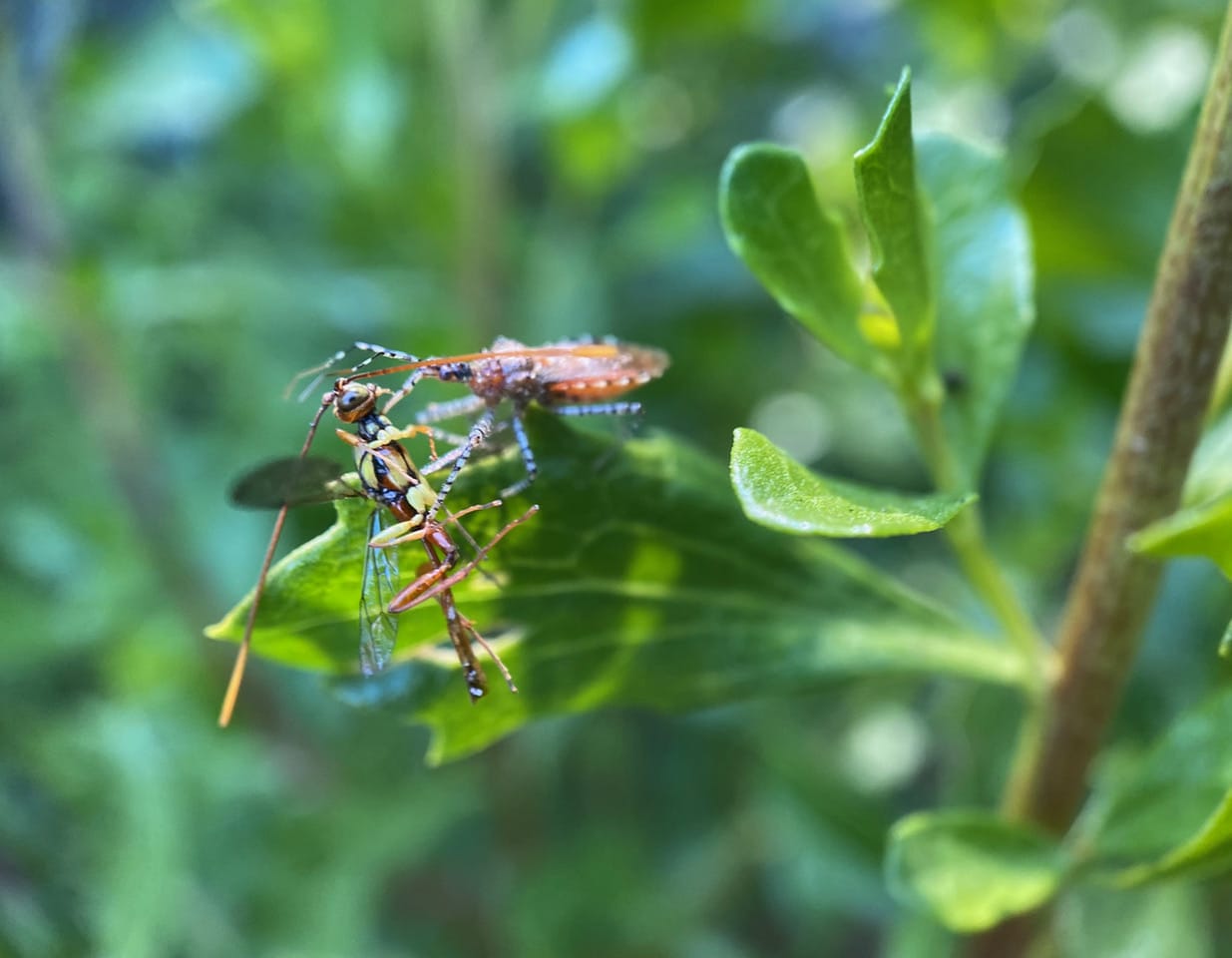
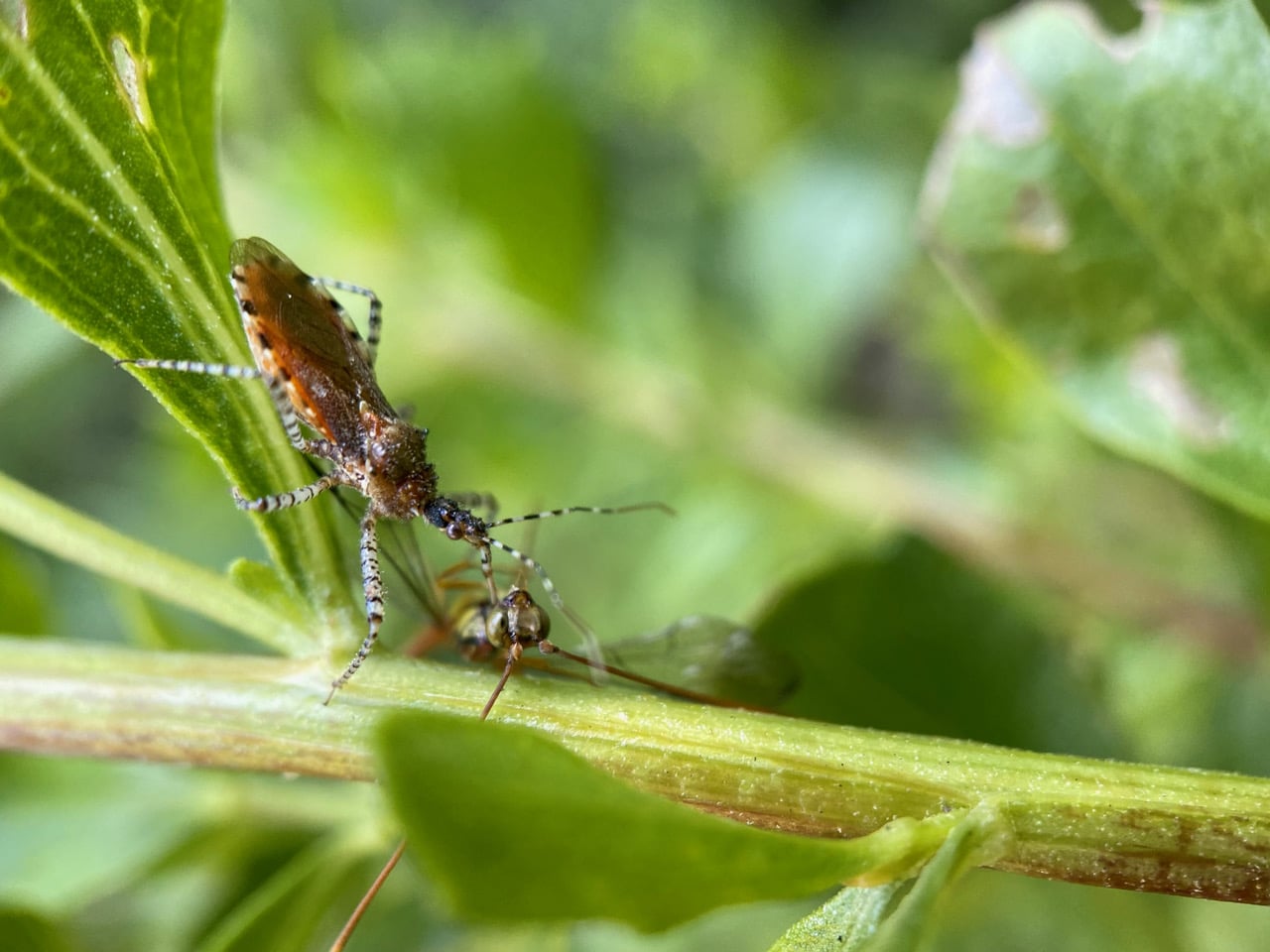
I watch as a Grotea wasp in flight disappear behind some Baccharis leaves. I quickly adjust my macro lens, and peek behind those leaves. What I find is almost unreal. The wasp has been captured by a Thorn-necked Assassin Bug, Pselliopus spinicollis (family Reduviidae)!
The Reduviidae are members of the order of true bugs, Hemiptera. The family members are almost all predatory. The bugs commonly have an elongated head with a distinct narrowed “neck”, long legs, and prominent, segmented, tubular mouthparts called the “rostrum”. Most species are bright in color with hues of brown, black, red, or orange. The most distinctive feature of the family is that the tip of the rostrum fits into a ridged groove in the prosternum, where it can be used to produce sound by stridulation when threatened.
Reduviidae use the long rostrum to inject a lethal saliva that contains digestive enzymes to liquify the insides of the prey, which are then sucked out. This process is generally referred to as extraoral digestion. The saliva is commonly effective at killing prey substantially larger than the bug itself.
Sensing my approach, the Assassin Bug drags it prey into the tangled shadow of the Baccharis foliage, never losing hold of its prize catch.
I finally have to bend the branch into the light to get a clear view of the action. The Thorn-necked Assassin Bug, Pselliopus spinicollis has its rostrum firmly planted in the wasp near the victim’s neck. Wow!
The genus name Pselliopus is most descriptive. Greek psellion ‘anklet/bracelet’ + pous ‘foot’ probably refer to the banded legs. Even the edges of the abdomen are banded. The bugs are found in meadows, fields; typically on flowers. Adults hibernate under rocks, bark, sometimes in groups.