

Pollinator Post 6/28/23 (1)

Near Siesta Gate I come across an unusual sight – a bumble bee foraging on the flowers of Sticky Monkeyflowers, Diplacus aurantiacus. I have only observed this behavior once last year. The floral tube of the flower is way too narrow for a bumble bee to enter through the front. One would expect the bee to try to “rob” nectar through the back door – by cutting a hole at the base of the flower to access the sweet stuff directly. However, bumble bees in general are known to have long tongues. But THIS long!? The bee continues to visit several flowers as I watch, apparently successful at getting nectar.
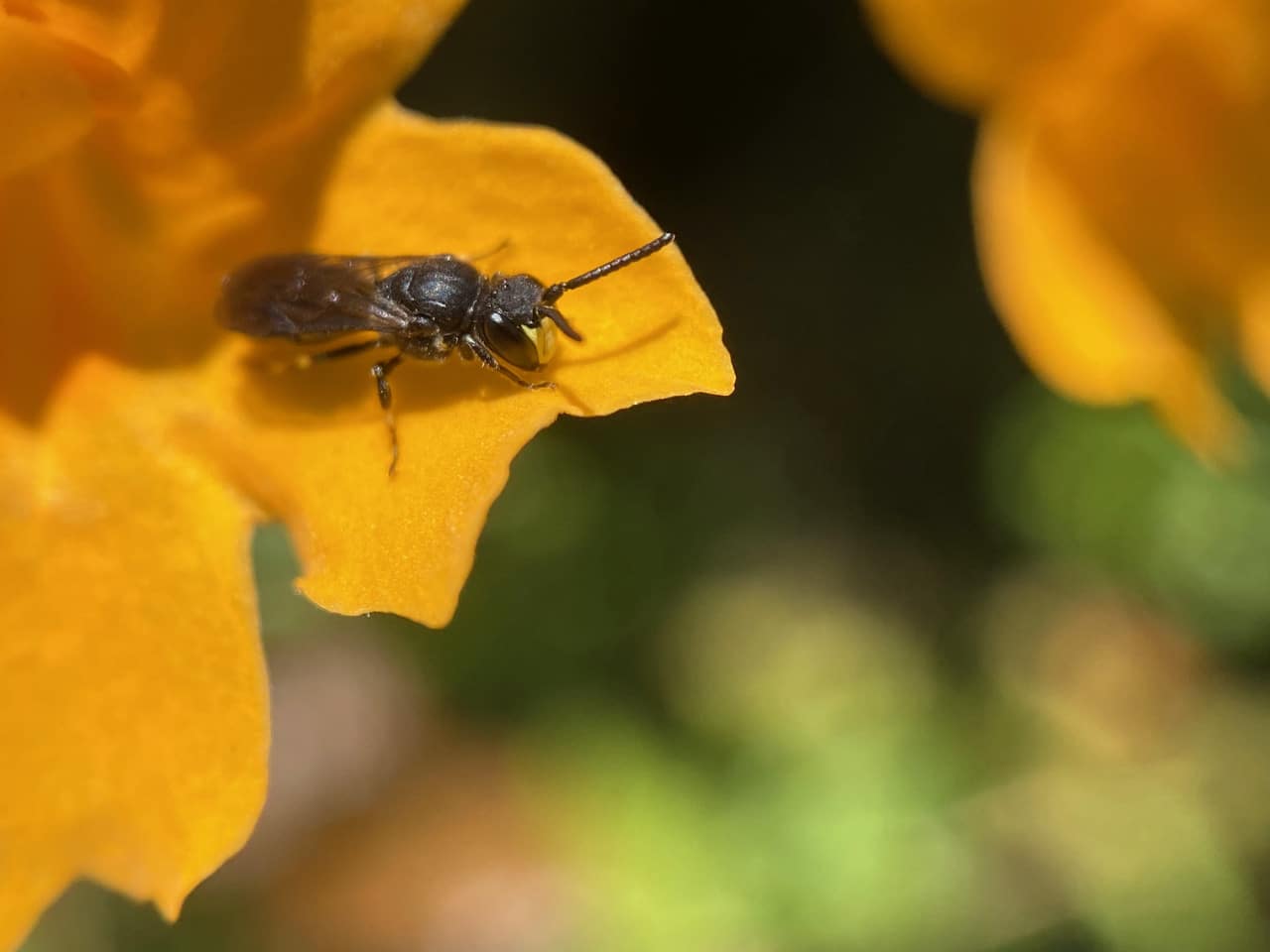
A much smaller bee, the size of a grain of rice, has just come out of a Sticky Monkeyflower. It is a male Masked Bee, Hylaeus sp. (family Colletidae). Note the large yellow marking on his face, and his long antennae. Hylaeus are short-tongued bees, but they are small enough to crawl through narrow floral tubes to access nectar.

A Small-headed Fly, Eulonchus sp. (family Acroceridae) lands on a Sticky Monkeyflower, its back covered with cream-colored pollen from a flower it has previously visited. Usually, as Eulonchus approaches a flower to feed on nectar, it unfolds its long, straight proboscis that is folded under its body when not in use. The species feeds on Sticky Monkeyflowers regularly, and is probably a major pollinator for the plant at Skyline Gardens.
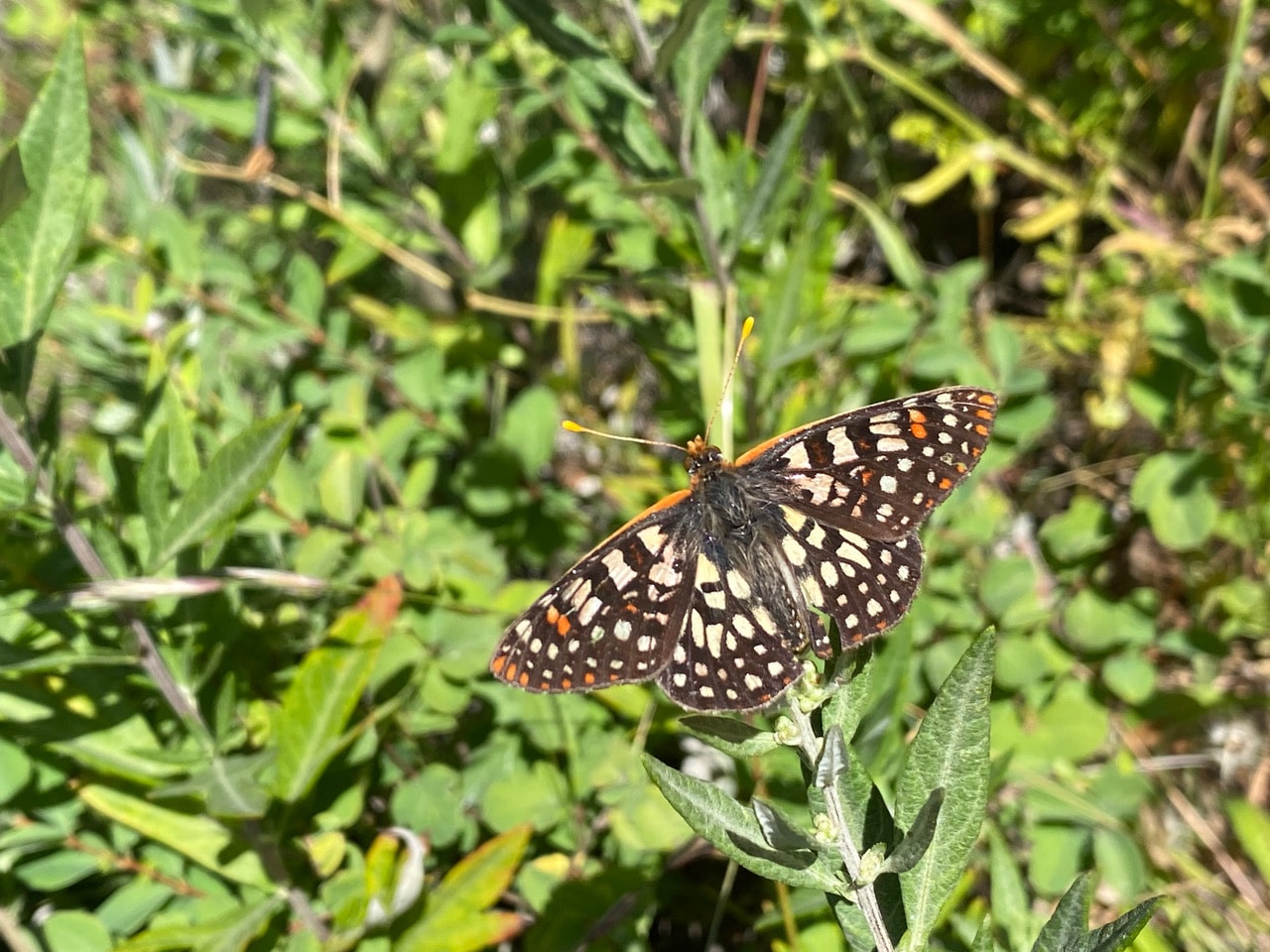
Many Variable Checkerspot butterflies, Euphydryas chalcedona (family Nymphalidae) can be seen fluttering along this stretch of Skyline Trail, where its favorite larval food plants, the California Bee Plant and the Sticky Monkeyflowers abound.
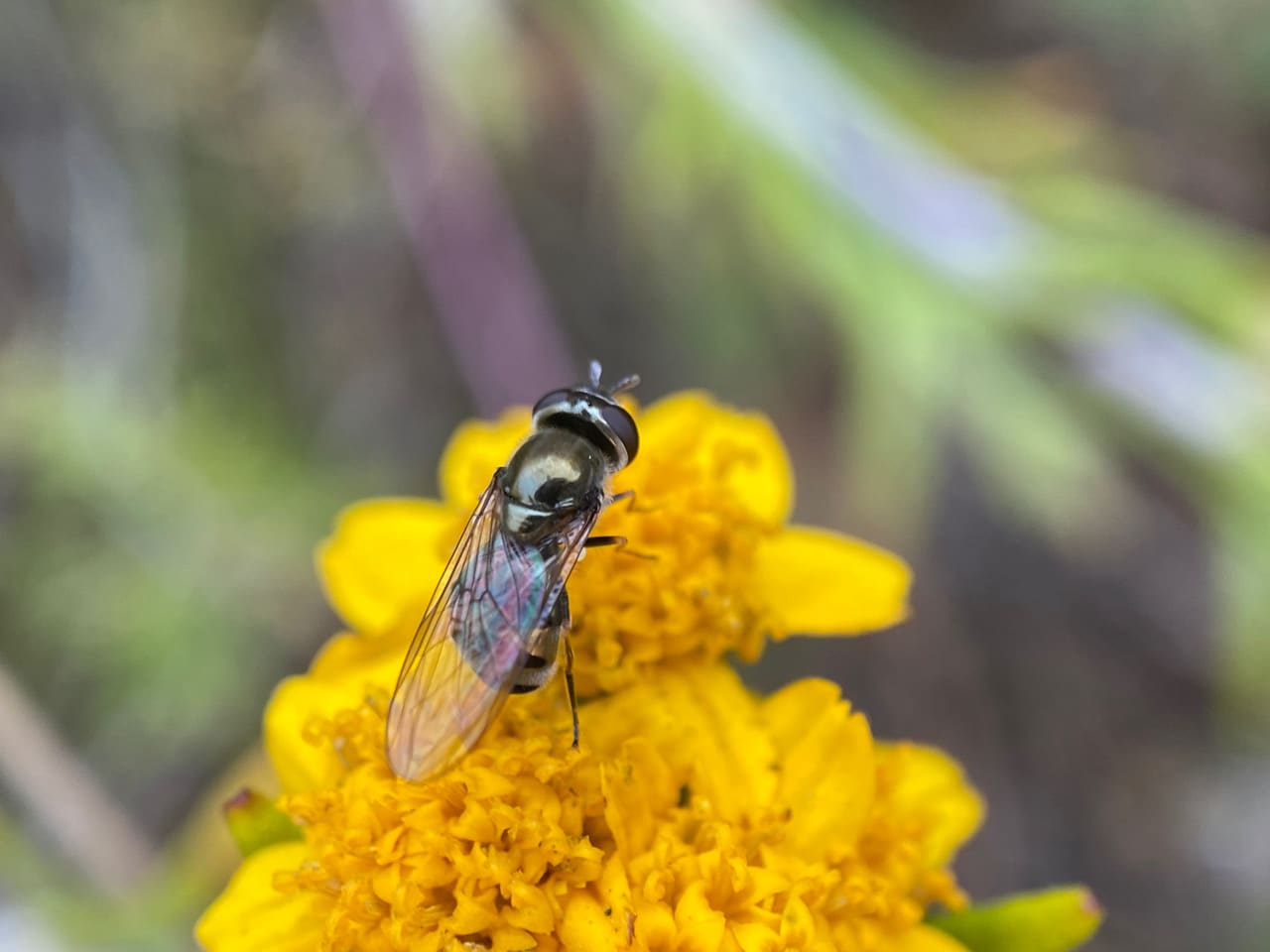
A Sedgesitter, Platycheirus sp. (family Syrphidae) has landed to forage on an inflorescence of Golden Yarrow, Eriophyllum confertiflorum.
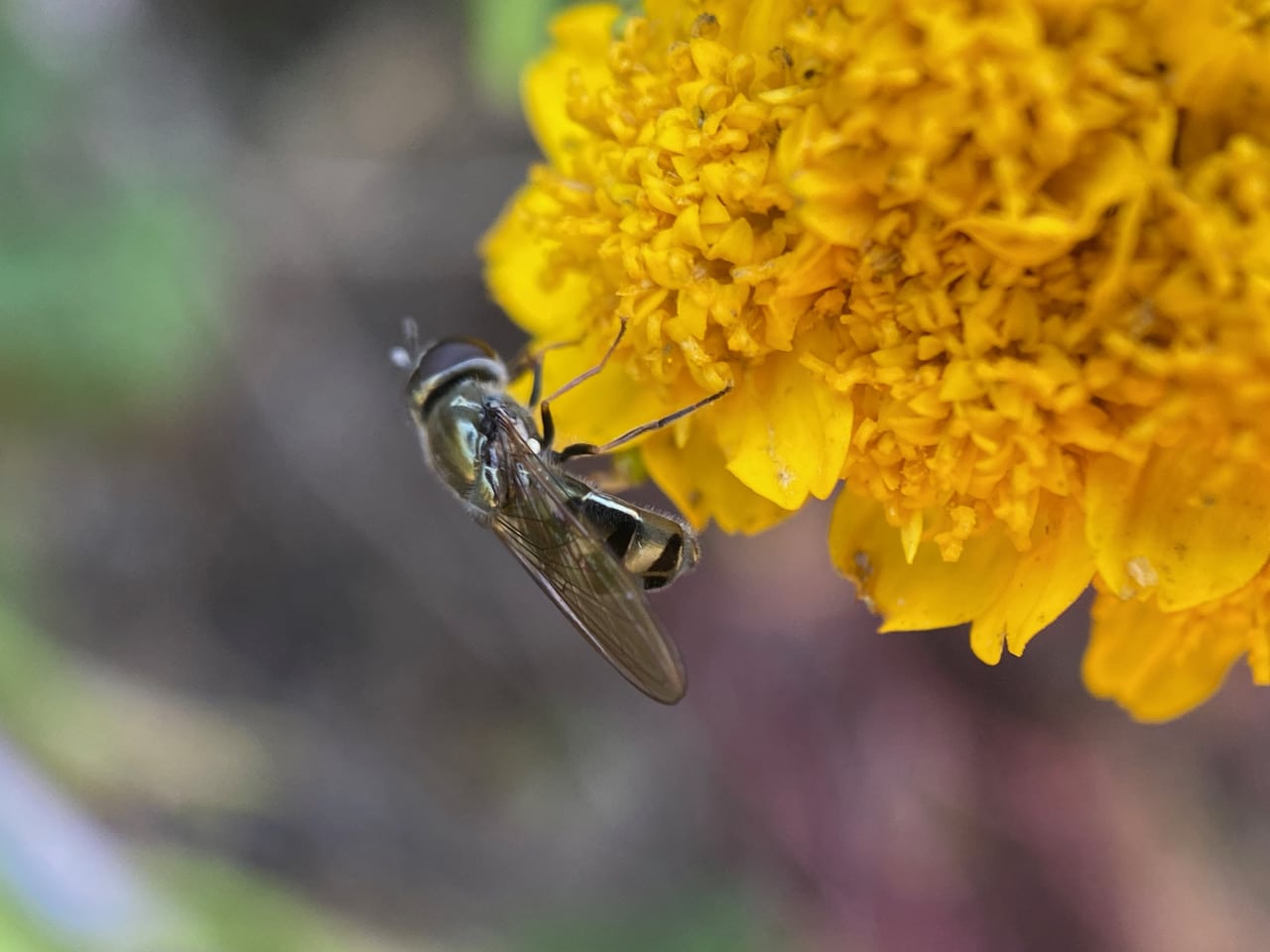
I am seeing many more of these metallic hover flies this year than ever. Probably because our cool and cloudy spring has been kind to this cold-tolerant species that tend to eschew bright light.
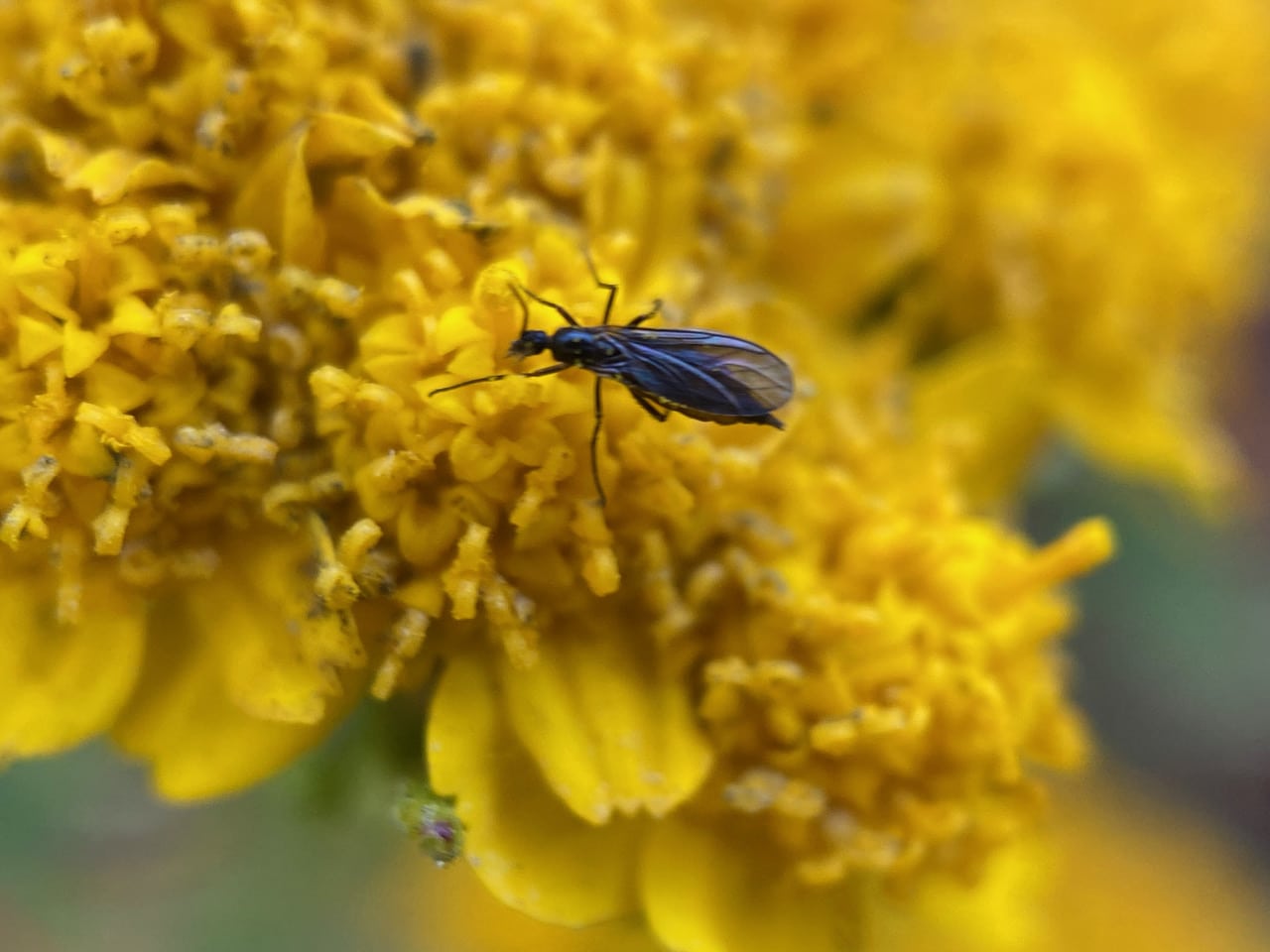
The Golden Yarrow is a favored feeding spot for many tiny insects overlooked by the casual hiker. One of the smallest is this Minute Black Scavenger Fly (family Scatopsidae).
As implied by the family name, these flies are also called “dung midges”. They are generally small, sometimes minute, dark flies (from 0.6 to 5 mm) with short antennae. Adults are often found on flowers. The larvae of most species are unknown, but the few that have been studied have a rather flattened shaped and are terrestrial and saprophagous, feeding on decaying plant and animal matter.

More commonly found on the Golden Yarrow are the Dark-winged Fungus Gnats (family Sciaridae).
Occurring worldwide, the Sciaridae are a family of flies, commonly known as Dark-winged Fungus Gnats. Commonly found in moist environments, they are known to be a pest of mushroom farms and are commonly found in household plant pots. In moist, shadowy areas, up to 70% of all dipteran species can be Sciaridae. Adults are small, dark flies, usually less than 5 mm long. They are distributed through wind and drifting, or by humans through transported soil. Sciarid larvae often occur in decaying plant matter such as rotten wood or under the bark of fallen trees. They play an important role in turning forest leaf litter into soil. The adults with their characteristic dancing flight do not bite. They only ingest liquids and only live long enough to mate and produce eggs. They die after about five days.
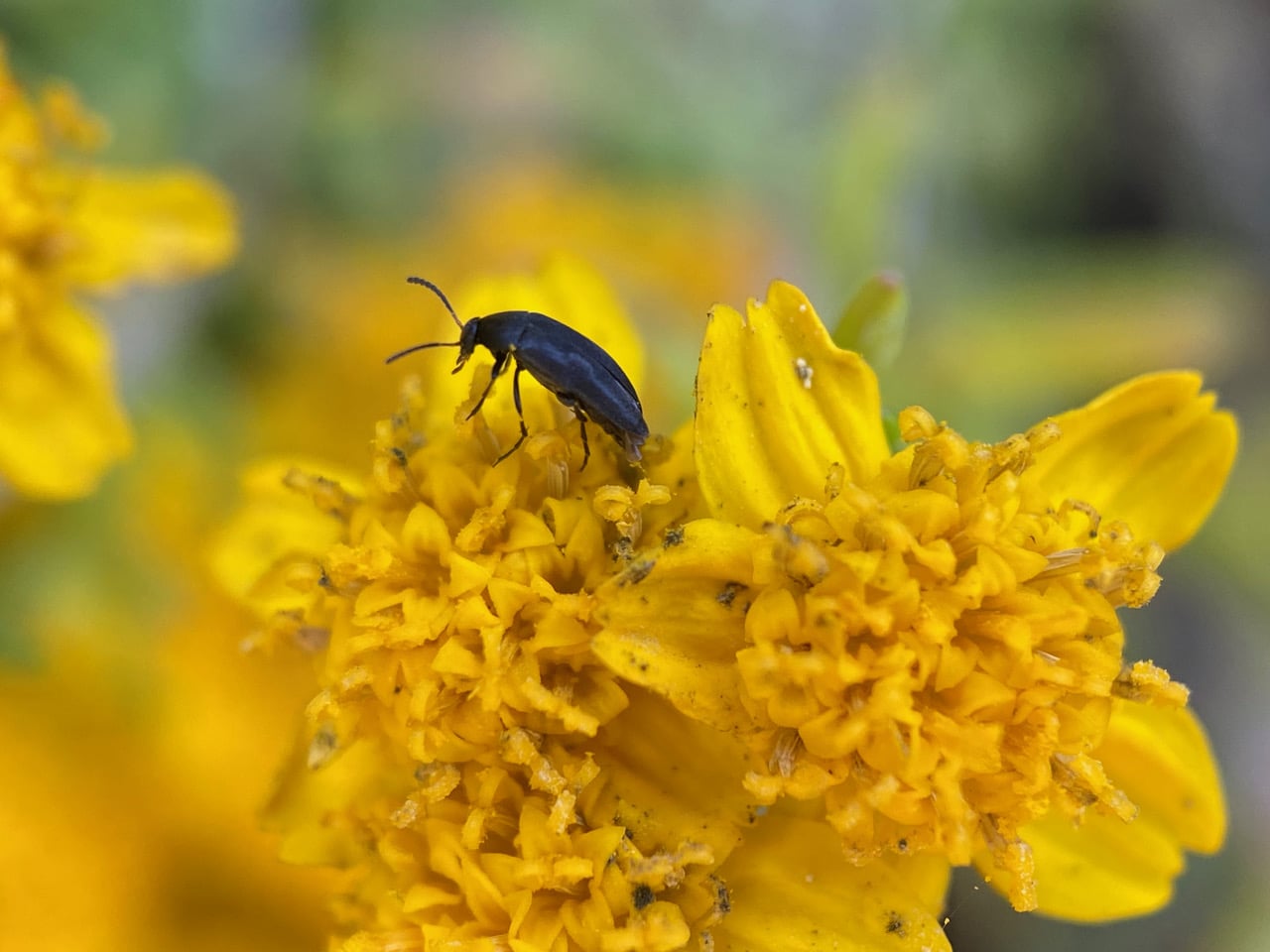
Last, but not least is the False Flower Beetle, Anaspis atrata (family Scraptiidae).
False Flower Beetles, Anaspis atrata (family Scraptiidae) are commonly found in western North America. The adults are found on flowers, sometimes in large numbers, but are also found on foliage. The larvae are typically found under the bark of dead trees.

I detect a movement in the underbrush. A Scudder’s Bush Cricket nymph, Scudderia sp. has hopped onto a dry grass. A day doesn’t go by that I don’t see one of these cuties – they are everywhere this year! I would love to see an adult eventually.
Scudderia is a genus of katydids in the family Tettigoniidae. They are sometimes called bush katydids and are 30-38 mm in length. They are mostly found in North America. Scudder’s Bush Katydids are herbivores, with nymphs feeding primarily on flowers and adults preferring woody deciduous plants.
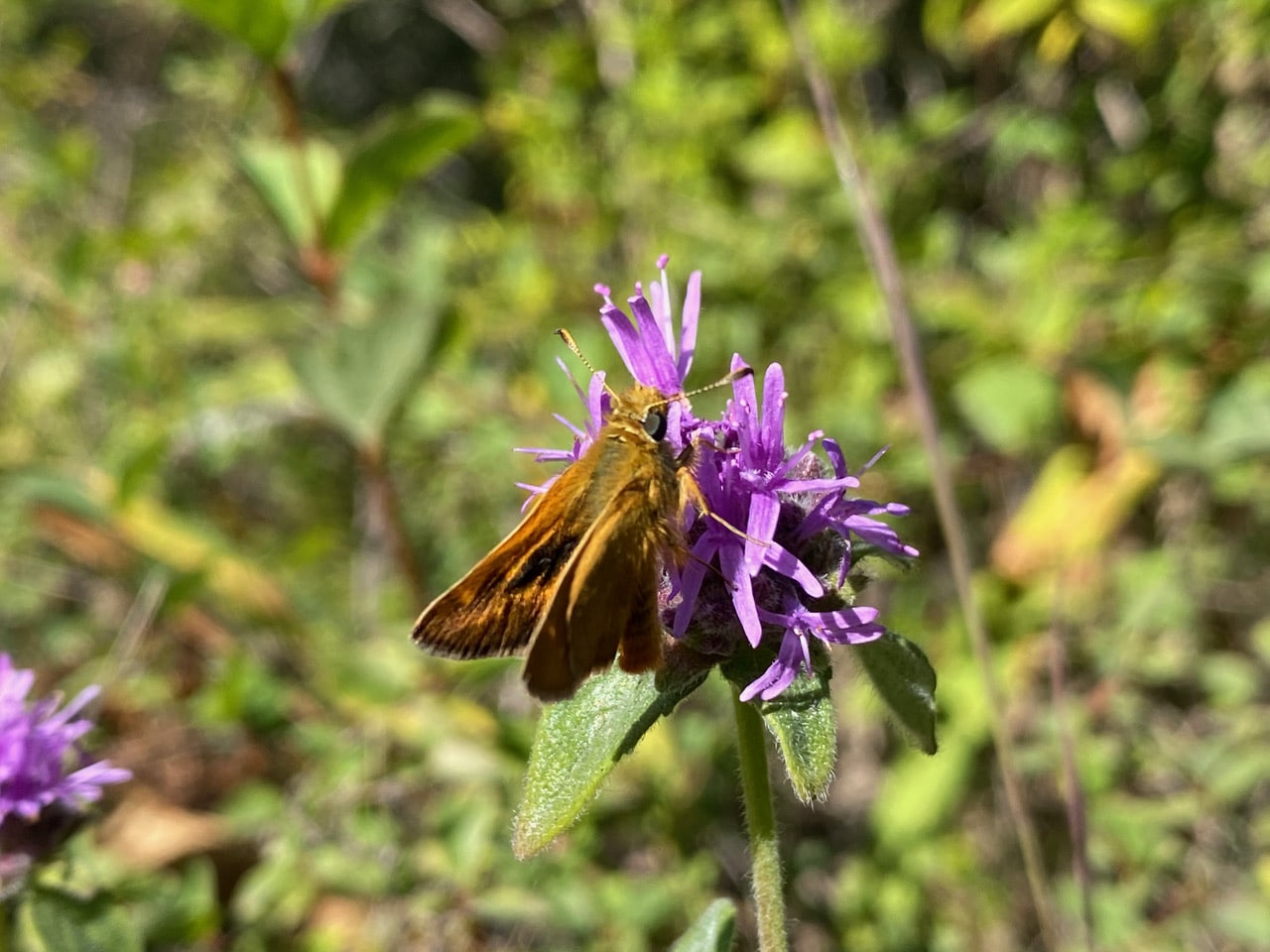
A Skipper (family Hesperiidae) is taking nectar on an inflorescence Coyote Mint, Monardella villosa.
Skippers are a family, the Hesperiidae, of the order Lepidoptera (butterflies and moths). They are named for their quick, darting flight habits. Most have the antenna clubs hooked backwards like a crochet hook. They also have generally stockier bodies and larger compound eyes than the other butterflies. Their wings are usually small in proportion to their bodies. When at rest, skippers keep their wings usually angled upwards or spread out, and only rarely fold them up completely. Californian species are mostly brown or tan, with black, orange, or yellow markings.
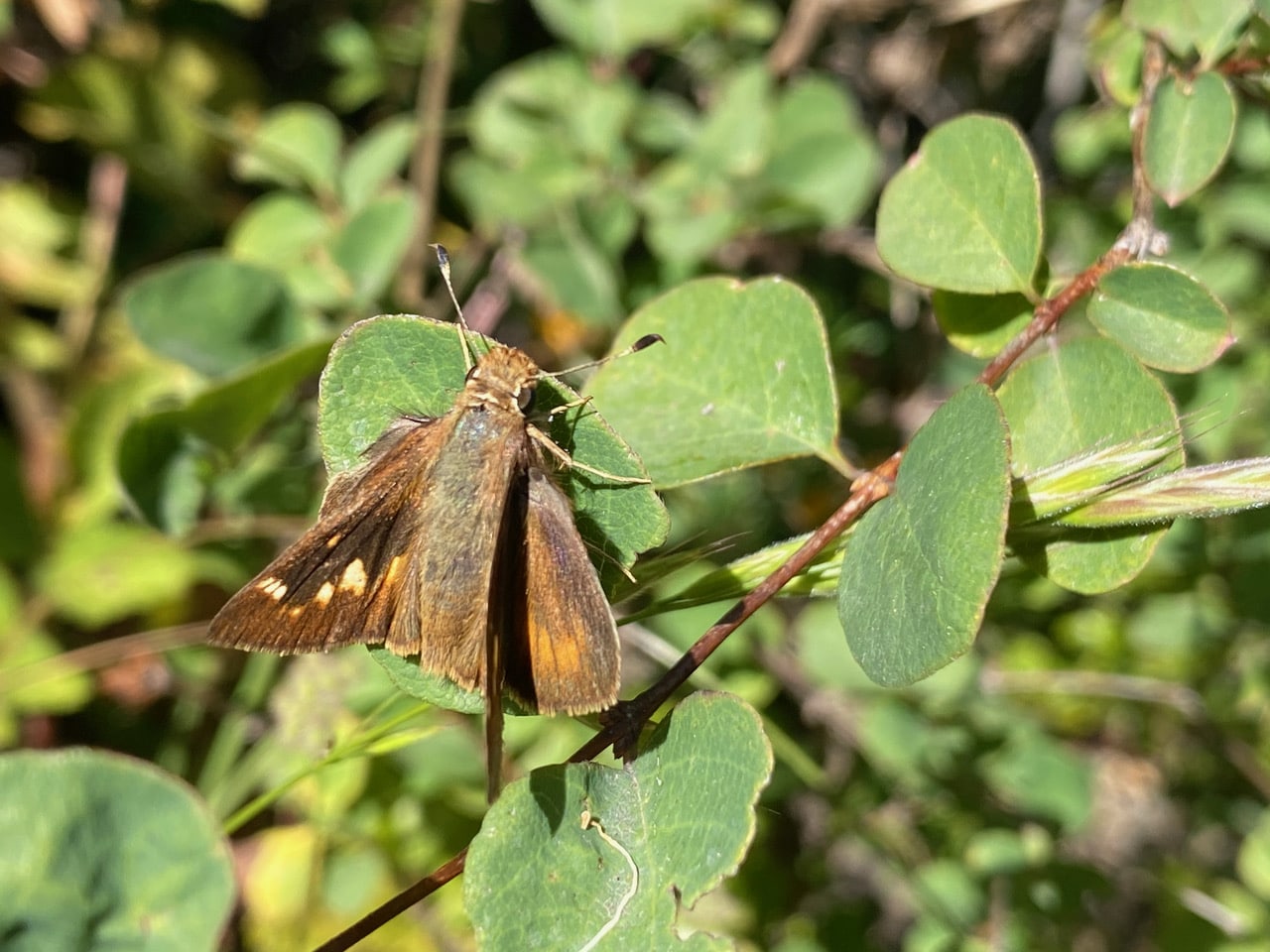
Another Skipper has landed on a leaf of Snowberry.
Skipper caterpillars are usually green or brown, sometimes yellowish, never brightly colored. They have a distinctive “collar”, a narrow ring around the body right behind the head. Caterpillars are camouflaged and often hide during the day. Many species make nests of leaves and silk for additional protection. Most North American species feed on grasses, but some common species eat shrubs and trees, especially in the bean family. Most species are limited to a single group of food plants. Adult skippers are only active during the day, but Skipper caterpillars feed mainly when it is dark or partly light.
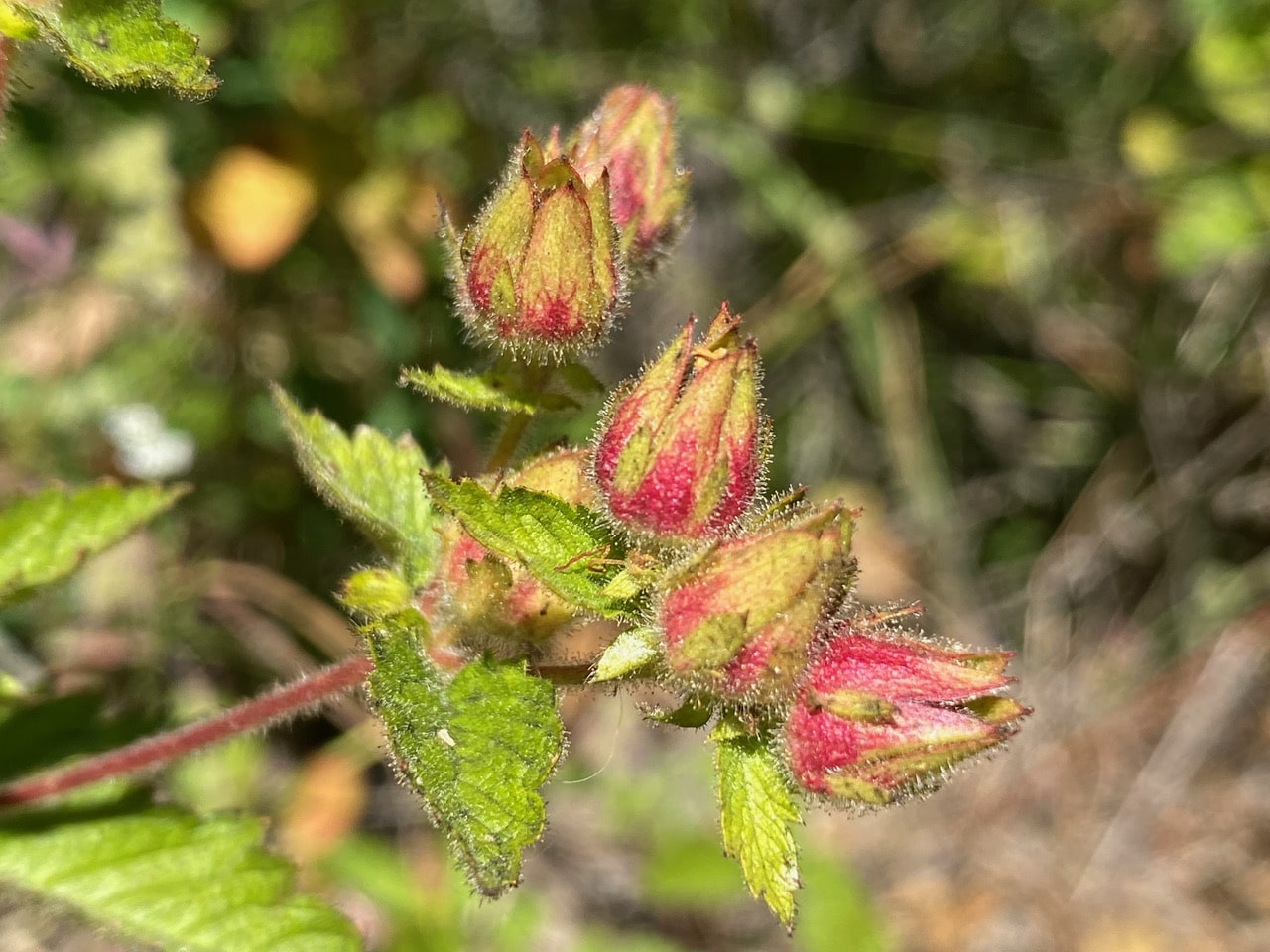
Most of the flowers of Sticky Cinquefoil, Drymocallis glandulosa (family Rosaceae) have faded and are developing into fruits. Once the petals are shed, the calyx closes up to protect the young fruits inside. At this stage they look very much like flower buds once again. When exposed to full sun, the sepals tend to acquire a reddish tinge.

The Cinquefoil flower closely resembles strawberry flower, both belonging to the rose family. Perhaps the fruit development is similar too. The fruits are achenes attached to a swelling receptacle. (An achene is a small, dry one-seeded fruit that does not open to release the seed.) We are actually looking at many fruits inside each calyx!
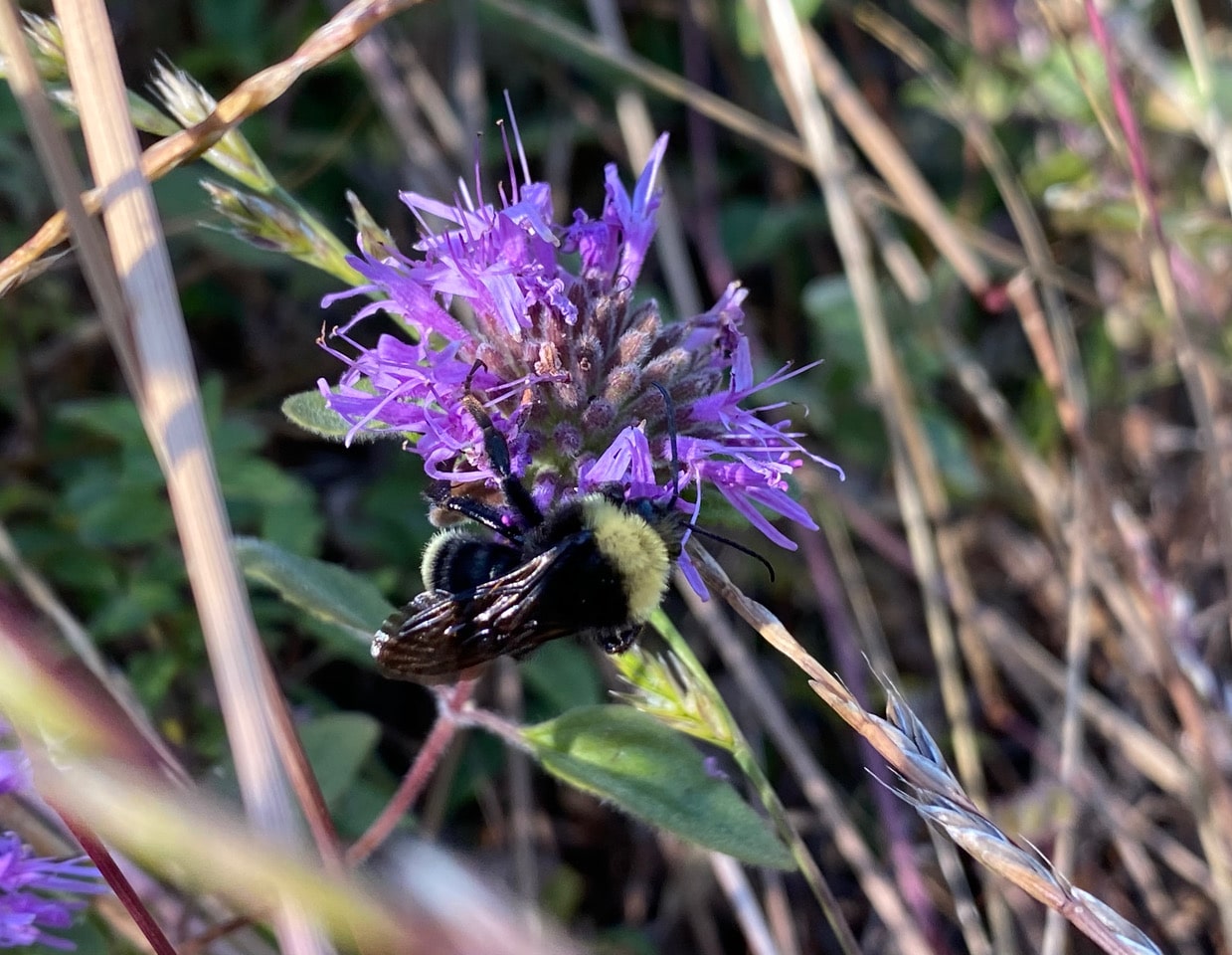
A California Bumble Bee, Bombus californicus visits an inflorescence of Coyote Mint, Monardella villosa for nectar. Easily mistaken for the more common Yellow-faced Bumble Bee, Bombus vosnesenskii, the California Bumble Bee lacks yellow hairs on the head.
Bombus californicus, the California Bumble Bee, is found in Central and the western half of North America. The species is now classified as Vulnerable by the IUCN. It was the most common bumble bee in California until about the 1990s when its numbers and distribution began to decline. Many factors may have contributed to its decline, including invasive species, pesticide use, commercial bumble bee rearing, habitat destruction, and climate change.
Although morphologically the species is quite variable, the “typical” color pattern of female B. californicus is black with only a single strong yellow band anteriorly on the thorax, and another single yellow band near the apex of the abdomen. Males exhibit considerably more variation.
The California Bumble Bee is an important pollinator in alpine environments in its native range. They are social bees having a queen and workers. Their colonies last for one year. New queens overwinter, usually underground, and found new colonies from scratch the following year. Queens emerge from April through mid July. Workers are present from April to September. The species is known to pollinate sage, blueberry bushes, red clover, California poppies, and many other species of flowers.
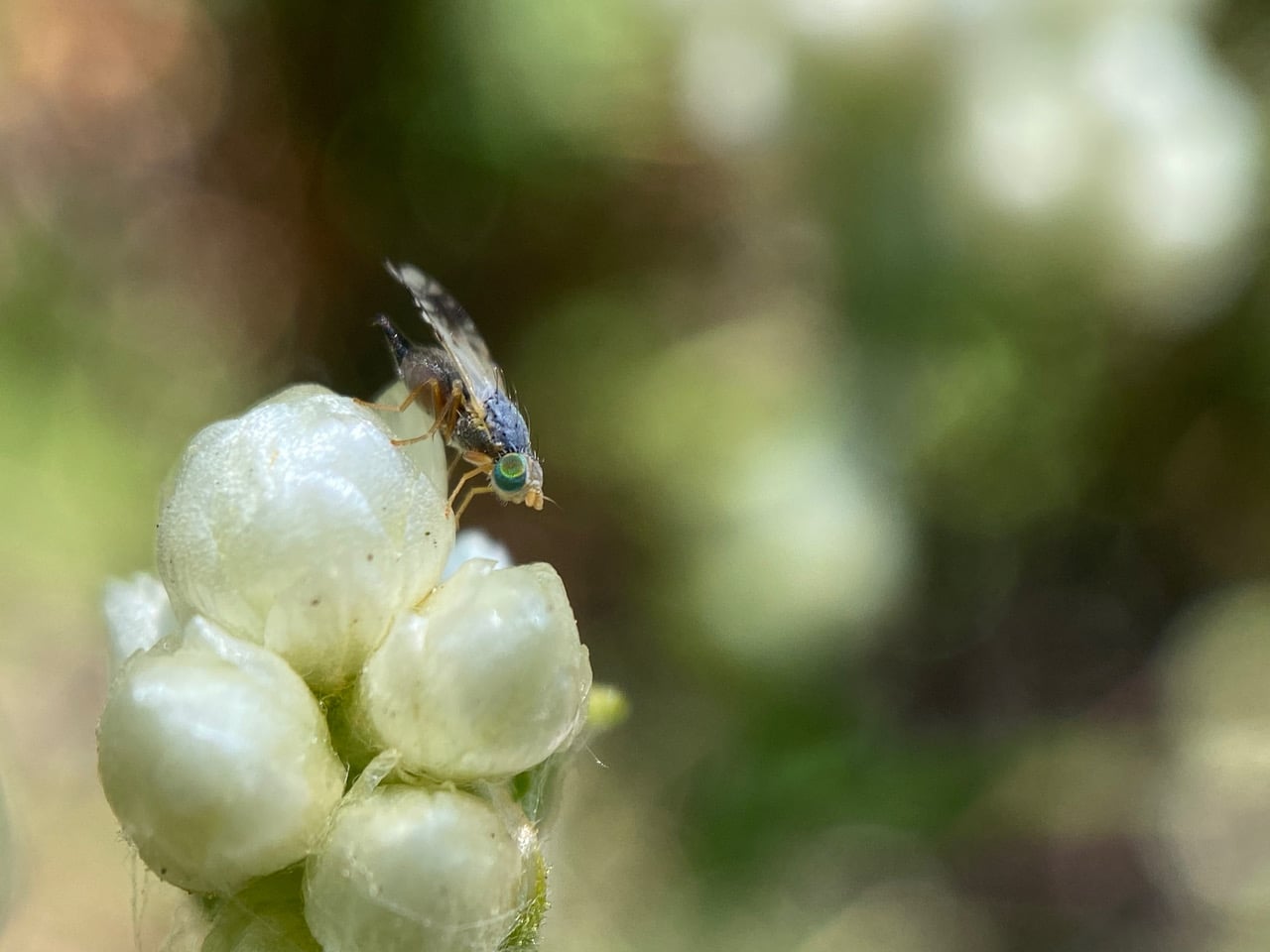
A female Fruit Fly, Trupanea sp. (family Trephritidae) is roaming the immature flowerheads of a California Everlasting, Pseudognaphalium californicum probably looking for a place to lay her eggs.
Tephritids are small to medium-sized flies that are often colorful, and usually with picture wings. The larvae of almost all Tephritidae are phytophagous. Females deposit eggs in living, healthy plant tissues using their telescopic ovipositors. Here the larvae find their food upon emerging. The larvae develop in leaves, stems, flowers, seeds, fruits, and roots of the host plant, depending on the species. Adults are often found on the host plant and feeding on pollen, nectar, rotting plant debris, or honeydew. Tephritid flies are of major economic importance as they can cause damage to fruit and other plant crops. On the other hand, some Tephritids are used as agents of biological control of noxious weeds.
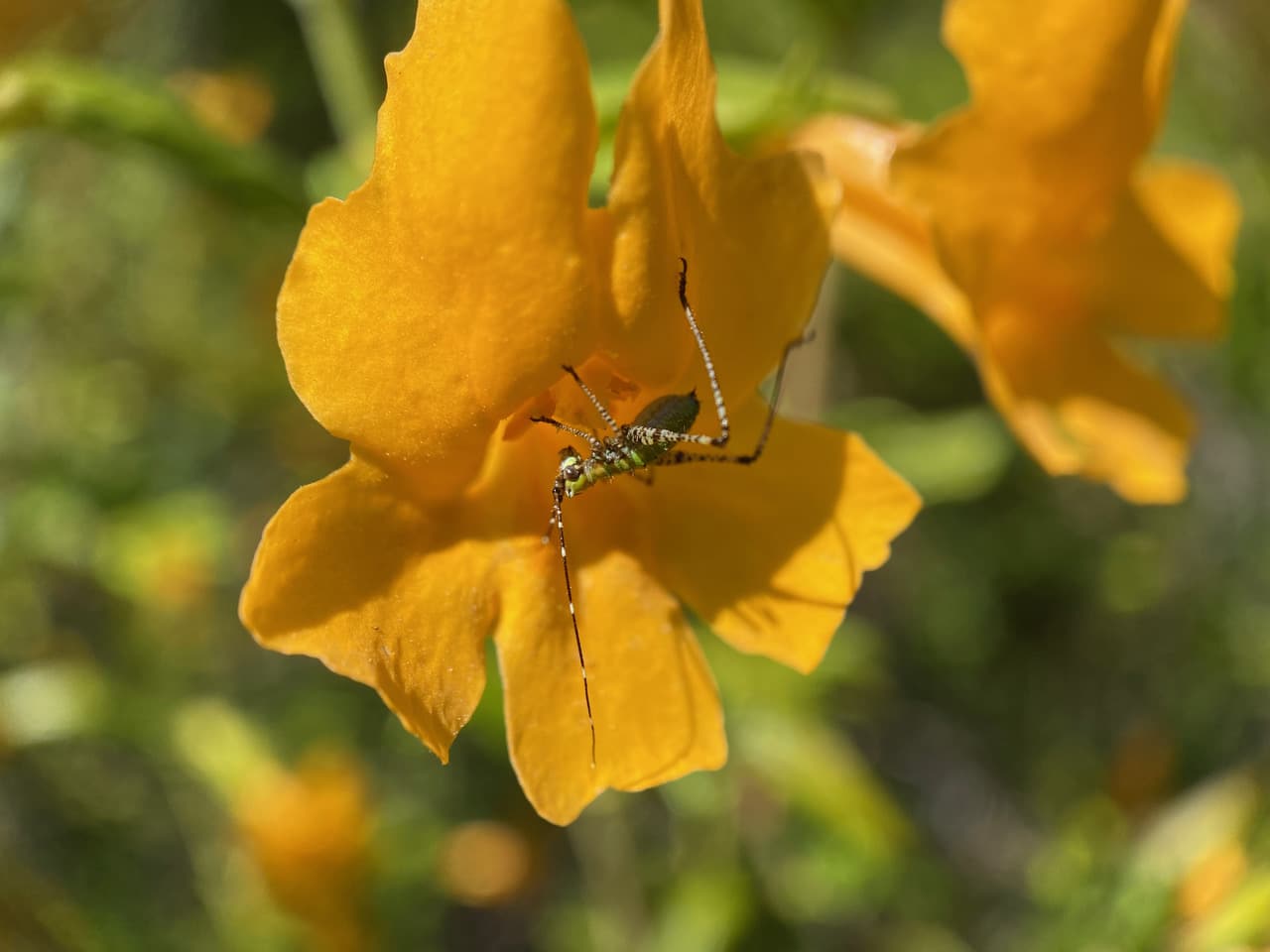
Hey, another Scudder’s Bush Katydid nymph! Apparently these babies love to eat the flowers of Sticky Monkeyflower, Diplacus aurantiacus.

A Tumbling Flower Beetle (family Mordellidae) is resting on the lower lip of a Sticky Monkeyflower.
The Tumbling Flower Beetles (family Mordellidae) are named for the characteristic irregular movements they make when escaping predators. They are also sometimes called Pintail Beetles for their abdominal tip which aids them in performing these tumbling movements. Mordellids are small, wedge-shaped, hump-backed beetles with head bent downward. The body is densely covered with fine silky hairs, usually black, but often very prettily spotted or banded with silvery hues. The adults feed on pollen, occurring on flowers or on dead trees, flying or running with rapidity. The larvae live in old wood or in the pith of plants, and those of some species are said to be carnivorous, feeding on the young of Lepidopterans and Diptera which they find in the plant stems.
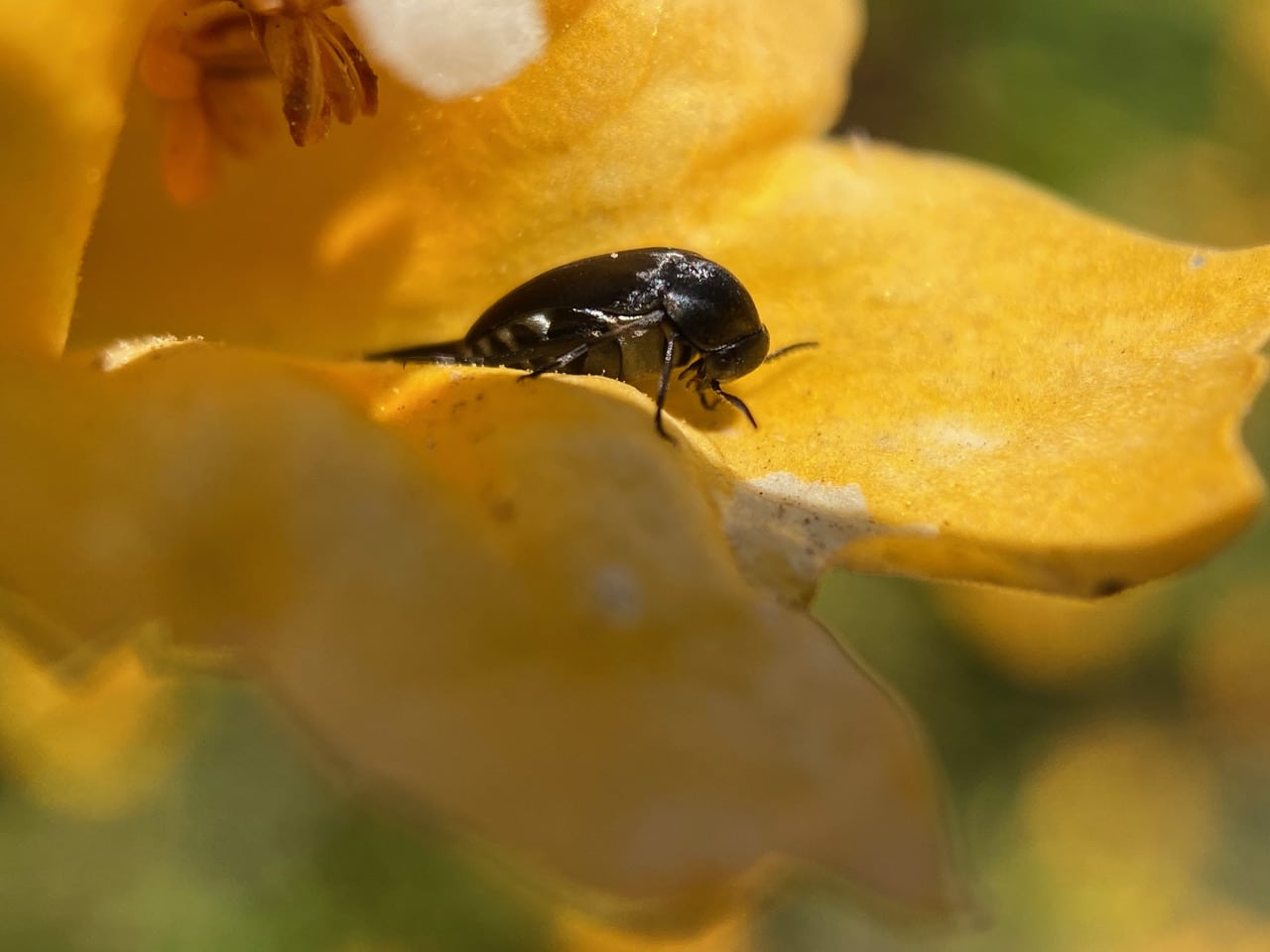
Side view of the same Tumbling Flower Beetle – in its typical posture with head tucked under the pronotum.

A Face Fly is perched on a Sticky Monkeyflower.
The Face Fly, Musca autumnalis (family Muscidae) is similar to the closely related housefly but is slightly larger, about 7-8 mm long, with a grey thorax with four dorsal longitudinal dark stripes. The yellowish abdomen has a single, dorsal longitudinal dark stripe.
Adult Face Flies emerge from winter hibernation in early spring. During the day, they feed on manure juices and plant sugars. On cattle and horses they feed on secretions around the eyes, mouth and nostrils. They will also feed on the hosts’ blood through wounds such as horse-fly bites. At night both sexes rest on vegetation. Females lay eggs on fresh cow manure where the maggots feed on microbes, developing through three instars and final pupation. Musca autumnalis is considered a pest species, as it transmits the eye worm to cattle and horses, and pinkeye to cattle.
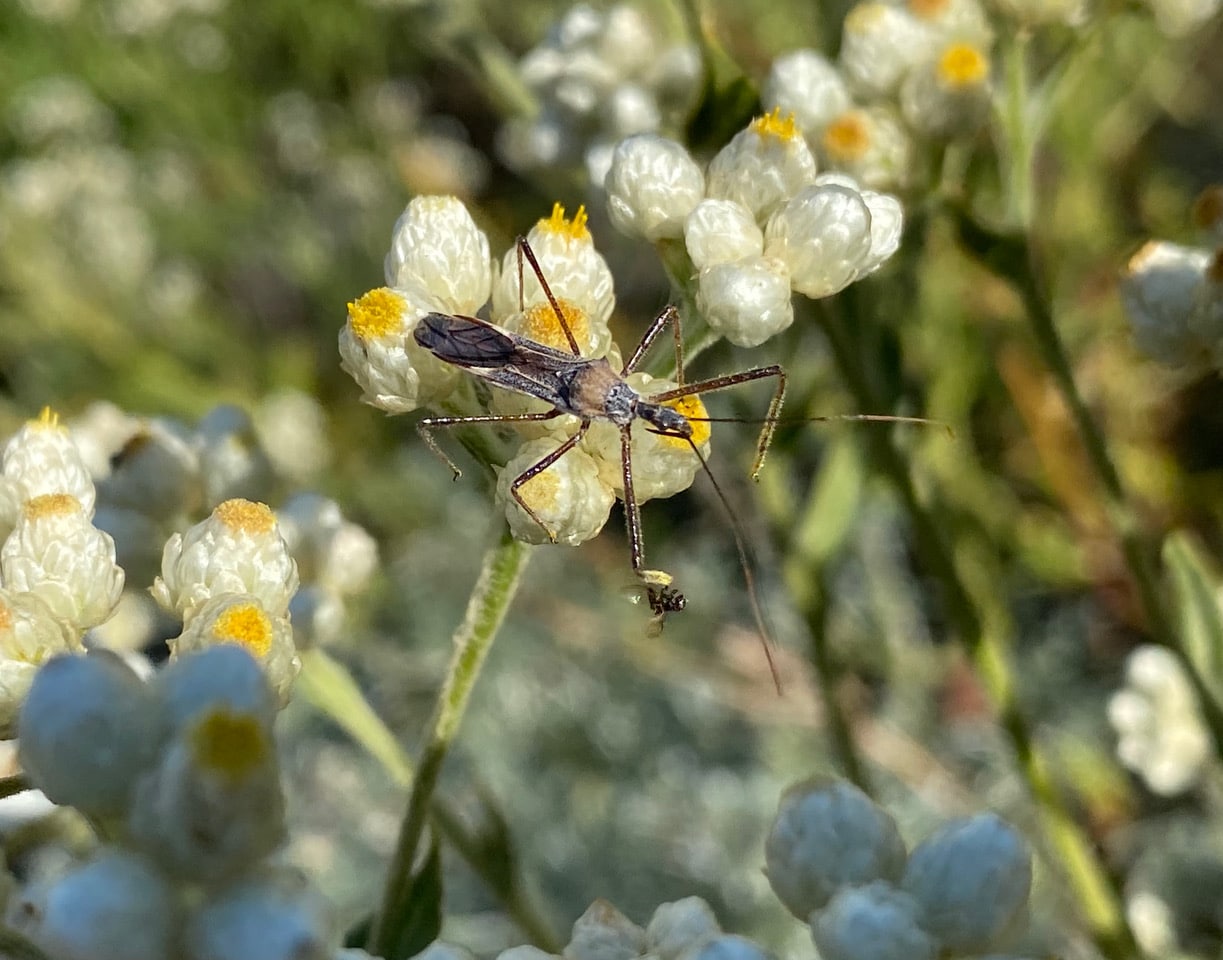
Across the bench at Diablo Bend, a Four-spurred Assassin Bug, Zelus tetracanthus (family Reduviidae) is enjoying a meal on an inflorescence of blooming California Everlasting. At my approach, the predator stops feeding, but its prey, a small fly remains stuck to its front leg.
The Reduviidae are members of the order of true bugs, Hemiptera. The family members are almost all predatory. The bugs commonly have an elongated head with a distinct narrowed “neck”, long legs, and prominent, segmented, tubular mouthparts called the “rostrum”. Most species are bright in color with hues of brown, black, red, or orange. The most distinctive feature of the family is that the tip of the rostrum fits into a ridged groove in the prosternum, where it can be used to produce sound by stridulation when threatened.
Reduviidae use the long rostrum to inject a lethal saliva that contains digestive enzymes to liquify the insides of the prey, which are then sucked out. This process is generally referred to as extraoral digestion. The saliva is commonly effective at killing prey substantially larger than the bug itself. Some species capture prey by either producing a gooey secretion from glands on their own bodies or capturing insects stuck on sticky plants. Recently a species of Assassin Bug has been shown to use sticky resin from a plant to help capture prey – a rare case of insect tool use.
The Four-spurred Assassin Bug, Zelus tetracanthus is found throughout the Americas. Adults are brown, black, or gray and have a body length of 10-16 mm. Their antennae and legs are long and slender. They have a row of four spurs across their thorax. Both adults and nymphs use a sticky secretion to capture prey.