

Pollinator Post 6/27/24

As I walk Skyline Trail south of Siesta Gate this morning, I notice how dry and dusty the trail has become. The grasses are a parched brown now. My only hope of seeing insects are on the few hardy late-blooming natives.
A Skipper has aimed its long, flexible proboscis into one of the flowers on a crowded inflorescence of Coyote Mint, Monardella villosa.
A tubular sucking organ, the proboscis enables a butterfly to extract sweet nectar from flowers, regardless of the shape of the blossom. When not in use, the proboscis is rolled up out of the way. Unlike caterpillars, adult butterflies do not have any chewing mouthparts, and therefore must obtain their nutrition from sipping liquids. Hydrostatic pressure extends the curled proboscis which is inserted deep into the tubes of flowers. At emergence from the chrysalis, the proboscis initially consists of two parts that appear like a forked tongue. Almost immediately the two tubes are “zipped” together to form the single tube. In addition to flower nectar, butterflies also use the proboscis to suck up moisture from puddles, liquids from fermenting fruits, rotting animal flesh or animal excrements.
Skippers are a family, the Hesperiidae, of the order Lepidoptera (butterflies and moths). They are named for their quick, darting flight habits. Most have the antenna clubs hooked backwards like a crochet hook. They also have generally stockier bodies and larger compound eyes than the other butterflies. Their wings are usually small in proportion to their bodies. When at rest, skippers keep their wings usually angled upwards or spread out, and only rarely fold them up completely. Californian species are mostly brown or tan, with black, orange, or yellow markings.
Skipper caterpillars are usually green or brown, sometimes yellowish, never brightly colored. They have a distinctive “collar”, a narrow ring around the body right behind the head. Caterpillars are camouflaged and often hide during the day. Many species make nests of leaves and silk for additional protection. Most North American species feed on grasses, but some common species eat shrubs and trees, especially in the bean family. Most species are limited to a single group of food plants. Adult skippers are only active during the day, but Skipper caterpillars feed mainly when it is dark or partly light.

A Yellow-faced Bumble Bee, Bombus vosnesenskii (family Apidae) is taking nectar from an inflorescence of Coyote Mint.

Bumble bees have been mainly taking nectar lately. Few show pollen in their pollen baskets. Perhaps in these dry times, liquid fuel is vital for survival. Reproductive activities in the nests might be winding down with no new larvae to be fed pollen.
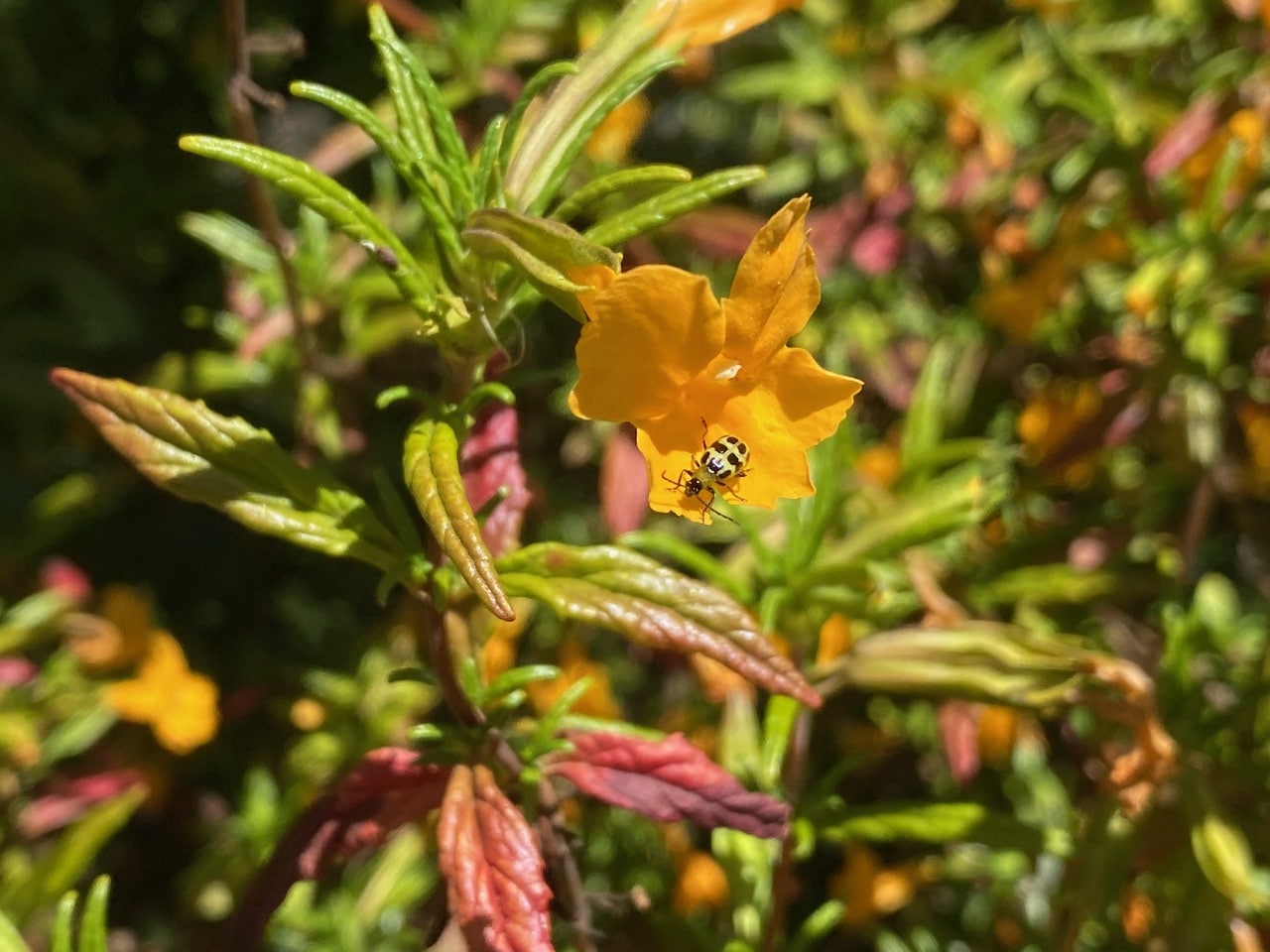
A Spotted Cucumber Beetle, Diabrotica undecimpunctata (family Chrysomelidae) wanders on the lower lip of a Sticky Monkeyflower, Diplacus aurantiacus. While the plant continues to bloom gloriously, its leaves are beginning to turn reddish bronze, a sign of heat stress. Interestingly, very few small bees are visiting the flowers today. Do heat and drought affect nectar production in flowers?
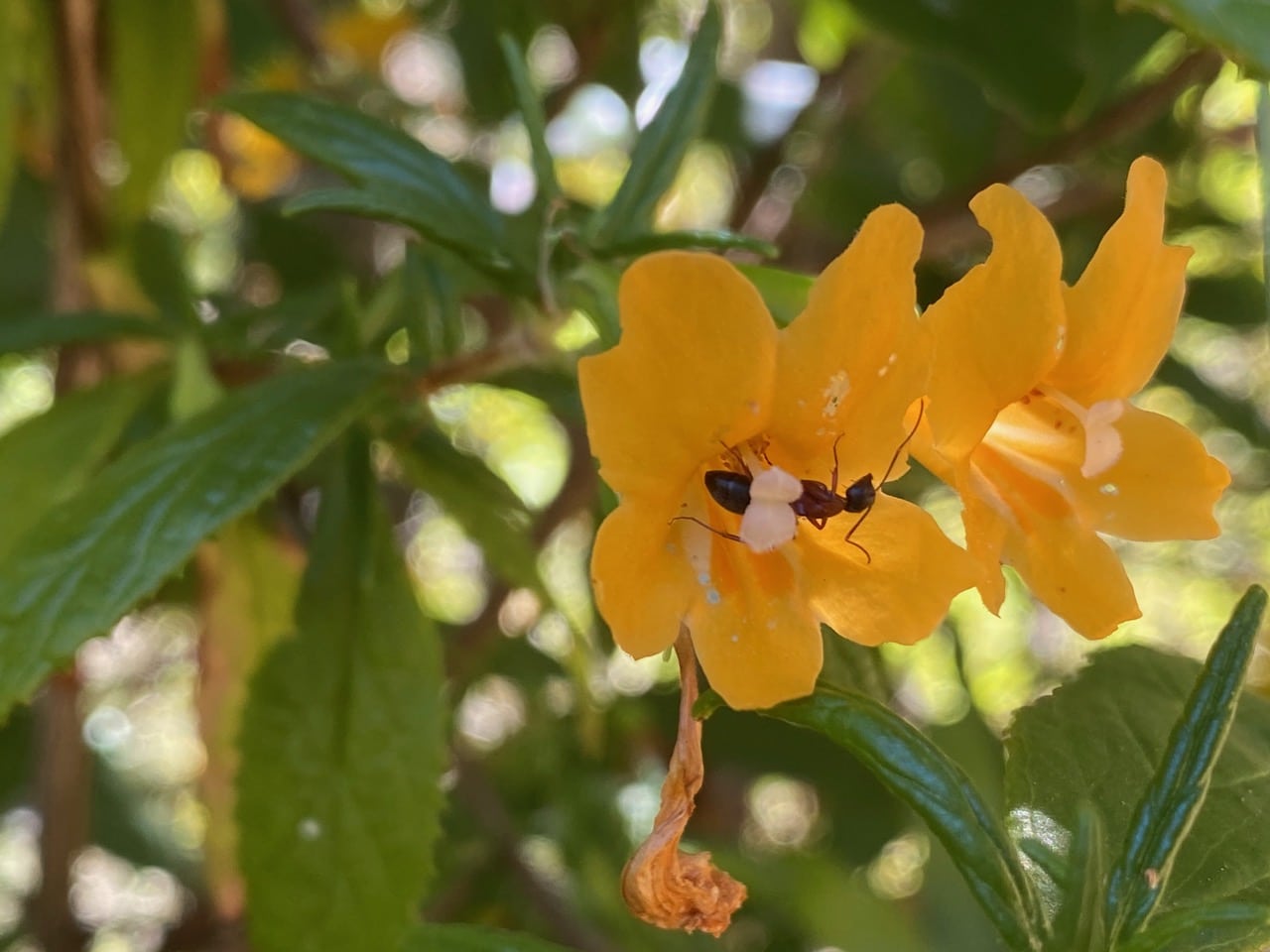
A Bicolored Carpenter Ant, Camponotus vicinus (family Formicidae) is foraging on a Sticky Monkeyflower.
Carpenter Ants are so named for their skill at constructing their homes from wood. These large ants are excavators, not wood feeders. They are among the largest ants in North America, with workers ranging from 1/4 – 1/2 inch long. They have only one bulge at their narrow “waist” (the single node on their petiole)) and an evenly rounded back, when viewed from the side. In established colonies, two castes of sterile workers develop – major and minor workers. The larger major workers defend the nest and forage for food. Minor workers tend to the young and maintain the nest.
Most carpenter ants build their nests in dead or decaying trees or logs, though they may inhabit wooden structures in people’s homes.
Camponotus do not eat wood. They are generalist omnivores, and will forage for honeydew, fruits, plant juices, other small insects and invertebrates. Some herd aphids for their honeydew, and will sometimes carry aphids to new plants. Carpenter ants can’t sting but can inflict painful bites with their powerful jaws and spray formic acid into the wound, causing a burning sensation.
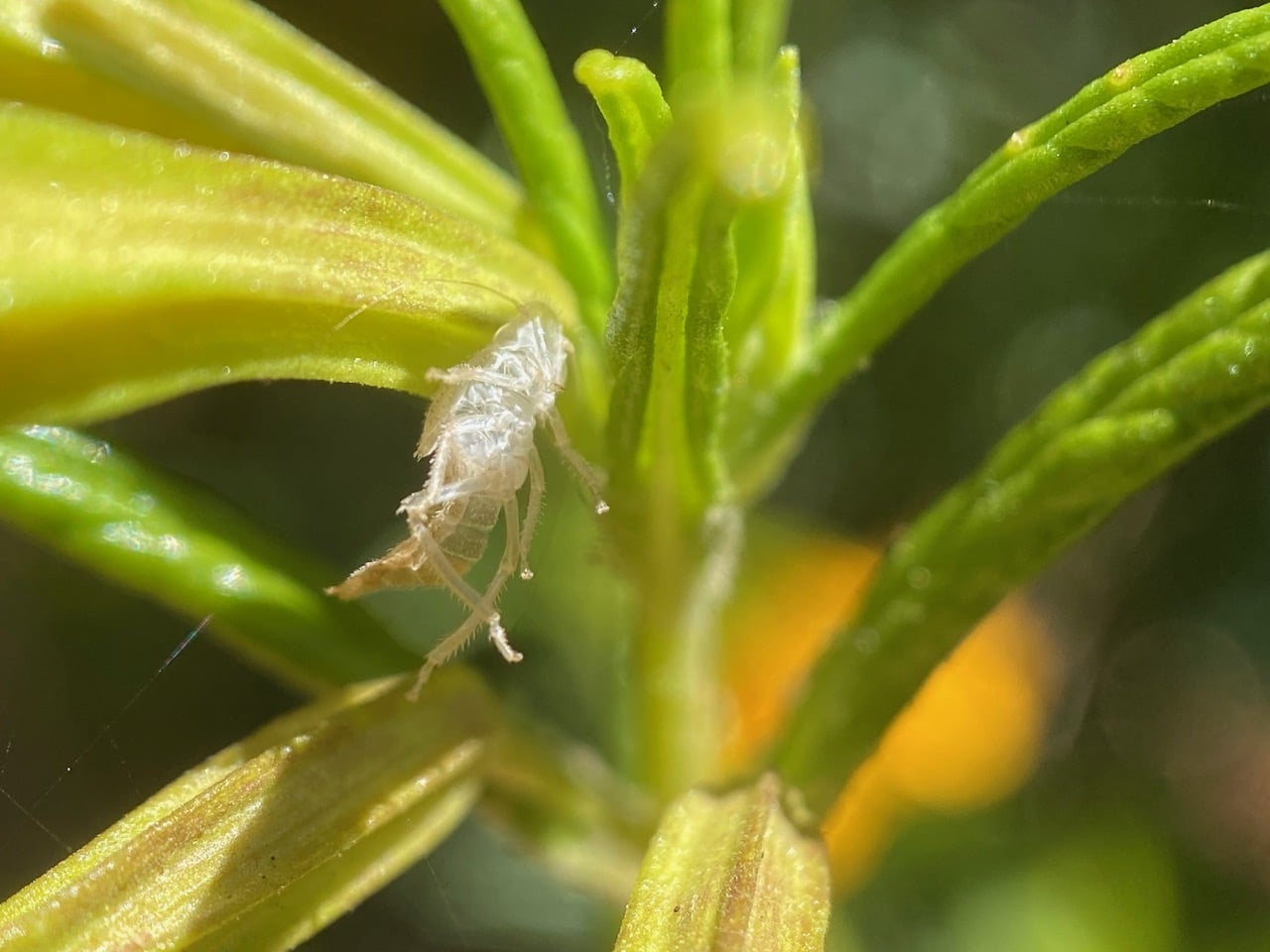
A ghostly exuvia hangs lifelessly from a calyx of Sticky Monkeyflower. An exuvia (plural exuviae) is the cast-off outer skin of an arthropod after a molt. The neat rows of comb-like spines on the hindlegs indicate that the discarded exoskeleton was shed by a Leafhopper (family Cicadellidae).
Leafhopper is the common name given to true bugs in the family Cicadellidae. The bugs are plant feeders that suck plant sap from grass, shrubs, or trees. Their hind legs are modified for jumping, and are covered with hairs that facilitate the spreading of a secretion over their bodies that act as a water repellent and carrier of pheromones. They undergo partial metamorphosis, and have various host associations, varying from very generalized to very specific.
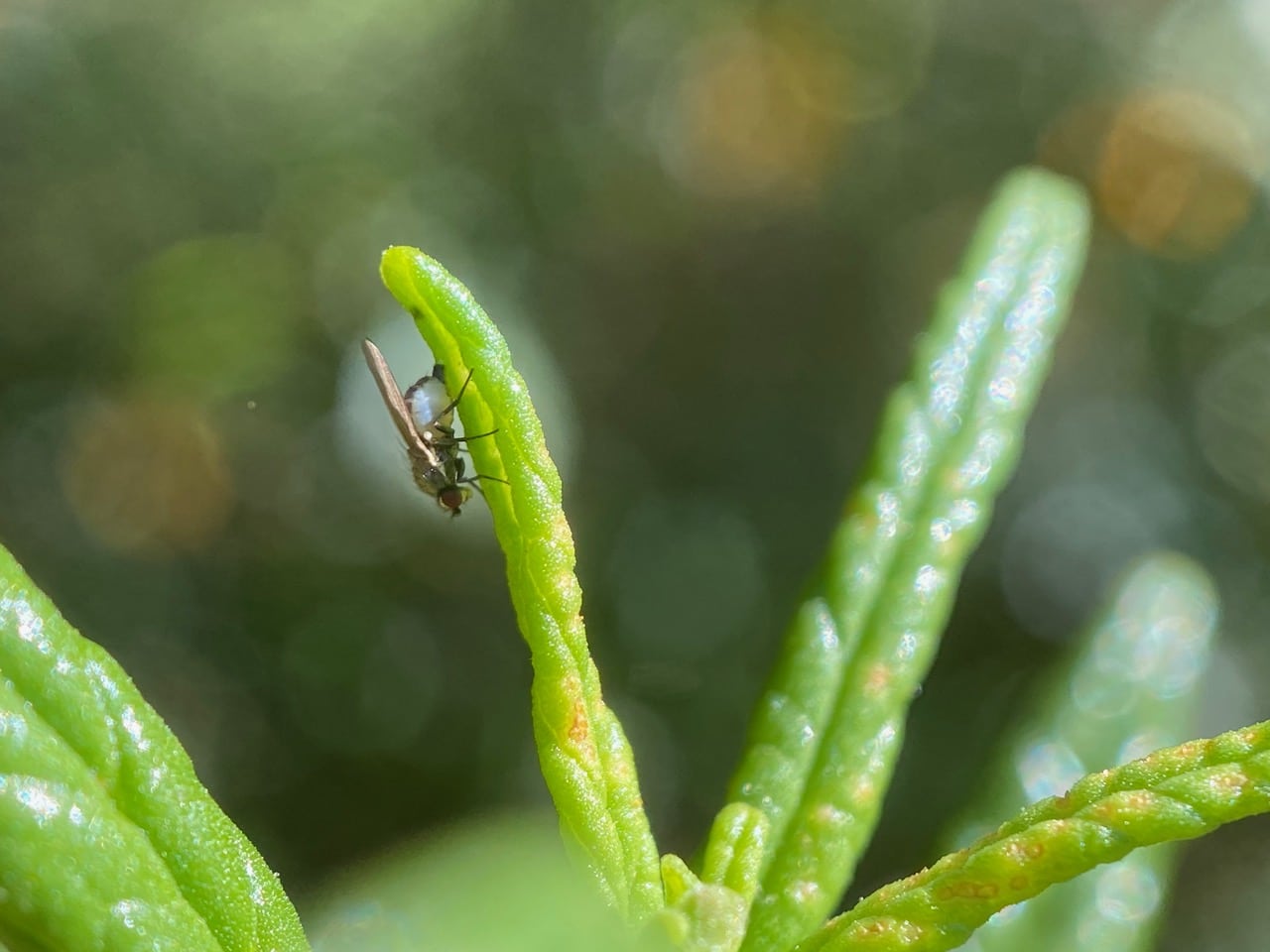
A female Leaf-miner Fly (family Agromyzidae) is ovipositing into a terminal leaf of Sticky Monkeyflower.
The Agromyzidae are a family commonly referred to as the Leaf-miner Flies, for the feeding habits of their larvae, most of which are leaf miners on various plants. They are small flies, most species in the range of 2-3 mm. Agromyzidae larvae are phytophagous, feeding as leaf miners, less frequently as stem miners or stem borers. A few live on developing seeds, or produce galls. There is a high degree of host specificity. A number of species attack plants of agricultural or ornamental value, so are considered pests. The shape of the mine is often characteristic of the species and therefore useful for identification. Adults occur in a variety of habitats, depending on the larval host plants.

A Yellow-faced Bumble Bee, Bombus vosnesenskii (family Apidae) takes nectar from Nude Buckwheat, Eriogonum nudum. The plant does not seem to do well along Skyline Trail this year. The inflorescences are small and few and far between.

Not surprisingly, the population of the Metallic Flea Beetles, Altica sp. (family Chrysomelidae) declines in sync with the Nude Buckwheat. In previous years when the plant thrived, the beetles and their larvae were everywhere feeding on the plant. Today I see only these two beetles tucked snugly among the inflorescence.
Flea Beetles are in the largest subfamily (Alticinae) of the family Chrysomelidae, or Leaf Beetles. The name Altica is derived from the Greek word haltikos, meaning good jumpers. The beetles have strong hind legs allowing them to jump long distances like true fleas. Altica flea beetles are 3-9 mm in length, and females are typically larger then males. Most Altica beetles have hard outer wings elytra that are metallic blue to green in color that protect similarly colored metallic bodies that reflect purple and bronze colors and are elongate oval in shape. Antennae have 11 segments and are filiform (threadlike).
The life history patterns of common flea beetles are very similar among Altica species with the major difference being host plant preference. Adults and larvae Altica flea beetles feed on all sorts of plant tissues, and all species are fully herbivorous. Many are serious pests of cultivated plants, including food crops. Others are beneficial due to their use in biocontrol of invasive weeds.

A Soft-winged Flower Beetle, Listrus sp. (family Melyridae, subfamily Dasytinae) is foraging on a flowerhead of California Everlasting, Pseudognaphalium californicum.
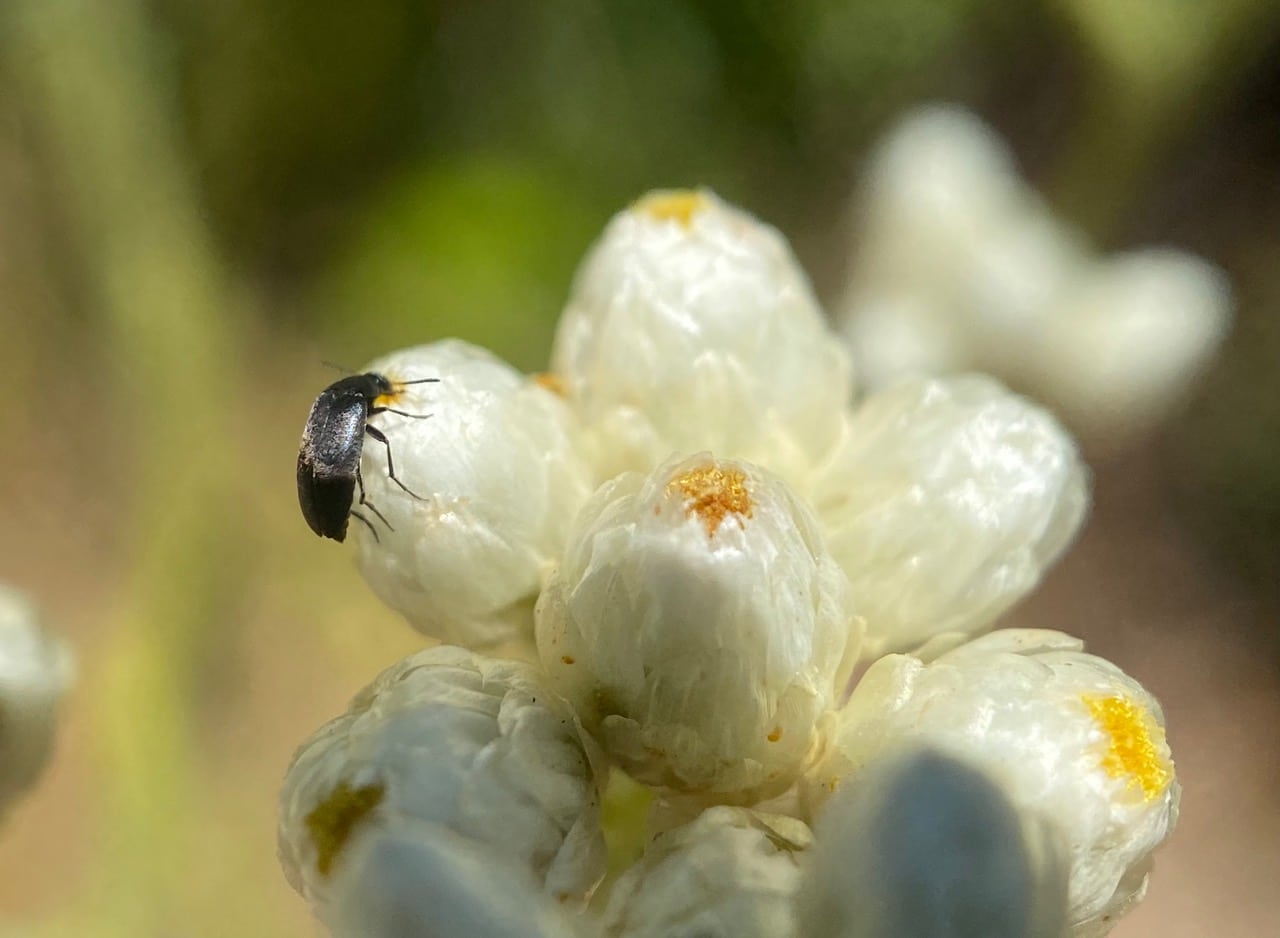
Most species of Melyridae are various shades of brown or black and just 2 to 4 mm in length. They are sometimes very abundant in spring when there is an abundance of open flowers, particularly those with an abundance of pollen. In north America, dasytine beetles are hardly represented in the east, but are enormously diverse in the west, especially in California.
11 families of Coleoptera (beetles) are known to pollinate flowering plants. In western North America, the 300+ species of the beetle subfamily Dasytinae are commonly found on flowers, where adults feed on both nectar and pollen. Their dense setae (hairs) often trap pollen grains, which are transported to other flowers during the course of normal feeding. Many dasytine beetles form large feeding aggregations.

A Tumbling Flower Beetle (family Mordellidae) is enjoying the hidden abundance offered by the flowers of California Everlasting.
The Tumbling Flower Beetles (family Mordellidae) are named for the characteristic irregular movements they make when escaping predators. They are also sometimes called Pintail Beetles for their abdominal tip which aids them in performing these tumbling movements. Mordellids are small, wedge-shaped, hump-backed beetles with head bent downward. The body is densely covered with fine silky hairs, usually black, but often very prettily spotted or banded with silvery hues. The adults feed on pollen, occurring on flowers or on dead trees, flying or running with rapidity. The larvae live in old wood or in the pith of plants, and those of some species are said to be carnivorous, feeding on the young of Lepidopterans and Diptera which they find in the plant stems.
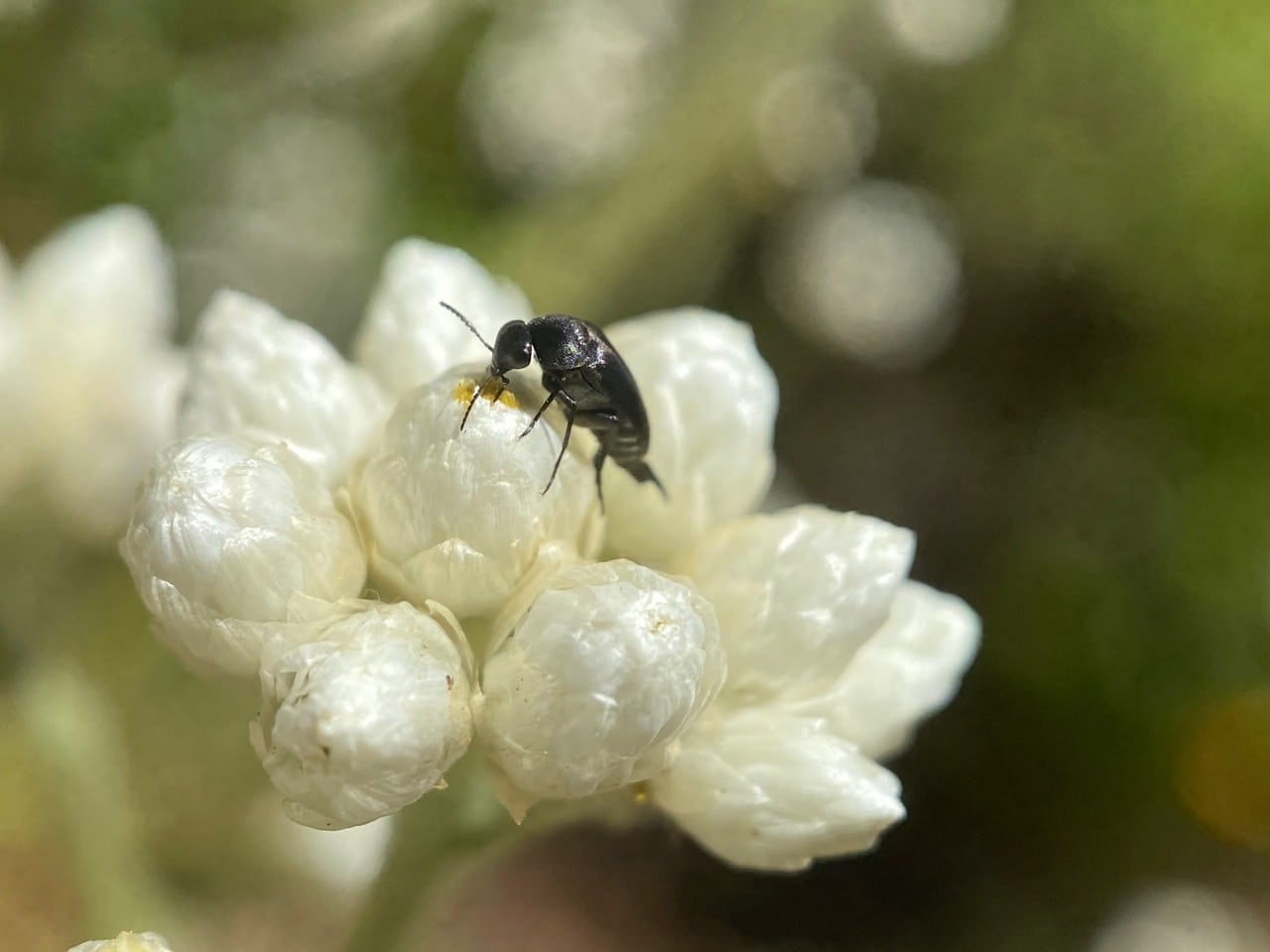
The head of the Tumbling Flower Beetle is hardly seen unless it is feeding. It is usually tucked under the humped thorax.
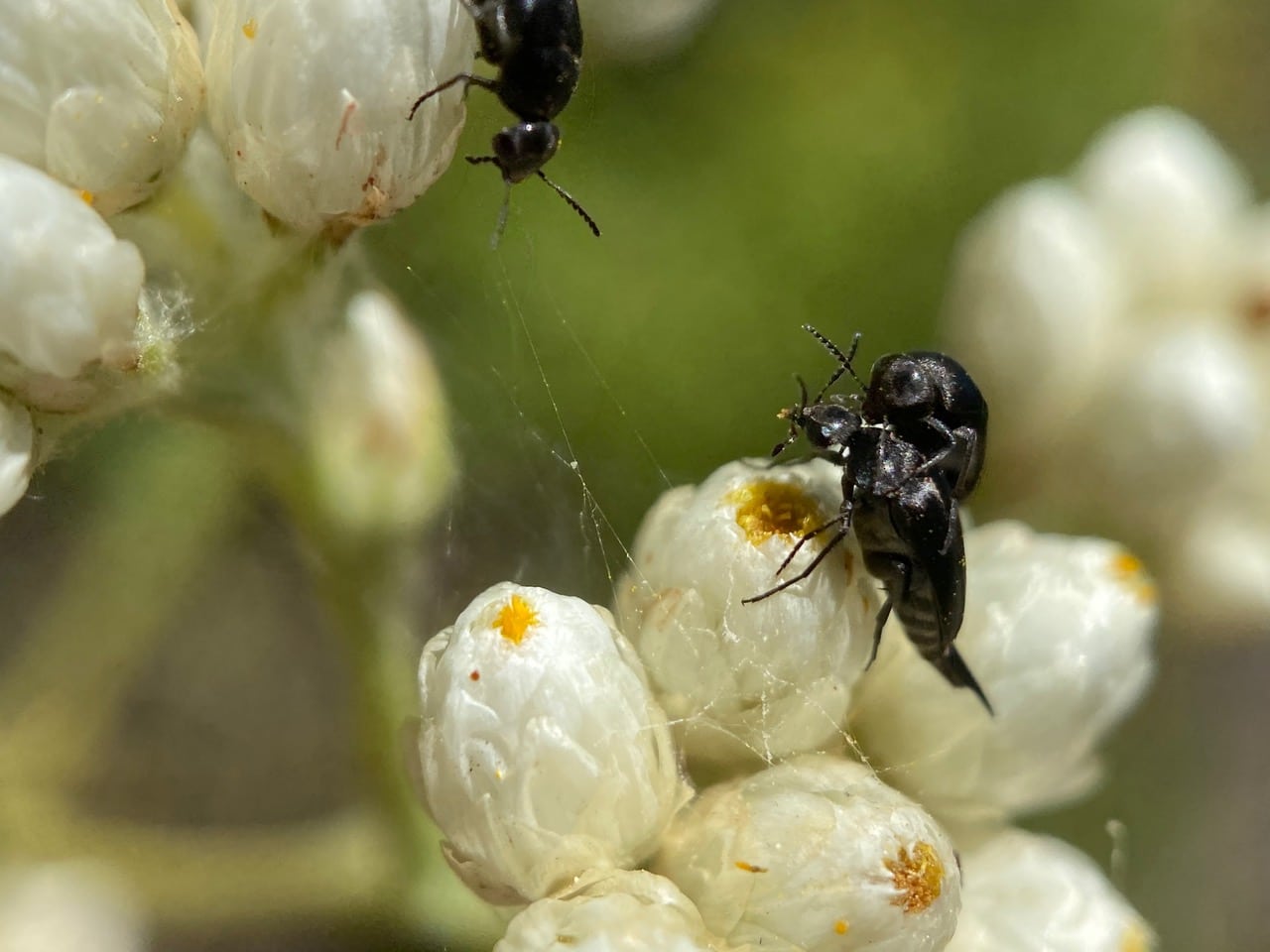
Today the Tumbling Flower Beetles have gathered in large numbers to feed on the open flowerheads of California Everlasting.

A tiny fly is feeding on an open flowerhead of California Everlasting.
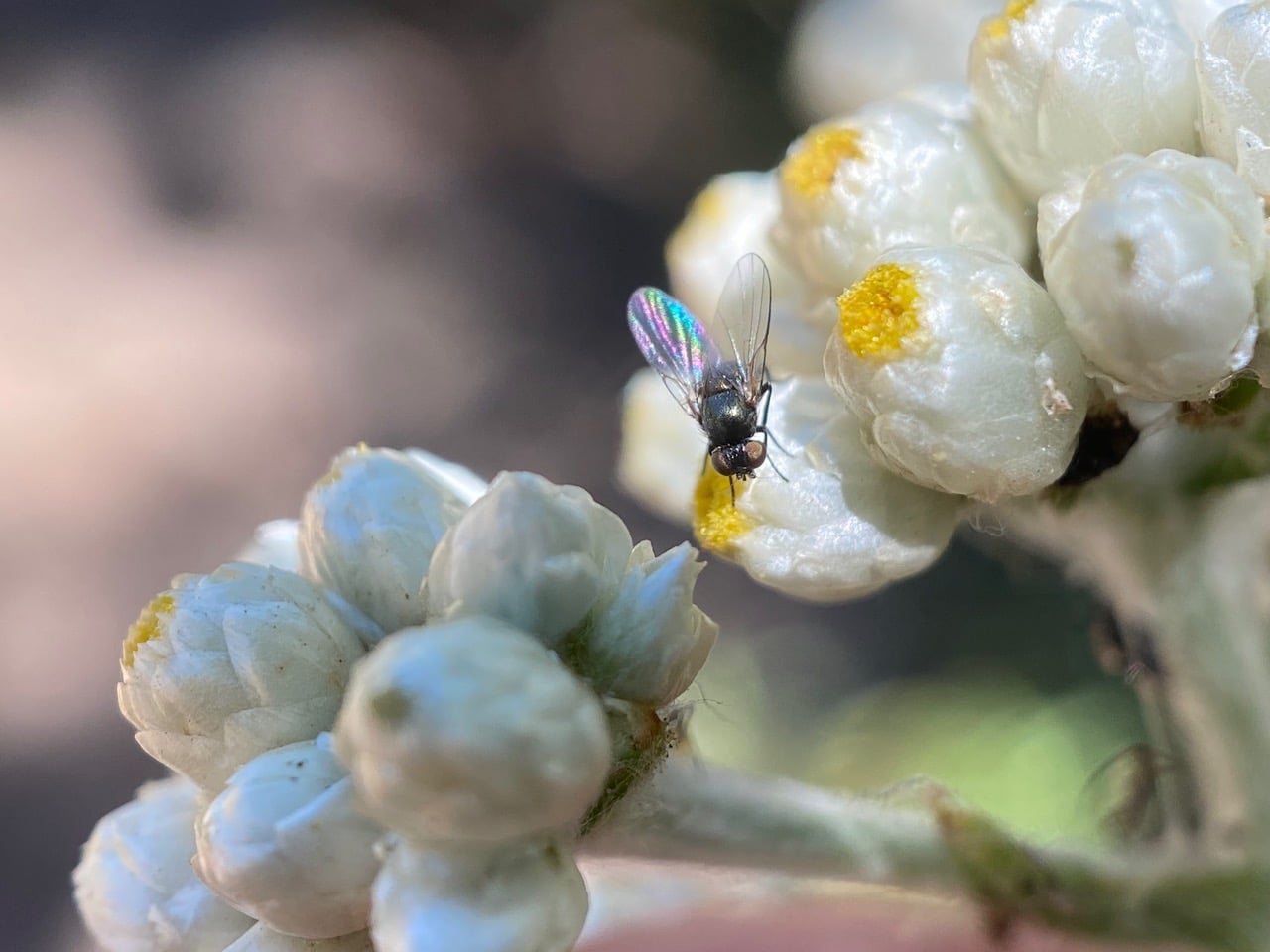
Unfortunately, it is impossible to have this tiny fly identified by a mere photo.

A small caterpillar shelter, rendered with silk and plant hairs has been constructed at a leaf axil near the top of a California Everlasting. Bits of frass (insect poop) can be seen on the silk. It is a typical shelter of a young caterpillar of the American Lady, Vanessa virginiensis (family Nymphalidae).
American Lady caterpillars are solitary feeders and construct nests from various parts of their host plant. Tiny larvae use leaf hairs to construct tiny nests; larger caterpillars arrange leaves, flower heads, and detritus to form tight shelters. Several structures are typically built during the caterpillar’s development.
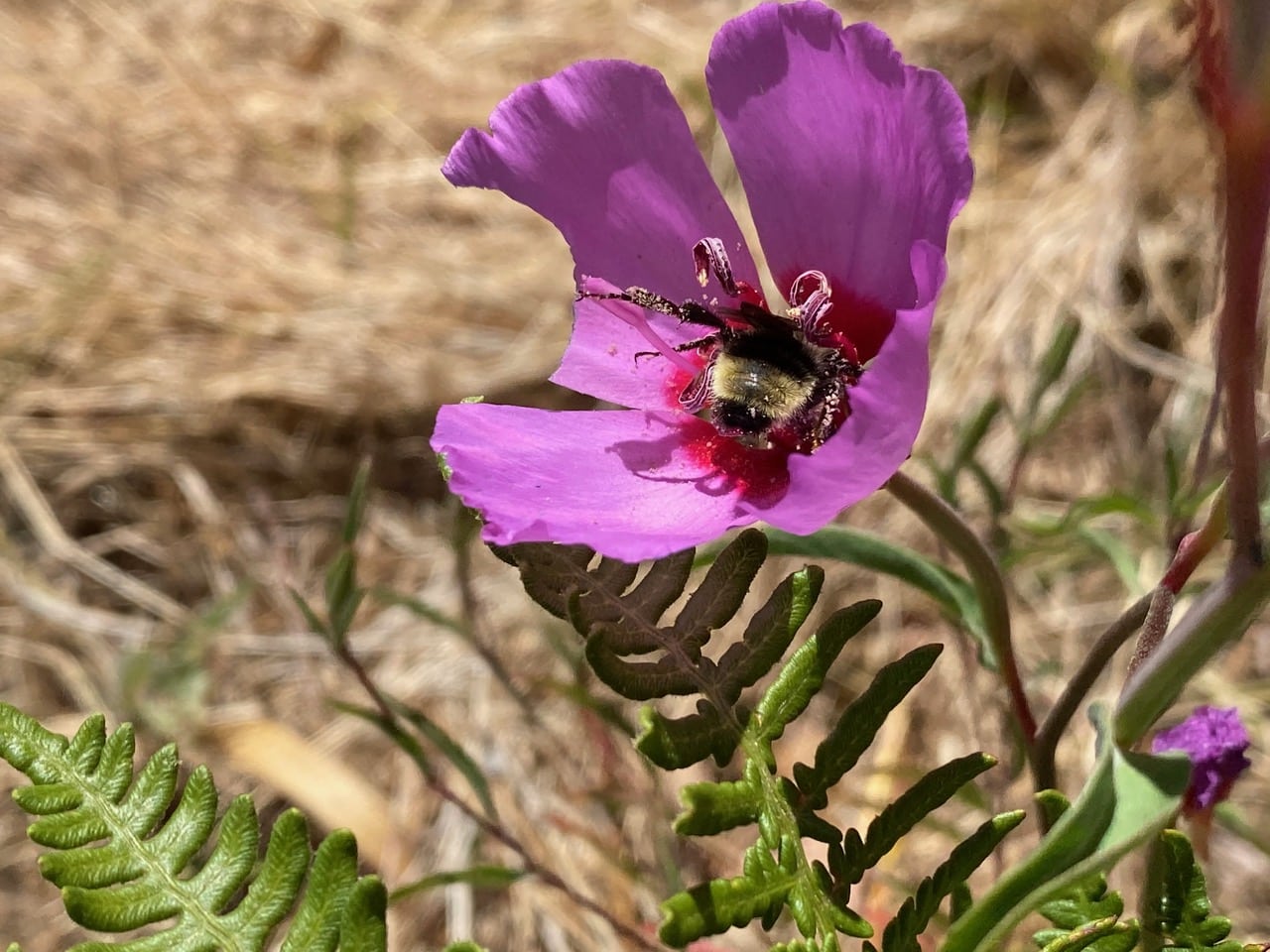
A large bumble bee dives into a flower of Farewell-to-spring, Clarkia rubicunda. Note that a big round piece is missing from one of the petals. A female Leaf-cutter Bee, Megachile sp. (family Megachilidae) has cut the piece for lining her nest cell.
With her powerful mandibles, the female Leaf-cutter Bee, Megachile sp. (family Megachilidae) snips a neat circle or oval from a leaf or flower petal. She will use these pieces to line and partition the nest cells in which her larvae will grow. They tend to favor rose leaves and Clarkia petals, maybe because these are soft and pliable. Pink floral wallpaper for their nurseries! The Leaf-cutter Bee always cuts extremely neat circles and ovals, unlike caterpillars which leave irregular holes. The bees fly with the pieces back to their nest which are burrows in the ground or in a narrow crevice. There they weave the leaf or petal pieces into a cylindrical brood cell for their young. She stocks the cell with nectar and pollen, before laying a single egg in the cell and sealing it up.
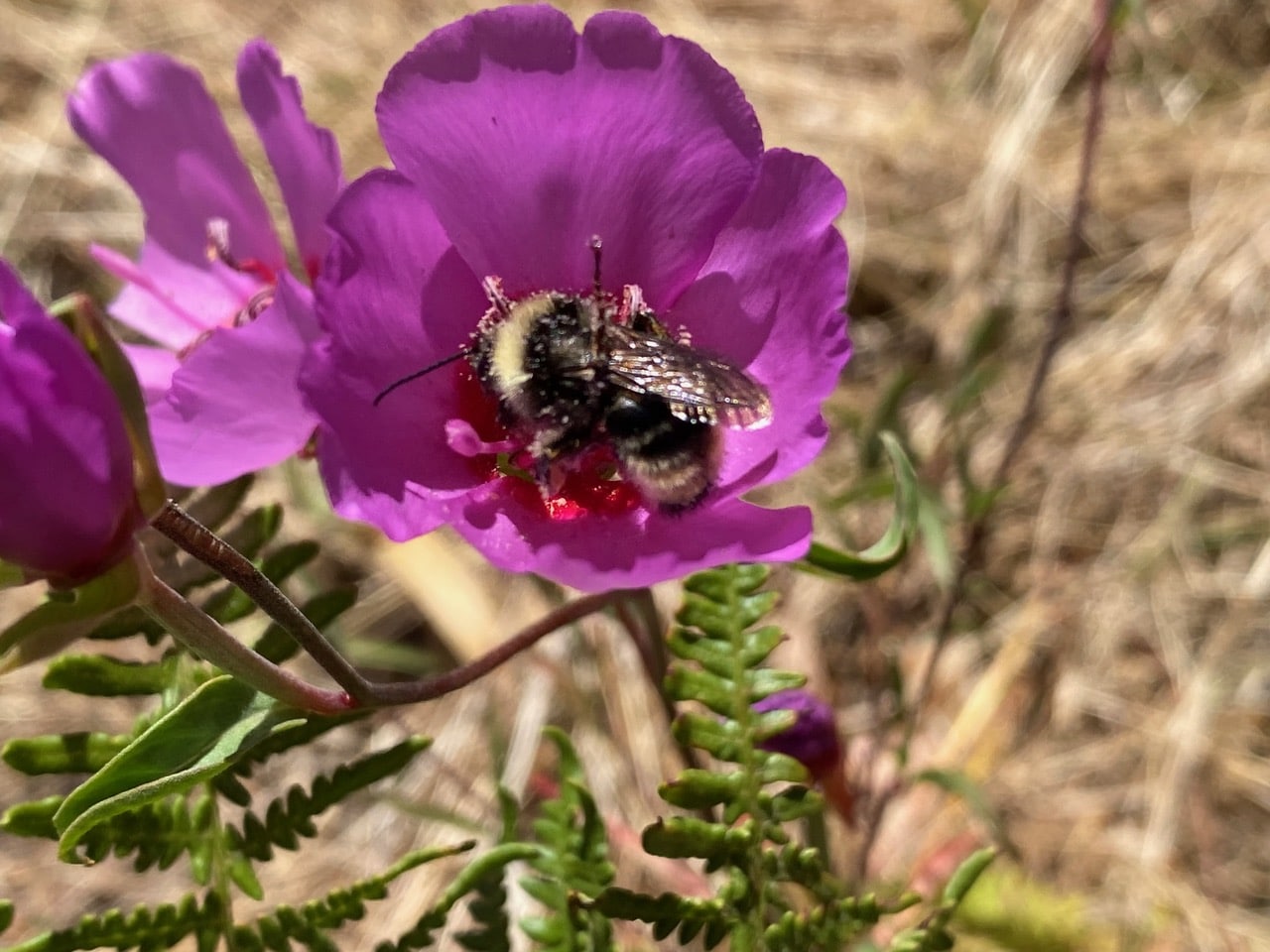
Hmm, I wonder if this isn’t a male California Bumble Bee. Note the long antenna. I need a better look at its head. The California Bumble Bee, Bombus californicus resembles the Yellow-faced Bumble Bee in the color pattern on their bodies. They are best distinguished by the color of the head. The Yellow-faced Bumble Bees have yellow hairs on their head, while the California Bumble Bee has a black head.
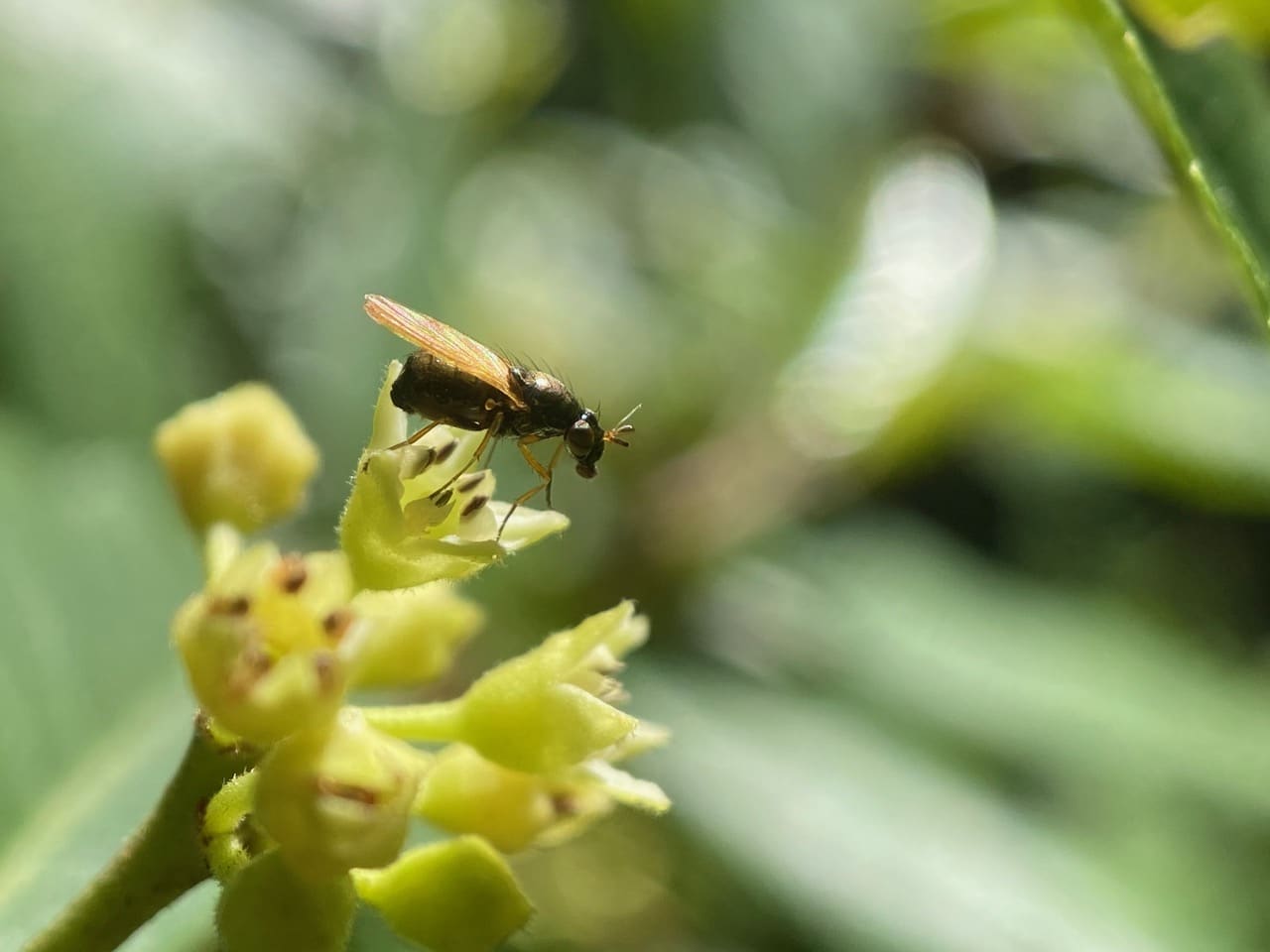
An unidentified fly is perched on a flower of Coffeeberry, Frangula californica. Rather strange mouthpart and antennae.

A worm-like larva is crawling on the stem of Coffeeberry. On closer inspection, it has three pairs of jointed legs, and no prolegs along the abdomen. The absence of prolegs precludes Lepidopteran caterpillars. The jointed thoracic legs are suggestive of beetle larvae. iNaturalist has identified the critter as the Australian Tortoise Beetle, Trachymela sloanei (family Chrysomelidae). I have occasionally come across the adult beetles on vegetation under Eucalyptus trees.
The beetle is native to Australia, but is now widespread in much of California. Their host plants include several species of Eucalyptus. Eggs are laid in crevices in or under bark. Both adults and the caterpillar-like larvae feed on foliage during the night, resulting in semicircular holes or irregular notches along edges of Eucalyptus leaves. The unsightly feeding scars do not appear to threaten Eucalyptus survival or health.
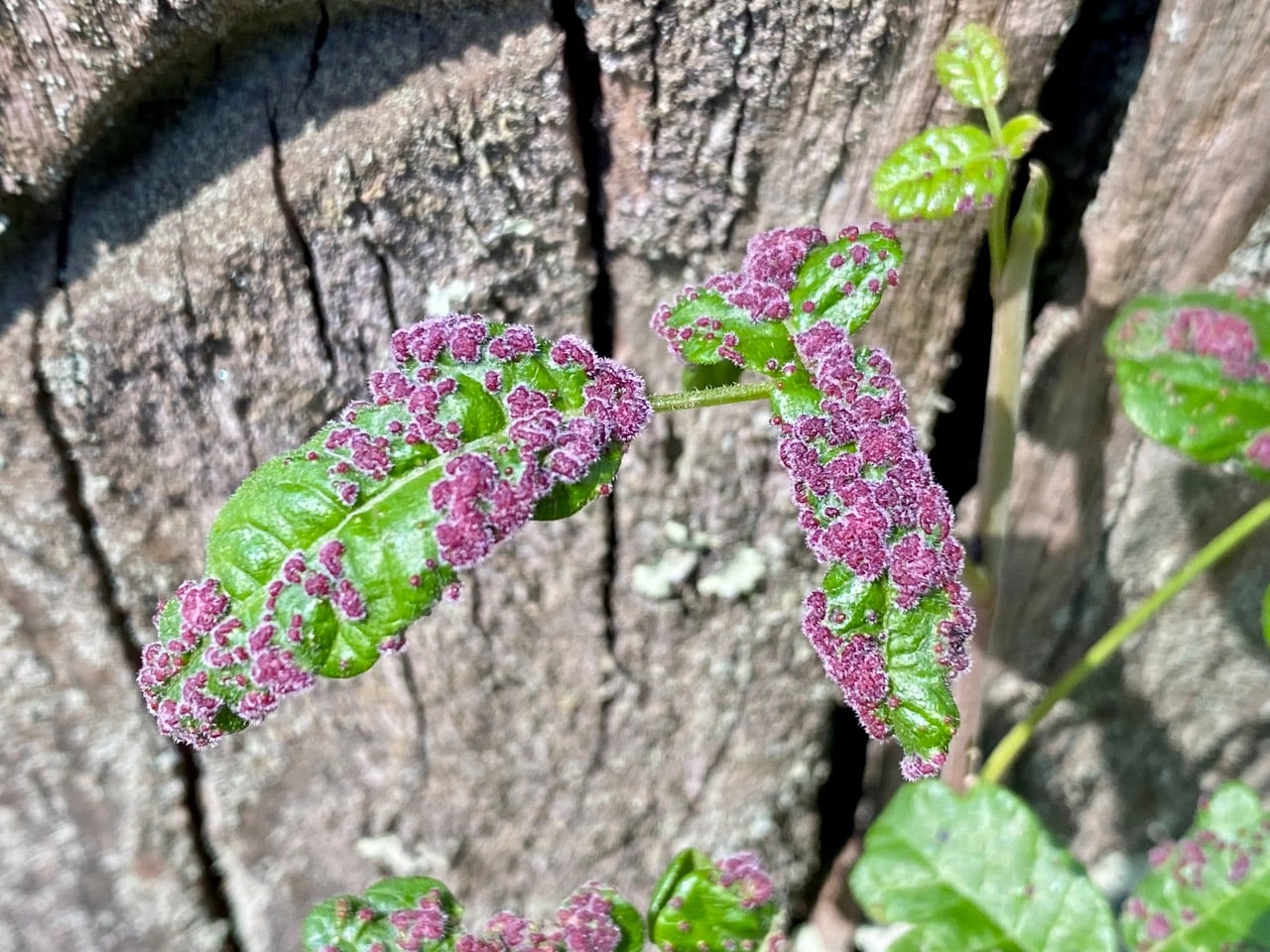 Growing by an old tree stump, a Pacific Poison Oak, Toxicodendron diversilobum seems to be suffering from a bad case of skin rash – poetic justice? The young leaves are covered with purplish-red, convoluted swellings.
 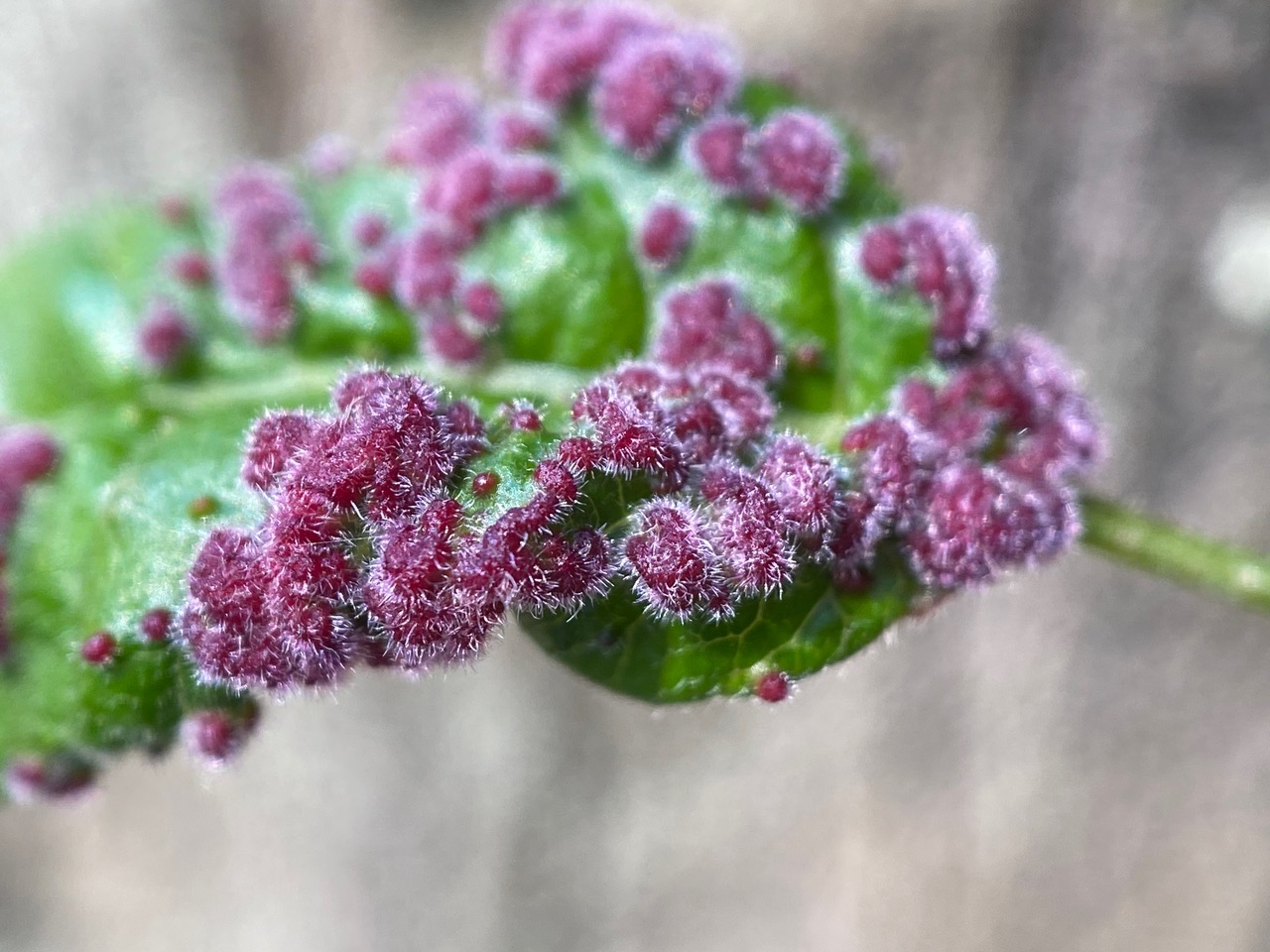 Close-up of the swellings show that they are covered with short white hairs. These growths are leaf galls induced by Gall Mites in the family Eriophyidae.
Eriophyid Mites are microscopic mites that often go undetected. Unlike most adult mites that have four pairs of legs, eriophyid mites have only two pairs. They are slow-moving, usually white or yellow in color, and have a distinctive “carrot” shape. They are very host-specific. Most eriophyid mites make their home on the surface of leaves where their feeding can cause bronzing or reddening but some are also responsible for creating galls on leaves or witches’-broom on stems and flower buds. Adult females overwinter in cracks and crevices of twigs and bud scales. Females lay eggs in the spring. The young mites that hatch out resemble the adults. Numerous generations are produced each year. They are primarily spread by wind.

A large bumble bee lands on an inflorescence of California Honeysuckle, Lonicera hispidula, and proceeds to take nectar from the flowers.

The bee has long legs and a black head, and is about the size of a queen Yellow-face Bumble Bee. It is a California Bumble Bee, Bombus californicus (family Apidae)!
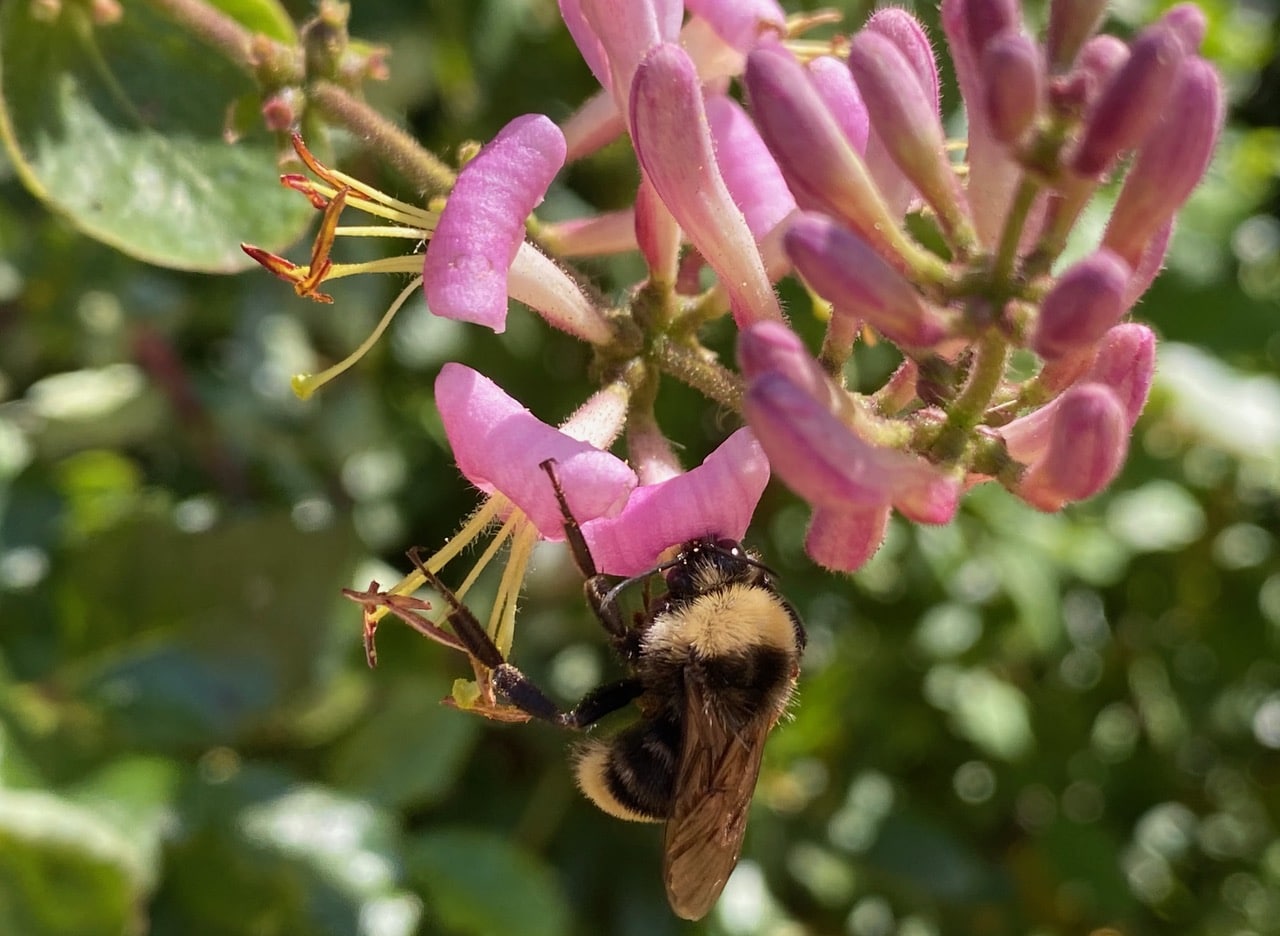
Bombus californicus, the California Bumble Bee, is found in Central and the western half of North America. The species is now classified as Vulnerable by the IUCN. It was the most common bumble bee in California until about the 1990s when its numbers and distribution began to decline. Many factors may have contributed to its decline, including invasive species, pesticide use, commercial bumble bee rearing, habitat destruction, and climate change.
Although morphologically the species is quite variable, the “typical” color pattern of female B. californicus is black with only a single strong yellow band anteriorly on the thorax, and another single yellow band near the apex of the abdomen. Males exhibit considerably more variation.
The California Bumble Bee is an important pollinator in alpine environments in its native range. They are social bees having a queen and workers. Their colonies last for one year. New queens overwinter, usually underground, and found new colonies from scratch the following year. Queens emerge from April through mid July. Workers are present from April to September. The species is known to pollinate sage, blueberry bushes, red clover, California poppies, and many other species of flowers.

A small Stink Bug, Cosmopepla uhleri (family Pentatomidae) is crawling up the stem of a California Bee Plant, Scrophularia californica. The bug is easily recognizable – black with an orange transhumeral band with black spots. The bug uses Scrophularia californica as a host plant. Note the rostrum (mouthpart) that is folded under the body when not feeding. The structure for piercing-sucking is characteristic of members of the order Hemiptera (“true bugs”).
Pentatomidae is a family of insects belonging to the order Hemiptera or “true bugs”. As hemipterans, the pentatomids have piercing-sucking mouthparts, and most are phytophagous, including several species that are severe pests on agricultural crops. Stink Bugs feed on plant fluids by inserting their needlelike mouthparts into stems, leaves or seed pods. While feeding, they inject materials into the plant to aid in digestion and sap removal. Penetration by the mouthparts can cause physical damage, much like stabbing the plant with a fine needle.
All Pentatomids have 5-segmented antennae (hence their family name, Penta – five and tomos – section.) They generally have a large triangular scutellum in the center of the back. The adult is generally shield-shaped when viewed from above. The common name of Stink Bug refers to their ability to release a pungent defensive spray when threatened, disturbed, or crushed.

A tiny wasp about 2 mm long, with a metallic green sheen, is grooming itself atop a Bee Plant flower. It is most likely a parasitic wasp in the superfamily Chalcidoidea. Some insect (a butterfly or moth?) has laid a translucent white egg on the calyx of the flower. Did the wasp just oviposit in the egg?

The little wasp is now cleaning its antennae.
Most Chalcid species are parasitoids of other insects, attacking the eggs or larval stage of their host, though many other life cycles are known. These hosts are to be found in at least 12 different insect orders including Lepidoptera (butterflies and moths), Diptera (true flies), Coleoptera (beetles), Hemiptera (true bugs), and other Hymenoptera, as well as two orders of Arachnida. When the host is itself a parasitoid, the wasps are referred to as hyperparasitoids. Generally beneficial to humans as a group, chalcidoids help keep various crop pests under control, and many species have been used as biocontrol agents.
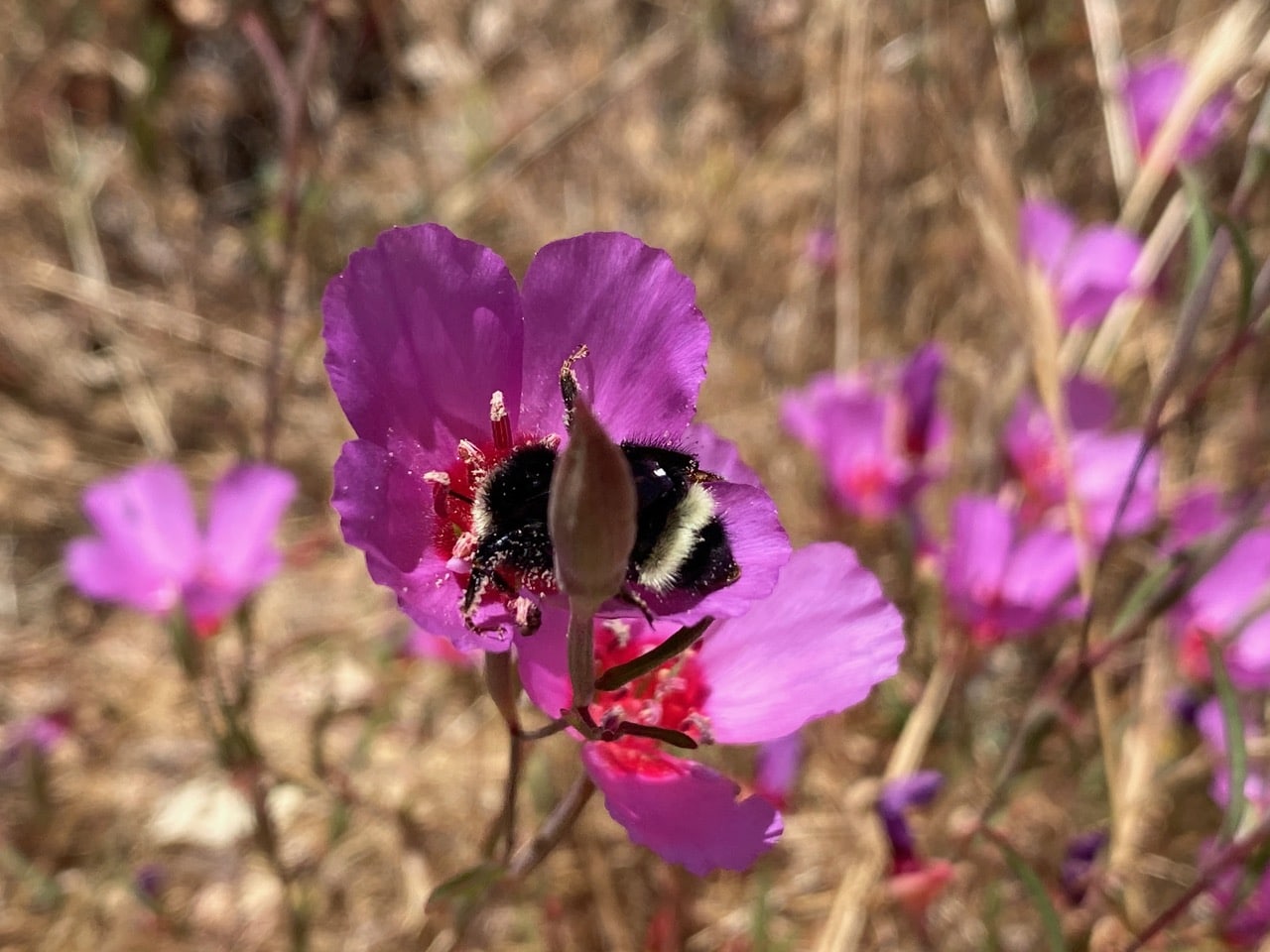
Alerted to the presence of California Bumble Bees, I am paying attention to every large bumble bee I come across now. Here’s one taking nectar from a Farewell-to-spring, Clarkia rubicunda.

As another large bumble bee backs out of a Clarkia flower, I have a good look at its head – it is black! Definitely a California Bumble Bee, Bombus californicus (family Apidae). I think Skyline Gardens has a good population of this species. We have just been mistaking them for the look-alike Yellow-faced Bumble Bees. The California Bumble Bees are large, about the size of the Yellow-faced queens, and they are long-legged. I have only been noticing them lately, perhaps because their size stands out against the small workers of the Yellow-faced Bumble Bees out and about now.