

Pollinator Post 6/27/23 (1)

In the early afternoon at Siesta Gate, an unfamiliar hover fly is hovering over the California Phacelia flowers, Phacelia californica. A new species for the garden?
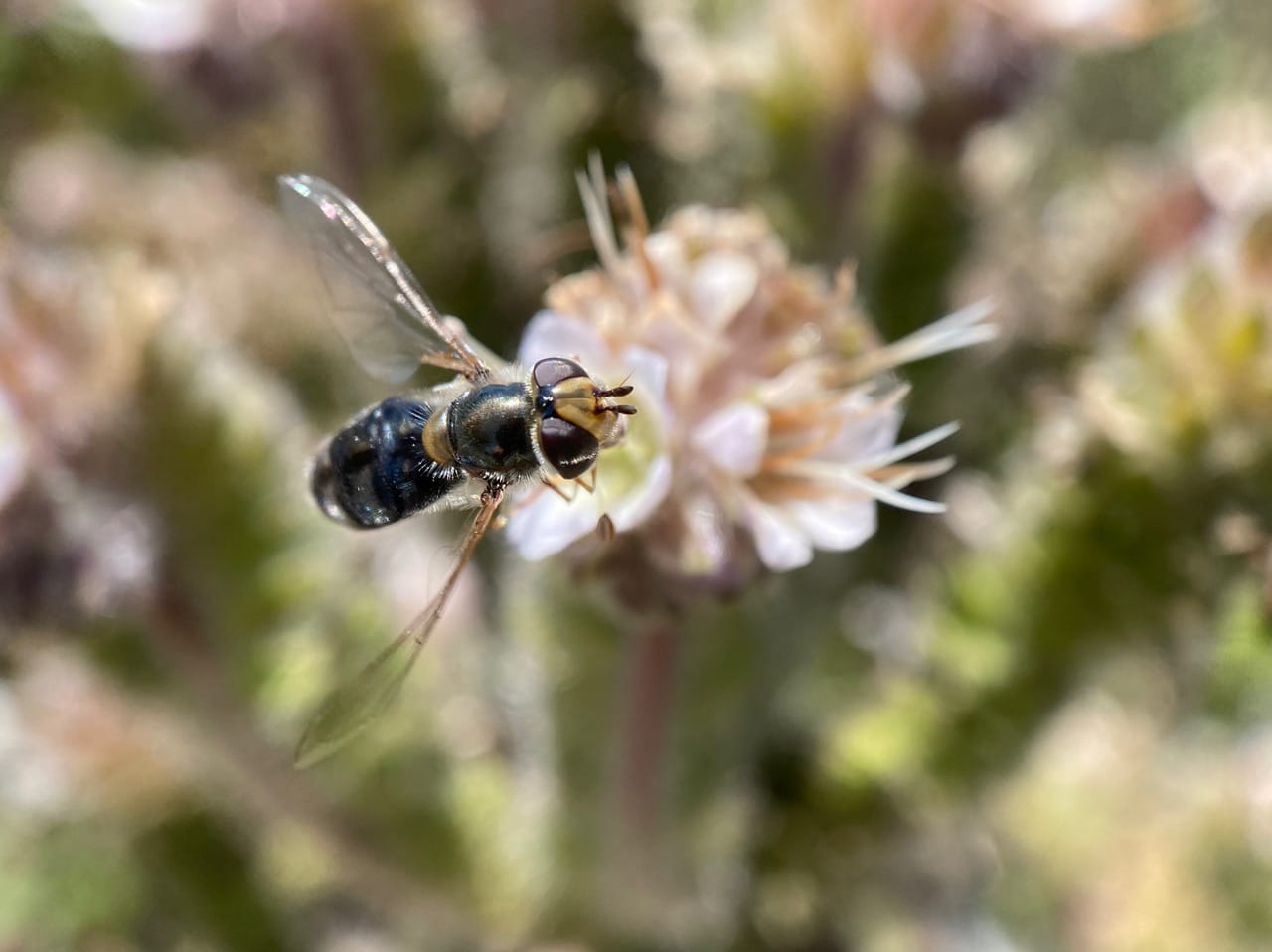
A Syrphid expert on iNaturalist has helped identify it as the dark form of the White-bowed Smoothwing, Scaeva affinis (family Syrphidae) without the usual white markings on the abdomen. Scaeva affinis is a common hover fly at Skyline but I have never encountered one like this. Of the hundreds of photos of this species on iNaturalist, only a handful are the dark form. Bizarre!
The White-bowed Smoothwing is mostly found in western North America. Adults visit flowers for nectar and pollen. Females are commonly seen laying single eggs close to aphid colonies on plants. Larvae are light green with a white dorsal longitudinal stripe. Each larva can consume over 500 aphids during its larval stages.
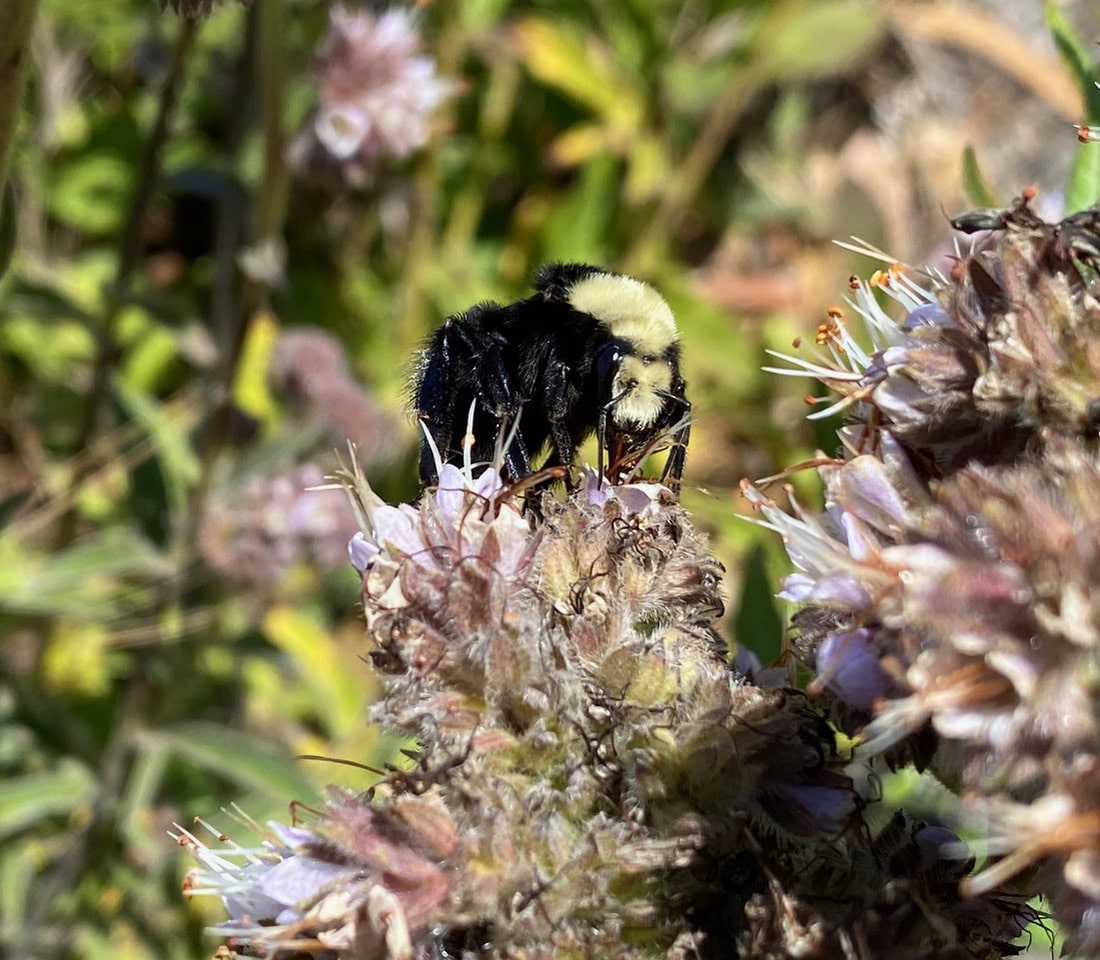
Whoa! That’s a huge Yellow-faced Bumble Bee, Bombus vosnesenskii taking nectar from the flowers of California Phacelia. Judging from the size alone, one can be certain that she is a queen. She is easily three times the size of the average worker bees of the species. She looks to be fresh and in good shape. I am surprised that these bumble bee queens are emerging so late – in the summer?! Normally they wake up from hibernation in early spring to start new colonies as single moms. Will these late queens have sufficient time to establish their colonies? Will there be enough floral resources to support their efforts?

Under a grove of Eucalyptus trees, an Australian Tortoise Beetle, Trachymela sloanei (family Chrysomelidae) is perched quietly on a grass stem. I am delighted to see its face which is often retracted under the pronotum.
The beetle is native to Australia, but is now widespread in much of California. Their host plants include several species of Eucalyptus. Eggs are laid in crevices in or under bark. Both adults and the caterpillar-like larvae feed on foliage during the night, resulting in semicircular holes or irregular notches along edges of Eucalyptus leaves. The unsightly feeding scars do not appear to threaten Eucalyptus survival or health.

A green hover fly pupa is wedged in the leaf axil of a tall Coast Tarweed, Madia sativa. Rather surprising as I have not seen aphids or other insects on the plant yet. Females of many hover fly species (family Syrphidae) lay eggs on plants near aphid colonies to ensure that their larvae will have plenty to eat when they hatch out. The larvae are voracious predators of aphids and other soft-bodied insects.
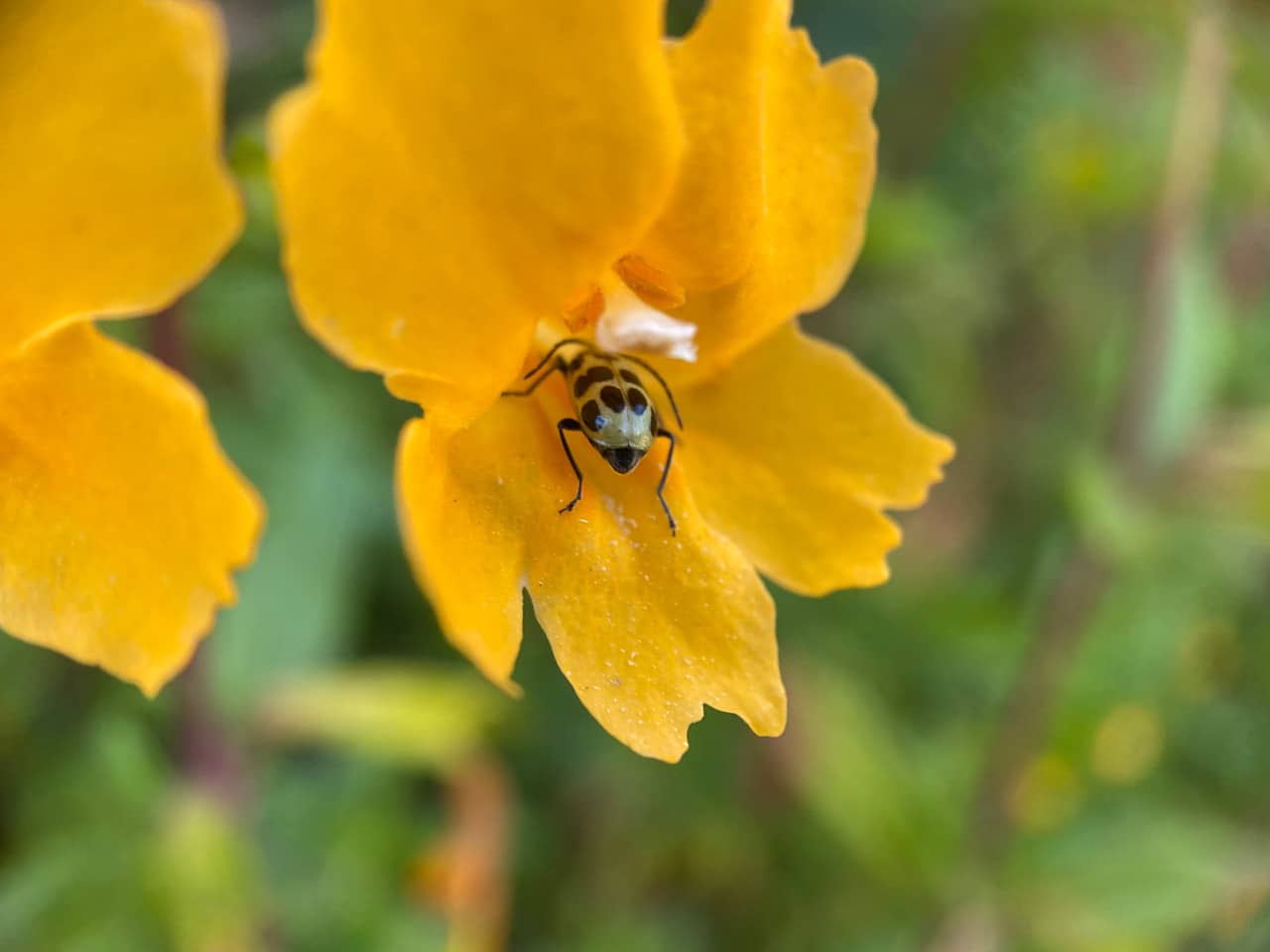
A Spotted Cucumber Beetle, Diabrotica undecimpunctata (family Chrysomelidae) is entering a Sticky Monkeyflower.
Members of the family Chrysomelidae are commonly known as Leaf Beetles. Adults and larvae feed on all sorts of plant tissues, and all species are fully herbivorous. Many are serious pests of cultivated plants, including food crops. Others are beneficial due to their use in biocontrol of invasive weeds. Chrysomelids are popular among insect collectors, as many are conspicuously colored, typically in glossy yellow to red or metallic blue-green hues, and some have spectacularly bizarre shapes. Photos of Leaf Beetles (Family Chrysomelidae) · iNaturalist
Native to North America, the Spotted Cucumber Beetle can be a major agricultural pest, causing damage to crops in the larval as well as adult stages of their life cycle. Larvae, sometimes known as rootworms feed on the roots of emerging plants. In the adult stage the beetles cause damage by eating the flowers, leaves, stems and fruits of the plant.

Upside down on the upper petal, this Spotted Cucumber Beetle is feeding on the stamens behind the white stigma of the flower.
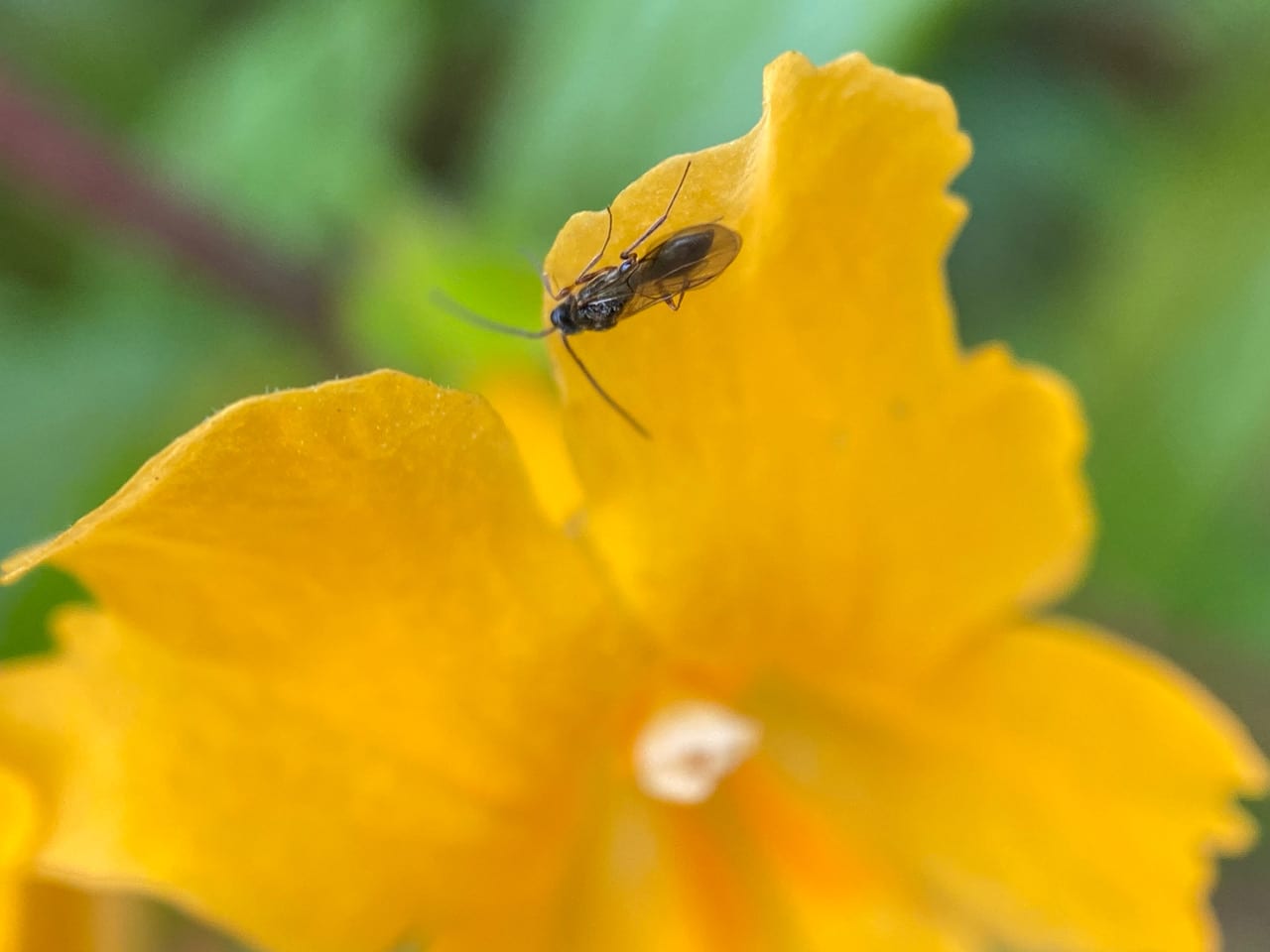
A parasitoid wasp is roaming the upper petal of a Sticky Monkeyflower. It probably belongs to the superfamily Ichneumonoidea.
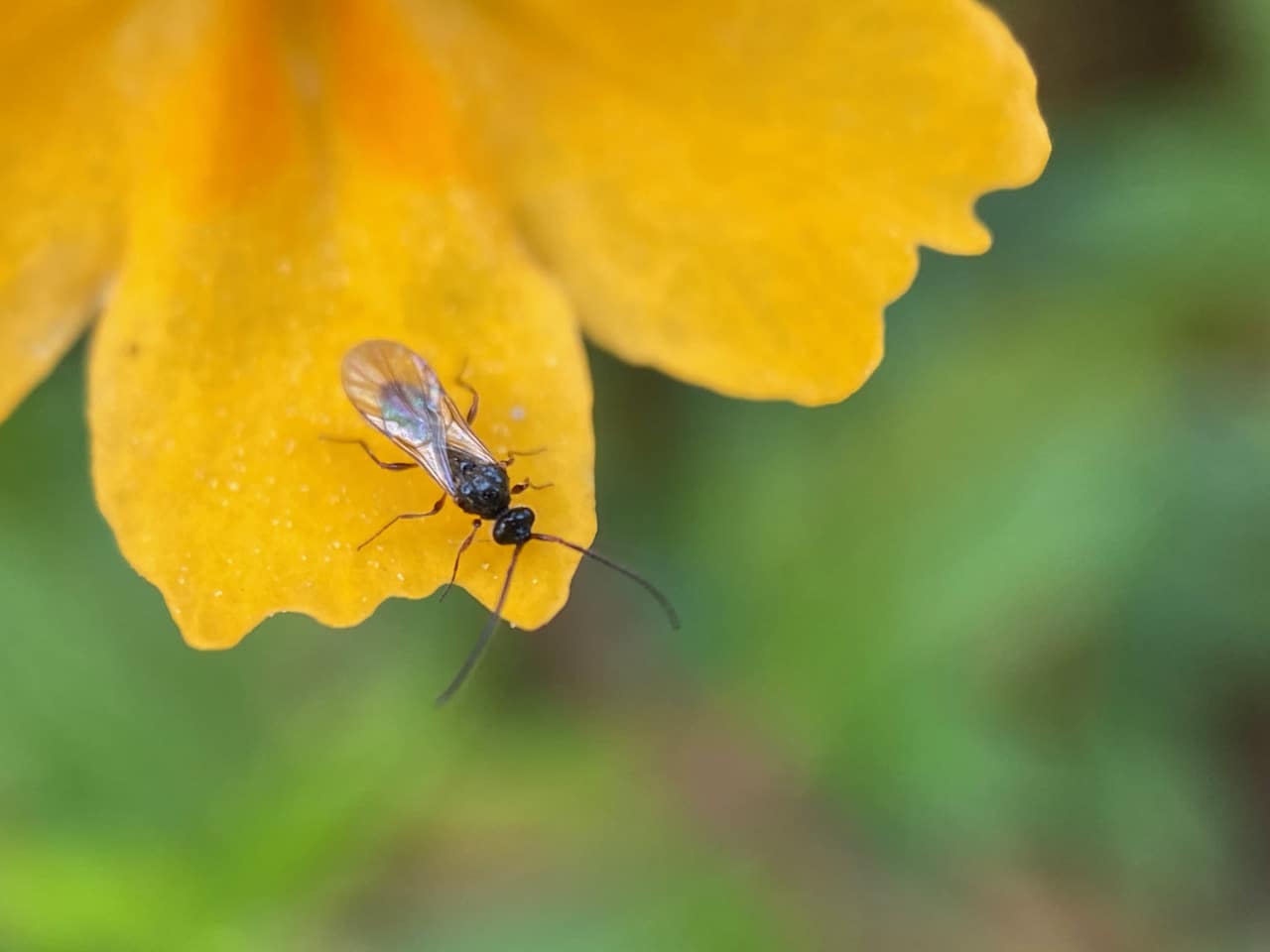
The superfamily Ichneumonoidea comprises the two largest families within Hymenoptera: Ichneumonidae and Braconidae, both with a cosmopolitan distribution. Members of the two families are distinguished by wing venation. Ichneumonoids are solitary wasps, and the vast majority are parasitoids; the larvae feed on or in another insect, eventually killing it. In general, ichneumonoids are host specific, and only attack one or few closely related host species. Many species use polydnaviruses to suppress the immune systems of their host insects.

A mere speck of an insect, only about 1 mm long, turns out to be a Jumping Plant Louse or Psyllid (family Psyllidae). The bug has probably been blown off a nearby Eucalyptus tree.
Psyllids are small plant-feeding insects that tend to be very host-specific, i.e. each plant-louse species only feeds on one plant species (monophagous) or feeds on a few closely related plants (oligophagous). Together with aphids, phylloxera’s, scale insects and whiteflies, they form a group considered the most “primitive” within the true bugs (Hemiptera).

Spidey, the female Red-backed Jumping Spider, Phidippus johnsoni (family Salticidae) is hunting from her usual spot on top of the California Phacelia inflorescence. She turns to face me, her hairy pedipalps under her face twitching nervously. She seems to be losing the red color on her abdomen. I hope she’s not sick or injured.
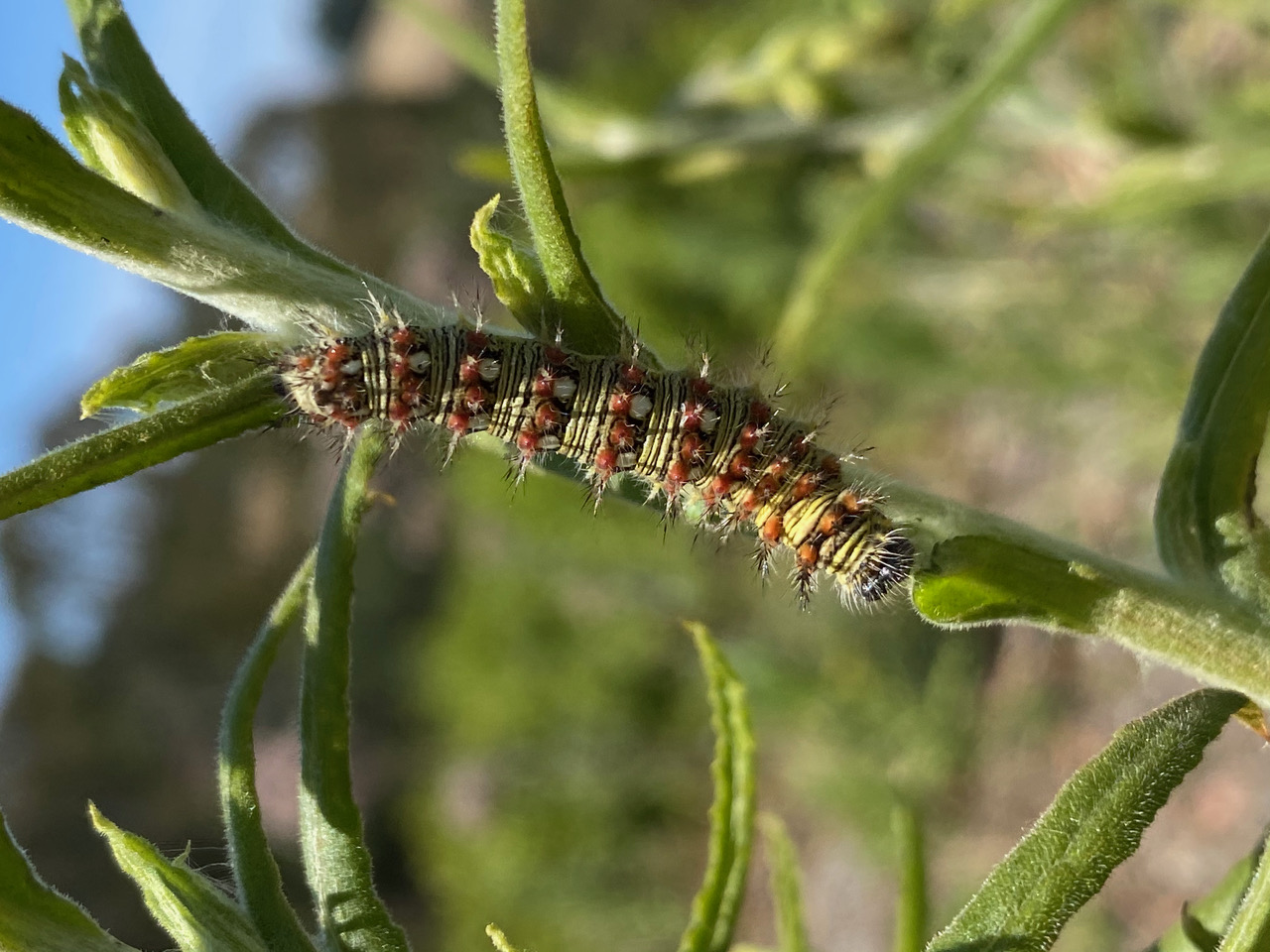
An American Lady caterpillar is out of its nest, feeding in the open on the foliage of California Everlasting, Pseudognaphalium californicum.

From a distance, I see a few bumble bees visiting the flowerheads of Cobweb Thistles, Cirsium occidentale on the ridge just past the Radio Tower. Carefully I approach the plants. So focused on sipping nectar, this large bumble bee does not so much as lift its head when I grasp the stem with my left hand to steady the flowerhead blowing in the wind. I take a few pictures and decide to start recording the bee’s behavior on video. It takes more than a minute of waiting before I can see its head clearly above the flowers – it is black! The bee is a not a Yellow-faced Bumble Bee, but a California Bumble Bee, Bombus californicus !
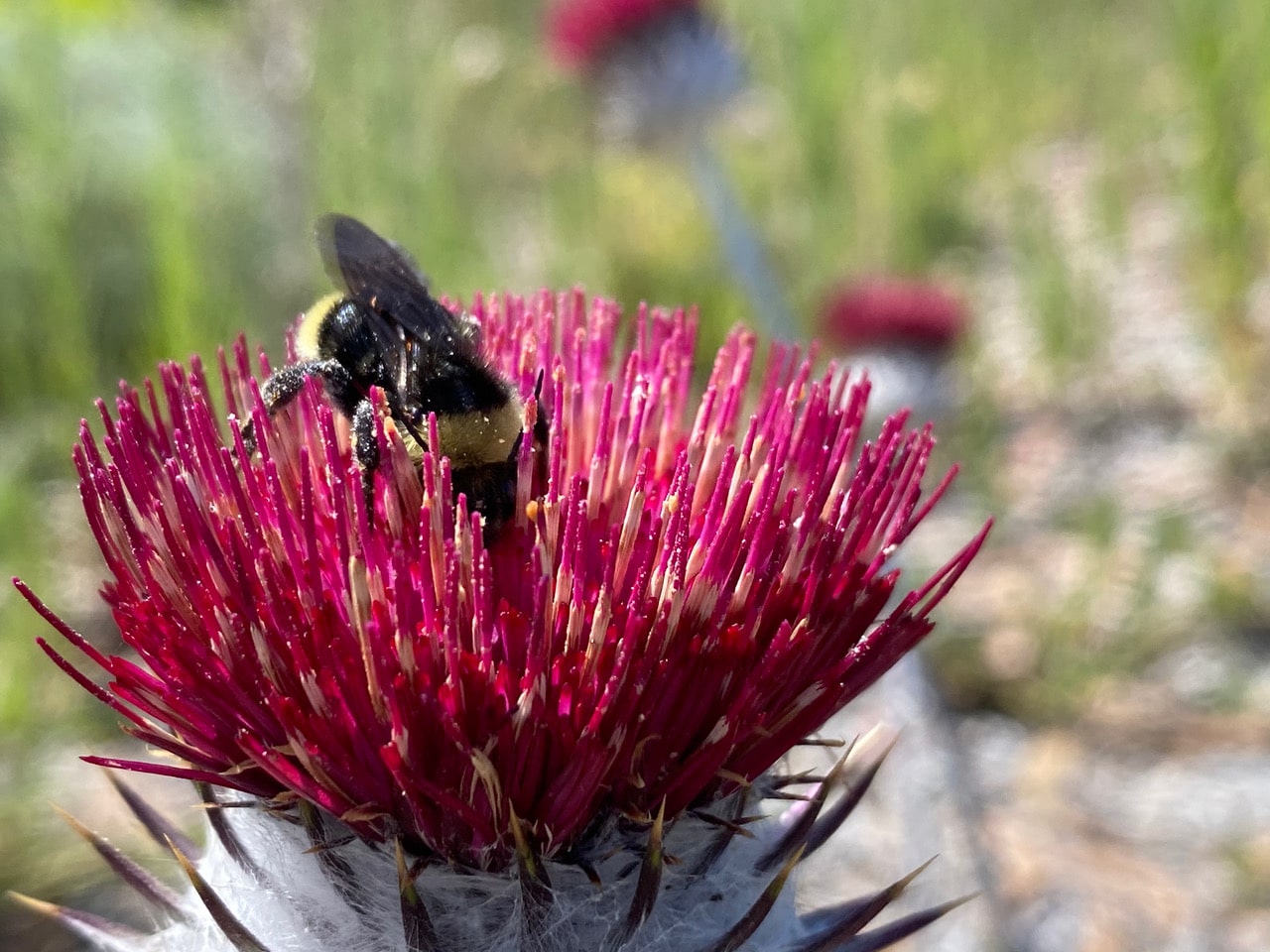
A little further on, across the road, I find another California Bumble Bee feeding on a flowerhead of a very small Cobweb Thistle. It’s good to know that Skyline Gardens is still home to this species of bumble bees.
Bombus californicus, the California Bumble Bee, is found in Central and the western half of North America. The species is now classified as Vulnerable by the IUCN. It was the most common bumble bee in California until about the 1990s when its numbers and distribution began to decline. Many factors may have contributed to its decline, including invasive species, pesticide use, commercial bumble bee rearing, habitat destruction, and climate change.
Although morphologically the species is quite variable, the “typical” color pattern of female B. californicus is black with only a single strong yellow band anteriorly on the thorax, and another single yellow band near the apex of the abdomen. Males exhibit considerably more variation.
The California Bumble Bee is an important pollinator in alpine environments in its native range. They are social bees having a queen and workers. Their colonies last for one year. New queens overwinter, usually underground, and found new colonies from scratch the following year. Queens emerge from April through mid July. Workers are present from April to September. The species is known to pollinate sage, blueberry bushes, red clover, California poppies, and many other species of flowers.

Back at Siesta Gate, a Darker-spotted Straw Moth, Heliothis phloxiphaga (family Noctuidae) is taking nectar from the flowers of California Phacelia. The moth has seen better days, its wings are worn and frayed at the edges.
The Darker-spotted Straw Moth is a medium-sized tan moth with darker markings. The species is found across the US and southern Canada. They frequent wooded edges, meadows, and other open areas. They are active from March through October. Adults are both nocturnal and diurnal in activity, and are often found feeding and ovipositing during the day. Like other Heliothis species, the larvae feed on the flowering parts and seeds of the host plant.