

Pollinator Post 6/26/26 (2)
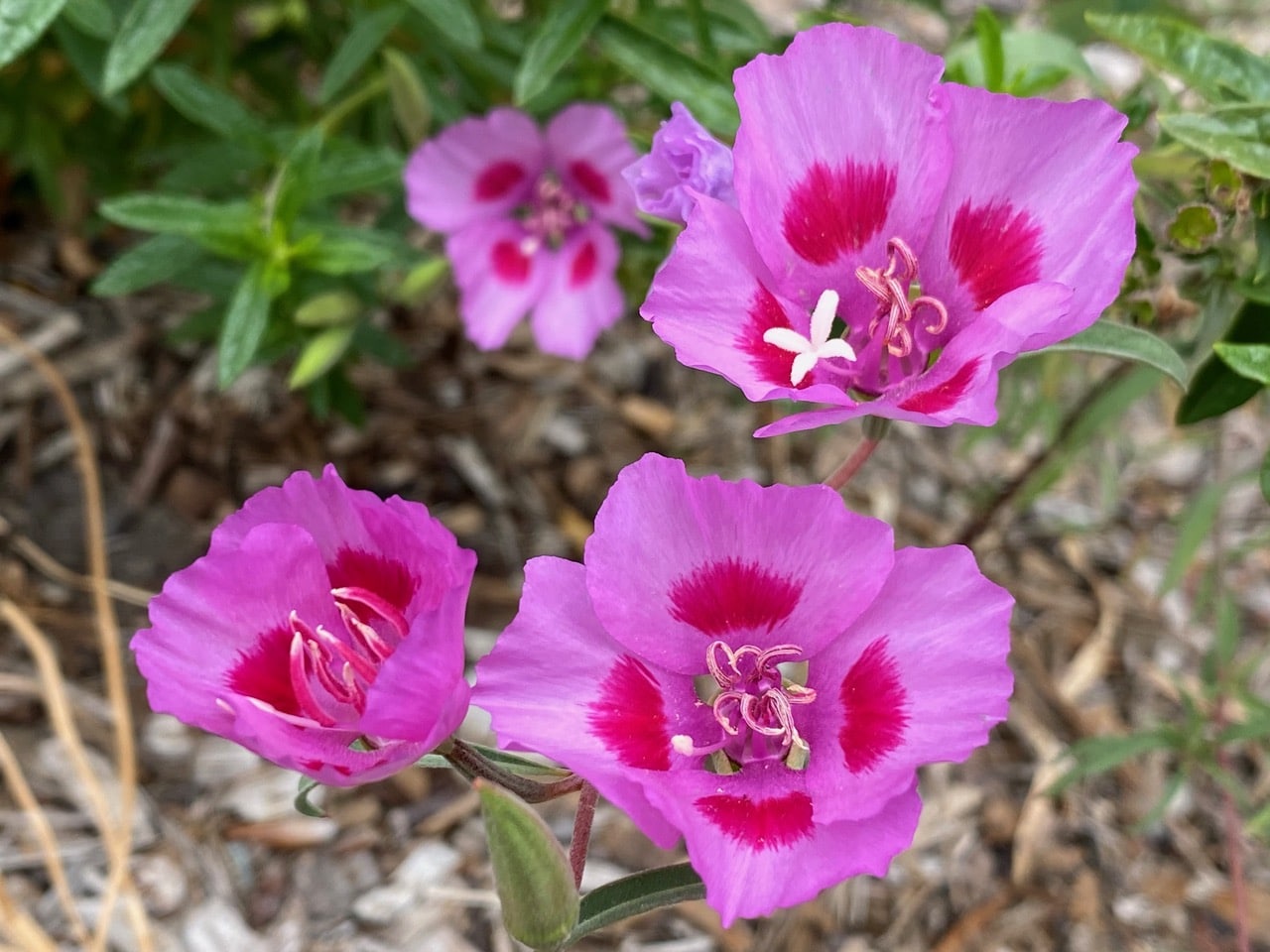
I finally look at the most conspicuous flowers in Jenny and Craig’s front garden – the Farewell-to-Spring, Clarkia amoena. While these large and showy flowers don’t seem to attract many insects, they are useful for illustrating a basic principle of pollination biology – dichotomy.
Dichogamy in flowers is the temporal separation of male and female reproductive maturation, a mechanism that prevents self-pollination. In Clarkia (evening-primrose family Onagraceae), this is almost exclusively achieved through protandry, whereby anthers release pollen before the stigma becomes receptive. This progression is well illustrated by the three flowers in the foreground here, all borne on the same branch. The least mature one on the left shows eight immature stamens.
Male Phase (middle flower): As the flower matures, the anthers split and curl back shedding pollen. During this time, the style remains tightly closed, preventing the flower’s own pollen from fertilizing its ovules.
Female Phase (flower on upper right): As the male phase concludes, the white stigma lobes open up and become sticky and receptive to pollen. By this time, the flower has exhausted its own pollen, forcing any fertilization to occur from outside sources.
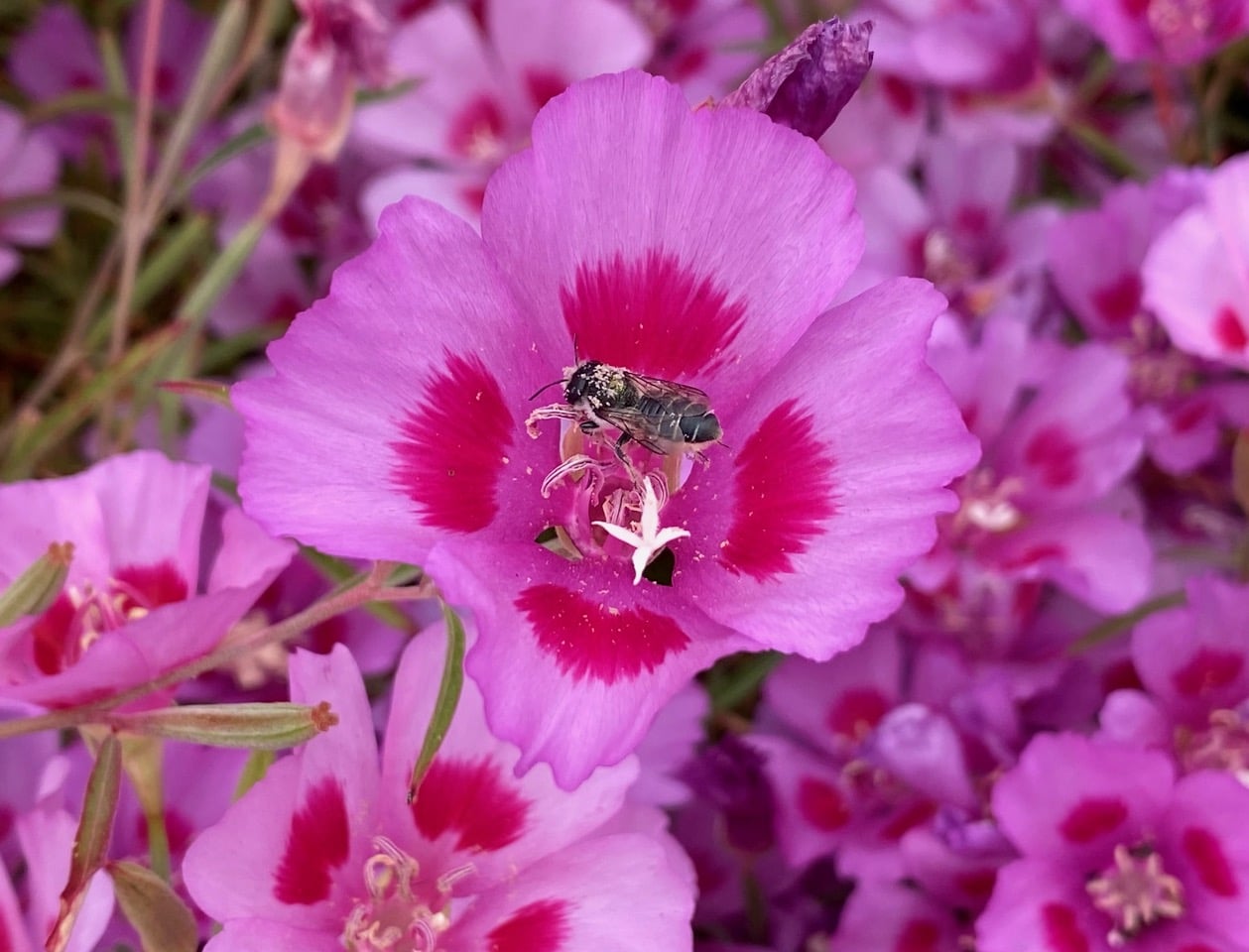
A small black bee dives to the base of a Clarkia flower, apparently to access the nectar. As it emerges, it proceeds to collect pollen from the mature anthers.
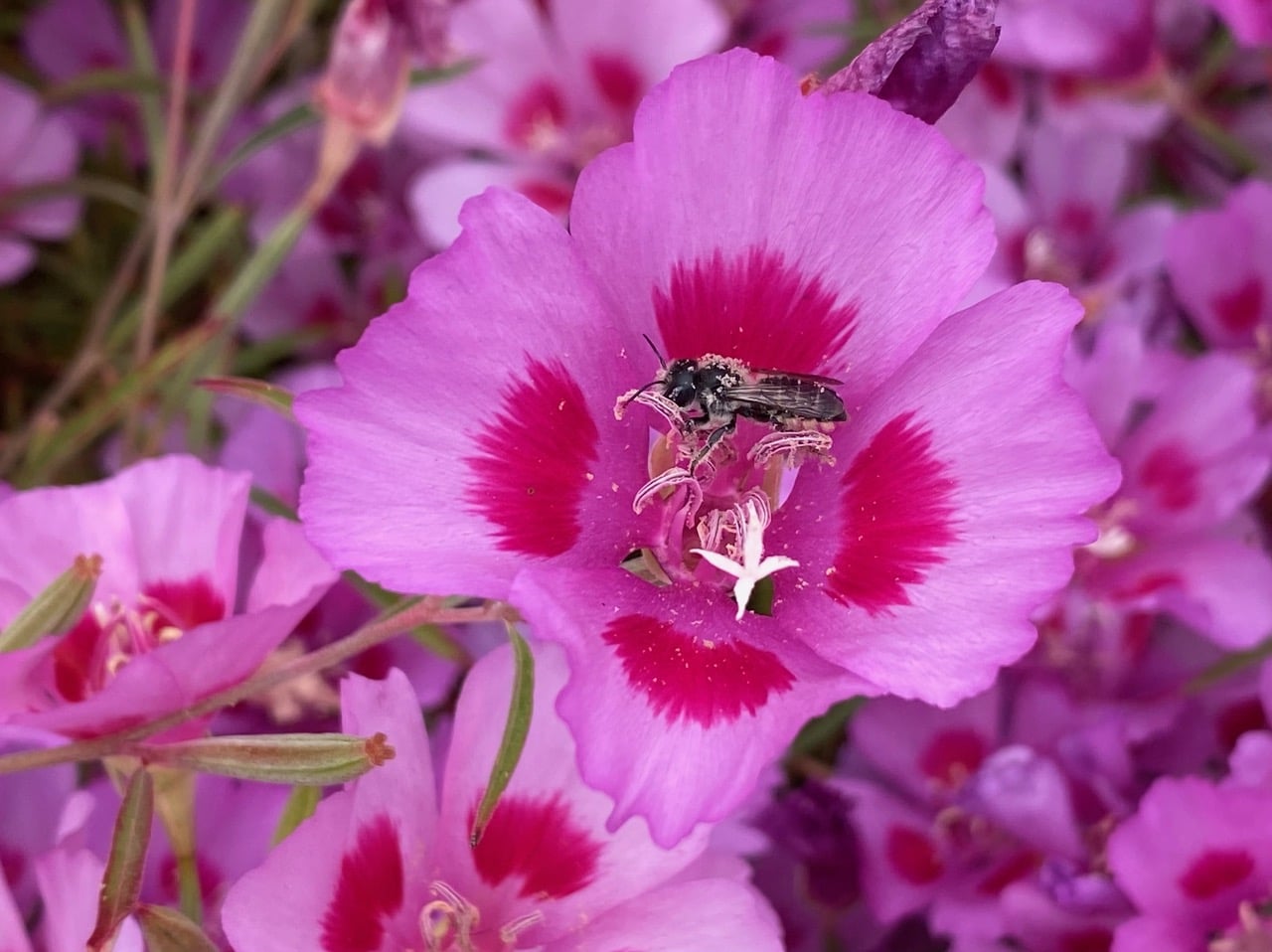
As the bee works the anthers, I glimpse the brushes of pale hairs on the underside of her abdomen. A Leafcutter Bee (family Megachilidae)? I am not familiar with this pollen collecting MO in leafcutter bees.
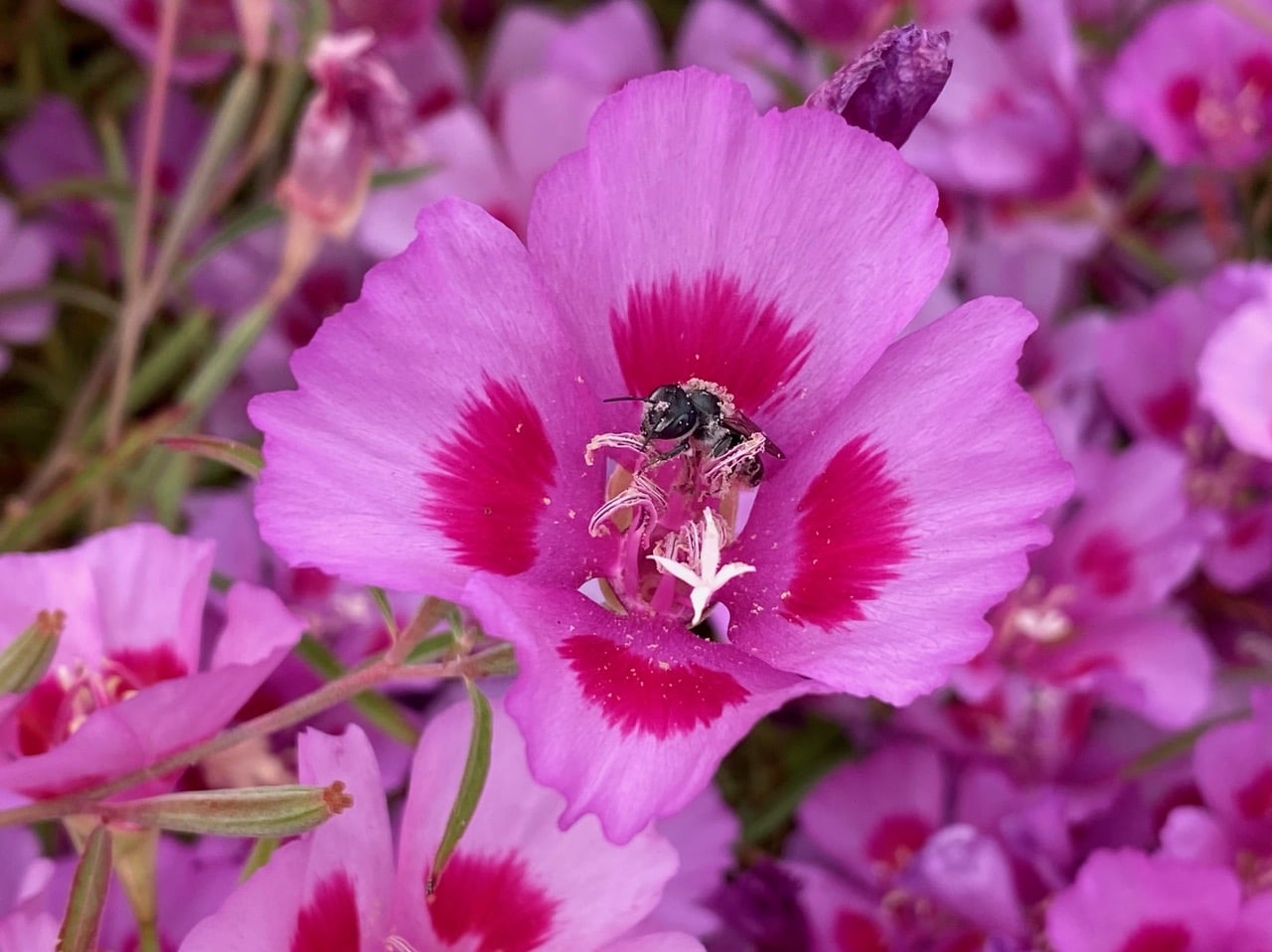
The bee is using her mandibles to manipulate the anthers. Clarkia flowers have large, pinkish-purple pollen grains. You can see them on her thorax.
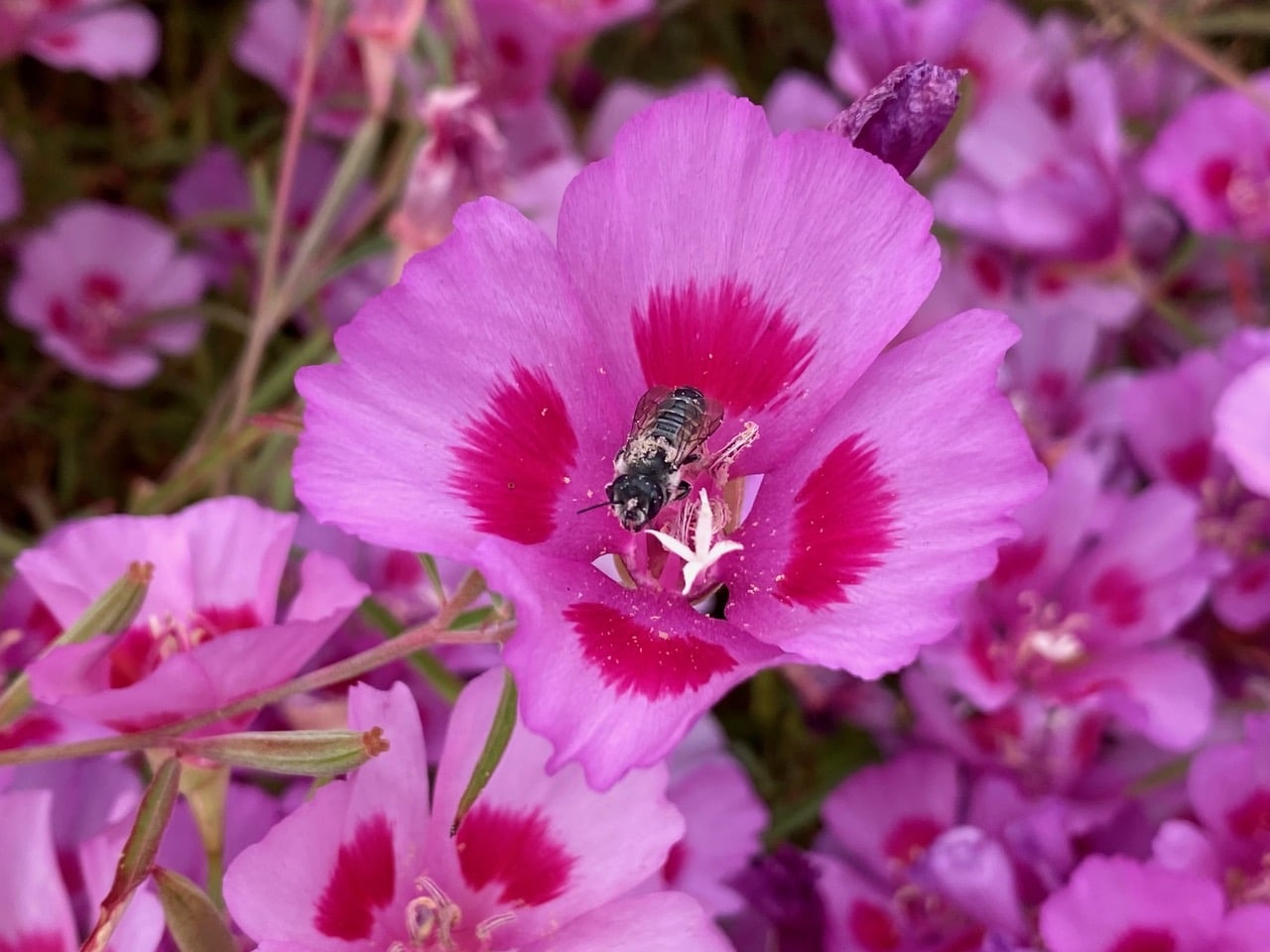
Are those the powerful jaws of a leafcutter bee?
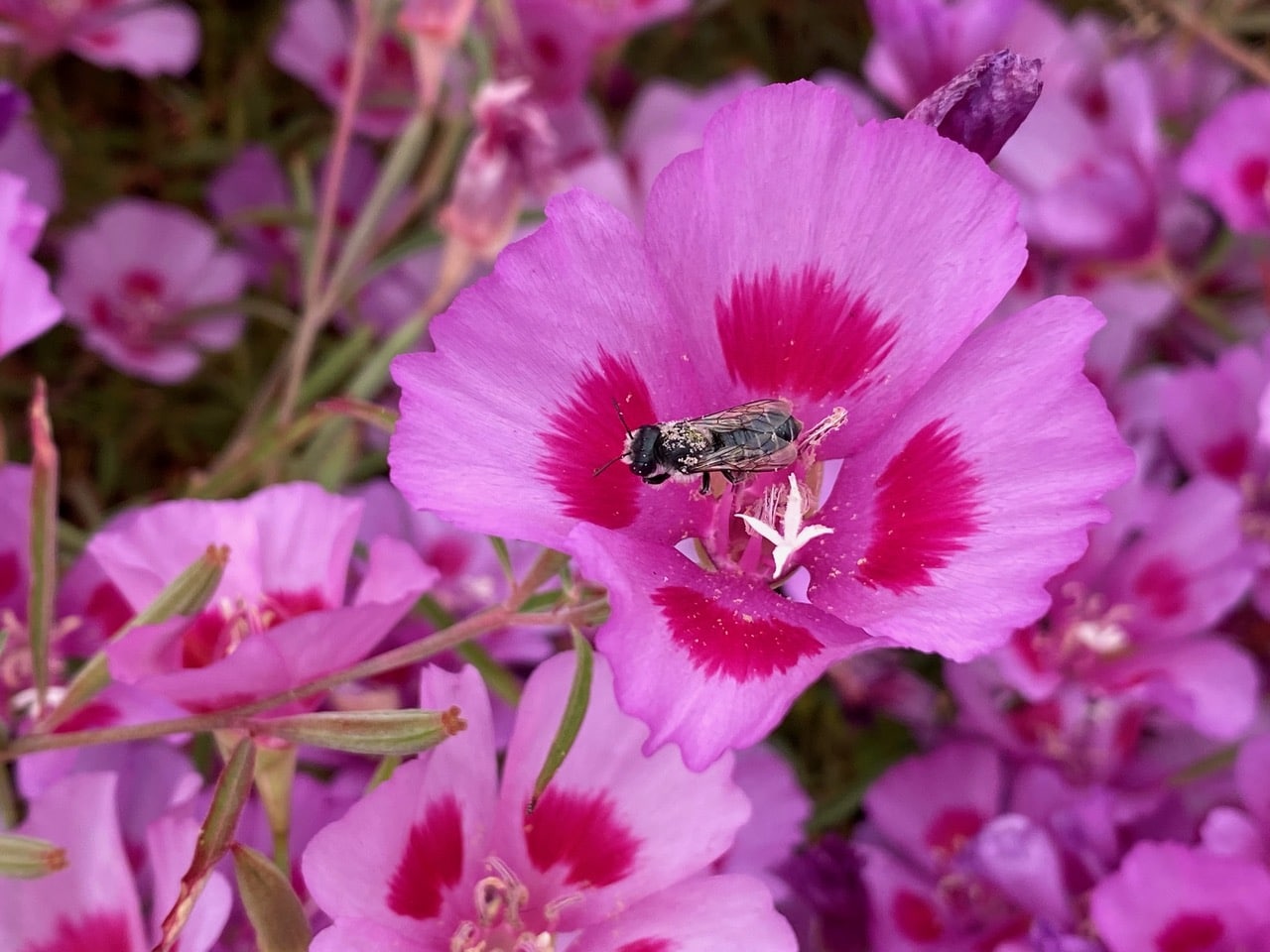
iNaturalist is able to confirm my suspicion, and goes further to identify the bee to the species – the Silver-tailed Petalcutter, Megachile montivaga (family Megachilidae). Yay, a new species for me!
The Silver-tailed Petalcutter Bee, Megachile montivaga is a unique solitary bee. While most leafcutter bees use leaves to build their nests, this species is known for exclusively using flower petals to wrap and protect its young. The females meticulously cut nearly perfect circles from soft flower petals (such as Clarkia, evening primrose, sunflowers) to wrap their eggs and provision them with “bee bread” (a mixture of pollen and nectar). The bees have a sleek body, five teeth on their mandibles, and carry pollen on specialized stiff hairs on the underside of their abdomen. They are widely distributed across North America, though they are most abundant in the western regions. In the San Francisco Bay Area, they are active from May through September, with peak activity occurring between June and August.
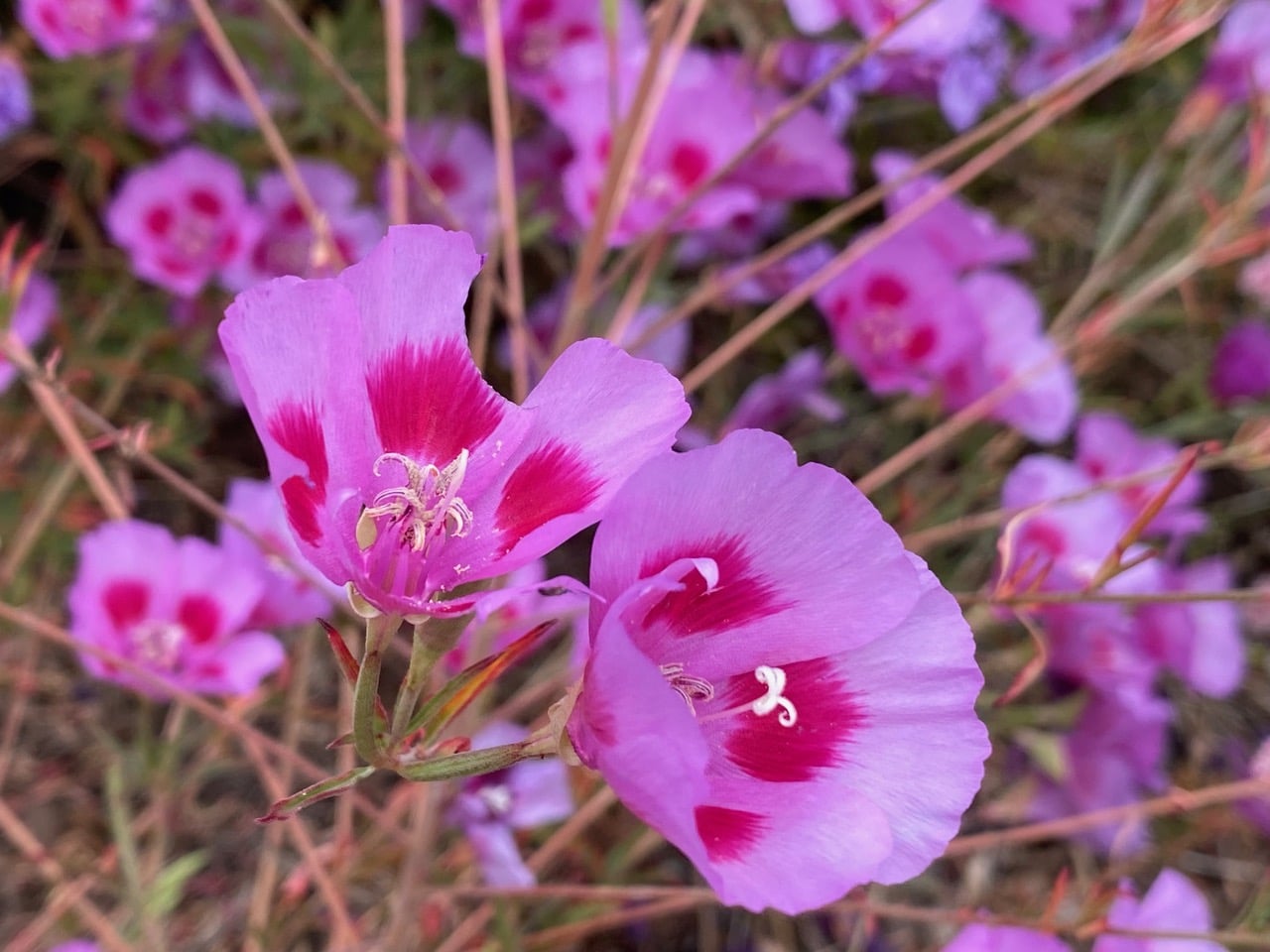
Since there are so many Leafcutter bees (of at least two species) in the garden, it doesn’t take long for me to find the cut leaves and petals that the females use to line their nest cells.
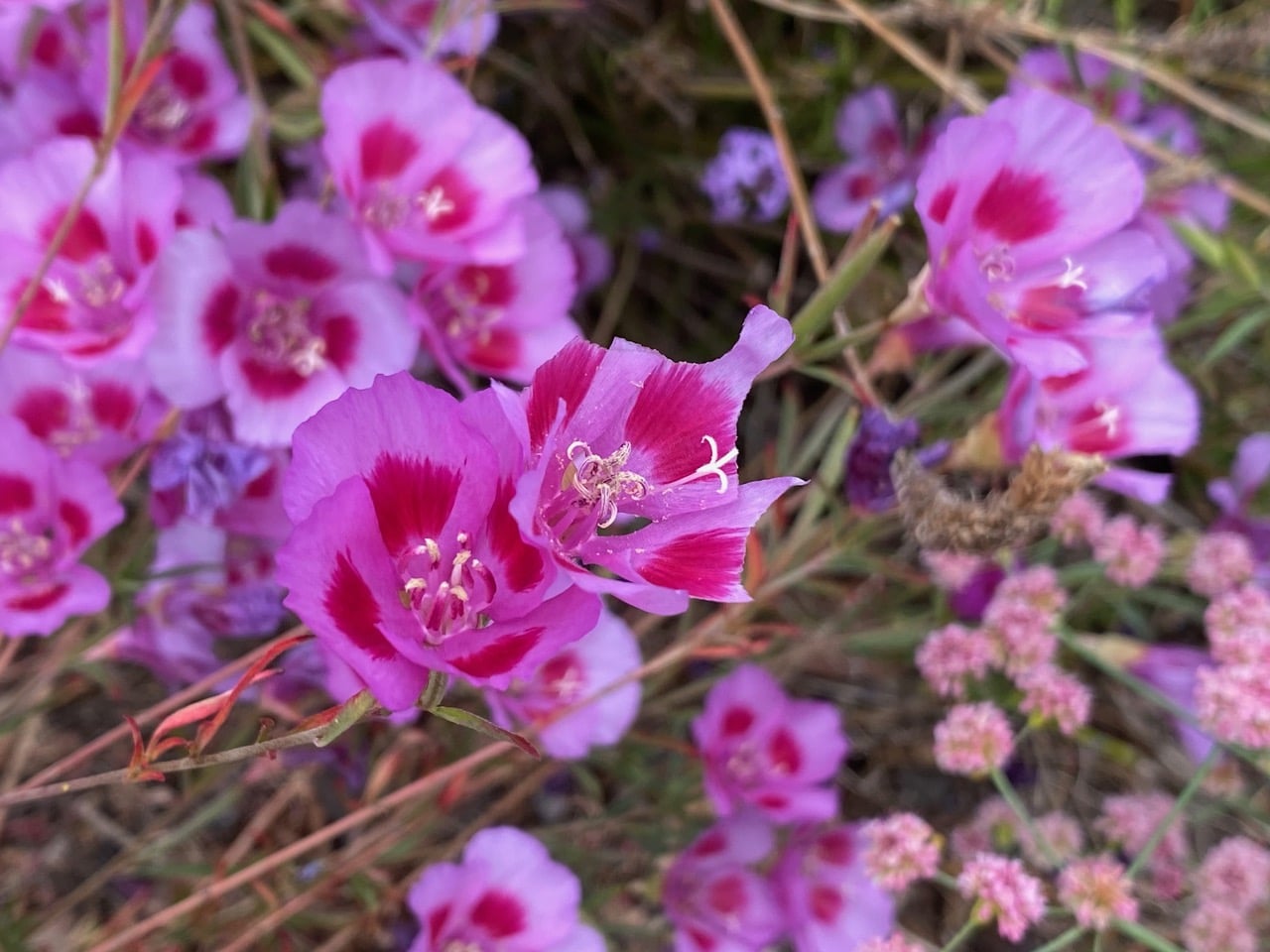
What is it about that particular Clarkia flower that the leafcutter bees love to use as wallpaper for their nurseries?

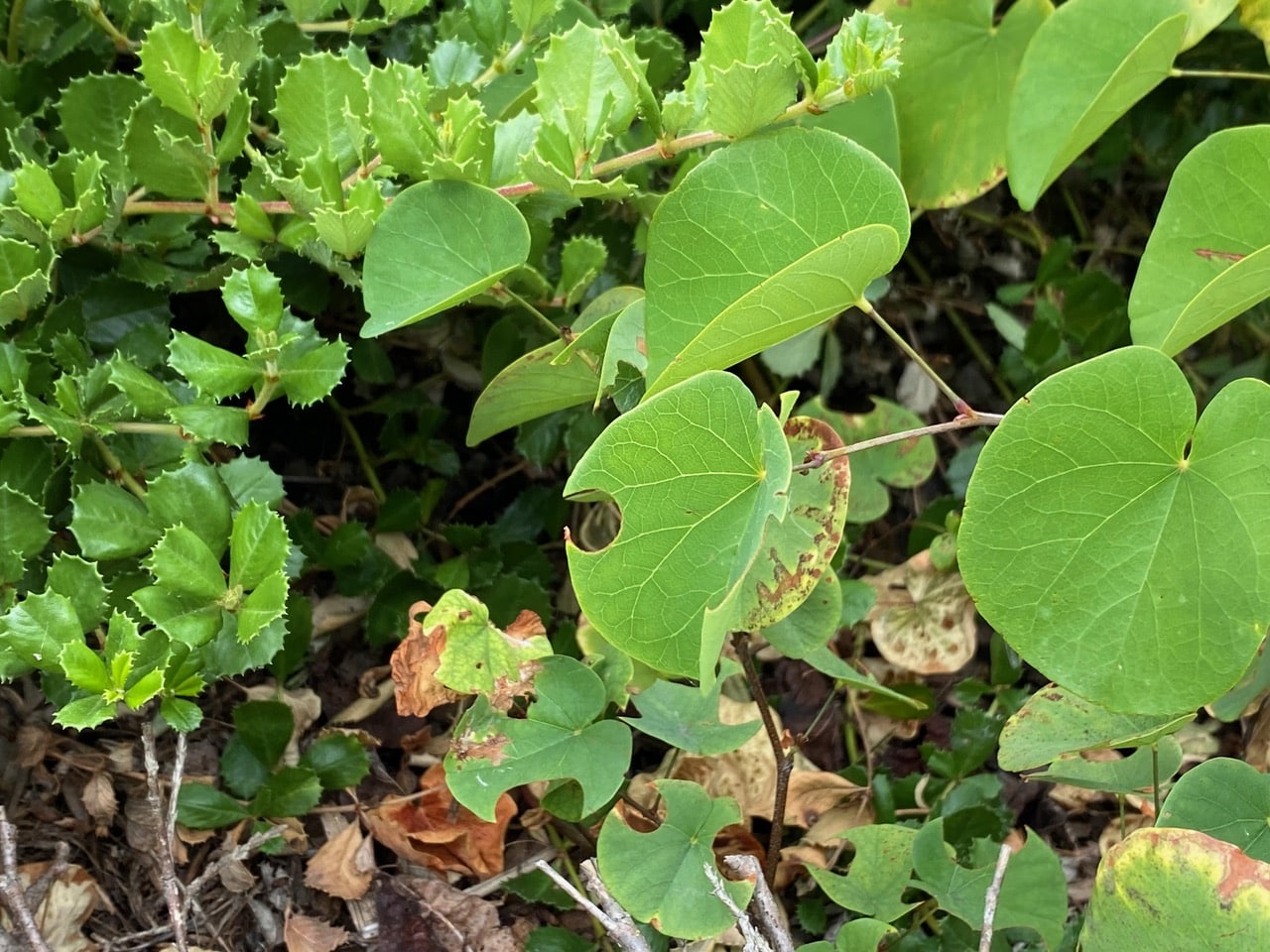 Adjacent to the Clarkia plantings in the front yard is a small Western Redbud, Cercis occidentalis. Many of the lower leaves of the tree show telltale signs of Leafcutter Bee activity.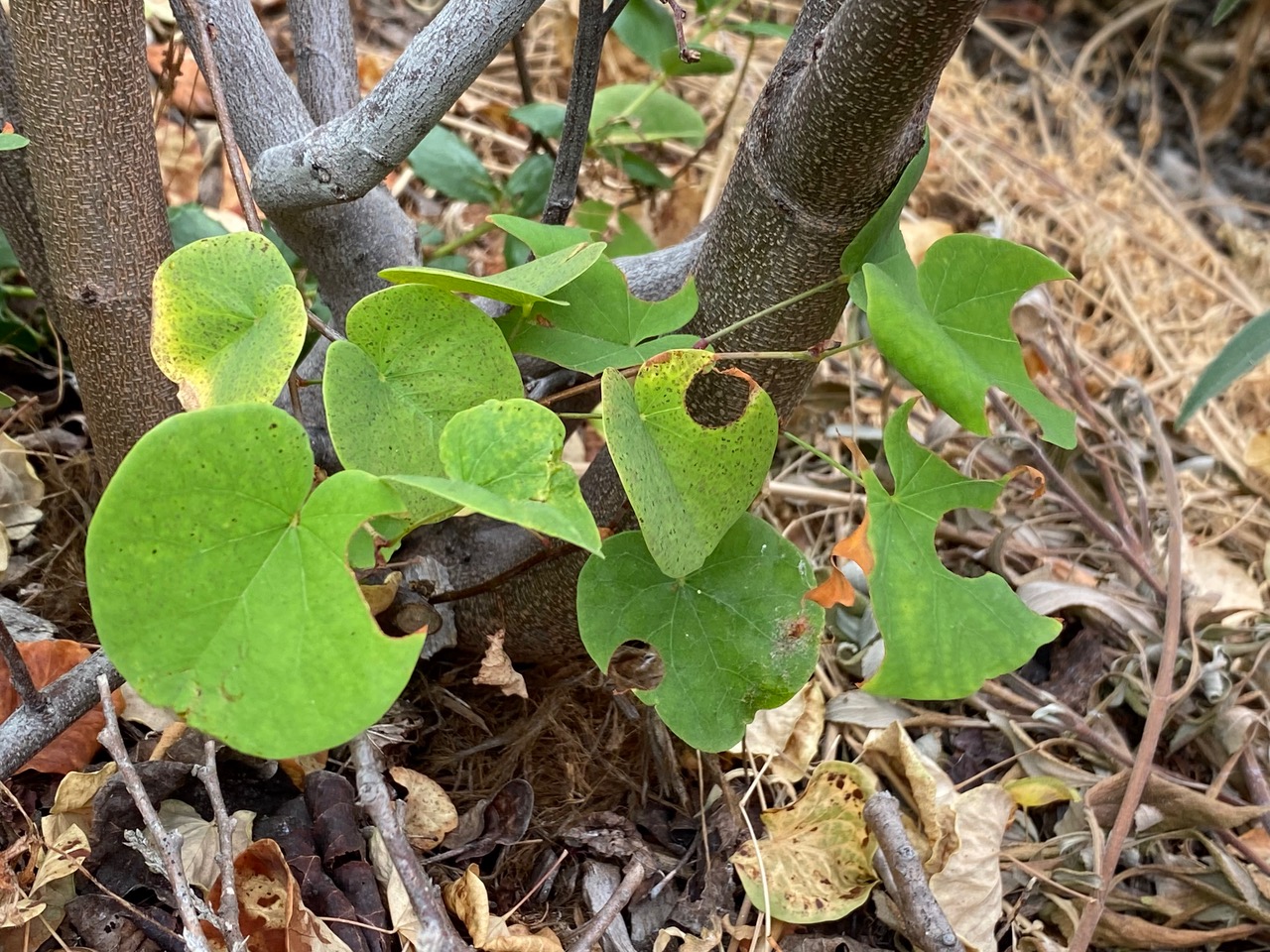
Still more cut leaves on the same tree. Why do the leafcutter bees prefer these lower leaves? Perhaps the location is concealed from the eyes of predators while the females work on the leaves? Or maybe the leaves have been cut a while ago when they were still young and supple?
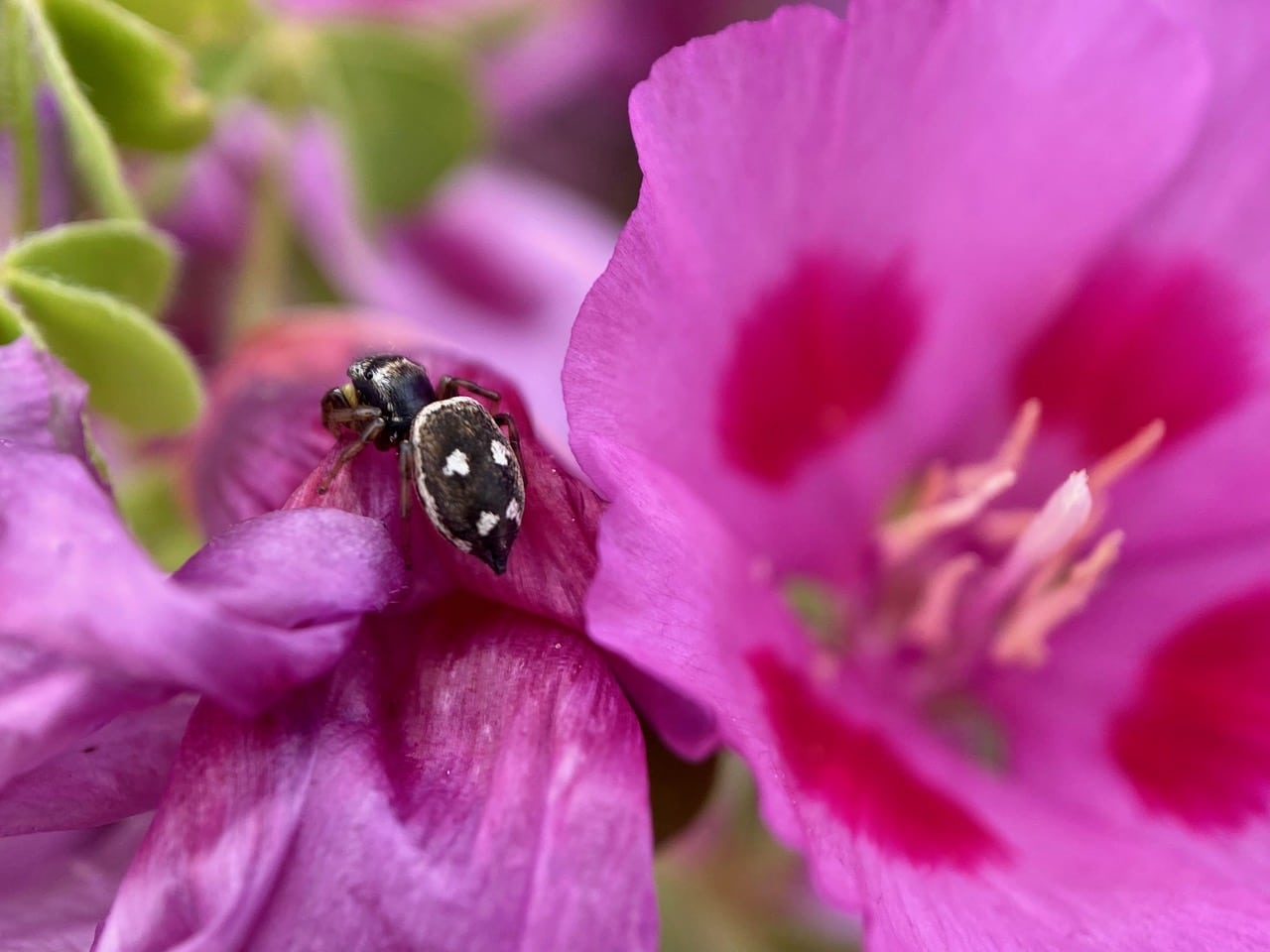
A Jumping Spider (family Salticidae) is perched on a wilted Clarkia flower. Judging from its size and coloration, I gather it is a mature Sun Jumping Spider, Heliophanus apiatus (family Salticidae).
Jumping spiders (family Salticidae) are free-roaming hunting spiders. They do not weave a web to catch prey. They stalk, then pounce on their prey. Just before jumping, the spider fastens a safety line to the substrate. It can leap 10-20 times their body length to capture prey. Their movement is achieved by rapid changes in hydraulic pressure of the blood. Muscular contractions force fluids into the hind legs, which cause them to extend extremely quickly. Jumping spiders are visual hunters. Their excellent vision has among the highest acuities in invertebrates. Since all their 8 eyes are fixed in place and cannot pivot independently from the body like human eyes can, jumping spiders must turn to face whatever they want to see well. This includes moving their cephalothorax up and down, an endearing behavior.
The genus Heliophanus is one of the largest genera of jumping spiders with over 150 species, widespread in the Palearctic and Africa, with one center of diversity in the Mediterranean region. Heliophanus apiatus was first reported in the San Francisco Bay Area in 2015. H. apiatus is a small salticid, male measuring 3.5-4.0 mm, and females 4.0-4.5 mm in body length. Mature males and females are similar in appearance, but only the females have yellow pedipalps. These spiders are found on low vegetation and on hard structures on or near the ground. They are capable of taking prey their own size.

A Common European Greenbottle Fly, Lucilia sericata (family Calliphoridae) is perched on a petal of Farewell-to-Spring.
The Common European Greenbottle Fly, Lucilia sericata (family Calliphoridae) is a Blowfly found in most areas of the world and is the most well-known of the numerous green bottle fly species. The lifecycle of Lucilia sericata is typical of blowflies. Females lay masses of eggs in fresh carrion. The flies are extremely prolific – a single female may produce 2,000 to 3,000 eggs in her lifetime. The larvae feed on dead or necrotic tissue, passing through 3 larval instars. Third-instar larvae drop off the host to pupate in the soil. The adults feed opportunistically on nectar, pollen, feces, or carrion; they are important pollinators as well as important agents of decomposition. Pollen is used as an alternative protein source, especially for gravid females who need large amounts of protein and cannot reliably find carrion.
While we may find the blowflies disgusting for their association with filth and carrion, they are important decomposers/ recyclers in the ecosystem. What’s more, their larvae are used in maggot therapy to clean wounds by consuming only dead and infected tissue, helping to promote faster healing and prevent infection.

The highlight of the backyard is the beautiful pond. It has been redesigned and reconfigured several times as Craig and Jenny persisted to learn the intricacies of maintaining a fresh water pond in the garden. It is an on-going process. Craig tells me that they have had a recent crash in the number of dragonfly larvae in the seemingly thriving pond, and he is still trying to figure out how to remediate the situation. Craig is also working to change the water source from municipal tap water to ground water from an old well on the property.

The young Narrow Leaf Milkweed, Asclepias fascicularis by the side of the backyard already harbors a small colony of Oleander Aphids, Aphis nerii (family Aphididae). The aphids have in turn attracted predators, such as this Lady Beetle larva. Earlier in the spring, the milkweed plantings at this spot have been nibbled to oblivion by an overwhelming number of Monarch caterpillars. These young milkweed plants are their replacements.
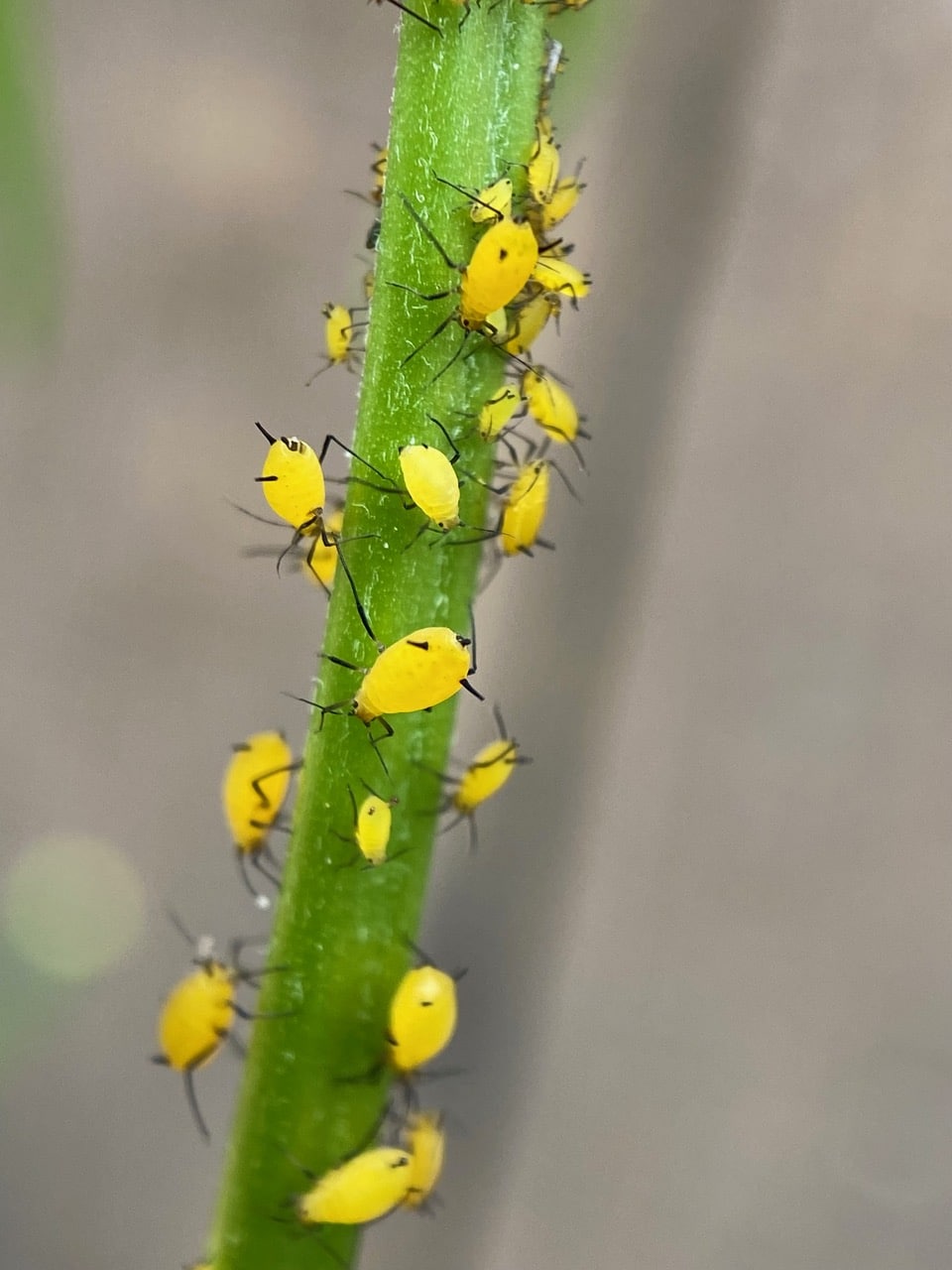
Close-up of Oleander Aphids, Aphis nerii (family Aphididae).
Female aphids are viviparous and parthenogenetic, meaning that they give birth to live young instead of laying eggs, and that the progeny are produced by the adult female without mating. The nymphs feed gregariously on the plant terminal in a colony that can become quite large. Nymphs progress through five nymphal instars without a pupal stage. Normally wingless adults are produced but alate adults occur under conditions of overcrowding and when plants are senescing, allowing the aphids to migrate to new host plants. The parthenogenetic mode of reproduction, high fecundity, and short generation time allow large colonies of Oleander Aphids to build quickly on infested plants.
The Oleander Aphid ingests sap from the phloem of its host plant. The damage caused by aphid colonies is mainly aesthetic due to the large amounts of sticky honeydew produced by the aphids and the resulting black sooty mold that grows on the honeydew. The terminal growths of host plants may be deformed, resulting in stunted growth in heavy infestation.
Oleander Aphids sequester cardiac glycosides, a toxin from their host plants. They also fortify their cornicle secretions with these bitter, poisonous chemicals. Their bright aposematic (warning) coloration and possession of toxins protect them from predation by certain species of birds and spiders. Aphid populations are usually kept under control by natural biological agents such as parasitoid wasps, and predators such as Syrphid larvae, Lacewing larvae, and Lady Beetles.

While photographing the aphids, I notice a very small Monarch caterpillar on an upper leaf. Wow, the butterflies have not wasted any time laying their eggs on these new plants. I wonder why the Monarch butterflies are so aggressively planting their eggs, to the extent of risking starvation of their larvae when they outgrow their food supply. Are there not enough predators and parasites to keep the Monarch population to a reasonable number? Maybe it takes more than two years for a healthy, balanced ecosystem to be established in a garden?
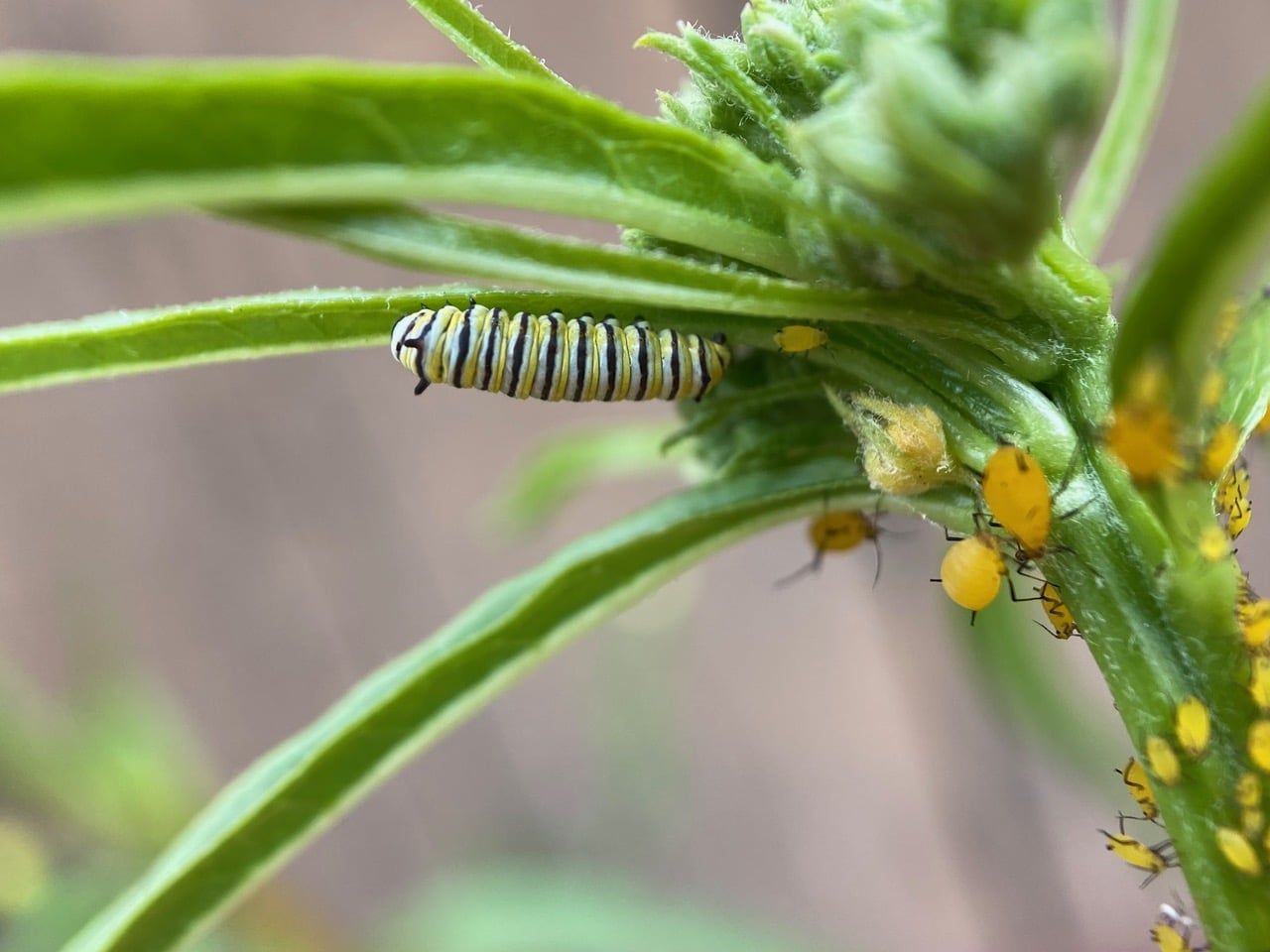
Close-up of the young Monarch caterpillar, Danaus plexippus (family Nymphalidae).
While they can take nectar from a wide variety of flowers, Monarch females will only lay their eggs on milkweed because it is the only food source their caterpillars can digest. The plant also provides crucial chemical defenses; the larvae ingest and sequester milkweed toxins (cardiac glycosides), making them unpalatable and poisonous to predators throughout their life. Female monarchs have adapted specialized receptors on their legs and antennae to taste and detect the specific chemical signatures of milkweed, ensuring they never misplace their eggs. The adults utilize aposematism – the use of bright, contrasting colors to warn predators of toxicity. Their iconic orange and black wings signal that they are unpalatable and potentially harmful, allowing them to survive encounters with birds and other animals.
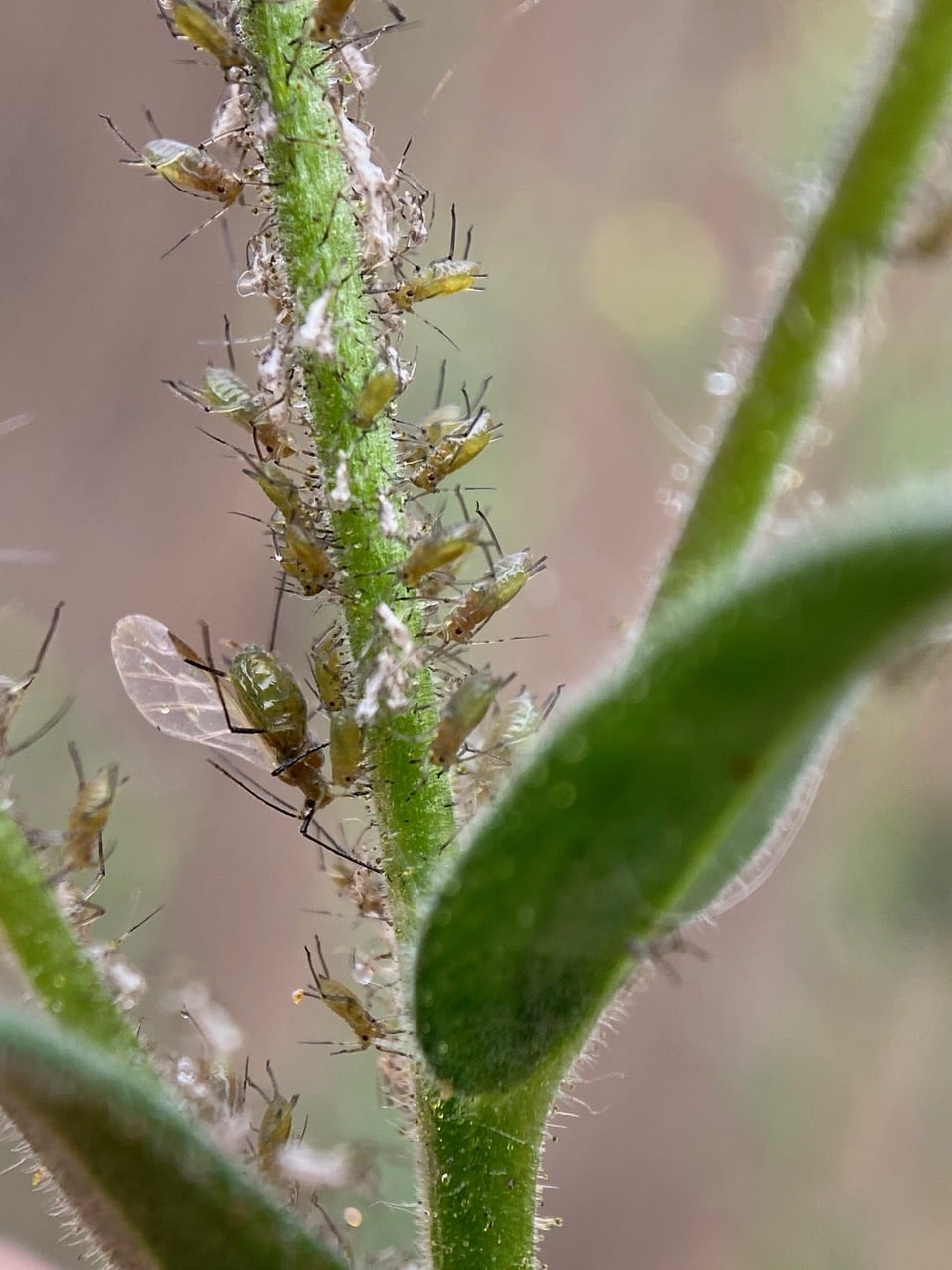
Next to the milkweed, a young Elegant Tarweed, Madia elegans has acquired its own colony of aphids. iNaturalist has helped identify these aphids as members of the genus Macrosiphum (family Aphididae).
Macrosiphum is a common genus of large, long-legged aphids, measuring up to 3.5 mm long. The genus name derives from their long, slender “tailpipes” (cornicles) on the rear of their bodies. During the summer populations are made of parthenogenetic females. In the fall, males and females are produced; they mate and females lay eggs that overwinter. These aphids are highly polyphagous, feeding on over 200 plant species, including vegetables like tomatoes, potatoes, and ornamentals. They extract sap from soft new foliage and terminal stems, causing leaves to curl, yellow, and stunt. They secrete a sticky, sugary waste product called honeydew that may coat the plant, promoting the growth of a black fungus called sooty mold. The aphids are also prominent vectors capable of transmitting plant viruses between crops.
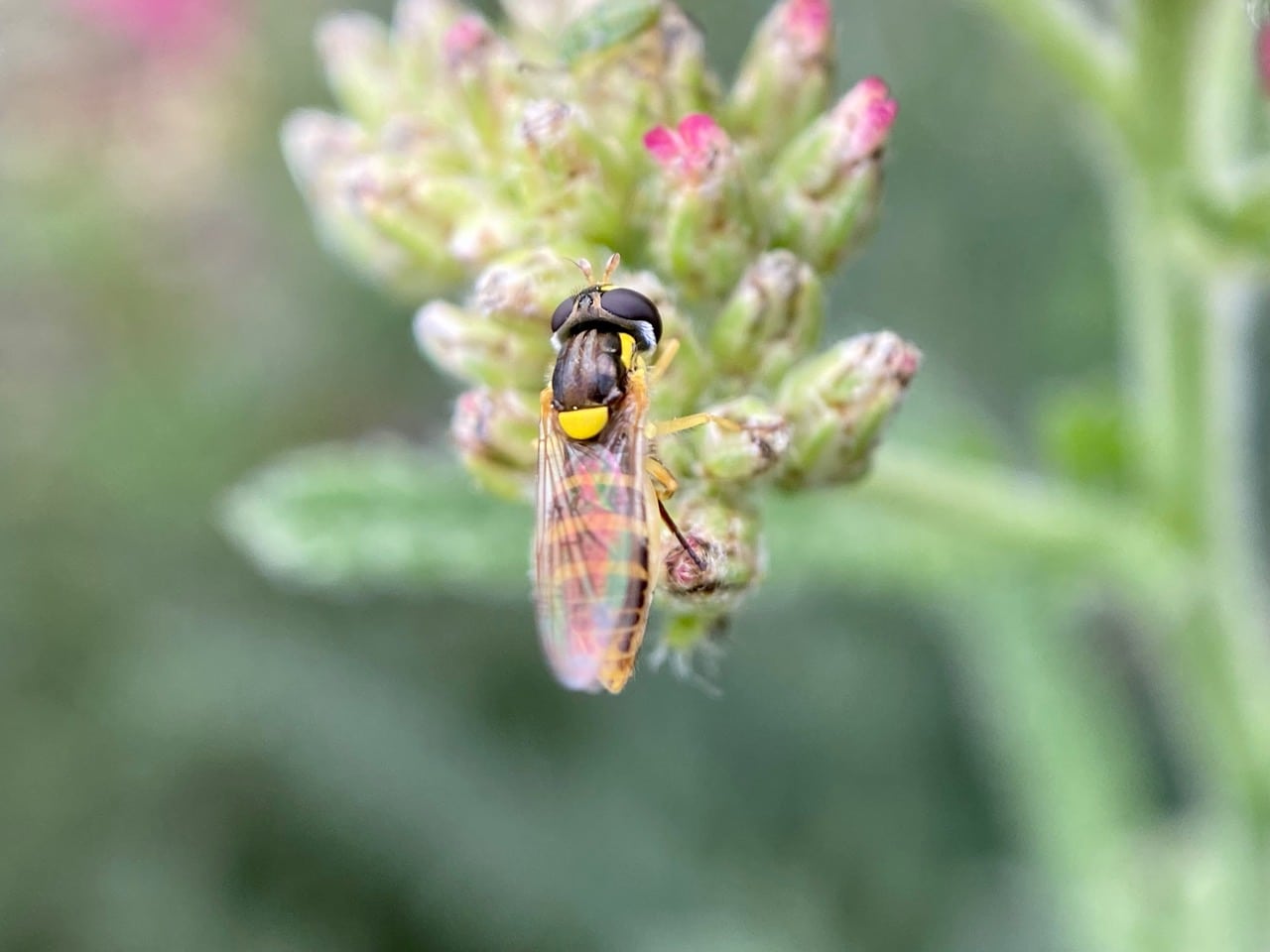
A female Forked Globetail, Sphaerophoria sulphuripes (family Syrphidae) has landed on a cluster of Yarrow flower buds.
The Forked Globetail, Sphaerophoria sulphuripes (family Syrphidae) is a hover fly native to western North America. Adults visit flowers for nectar and pollen. Larvae feed on aphids and other soft-bodied insects. There is marked sexual dimorphism in the species – the males have a slender abdomen with a reddish, swollen tip.

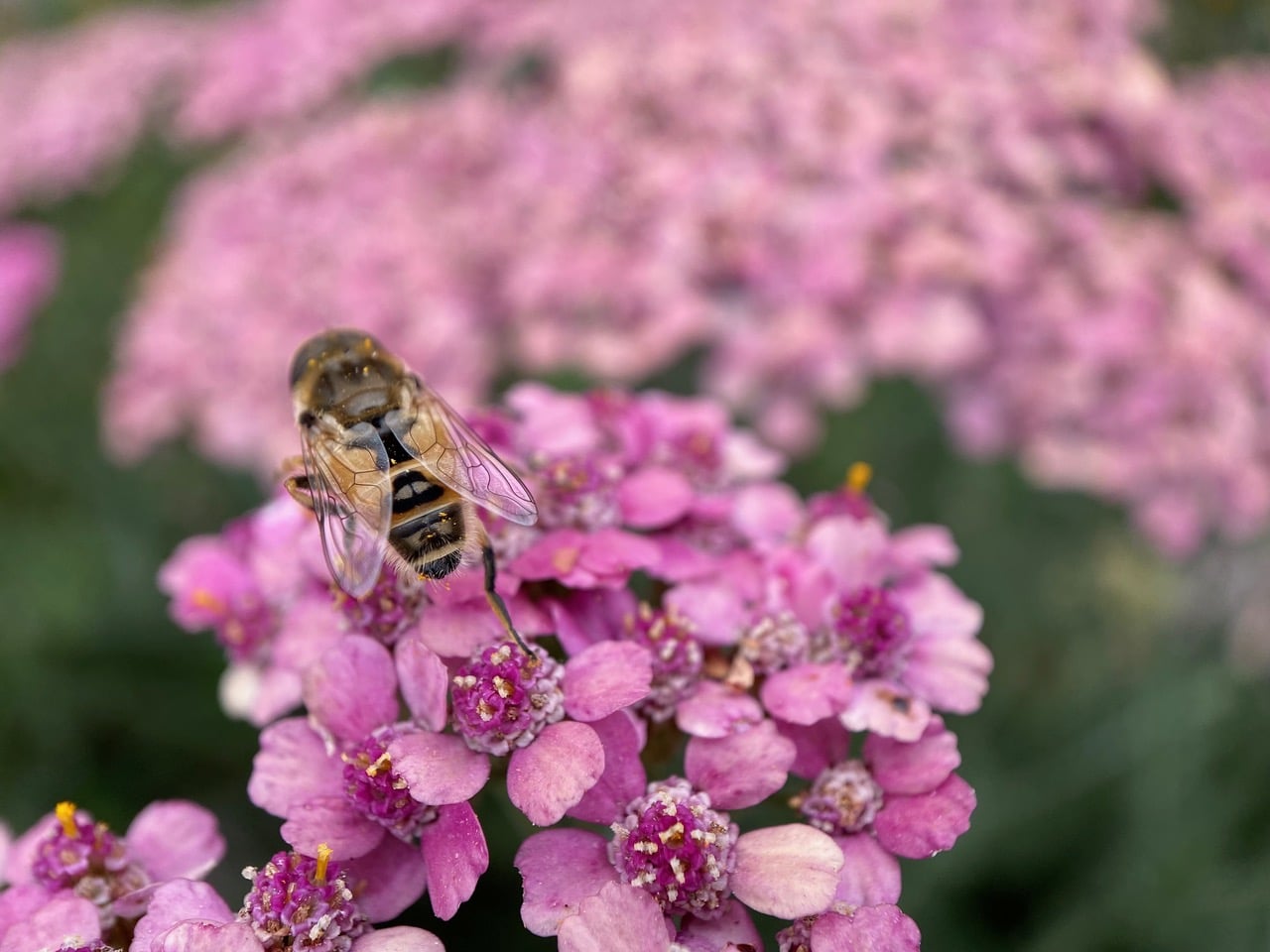
A Eurasian Drone Fly, Eristalis arbustorum (family Syrphidae) is foraging on an inflorescence of Yarrow.
The Eurasian Drone Fly, Eristalis arbustorum is an abundant species of hover fly that occurs throughout the northern hemisphere, including Europe, North Africa and North India. It was introduced to North America in the mid 1800’s and is now ubiquitous throughout much of the United States and Canada. The common name “drone fly” refers to its resemblance to the drone of the honeybee. The Eurasian Drone Fly is found in a diversity of habitats, including wetland, forests, montane tundra, as well as farmland, urban parks and gardens. It visits the flowers of a wide range of low-growing plants and shrubs. The larvae are aquatic, occurring in shallow, nutrient rich standing water and in cow manure and compost heaps. Also known as “rat-tailed maggots”, the larvae have a siphon on their rear end that acts like a snorkel, helping them breathe under water. The siphon can be several times the length of the larva’s body. The larvae are saprophagous, feeding on bacteria in stagnant water rich in decomposing organic matter.
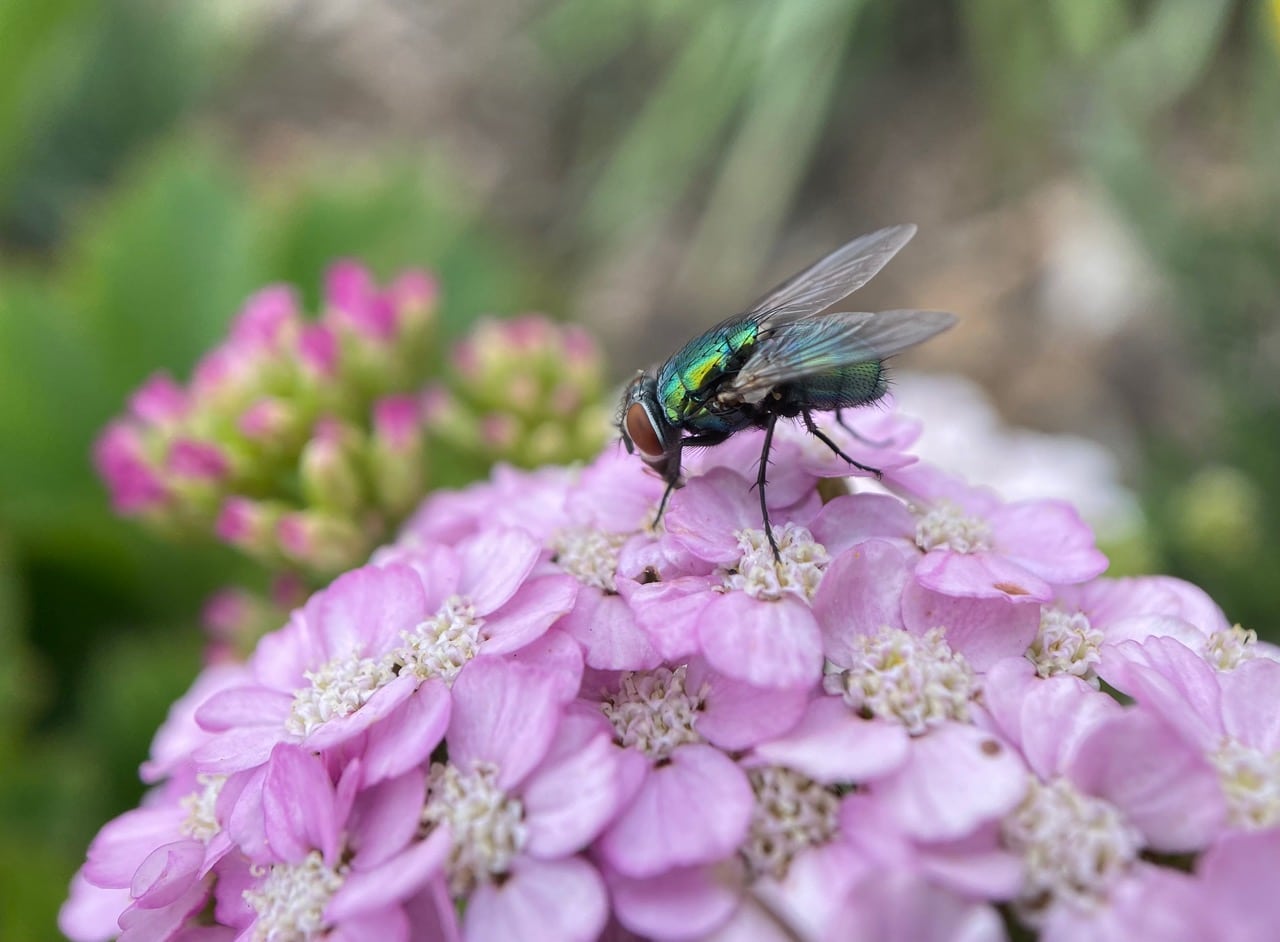
A Common European Greenbottle Fly, Lucilia sericata (family Calliphoridae) is taking nectar from Yarrow flowers.
The Common European Greenbottle Fly, Lucilia sericata (family Calliphoridae) is a Blowfly found in most areas of the world and is the most well-known of the numerous green bottle fly species. The lifecycle of Lucilia sericata is typical of blowflies. Females lay masses of eggs in fresh carrion. The flies are extremely prolific – a single female may produce 2,000 to 3,000 eggs in her lifetime. The larvae feed on dead or necrotic tissue, passing through 3 larval instars. Third-instar larvae drop off the host to pupate in the soil. The adults feed opportunistically on nectar, pollen, feces, or carrion; they are important pollinators as well as important agents of decomposition. Pollen is used as an alternative protein source, especially for gravid females who need large amounts of protein and cannot reliably find carrion.
While we may find the blowflies disgusting for their association with filth and carrion, they are important decomposers/ recyclers in the ecosystem. What’s more, their larvae are used in maggot therapy to clean wounds by consuming only dead and infected tissue, helping to promote faster healing and prevent infection.
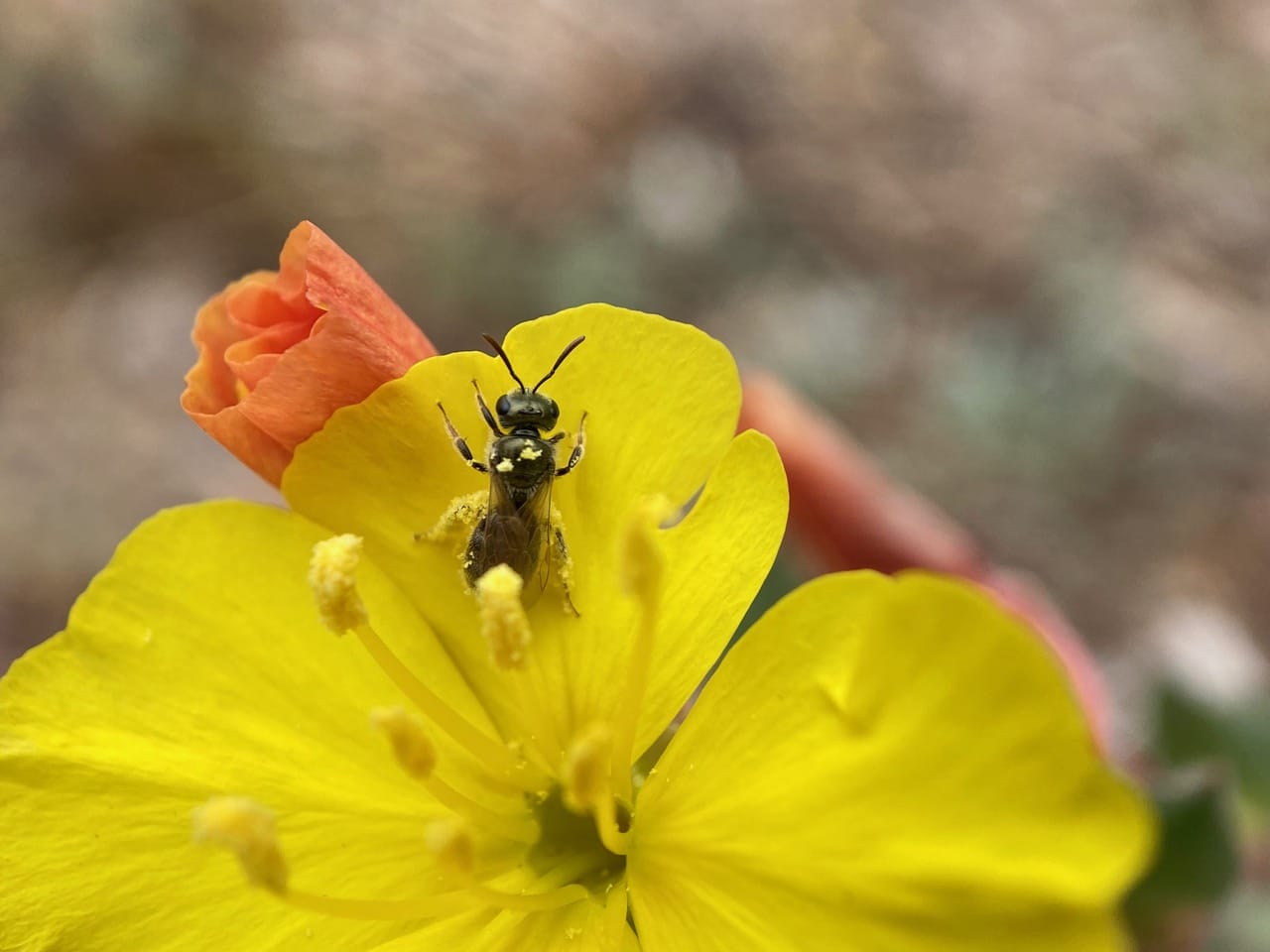
As the afternoon wears on the sky becomes increasingly overcast. Dependent solely on natural light for photography, I am fast losing my ability to take any decent pictures. Her thorax covered in stray pollen, a tiny bee is crawling out of a flower of Beach Evening Primrose, Camissoniopsis cheiranthifolia. Although she does not look shiny in this low light, I recognize her as a Metallic Sweat Bee, Lasioglossum (Dialictus) sp. (family Halictidae).
Lasioglossum species are found worldwide, and they constitute the largest bee genus. The subgenus Dialictus are the most likely to be seen in the U.S., with over 300 species of these tiny metallic bees. The majority of Lasioglossum are generalists. Because they are so abundant throughout the flowering season, the bees are often important pollinators. Their sheer numbers are enough to achieve excellent pollination of many wild flowers, especially of plants in the Asteraceae, which have shallow floral tubes that are easily accessed by these minute bees.
Lasioglossum exhibit a range of social behaviors; the genus includes solitary, communal, semi social, primitively eusocial, and even parasitic species. Almost all Lasioglossum in the U.S. nest in the ground. Generally these nests are built in the spring by fertilized females (called foundresses) that spent the winter in hibernation. In social species, the foundresses behave much like the queen bumble bees – they lay the first batch of eggs that develop into the first generation of female workers. The nest grows with each additional generation of bees. Later broods may consist of both males and females. They mate, and at the end of the season the fertilized females hibernate til the following spring, repeating the life cycle of the colony.

A female Metallic Sweat Bee, Lasioglossum (Dialictus) sp. (family Halictidae) is lifting off after foraging on a Seaside Daisy flowerhead. On a sunny day, she would look a lot sharper and shinier.

Same problem with the low light here. The Yellow-haired Sun Fly on the Pacific Aster, Symphyotrichum chilense has lost its typical luster and vibrancy. It’s time for me to go home and cover the garden another day.
The Yellow-haired Sun Fly, Myathropa florea is a hover fly native to Europe and North Africa. It has been found along the Pacific Coast of North America since 2005. It is of a similar size to the Common Drone Fly (Eristalis tenax), but Myathropa are generally more yellow, with two light bands to the thorax, interrupted with a black central smudge. These flies are rather variable in size, shape and color. The species occurs in deciduous forests, farmland, parks, and gardens. Adults visit flowers of a wide variety of plants for nectar and pollen, and are important pollinators. Larvae are rat-tailed maggots that live in stagnant, water-logged tree rot holes or decaying wood, feeding on bacteria. They have a siphon on their rear end that acts like a snorkel, helping them breathe under water. The siphon can be several times the length of the larva’s body. These larvae serve an important function as decomposers/recyclers in the ecosystem.