

Pollinator Post 6/26/26 (1)

It seems surprises are always in store when I visit Jenny and Craig’s native garden in Alameda. Not only am I greeted by a floriferous front yard this afternoon, there is a handsome plaque planted amidst the riot of flowers.
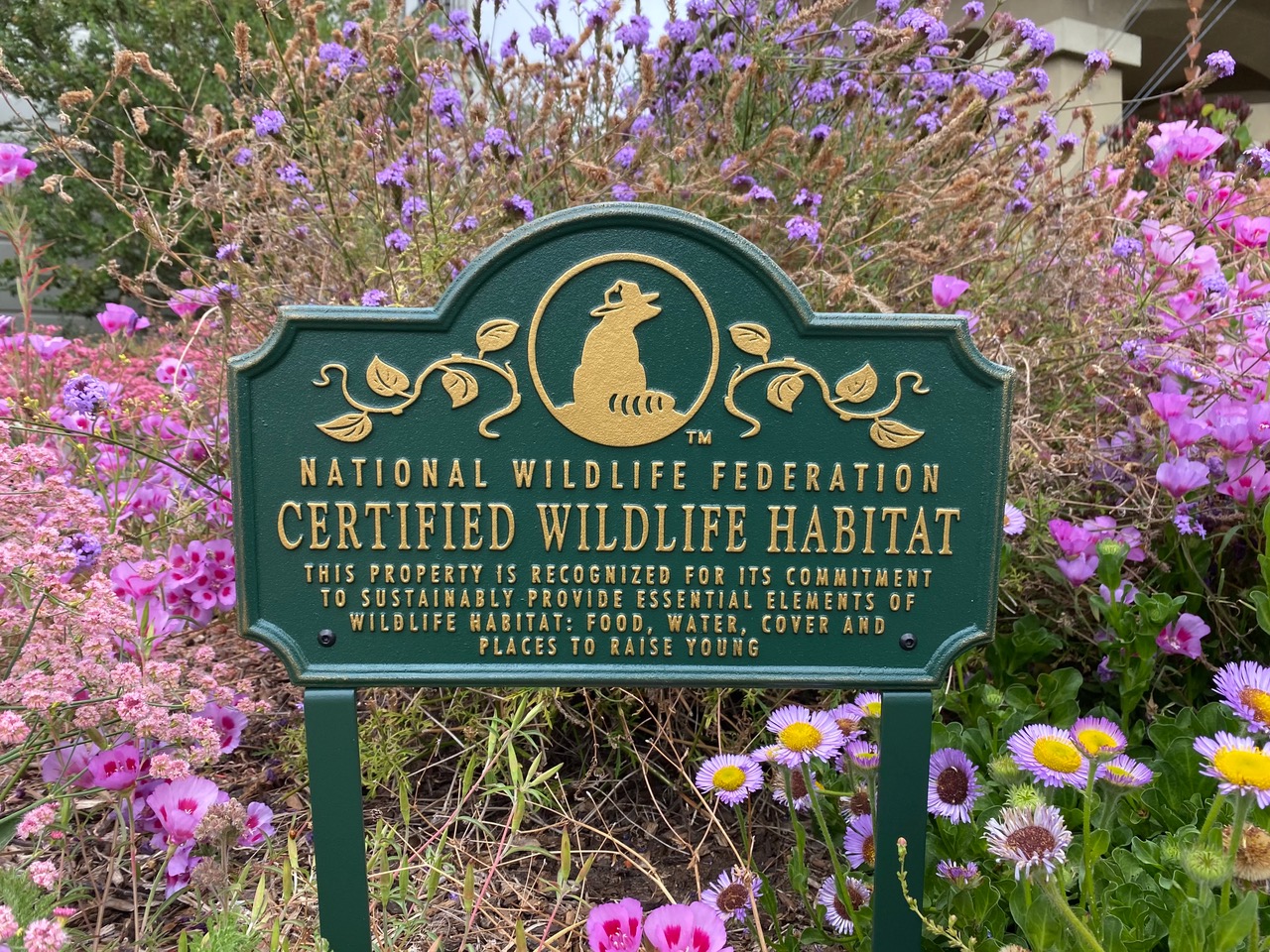


Their garden has been certified as a Wildlife Habitat by the National Wildlife Federation. As far as I know, the certification is a rather rigorous process. Congratulations, Jenny and Craig!
Despite the heavily overcast sky, the front garden is buzzing with insect activity. There’s so much going on it’s hard to decide what to look at. I guess the Red-flowered Buckwheat, Eriogonum grande var. rubescens is a good place to start as it is in prime bloom. Several worker Yellow-faced Bumble Bees, subgenus Pyrobombus (genus Bombus, family Apidae) are busy foraging on the clusters of red flowers.
Wait, isn’t that a female Sharptail Bee, Coelioxys sp. (family Megachilidae)? It’s always a thrill to find a Cuckoo Bee!
The term cuckoo bee refers to a variety of different bee lineages which have evolved the kleptoparasitic behavior of laying their eggs in the nests of other bees, similar to the behavior of cuckoo birds. Female cuckoo bees lack pollen-collecting structures and do not construct their own nests. Cuckoo bees typically enter the nests of pollen-collecting species, and lay their eggs in cells provisioned by the host bee. When the cuckoo bee larva hatches, it consumes the provision in the nest, and kills the host larva. Many cuckoo bees are closely related to their hosts, and may bear similarities in appearance reflecting this relationship. Others parasitize bees in families different from their own.
The Cuckoo Leafcutter Bees, also known as Sharptail Bees, belong to the genus Coelioxys, in the same family as their hosts, Megachilidae. Members of the genus Coelioxys share the distinctive trait of having hairs on their eyes. In addition, the back rim of the bee’s scutellum (the second segment of the thorax) has prominent toothlike protrusions called axillae. In Greek, Coelioxys means “sharp belly”, referring to the tapered, pointed abdomens of cuckoo leaf cutters. The bees have dark abdomens banded by short pale hairs; thorax with prominent axillae; red, black or red-and-black legs; and green eyes. Female Coelioxys have pointed, conical abdomens with spearlike tips. The spade-shaped abdominal tips allow the female cuckoos to break through the brood-cell walls that leafcullters construct with leaves, petals and other materials. Males have abdomens armed with multiple pronged tips.
These bees are known to sometimes sleep upside down on vegetation, holding on with their mandibles.
While we might be alarmed by the presence of cuckoo bees with unsavory behavior in our garden, we really have nothing to worry about. The presence of cuckoo bees is a clear indication of a thriving population of their host bees. By parasitizing specific species, cuckoo bees prevent dominant host bees from pushing out less competitive, rarer bee species, allowing for greater biodiversity. The arms race between cuckoo bees and their hosts drives genetic diversity and adaptation. Hosts evolve defenses against parasites, which naturally strengthens the resilience of the bee community. What’s more, although they do not intentionally collect pollen, cuckoo bees must visit flowers to forage for nectar, which sometimes leads to incidental pollen transfer.
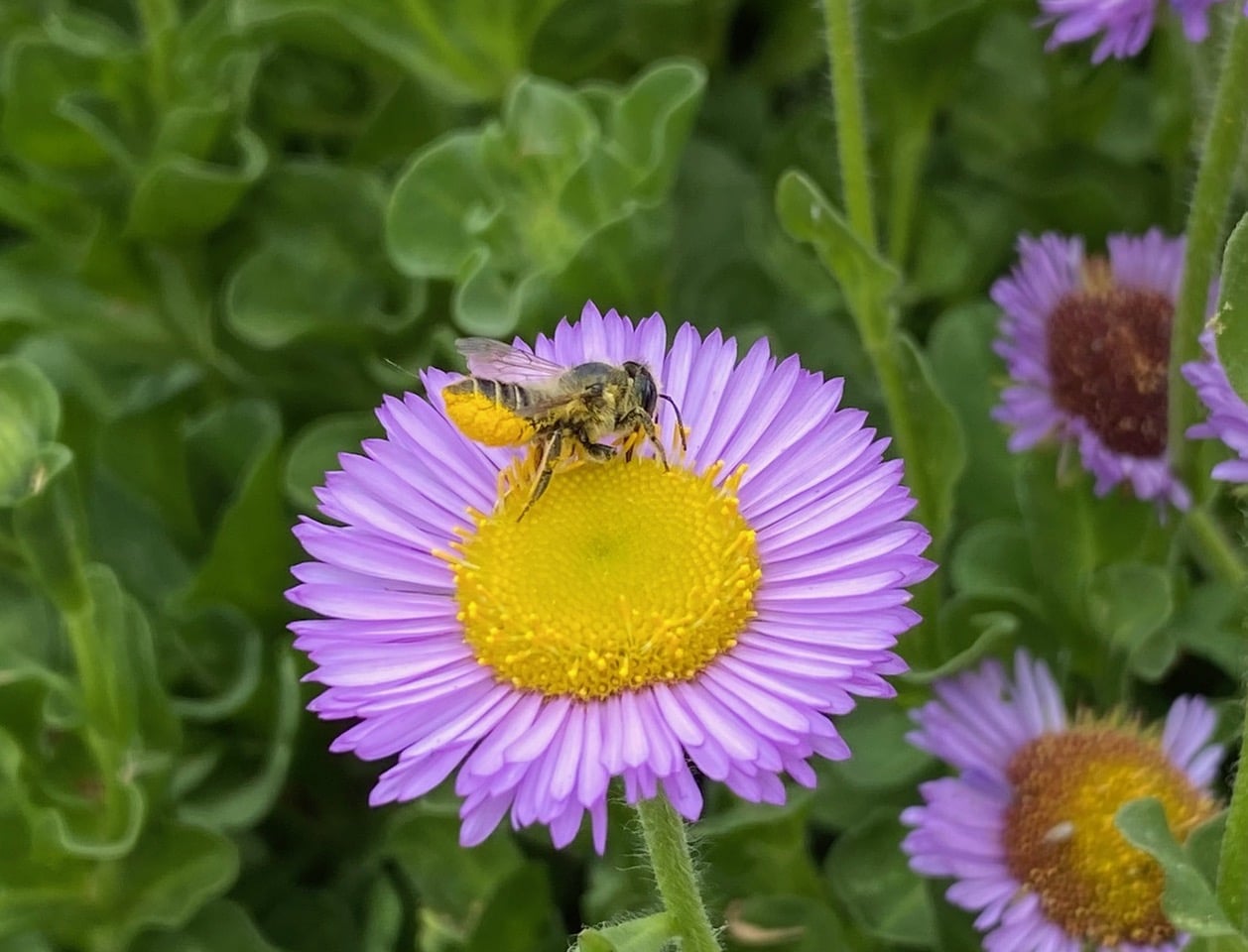
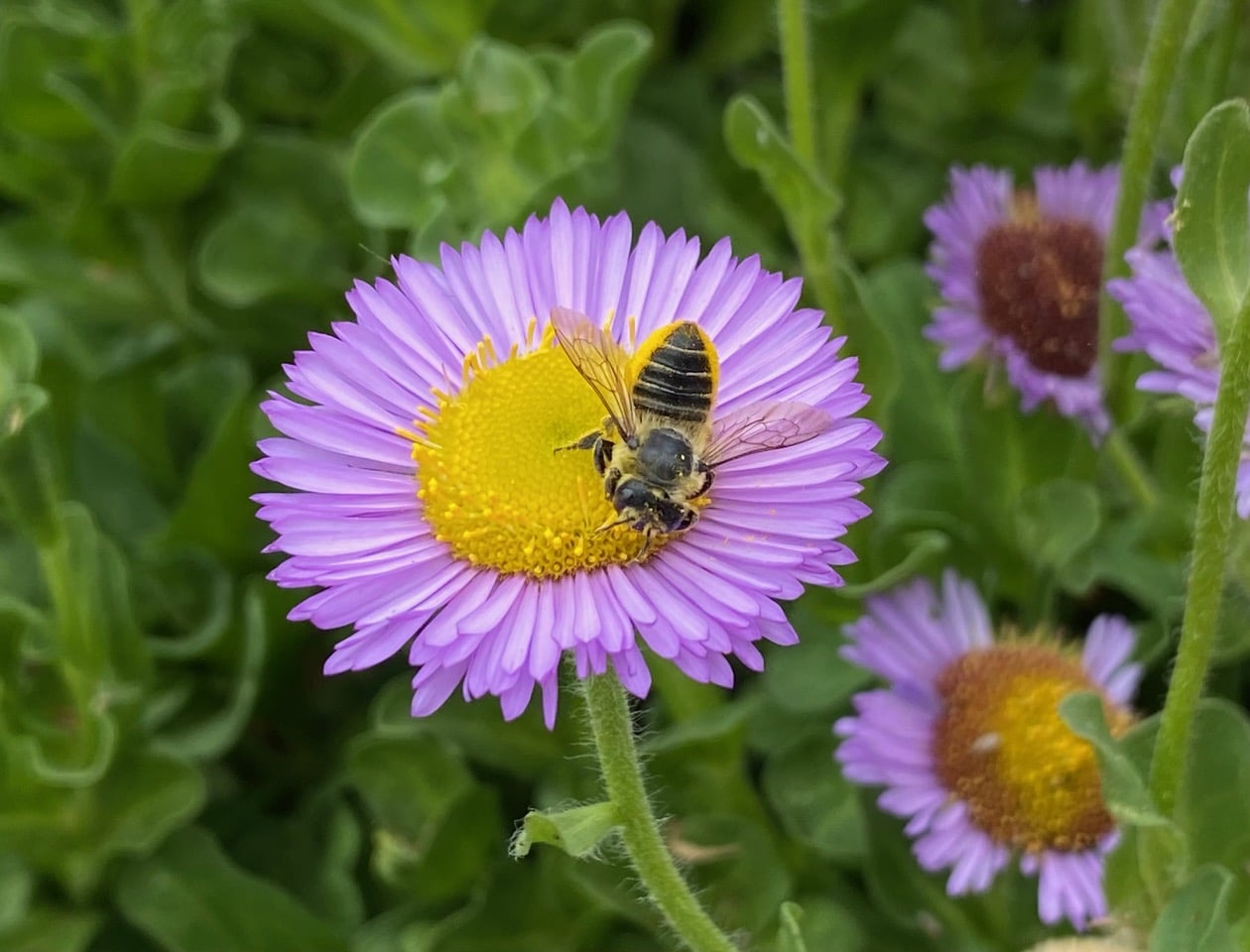
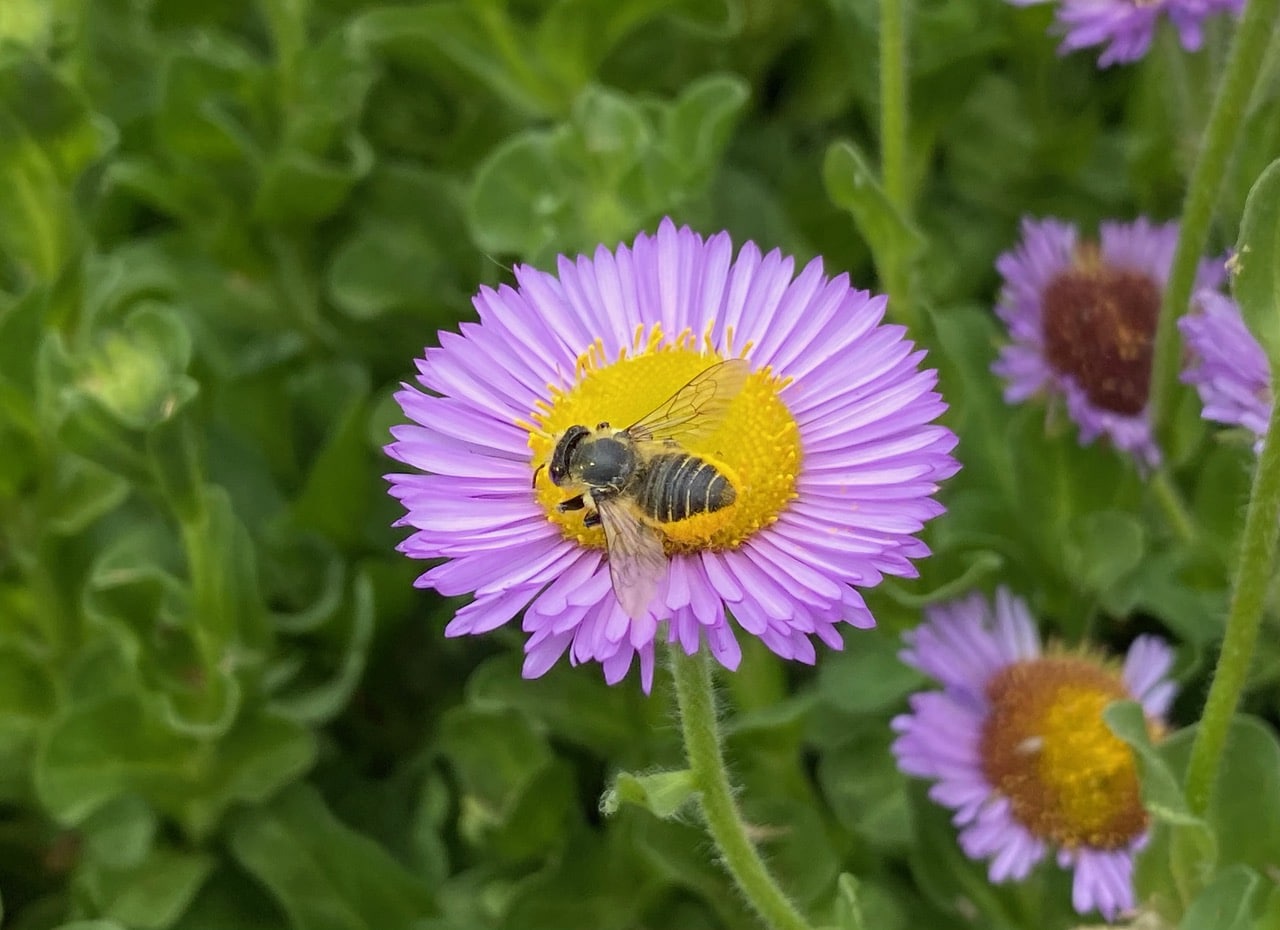
My attention is quickly hijacked by the Seaside Daisy, Erigeron glaucus. A female Western Leafcutter Bee, Megachile perihirta (family Megachilidae) has landed on a fresh flowerhead. Note that the scopa on the underside of her abdomen is already covered with yellow pollen..
Leaf-cutter Bees, Megachile sp. (family Megachilidae) are stout-bodied, usually with pale hair on the thorax and stripes of white hairs on the abdomen. Females usually have a triangular abdomen with a pointed tip, and males’ faces are covered with dense, pale hair. Flight season is from May into September, with peak activity from June to August. Solitary females construct nests in tubular cavities, including hollow stems, tree holes, and abandoned beetle burrows in wood. Many use holes drilled into wood, straws, or other manufactured tunnels. Females cut pieces from leaves or flower petals for use in the construction of brood cells. Most Megachile females are generalist foragers, but prefer flowers in the family Asteraceae. Pollen is transported in dense scopae (special pollen collecting hairs) on the underside of the abdomen.
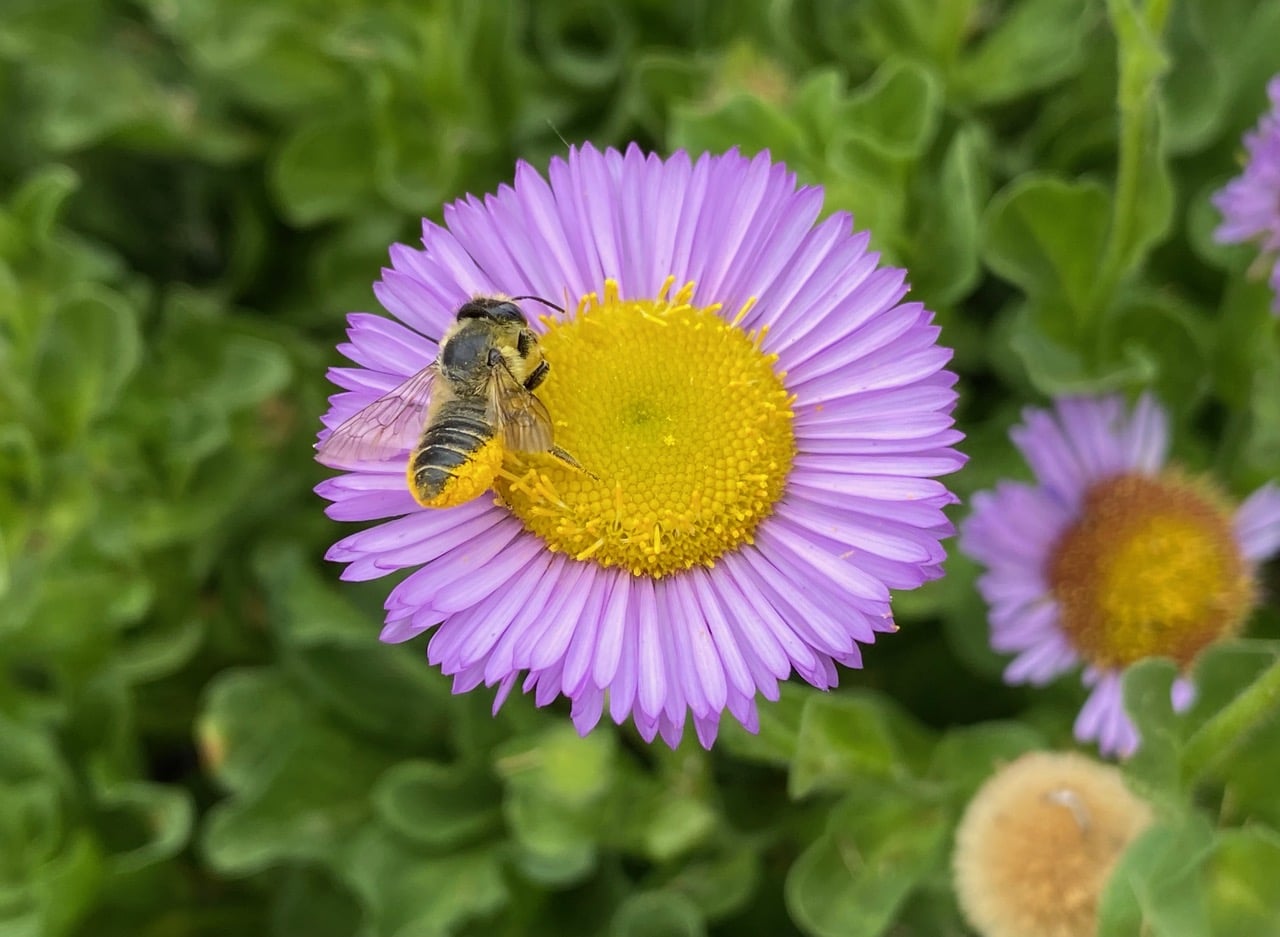
I follow the Leafcutter Bee as she navigates a full circle, gathering pollen from the open florets on the outer edges of the fresh flowerhead, her legs a flurry of activity as the pollen load on her belly grows.
Leafcutter bees (genus Megachile) carry pollen on a dense brush of stiff hairs on the underside of their abdomen, known as a scopa. As the bee flies, her fuzzy body builds up a positive static charge. When she lands on a flower, this static electricity pulls pollen grains from the anthers, causing them to cling all over her body. Rather than landing and simply walking around, leafcutter bees often dive directly onto the flower and raise their abdomen, rubbing their hairy underside aggressively against the flower’s reproductive parts. She uses a coordinated grooming motion to brush pollen off her body with her forelegs, passing it to her middle legs, and then uses her hind legs to rake and pack the pollen grains securely into the scopa on her belly. When she returns to her nesting cavity, she scrapes the pollen off her abdomen using her hind legs and mixes it with regurgitated nectar to form a nutrient-rich “bee bread” on which she lays an egg.
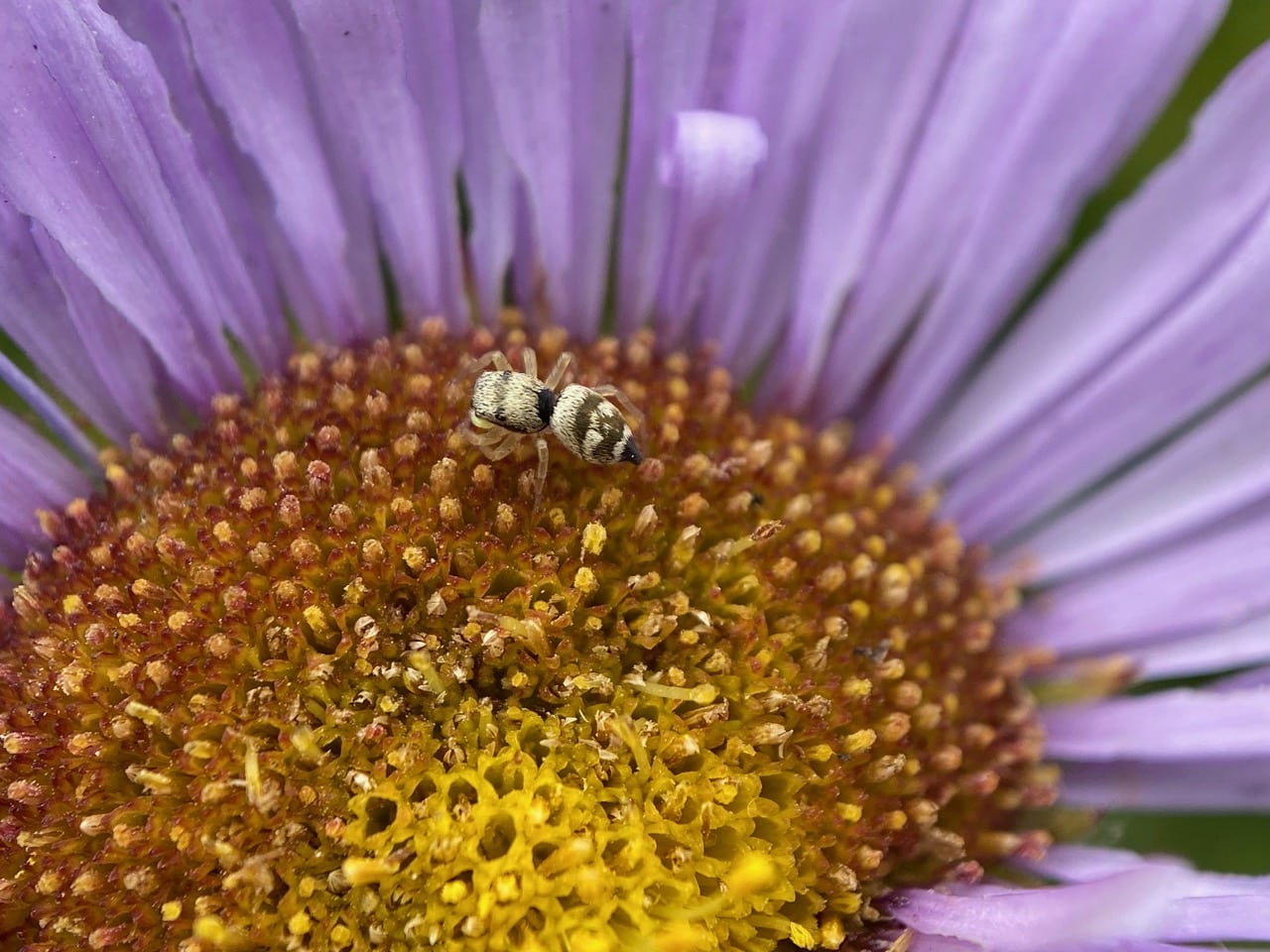
A tiny Jumping Spider is hunting on a Seaside Daisy flowerhead.
Jumping spiders (family Salticidae) are free-roaming hunting spiders. They do not weave a web to catch prey. They stalk, then pounce on their prey. Just before jumping, the spider fastens a safety line to the substrate. It can leap 10-20 times their body length to capture prey. Their movement is achieved by rapid changes in hydraulic pressure of the blood. Muscular contractions force fluids into the hind legs, which cause them to extend extremely quickly. Jumping spiders are visual hunters. Their excellent vision has among the highest acuities in invertebrates.

As the spider turns, I see that it has pale yellow pedipalps that it holds in front of its face. Ah, those yellow palps help identify it as a young female Sun Spider, Heliophanus apiatus (family Salticidae).
Spiders’ pedipalps are short, leg-like appendages near the mouth that function as sensory organs for touch, smell, and taste, as well as for handling food and manipulating prey. In male spiders, the pedipalps are modified for transferring sperm to the female during mating.
The genus Heliophanus is one of the largest genera of jumping spiders with over 150 species, widespread in the Palearctic and Africa, with one center of diversity in the Mediterranean region. Heliophanus apiatus was first reported in the San Francisco Bay Area in 2015. Since then the species has established in three counties – Alameda, Santa Clara and San Mateo – surrounding the southern arm of San Francisco Bay. H. apiatus is a small salticid, male measuring 3.5-4.0 mm, and females 4.0-4.5 mm in body length. Mature males and females are similar in appearance, but only the females have yellow pedipalps. These spiders are found on low vegetation and on hard structures on or near the ground. They are capable of taking prey their own size.

Here’s another Sun Spider, Heliophanus apiatus on a different Seaside Daisy flowerhead. As I close in for a better look, the spider pivots around to fix its large eyes on me – a typical jumping spider behavior.
Jumping spiders have excellent vision, with among the highest acuities in invertebrates. The 8 eyes are grouped four on the face (the two big Anterior Median Eyes in the middle, and two smaller Anterior Lateral eyes to the side), and four on top of the carapace. The anterior median eyes provide high acuity but small field of view, while the other six eyes act like our peripheral vision, with lower resolution but broad field of view. Since all eight eyes are fixed in place and can’t pivot independently from the body like human eyes can, jumping spiders must turn to face whatever they want to see well. This includes moving their cephalothorax up and down, an endearing behavior.

That tiny bug is a familiar one by now, seen in so many gardens. It is a Scentless Plant Bug, Arhyssus sp. (family Rhopalidae).
Arhyssus is a genus of small, true bugs belonging to the family Rhopalidae. There are over a dozen species native to North America. They are small, typically measuring 5-12 mm in length. They possess distinct, raised simple eyes (ocelli) at the front of the head. Unlike other true bugs, they lack well-developed scent glands (hence the common name).
Arhyssus primarily feed on weeds, seeds, and xeric (dry-habitat) grass plants. Adults spend the spring and summer feeding outdoors. In early autumn, they migrate into wall crevices, woodpiles, or homes to hibernate.
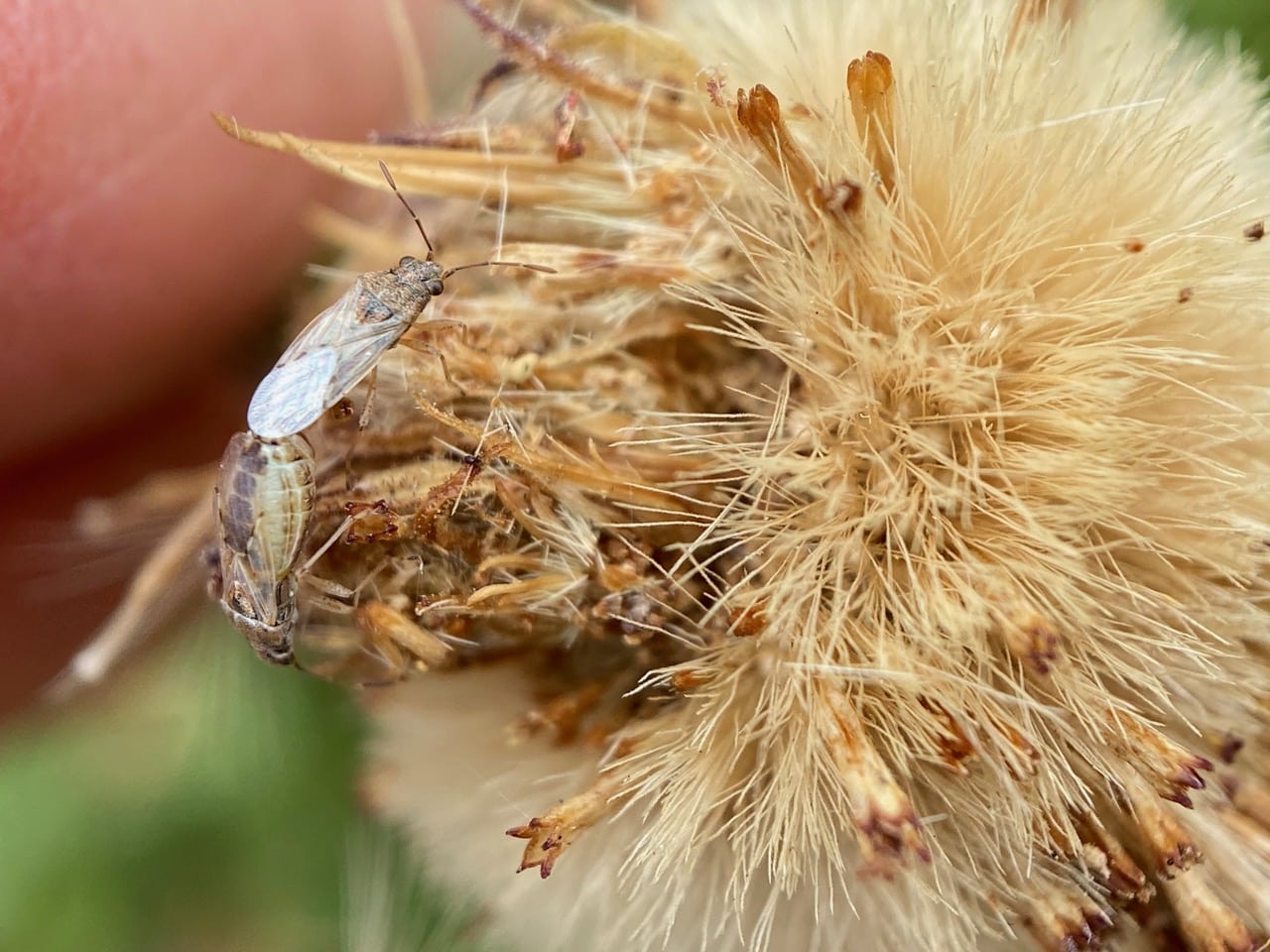
A pair of Scentless Plant Bugs, Arhyssus sp. (family Rhopalidae) are mating on a Seaside Daisy seed head. The larger one on the left is the female.
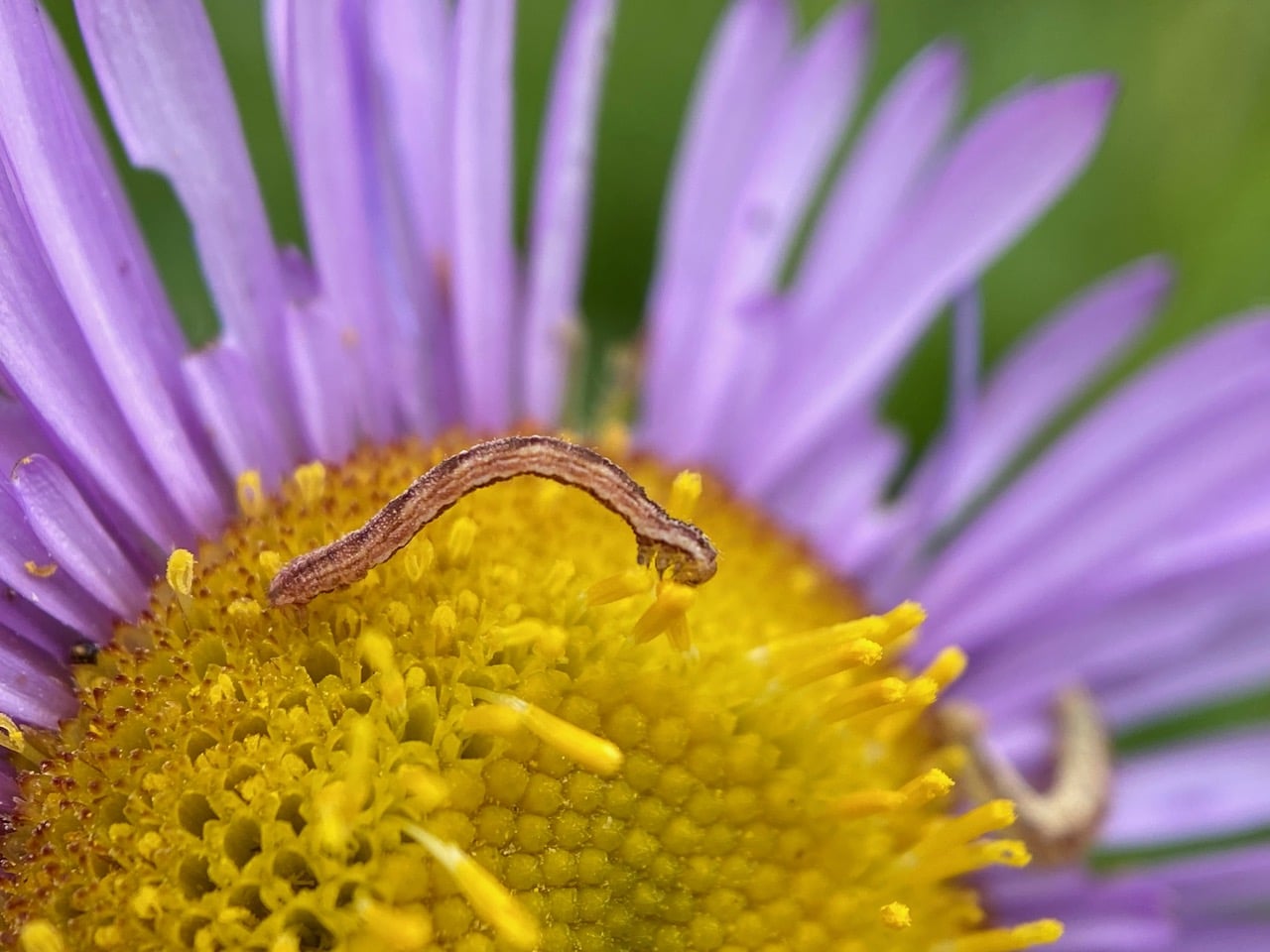
An Inchworm, Eupithecia sp. (family Geometridae) has reared up to reach a distant floret on a Seaside Daisy flowerhead. Note the three pairs of true legs right behind its head, and the absence of prolegs along most of the length of its body.
Inchworms are also called loopers and measuring worms. The majority of the inchworms are the larvae of moths in the family Geometridae. The name comes from the Greek “geo” for earth and “metro” from measure, because the caterpillars seem to be measuring the surface on which they are walking. The “looping” locomotion is mandated by the absence of prolegs in the middle section of the caterpillar’s body.
Eupithecia is the largest genus of moths of the family Geometridae. Occurring worldwide except for Australasia, species in the genus are commonly known as pugs. The caterpillars move in a looping manner and are commonly called inchworms. Adults are typically small, 12 – 35 mm, with muted colors. Most species rest with forewings held flat at right angles to the body, while the hindwing are largely covered by the forewings. They are generally nocturnal. Larvae mostly feed from the flowers and seeds of their food plants rather than the foliage. Many species have a very specific food plant. Many are commonly found on Asteraceae flowers.
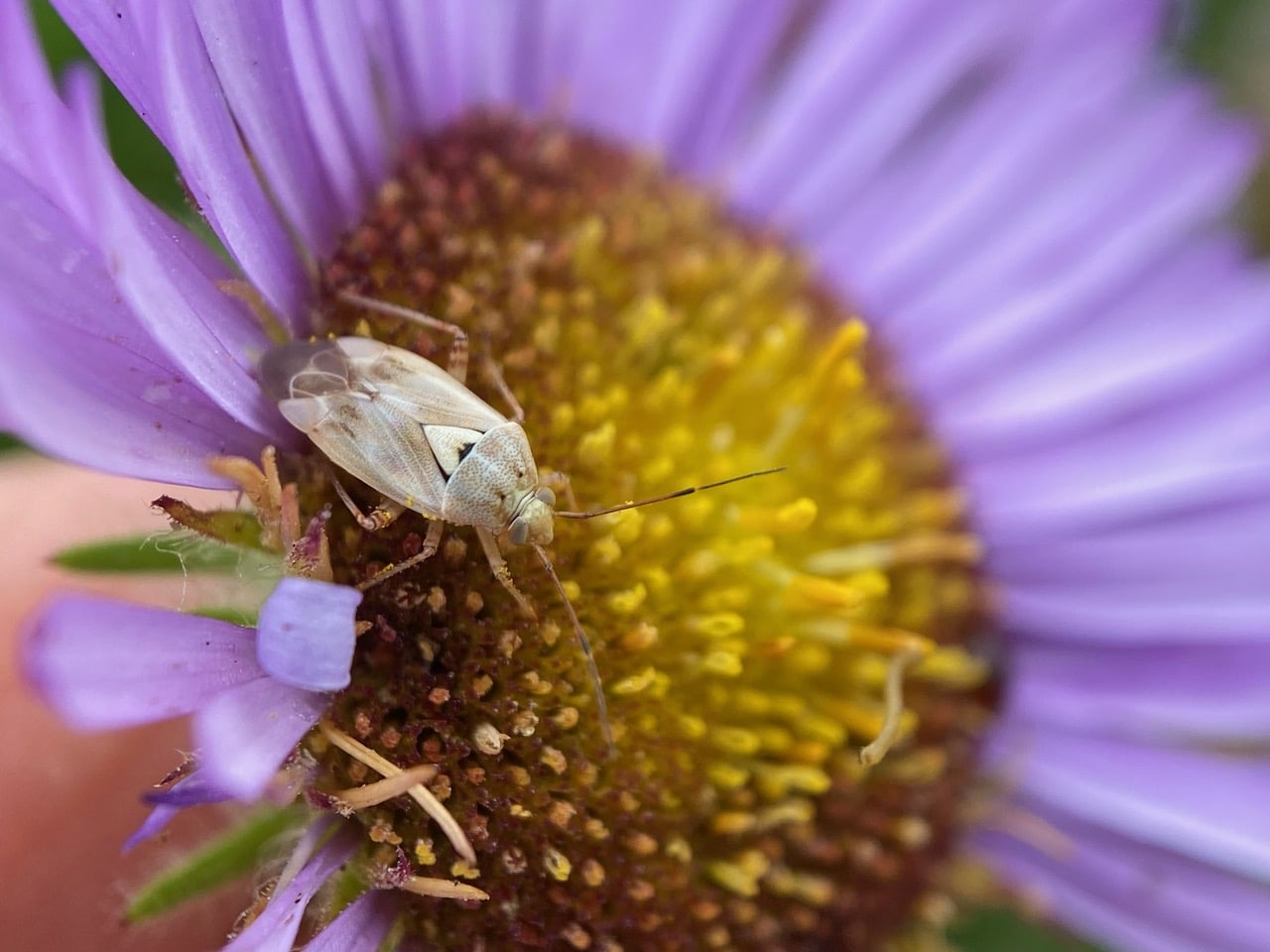
A very pale Lygus Bug, Lygus sp. (family Miridae) is lurking on a Seaside Daisy flowerhead.
Lygus Bugs are small (6-7 mm long), oval-shaped plant bugs (family Miridae), ranging in color from pale green to yellowish-brown or dark brown. They feature a prominent, triangular “V” shape in the center of their back and have long, spindly antennae. Nymphs are wingless, generally pale green, and resemble aphids but lack the backward-facing tubes (cornicles) on their abdomen. They are fast-moving and larger nymphs often have five black spots on their backs. Lygus Bugs are major agricultural pests. They have a massive host range, primarily feeding on flowering crops and common weeds, which act as reservoirs before the insects migrate to commercial fields. Both adults and nymphs use piercing-sucking mouthparts to feed on new growth, buds, and seeds. Their feeding causes severe plant damage, including flower drop, discolored leaves, and deformed fruits or seeds.
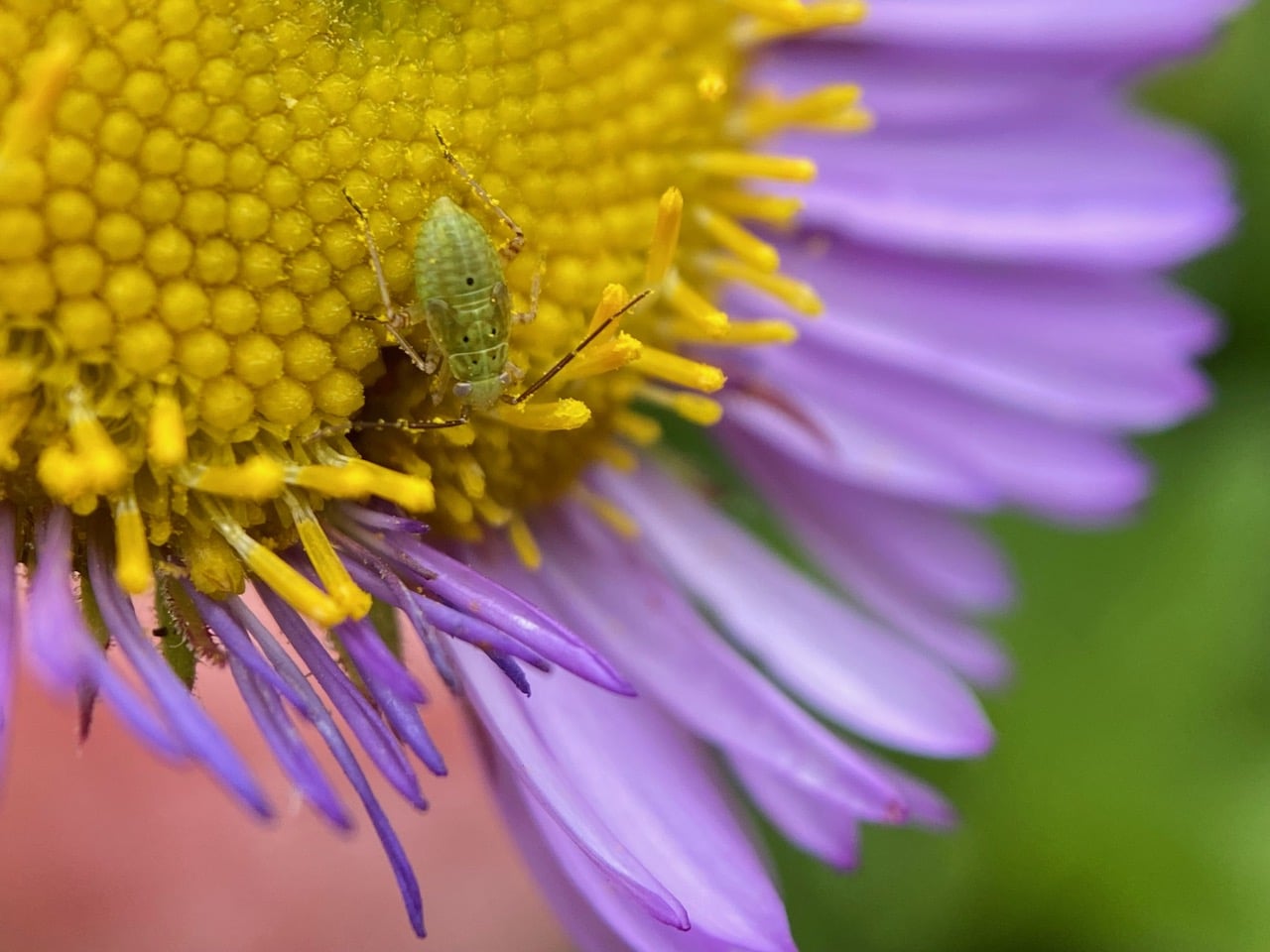
Its antennae and legs covered with sticky pollen, a late-instar Lygus Bug nymph is fleeing from my prying camera. Note the five black spots on its back, and the brownish wing pads. At this stage, the bug is not capable of flying.
Insect larvae are called nymphs when they undergo incomplete metamorphosis (hemimetabolism), meaning they resemble smaller, wingless versions of the adult. Unlike larvae that pupate, nymphs gradually develop adult features through several stages (instars) and molt directly into adults, rather than transforming completely in a pupal stage.