

Pollinator Post 6/25/24 (2)

Perched on a cluster of flowerheads of California Everlasting, a Gray Hairstreak, Strymon melinus (family Lycaenidae) is rubbing its hind wings together continuously.
Why the name “hairstreak”? These small butterflies have a slim, hair-like tail on the lower corner of each hindwing. Gray Hairstreak also has colorful false eyespots near the base of each tail. The eyespots and antenna-like tails are believed to fool predators into mistaking its tail for its head. Hairstreaks even add a behavioral component – a nectaring hairstreak often rubs its wings up and down, simulating the movement of twitchy antennae. This may fool birds, lizards, and spiders into attacking the wrong end, sparing the life of the butterfly.
Female Gray Hairstreaks lay eggs singly on the flowers, flower buds, young fruits and nearby leaves of a host plant. Host plants include a wide variety of plants, notably from the pea (Fabaceae) and mallow (Malvaceae) families. The caterpillars are greenish at the start, but older individuals range in color from gray to pink. As in many species of Lycaenidae, Gray Hairstreak larvae are myrmecophiles (ant-lovers) – often tended by ants. Ants harvest a sweet liquid from the caterpillar’s dorsal nectary organ (“honey gland”) and in exchange may protect them from predators. Larvae of many Lycaenidae species also communicate with ants via ant-like sounds (clicks and hums) or by sending vibrations through the substrate.
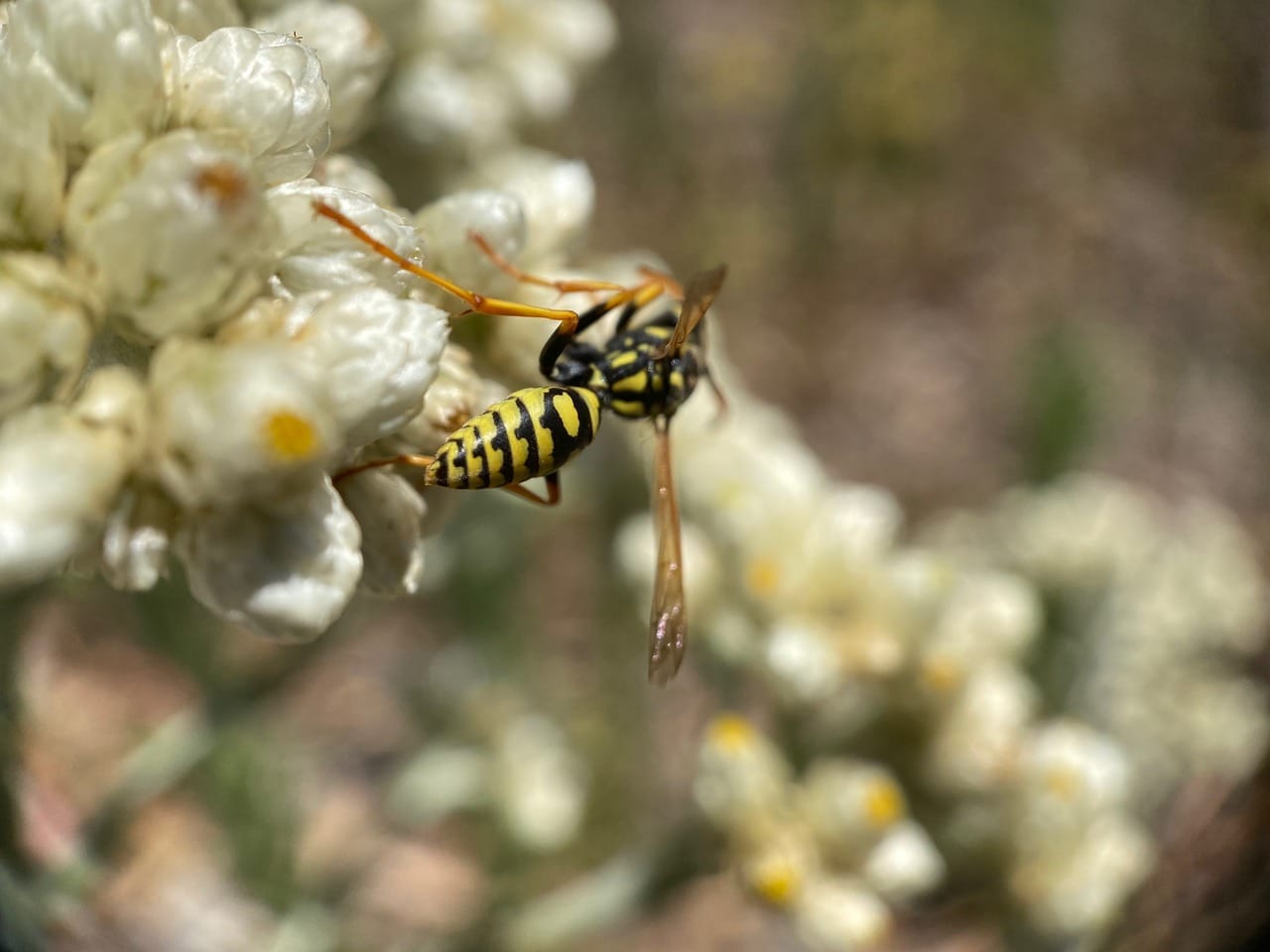
A European Paper Wasp, Polistes dominula (family Vespidae) is foraging on a cluster of California Everlasting flowerheads.
Native to Europe, the European Paper Wasp, Polistes dominula, is a social insect that produces an annual colony in a paper nest. Individual colonies are established anew each spring. The overwintering stage are mated females (queens). The overwintered queens emerge from sheltered spots in spring and search out sites to establish a new colony. Nests are constructed of paper, produced from chewed wood fibers of weathered fences, porch decks and other similar sources. Larvae are fed crushed insects, usually caterpillars. As the population increases, the original queen increasingly remains in the nest as new workers take over colony activities. A few of the wasps produced later in summer are males and increasing numbers of the females become sexually mature. Mating occurs and the mated females are the surviving overwintering stage. Males and non-reproductive females do not survive winter and the nest is abandoned by late fall. European Paper Wasps will sometimes feed on sweet materials, including honeydew produced by aphids. They may also feed on damaged ripe fruits. Because of their habit of hunting caterpillars, the wasps have become one of the most important natural controls of garden pests.
Often mistaken for Yellowjacket Wasps, the European Paper Wasps can be distinguished by their slender body, and their orange-tipped antennae. Yellowjackets have shorter, thicker bodies, and they have black antennae. Paper wasps dangle their long legs when they fly, while the yellowjackets tuck their legs under their bodies when they fly. Paper wasp nests resemble an open honeycomb or upside-down umbrella. They often build their nests on man-made structures such as eaves or lawn furniture. Yellowjacket nests are covered with a surrounding envelope of paper; the nests have a single opening that is often hard to see because the nest is underground.
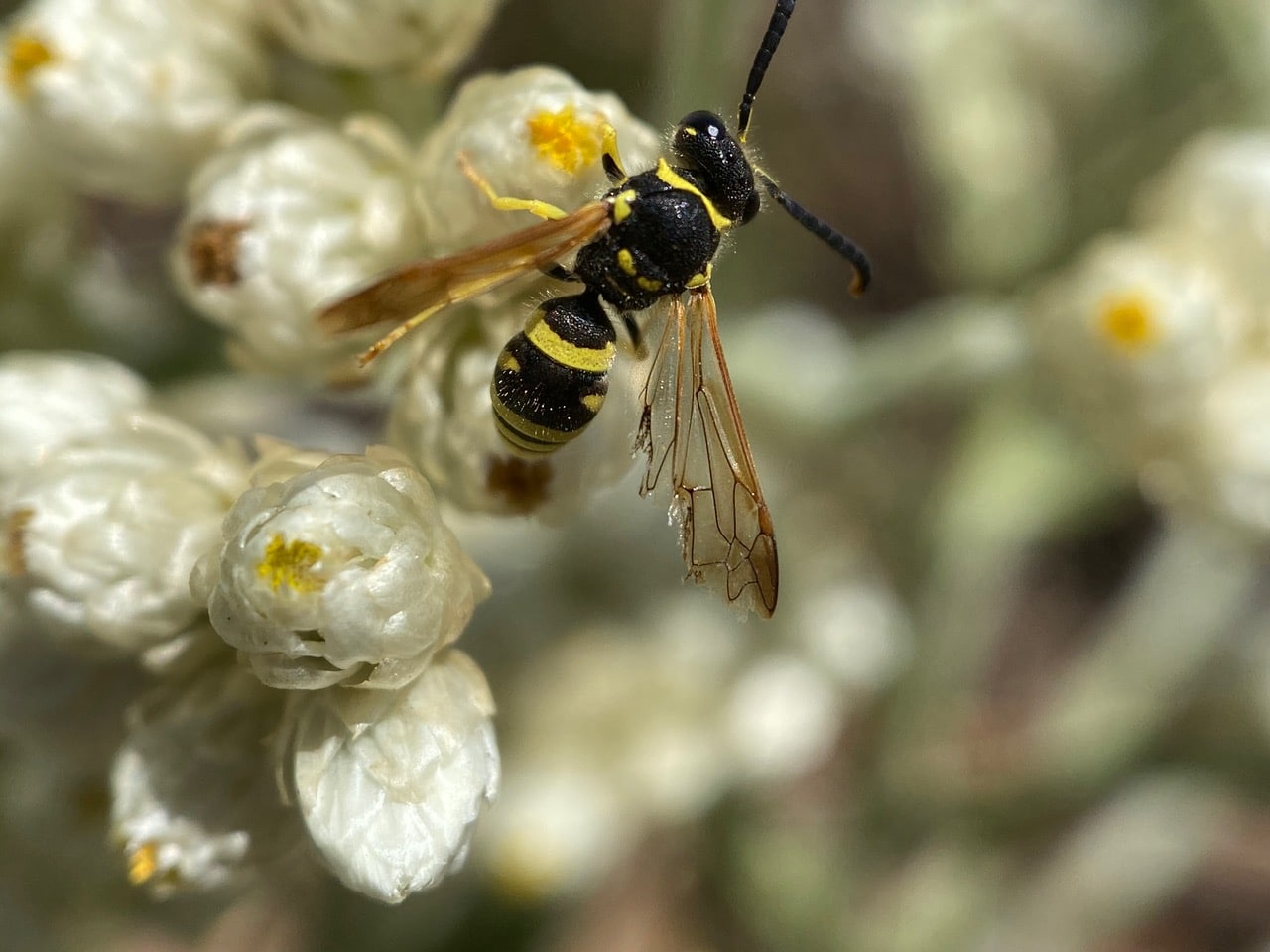
A Potter Wasp, Ancistrocerus sp. (family Vespidae, subfamily Eumeninae) with tattered wings lands on an inflorescence of California Everlasting. The name of the genus means “hooked horn” for the back-curved last segment of the antennae characteristic of males of this genus and most other potter wasp genera.
Female Potter Wasps build earthenware nests attached to twigs, leaves and walls. The wasps get their common name from the brood chamber or “pot” they build. Adults visit flowers for nectar. Mature females construct earthen homes for their young and provision them with food. The female potter wasp gathers clay and soil particles in moist areas and transports them back to the construction site. Layer by layer she carefully molds the mud into a tiny hollow vessel. This requires many trips to the mud puddle. When the pot is nearly finished, she provisions the pot with enough food to support the growth and development of her young that will grow inside the pot. Most hunt for small caterpillars, other species fill their pots with beetles or spiders. Upon finding a caterpillar the potter wasp delivers a paralyzing but non-lethal sting, and then carries the victim back to be placed in the pot. When the pot is fully stocked with fresh meat, the potter lays an egg on the victims. Then she gathers more mud and seals the chamber completely. After a few days the egg hatches into a small legless larva which feeds on the caterpillars. When it is fully developed, the larva molts into a pupa, and eventually transforms into a wasp. With powerful jaws the wasp breaks open its earthen nursery, frees itself and emerges to find a mate.
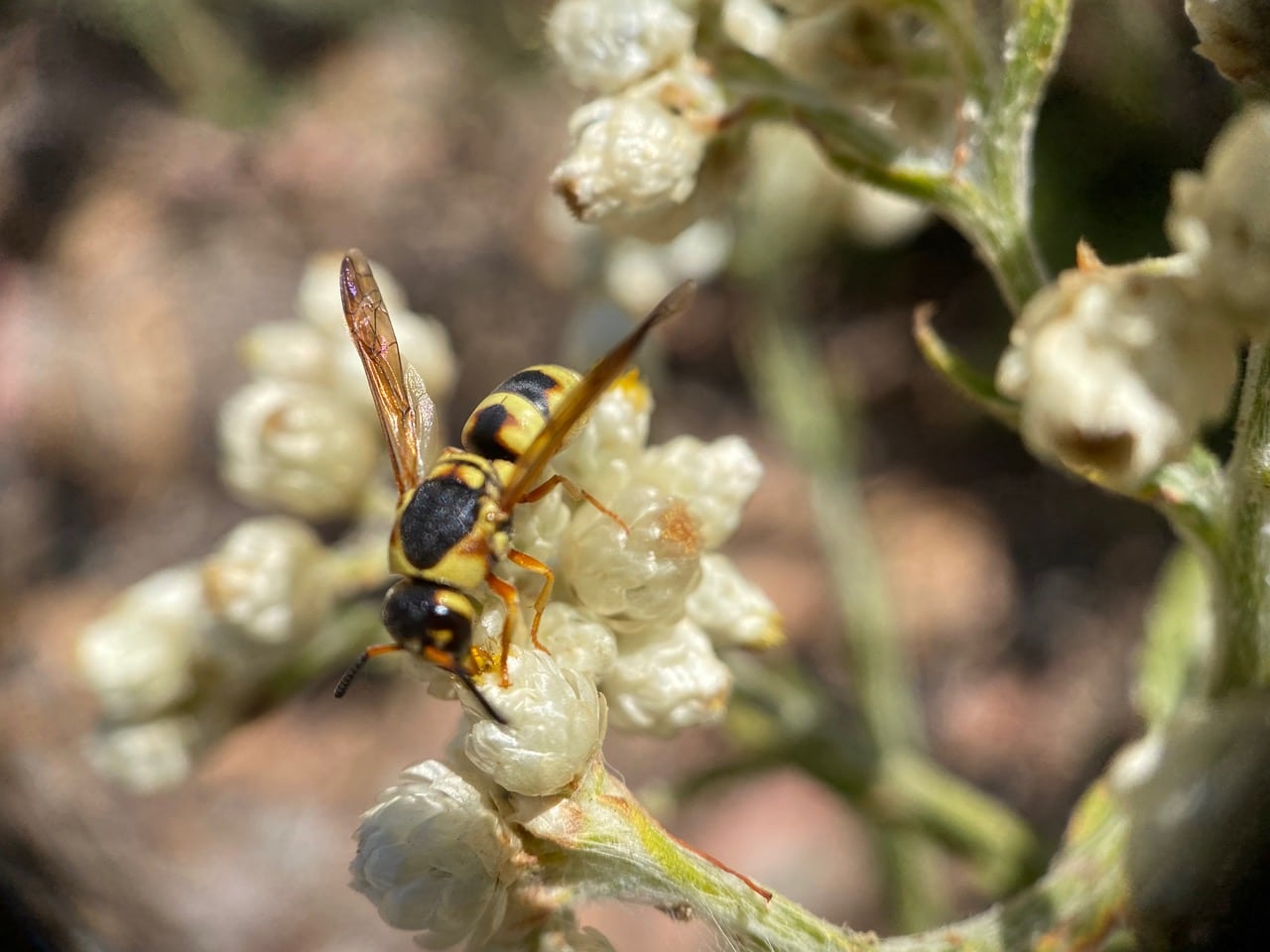
A Hidalgo Mason Wasp, Euodynerus hidalgo (family Vespidae, subfamily Eumeninae) is taking nectar from the flowers of California Everlasting.
The species ranges across the United States from the Atlantic to Pacific coasts. Female wasps nest in preexisting cavities including the abandoned nests of other wasps, or old solitary bee burrows. They are also known to nest in the mortar crevices between bricks, and in holes where rusted nails have fallen out. Nests may consist of one to several cells, arranged linearly along the length of the tunnel. Each cell is furnished with several small caterpillars, paralyzed by the sting of the female wasp. An egg is laid in the cell, then a partition of sand or soil is fabricated and a new cell is created atop the previous cell.
Many members of the genus Euodynerus have a blocky or “chunky” appearance, especially the thorax with its angular edges. The wasps are frequently seen on wildflowers feeding on nectar.

The most common insects on the California Everlasting today are the Woodlouse Flies, Stevenia deceptoria (family Rhinophoridae). They don’t seem to be feeding, just hanging around. These small, slender, black, bristly flies are somewhat related to the Tachinidae. The larvae are mostly parasitoids of woodlice (pill bugs), beetles, spiders and other arthropods, and occasionally snails.

Another view of the Woodlouse Fly, Stevenia deceptoria (family Rhinophoridae).
Native to Europe, Stevenia deceptoria is now widespread in the US. The flies are parasitoids of terrestrial woodlice (roly polies) of the order Isopoda (Oniscoidea).

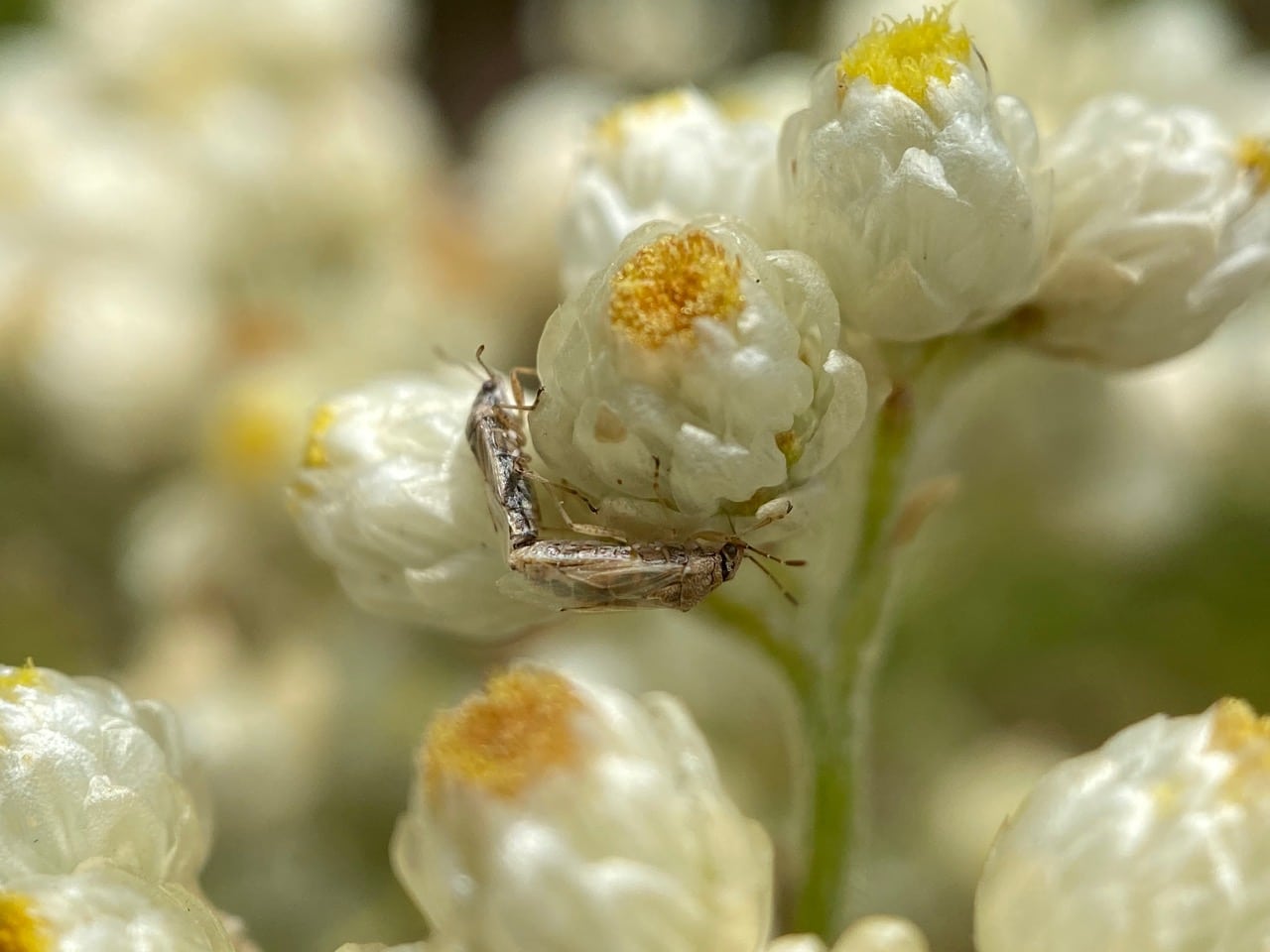
A mating orgy is happening on this California Everlasting, Pseudognaphalium californicum. Nearly all the False Chinch Bugs, Nysius raphanus (family Lygaeidae or seed bugs) on the plant are in copula.
The False Chinch Bug, Nysius raphanus is a small (3-4 mm), grayish-brown native North American seed bug. The bugs are commonly found within grassy or weedy fields, pastures, and foothills. The bugs spend the winter as nymphs and adults, usually in uncultivated areas beneath debris or in plants, often feeding on mustards or other winter annual plants. Each spring, once the plants in these areas dry up, the False Cinch Bug migrates to find new places to feed. There can be several generations a year. When populations are high in wet years, the bugs can become a nuisance for gardeners and farmers.
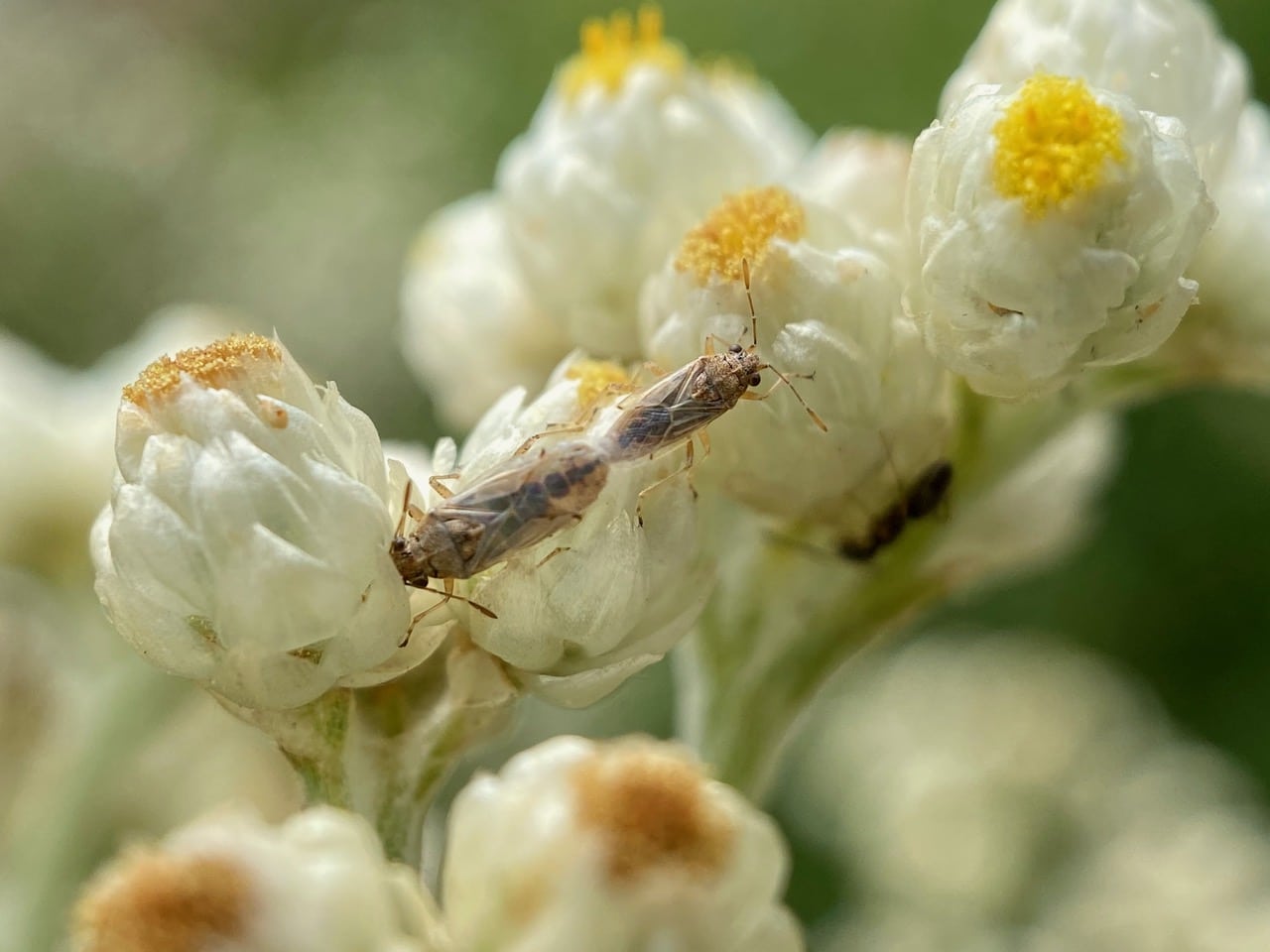

Females are significantly larger than the males.

Note the bug’s needle-like mouthpart that is folded under its body when not feeding. The family Lygaeidae or Seed Bugs belong to the order Hemiptera (true bugs), characterized by their piercing-sucking mouthparts. Seed bugs are named because most species in their family eat seeds. Seed bugs are able to feed on seeds by injecting digestive juices into the seeds and sucking up the digested contents as a liquid. Included in this group of true bugs are the colorful milkweed bugs but also a number of less exciting brownish bugs.
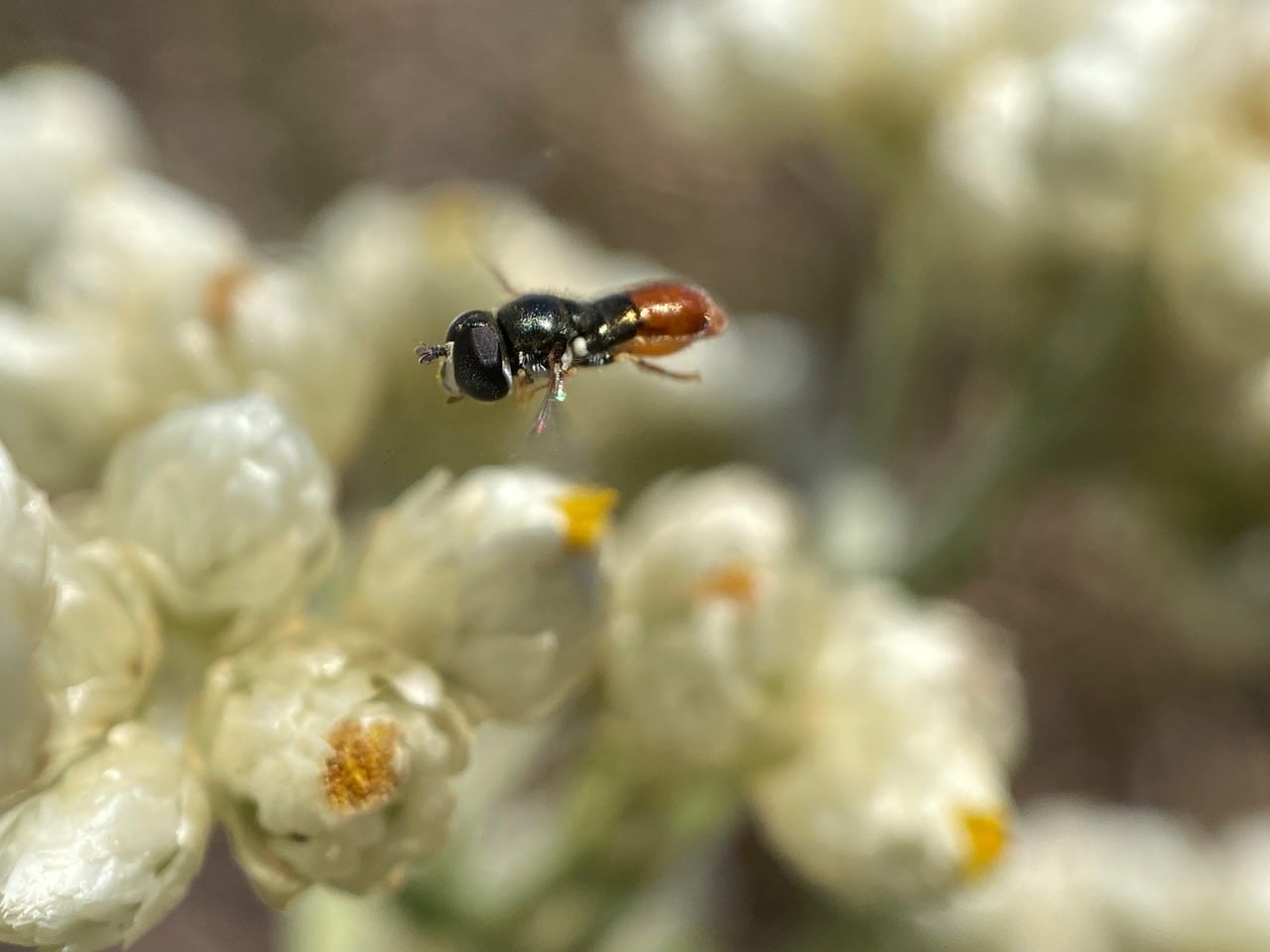
A Common Grass Skimmer, Paragus haemorrhous (family Syrphidae) is foraging among the blooming flowerheads of California Everlasting.
The Common Grass Skimmer, Paragus haemorrhous (family Syrphidae) is easily the smallest hover fly I know, measuring only about 4 mm in length. The species has a world-wide distribution, found in unimproved grassland, dune grass, open areas and pathsides in forest, and meadows. Adults visit flowers for nectar and pollen. Larvae feed on aphids on low herbaceous plants.
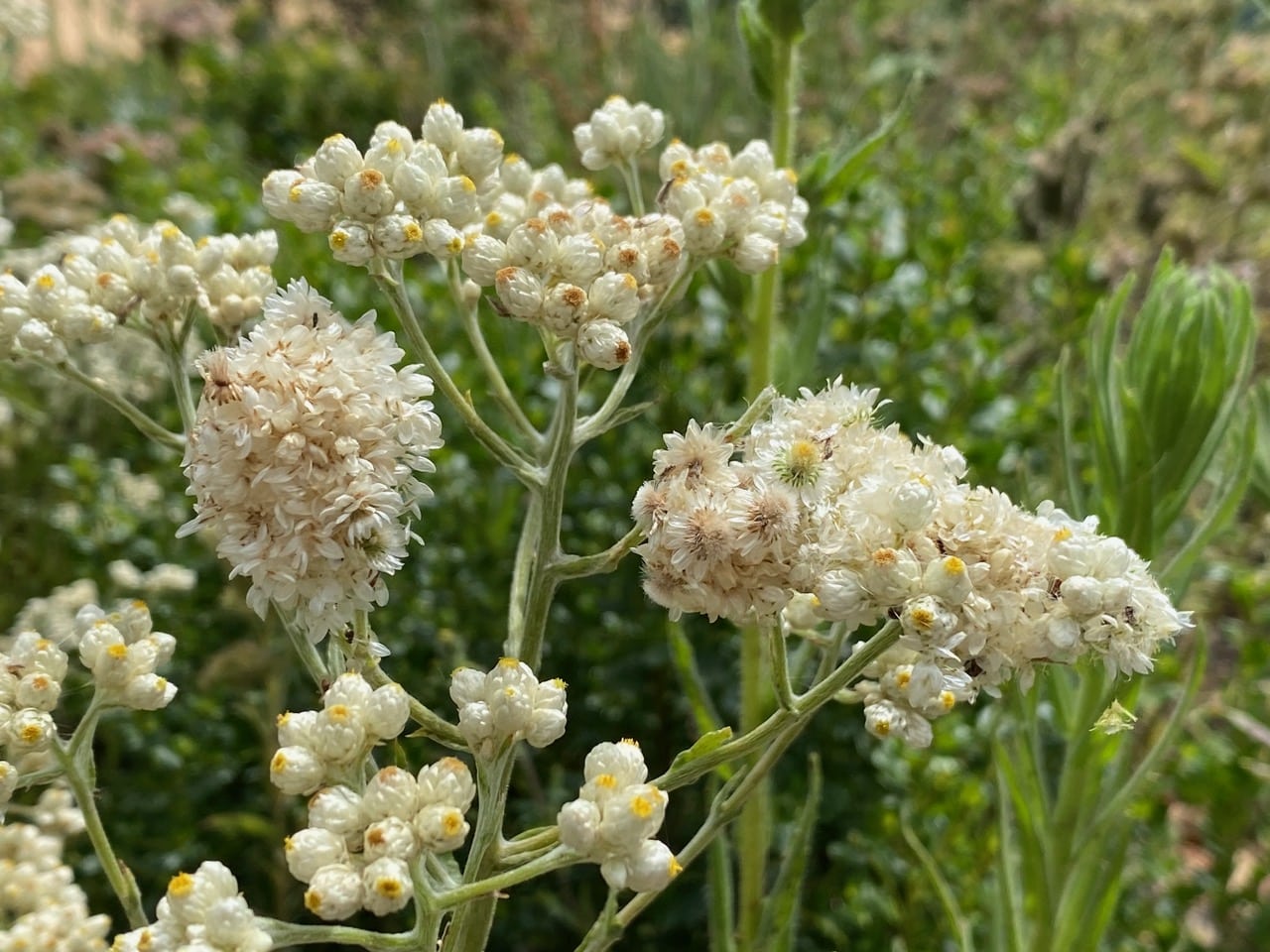
See those two large clusters of flowerheads on the California Everlasting? They look different from the others as they are jumbles of loose phyllaries, not whole flowerheads. These are the typical nests of the late instar caterpillars of the American Lady butterfly, Vanessa virginiensis (family Nymphalidae).
American Lady caterpillars are solitary feeders and construct nests from various parts of their host plant. Tiny larvae use leaf hairs to construct tiny nests; larger caterpillars arrange leaves, flower heads, and detritus to form tight shelters. Several structures are typically built during the caterpillar’s development.

I detect movements among a clusters of California Everlasting flowerheads on another plant. An American Lady caterpillar is busy constructing its shelter. It’s a pinch-myself moment – I can’t believe I am witnessing this!

I take a video of the caterpillar attaching silk to adjacent clusters of flowerheads. This effectively draws the flowerheads together into a tight shelter within which the caterpillar can feed in safety. After the flowers are eaten, the discarded phyllaries are attached to the silk for better coverage.