

Pollinator Post 6/25/24 (1)

It’s a cloudy morning, a respite from the oppressive heat of yesterday. The air is muggy with humidity, rather unusual for a California summer. I find myself walking the paved road from Siesta Gate.

One can measure the passage of time by the length of the inflorescences on California Phacelia, Phacelia californica. Once coiled up, they have straightened out as the flowers bloom and wither along the stalk, leaving little fruits hidden in the neatly arranged green bracts.

A few bumble bee workers forage on the last remaining flowers at the tips of the inflorescences.
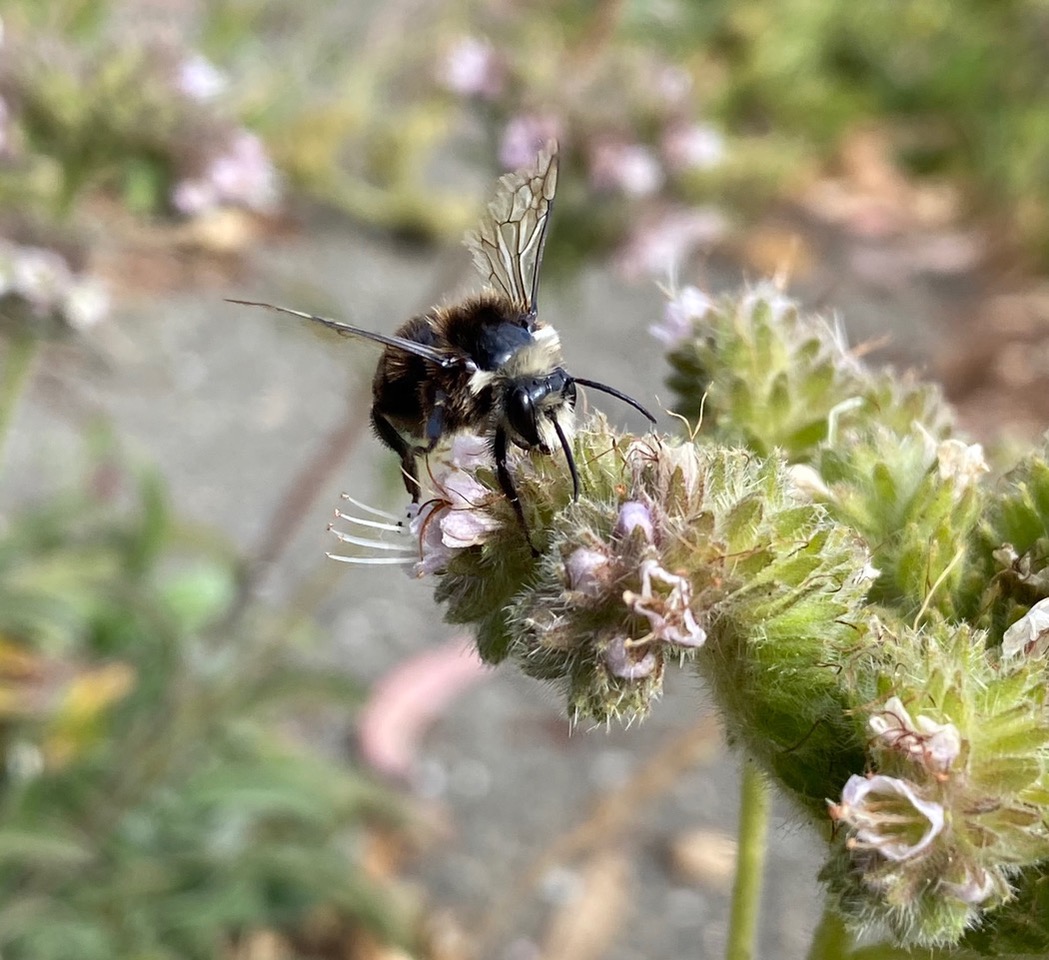
This Yellow-faced Bumble Bee, Bombus vosnesenskii (family Apidae) is showing her age. Her wings are tattered. Her hair is thinning. The yellow hairs have faded and the once jet black fur is losing its color as well. Yet she is still working hard, gathering floral resources for the colony.
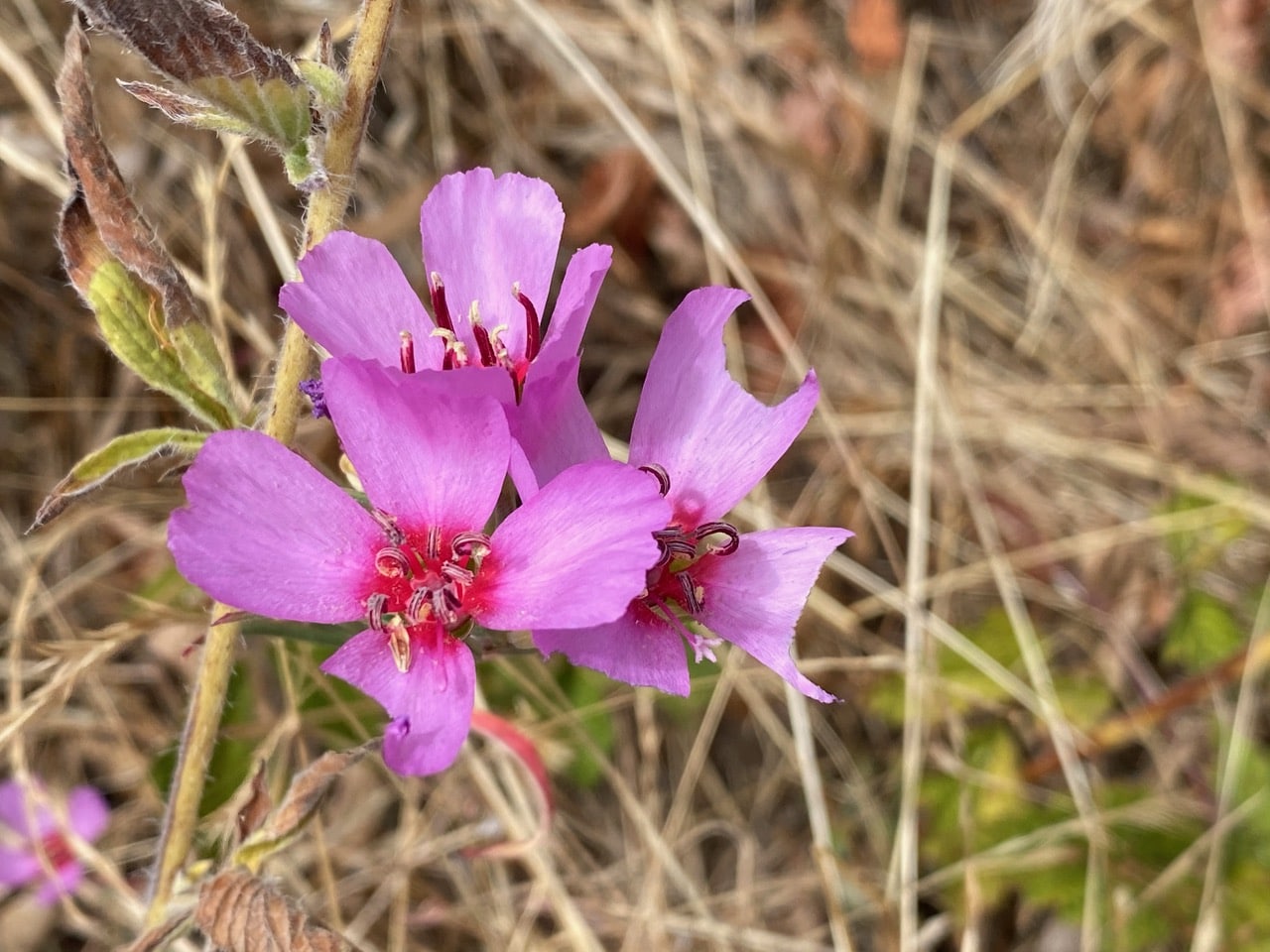
A small patch of pink brightens up the hillside of brown grass. Farewell-to-spring, Clarkia rubicunda is a blessing for insects at a time of dwindling floral resources. I watch a Small Carpenter Bee collect pollen in a flower but miss the shot. But then I notice the cut petals on some of the flowers. It’s good to know that some Leaf-cutter Bees, Megachile sp. (family Megachilidae) are nesting close by.
With her powerful mandibles, the female Leaf-cutter Bee, Megachile sp. (family Megachilidae) snips a neat circle or oval from a leaf or flower petal. She will use these pieces to line and partition the nest cells in which her larvae will grow. They tend to favor rose leaves and Clarkia petals, maybe because these are soft and pliable. Pink floral wallpaper for their nurseries! The Leaf-cutter Bee always cuts extremely neat circles and ovals, unlike caterpillars which leave irregular holes in leaves. The bees fly with the pieces back to their nest which are burrows in the ground or in a narrow crevice. There they weave the leaf or petal pieces into a cylindrical brood cell for their young. She stocks the cell with nectar and pollen, before laying a single egg in the cell and sealing it up.

Something is clinging to the immature flowerhead of California Everlasting, Pseudognaphalium californicum. I have never seen anything like this, but I think it might be a beetle larva or pupa. iNaturalist has identified the critter as a Eucalyptus Snout Beetle or Eucalyptus Weevil, Gonipterus platenis (family Curculionidae). It makes sense, as the everlasting is under a grove of tall Eucalyptus trees. The weevil larva might have fallen from the trees. The adult weevils are often found on plants under the Eucalyptus trees in Skyline Gardens.
Eucalyptus trees are the only hosts for the Eucalyptus Snout Beetle. The beetle is endemic to Australia where Eucalyptus trees are native, but it has spread around the world where Eucalyptus is found. Adult female Eucalyptus Snout Beetles lay about two hundred eggs in batches of about ten in grey colored capsules, attached to the leaves. Upon hatching, the larvae feed on leaves and young shoots. After three molts, the larvae drop to the ground to pupate in the soil. The weevil is of little economic significance in Australia where it has natural enemies. This is not the case where the trees have been introduced. Adult weevils feed mostly on leaves and the soft bark of twigs while the larvae feed mostly on leaves. Repeated defoliation may cause the splitting and death of branches or even whole trees. The weevil is able to disperse by flight.
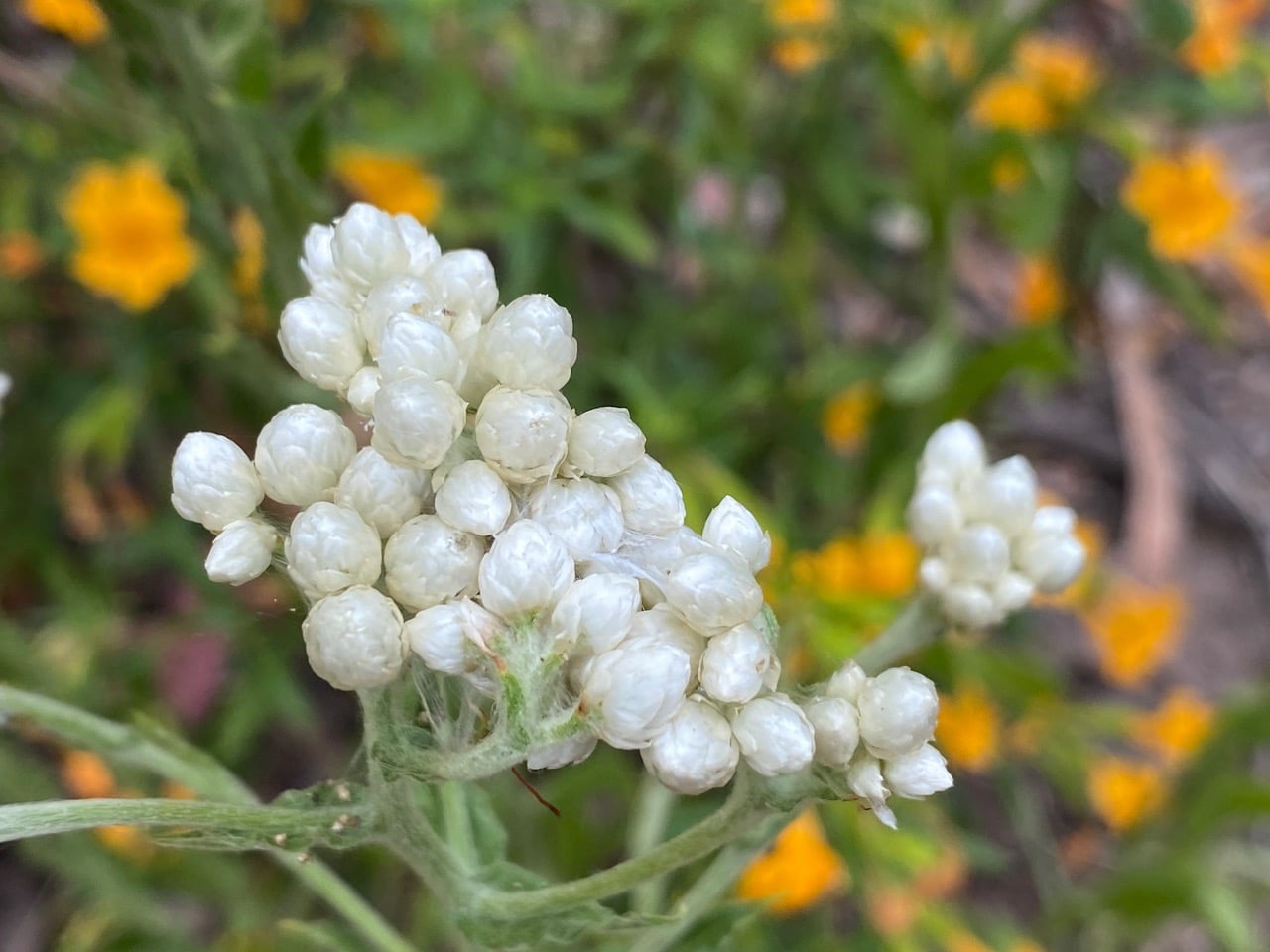
Someone has rearranged the clusters of flowerheads on this California Everlasting, Pseudognaphalium californicum . Adjacent clusters have been unnaturally drawn together, and there are traces of silk around them. Who’s responsible for this? I bet it’s a caterpillar of the American Lady butterfly, Vanessa virginiensis!
American Lady caterpillars are solitary feeders and construct nests from various parts of their host plant. Tiny larvae use leaf hairs to construct tiny nests; larger caterpillars arrange leaves, flower heads, and detritus to form tight shelters. Several structures are typically built during the caterpillar’s development.
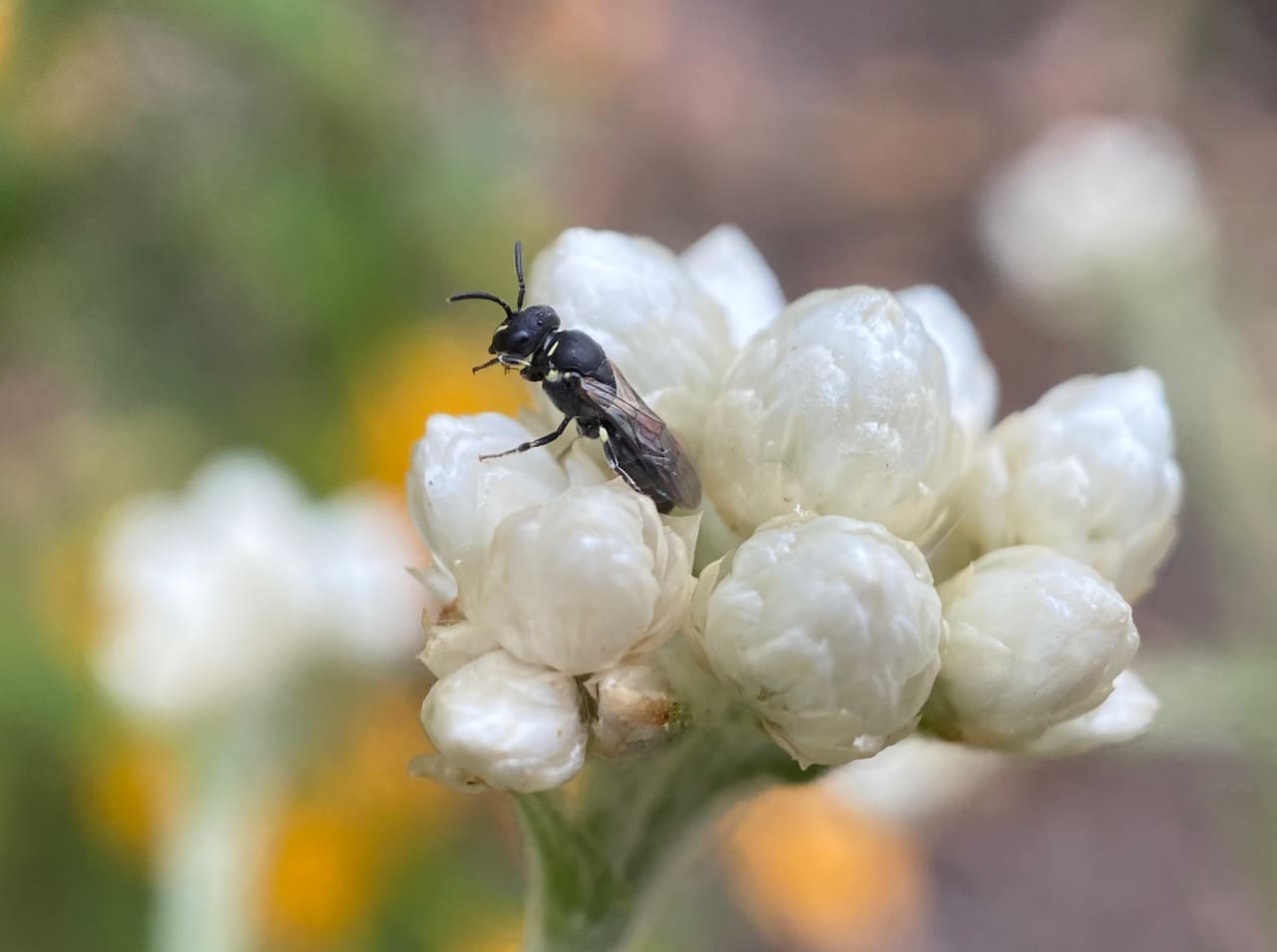
A female Masked Bee, Hylaeus sp. (family Colletidae) is perched on a cluster of flowerheads of California Everlasting. I can tell she’s female from the small yellow marks on her face. Note the absence of scopa (special pollen collecting hairs) on her body.
Hylaeus (family Colletidae) are shiny, slender, hairless, and superficially wasp-like bees. They are small, 5 to 7 mm long, usually black with bright yellow or white markings on their face and legs. These markings are more pronounced on the males. Hylaeus do not carry pollen and nectar externally, they instead store their food in the crop and regurgitate it upon returning to their nests. They are primarily generalist foragers. Hylaeus are short-tongued, but their small body size enables them to access deep flowers. Hylaeus nest in stems and twigs, lining their brood cells with self-secreted cellophane-like material. They lack strong mandibles and other adaptations for digging, using instead pre-existing cavities made by other insects.
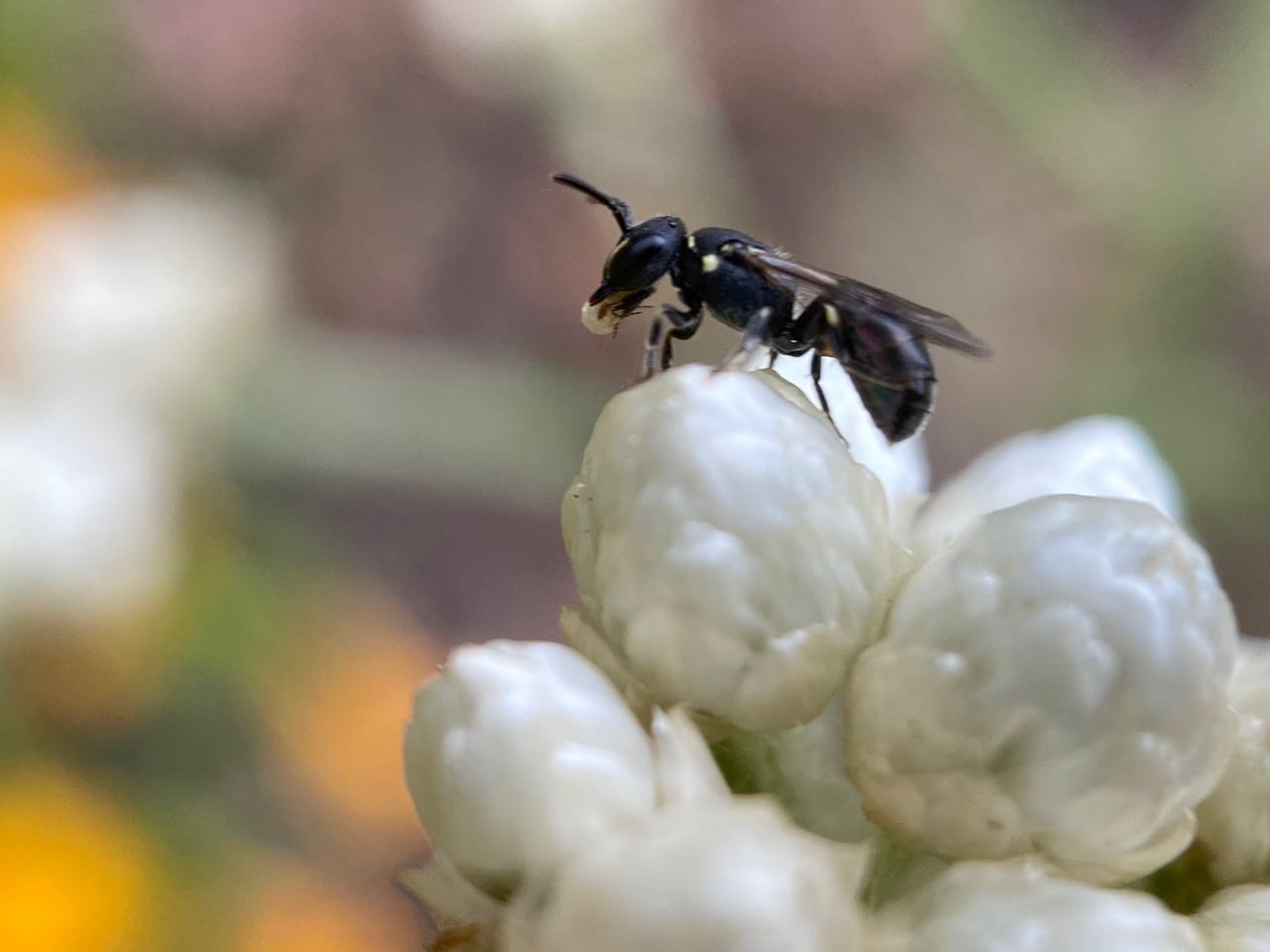
The bee settles down to “blow bubbles”. The drop of liquid she regurgitates repeatedly is not clear but milky, probably a mixture of nectar and pollen she has collected in her crop.
“Bubble blowing” is a behavior often observed in Hylaeus. The bee repeatedly brings up a droplet of liquid in its jaws, and then slowly retrieves it into its body. It has been speculated that Masked Bees do this to facilitate the evaporation of the nectar they have collected, to reduce the load they have to fly home with.
It was recently discovered that the semi-liquid provisions that females of a species of Colletidae prepare for the young is a fermented brew rich in lactic acid bacteria. Is bubble-blowing a procedure to mix the gathered nectar and pollen with the bacteria, I wonder? Many insects have compartments in their gut that harbor symbiotic microbiota that aid in their nutrition. Maybe the Hylaeus moms are starting the brewing process even before they head home with the day’s harvest?
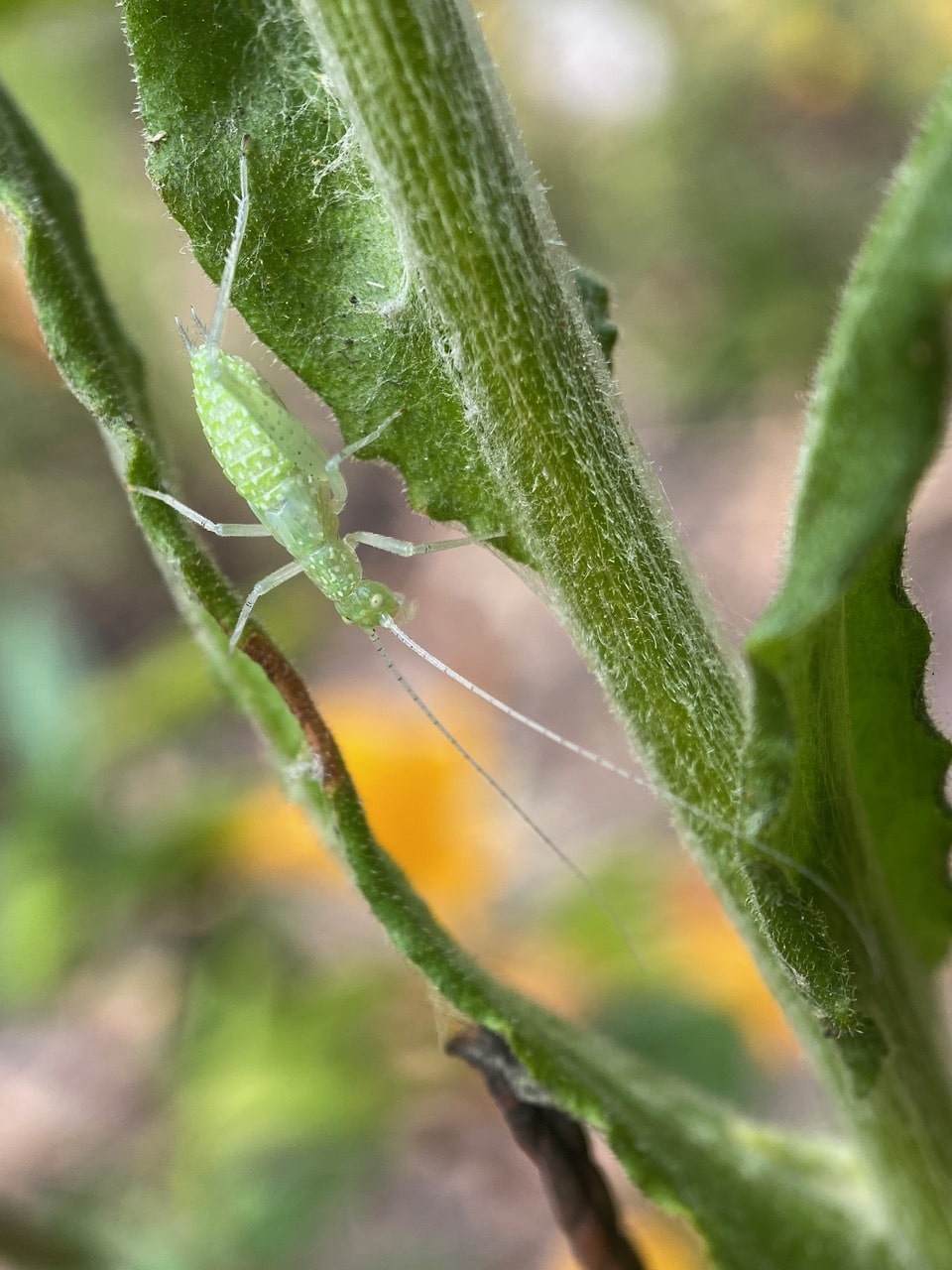
Movements in the foliage of the California Everlasting alert me to the presence of a very young nymph of the Common Tree Cricket, Oecanthus sp. (family Gryllidae). It is a translucent pale green and only about 1/4 in. long, excluding its long antennae. Note the small wing buds behind its thorax.
Common Tree Crickets, Oecanthus sp. are delicate whitish or pale green insects with slender bodies, long antennae and transparent forewings. They are in the order Orthoptera (crickets, katydids, grasshoppers, etc.) and in the “true cricket” family Gryllidae. The tree crickets undergo a paurometabolous development (gradual metamorphosis). Nymphs resemble small adults and gradually develop external wing buds. They live in the same habitat as adults, and typically take the same food. Tree Crickets inhabit trees, shrubs and tall weeds, feeding on plant parts, some insects (e.g., aphids, scales) and other materials (e.g., fungi, pollen). Egg laying activities can affect plant health by injuring growth on twigs and branches or introducing plant pathogens.
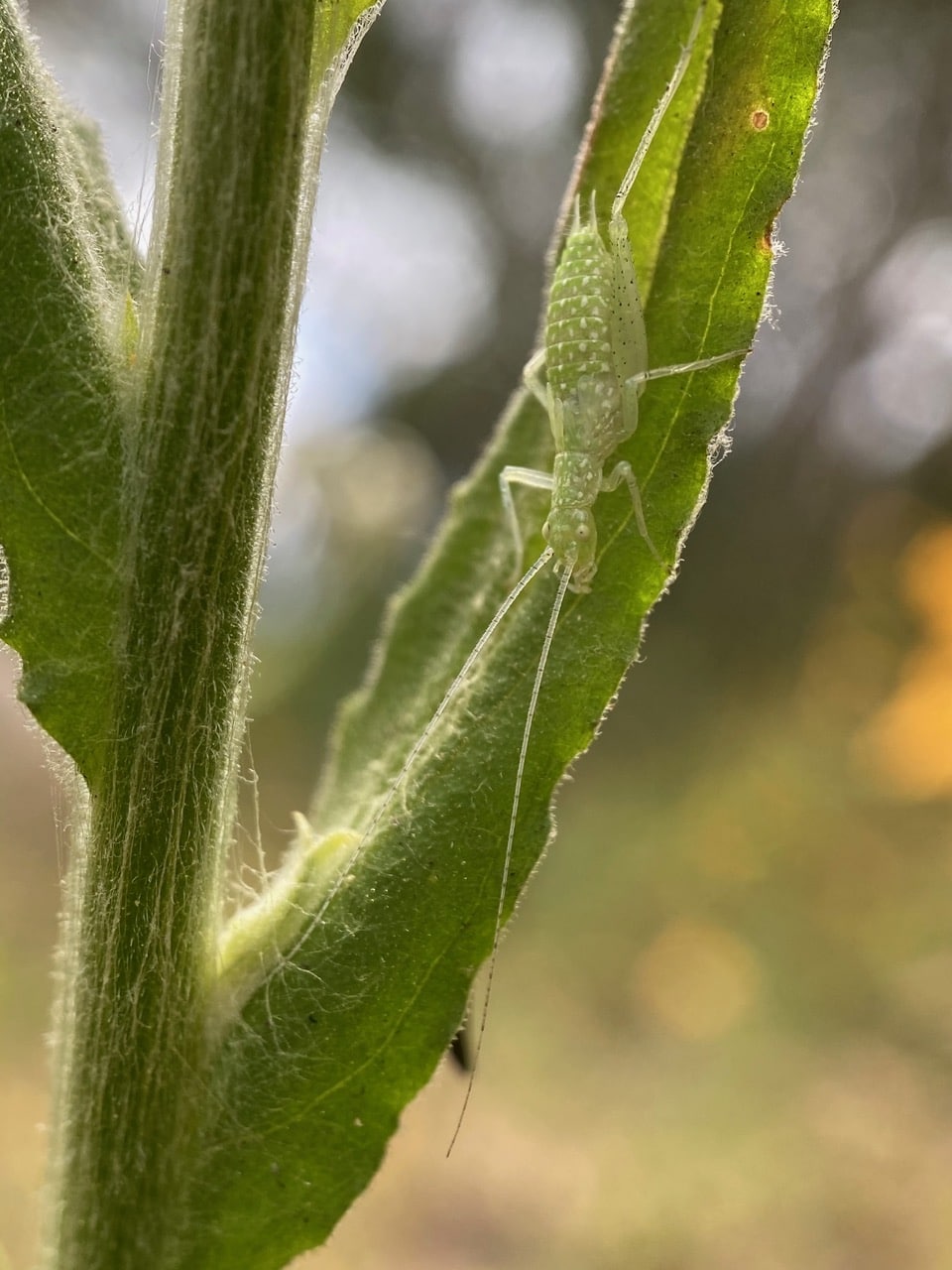
More often heard than seen, tree crickets are active at dusk and at night. In late summer, males produce a high-pitched whine or “song”, a prelude to courtship and mating. Sound is produced by stridulation; the basal edge of one forewing (scraper) is rubbed along a filelike ridge (file) on the ventral side of the other forewing. Other members of the Orthoptera, including katydids and horned grasshoppers also produce sound by the file and scraper method.
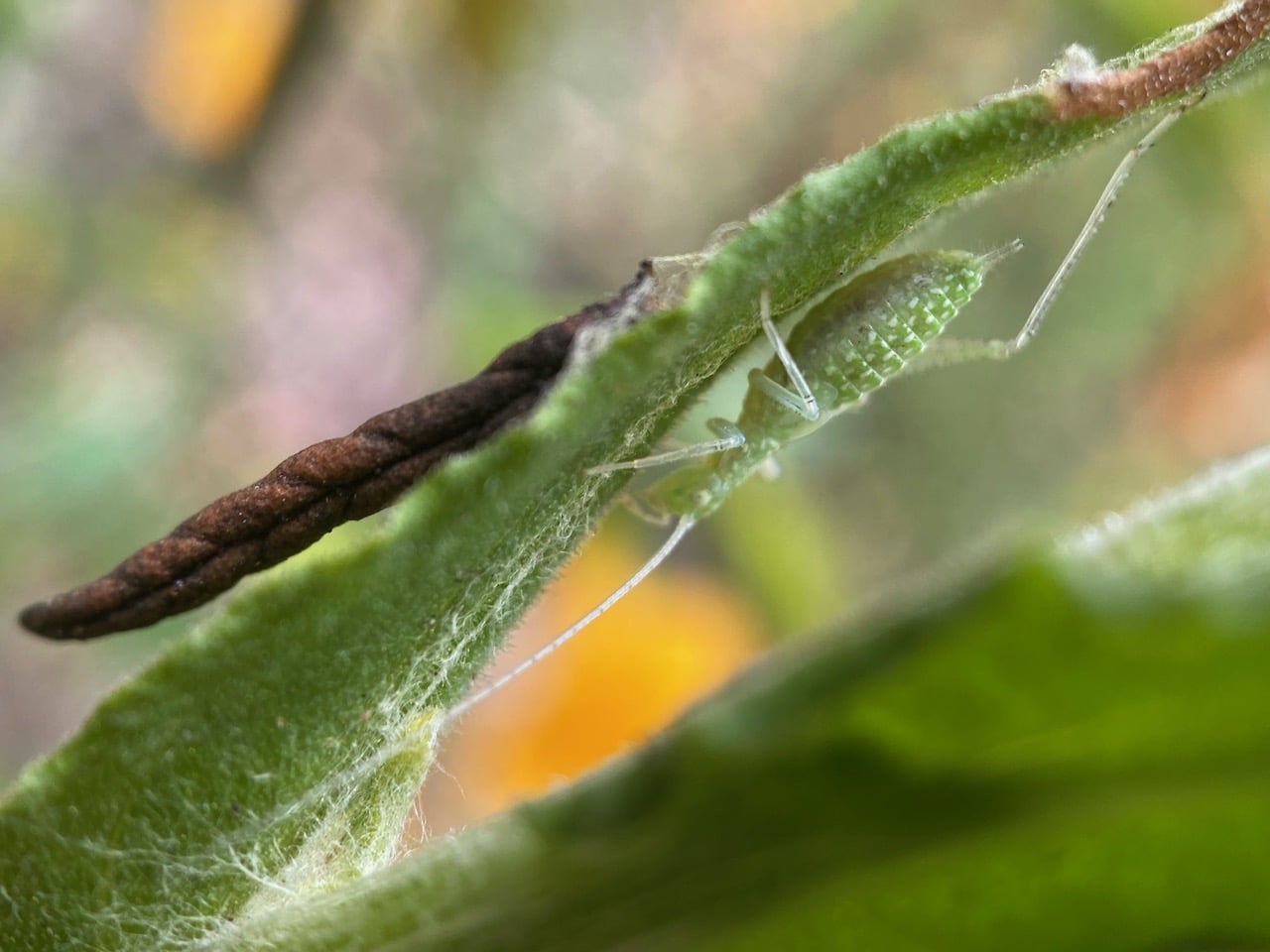
The Tree Cricket nymph is missing its right hind leg. Fear not – cricket nymphs have the remarkable ability to regenerate a functional leg following amputation. All the insect appendages, highly complex structures composed of epidermis, muscles and nerves, can regenerate. Because of the existence of exoskeleton, limb regeneration is sheltered by this chitin shell, thus complete regeneration requires molting. Adult insects that no longer molt cannot replace broken or missing appendages like wings or legs. The replacement limb will grow after every subsequent molt, and our young nymph has plenty of time to catch up before it turns into an adult.

A female Masked Bee, Hylaeus sp. (family Colletidae) is collecting pollen from a fresh, unopened anther of California Phacelia.

Once the pollen is exposed, she can gather it into her crop, part of her digestive tract, for storage. Note the yellow markings on the female’s face. They consists of two curved lines flanking the inner margins of her compound eyes.

Another Masked Bee, Hylaeus sp. (family Colletidae) is looking for fresh flowers. Note the yellow markings on her face. Masked Bees are best identified by these markings. Males have more prominent markings on their faces.

A Spotted Cucumber Beetle, Diabrotica undecimpunctata (family Chrysomelidae) is feeding on the stamens located behind the white stigma of the Sticky Monkeyflower, Diplacus aurantiacus.
Members of the family Chrysomelidae are commonly known as Leaf Beetles. Adults and larvae feed on all sorts of plant tissues, and all species are fully herbivorous. Many are serious pests of cultivated plants, including food crops. Others are beneficial due to their use in biocontrol of invasive weeds. Chrysomelids are popular among insect collectors, as many are conspicuously colored, typically in glossy yellow to red or metallic blue-green hues, and some have spectacularly bizarre shapes. Photos of Leaf Beetles (Family Chrysomelidae) · iNaturalist
Native to North America, the Spotted Cucumber Beetle can be a major agricultural pest, causing damage to crops in the larval as well as adult stages of their life cycle. Larvae, sometimes known as rootworms feed on the roots of emerging plants. In the adult stage the beetles cause damage by eating the flowers, leaves, stems and fruits of the plant.
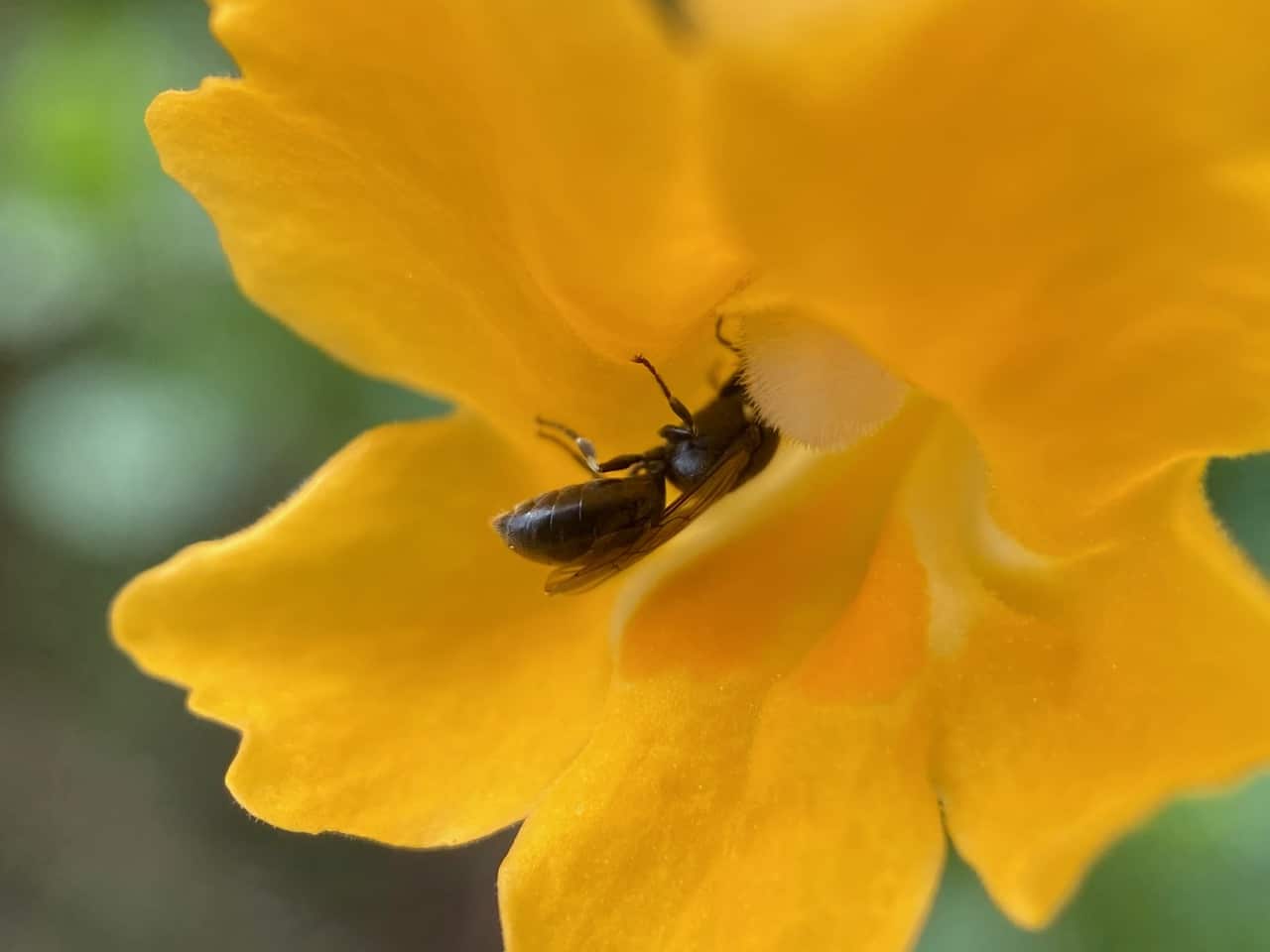
A small bee is reaching into the flower of Sticky Monkeyflower, probably collecting pollen from the stamens on the ceiling of the corolla.
 Pollen grains have adhered to the Masked Bee as she exits the flower. Although the nectar and pollen she collects are stowed in her crop, the bee can still be an effective pollinator, transferring pollen between flowers.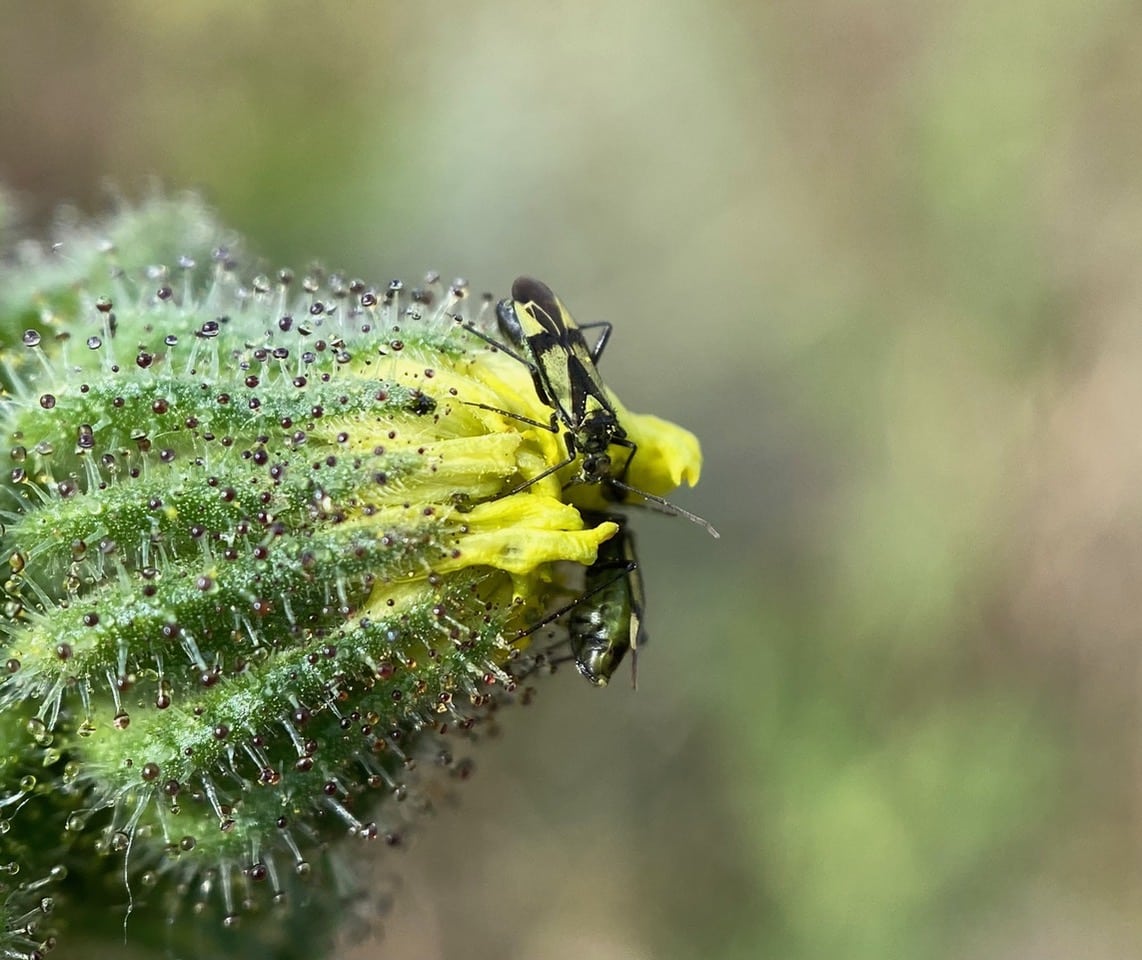
Immune to the sticky exudates of the glandular hairs on the phyllaries, two tiny Plant Bugs, Macrotylus essigi (family Miridae) are feeding on an immature flowerhead of Coast Tarweed, Madia sativa.
Mirid bugs are also referred to as plant bugs or leaf bugs. Miridae is one of the largest family of true bugs in the order Hemiptera. Like other Hemipterans, Mirids have piercing, sucking mouthparts to extract plant sap. Some species are predatory. One useful feature in identifying members of the family is the presence of a cuneus; it is the triangular tip of the corium, the firm, horny part of the forewing, the hemielytron. The cuneus is visible in nearly all Miridae.

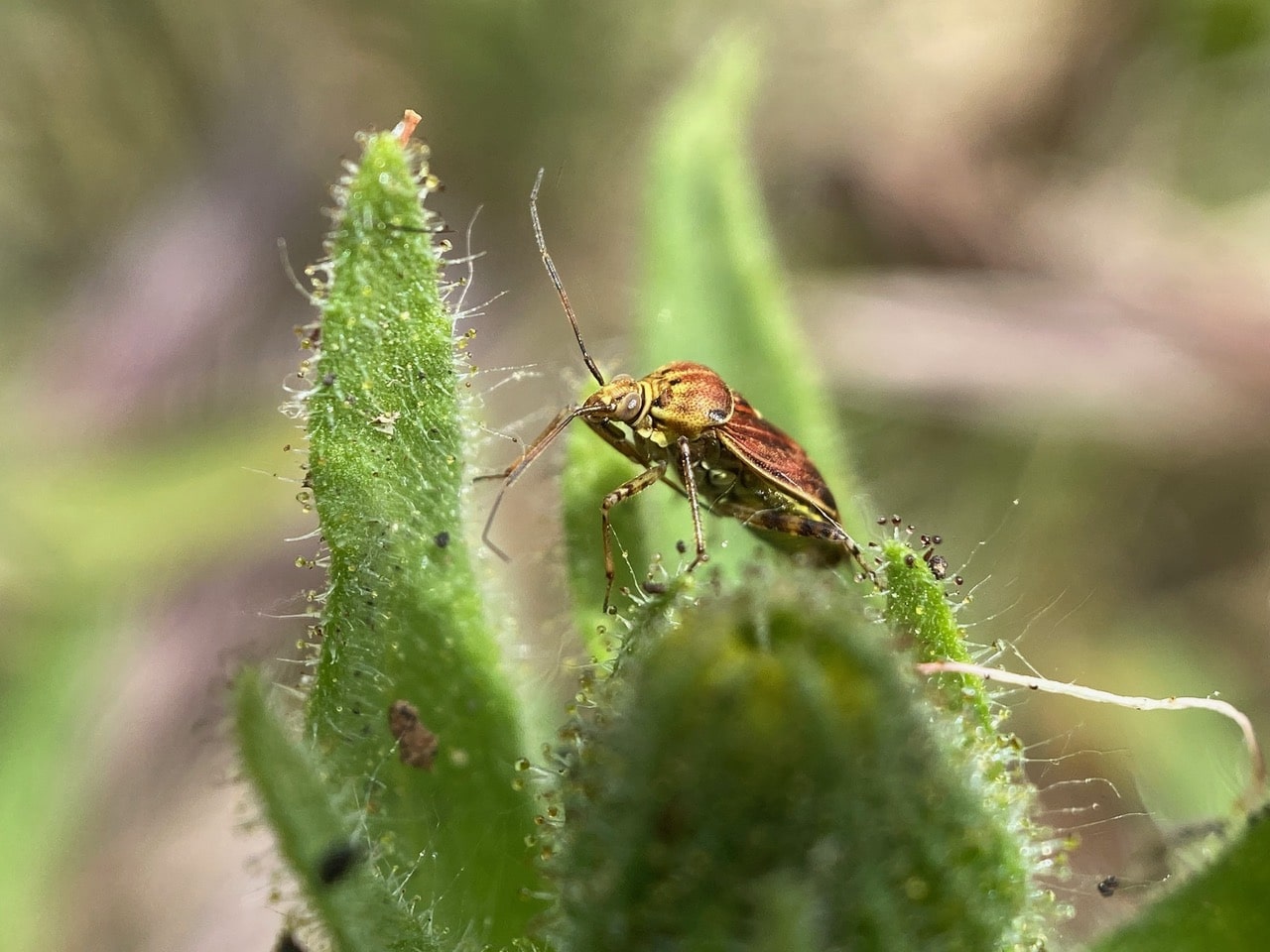 A Lygus Bug, Lygus sp. (family Miridae) is roaming the terminal leaves of a Coast Tarweed, Madia sativa.
 The term lygus bug is used for any member of the genus Lygus, in the family of plant bugs, Miridae. Adult lygus are approximately 3 mm wide and 6 mm long, colored from pale green to reddish brown or black. They have a distinctive triangle or V-shape on their backs. Lygus bugs are known for their destructive feeding habits – they puncture plant tissues with their piercing mouthparts, and feed by sucking sap. Both the physical injury and the plant’s own reaction to the bug’s saliva cause damage to the plant. Many lygus bugs are well-known agricultural pests.
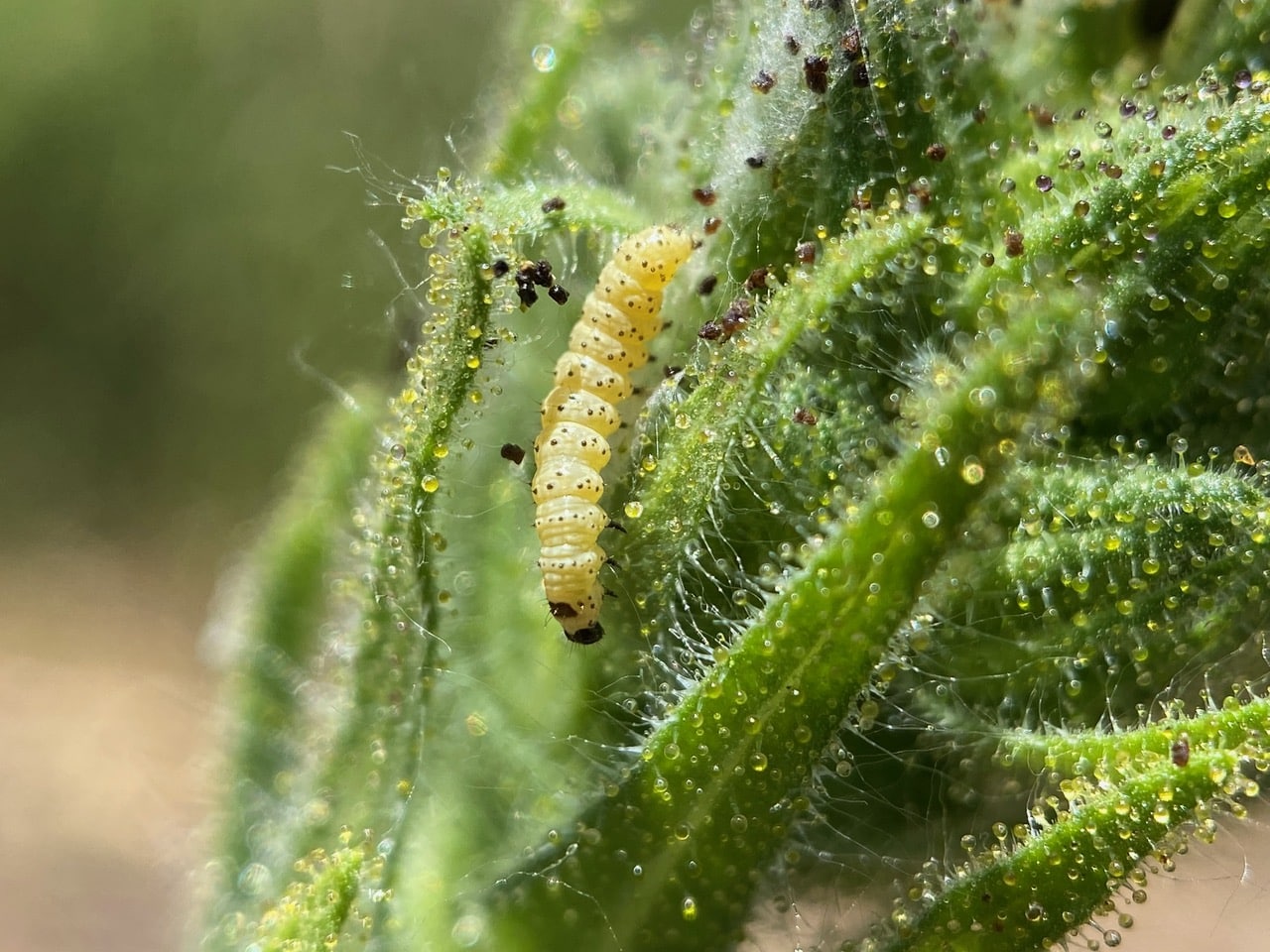
This unusually pale caterpillar of the Small Heliothodes Moth, Heliothodes diminutiva (family Noctuidae) stands out among the foliage of the Coast Tarweed. The normal green caterpillars with the fake tar spots are almost invisible on their host plant.
The Small Heliothodes Moth, Heliothodes diminutiva (family Noctuidae) is day-active. It is found from California, through Oregon to Washington, most often on plants in the family Asteraceae, especially tarweeds. The caterpillars feed on the reproductive parts of the flower.

Many of the flowers of this Coast Tarweed, Madia sativa have gone to seed, attracting numerous seed eaters. Do you see the well-camouflaged Scentless Plant Bug, Arhyssus sp. (family Rhopalidae) perched on a developing Coast Tarweed seed head?
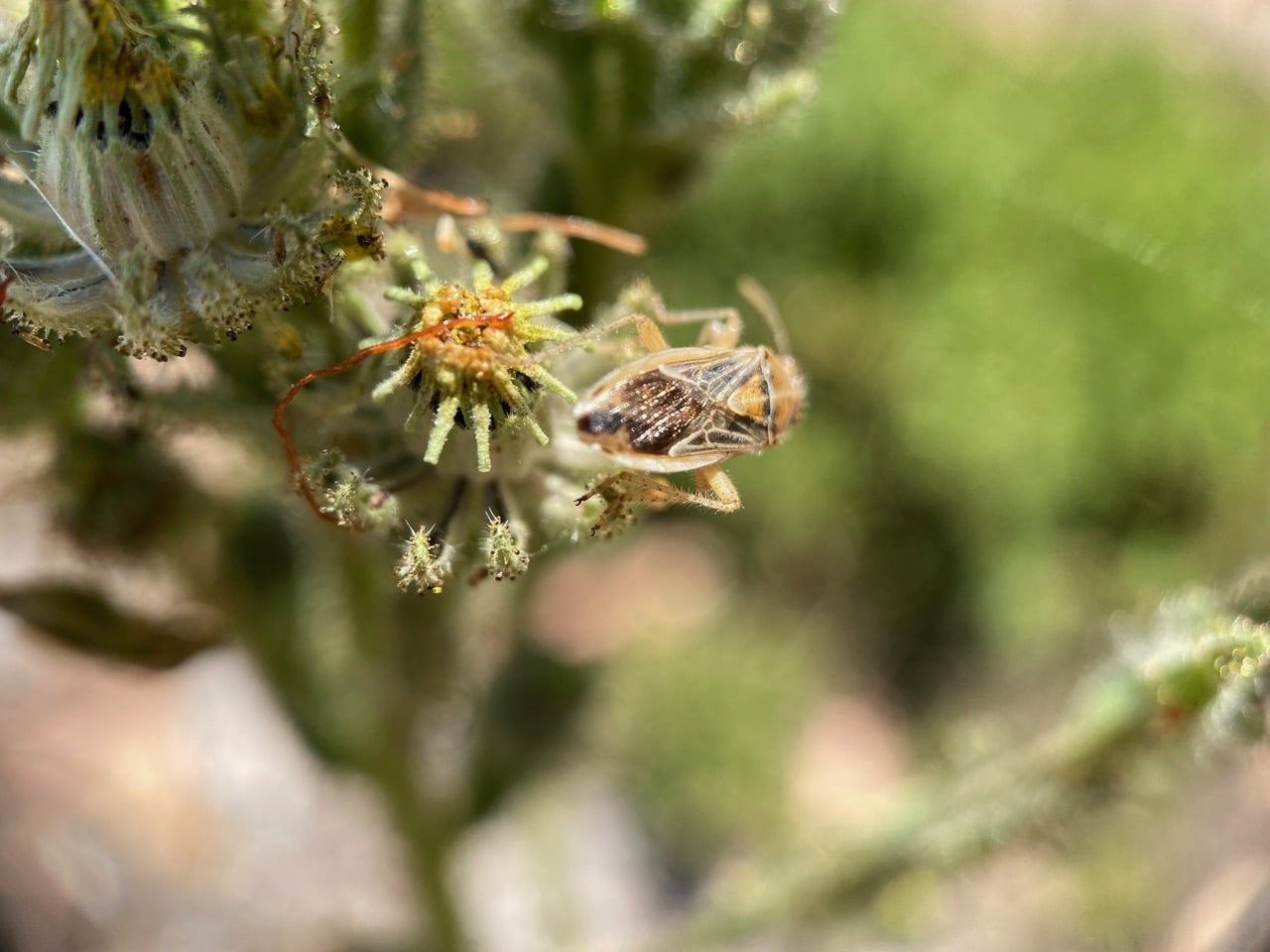
The Rhopalidae are distinguished by many veins on the membranous portion of the forewings. They differ from coreids and other hemipterans in lacking functional scent glands. All are plant-feeders, usually on ripe seeds of herbaceous plants. These bugs are never far away from their food – seeds. The Coast Tarweed produces prodigious amounts of seeds. Each seed head can hold dozens of seeds.