

Pollinator Post 6/23/25 (2)
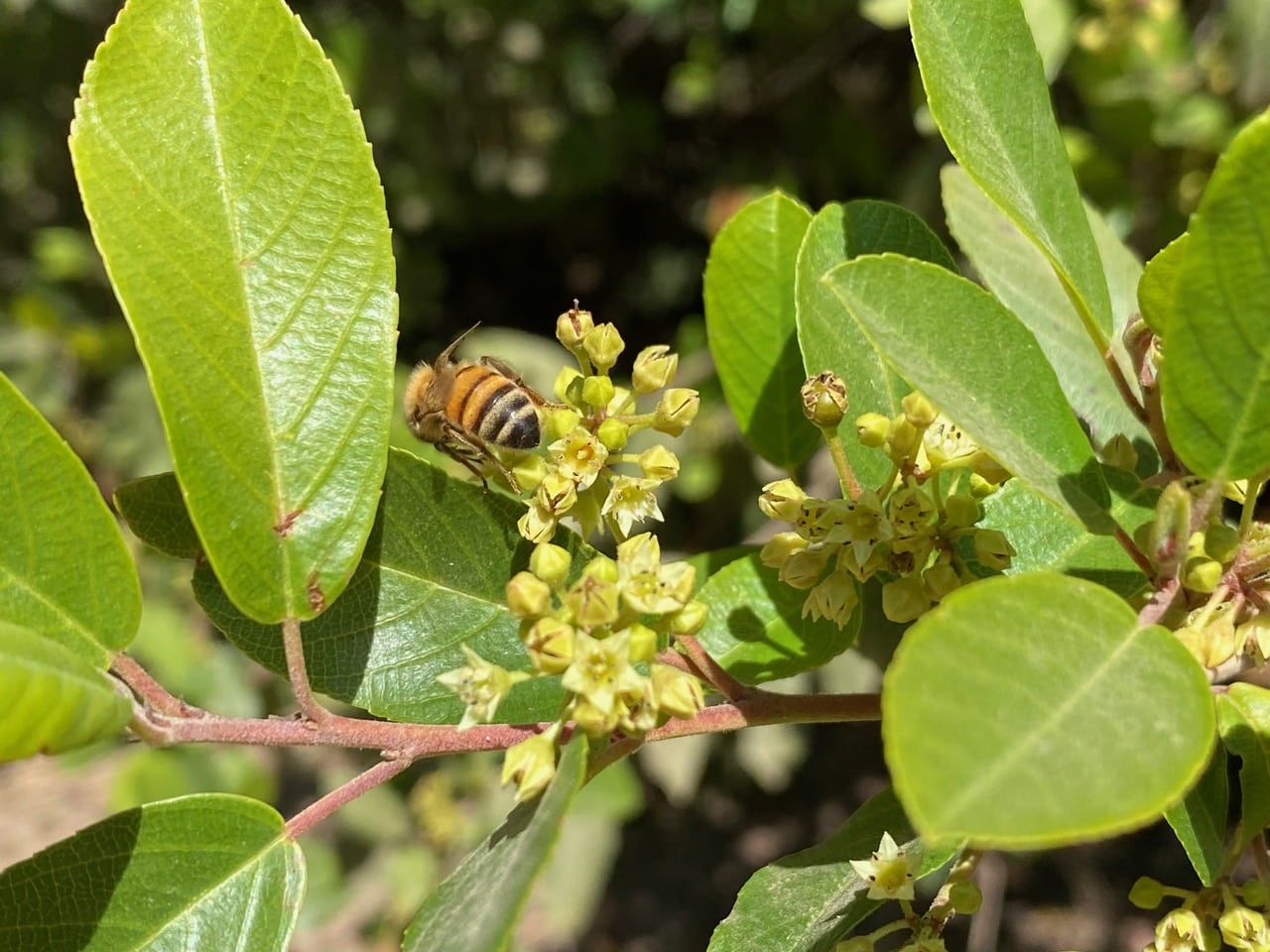
I stop by a large shrub of Coffeeberry, Frangula californica that is in bloom. A Honey Bee, Apis mellifera (family Apidae) is foraging on a cluster of Coffeeberry flowers.
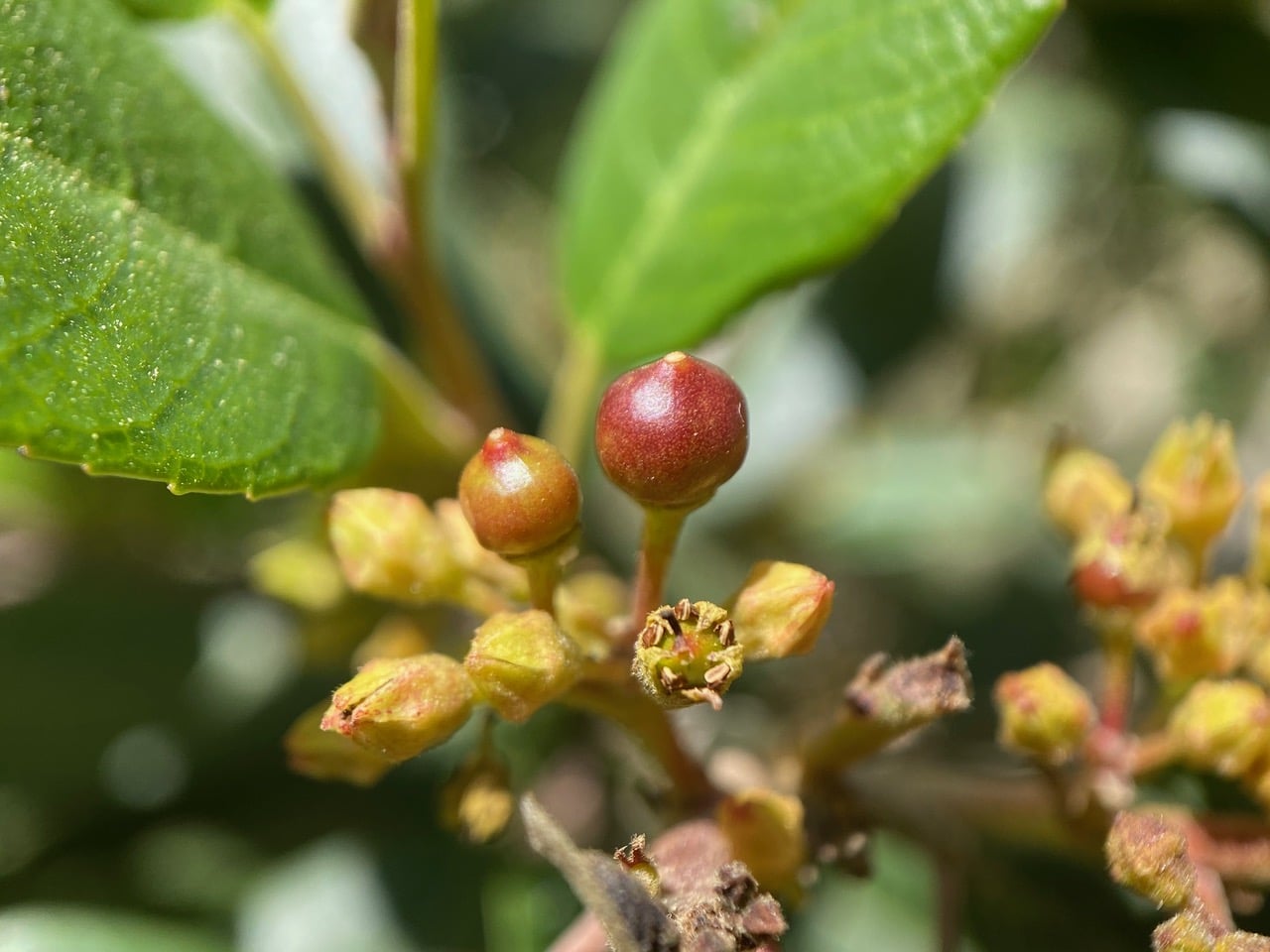




A couple of fruits are ripening among a cluster of flower buds. The small round stone fruits are initially green, turning a deep red, then reddish-purple as they ripen. The fruit contains two seeds, with flat side facing each other in the fruit, resembling the coffee beans used in our morning beverage, hence the plant’s common name. The fruits are eaten by various birds and mammals, which in turn help disperse the seeds in their droppings.
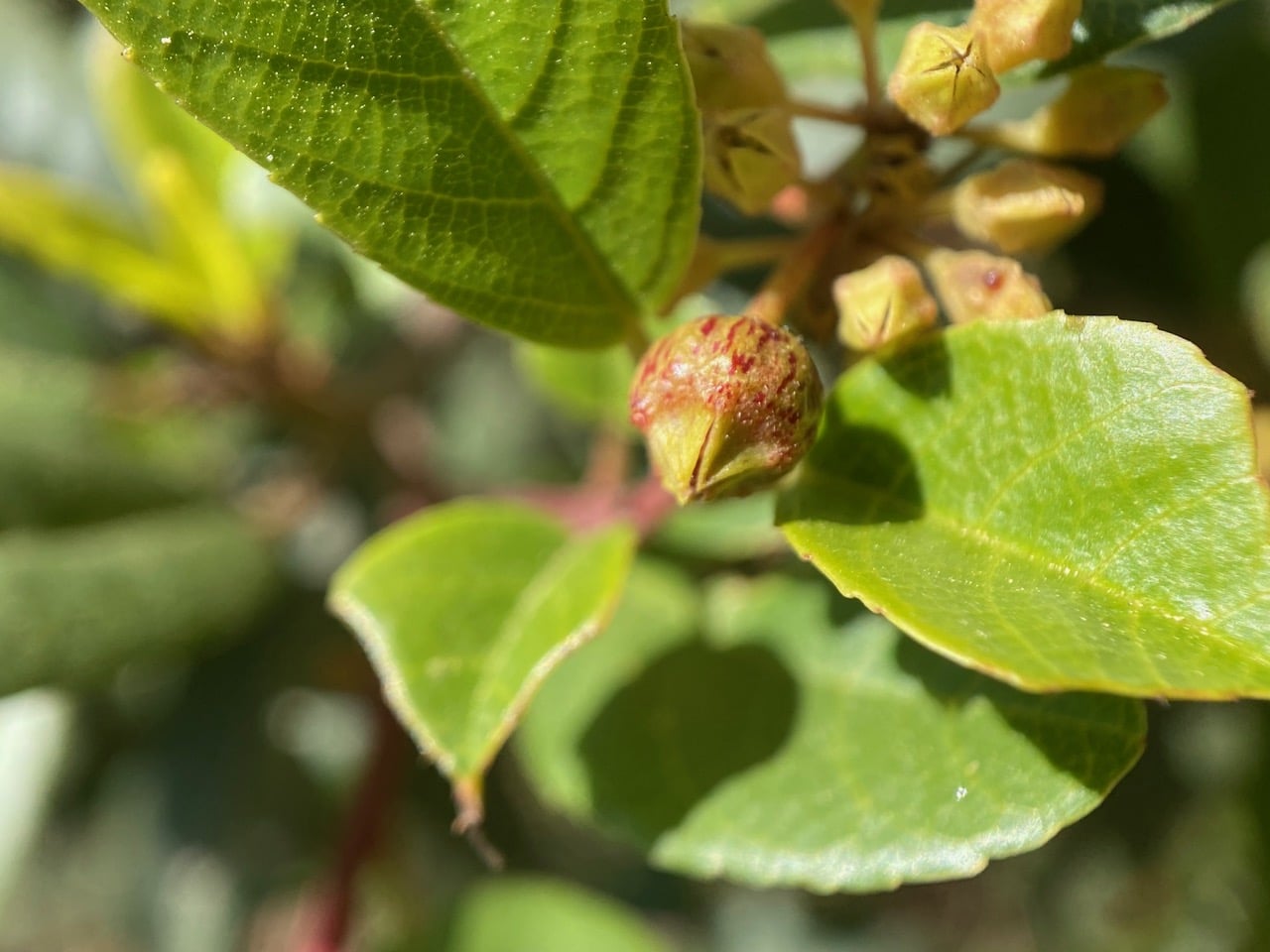
Hey, that doesn’t look like a regular Coffeeberry fruit, but it resembles an enlarged flower bud flecked with red. It is in fact a flower bud gall induced by the Gall Midge, Asphondylia sp. (family Cecidomyiidae).
Plant galls are abnormal growths, resembling tumors or warts, that form on plants due to the influence of other organisms such as insects, mites, bacteria, fungi, or nematodes, providing them with food, shelter, and protection. The gall-inducing organism lays eggs or penetrates the plant tissue, triggering a response in the plant. The plant cells begin to proliferate and reorganize, forming the gall tissue within which the gall organism feeds, protected from predators and harsh environmental conditions. Different gall-inducing organisms can create galls with unique appearances, shapes, and colors, allowing for identification.
Asphondylia is a cosmopolitan genus of gall midges in the family Cecidomyiidae. All species in this genus induce galls on plants, especially on flowers and flower buds.
A fly with a light yellow abdomen lands on the Coffeeberry flowers.
The black markings on the abdomen is characteristic of the Face Fly, Musca autumnalis (family Muscidae).
Musca autumnalis is widespread throughout most of Europe, Asia and some parts of North Africa. It was introduced into North America around the 1940s and is now commonly found in most temperate parts of the United States.
Adult Face Flies emerge from winter hibernation in early spring. During the day, they feed on manure juices and plant sugars. On cattle and horses they feed on secretions around the eyes, mouth and nostrils. They will also feed on the hosts’ blood through wounds such as horse-fly bites. At night both sexes rest on vegetation. Females lay eggs on fresh cow manure where the maggots feed on microbes, developing through three instars and final pupation. Musca autumnalis is considered a pest species, as it transmits the eye worm to cattle and horses, and pinkeye to cattle.
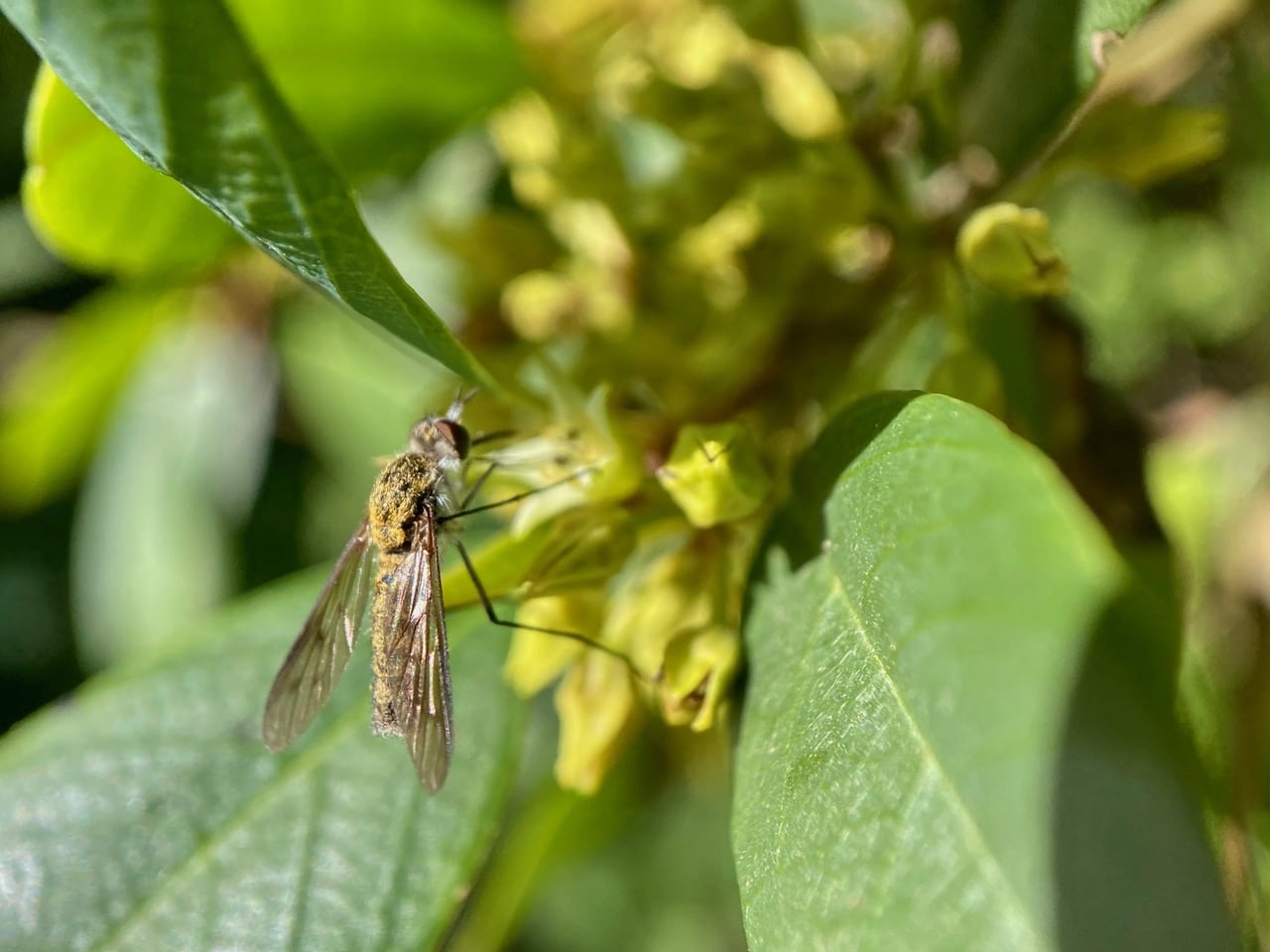
Perched on a Coffeeberry leaf is a small, dusky Bee Fly with golden scales covering most of its body. It is a member of the subgenus Thevenetimyia (family Bombyliidae).
The Bee Flies belong to the family Bombyliidae. Adults generally visit flowers for nectar and pollen, some being important pollinators. Larvae generally are parasitoids of other insects. When at rest, many species of bee flies hold their wings at a characteristic “swept back” angle. The adult females usually deposit eggs in the vicinity of possible hosts, quite often in the burrows of beetles or ground-nesting bees/wasps. Bombyliidae parasitism is not host-specific, but rather opportunistic, using a variety of hosts.
Thevenetimyia is a genus of bee flies in the family Bombyliidae. There are more than 40 described species in Thevenetimyia found worldwide, mostly in North America. They are parasites of wood-boring beetle larvae.
Other Bee Flies hovering over the Coffeeberry flowers have slighter builds and less densely colored wings and scales. I think they are males of the same species, Thevenetimyia sp. (family Bombyliidae).
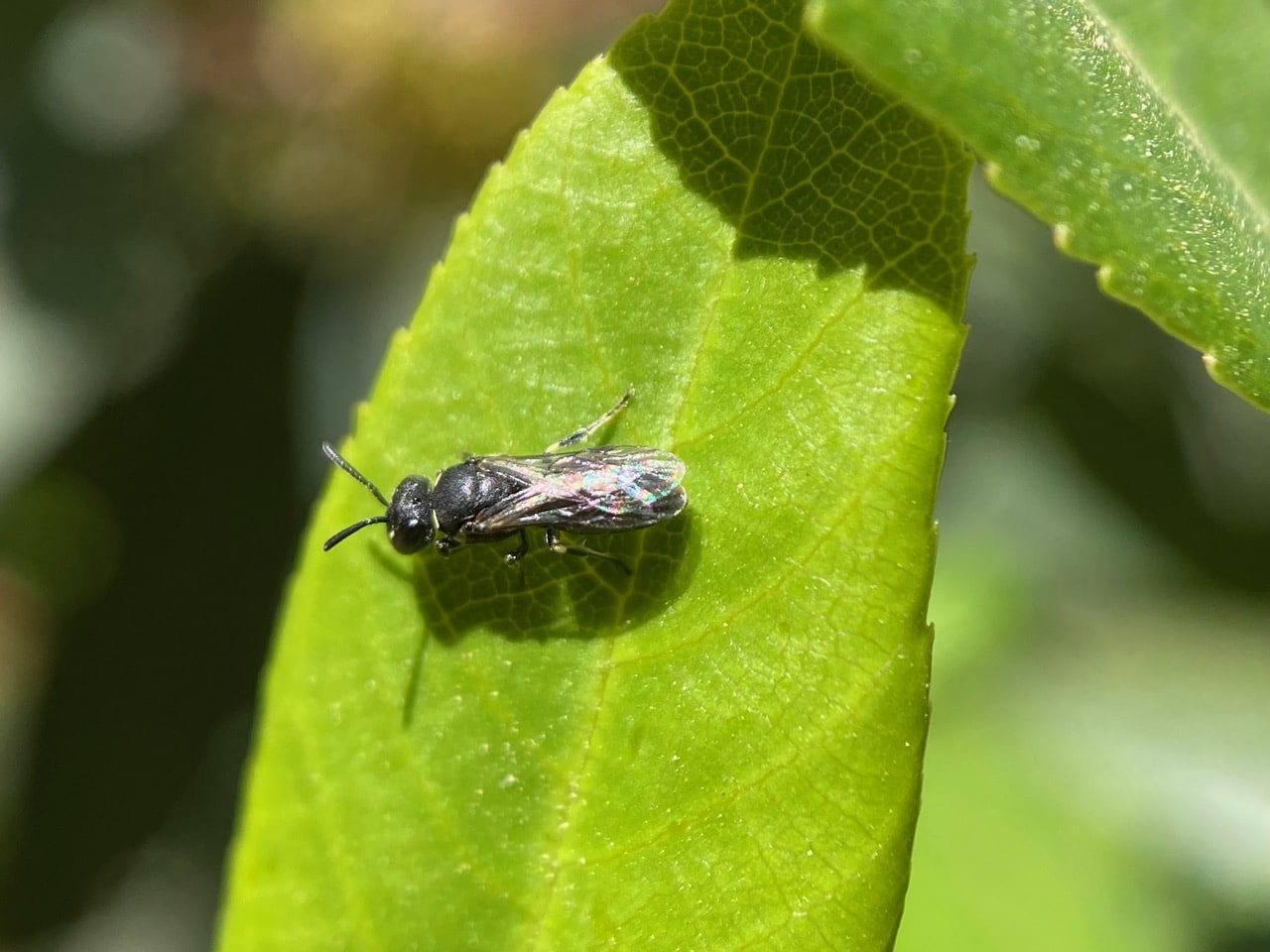
Some tiny bees the size of rice grains are foraging on the Coffeeberry flowers. One conveniently lands on a leaf. See the yellow markings on the face, neck and legs? Note also that it does not have any scopae on its hind legs. It is a Masked Bee, Hylaeus sp. (family Colletidae).
Hylaeus (family Colletidae) are shiny, slender, hairless, and superficially wasp-like bees. They are small, 5 to 7 mm long, usually black with bright yellow or white markings on their face and legs. These markings are more pronounced on the males. Hylaeus do not carry pollen and nectar externally, they instead store their food in the crop and regurgitate it upon returning to their nests. They are primarily generalist foragers. Hylaeus are short-tongued, but their small body size enables them to access deep flowers. Hylaeus nest in stems and twigs, lining their brood cells with self-secreted cellophane-like material. They lack strong mandibles and other adaptations for digging, using instead pre-existing cavities made by other insects.
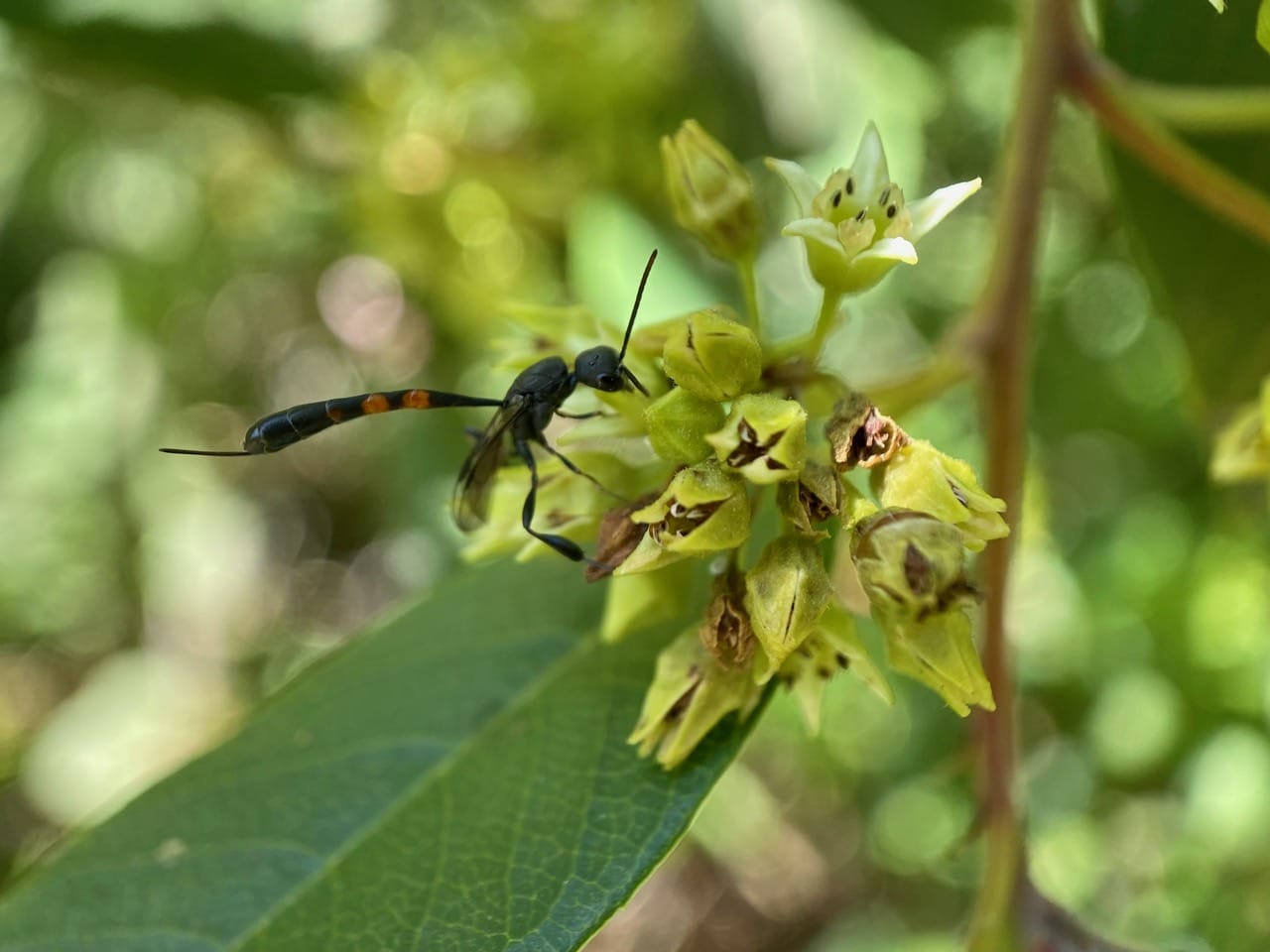
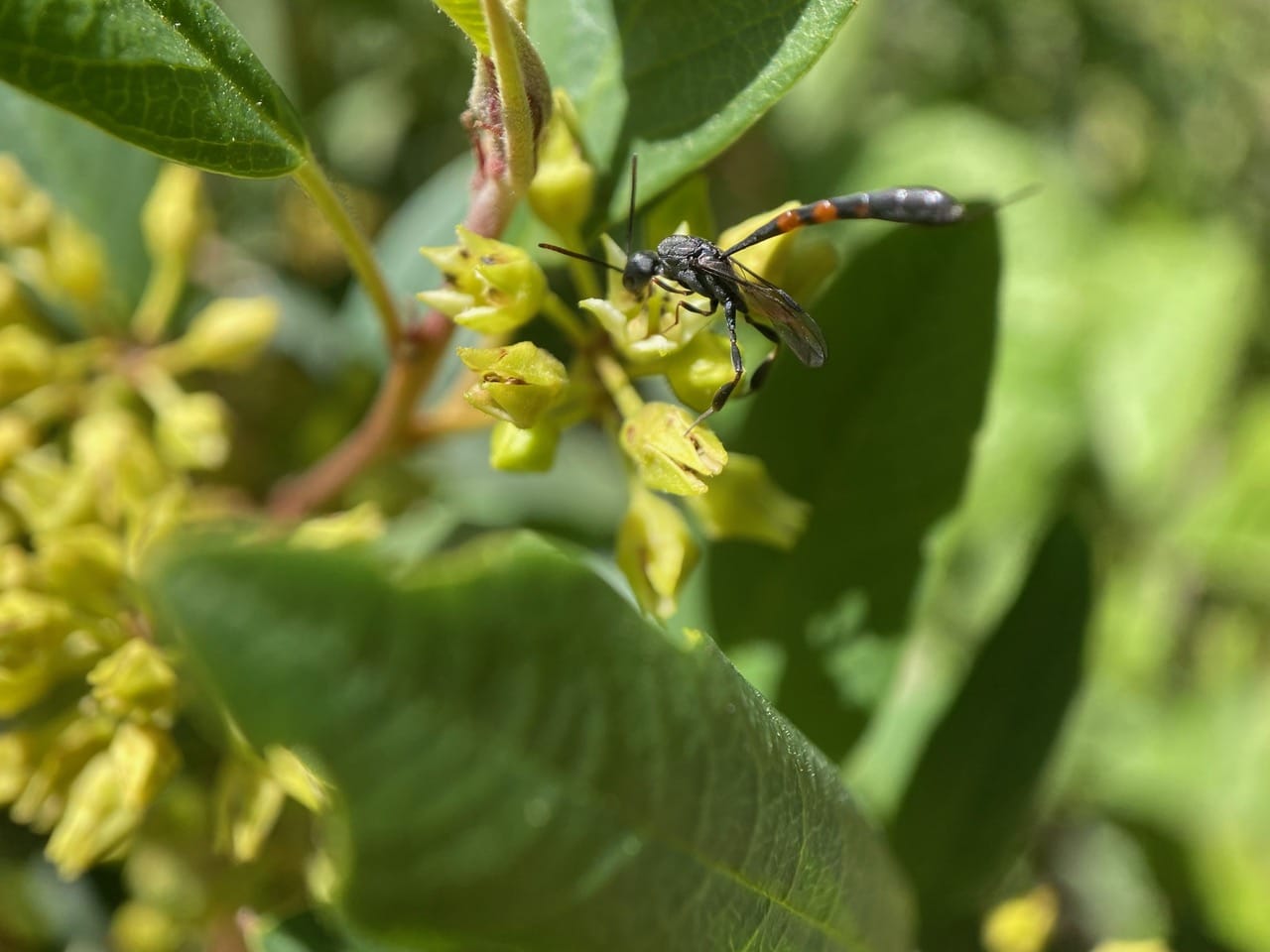
My heart misses a beat as I spot a small, skinny, strangely shaped wasp visit a cluster of Coffeeberry flowers in the shade. It is unmistakably a Carrot Wasp, Gasteruption sp. (family Gasteruptiidae). Nothing else in the insect world looks like this! It appears to be a male, without the long needle-like ovipositor characteristic of the females.
Gasteruption are wasps in the family Gasteruptiidae, a family of parasitoid wasps with a worldwide distribution. They are small wasps, from 13-40 mm depending on the species, and much of that length owing to the long ovipositor in females of some species. The wasps are so skinny they have been called “flying needles”. The wasp has a pronounced “neck” between head and thorax. The abdomen is attached high up on the thorax, not between hind legs. Hind tibia are swollen.
Adult wasps are most often found at flowers, especially those in the carrot family, Apiaceae, hence their common name of “carrot wasps”. Flight activity peaks in late spring and/or mid-summer. Carrot Wasps are parasitoids of solitary bees and wasps that nest in twigs or borings in wood. The female searches for nests of various solitary bees or wasps, assessing each hole by feeling for vibrations from the larvae moving around inside, as the nest burrow will have been blocked up to protect the larvae. The female wasp needs her long ovipositor to reach the depths of a host’s tunnel and deposit an egg. She pushes her long ovipositor through the blocked-up entrance into the nest cell, depositing her own eggs next to the host larvae. The larva that hatches out prey upon the host eggs, larvae and provisions. Gasteruption wasps have been recorded in the nests of digger bees, plasterer bees, leaf-cutter bees, mud daubers, and pollen wasps.
A male Western Calligrapher, Toxomerus occidentalis (family Syrphidae) lands on a Coffeeberry leaf. His abdomen is much more slender compared to the females, and not as beautifully patterned. I have often noticed that many males of the species have a somewhat deformed or misshaped abdomen.
Toxomerus is a very large genus of Hover Flies. They are found in North and South America. The majority of species are only 6-9 mm in length. They are notable for their mimicry of stinging Hymenoptera to avoid predators. Their unique abdominal patterns are diagnostic at the species level within the genus. There is marked sexual dimorphism – the females have a broader abdomen with lighter coloration and pattern. Most larvae feed on soft bodied insects, such as aphids; a few feed on pollen. Adults feed on the pollen of a wide range of flowers. A female can lay up to hundreds of eggs at a time and will place them where prey or pollen food sources are readily available. They can be found in a wide variety of habitats, often in dense ground cover.
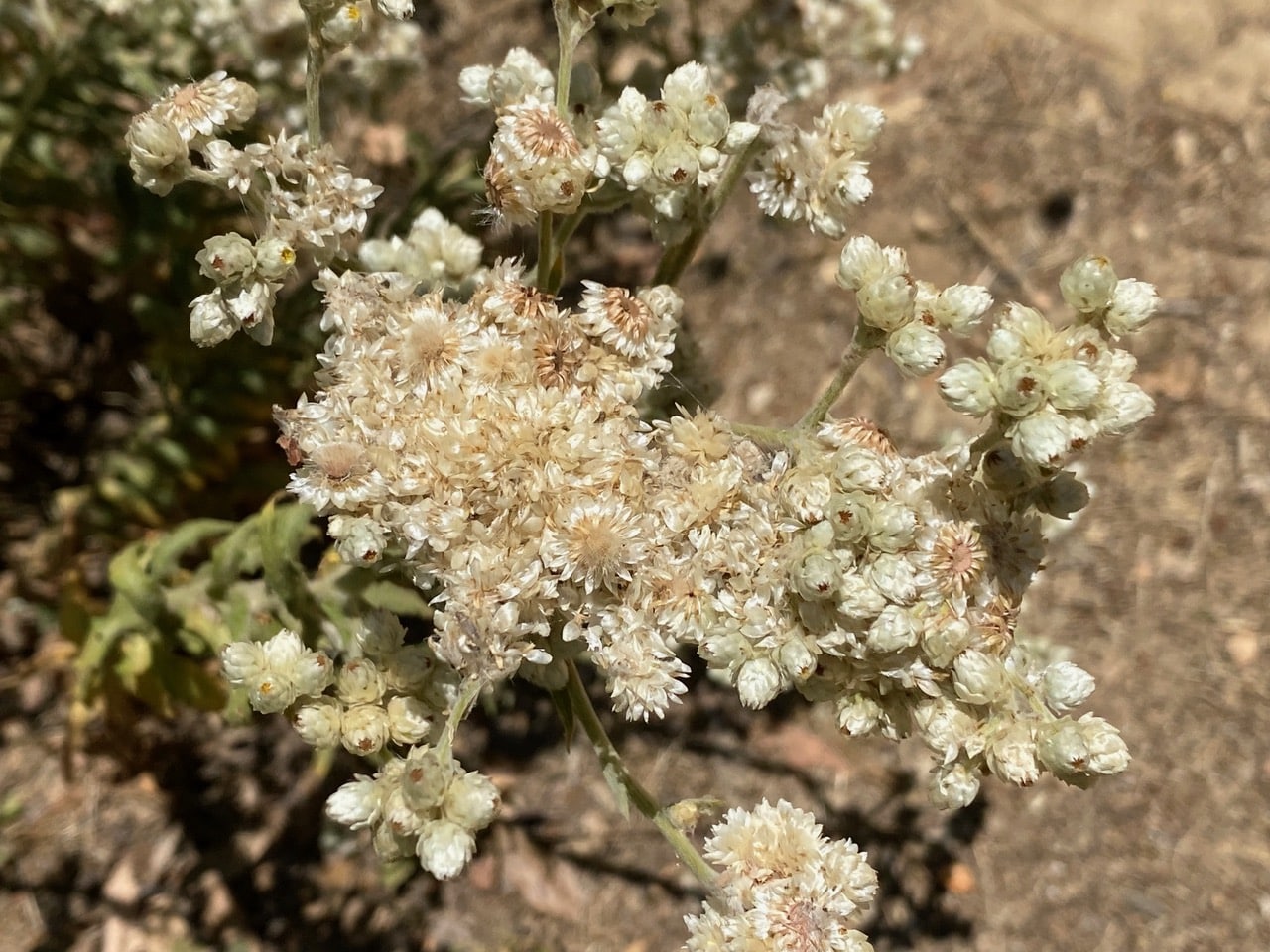
I am delighted to come across a small patch of blooming California Everlasting, Pseudognaphalium californicum. That large cluster of flowerheads looks rather unruly, not composed entirely of discreet flowerheads. The cluster is actually an assembly of loose phyllaries – a sure sign of a nest of the American Lady caterpillar, Vanessa virginiensis (family Nymphalidae)!
American Lady caterpillars are solitary feeders and construct nests from various parts of their host plant. Tiny larvae use leaf hairs to construct tiny nests; larger caterpillars arrange leaves, flower heads, and detritus to form tight shelters. Several structures are typically built during the caterpillar’s development.
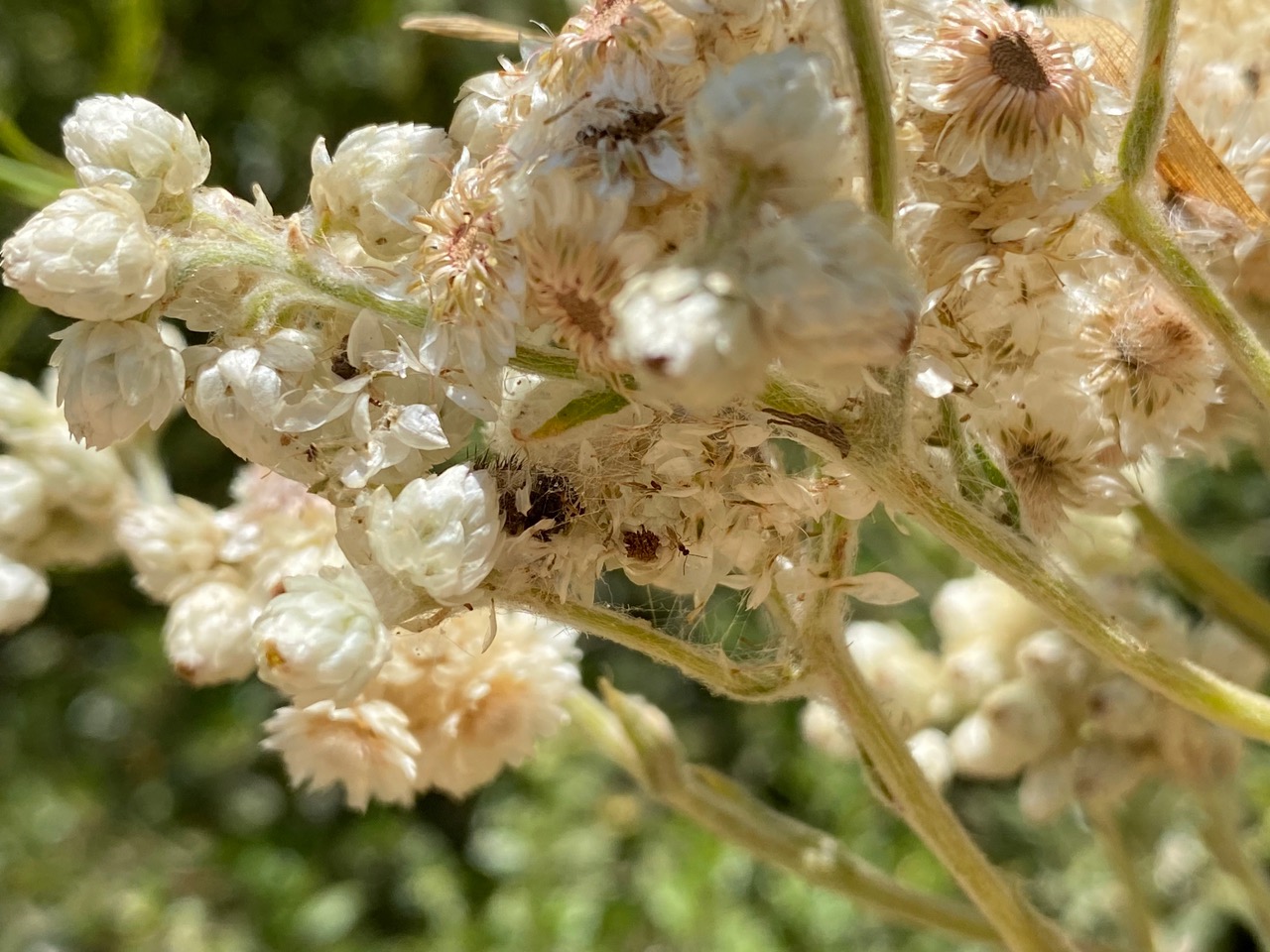
Examining the underside of the large cluster, I find a dark spiny caterpillar within a shelter composed of loose phyllaries bound together with silk. Is it alive? Or is that just an exuvia (shed skin)? Larger caterpillars of the American Lady often construct nests by binding together adjacent clusters of flowerheads with silk. They feed on the flower parts underneath the cluster in the safety of the shelter, adding the discarded phyllaries to the silken nest as they feed and grow. They may build several such nests during their development, eventually pupating within the nest.
Ooh, do you see the tiny wasp close to the caterpillar? It has long antennae, and is probably a Braconid wasp, a parasitoid wasp that lays eggs in or on Lepidopteran larvae. It’s a jungle down here!
Here’s another nest of the American Lady caterpillar. It is camouflaged as a cluster of flowerheads, constructed with discarded phyllaries from the flowerheads that have been eaten by the caterpillar. How clever of the little critter – nothing goes to waste!
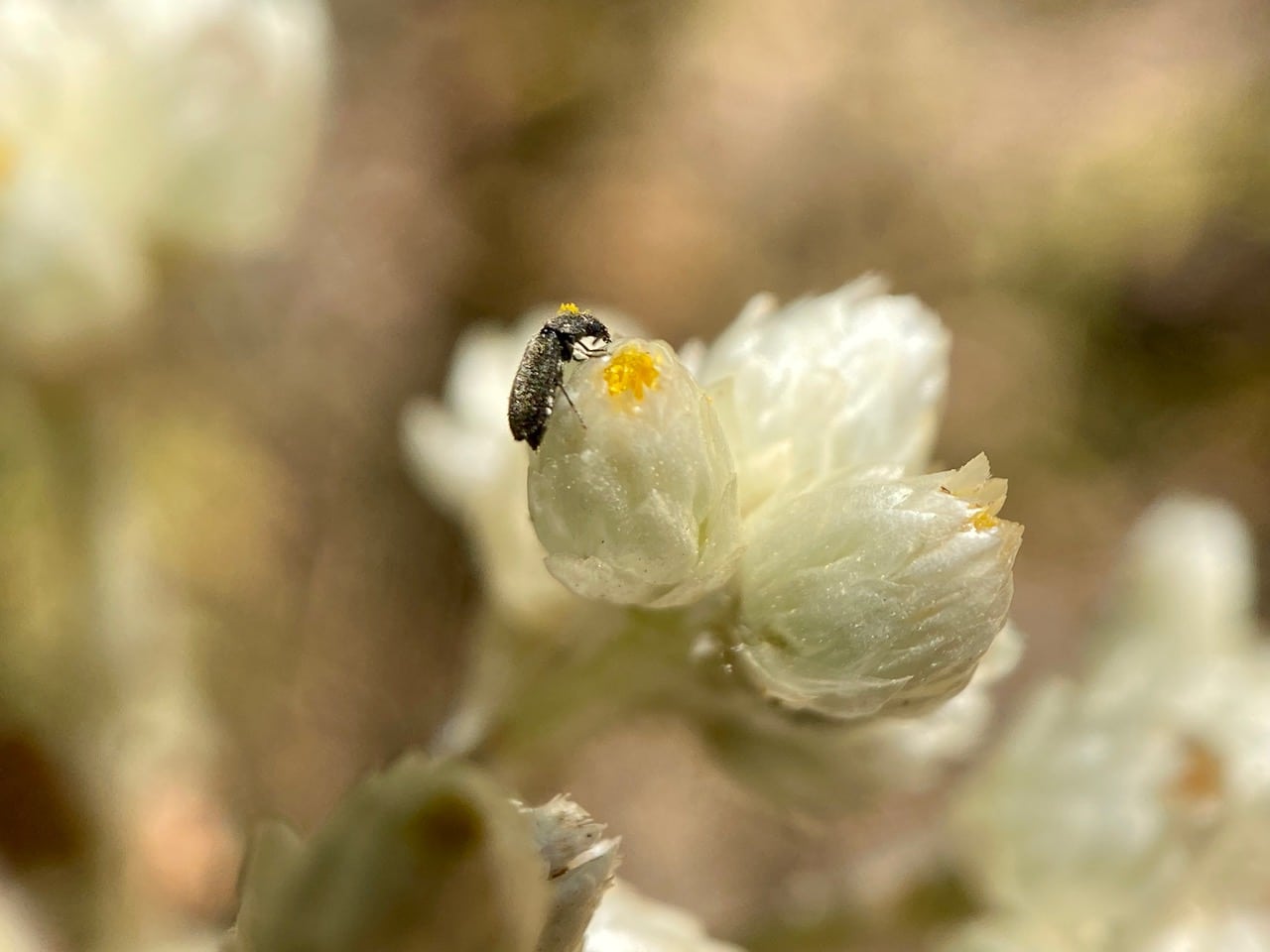
A Soft-winged Flower Beetle, Listrus sp. (family Melyridae, subfamily Dasytinae) lifts its head from reaching into a flowerhead of California Everlasting. Some yellow pollen has adhere to its thorax.
Most species of Melyridae are various shades of brown or black and just 2 to 4 mm in length. They are sometimes very abundant in spring when there is an abundance of open flowers, particularly those with an abundance of pollen. In north America, dasytine beetles are hardly represented in the east, but are enormously diverse in the west, especially in California.
11 families of Coleoptera (beetles) are known to pollinate flowering plants. In western North America, the 300+ species of the beetle subfamily Dasytinae are commonly found on flowers, where adults feed on both nectar and pollen. Their dense setae (hairs) often trap pollen grains, which are transported to other flowers during the course of normal feeding. Many dasytine beetles form large feeding aggregations.