

Pollinator Post 6/23/25 (1)

On this fine, sunny morning I go for my walk on the West Ridge Trail in the Redwood Regional Park starting from the Waterloo Staging Area.






A small, dark butterfly lands on the tangle of fading thistles on the side of the trail. It is a Mournful Duskywing, Erynnis tristis (family Hesperiidae).
The Mournful Duskywing, Erynnis tristis (family Hesperiidae) is a species of spread-wing skipper that is often found in urban areas. Unlike the familiar brown-and-orange grass skippers, the spread-wing skippers spread out their wings when perched. They are also generally larger (wingspan of 1.25 – 2 in.) and sport a different color scheme. The species is found in Central America, North America, and South America. The butterfly is mottled brown with a white fringe on the trailing edge of the hind wings. The larvae feed on young oaks and rest in shelters of rolled or tied leaves. Adults nectar from a variety of wild and garden flowers.
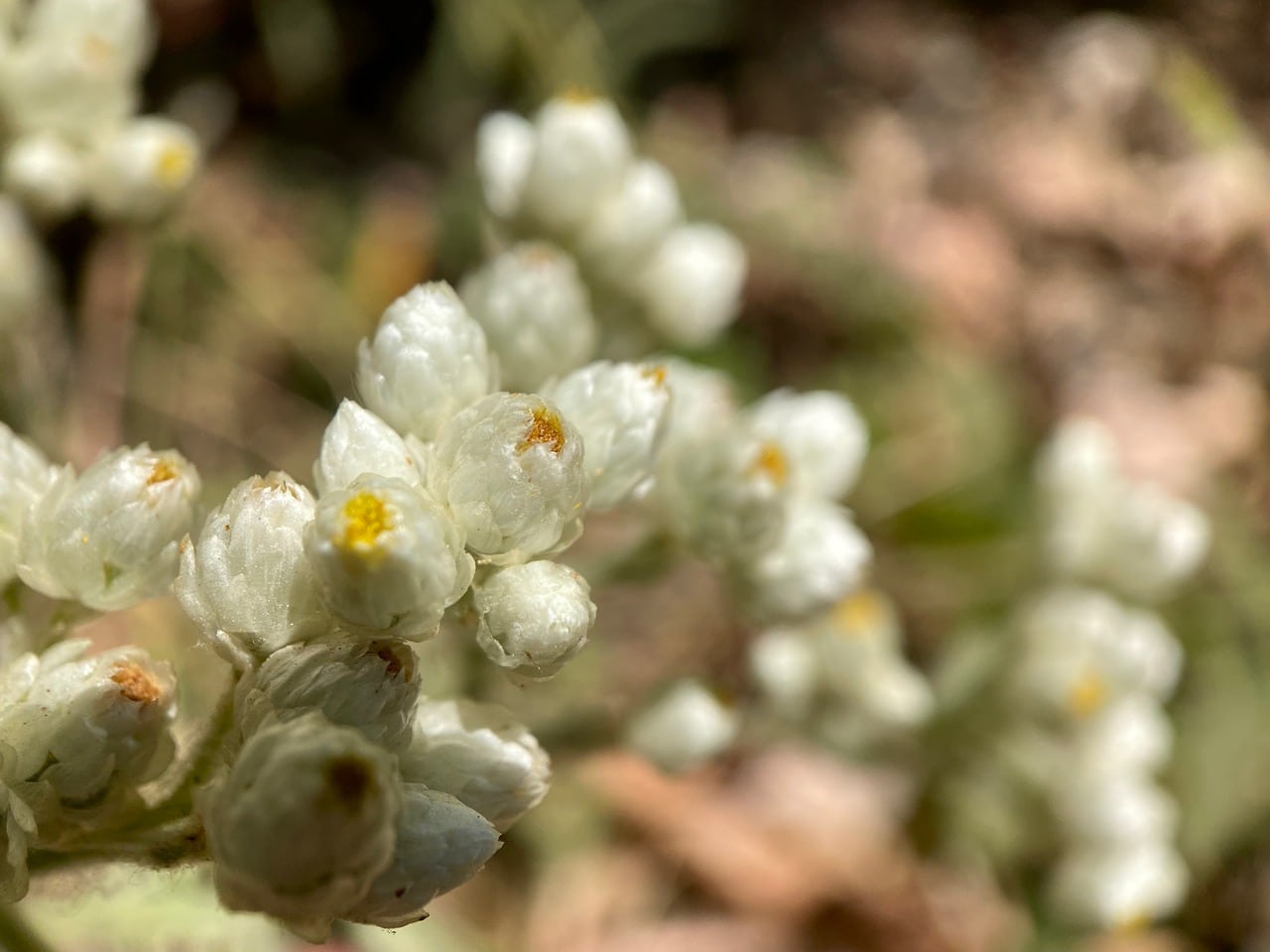
I am glad that the extensive weeding and brush clearing in the park has spared this California Everlasting, Pseudognaphalium californicum. It is blooming gloriously, with silvery white flowerheads shining in the sunlight.
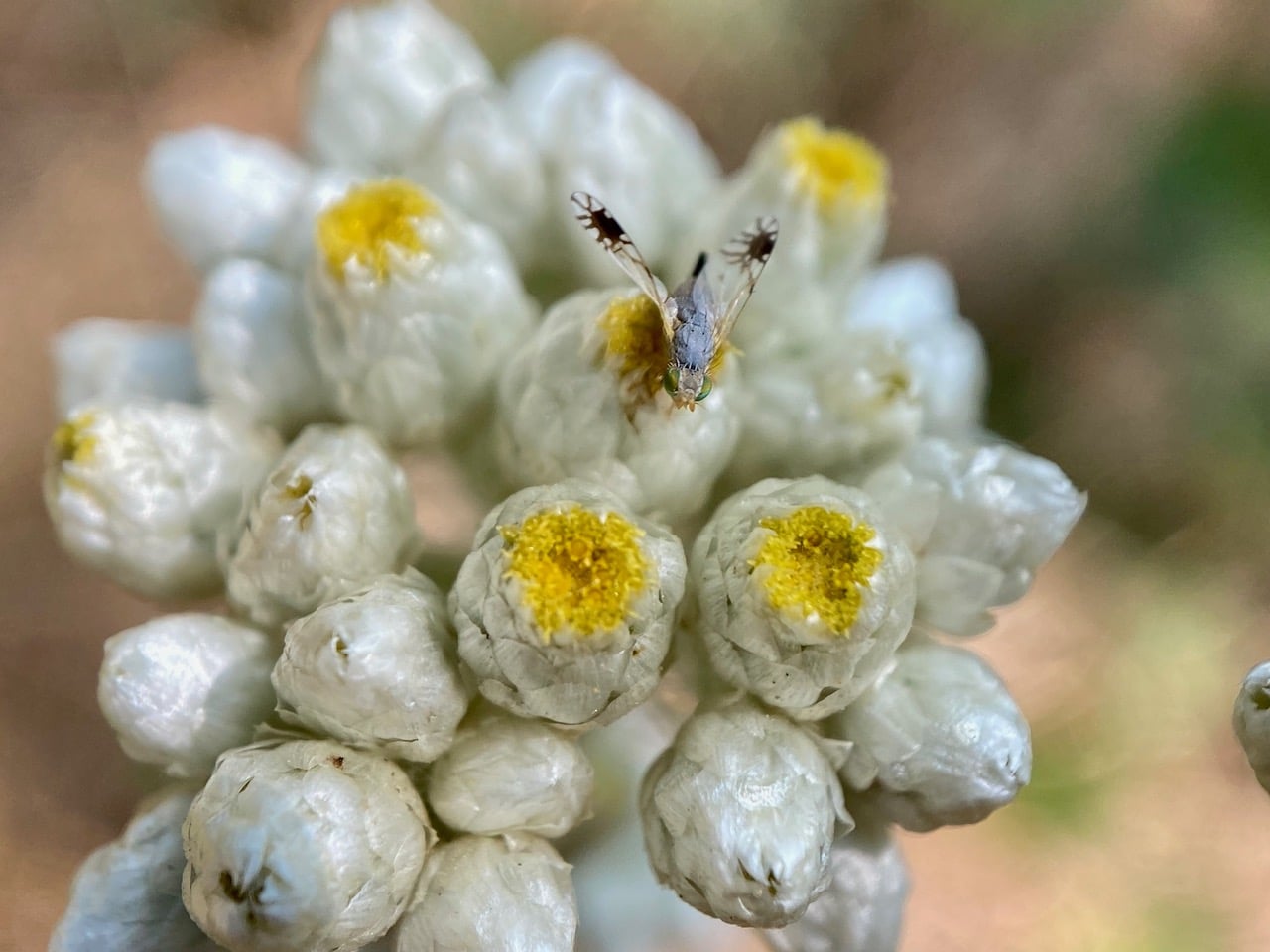
The California Everlasting inflorescence is a wide cluster of egg-shaped flowerheads, each enveloped in an involucre of rows of overlapping, papery, shiny white phyllaries. Nestled within the phyllaries are numerous, very small individual florets. The flower parts are indistinct, seen at the tip and are yellow to brownish. On maturity, the phyllaries spread apart to release small seeds which are wind-dispersed by means of pappus.
In the everlastings, the phyllaries closely enclose the tiny florets. This would seem to deter many pollinators. According to one authority, many species of everlasting are probably self-pollinated, although the small openings may be visited by small flies, bees and wasps.
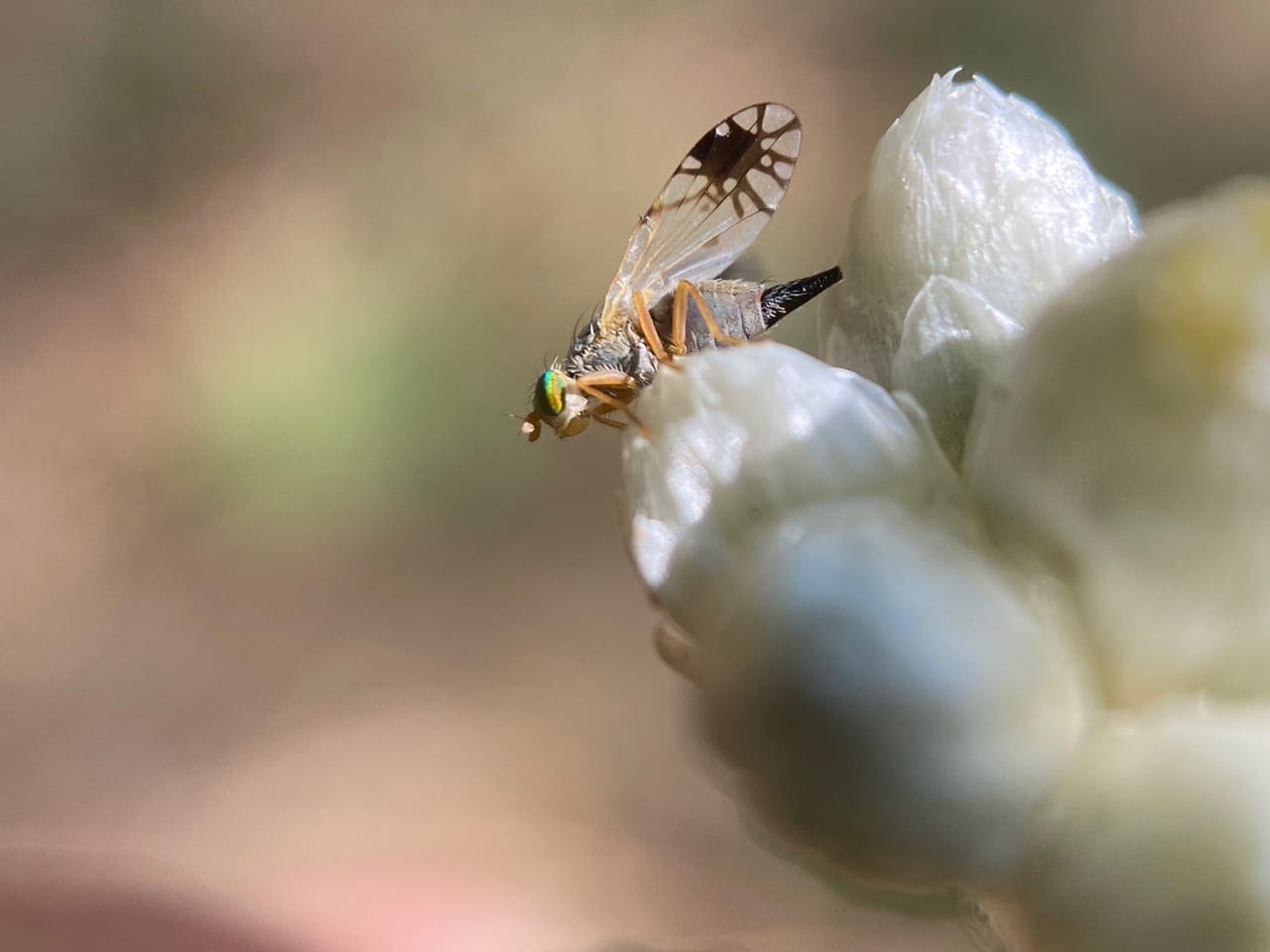
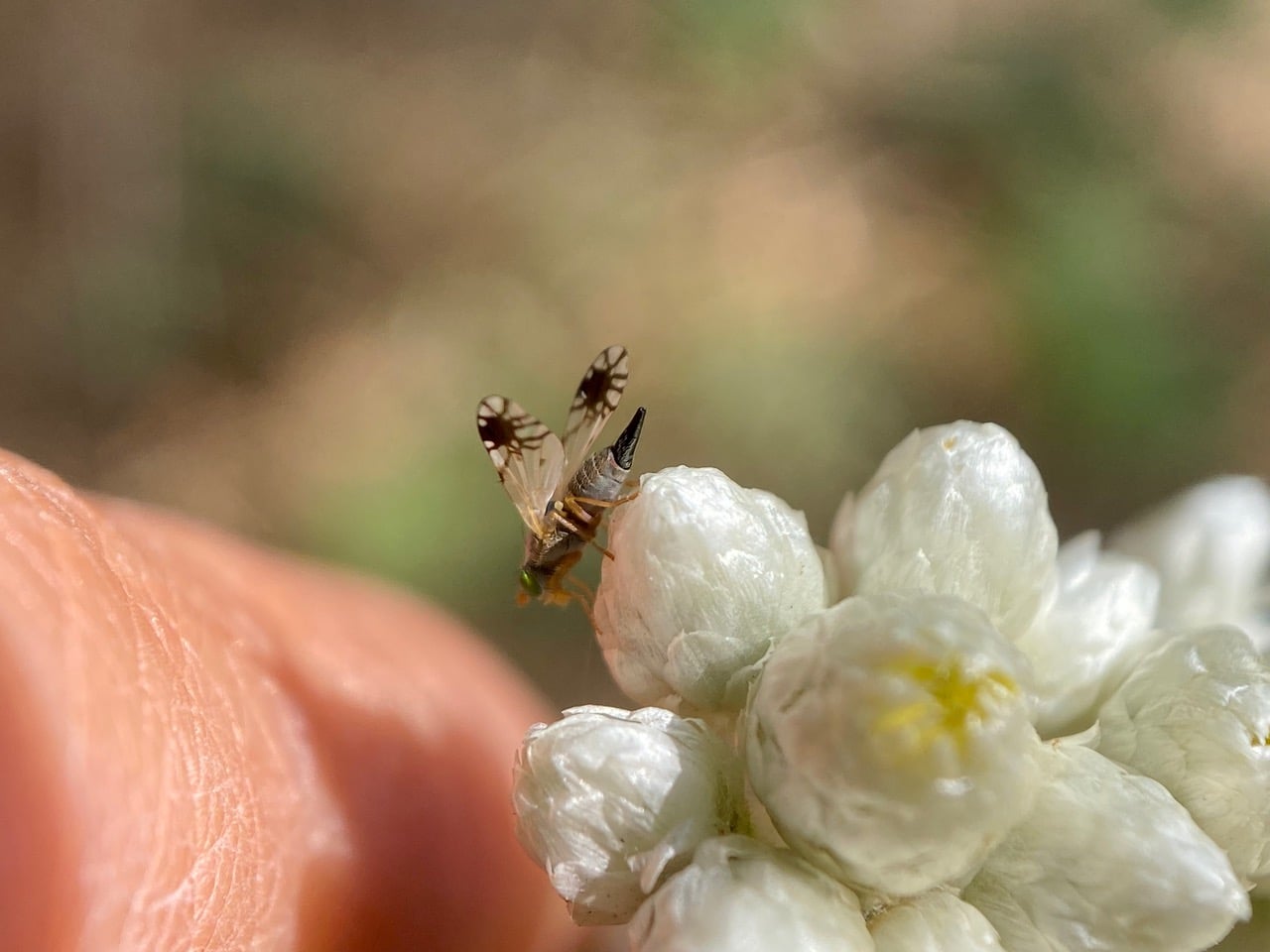
A tiny Fruit Fly Trupanea californica (family Trephritidae) waving its picture wings atop one of the egg-shaped flowerheads. The presence of an oviscape at the tip of its abdomen tells me that it is a female. She is waving her wings alternately in semaphore-style, twisting them in figure-8 motion. Is she sending messages with that wing display?
Tephritids are small to medium-sized flies that are often colorful, and usually with picture wings. The larvae of almost all Tephritidae are phytophagous. Females deposit eggs in living, healthy plant tissues using their telescopic ovipositors. Here the larvae find their food upon emerging. The larvae develop in leaves, stems, flowers, seeds, fruits, and roots of the host plant, depending on the species. Adults are often found on the host plant and feeding on pollen, nectar, rotting plant debris, or honeydew. Tephritid flies are of major economic importance as they can cause damage to fruit and other plant crops. On the other hand, some Tephritids are used as agents of biological control of noxious weeds.
Female Fruits Flies are easily distinguished by the presence of an oviscape – the pointy structure at the tip of their abdomen. The oviscape is the basal part of the ovipositor, the non-retractile sheath that protects the ovipositor. It remains exposed when the ovipositor is withdrawn and not in action.
Trupanea californica reproduces in the flowerheads of Gnaphalium and related genera in Asteraceae. The larvae feed mainly on the ovules and achenes of their host plants.
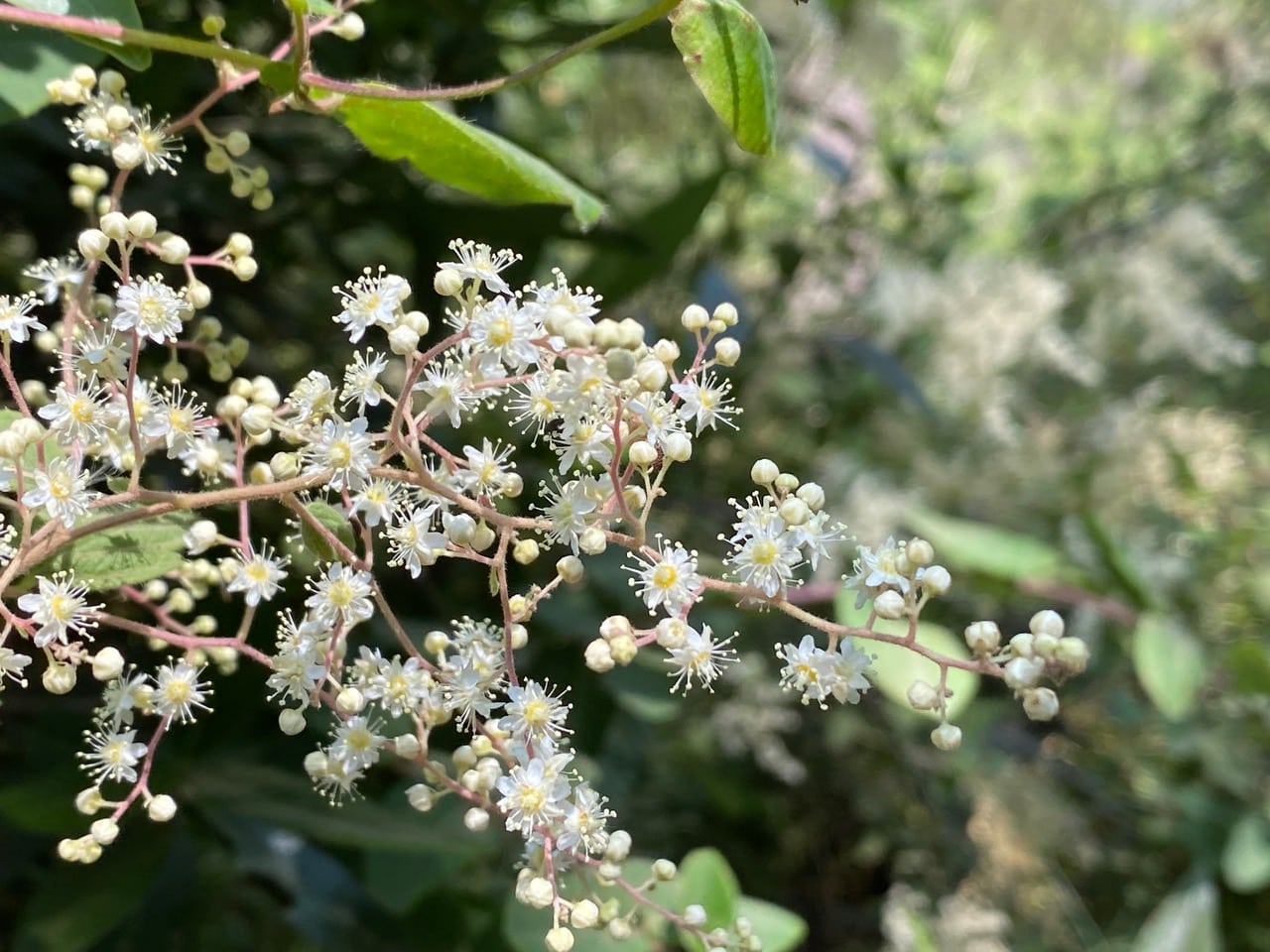
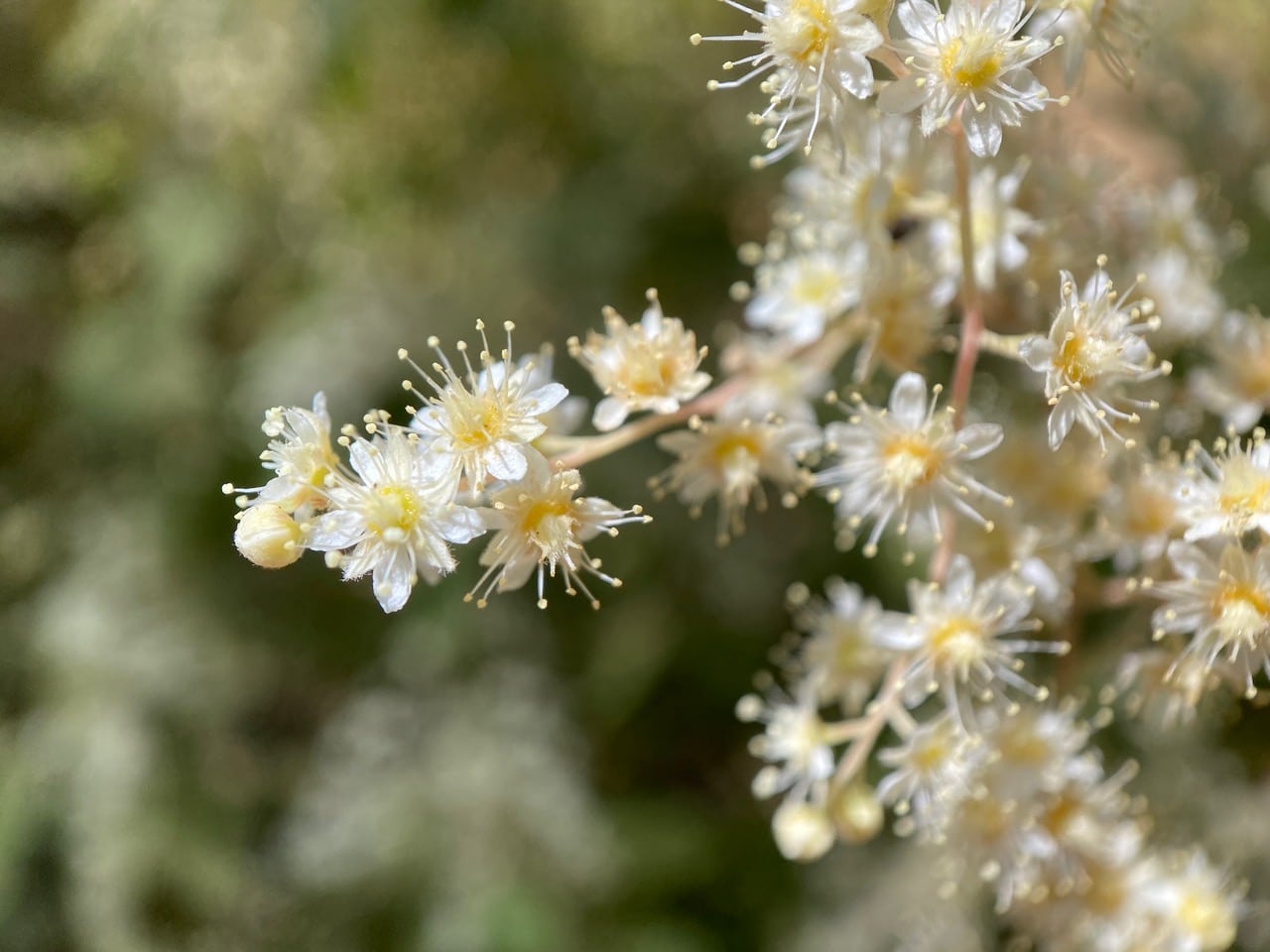
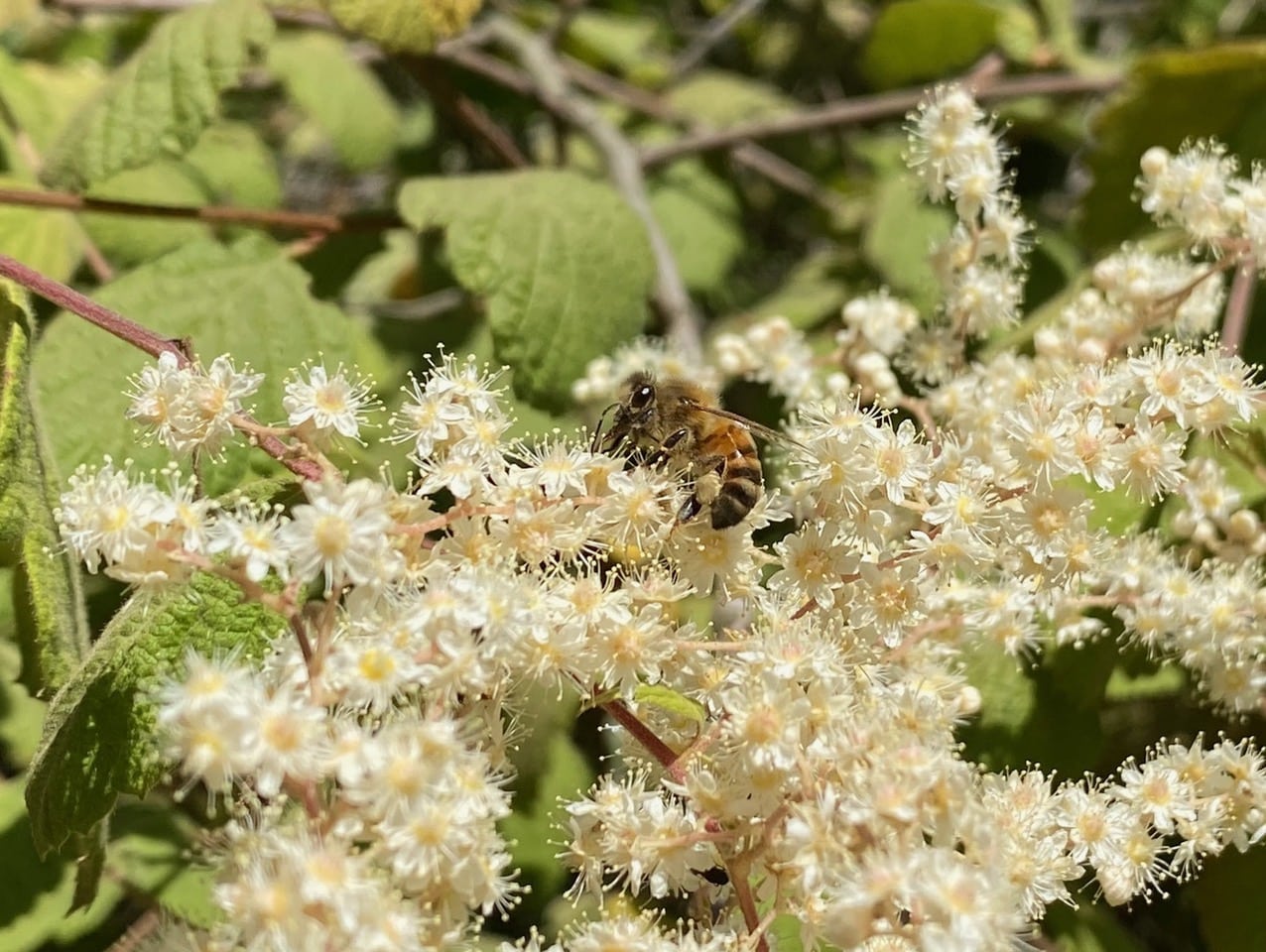
As its common name of Ocean Spray describes, Holodiscus discolor is blooming on the drooping branch tips in cascades of cream-colored inflorescences. There are no more Longhorn Fairy Moths dancing in courtship display over the plant at this stage, but the tiny flowers attract plenty of other insects.
Ocean Spray or Creambush, Holodiscus discolor is a fast-growing deciduous shrub in the rose family, Rosaceae found commonly in western North America in diverse habitats. With its numerous fully-exserted stamens, and a subtle fragrance, the plant is visited by a large diversity of insects. The shrub is of special value as a pollinator plant for native bees and butterflies. It is also a larval host to Lorquins’s admiral, pale swallowtail, spring azure, and Longhorn Fairy Moth caterpillars.
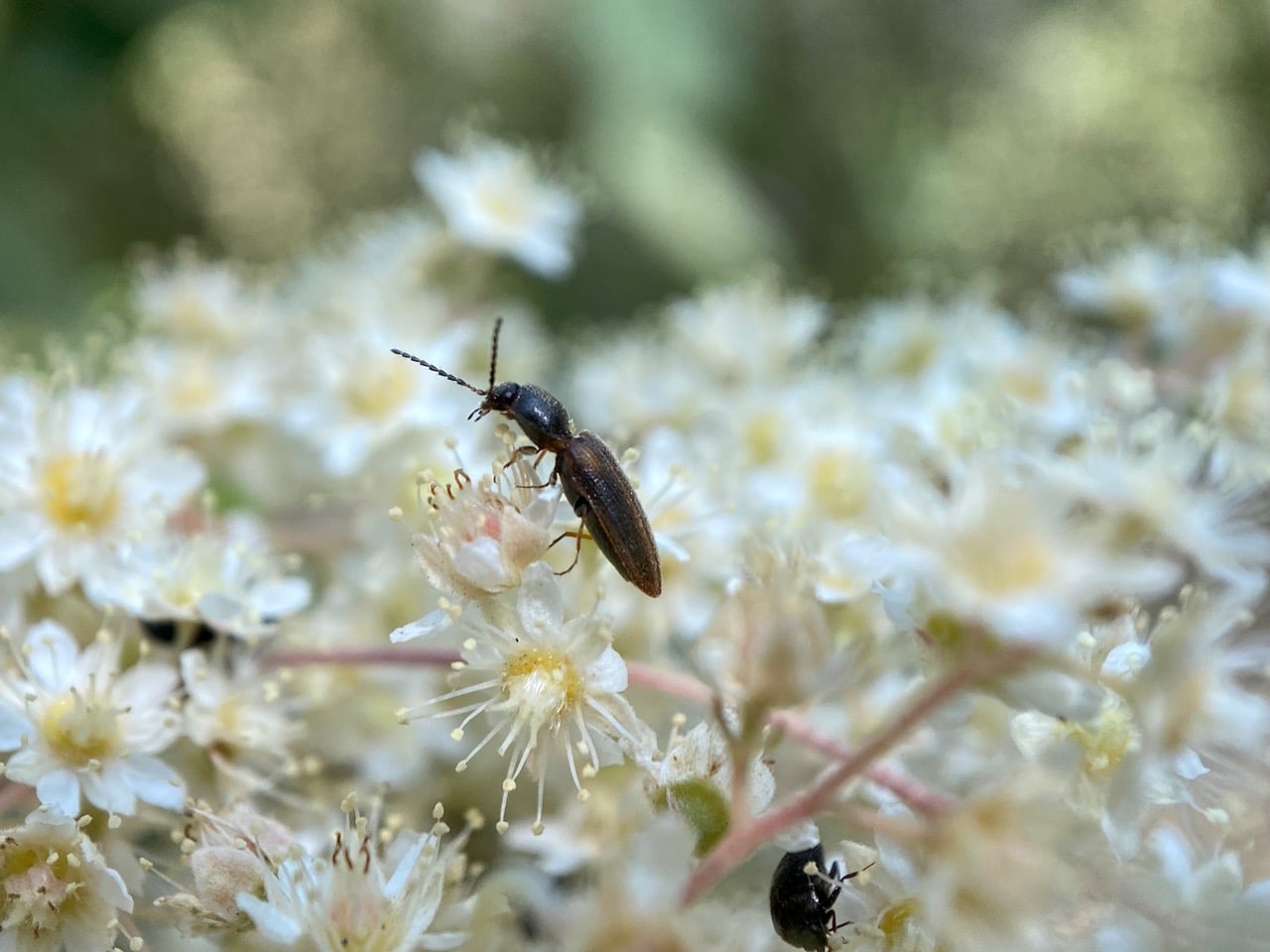
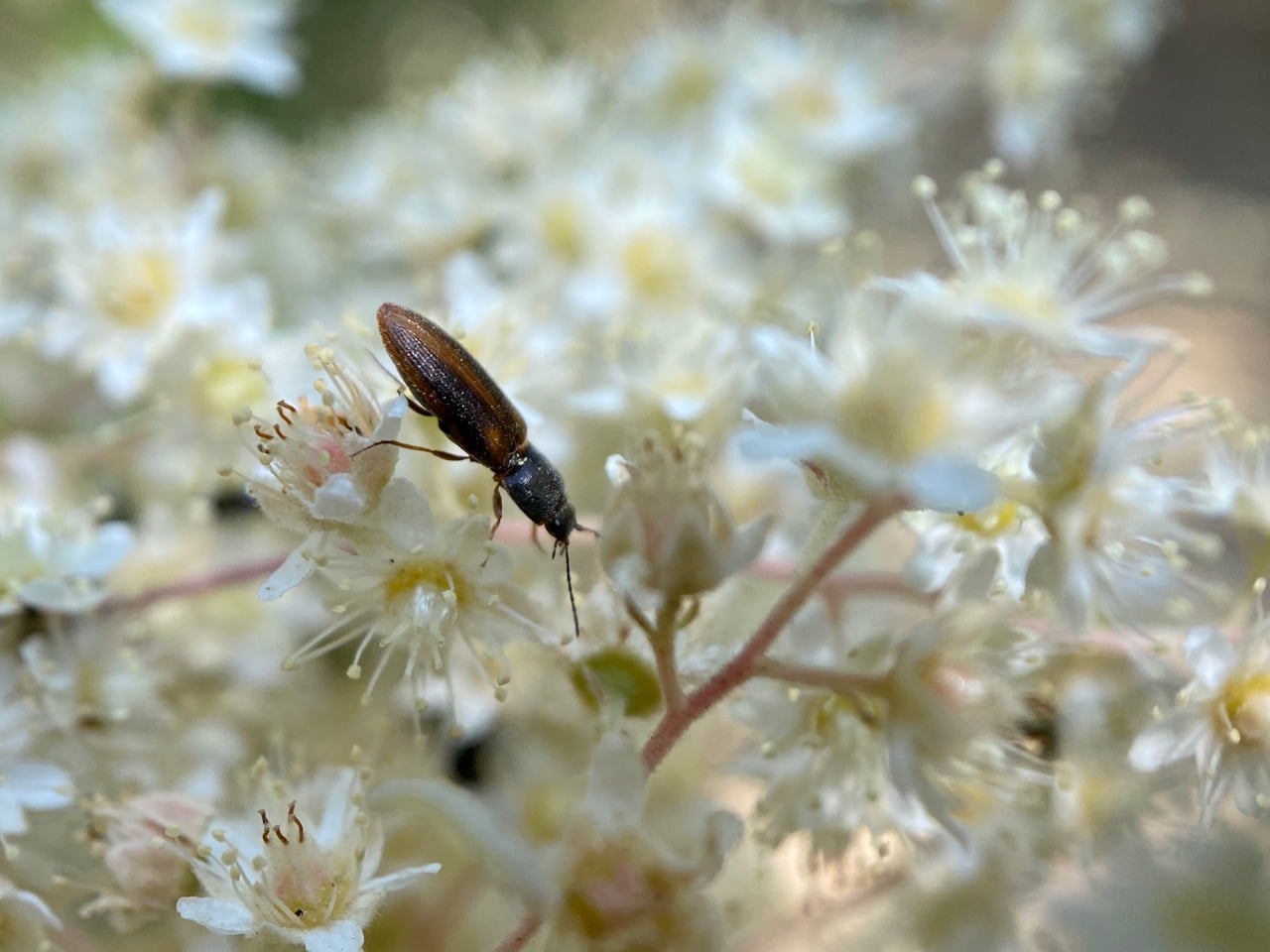
That is the smallest Click Beetle (family Elateridae) I have ever seen!
Elateridae or Click Beeltes are a cosmopolitan beetle family characterized by the unusual click mechanism they possess. A spine on the prosternum can be snapped into a corresponding notch on the mesosternum, producing a violent “click” that can bounce the beetle into the air. Clicking is mainly used to avoid predation, although it is also useful when the beetle is on its back and needs to right itself.
Adult Click Beetles are typically nocturnal and phytophagous (feeding on plants). Their larvae, called wireworms, are usually saprophagous, living on dead organisms, but some species are agricultural pest, and others are active predators of other insect larvae.
Honey Bees, Apis mellifera (family Apidae) flock to the Ocean Spray flowers for both nectar and pollen.
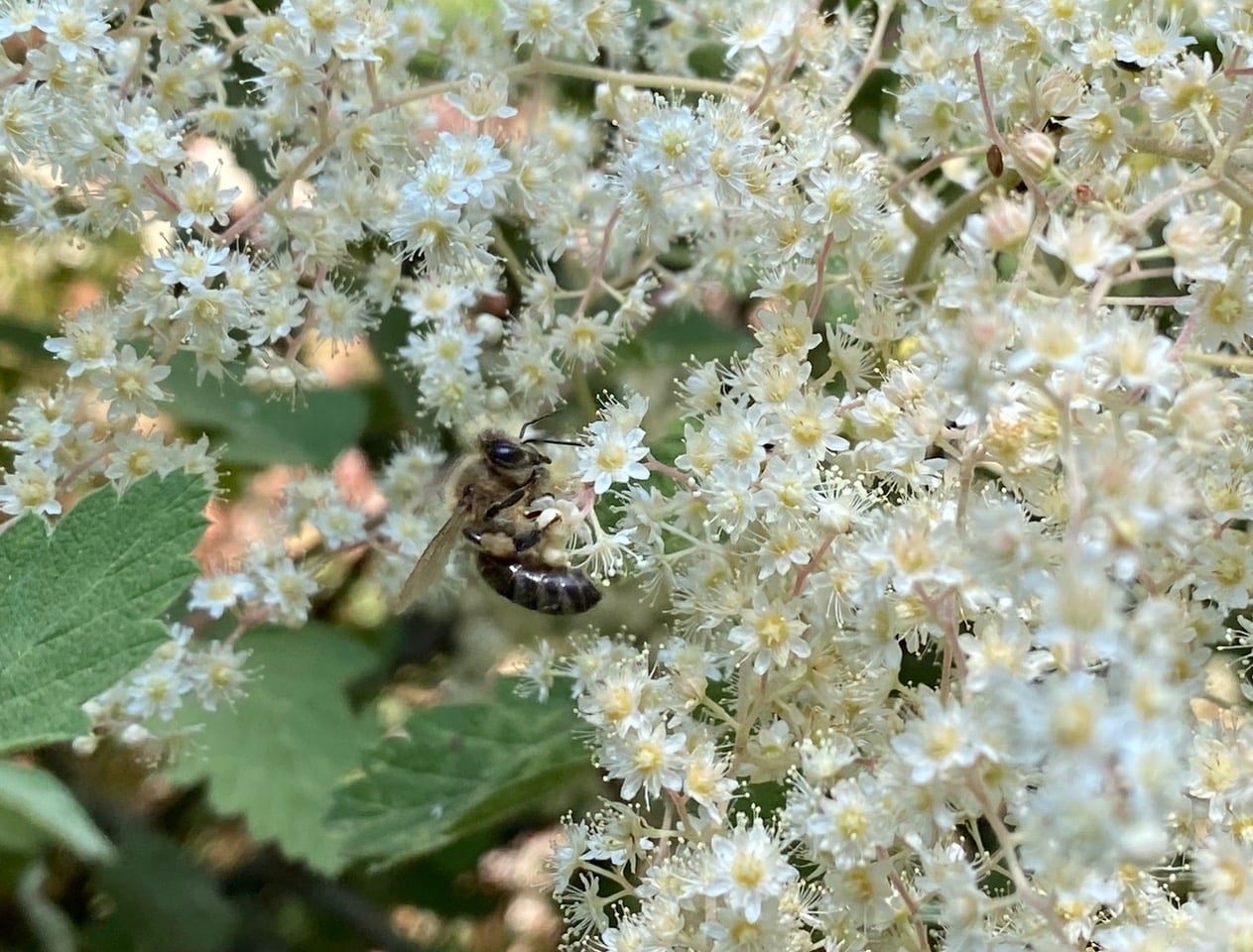
Ooh, that’s one of those dark Honey Bees. I have been seeing more of them as the season warms.
I find only confusing information about these dark honey bees online. One theory posits that the black coloration results from older bees having their hairs rubbed off from their abdomen by their hive mates. I can’t subscribe to that since the yellow color is part of the integument, and is not conferred by the abdominal hairs.
Another theory posits that these black bees are a subspecies, Apis mellifera mellifera, the so-called European Dark Bee, or the German Dark Bee. However, the subspecies is only found in one small region of the world, and not known to have been introduced to America. It’s also proposed that genetic mutation may cause a rare handful of bees to turn black, but this is very uncommon. Others think that the bee might have been infected with a virus that turns the bees black. This is typically why black bees are found dead in abandoned hives.
Most beekeepers know that there’s color variations in Honey Bees. A queen honey bee only mates over a few days early in her life. During these mating flights, she mates with 12-20 drones or males. These drone fathers come from many different colonies within the flight region. The queen bee has a spermatheca to store sperm and an enormous warehouse of eggs. Naturally, this results in a colony of worker bees that may be different colors. All colony members have the same mother but there are many different fathers that contributed to the genetic pool. Italian honey bees tend to be lighter in color with brighter yellow markings. The darker Carniolans are characterized by being winter hardy, quick spring build up and superior disease resistance. Russian honey bees also tend to be darker. If you see many darker bees, they are likely related to Russians or Carniolans.
Honey Bees do not change color during their lifetime. The color changes in the hive members are due to workers being born with different fathers. Are the Carniolan and Russian genes being expressed preferentially in the fall to enhance winter survival? Does this mean that the queen bee can exert control over which sperm she uses to fertilize her eggs? Anyway, genetic diversity is a good thing, conferring strength, flexibility and resilience to the colony.
None of the above theories explain why the black bees are more often found in late summer. One would think that the black coloration is not a good adaptation for the hot summer, as black would absorb more heat. The phenomenon remains a mystery to me.
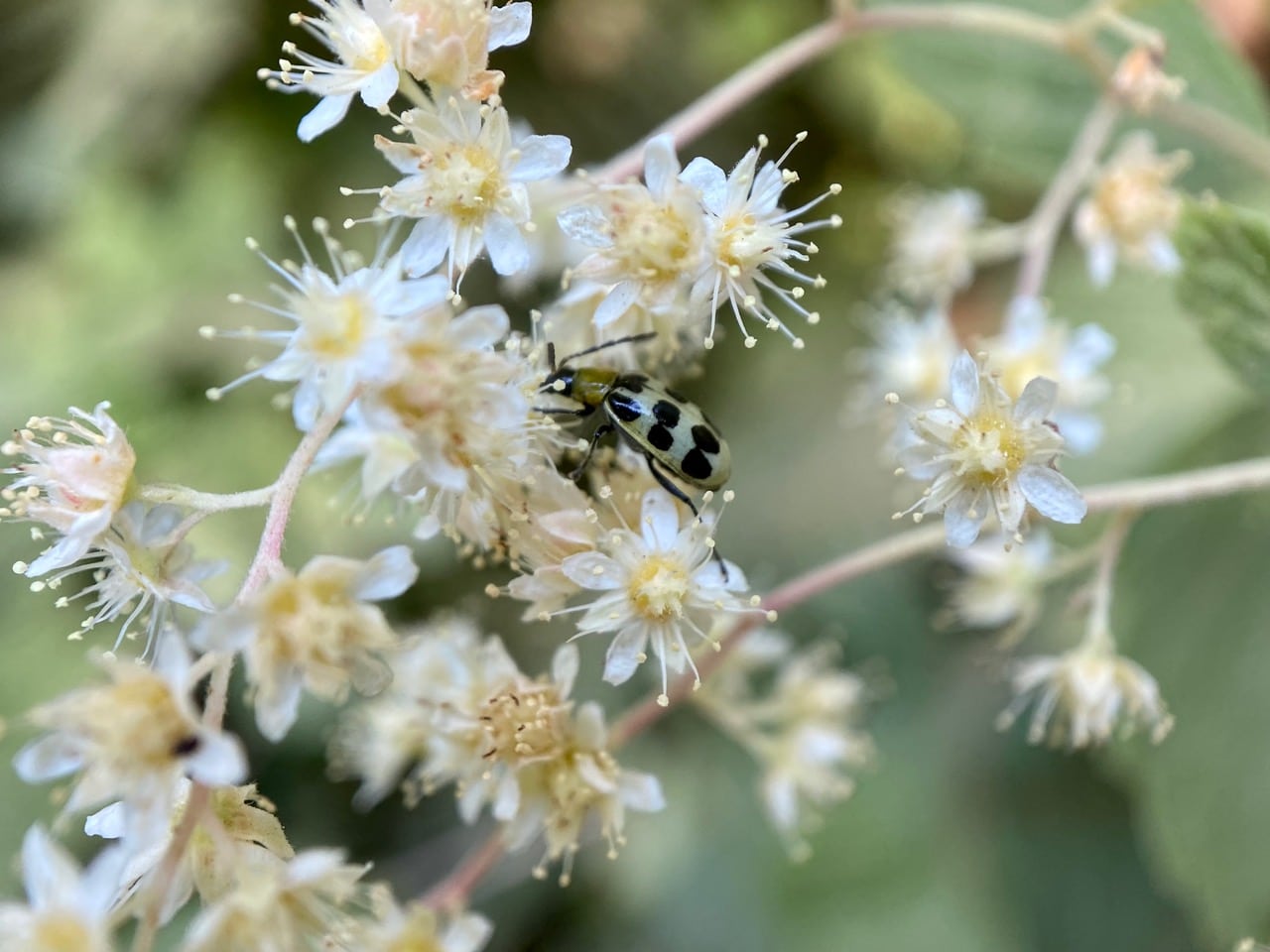
It’s no surprise to find the ubiquitous Spotted Cucumber Beetle, Diabrotica undecimpunctata (family Chrysomelidae) among the Ocean Spray flowers.
Native to North America, the beetle can be a major agricultural pest, causing damage to crops in the larval as well as adult stages of their life cycle. Larvae, sometimes known as rootworms feed on the roots of emerging plants. In the adult stage the beetles cause damage by eating the flowers, leaves, stems and fruits of the plant.
Spotted Cucumber Beetle (Diabrotica undecimpunctata) · iNaturalist
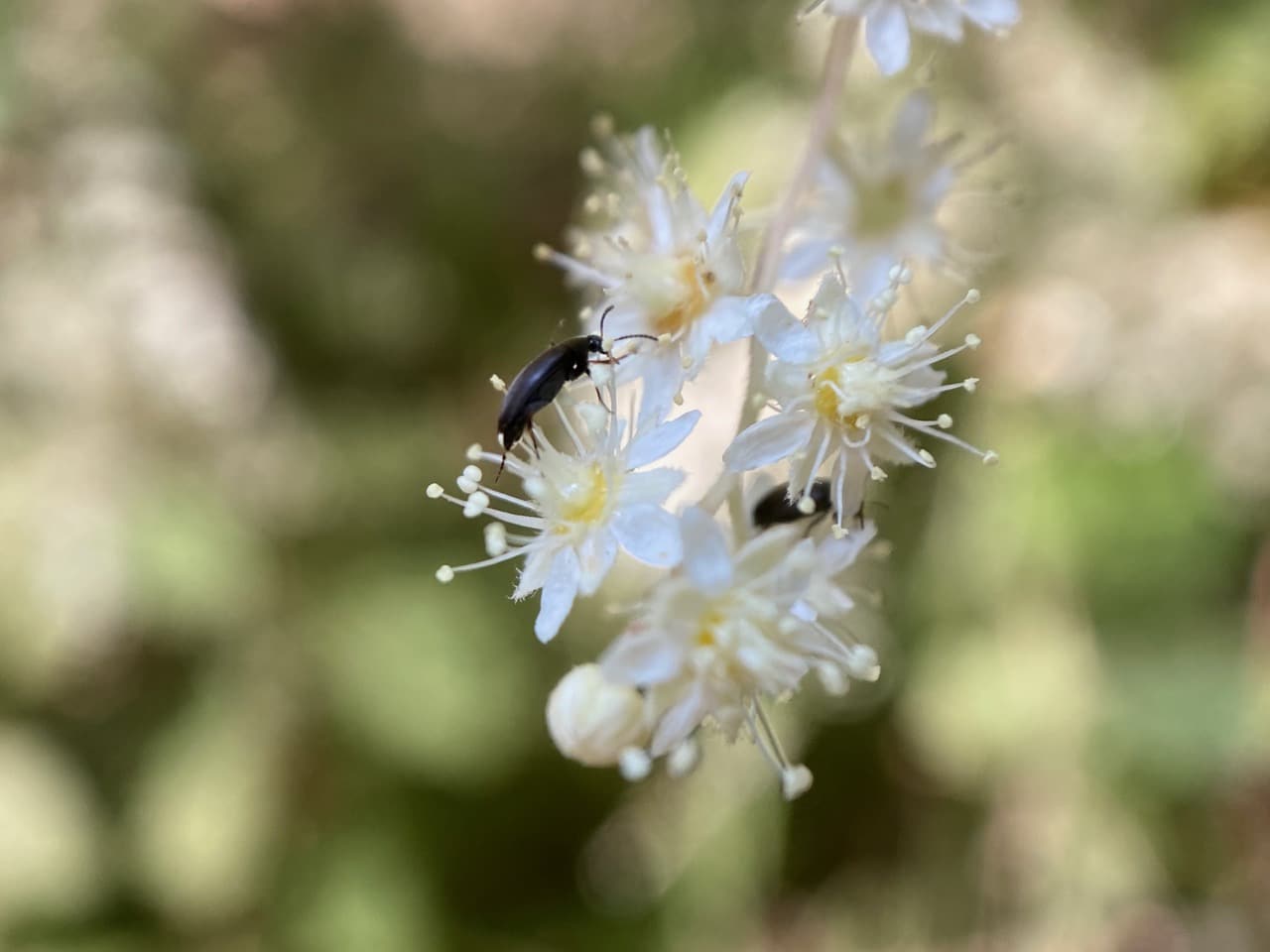
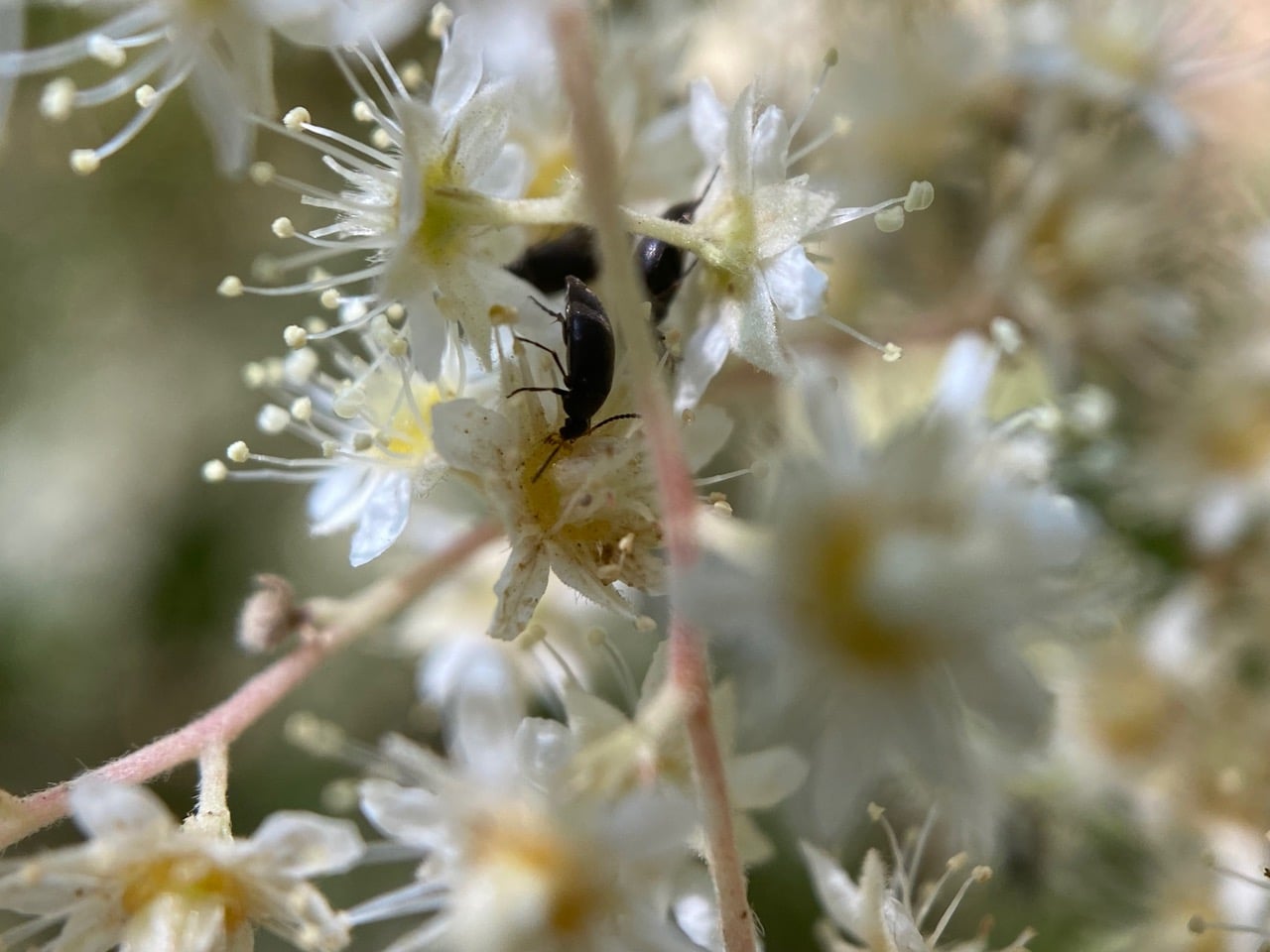
Numerous small black beetles are feeding among the flowers. These are False Flower Beetles, Anaspis sp. (family Scraptiidae).
False Flower Beetles, Anaspis atrata (family Scraptiidae) are commonly found in western North America. The adults are found on flowers, sometimes in large numbers, but are also found on foliage. The larvae are typically found under the bark of dead trees or lichens.
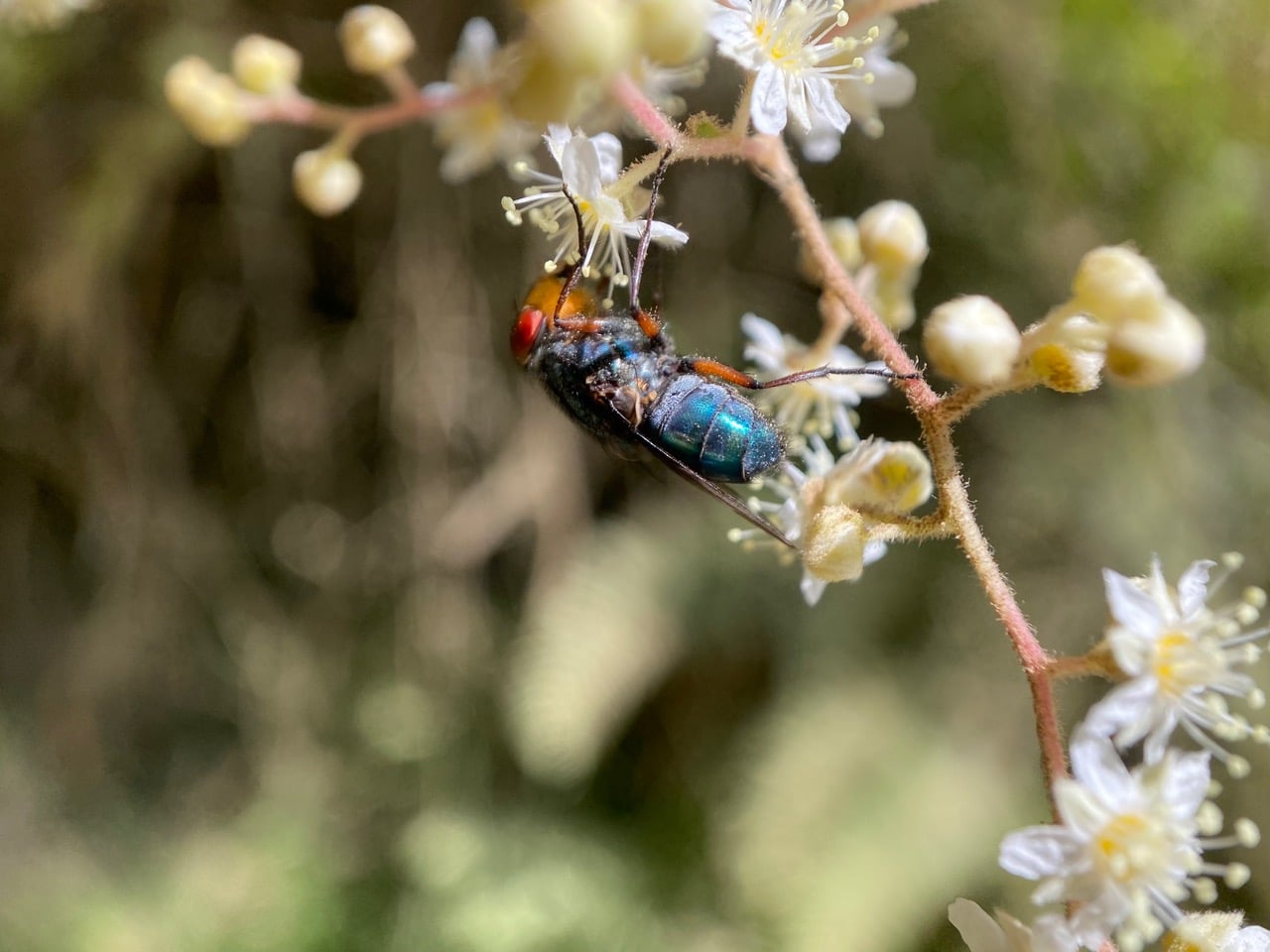
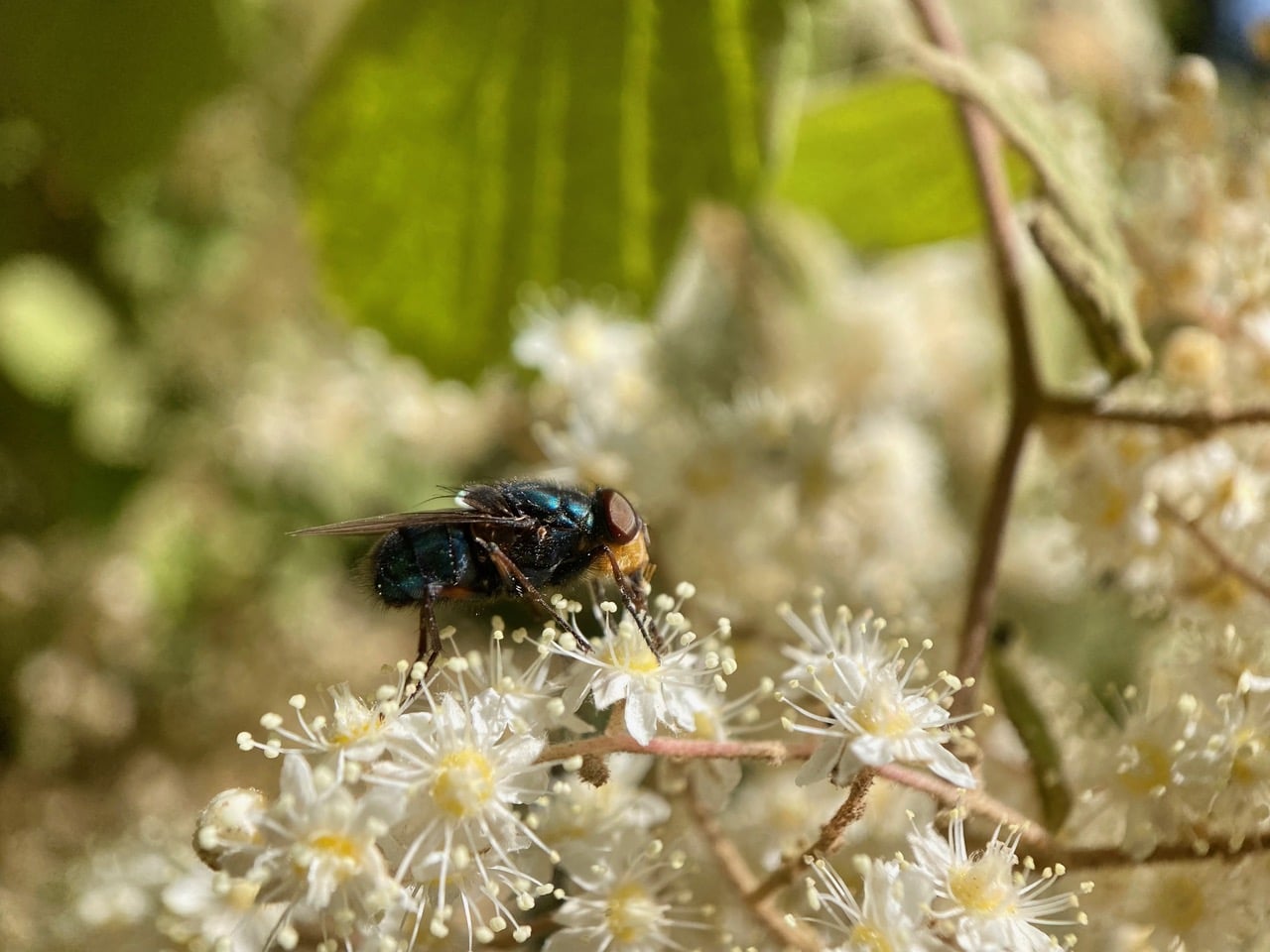
A Blowfly, Compsomyiops callipes (family Calliphoridae) is walking over a dense cluster of Ocean Spray flowers.
The Blowfly, Compsomyiops callipes (family Calliphoridae) is a warm weather fly that can be found in southwestern parts of the United States and parts of South America. It is more abundant in rural and riparian areas as opposed to urban settings. It is a relatively large fly with a length of about 6-12 mm. Its abdomen and thorax are a metallic blue color. It has a bright yellow gena and four longitudinal lines on its pronotum. The gena is a flattened area on the side of the head below the eyes and above the mouthparts. Along with other head structures, the gena plays a role in the fly’s sensory perception and feeding. The fly is attracted to carrion, and can smell carrion from up to 10 miles away. The species has been involved in case studies in California where it has been the primary fly found on human remains.
The Blowfly, Compsomyiops callipes has been intensively studied for its importance in forensic entomology. Its larval development/ life cycle is used to solve criminal cases by determining the post mortem interval (PMI), time of death, and location of crime. The fly’s life cycles allow the entomologist to determine their age and how long they have been present based on their succession pattern.
While they are primarily recognized for their role as scavengers, particularly attracted to carrion where they lay their eggs, adult blowflies utilize nectar as an energy source to fuel their flight and other activities. The nectar consumption also facilitates their role as pollinators, as they can inadvertently transfer pollen from one flower to another as they feed.
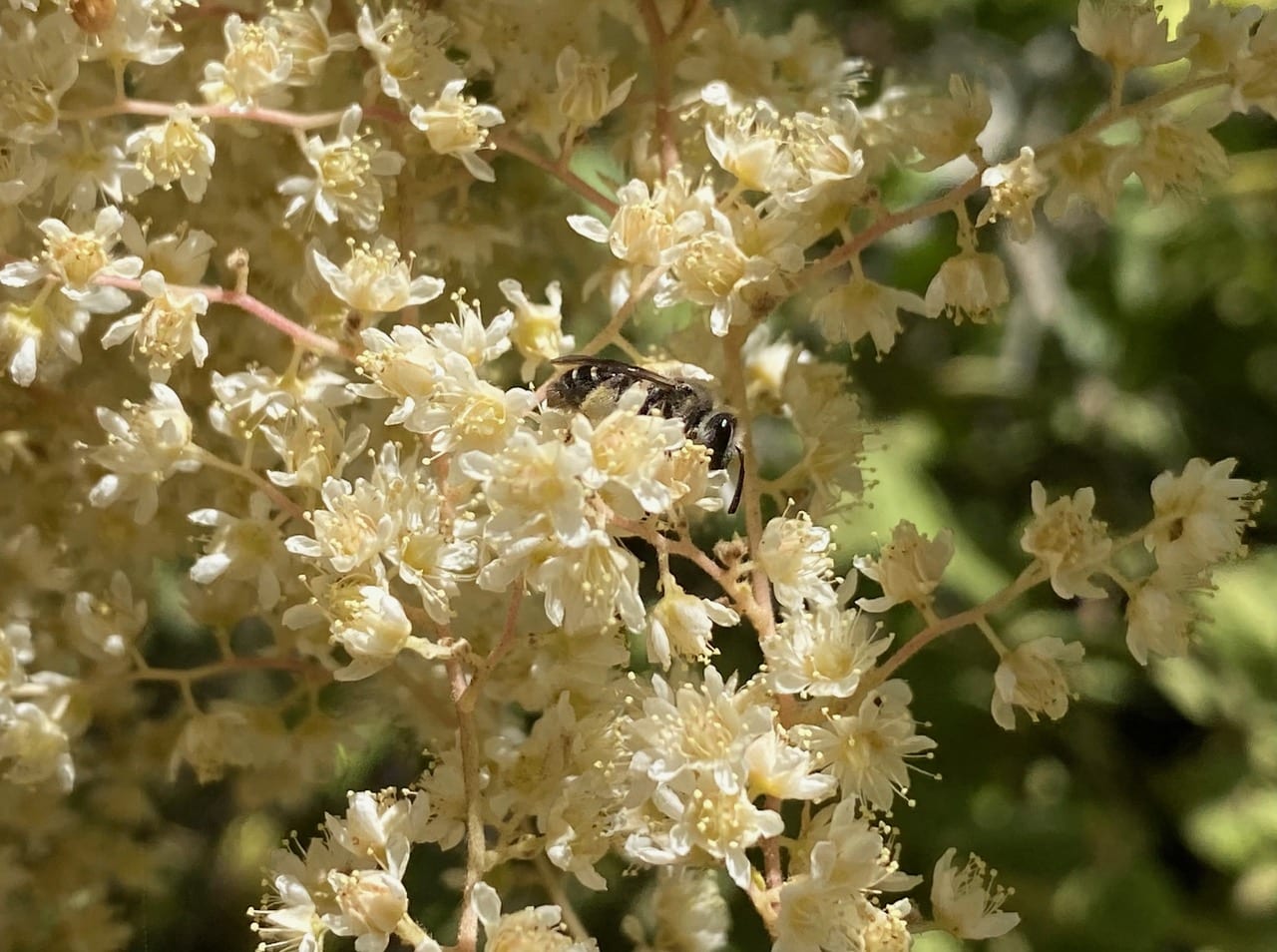
Ooh, there’s a small black bee moving among the Ocean Spray flowers.
The bee has some pollen in her scopae on the hind legs. Unfortunately I don’t see enough of the bee to be able to identify it, even to the family.
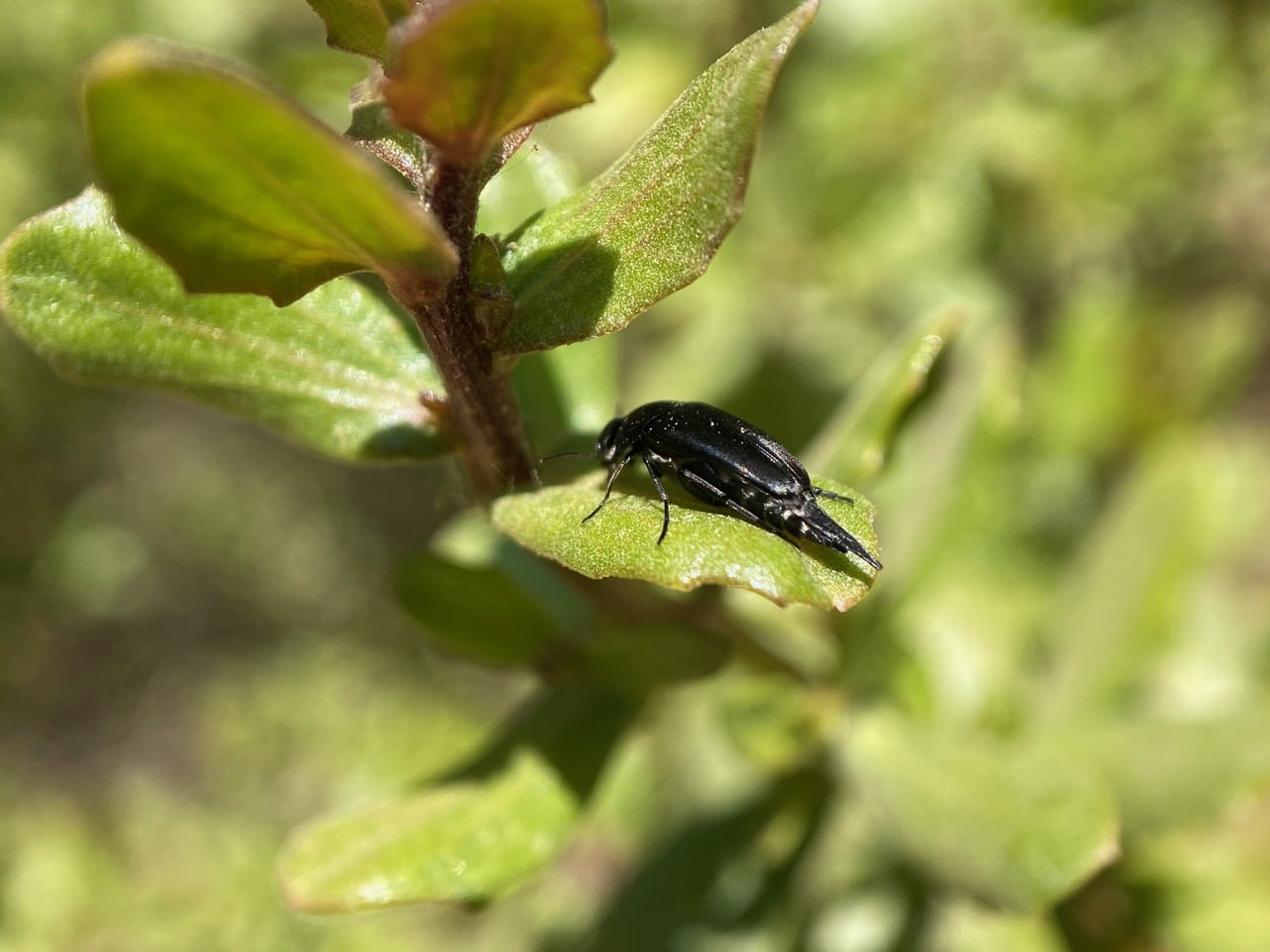
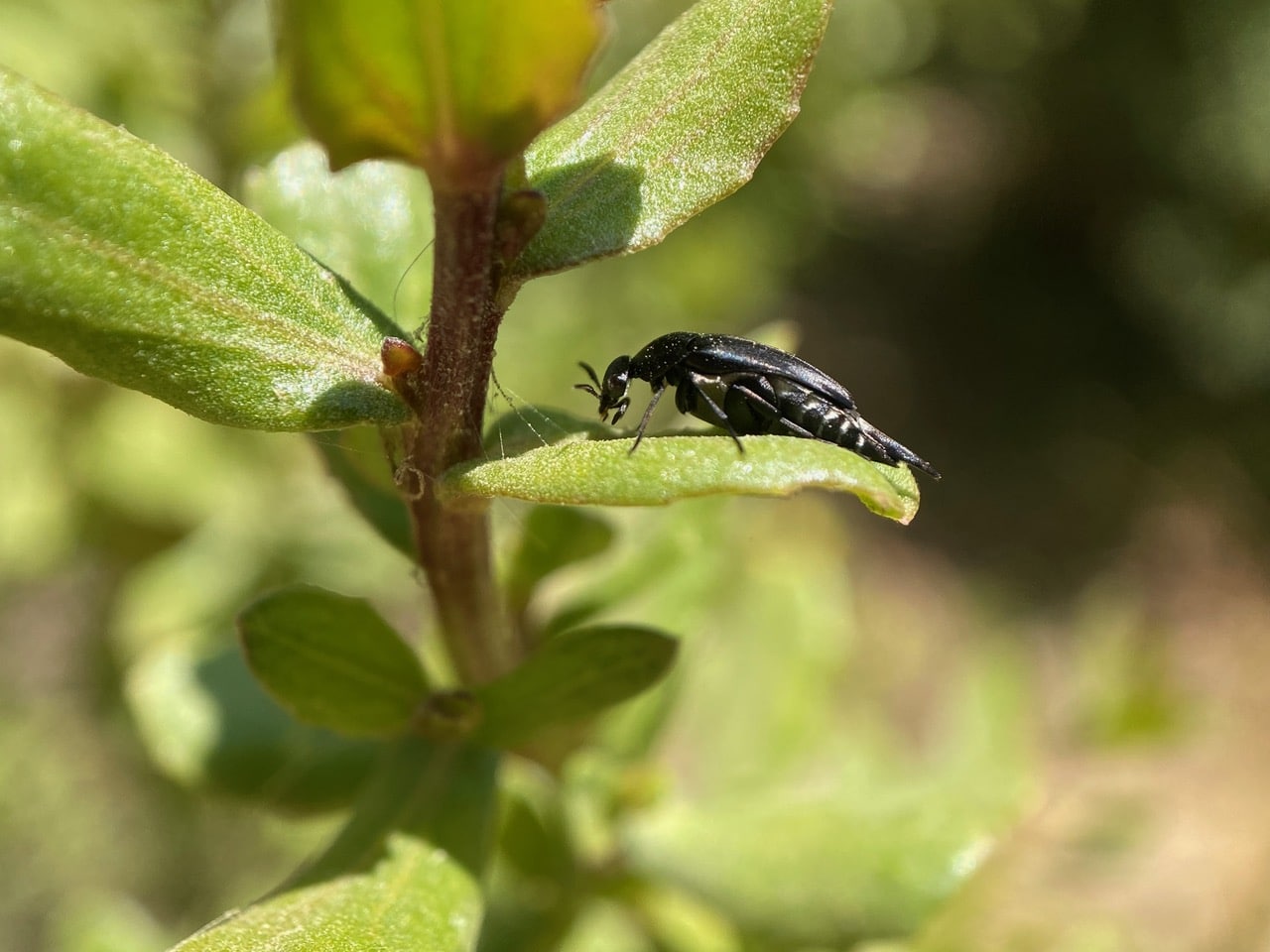
A small black beetle with a long, pointed tail is perched on a leaf of Coyote Brush, Baccharis pilularis. It is easily recognizable as the Tumbling Flower Beetle (family Mordellidae).
iNaturalist has helped identify the beetle to the species Mordella hubbsi (family Mordellidae).
The Tumbling Flower Beetles (family Mordellidae) are named for the characteristic irregular movements they make when escaping predators. They are also sometimes called Pintail Beetles for their abdominal tip which aids them in performing these tumbling movements. Mordellids are small, wedge-shaped, hump-backed beetles with head bent downward. The body is densely covered with fine silky hairs, usually black, but often very prettily spotted or banded with silvery hues. The adults feed on pollen, occurring on flowers or on dead trees, flying or running with rapidity. The larvae live in old wood or in the pith of plants, and those of some species are said to be carnivorous, feeding on the young of Lepidopterans and Diptera which they find in the plant stems.
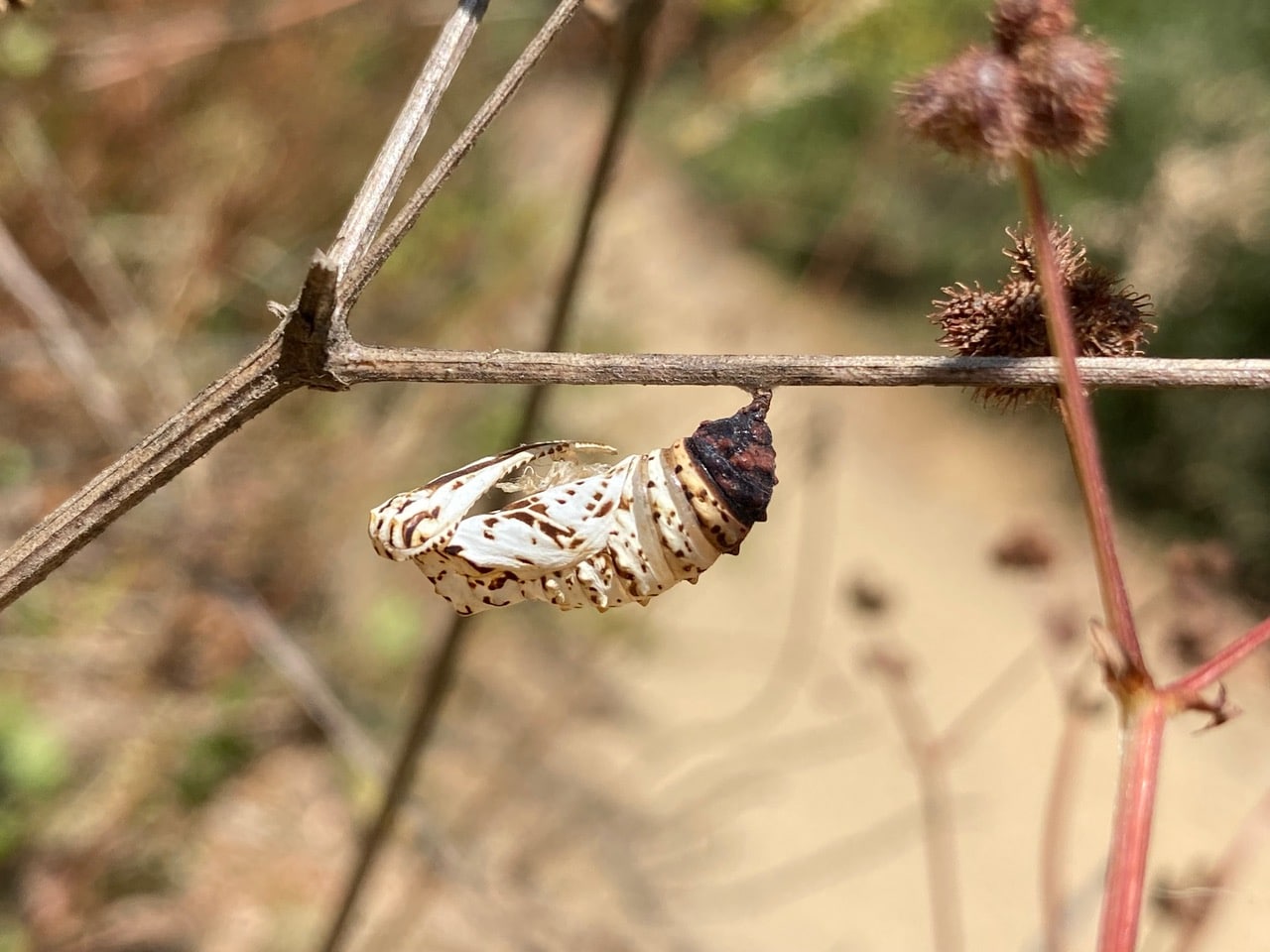
Ooh, there’s an empty chrysalis shell still attached to the dried stem of Pacific Sanicle. I recognize it as that of a Variable Checkerspot, Euphydryas chalcedona (family Nymphalidae), having reared dozens of the butterfly in the past. I wonder what plant the caterpillar has been feeding on before it went into pupation. The larvae of the species are known to feed on a wide variety of plants, notably the Bee Plant and the Sticky Monkeyflower, both prevalent along this trail.
Most caterpillars do not pupate on the host plants that they feed on. When mature, they wander off in search of a protected site. They often use surfaces that are hard and firm, such as a tree trunk or fence post.
It was formerly thought that pupation is a quiescent resting period in a butterfly’s life cycle. Nothing can be further from the truth. The chrysalis is a hotbed of demolition and reconstruction.
Photo taken on 5/2/25 at Stefanie’s garden, where she has been rearing several Variable Checkerspot caterpillars in a soft cage.
A freshly eclosed Variable Checkerspot butterfly is still clinging to its chrysalis shell while its wings expand and harden. What a magnificent creature!