

Pollinator Post 6/23/24
I recently heard about the volunteer-tended native garden in Mendocino Park in Richmond, and decide to visit the place this morning. It is a 0.4 acre suburban park in the hills of Richmond, consisting of a children’s playground and picnic area bordered by wide strips of plantings. Not surprisingly, the garden is already past its prime, but there’s still enough late blooming natives to support insect activities.
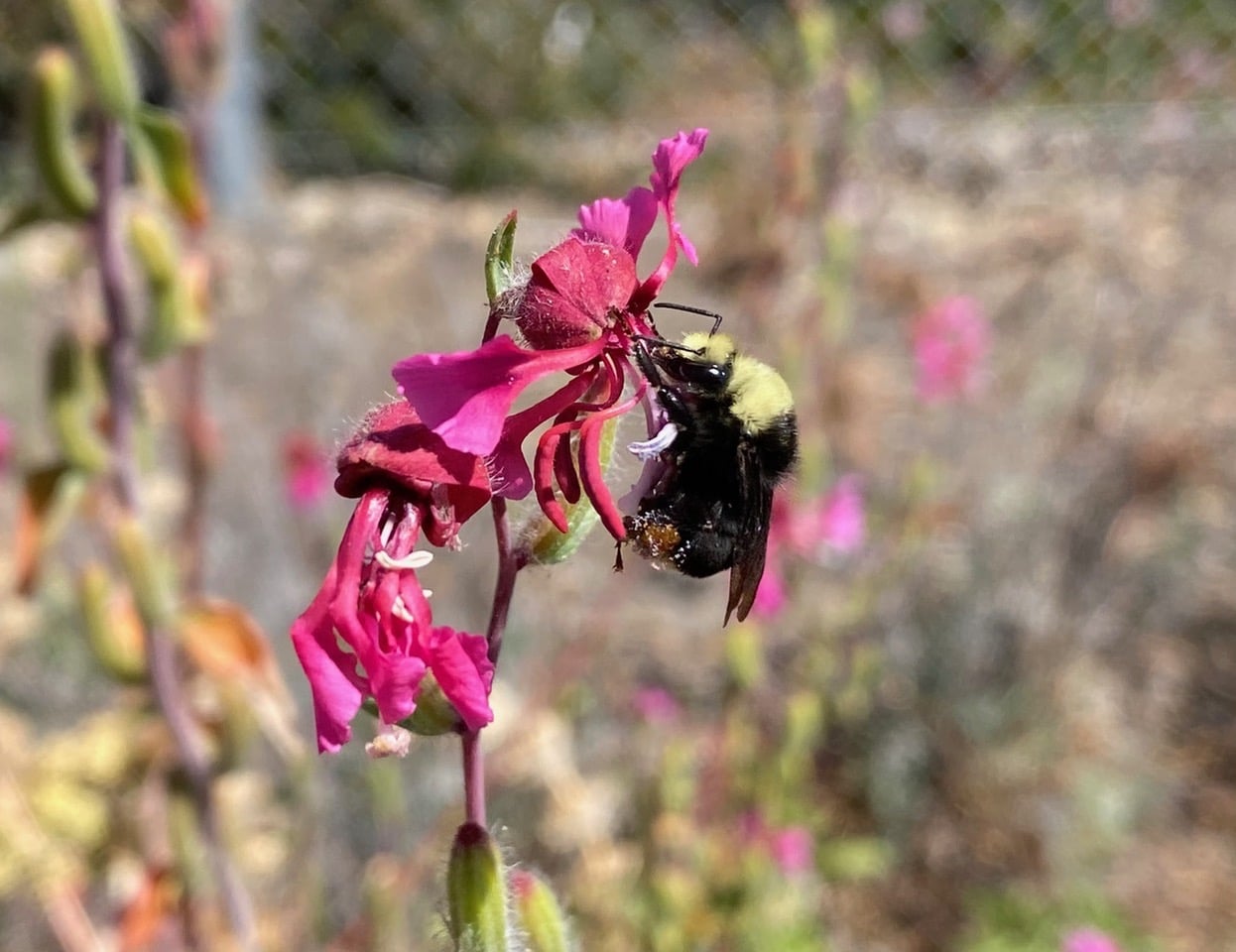
A Yellow-faced Bumble Bee, Bombus vosnesenskii (family Apidae) is taking nectar from a flower of Elegant Clarkia, Clarkia unguiculata
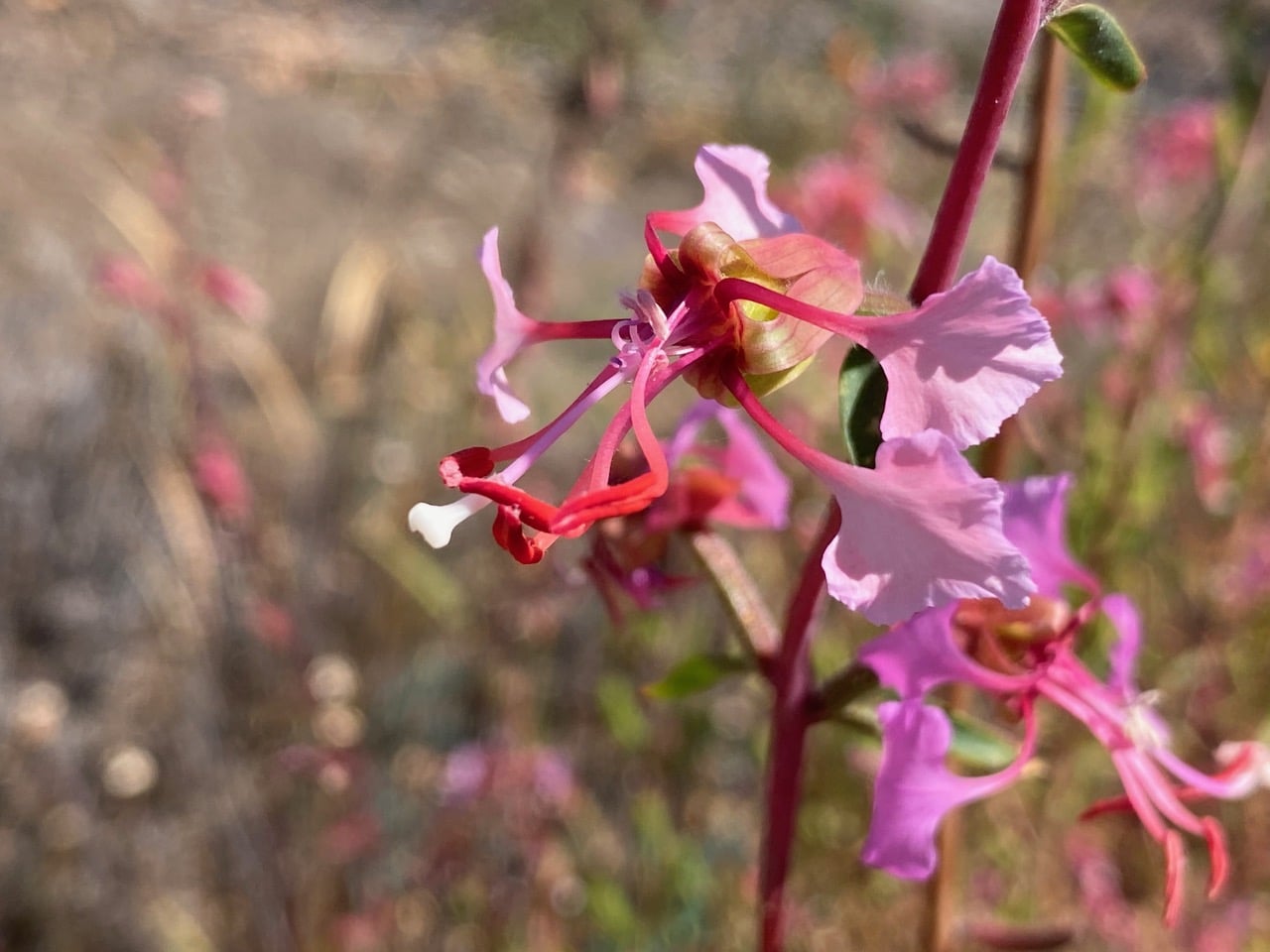
Elegant Clarkia, Clarkia unguiculata is an annual wildflower in the Evening-Primrose family, Onagraceae. It is endemic to California. Blooming in summer, the flowers are a vital support for native insects when other floral resources have dwindled. The four spade-shaped petals come in various shades of pink. Clarkia flowers are protandrous, the male parts maturing before the female parts. The male anthers release their pollen before the female stigma becomes receptive – an arrangement that reduces the chance of self-pollination.
Historically the Elegant Clarkia has occupied a prominent place in the study of pollination. It displays a pollination strategy involving flowers with two distinct sets of anthers that differ in color, size, and position. The phenomenon, called heteranthery has puzzled Charles Darwin to his dying days. In 2021, a research team at UCSC showed that heteranthery in Clarkia is a way for flowers to gradually dole out their pollen to bees over multiple visits as the anthers open at different times.
There are about 41 species of Clarkia in California, and about half of them have two types of anthers. These tend to be pollinated by specialized species of native solitary bees. In the heterantherous clarkias, an inner whorl of shorter stamens stands erect in the center of the flower, and matures early, releasing its pollen first. An outer whorl of longer anthers (red in Elegant Clarkia) lies back against the petals until after the inner anthers have opened. The outer anthers then move toward the center of the flower and begin to release their pollen gradually. A few days later, the stigma becomes erect and sticky, ready to receive pollen from another flower.
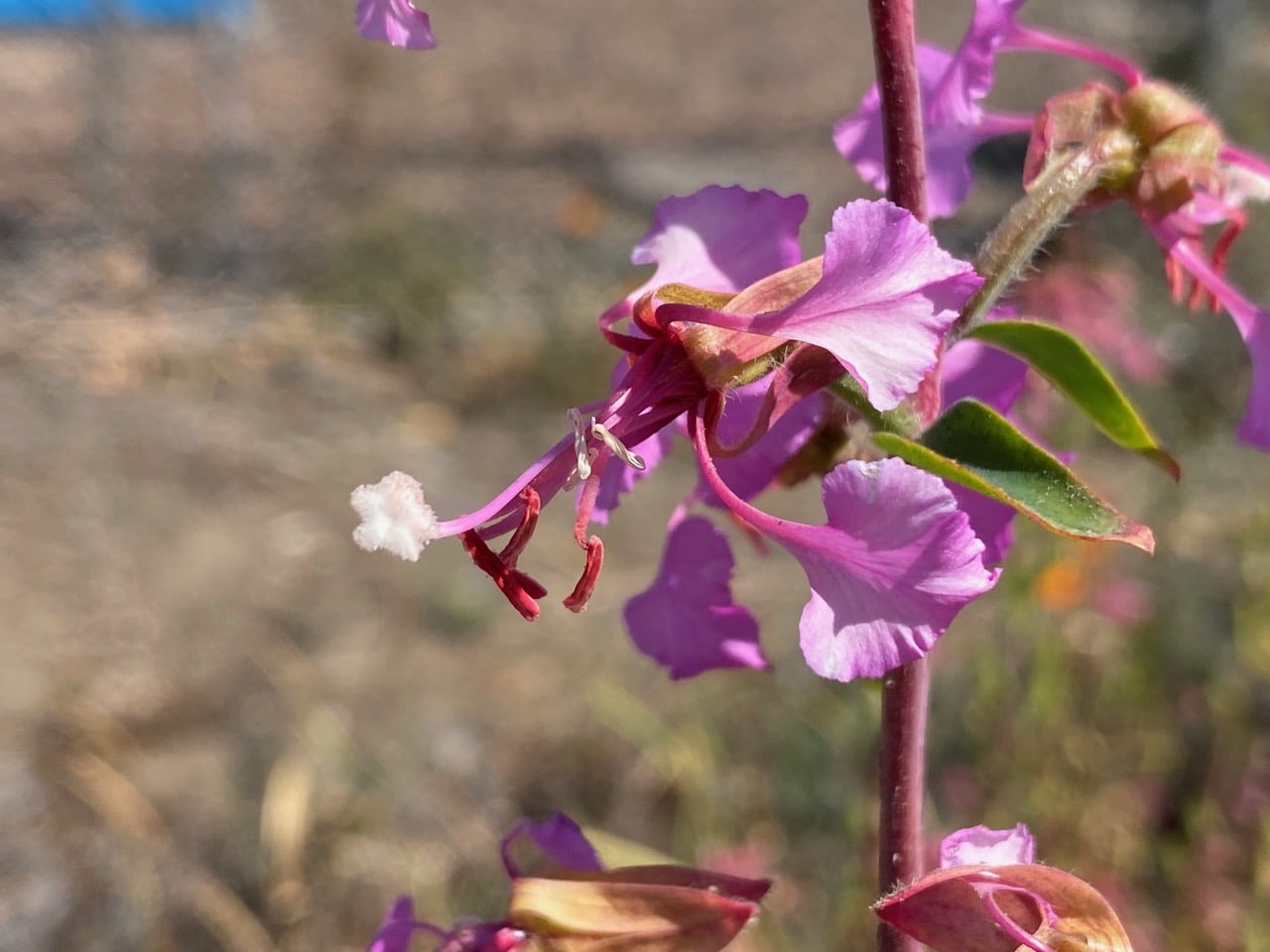
This picture shows an older flower in the female phase. Both sets of stamens, long and short, are spent, and the white stigma lobes have opened up to receive incoming pollen.
While the conclusion of the UCSC team may be correct, it fails to explain several of the other features of the clarkia flower. Why are there two different types of pollen from the distinct anthers? Maybe they are qualitatively different besides having different colors? Why do the long anthers converge towards the center of the flower as they mature, almost touching the stigma as they release their pollen? I hazard a guess that the second set of anthers is a way to ensure self-pollination in case cross-pollination by the bees have failed. After all, self-pollination is better than no pollination at all.
In Clarkia’s wild native range, a little oligolectic bee Hesperapis regularis (family Melittidae) specializes in Clarkia. The females collect pollen only from Clarkia flowers to provision for their larvae. Like its host plant, the bee is native to California, and inhabits meadows, fields, and gardens, where it visits only flowers in the genus Clarkia.
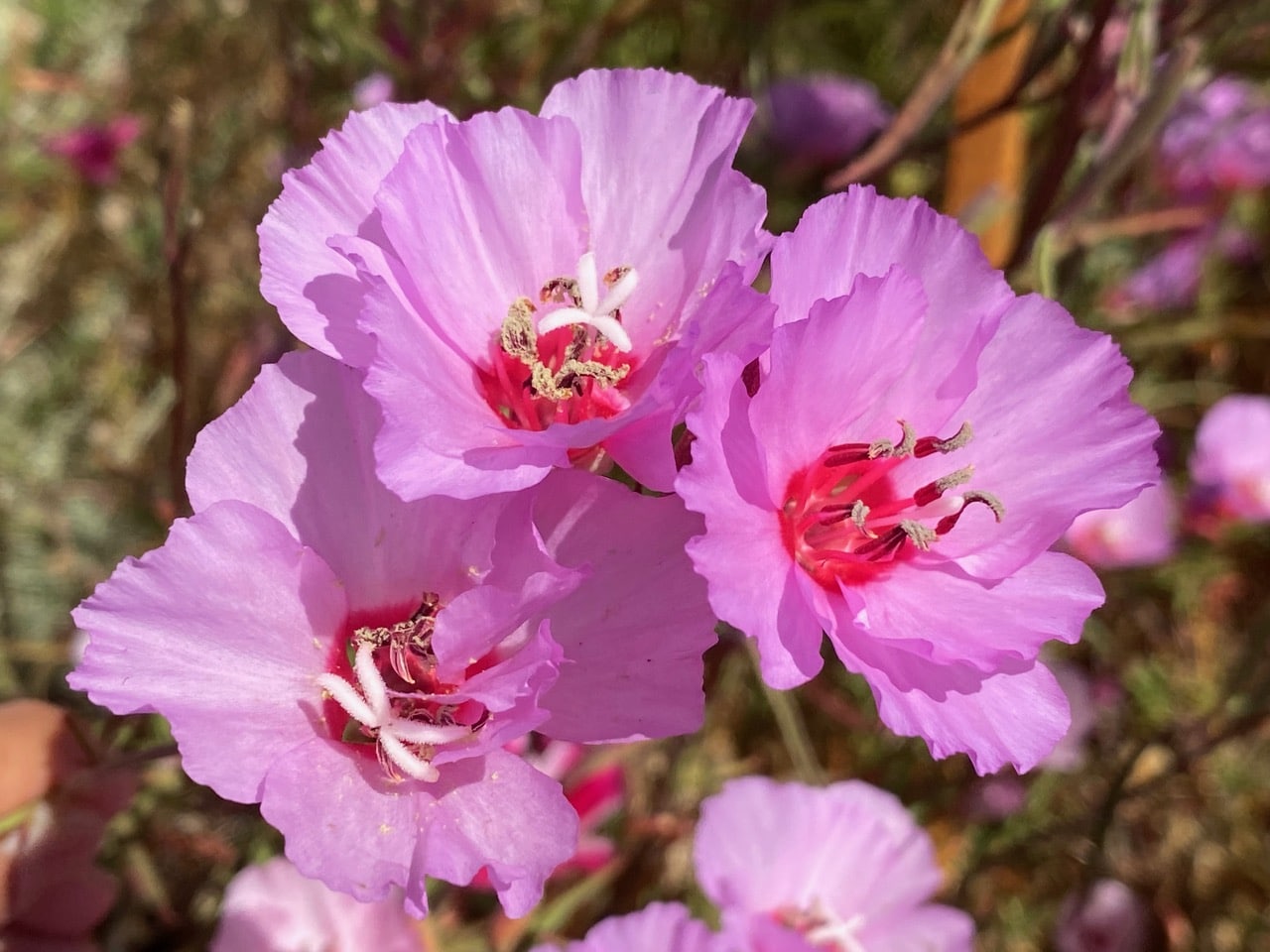
The Farewell-to-Spring, Clarkia rubicunda is blooming gloriously, adding much color and cheer to the fading garden. But these flowers are not getting any attention from the insects. I notice that the flowers have more than the usual 4 petals of Clarkia. The plant is either a natural mutant or a cultivar. The horticulture trade likes to modify plants for bigger blooms, more petals, unusual colors, etc. – all for human aesthetic pleasure. Too often we ignore the needs of pollinators. The extra petals are modified stamens, meaning that there is less pollen. The flowers are more crowded, making it harder for pollinators to access the nectar and pollen. And we don’t know how the quality and quantity of nectar are affected by the manipulation. When colors and patterns are changed, the subtle signaling between flower and insects are also muddled.
Protandry is on full display in this group of flowers from the same stalk. The youngest flower on the right is in its male phase, about ready to release pollen from its anthers. The club-shaped style is barely visible in the center of the flower. In the second flower in the upper left, the anthers have split open and curled back to release pollen. The style has grown longer and the four-lobed stigma has unfurled to receive incoming pollen. In the oldest flower on the lower left the anthers are spent and no longer releasing pollen – it is fully in its female phase.

A Yellow-faced Bumble Bee, Bombus vosnesenskii (family Apidae) visits one of the last flowers on the uncoiling inflorescence of the Caterpillar Phacelia, Phacelia cicutaria. The orange pollen in her pollen basket is not from phacelia.
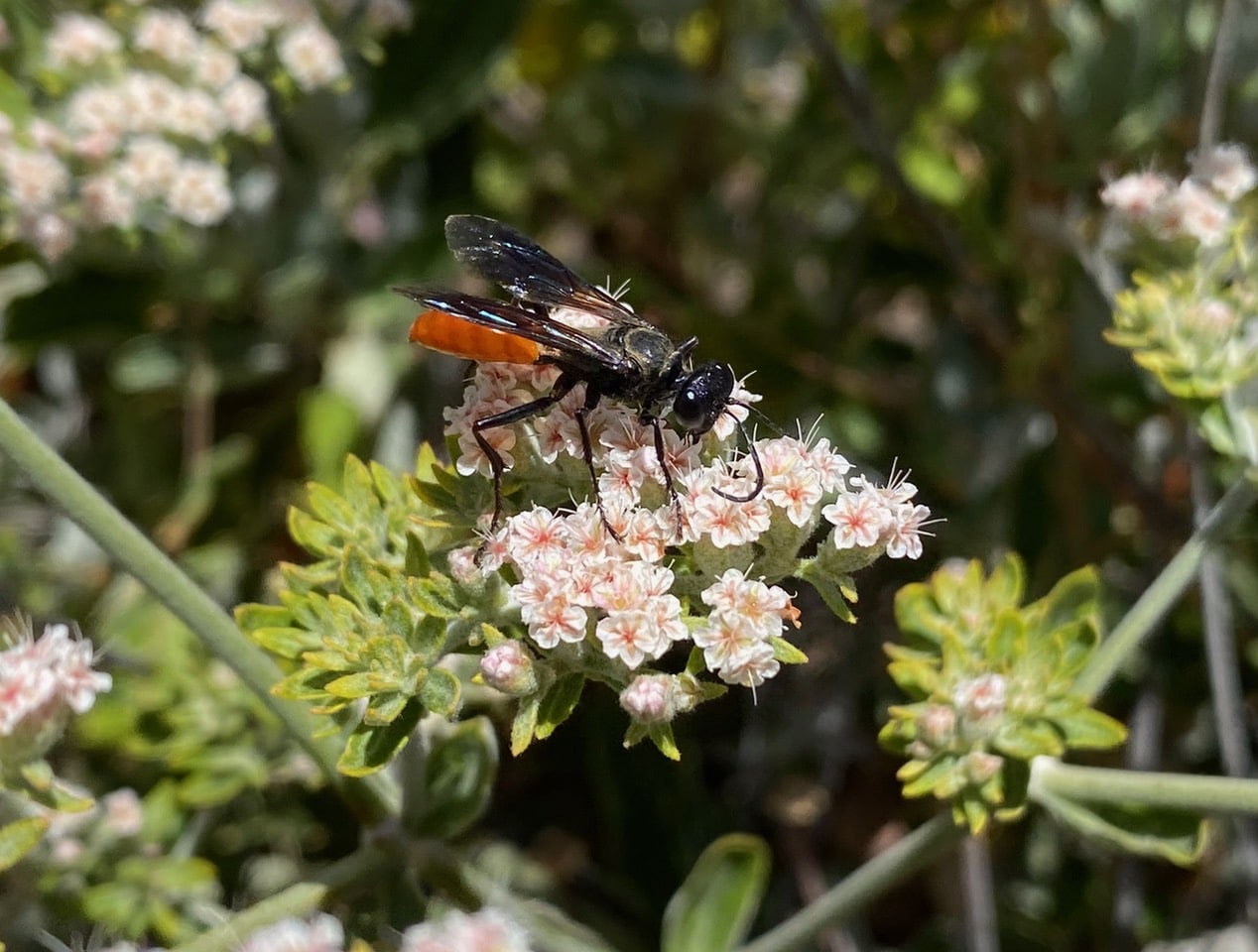
A female Thread-waisted Burrowing Wasp, Sphex lucae (family Sphecidae) is flitting around of the inflorescences of St. Catherine’s Lace, Eriogonum giganteum, seeking nectar. Not only is she big, her abdomen is a striking orange-red color.
The Sphecidae are solitary wasps with elongated and narrow first abdominal segment, giving rise to the common name Thread-waisted Wasps. Sphex lucae is a widespread western species, ranging from WA in the north, south to CA, and east to TX. The species exhibits sexual dimorphism – females are black with a red abdomen, while the males are all black. Adults visit many types of flowers for nectar. Females hunt katydids and grasshoppers as food for their young. The wasp excavates a single-celled burrow in the soil in advance of hunting activities. She drags her paralyzed prey back to the burrow, laying a single egg on the victim. The nest entrance is then sealed and the process is repeated. Males of this species spend nights in sleeping aggregations in sheltered places such as beneath a rock overhang.

A male Forked Globetail, Sphaerophoria sulphuripes (family Syrphidae) is foraging among the flowers of St. Catherine’s Lace.
The males of this species is easily recognizable for the slim, cylindrical, black/yellow abdomen and the bulbous reddish genitalia that is curled under the tip of the abdomen. Females have rounder abdomen and no red coloration. The larvae of Sphaerophoria feed on aphids and other soft-bodied insects. Mating Hoverfly Sphaerophoria scripta pos | Seen on birch sa… | Flickr
Hover Flies, also called Syrphid Flies make up the insect family Syrphidae. They are often seen hovering or nectaring at flowers; the adults of many species feed mainly on nectar and pollen, while the larvae eat a wide range of foods. In many species, the larvae feed on aphids, thrips, and other plant-sucking insects. In some species, the larvae are saprotrophs, eating decaying plant and animal matter in the soil or in ponds and streams. Many Hover Flies are brightly colored, with spots, stripes and bands of yellow; due to this coloring, they are often mistaken for wasps or bees. They exhibit Batesian mimicry – the resemblance to stinging insects gives the hover flies some protection from predators.
Hover Flies are considered the second-most important groups of pollinators after wild bees. Most are generalists that visit a wide range of plant species. The feeding habits of Syrphid larvae further endear them to the gardeners, serving as pest control agents and recyclers of organic matter.

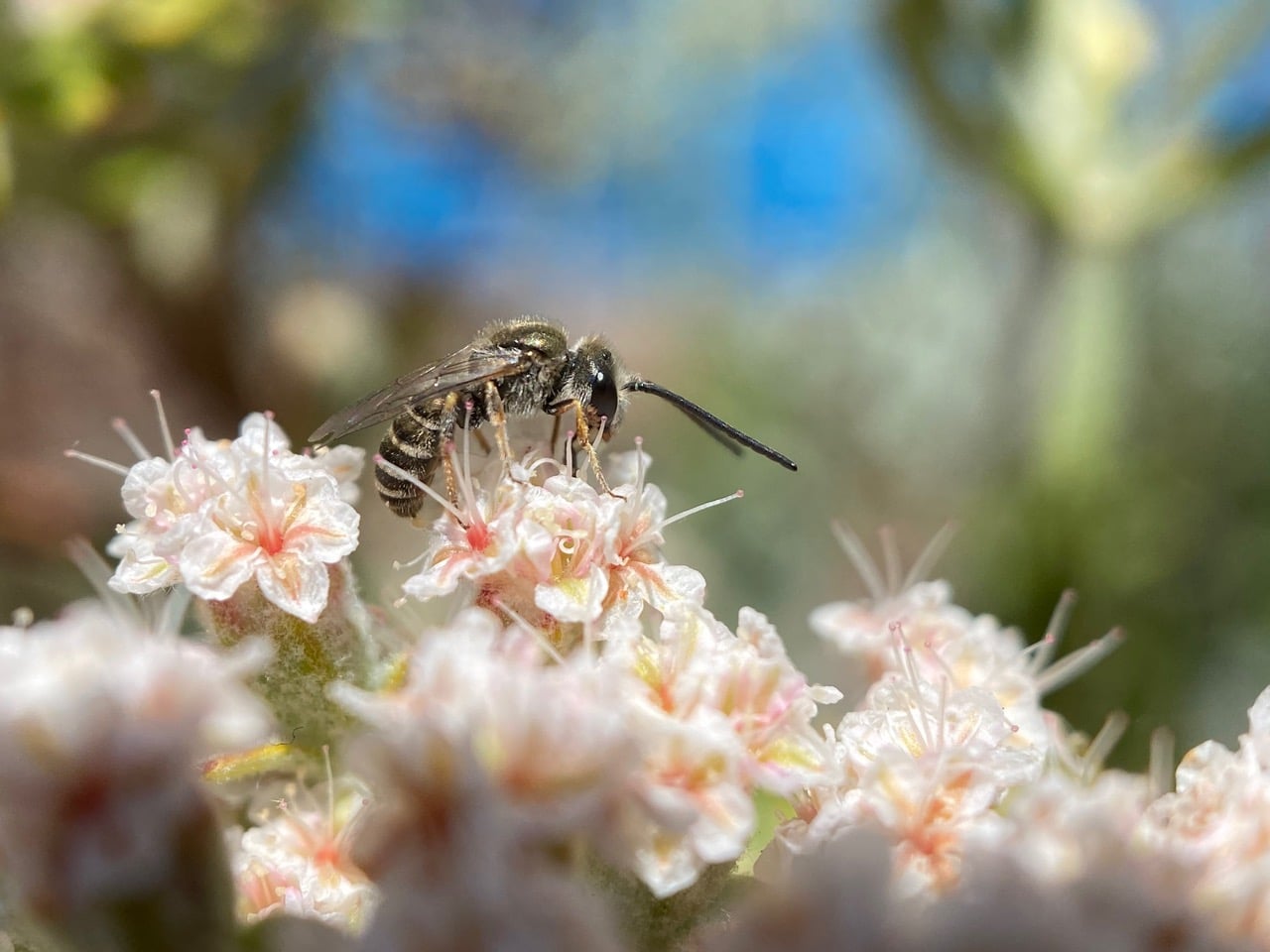
A male Sweat Bee, Halictus sp.(family Halictidae) is foraging on the flowers of St. Catherine’s Lace. The antennae of male bees are often much longer than their female counterparts. Male antennae have an extra segment and the segments themselves are longer. This is because male antennae are specialized to pick up the subtle scent of female pheromones.
Halictus is found worldwide; they are most common in the Northern Hemisphere. All are generalists, foraging from a wide variety of flowering plants. Many species are social and produce several generations per year. This is not surprising as most blooming plants are season-specific; a bee that requires pollen and nectar across multiple seasons would not thrive as a specialist. All Halictus in North America nest in the ground, often in aggregations; and they may nest in the same area for decades.

Note the absence of scopa (special pollen collecting hairs) on the hind legs of the male Sweat Bee. Male bees do not collect pollen to provision the nest, neither do they have the equipment for the task.
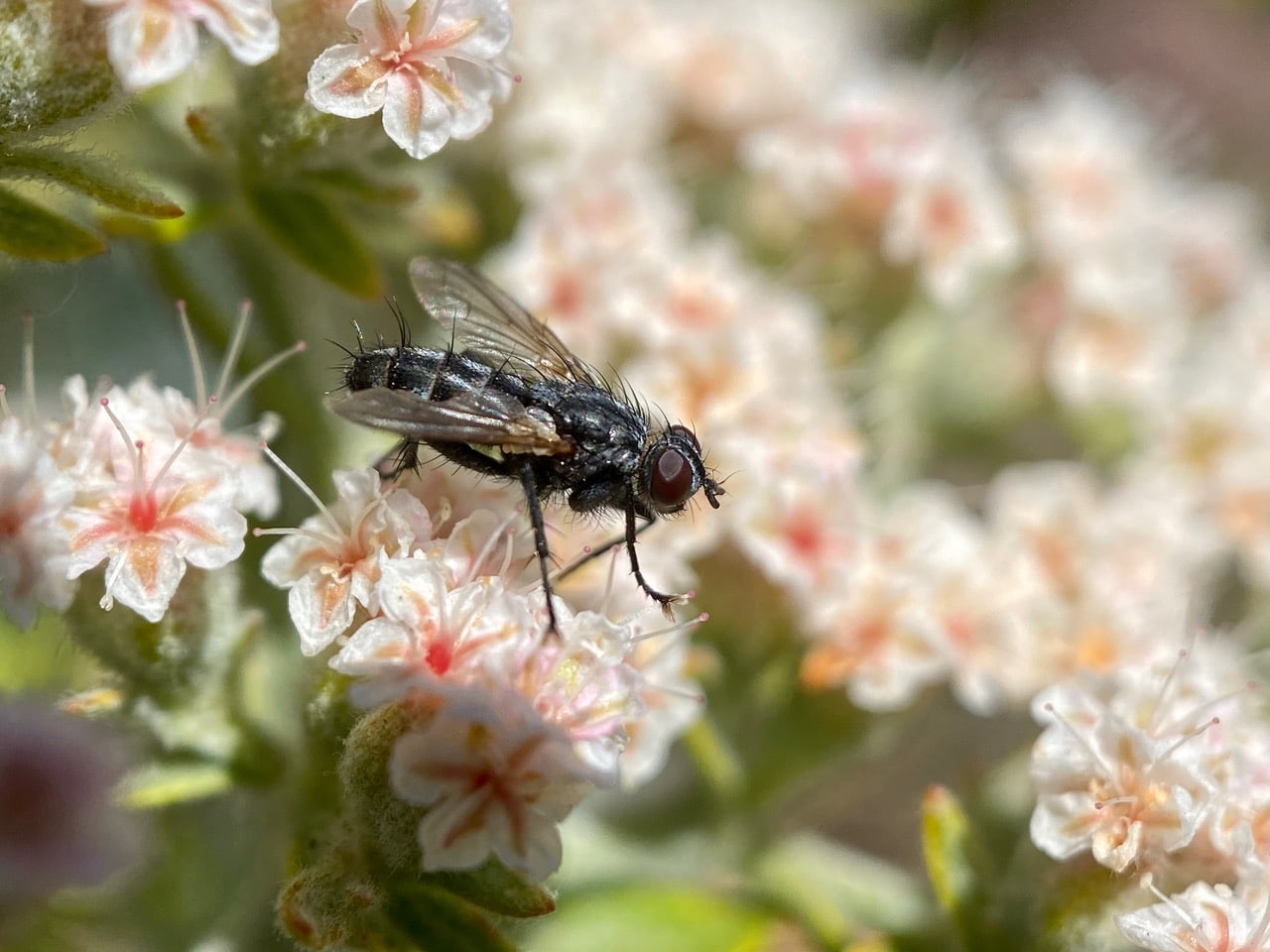
A small, dark and glossy fly lands on an inflorescence of St. Catherine’s Lace. It is a Woodlouse Fly, Stevenia deceptoria (family Rhinophoridae). These small, black, bristly flies are somewhat related to the Tachinidae. The larvae are mostly parasitoids of woodlice (pill bugs), beetles, spiders and other arthropods, and occasionally snails.


A Common Checkered Skipper, Burnsius communis (family Hesperiidae) flits around a mallow plant and finally lands on the leaf litter. Is this a female looking to lay her eggs?
Because of its small size, bluish color, and spread-wing posture, the butterfly is often mistaken for one of the “Blues” in the family Lycaenidae. Skippers have the antennae clubs hooked backward like a crochet hook, while the typical butterflies have club-like tips to their antennae. Skippers also have generally stockier bodies and larger compound eyes.
Checkered Skippers belong to the subfamily Pyrginae, commonly known as spread-wing skippers, in the family Hesperiidae. Spread-wing skippers bask with their wings held wide open. The wings are held closed when they are at rest. Caterpillars make folded-leaf nests in which they live and feed on several plants in the mallow family, Malvaceae.
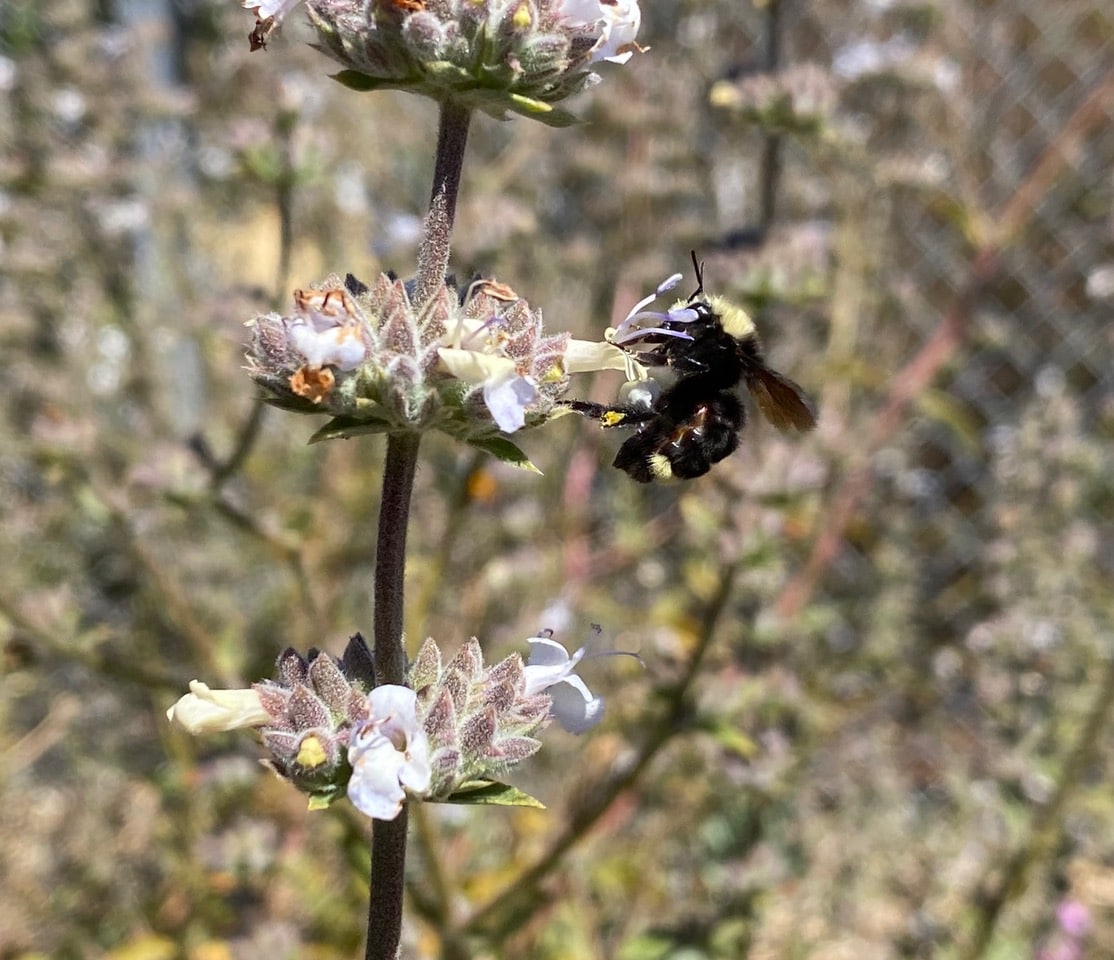
A Yellow-faced Bumble Bee, Bombus vosnesenskii (family Apidae) lands on a flower of Black Sage, Salvia mellifera. The flowers are a good source of nectar, but the pollen is hardly adequate for these large bees.

A Yellow-faced Bumble Bee is taking nectar from a fading flower of Black Sage. Check out the load in her pollen baskets! The bee has probably collected the orange pollen from the nearby California Poppies.
The pollen collecting apparatus in Apidae bees, which include honey bees and bumble bees, is commonly called a “pollen basket” or corbicula. This region is located on the tibia of the hind legs and consists of hairs surrounding a concave region. After the bee visits a flower, she begins to groom herself and brushes the pollen down toward her hind legs and packs the pollen into her pollen basket. A little nectar mixed with the pollen keeps it all together like putty, and the stiff hairs surrounding the pollen basket hold it in place. A honey bee can fly with a full pollen load that weighs as much as a third of her body weight.
.jpg)
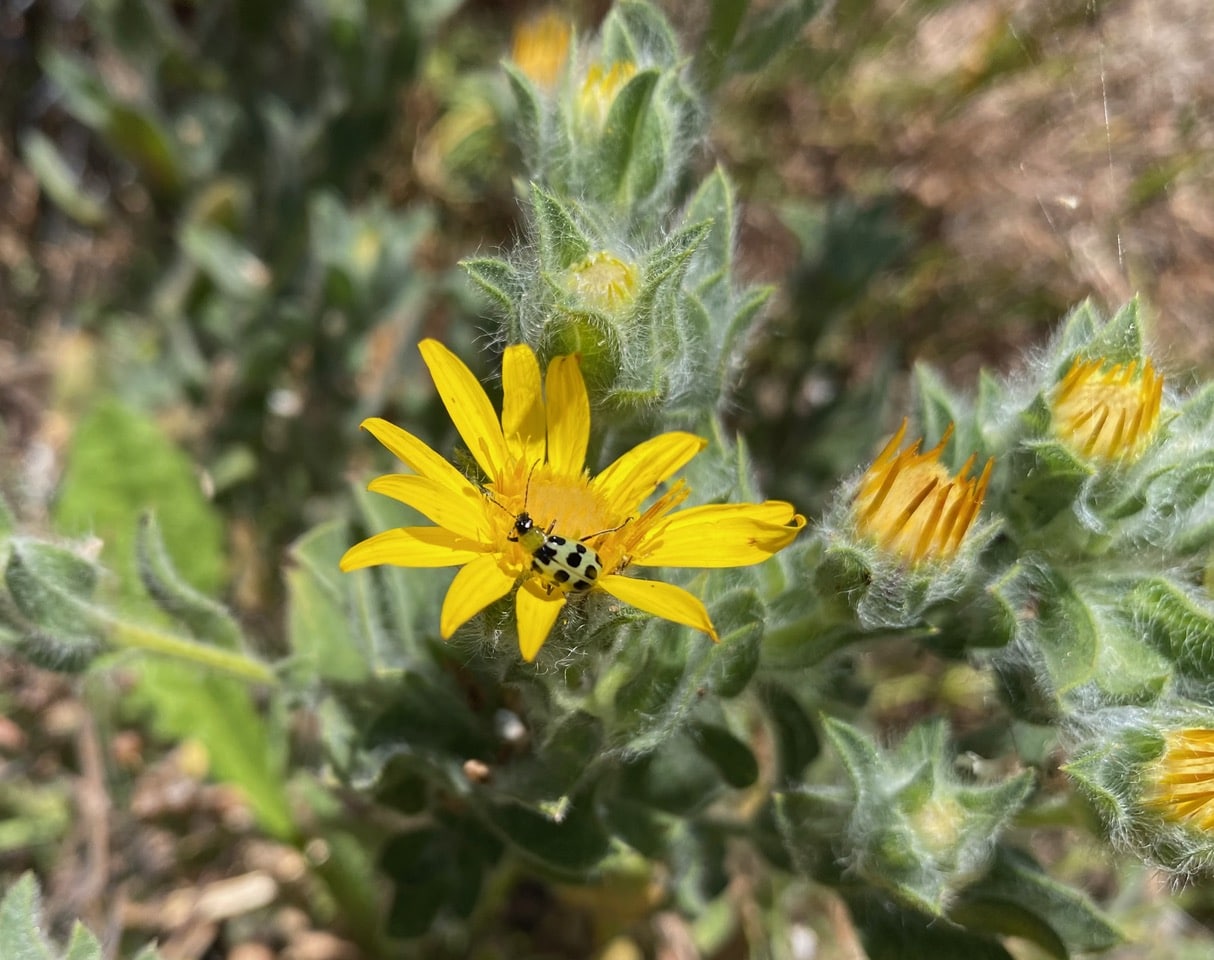
The Sessileflower False Goldenaster, Heterotheca sessilliflora still has fresh blooms. A Spotted Cucumber Beetle, Diabrotica undecimpunctata
(family Chrysomelidae) has already claimed one of them.
Members of the family Chrysomelidae are commonly known as Leaf Beetles. Adults and larvae feed on all sorts of plant tissues, and all species are fully herbivorous. Many are serious pests of cultivated plants, including food crops. Others are beneficial due to their use in biocontrol of invasive weeds. Chrysomelids are popular among insect collectors, as many are conspicuously colored, typically in glossy yellow to red or metallic blue-green hues, and some have spectacularly bizarre shapes. Photos of Leaf Beetles (Family Chrysomelidae) · iNaturalist
Native to North America, the Spotted Cucumber Beetle can be a major agricultural pest, causing damage to crops in the larval as well as adult stages of their life cycle. Larvae, sometimes known as rootworms feed on the roots of emerging plants. In the adult stage the beetles cause damage by eating the flowers, leaves, stems and fruits of the plant.

A male Sweat Bee, Halictus sp. (family Halictidae) is foraging on a flowerhead of Sessileflower False Goldenaster. Note his long antennae and lack of scopa on the hind leg.

Male bees tend to be smaller and more slender than their female counterparts.
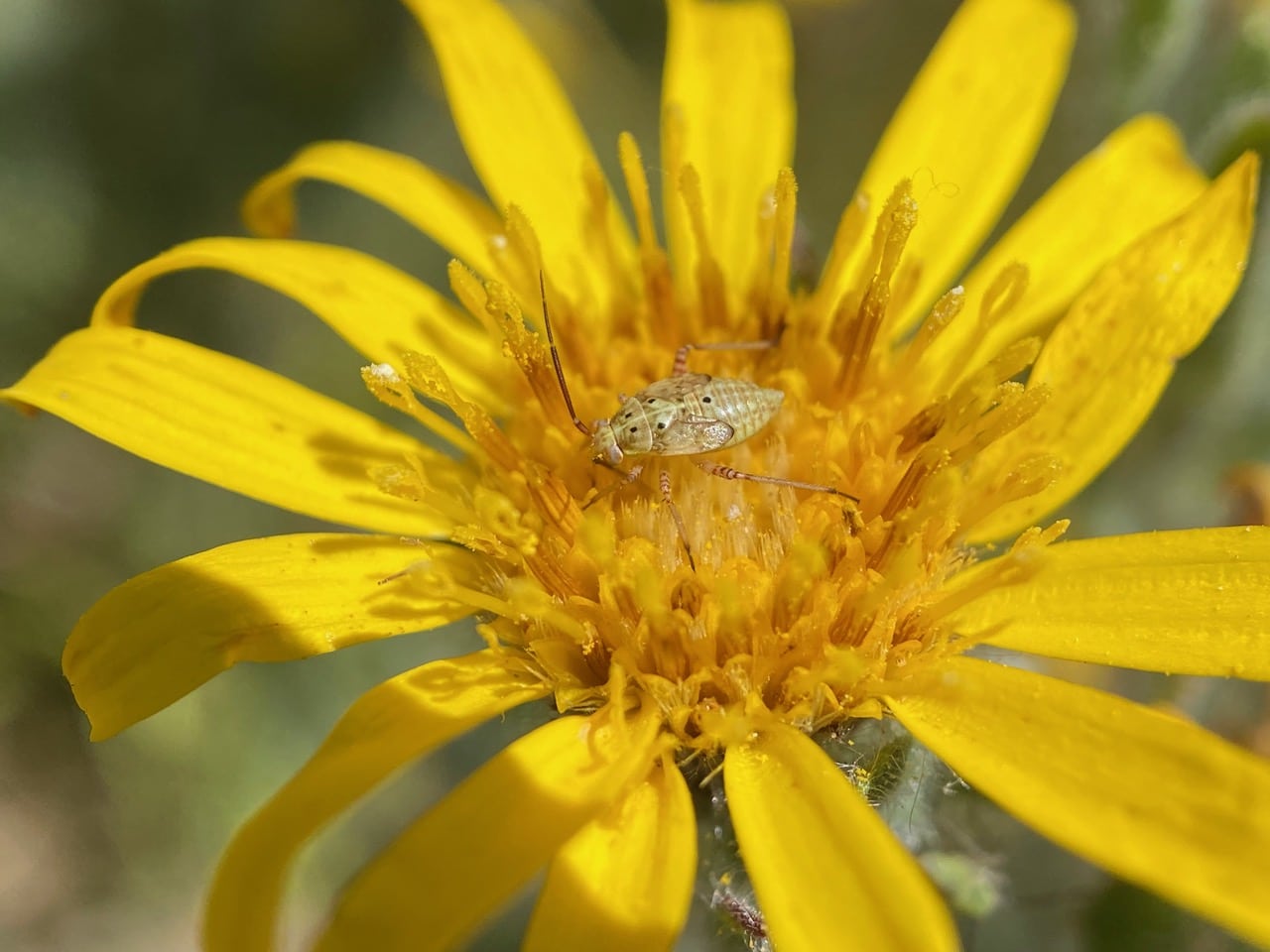
A late instar Lygus Bug, Lygus sp. (family Miridae, order Hemiptera) is resting on a flowerhead of Sessileflower False Goldenaster. It has a well-developed wing pad and its body is turning from green to brown.
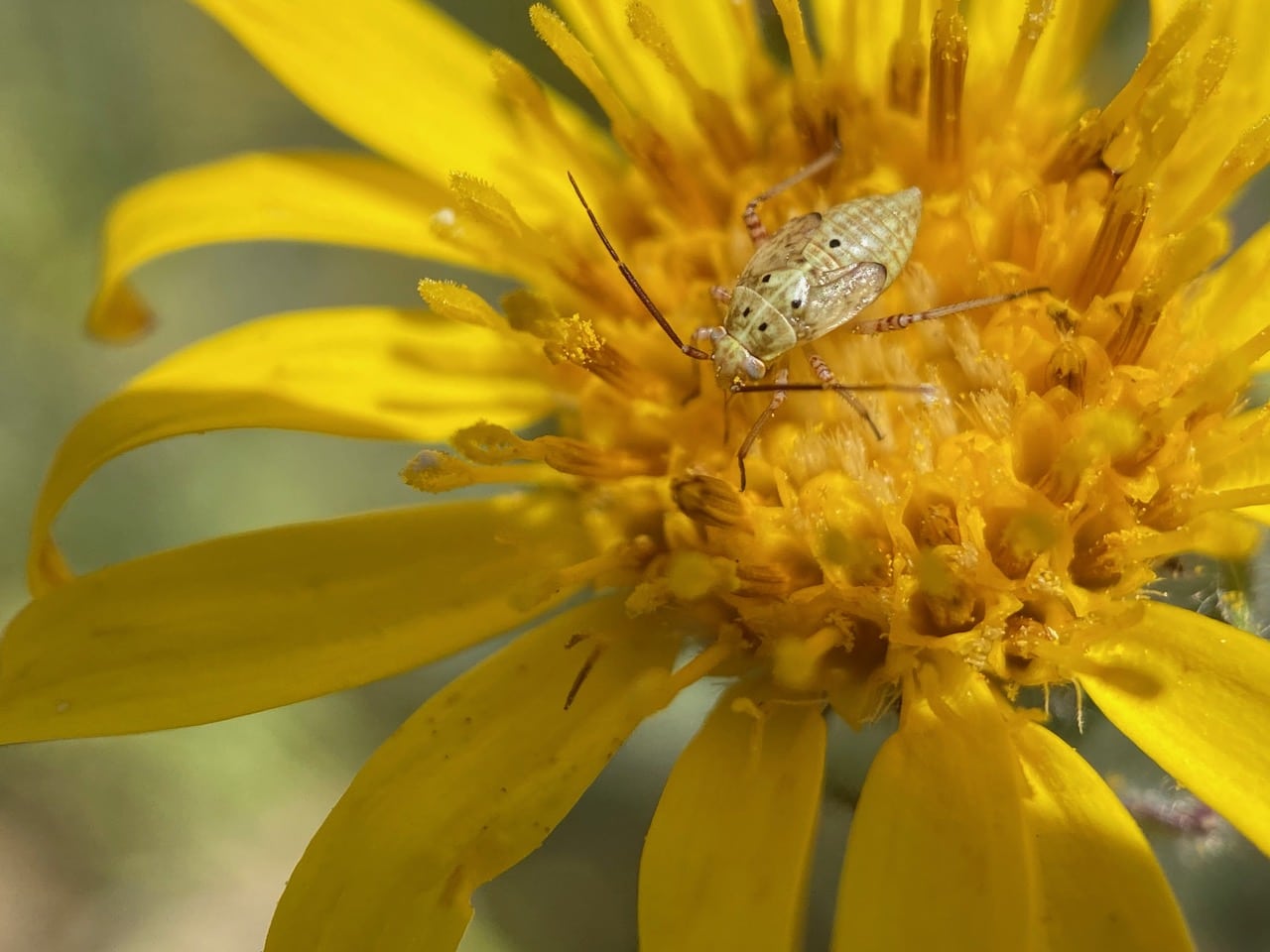
“True bugs” in the order Hemiptera undergo incomplete metamorphosis without a pupal stage. The nymphs, which look like adults, develop through a series of molts, each time getting bigger after shedding their old exoskeleton. At the last molt, they transform into adults with functional wings and reproductive parts.

An adult Lygus Bug, Lygus sp. (family Miridae) is fleeing from my camera.
Members of the family Miridae are also referred to as plant bugs or leaf bugs. Miridae is one of the largest family of true bugs in the order Hemiptera. Like other Hemipterans, Mirids have piercing, sucking mouthparts to extract plant sap. Some species are predatory. One useful feature in identifying members of the family is the presence of a cuneus; it is the triangular tip of the corium, the firm, horny part of the forewing, the hemielytron. The cuneus is visible in nearly all Miridae.

The term lygus bug is used for any member of the genus Lygus, in the family of plant bugs, Miridae. Adult lygus are approximately 3 mm wide and 6 mm long, colored from pale green to reddish brown or black. They have a distinctive triangle or V-shape on their backs. Lygus bugs are known for their destructive feeding habits – they puncture plant tissues with their piercing mouthparts, and feed by sucking sap. Both the physical injury and the plant’s own reaction to the bug’s saliva cause damage to the plant. Many lygus bugs are well-known agricultural pests.
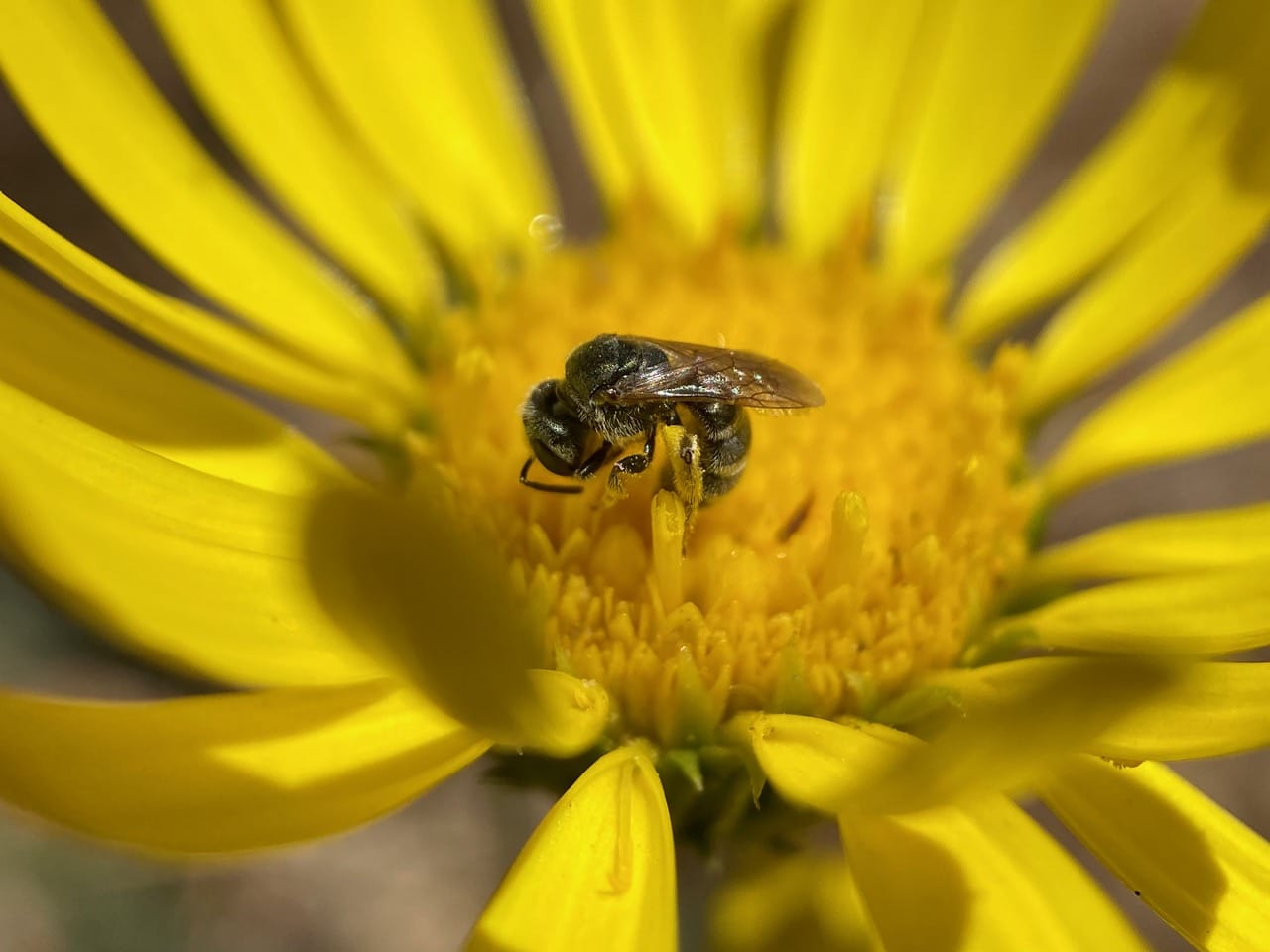
A female Sweat Bee, Halictus sp. (family Halictidae) is foraging on a flowerhead of Sessileflower False Goldenaster.

The female bee has a wider abdomen than the male. Note the furrow on her last abdominal segment. This feature (found only on females) identifies her as a Furrow Bee in the genus Halictus. The bee does have scopae on her hind legs, but they are empty.

The Sweat Bee proceeds to gather pollen from the flowers.
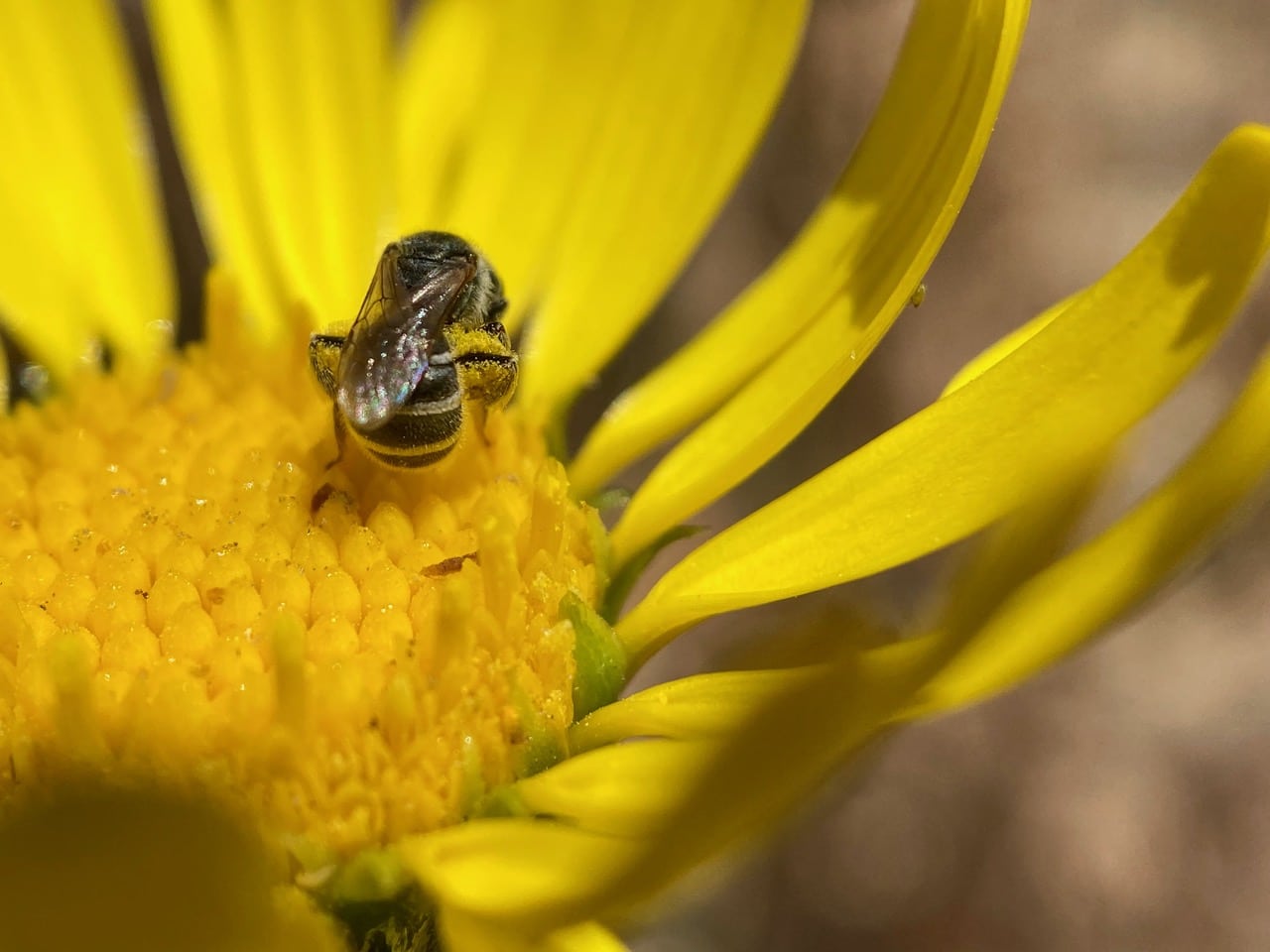
Now that her scopae are filling up with pollen they have become more visible. A Sweat Bee’s scopae cover the full length of her hind legs. Pollen grains are loosely held on the hairs of the scopa by electro-static attraction. They are not moistened and compacted like the pollen in the bumble bee’s pollen baskets (corbiculae).
 In a corner of the garden, the Evening Primrose, Oenothera sp. (family Onagraceae) is blooming well. Note the stringy pollen released from the long anthers. The pollen grains of many members of the Onagraceae family are held together by viscin threads. They tend to adhere to insects. Small insects that attempt to gather this pollen are often mired with the stuff and have difficulty flying. The stringy pollen is actually an adaptation for pollination by Lepidopteran (moths and butterflies) that are large enough to make contact with all the reproductive parts of the flower, and effectively pollinate them. The most common pollinators for the flower are the long-tongued Hawk Moths (family Sphingidae) that can hover in front of the flower to take nectar without landing. They transfer pollen from flower to flower on their wings.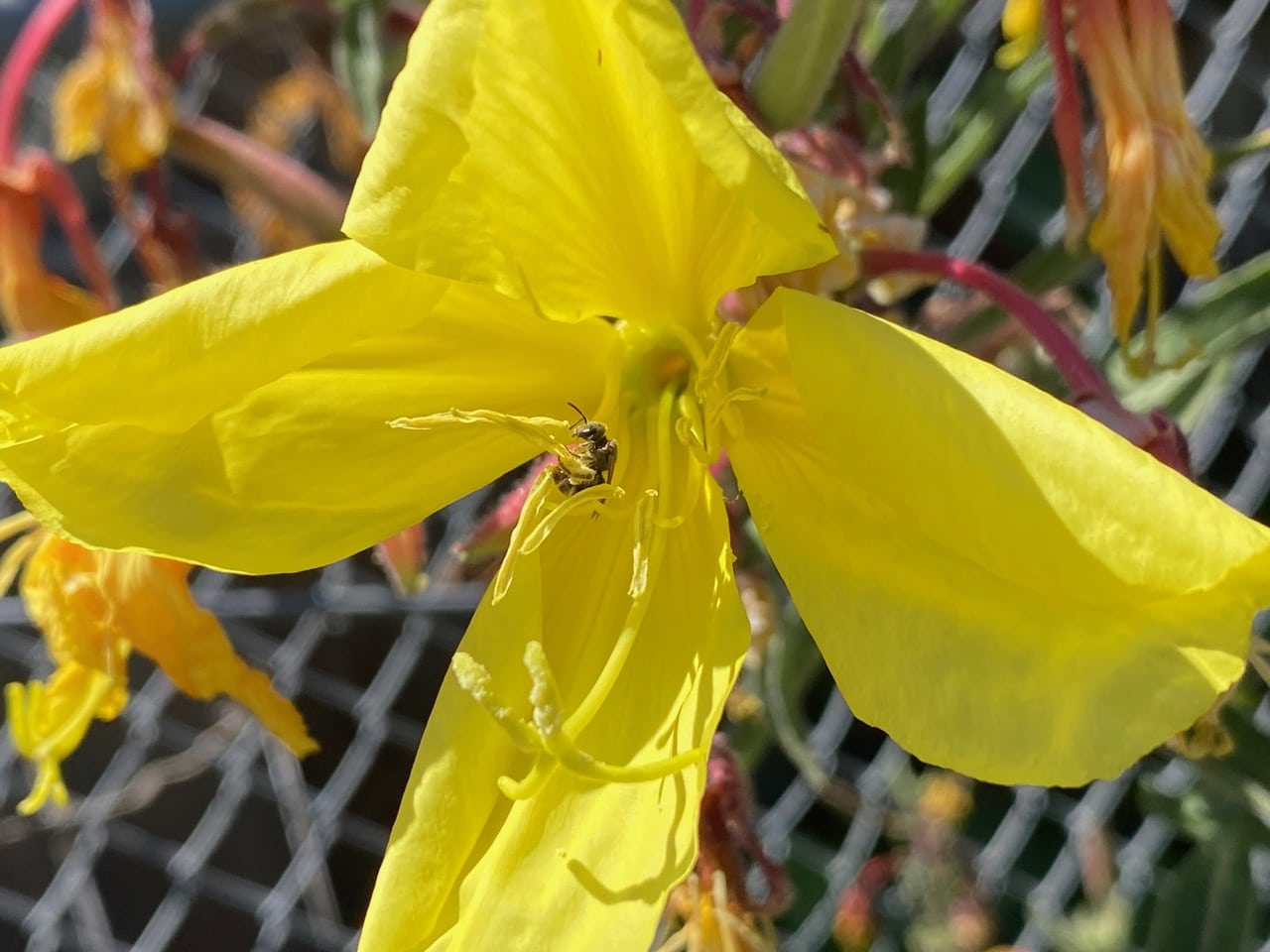
A Sweat Bee, Halictus sp. (family Halictidae) is risking life and limb gathering pollen from the Evening Primrose stamen. Because the stamens and the style are so far apart, the bee is not likely to be an effective pollinator for the flower.
 I watch as several Sweat Bees crawl down to the base of the petals, seeking nectar. Because they are taking nectar from the flower without contributing to pollination, they are considered “nectar thieves”.
A couple of large, glossy black bees suddenly make a noisy appearance and buzz around the Evening Primrose. They are female Carpenter Bees, Xylocopa sp. (family Apidae). Fast and furious, they seem to bounce from flower to flower. I don’t see any pollen on their hind legs. They are probably taking nectar only.

Because of their large size, the Carpenter Bees are not threatened by the sticky pollen, and will not be immobilized by it. The four-lobed stigma of the flower protrudes beyond the anthers, so the bee is likely to come in contact with the stigma when they fly in to land on the stamens. The Carpenter Bees are likely pollinators for the Evening Primrose.
Carpenter bees are large, shiny, and stout bodied, with sparse hair. Females are mostly black, while males often have some yellow hairs. The common name “carpenter bee” derives from their nesting behavior; nearly all species burrow into hard plant material such as dead wood or timber. The bees vibrate their bodies as they rasp their mandibles against hard wood, each nest having a single entrance which may have many adjacent tunnels. The entrance is often a perfectly circular hole about 0.6 in. in diameter on the underside of a beam, bench, or tree limb. Carpenter bees do not eat wood. They discard the bits of wood, or reuse particles to build partitions between brood cells. The tunnel functions as a nursery for brood and storage for the pollen/nectar on which the brood subsists.