

Pollinator Post 6/23/23 (1)
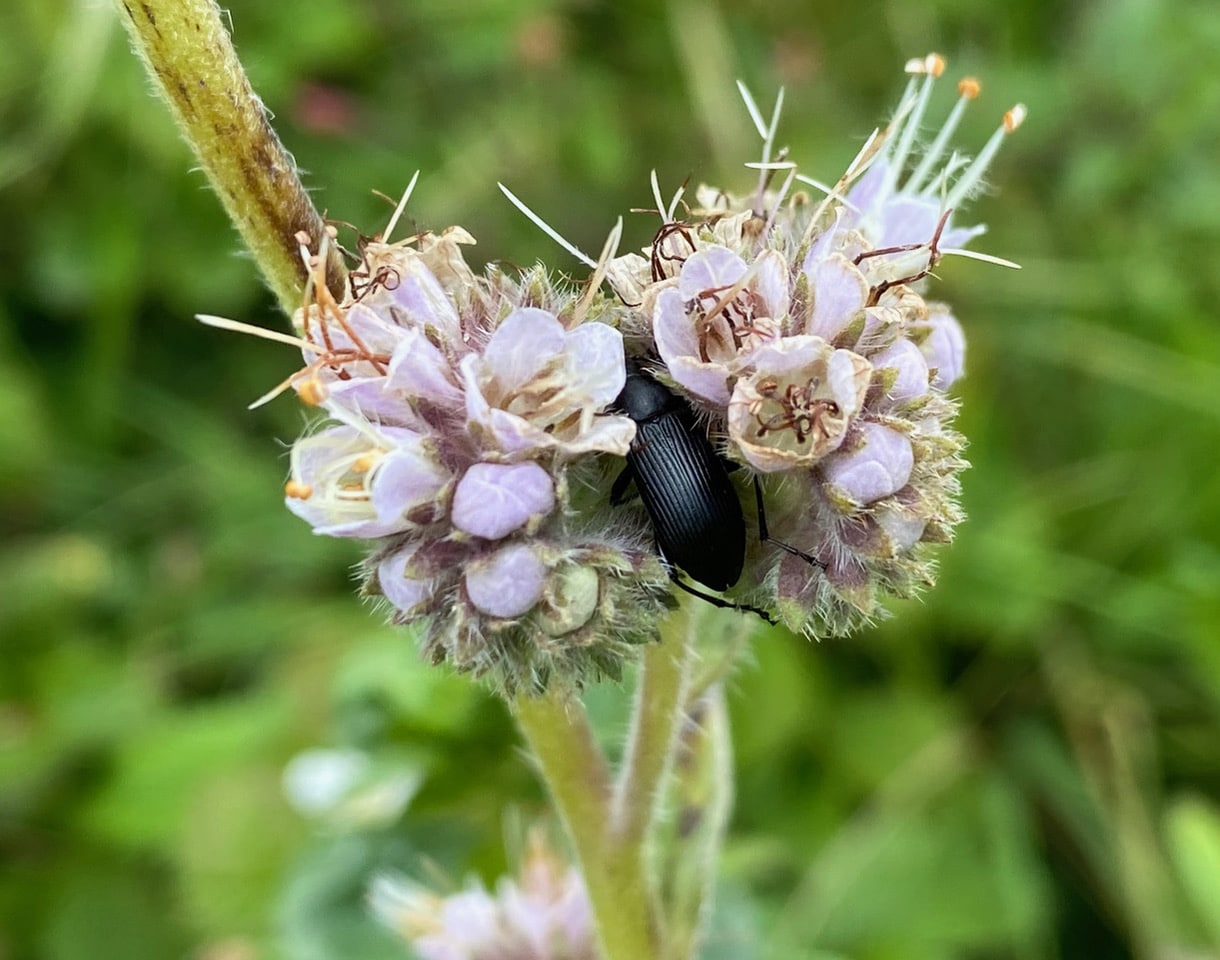
A black beetle is resting motionless between the flowers of California Phacelia, Phacelia californica. Not wanting to disturb the beetle, I tag the plant with a piece of red yarn. I’ll check on the beetle on the way back.
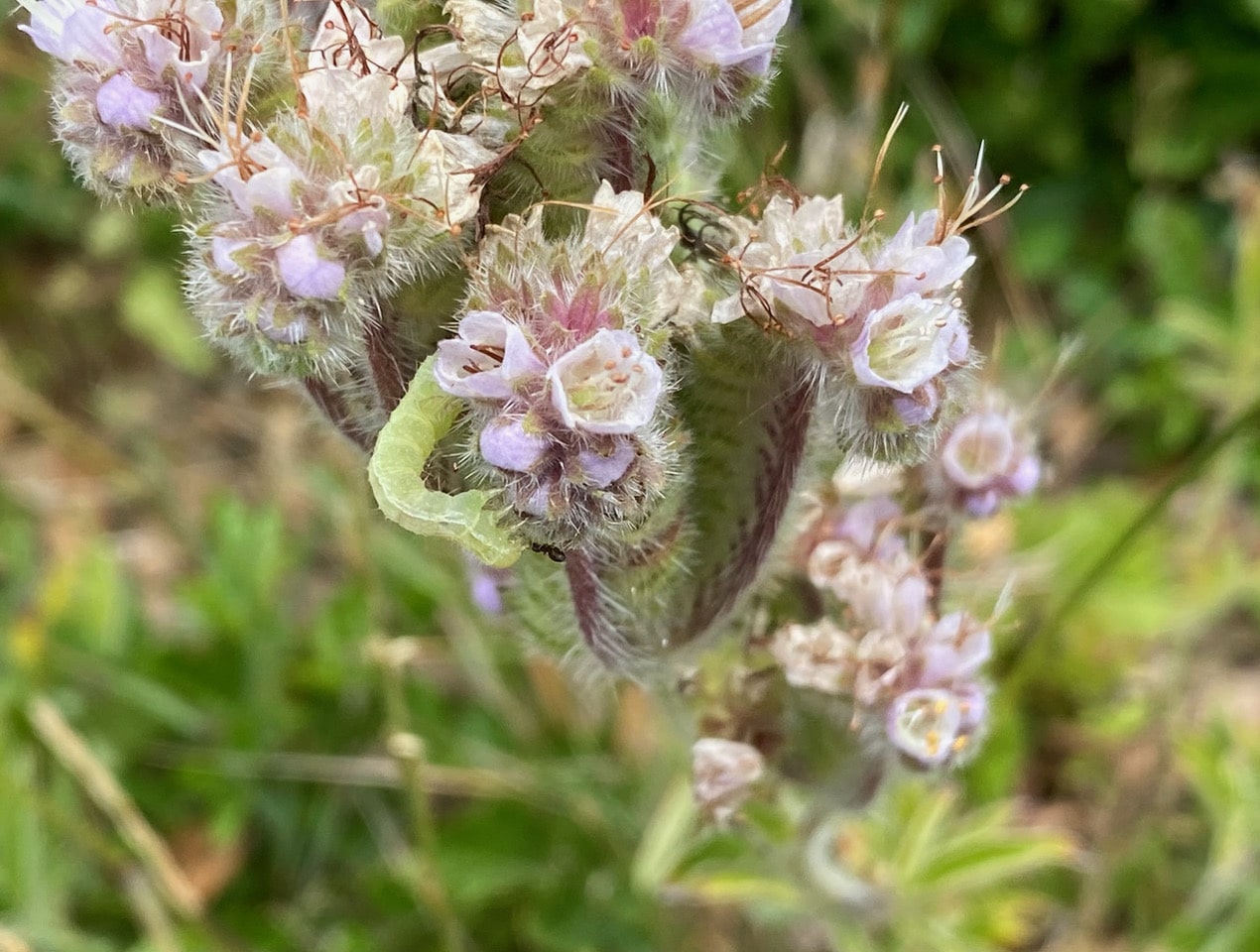




In typical looping locomotion of an Inchworm, a pale green caterpillar of Geometrid Moth (family Geometridae) is making its way on an inflorescence of California Phacelia.
Inchworms are also called loopers and measuring worms. They majority of the inchworms are the larvae of moths in the family Geometridae. The name comes from the Greek “geo” for earth and “metro” from measure, because the caterpillars seem to be measuring the surface on which they are walking.
All caterpillars have three pairs of jointed legs behind their heads. These legs are called true legs because they will become the six legs of the adult butterfly or moth. There are additional appendages, called prolegs, along their bodies. Prolegs are not true legs, they are just outgrowths of the body wall and will be lost at metamorphosis. They have little hooks on their soles to help the caterpillar walk and grip onto things.
Most caterpillars have five sets of prolegs, four in the middle of the body and one pair at the hind end. Inchworms have the normal six true legs but only two or three pairs of prolegs, all located at the tail end of the body, with none in the middle. When an inchworm walks, it moves its tail-end prolegs up behind its true legs, causing the center of its body to loop upward. Then it stretches its front end forward to take another step.
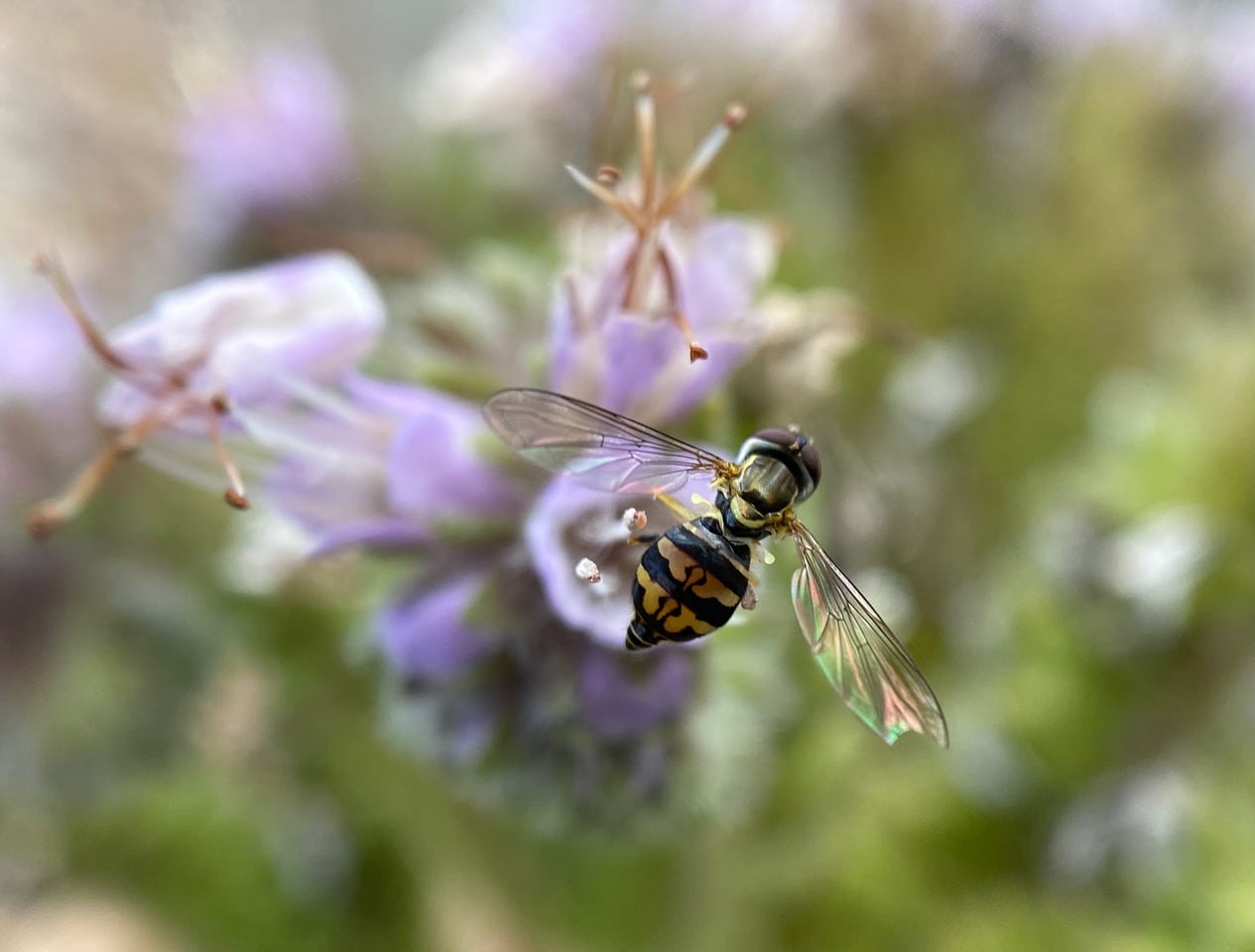
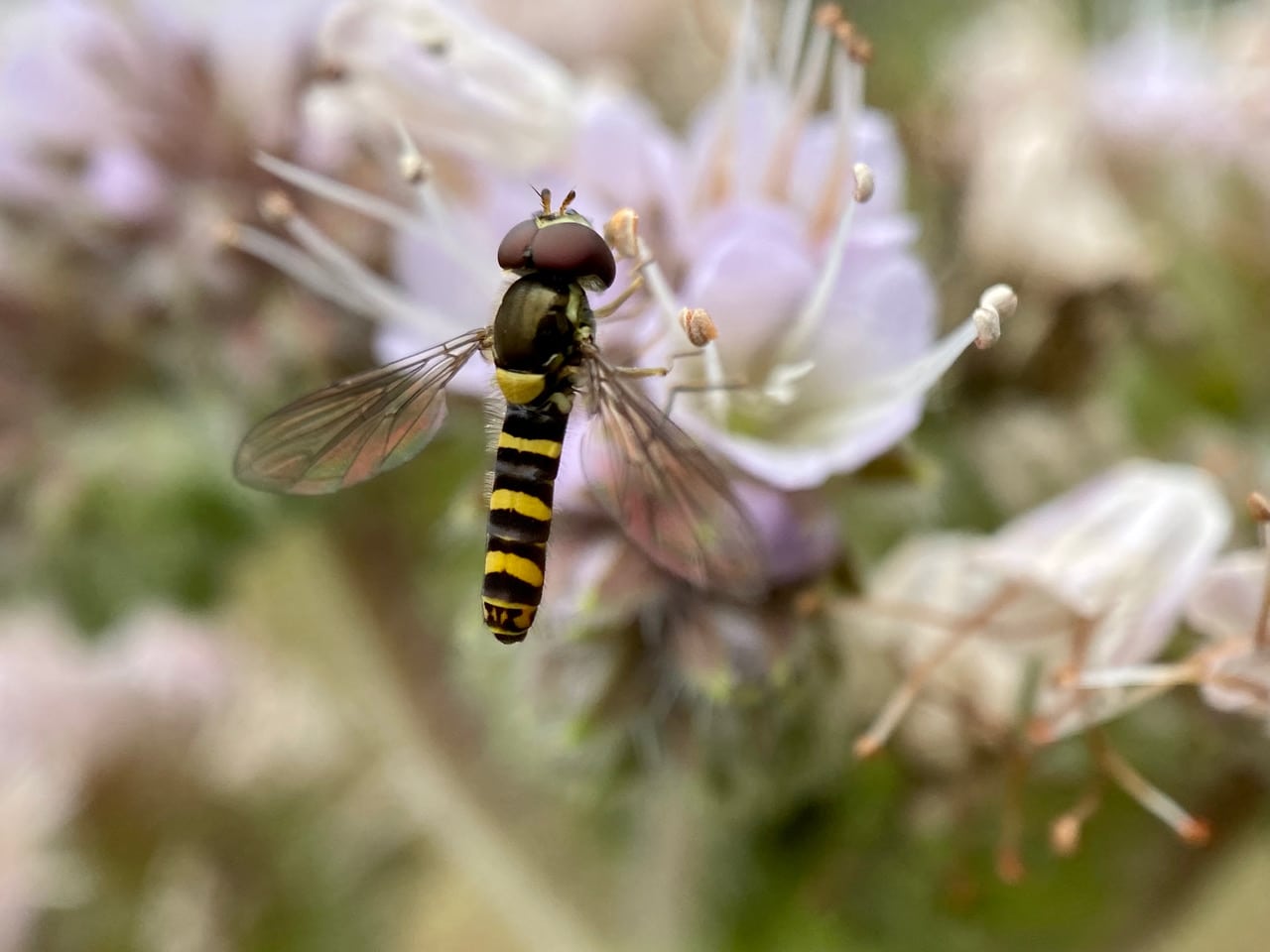
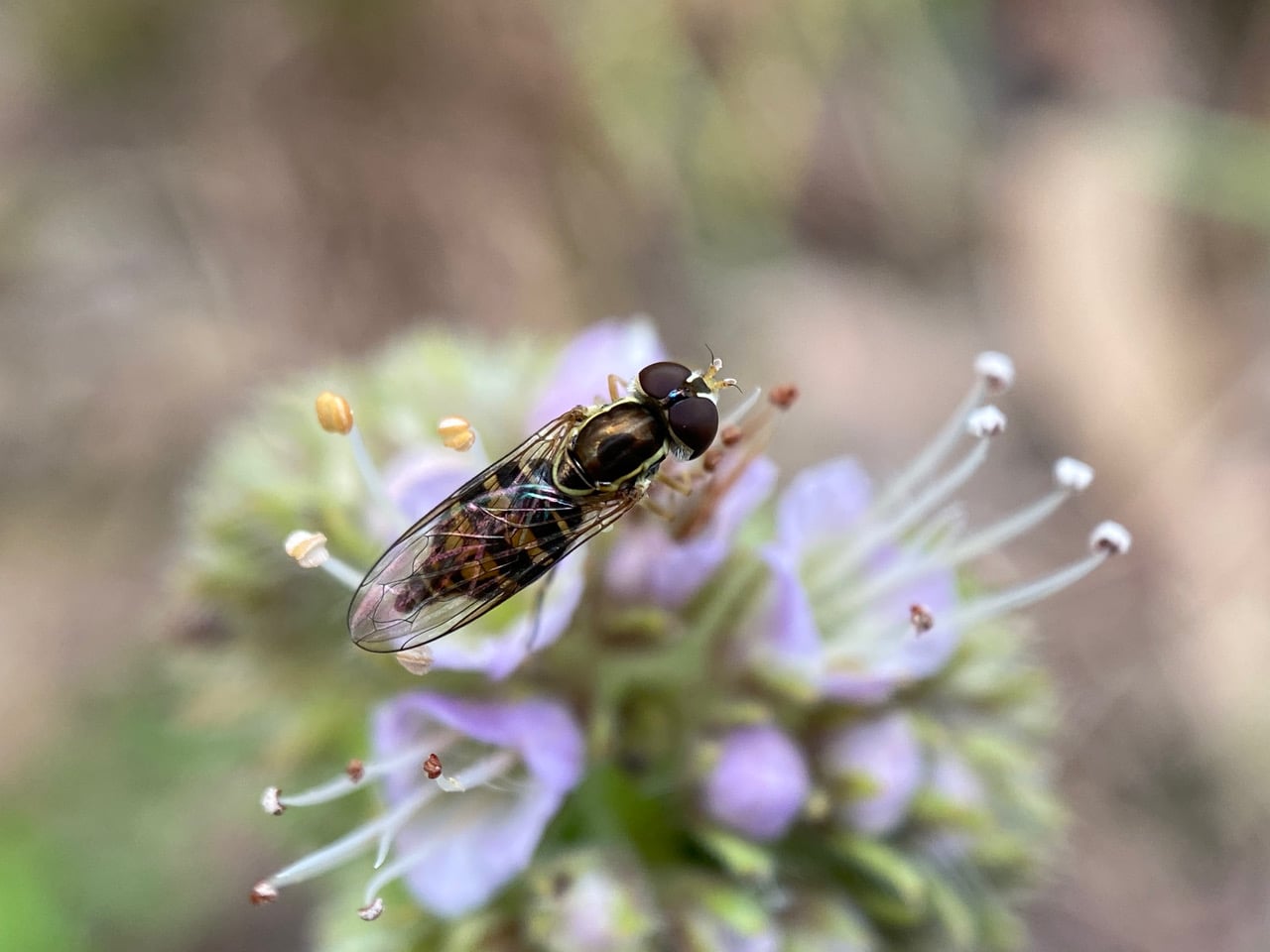
A Western Calligrapher, Toxomerus occidentalis (family Syrphidae) is easy to identify from the distinctive pattern on its abdomen. The rounded shape of this individual tells us that it is a female.
Hover Flies, also called Syrphid Flies make up the insect family Syrphidae. They are often seen hovering or nectaring at flowers; the adults of many species feed mainly on nectar and pollen, while the larvae eat a wide range of foods. In many species, the larvae feed on aphids, thrips, and other plant-sucking insects. In some species, the larvae are saprotrophs, eating decaying plant and animal matter in the soil or in ponds and streams. Many Hover Flies are brightly colored, with spots, stripes and bands of yellow; due to this coloring, they are often mistaken for wasps or bees. They exhibit Batesian mimicry – the resemblance to stinging insects gives the hover flies some protection from predators.
Hover Flies are considered the second-most important groups of pollinators after wild bees. Most are generalists that visit a wide range of plant species. The feeding habits of Syrphid larvae further endear them to the gardeners, serving as pest control agents and recyclers of organic matter.
The picture shows clearly that the insect has only a single pair of wings, making it a fly (order Diptera). See the two white lollipop-like structures under the wings? Those are halteres, modified hind wings in Diptera. Halteres are highly sophisticated balance organs and they oscillate during flight.
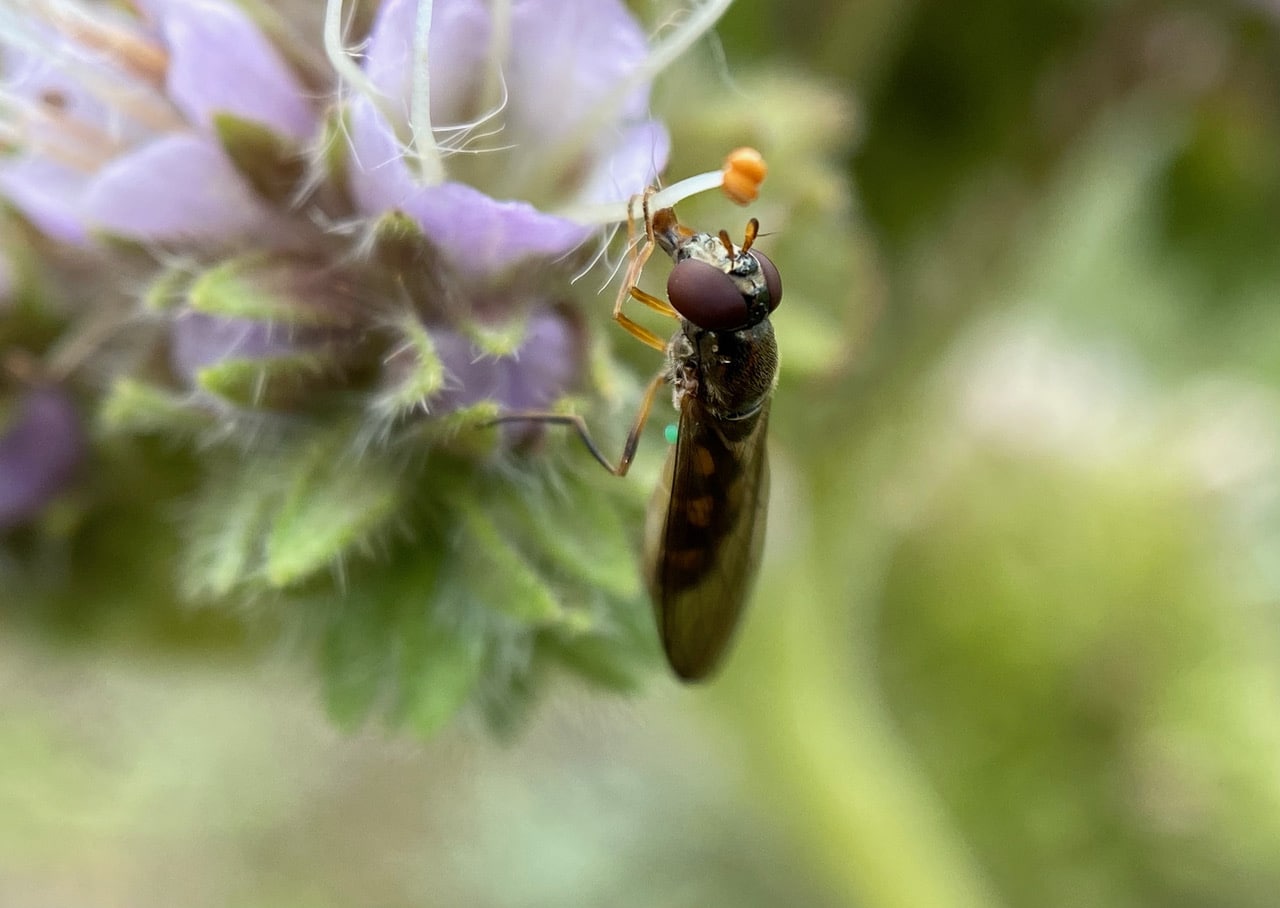
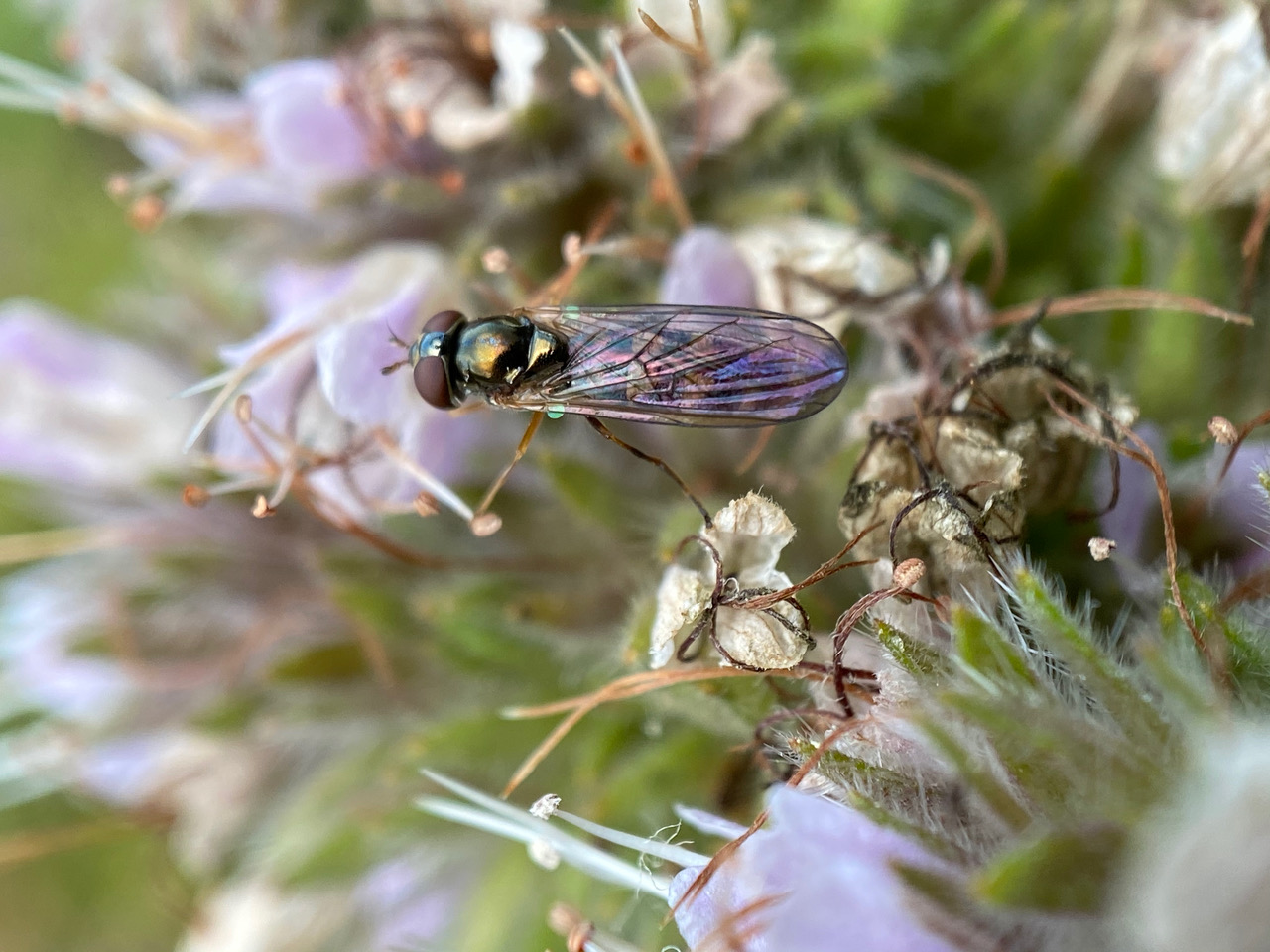
I was about to delete this photo when I realized that it is not so bad. After all the hover fly can be identified to the species and sex from this single picture! See the green haltere under the wing? The halteres of female Variable Duskyface Fly, Melanostoma mellinum (family Syrphidae) turn green when they are about to lay eggs.
Melanostoma mellinum is a very common species of hover fly found in many parts of Europe including the Mediterranean basin and North Africa, the East Palearctic, and North America. A small species, their wingspan between 4.7 and 7.0 mm. Very similar to Platycheirus, but can be distinguished by fine details. In M. mellinum, the normally pale halteres turn bright blueish-green in females about to lay eggs.
The species’ preferred habitat include grasslands and moorlands, including those in hilly and mountainous regions. Adults can be found feeding on pollen of grasses and other wind-pollinated plants. Little is known of their biology, but the larvae are suspected to be a general predator of small insects in the leaf litter.
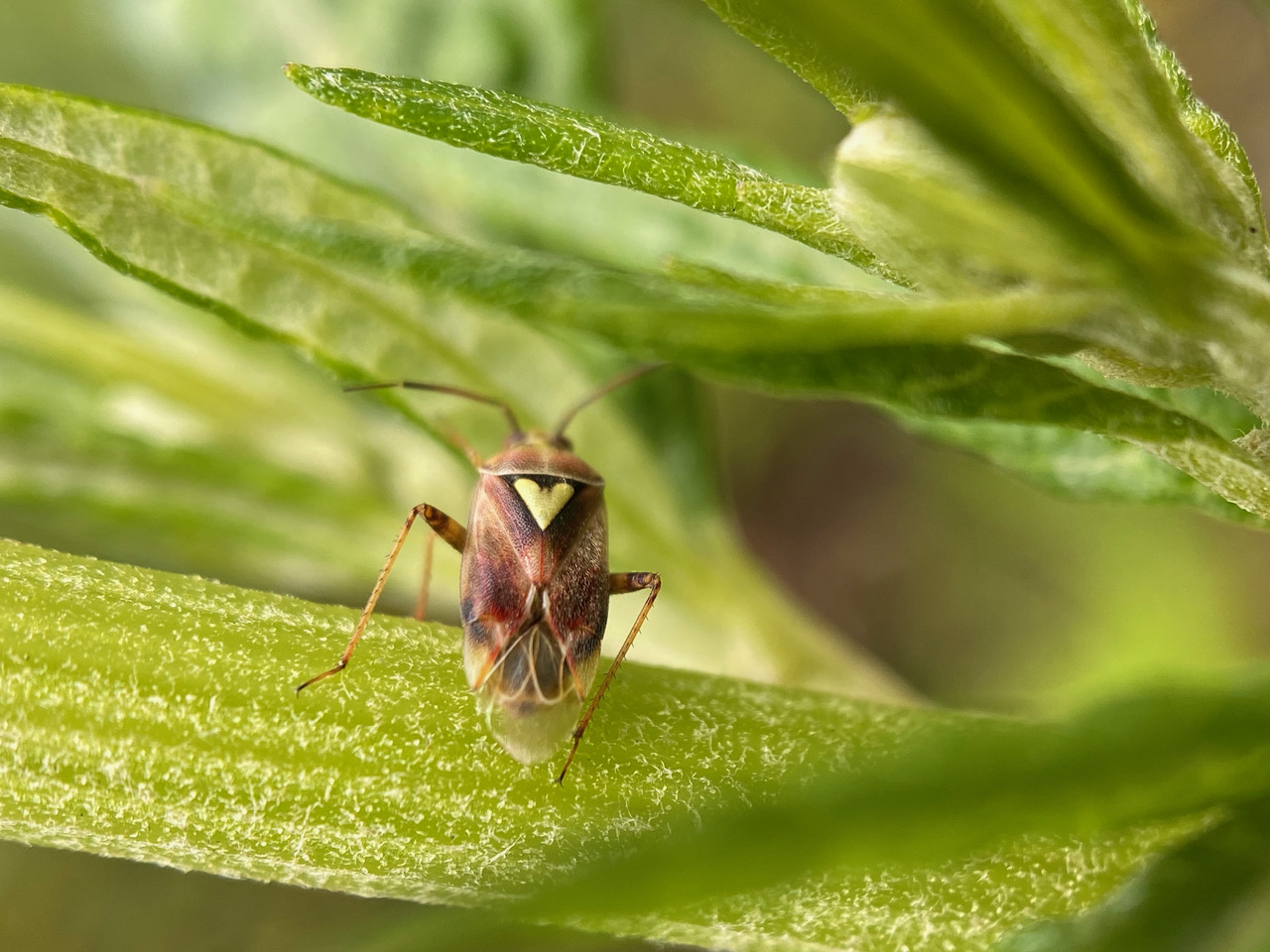
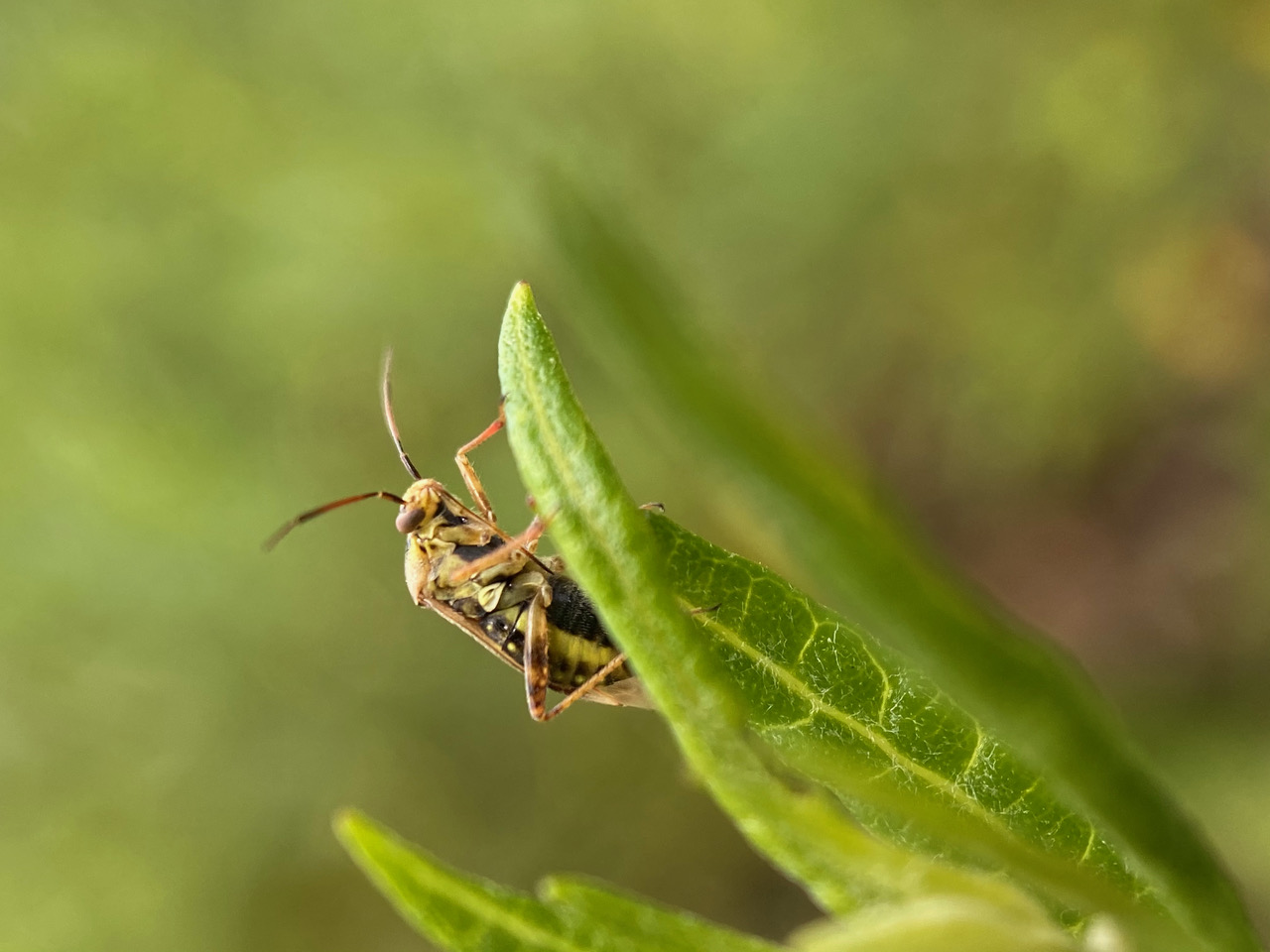
A Lygus Bug (family Miridae) is moving around in the foliage of California Mugwort, Artemisia douglasiana.
The term lygus bug is used for any member of the genus Lygus, in the family of plant bugs, Miridae. Adult lygus are approximately 3 mm wide and 6 mm long, colored from pale green to reddish brown or black. They have a distinctive triangle or V-shape on their backs. Lygus bugs are known for their destructive feeding habits – they puncture plant tissues with their piercing mouthparts, and feed by sucking sap. Both the physical injury and the plant’s own reaction to the bug’s saliva cause damage to the plant. Many lygus bugs are well-known agricultural pests.
The Lygus Bug pauses on a top leaf of Mugwort, giving me a clear view of its rostrum that is folded under its body.
The defining feature of Hemipterans or “true bugs” is their “beak” or rostrum in which the modified mandibles and maxillae form a “stylet” which is sheathed within a modified labium. The stylet is capable of piercing tissues and sucking liquids, while the labium supports it. The stylet contains a channel for outward movement of saliva and digestive enzymes, and another channel for the inward movement of pre-digested liquid food. The rostrum is usually folded under the body when not in use. Seed bugs are able to feed on seeds by injecting digestive juices into the seeds and sucking up the digested contents as a liquid.

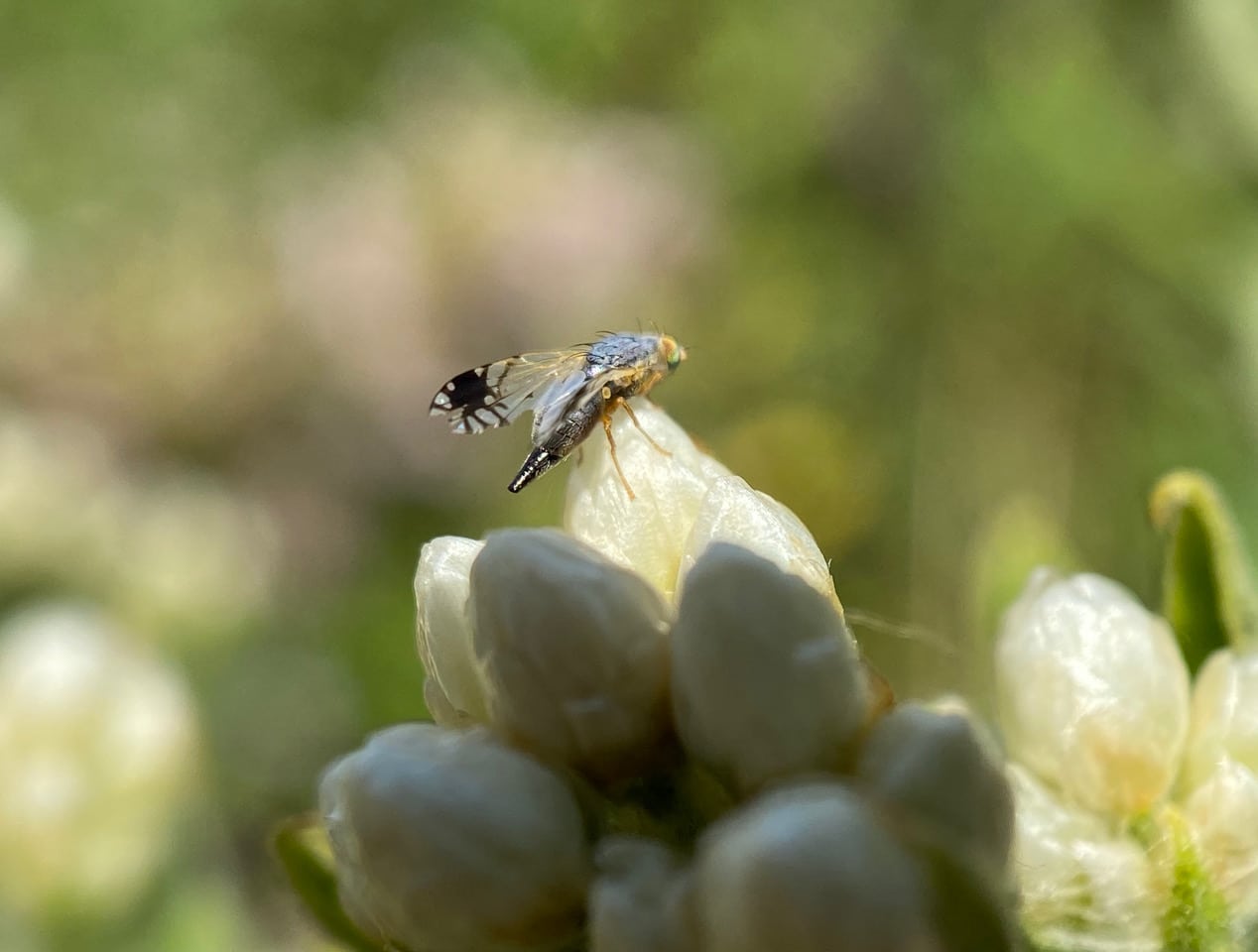
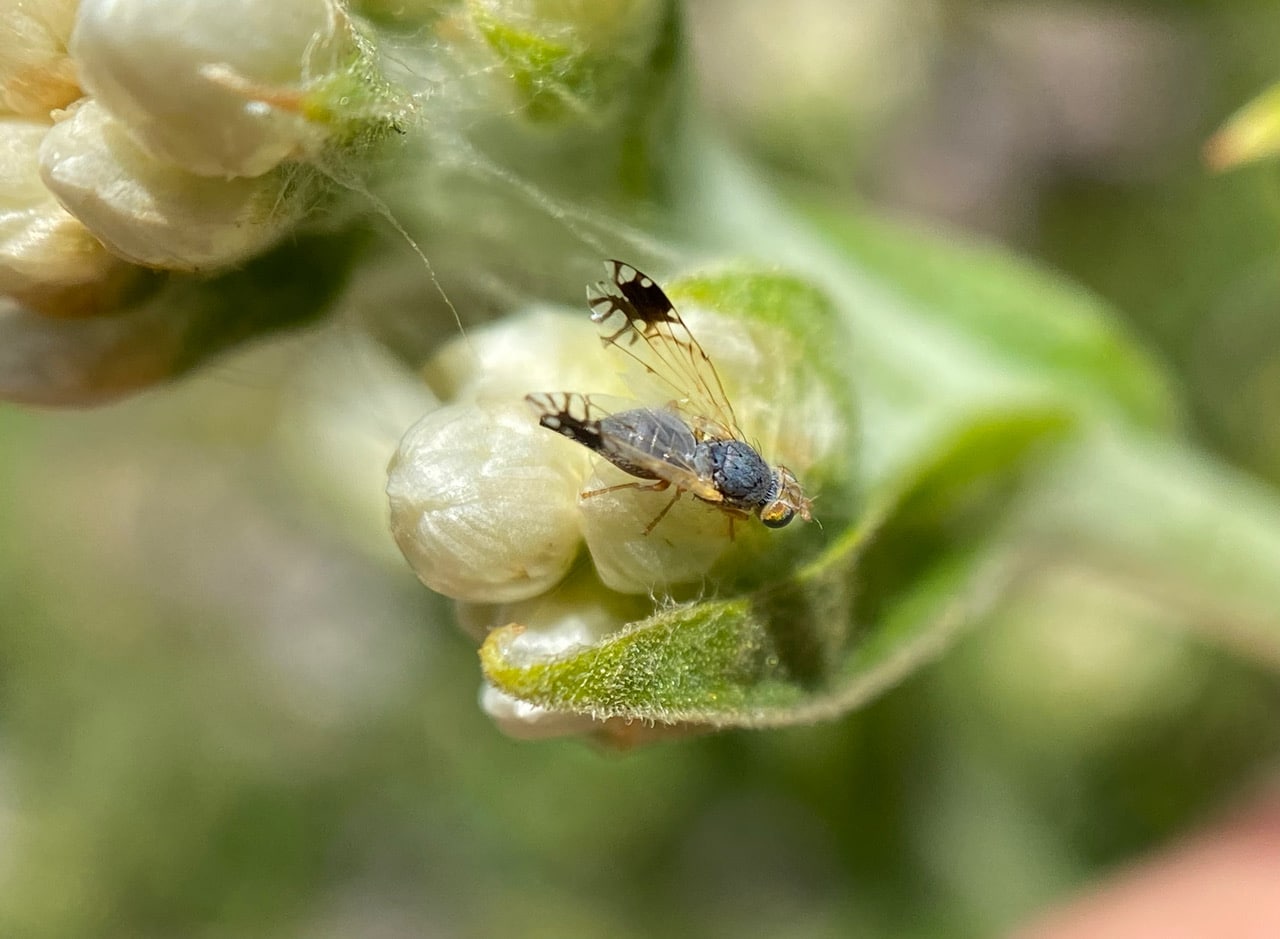
It’s that tiny Fruit Fly, Trupanea sp. (family Tephritidae) again, and again a female roaming the immature inflorescence of California Everlasting, Pseudognaphalium californicum! I have come across this scene too many times to think that it is just coincidental. There’s probably a specific relationship between the fly and the plant. She is probably here to lay her eggs!
Tephritids are small to medium-sized flies that are often colorful, and usually with picture wings. The larvae of almost all Tephritidae are phytophagous. Females deposit eggs in living, healthy plant tissues using their telescopic ovipositors. Here the larvae find their food upon emerging. The larvae develop in leaves, stems, flowers, seeds, fruits, and roots of the host plant, depending on the species. Adults are often found on the host plant and feeding on pollen, nectar, rotting plant debris, or honeydew. Tephritid flies are of major economic importance as they can cause damage to fruit and other plant crops. On the other hand, some Tephritids are used as agents of biological control of noxious weeds.
The Fruit Fly is female as evidenced by her oviscape at the tip of her abdomen. The oviscape is the basal part of the ovipositor, the non-retractile sclerotized sheath that remains exposed when the telescopic ovipositor is withdrawn and not in action.
Hey, another gravid female Variable Duskyface Fly, Melanostoma mellinum (family Syrphidae) on California Phacelia. This time we have better light on the insect. Her green halteres are partially visible under her folded wings.
A male Diamond Spottail Hover Fly, Fazia micrura (family Syrphidae) is feeding on the pollen of California Phacelia.
You can still tell that this is a Western Calligrapher, Toxomerus occidentalis (family Syrphidae). The unique shape of her abdomen is still visible through the folded wings. I didn’t know that the fly has a yellow line outlining its thorax and scutellum. Cool!
Another Inchworm caterpillar on California Phacelia inflorescence. Note the three pairs of true legs behind the head, followed by a long expanse of body segments with no prolegs.
I think that’s a Sedgesitter, Platycheirus sp. (family Syrphidae) feeding on a Sticky Monkeyflower, Diplacus aurantiacus. Although the two common species of metallic hover flies, the Sedgesitters and the Variable Duskyface Flies are very similar in appearance, the Sedgesitters have a proportionately shorter abdomen, and if visible, the patterns on the abdomen are different in the two species.
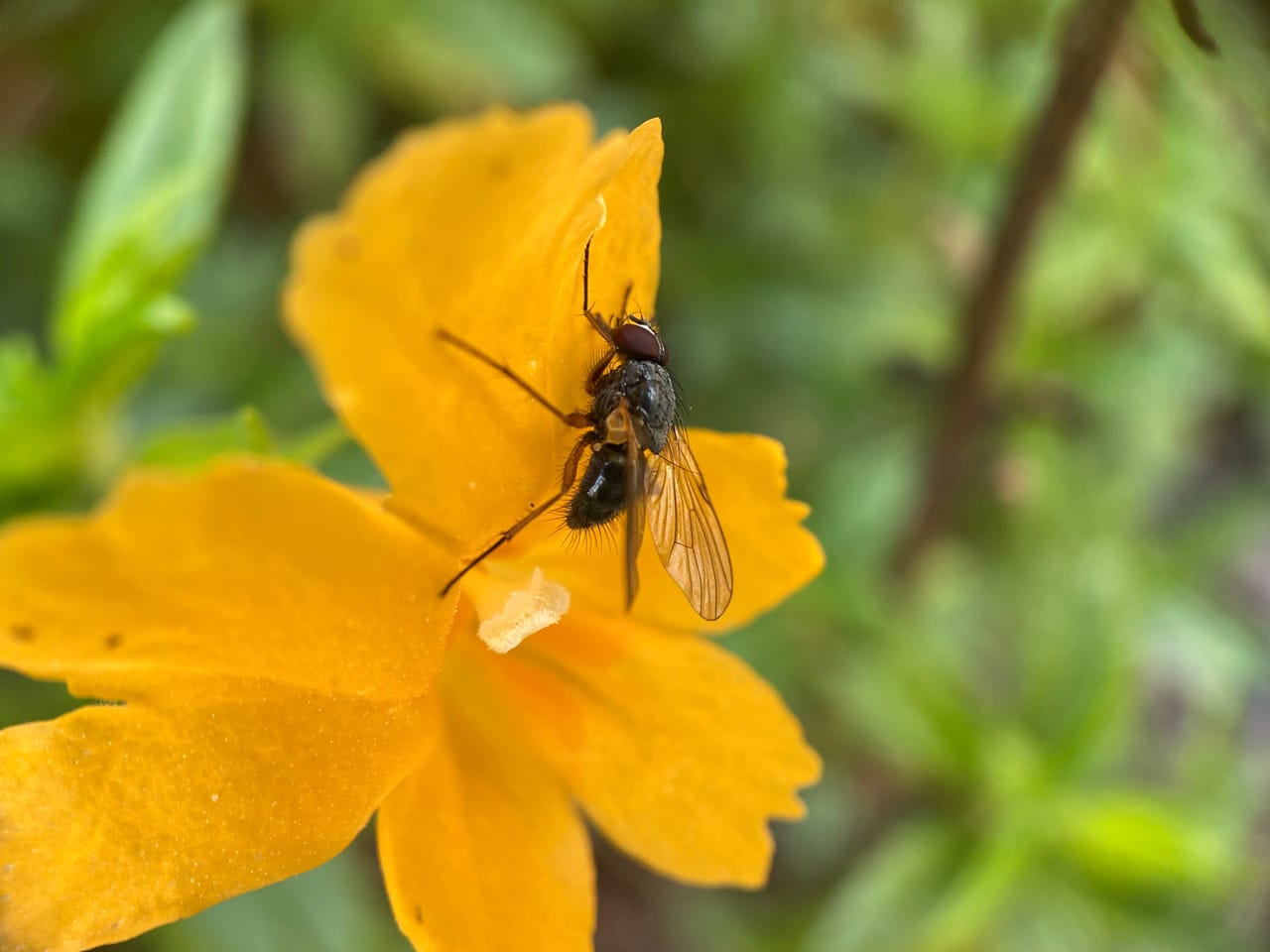
This fly is commonly seen visiting the Sticky Monkeyflowers, but I am not getting anywhere trying to have it identified. It has orange-colored double calypters under each wing.
Up near the Radio Tower along the paved road, many of the Coast Tarweed, Madia sativa have been blooming for a while. Lately, I have noticed that the top flowerheads on many plants have taken on this brown, parched appearance. It’s as if they have been freeze-dried on the spot. Could it be wind burn? This section of the ridge is often quite windy. Or could it be flash drought? But this area gets plenty of fog drip from the oak and Eucalyptus trees…
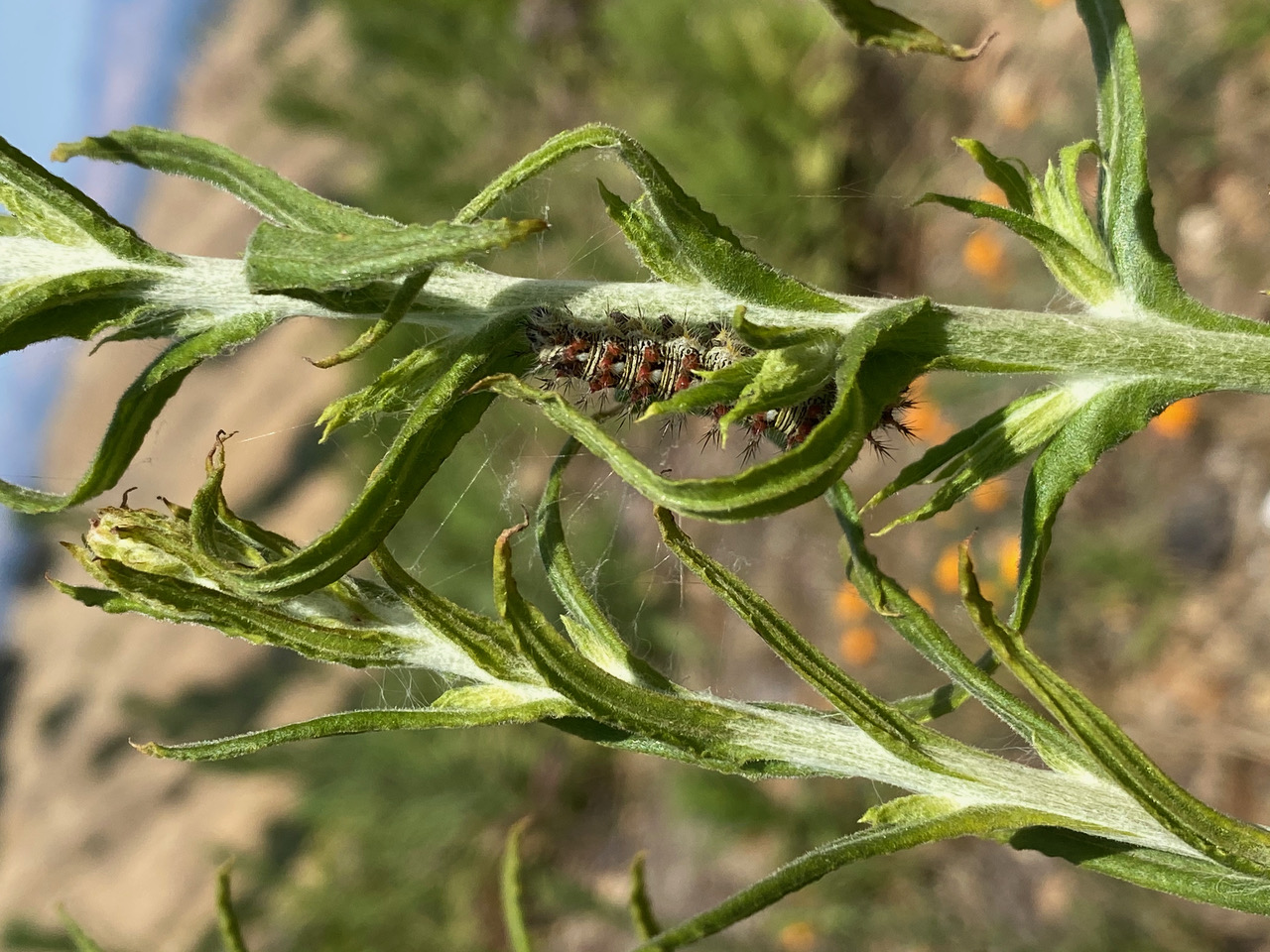
A young American Lady caterpillar,Vanessa virginiensis (family Nymphalidae) is constructing a nest on its host plant California Everlasting, Pseudoghaphalium californicum. It is webbing together two branches of the same plant with silk from the silk gland in its mouth.
The American Lady, Vanessa virginiensis (family Nymphalidae) occurs from southern Canada throughout the US and southward to South America. The preferred host plants for the larvae are the “everlastings” or “cudweed” herbs and their close relatives in the sunflower family, Asteraceae. American Lady caterpillars are solitary feeders and construct nests from various parts of their host plant. Tiny larvae use leaf hairs to construct tiny nests; larger caterpillars arrange leaves, flower heads, and detritus to form tight shelters. Several structures are typically built during the caterpillar’s development.
Both moth and butterfly caterpillars have spinnerets, which are modified salivary glands located on their lower jaw. They spit out the liquid silk which solidifies on contact with air to form strands of fibroin protein. Many caterpillars hide from predators by stitching the edges of a host plant leaf into a nest with silk thread.
I am intrigued by the various constructions of the American Lady caterpillars. The youngest caterpillars use the young leaves at the tips of the plants, while the older ones use the flowerheads. How do they do it? Do they have a plan in their head?
The majority of caterpillars have twelve small eyes (stemmata), six on either side of their head. It is thought that their eye sight is relatively simple, detecting light and dark, but not forming image. Do the caterpillars construct their nests using mainly tactile perception?
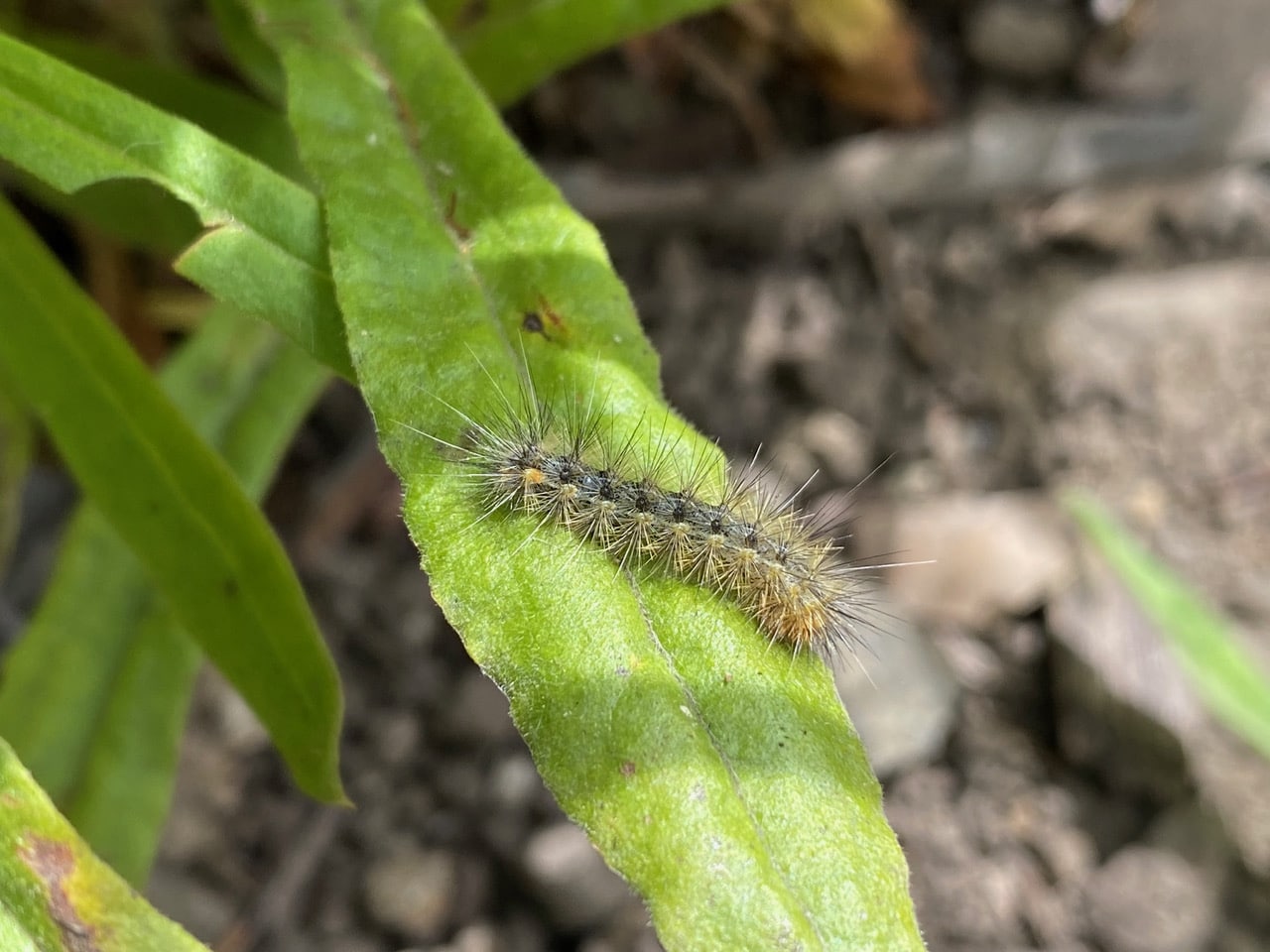
A tiny caterpillar with long bristles is resting on a lower leaf of California Everlasting. It is a member of the family Eribidae. There are no signs of fresh feeding damage on the plant.
The Erebidae are a family of moths in the superfamily Noctuoidea. The family is among the largest families of moths by species count and contains a wide variety of well-known macro moth groups, uncluding the Underwing moths, Tiger moths, Tussock moths and many others.