

Pollinator Post 6/21/25 (2)
I travel the short distance from Naomi’s native sidewalk garden on Lincoln Ave. to Crab Cove. First I check the plantings at the end of McKay Ave.
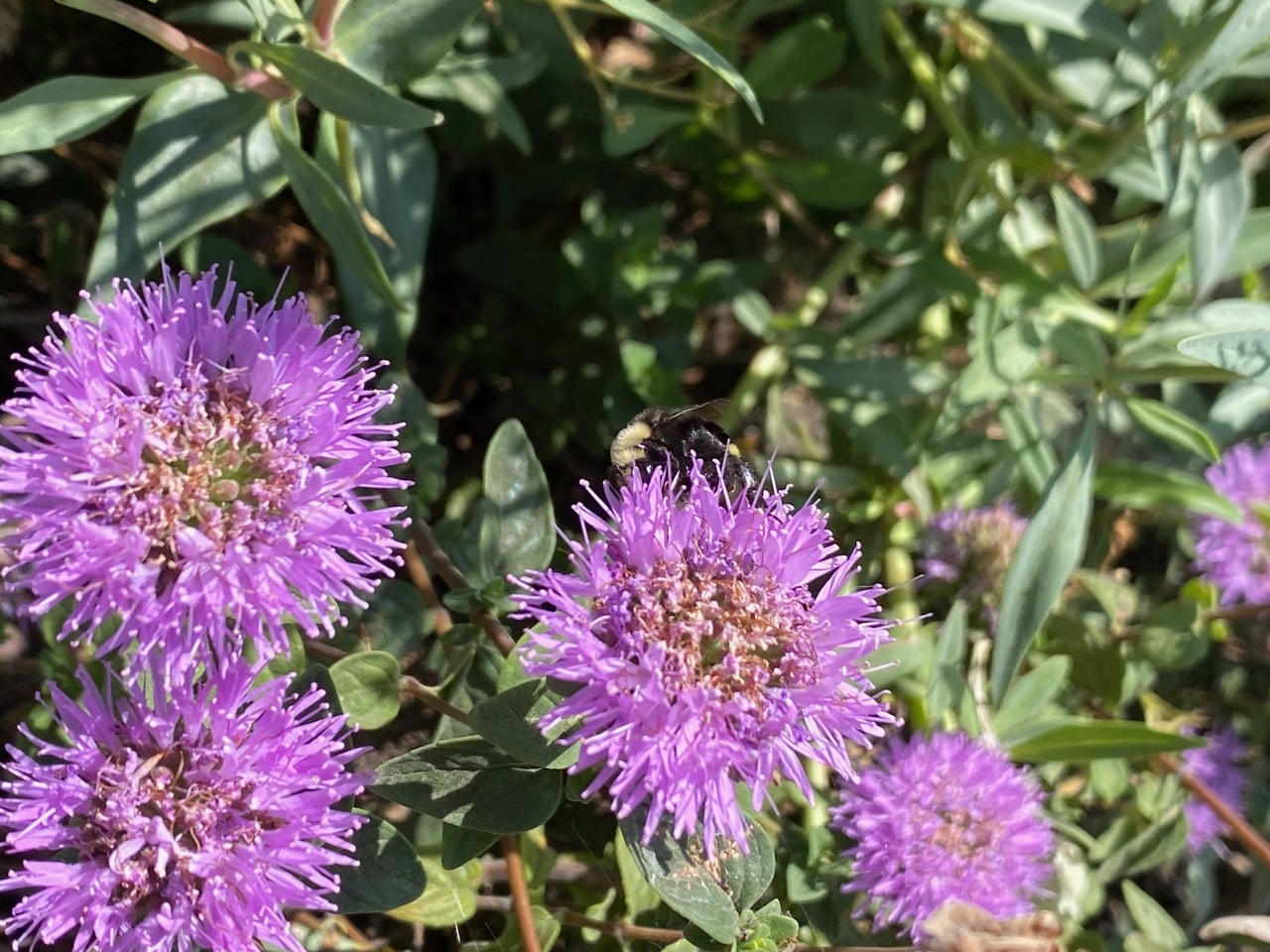
The Coyote Mint, Monardella villosa is fading but still attracting the usual insect visitors. Here a Yellow-faced Bumble Bee, subgenus Pyrobombus (genus Bombus, family Apidae) is foraging on a flowerhead.
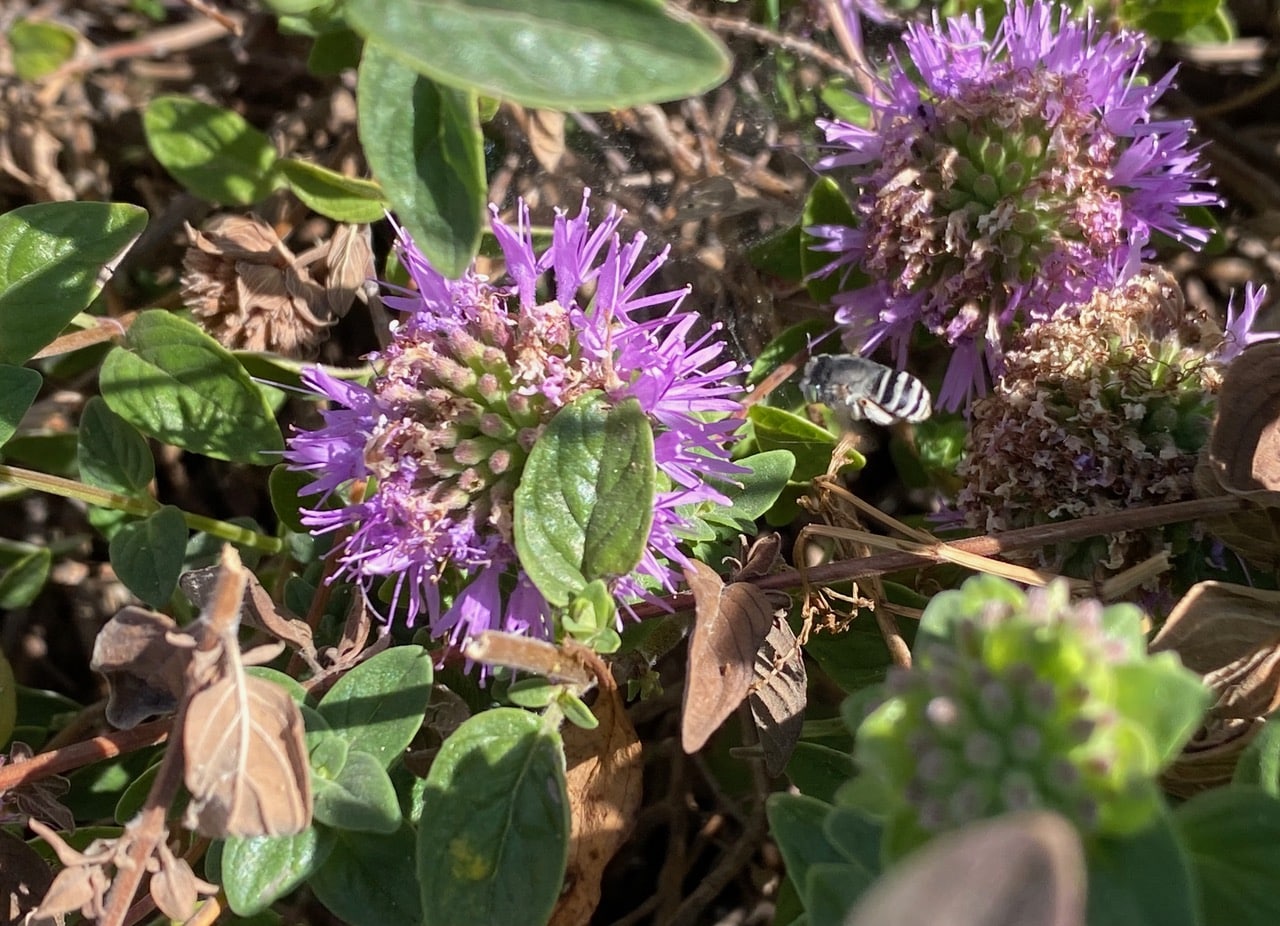
A little bee with black-and-gray striped abdomen is zipping around the patch…
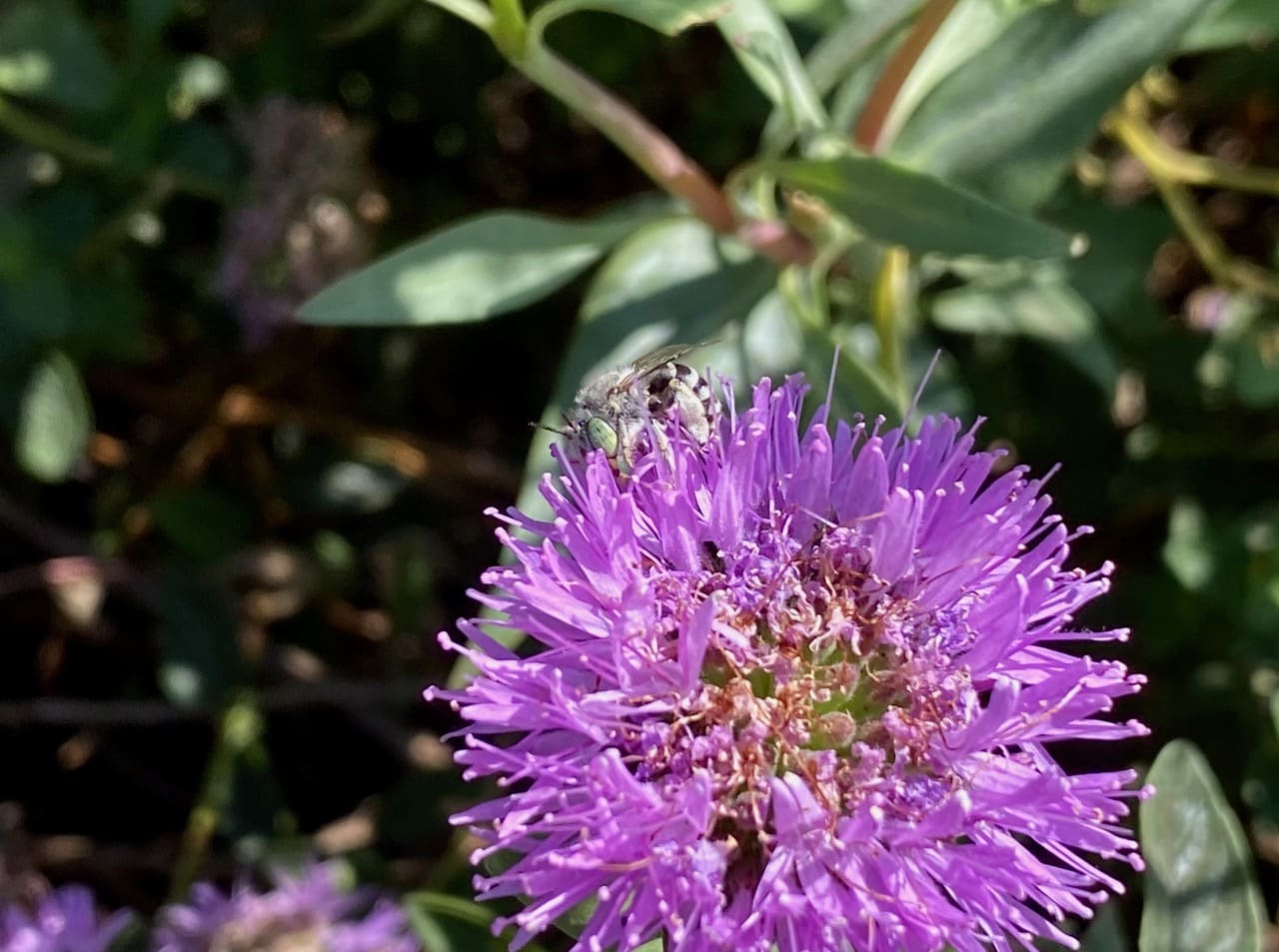
… occasionally landing to sip nectar and collect pollen. Though small and dwarfed by the crowded flowers of the Coyote Mint, the Short Sun-Digger Bee, Anthophora curta (subgenus Micranthophora, family Apidae) apparently has long enough tongue to access the nectar in the tubular flowers. Note the distinctive white scopae (special pollen collecting hairs) on her hind legs.
The bee genus Anthophora, commonly known as Digger Bees, is one of the largest in the family Apidae. All species are solitary, though many nest in large aggregations. Nearly all species construct nests in the soil, either in banks or in flat ground; the larvae develop in cells with waterproof linings and do not spin cocoons. Males commonly have pale white or yellow facial markings, and/or peculiarly modified leg armature and hairs. Anthophora bees generally have long tongues that allow them to access nectar and pollen in deep-throated or tubular flowers which are out of reach of other bees. Members of the subgenus Micranthophora are much smaller in size than the common Anthophora species. A. Curta is only about a third the size of the A. pacifica I am used to seeing in early spring. The general appearance and behavior (frenetic) are, however, similar.
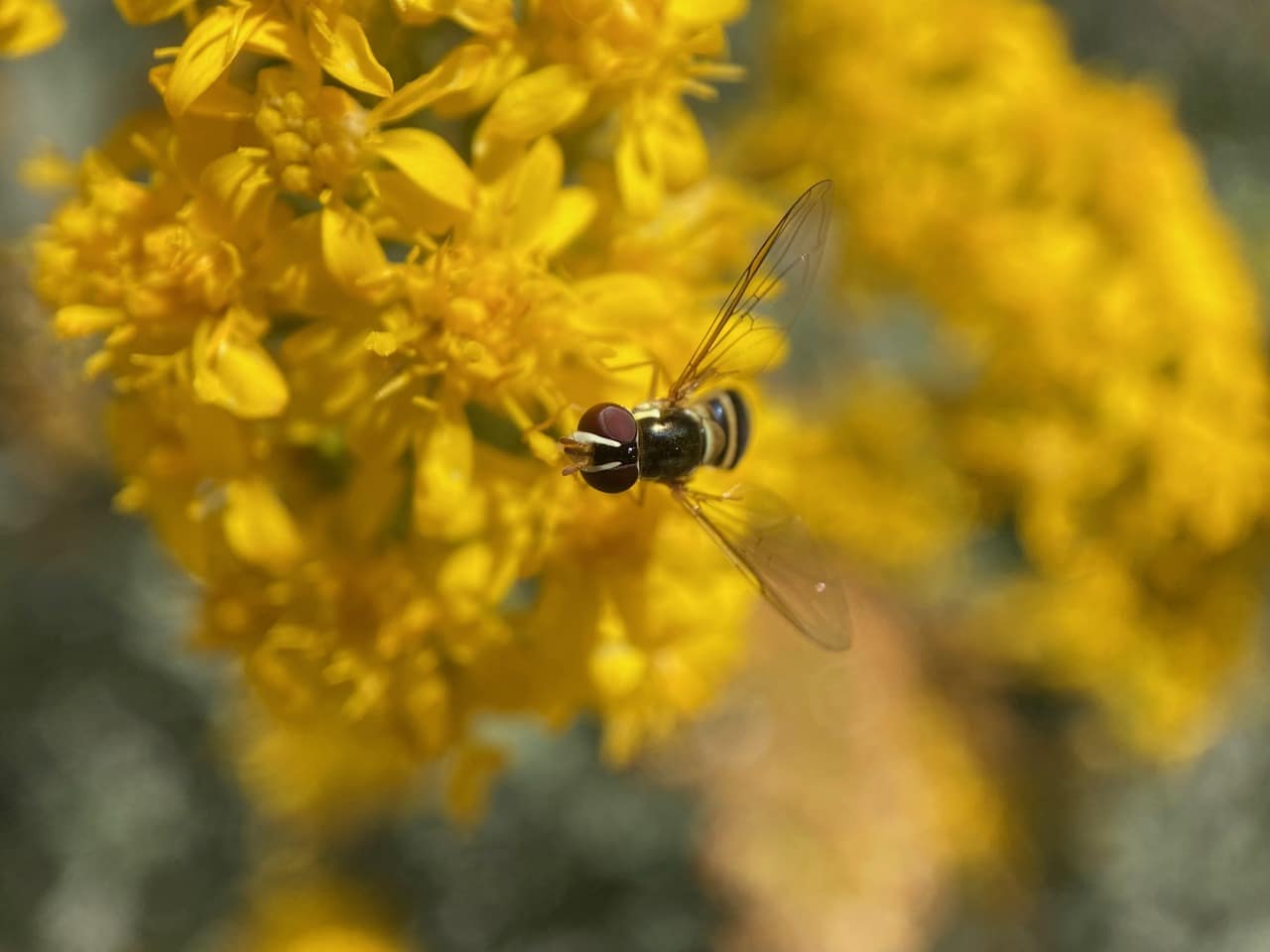
More flowers have come into bloom in the patch of California Goldenrod, Solidago velutina ssp. californica. A small hover fly is hovering over a cluster of flowerheads.

When it finally lands, I realize that it is a gravid female Oblique Streaktail, Allograpta obliqua (family Syrphidae). She curls her abdomen forward in an egg-laying position. There’s no way I can see any egg among that busy substrate.
Although small in size (6-7 mm long), the Oblique Streaktail is easily recognizable for the unique pattern on its black-and-yellow abdomen. It is a common North American species of hover fly. Adults visit flowers for nectar and pollen, and are pollinators. Females lay eggs on plant surfaces near aphids. Larvae feed on the aphids.

There are several large St. Catherine’s Lace, Eriogonum giganteum planted at the end of McKay Ave, and they are all starting to bloom. Insect visitation is less enthusiastic compared to the Coyote Mint. A small wasp lands on a far branch, but its markings are distinctive enough that I recognize it as a Mason Wasp, Euodynerus annulatus (family Vespidae, subfamily Eumininae).
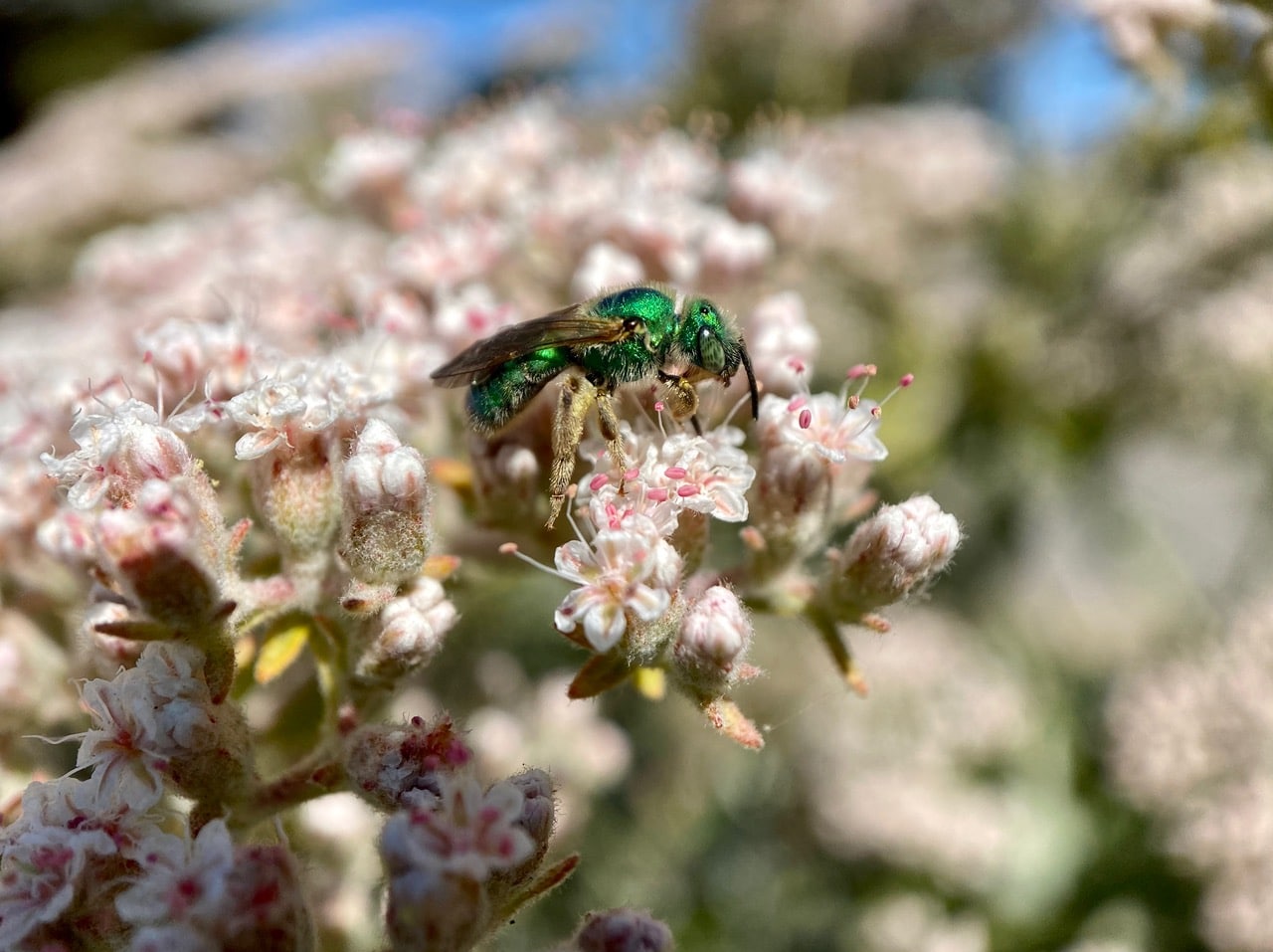
Aglow in emerald green, a female Fine Striped Sweat Bee, Agapostemon subtilior (family Halictidae) is taking nectar from the small flowers. The bee’s scopae that extend the entire length of her hind legs are essentially empty of pollen.
Agapostemon are brightly colored metallic green or blue bees measuring 7 to 14.5 mm long. Most species have a metallic green head and thorax, and black-and-yellow striped abdomen; some females are entirely bright green or blue. Females carry pollen on scopal hairs located on their hind legs. Agapostemon are generalists. Like other members of the family Halictidae, they are short-tongued and thus have difficulty extracting nectar from deep flowers. Males are often seen flying slowly around flowers looking for females. The bees favor flowers with high densities. Females excavate nests in the ground. These are summer to fall bees.
Fine striped sweat bee (Agapostemon subtilior) · iNaturalist
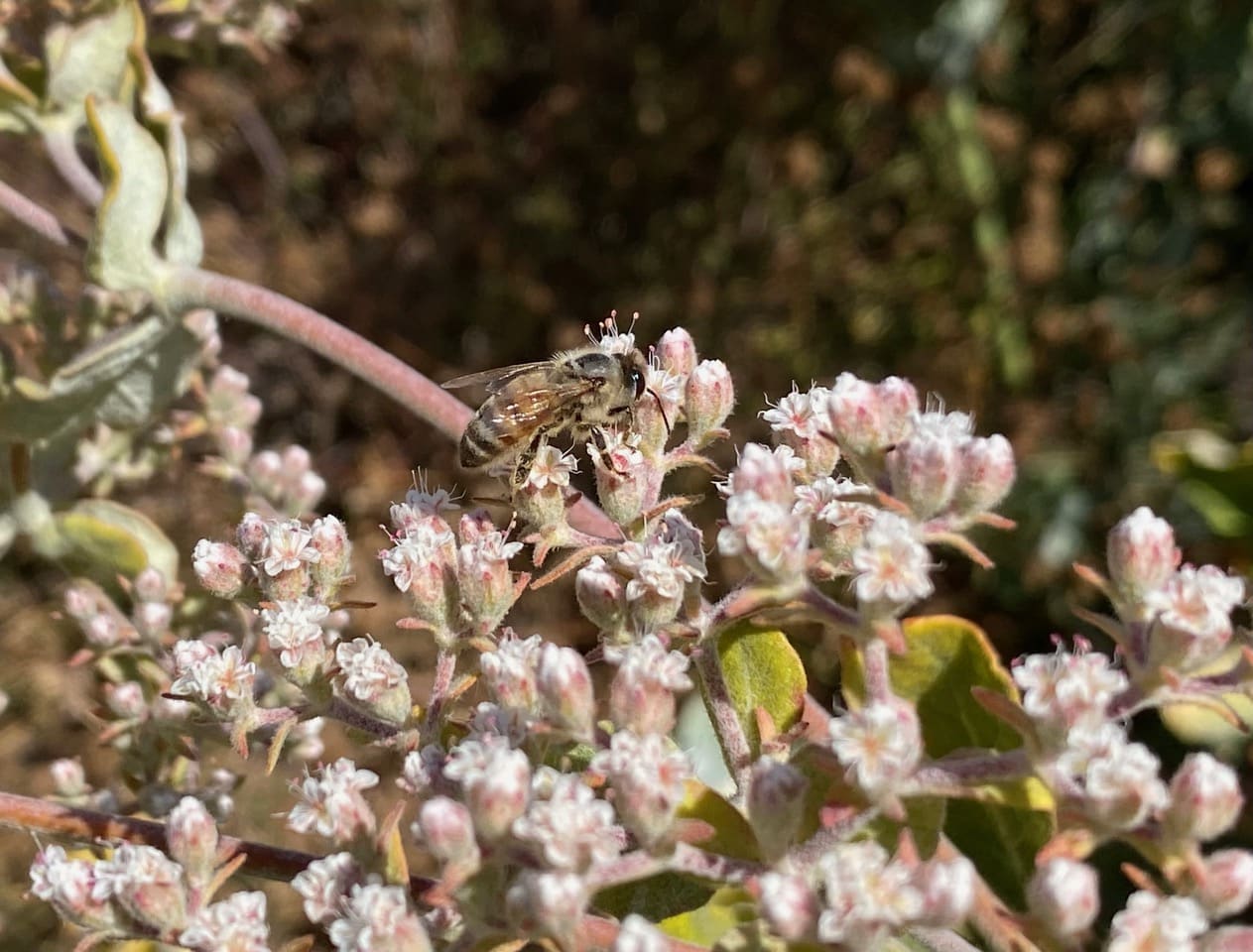
So far, the Honey Bees, Apis mellifera (family Apidae) are the most common visitors to the flowers of St. Catherine’s Lace. This bee too is not collecting pollen – her pollen baskets (corbiculae) are empty.

A robust Hot Lips Sage, Salvia microphylla is included in the bed of mixed native and non-native plants known to be attractive to butterflies.

A large Yellow-faced Bumble Bee is causing a commotion in the Hot Lips Sage. Her weight causes the flowers to droop whenever she lands on them. I follow her movements through the plant and am rather surprised that the young queen bee is actually accessing nectar the legitimate way – from the front to the tubular corolla. Her tongue is apparently long enough to reach the nectar at the base of the flower. Large bees such as Carpenter Bees and Bumble Bees that can’t enter the narrow tubular flowers often engage in “nectar robbing” – by cutting a slit at the base of the flower to access the nectar directly. The sneaky practice bypasses the reproductive structures of the flower and does not contribute to pollination.
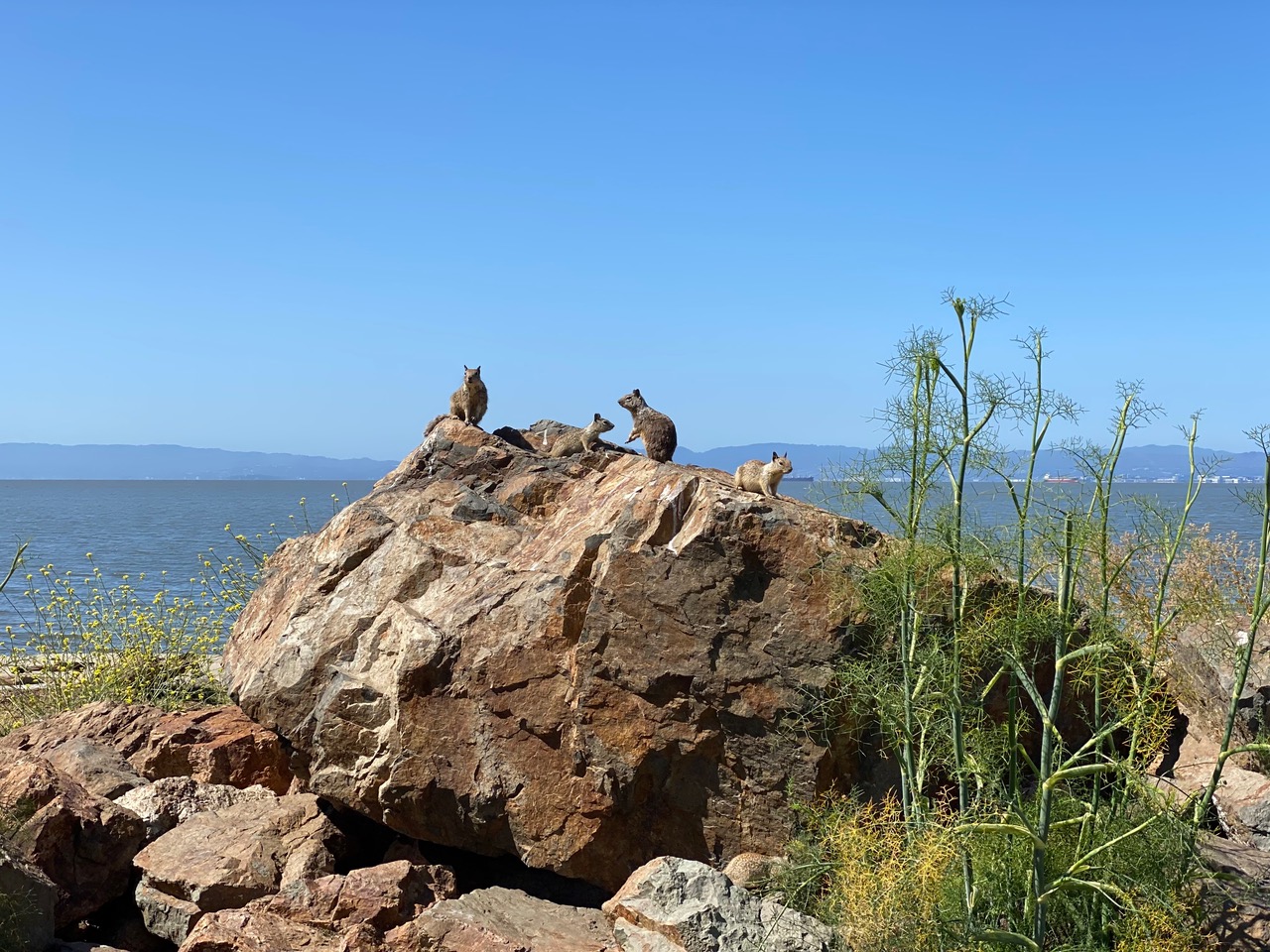
As I walk to the demonstration garden near the Bath House, I am greeted by the sight of a family of ground squirrels enjoying the sun on a big rock by the beach.

A large crowd has gathered along the sandy beach. Unbeknownst to me, today is the annual Sand Castle and Sand Sculpture Contest at Crown Memorial Beach. What fun! I detour to the beach to take in the fun and festivities.

Some of the Red-flowered Buckwheat, Eriogonum grande ssp. rubescens are already in peak bloom at the native garden. As is the case for most plants in this park, the flowers are dominated by the American Sand Wasps, Bembix americana (family Crabronidae). They are only out-sized by the occasional bumble bees here.
Sand wasps in the genus Bembix are familiar and common throughout North America, digging their burrows in dunes, on beaches, and other habitats with loose, deep sand. The female rapidly kicks out large quantities of sand using a “tarsal rake” of spines on each front leg. The burrow is excavated before the wasp goes hunting. Bembix are generalist, opportunistic hunters. True flies in the order Diptera are the usual prey. A victim is paralyzed or killed by the wasp’s sting, and is then flown back to the nest. Most species will lay an egg on the first victim, while some species lay an egg in the empty cell before starting to hunt. Once the egg hatches, mama wasp brings flies to her larva as needed. This “progressive provisioning” is rare in the insect world. When the larva reaches maturity, mama wasp closes the cell. Inside, the larva spins an oblong cocoon, weaving sand grains into the structure and resulting in a hardened capsule. Overwintering takes place as a prepupa inside this cocoon, but there are usually two generations a year.
Male sand wasps often engage in an elaborate flight ritual called “sun dances”. Males emerge before females, and fly erratically at dizzying speed one or two inches above the ground attempting to detect virgin females about to emerge from their underground nests. Both sexes are often seen taking nectar at flowers, especially from Asteraceae family. Bembix wasps are often victims of other insects such as cuckoo wasps (Chrysididae), velvet ants (Mutillidae), satellite flies (Sarcophagidae), bee flies (Bombyliidae), and thick-headed flies (Conopidae).
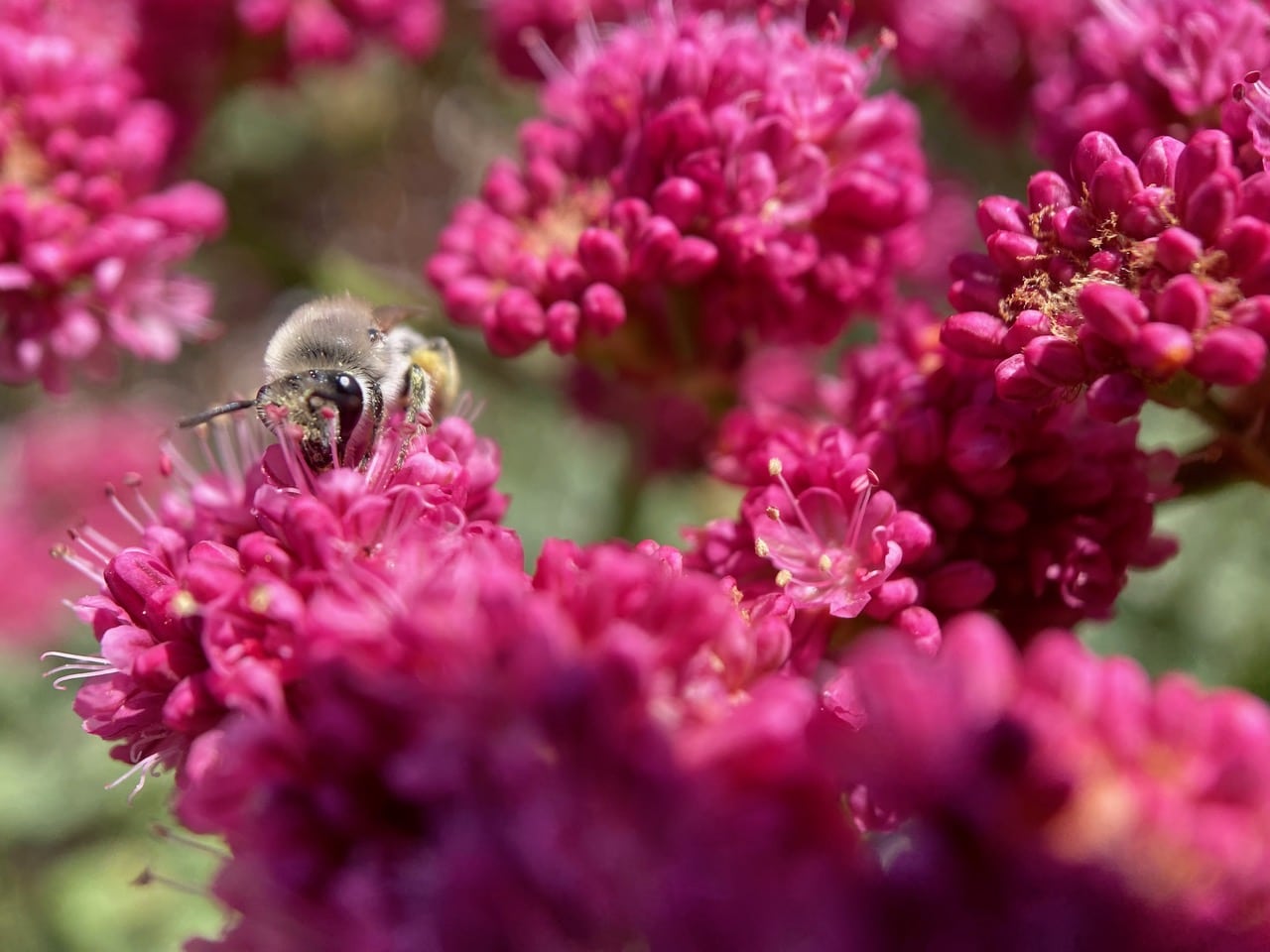
A small bee with a sweet, heart-shaped face is making her way through an inflorescence of the Red-flowered Buckwheat, her head lowered to take nectar. She is a Cellophane Bee, Colletes sp. (family Colletidae).
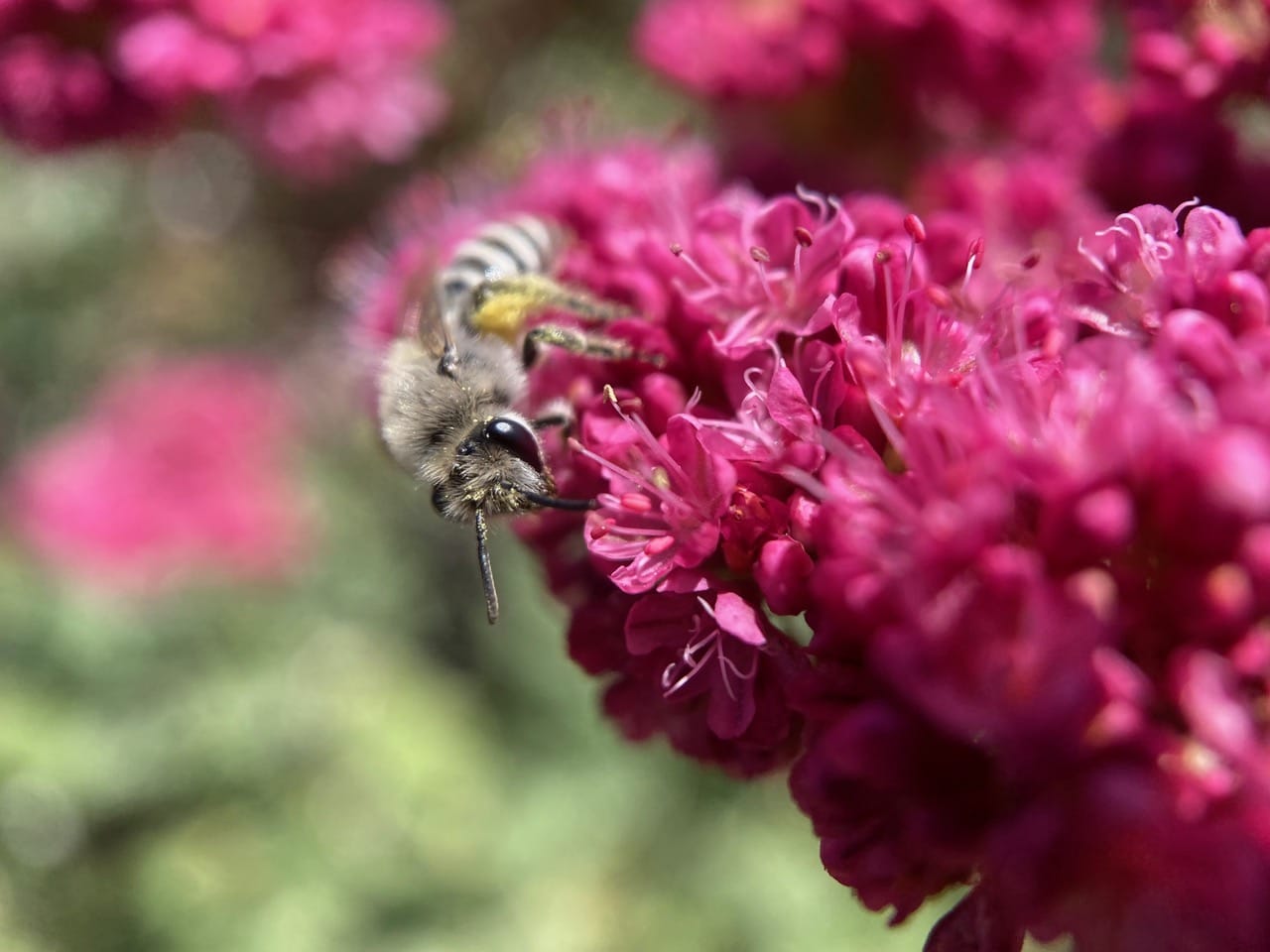
The bee family Colletidae includes generalists and specialists, and they are likely important pollinators of many wildflowers. All Colletidae in North America are solitary ground nesters, but some species nest in large aggregations. There are two major genera of Colletidae in North America: the Masked Bees (genus Hylaeus) and Cellophane Bees (genus Colletes). The most obvious shared characteristics of Colletidae is also the hardest to see: their short tongue. Colletes are moderately hairy, slender bees, ranging in size from 7 to 16 mm. Distinct features include a hairy head and thorax, pale bands of hair on the abdomen, and a heart-shaped head. The eyes of Colletes are angled (rather than being parallel), making the face slightly heart-shaped.

The genus name Colletes means “one who glues”, referring to their habit of applying a glue- or cellophane-like lining to the walls of nest cells, using their specialized tongues. This lining gives rise to their common names: cellophane bees, polyester bees, and plasterer bees. Colletes tongue is unique: short, flat, and forked at the tip. Colletes line their nests with a distinctive cellophane-like substance made from saliva and secretions from the Dufour’s gland on the abdomen. Using their specialized tongue, they paint the walls with saliva, then with secretions from the Dufour’s gland, they add a coat of varnish. This creates a clear covering that is strong, durable, and resistant to mold and water.
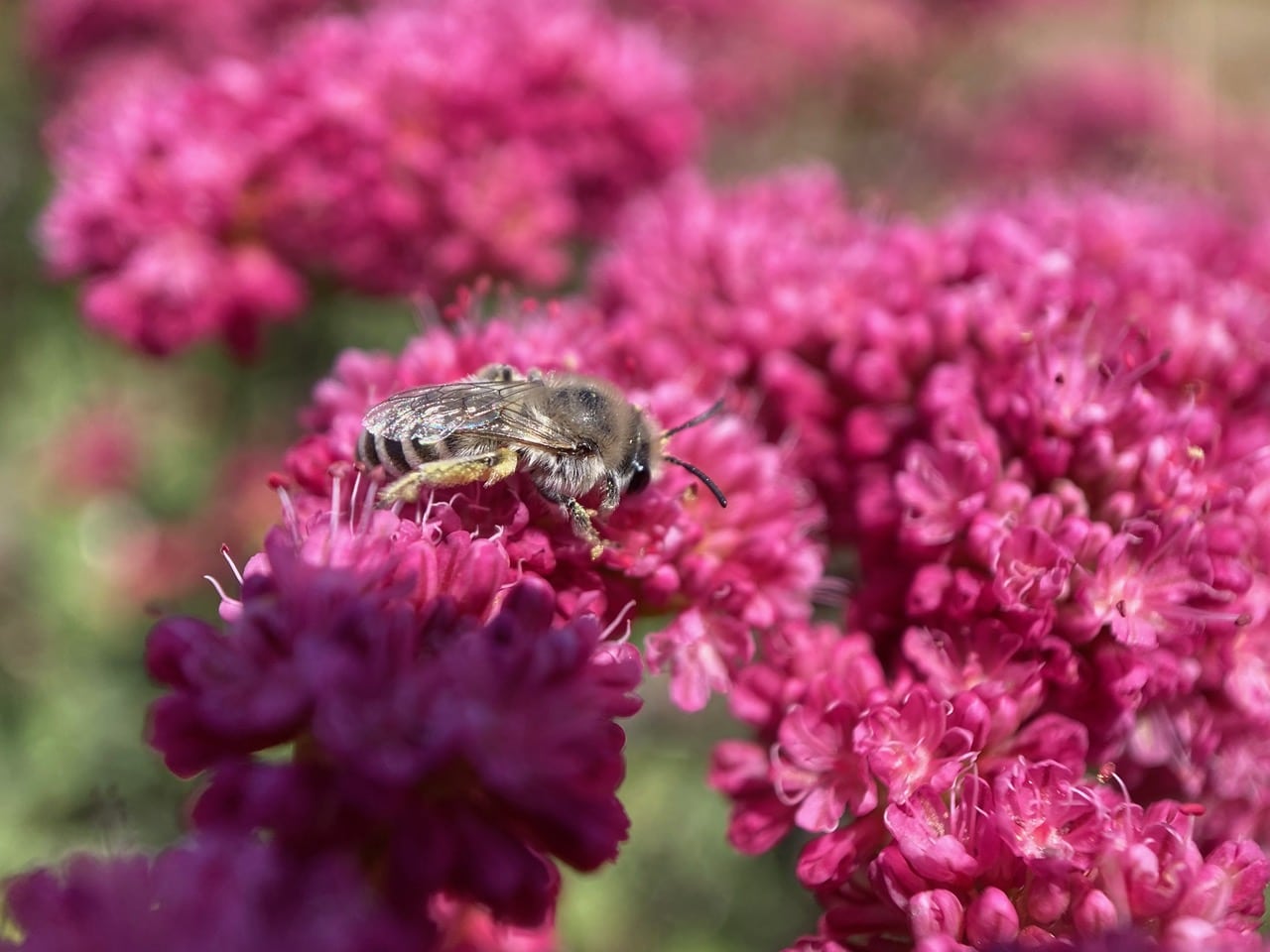

Hyperactive, wary and elusive, this tiny Bee Fly, Lepidanthrax sp. (family Bombyliidae) is one of the most difficult insects I have photographed.
The Bee Flies belong to the family Bombyliidae. Adults generally visit flowers for nectar and pollen, some being important pollinators. Larvae generally are parasitoids of other insects. When at rest, many species of bee flies hold their wings at a characteristic “swept back” angle. The adult females usually deposit eggs in the vicinity of possible hosts, quite often in the burrows of beetles or ground-nesting bees/wasps. Bombyliidae parasitism is not host-specific, but rather opportunistic, using a variety of hosts.
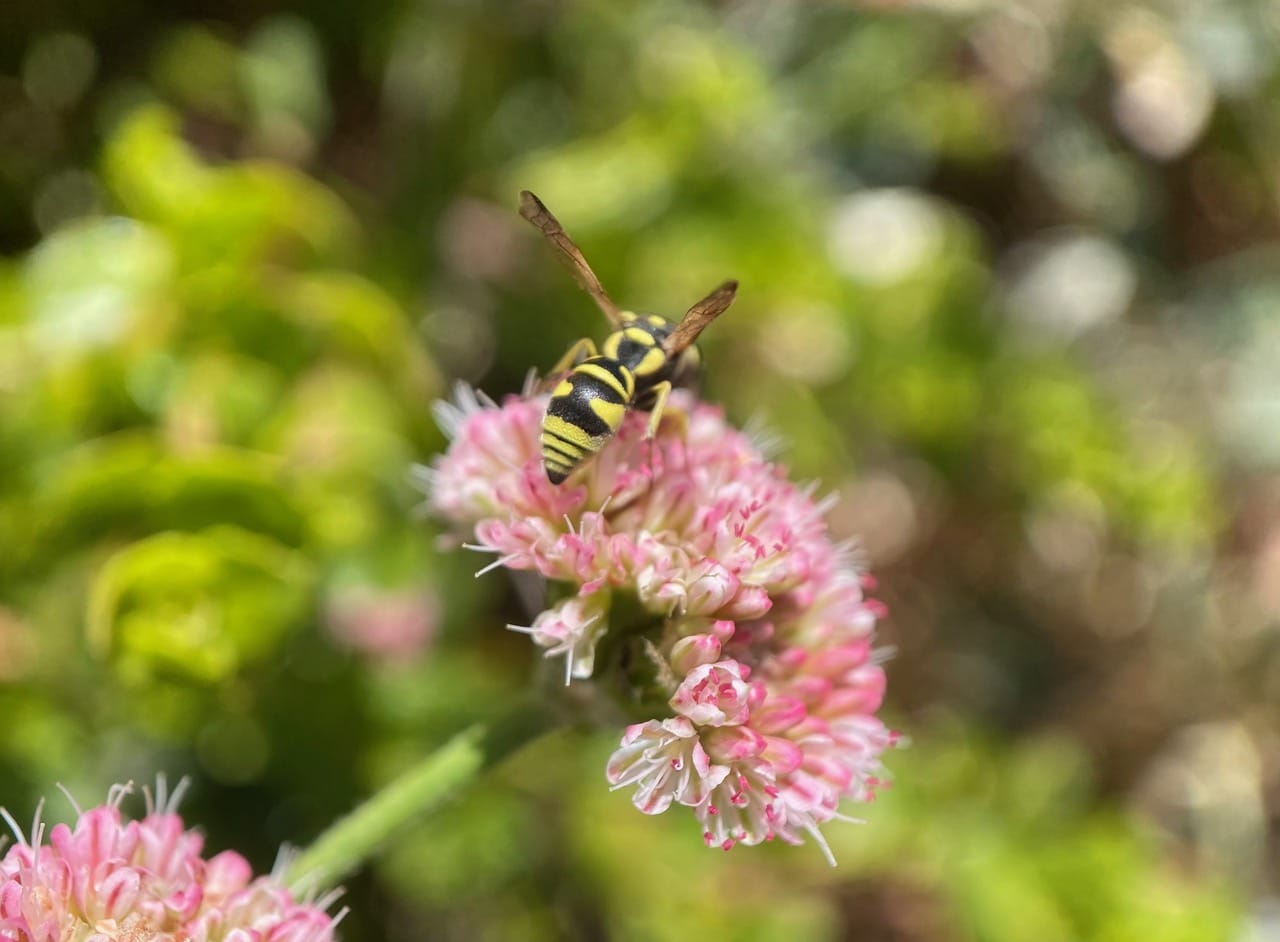
A small wasp is foraging on a cluster of buckwheat flowers. Its abdominal markings are suggestive of the Mason Wasp, Euodynerus annulatus (family Vespidae, subfamily Eumininae). It’s the same species as the one I saw earlier on the flowers of the other buckwheat, St. Catherine’s Lace.
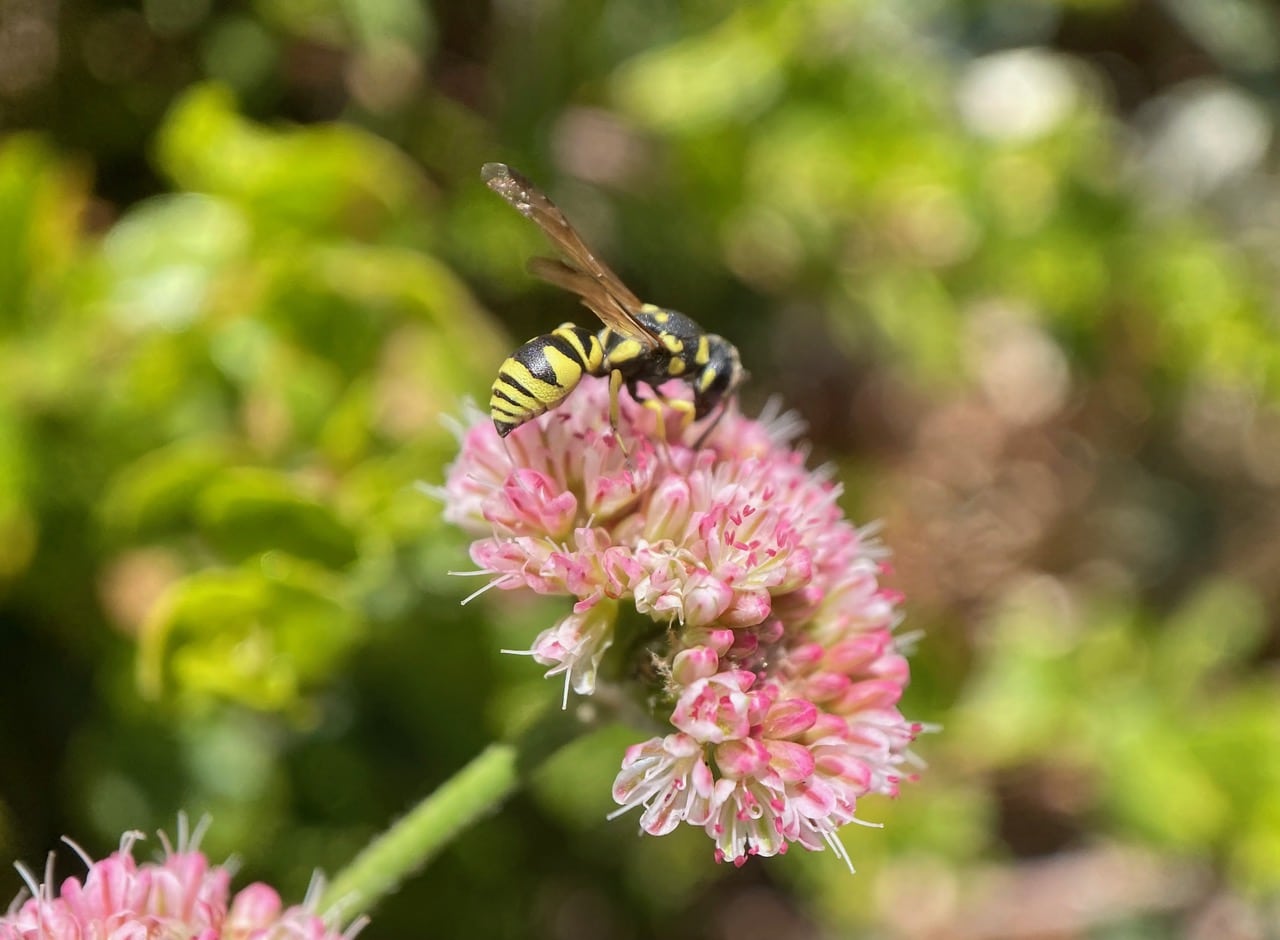
The Mason Wasp, Euodynerus annulus (family Vespidae, subfamily Eumininae) is a widespread species, found from coast to coast in the United States, south to Mexico, and north into Canada. The color and markings vary considerably among the various subspecies. These are sizable wasps, their fore wings measuring 8.5-10.5 mm. Males can be recognized by the hooked tips of the antennae, and their less robust appearance. Unlike the other Mason Wasps that use pre-existing cavities, or making mud nests, the females of this species excavate burrows. They also extend the tunnel above ground as a curved mud “chimney”. Several individual cells branch from the main burrow underground. The species seem to favor situations close to water, as the female regurgitate water to soften the soil during nest-building. The chimney might help protect against parasites, but it apparently serves as the source of mud pellets to make the final nest closure as well.
The female wasps provision their nests with moth caterpillars as food for their offspring. A single egg is suspended from a short thread attached to the wall of the cell before it is stocked with caterpillars. Usually several caterpillars are placed in each cell. When all cells are provisioned, the nest entrance is sealed. The turret or chimney is deconstructed entirely and the nest entrance made nearly invisible and flush with the surrounding soil. The wasp leaves to begin a new nest.

While taking nectar, the little wasp is probably also on the lookout for moth caterpillars among the flowers.

I have spent so much time photographing this photogenic and cooperative wasp that I have exhausted my camera battery. Time to head home for lunch.

Just a stone’s throw from the visitor center, I come across this amazing sight on the paved path – a queen Yellow-faced Bumble Bee mating. There are three drones (males) on her back! The foursome must have crash-landed because the queen bee couldn’t fly with their combined weight. Wow, I can’t think of a worse time to be out of camera battery. I have to resort to the Low Battery Mode on my camera to take this last picture. There are runners, children, strollers, dogs, bicycles whizzing by on this busy day at Crab Cove – it is a miracle that the bees have not been trampled. I quickly scoop up the bees into a little bug container in my vest pocket and run for the visitor center. There I release the foursome on a bench on the deck. The queen bee tumbles out upside down but quickly rights herself, all the drones still holding on tight. A staff member at the visitor center kindly helps to photograph the bees with her iPhone.
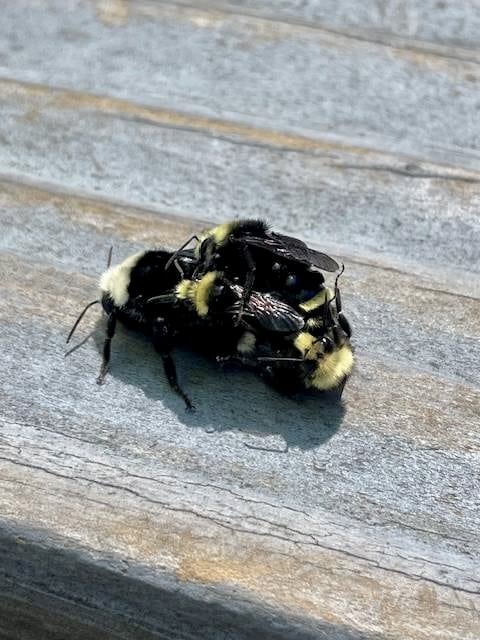
While Rosie takes this picture of the queen bee and her entourage, I finally get to find out which of the drones is actually mating with the queen. I have initially thought that the one in the rear is the lucky guy, but I am proven wrong. Of the two drones on her back, see the one on the right? His abdomen is fully stretched, with his aedeagus (insect version of a penis) attached to the queen’s genitals. I guess the other two drones are patiently waiting their turn to inseminate her.
Bumble Bees undergo annual life cycles. Near the end of the season, usually in late summer, the colony produces new queens and drones. Bumble Bee mating rituals involve a fascinating set of behaviors driven by chemical communication and sometimes physical competition. Males engage in scent marking and patrol flying. They use their cephalic labial glands (CLG) to produce a species-specific pheromone, a strong attractant for virgin queens. This pheromone is secreted at the base of the mandibles. The males establish specific flight paths, often marked with the pheromone, and repeatedly fly these routes, hoping to encounter a queen. Some species with large eyes use a perching strategy, waiting at prominent objects to spot and approach queens. Bumble Bee queens often mate with multiple males while in flight. The sperm is stored in a specialized structure called the spermatheca after mating. The spermatheca is not just a storage container; it also contains cells that secrete nutrients to nourish and maintain the sperm. This sperm is then used throughout the queen’s lifetime for fertilizing eggs as she establishes and manages her own colony. The males usually do not live long after mating; they die with the workers and the old queen at the end of the season. The mated queen gorges on nectar and pollen, builds up fat reserves, and finds a place to hibernate for the winter. The following spring, she will start a new colony. Long Live the Queen!