

Pollinator Post 6/21/24 (1)
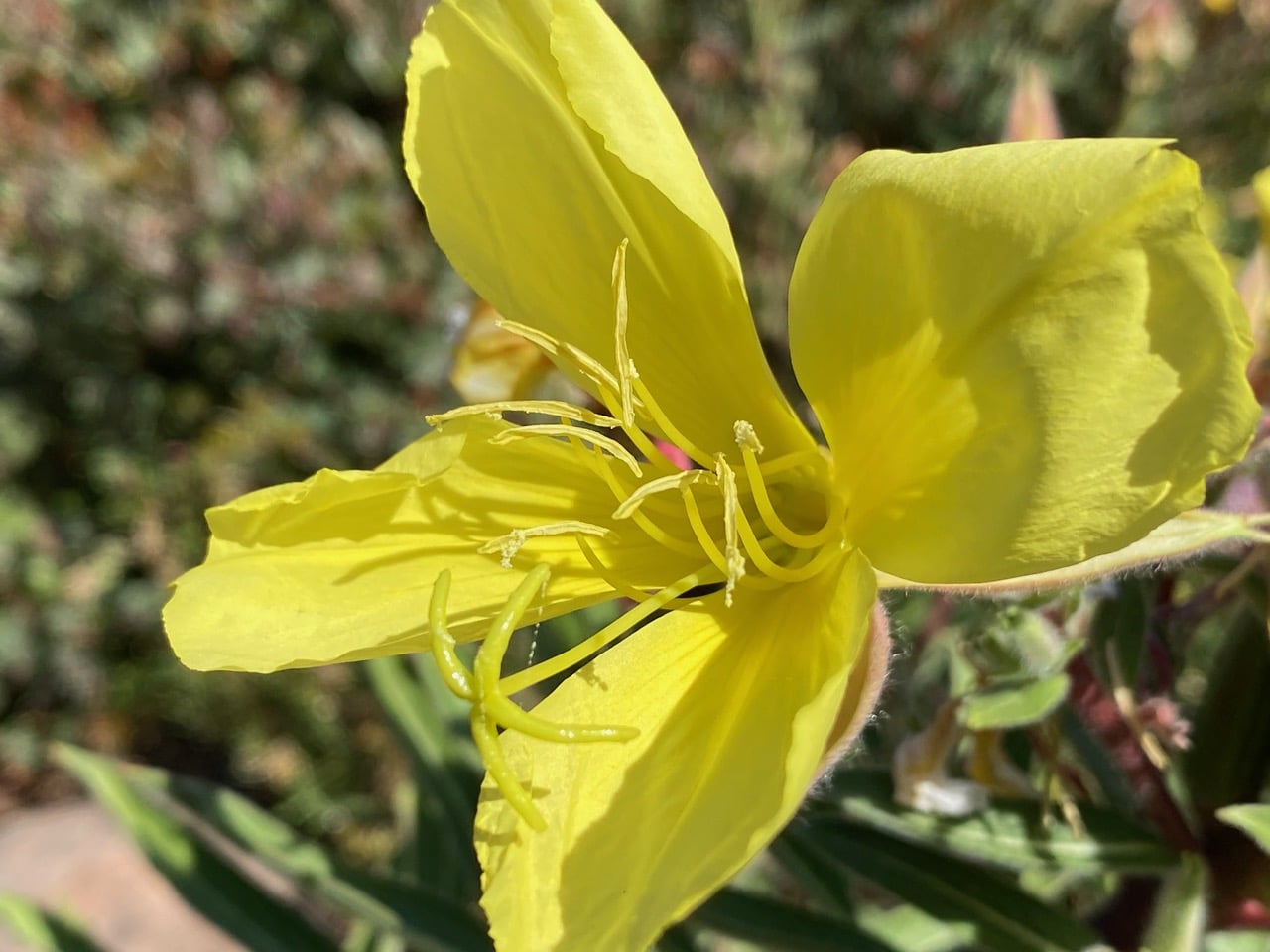
It’s always fun to explore Stefanie’s home garden in San Leandro. The late blooming natives continue to support a diversity of insects through the summer.
The large flowers of the Hooker’s Evening Primrose, Oenothera elata are open all night and produces a fragrance. By mid-day the flowers will close. Each flower typically only lasts a single day. Evening Primrose’s unusual pollen is held in stringy viscin threads, and is usually transferred by long-tongue moths. Hovering in front of the flower to probe for nectar with its long tongue, a Hawk Moth (family Sphingidae) invariably makes contact with the stamens with its wings and body, pulling out the pollen in sticky strands. As it visits the next flower, the pollen might be transferred onto the large X-shaped stigma that protrudes furthest from the corolla, accomplishing pollination.
In the morning, before the flowers wilt, they are frequently visited by Carpenter Bees, Xylocopa sp. (family Apidae). By sheer size and power, the large bees can handle the stringy pollen without being immobilized by it. The females drink nectar and gather pollen and often climb on the style to launch into the air.
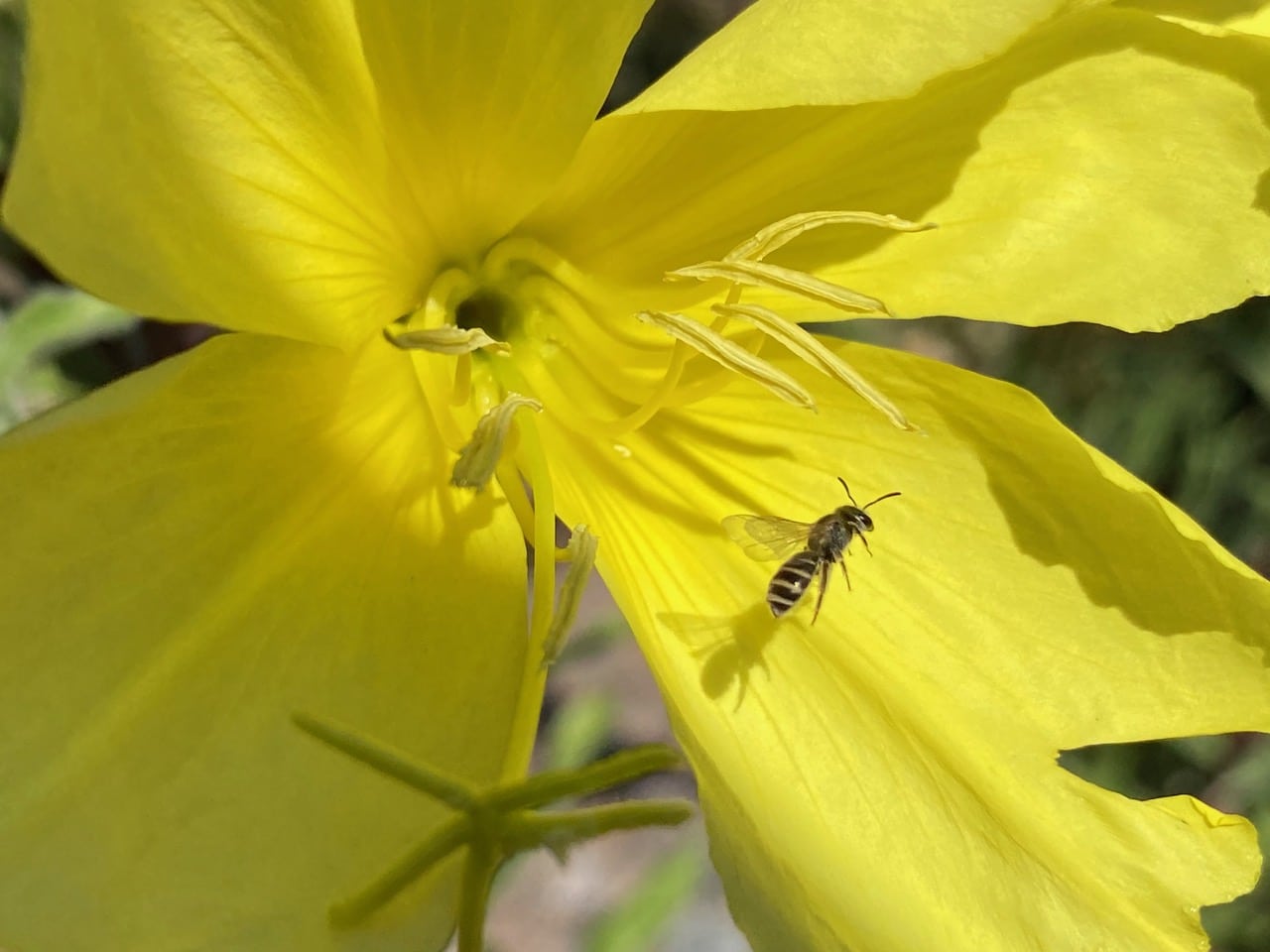
Then there are these small Sweat Bees, Halictus sp. (family Halictidae).
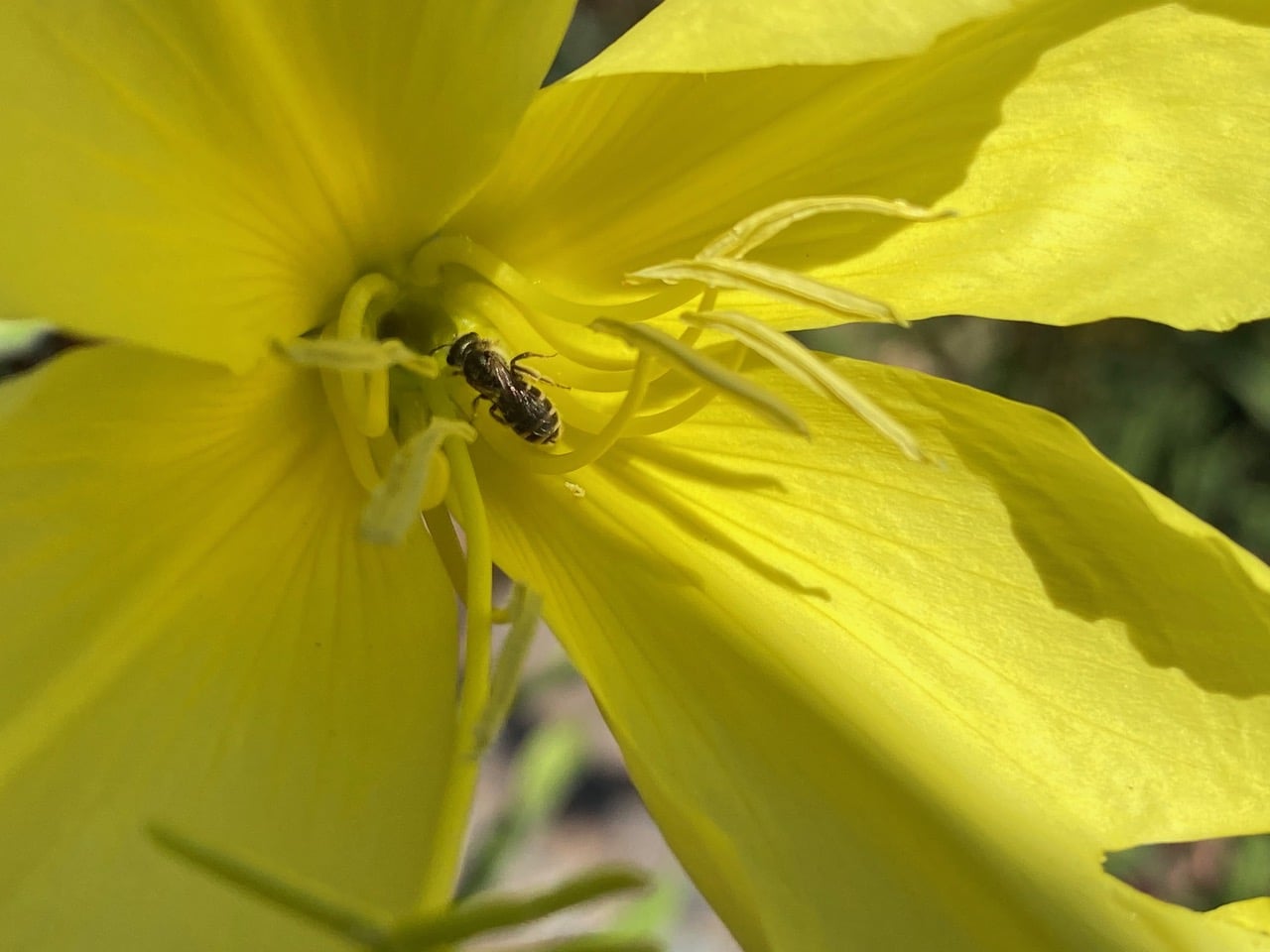
The Sweat Bee carefully climbs a stamen to the base of the Evening Primrose flower for nectar. It is small enough to go through the hole at the base of the corolla.
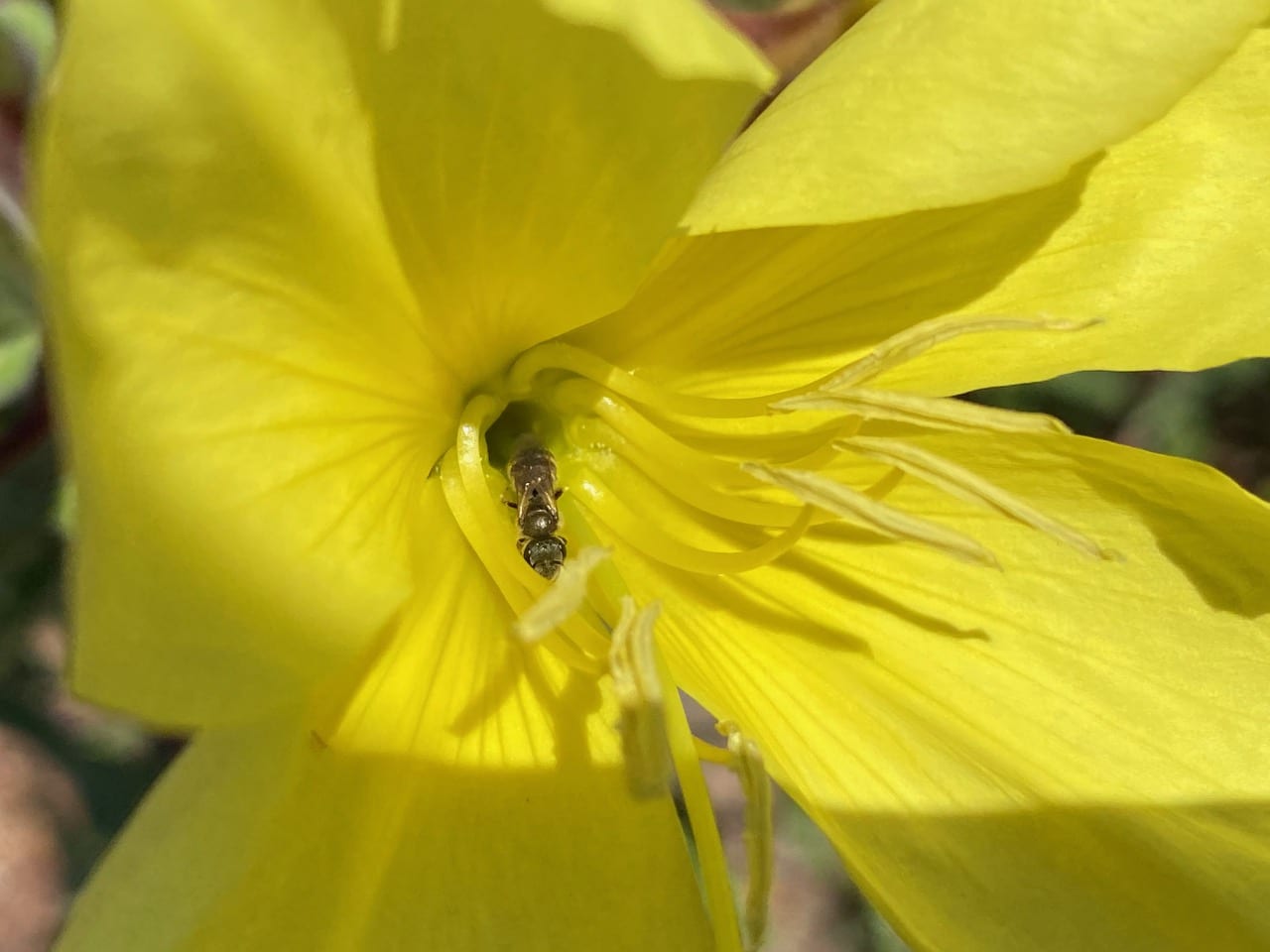
Emerging from its nectar feast, the little bee scavenges fallen pollen on the petals in safe, discreet amounts.
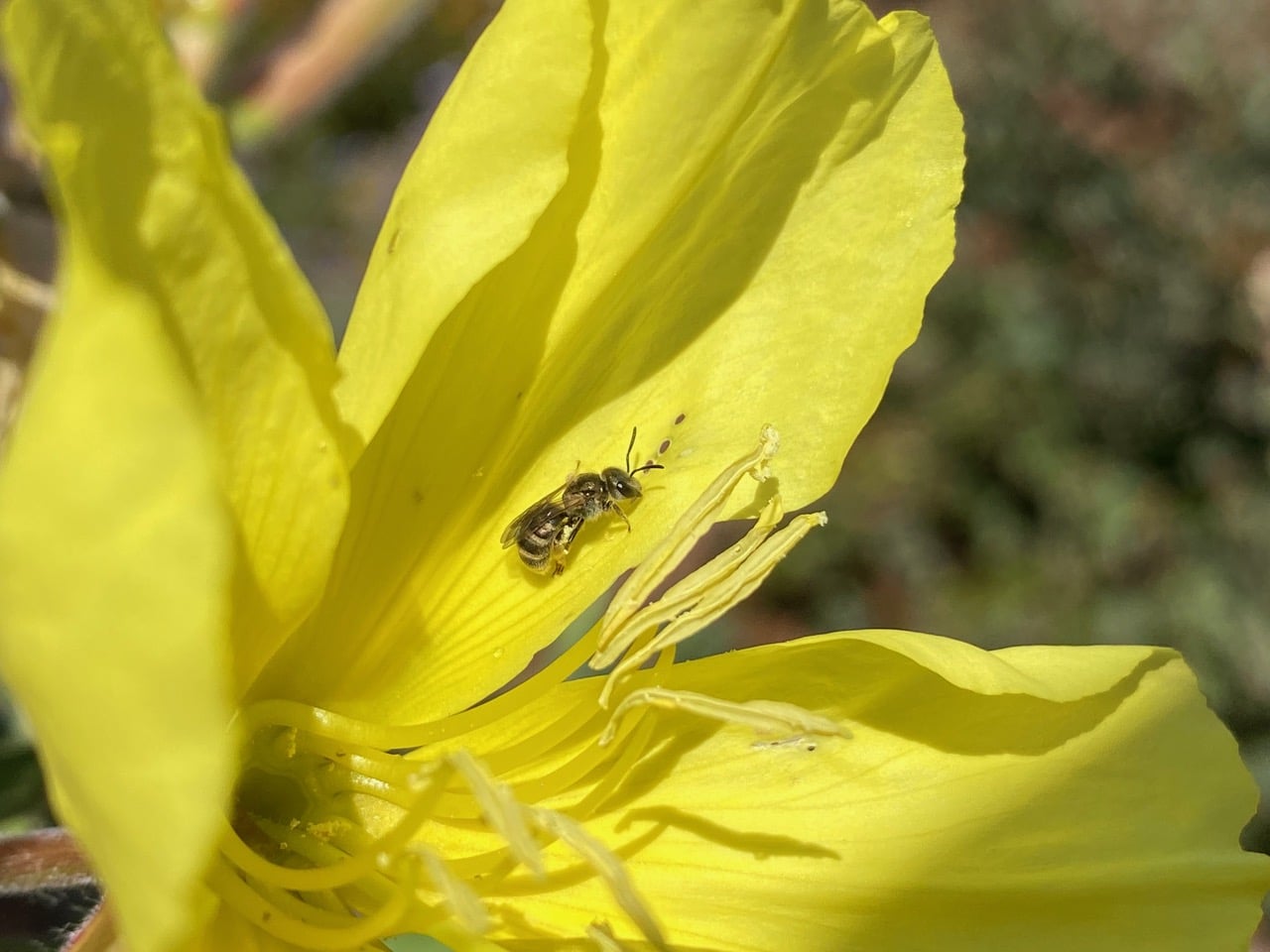
She then climbs up the petal and lifts off from there. Since she does not make contact with the reproductive parts of the flower, she contributes no pollination service to the flower. The little bee is considered a “nectar thief”.
Interestingly, there is a nocturnal Sweat Bee Lasioglossum oenotherae (family Halictidae) that specializes in harvesting Evening Primrose pollen. The females have modified scopal hairs on their hind femurs to handle the stringy pollen. These specialist bees are able to fly in dim light during dusk and dawn, and even into the night when there is enough moonlight, aided by large simple eyes called ocelli on top of their heads. The bees are found in gardens on cultivated varieties of Oenothera.
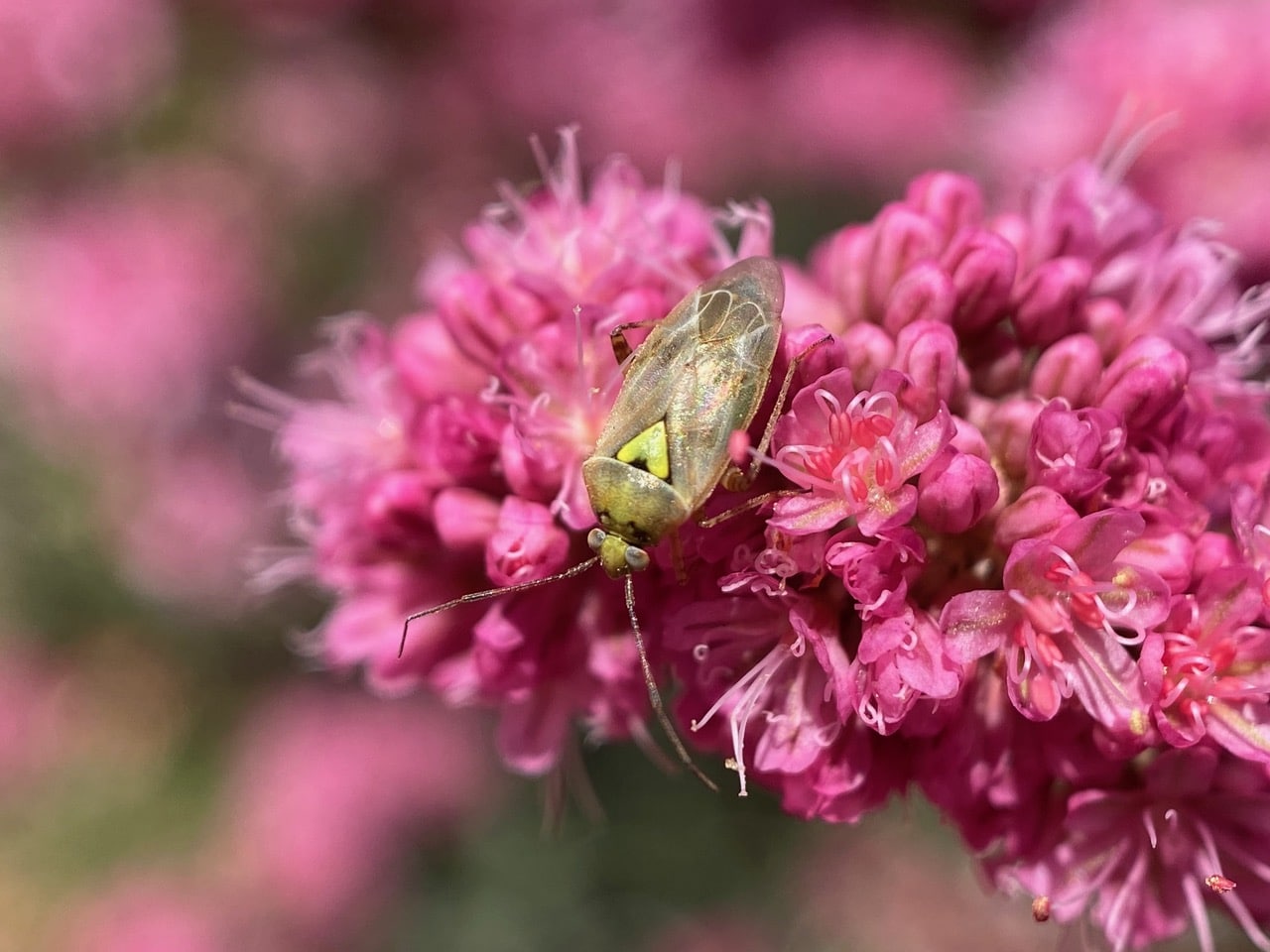
A Lygus Bug, Lygus sp. (family Miridae) is resting on an inflorescence of Red-flowered Buckwheat, Eriogonum grande var. rubescens.
The term lygus bug is used for any member of the genus Lygus, in the family of plant bugs, Miridae. Adult lygus are approximately 3 mm wide and 6 mm long, colored from pale green to reddish brown or black. They have a distinctive triangle or V-shape on their backs. Lygus bugs are known for their destructive feeding habits – they puncture plant tissues with their piercing mouthparts, and feed by sucking sap. Both the physical injury and the plant’s own reaction to the bug’s saliva cause damage to the plant. Many lygus bugs are well-known agricultural pests.
One useful feature in identifying members of the family Miridae or plant bugs is the presence of a cuneus; it is the triangular tip of the corium, the firm, horny part of the forewing, the hemielytron. The cuneus is visible in nearly all Miridae.

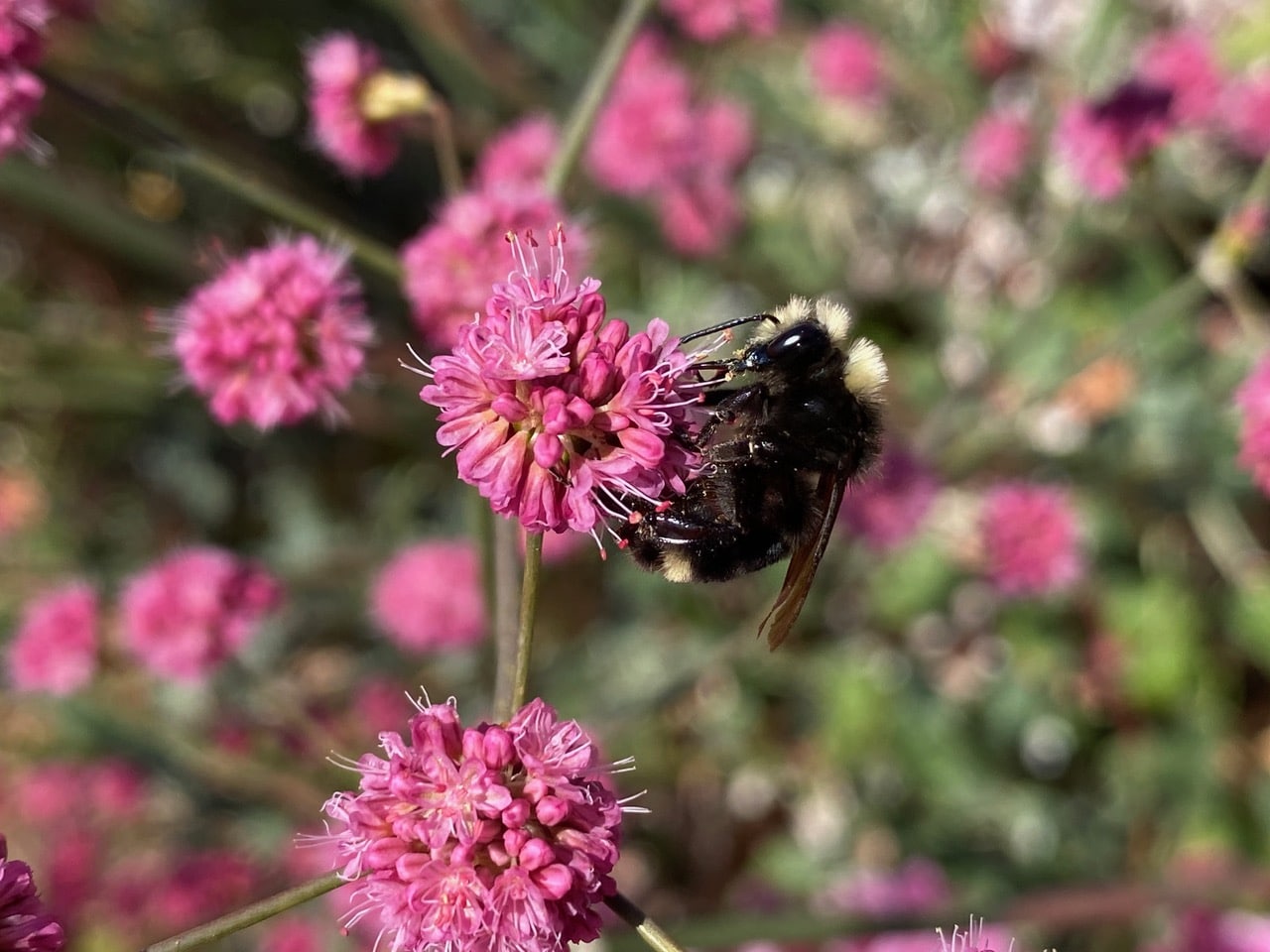
The large patch of the Red-flowered Buckwheat is abuzz with Yellow-faced Bumble Bees, Bombus vosnesenskii (family Apidae). Most of them seem to be simply taking nectar from the tightly clustered flowers. They can still serve as effective pollinators as pollen that sticks to their hairs can be transferred to the flowers of the next plant they visit.
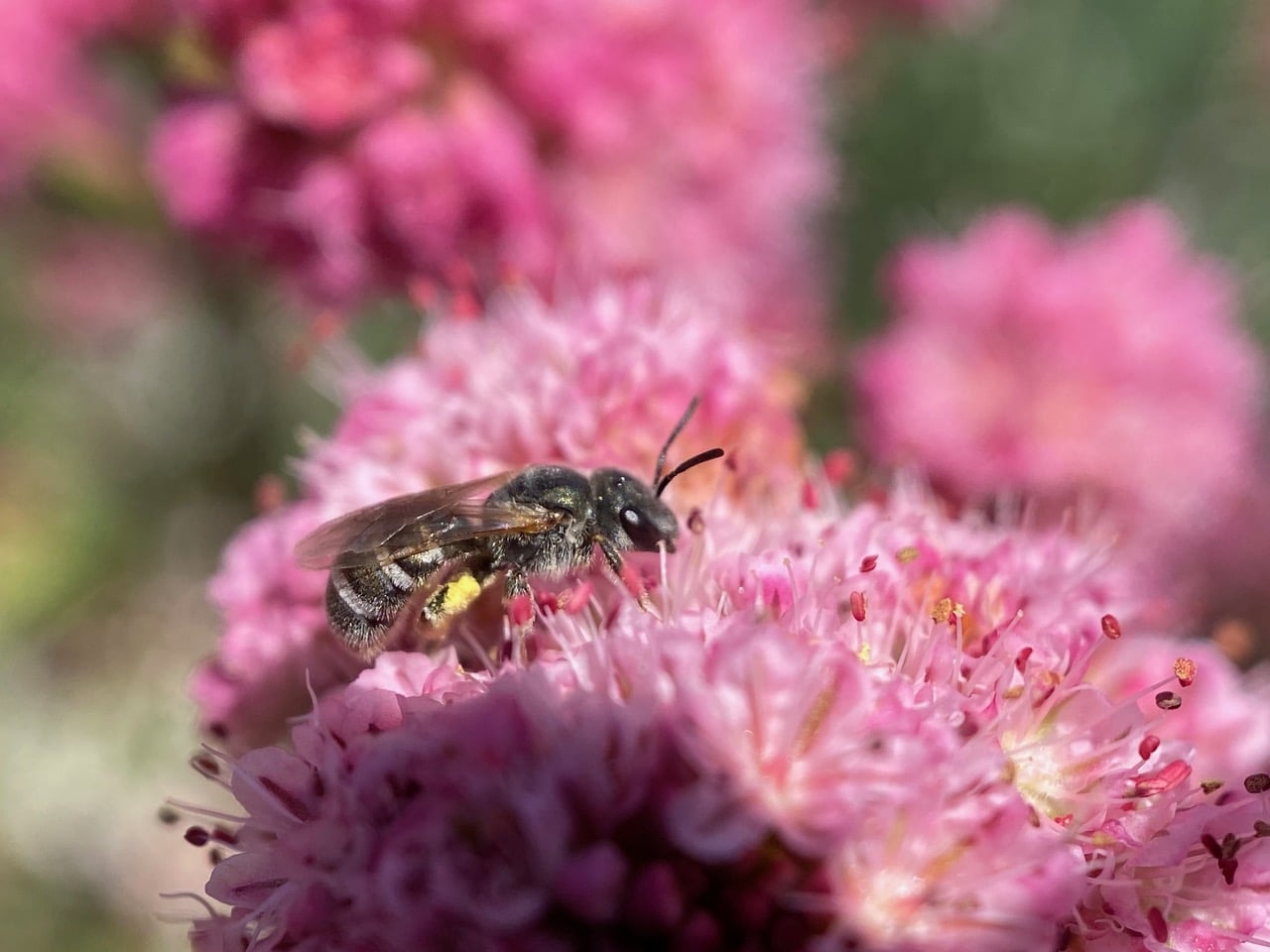
A Sweat Bee, Halictus sp. (family Halictidae) is foraging on an inflorescence of Red-flowered Buckwheat.
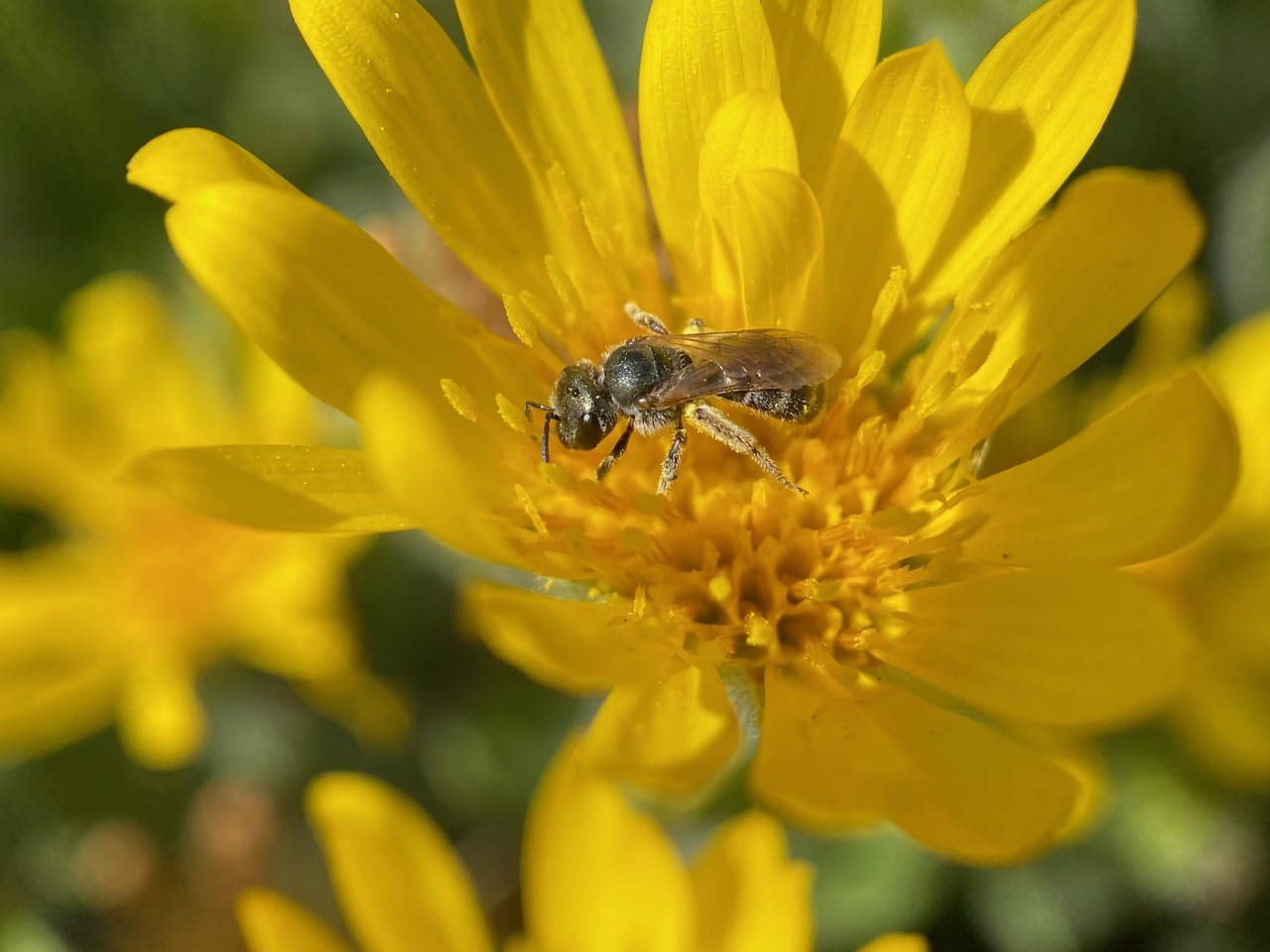
A Sweat Bee, Halictus sp. (family Halictidae) is foraging on a flowerhead of Oregon Sunshine, Eriophyllum lanatum.
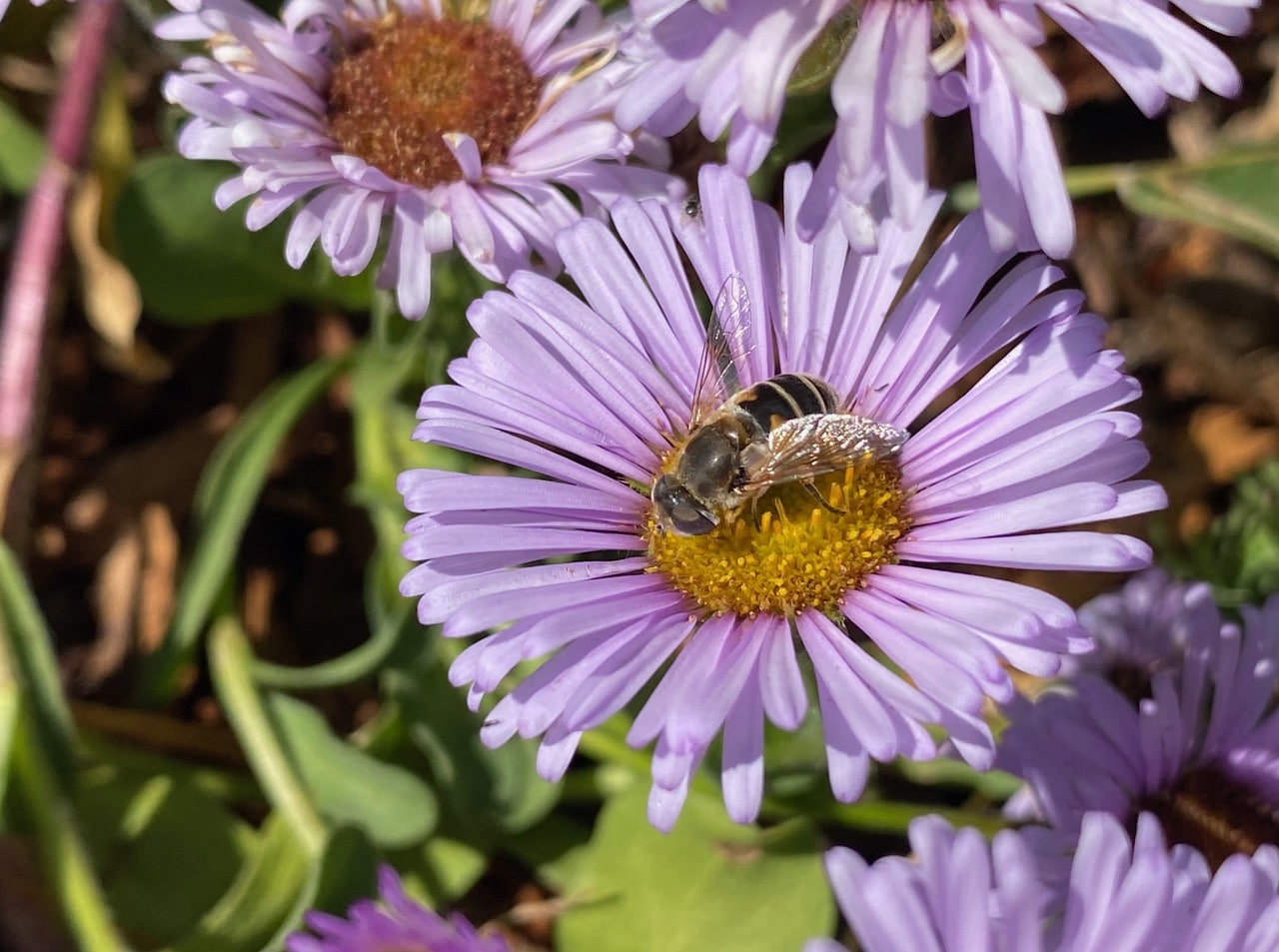
The Black-footed Drone Fly can be seen on many flowers in the garden, including this Seaside Daisy, Erigeron glaucus.
The Black-footed Drone Fly, Eristalis hirta (family Syrphidae) is a common Western North American species of hoverfly. The adults visit flowers for nectar and pollen. Larvae are aquatic filter-feeders of the rat-tailed type.
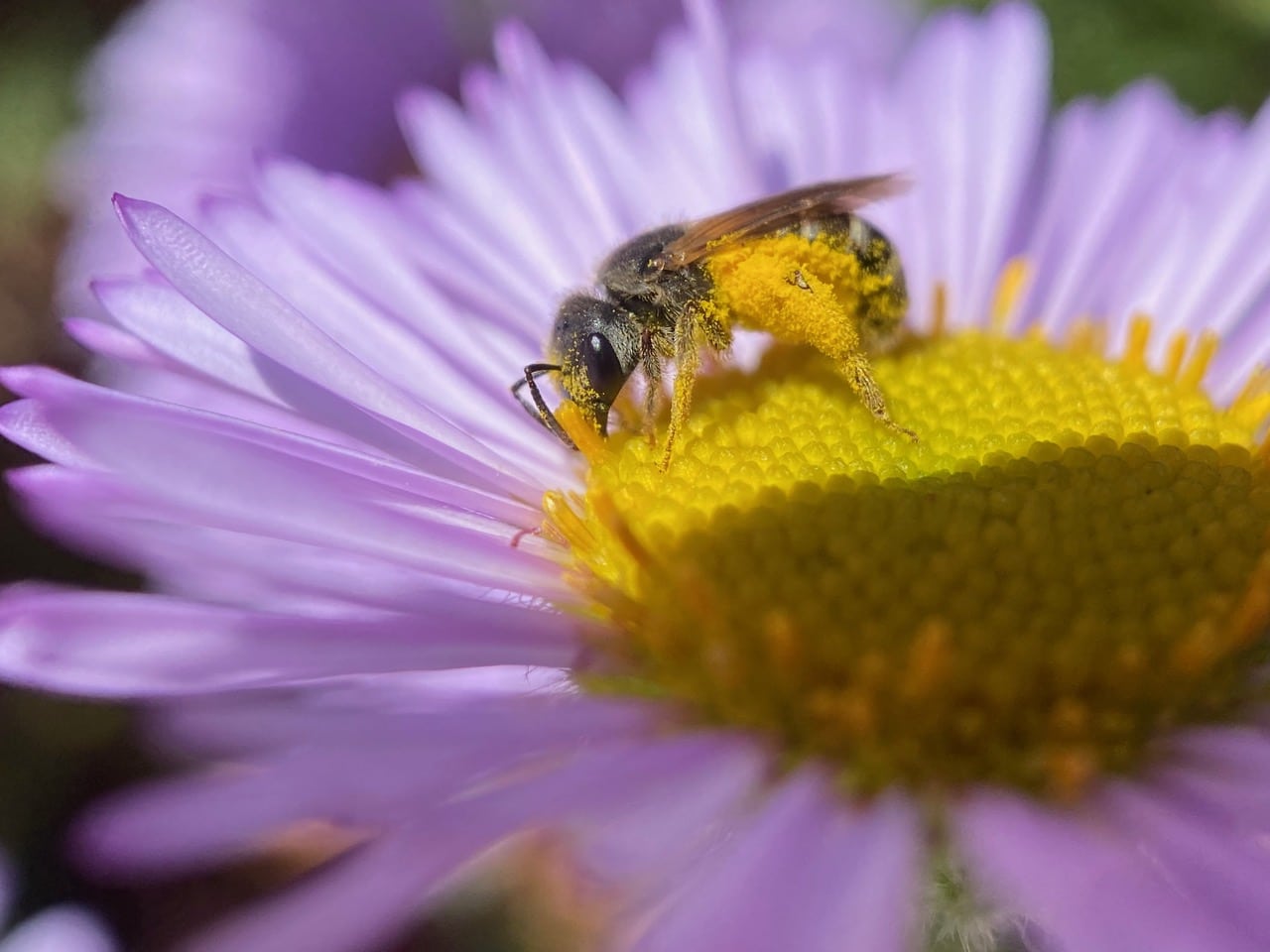
Packed with a full load of pollen, a Sweat Bee, Halictus sp. (family Halictidae) is foraging on a flowerhead of Seaside Daisy. Even the underside of her abdomen is used to stow pollen. This is typical pollen transport in the sweat bees. Note that the pollen is not light and fluffy. Asteraceae pollen tends to be sticky and clumpy.
Pollenkitt is a sticky covering found on the surface of pollen grains. It is also sometimes called “pollen coat”. It is found in some plant families more often than others, but it is especially common in plants that are pollinated by insects. Because of this scientists believe that one of the major functions of pollenkitt is to help the pollen stick to the insect pollinators. The pollen from many wind-pollinated plants, such as grass, is much drier and not nearly so sticky. The insects benefit from lots of pollen that is easy to carry home. What’s more, pollenkitt contains lipids, proteins, and phenolic compounds that are important to bee health. For the plant, pollenkitt may prevent the pollen from blowing away or drying out, or it may protect the pollen from ultra-violet radiation and certain pathogens.
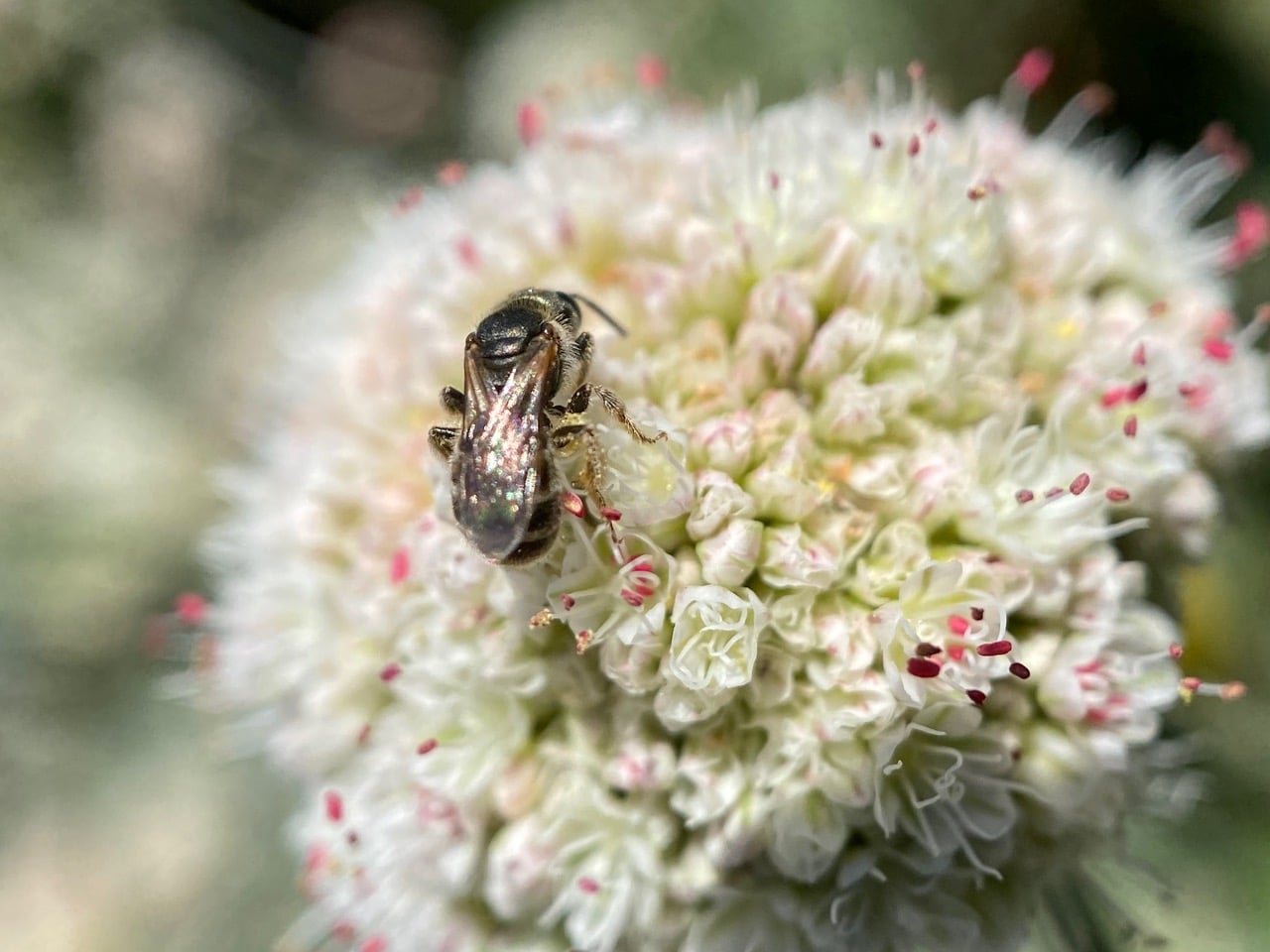
This Sweat Bee, Halictus sp. (family Halictidae) foraging on an inflorescence of Nude Buckwheat, Eriogonum nudum has yet to fill her scopae.
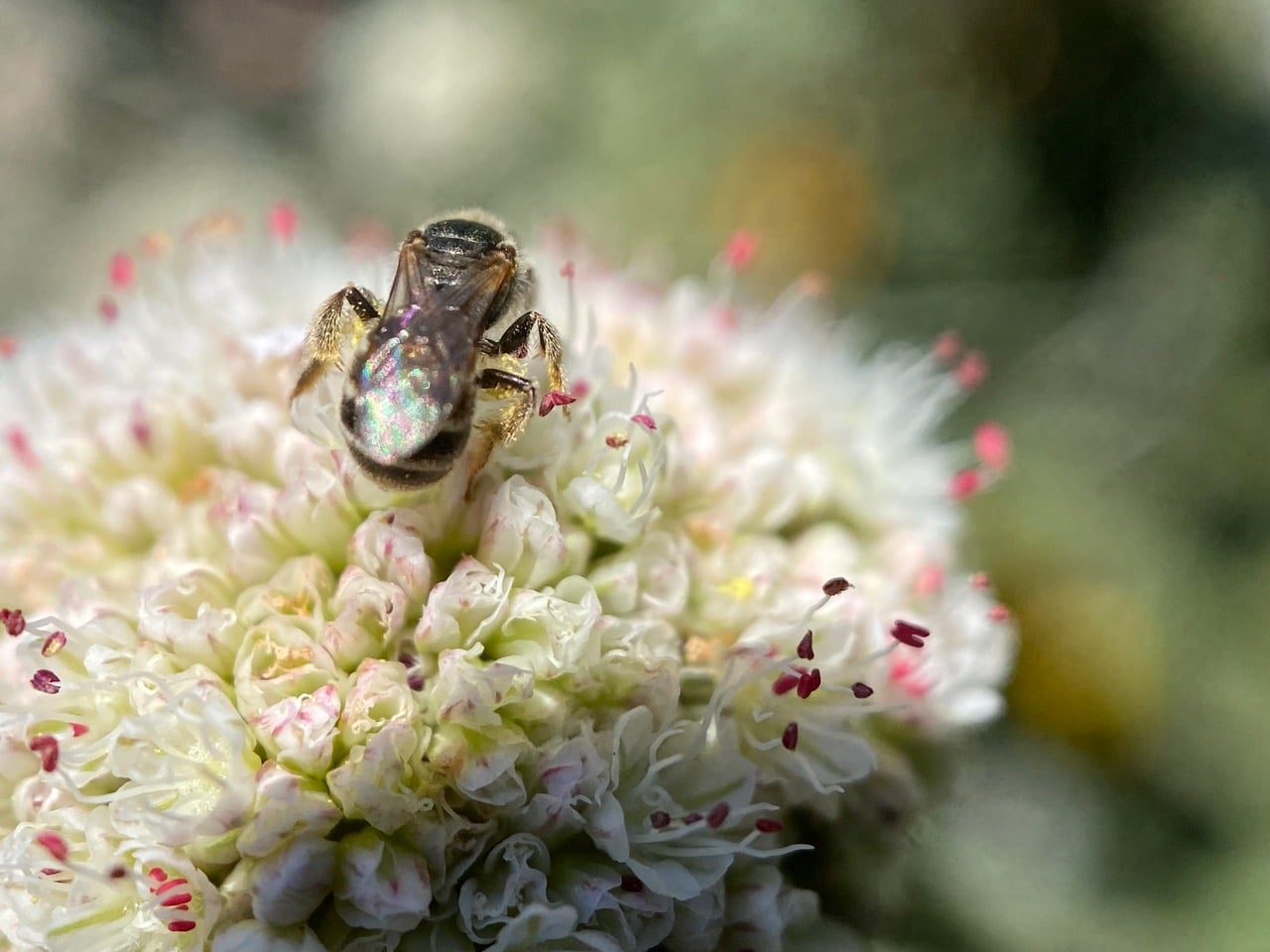
The special pollen collecting hairs on her empty scopae are lit up in the morning light.
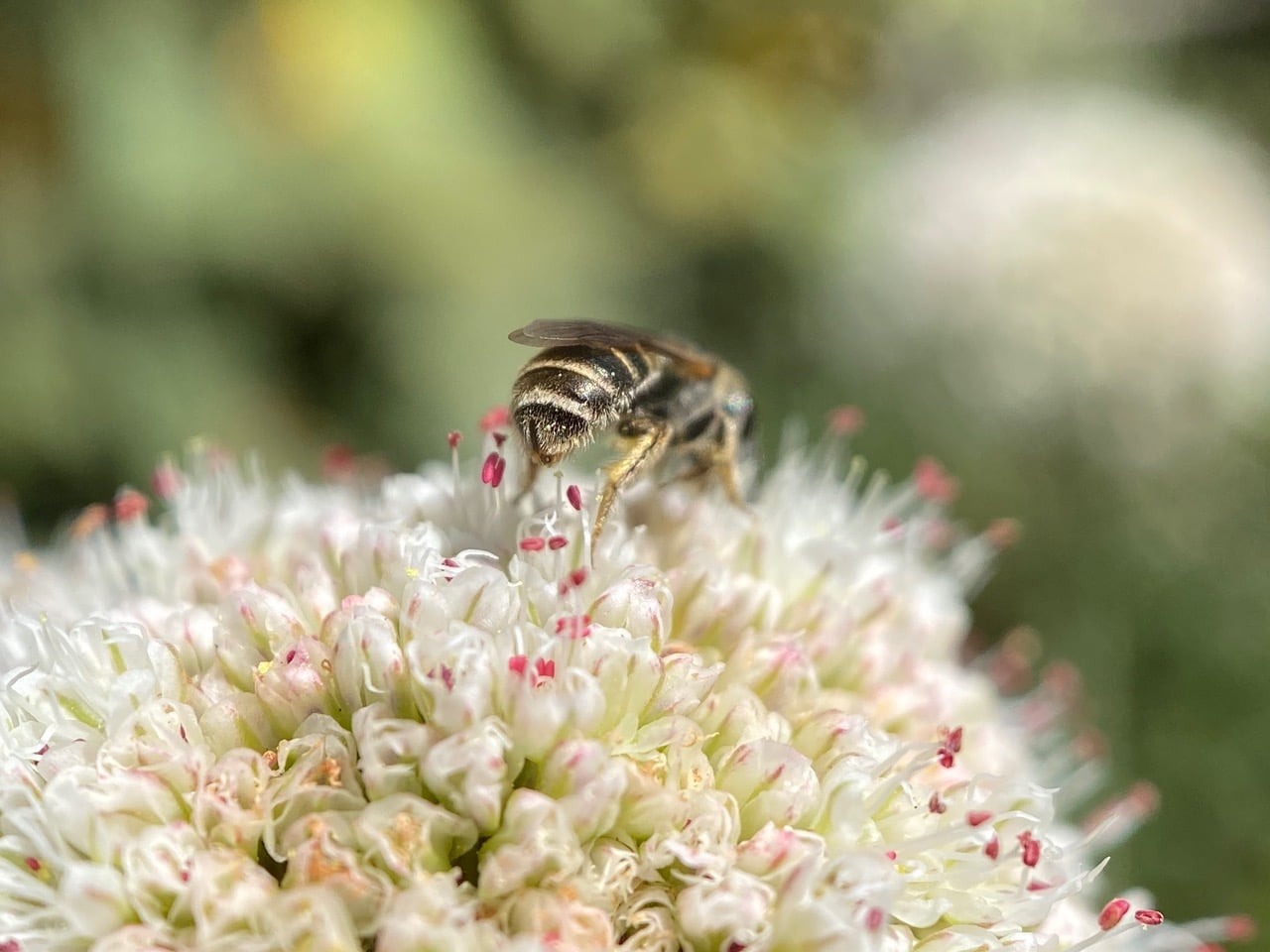
The Sweat Bee family Halictidae comprises two main genera, Halictus and Lasioglossum, which can be tricky to separate. Females of both genera have a groove, or furrow at the tip of the abdomen, called a rima. The two genera differ in the position of the hair bands on the abdomen. In Halictus these are on the hind margin of the each tergite (body segment), but in Lasioglossum they are at the front of each tergite, often partly covered by the hind edge of the preceding tergite.
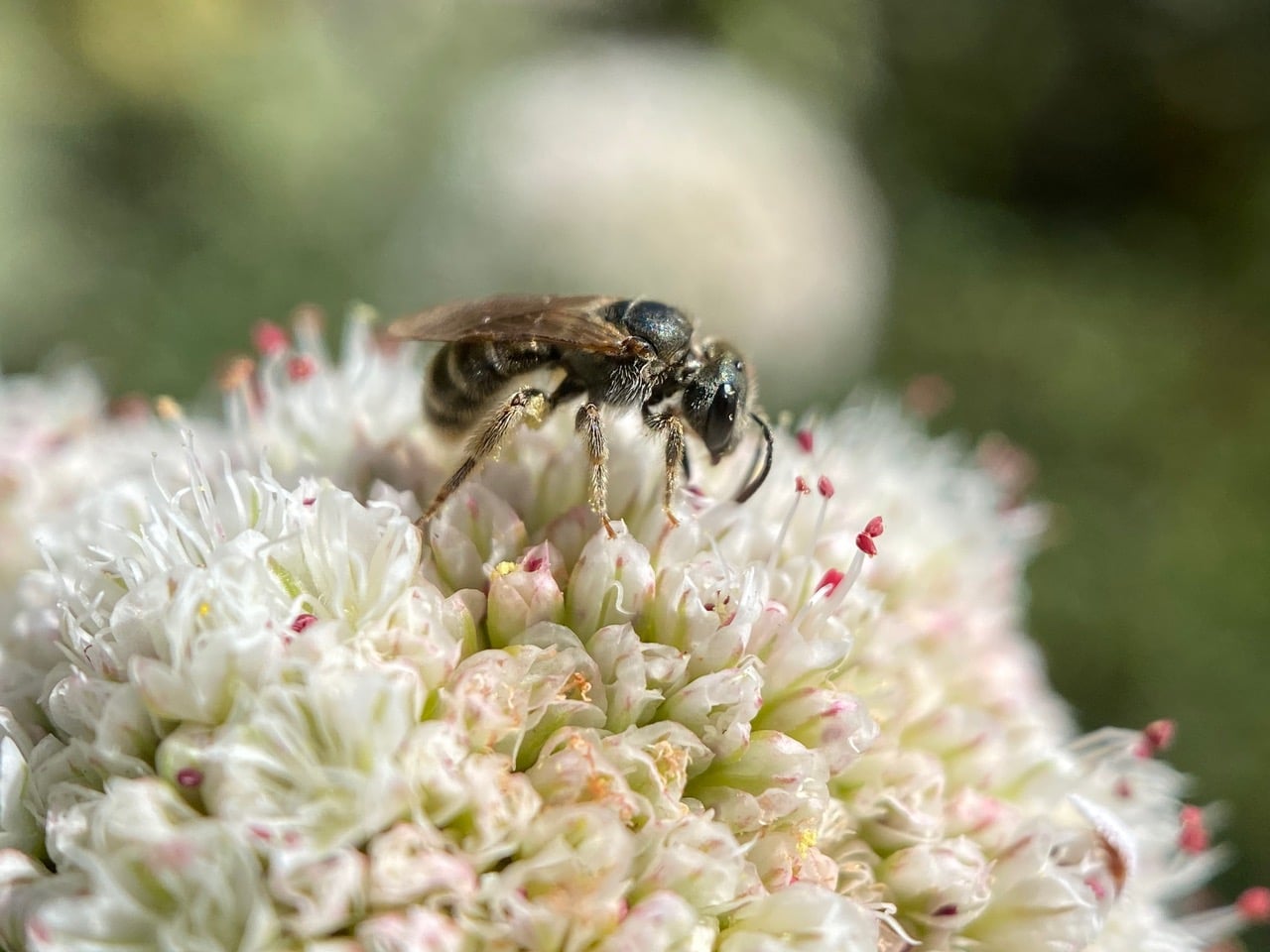
I take numerous close-up pictures of the Sweat Bee….
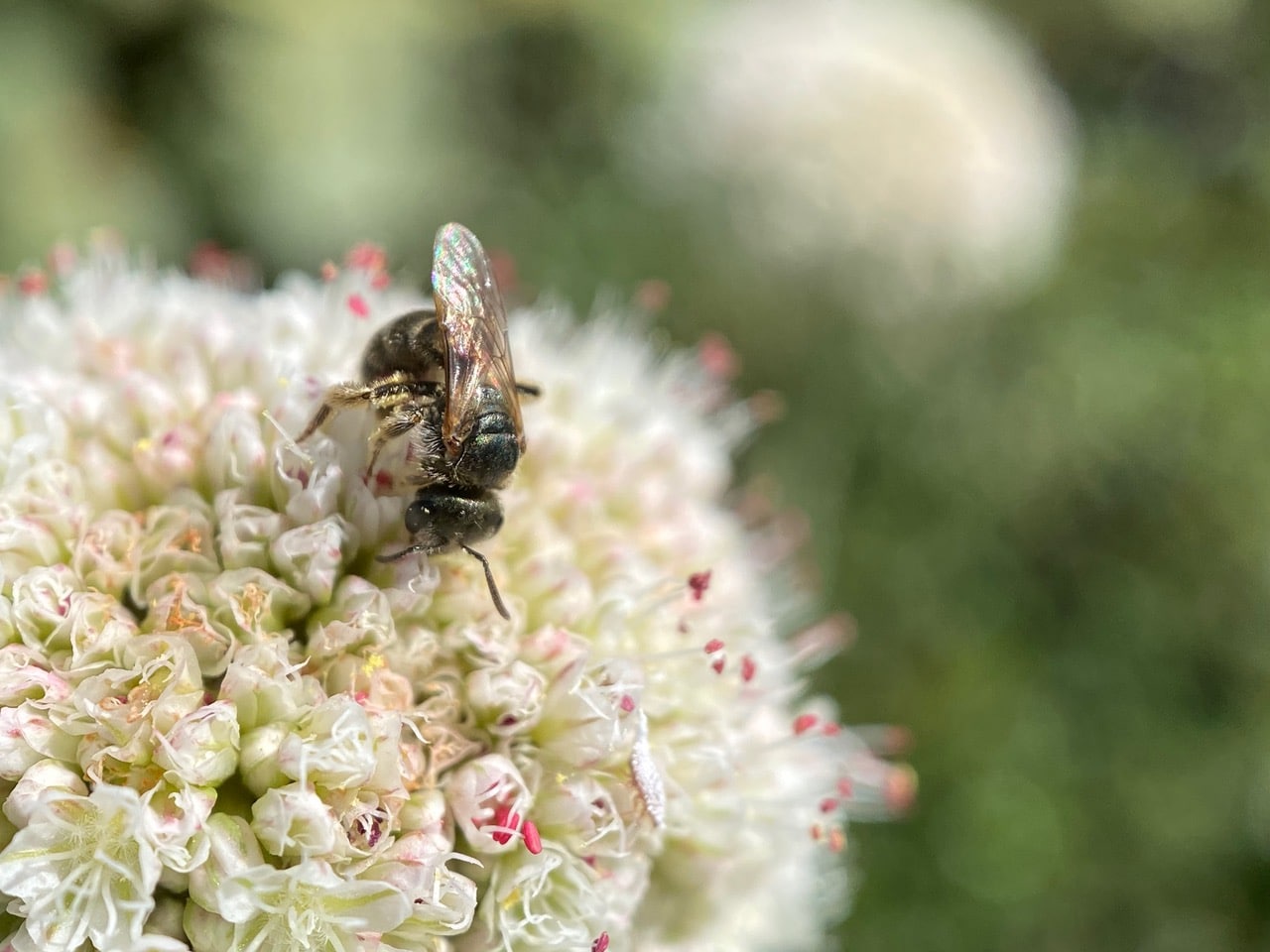

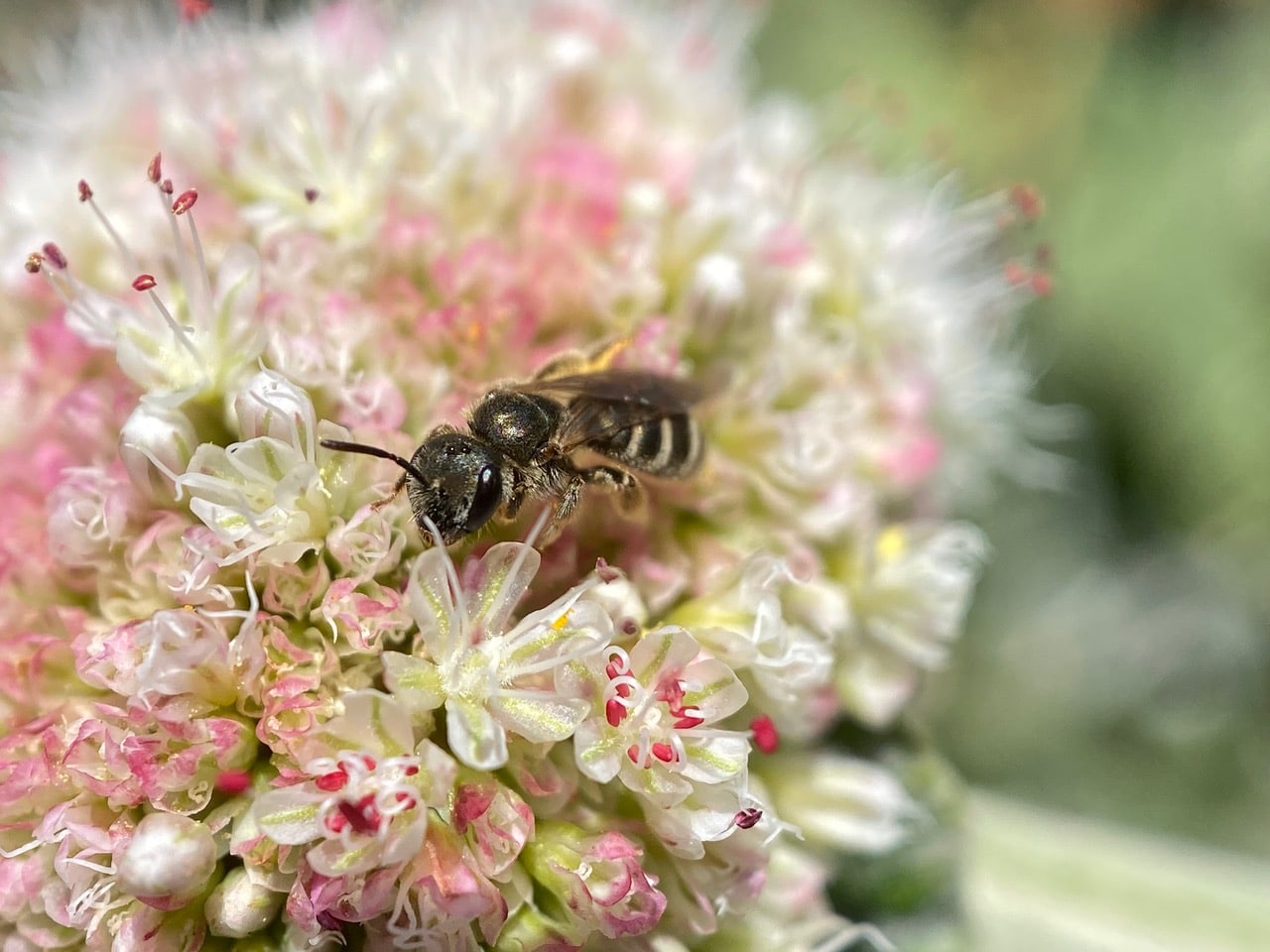
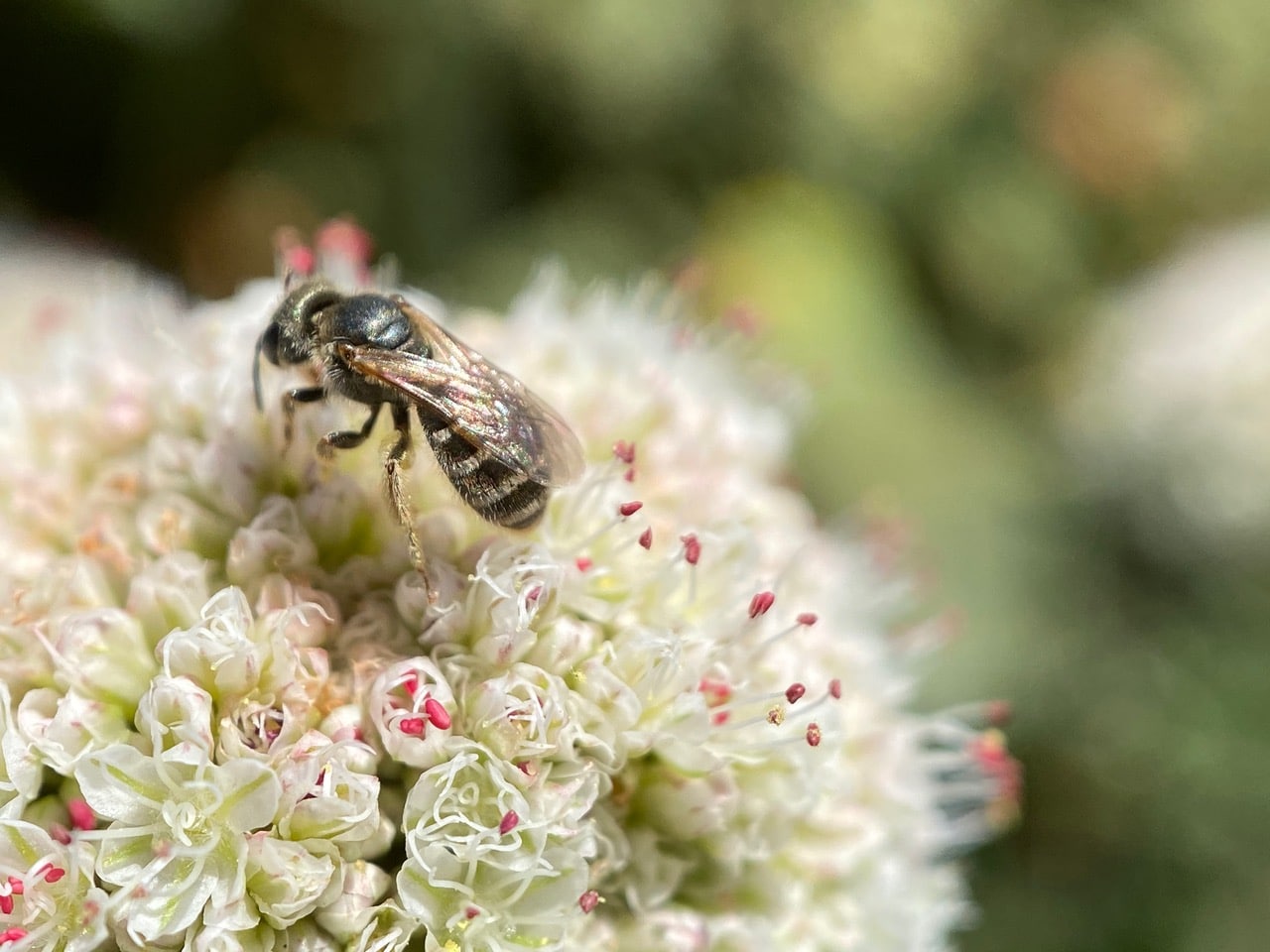

Who is this Sweat Bee, a Halictus or Lasioglossum?
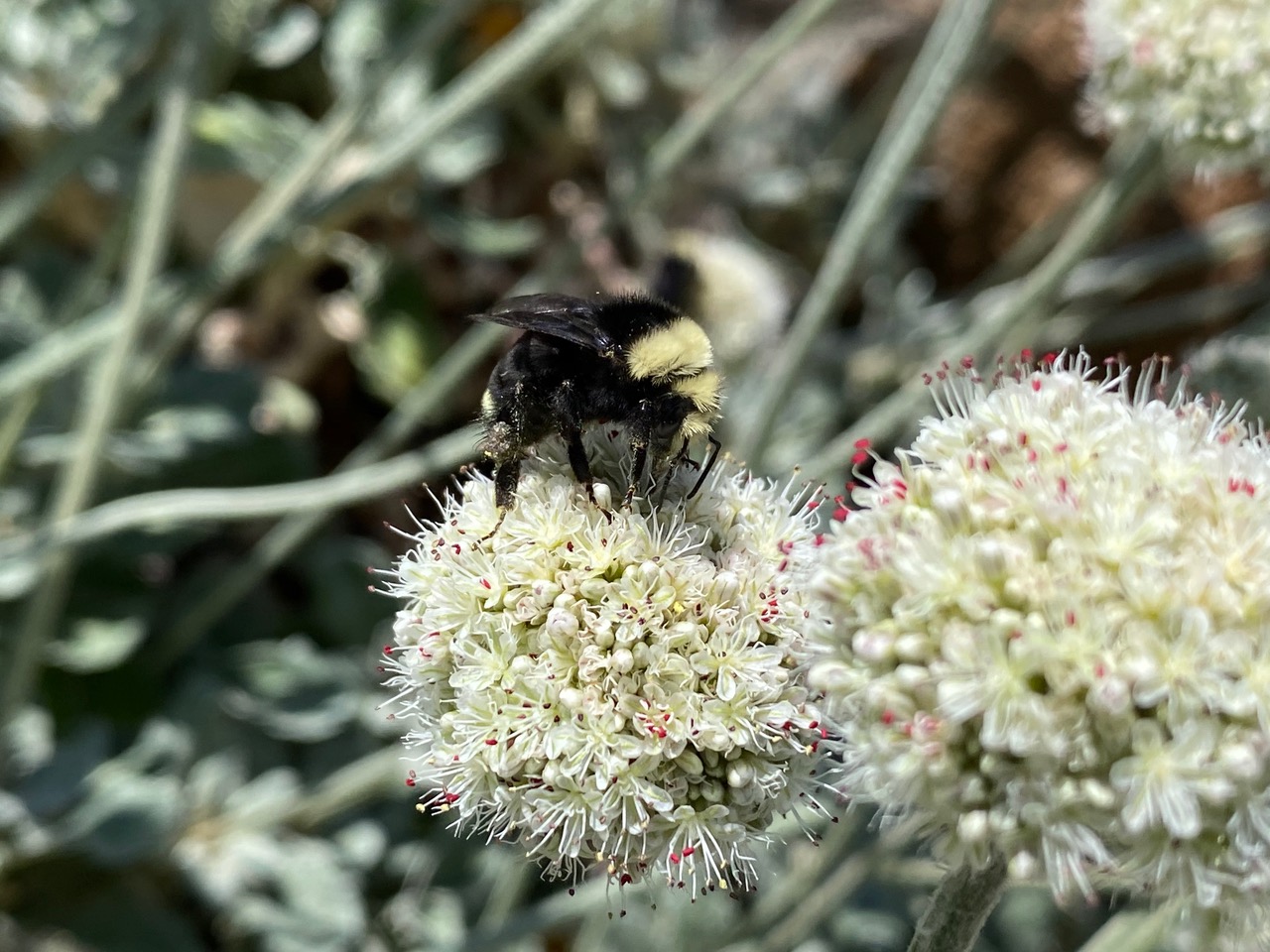 Numerous Yellow-faced Bumble Bees, Bombus vosnesenskii (family Apidae) buzz around the blooming Nude Buckwheat, Eriogonum nudum. The plant is one of the best summer-blooming natives to have in the garden, offering a rich source of nectar and pollen to insects big and small.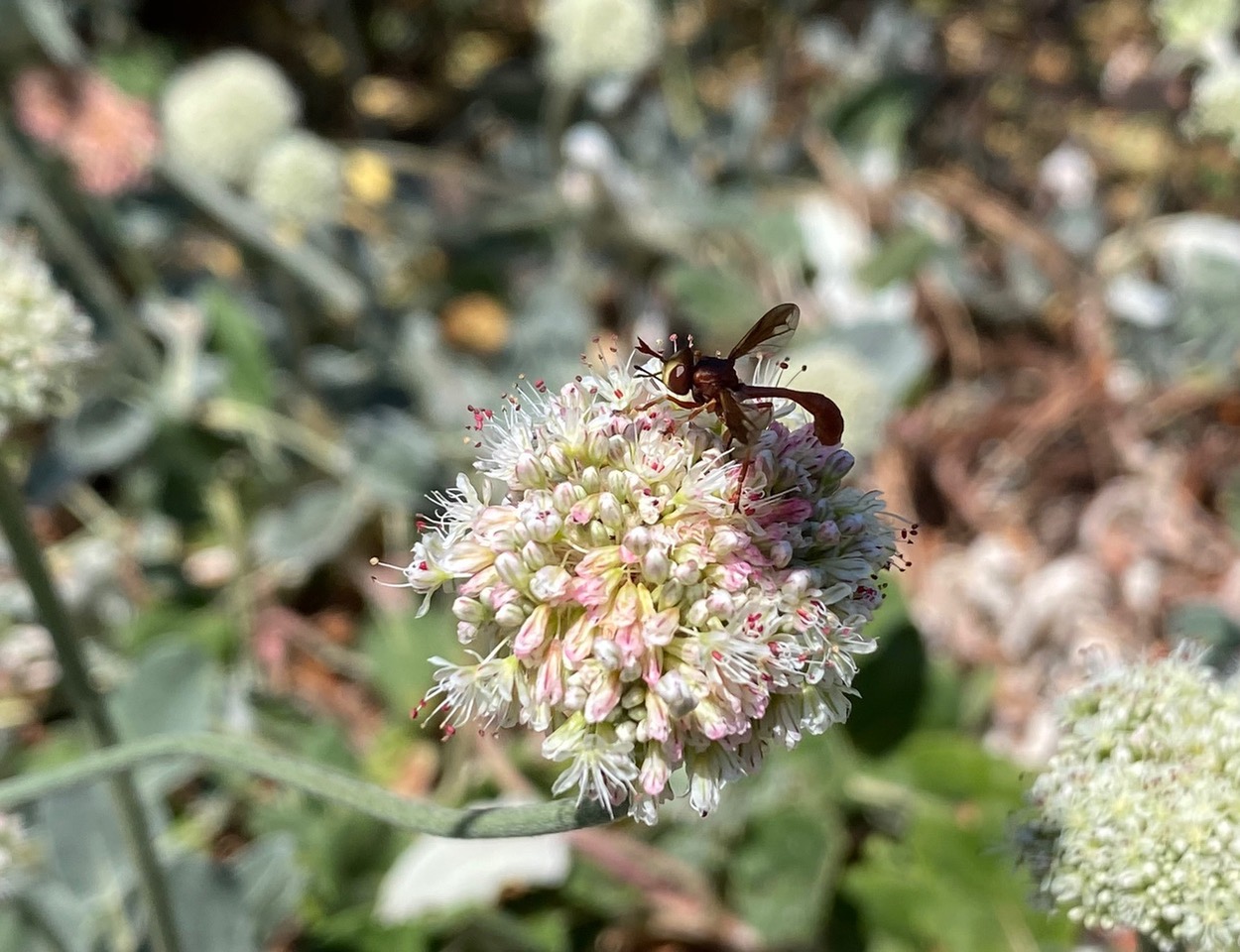
On a Nude Buckwheat inflorescence in partial shade, a small reddish-brown insect is watching the bees with great interest. The profile of the fly is unmistakable – it is a Thick-headed Fly, Physocephala burgessi (family Conopidae).
The small and little-known family of Conopidae, commonly called the Thick-headed Flies, are distributed worldwide. Remarkable mimics of wasps and bees, the flies are frequently found at flowers, feeding on nectar with their long probosces. The larvae of all Conopids are internal parasitoids, mostly of aculeate (stinging) Hymenoptera (wasps, bees). Adult females aggressively intercept their hosts in flight to deposit eggs. Vulnerable foraging bees are likely the most susceptible to parasitism by Conopids. The female’s abdomen is modified to form what amounts to a “can opener” to pry open the segments of the host abdomen as the egg is inserted. The fly larva feeds on the host from the inside out. The vast majority of parasitized bumble bees bury themselves by burrowing into the ground right before they die. This behavior does not matter to the bees – they are doomed. But it is critical for the flies – if the host dies underground, the fly is sheltered from the elements, predators and parasites.
The life spans of parasitized bumble bees are not significantly shortened, though as the parasitoid grows, the bee can’t carry home as much nectar. Bumble bees will chill, literally, to put off the inevitable, seeking cooler spots, even sleeping outside at night to slow the growth within them. If many of the workers in a colony are infested, future queens may be smaller in size and may not have enough energy to get through the winter.
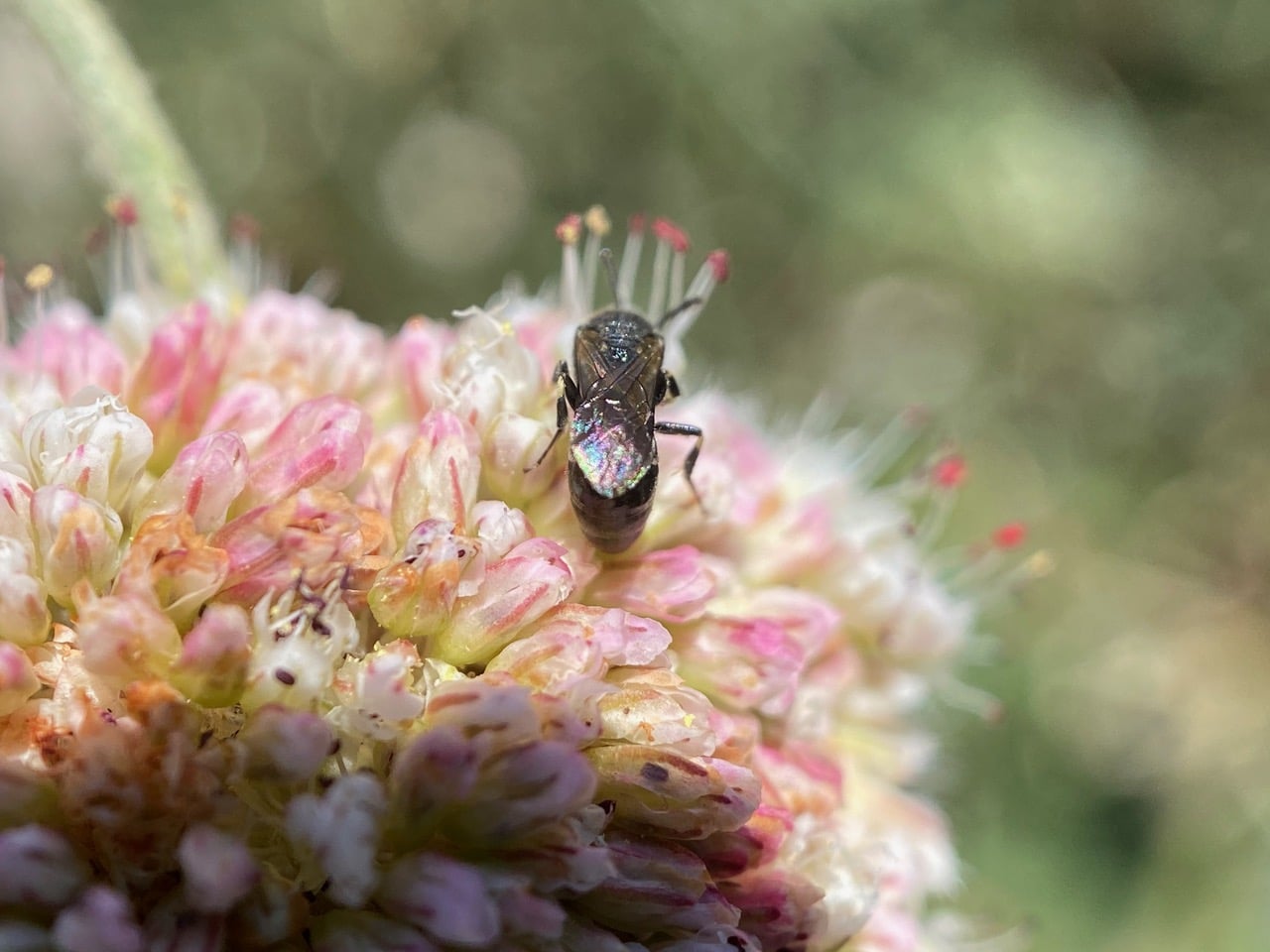
A tiny bee no bigger than a grain of rice is foraging on an inflorescence of Nude Buckwheat. She has no visible scopae on her hind legs.
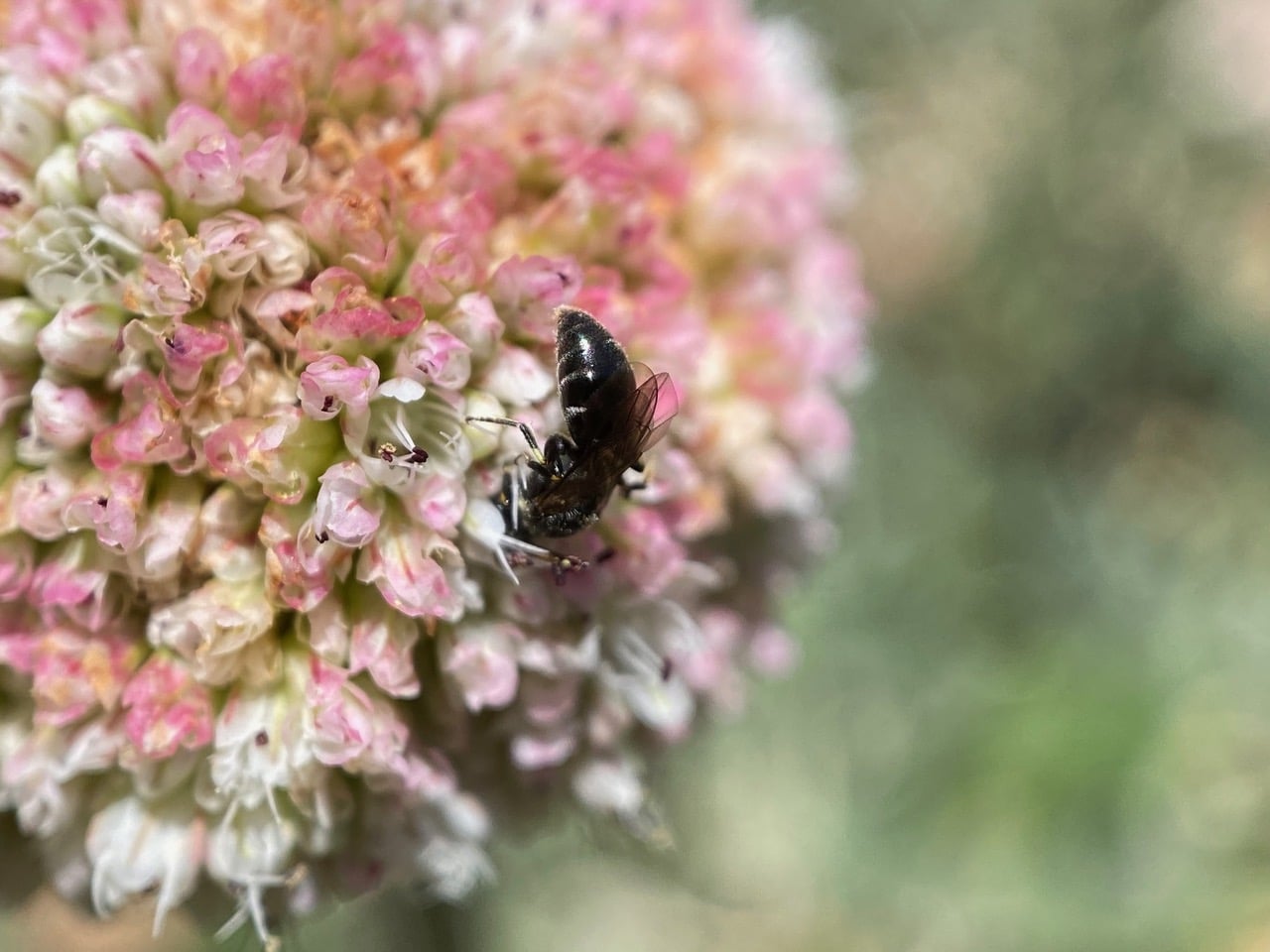
The bee is slender and wasp-like, with little hairs on her body.

There are some scattered yellow markings on her legs.
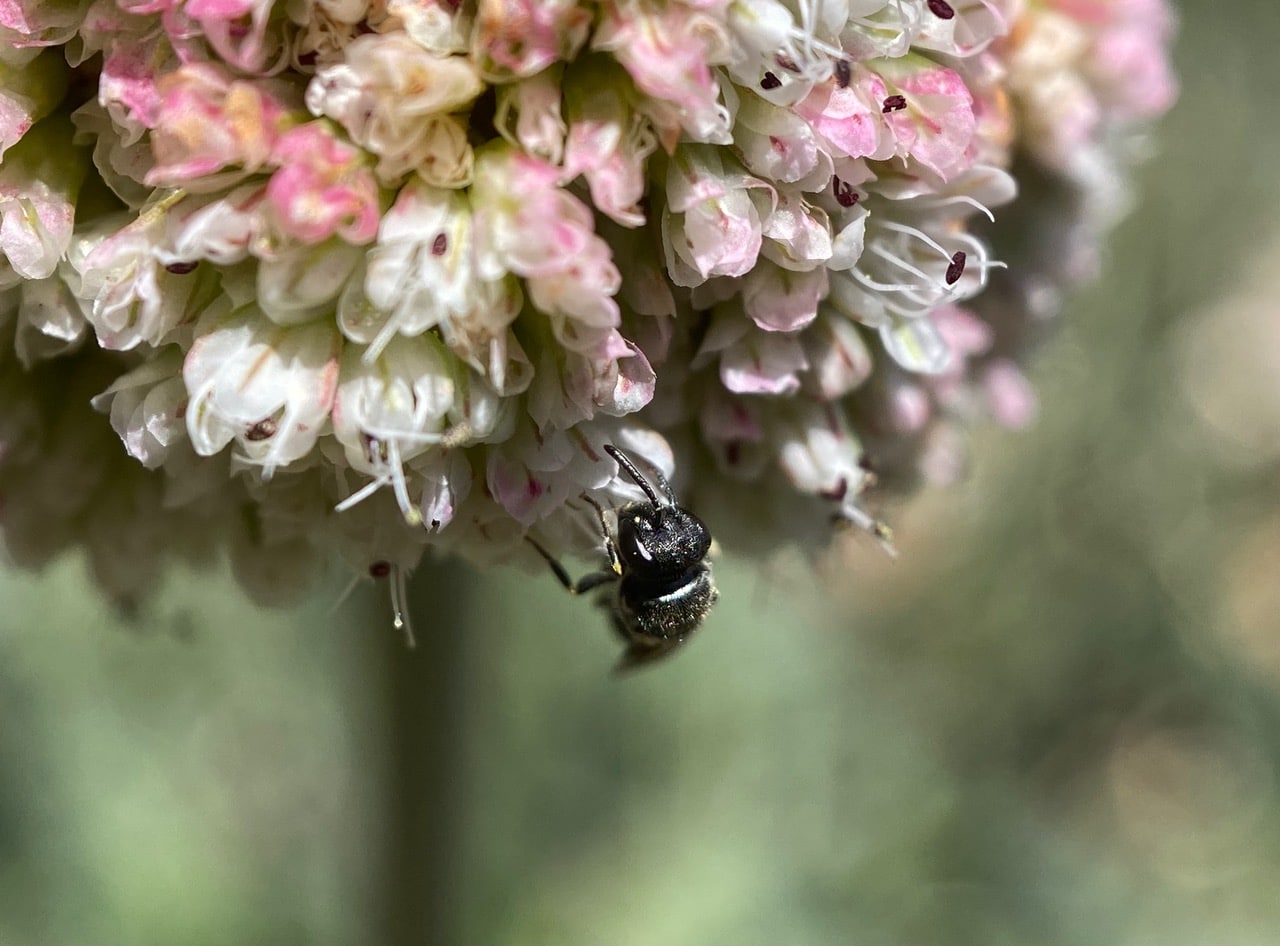
The best feature of all for identifying the little bee is the yellow markings on the inner margins of her eyes. She is a Mask Bee, Hylaeus sp. (family Colletidae).
Hylaeus (family Colletidae) are shiny, slender, hairless, and superficially wasp-like bees. They are small, 5 to 7 mm long, usually black with bright yellow or white markings on their face and legs. These markings are more pronounced on the males. Hylaeus do not carry pollen and nectar externally, they instead store their food in the crop and regurgitate it upon returning to their nests. They are primarily generalist foragers. Hylaeus are short-tongued, but their small body size enables them to access deep flowers. Hylaeus nest in stems and twigs, lining their brood cells with self-secreted cellophane-like material. They lack strong mandibles and other adaptations for digging, using instead pre-existing cavities made by other insects.
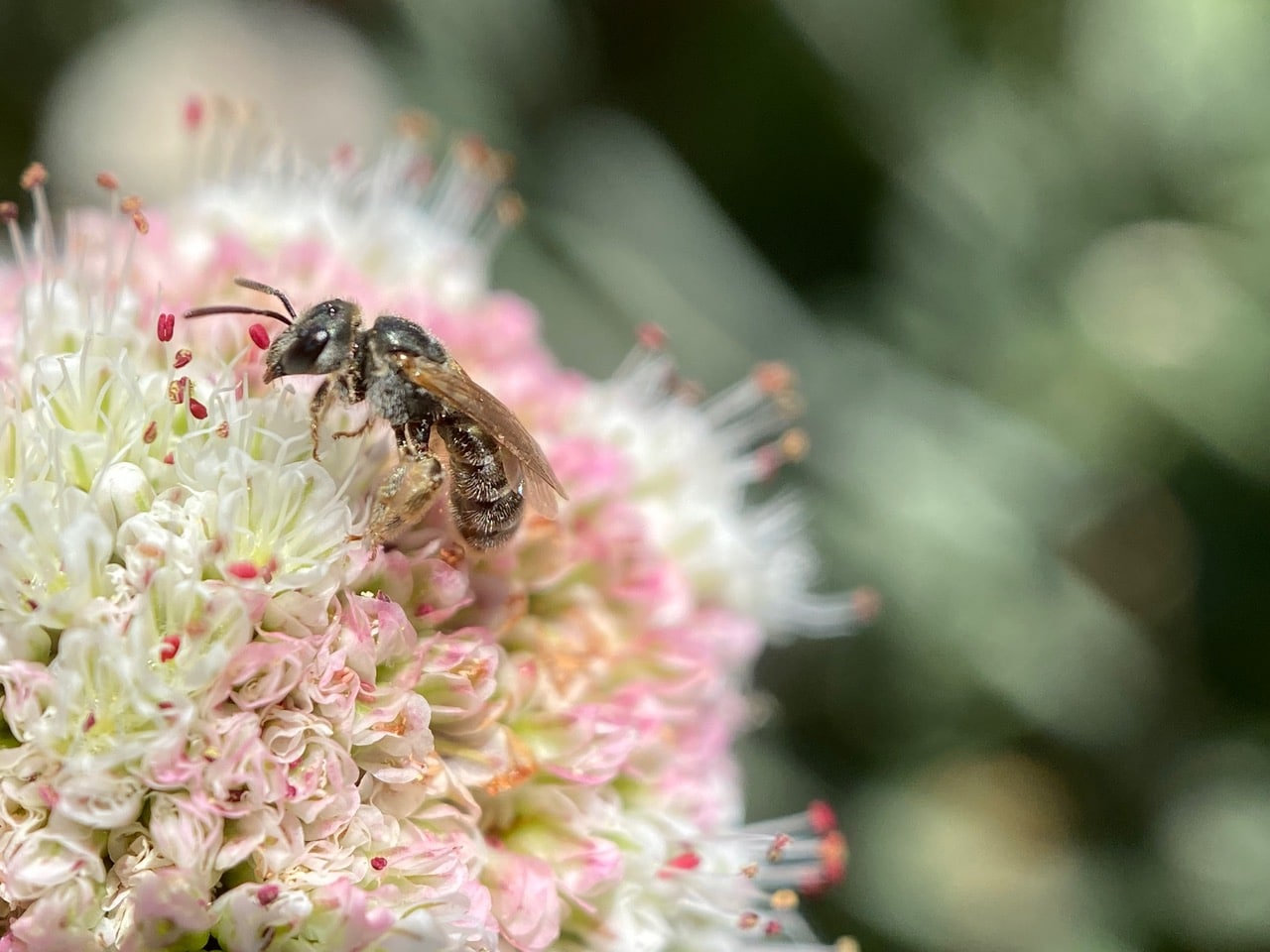
A little Sweat Bee is foraging on an inflorescence of Nude Buckwheat.
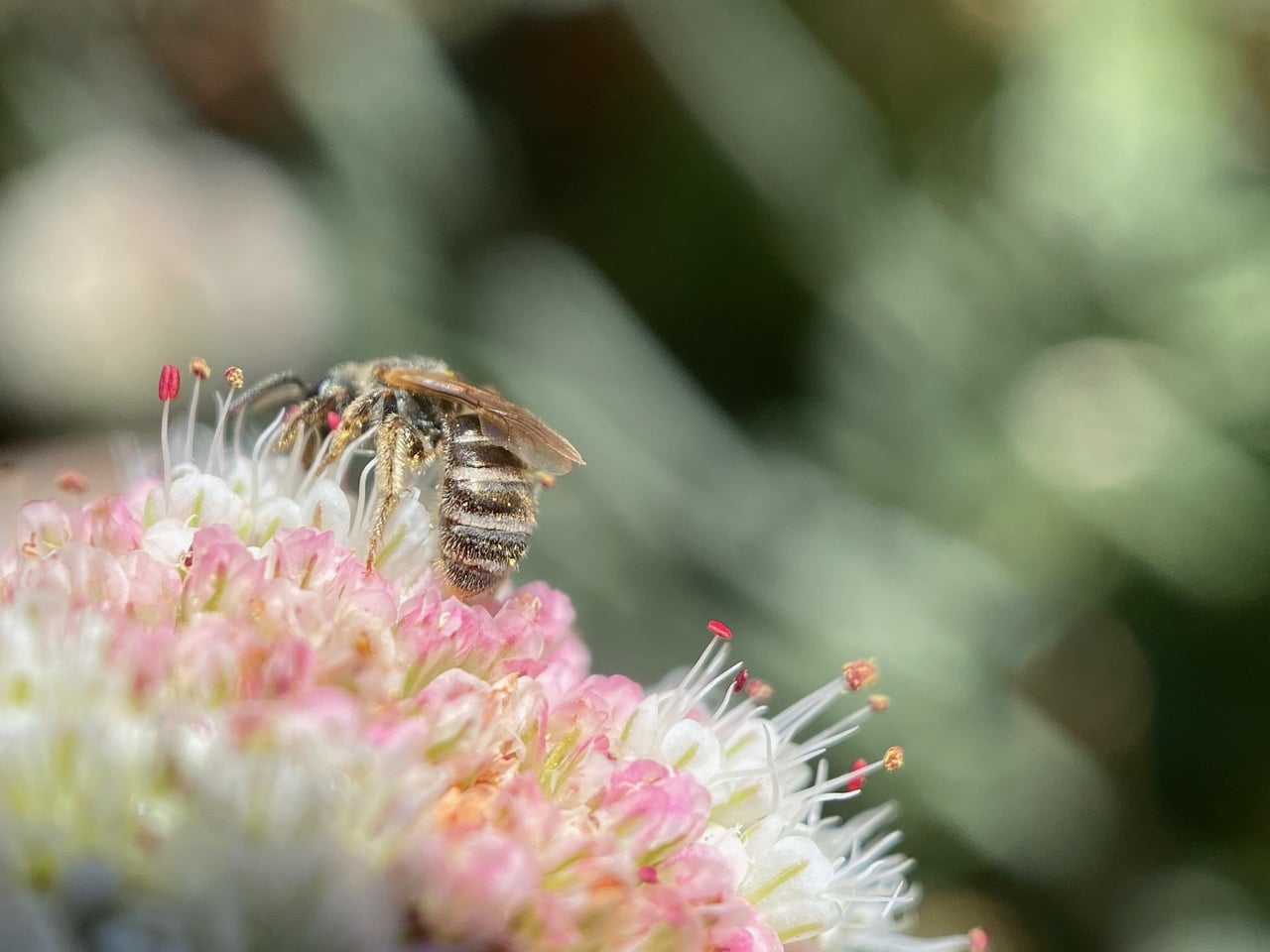
As the bee bends forward, her abdomen is stretched making it easy to see the hair bands. The bands of hair are on the hind margin of each tergite. The bee belongs to the genus Halictus.
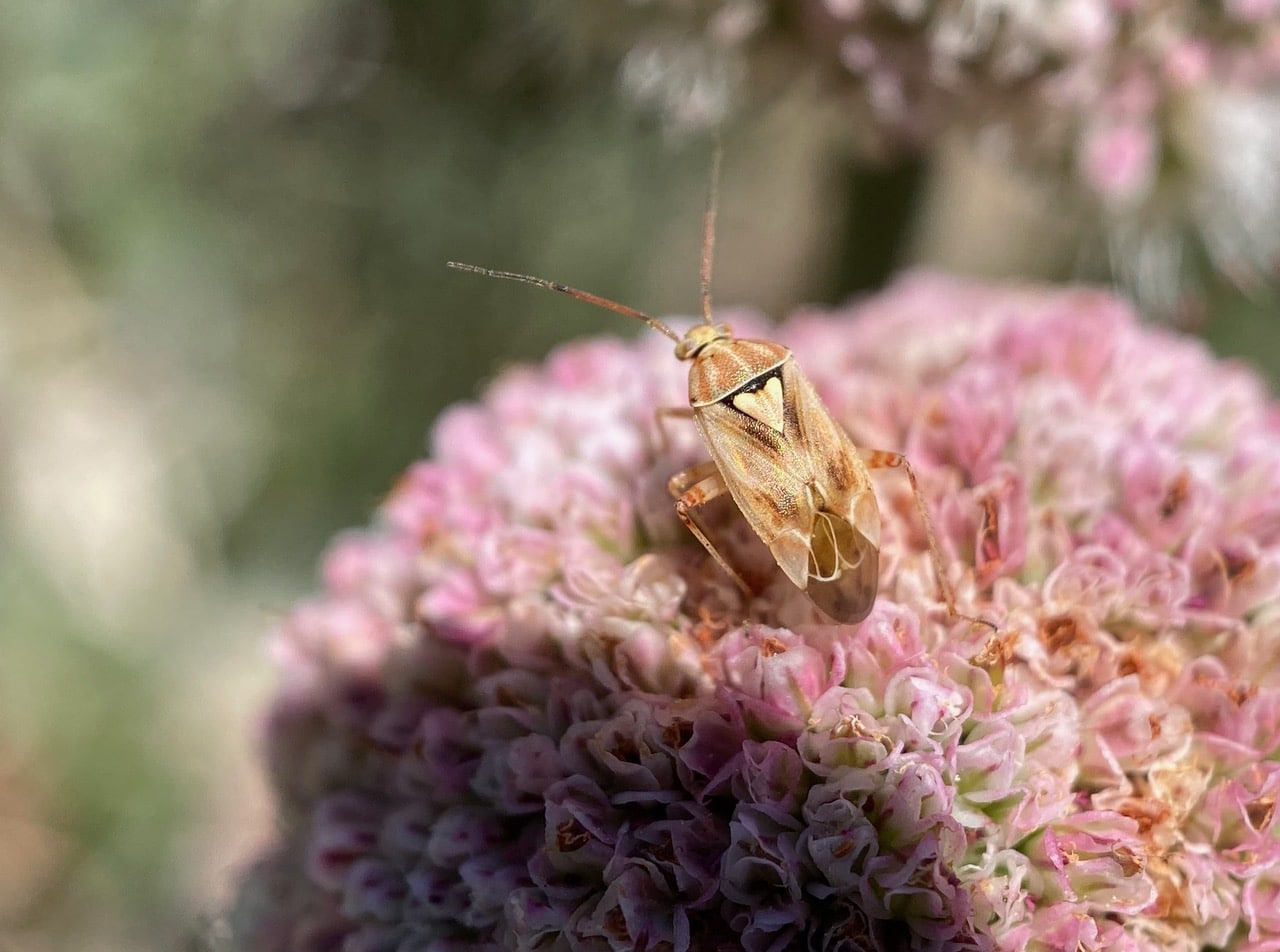
Thanks to the prominent cuneus on the forewings, it is easy to tell that the Lygus Bug, Lygus sp. is a member of the Plant Bug family, Miridae.