

Pollinator Post 6/20/23 (2)

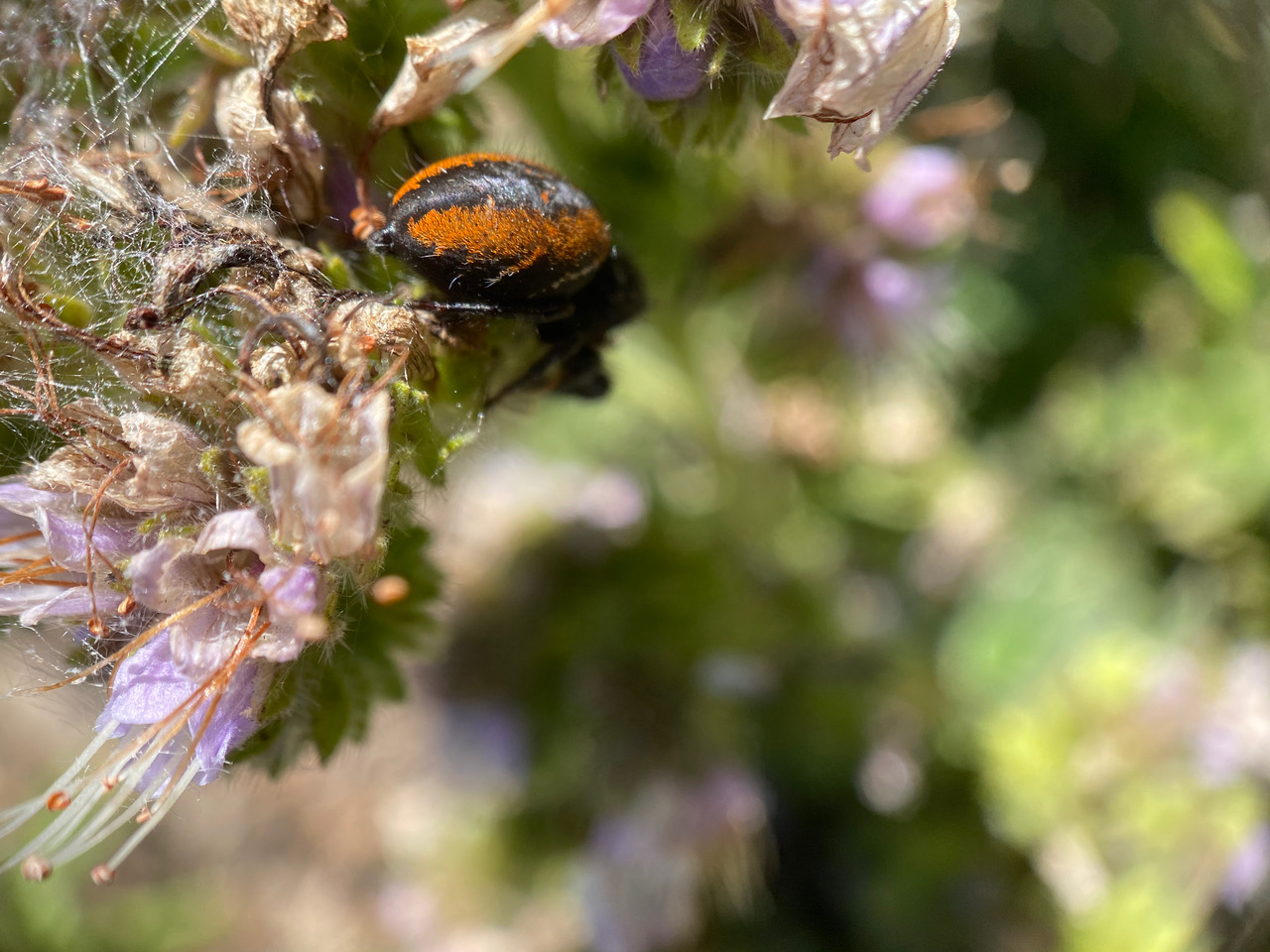
The Red-backed Jumping Spider, Phidippus johnsoni (family Salticidae) runs for cover as soon as she senses my approach to the California Phacelia inflorescence she is sitting on.

Then, all of a sudden, Spidey turns around and returns to her ambush site on top of the inflorescence and settles down meekly. It’s as if she’s saying, “Oh, it’s only you!” Has she learned to trust me? Note the web of silk threads on the inflorescence around her. Spidey has been leaping for prey from this spot for a while. Before a jumping spider leaps, it attaches a safety line on the substrate so that it can safely and quickly return to the spot. Have a great day, Spidey!

I return to the California Everlasting, Pseudognaphalium californicum on which I have observed a little American Lady caterpillar weaving a nest on 6/17. The caterpillar is no longer there. It has left a pile of frass (insect poop) at the bottom of the nest. It has apparently devoured more than half of the flowers on the cluster of flowerheads it has webbed together, leaving the papery white bracts (technically the phyllaries) attached to the silk scaffolding. Now I know why the nests on the everlastings look the way they do – the caterpillars feed from within the nest and leave the phyllaries on the web. What a clever ploy to conceal itself!


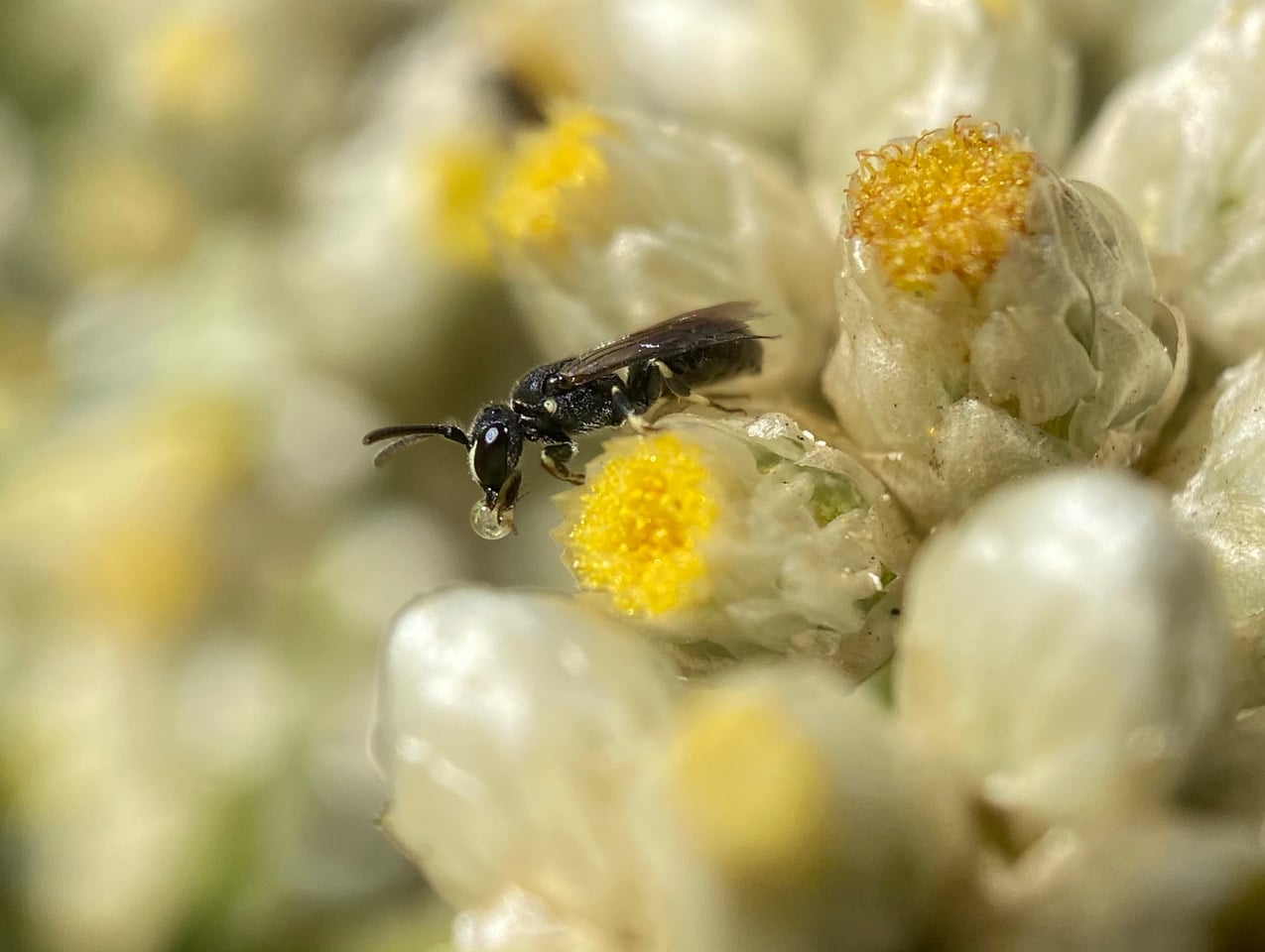 Look, the little bee is blowing bubbles – a behavior often observed in Hylaeus. The bee repeatedly brings up a droplet of liquid in its jaws, and then retrieves it into its body. It has been speculated that Masked Bees do this to facilitate the evaporation of the nectar they have collected, to reduce the load they have to fly home with.


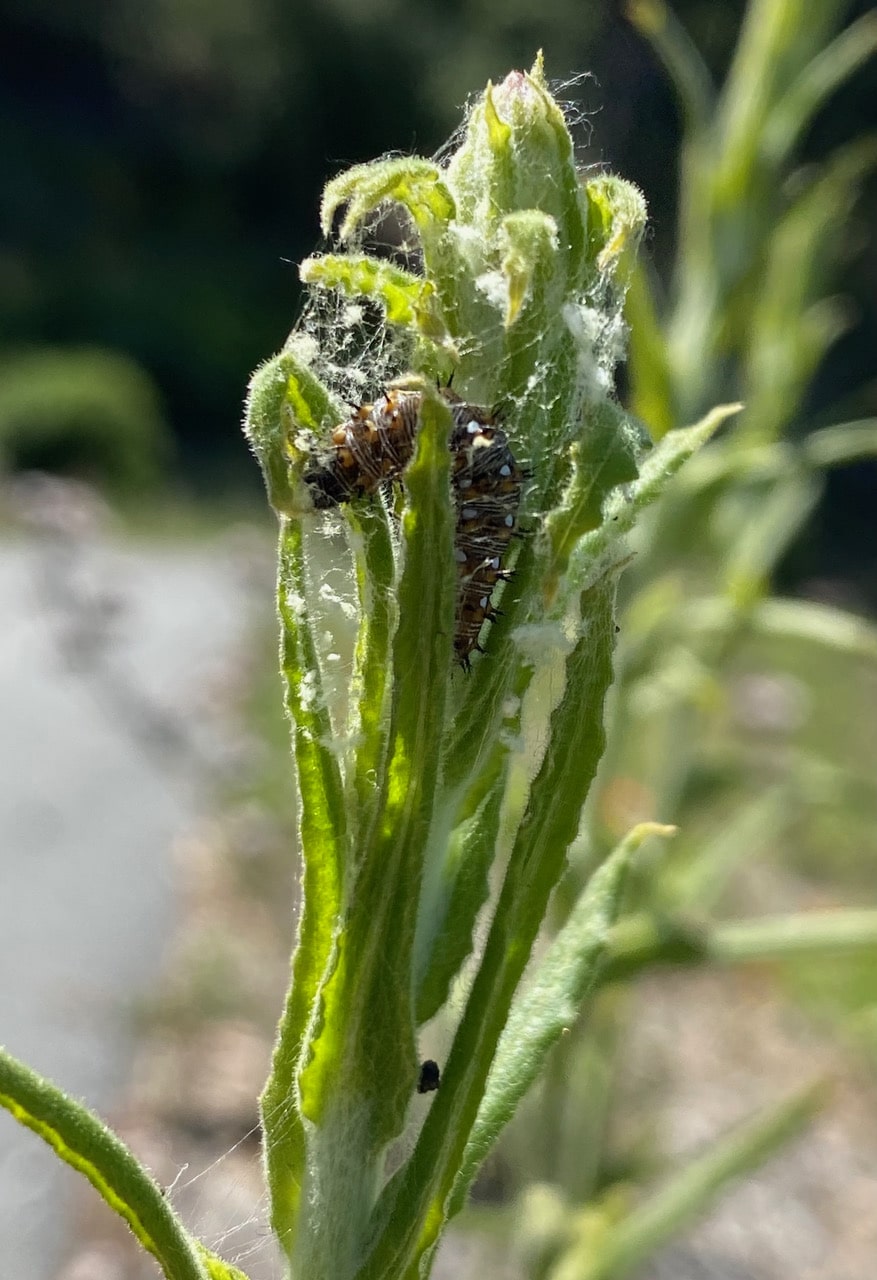
On the tip of a young plant, a small American Lady caterpillar is constructing a simple silk nest, webbing the adjacent terminal leaves together. It has also pulled off some of the fluffy hairs from the foliage to cover the silken structure. Thanks for the show, little fella! Apparently young caterpillars use only leaves to build their starter homes, as their host plant is not even blooming yet.
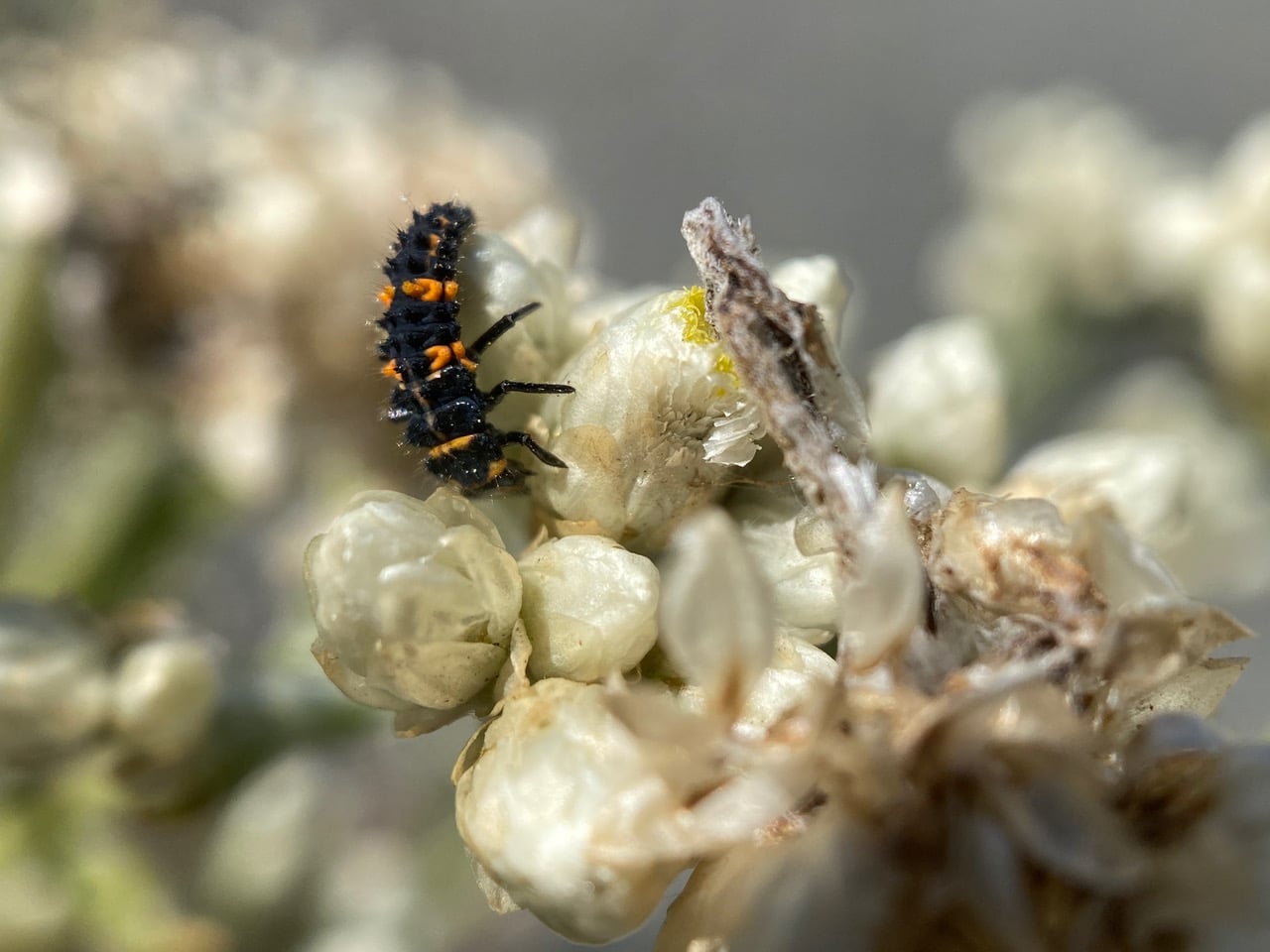
At the site of an old, abandoned caterpillar nest, a young Ladybeetle larva is foraging/scavenging. Perhaps there are little bugs that are associated with the nest?
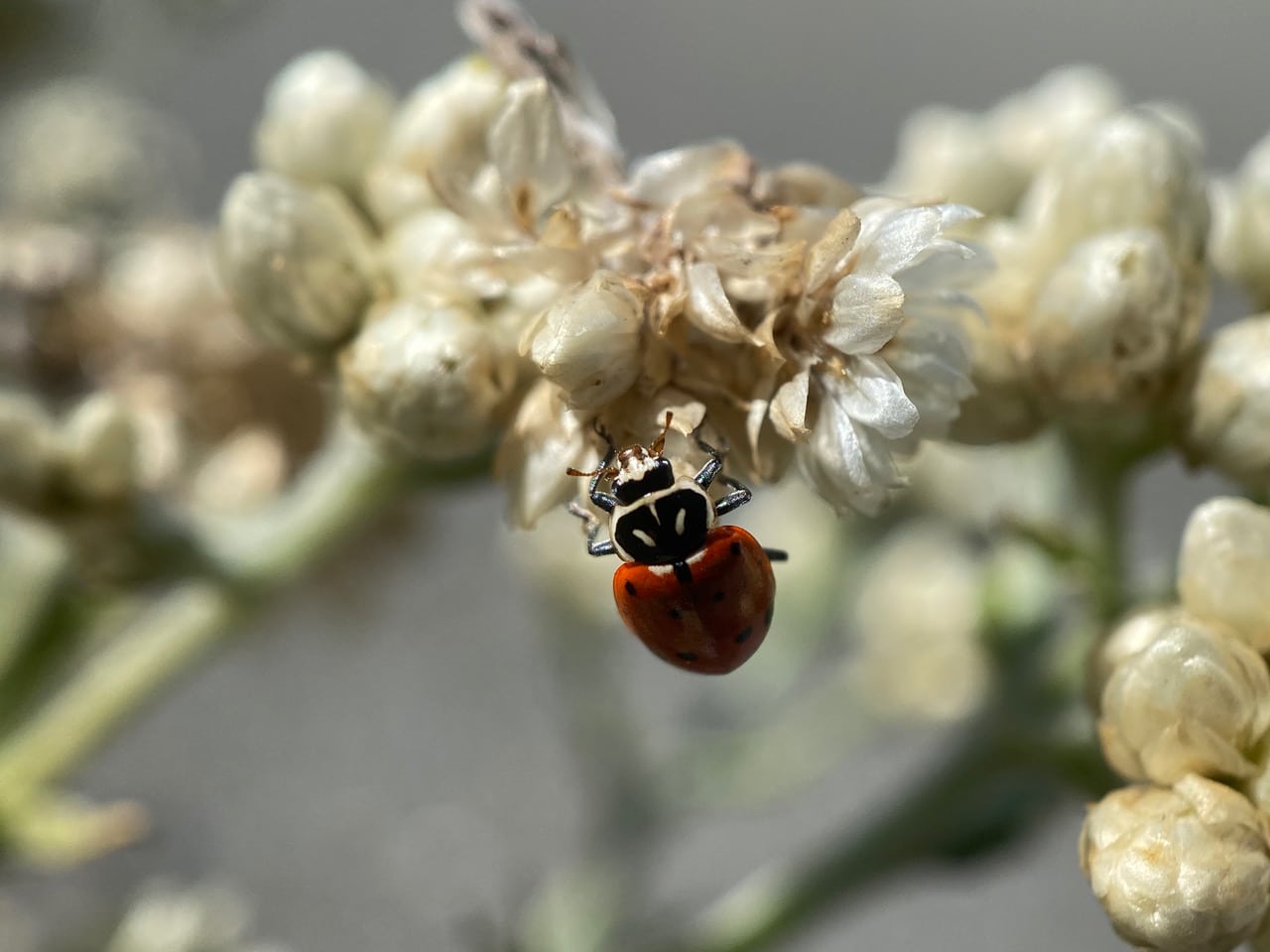
The clean-up crew includes an adult Ladybeetle as well. What an interesting cycle of events on the California Everlasting!
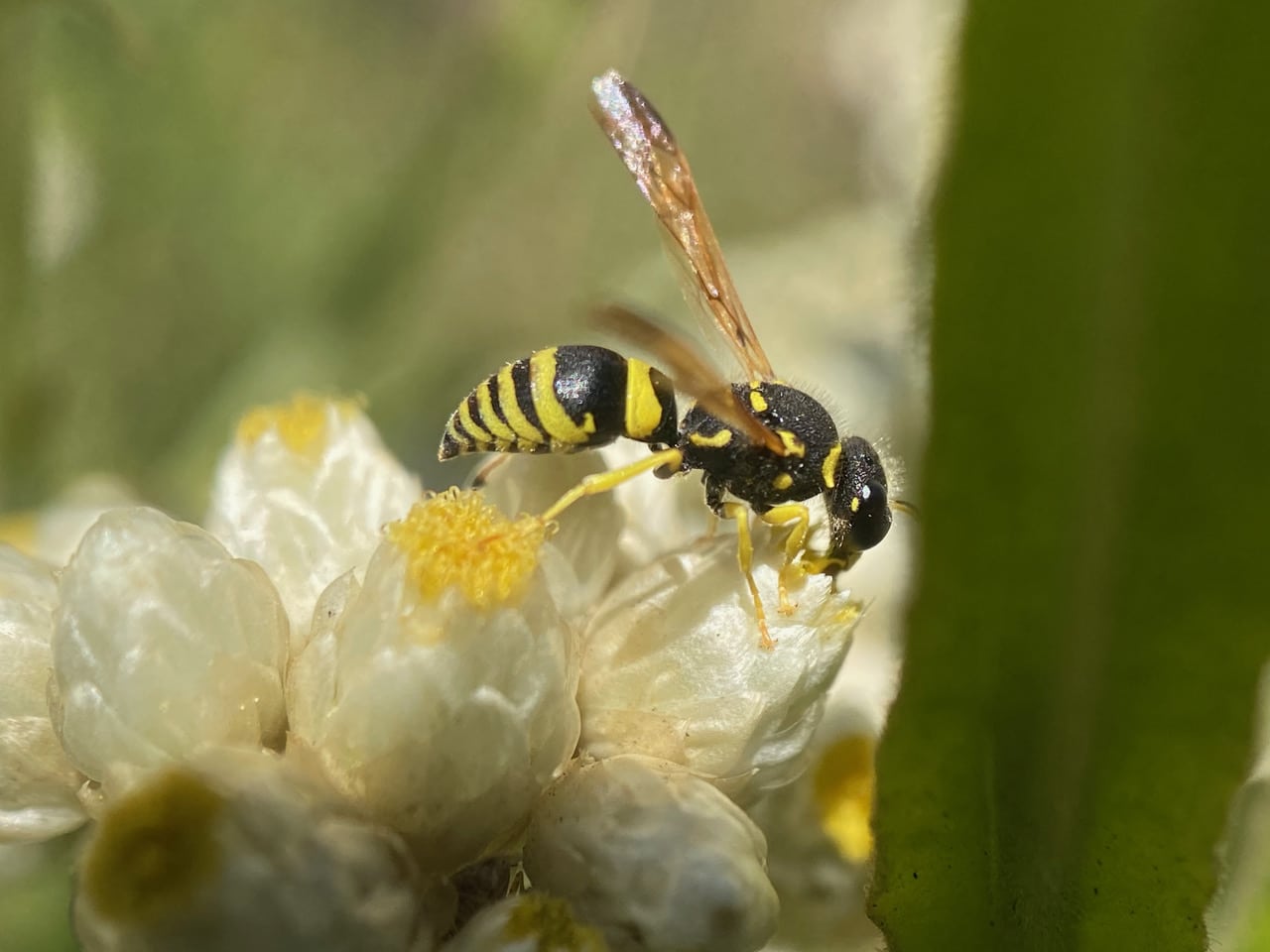
A Potter Wasp, Ancistrocerus sp. (family Vespidae, subfamily Eumeninae) is on an inflorescence of California Everlasting. It is either seeking nectar from the opened flowerheads, and/or hunting caterpillars.
Potter Wasps (or Mason Wasps), the Eumeninae, are a subfamily of Vespidae. Most eumenine species are black or brown, and commonly marked with strikingly contrasting patterns of yellow, white, orange, or red. Like most vespers, their wings are folded longitudinally at rest.
Eumenine wasps are diverse in nest building. The different species may either use existing cavities (such as beetle tunnels in wood, abandoned nest of other Hymenoptera, or even man-made holes like old nail holes) that they modify, or they construct their own either underground or exposed nests. The nest may have one or several individual brood cells. The most widely used building material is mud made of a mixture of soil and regurgitated water.
All known eumenine species are predators, most of them solitary mass provisioners. When a cell is completed, the adult wasp typically collects beetle larvae, spiders, or caterpillars and, paralyzing them, places them in the cell to serve as food for a single wasp larva. As a normal rule, the adult wasp lays a single egg in the empty cell before provisioning it. The complete lifecycle may last from a few weeks to more than a year from the egg until the adult emerges. Adult potter wasps feed on floral nectar.
The genus Ancistrocerus is a widely distributed genus of potter wasps. They are nonpetiolate. The name of the genus (meaning “hooked horn” for the back-curved last segment of the antennae characteristic of males of this genus and most other potter wasps genera).
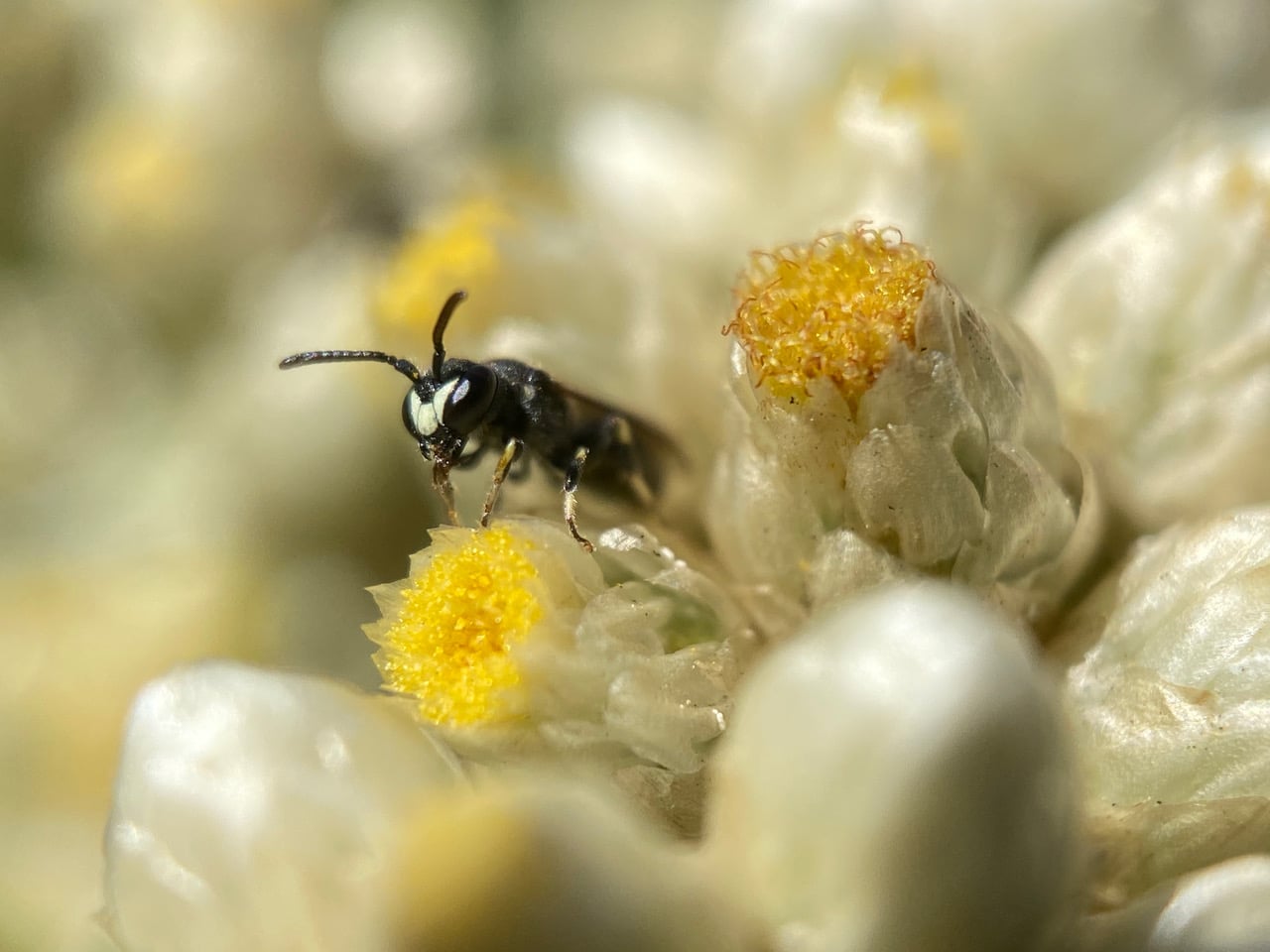
A Masked Bee, Hylaeus sp. (family Colletidae) is foraging on the California Everlasting flowers.
Look, the little bee is blowing bubbles – a behavior often observed in Hylaeus. The bee repeatedly brings up a droplet of liquid in its jaws, and then retrieves it into its body. It has been speculated that Masked Bees do this to facilitate the evaporation of the nectar they have collected, to reduce the load they have to fly home with.The next scene surprises me. The bee is a male, as evidenced by the large yellow marking on its face. It is extruding its tongue, apparently cleaning it.
Male bees neither patcipate in nest building, nor do they collect nectar and pollen to provision the nest. So why would this male concentrate the nectar? I would assume that he was sipping nectar for himself, not to transport it to the nest. We have to reassess that hypothesis about bubble blowing.
Hey, another Potter Wasp, Ancistrocerus sp. (subfamily Eumeninae, family Vespidae).
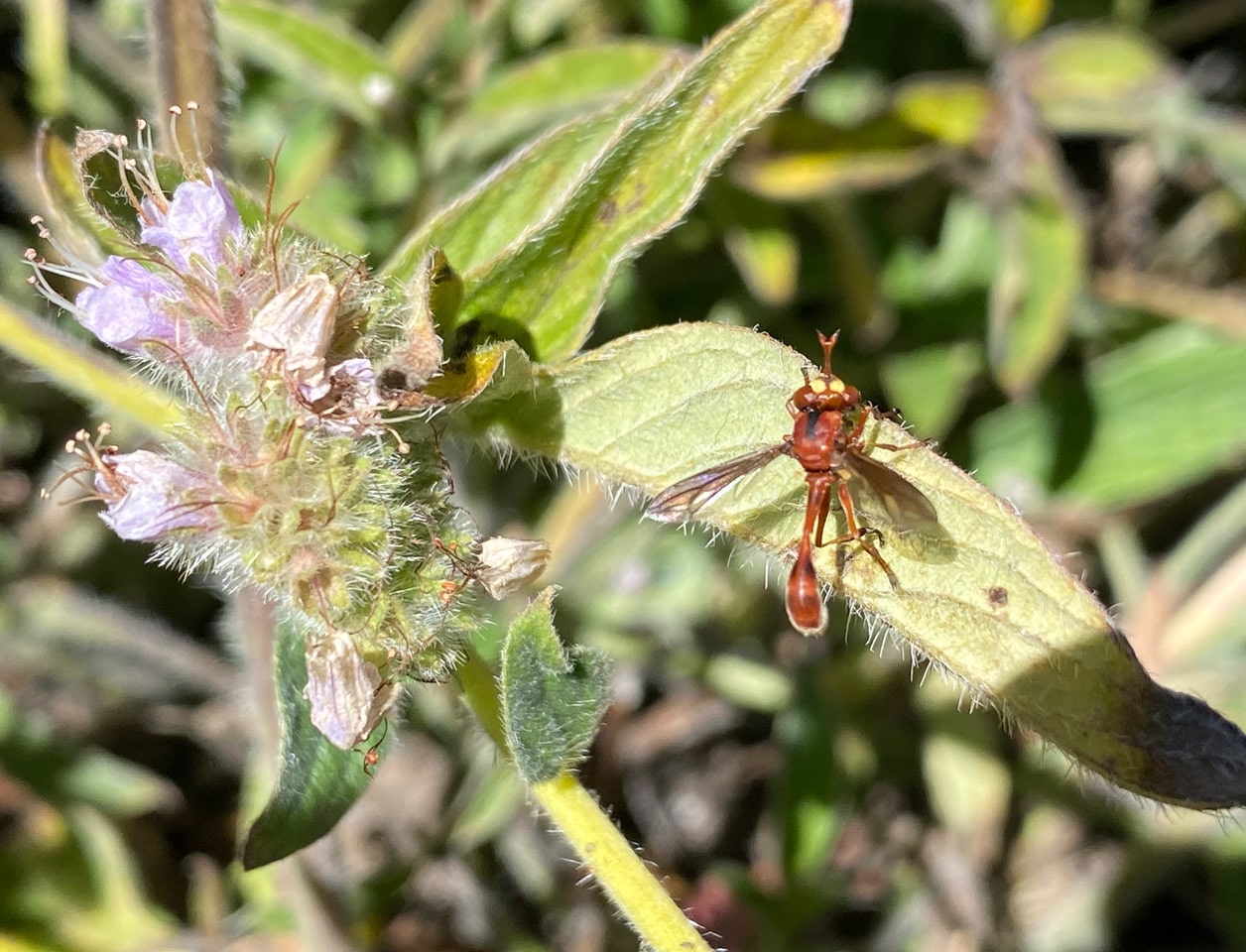
Amidst the hustle and bustle of bumble bees around the California Phacelia, a reddish-brown wasp-like insect is perched in full alert on a leaf. It is a Thick-headed Fly, Physocephala burgessi (family Conopidae)!
The small and little-known family of Conopidae, commonly called the Thick-headed Flies, are distributed worldwide. Remarkable mimics of wasps and bees, the flies are frequently found at flowers, feeding on nectar with their long probosces. The larvae of all Conopids are internal parasitoids, mostly of aculeate (stinging) Hymenoptera (wasps, bees). Adult females aggressively intercept their hosts in flight to deposit eggs. Vulnerable foraging bees are likely the most susceptible to parasitism by Conopids. The female’s abdomen is modified to form what amounts to a “can opener” to pry open the segments of the host abdomen as the egg is inserted. The fly larva feeds on the host from the inside out. The vast majority of parasitized bumble bees bury themselves by burrowing into the ground right before they die. This behavior does not matter to the bees – they are doomed. But it is critical for the flies – if the host dies underground, the fly is sheltered from the elements, predators and parasites.
The life spans of parasitized bumble bees are not significantly shortened, though as the parasitoid grows, the bee can’t carry home as much nectar. Bumble bees will chill, literally, to put off the inevitable, seeking cooler spots, even sleeping outside at night to slow the growth within them. If many of the workers in a colony are infested, future queens may be smaller in size and may not have enough energy to get through the winter.
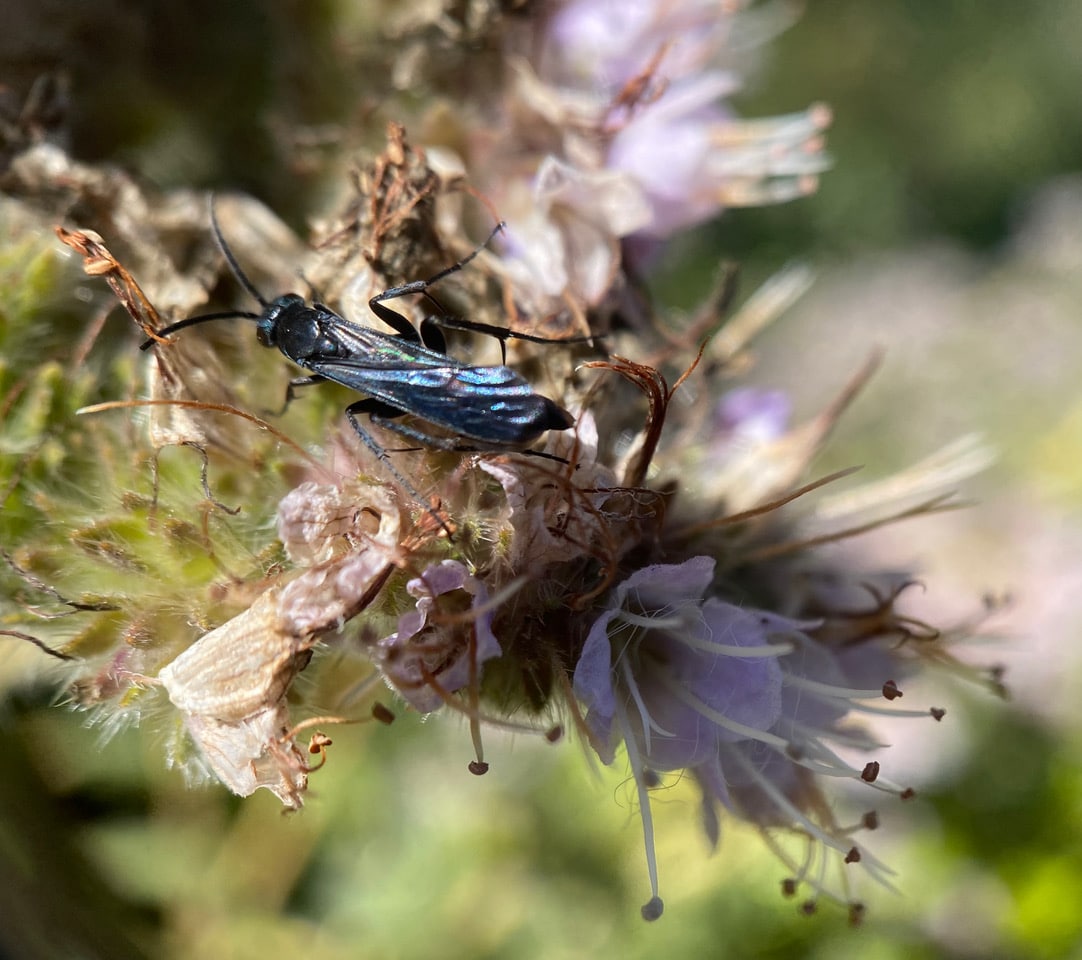
Flashes of iridescent blue wings on an inflorescence of California Phacelia alerts me to the presence of a Spider Wasp, Aporus sp. (family Pompilidae).
Aporus is a genus of spider wasps from the family Pompilidae; they specialize in hunting ground dwelling spiders in their burrows for laying eggs on. All species and both sexes are black; some have a fine pubescence that reflects bluish or greenish.
Members of the family Pompilidae have long, spiny legs; the hind femur is often long enough to reach past the tip of the abdomen. The tibiae of the rear legs usually have a conspicuous spine at their distal end. The pompilid body is typically dark (black or blue, sometimes with metallic reflections).
Adult pompilidae are nectar-feeding insects and feed on a variety of plants. An adult female searches the ground and/or vegetation for a spider, and upon finding one, stings it, paralyzing the spider. The wasp then excavates a burrow or flies or drags the spider to a previously made burrow. Sometimes the host burrow is used. The wasp lays a single egg on the abdomen of the spider, then leaves after closing the burrow and spreading soil around the burrow to make the nest site inconspicuous. When the wasp larva hatches, it penetrates the spider’s abdomen, and feeds on it from the inside, avoiding vital organs for as long as possible to keep the spider alive. The wasp larva pupates within the spider and eventually emerges as an adult to continue the life cycle.
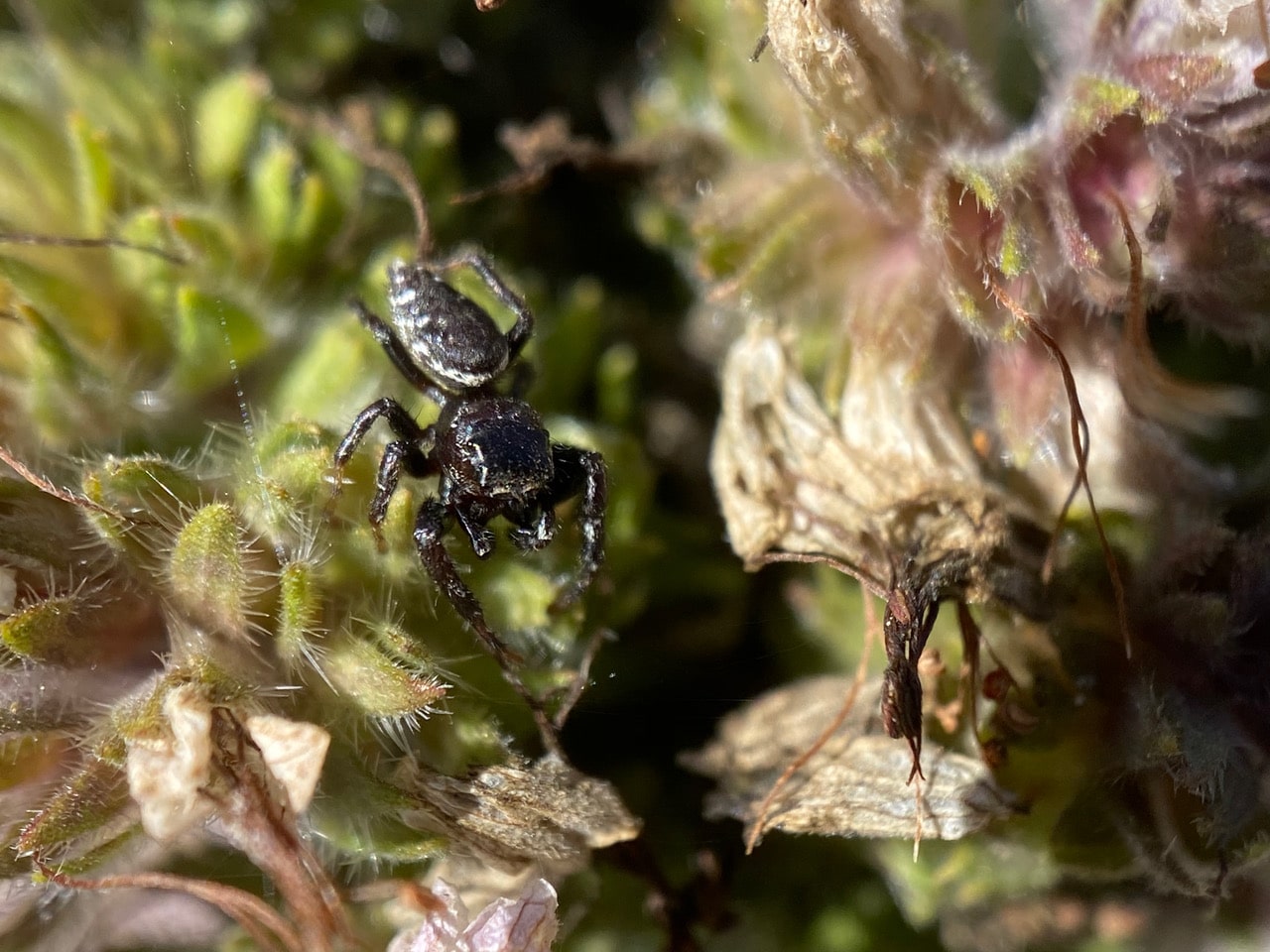
A small shiny spider is running on an inflorescence of California Phacelia. It is a male Copper White-cheeked Jumping Spider, Pelegrina aeneola (family Salticidae). We saw a female just yesterday! The sexes appear completely different.
Jumping Spiders’ eyes do not pivot in their sockets. To see me well, the Jumping Spider has to face me squarely – giving that adorable, wide-eyed gaze typical of the family Salticidae.
Jumping spiders have excellent vision, with among the highest acuities in invertebrates. The 8 eyes are grouped four on the face (the two big Anterior Median Eyes in the middle, and two smaller Anterior Lateral eyes to the side), and four on top of the carapace. The anterior median eyes provide high acuity but small field of view, while the other six eyes act like our peripheral vision, with lower resolution but broad field of view. Since all eight eyes are fixed in place and can’t pivot independently from the body like human eyes can, jumping spiders must turn to face whatever they want to see well. This includes moving their cephalothorax up and down, an endearing behavior.

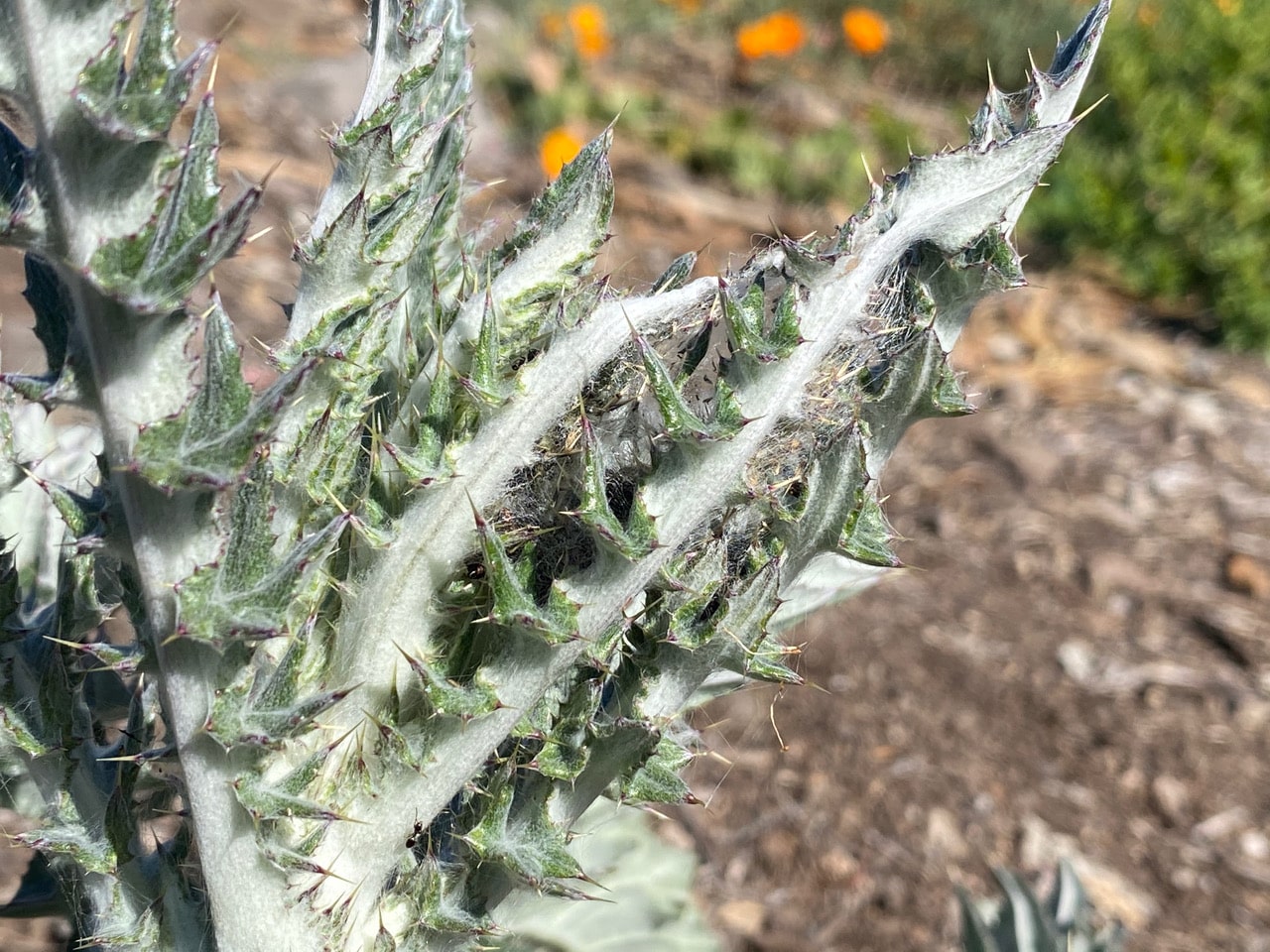
I check the Cobweb Thistles, Cirsium occidentale for signs of the Painted Lady caterpillars. A new, elaborate nest has been constructed by webbing adjacent young leaves together with silk. That’s impressive!
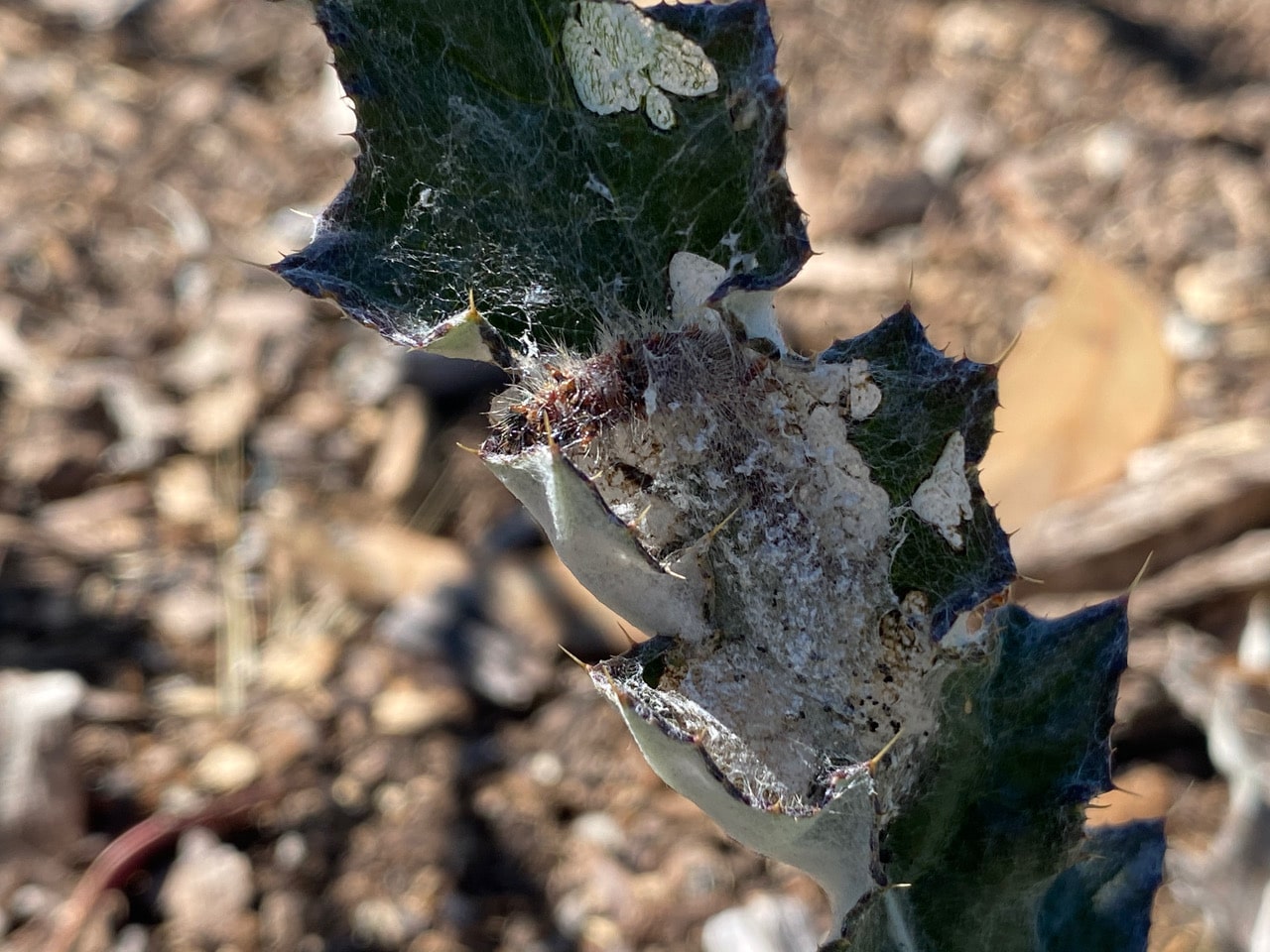
A Painted Lady caterpillar is extending its nest by webbing more areas of the thistle leaf with silk from its salivary glands. See those white patches on the leaf? Those are scars from caterpillar feeding. Young caterpillars feed in safety within their silken nests.
Another caterpillar is desperately trying to seal its nest at the edge against ant intrusion. The journey to becoming a butterfly is rife with peril!