

Pollinator Post 6/19/24

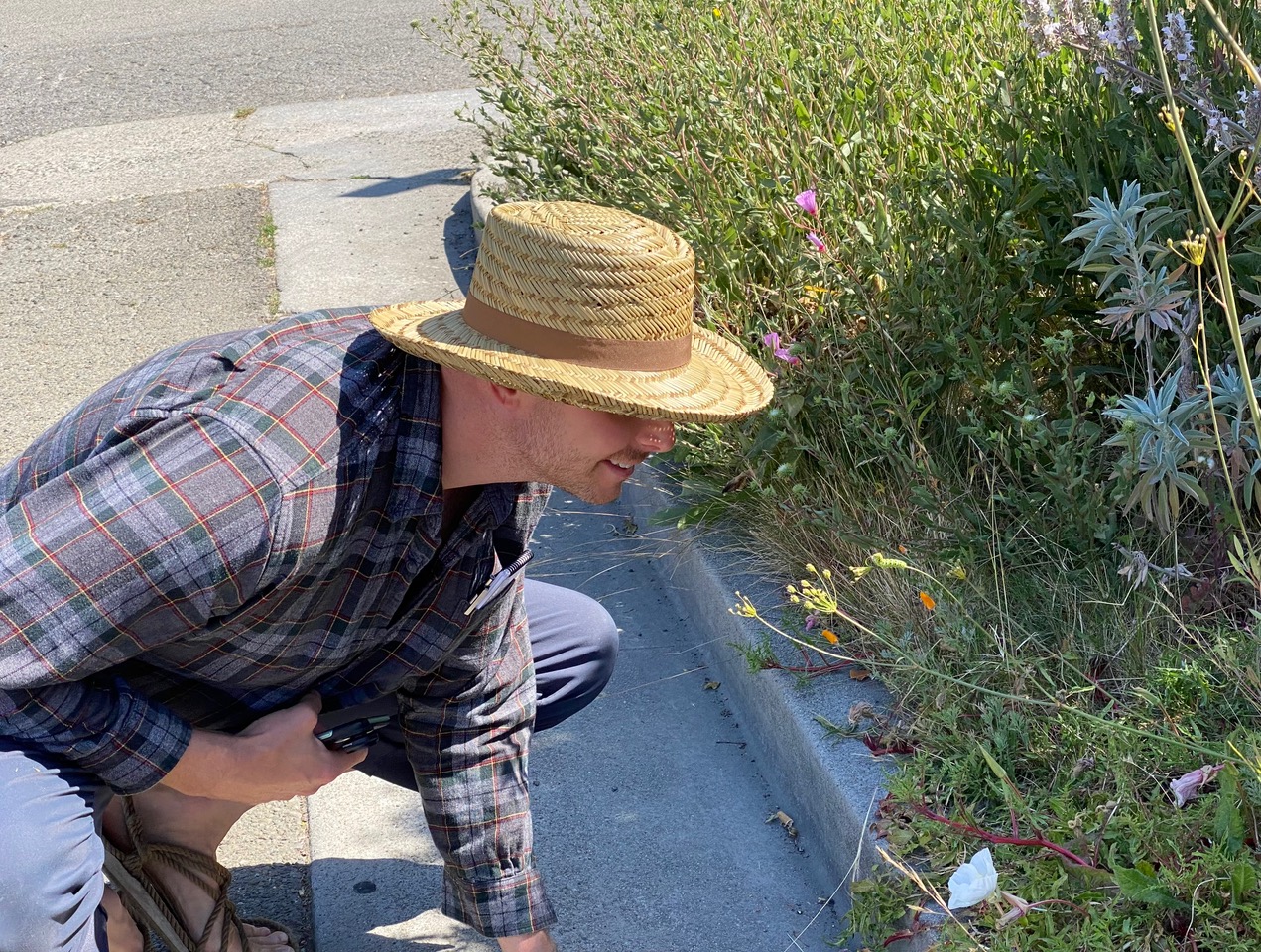
Kathy has kindly arranged for me and another friend, Ben to visit a beautiful home garden in Richmond with her.
The strip along the curb is lushly planted, and still floriferous.
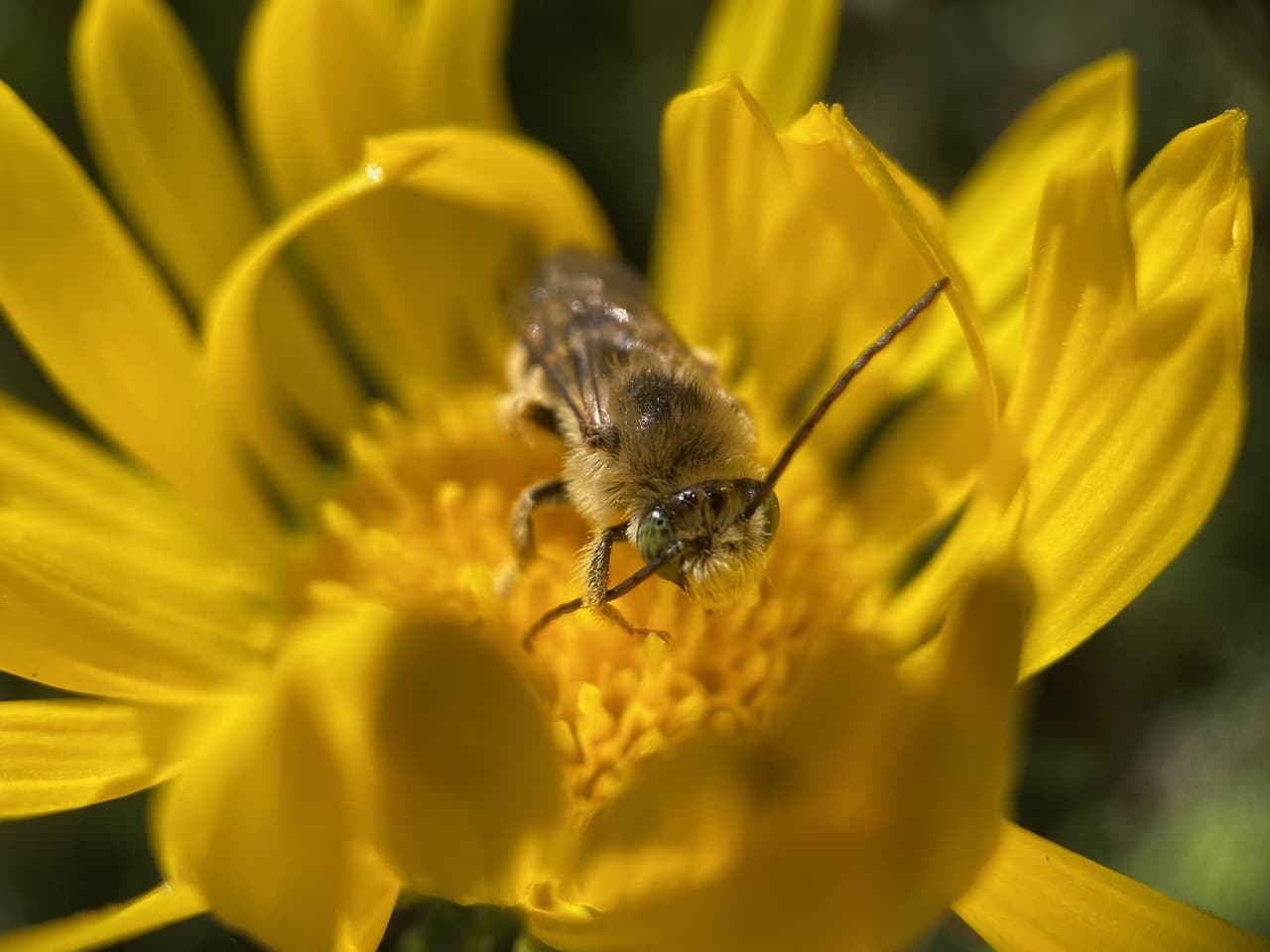
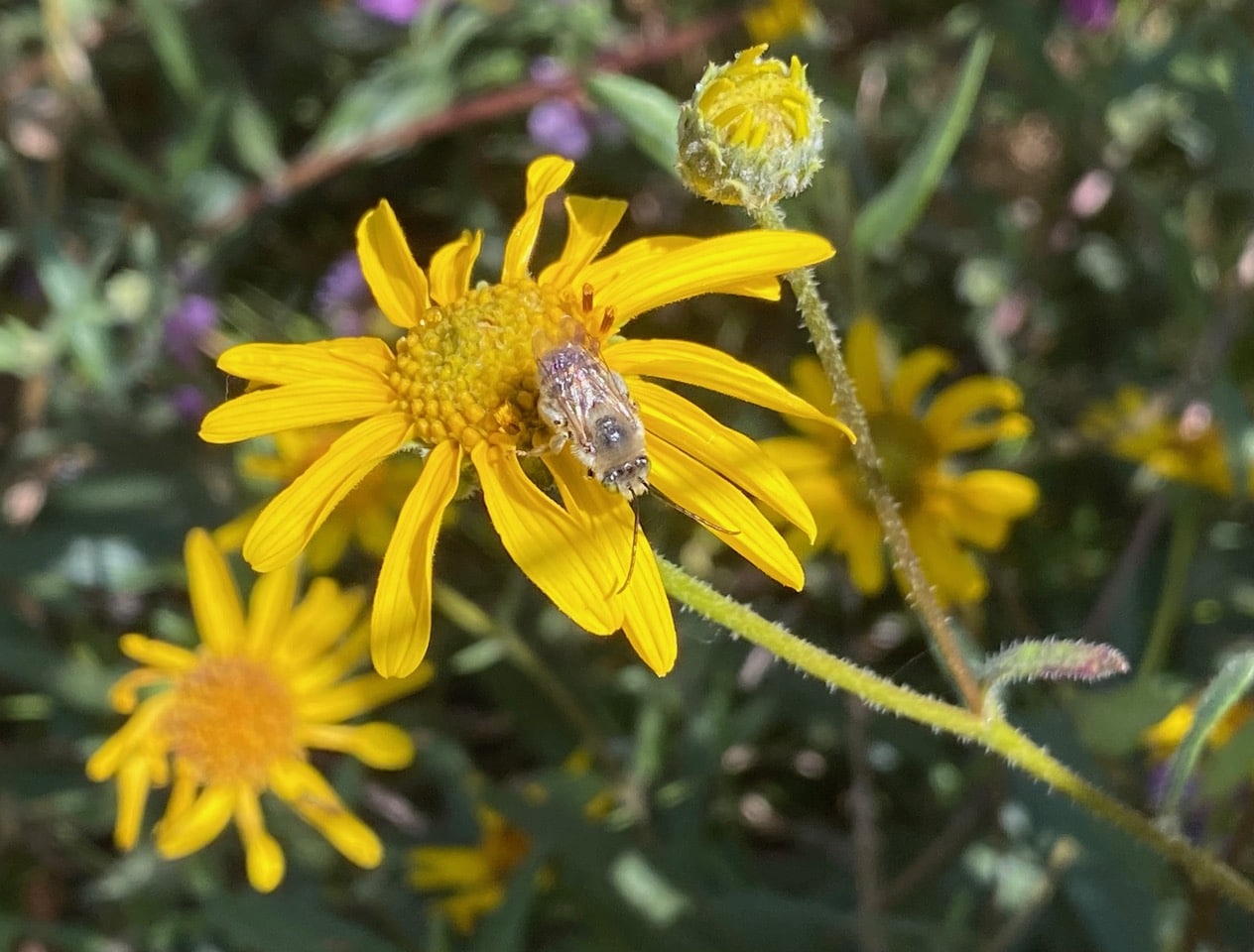 Hey, isn’t that a male Longhorn Bee on a flowerhead of Slender Sunflower, Helianthus gracilentus?
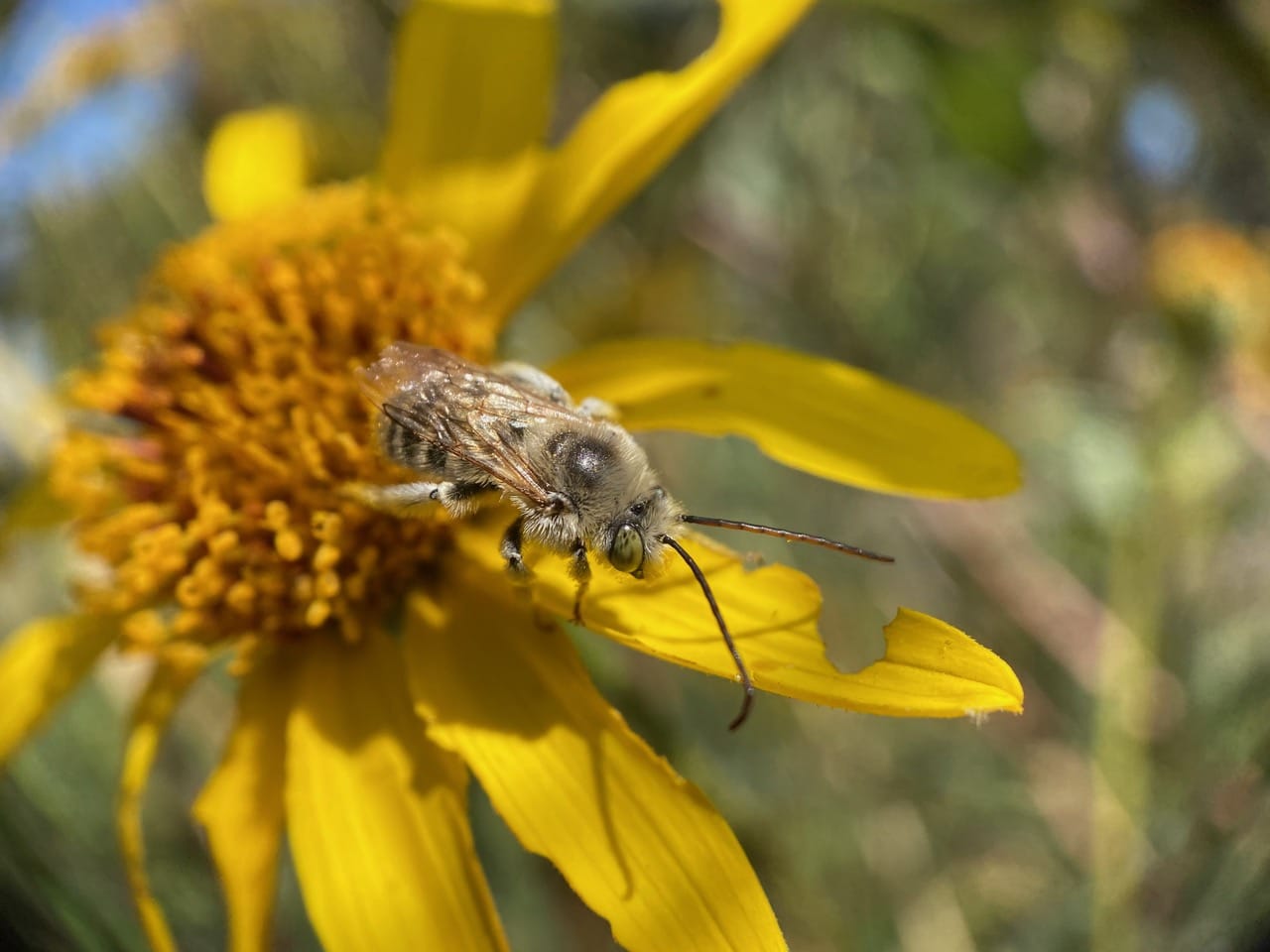
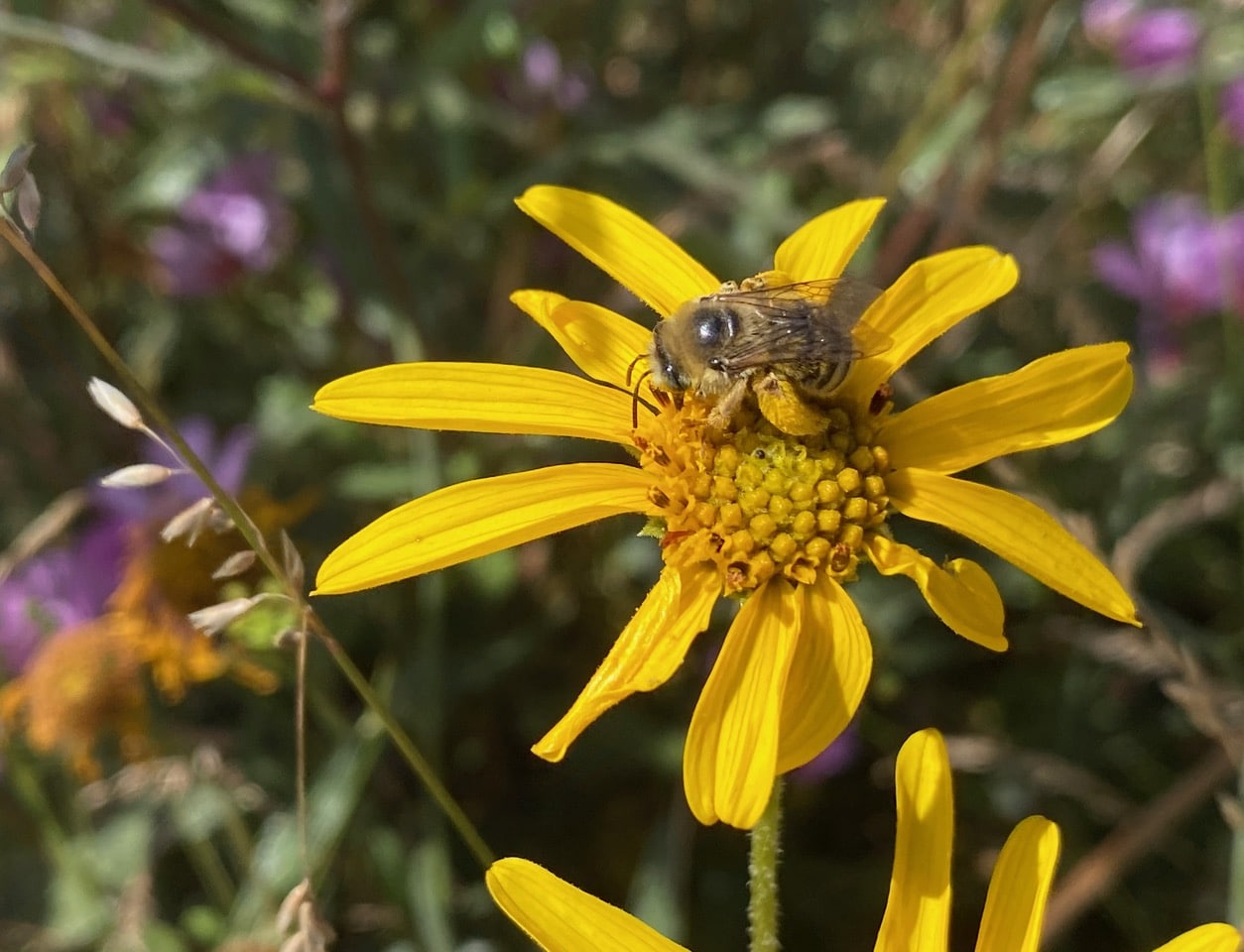

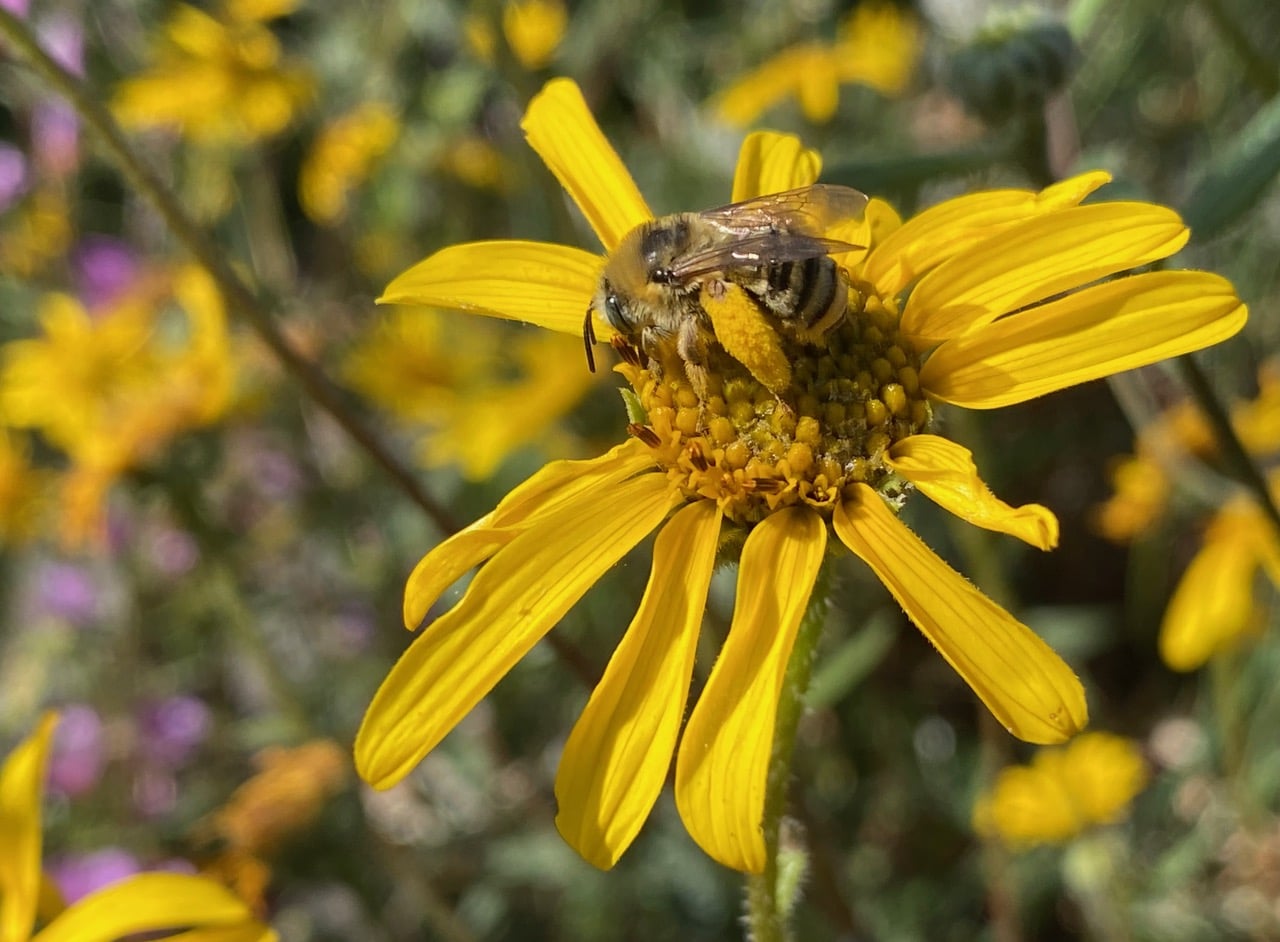
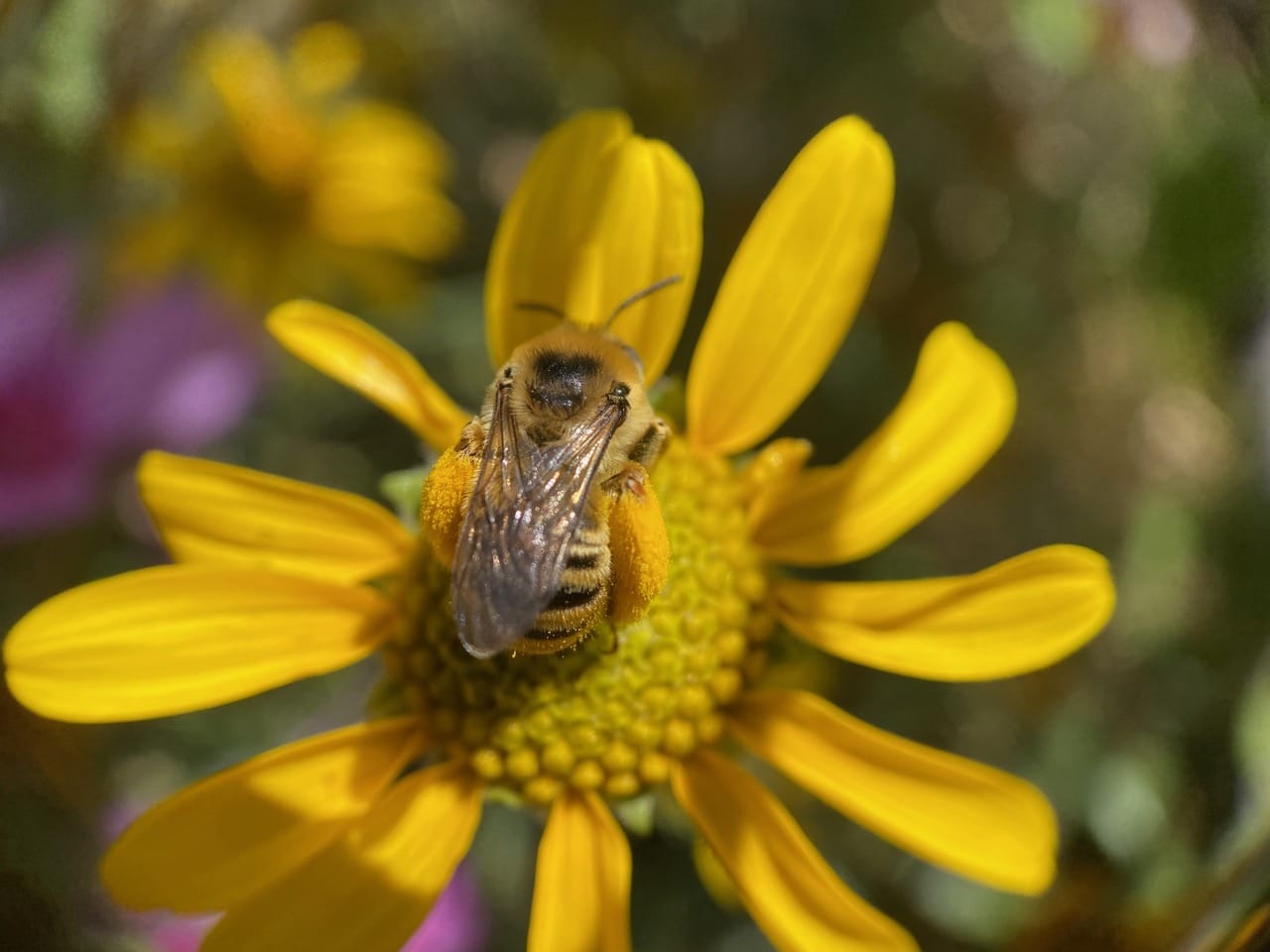

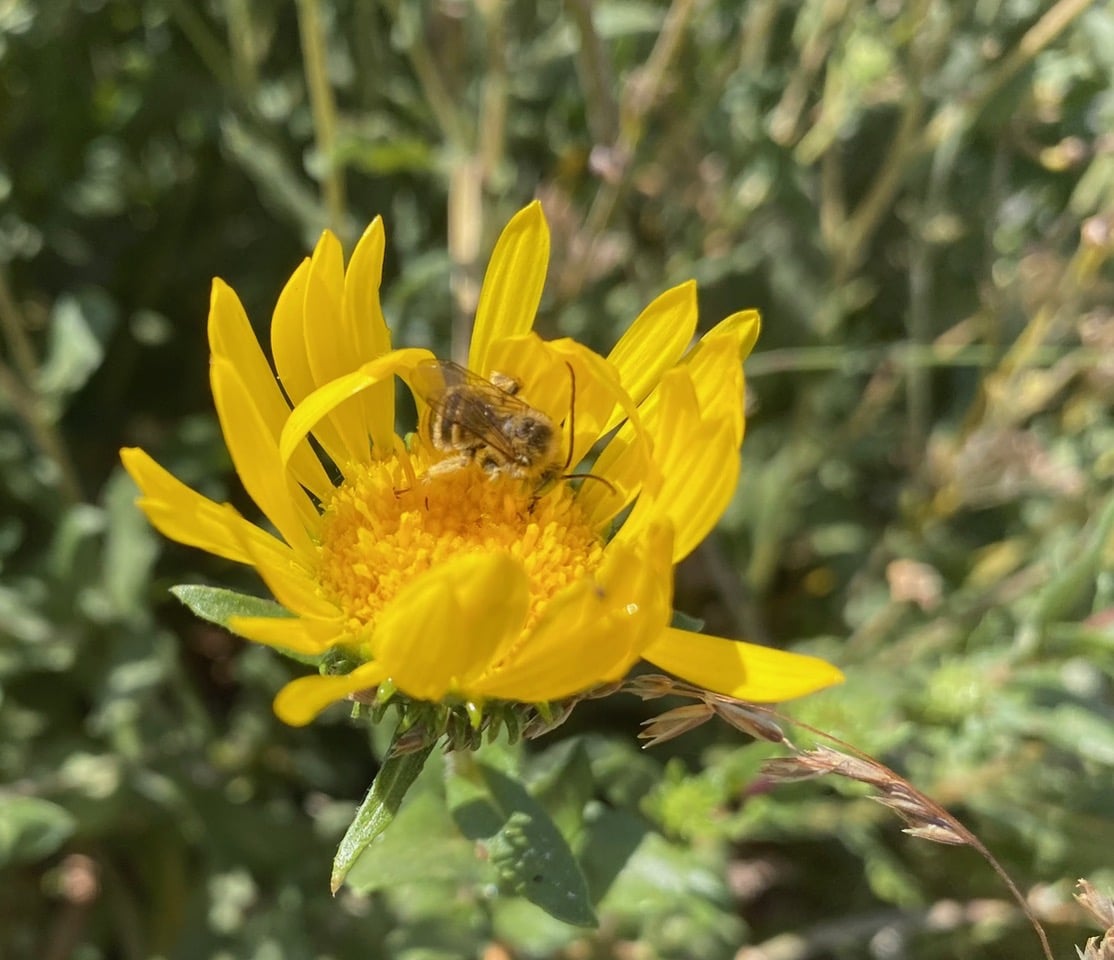
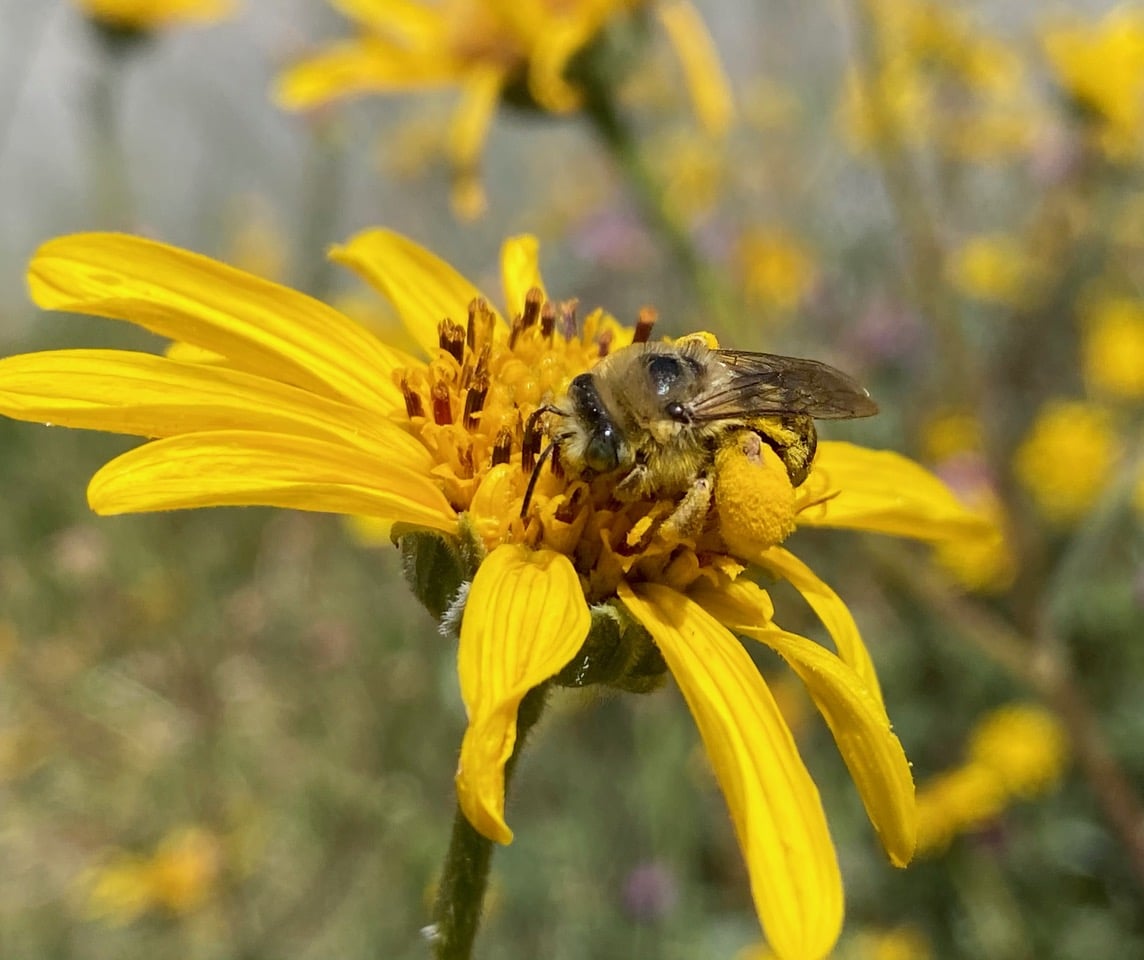
Hey, isn’t that a male Longhorn Bee on a flowerhead of Slender Sunflower, Helianthus gracilentus?
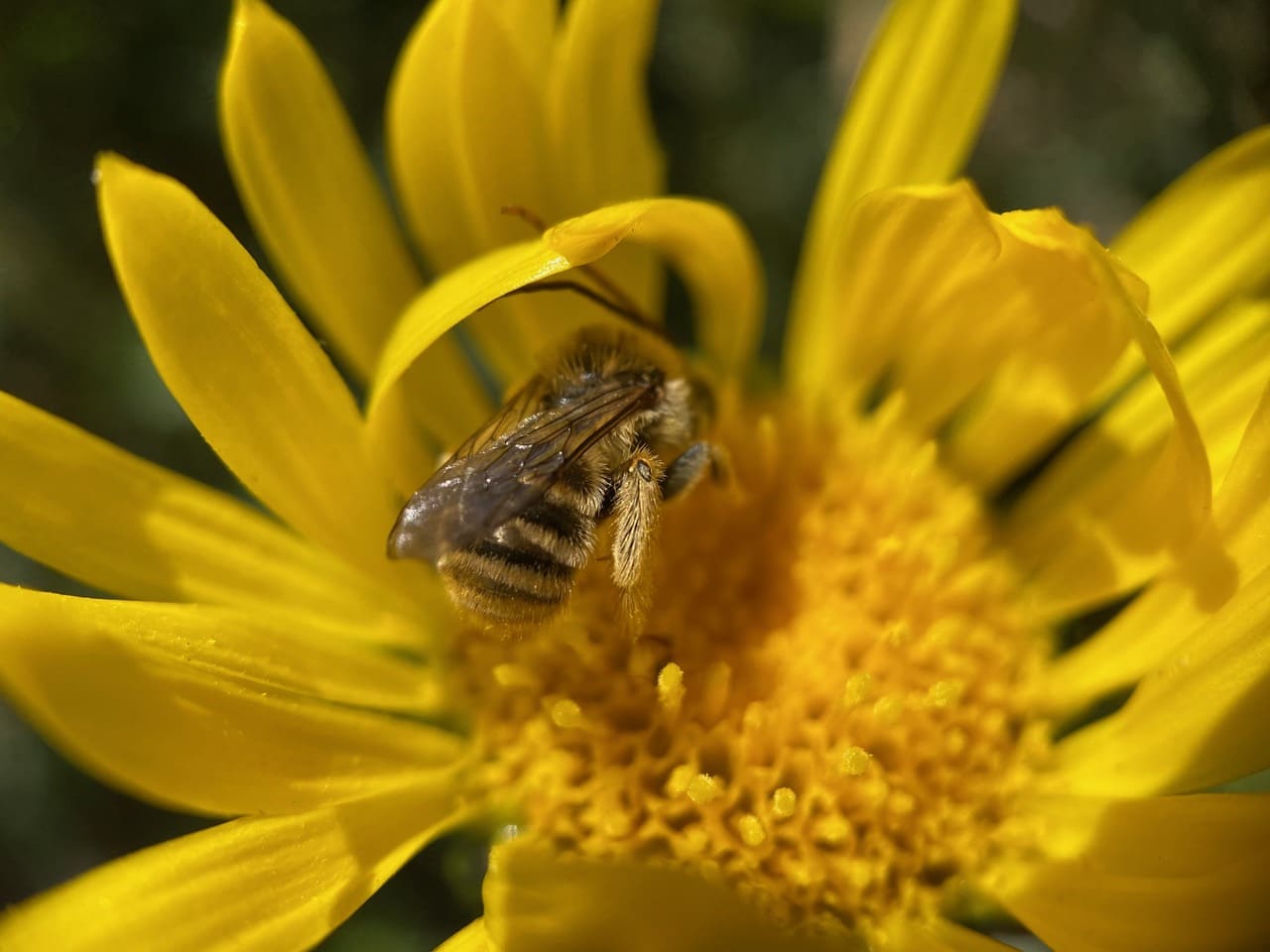
Close-up of the male Summer Longhorn Bee, Melissodes sp. (family Apidae). Members of this genus are remarkably similar to the Spring Longhorn Bees (genus Eucera) but are summer fliers, seen typically on sunflowers. The very long antennae of the males give rise to the common name of “longhorn”.
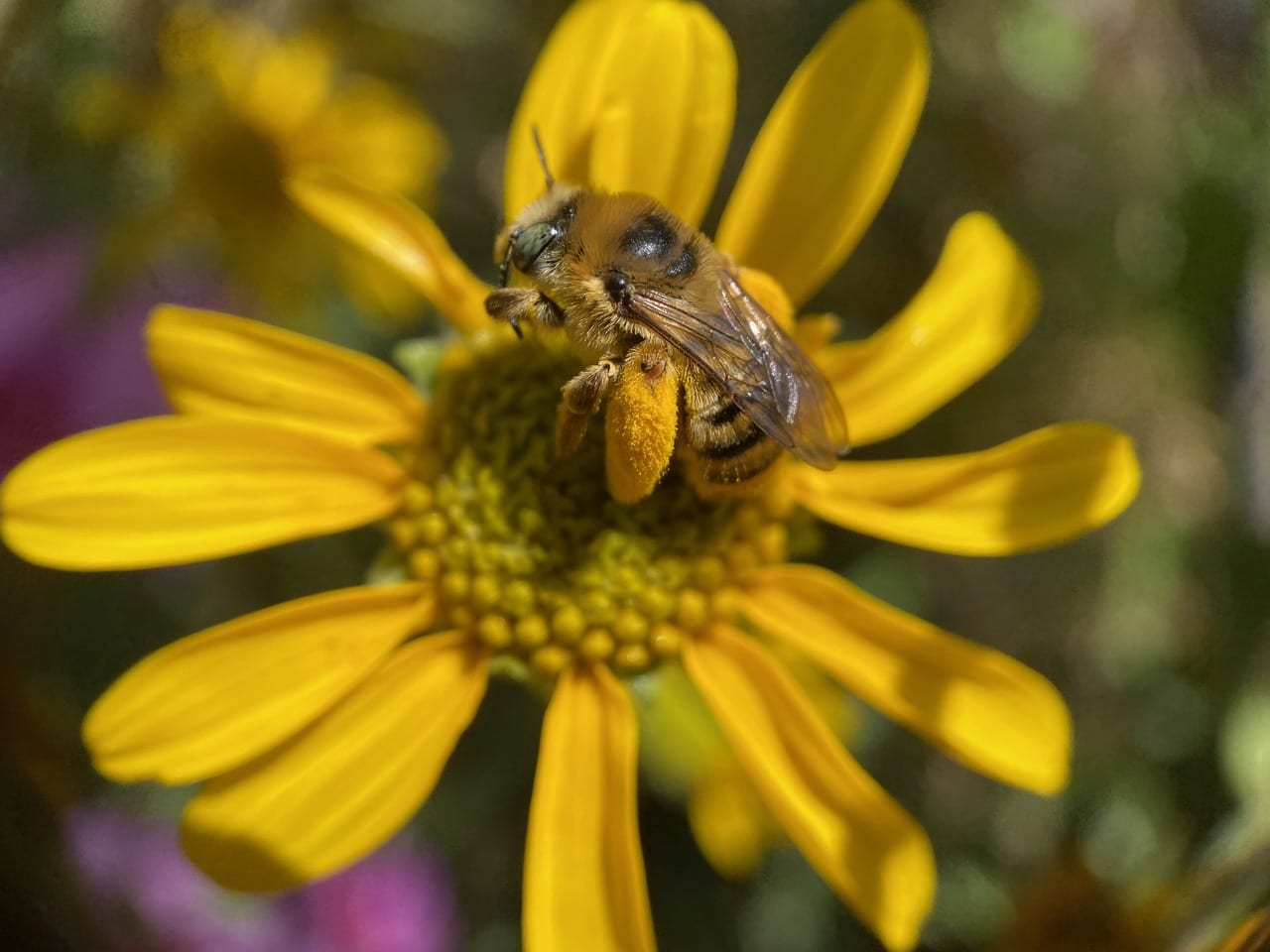
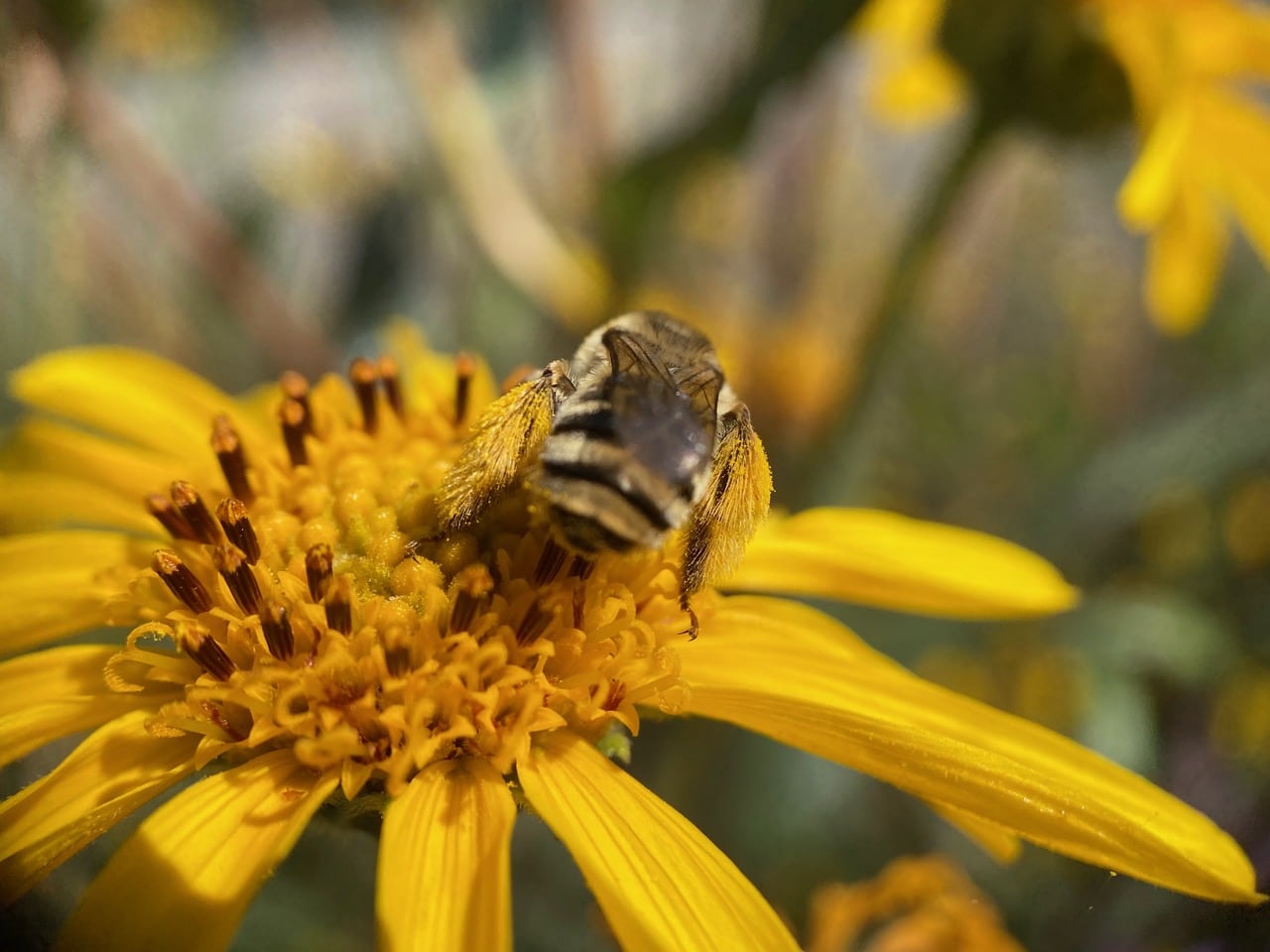
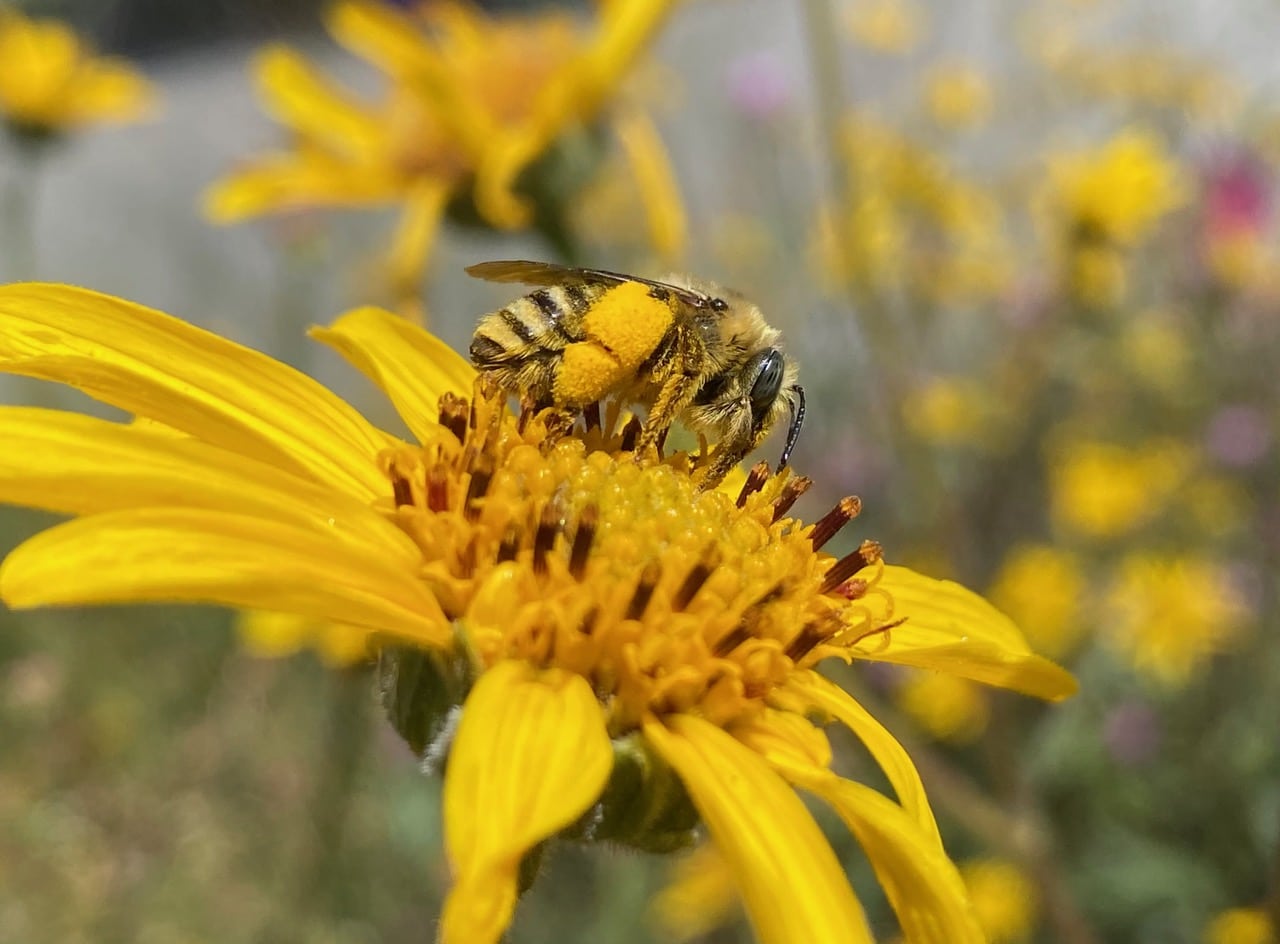
A female Summer Longhorn Bee, Melissodes sp. (family Apidae) lands on a flowerhead of Slender Sunflower and proceeds to gather pollen.
The Summer Longhorn Bees, Melissodes sp. (family Apidae) are medium to large bees, stout-bodied, usually with gray hair on the thorax and pale hair bands on the abdomen. Males usually have yellow markings on their faces and have very long antennae from which their common name is derived. They are active May to September, with peak flight in late June to early August. The females prefer flat, bare ground for digging their solitary nests, though they sometimes nest in aggregations. Pollen is transported in scopae on the hind legs. Pollen loads are often copious and brightly colored and thus very distinguishable. Melissodes are specialists on Asteraceae – females gather pollen from flowers of Aster, Bidens, Coreopsis, Cosmos, Encelia, Gaillardia, Helianthus, and Rudbeckia ssp.
The bee pauses momentarily to clean her antennae.
All bees have an antenna cleaner on each of their two forelegs. The antenna cleaners consists of two parts: a notch in the basitarsus, which is fitted with stiff hairs, and a corresponding spur on the tibia. To clean its antenna, the bee raises its foreleg over its antenna and then flexes it tarsus. The action allows the spur to close the notch, forming a ring around the antenna. The bee pulls each antenna through the bristles to clean it of debris such as pollen or dust which might interfere with the many sensory organs within the antenna. A bee’s antennae serve numerous functions: smell, taste, perceive humidity and temperature, feel, monitor gravity and flight speed and even detect sound waves to help guide the bee in its daily activities.
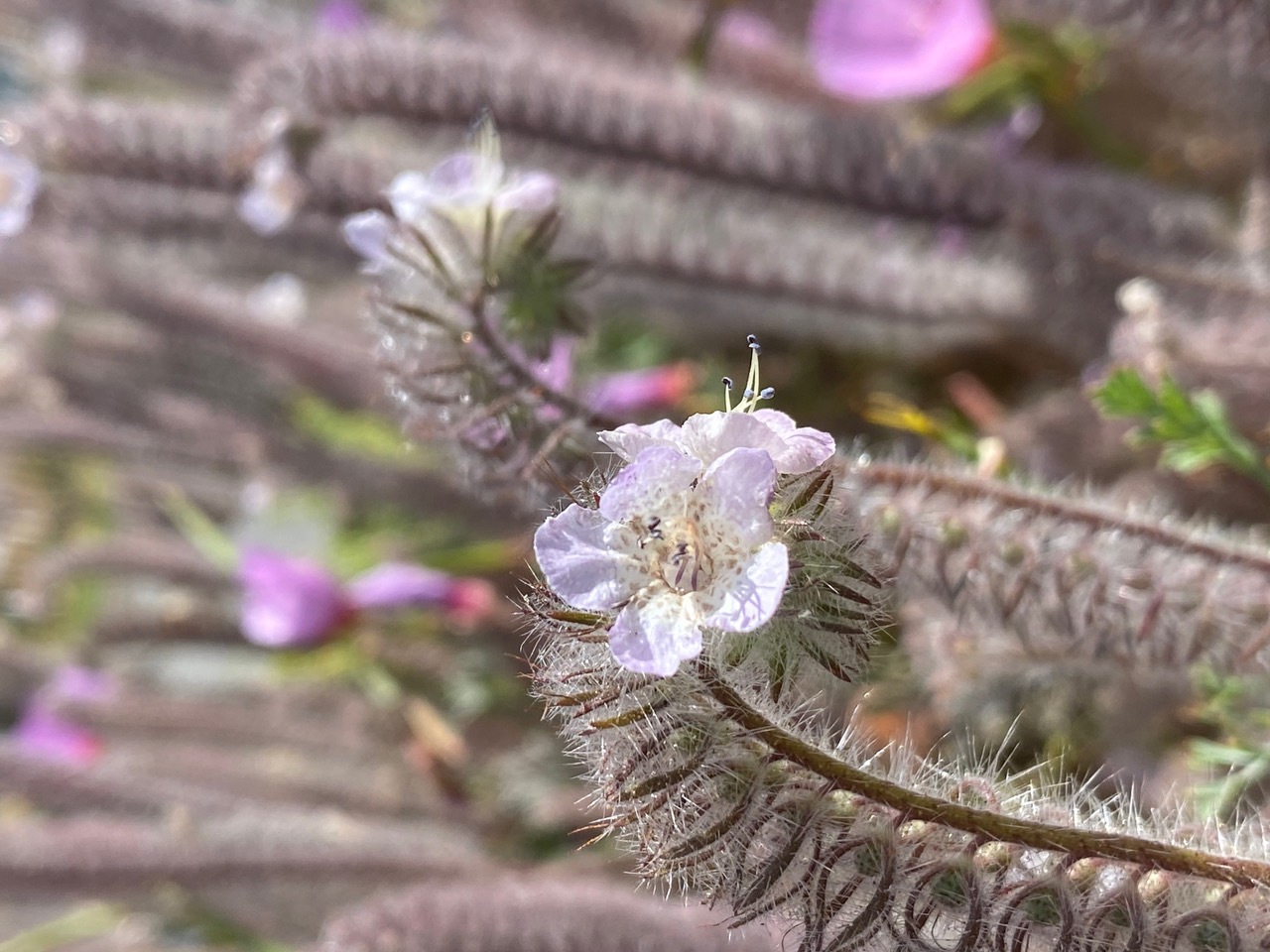
The Caterpillar Phacelia, Phacelia cicutaria is at the very end of their bloom, with only the last flowers open on the formerly coiled inflorescence. The shiny bristles protect the developing fruits along one side the straightened stalk.
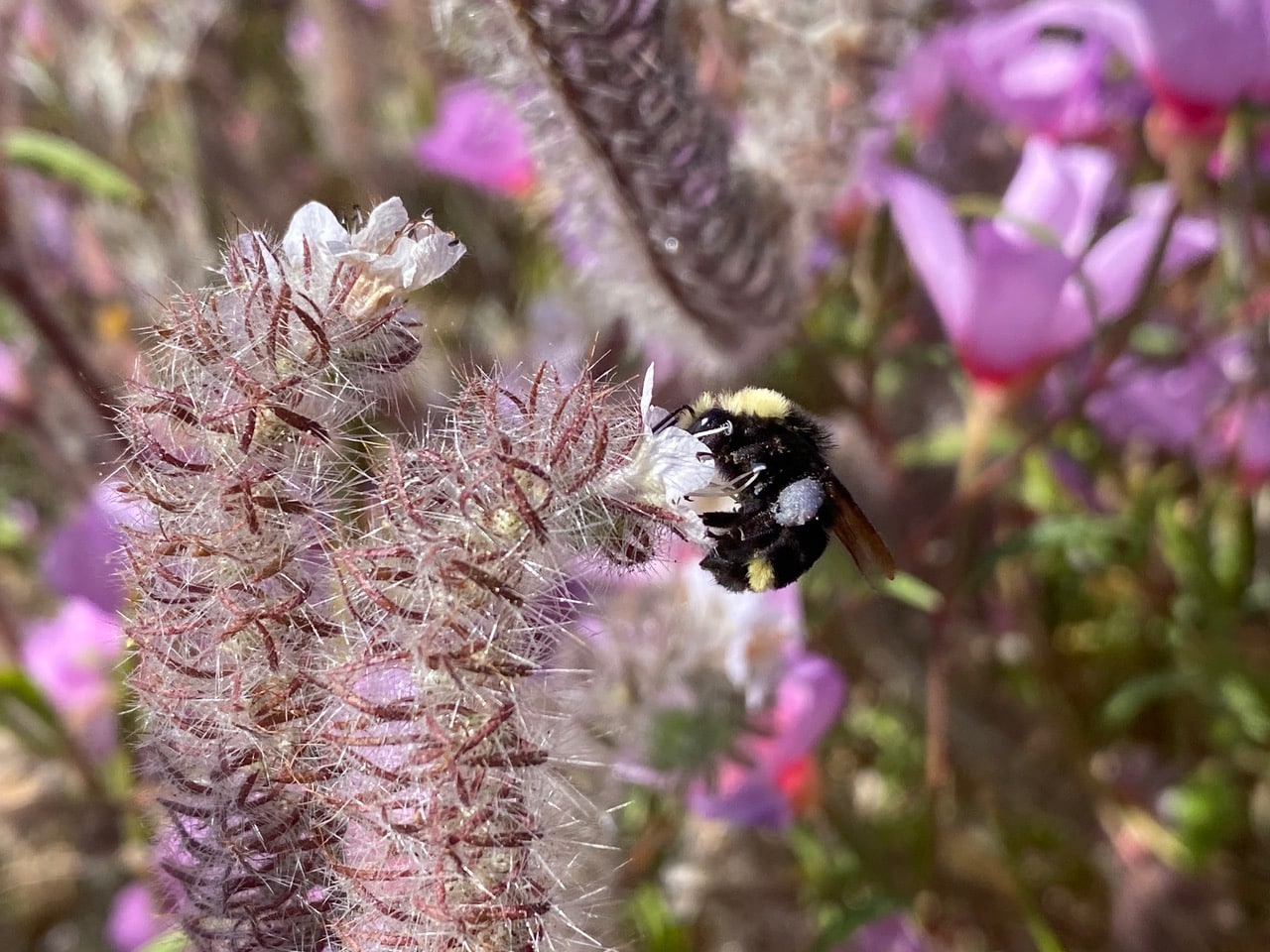
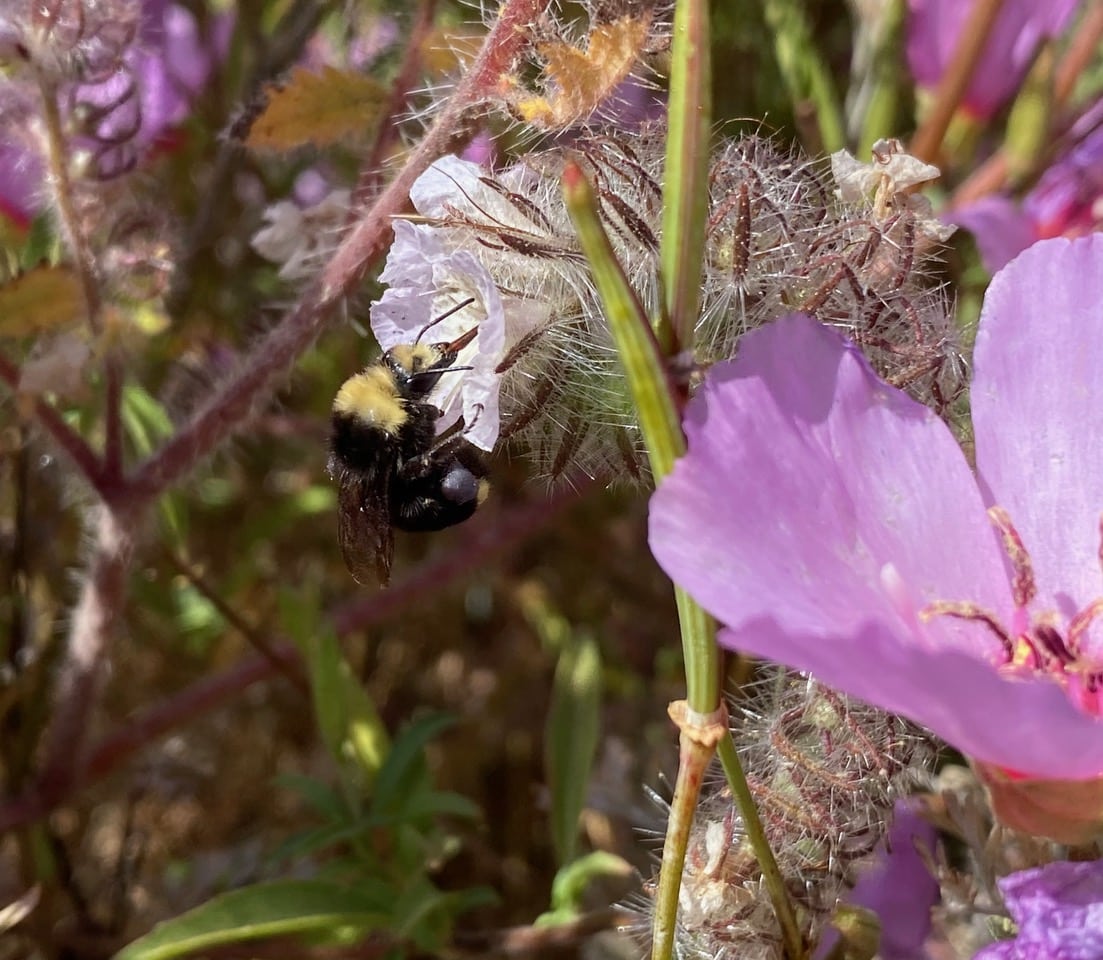
A Yellow-faced Bumble Bee, Bombus vosnesenskii (family Apidae) is foraging on the terminal flower of a Caterpillar Phacelia. Her pollen basket is filled with grayish-purple pollen from the phacelia flowers.
Her long tongue extended, a Yellow-faced Bumble Bee takes nectar from a top flower of a Caterpillar Phacelia.
This female Longhorn Bee, Melissodes sp. (family Apidae) has a relatively empty scopae on her hind legs. The hairs on the scopae are impressively long. As the bee gathers pollen, it is held loosely on the hairs by electro-static attraction. Because pollen in scopae are not moistened and compacted, it falls off easily. It is believed that bees that transport pollen in scopae are better pollinators than bees that pack pollen in corbiculae (“pollen baskets”), such as honey bees and bumble bees.
As the bee gathers pollen, her scopae fill up quickly. A female can create and provision one nest cell per day.
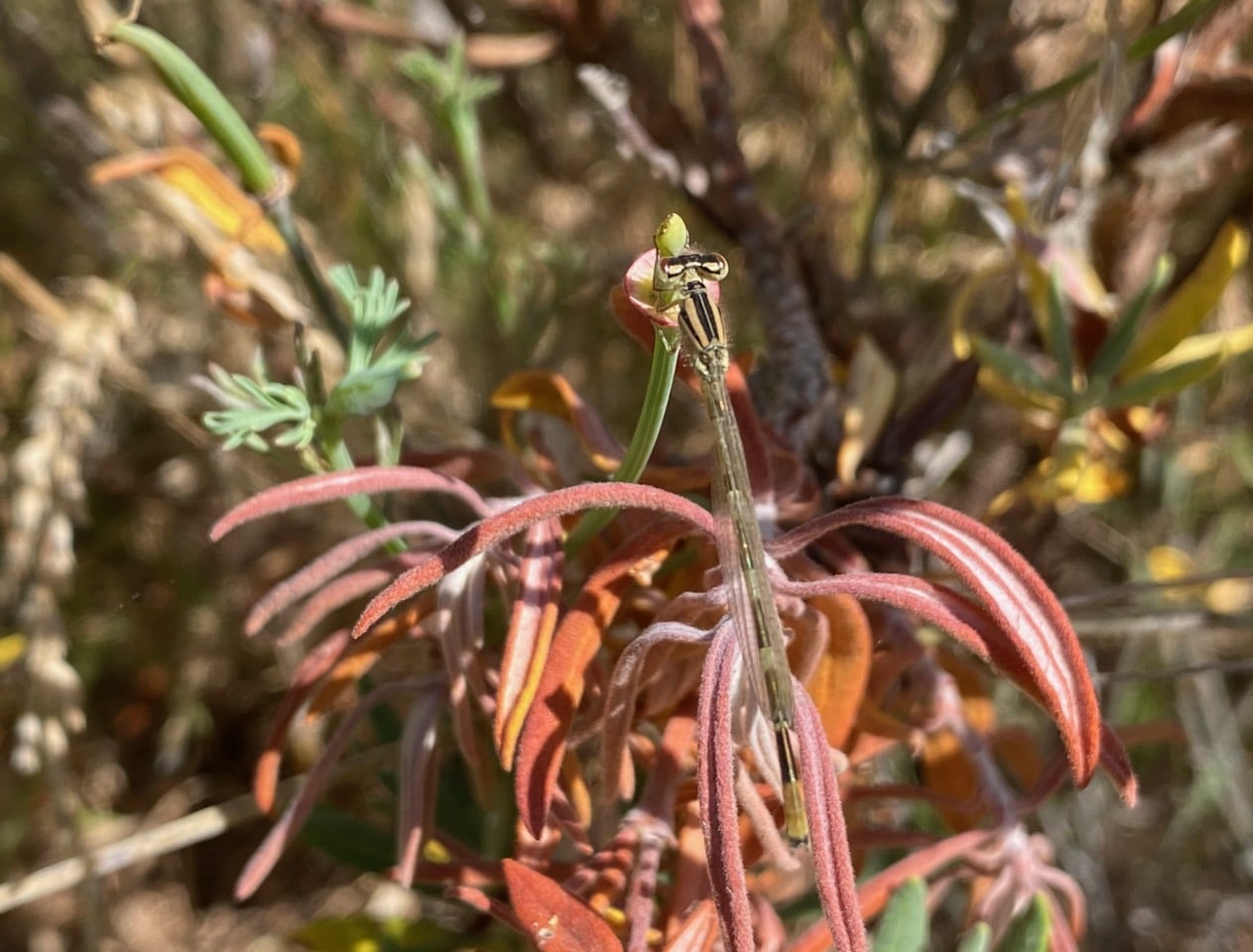
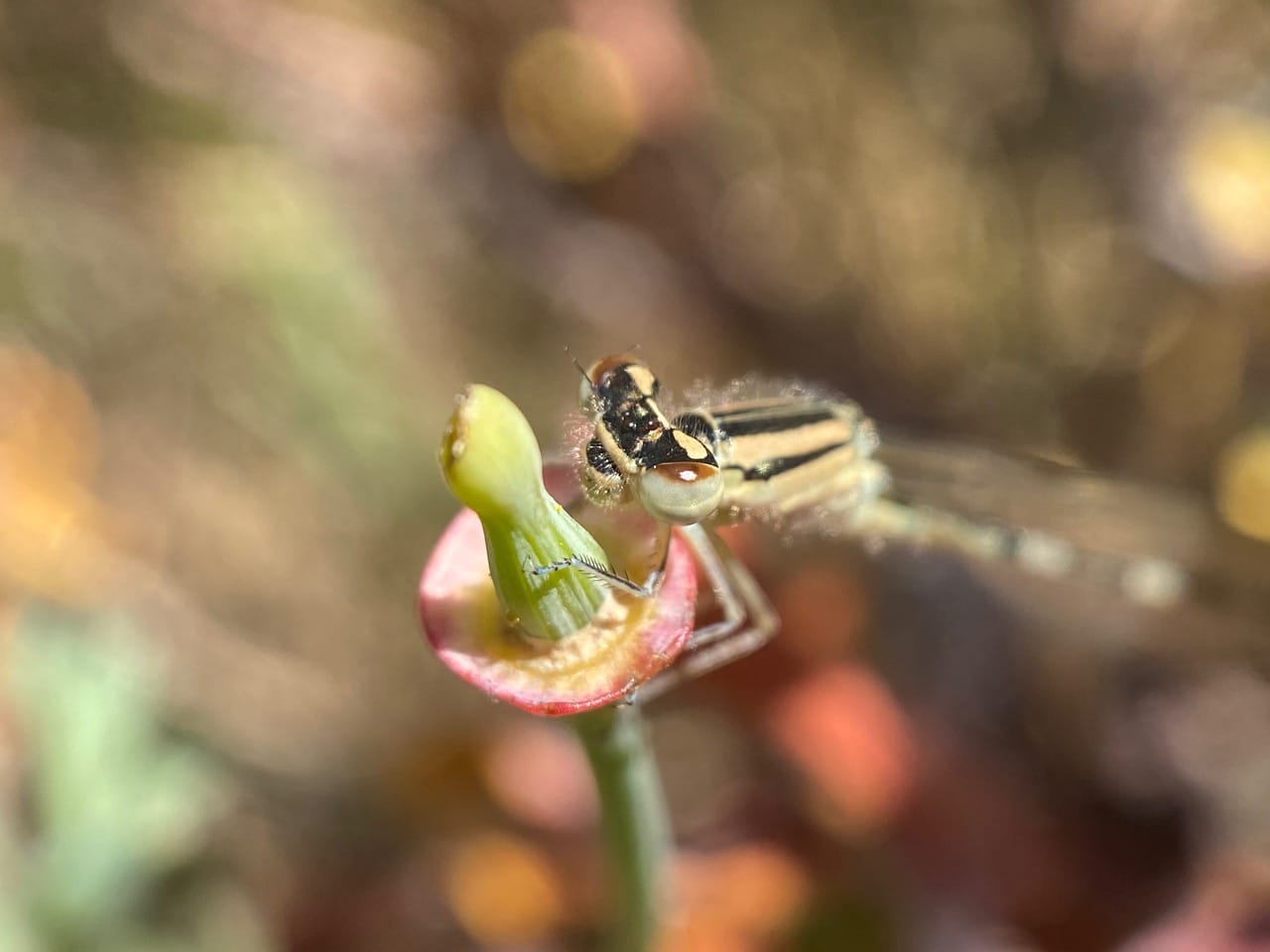
Even when Kathy points out the Damselfly perched on a developing California Poppy seed capsule, I have difficulty locating it, so does my camera. As it is so pale overall, I first thought it might be a teneral. A teneral insect is one that has recently molted and its exoskeleton is yet to harden and get its final coloration. iNaturalist has identified the damselfly as a Tule Bluet. Males are a bright blue color, while some females are pale yellow-green.
Tule Bluet, Enallagma carunculatum (family Coenagrionidae) is found in North America, from northern Mexico to southern Canada. Habitats include places where bulrushes abound – rivers, lakes, ponds, marshes and bogs. Males set up territories at choice breeding sites. After mating, the male stays attached to the female in tandem position as she lays eggs in the stems of bulrushes. Nymphs that hatch out feed on a large variety of aquatic insect larvae.
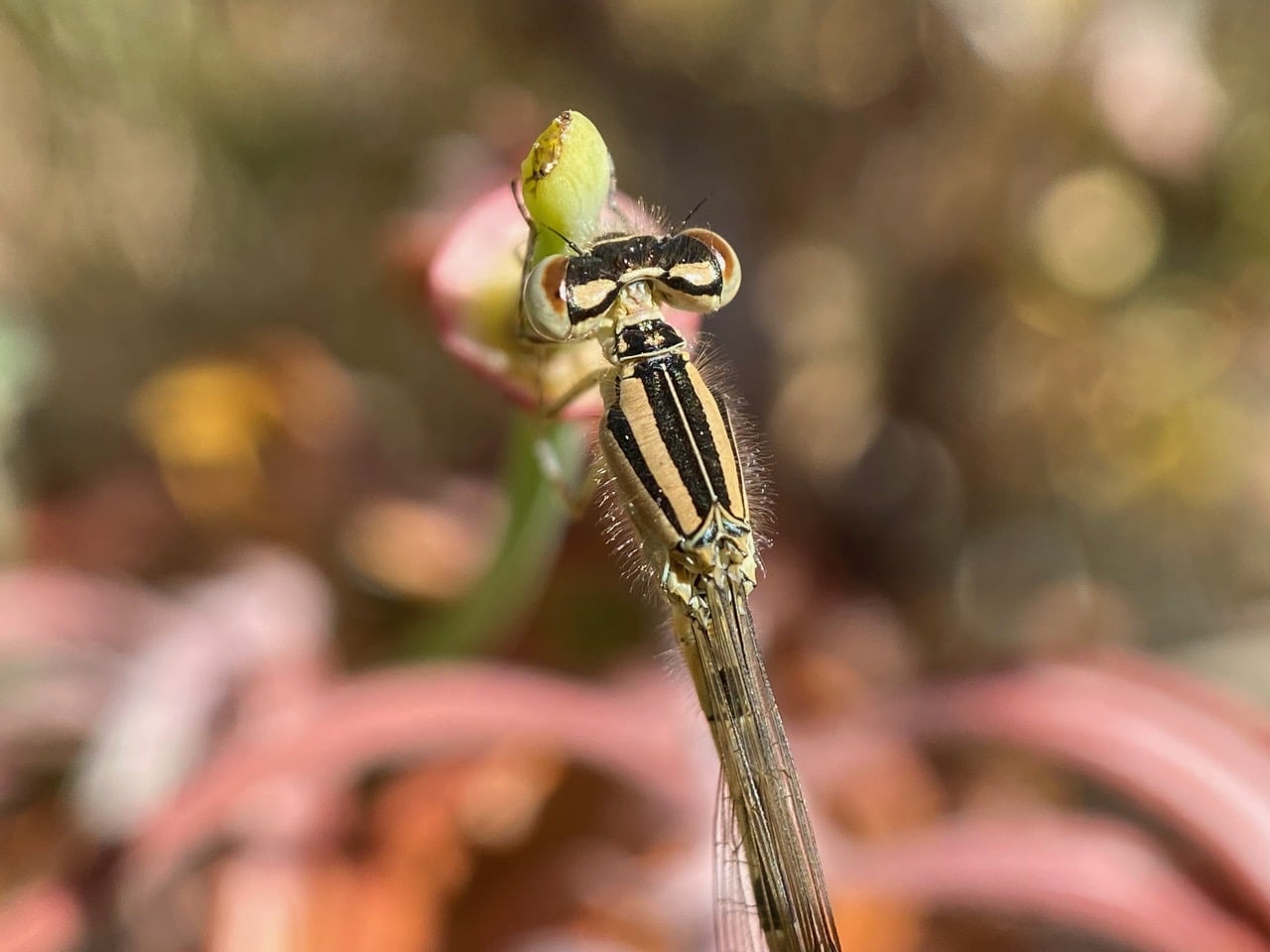
I am amazed that the damselfly remains so calm as I close in for this shot of its head. Wow, I finally get to see a damselfly’s antennae – they are minuscule! Unlike Dragonflies, Damselflies have compound eyes that are placed far apart on the head. Many damselflies have brilliant, gem-like colors.
Side view of the damselfly’s head.
Damselflies are aerial predators that feed on a wide variety of small flying insects. They sometimes pick up small insects from plants such as aphids.
A male Longhorn Bee, Melissodes sp. (family Apidae) is taking nectar from a flowerhead of Hairy Gumweed, Grindelia hirsutula, another species of Asteraceae whose bloom period conveniently matches the flight time of the Melissodes.
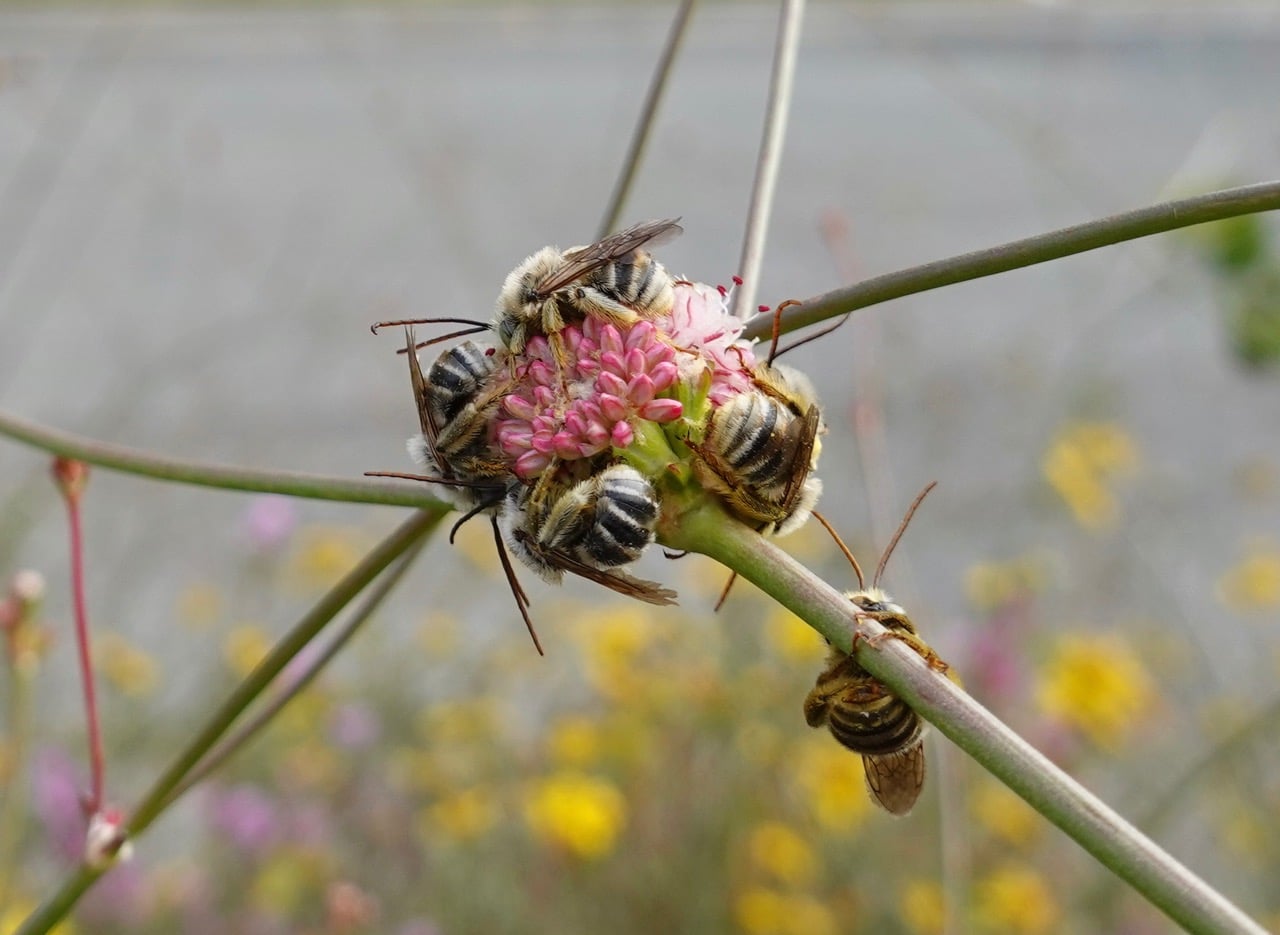
Male bees do not collect pollen. Neither do they have the equipment for the job. Note the absence of scopa on the male. As the males do not participate in nest construction and provisioning, they do not have a nest to return to at the end of the day. They can often be found sleeping in clusters on flowerheads in the early morning or late evening.
Here’s a photo taken by Anni, owner of the amazing garden, on a recent cool, calm morning before the male Melissodes bees were awake. The “boys”, as Anni refers to them affectionately, have gathered to sleep together on a Nude Buckwheat, Eriogonum nudum growing next to the Slender Sunflower.
The male Melissodes is cleaning his very long antenna. There’s a little-known reason for the males to keep their antennae in tip-top condition.
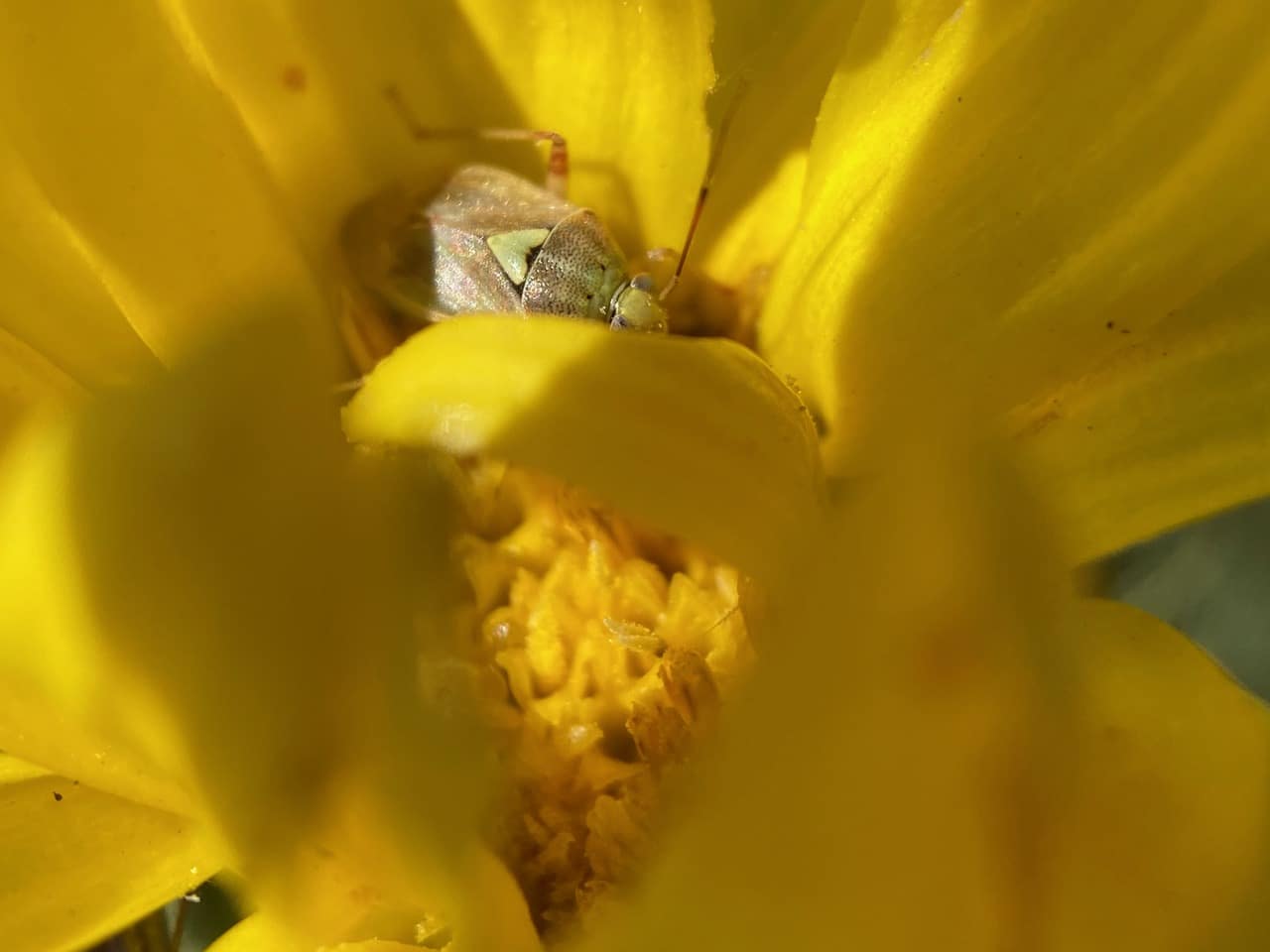
A Potato Mirid, Closterotomus norvegicus (family Miridae, order Hemiptera) is feeding on a Grindelia flowerhead.
The bug originated in the Mediterranean region, but is now widespread worldwide. It is an adventive, polyphagous species of bugs belonging to the family Miridae, subfamily Mirinae. This cosmopolitan insect attacks a wide range of herbaceous plants and it is also partly predacious. In New Zealand it developed a taste for young potato plants, which probably accounts for its common name. Like other mirids, the bug possesses a sharp and hard needle-like piercing-sucking mouthparts capable of penetrating tough tissue and sucking nutrients. It feeding activities threatens pistachio nut production in California. The female bugs prefer to lay their eggs on native or introduced legumes, or weeds such as wild mustard.
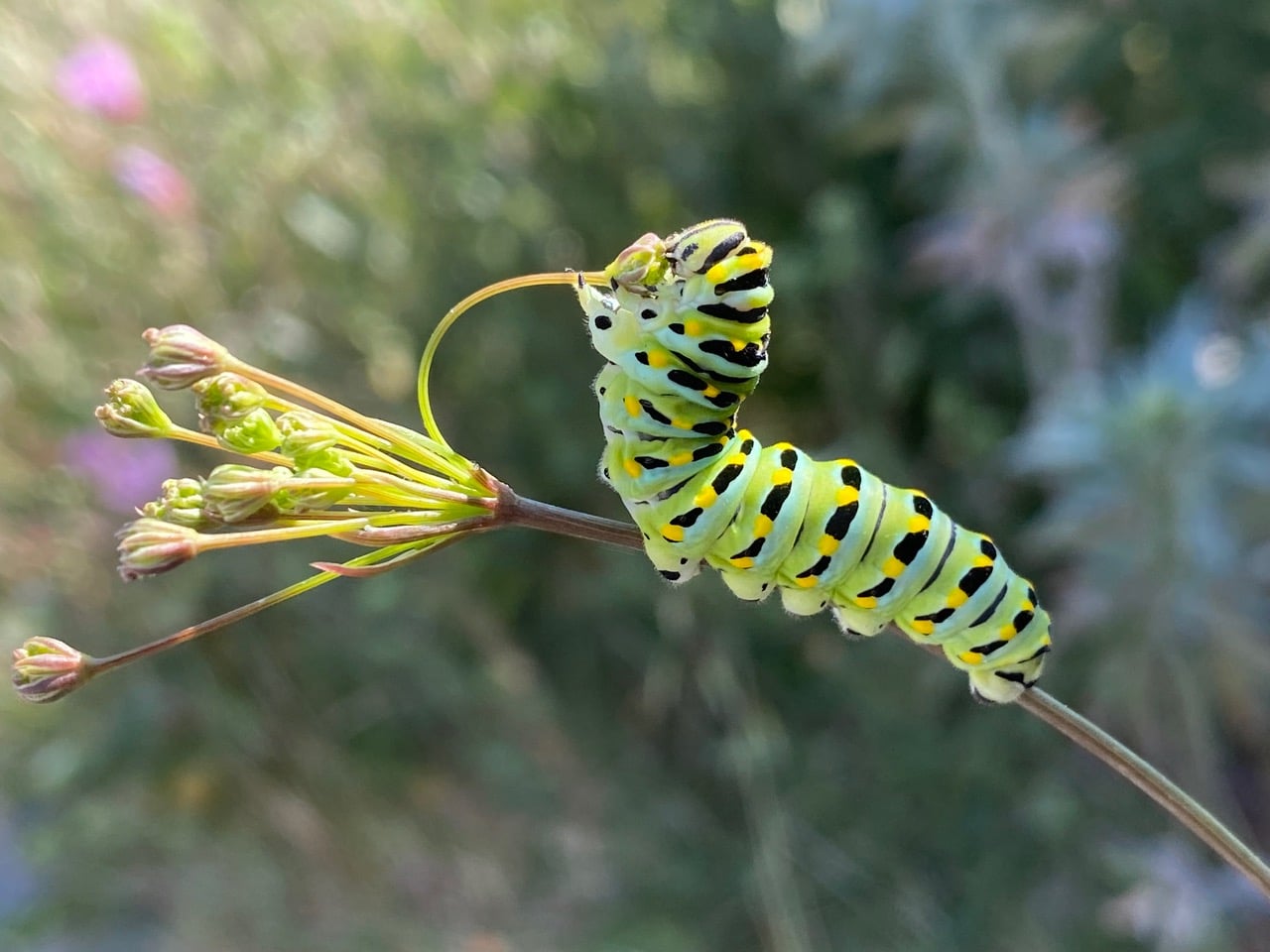
Holding a cluster of Yampah flower buds in its true legs, a late instar Anise Swallowtail caterpillar is feeding on its host plant. Note that the caterpillar is holding onto the stalk with fleshy, stubby structures called prolegs on the underside of its abdominal segments. The last segment of the caterpillar has a similar pair of prolegs known as anal prolegs. Each proleg has a crochet which helps in walking and gripping objects. Unlike true legs, prolegs disappear during metamorphosis.
While I have been seeing many Anise Swallowtail caterpillars on Fennel lately, it is a special treat to find one feeding on its native host plant for a change. Their host plants include various species in the parsley family (Apiaceae), and some in the citrus family (Rutaceae). The caterpillar’s ability to feed on non-native Fennel has secured their populations.
California Yampah, Perideridia californica (family Apiaceae) is a perennial herb endemic to California. The slender stem grows from cylindrical tubers. The deeply divided leaves near the base have mostly withered by the time the flowers bloom. The flower cluster is a compound umbel of many spherical clusters of small white flowers. I wonder how many Yampah flower umbels a caterpillar needs to eat during its development?
Ben falling in love with the caterpillar.
Whoa, this female Longhorn Bee, Melissodes sp. (family Apidae) has a colossal load of pollen in her scopae!
The Melissodes female labors all day to provision for her young. At the end of the day, after the nest cell has been taken care of, some species of Melissodes apparently make one final trip and gather pollen for themselves. Even mothers need nourishment!
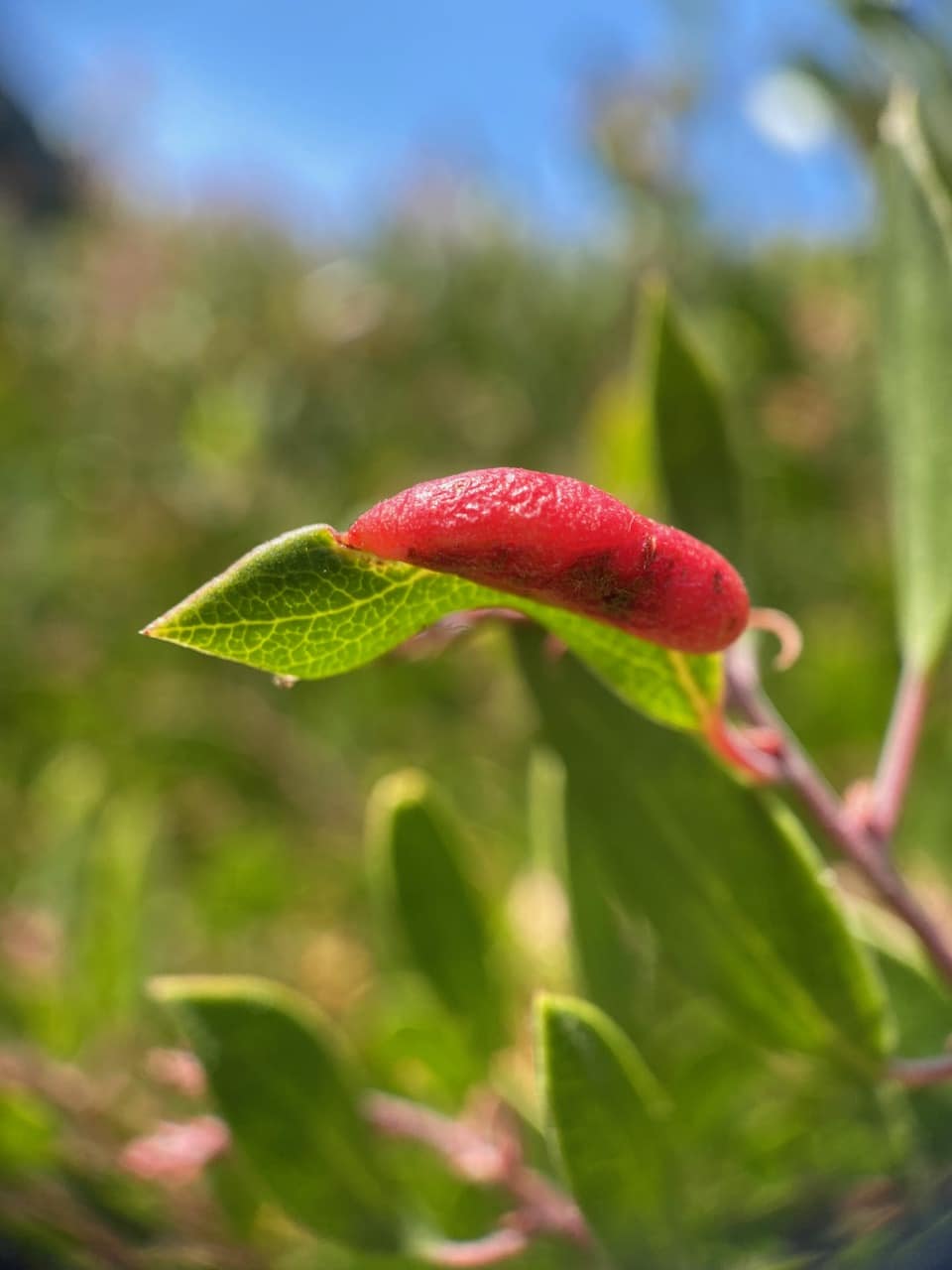
Many leaves of a large Manzanita, Arctostaphylos sp. in front of the house have red swellings along the edge. I recognize them as the leaf galls induced by the aphid, Tamalia coweni (family Aphididae). Backlit by the sun, the occupants are visible as dark forms through this thick, fleshy gall.
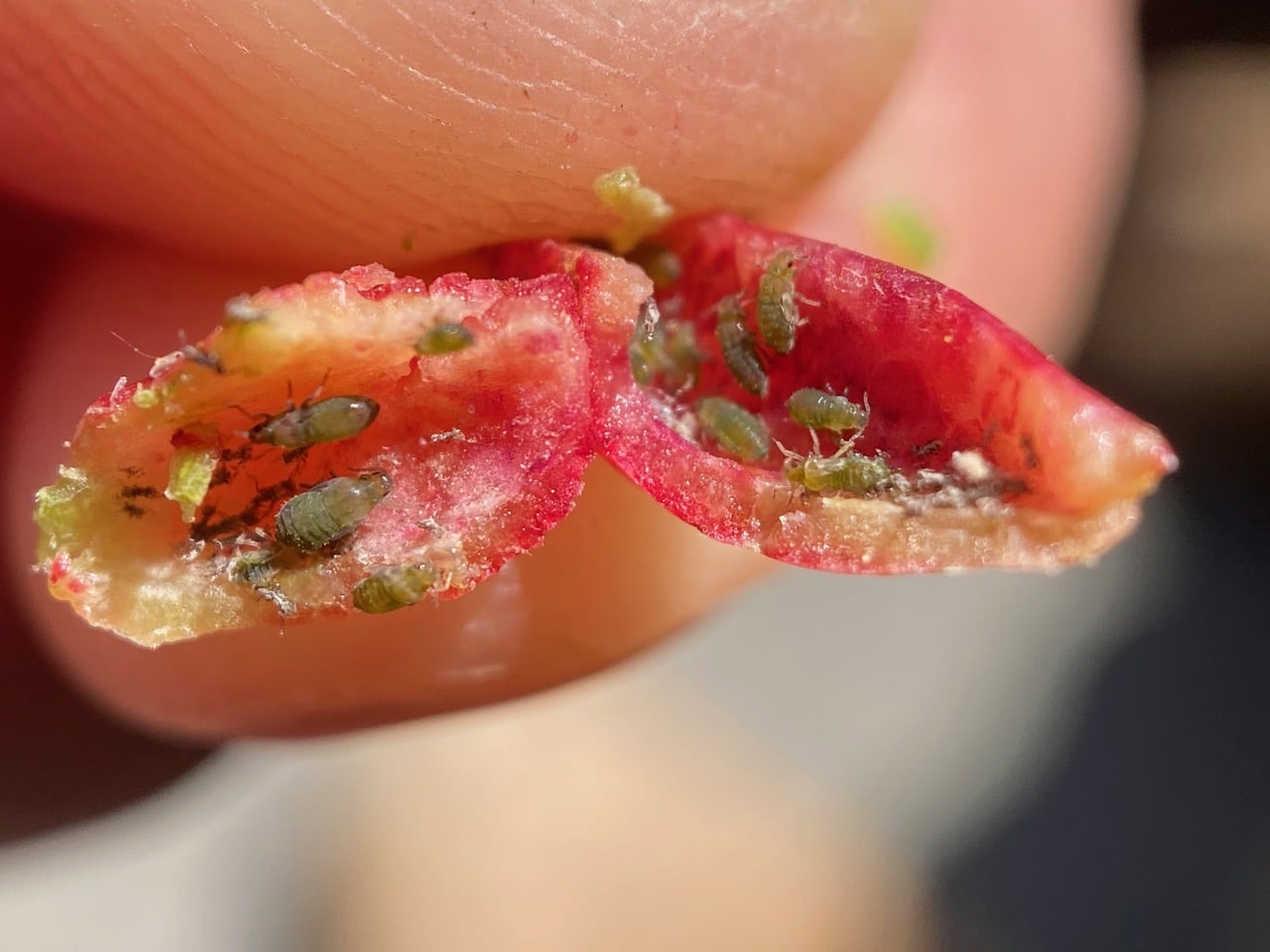
As Ben opens up the gall with his fingernails, tiny dull green aphids of various sizes spill out of the thick-walled structure. These aphids do not seem to have the typical cornicles (tail-pipes).
The Manzanita Leaf-gall Aphid, Tamalia coweni (family Aphididae) is a widespread species native to the west coast of North America. Feeding by the aphid on Arctostaphylos leaves induces red or reddish-green pod-shaped galls within which the aphids feed and develop. The tiny, gray or greenish aphids feed by sucking on tissue within the leaf galls. These aphids feed only on manzanita. Throughout most of the year adult females (which may be winged or wingless) give birth to live young without mating. In the fall, a sexual generation of winged males and females is produced. The winged aphids disperse, mate, and the females lay overwintering eggs on bark at the base of the plant. Eggs hatch in late winter or spring and the emerging aphids walk up to the leaves, settle to feed, and initiate galls. They have several generations per year.
The galls do not significantly affect plant health, but some consider them aesthetically objectionable.
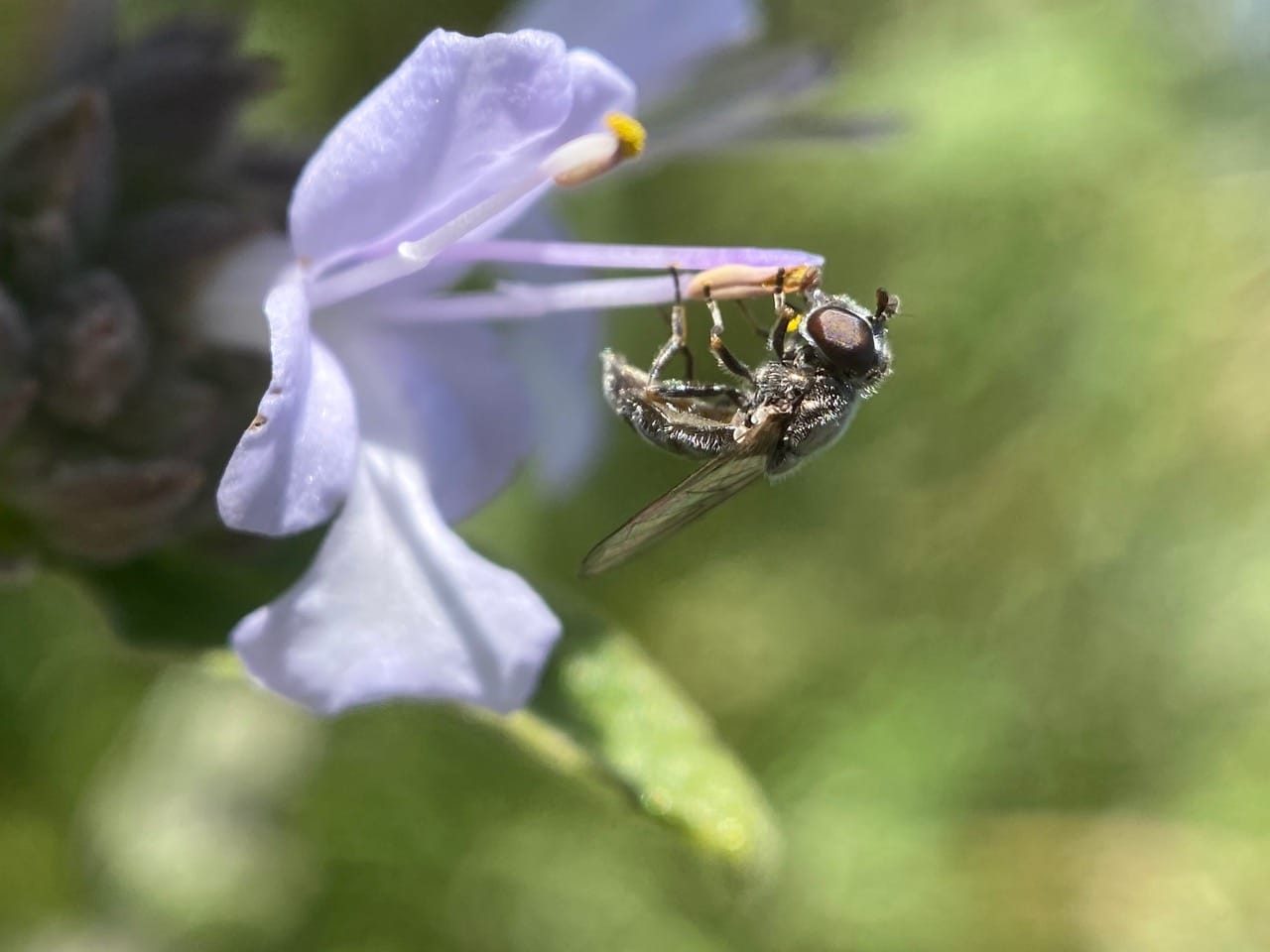
I am re-posting this picture from 5/1/24 taken in a garden in Livermore. Hanging on a stamen of Black Sage, a tiny, shiny Hover Fly (family Syrphidae) is feeding on pollen from the anther. A Syrphid expert on iNaturalist suggested that it is a Syrpid Fly in the subfamily Pipizinae, commonly called “Pinheads and Kin”. These rare syrphids are small, black, and pilose (covered with fine, soft hairs). Known larvae are predators of gall-making or leaf-curling aphids, adelgids, or psyllids. Wow, talk about a narrow, specialized niche! How do the larvae get into the galls?