

Pollinator Post 6/19/23 (3)
 In the dappled shade along Skyline Trail, the fruits of a female Osoberry, Oemleria cerasiformis are ripening in a delightful assortment of colors.The 1/2 inch fruit of Osoberry, numbering up to 5 per flower, start out tan to pale orange, transition through pink to reddish purple, then ripens bluish black with a thin waxy coat. The seed is a stone, or pit, that contains cyanoglucosides (the bitter, toxic compounds also found in almonds). The fruits are edible and are eaten by birds and small mammals.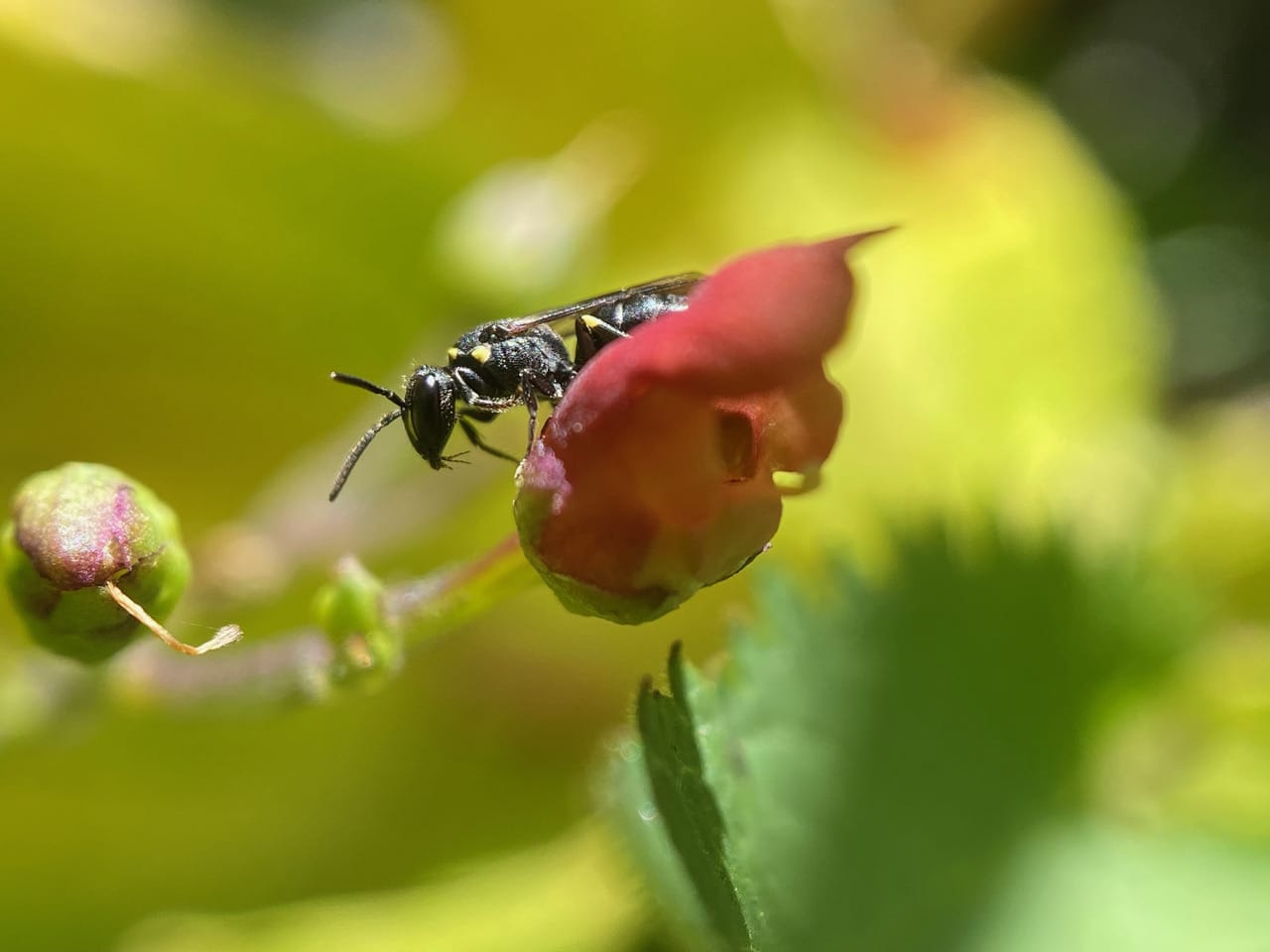
A Masked Bee, Hylaeus sp. (family Colletidae) has just visited a California Bee Plant flower, Scrophularia californica, and is now perched atop the flower to groom itself.
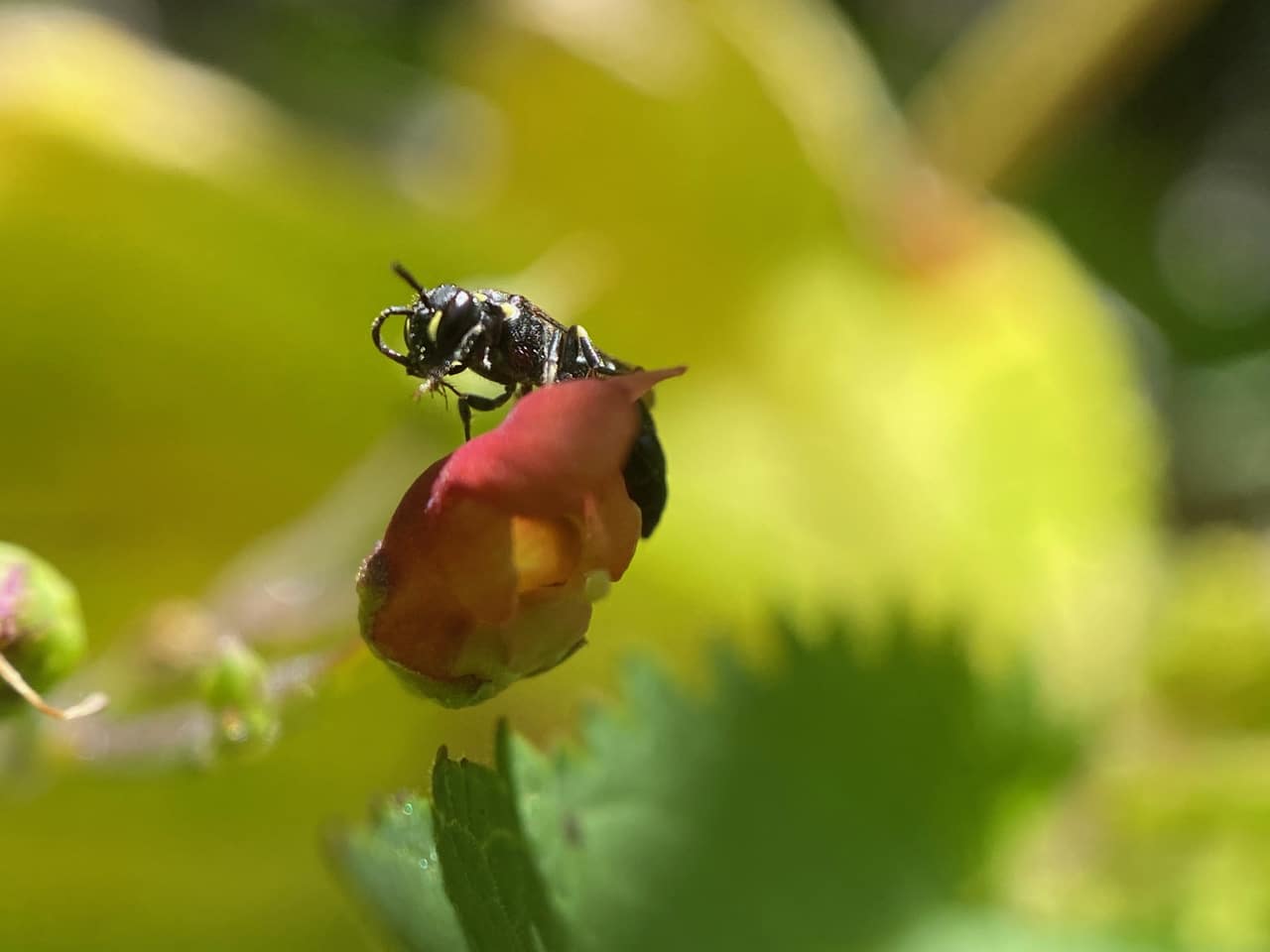
The bee proceeds to clean its antennae.
All bees have an antenna cleaner on each of their two forelegs. The antenna cleaners consists of two parts: a notch in the basitarsus, which is fitted with stiff hairs, and a corresponding spur on the tibia. To clean its antenna, the bee raises its foreleg over its antenna and then flexes it tarsus. The action allows the spur to close the notch, forming a ring around the antenna. The bee pulls each antenna through the bristles to clean it of debris such as pollen or dust which might interfere with the many sensory organs within the antenna. A bee’s antennae serve numerous functions: smell, taste, perceive humidity and temperature, feel, monitor gravity and flight speed and even detect sound waves to help guide the bee in its daily activities.
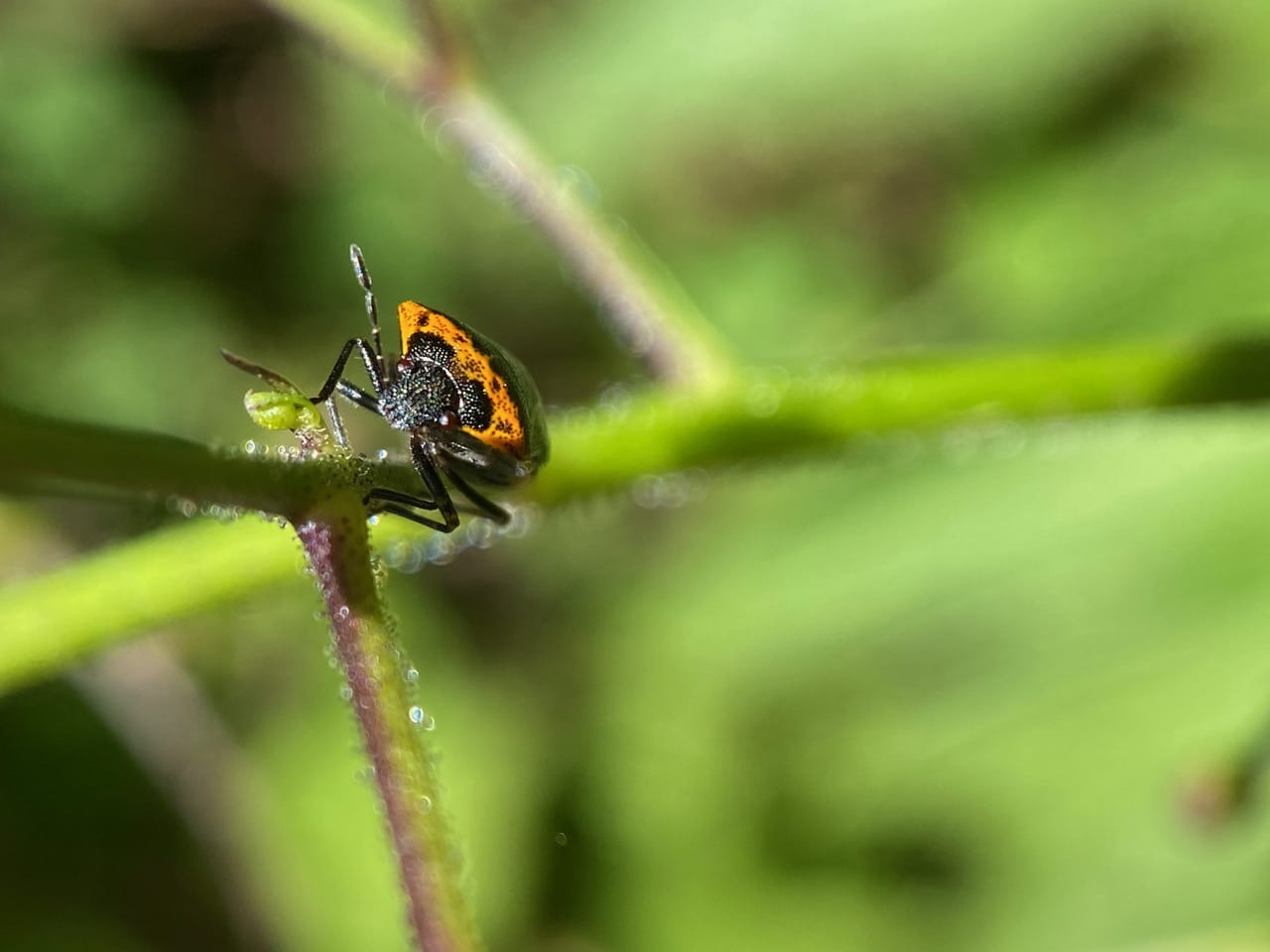
A small Stink Bug, Cosmopepla uhleri (family Pentatomidae) is navigating the branches of a California Bee Plant. The bug is easily recognizable – black with an orange transhumeral band with black spots. The bug uses Scropularia californica as a host plant.
All Pentatomids have 5-segmented antennae (hence their family name, Penta – five and tomos – section.) They generally have a large triangular scutellum in the center of the back. The adult is generally shield-shaped when viewed from above. The common name of Stink Bug refers to their ability to release a pungent defensive spray when threatened, disturbed, or crushed.

A view of the Stink Bug’s underside shows its rostrum, the piercing-sucking mouthpart that is folded under the body when not in use.
Pentatomidae is a family of insects belonging to the order Hemiptera or “true bugs”. As hemipterans, the pentatomids have piercing-sucking mouthparts, and most are phytophagous, including several species that are severe pests on agricultural crops. Stink Bugs feed on plant fluids by inserting their needlelike mouthparts into stems, leaves or seed pods. While feeding, they inject materials into the plant to aid in digestion and sap removal. Penetration by the mouthparts can cause physical damage, much like stabbing the plant with a fine needle. Cosmopepla uhleri is so small that the damage is generally limited to fine stippling on the leaves of California Bee Plant.
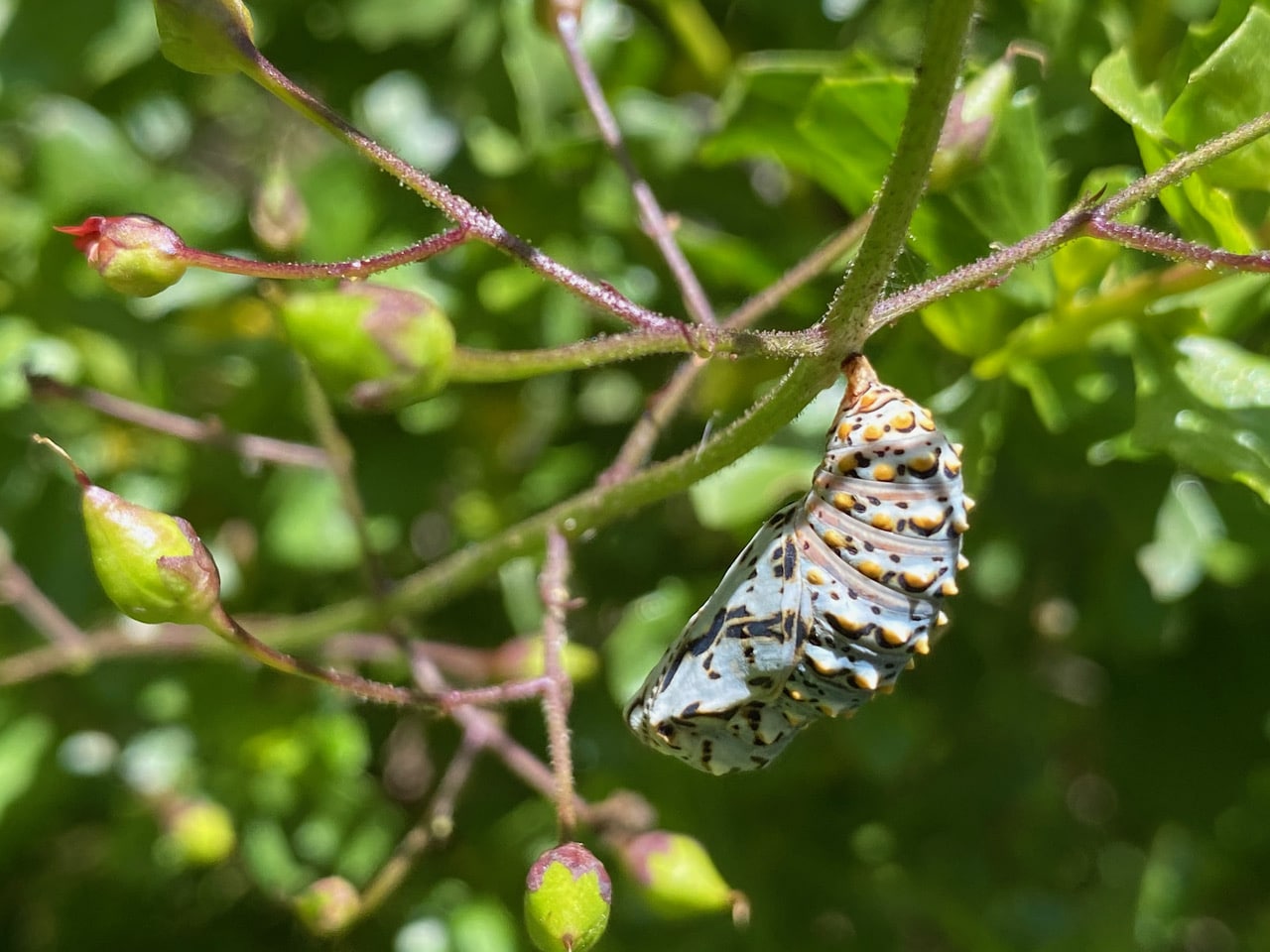 A chrysalis of the Variable Checkerspot butterfly is hanging inconspicuously on a low leaning stem of a Bee Plant in the dappled shade. I have been looking out for these chrysalids ever since the caterpillars disappeared from their food plant in another section of the Skyline Trail a while ago. Many of the adult butterflies are on the wing now, so I know that the species is doing alright.
 The Variable Checkerspot is found across western North America. The butterfly occupies a wide range of habitats, including sagebrush flats, desert hills, prairies, open forests and alpine tundra. Males perch or patrol around larval host plants to encounter females. Eggs are laid in large groups on underside of leaves of host plants. Host plants include California Bee Plant, Scrophularia californica, and Sticky Monkeyflower, Diplacus aurantiacus. These plants provide the caterpillars with iridoid glycoside, a chemical that imparts unpalatable taste to birds, protecting the caterpillars from predators. Larvae feed in large, loose groups on the host plants. They enter diapause (hibernation) in sheltered sites under bark or dead branches, in hollow stems and in rock crevices. Pupation begins in early to mid April and the adult flight season begins between mid-April and May and continues into June. The adults feed exclusively on nectar, and have a life span of about 15 days.
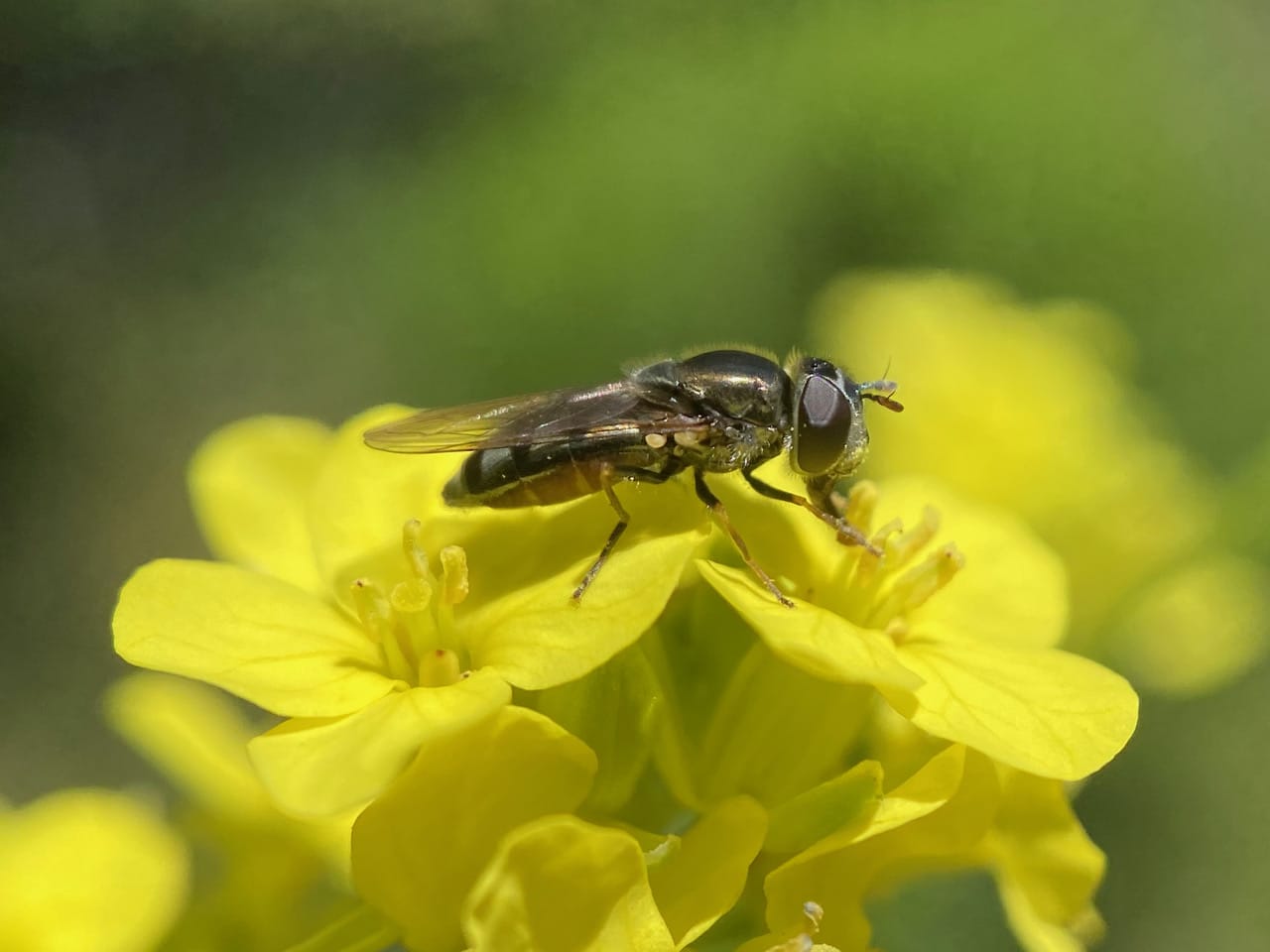
A female Sedgesitter, Platycheirus sp. (family Syrphidae) is feeding on the pollen of a wild mustard. How do I know that this hover fly is female?
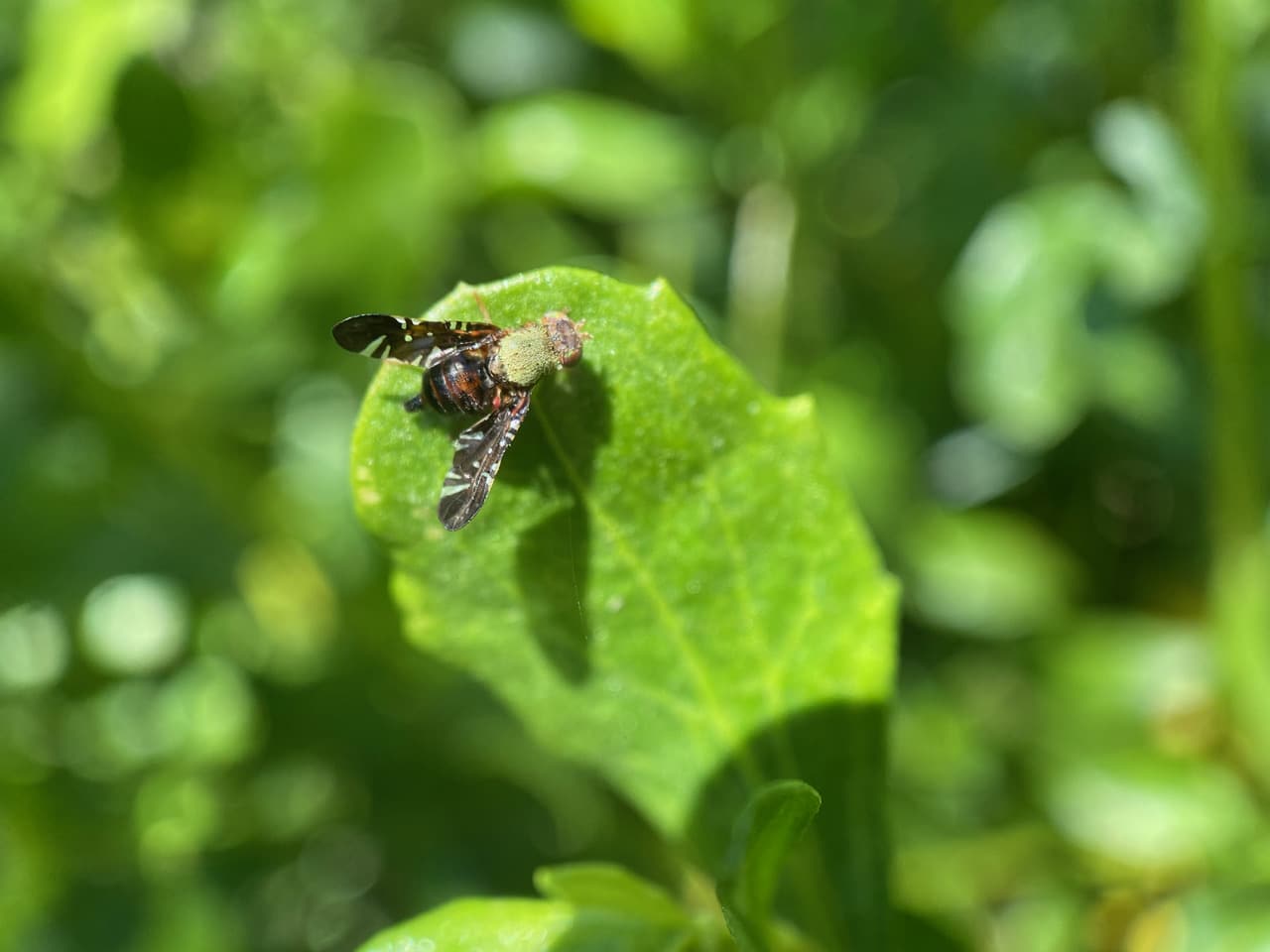
Hey, it’s that Fruit Fly again, waving its picture wings on a Coyote Brush! I am glad to see it again. It has been identified by an expert on iNaturalist as Aciurina michaeli (family Tephritidae). Not much is known about the species, other than that it uses Baccharis as its host plant. This is what Spencer Pote has to say: “The fly you observed, Aciurina michaeli, is pretty rare, and usually if people see it, it’s the distinctive gall rather than the adult.” I have yet to learn what the galls look like.
I am rather surprised to learn that the flies are rare. I see several of them today on the Coyote Brush. Maybe the timing is just right – the adults gathering to meet and mate, and the females to lay their eggs. I take a video from a distance of a pair approaching each other on a grass stem in the middle of a Coyote Brush. It is hard to discern the sexes of the individuals, but I think they might both be female as they both seem to have oviscapes on the tips of their abdomen.
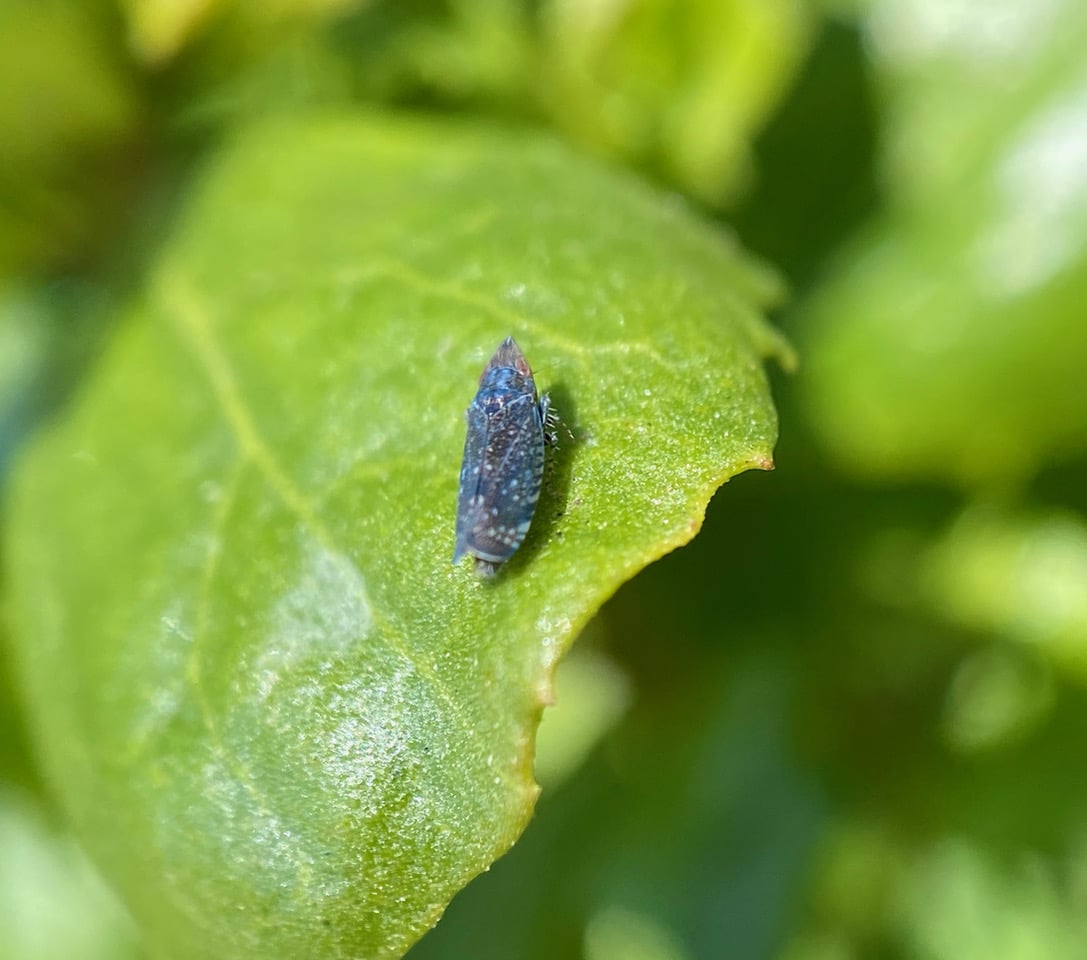
Oh, we have yet another Leafhopper! This one is seriously small, about 3 mm long, perched on a leaf of Coyote Brush. It is a Leafhopper in the subgenus Cloanthanus, genus Scaphytopius, family Cicadellidae. Photos of Genus Scaphytopius · iNaturalist
Leafhopper is the common name given to true bugs in the family Cicadellidae. The bugs are plant feeders that suck plant sap from grass, shrubs, or trees. Their hind legs are modified for jumping, and are covered with hairs that facilitate the spreading of a secretion over their bodies that act as a water repellent and carrier of pheromones. They undergo partial metamorphosis, and have various host associations, varying from very generalized to very specific.
While sucking the sap of plants, these insects excrete any extra sugar as a sticky liquid commonly called honeydew. This is a serious hazard for small insects, possibly sticking the insect to a leaf, or gluing its body parts together. Some bugs deal with this problem by shooting the waste away from their bodies at high speed. Leafhoppers have a unique solution – they make brochosomes, a proteinaceous material within a special gland in their guts, and secrete them by the billions in a milky anal fluid, and spread them over their bodies using their legs. When the fluid dries, the brochosomes form a powdery coating, and the leafhoppers spread them even further using comb-like hairs on their legs. The brochosomal coat is superhydrophobic, and acts as a water-repellent, non-stick coating protecting the leafhoppers from their own sticky exudates.
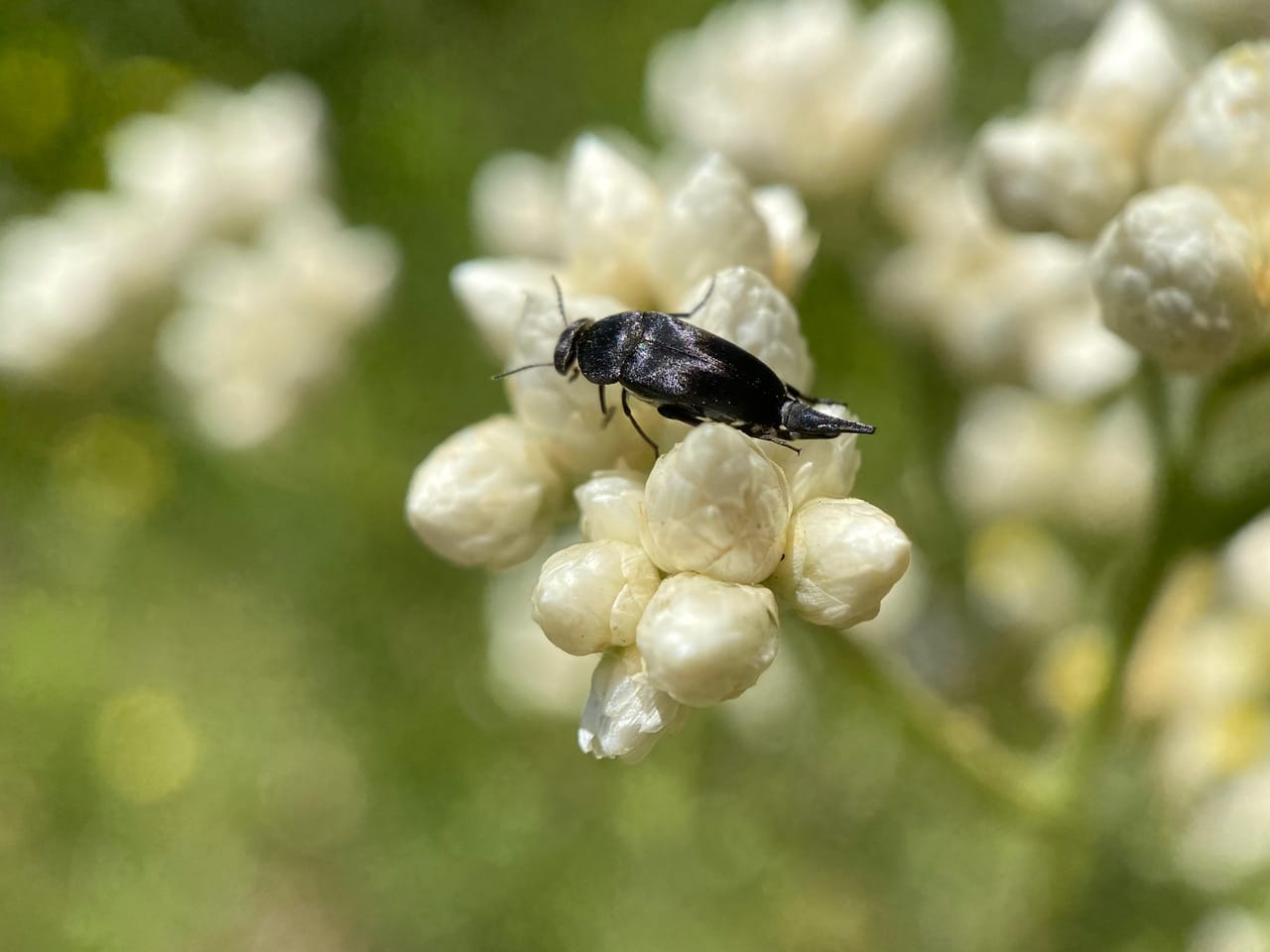
A Tumbling Flower Beetle (family Mordellidae) is perched on a cluster of California Everlasting flowerheads, Pseudognaphalium californicum.

The Tumbling Flower Beetles (family Mordellidae) are named for the characteristic irregular movements they make when escaping predators. They are also sometimes called Pintail Beetles for their abdominal tip which aids them in performing these tumbling movements. Mordellids are small, wedge-shaped, hump-backed beetles with head bent downward. The body is densely covered with fine silky hairs, usually black, but often very prettily spotted or banded with silvery hues. The adults feed on pollen, occurring on flowers or on dead trees, flying or running with rapidity. The larvae live in old wood or in the pith of plants, and those of some species are said to be carnivorous, feeding on the young of Lepidopterans and Diptera which they find in the plant stems.
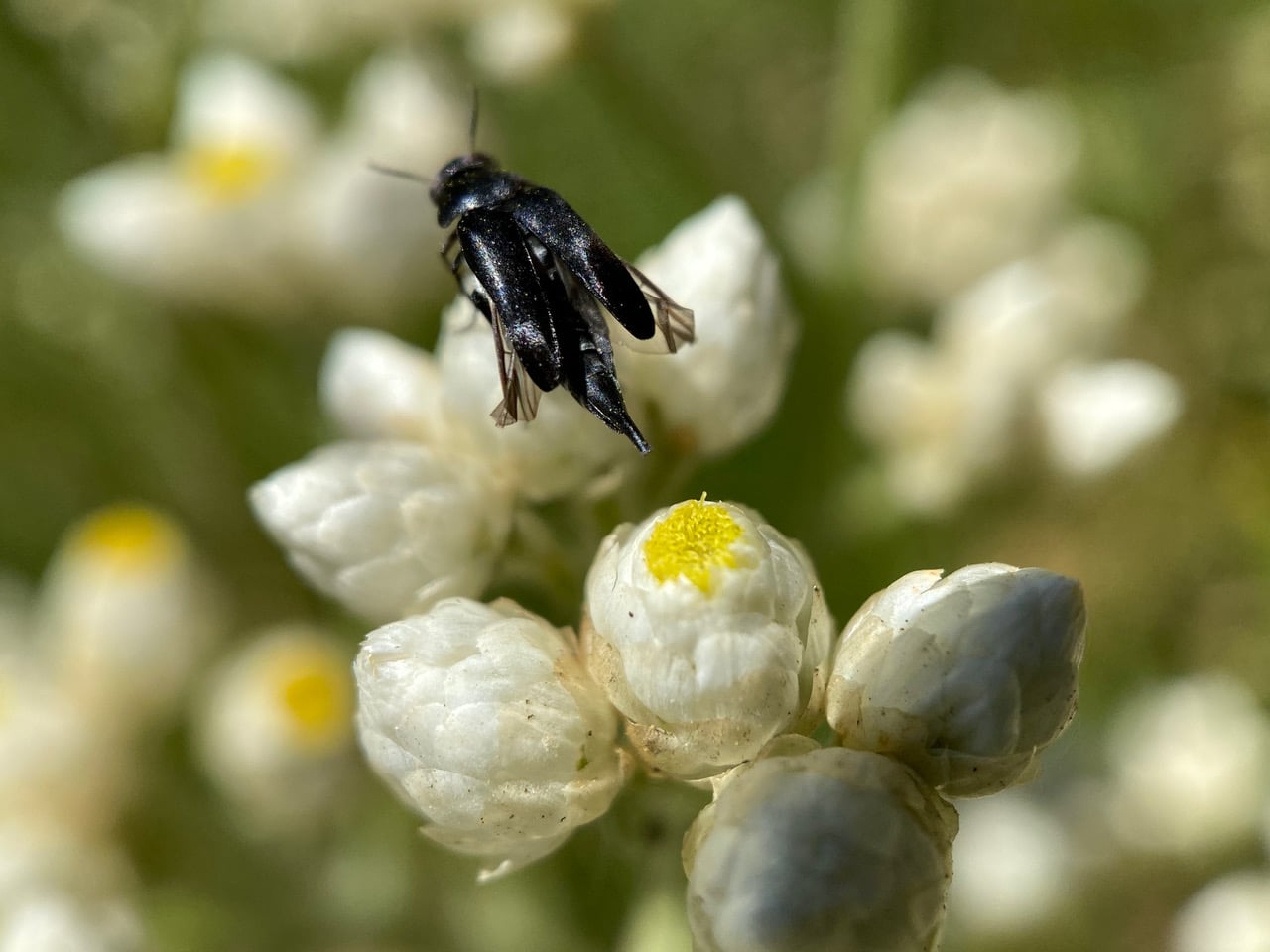
The beetle lifts its elytra and unfurls its membranous flight wings underneath, ready to fly away.
The beetles, order Coleoptera is the largest order of insects. The order is typically characterized by a pair of elytra (hardened front wings) and a pair of membranous hind wings. They have chewing mouthparts that may be slightly modified for various functions, and they undergo complete metamorphosis.
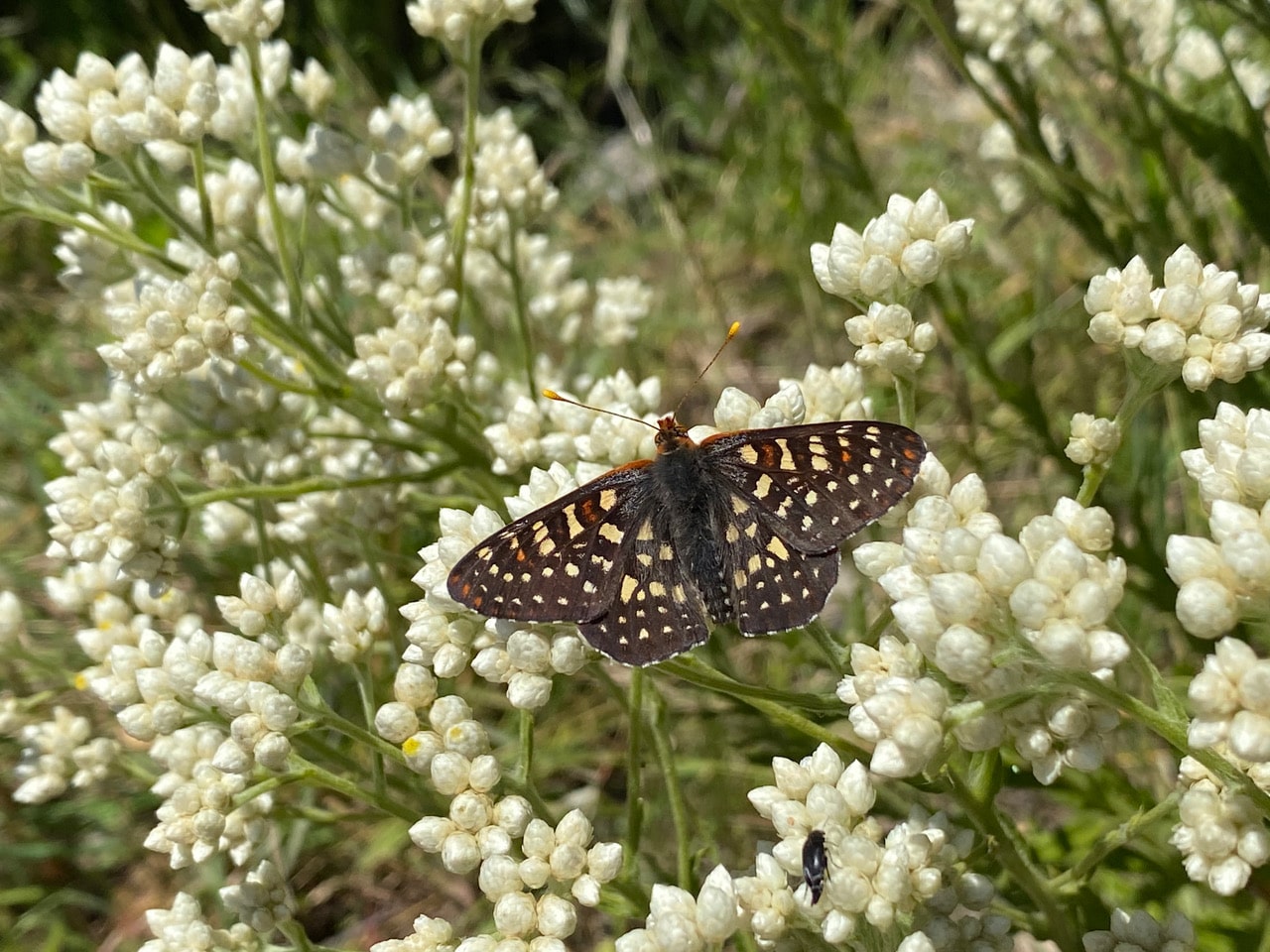
A Variable Checkerspot butterfly, Euphydryas chalcedona (family Nymphalidae) alights on the blooms of California Everlasting. It might be an older individual as its colors are rather faded, having worn out some of its wing scales.
The Variable Checkerspot is found across western North America. The butterfly occupies a wide range of habitats, including sagebrush flats, desert hills, prairies, open forests and alpine tundra. Males perch or patrol around larval host plants to encounter females. Eggs are laid in large groups on underside of leaves of host plants. Host plants include California Bee Plant, Scrophularia californica, and Sticky Monkeyflower, Diplacus aurantiacus. These plants provide the caterpillars with iridoid glycoside, a chemical that imparts unpalatable taste to birds, protecting the caterpillars from predators. Larvae feed in large, loose groups on the host plants. They enter diapause (hibernation) in sheltered sites under bark or dead branches, in hollow stems and in rock crevices. Pupation begins in early to mid April and the adult flight season begins between mid-April and May and continues into June. The adults feed exclusively on nectar, and have a life span of about 15 days.
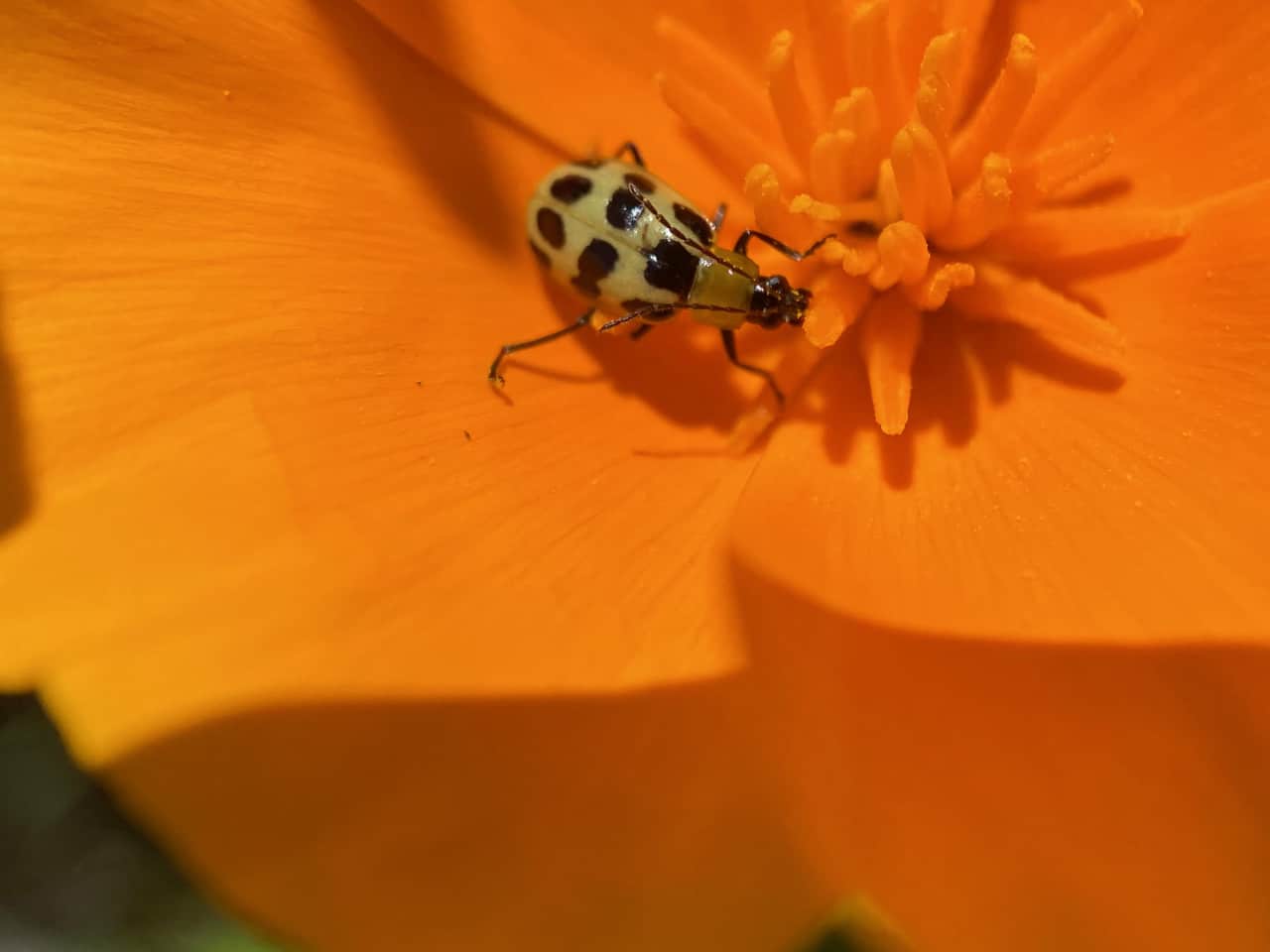
A Spotted Cucumber Beetle, Diabrotica Undecimpunctata (family Chrysomelidae) is feeding on the anthers of California Poppy, Eschscholzia californica.
Members of the family Chrysomelidae are commonly known as Leaf Beetles. Adults and larvae feed on all sorts of plant tissues, and all species are fully herbivorous. Many are serious pests of cultivated plants, including food crops. Others are beneficial due to their use in biocontrol of invasive weeds. Chrysomelids are popular among insect collectors, as many are conspicuously colored, typically in glossy yellow to red or metallic blue-green hues, and some have spectacularly bizarre shapes. Photos of Leaf Beetles (Family Chrysomelidae) · iNaturalist
Native to North America, the Spotted Cucumber Beetle can be a major agricultural pest, causing damage to crops in the larval as well as adult stages of their life cycle. Larvae, sometimes known as rootworms feed on the roots of emerging plants. In the adult stage the beetles cause damage by eating the flowers, leaves, stems and fruits of the plant.
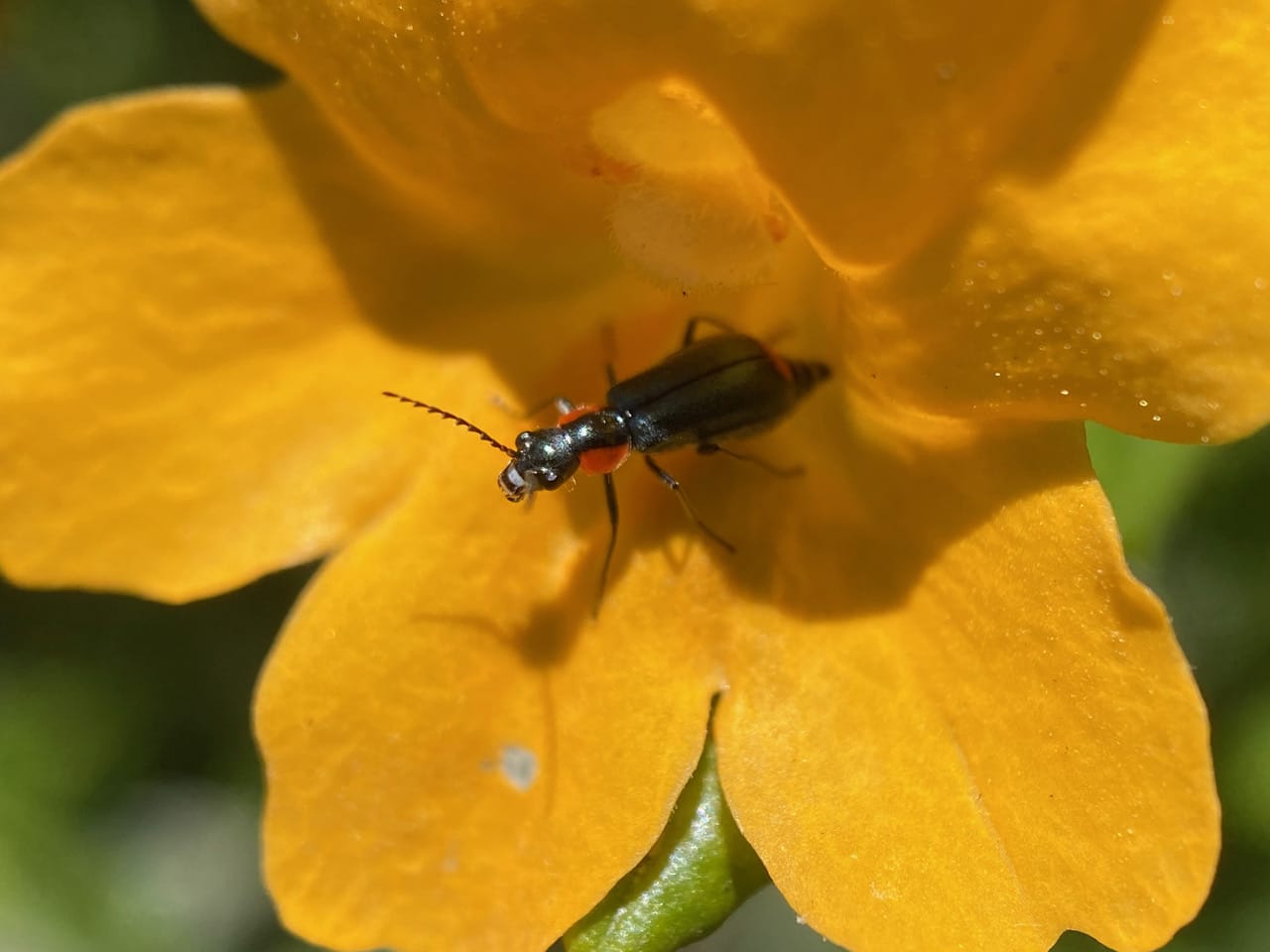
One never knows what might walk out of a Sticky Monkeyflower. It’s a Malachite Beetle, Malachius auritus (family Melyridae, subfamily Malachiinae)!
The Malachite Beetle (subfamily Melachiinae) is a member of the family of Soft-winged Flower Beetles (family Melyridae). Most Melyrids are elongate-oval, soft-bodies beetles 10 mm or less in length. Members of the subfamily Malachiinae have peculiar orange structures along the sides of the abdomen which can be everted, but usually kept hidden. Most adults and larvae are predaceous. Omnivorous adult Melyrids are often found on flowers out in the open, where they feed on pollen, insect eggs, and flower-loving insects that land within their grasp. The larvae generally stay concealed under tree bark or leaf litter or soil, where they prey on other invertebrates.