

Pollinator Post 6/18/26 (3)
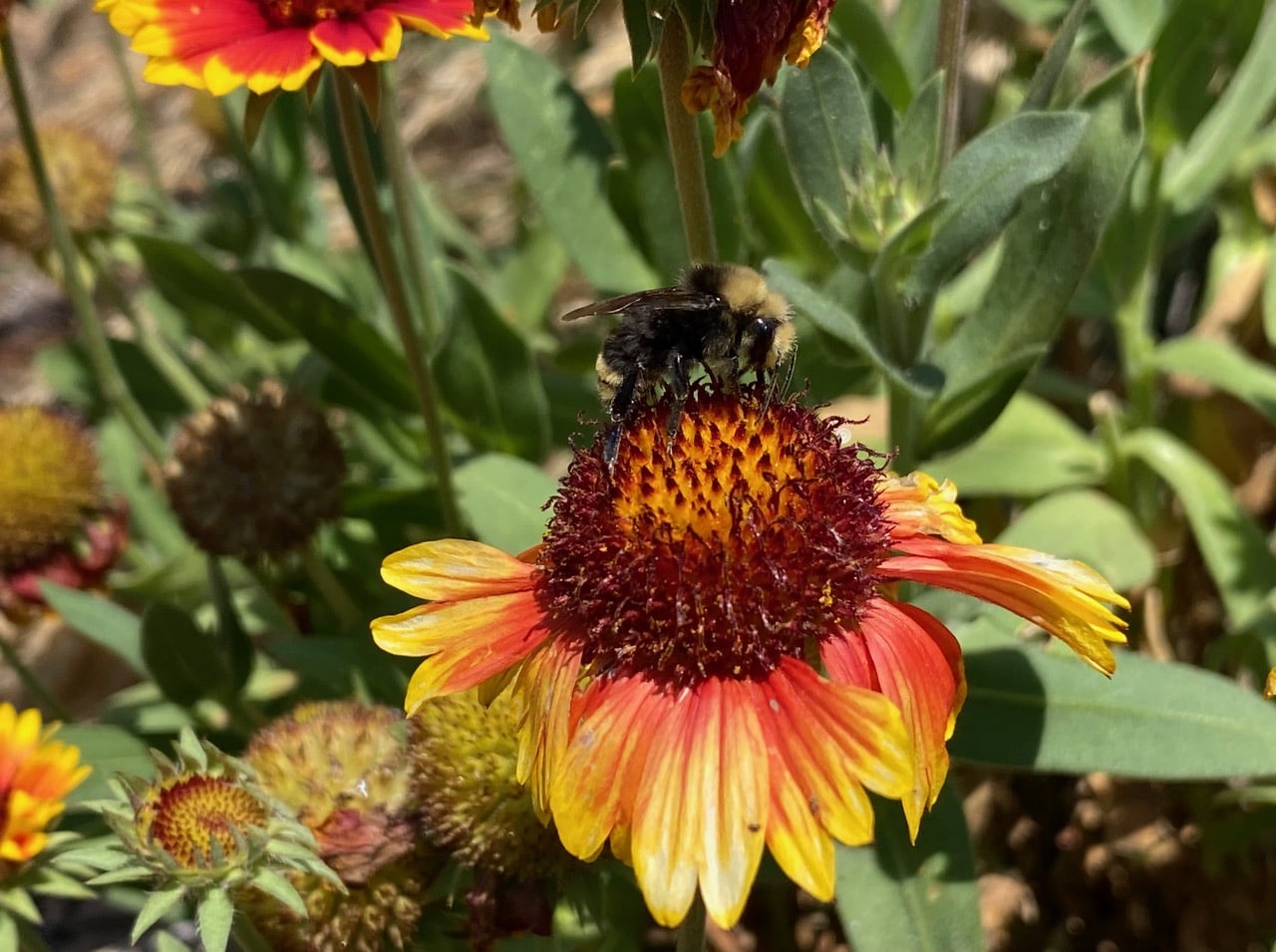
A Yellow-faced Bumble Bee, subgenus Pyrobombus (genus Bombus, family Apidae) is taking nectar on a flowerhead of Blanketflower, Gaillardia sp., one of the few non-native plants in the garden. Stefanie has judiciously kept a few of these in her garden as their bright, daisy-like blooms are rich in nectar and pollen, attracting a variety of native bees, butterflies, and wasps from spring through fall.
The bee appears to have two yellow bands on the abdomen. I wonder if it might not be a male, as most male Yellow-faced Bumble Bees have two bands as compared to the worker’s single band. What’s more, the pale hairs scattered throughout the bee’s black fur makes me think of another possibility – a Fog-belt Bumble Bee, Bombus caliginosus? Trying to identify bumble bees from photographs is a tricky business. Most definitive identification of these look-alike species requires details that can only be seen under the microscope.
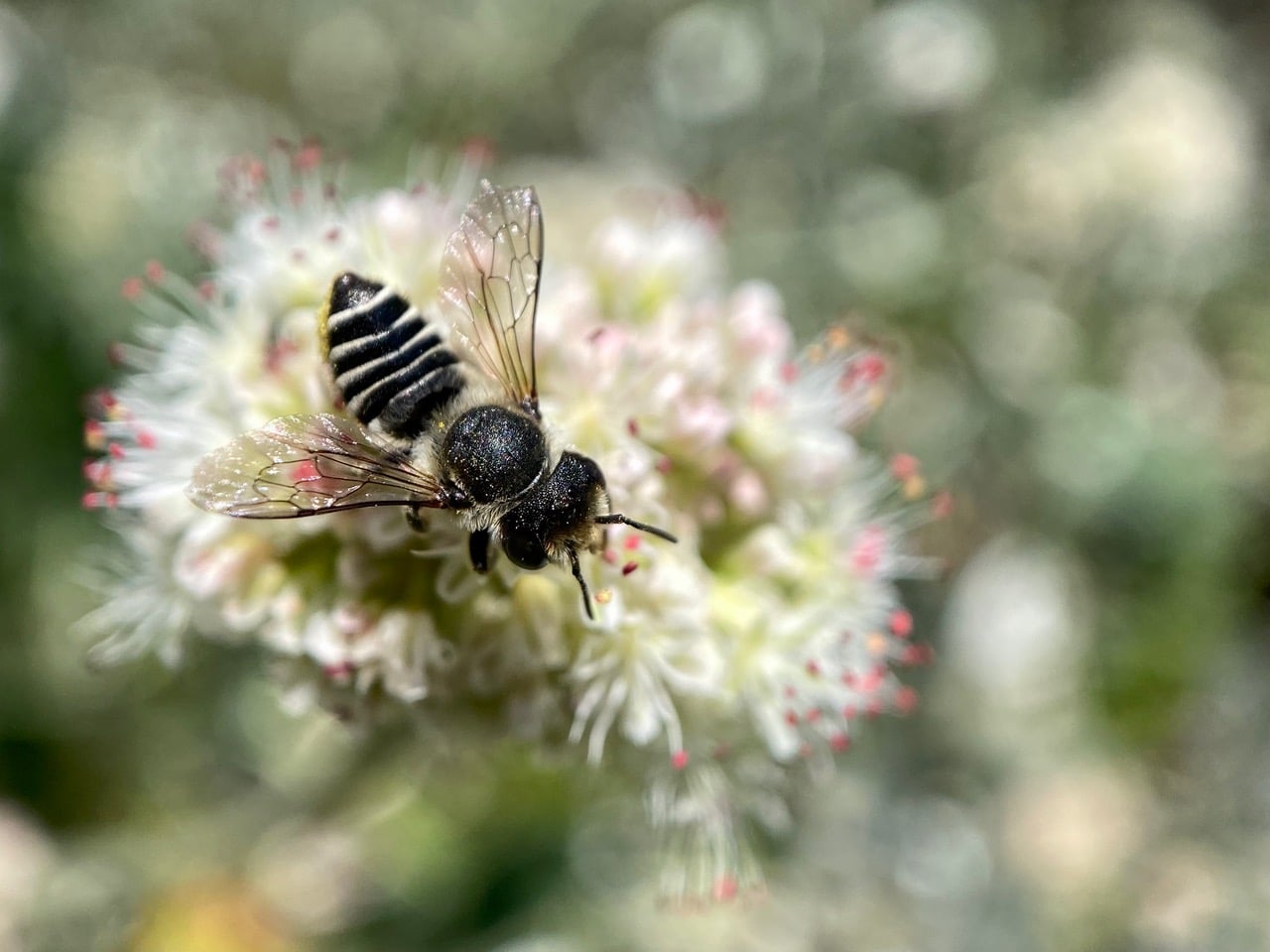
Among the vibrant growth of Coast Buckwheat, Eriogonum latifolium in the backyard, I spot a feisty little black-and-white bee foraging on the white flowers. From its large head and the way the bee holds up its abdomen with a pointed tip, I gather that it is a female Alfalfa Leafcutter Bee, Megachile rotundata (family Megachilidae). There are many of these in Stefanie’s garden. I wonder where they nest in the garden, and the sources of materials for constructing their nests. Leafcutter Bees are known to use Clarkia petals for lining their brood cells. Stefanie has since confirmed that she has found numerous round holes on the petals of her Clarkia flowers. Imagine nurseries with floral wallpaper!
Originally from Eurasia, the Alfalfa Leafcutter Bee, Megachile rotundata (family Megachilidae) are highly efficient pollinators. They are solitary, each female constructing individual leaf-lined nests in cavities. They cut neat, circular discs out of soft leaves and flower petals to line and partition their nest tunnels. Because they trigger alfalfa flowers effectively to release pollen, the bees are vital to agriculture and seed production. While highly valued for commercial alfalfa, the bees also readily pollinate other crops like canola, carrots, and various wildflowers.
The species is among the most heavily managed solitary bees in the world. Females live only a few weeks in the summer. The offspring spend the winter as prepupae inside their leaf-lined cocoons. Commercial growers manage and store these cocoons in controlled environments over the winter to synchronize their emergence with summer crop blooms.
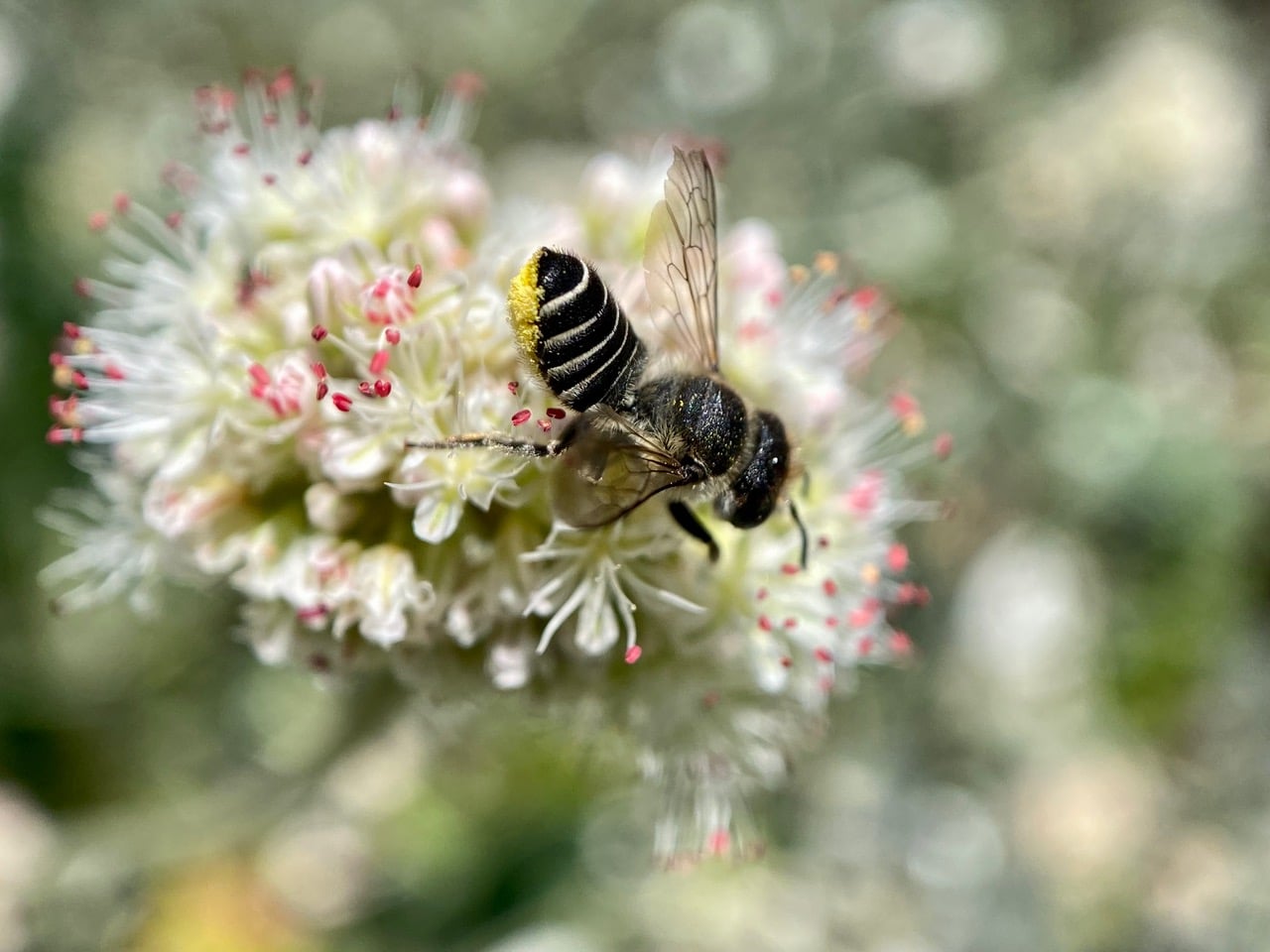
As the bee turns, you can see the light yellow pollen she has gathered onto the scopae on the underside of her up-lifted abdomen. It’s a treat to watch a leafcutter bee gather pollen.
Leafcutter bees (genus Megachile) carry pollen on a dense brush of stiff hairs on the underside of their abdomen, known as a scopa. As the bee flies, her fuzzy body builds up a positive static charge. When she lands on a flower, this static electricity pulls pollen grains from the anthers, causing them to cling all over her body. Rather than landing and simply walking around, leafcutter bees often dive directly onto the flower and raise their abdomen, rubbing their hairy underside aggressively against the flower’s reproductive parts. She uses a coordinated grooming motion to brush pollen off her body with her forelegs, passing it to her middle legs, and then uses her hind legs to rake and pack the pollen grains securely into the scopa on her belly. When she returns to her nesting cavity, she scrapes the pollen off her abdomen using her hind legs and mixes it with regurgitated nectar to form a nutrient-rich “bee bread” on which she lays an egg.

A much smaller bee, no bigger than a grain of rice, is moving slowly amidst a tight cluster of buckwheat flowers. From the size of the bee, and the yellow markings on the its body and face, I gather that it’s a female Masked Bee, Hylaeus sp. (family Colletidae).
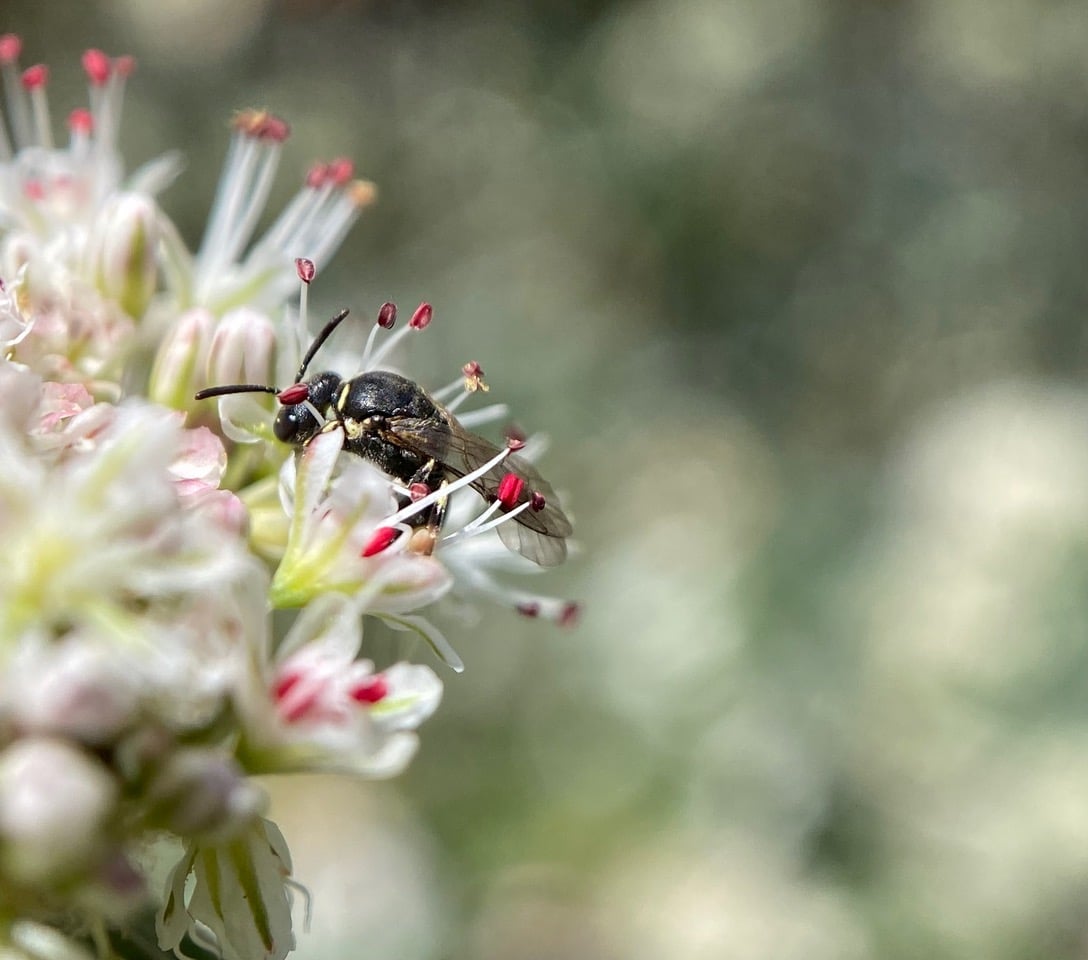
Hylaeus (family Colletidae) are shiny, slender, hairless, and superficially wasp-like bees. They are small, 5 to 7 mm long, usually black with bright yellow or white markings on their face and legs. These markings are more pronounced on the males. Hylaeus do not carry pollen and nectar externally, they instead store their food in the crop and regurgitate it upon returning to their nests. They are primarily generalist foragers. Hylaeus are short-tongued, but their small body size enables them to access deep flowers. Hylaeus nest in stems and twigs, lining their brood cells with self-secreted cellophane-like material. They lack strong mandibles and other adaptations for digging, using instead pre-existing cavities made by other insects.

As I head for the side gate to exit the backyard, I notice a female Foothill Carpenter Bee, Xylocopa tabaniformis ssp. orpifex (family Apidae) robbing nectar from a flower of Autumn Sage, Salvia greggii. How cool is that!
The common name “carpenter bees” derives from their nesting behavior; nearly all species burrow into hard plant material such as dead wood or bamboo. These robust bees are often mistaken for bumble bees. The simplest way to tell them apart is that most carpenter bees have a shiny abdomen, whereas bumble bees abdomens are completely covered with dense hair. Males of some species of carpenter bees have a white or yellow face, unlike bumble bees, while females lack the bare corbicula (pollen baskets) of bumble bees; the hind leg is entirely hairy and includes the scopa.
Carpenter Bees are traditionally considered solitary bees, though some species, including our Foothill Carpenter Bee, have simple social nests in which mothers and daughters may cohabit. Carpenter Bees make nests by tunneling into wood, bamboo and similar hard plant materials. They vibrate their bodies as they rasp their mandibles against the wood, each nest having a single entrance which may have many adjacent tunnels. The entrance is often a perfect circular hole measuring about 0.6in. on the underside of a beam, bench, or tree limb. Carpenter Bees do not eat wood; they discard the bits of wood, or reuse the sawdust to build partitions between cells. The tunnel functions as a nursery for brood and storage for the pollen/nectar upon which the brood subsists. Carpenter can be timber pests, and cause substantial damage to buildings.
Carpenter Bees have short mouthparts and are important pollinators on some open-faced or shallow flowers. They also are important pollinators of flowers with various forms of lids, such as Salvia species, and some members of the Fabaceae such as Lupinus. Many Carpenter Bees are known to “rob” nectar by cutting slits on the sides of flowers with deep corolla that they cannot enter. In doing so, the bees can access the nectar directly with their short tongue. This move precludes contact with the reproductive parts of the flower, and results in no pollination.
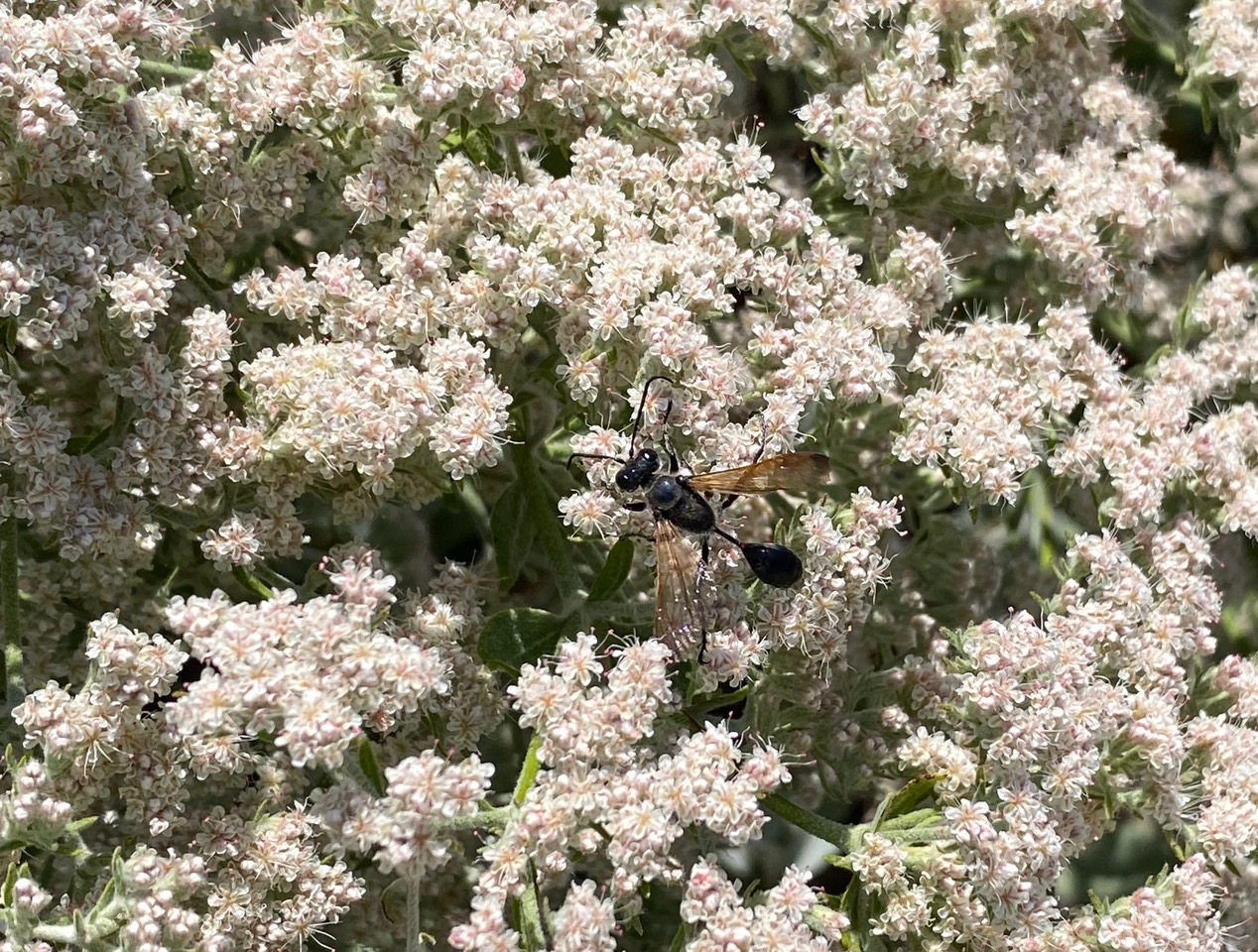 As the day warms up, insect activity has intensified noticeably on the St. Catherine’s Lace, Eriogonum giganteum in the front garden. I stop to watch a large black wasp foraging on the small flowers. It could easily be mistaken for a male Sphex lucae, but the shape of the abdomen and the color of the wings tell me it’s different.
 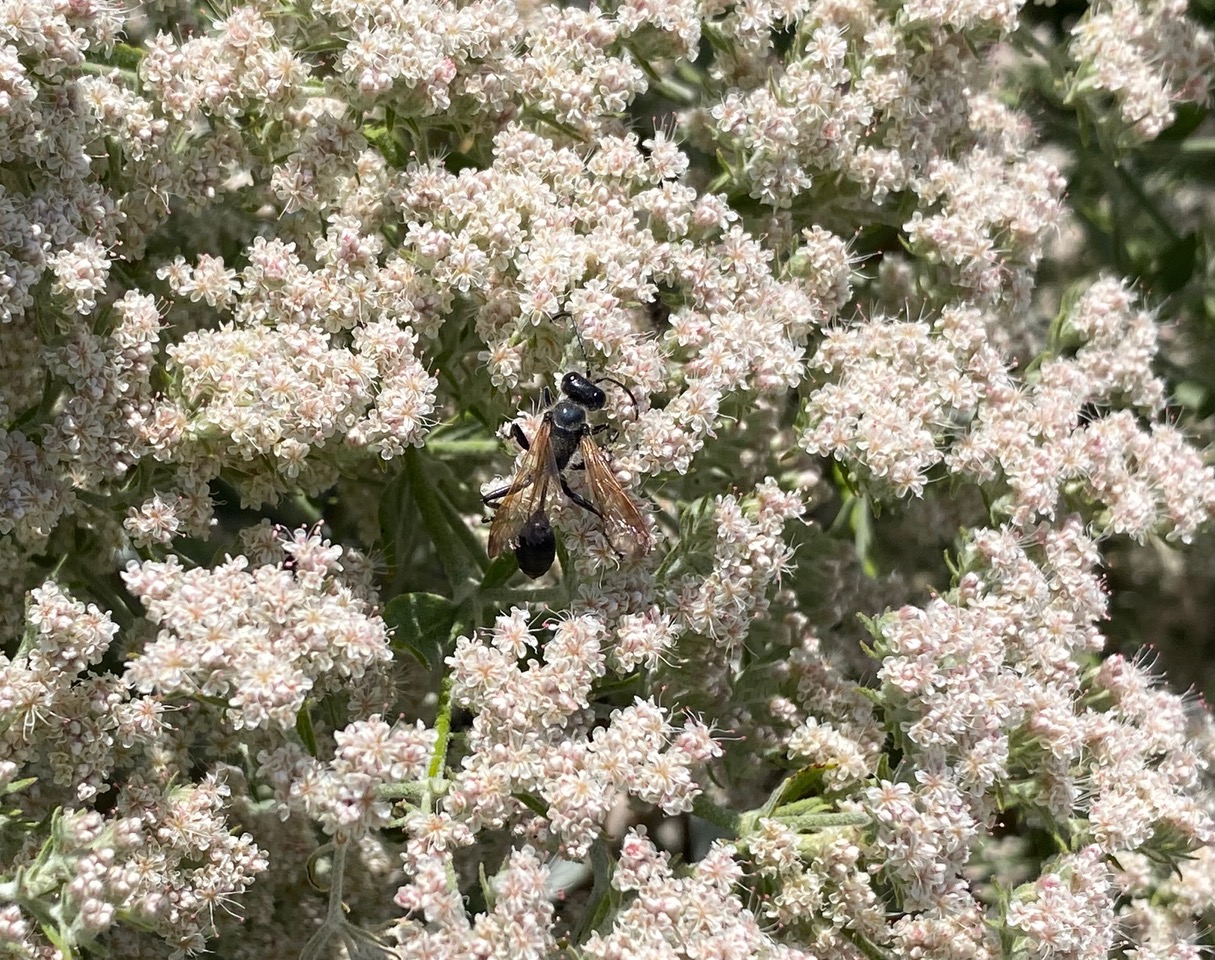 iNaturalist has helped identify the wasp as a Mexican Grass-carrying Wasp, Isodontia mexicana (family Sphecidae). I have heard about these fascinating wasps, but never dreamed that I would actually see one!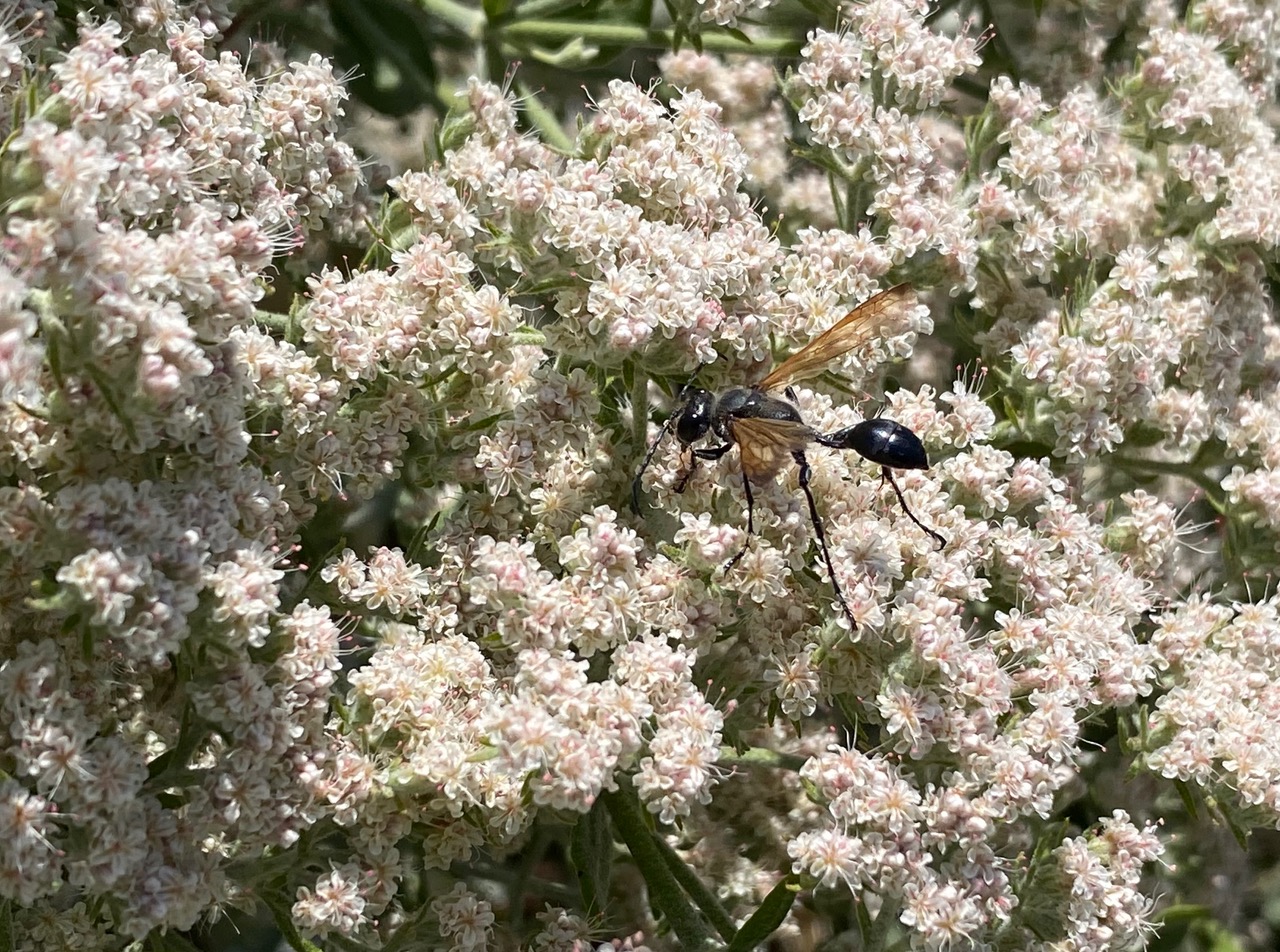
The Mexican Grass-carrying Wasp, Isodontia mexicana is a species of wasps belonging to the family Sphecidae. It is mainly found throughout North America, but has become established in Europe. Like others in the Sphecidae family, Grass-carrying Wasps have a very narrow section (thread waist) connecting their abdomen to their thorax. The adults grow up to 18-20 mm long, the body is completely black, thorax is quite hairy and the wings have a smoky-brown color. They are often seen from early summer through September. Females are larger and emerge as adults later in the season than males. The wasps frequent woodland edges, gardens, meadows, old fields and farms.
After emerging from their natal nest, females mate with males and begin nest construction. These wasps build their nests in preexisting cavities such as hollow stems or in other natural cavities, often reusing the nests of other species. Females typically use pieces of grass to line their nests and make divisions inside the cavity for the developing larvae. Using her mandibles, the female wasp cuts a grass blade, then flies back to her nest carrying it in her mandibles. She coils the blades to form partitions between the brood cells or to plug the end of the nest cavity.
Isodontia mexicana mainly preys on grasshoppers (usually katydids, Tettigoniidae species) or tree crickets (Gryllidae species) to feed their young. The female stings the victim, then clutching the paralyzed prey underneath her, she carries it back to the nest. Once a brood cell is provisioned with enough prey, she lays an egg. When the food provisions are entirely consumed, each larva spins a cocoon in which it overwinters in prepupal or pupal state. Development continues the following spring with the adults emerging in July.
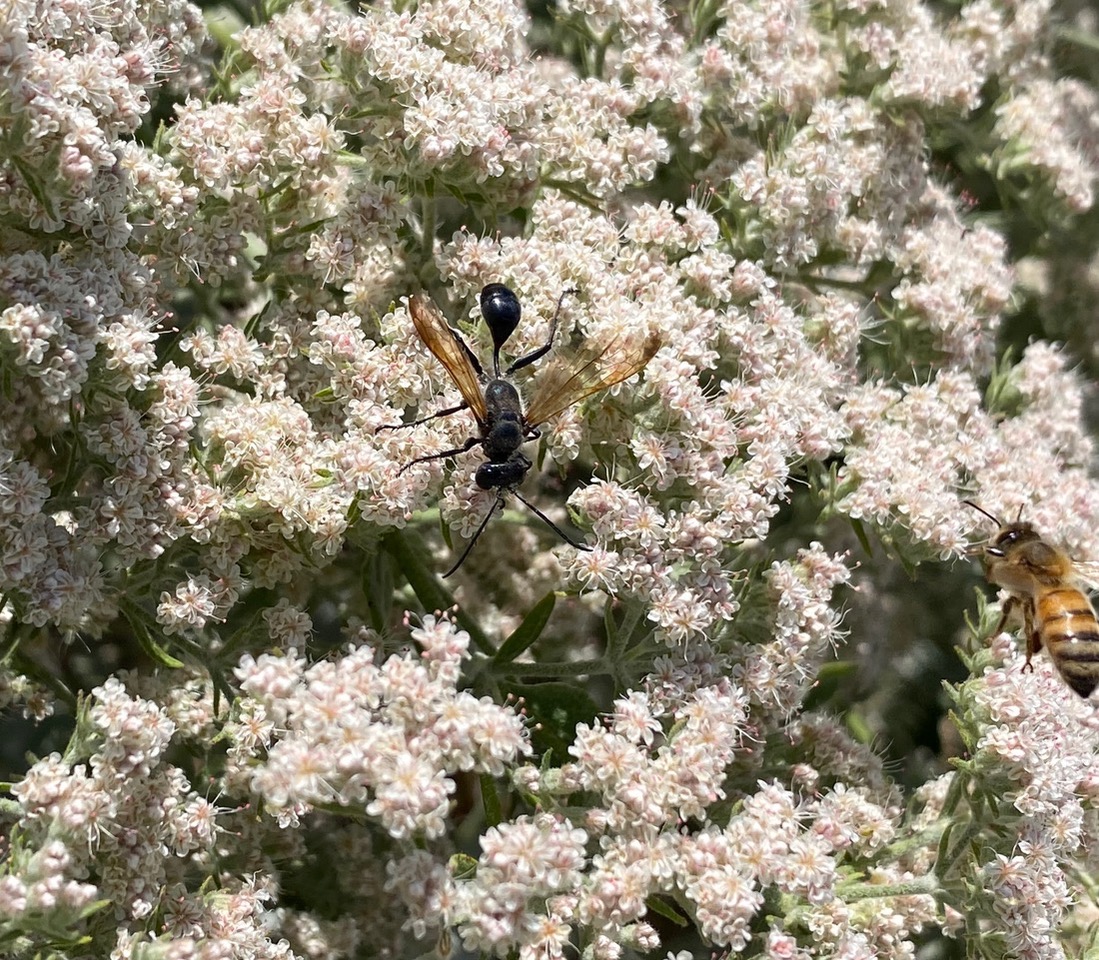
Here’s a nice size comparison with a Honey Bee buzzing by. The wasp is quite large, about 18-20 mm long.
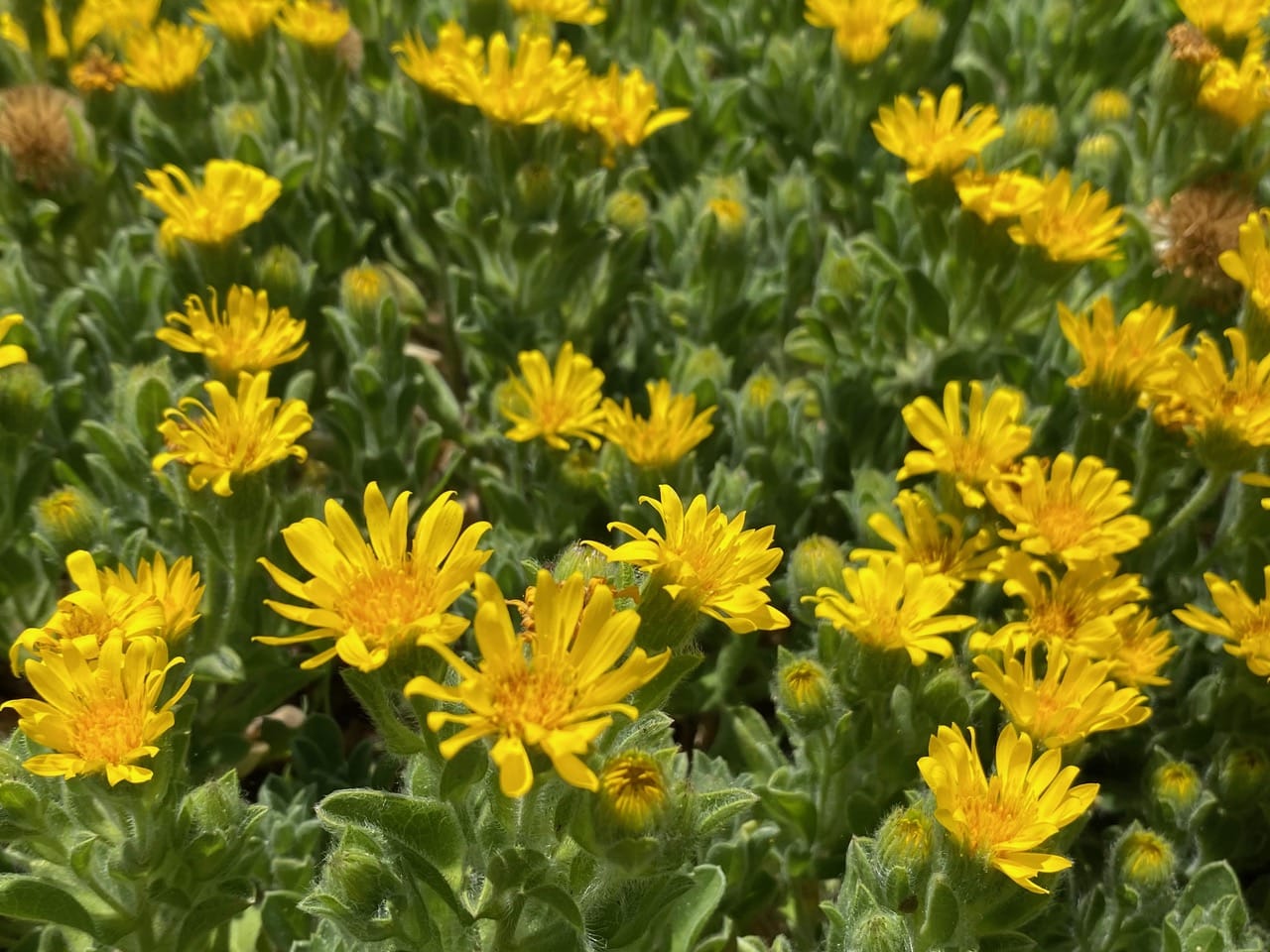
In the front yard, the low-growing Sessileflower False Goldenaster, Heterotheca sessiliflora is blooming brilliantly, but does not seem to attract many insects.
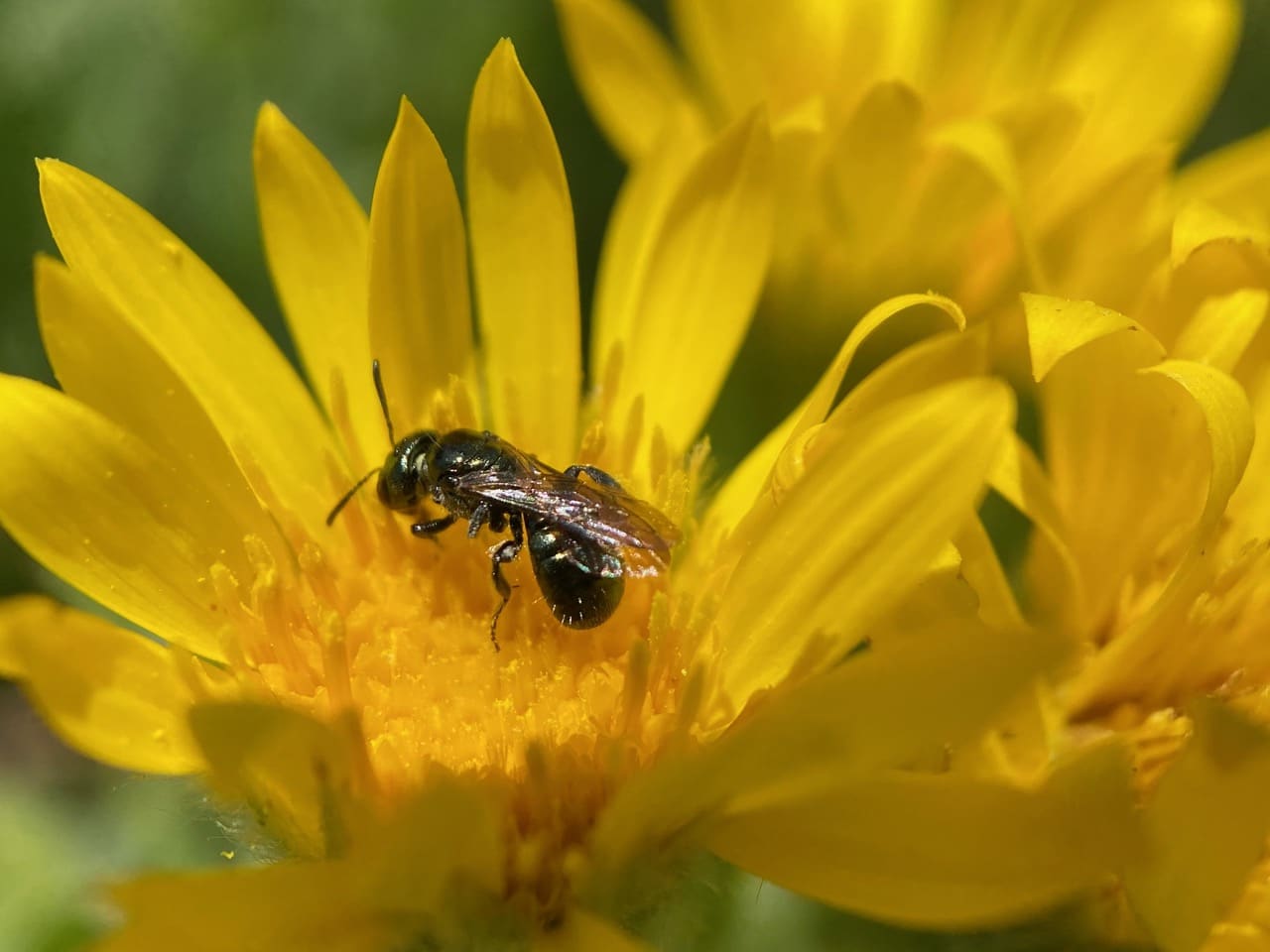
Ah, finally a glossy black insect lands to forage on a flowerhead of the Sessileflower False Goldenaster. It is easily recognizable as a Small Carpenter Bee, Ceratina sp. (family Apidae).
The Small Carpenter Bee genus Ceratina is closely related to the more familiar, and much larger Carpenter Bees (genus Xylocopa). Ceratina are typically dark, shiny, even metallic bees, with fairly sparse body hairs and a weak scopa on the hind leg. The shield-shaped abdomen comes to a point at the tip. Some species have yellow markings, often on the face.
Females excavate nests with their mandibles in the pith of broken or burned plant twigs and stems. While many species are solitary, a number are subsocial. Both male and female carpenter bees overwinter as adults within their old nest tunnels, emerging in the spring to mate. In the spring, this resting place (hibernaculum) is modified into a brood nest by further excavation. The female collects pollen and nectar, places this mixture (called bee bread) inside the cavity, lays an egg on the provision, and then caps off the cell with chewed plant material. Several cells are constructed end to end in each plant stem.

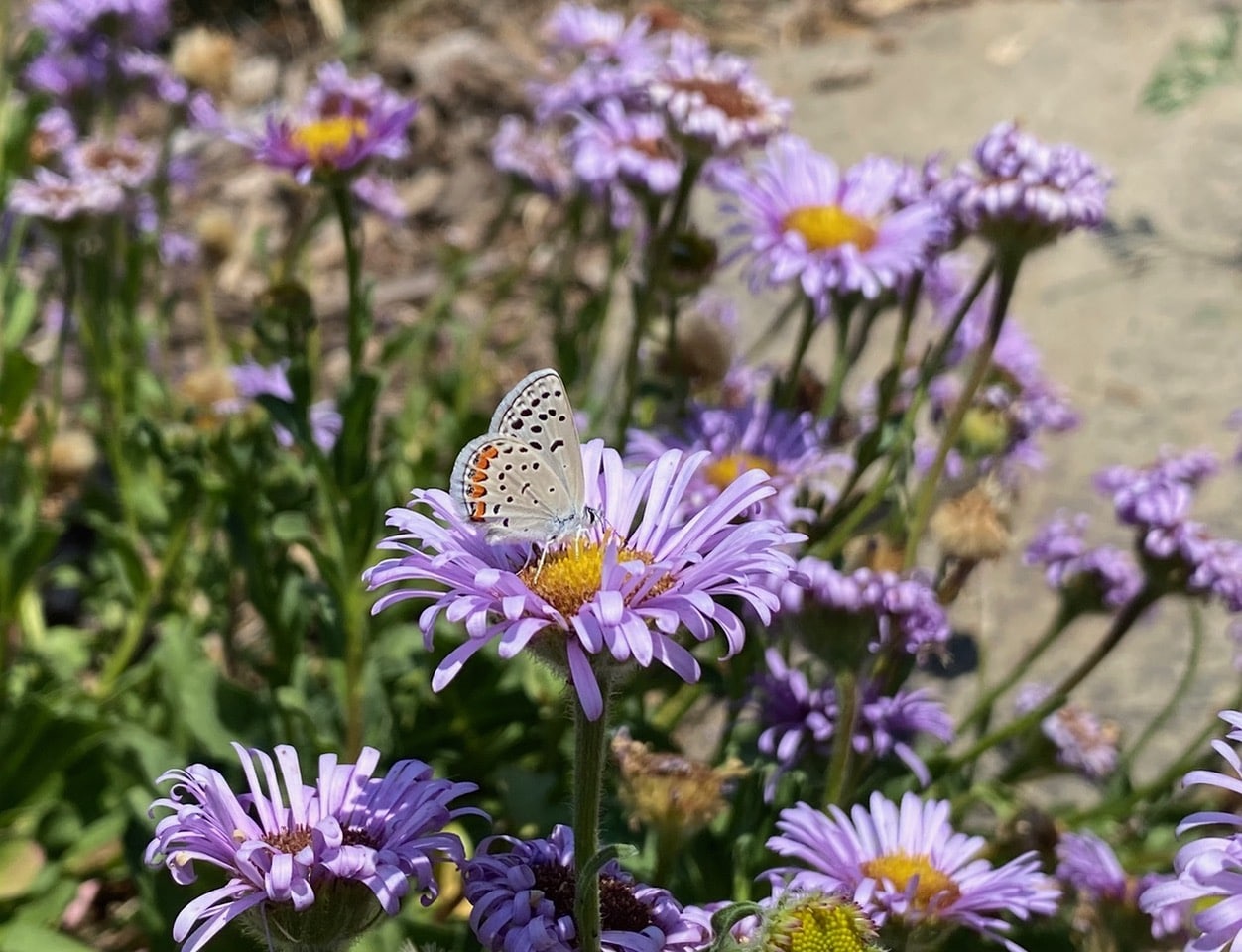
An Acmon Blue butterfly, Icaricia acmon (family Lycaenidae) is taking nectar on a flowerhead of Seaside Daisy, Erigeron glaucus.
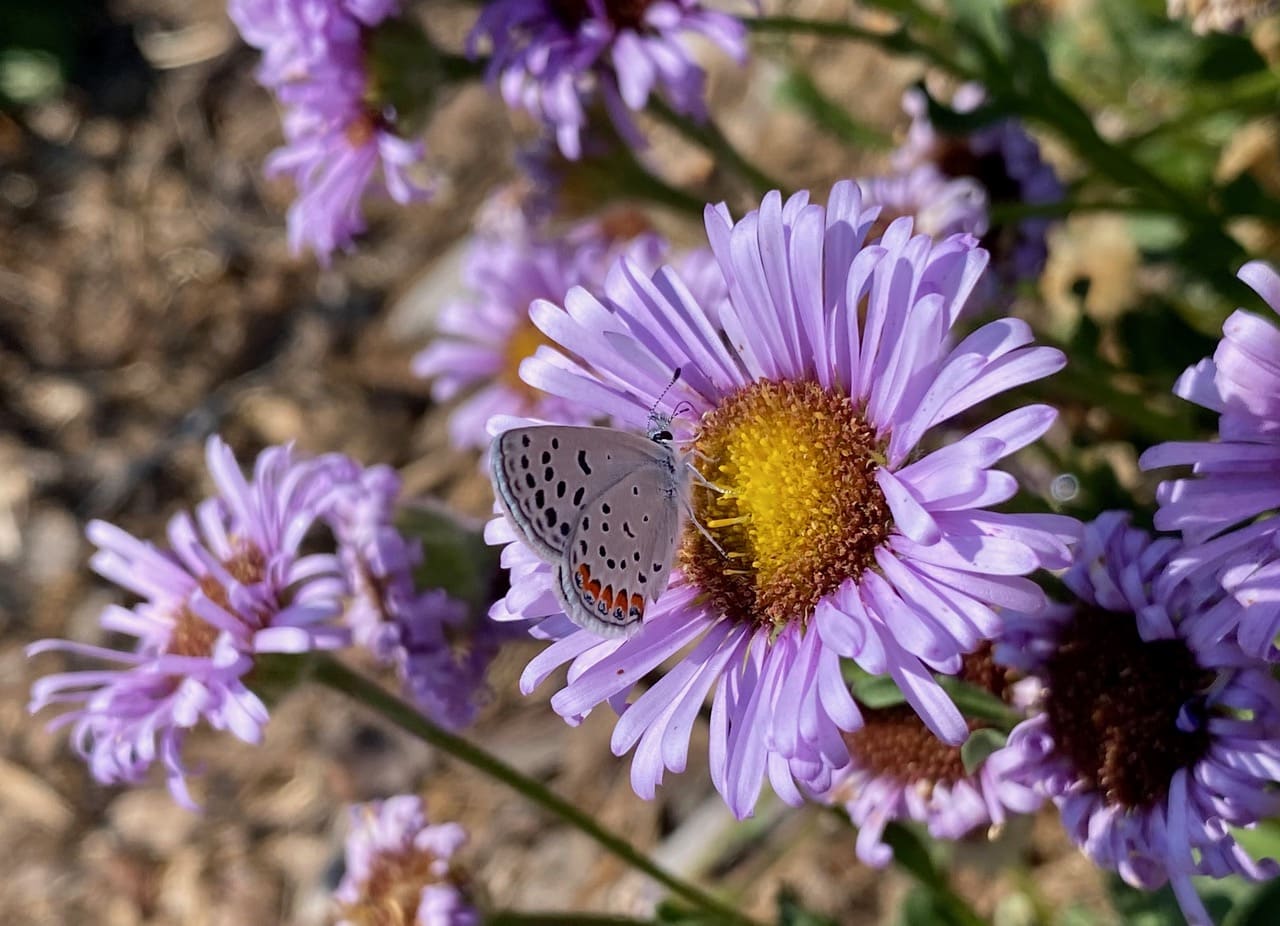
Acmon Blue, Icaricia acmon (family Lycaenidae) is a North American butterfly, found mostly in California. It is a small butterfly, with a wingspan of 0.75 to 1.125 in. It can be seen from March to October, with peak numbers in July. Adults feed on nectar while caterpillars feed on a variety of plant species, including buckwheats, deer weed, lupines, trefoils, and milkvetches. Like many Lycaenid butterflies, Acmon Blue shares a mutualistic relationship with ants. The ants protect the caterpillars from predators in exchange for the sweet “honeydew” the caterpillars secrete from a nectary gland. The larvae are often protected and kept in the ant nest when not feeding.