

Pollinator Post 6/18/26 (1)

It’s time to pay a visit to Stefanie’s beautiful garden in San Leandro again! The front yard is so lush and full, I can hardly see her house now. Her garden spills into the sidewalk strip, bursting in color. Stefanie planted the first generation of natives including trees and larger shrubs (manzanitas, ceanothus, toyon etc.) in 2017, and the others have since been replanted/replaced sporadically.

While the large-flowered and brightly colored Farewell to Spring, Clarkia amoena is the most showy in the garden, it hardly garners any attention from the insects. Both Stefanie and I agree on this observation over the years. The plant simply cannot hold a candle to the similarly-colored, but small-flowered Buckwheat, Eriogonum grande var. rubescens blooming across the path.
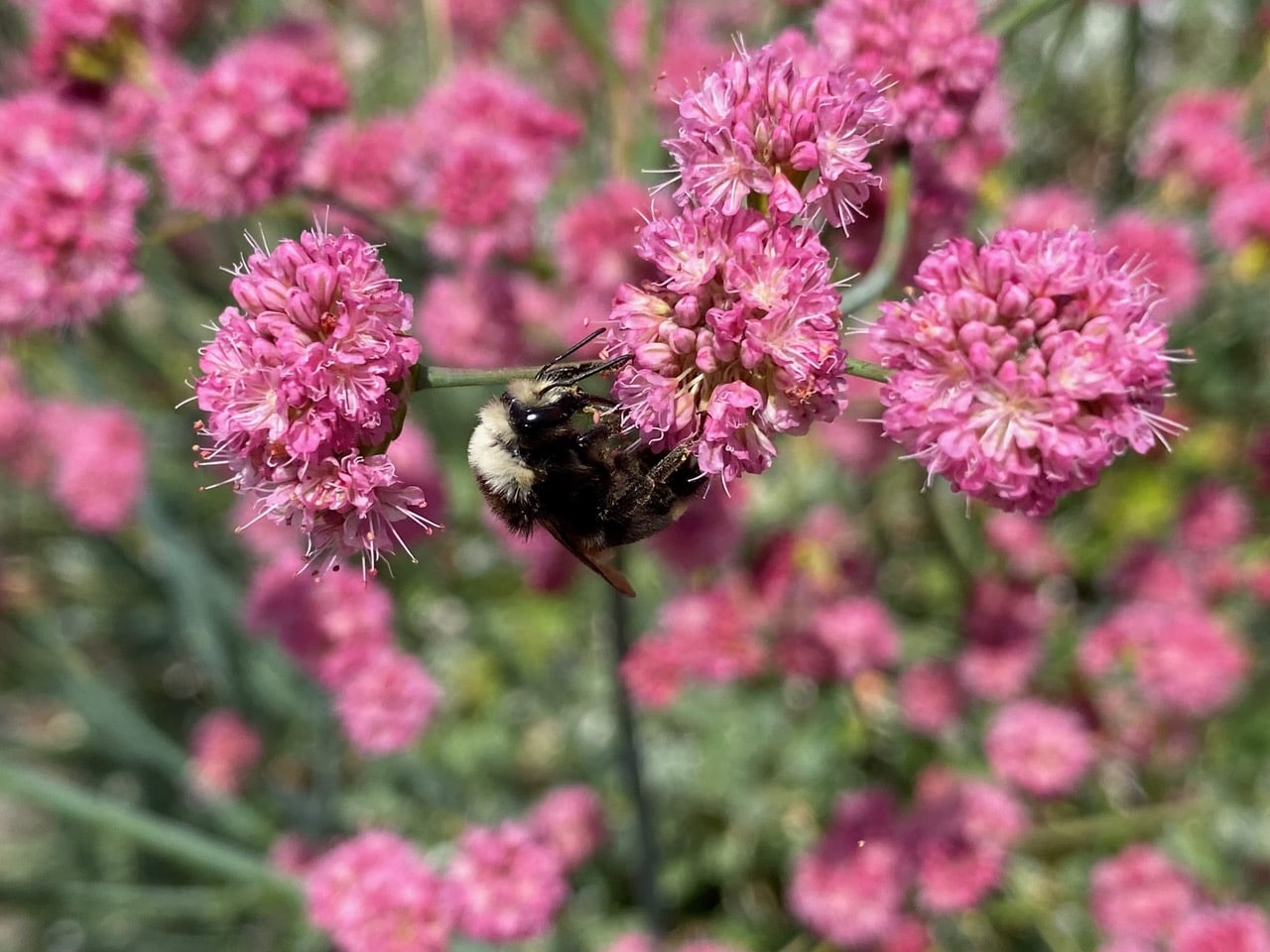
A Yellow-faced Bumble Bee, subgenus Pyrobombus (genus Bombus, family Apidae) is flying around, taking nectar from the tight clusters of flowers of the Red-flowered Buckwheat. Is this a male? Its antennae seem rather long, and its hind legs are slender and lack the corbicula (pollen basket) of the females.

Not surprisingly, the most commonly seen bee here is the Honey Bee. This worker does not seem to be collecting pollen, but is only taking nectar.
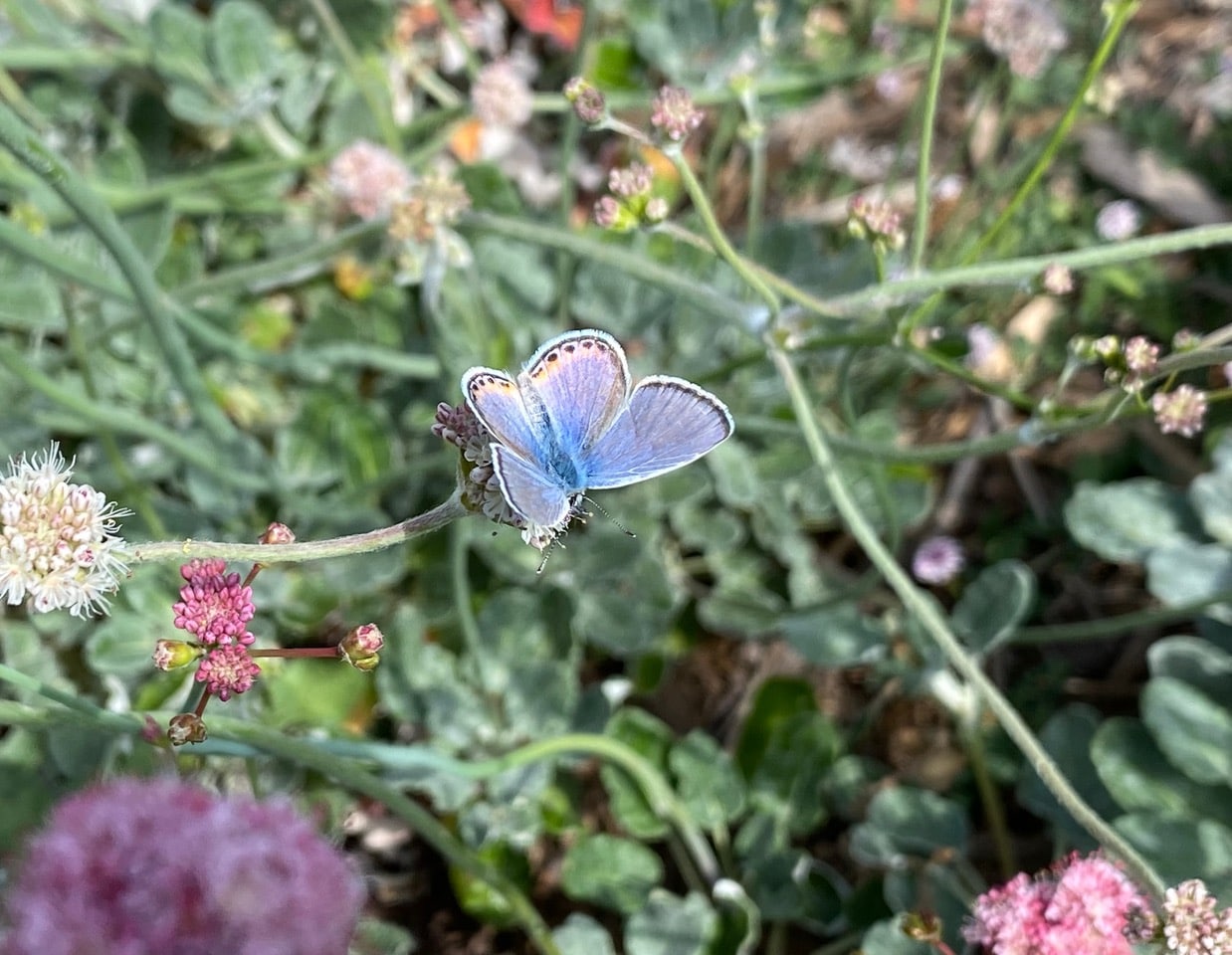
An Acmon Blue butterfly is taking nectar on a small cluster of flowers of Red-flowered Buckwheat.
Acmon Blue, Icaricia acmon (family Lycaenidae) is a North American butterfly, found mostly in California. It is a small butterfly, with a wingspan of 0.75 to 1.125 in. It can be seen from March to October, with peak numbers in July. Adults feed on nectar while caterpillars feed on a variety of plant species, including buckwheats, deer weed, lupines, trefoils, and milkvetches. Like many Lycaenid butterflies, Acmon Blue shares a mutualistic relationship with ants. The ants protect the caterpillars from predators in exchange for the sweet “honeydew” the caterpillars secrete from a nectary gland. The larvae are often protected and kept in the ant nest when not feeding.
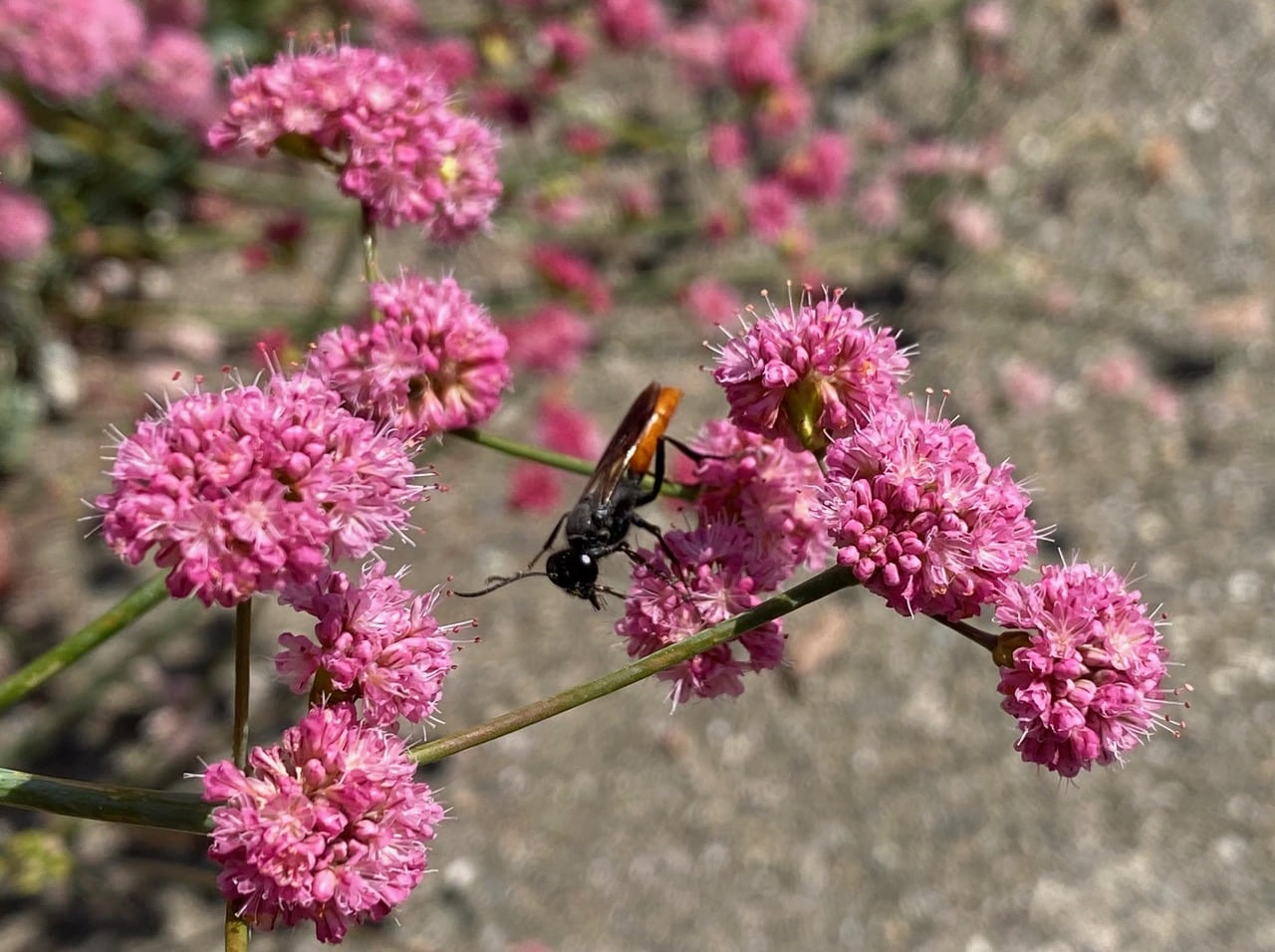
A black wasp with orange abdomen is foraging on the flowers of Red-flowered Buckwheat. It is a female Thread-waisted Burrowing Wasp, Sphex lucae (family Sphecidae).
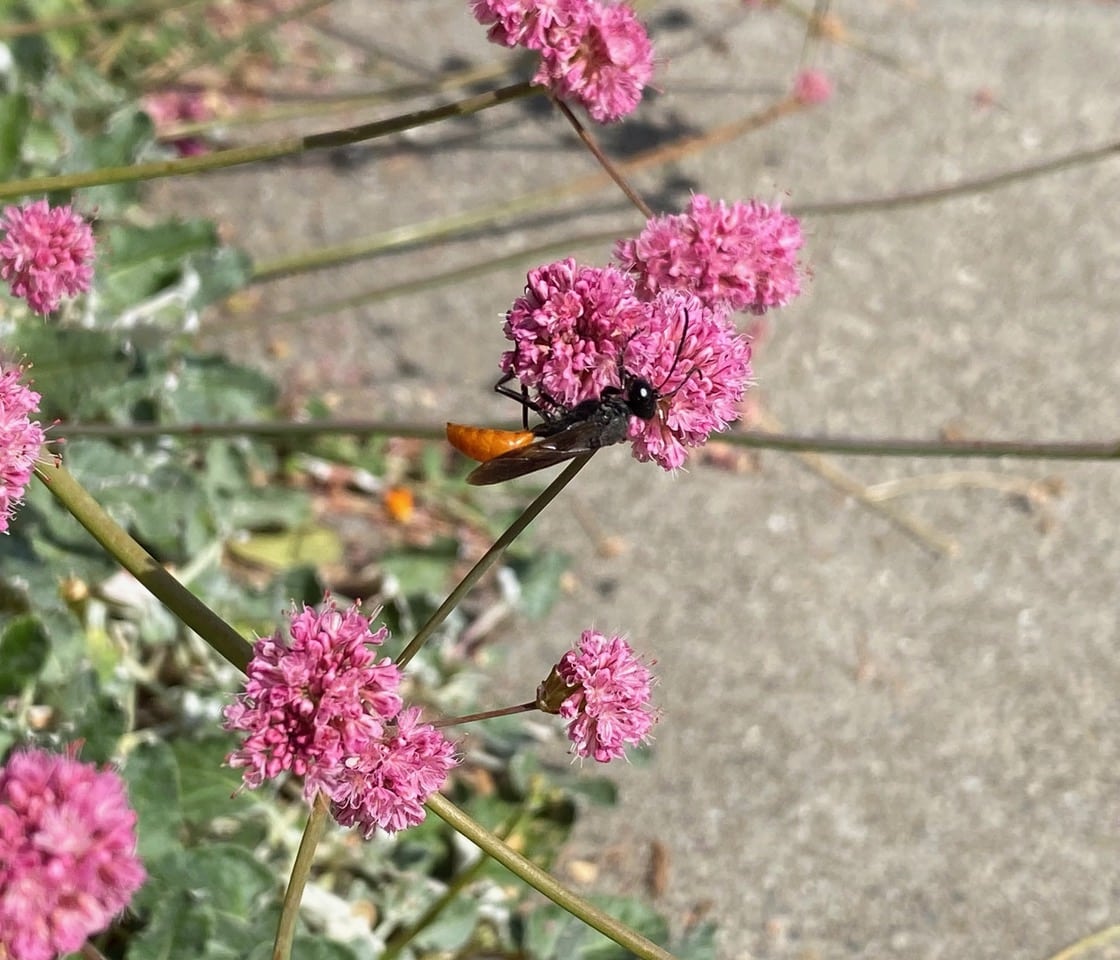
The Sphecidae are solitary wasps with elongated and narrow first abdominal segment, giving rise to the common name Thread-waisted Wasps. Sphex lucae is a widespread western species, ranging from WA in the north, south to CA, and east to TX. The species exhibits sexual dimorphism – females are black with a red abdomen, while the males are all black. Adults visit many types of flowers for nectar. Females hunt katydids and grasshoppers as food for their young. The wasp excavates a single-celled burrow in the soil in advance of hunting activities. She drags her paralyzed prey back to the burrow, laying a single egg on the victim. The nest entrance is then sealed and the process is repeated. Males of this species spend nights in sleeping aggregations in sheltered places such as beneath a rock overhang.
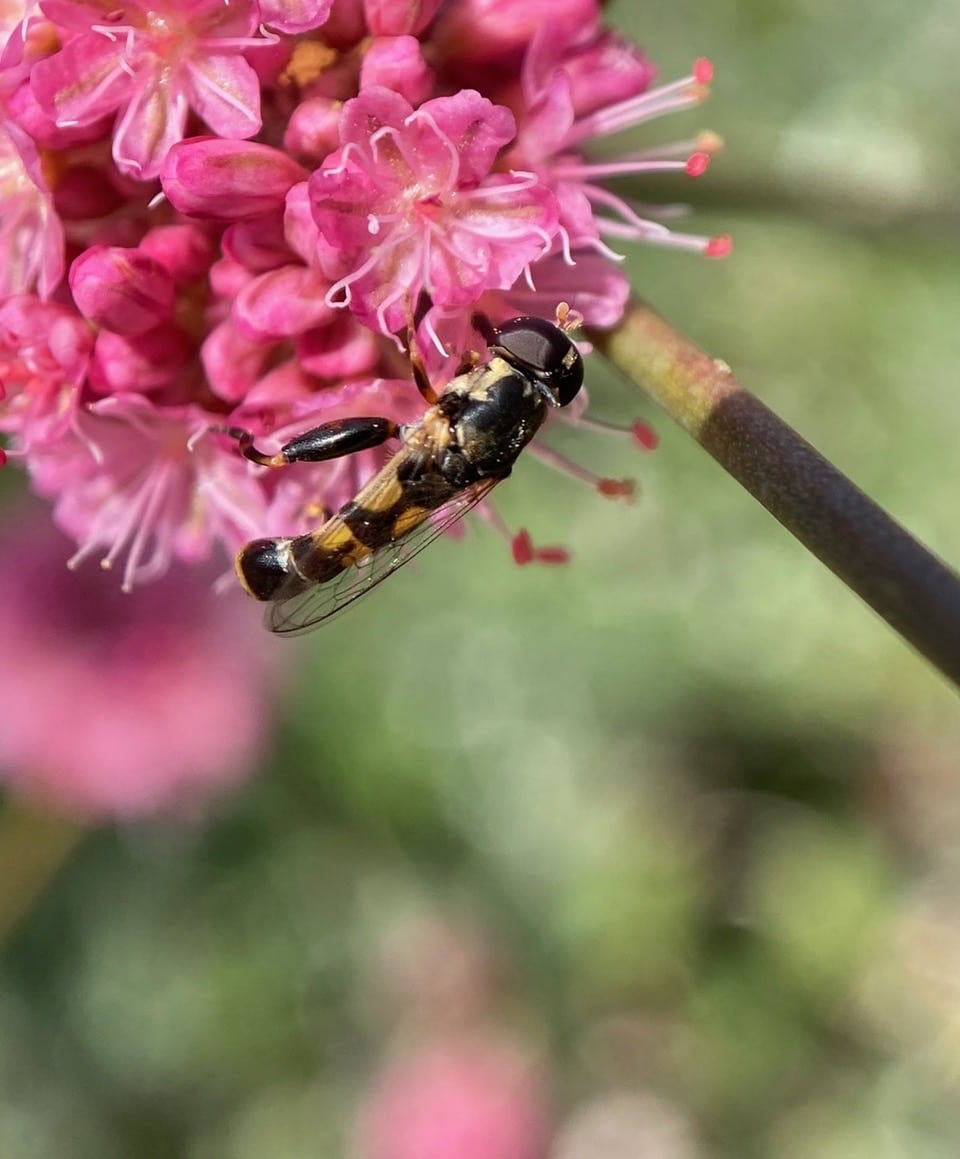
Numerous small hover flies with elongated abdomen are chasing each other and occasionally landing on the buckwheat flowers to feed on nectar and pollen. They are Thick-legged Hover Flies, Syritta pipiens (family Syrphidae)
Syritta pipiens originates from Europe and is currently distributed across Eurasia and North America. They are fast and nimble fliers. The fly has an elongate body about 6.5 – 9 mm long, and has distinctly enlarged hind femora which gives it its common name. The species flies at a very low height, rarely more than 1 m above the ground. Adults visit flowers – males primarily to feed on nectar, and females to feed on protein-rich pollen to produce eggs. The species is found wherever there are flowers. It is also anthropophilic, occurring in farmland, suburban gardens, and urban parks. Larvae are found in wetlands that are close to bodies of freshwater such as lakes, ponds, rivers, ditches. Larvae feed on decaying organic matter such as garden compost and manure. Males often track females in flight, ending with a sharp dart towards them after they have settled, aiming to attempt forced copulation.
Syritta pipiens exhibits migratory behavior. These small fast-flying hover flies are highly adaptable and migrate to avoid harsh weather and seasonal resource shortages. They utilize a time-compensated sun compass, taking advantage of tailwinds on dry, sunny days to travel long distances. By migrating, these flies act as crucial long-range pollinators, transferring pollen over hundreds of miles while feeding on small flowers.
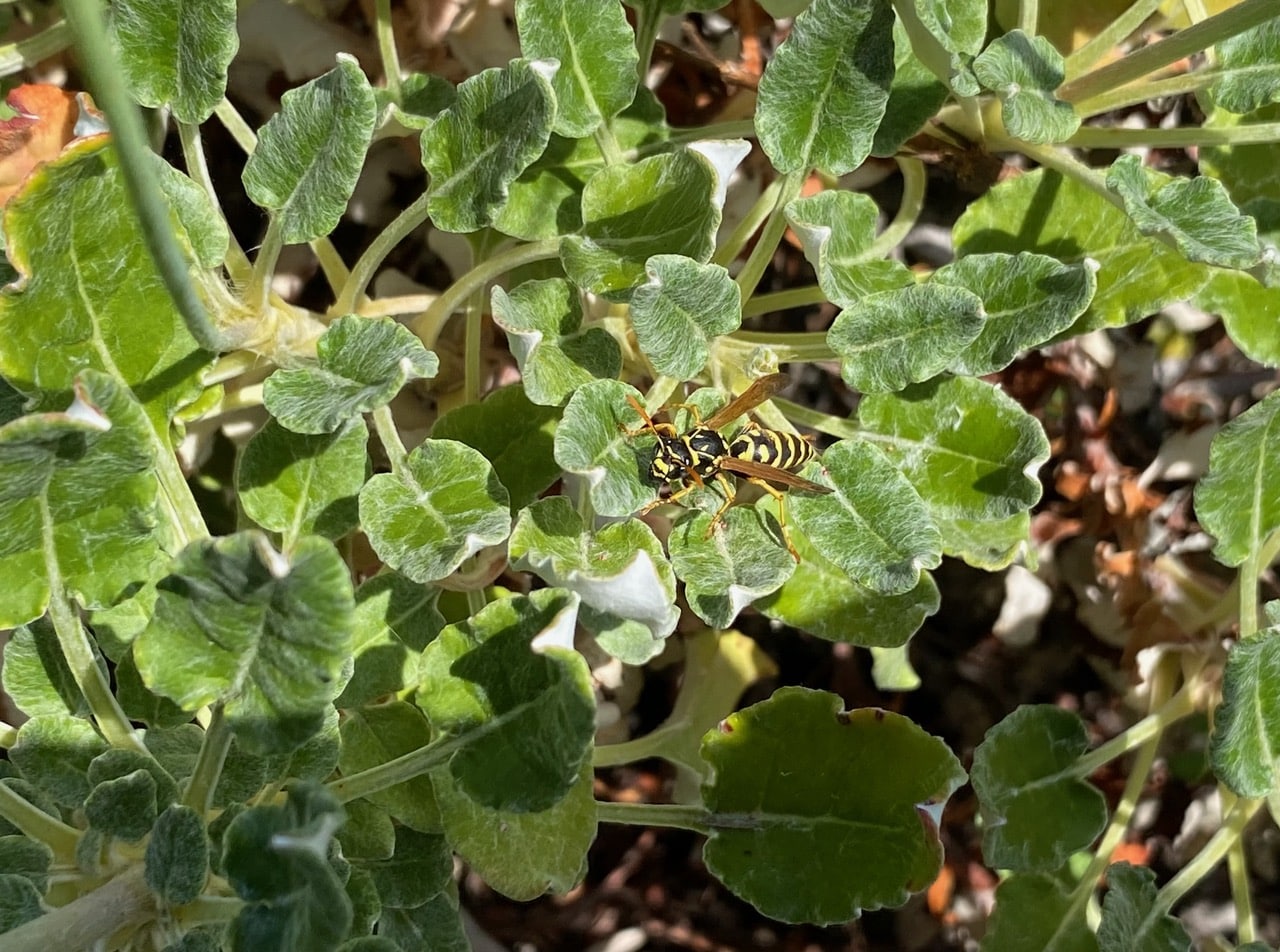
A European Paper Wasp has landed on the low buckwheat foliage to hunt for prey to feed the hungry brood back in her nest. Note her orange-tipped antennae – the easiest way to distinguish her from the look-alike Yellowjackets which have black antennae.
Native to Europe, the European Paper Wasp, Polistes dominula, is a social insect that produces an annual colony in a paper nest. Individual colonies are established anew each spring. The overwintering stage are mated females (queens). The overwintered queens emerge from sheltered spots in spring and search out sites to establish a new colony. Nests are constructed of paper, produced from chewed wood fibers of weathered fences, porch decks and other similar sources. Larvae are fed crushed insects, usually caterpillars. As the population increases, the original queen increasingly remains in the nest as new workers take over colony activities. A few of the wasps produced later in summer are males and increasing numbers of the females become sexually mature. Mating occurs and the mated females are the surviving overwintering stage. Males and non-reproductive females do not survive winter and the nest is abandoned by late fall. European Paper Wasps will sometimes feed on sweet materials, including honeydew produced by aphids. They may also feed on damaged ripe fruits. Because of their habit of hunting caterpillars, the wasps have become one of the most important natural controls of garden pests.
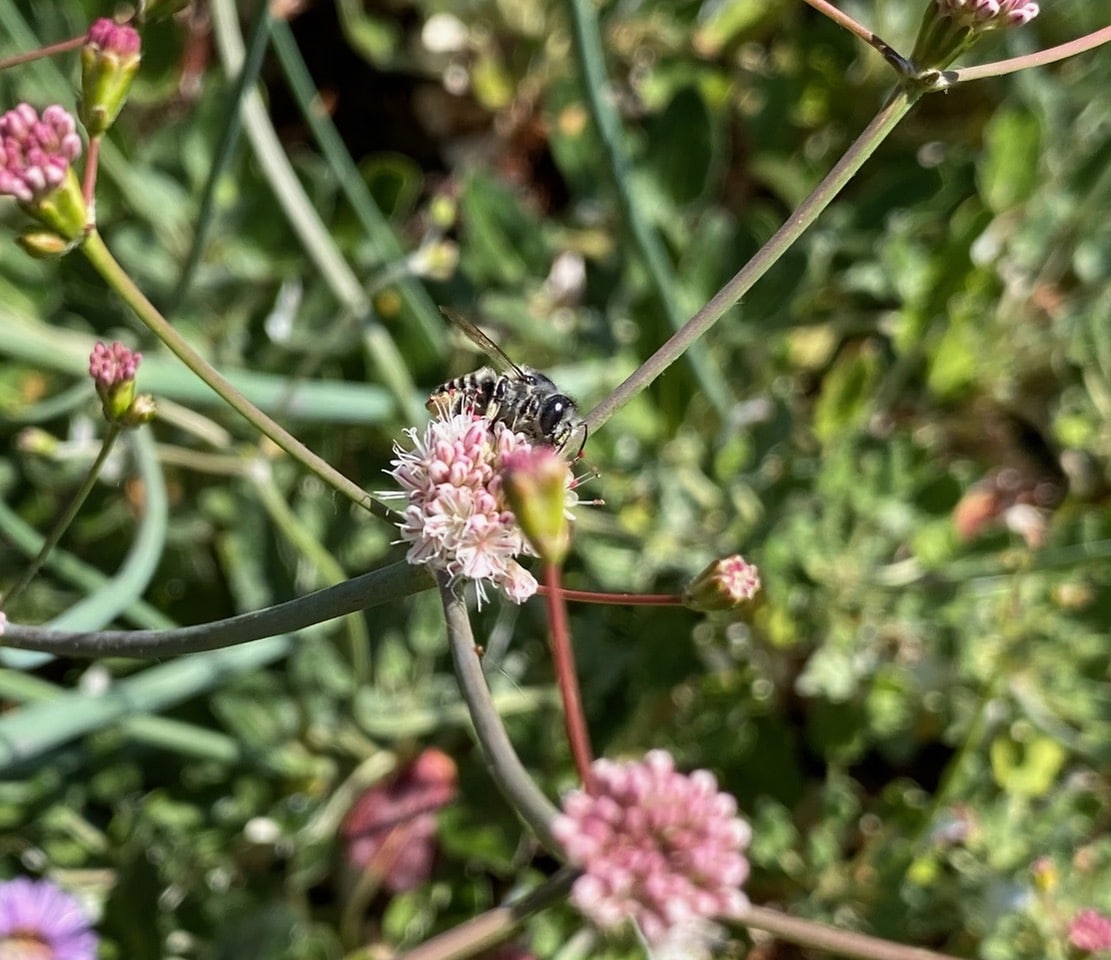
Ooh, who’s that unfamiliar black-and-white insect that has just landed on that cluster of buckwheat flowers?
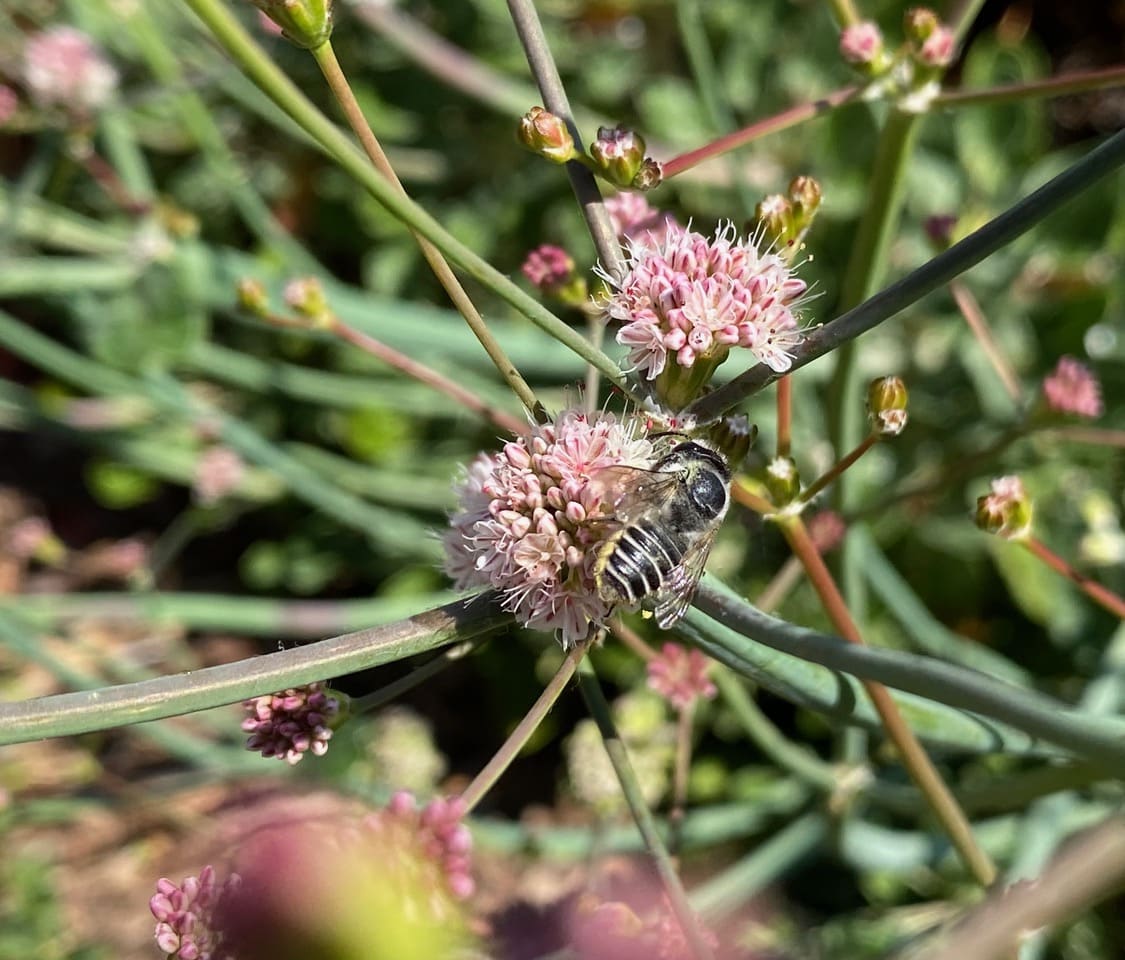
Closing in I realize that it is an Alfalfa Leafcutter Bee, Megachile rotundata (family Megachilidae).
Leaf-cutter Bees, Megachile sp. (family Megachilidae) are stout-bodied, usually with pale hair on the thorax and stripes of white hairs on the abdomen. Females usually have a triangular abdomen with a pointed tip, and males’ faces are covered with dense, pale hair. Flight season is from May into September, with peak activity from June to August. Solitary females construct nests in tubular cavities, including hollow stems, tree holes, and abandoned beetle burrows in wood. Many use holes drilled into wood, straws, or other manufactured tunnels. Females cut pieces from leaves or flower petals for use in the construction of brood cells. Most Megachile females are generalist foragers, but prefer flowers in the family Asteraceae. Pollen is transported in dense scopae (special pollen collecting hairs) on the underside of the abdomen.
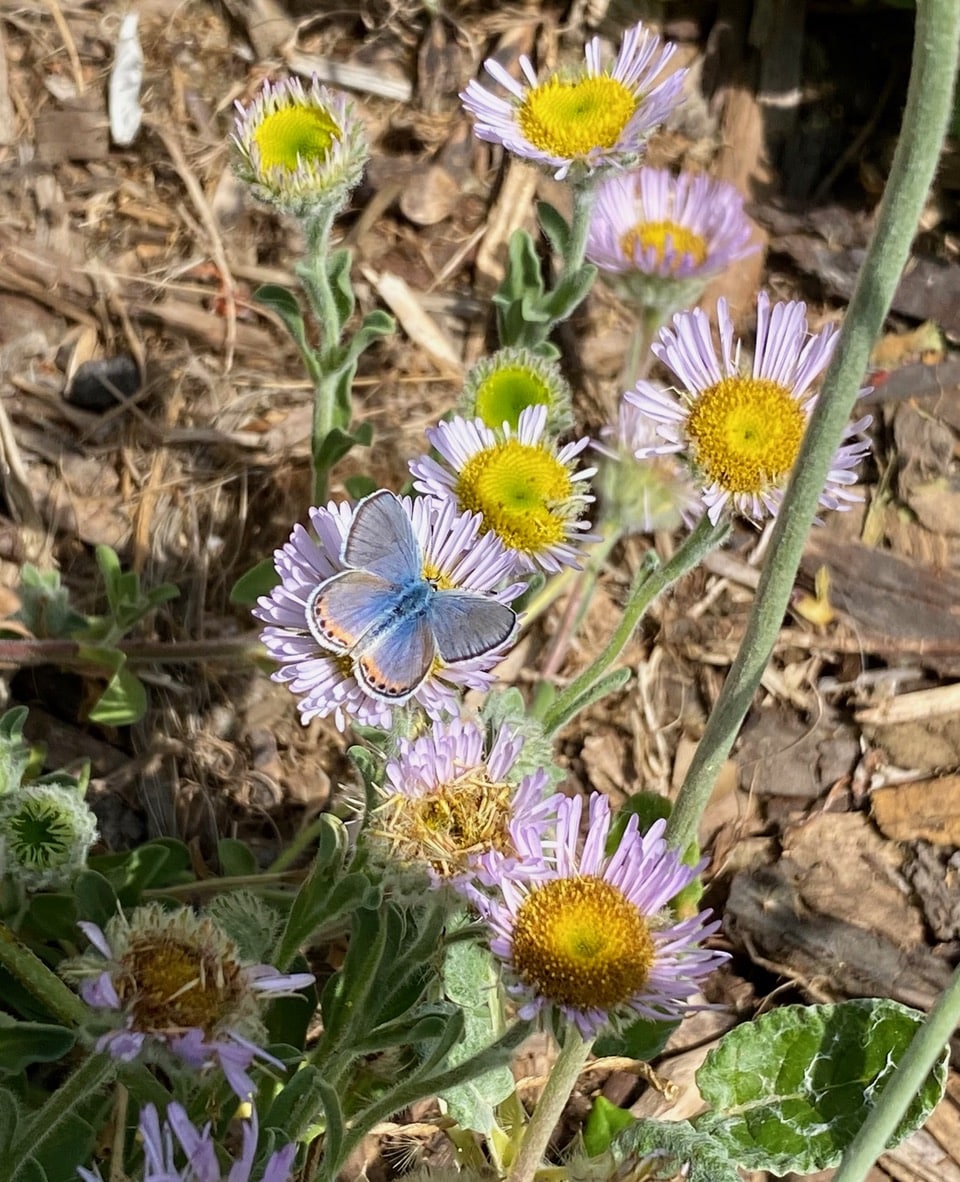
An Acmon Blue butterfly has settled on a flowerhead of Seaside Daisy, Erigeron glaucus to take nectar. Stefanie’s garden is aflutter with these dainty butterflies – they are everywhere. That’s because she has planted several species of buckwheat in her garden, all in bloom now. While the butterfly favors buckwheats for their larval food plant, the adults take nectar from a wide variety of flowers.
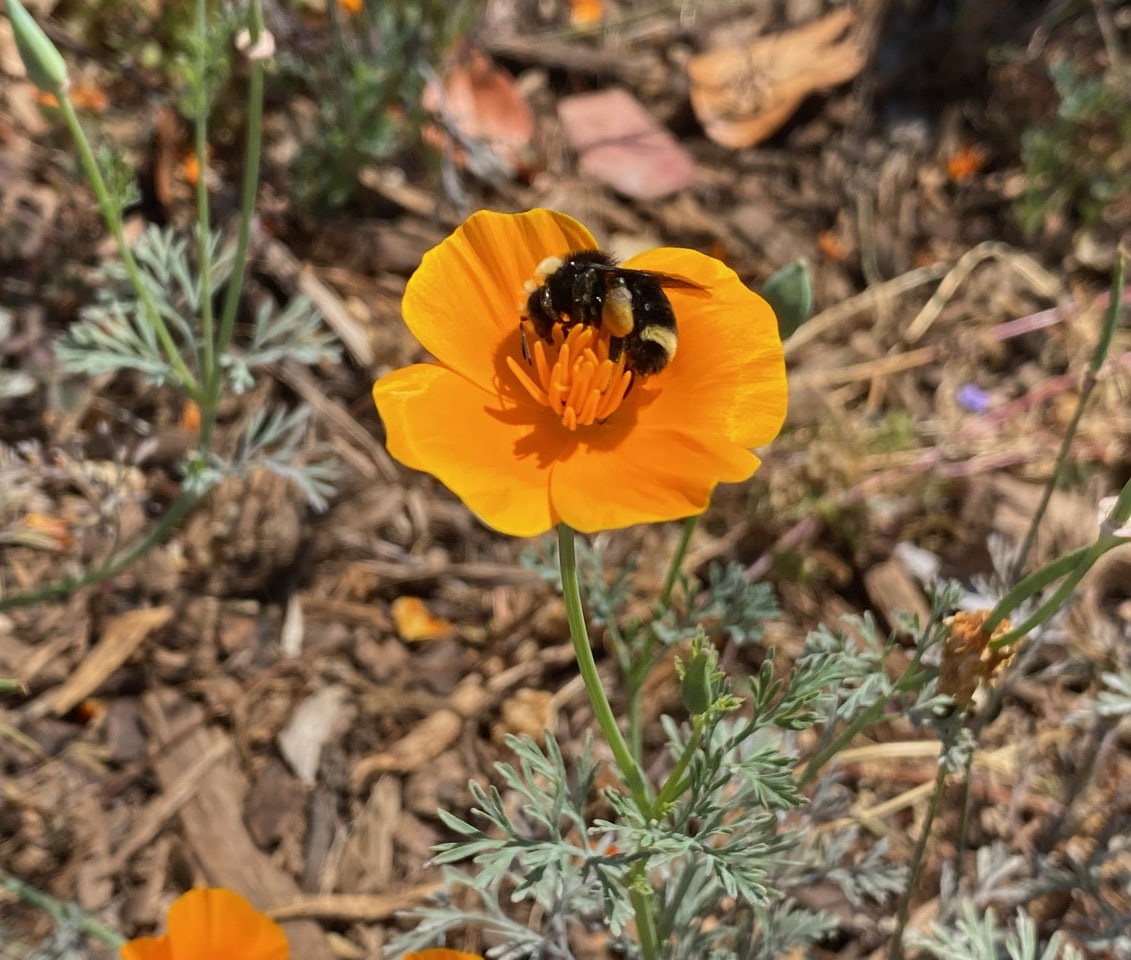
A Yellow-faced Bumble Bee, subgenus Pyrobombus (genus Bombus, family Apidae) is foraging on a flower of California Poppy, Eschscholzia californica. Poppy flowers do not produce any nectar, but offer generous amounts of pollen in their large, elongate stamens. The pollen load in the bee’s corbicula is not purely orange – she has been gathering pollen of various colors from different flowers. Bumble bees are the quintessential generalist forager.
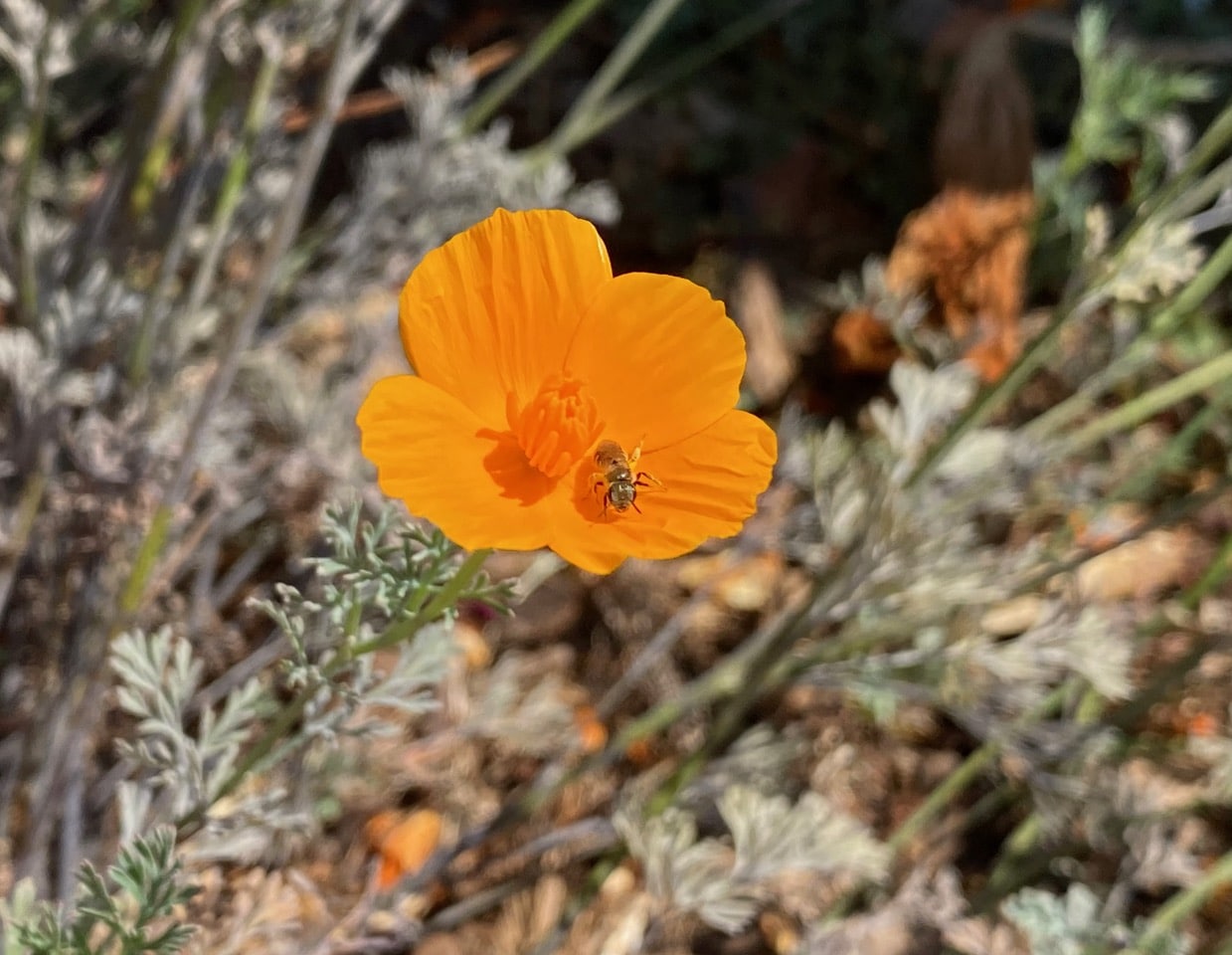
It scopae loaded with pollen, a tiny bee is crawling out of a California Poppy flower.
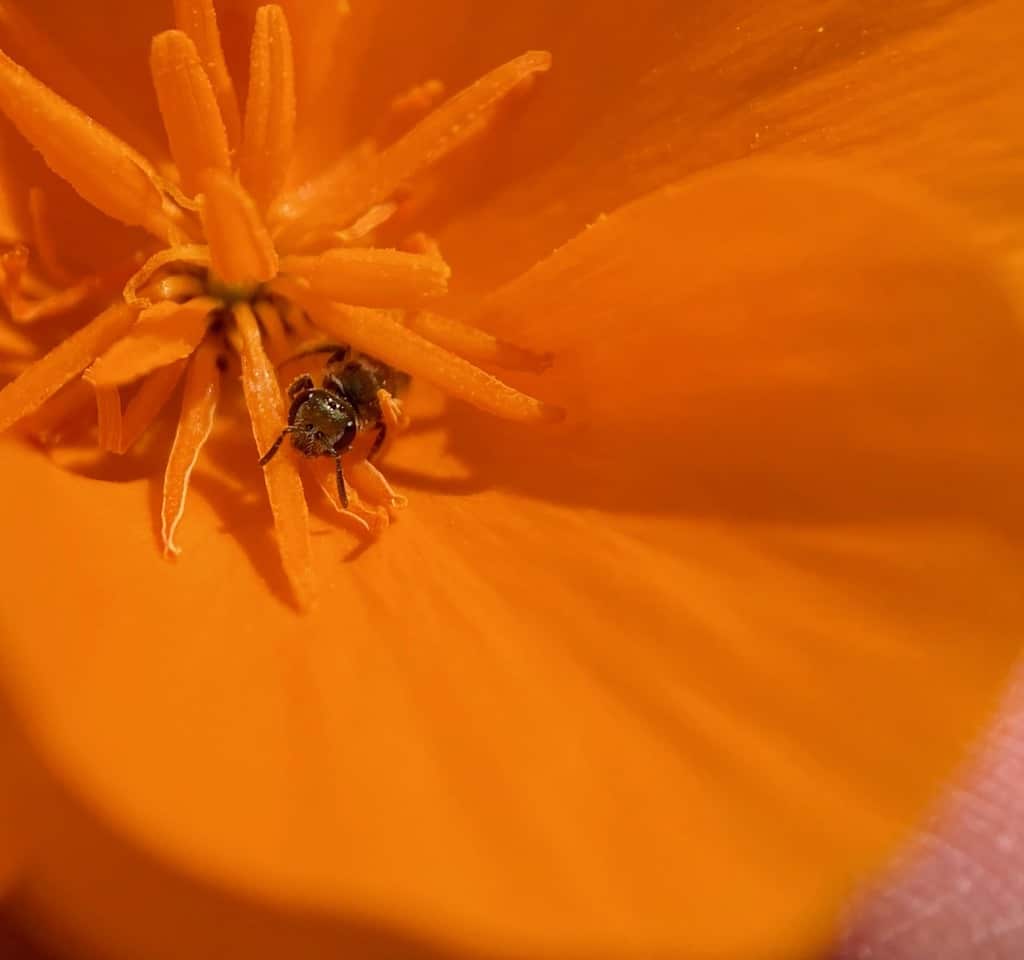
Dwarfed by the poppy stamens, a tiny bee is collecting pollen at the base of the flower among the anthers. The work often involves the use of the bee’s jaws.
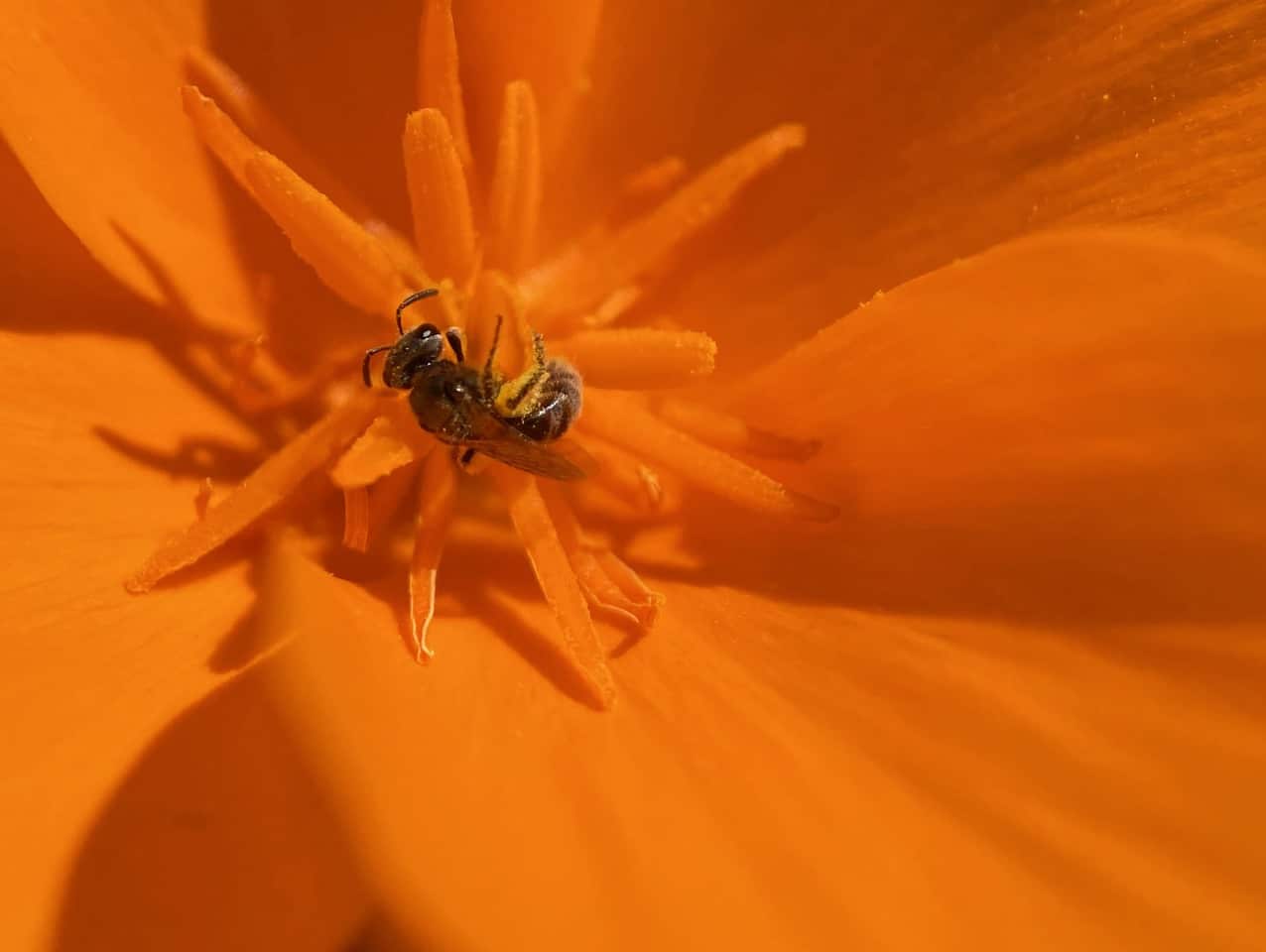
For the little bee, the job is a dull-body workout.

Ah, from this view, I can tell that it is a Metallic Sweat Bee, Lasioglossum (Dialictus) sp. (family Halictidae).
Lasioglossum species are found worldwide, and they constitute the largest bee genus. The subgenus Dialictus are the most likely to be seen in the U.S., with over 300 species of these tiny metallic bees. The majority of Lasioglossum are generalists. Because they are so abundant throughout the flowering season, the bees are often important pollinators. Their sheer numbers are enough to achieve excellent pollination of many wild flowers, especially of plants in the Asteraceae, which have shallow floral tubes that are easily accessed by these minute bees.
Lasioglossum exhibit a range of social behaviors; the genus includes solitary, communal, semi social, primitively eusocial, and even parasitic species. Almost all Lasioglossum in the U.S. nest in the ground. Generally these nests are built in the spring by fertilized females (called foundresses) that spent the winter in hibernation. In social species, the foundresses behave much like the queen bumble bees – they lay the first batch of eggs that develop into the first generation of female workers. The nest grows with each additional generation of bees. Later broods may consist of both males and females. They mate, and at the end of the season the fertilized females hibernate til the following spring, repeating the life cycle of the colony.
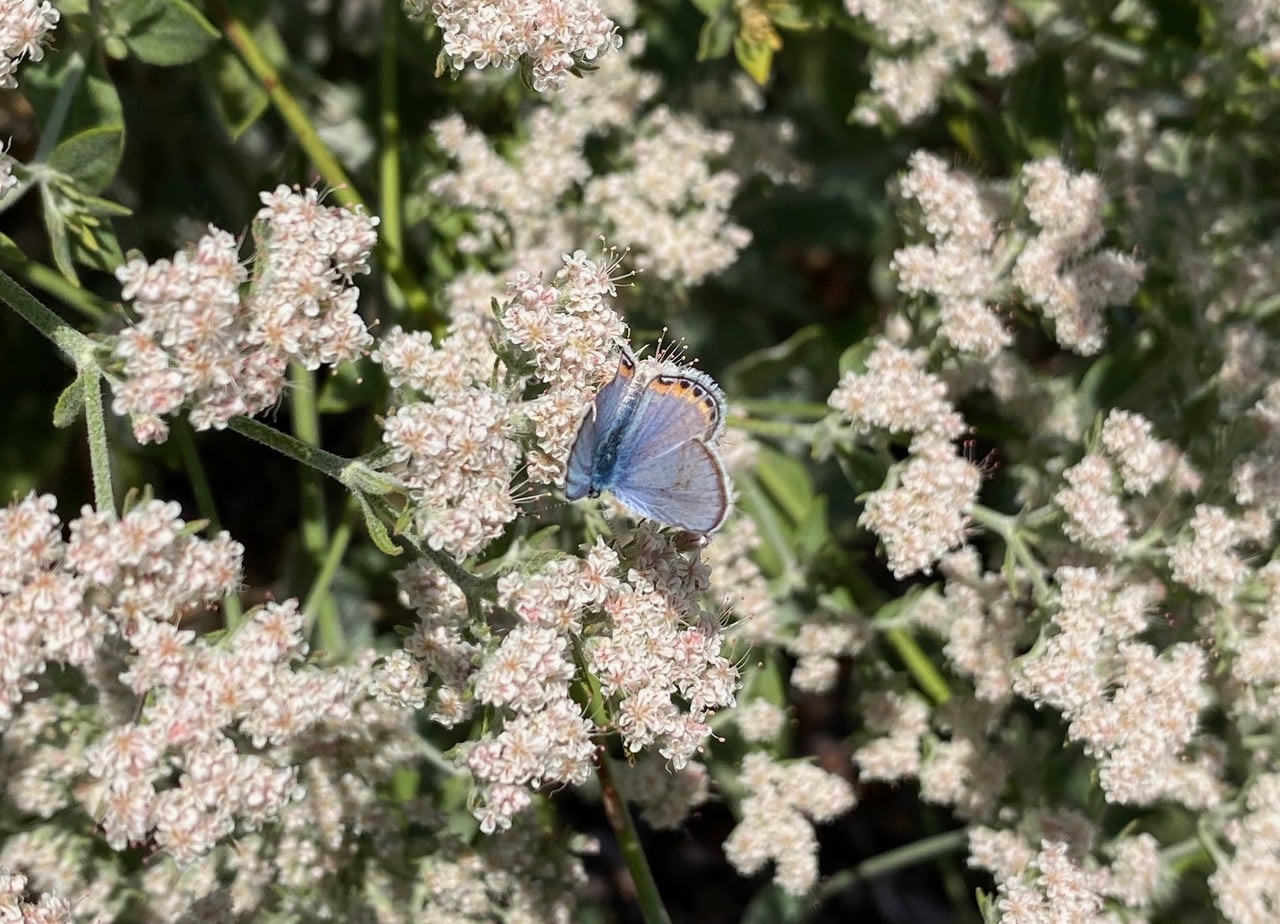
Another Acmon Blue butterfly on the flowers of St. Catherine’s Lace, Eriogonum giganteum. It’s a good place for the male to hang out, waiting for the females who come to lay their eggs.

A Bronze Leaf Beetle, Diachus auratus (family Chrysomelidae) is so minute it is dwarfed by even the small flowers of the Buckwheat.
The Bronze Leaf Beetle, Diacus auratus (family Chrysomelidae) is a small, shiny, “bullet-shaped” beetle that feeds on the leaves, flowers, and fruits of plants, particularly berry crops such as strawberries, raspberies, and blackberries. It is a species of case-bearing leaf beetle in the subfamily Cryptocephalina, known for larvae that create cases out of feces and debris. The species is widespread in North America, as well as parts of Central and South America, Australia, and Asia. Adults, 1-2 mm, are found on many unrelated plants, especially plants in bloom. The larvae live underground and feed on the roots of plants, specifically grass and clover. As she lays her eggs, the female covers each one with a layer of excrement. After the larvae hatch, they retain this covering (case) as camouflage and add to it throughout their larval life. When disturbed, the larvae pull in their head and legs; because their color and shape resemble caterpillar droppings they are ignored by predators. Eventually the larva seals the case to pupate inside, before emerging as an adult. Some species are myrmecophiles, living near or even inside ant nests.

In the side yard, a scruffy little bee is foraging on a cluster of flowers of Sea Cliff Buckwheat, Eriogonum parvifolium. A close-up view shows distinct facial fovea on her face. She’s a Mining Bee, Andrena sp. (family Andrenidae)!
Bees in the family Andrenidae, commonly called miner bees or mining bees, are solitary ground-nesters. Andrenids are fairly small bees, usually dark-colored, and often banded. They are identified by the dense bristles (scopae) at the bases of the legs and the shin-like sections (tibias) of the legs, as well as by certain creases and grooves on the face and head and by unique wing venation. Many Andrenids resemble wasps – slender with long abdomen.
Most andrenids are specialist pollinators whose life cycle is timed to correspond precisely to the blooming of specific flowers. Because of this, andrenids are some of the first bees to emerge in spring, and many are active in March and April, as they visit early spring wildflowers.
All Andrena species share a distinctive facial characteristic: facial depressions called fovea resting alongside the sutures under each antenna. The foveae are covered with hairs that are sometimes described as looking like “sideways eyebrows”. Another distinguishing Andrena trait is that females appear as if they carry pollen under their “armpits”. This is because they have propodeal corbiculae in the space between their thorax and abdomen.
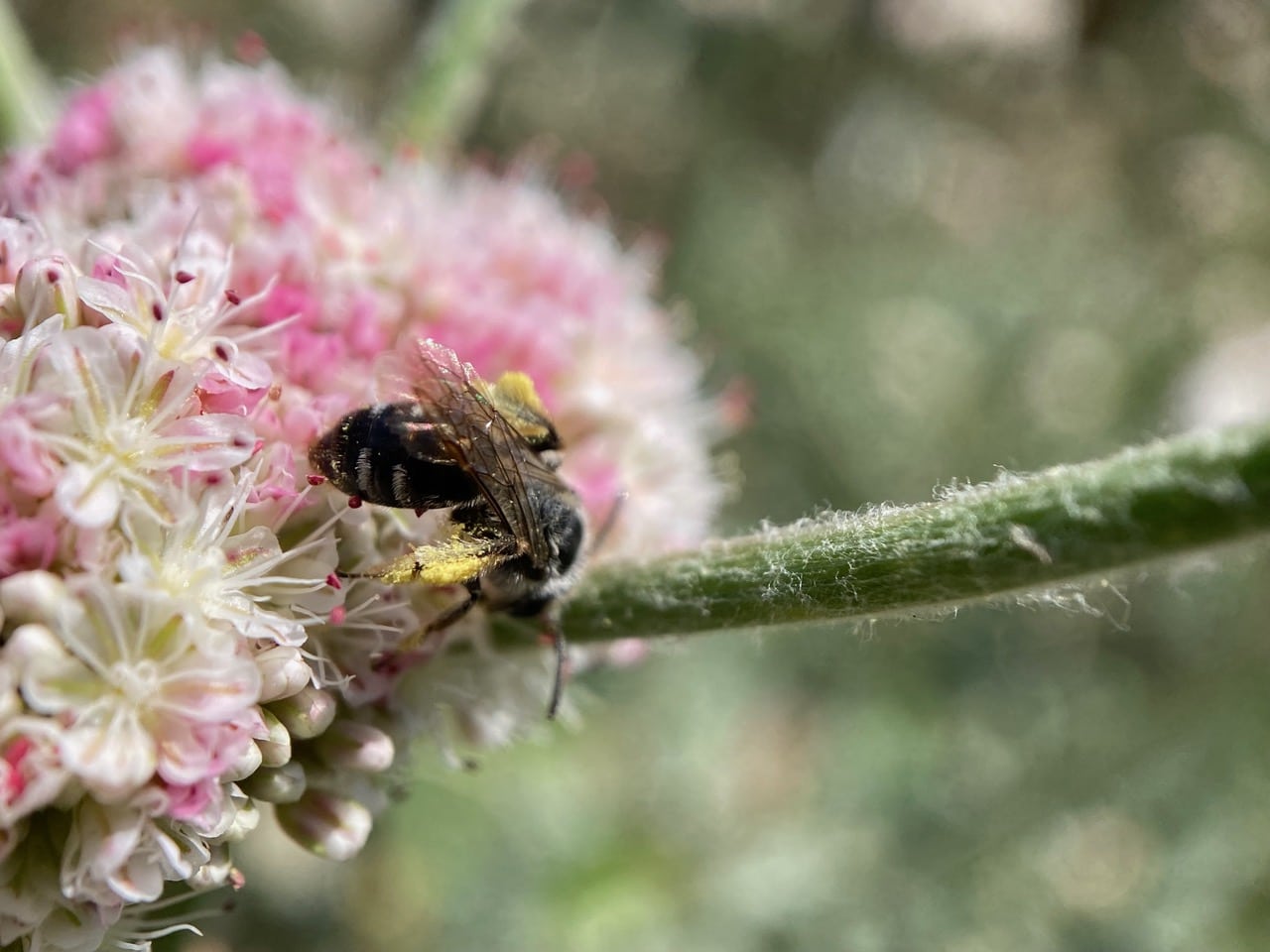

There, that’s the facial fovea again – the “sideways eyebrows”!
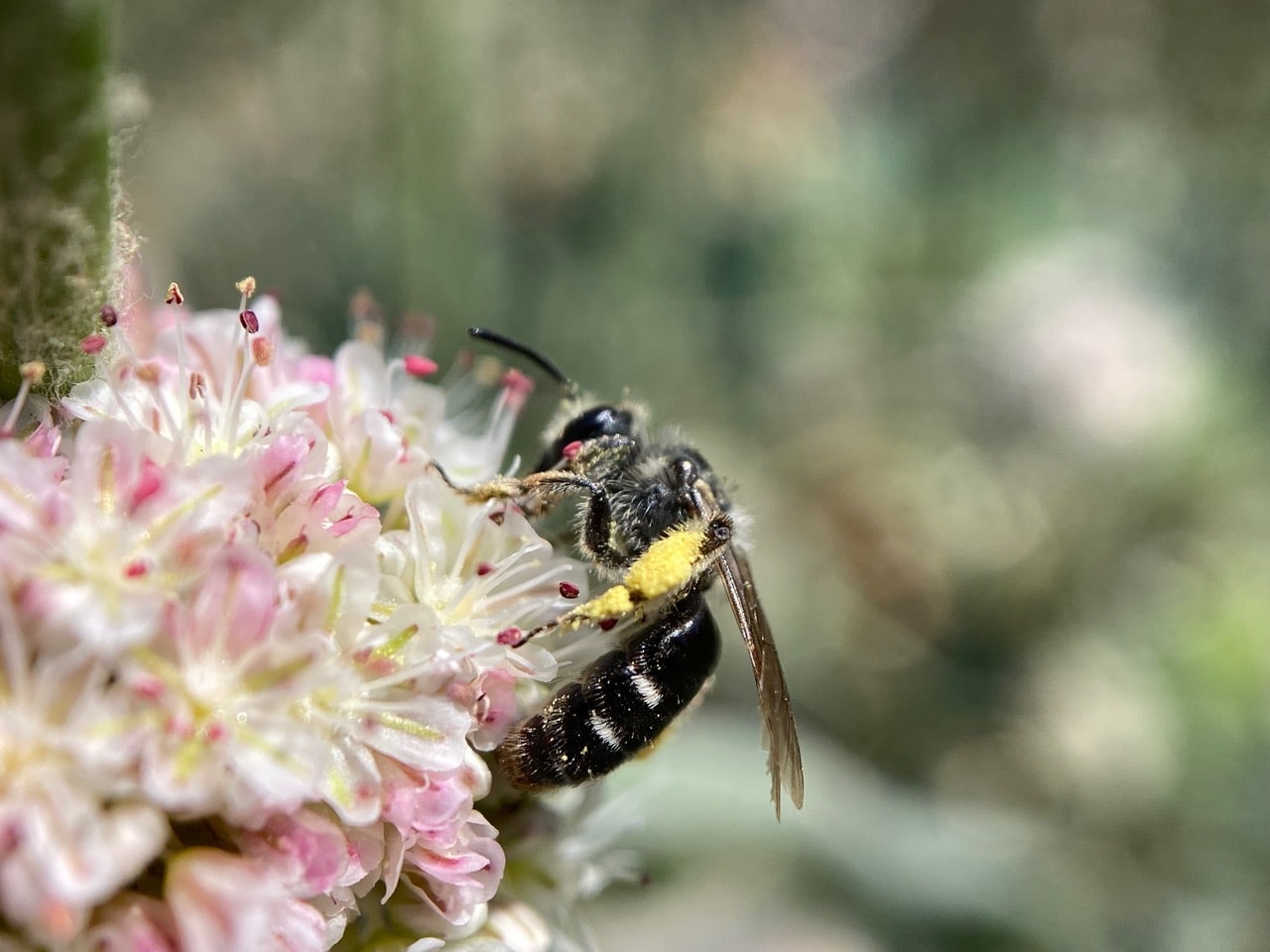
Note the slender build and long abdomen of the Mining Bee. Note also that the scopa extends the full length of the hind leg.
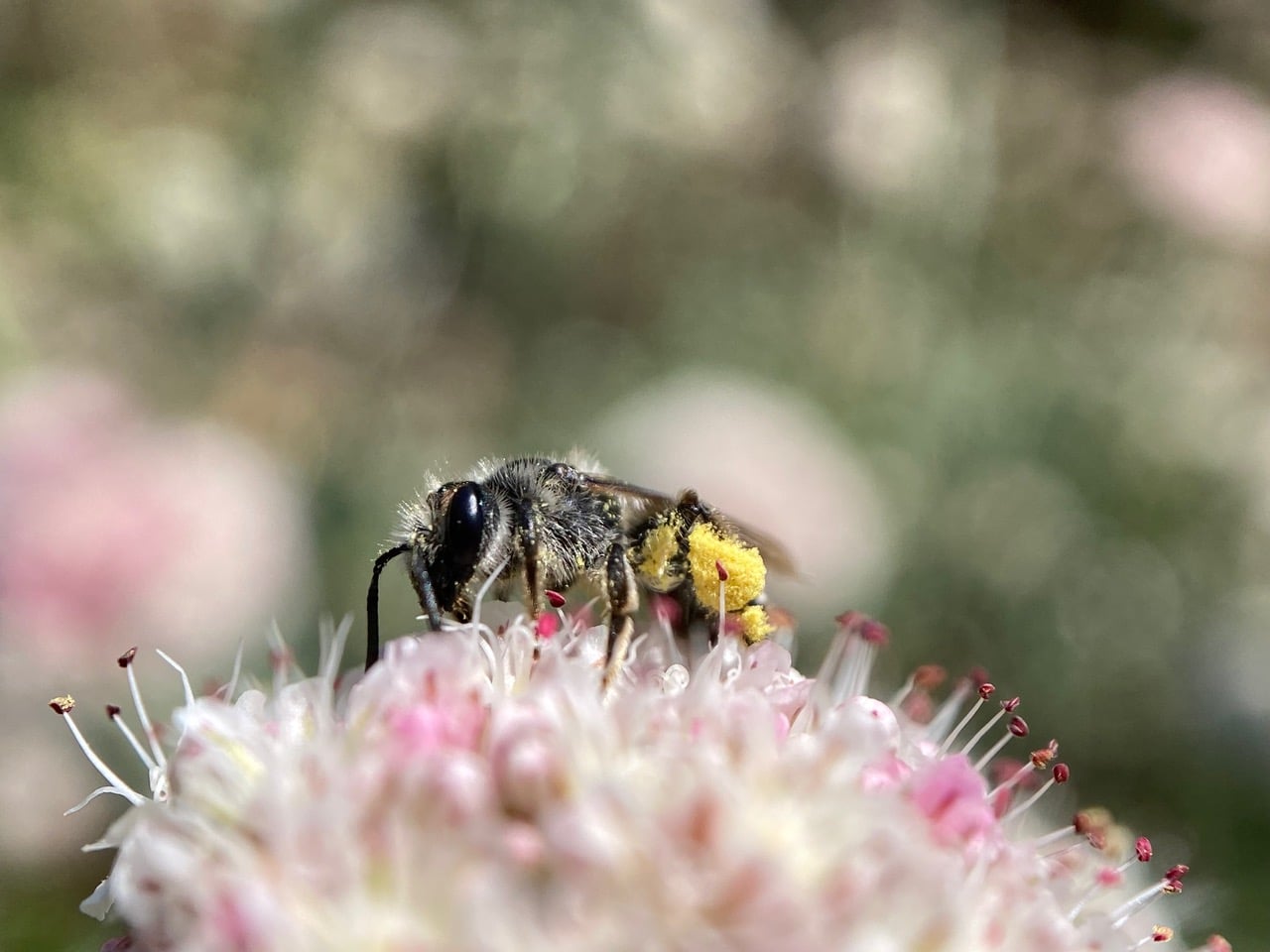
This view gives a hint of the propodeal corbicula located in the space between the thorax and abdomen, characteristic of Andrena.

This is the first time I have recorded a Mining Bee in Stefanie’s garden!