

Pollinator Post 6/18/25 (2)
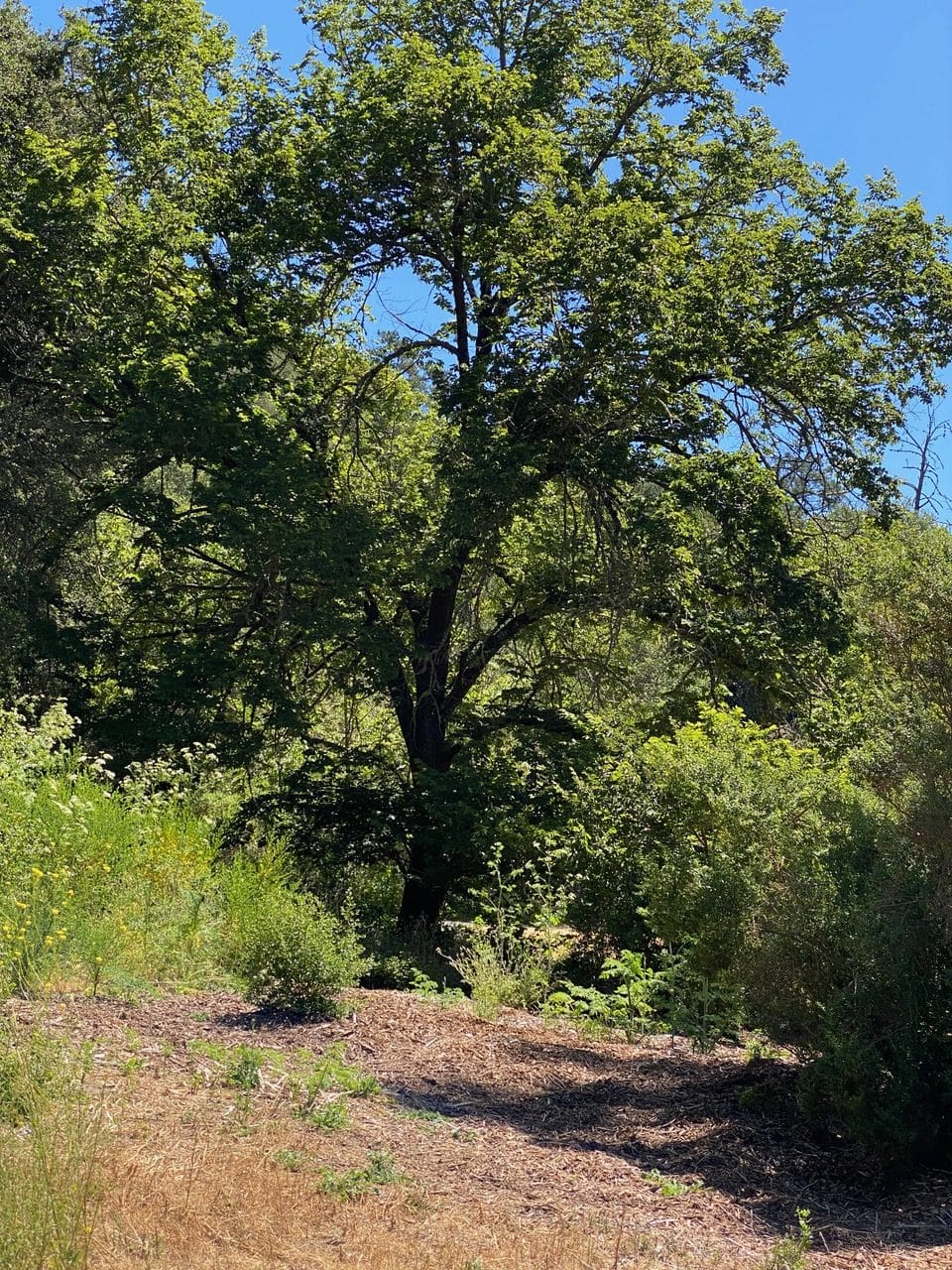
When I look up from photographing insects I was amazed to see large numbers of insects swarming over the lawn area near the children’s playground. They don’t show up in this photo at all. The insects look bigger than midges, but I can’t tell for sure until I see them land.
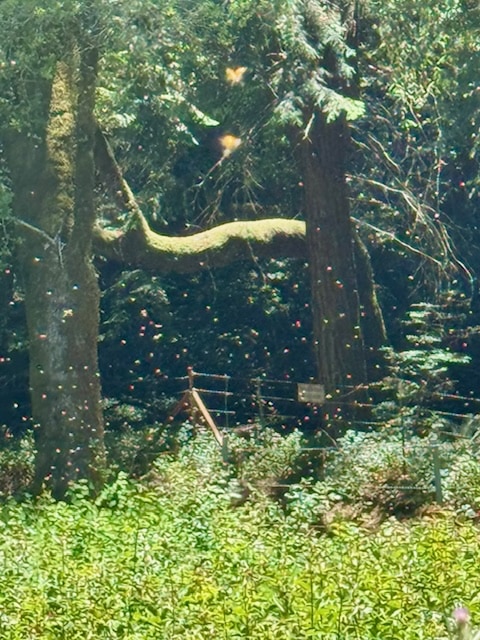
Here’s a better picture from my friend Julie who witnessed the swarming somewhere else in the Oakland hills. You can actually see the beetles in the air.
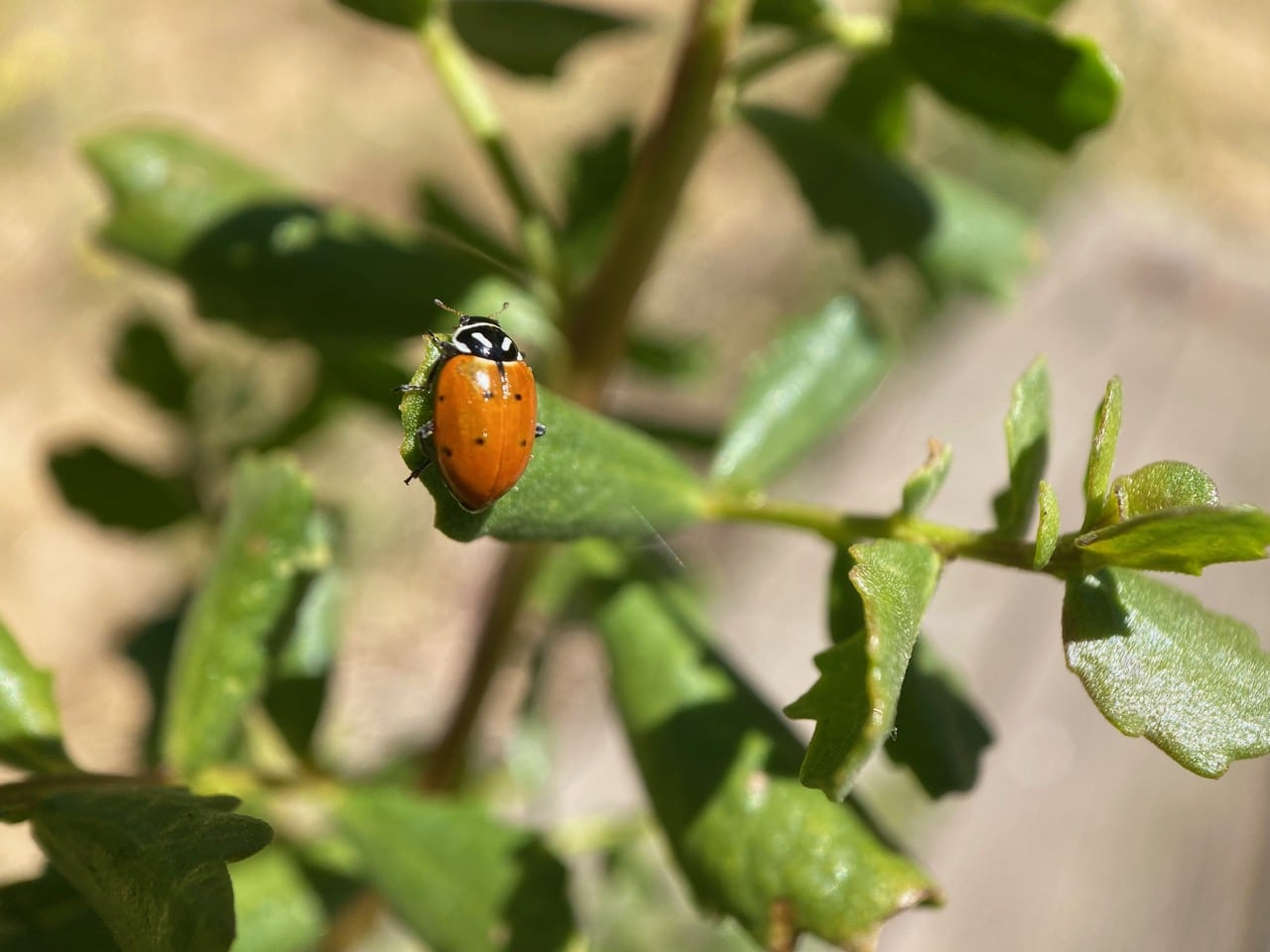
A Convergent Lady Beetle, Hippodamia convergens (family Coccinellidae) lands on a leaf of Coyote Brush. It is well-known that this species overwinters in this park. Wow, I thought they woke up from hibernation a while ago, and I have been seeing scattered ones in parks and gardens in the area through spring. Why are they swarming today? The timing confuses me. Lady Beetles typically swarm in the fall as they prepare for winter. They seek sheltered locations, outdoors and sometimes indoors. This swarming behavior usually occurs on warm days following cooler temperatures, particularly in the afternoon.
I consulted my entomologist friend Eddie Dunbar about the swarming lady beetles. This is his reply:
“The fall swarms are to overwinter. Overwintering is over now and they’re swarming back out – to disperse. In my opinion, yes, it’s late, but they have dispersed this late before. You can check iNat for frequency of sightings in the park by month. I think they’ll show June is not unusual for dispersal swarms.”
Convergent Lady Beetles swarm in warm weather because it triggers their migratory and reproductive behaviors. Warm temperatures signal the end of their winter dormancy (diapause) and encourage them to seek out food sources like aphids and pollen, which are more abundant in warmer months.
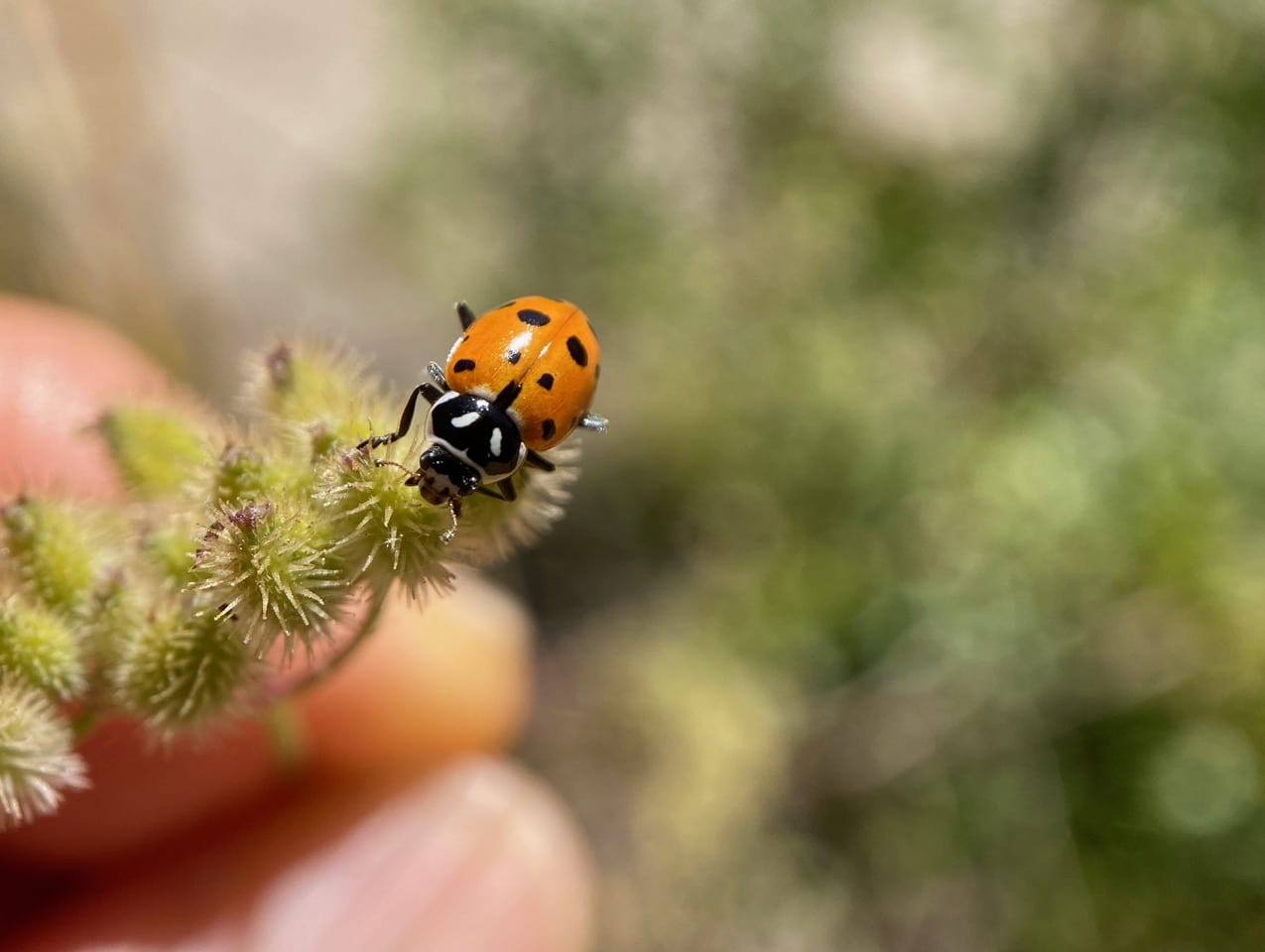
Another Convergent Lady Beetle lands on some Torilis seed heads. This individual has much larger spots on the elytra. The markings on the elytra are highly variable, some with no black spots at all. The characteristic feature of the species is the pair of white “converging” lines on their black pronotum.

A Small Carpenter Bee, Ceratina sp. (family Apidae) is foraging on a Wild Mustard flower. Is that its tongue we see reaching way down to the base of the flower to access nectar? The bee is female – she has pollen in the scopa on her hind leg. Male bees do not collect pollen to provision the nest.
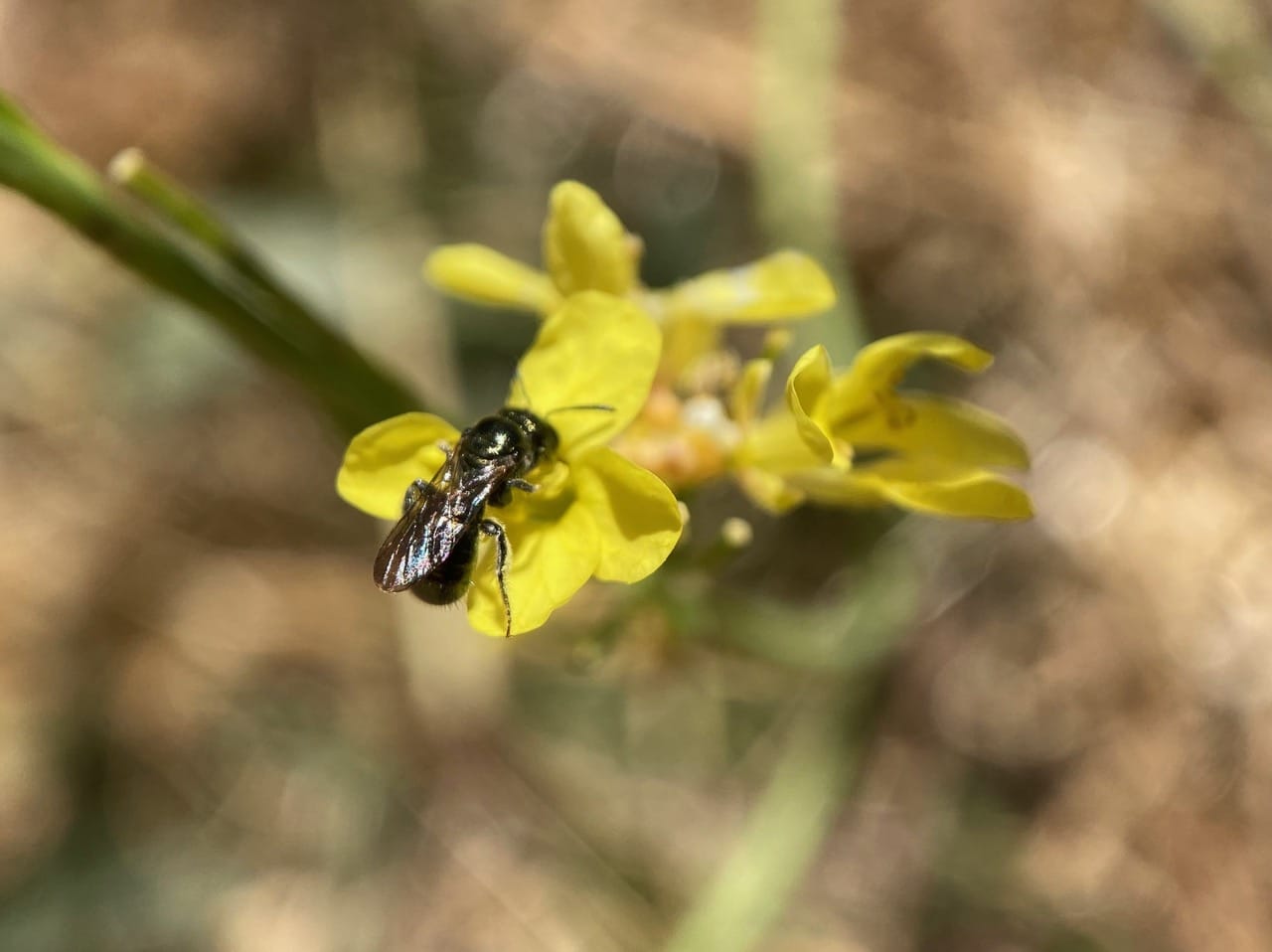

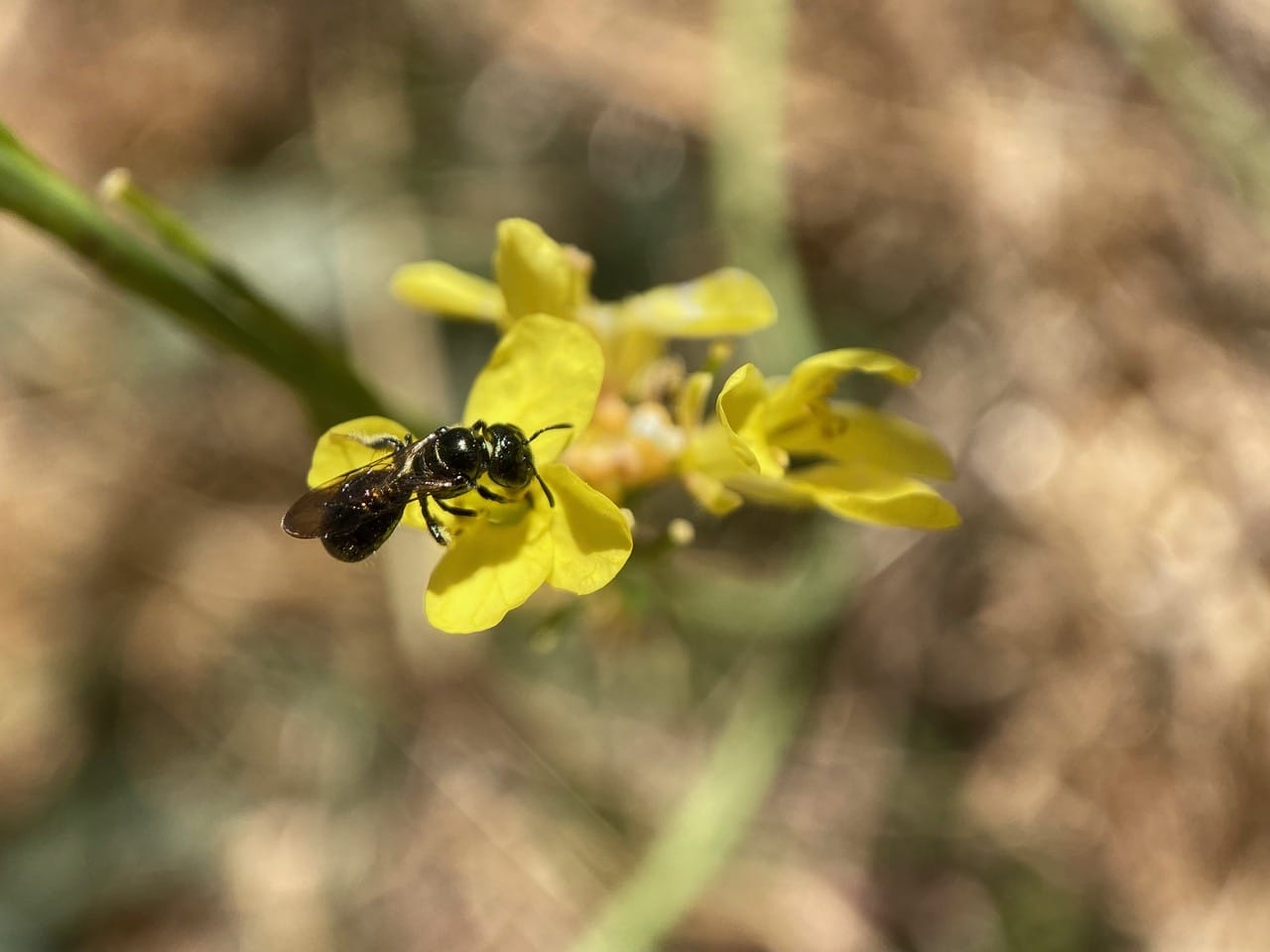
The Small Carpenter Bee genus Ceratina is closely related to the more familiar, and much larger Carpenter Bees (genus Xylocopa). Ceratina are typically dark, shiny, even metallic bees, with fairly sparse body hairs and a weak scopa on the hind leg. The shield-shaped abdomen comes to a point at the tip. Some species have yellow markings, often on the face.
Females excavate nests with their mandibles in the pith of broken or burned plant twigs and stems. While many species are solitary, a number are subsocial. Both male and female carpenter bees overwinter as adults within their old nest tunnels, emerging in the spring to mate. In the spring, this resting place (hibernaculum) is modified into a brood nest by further excavation. The female collects pollen and nectar, places this mixture (called bee bread) inside the cavity, lays an egg on the provision, and then caps off the cell with chewed plant material. Several cells are constructed end to end in each plant stem.


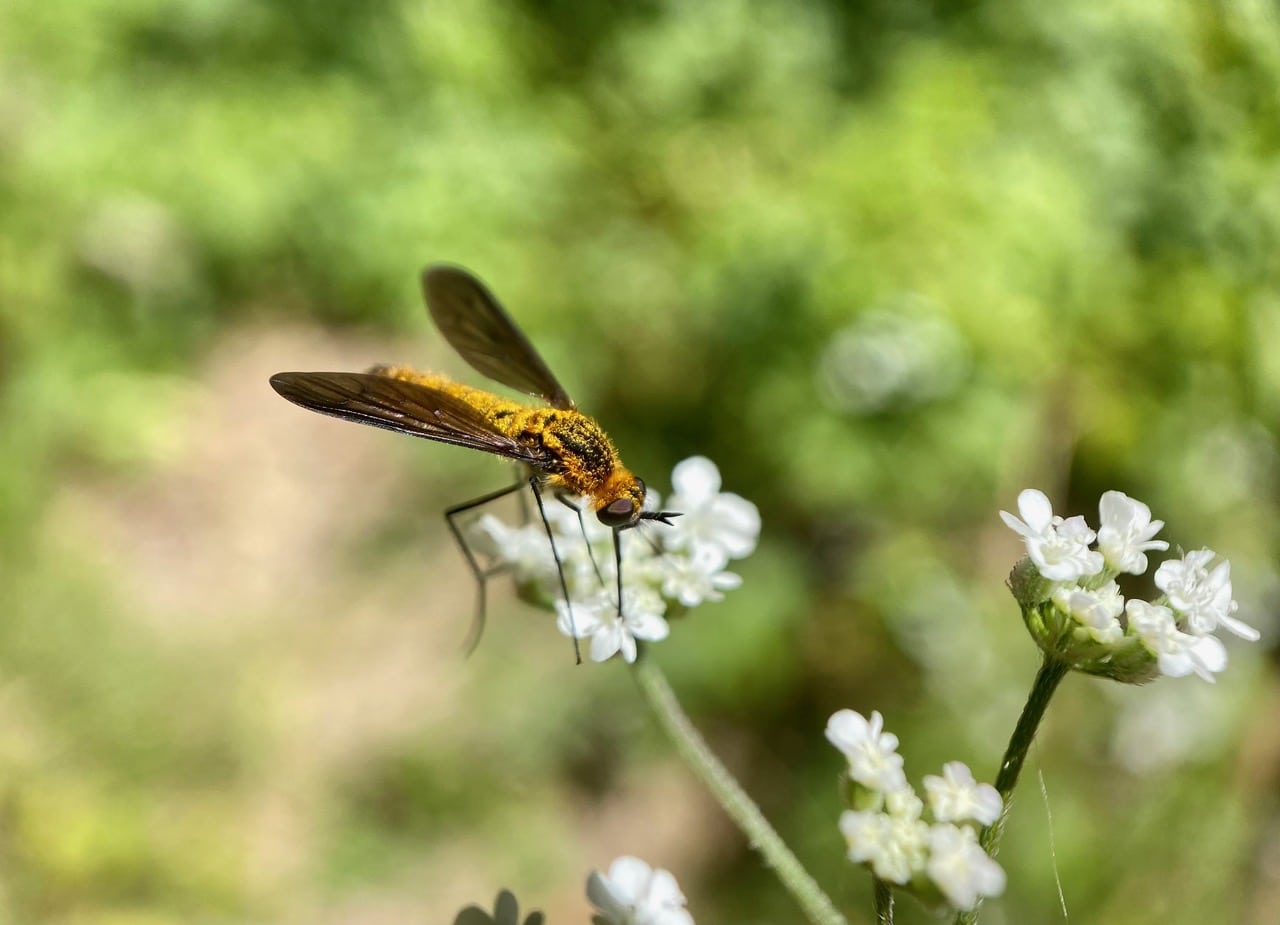
Some small, mosquito-like insects are visiting the umbels of white Torilis flowers. They look almost like Dance Flies (superfamily Empidoidea), but their behavior is more typical of some Bee Flies (family Bombiliidae). When disturbed, they tend to fly up, bob up and down in place before settling down again. You can almost tell where they are going to land. I have often seen this behavior on the Bee Flies in the genus Geron.


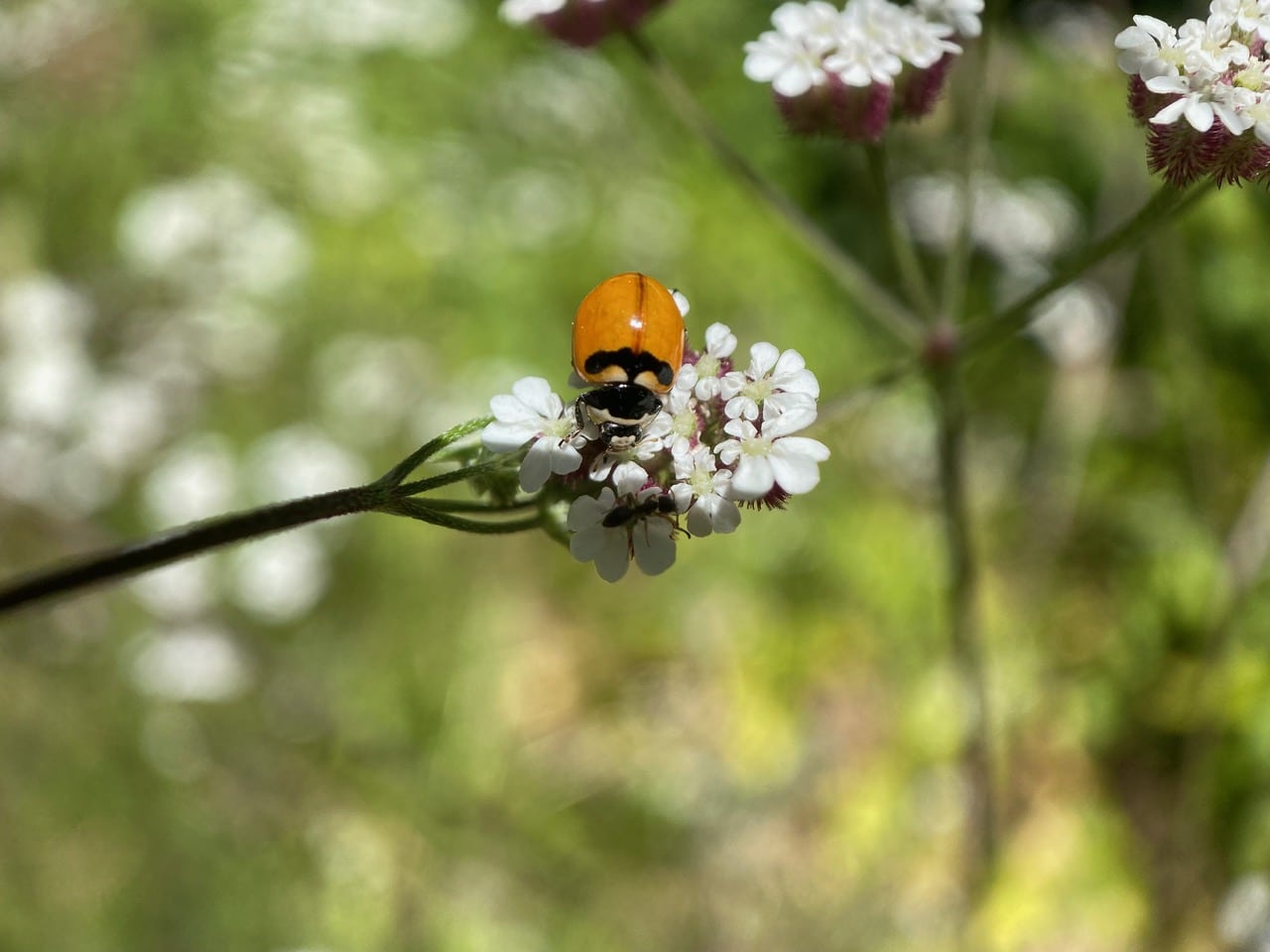
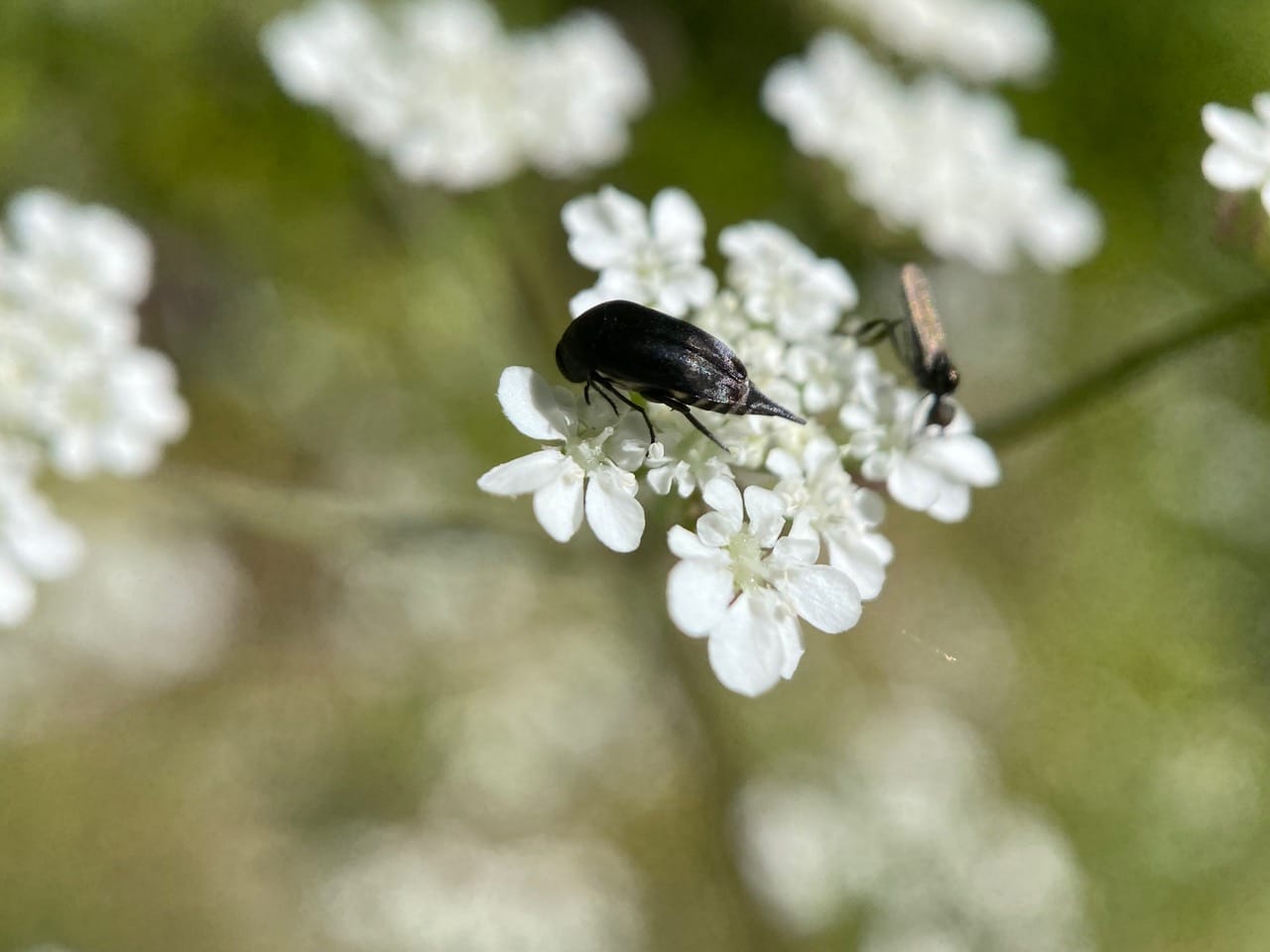
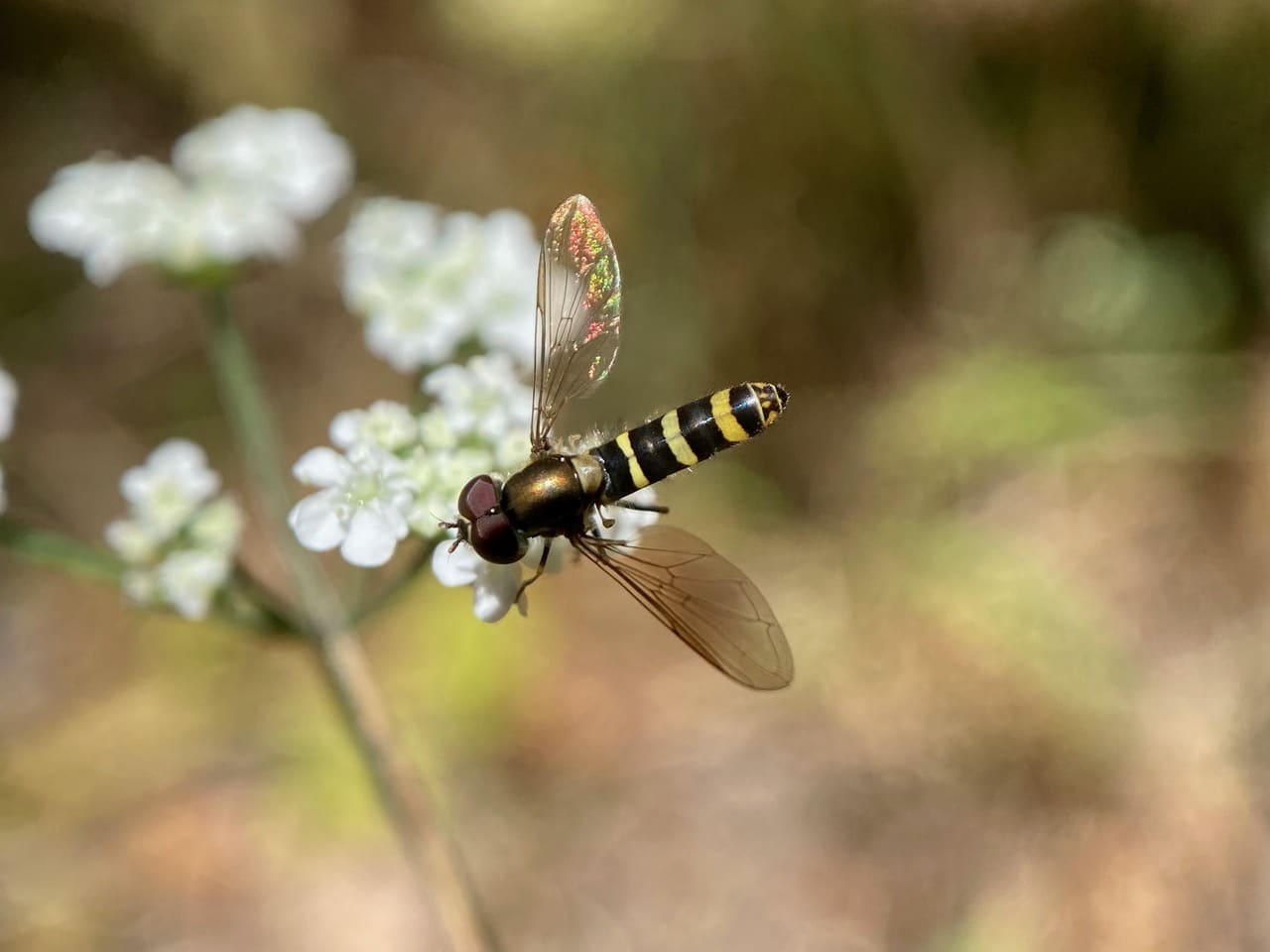


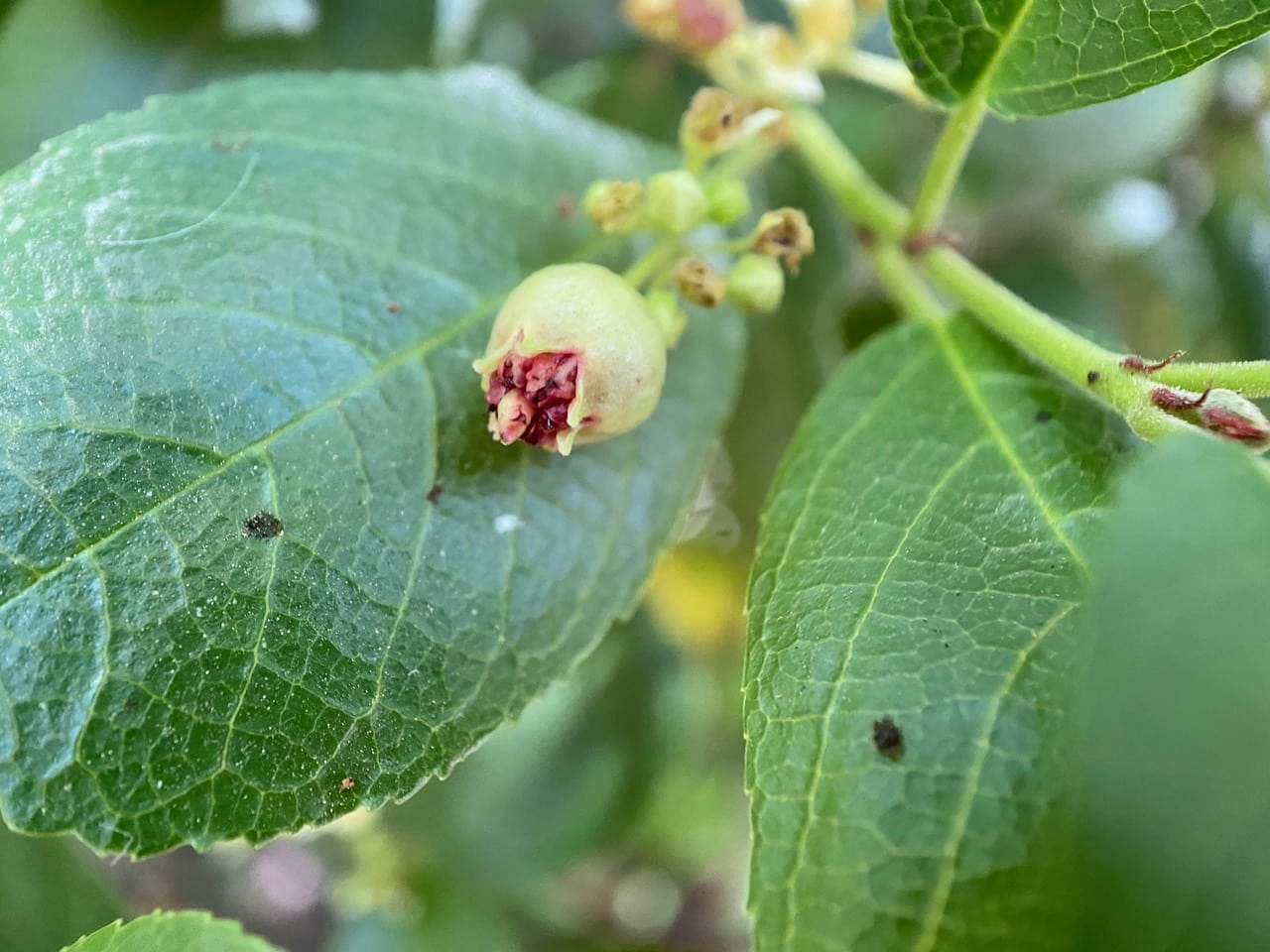

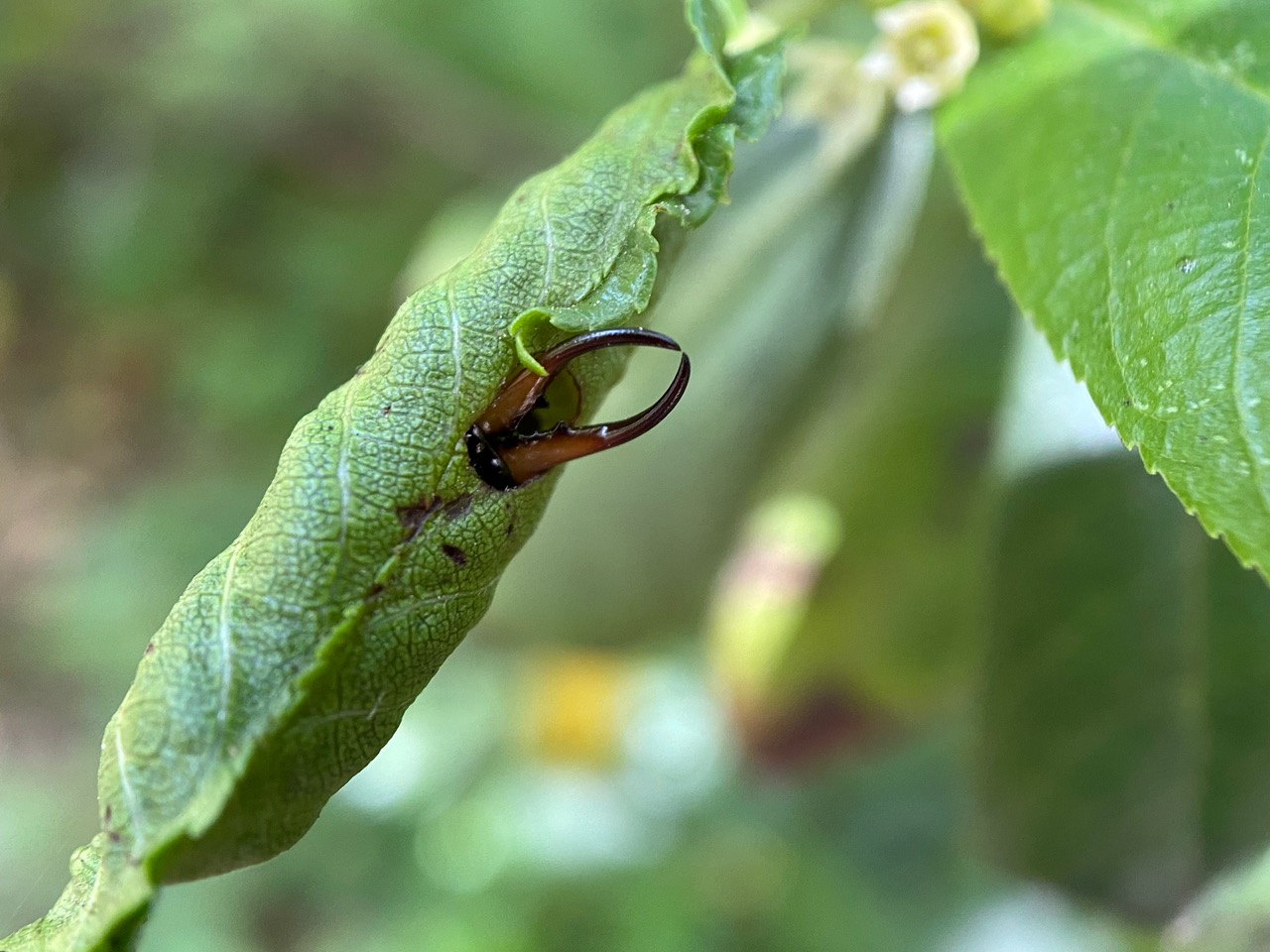
This Bee Fly has straight, long proboscis that it can aim into the tiny Torilis flowers. It has long, skinny legs, and its dark body is covered with scattered glittery golden scales.



Here’s another one of the Bee Flies. iNaturalist has helped identify it as a member of the subgenus Thevenetimyia (family Bombyliidae).
The Bee Flies belong to the family Bombyliidae. Adults generally visit flowers for nectar and pollen, some being important pollinators. Larvae generally are parasitoids of other insects. When at rest, many species of bee flies hold their wings at a characteristic “swept back” angle. The adult females usually deposit eggs in the vicinity of possible hosts, quite often in the burrows of beetles or ground-nesting bees/wasps. Bombyliidae parasitism is not host-specific, but rather opportunistic, using a variety of hosts.
Thevenetimyia is a genus of bee flies in the family Bombyliidae. There are more than 40 described species in Thevenetimyia found worldwide, mostly in North America. They are parasites of wood-boring beetle larvae.
Whoa, here’s another Bee Fly with shiny golden scales in the same patch of Torilis flowers. It is at least twice as large and robust as the others, with large smoky wings. Interestingly iNaturalist has also identified it as a member of the subgenus Thevenetimyia (family Bombyliidae). Is this individual a female of the species? There’s quite a sexual dimorphism! There’s no information about this Bee Fly that I can find to verify my suspicions. It is conceivable, albeit unlikely that two different species of Bee Flies are foraging on the same flowers.
What an interesting creature. Looks like those shiny scales can come off easily. Why would an insect evolve to be so conspicuous?
Hey, here’s a different species of Lady Beetle – the Pacific Three-banded Lady Beetle, Coccinella trifasciata subversa (family Coccinellidae).
“Three-banded”? The species is rather variable depending on its range. The ones found east of the Rockies are indeed three-banded. Species Coccinella trifasciata – Three-banded Lady Beetle – BugGuide.Net Here in California, we have the subspecies Coccinella trifasciata subversa, also known as the Pacific Three-banded Ladybeetle. Photos of Pacific Three-banded Lady Beetle (Subspecies Coccinella trifasciata subversa) · iNaturalist These beetles are active from spring through summer months and on warm days of fall; diapausing (that’s insect version of hibernation) through the colder winter months.
Sharing a umbel of Torilis flowers is a Tumbling Flower Beetle (family Mordellidae).
The Tumbling Flower Beetles (family Mordellidae) are named for the characteristic irregular movements they make when escaping predators. They are also sometimes called Pintail Beetles for their abdominal tip which aids them in performing these tumbling movements. Mordellids are small, wedge-shaped, hump-backed beetles with head bent downward. The body is densely covered with fine silky hairs, usually black, but often very prettily spotted or banded with silvery hues. The adults feed on pollen, occurring on flowers or on dead trees, flying or running with rapidity. The larvae live in old wood or in the pith of plants, and those of some species are said to be carnivorous, feeding on the young of Lepidopterans and Diptera which they find in the plant stems.
A male Diamond Spottail, Fazia micrura (famy Syrphidae) lands on an umbel of Torilis flowers. Note the characteristic four diamond-shaped yellow markings near the tip of the abdomen. How do I tell it’s a male? The fly has a slender, parallel-sided abdomen, and it also has holoptic eyes that meet on top of the head.
Hover Flies, also called flower flies or Syrphidae flies, make up the insect family Syrphidae. The adults of many species feed mainly on nectar and pollen, and are often seen hovering and nectaring at flowers. They are important pollinators of flowering plants in many ecosystems worldwide. The larvae feed on a wide range of foods. In many species, the larvae are insectivores and prey on aphids, thrips, and other plant-sucking insects. In other species, the larvae are saprotrophs, eating decaying plant and animal matter in the soil or in ponds and streams.
Many species of Hover Flies exhibit Batesian mimicry; they are brightly colored, with bands of yellow resembling the bees and wasps. The mimicry provides the fly with some measure of protection from potential predators, although the flies are harmless and lack a sting.
The Diamond Spottail, Fazia micrura occurs in western North America, from British Columbia south to California and Texas; and Mexico. The slender, elongate fly measures 6-7 mm. The adult and larva feed on pollen. Females lay eggs on flowers. Larvae are often encountered in the field chewing through the calyx and corolla of unopened flower buds. They are known to feed on pollen in the anthers. Usually only one larva is found in each flower. This larval diet is rather unusual for hoverflies, most of which consist of aphids on plants or decomposing matter in aquatic environments, depending on the species.
It is easy to distinguish the genders in the hover flies. Males have holoptic eyes that meet on top of the head, while females’ eyes are set apart on the head.
I stop at the Coffeeberry, Frangula californica near the parking lot. What’s that radish globular structure among the greenish-yellow flowers? It is a flower bud galls induced by the Gall Midge, Asphondylia sp. (family Cecidomyiidae).
Plant galls are abnormal growths, resembling tumors or warts, that form on plants due to the influence of other organisms such as insects, mites, bacteria, fungi, or nematodes, providing them with food, shelter, and protection. The gall-inducing organism lays eggs or penetrates the plant tissue, triggering a response in the plant. The plant cells begin to proliferate and reorganize, forming the gall tissue within which the gall organism feeds, protected from predators and harsh environmental conditions. Different gall-inducing organisms can create galls with unique appearances, shapes, and colors, allowing for identification.
Asphondylia is a cosmopolitan genus of gall midges in the family Cecidomyiidae. All species in this genus induce galls on plants, especially on flowers and flower buds.
Some of the bud galls have gaped open at the tip. Have the gall midges emerged from the gall through the opening without having to chew their way out?
Why should we care about these minute gall insects? Like the caterpillars and aphids, gall insects are “first order consumers”, plant feeders that convert plant materials into animal tissues. Though small and apparently insignificant, they feed those further up the food chain – the predatory insects, lizards, birds and so on. They are often the overlooked elements of a healthy ecosystem.
The edges of this Coffeeberry leaf have been neatly bound together with silk to form this bloated structure. Who made this fascinating structure?
This is a leaf gall induced by the Midrib Gall Moth, Sorhagenia nimbosa (family Cosmopterigidae). The galls are the result of a significant expansion of the tissues in and around the midrib. These rigid, thick-walled galls occupy most to the affected leaf with only the basal and apical portions of the leaf unaffected. The single caterpillar feeding inside is brown with a darker head, and is 6 mm long. Galls appear in mid-May along the California coast. Most of the older galls have an exit hole through which the caterpillar lowers itself to pupate in the ground.
Hey, that leaf gall has been breached! The pair of cerci left exposed tells me that the intruder is a male Earwig (order Dermaptera). Is it eating the moth larva inside, or is it using the gall as a place to sleep? iNaturalist has helped identify the insect as the Western Earwig, Forticula dentata (family forticulidae, order Dermaptera).
Earwigs are rather cryptic, small to medium sized insects distinguished from other insects by a pair of forcep or pincer-like cerci at the end of the abdomen. The name Dermaptera refers to the thickened leathery forewings and is derived from Greek with “derma” meaning skin and “ptera” meaning wings. Earwigs have an elongated and flattened or cylindrical body. They can be winged or wingless, and they have chewing mouthparts. The abdomen is long, flexible and telescopic. The two forcep-like cerci on the end of the abdomen are heavily sclerotized (hardened) and vary in shape and size between species. The forewings, called ’tegmina’, are short and lack veins. The large, membranous and semicircular hindwing fold up fan-like under the tegmina and can be unfurled or folded very quickly. Females can be readily distinguished from males as they are usually smaller, and have simple, straighter cerci.
Earwigs may be found in protected, moist environments in leaf litter and all kinds of debris on the ground, under bark, under stones. The insects are usually nocturnal. They are mostly omnivorous eating a wide variety of live and decaying plant and animal material. They undergo incomplete metamorphosis. Nymphs molt 4-5 time before becoming adults. Female earwigs care for their eggs and young nymphs, an unusual trait in non-social insects.
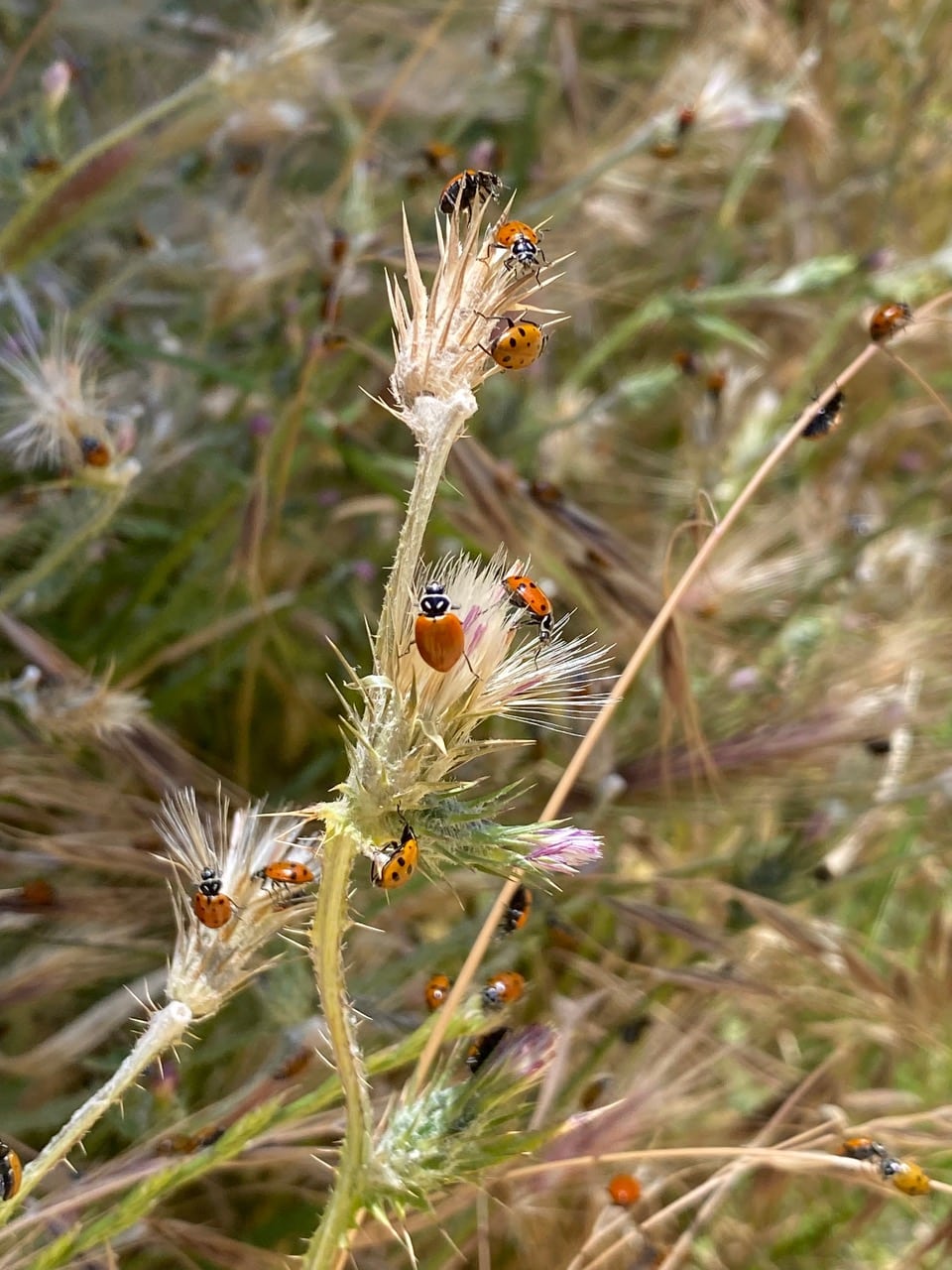
Walking back to my car, I see lady beetles swarming everywhere in incredible numbers. Here they are crawling on the weeds in a parking lot. I stop to take a video of hikers watching the beetle swarms in amazement: