

Pollinator Post 6/17/23 (2)

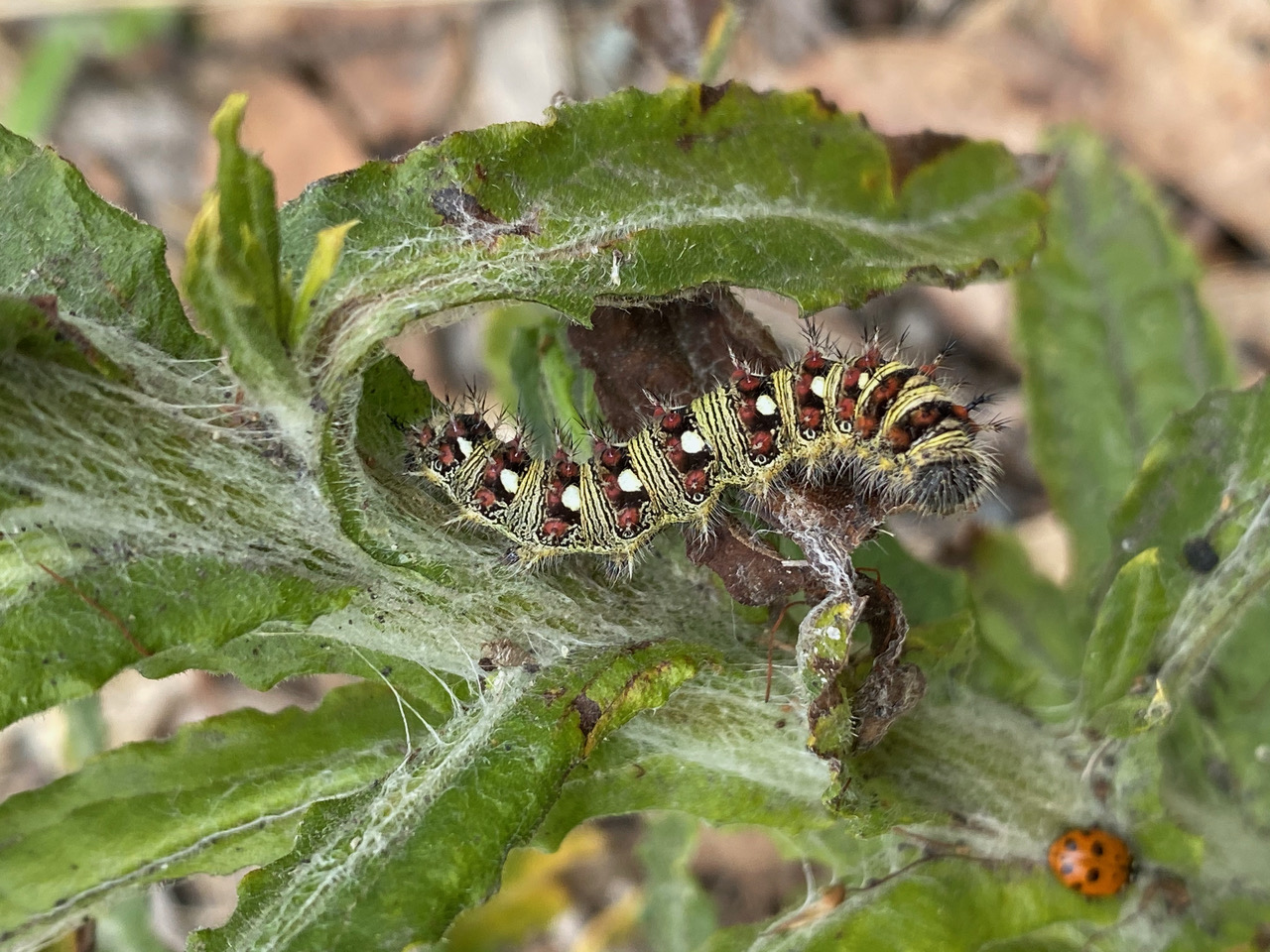
What a surprise and delight to see my old friend, the American Lady caterpillar. It is back on its host plant, the California Everlasting, Pseudognaphalium californicum, the same one with the collapsed caterpillar nest. The caterpillar is about 2 inches long now.
The American Lady, Vanessa virginiensis (family Nymphalidae) occurs from southern Canada throughout the US and southward to South America. The preferred host plants for the larvae are the “everlastings” or “cudweed” herbs and their close relatives in the sunflower family, Asteraceae. American Lady caterpillars are solitary feeders and construct nests from various parts of their host plant. Tiny larvae use leaf hairs to construct tiny nests; larger caterpillars arrange leaves, flower heads, and detritus to form tight shelters. Several structures are typically built during the caterpillar’s development.
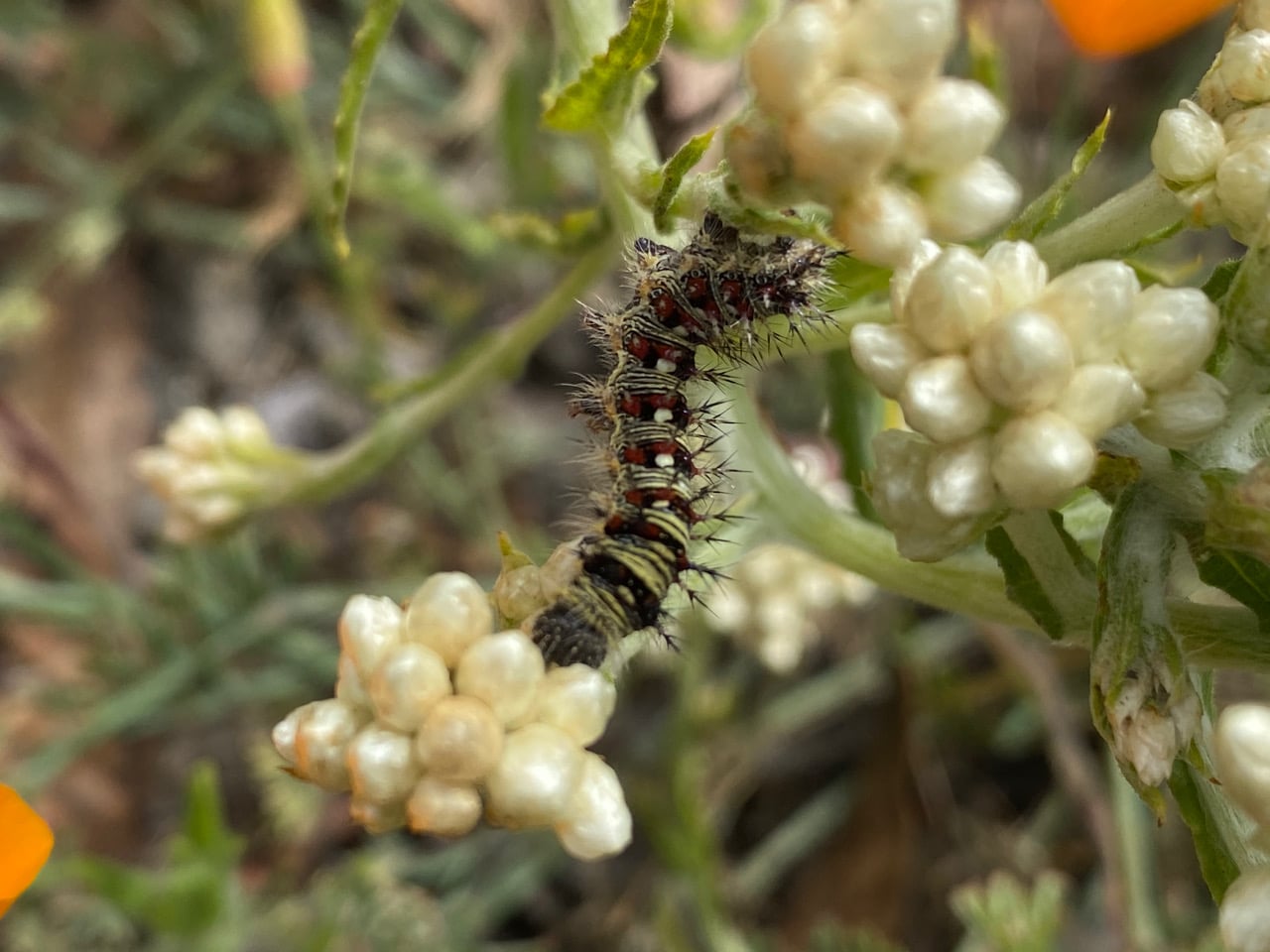 Just a few steps away, on another everlasting plant, a different, smaller American Lady caterpillar is moving around in the open.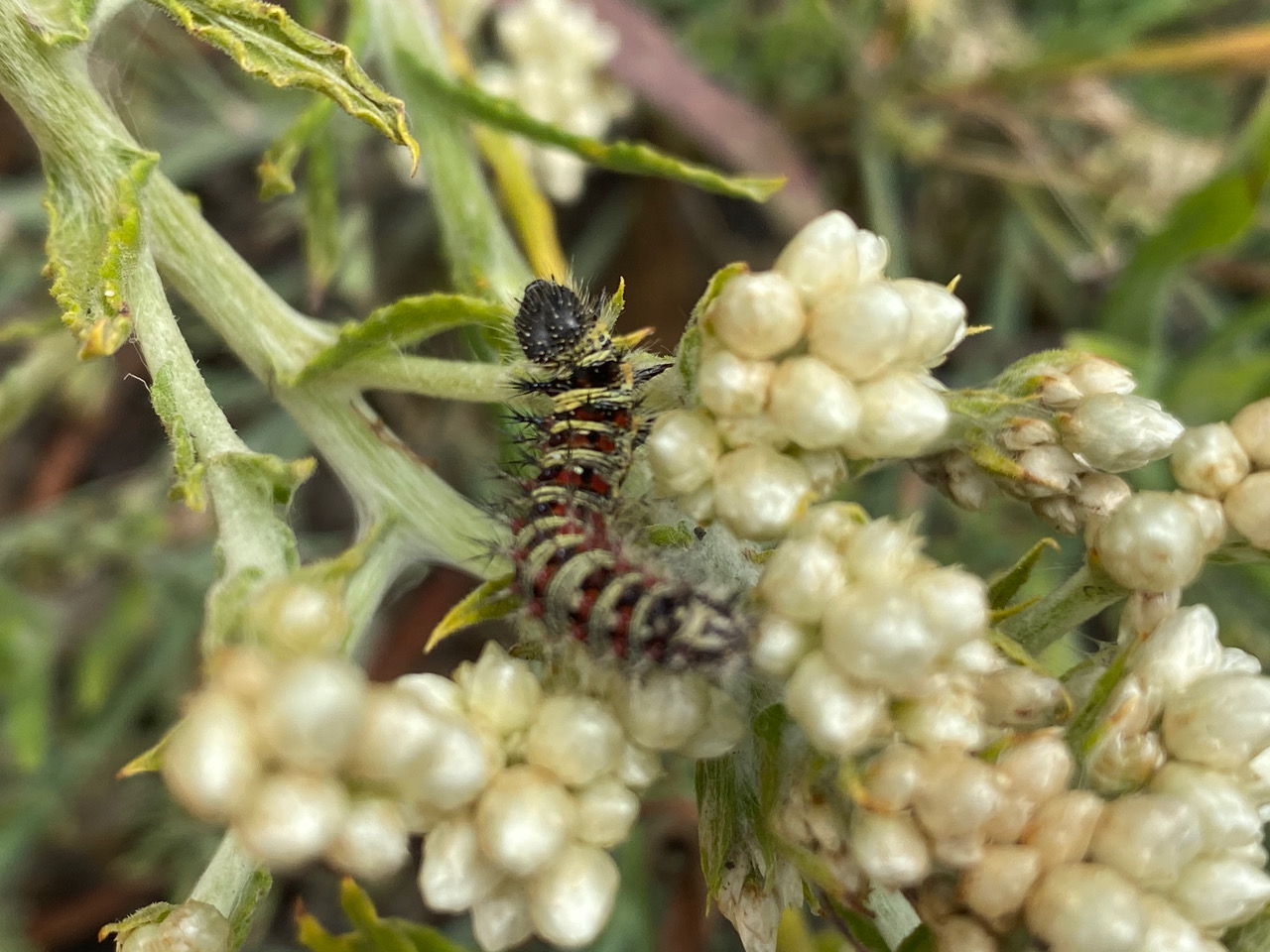
As I watch, the caterpillar is roaming all over this section of the plant investigating the various clusters of flowerheads, its bristly black head moving this way and that.

It suddenly dawns on me that the caterpillar is constructing a nest with silk from its mouth! It is attaching a strand of silk wherever it touches the clusters of flowerheads, drawing them together.
Both moth and butterfly caterpillars have spinnerets, which are modified salivary glands located on their lower jaw. They spit out the liquid silk which solidifies on contact with air to form strands of fibroin protein. Many caterpillars hide from predators by stitching the edges of a host plant leaf into a nest with silk thread. Instead of manipulating leaves, the American Lady caterpillars bind the flowerheads of their host plant (the everlastings) together to form the nest.
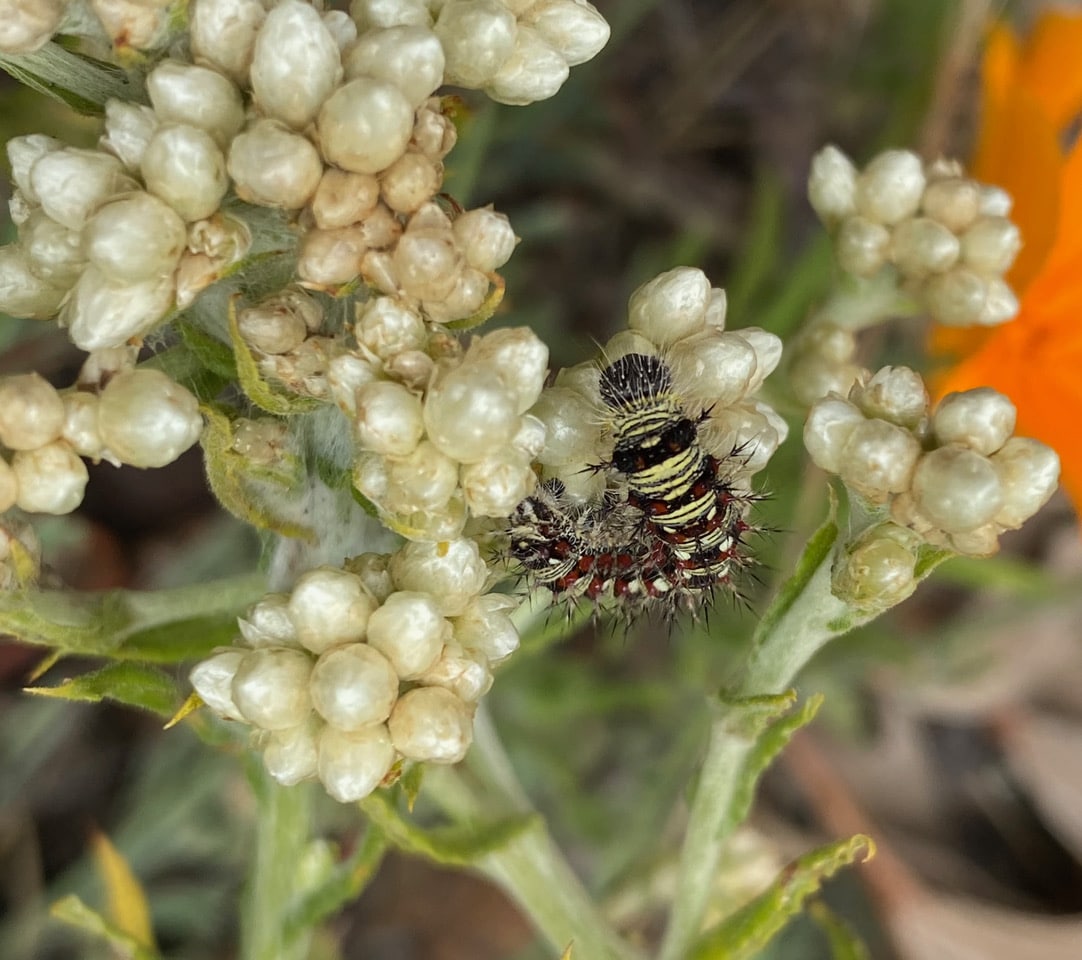
Caterpillars impart potential energy to their silk strands by stretching them beyond their equilibrium length as they are spun out. Axial retraction of the stretched strands then draws the bound plant surfaces together. Although a single stretched strand exerts only a minuscule force, the combined force generated by many such strands attached to the same opposable plant surfaces is substantial and allows the caterpillars to manipulate items many times their size and mass.

You can see some of the silk strands the caterpillar has strung between the flowerheads of several clusters.
Wow, I am totally blown away! How does the caterpillar know what to do, which cluster of flowers to bind with which? How does it see the big picture of its construction project? Does it envision the finished product? Does it have a plan in its head?
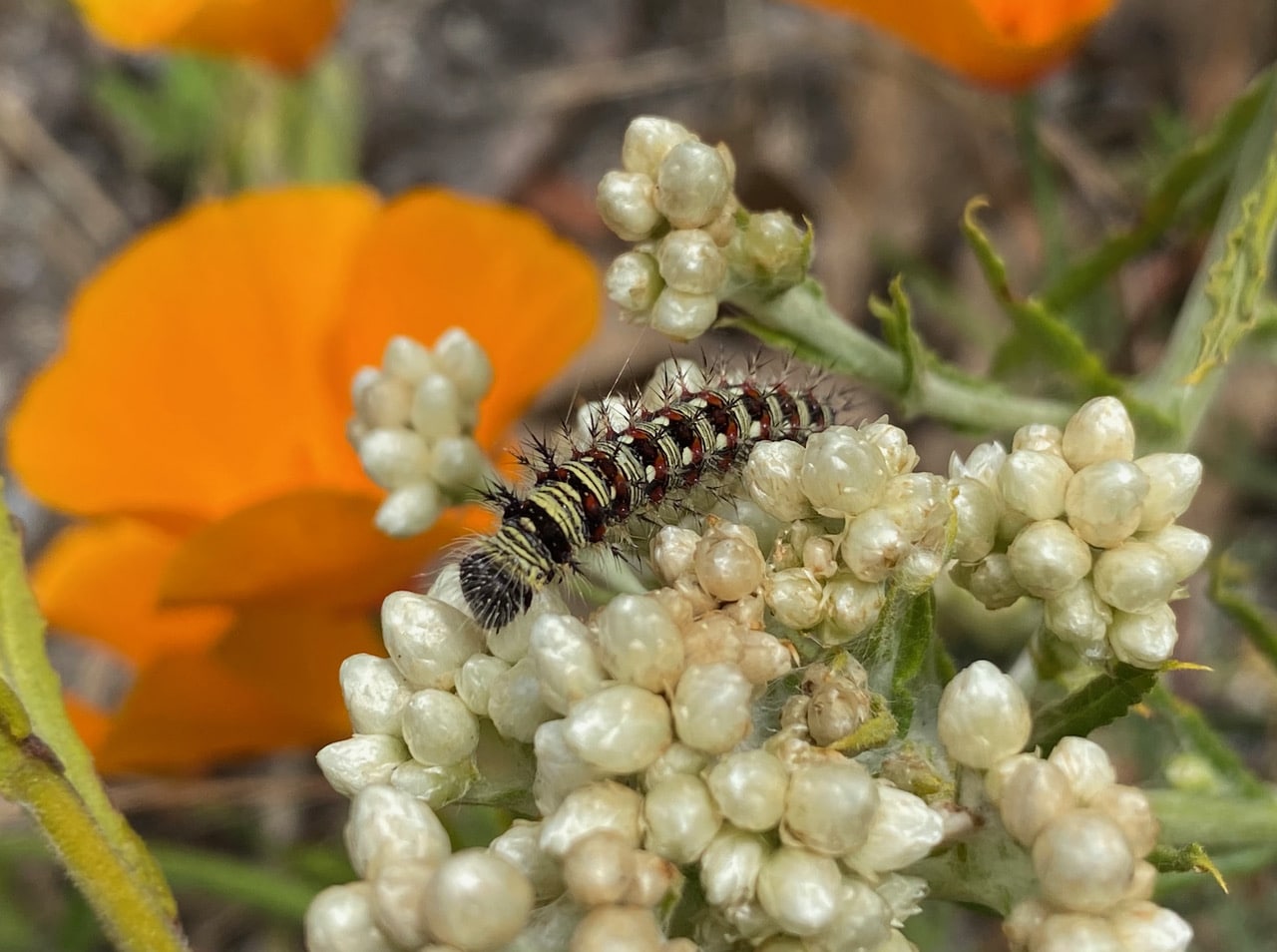
The caterpillar is reaching to stretch the silk to the next attachment point.
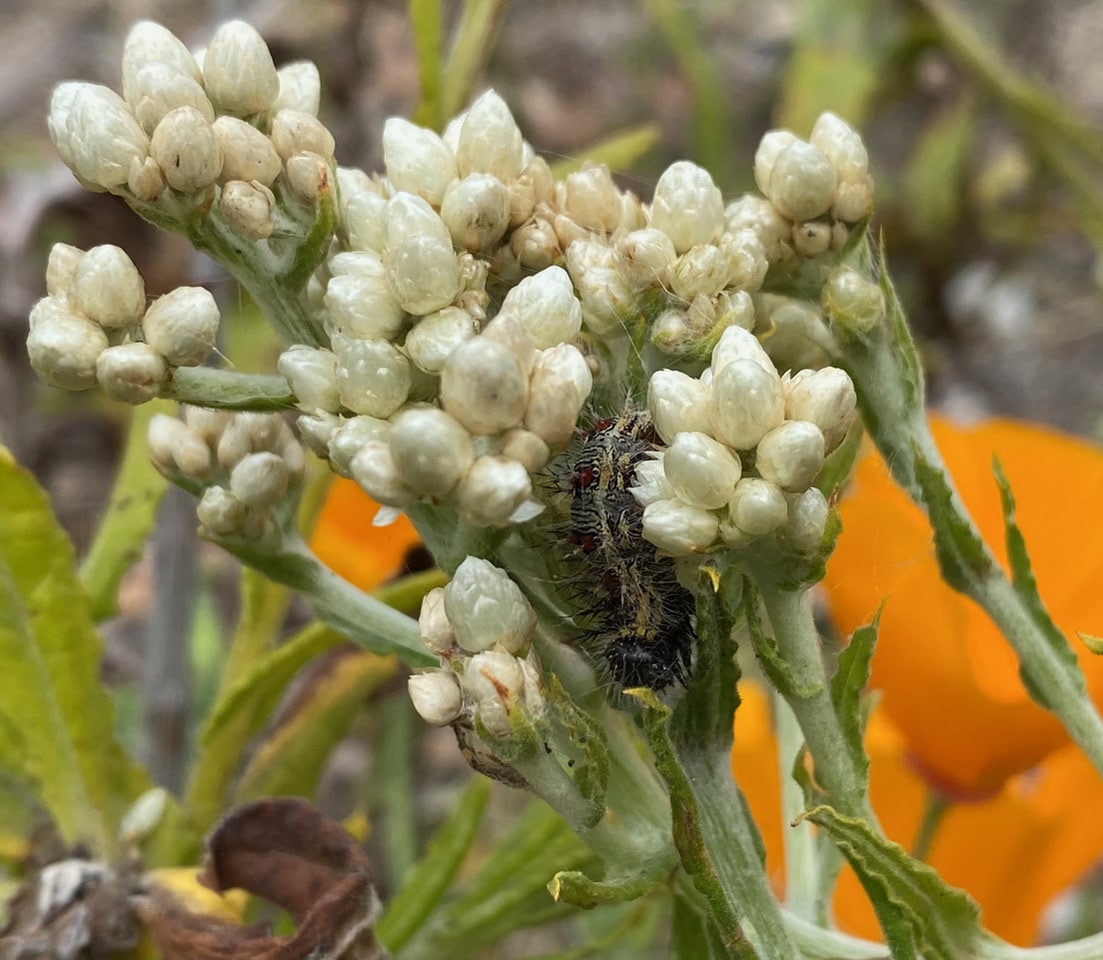
In mere minutes of continuous labor, the caterpillar has managed to draw a few of the neighboring clusters of flowerheads closer together. It is an incredible privilege to be a witness to this! I take a short video of the painstaking process.

Further up the road, I find a younger California Everlasting plant with a very small American Lady caterpillar. Some of the leaves have been bent around the caterpillar. Apparently nest construction is in progress.

On the same plant, I also find an old, abandoned nest at the tip of a branch. It is constructed of leaf hairs and other plant debris. Apparently a starter home of a very young caterpillar.
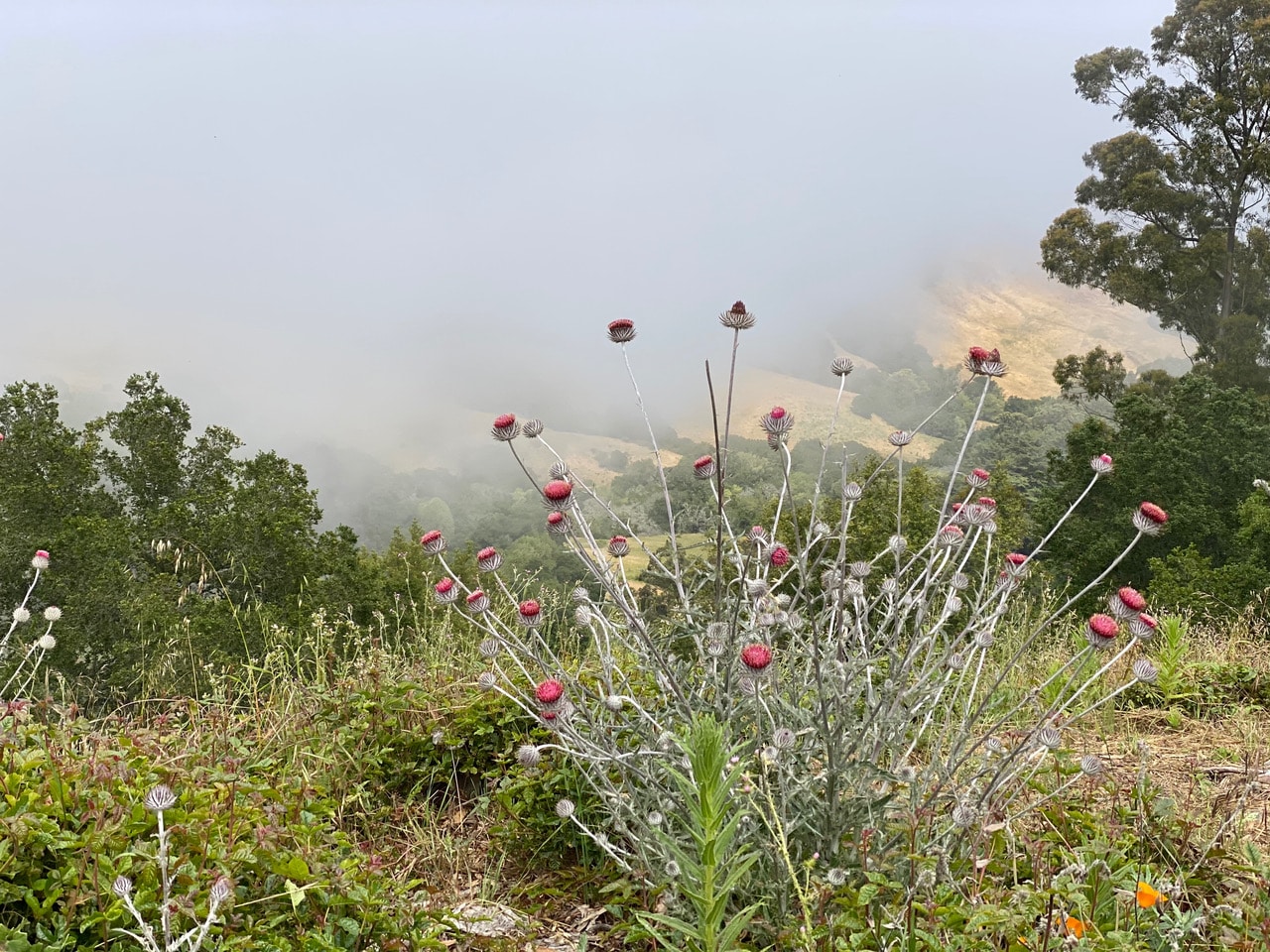
The wind has picked up, and fog is rolling in. The Cobweb Thistles, Cirsium occidentale on the ridge are doing well, blooming gloriously.
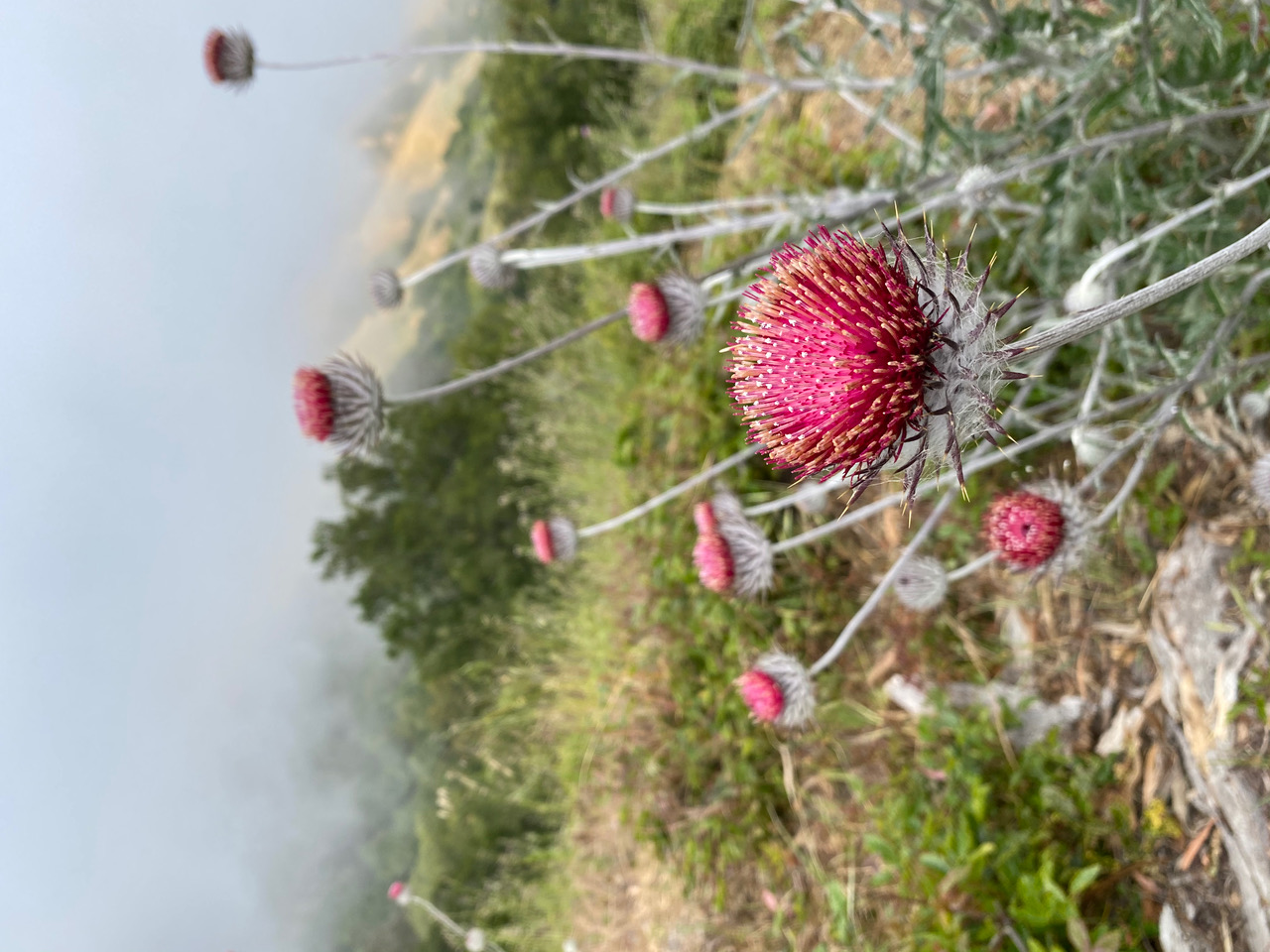
Besides the occasional Hummingbirds that visit for nectar, I see few insects on the thistle flowerheads.
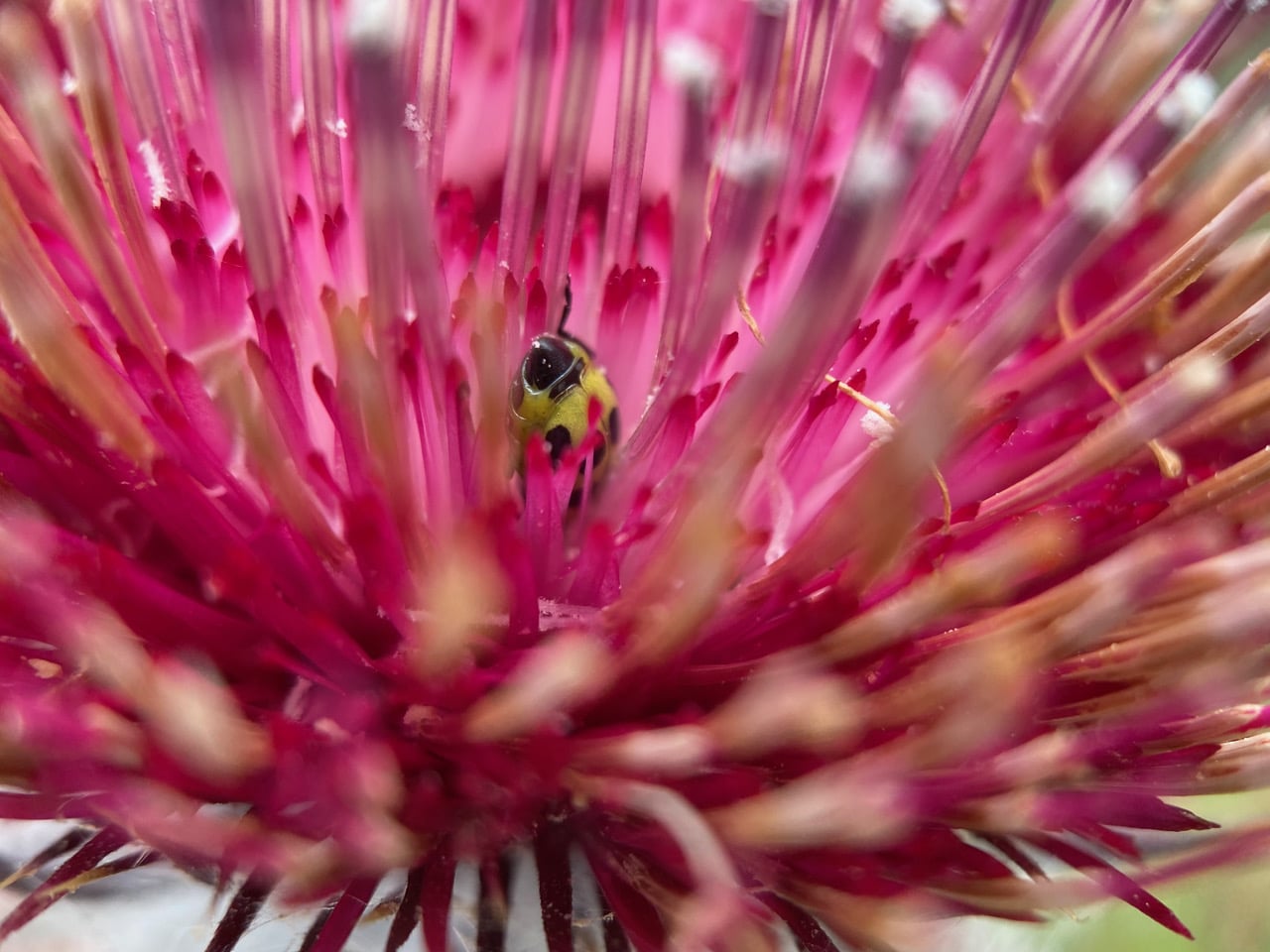
Is this Spotted Cucumber Beetle, Diabrotica undecimpunctata (family Chrysomelidae) feeding on the nectar or it is merely sheltering from the winds?
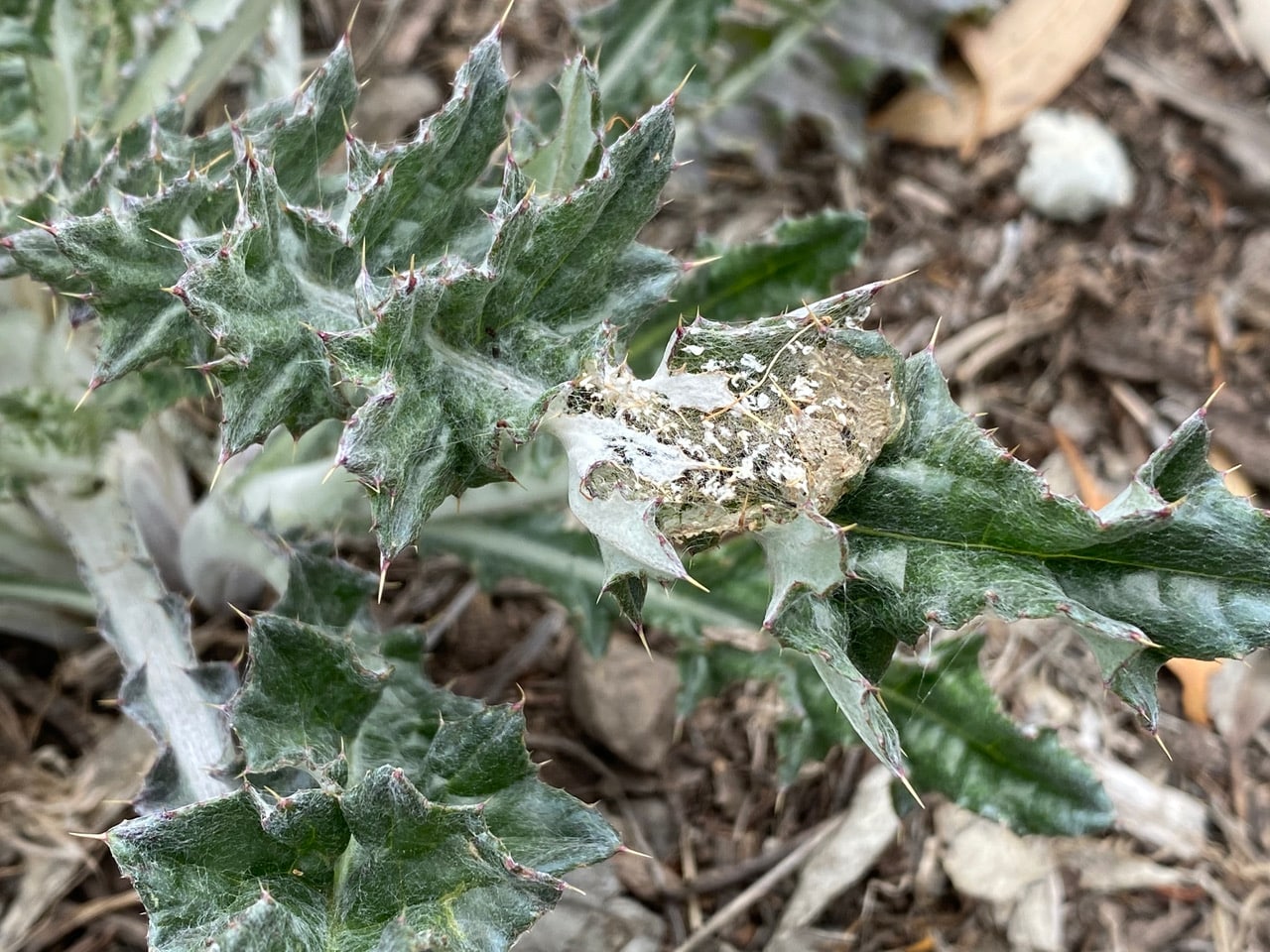 A few young Cobweb Thistles have grown up around the large plant. Some of their leaves have been webbed in silk – a sure sign of caterpillar activity. Painted Lady caterpillars?
The Painted Lady, Vanessa cardui (family Nymphalidae) is the most widespread of all butterflies. They are found on every continent except Antarctica and Australia. The butterfly also goes by the name thistle butterfly; its scientific name Vanessa cardui means “butterfly of thistle”. Although more than 100 host plants have been recorded for the species, the caterpillars’ favorites include thistles (Asteraceae), hollyhock and mallow (Malvaceae), and various legumes (Fabaceae).
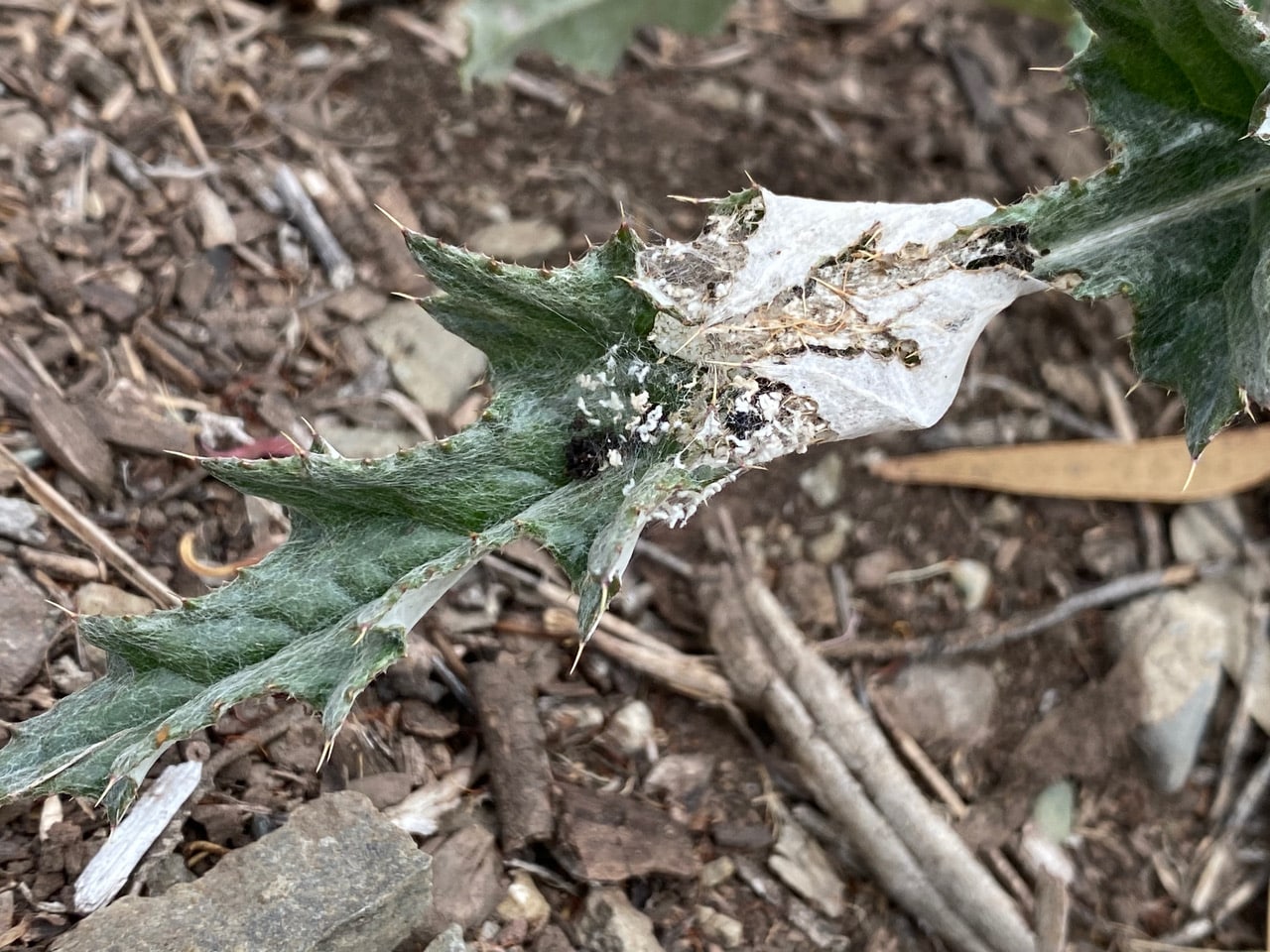
Another silk tent of a caterpillar concealed in bound leaves of Cobweb Thistle. The fuzzy black object at the entrance is the shed skin of the caterpillar discarded upon molting. The white flecks incorporated into the silk tent are leaf hairs that the caterpillar has gathered from the host plant.
Female Painted Lady butterflies lay eggs singly on the upper side of host plant leaves, sometimes on the thistle flowerheads. When small the caterpillars live for most of the time within a tent of leaves loosely spun together with silk. Only when larger are the larvae more likely to be found feeding outside a leaf tent on the food plant.
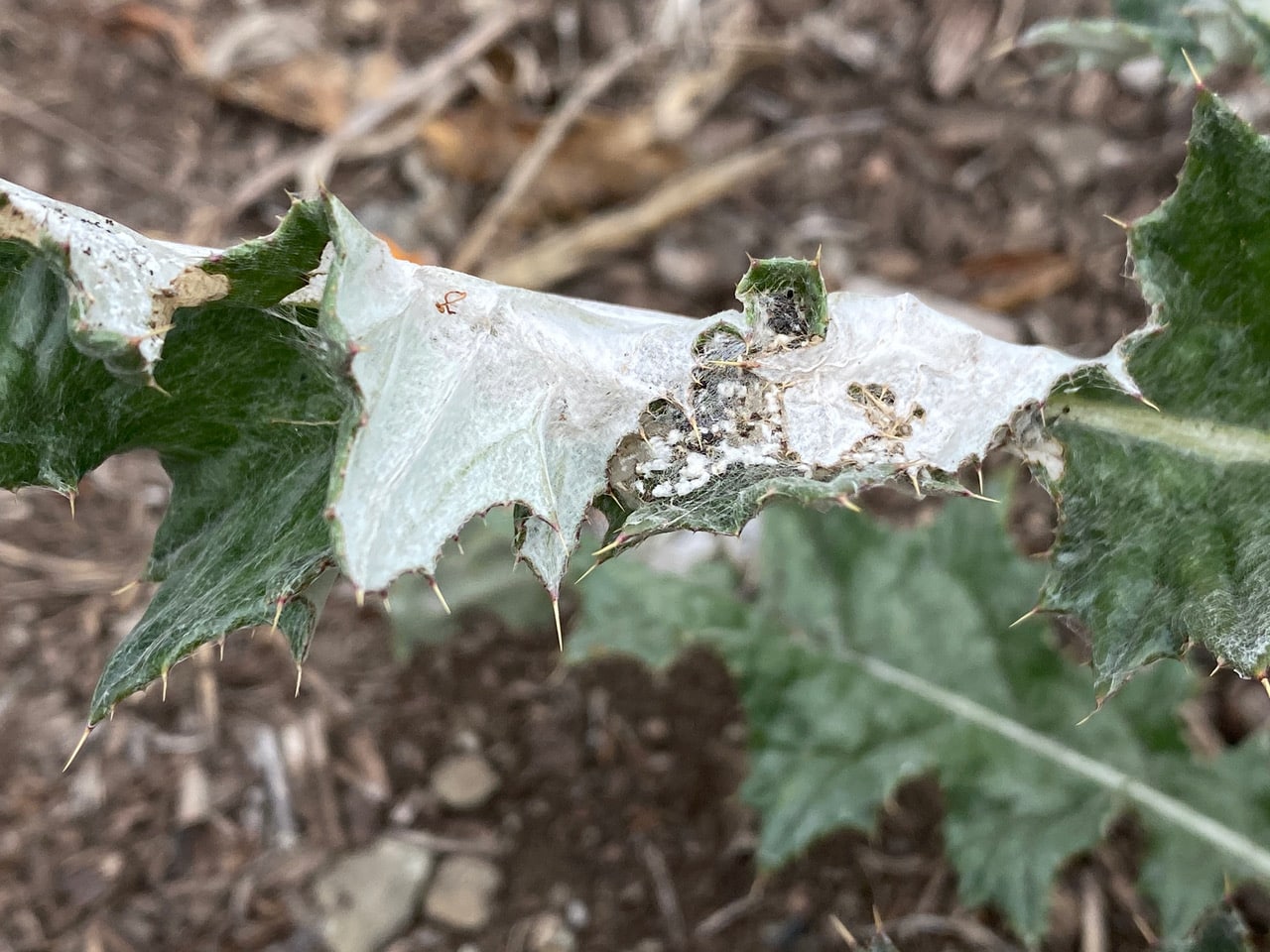 In contrast to the caterpillars of the American Lady caterpillars that construct new and bigger nest on their host plant as they grow bigger, Painted Lady caterpillars simply extend/enlarge their existing nests.
 Painted Lady butterflies are known for their distinct migratory behavior. They are an irruptive migrant, meaning that they migrate independently of any seasonal or geographical pattern. The populations that migrate from North Africa to Europe may include millions of butterflies. The distance covered rivals that of the better known Monarch butterflies. The butterflies can cover up to 100 miles per day during their migration; the round trip may take up to 6 successive generations.
In California, the butterflies are usually seen flying from north to north-west. These migrations appear to be partially initiated by heavy winter rains in the desert where rainfall controls the growth of larval food plants. In the spring of 2019, the butterflies migrated by the millions across the state.
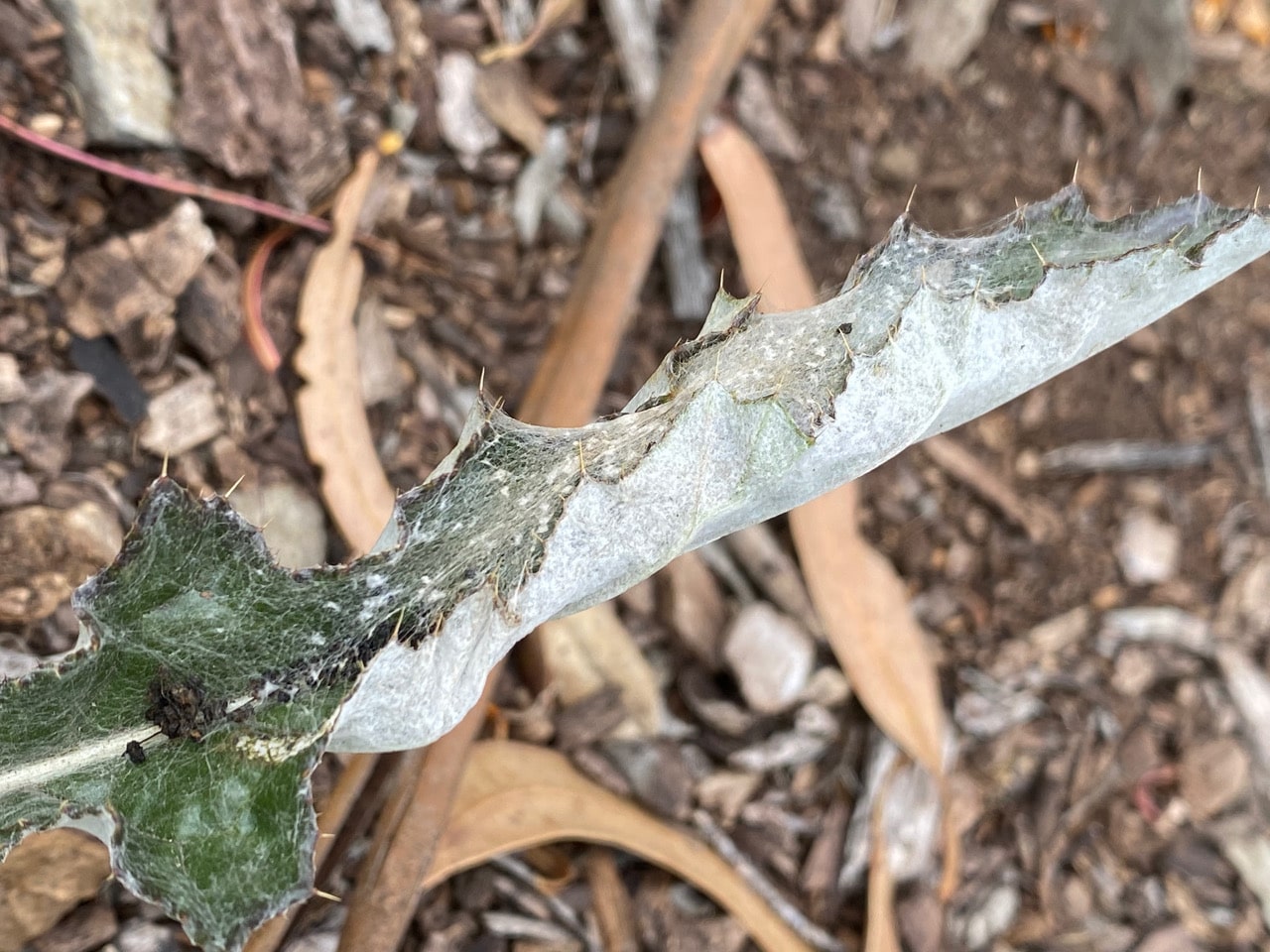
This is the largest of the nests I find. The caterpillar has webbed up the thistle leaf longitudinally, taco-style. The dark pellets at the end of the nest is a pile of frass (insect poop).
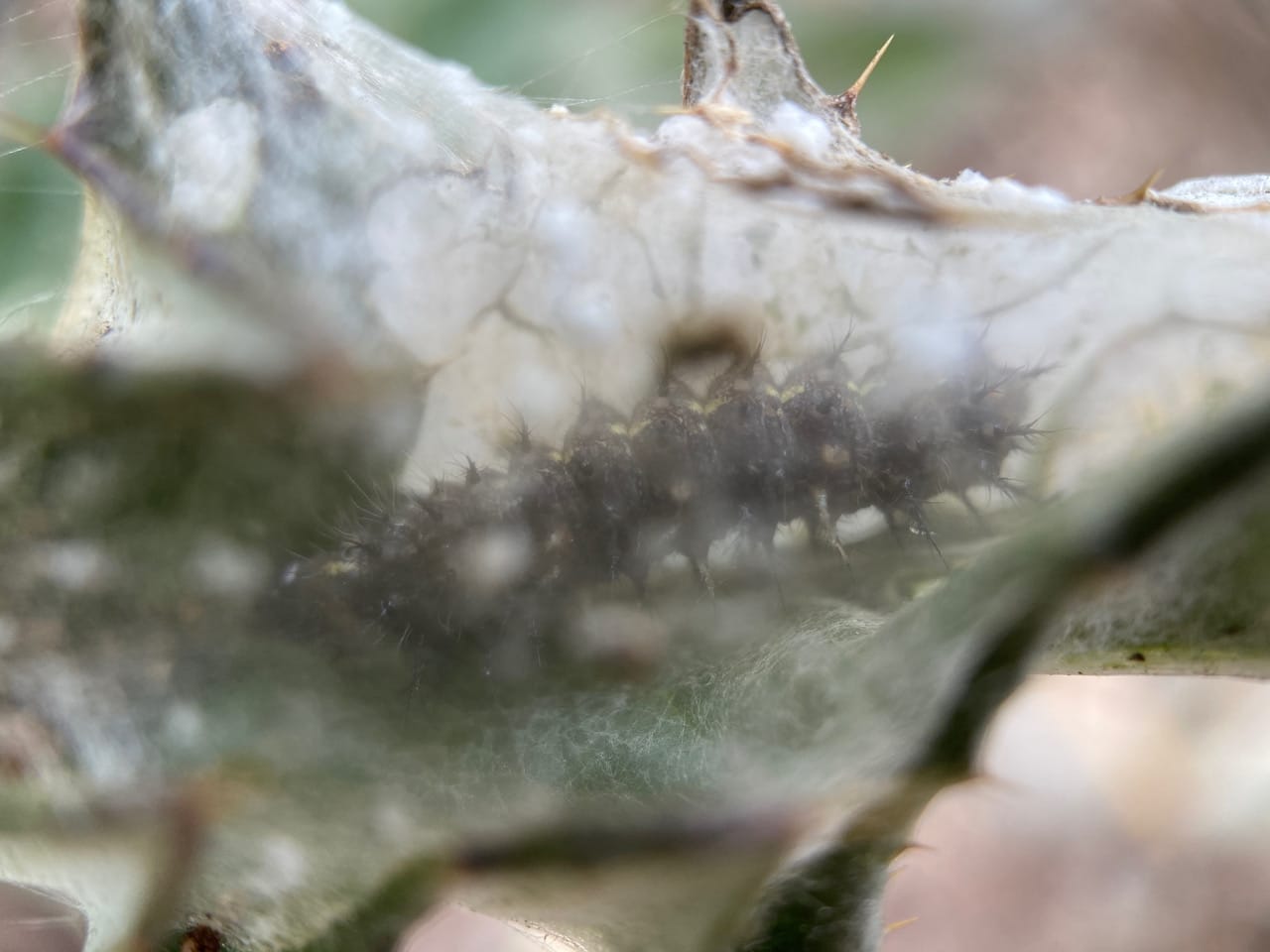
Focusing my macro lens beyond the silk webbing, I can see a black caterpillar with white stripes within the nest. Yep, sure looks like a Painted Lady caterpillar!
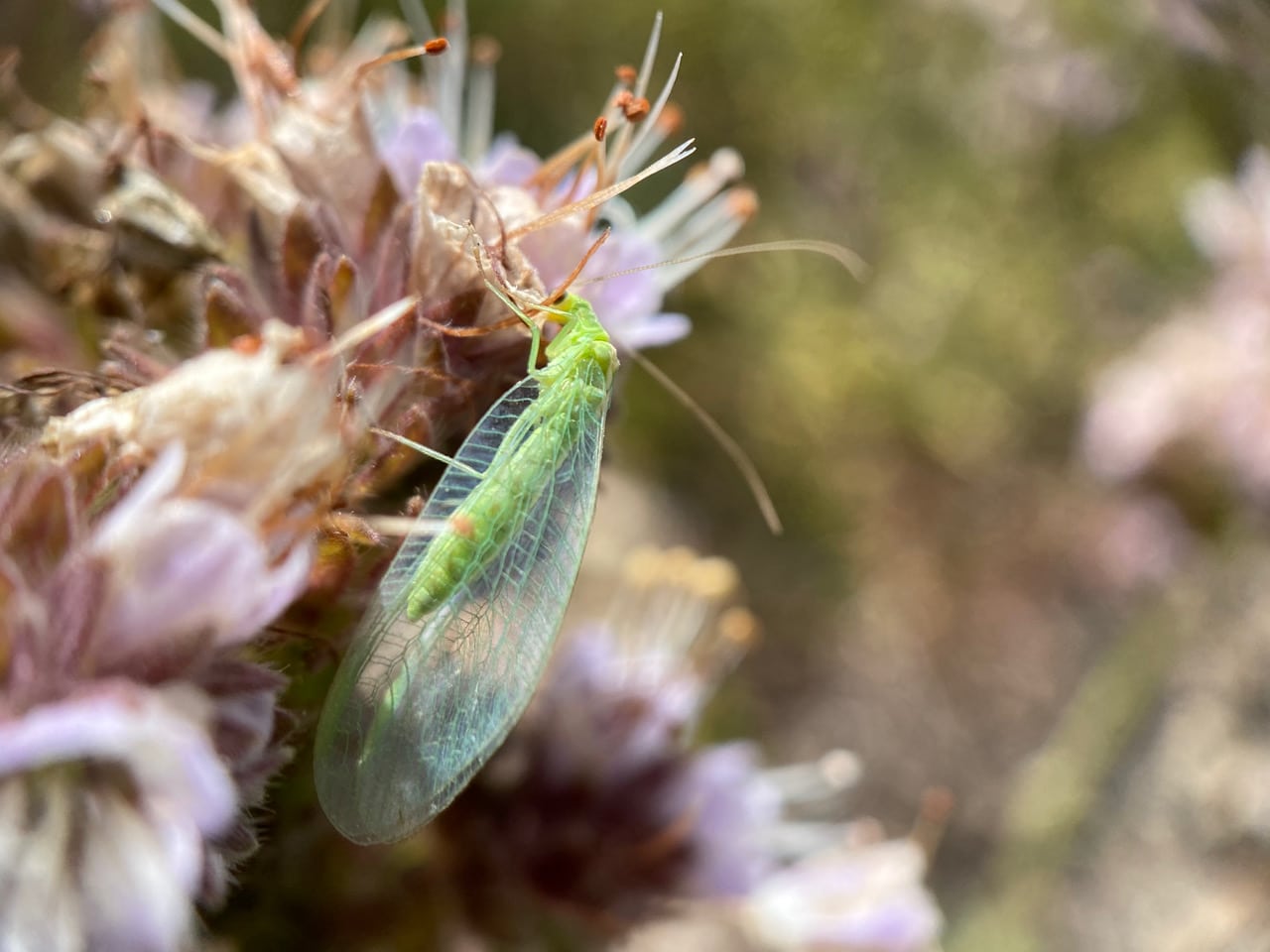
A Lacewing (family Chrysopidae) is browsing on an inflorescence of California Phacelia.

Lacewings are insects in the large family Chrysopidae of the order Neuroptera. Adults are crepuscular or nocturnal. They feed on pollen, nectar and honeydew supplemented with mites, aphids and other small arthropods. Eggs are deposited at night, hung on a slender stalk of silk usually on the underside of a leaf. Immediately after hatching, the larvae molt, then descend the egg stalk to feed. They are voracious predators, attacking most insects of suitable size, especially soft-bodied ones (aphids, caterpillars and other insect larvae, insect eggs). Their maxillae are hollow, allowing a digestive secretion to be injected in the prey. Lacewing larvae are commonly known as “aphid lions” or “aphid wolves”. In some countries, Lacewings are reared for sale as biological control agents of insect and mite pests in agriculture and gardens.