

Pollinator Post 6/15/26

After dropping Fred off at Shoreline Park for his walk this afternoon, I head for the Bay Farm Island Library to check on the native plant garden there.
Much to my delight, the young garden has matured nicely, and plants are still blooming profusely despite the extreme temperature spike we experienced last week.



The side garden is also quite colorful. There is still plenty of space between the plants for me to walk around without trampling on anything.
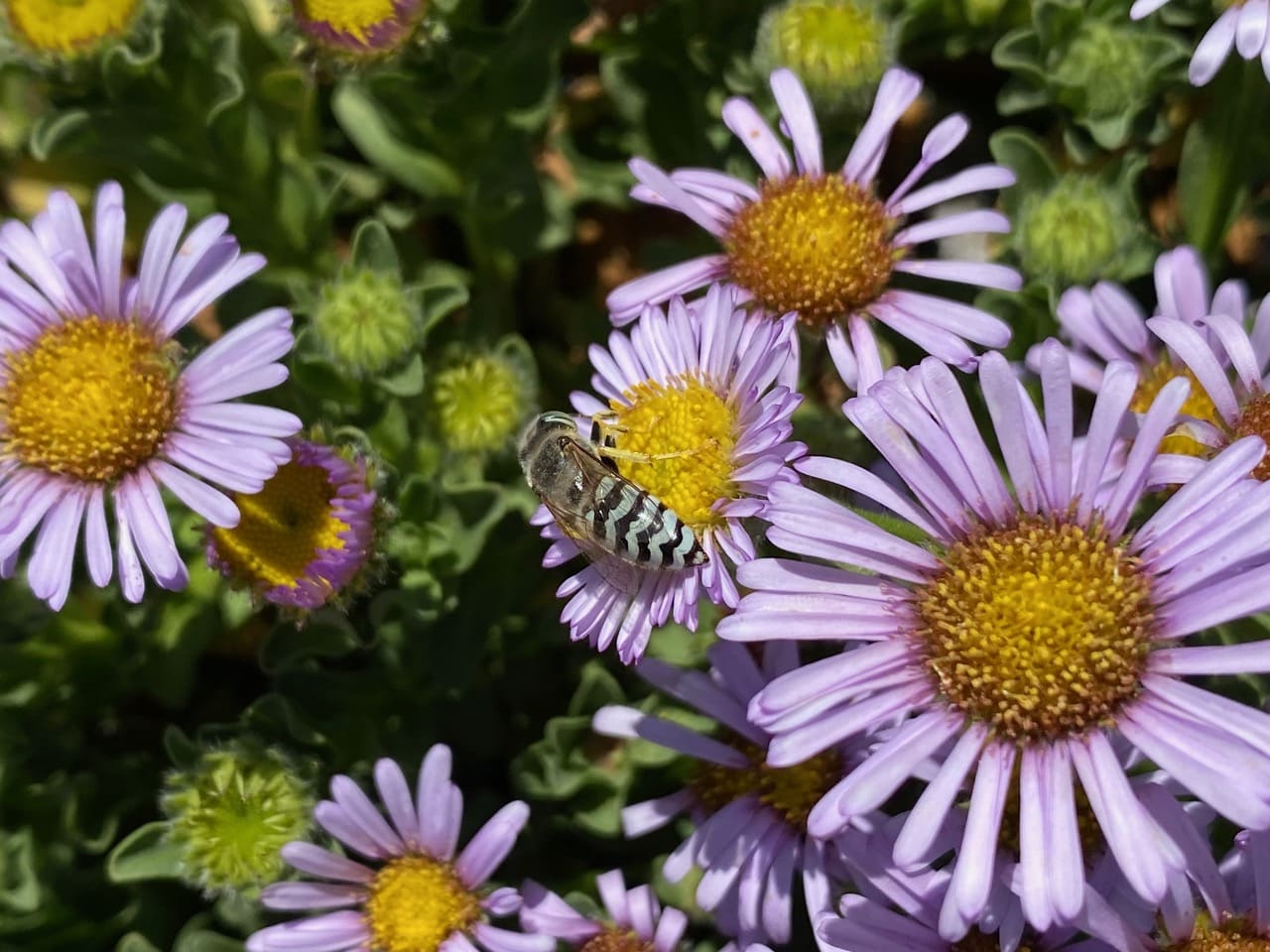
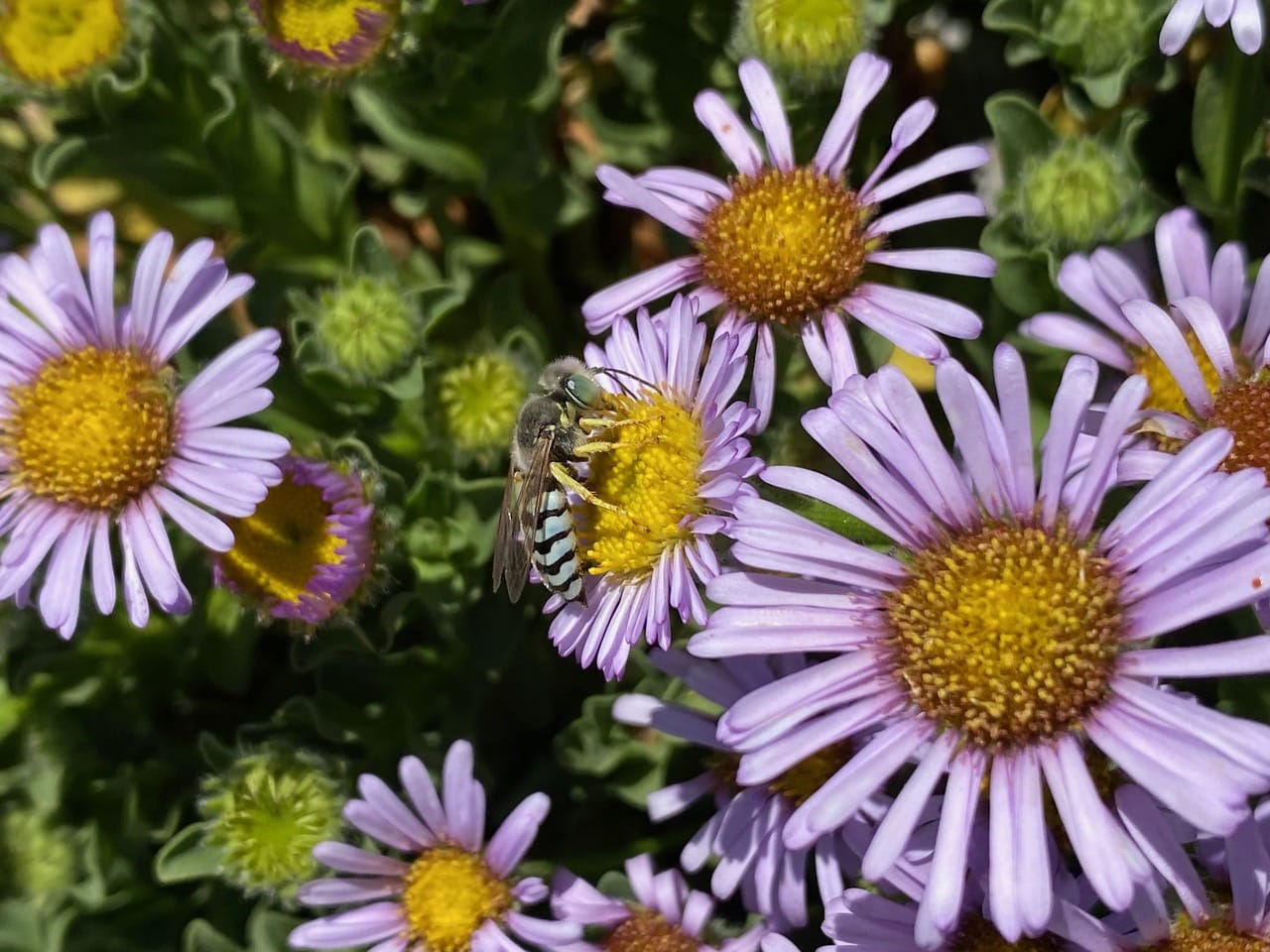
Most of the insect activity seems to be concentrated on the low-growing Seaside Daisy, Erigeron glaucus. An American Sand Wasp, Bembix americana (family Crabronidae) has landed on a flowerhead to take nectar. These wasps, about the size of a Honey Bee, are easily recognizable from their wavy black-and-white striped abdomen.
Sand wasps in the genus Bembix are familiar and common throughout North America, digging their burrows in dunes, on beaches, and other habitats with loose, deep sand. The female rapidly kicks out large quantities of sand using a “tarsal rake” of spines on each front leg. The burrow is excavated before the wasp goes hunting. Bembix are generalist, opportunistic hunters. True flies in the order Diptera are the usual prey. A victim is paralyzed or killed by the wasp’s sting, and is then flown back to the nest. Most species will lay an egg on the first victim, while some species lay an egg in the empty cell before starting to hunt. Once the egg hatches, mama wasp brings flies to her larva as needed. This “progressive provisioning” is rare in the insect world. When the larva reaches maturity, mama wasp closes the cell. Inside, the larva spins an oblong cocoon, weaving sand grains into the structure and resulting in a hardened capsule. Overwintering takes place as a prepupa inside this cocoon, but there are usually two generations a year.
Male sand wasps often engage in an elaborate flight ritual called “sun dances”. Males emerge before females, and fly erratically at dizzying speed one or two inches above the ground attempting to detect virgin females about to emerge from their underground nests. Both sexes are often seen taking nectar at flowers, especially from Asteraceae family. Bembix wasps are often victims of other insects such as cuckoo wasps (Chrysididae), velvet ants (Mutillidae), satellite flies (Sarcophagidae), bee flies (Bombyliidae), and thick-headed flies (Conopidae).
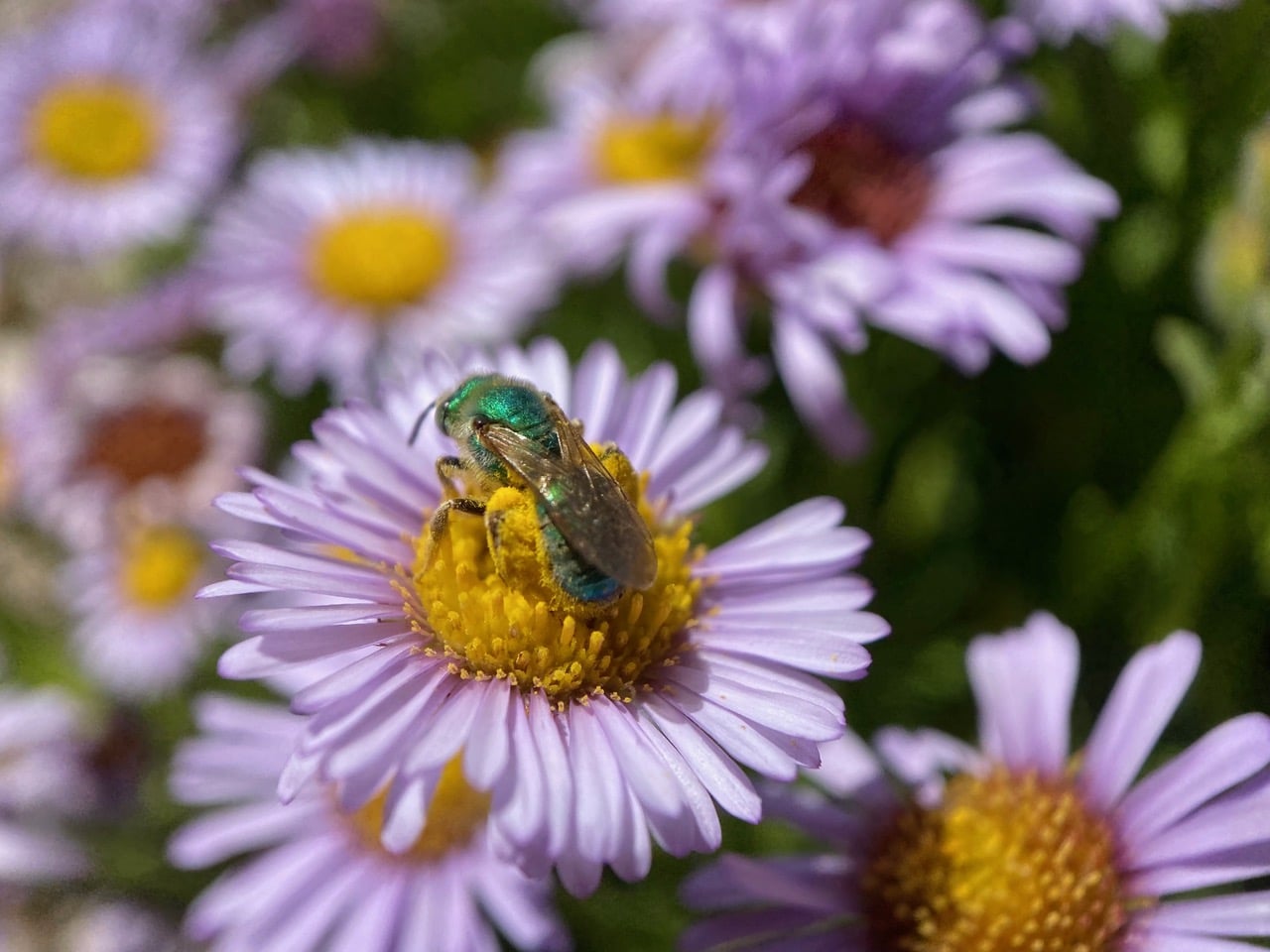
A female Fine Striped Sweat Bee, Agapostemon subtilior (family Halictidae) is foraging on a flowerhead of Seaside Daisy.
Agapostemon bees, or metallic sweat bees, are ground-nesting, often communal pollinators known for their bright green, metallic appearance and for being bivoltine (two generations per year). The first generation emerges in spring, and the second, larger generation emerges in late summer. Agapostemon bees are medium-sized (7-14.5 mm), featuring a metallic green or blue head and thorax. Many females have striped abdomens, while others are entirely metallic green. They are generalist pollinators, visiting a wide variety of flowers, including asters, sunflowers, and fruit crops. Females are efficient and fast-flying carrying pollen on their hind legs.
Mated females overwinter in the soil and emerge in early spring to establish nests in the ground, often in aggregations (close to one another). They prefer to nest in loamy soil in flat, sloped, or bank areas, creating tunnels with individual brood cells. Although solitary, some species are communal, sharing a single entrance while maintaining separate tunnels. Females create balls of pollen and nectar in each cell, laying a single egg on each, which the larva consumes upon hatching. Males usually die after mating in late summer, while mated females hibernate through the winter.
The Fine Striped Sweat Bee, Agapostemon subtilior is a small, widespread species found across North America. They are active from late spring to fall, with all-green females measuring roughly 11 mm, and males (slightly smaller) displaying a black-and-yellow striped abdomen. Like other Agapostemon bees, they are solitary ground-nesters, and are polylectic, foraging from a wide variety of flowers.
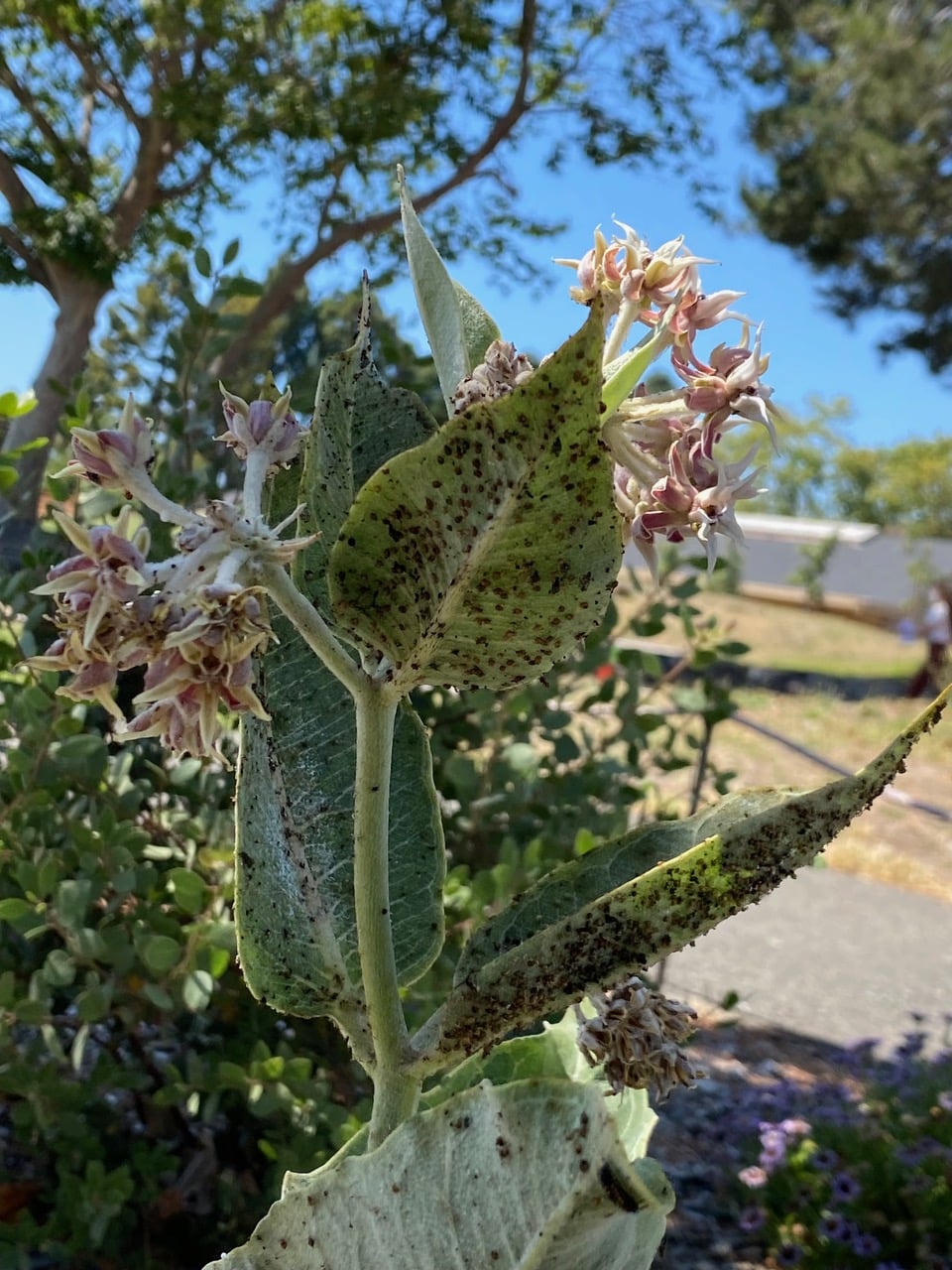
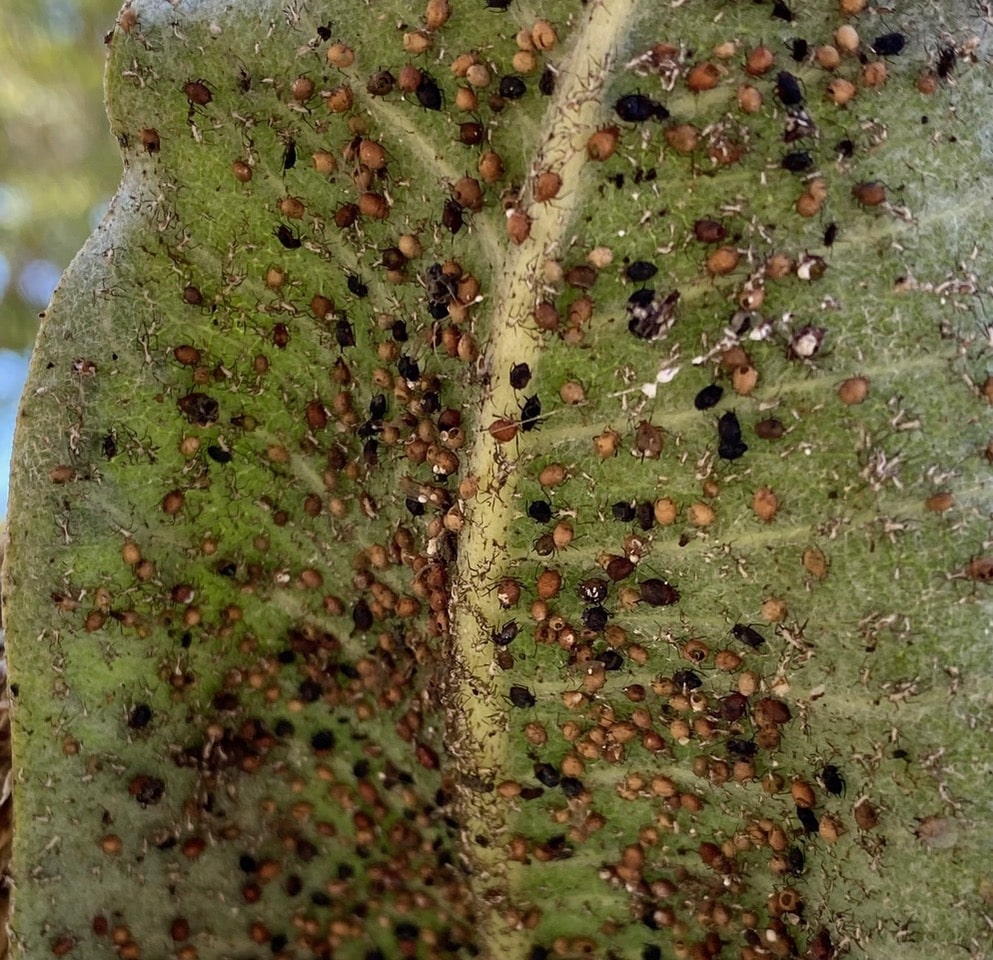
Under the big tree, a Showy Milkweed, Asclepias speciosa is still holding on to its fading flowers while most of its foliage is speckled with dark debris, especially on the underside of the leaves.
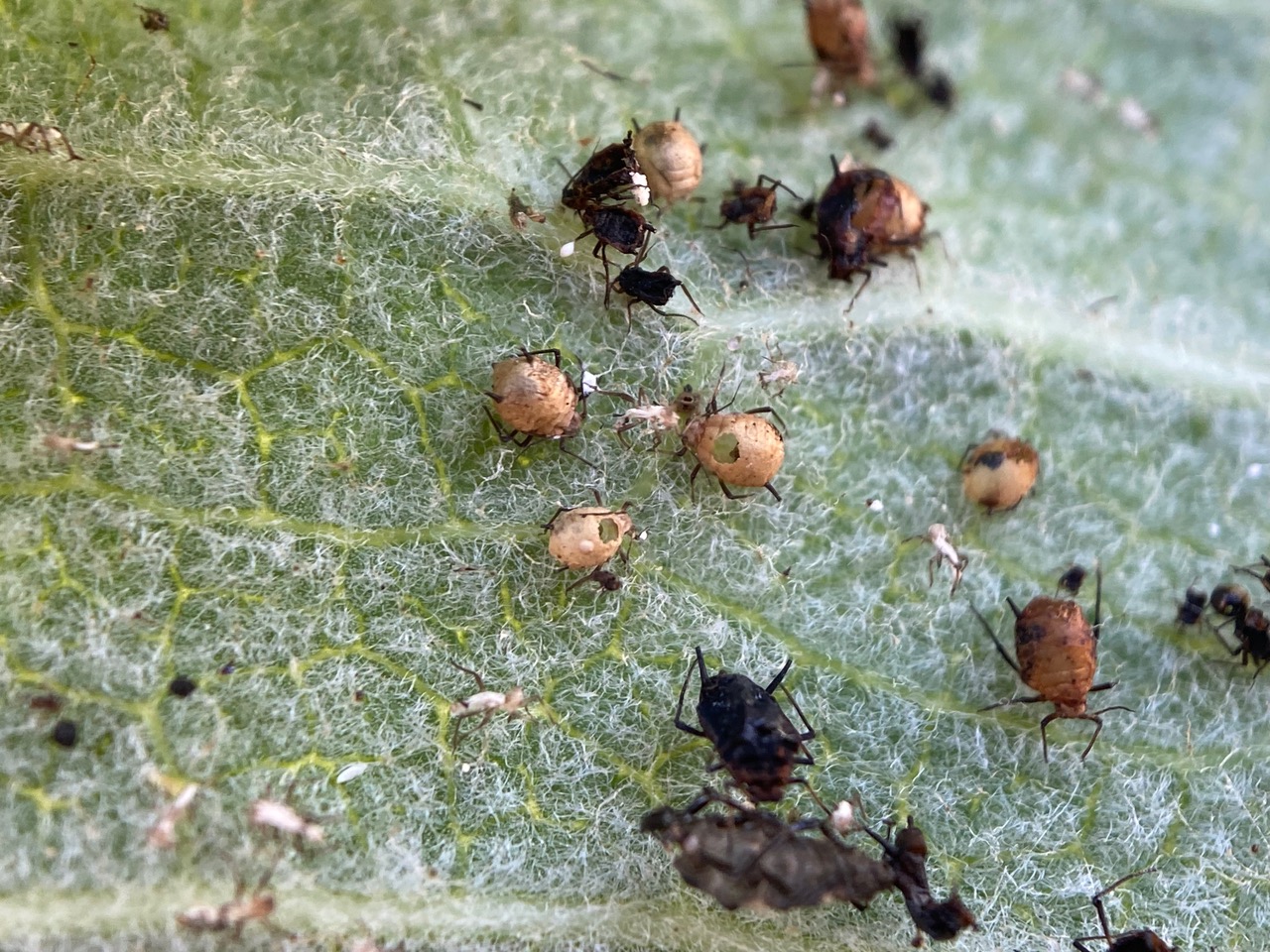
I lift up one of the leaves to look at the underside and am astonished to find a veritable aphid graveyard. Whoa, I have never seen so many aphid mummies in one place! There’s not a single live aphid in sight – not a single one of the those yellow Oleander Aphids, Aphis nerii (family Aphididae) commonly found on milkweeds! Wow, the Aphid Mummy Wasps have completely annihilated the aphid colony on this plant – a testament to the effectiveness of these parasitoid wasps as natural pest control.
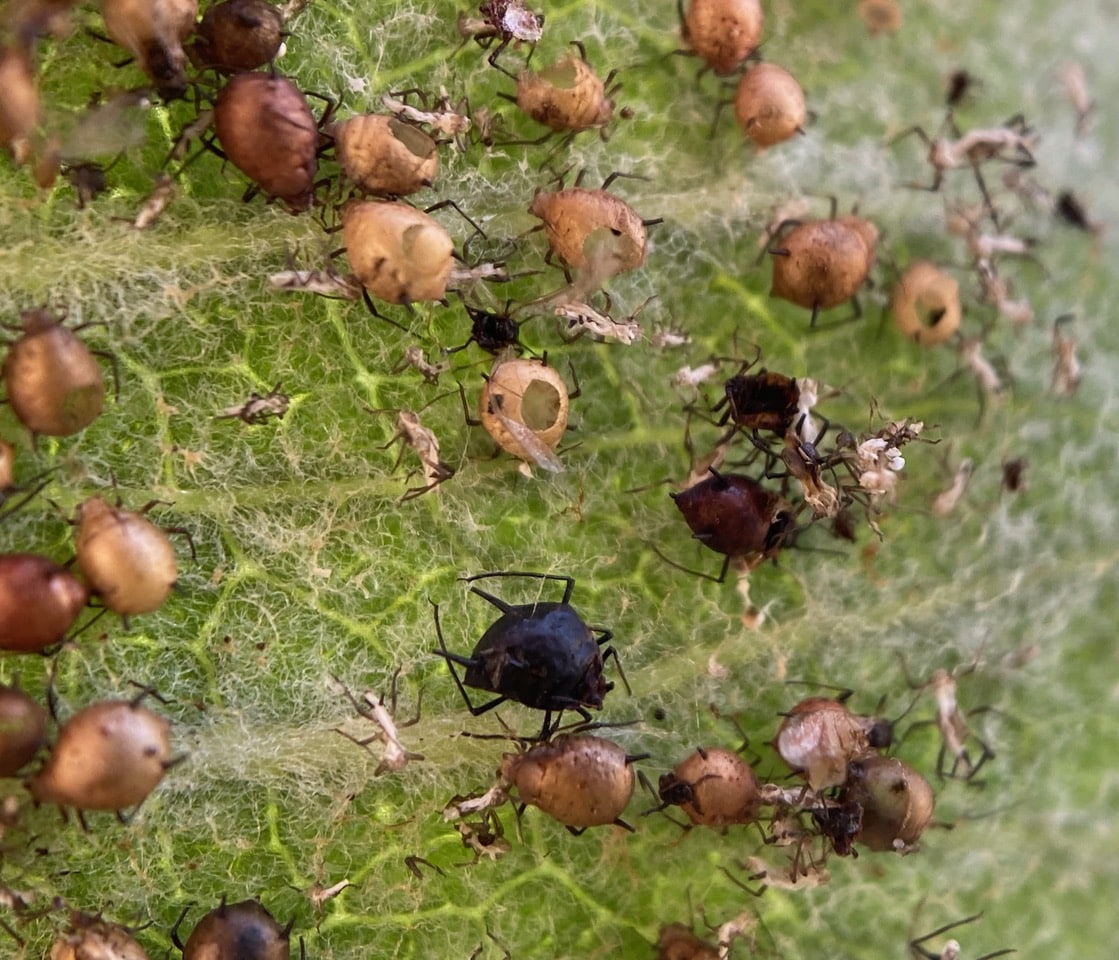
Note the gaping round holes on the abdomen of the aphid mummies. The wasps have chewed their way out of their aphid hosts after feeding and pupating within.
The original yellow Oleander Aphids have been decimated by a parasitoid wasp. Aphid Mummy Wasps, Aphidius sp. (family Braconidae) are small wasps, typically less than 1/8 in. long. The female wasp lays a single egg in an aphid. When the egg hatches, the wasp larva feeds inside the aphid. As the larva matures the aphid is killed and becomes bloated and mummified, usually turning tan or golden in color. The adult wasp chews its way out of the mummy leaving a circular hole.
These mummies are of two distinct types – the brown/straw-colored ones, and the black ones. They are created by two different types of Aphid Mummy Wasps. The former by wasps in the family Braconidae, and the latter by wasps in the family Aphelinidae.
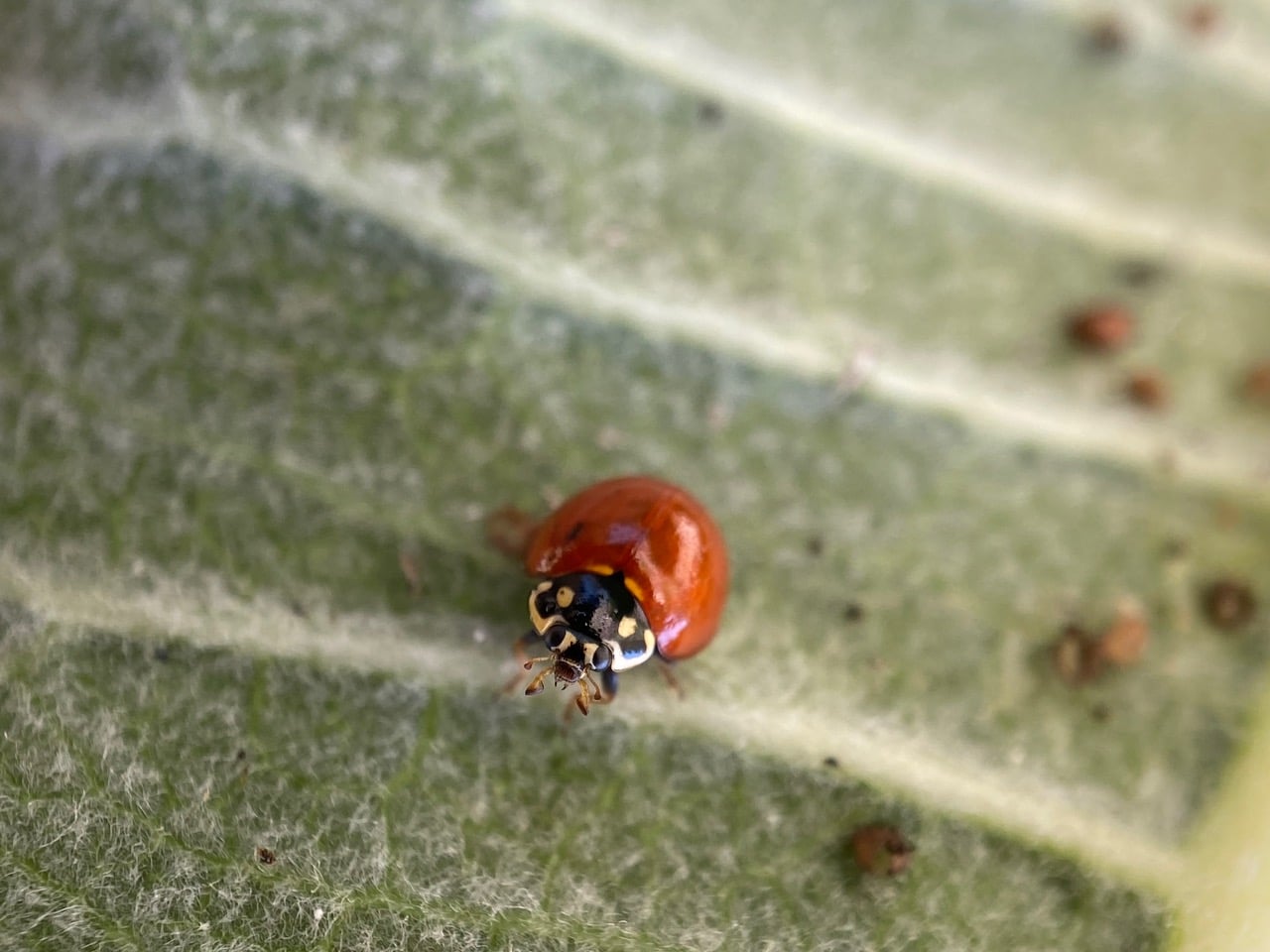
A forlorn Spotless Lady Beetle is moving slowly past the aphid carnage. Sadly for the beetle, there is no live aphid to feed on today…
The Spotless Lady Beetle, Cycloneda sanguinea (family Coccinellidae) is a widespread species of lady beetle in the Americas. It is is a large lady beetle with red, unspotted elytra (wing covers) ranging from 4-6.5 mm long. The black and white marks on the head and pronotum are very distinctive, and they are also gender-specific. Both adult and larvae of Spotless Lady Beetles are voracious predators of aphids. They are very often found feeding on aphids on milkweeds, but also occur on a number of other plants. Adults live longer when nectar and pollen are available for nourishment when prey is scarce.
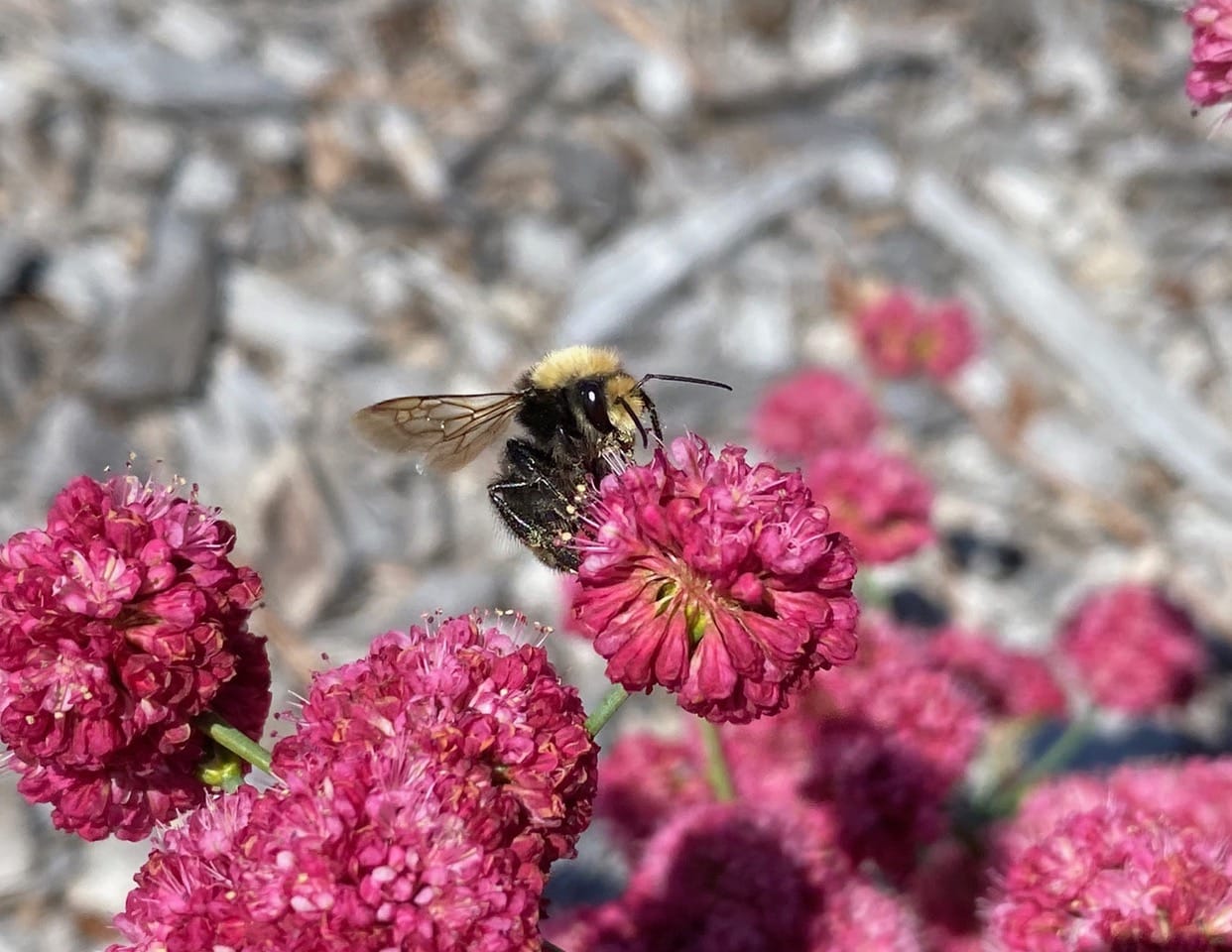
A Yellow-faced Bumble Bee, subgenus Pyrobombus (genus Bombus, family Apidae) lands on an inflorescence of a Red-flowered Buckwheat, Eriogonum grande var. rubescens. Hmm, I wonder if this might not be a male – note the long antennae, and the slender hind leg that does not seem to have a corbicula (pollen basket). Is our warmer summer causing the bumble bee colonies to produce males earlier?
Female bumble bees (workers and queens) do all the work of foraging, building nests, and defending the colony. They have pollen baskets (corbiculae) on their hind legs – a wide, shiny, concave section on their hind legs for carrying pollen. Males have skinnier, hairy hind legs with no pollen basket. Females have shorter antennae with 12 segments, males have longer antennae with 13 segments. While females actively collect both nectar and pollen, males only visit flowers to drink nectar and never carry pollen. Female workers live for about 4-6 weeks, while queens live up to a year. Males, produced late in the season (late summer, early fall) expressly for reproductive purposes, only live for about 2-3 weeks and die shortly after mating.
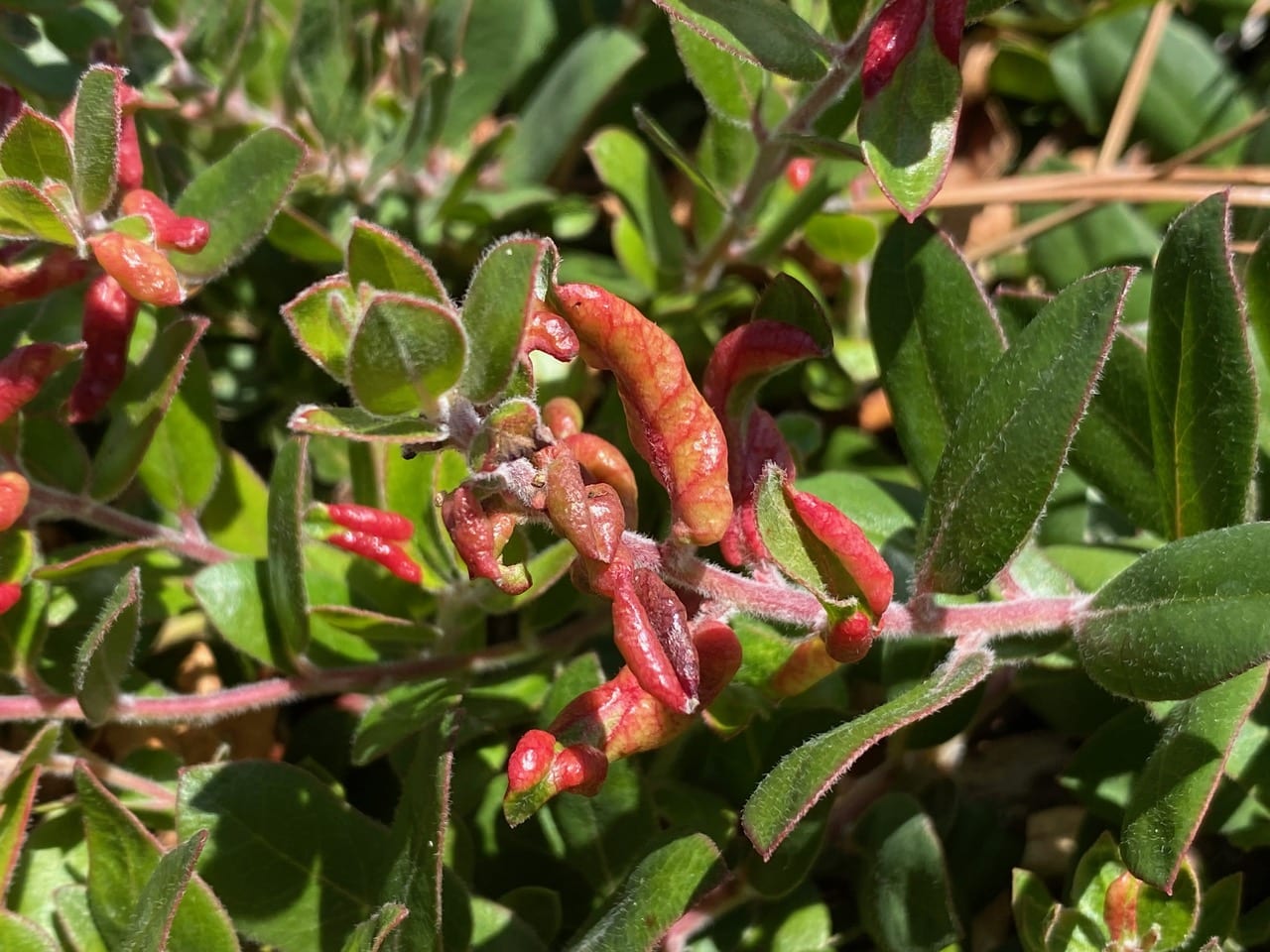
Grotesque red swellings have deformed the margins of many young leaves of this Manzanita. They are galls induced by the Manzanita Leafgall Aphid, Tamalia coweni (family Aphididae).
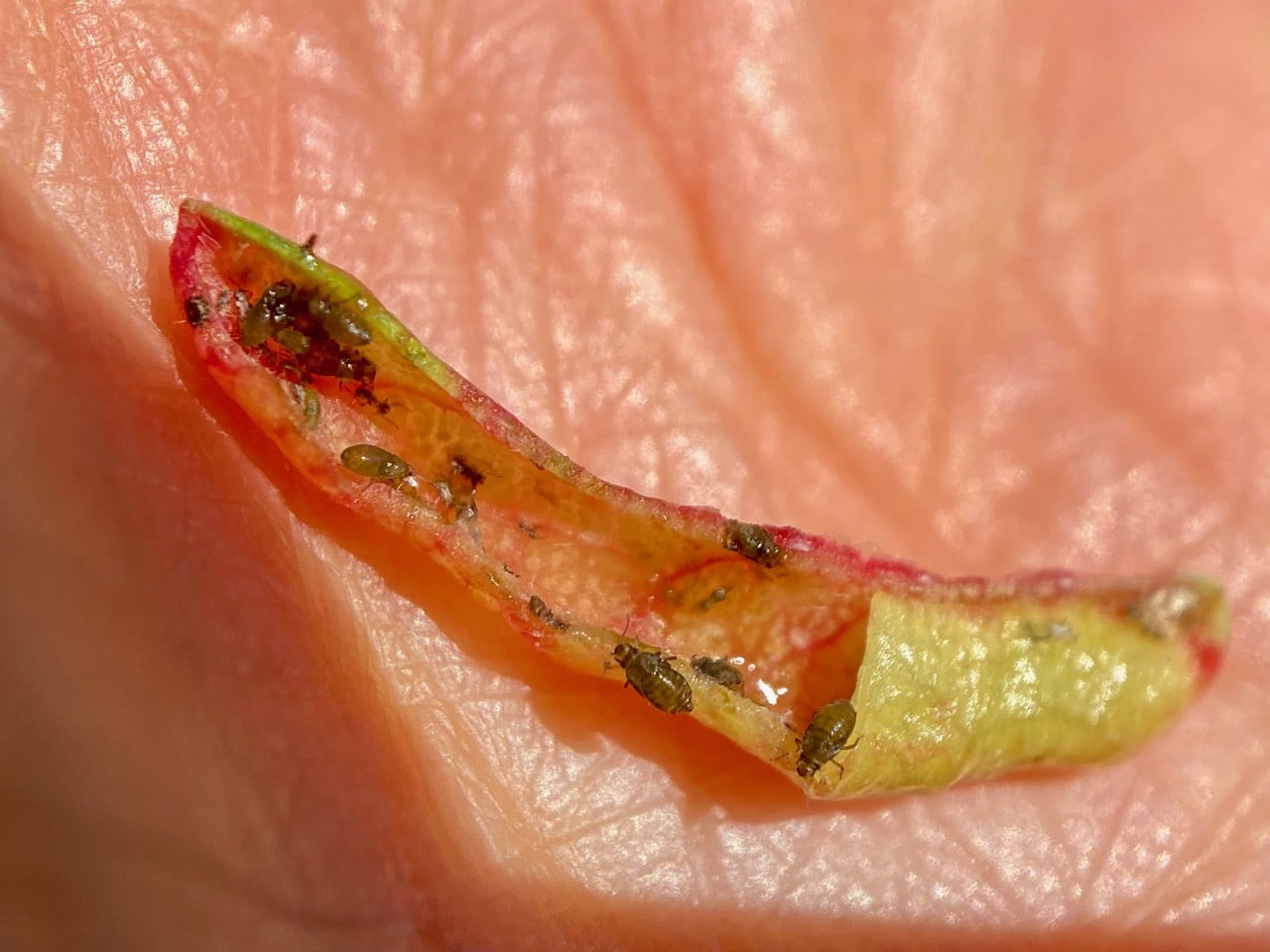
As I open up a gall with my fingernails, tiny olive green aphids of various sizes spill out of the thick-walled structure. These aphids do not seem to have the typical cornicles (“tail-pipes”).
The Manzanita Leaf-gall Aphid, Tamalia coweni (family Aphididae) is a widespread species native to the west coast of North America. Feeding by the aphid on Arctostaphylos leaves induces red or reddish-green pod-shaped galls within which the aphids feed and develop. The tiny, gray or greenish aphids feed by sucking on tissue within the leaf galls. These aphids feed only on manzanita. Throughout most of the year adult females (which may be winged or wingless) give birth to live young without mating. In the fall, a sexual generation of winged males and females is produced. The winged aphids disperse, mate, and the females lay overwintering eggs on the bark at the base of the plant. Eggs hatch in late winter or spring and the emerging aphids walk up to the leaves, settle to feed, and initiate galls. They have several generations per year.
While some consider them aesthetically objectionable, the galls do not significantly affect the health of the plant .
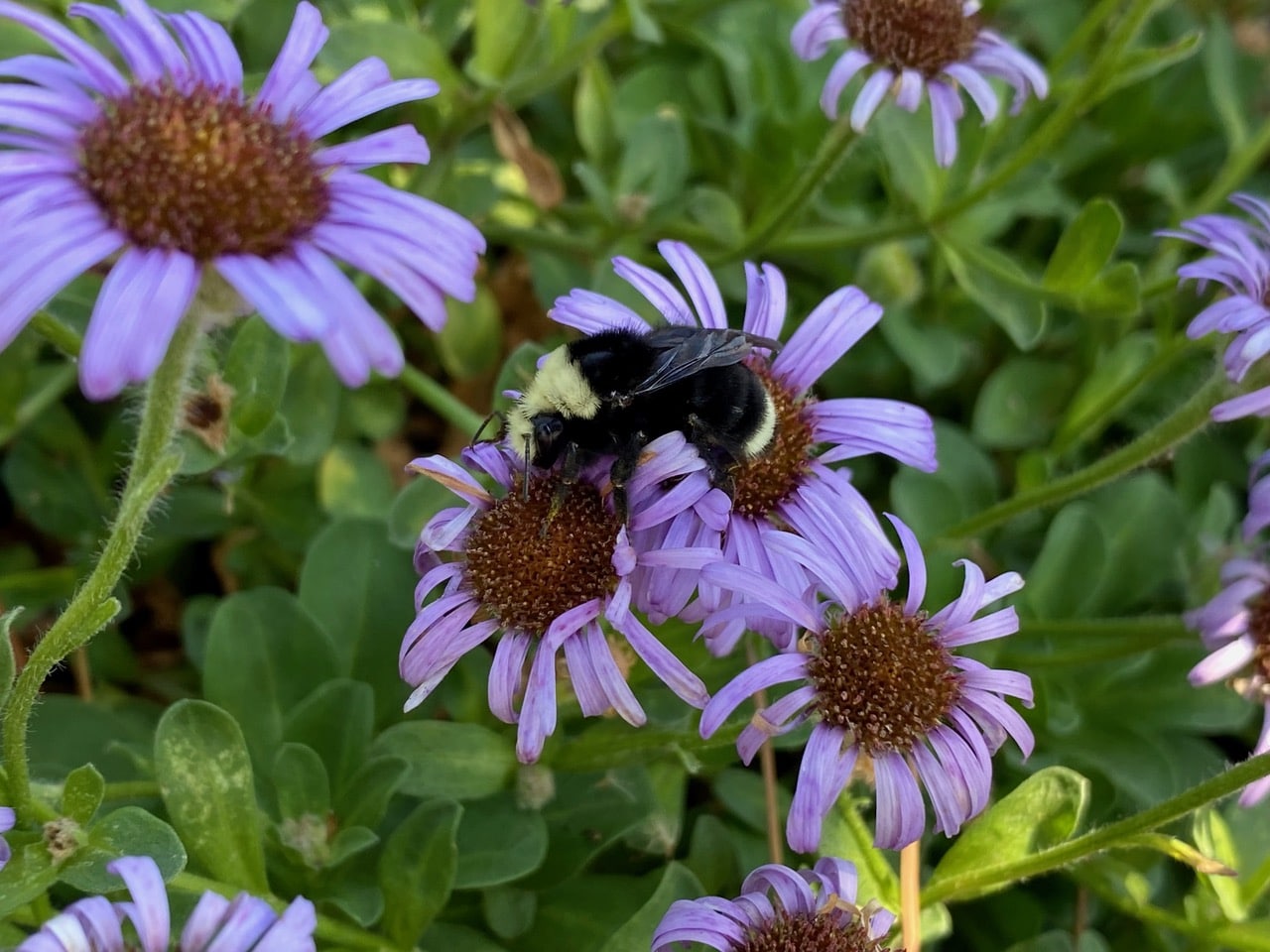
In the shade, a large queen Yellow-faced Bumble Bee, subgenus Pyrobombus (genus Bombus, family Apidae) is slumped over a couple of adjacent Seaside Daisy flowerheads, apparently fast asleep. She looks pristine, not a hair out of place. Is this a newly emerged queen recently produced by the colony?
Queens are noticeably larger than worker bees, which is one of the easiest ways to distinguish them. As larvae, bumble bee queens receive a diet with significantly more protein (especially from pollen) compared to worker larvae; this special diet is essential for their development into larger, reproductive adults. This rich diet triggers specific epigenetic changes, directing the larva to develop into a queen rather than a sterile worker. The queen’s large size is crucial for her to store enough nutrients to survive hibernation, and establish a new colony, laying a large number of eggs throughout the colony’s lifespan.
A recent study helps explain the tendency of bumble bee queens to seek naps during the day. Bumblebees have long, hairy tongues that help them lap up nectar from flowers. The bee’s tongue is densely lined with hairs near the tip, and acts somewhat like a microscopic sponge. The closely spaced hairs create countless tiny gaps that hold nectar by surface tension. The queens, who are bigger than the workers, tended to have longer tongues, but these longer tongues have relatively less hair and are less effective at trapping nectar. Since nectar gathering is laborious and less efficient for the queens, they probably need to conserve energy and recharge frequently by taking power naps throughout the day.
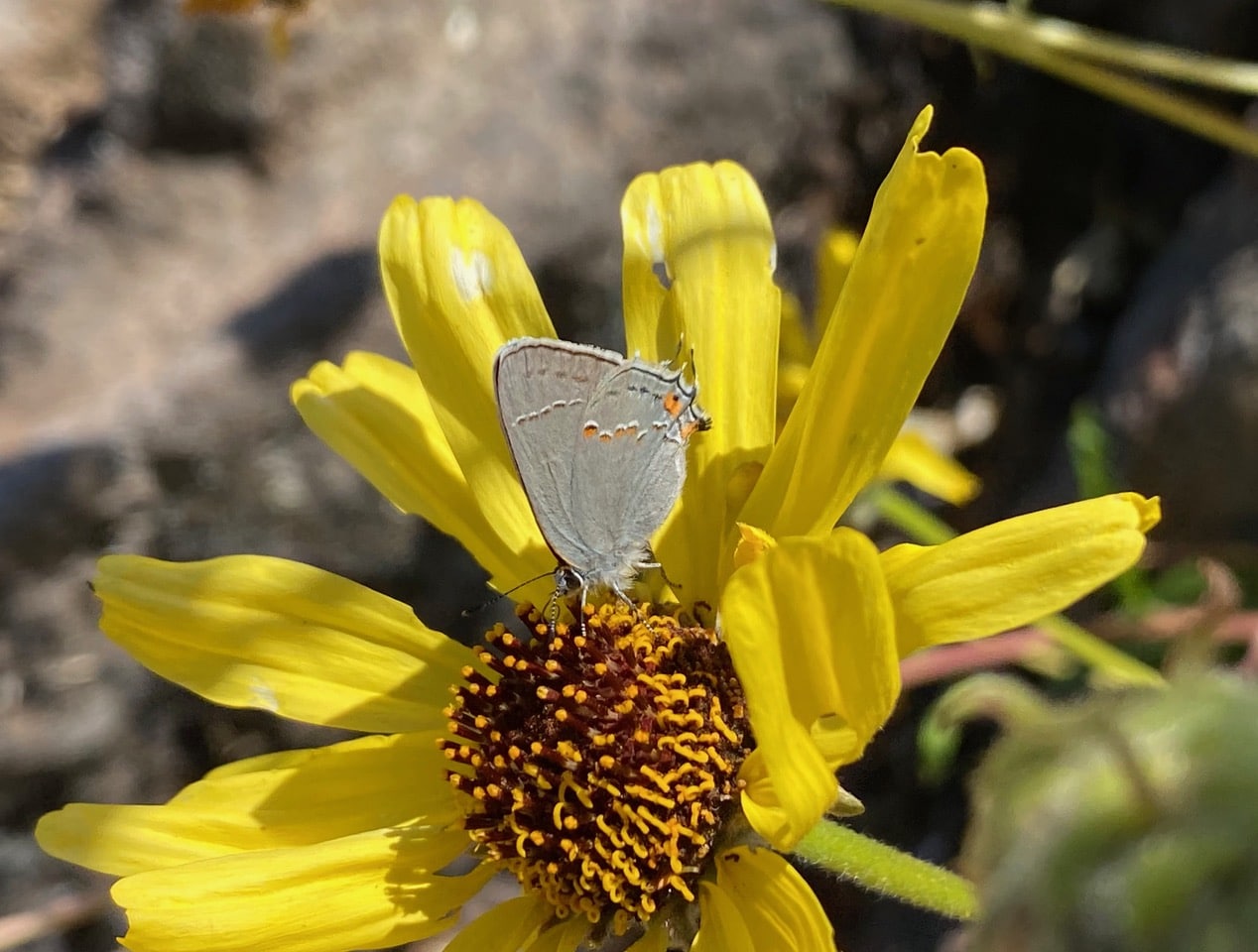
A Gray Hairstreak, Strymon melinus (family Lycaenidae) lands on a flowerhead of Bush Sunflower, Encelia californica. The butterfly rubs its two hind wings together as it takes nectar from the small flowers.
Why the name “hairstreak”? These small butterflies have a slim, hair-like tail on the lower corner of each hindwing. Gray Hairstreak also has colorful false eyespots near the base of each tail. The eyespots and antenna-like tails are believed to fool predators into mistaking its tail for its head. Hairstreaks even add a behavioral component – a nectaring hairstreak often rubs its wings up and down, simulating the movement of twitchy antennae. This may fool birds, lizards, and spiders into attacking the wrong end, sparing the life of the butterfly.
Female Gray Hairstreaks lay eggs singly on the flowers, flower buds, young fruits and nearby leaves of a host plant. Host plants include a wide variety of plants, notably from the pea (Fabaceae) and mallow (Malvaceae) families. The caterpillars are greenish at the start, but older individuals range in color from gray to pink. As in many species of Lycaenidae, Gray Hairstreak larvae are myrmecophiles (ant-lovers) – often tended by ants. Ants harvest a sweet liquid from the caterpillar’s dorsal nectary organ (“honey gland”) and in exchange may protect them from predators. Larvae of many Lycaenidae species also communicate with ants via ant-like sounds (clicks and hums) or by sending vibrations through the substrate.
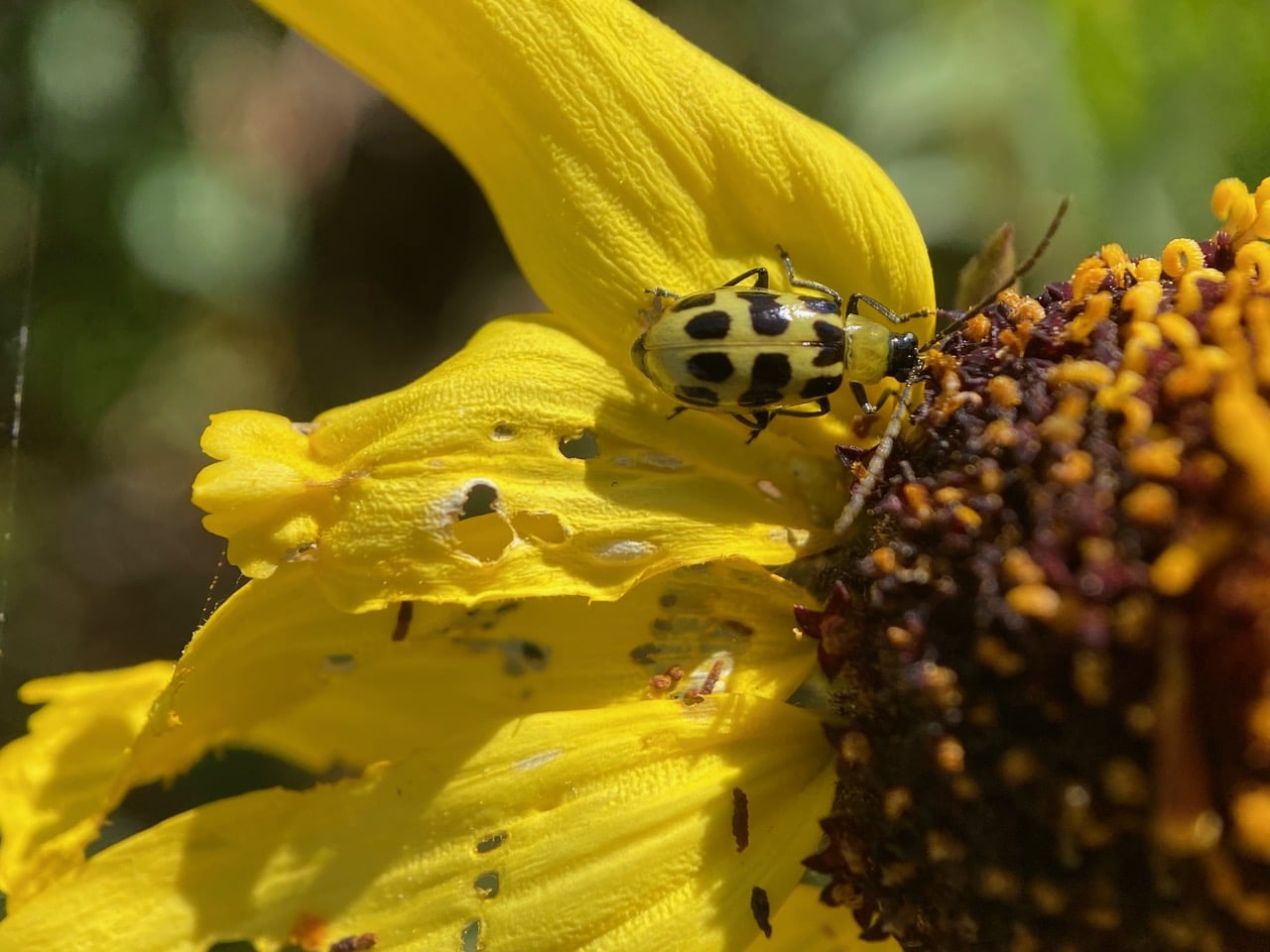
The ray petals of some of the Bush Sunflowers are riddled with feeding scars. Ah, I might have found the culprit – the Spotted Cucumber Beetle, Diabrotica undecimpunctata (family Chrysomelidae)!
The specific epithet undecimpunctata is a Latin-derived biological term that means “eleven-spotted”. Native to North America, the Spotted Cucumber Beetles are generalist feeders, consuming a wide variety of foods, although they have a preference for cucurbits (plants in the gourd family), causing damage to crops in the larval as well as adult stages of their life cycle. Larvae, sometimes known as rootworms feed on the roots of emerging plants. In the adult stage the beetles cause damage by eating the flowers, leaves, stems and fruits of the plant.
Various birds, mammals, and amphibians feed on the spotted cucumber beetle, while the beetle’s eggs are targeted by spiders, ground beetles, ants, and crickets.
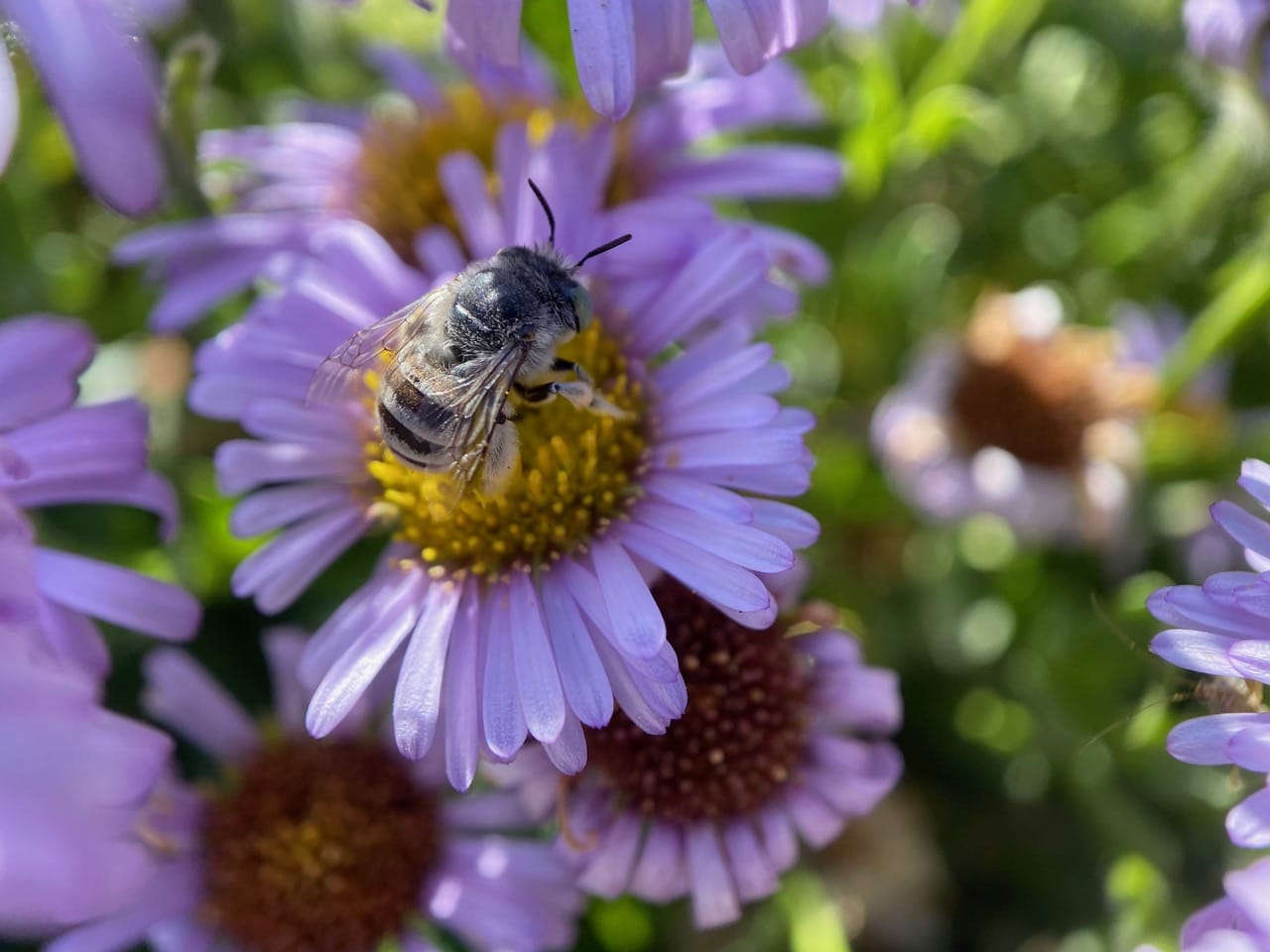
A Short Sun-digger Bee, Anthophora curta (family Apidae) is foraging on a Seaside Daisy flowerhead.
The Short Sun-digger Bee, Anthophora curta is a species of solitary, ground-nesting bee native to North America. It is well-adapted to dry, desert-like environments and arid regions, and it frequently inhabits gardens and open sandy areas throughout the western United States. They are relatively small species of Anthophora, but feature distinct large heads that give them a slightly comical, stuffed-toy appearance. They are well covered with small, short, densely branched hairs. They have prominent milky greenish-blue eyes, and a profusion of fuzz on the head and thorax. The bees are highly active and fast flyers, preferring to forage on composite flowers (family Asteraceae). Females carry pollen on scopae on their hind legs.
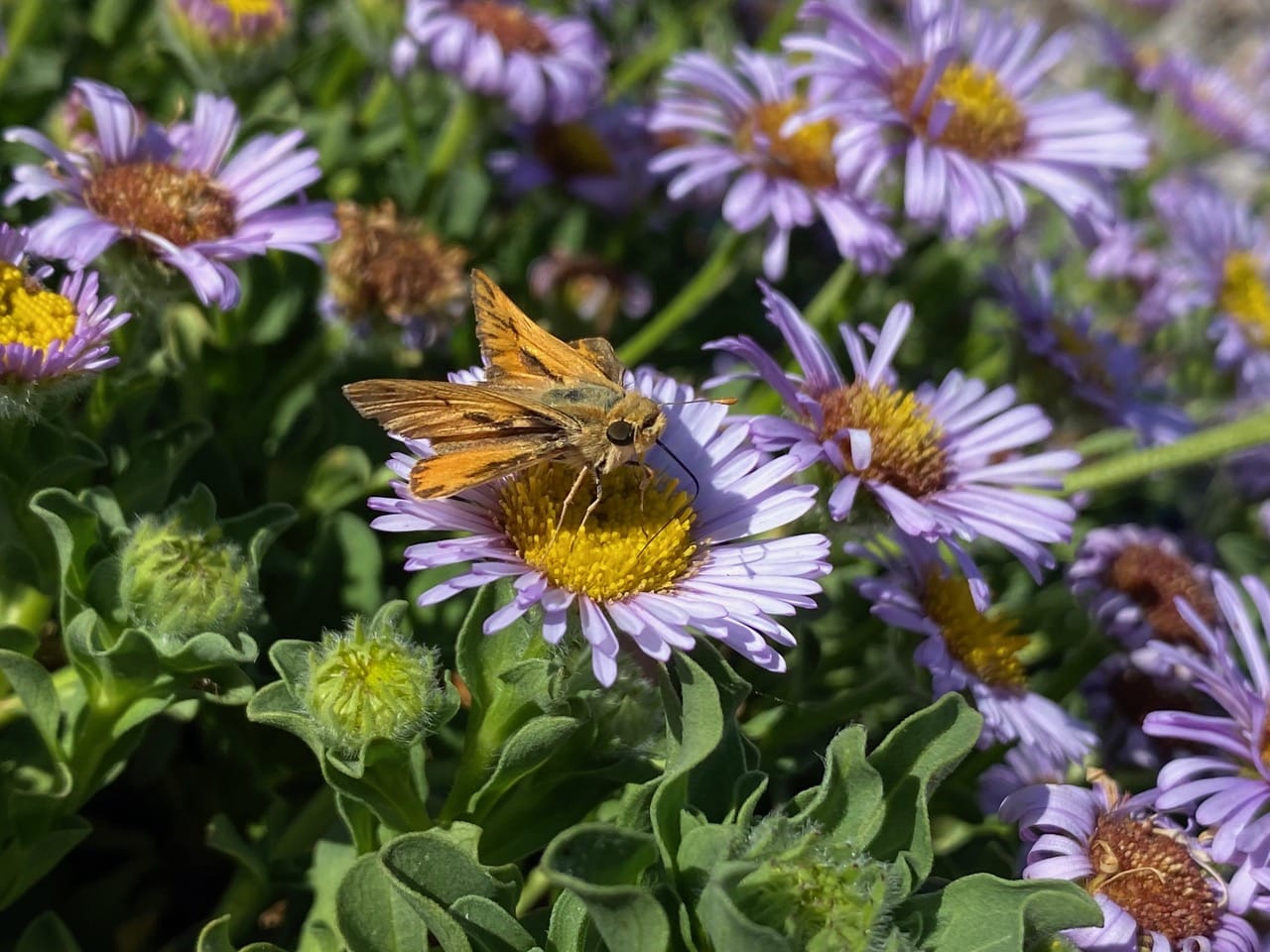
A Sandhill Skipper, Polites sabuleti (family Hesperiidae) is taking nectar on a Seaside Daisy flowerhead with its long, flexible proboscis.
Skippers are a family, the Hesperiidae, of the order Lepidoptera (butterflies and moths). They are named for their quick, darting flight habits. Most have the antenna clubs hooked backwards like a crochet hook. They also have generally stockier bodies and larger compound eyes than the other butterflies. Their wings are usually small in proportion to their bodies. When at rest, skippers keep their wings usually angled upwards or spread out, and only rarely fold them up completely. Californian species are mostly brown or tan, with black, orange, or yellow markings.
Skipper caterpillars are usually green or brown, sometimes yellowish, never brightly colored. They have a distinctive “collar”, a narrow ring around the body right behind the head. Caterpillars are camouflaged and often hide during the day. Many species make nests of leaves and silk for additional protection. Most North American species feed on grasses, but some common species eat shrubs and trees, especially in the bean family. Most species are limited to a single group of food plants. Adult skippers are only active during the day, but Skipper caterpillars feed mainly when it is dark or partly light.
The Sandhill Skipper, Polites sabuleti is a small, variable butterfly found in Western North America. They frequently inhabit grasslands, lawns, and alkaline meadows, where they feed on nectar and rely on saltgrass (Distichlis) as a larval host.
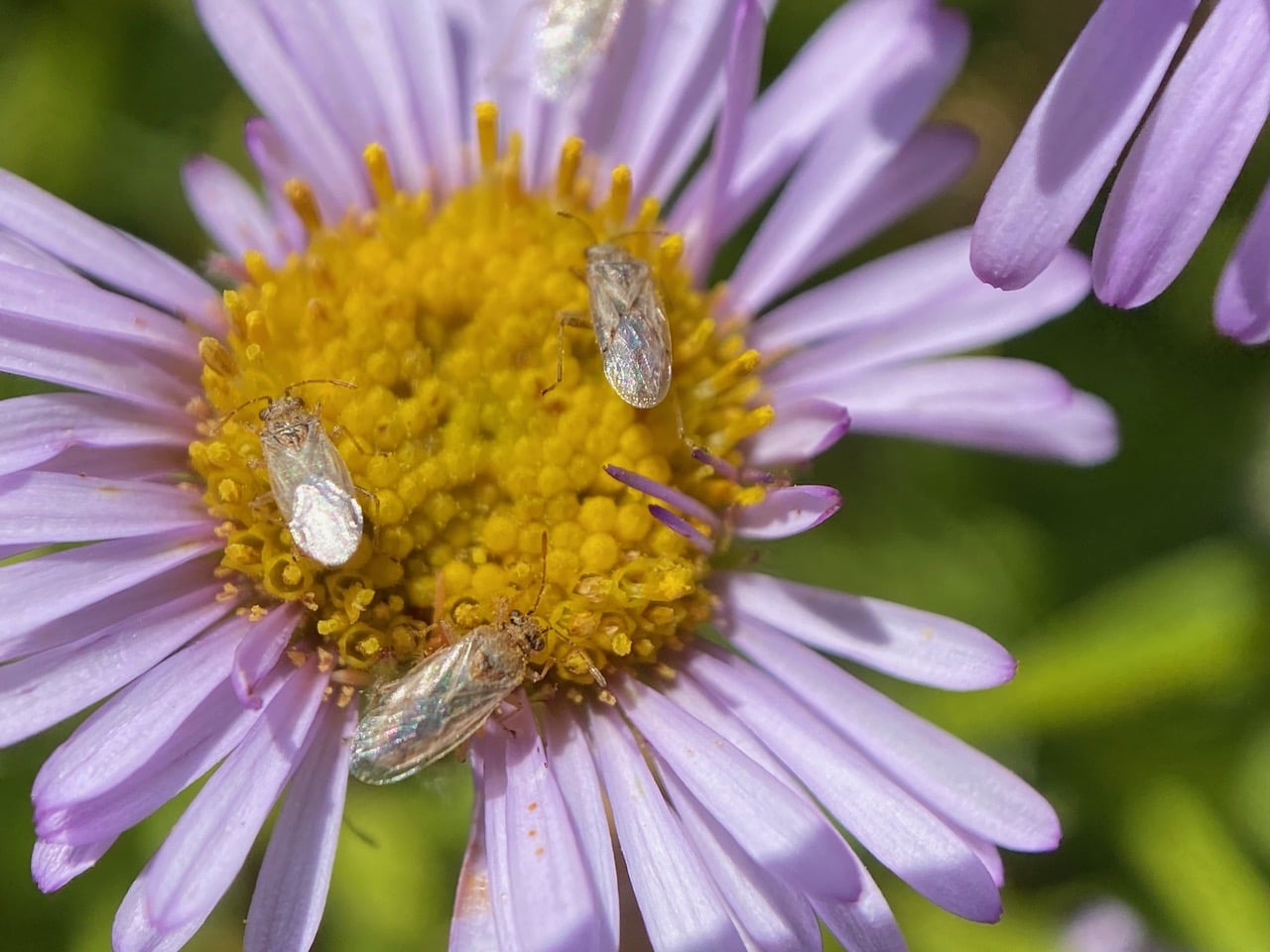
Tiny insect wings glinting in the sunlight draw my attention to a Seaside Daisy flowerhead. The skittish bugs scatter at the approach of my camera.
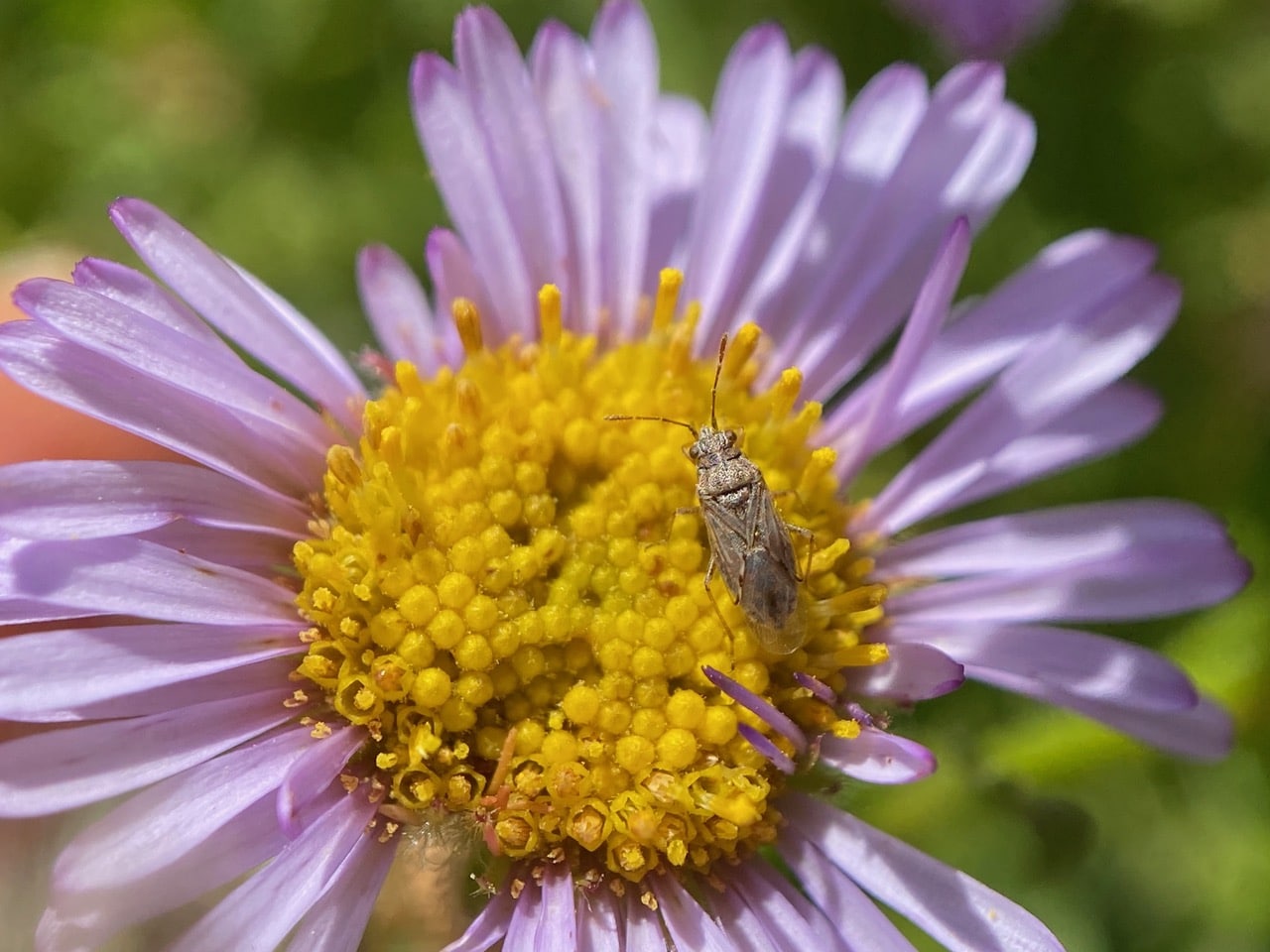
At least this one stays long enough for a photo. I recognize it as a Scentless Plant Bug, Arhyssus sp. (family Rhopalidae).
Arhyssus is a genus of small, true bugs belonging to the family Rhopalidae. There are over a dozen species native to North America. They are small, typically measuring 5-12 mm in length. They possess distinct, raised simple eyes (ocelli) at the front of the head. Unlike other true bugs, they lack well-developed scent glands (hence the common name).
Arhyssus primarily feed on weeds, seeds, and xeric (dry-habitat) grass plants. Adults spend the spring and summer feeding outdoors. In early autumn, they migrate into wall crevices, woodpiles, or homes to hibernate.