

Pollinator Post 6/15/24
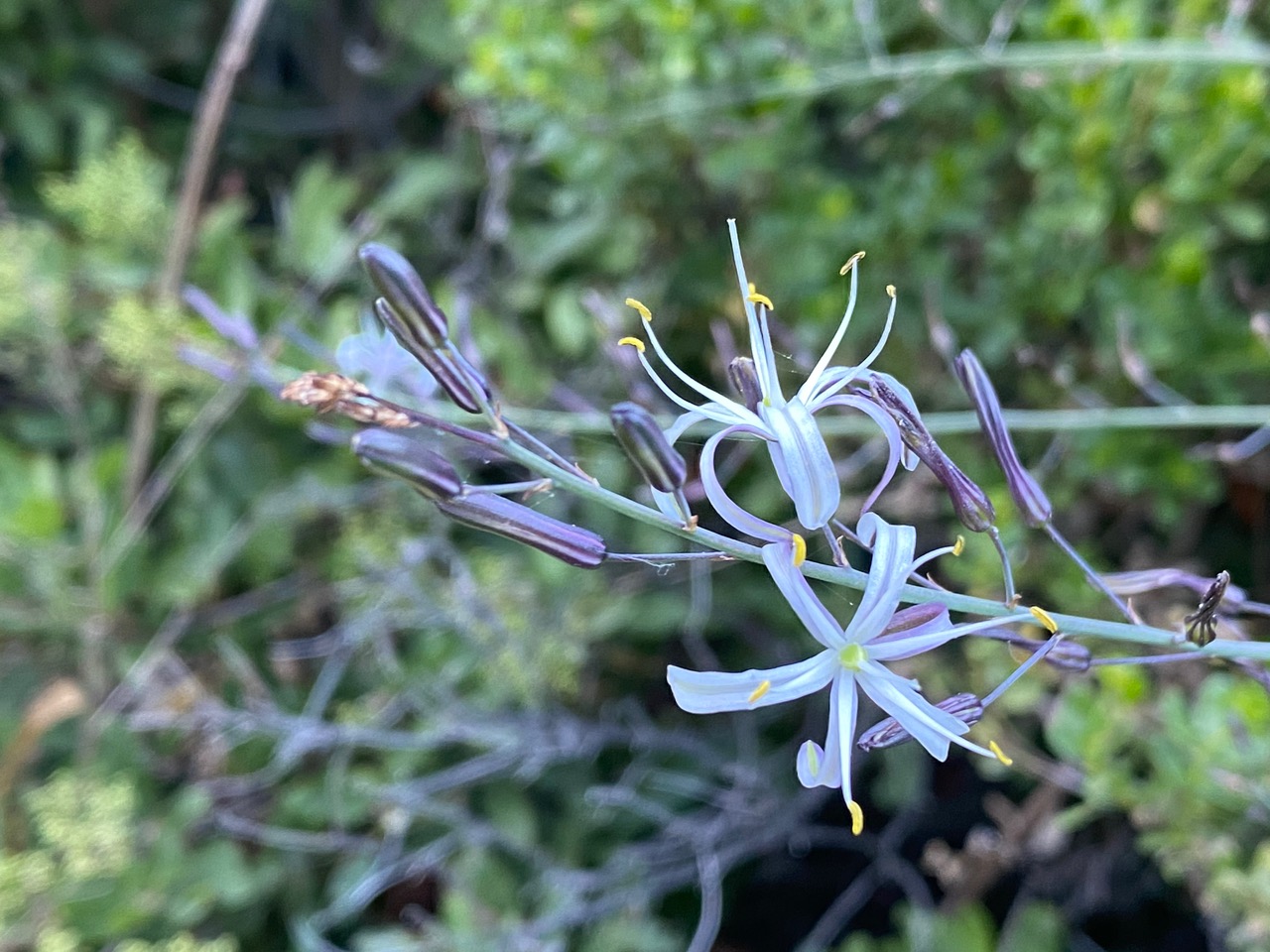
I decide to go for an evening stroll along the northern section of Skyline Trail, entering through the Steam Train gate at about 6:30 pm. The night-blooming Soap Plant, Chlorogalum pomeridianum has started to bloom, but there are much fewer plants along this stretch of the garden than in previous years. I pause by the few open flowers to check for insect visitors, but don’t see any action.
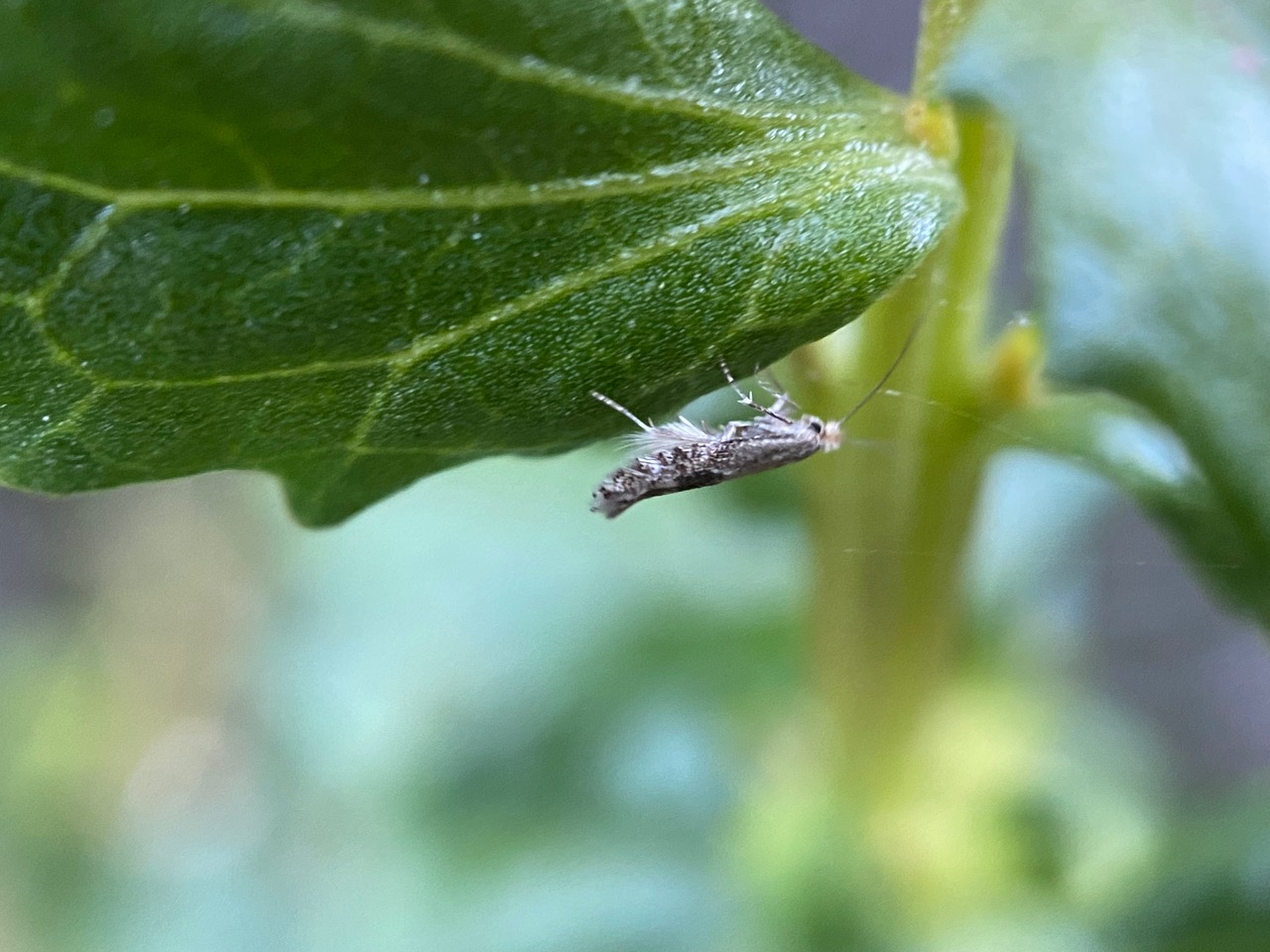
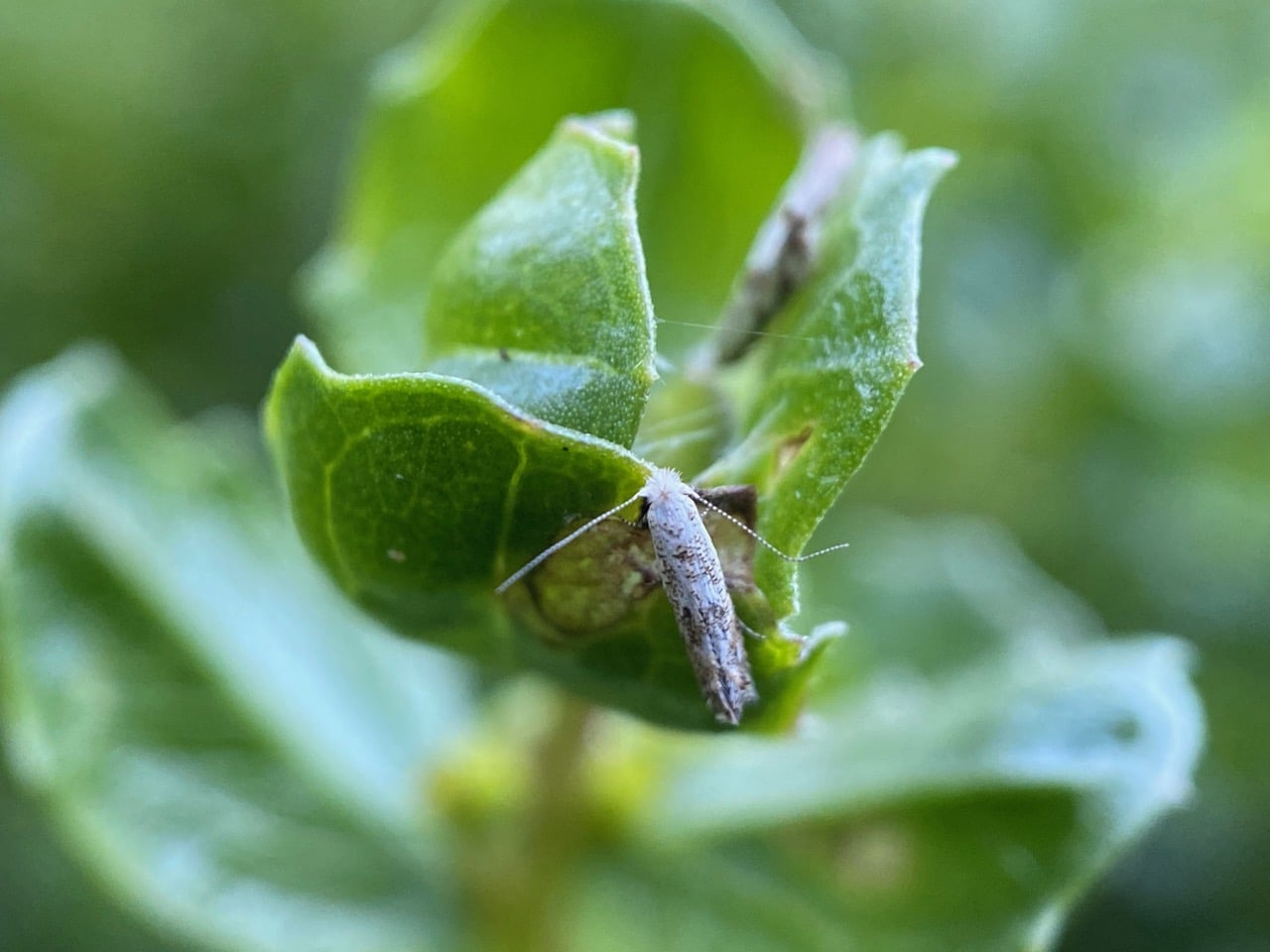



Tiny white moths are flitting between the Coyote Brush, Baccharis pilularis. They land on the terminal leaves and mill around, their movements swift and smooth. On closer inspection, the slender, elongated moths are not white, but have mottled brown wings.
iNaturalist’s AI suggested that the moth is a Leaf Miner.
A leaf miner is any one of numerous species of insects in which the larval stage lives in, and eats, the leaf tissue of plants. The vast majority of leaf-mining insects are moths (Lepidoptera), sawflies (Symphyta), and flies (Diptera). Leaf miners are protected from many predators and plant defenses by feeding within the tissues of the leaves, selectively eating only the layers that have the least amount of cellulose. The pattern of the feeding tunnel and the layer of the leaf being mined is often diagnostic of the insect responsible, sometimes even to the species level. The mine often contains frass, or droppings, and the pattern of frass deposition, mine shape, and host plant identity are useful to determine the species and install of the leaf miner.
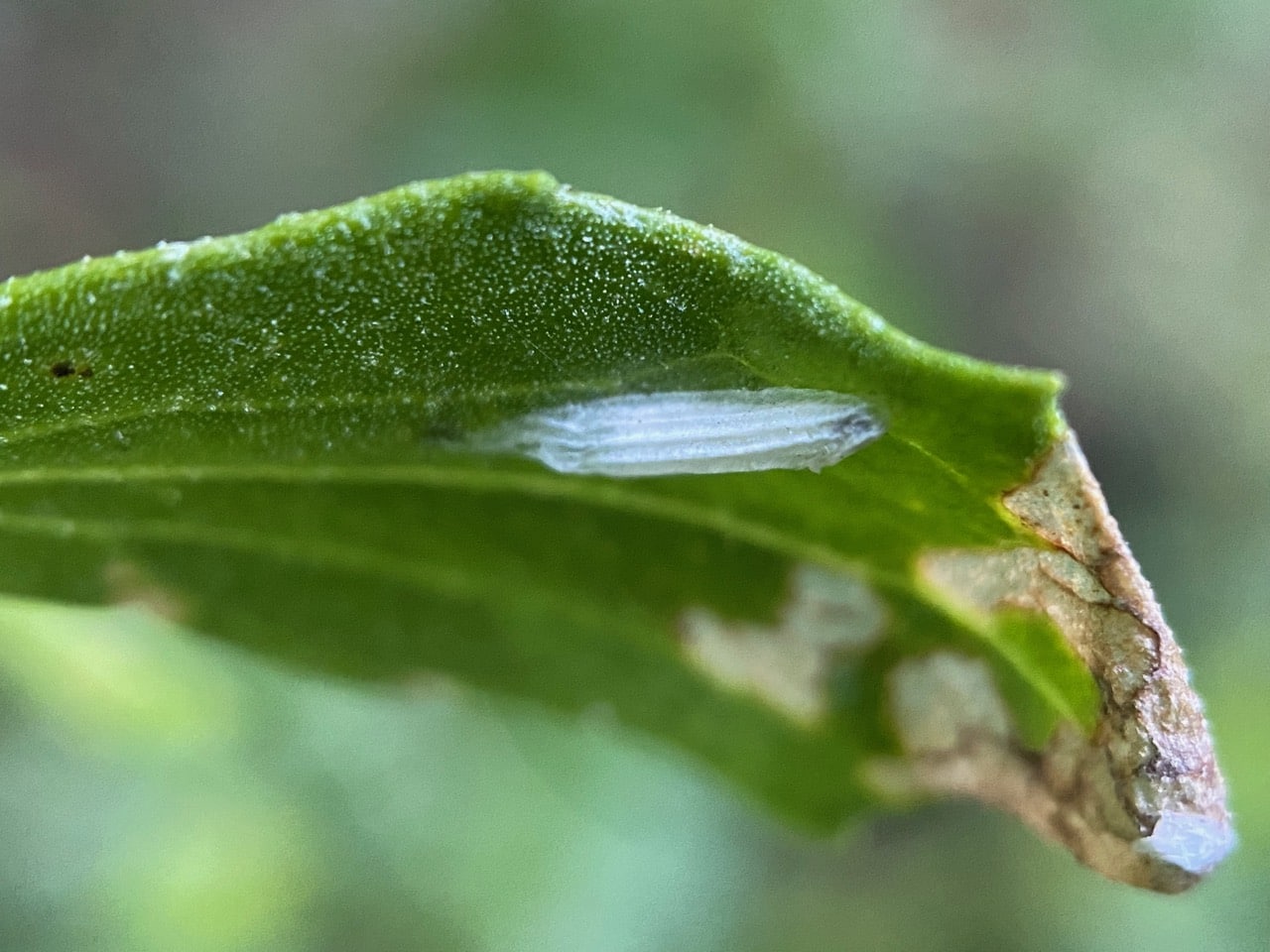
Here’s a pupa case of the Ribbed Cocoon Maker Moth, Bucculatrix sp. (family Bucculatricidae). Did those tiny moths emerge from these pupa cases?
Bucculatricidae is a family of small moths with worldwide distribution. Adults are easily overlooked, being very small with narrow wings wrapped around the body at rest. The tiny moths have the top of the head covered with rough, bristly scales. Larvae start out as leaf miners but when they outgrow the confines of their narrow mine, they become leaf skeletonizers, feeding on the leaves externally. Many species have specific host plants. The pupal cases have distinctive longitudinal ridges, leading to the common name Ribbed Cocoon Makers. To evade capture, the larvae drop and dangle from firm silk threads.
The species Bucculatrix variabilis is found in California. The wingspan is 7-8 mm. The forewings are clothed with fuscous-tipped scales, with whitish bases. The hindwing are pale grey. The larvae feed on Baccharis pilularis.
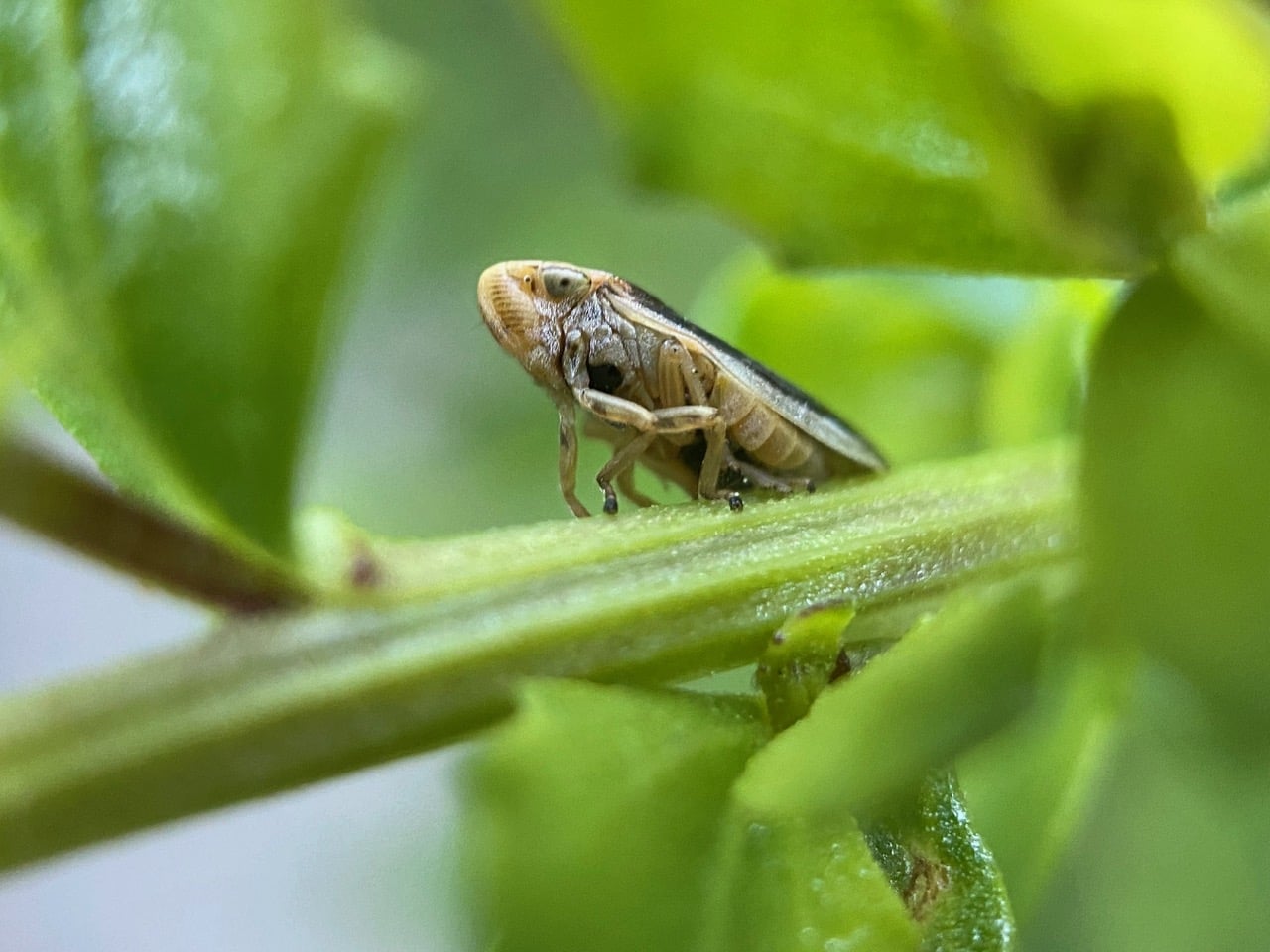
A Froghopper (family Aphrophoridae) is standing stock-still on a stem of Coyote Brush.
The Froghopper is a “true bug” in the order Hemiptera, family Aphrophoridae. Froghopppers are the adult form of the “spittlebugs” that feed on plant sap under a foamy mass that they produce. Froghoppers are champion jumpers among insects, out-performing even the fleas. The bug can leap the human equivalent of a skyscraper without a running start! The muscles in its hind legs act like a “catapult” to release energy explosively. Its athletic prowess not withstanding, the Froghopper is better known for its young, the “spittle bugs”. The nymphs produce foamy white masses on plants within which they feed on plant sap. Froghoppers have piercing-sucking mouthparts, and feed on plant sap as both nymphs and adults. A recent report claims, “Froghoppers are the super-suckers of the animal world. The tiny insects produce negative pressures equivalent to people sucking a 100-meter-long straw.” So the little bug has two titles under its belt – champion jumper, and super-sucker!
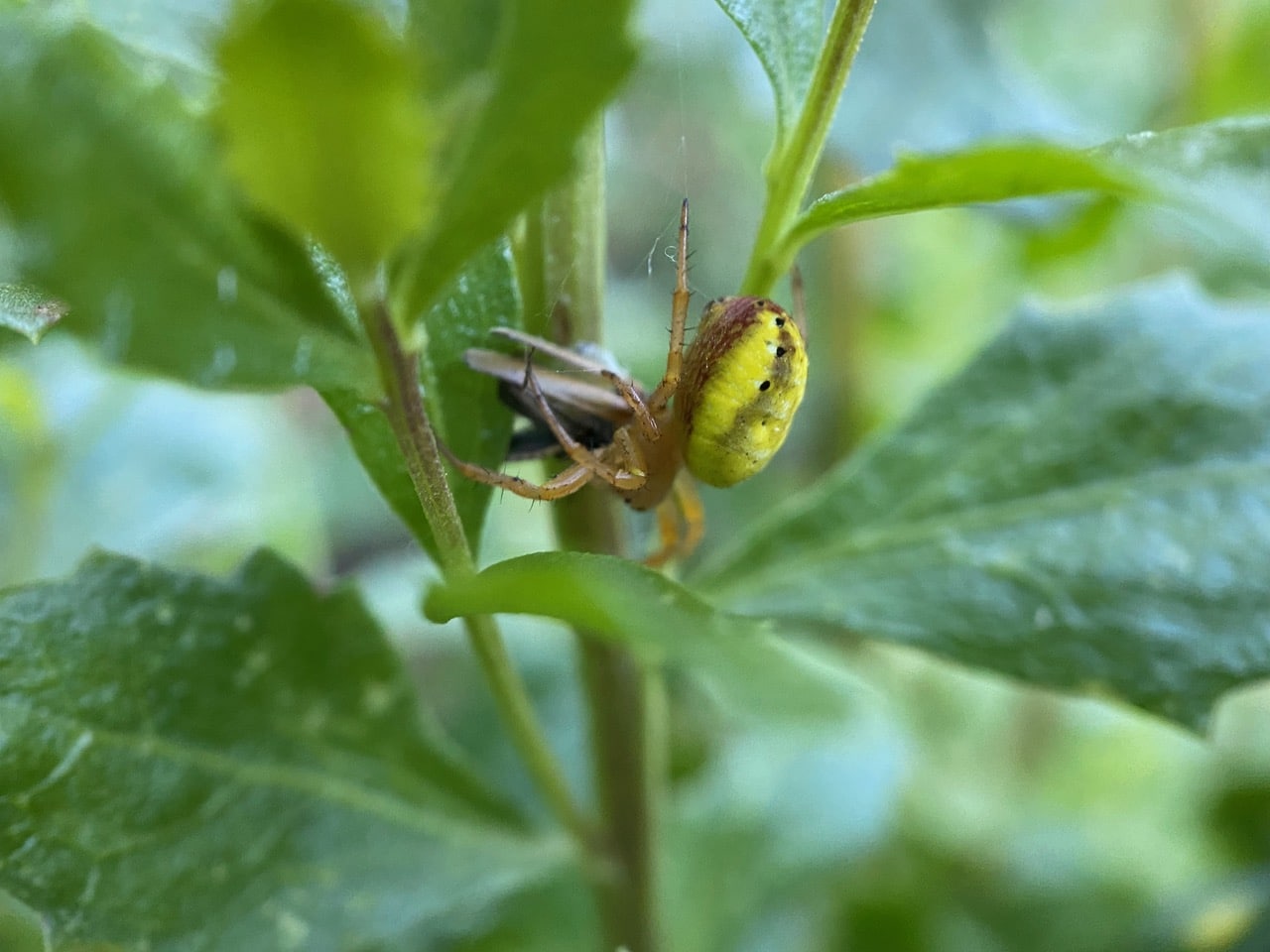
A Six-spotted Orbweaver, Araniella displicata (family Araneidae) is feeding on an insect prey.
The Six-spotted Orbweaver is a small cucumber spider. It occurs throughout Europe and North America and in parts of Asia. It is found on trees and shrubs in woodland habitats. It is one of the most widely distributed arachnids in North America, but often overlooked due to its small size. Adult females measure only 4-8 mm in length, males 4-6 mm. The species is distinguished by three (sometimes four) pairs of black spots along the edges of the rear half of the abdomen. There’s quite a bit of color variation within the species.
Most orb weavers spin fairly large webs in proportion to their own body size, but not so with Araniella displicata. The web of an adult spider may be only three or four inches in diameter. The spiral snare is usually built well off the ground, and often oriented in the horizontal plane, frequently spanning the edges of a single large leaf. The spider sits in the center, hanging beneath a horizontal web. Adult Araniella displicata are often mistaken for “baby” orb weavers. In late May or early June mating takes place, and females produce egg sacs that contain 80 eggs and are covered in loose, fluffy, yellowish silk. The package may be deposited in a curled leaf that also serves as the mother’s retreat on the perimeter of the web.
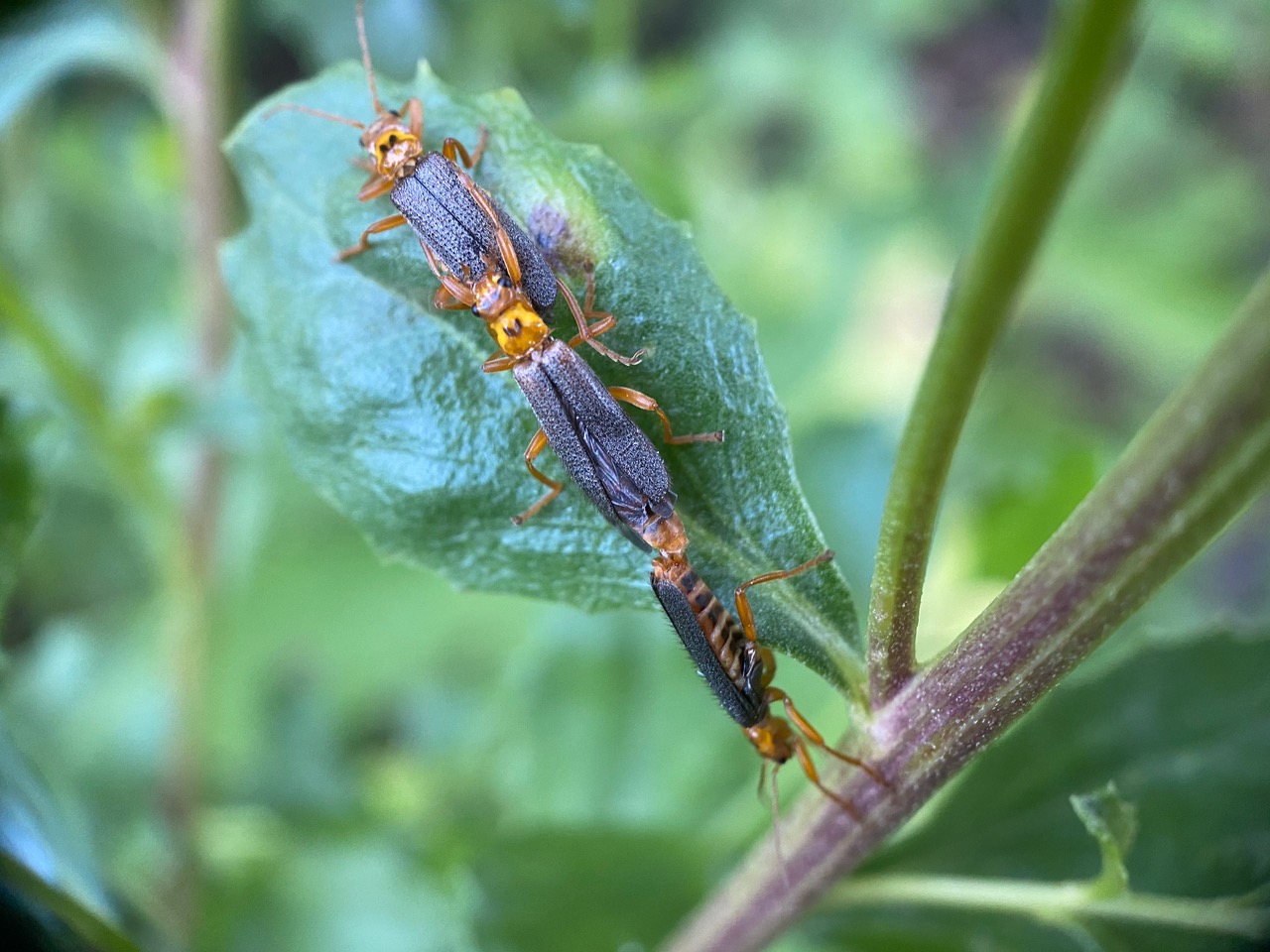
The other common insects active on the Coyote Brush at this hour are the Soldier Beetles, Cultellunguis americanus (family Cantharidae). What are they hunting during the twilight hours?
The Soldier Beetles, family Cantharidae are relatively soft-bodied, straight-sided beetles. One of the first described species has a color pattern reminiscent of the red coats of early British soldiers, hence the common name. They are also known commonly as Leatherwings because of their soft elytra.
Soldier beetles often feed on both nectar and pollen as well as predating on other small insects. The larvae are often active, and feed on the ground, hunting snails and other small creatures. Soldier beetles are generally considered beneficial insects by gardeners.
Whoa, what is happening here?! I think the Soldier Beetle in the middle is a female.
Eventually the threesome breaks up. This is the remaining pair.
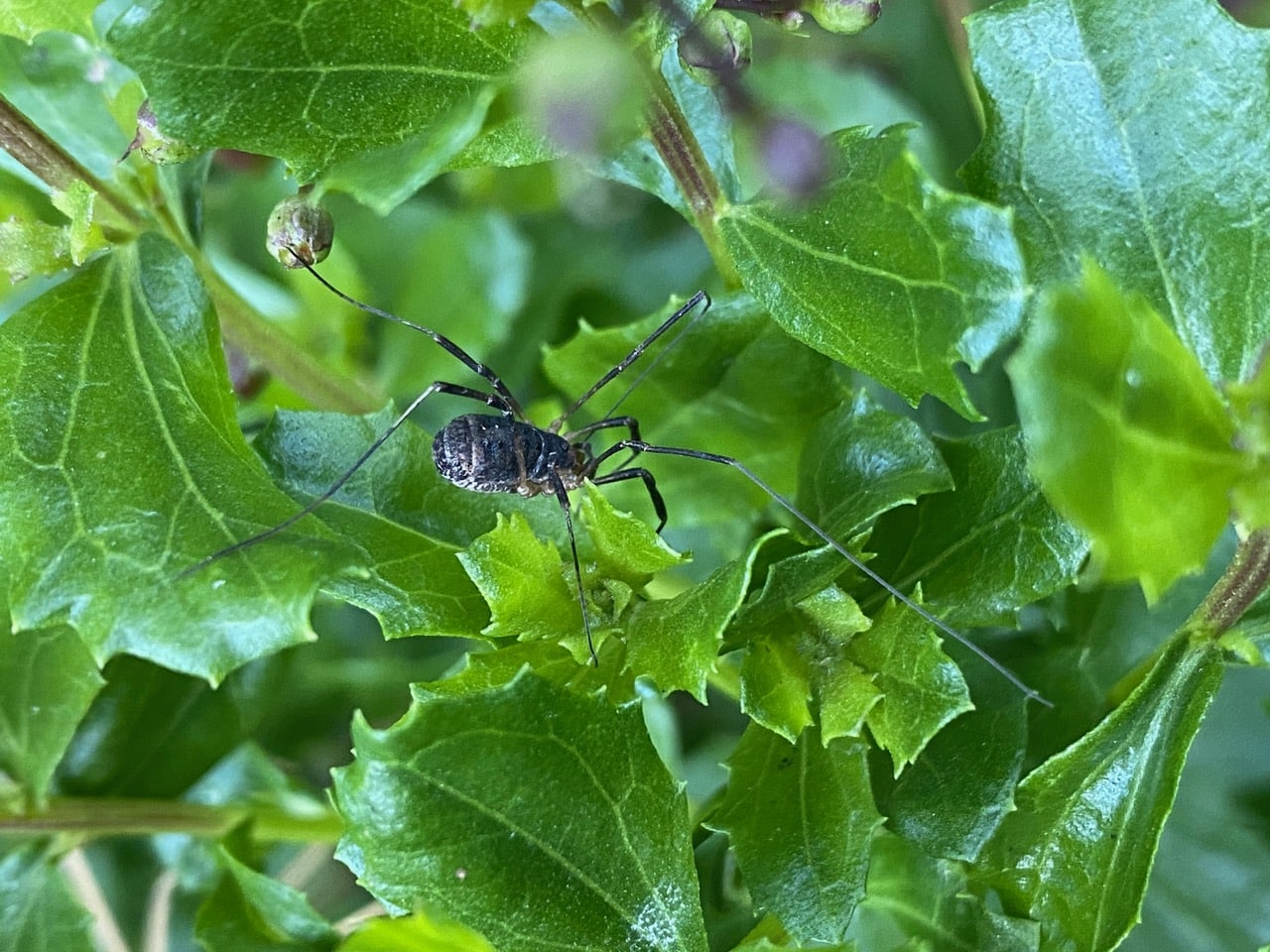
A Harvestman scrambles across the foliage of a Coyote Brush. Looks like it has lost its right hind leg. Note its second pair of legs that are extra long that it uses like antennae to navigate its surroundings.
The Opiliones are an order of arachnids commonly known as harvestmen or daddy longlegs. They are known for having exceptionally long legs relative to their body size. They are distinguished from the spiders in several ways. In the harvestmen, the connection between the cephalothorax and abdomen is broad, so the body appears as a single oval structure. Unlike spiders, Opiliones have no venom glands in their chelicerae, so pose no danger to humans. They also lack silk glands and therefore do not build webs.
Most Harvestman species are omnivorous, eating primarily small insects and all kinds of plant material and fungi. Some are scavengers, feeding on dead organisms and fecal material. Because their eyes cannot form images, they use their second pair of legs as antennae to explore their environment.
Ooh, another Six-spotted Orbweaver, Araniella displicata (family Araneidae) hiding in the Coyote Brush. Note the strand of silk coming out of her spinneret.
The spinneret is a silk-spinning organ of the spider, located at the tip of the abdomen. Spinnerets are tubular or conical structures and silk is produced in liquid form at the tip. When exposed to the air the silk forms a filament and the spider draws out the silk into a thread. Most spinnerets are not simple structures, but consist of many microscopic spigots, each producing one filament. Spigots can be singular or found in groups, which permits the spider to combine multiple filaments in different ways to produce many kinds of silk for various purposes.

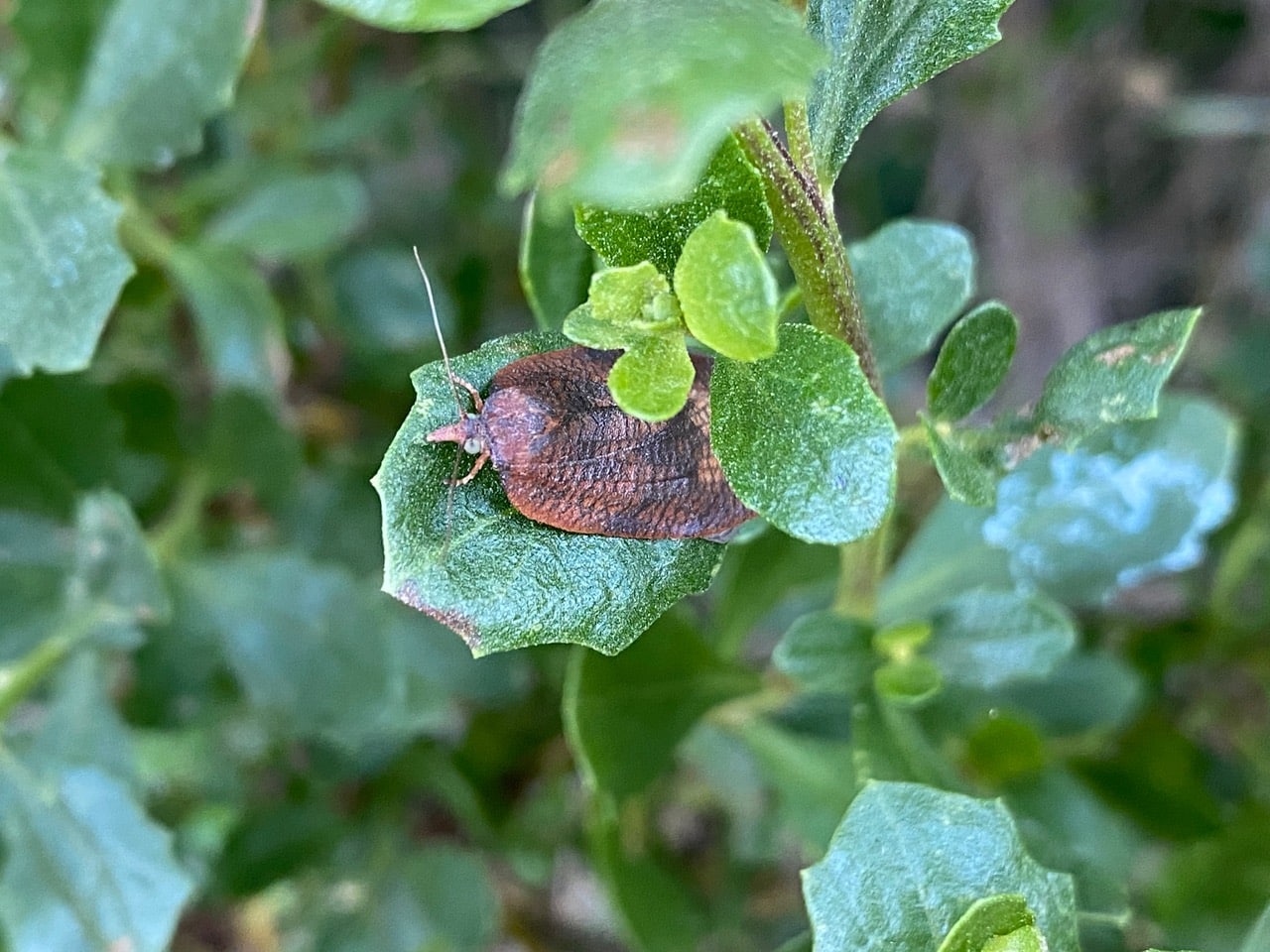
This brown moth would be almost invisible on a tree trunk, but it stands out against the green foliage of Coyote Brush. iNaturalist’s AI suggested that it is a Tortricid Leafroller Moth (family Tortricidae).
Members of the family Tortricidae are commonly known as tortrix moths or leafroller moths. Many are economically important pests. The typical resting posture of the adult is with the wings folded back, producing a rather rounded profile. Tortricid moths are generally small, with a wingspan of 3 cm or less. Many species are drab and have mottled and marbled brown colors. Larvae of some species feed by boring into stems, roots, buds or seeds. Others feed externally and construct leaf rolls.
Leaf shelter-builders, either leaf-tiers or leaf-rollers, do not manipulate leaves directly but use their silk to draw plant surfaces together. The caterpillars impart potential energy to their silk strands by stretching them beyond their equilibrium length as they are spun out. Axial retraction of the stretched strands then draws the bound plant surfaces together. Although a single stretched strand exerts only a minuscule force, the combined force generated by many such strands attached to the same opposable plant surfaces is substantial and allows the caterpillars to manipulate leaves many times their size and mass.
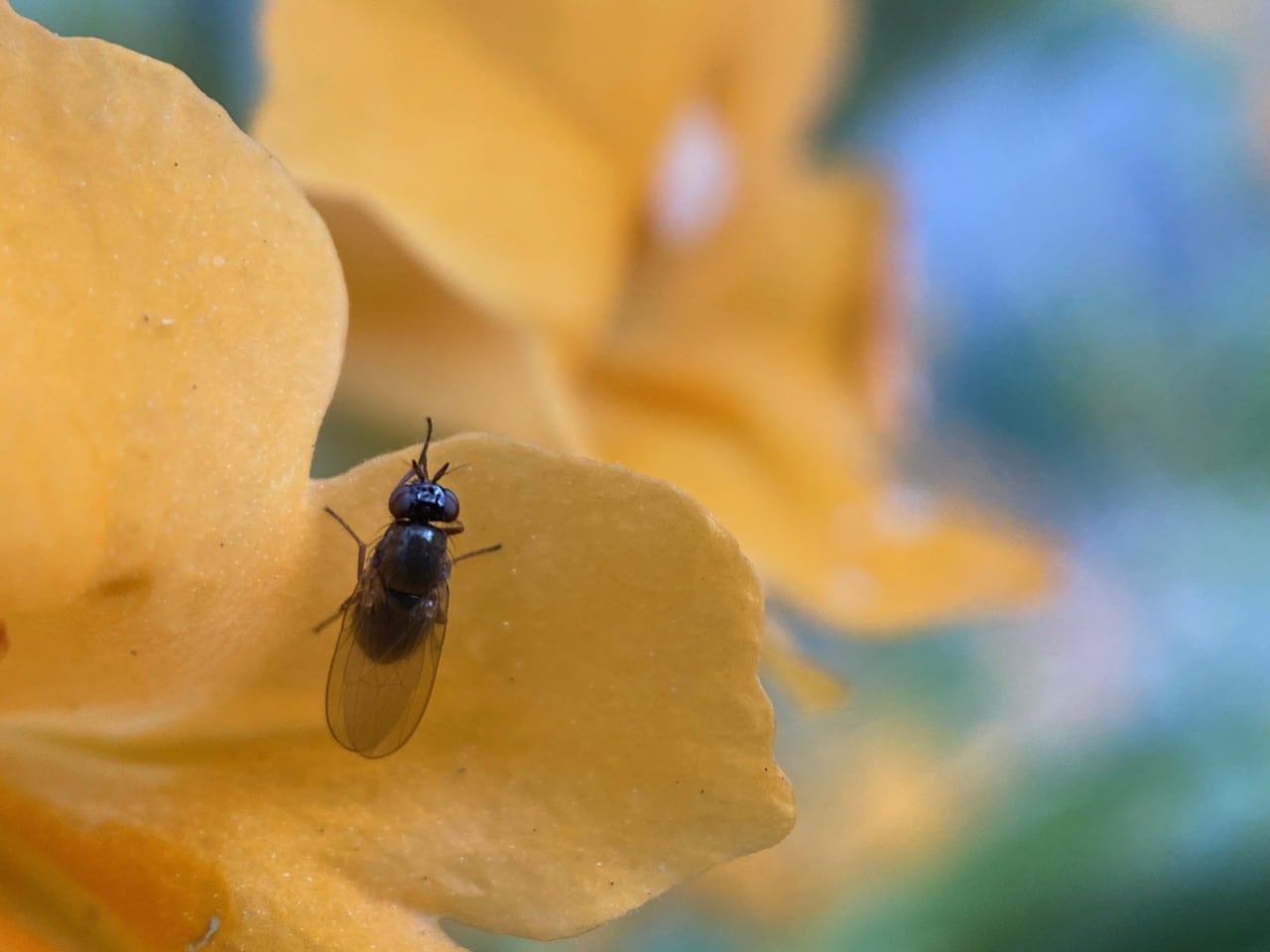
A small dark fly peeks out from a Sticky Monkeyflower. I am fast losing light at 8 pm. It is time to head home.