

Pollinator Post 6/15/23 (2)
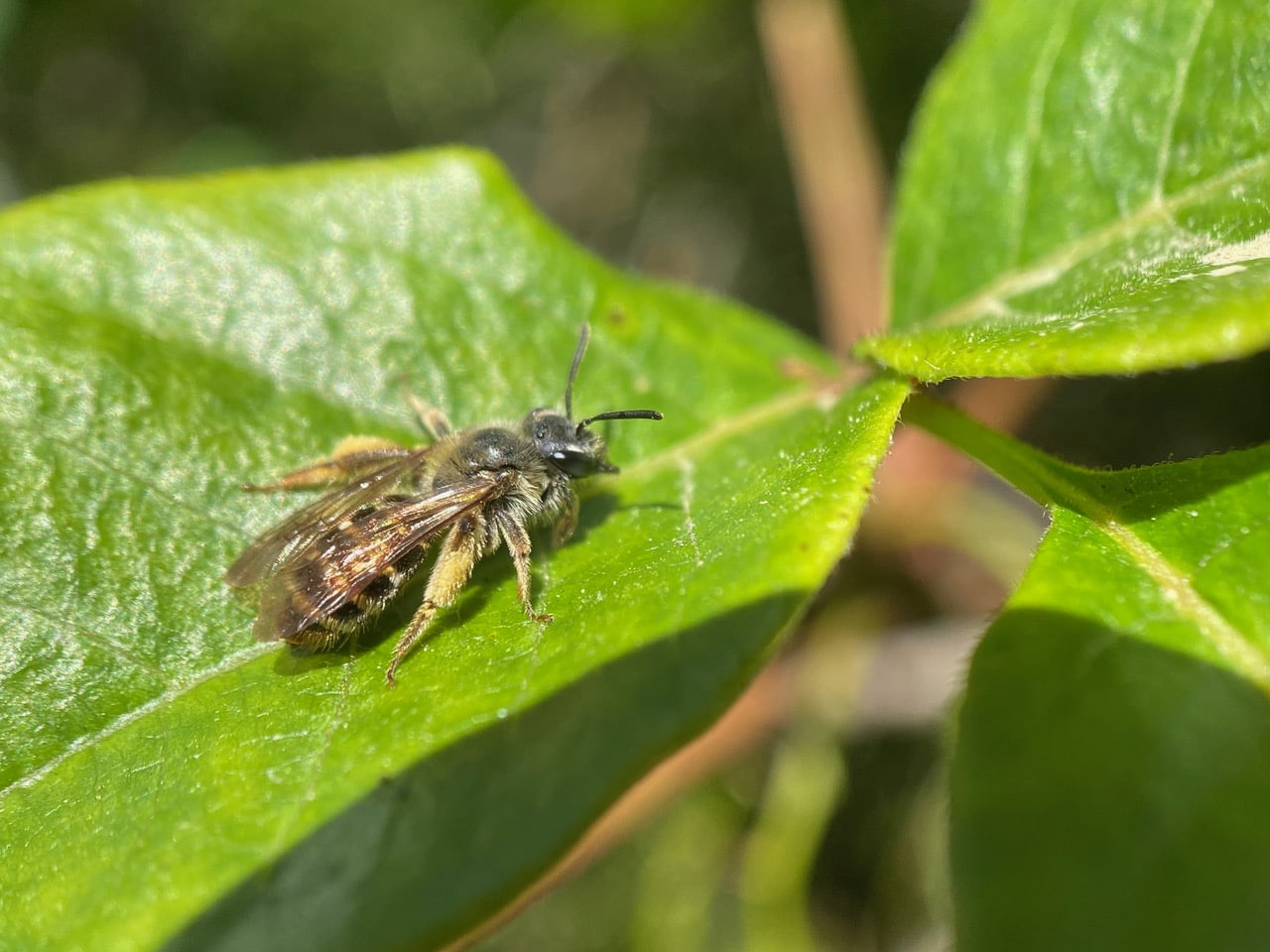
A few small bees are flying around, visiting the California Bee Plant flowers. Occasionally they would land on the foliage and spread eagle against the leaves to bask in the sunlight – a rather endearing sight. Alas, their basking place of choice seems to be Poison Oak leaves, making them oh so difficult to approach for a picture! This behavior of basking is known for the Mining Bees, family Andrenidae.

Do I see a hint of a facial fovea on that face? Members of the genus Andrena have a band of pale hairs running down each side of their face: the hairs emerge from a groove (a fovea) located between each compound eye and the middle of the face.
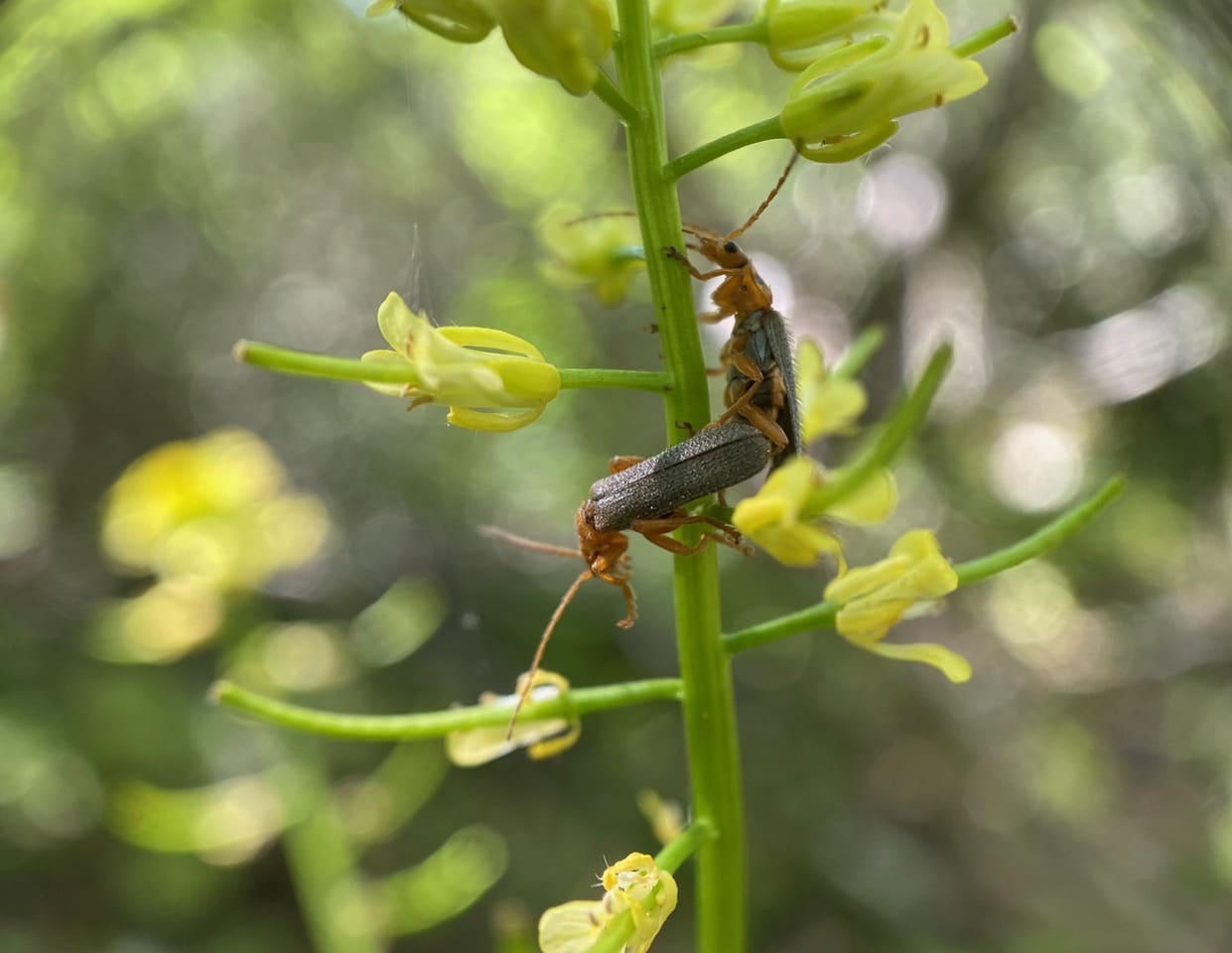
Locked in copula on a wild mustard, a pair of Soldier Beetles, Cultellunguis americanus (family Cantharidae) is still struggling to find a more comfortable position.

There sure are a lot of Dance Flies (family Empididae) lately. This one has just landed on a flower of the Sticky Cinquefoil, Drymocallis glandulosa.
Dance Flies, in the family Empididae, get their name from the habit of males of some species to gather in large groups and dance up and down in the air in the hopes of attracting females. They are predominantly predatory and they are often found hunting for small insects on and under vegetation in shady areas. Both genders may also drink nectar. Male dance flies give their sweeties a nuptial gift to eat while they mate. The gift is thought to enable her to complete the development of her eggs. Males may wrap their gifts in balloons of silk or spit.
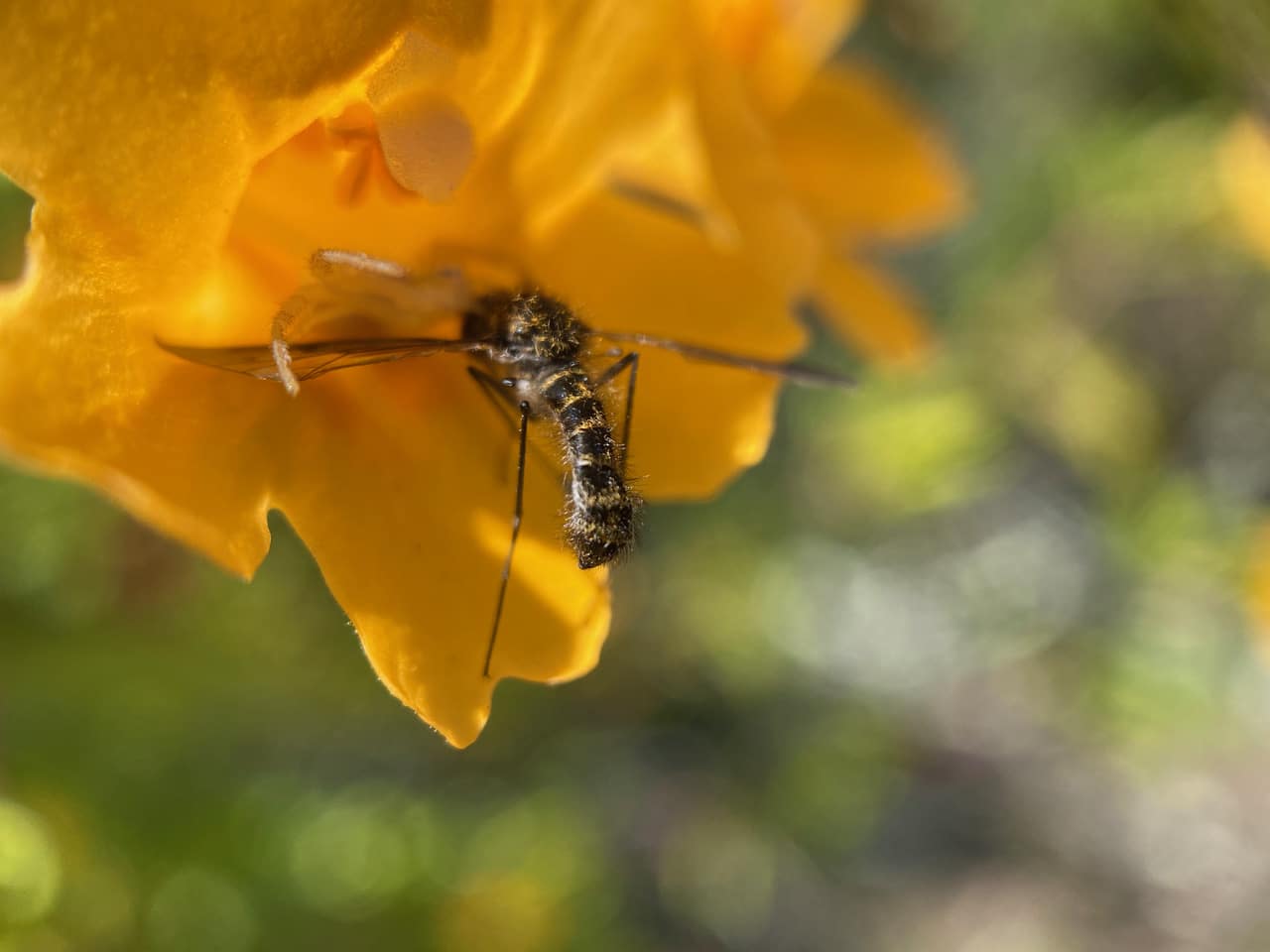
A dark insect is perched on the lower lip of a Sticky Monkeyflower. I think it is being held by a Crab Spider.
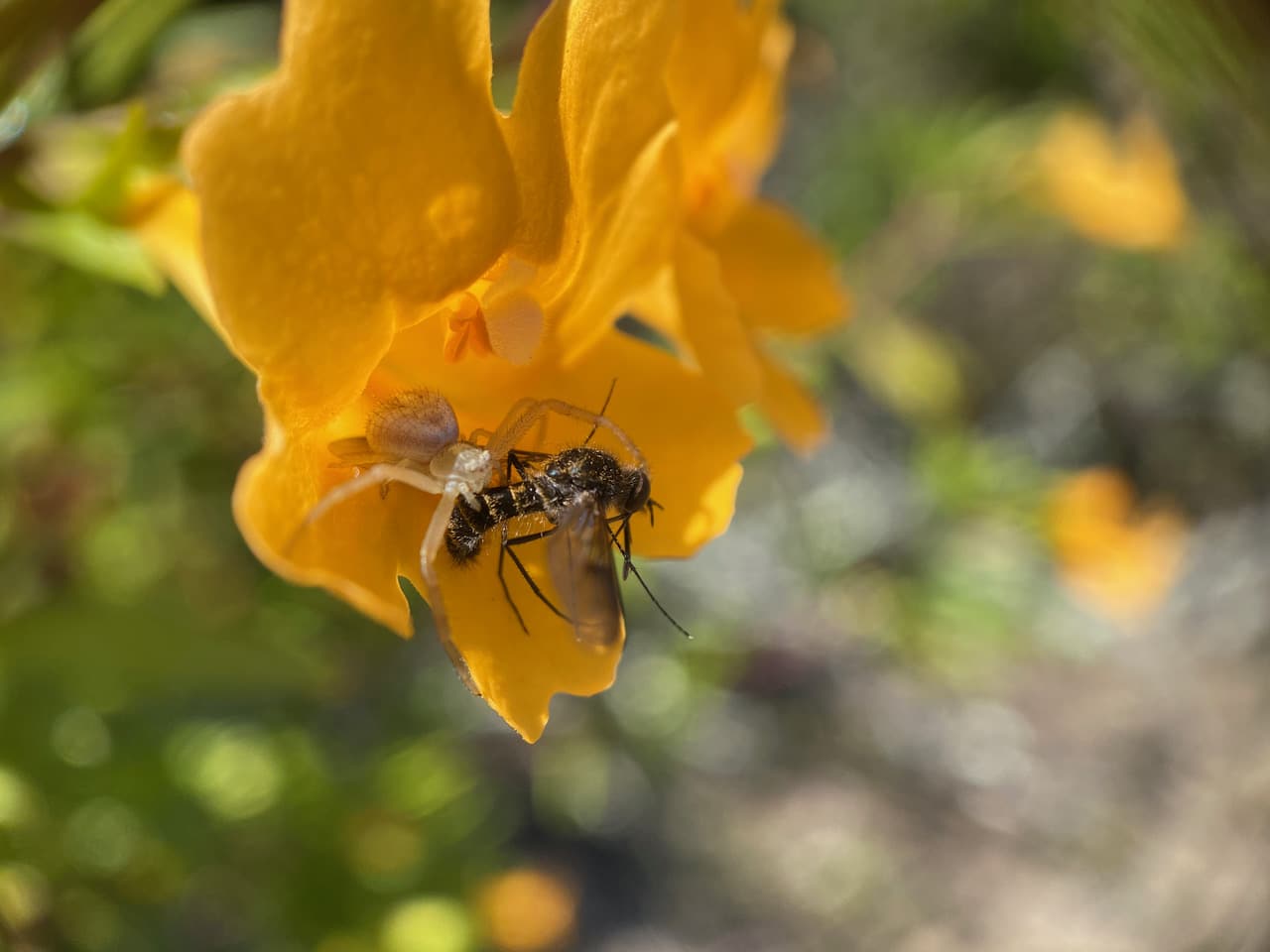
Looking down on the flower from a higher vantage point, I see the spider – a Mecaphesa sp. (family Thomisidae). The spider pulls its prey closer to itself. Now I can see that the prey is a Dance Fly! Wow, this is new to me. I have never seen a Crab Spider ambush hunting from inside a Sticky Monkeyflower. They are often seen on large clusters of small flowers, such as Yarrow and Cow Parsnip.
Members of the family Thomisidae do not spin webs, and are ambush predators. The two front legs are usually long and more robust than the rest of the legs. Their common name derives from their ability to move sideways or backwards like crabs. Most Crab Spiders sit on or beside flowers, where they grab visiting insects. Some species are able to change color over a period of some days, to match the flower on which they are sitting.
Mecaphesa is distinguished from the other genera of Crab Spider by the size and arrangement of the eight eyes (in two curved rows of four). Mecaphesa is also often hairy, with tiny hairs protruding from the head, legs, and body.
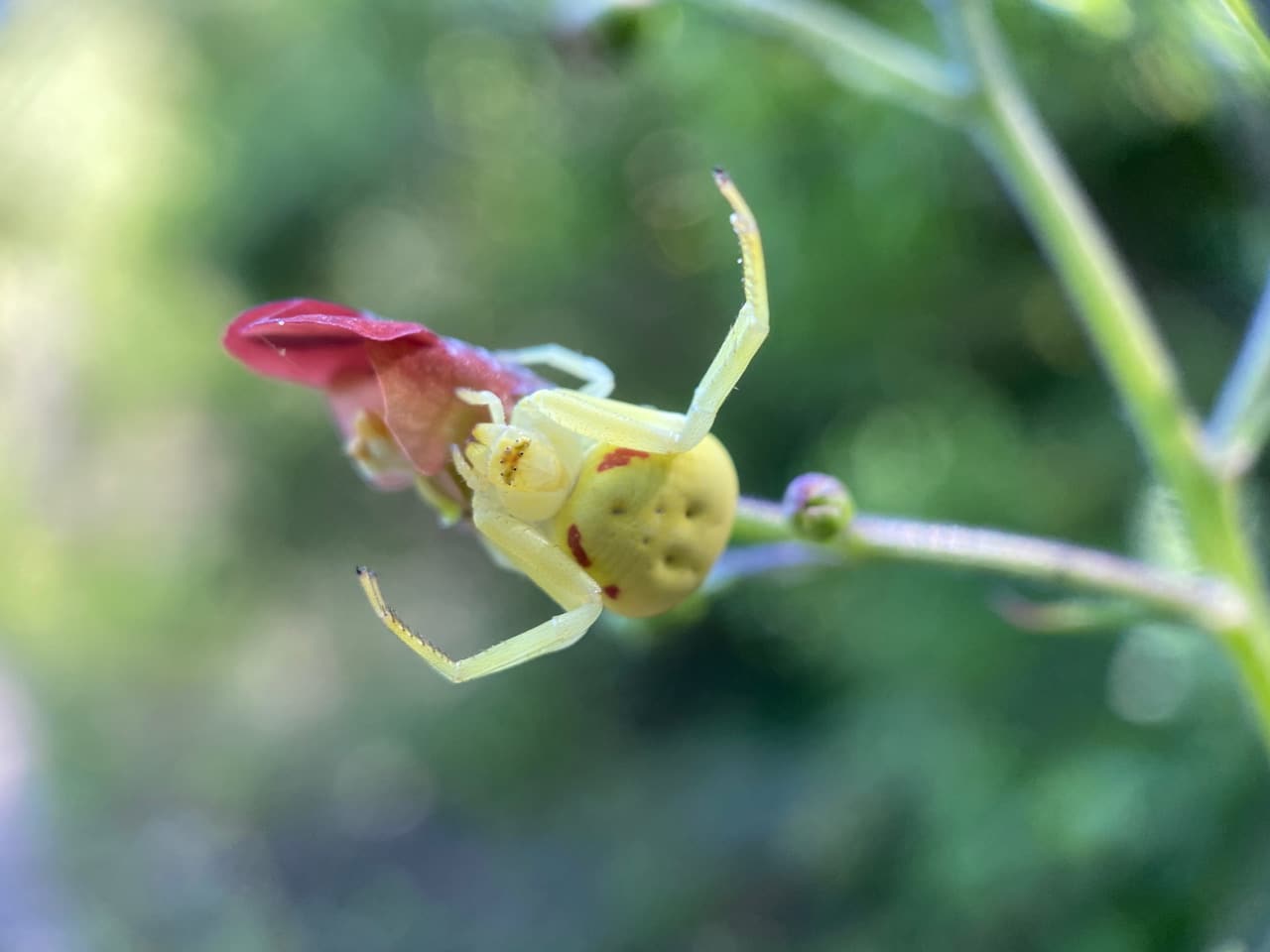
Ooh, here’s another Crab Spider, Misumena vatia (family Thomisidae) sitting in ambush on a California Bee Plant flower, Scrophularia californica. The spider is bigger than the flower! There’s a soft, pale, almost translucent quality to the spider – has the spider just molted recently?
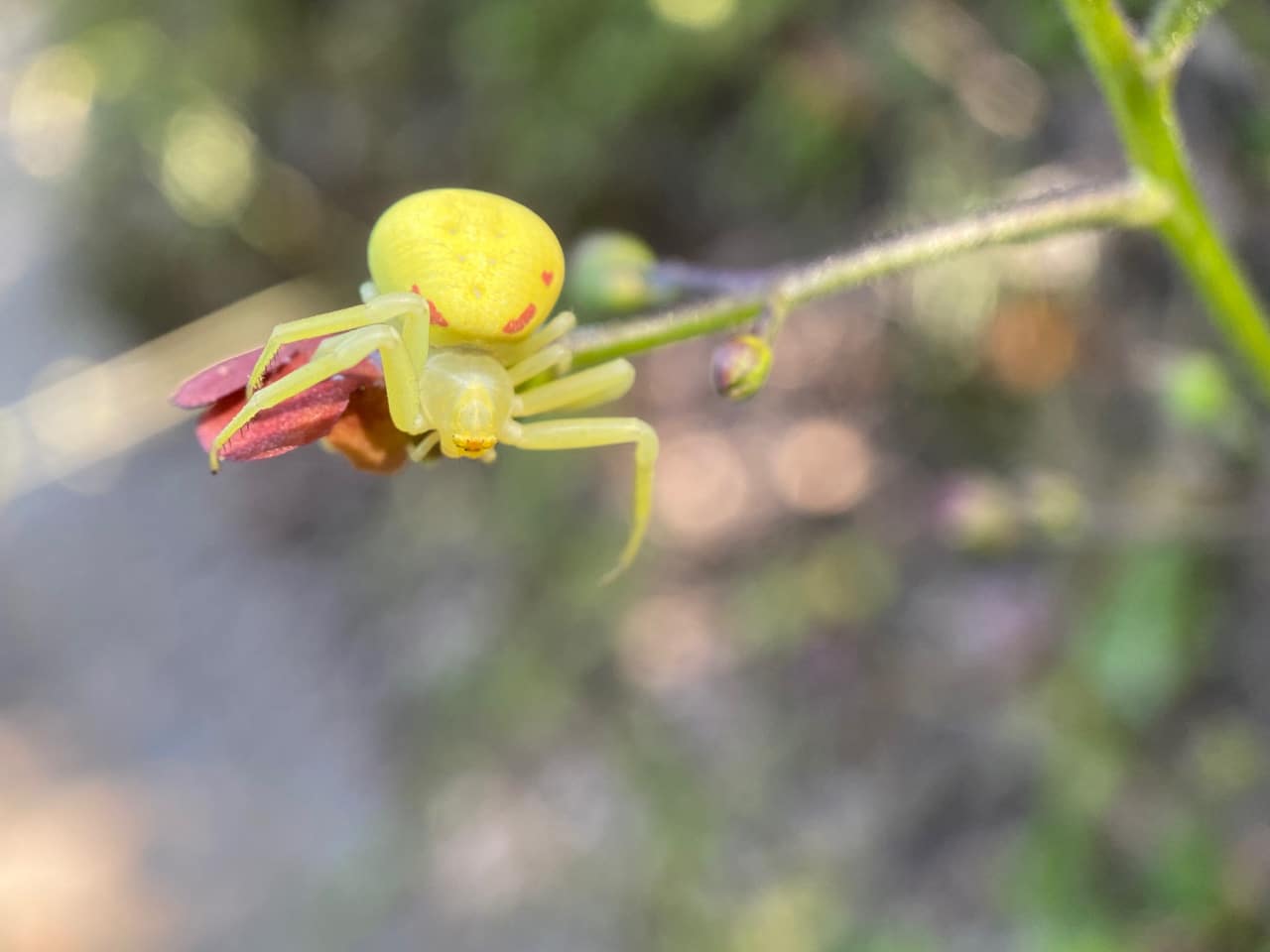
Misumena vatia is found only in North America and Europe. They are sometimes called the Goldenrod Crab Spiders, as they are commonly found hunting in goldenrod sprays and milkweed plants. Misumena vatia are usually yellow or white. This ultimately depends on the flower on which they are hunting (active camouflage). They have the ability to change between these colors based on their surroundings, using visual cues. The color-changing process is not instant and can take up to 25 days to complete.
There’s another trick that the spider might be playing that we are not aware of because we cannot see in the ultraviolet (UV) spectrum of light. It’s been discovered that Crab Spiders reflect UV light strongly. Most insects, notably the bees, see UV well, and favor sunlit flowers while foraging. Experiments have shown that flowers that have crab spiders sitting on them actually garner more insect visits than those that don’t! It is thought that perhaps color camouflage in the visible spectrum helps the spiders avoid vertebrate predators (birds, lizards, etc.), while the UV reflectance is useful for attracting insect prey.
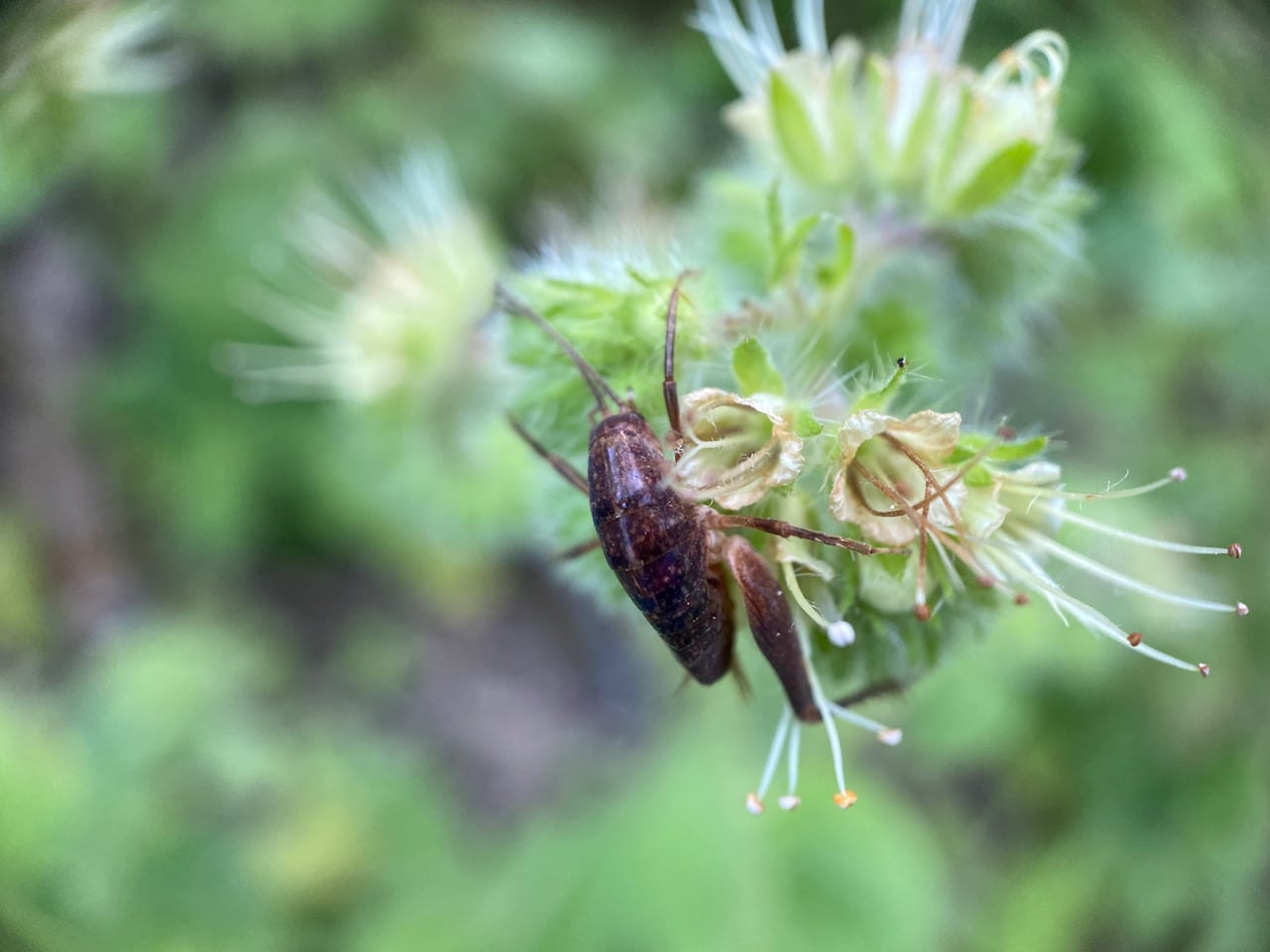
In the deep shade, a Camel Cricket, Pristoceuthophilus sp.(family Rhaphidophoridae) is clinging onto an inflorescence of Imbricate Phacelia, Phacelia imbricata.
Most camel crickets have very large hind legs with “drumstick-shaped” femora and long, thin tibia, and long, slender antennae. They are brownish in color and humpbacked in appearance, always wingless. Some species are cave dwellers. Most inhabit cool, damp environments, such as rotten logs, stumps and hollow trees, and under damp leaves, stones, boards, and logs. The cricket’s distinctive limbs and antennae serve a double purpose. Typically living in a lightless environment, or active at night, they rely heavily on their sense of touch, which is limited by reach. Given their limited vision, these crickets often jump to avoid predation. Rhaphidophoridae are primarily scavengers, eating plant, animal, and fungi material.
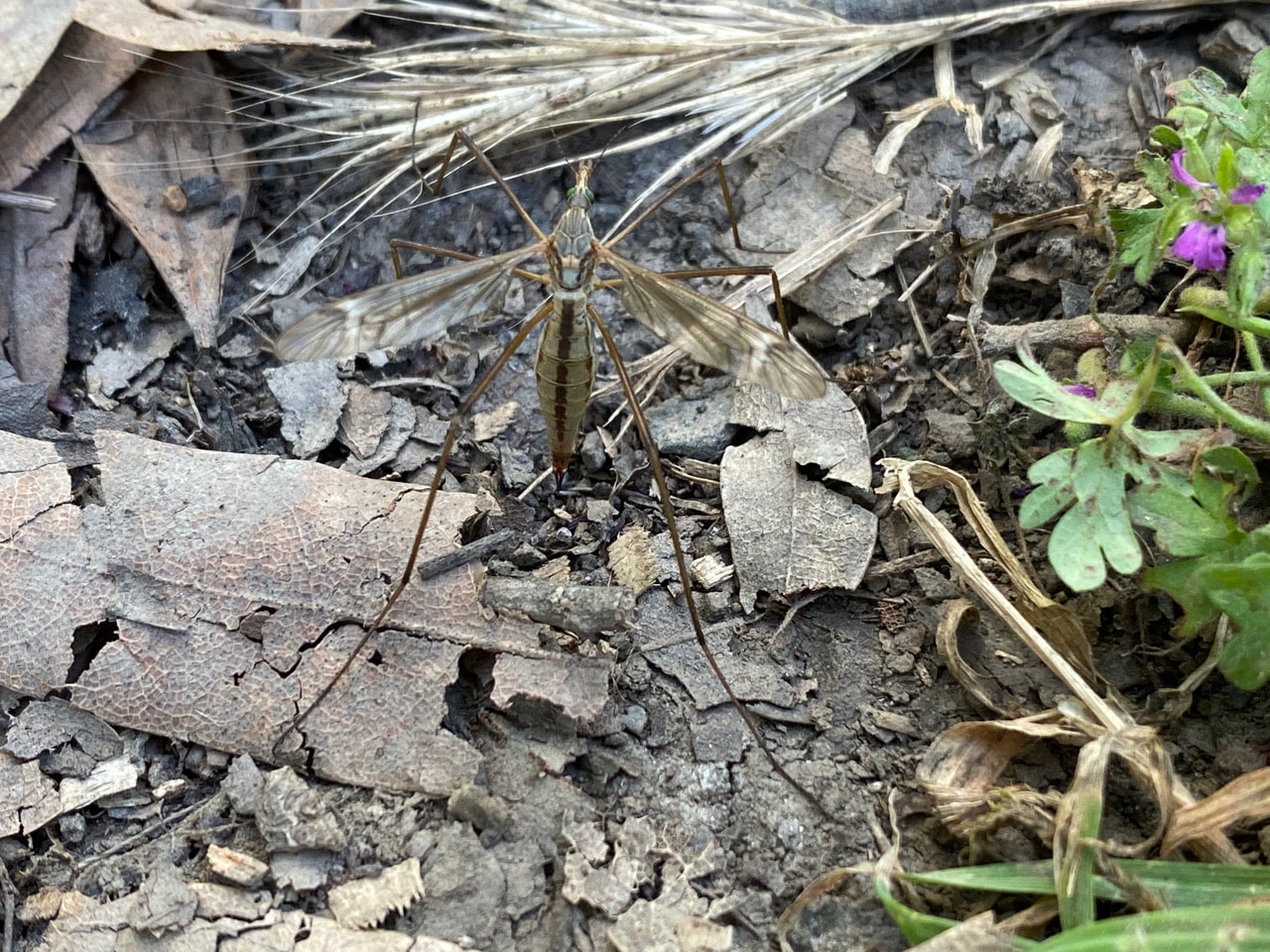
Something is moving vigorously on the ground by the side of the trail. I stop to watch a Common Crane Fly, Tipula sp. (family Tipulidae or Large Crane Flies) bob up and down continuously on its long legs, jabbing its abdomen into the soil and leaf litter. It is a female laying eggs!
The adult Crane Fly looks like an oversized mosquito, typically has a slender body and long, stilt-like legs that are deciduous, easily coming off the body. They occur in moist, temperate environments such as vegetation near lakes and streams. Adults generally do not feed, but some species consume nectar, pollen and/or water. Larvae, commonly called leatherjackets, occur in various habitats including marshes, springs, decaying wood, moist soil, leaf litter, fungi, vertebrate nests and vegetation. They usually feed on decaying plant matter and associated microbes. The larvae are important in the soil ecosystem, as they process organic material and increase microbial activity. Both larvae and adults are also valuable prey items for many animals, including insects, spiders, fish, amphibians, birds, and mammals.
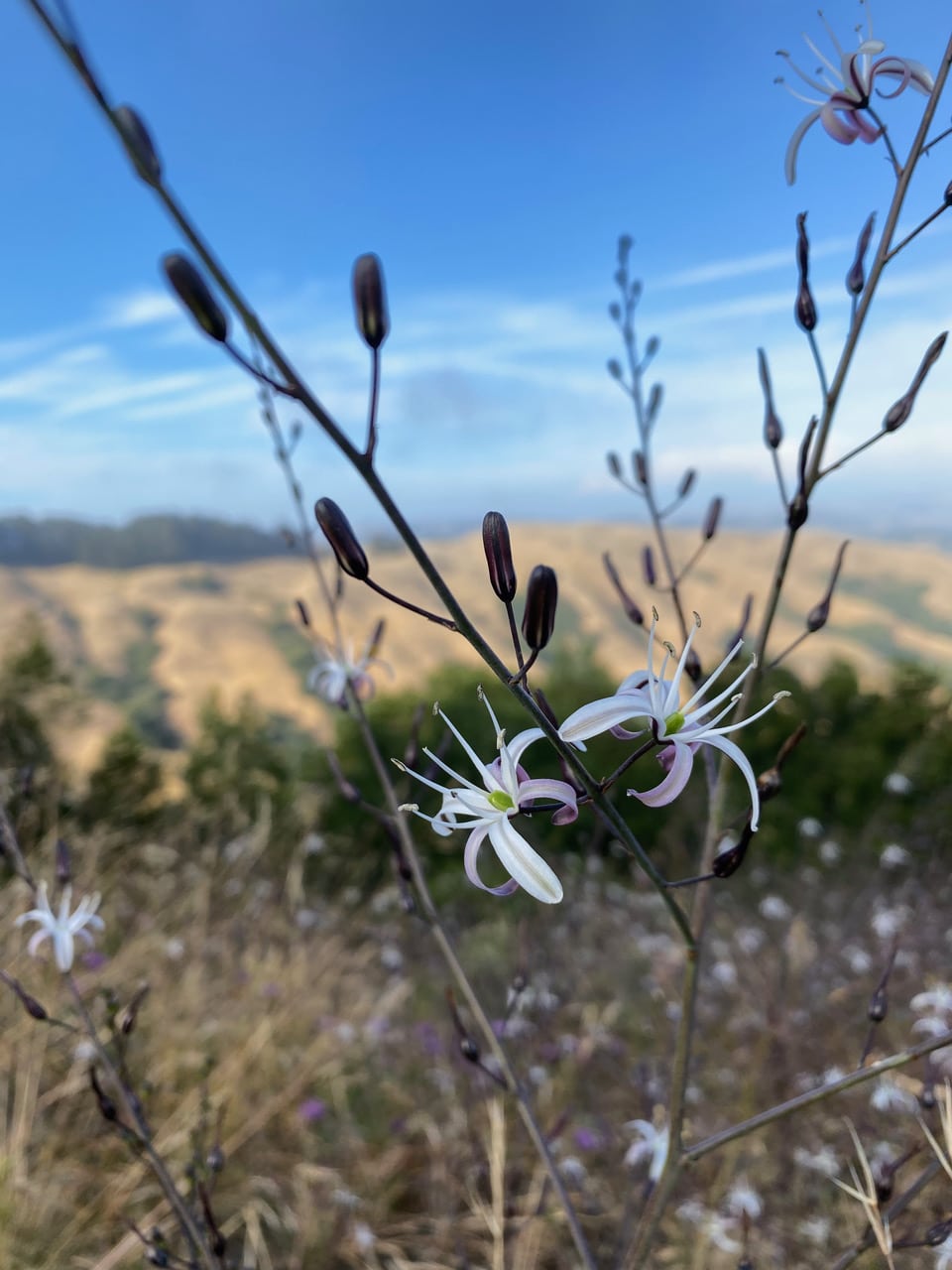
Thanks to Glen who let me through the gates, I get to spend a special late afternoon with the blooming Soap Plants on the ridge at the Backbone.
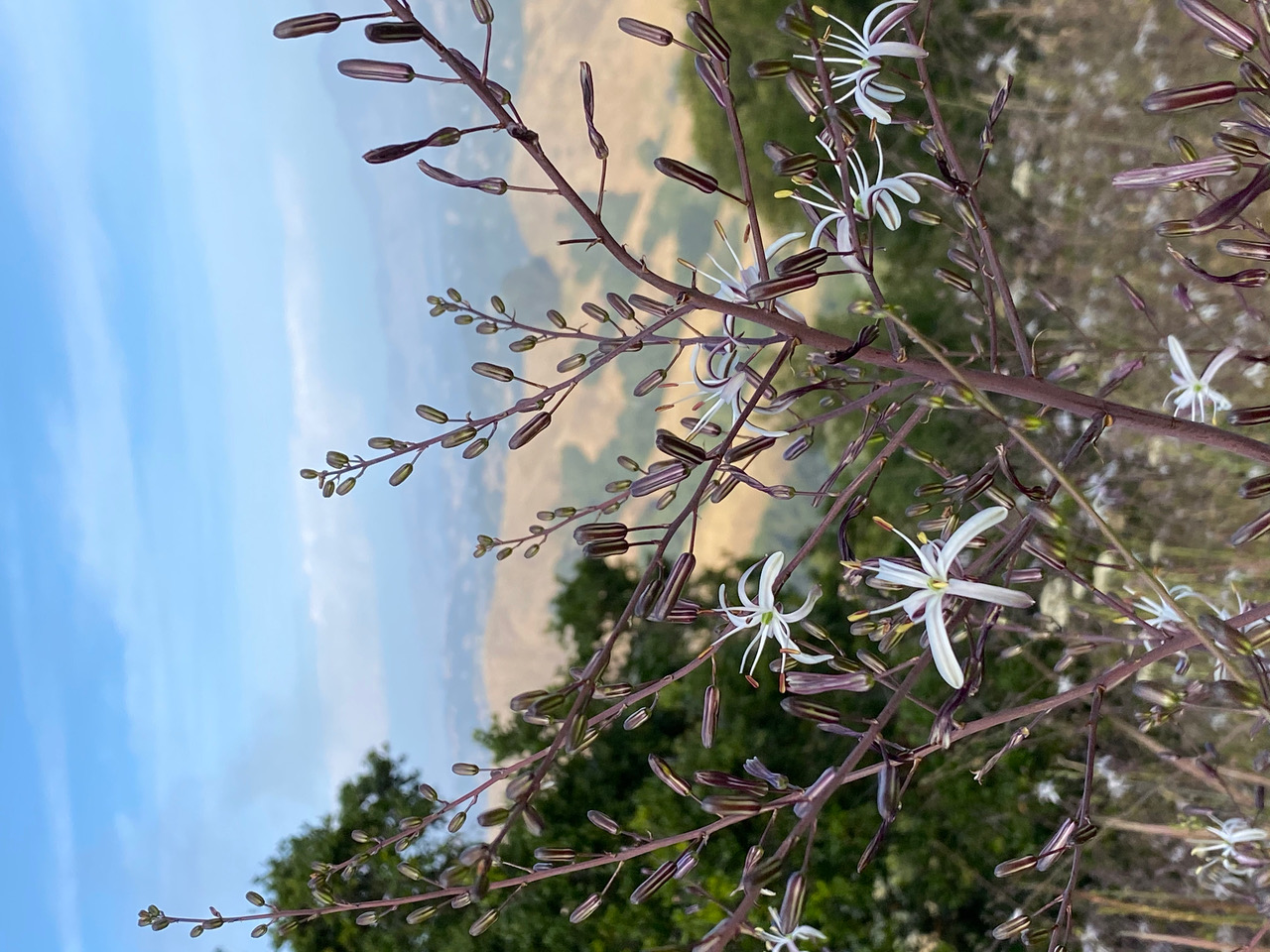
We arrive at about 6 pm when there’s barely enough light to take pictures. The Soap Plant grows dense this year – one can hardly walk between the plants without tripping over the wiry branches. I look up the steep slope and see an ocean of little white blooms dancing in the wind. Soap Plant magic!
Soap Plant, Chlorogalum pomeridianum is a perennial that grows from a bulb. The plant is easily recognized by its linear, wavy-edged leaves. The generic name Chlorogalum means “green milk”, referring to the green juice exuded by a broken leaf. The specific epithet pomeridianum, or “past mid-day”, is the Latin phrase which gave rise to our abbreviation “p.m.” This refers to the plant’s trait of opening its flowers late in the day.
The white star-like flowers have a very short life – in the late afternoon one row of buds opens, starting from the bottom of the long stalk. Each flower remains open through the night, but twists closed (the wilted tepals twist around the fertilized ovary) by the morning and never opens again.
The flowers are known to be pollinated during the afternoon by large bees (honey bees, carpenter bees, and bumble bees), and, after dark, by sphingid moths.

In the brisk breeze, a few hardy Yellow-faced Bumble Bees, Bombus vosnesenskii are foraging on the Soap Plant flowers, weaving in and out through the tangle of branches with ease. Their stops for nectar are fast and furious. Her long tongue extended, this bee is able to reach the nectar below the green ovary. She already has some of Soap Plant’s lemon yellow pollen tucked in her pollen baskets.
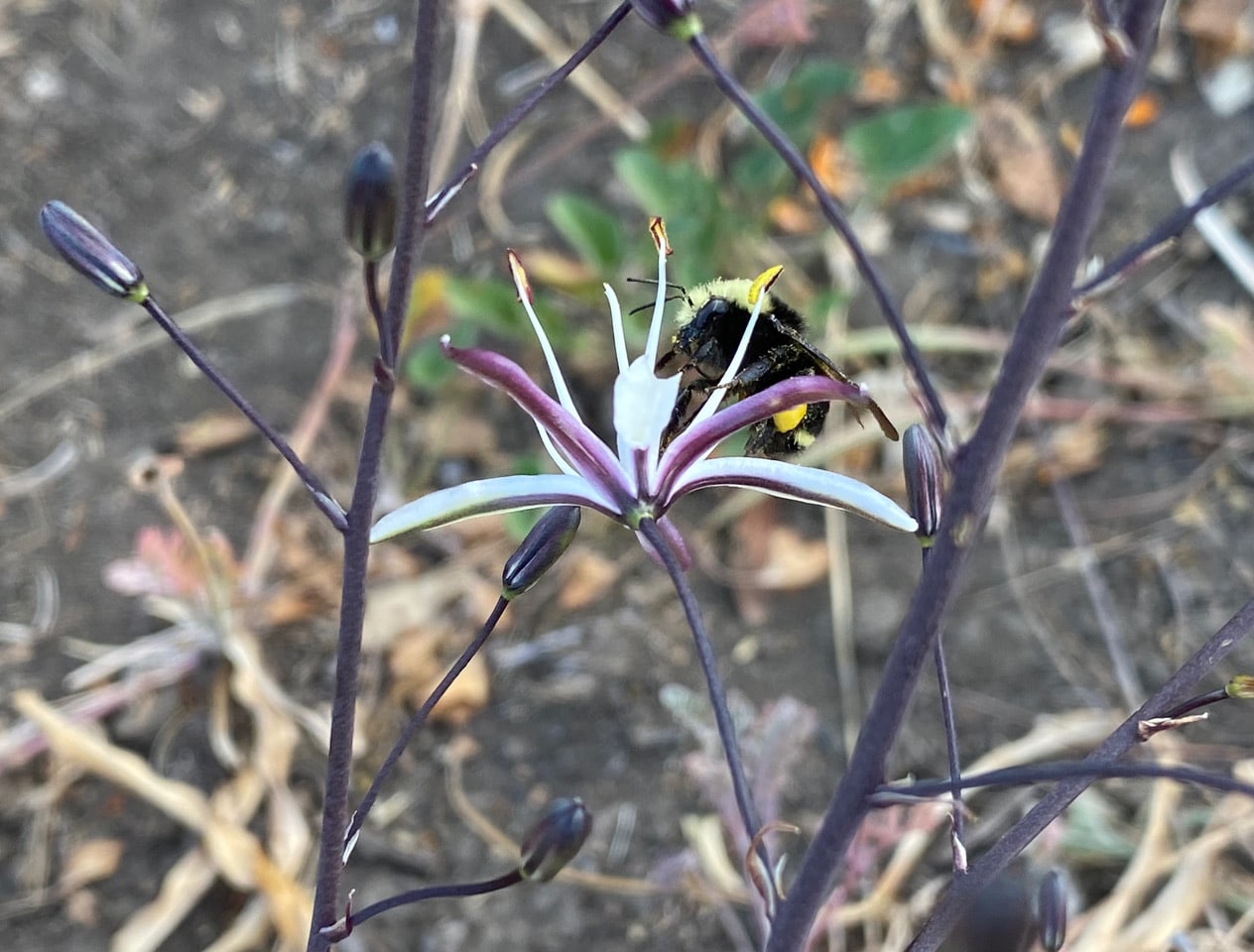
This other Yellow-faced Bumble Bee is landing on another flower.
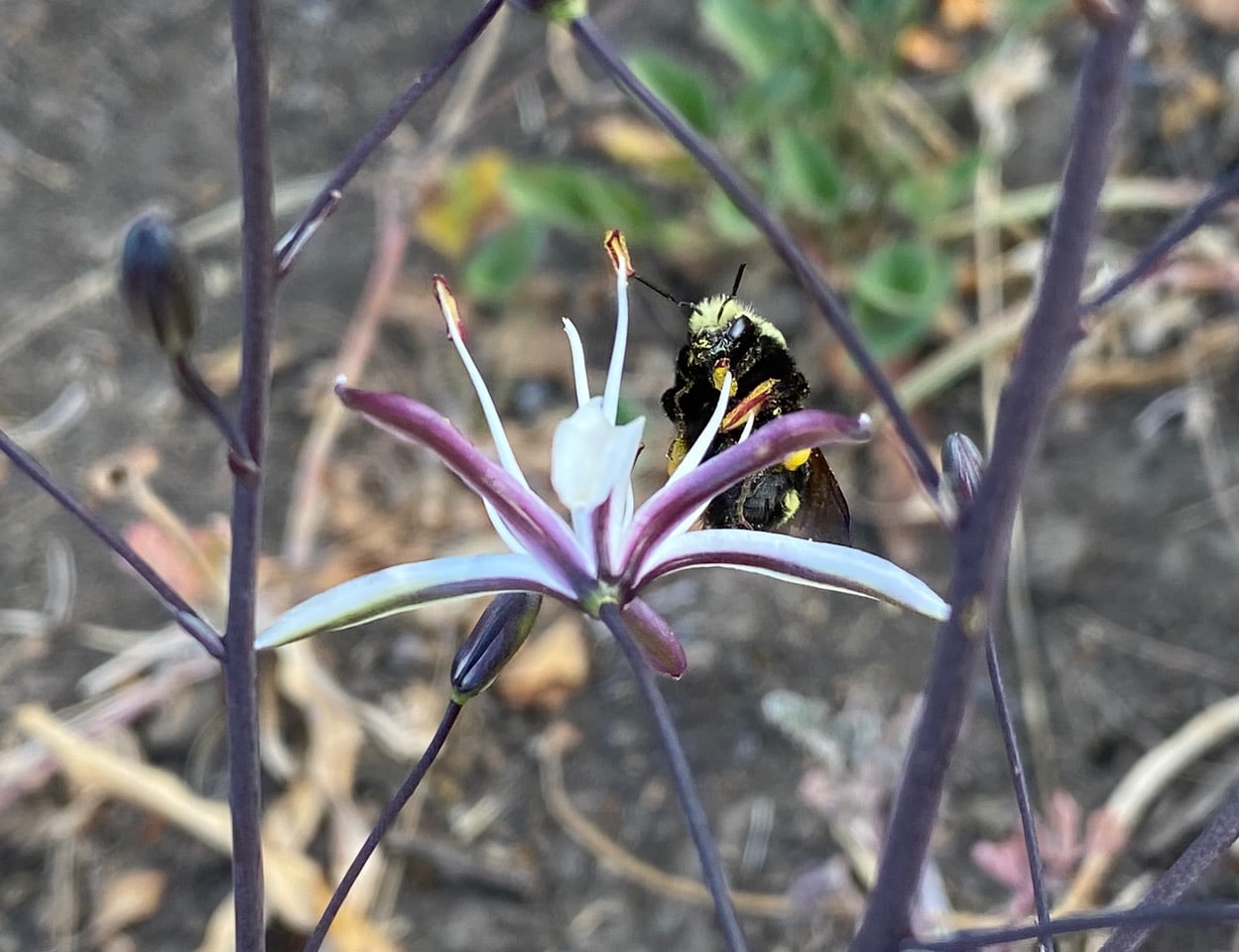
Her stop is more prolonged, because she is collecting pollen from the stamens. Her face and body already peppered with yellow pollen, she works the individual anthers with her mouthparts. With quick movements of her body and legs, she deftly packs the gathered pollen into the corbiculae (pollen baskets) on her hind legs.
It would be fun to watch the next shift of pollinators – the moths. But there’s no light up here, and we need to be back on the trail before dark….
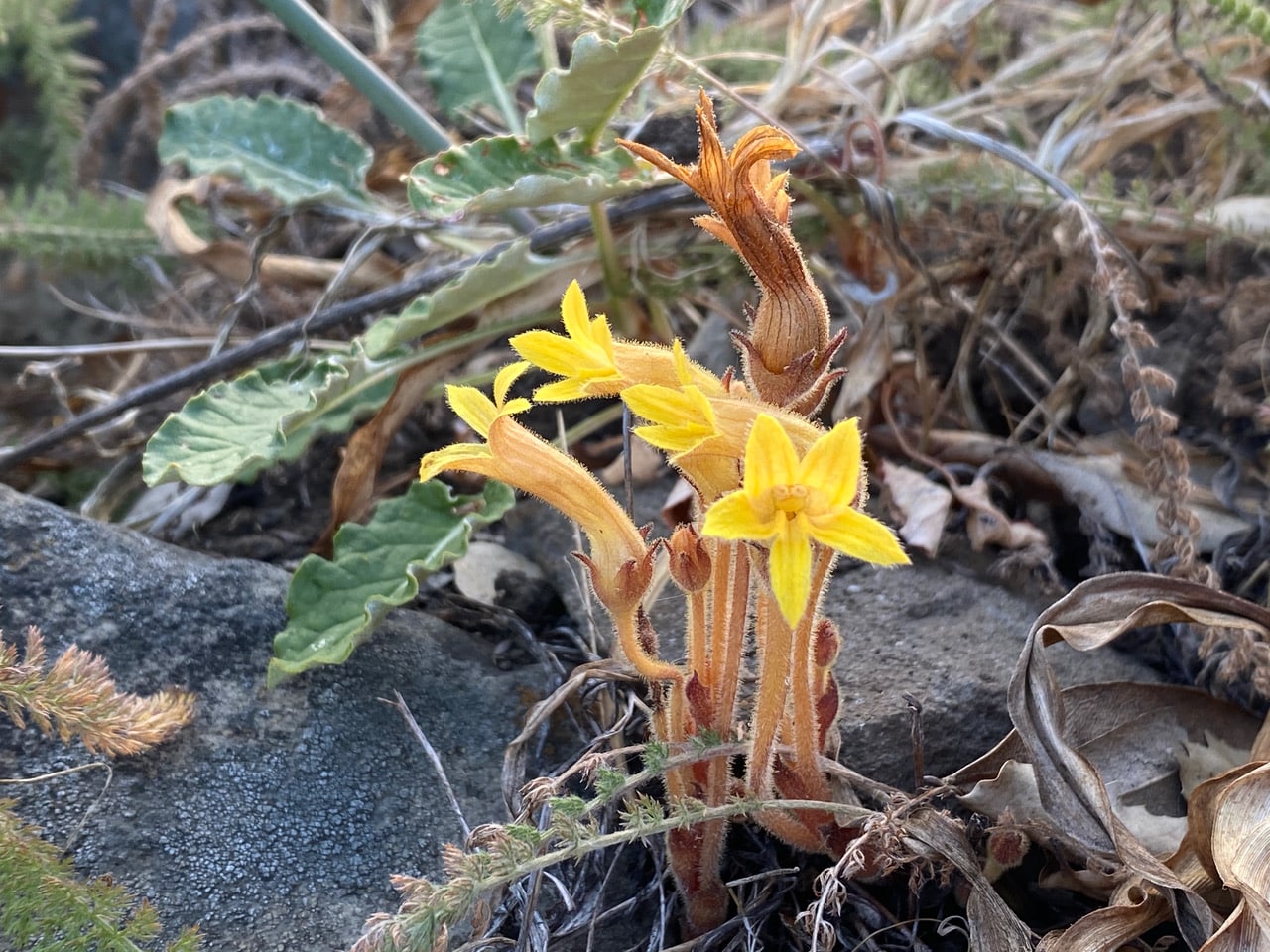
There’s another delight in store for me at the Backbone – Clustered Broomrape, Orobanche fasciculata (family Orobanchaceae)!
Orobanche, commonly known as broomrape, are small parasitic herbaceous plants. When they are not flowering, no part of the plant is visible above the surface of the soil. As they have no chlorophyll, the broomrapes are totally dependent on other plants for nutrients. Broomrape seeds remain dormant in the soil, often for many years, until stimulated to germinate by certain compounds produced by living plant roots. Broomrape seedlings put out a root-like growth which attaches to the roots of nearby hosts. Once attached to a host, the broomrape robs its host of water and nutrients.
O. fasciculata is native to much of western and central North America where it grows in many types of habitat. It’s host plants include members of the Asteraceae such as Artemisia, and other genera such as Eriodictyon and Eriogonum. The plant produces one or more stems from a bulbous root. The stems, leaves and five-lobed flowers are covered by sticky hairs. The inflorescence is a raceme of up to 20 flowers, each on a pedicel. Each flower has a calyx of hairy triangular sepals and a tubular corolla.
Orobanche fasciculata produces insect-pollinated flowers like autotrophic species and reproduces exclusively by seed. The seeds are minute and are shed from dried capsules. Orobanche are considered to be annuals, and the species appear to be monocarpic, which means that each individual dies after flowering. This may explain, in part, why the number of individuals in established populations is known to fluctuate greatly from year to year.