

Pollinator Post 6/14/25

Afternoon walk at Crab Cove, Alameda.
The blooming Pacific Aster, Symphyotrichum chilense in front of the visitor center continues to attract many insects. A Tripartite Sweat Bee, Halictus tripartitus (family Halictidae) is collecting pollen on a flowerhead. I know by now that the small sweat bees with the white-striped abdomen are all Tripartite Sweat Bees. These highly successful, generalist foragers can be seen on the flowers of just about every plant in bloom right now.
The genus Halictus is found worldwide; they are most common in the Northern Hemisphere. All are generalists, foraging from a wide variety of flowering plants. Many species are social and produce several generations per year. This is not surprising as most blooming plants are season-specific; a bee that requires pollen and nectar across multiple seasons would not thrive as a specialist. All Halictus in North America nest in the ground, often in aggregations; and they may nest in the same area for decades.
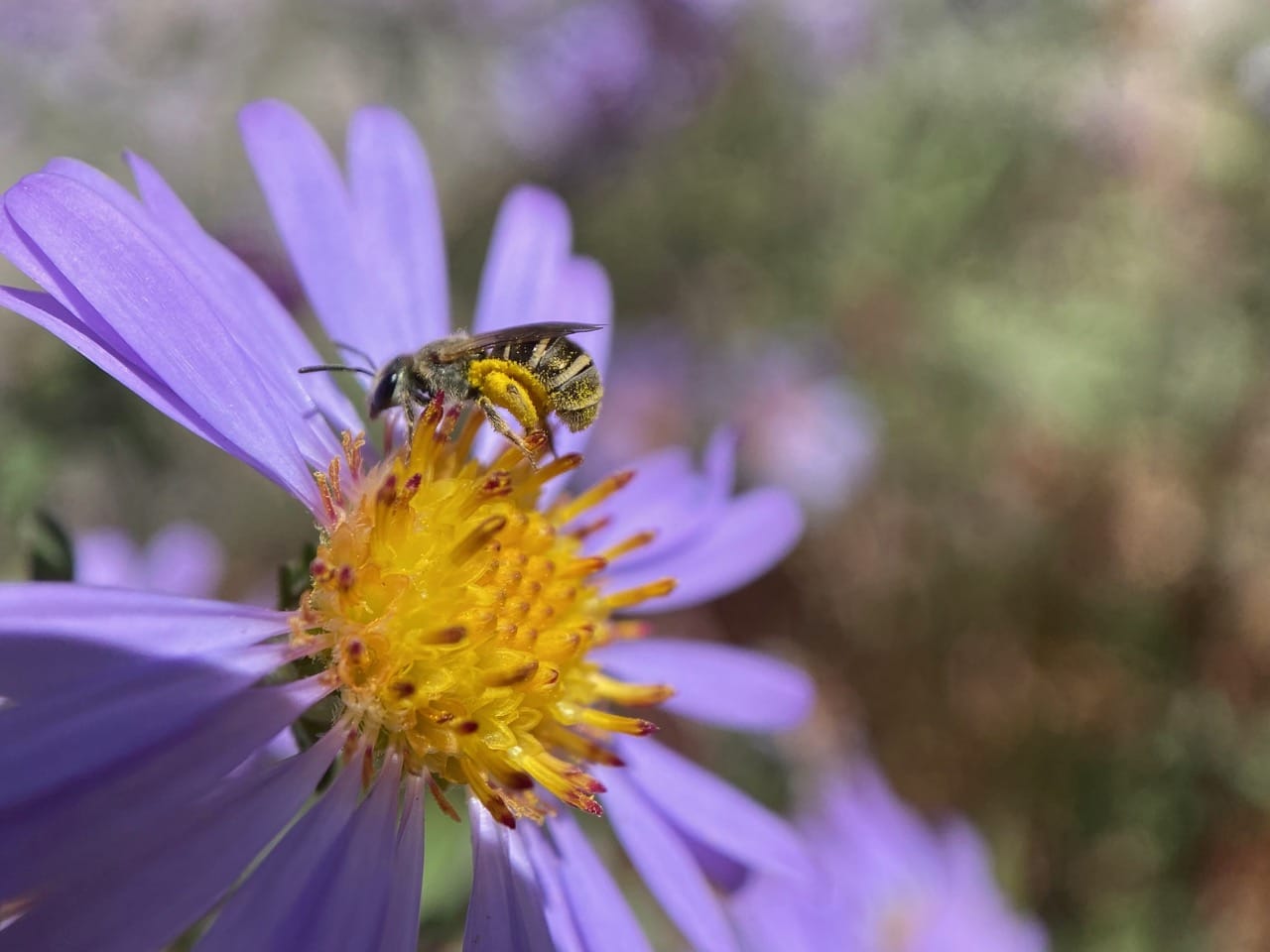
Note where the Sweat Bee is carrying the pollen she has collected – her scopa extends the full length of her hind legs. She also packs pollen on the underside of her abdomen.

Much larger, with black-and-white wavy striped abdomen are the American Sand Wasps, Bembix americana (family Crabronidae), so common in Alameda due to its location on the bay. The sandy banks along the shoreline are perfect nesting habitats for these hard-working wasps. These wasps dominate every patch of flowers in this park, just by sheer numbers.
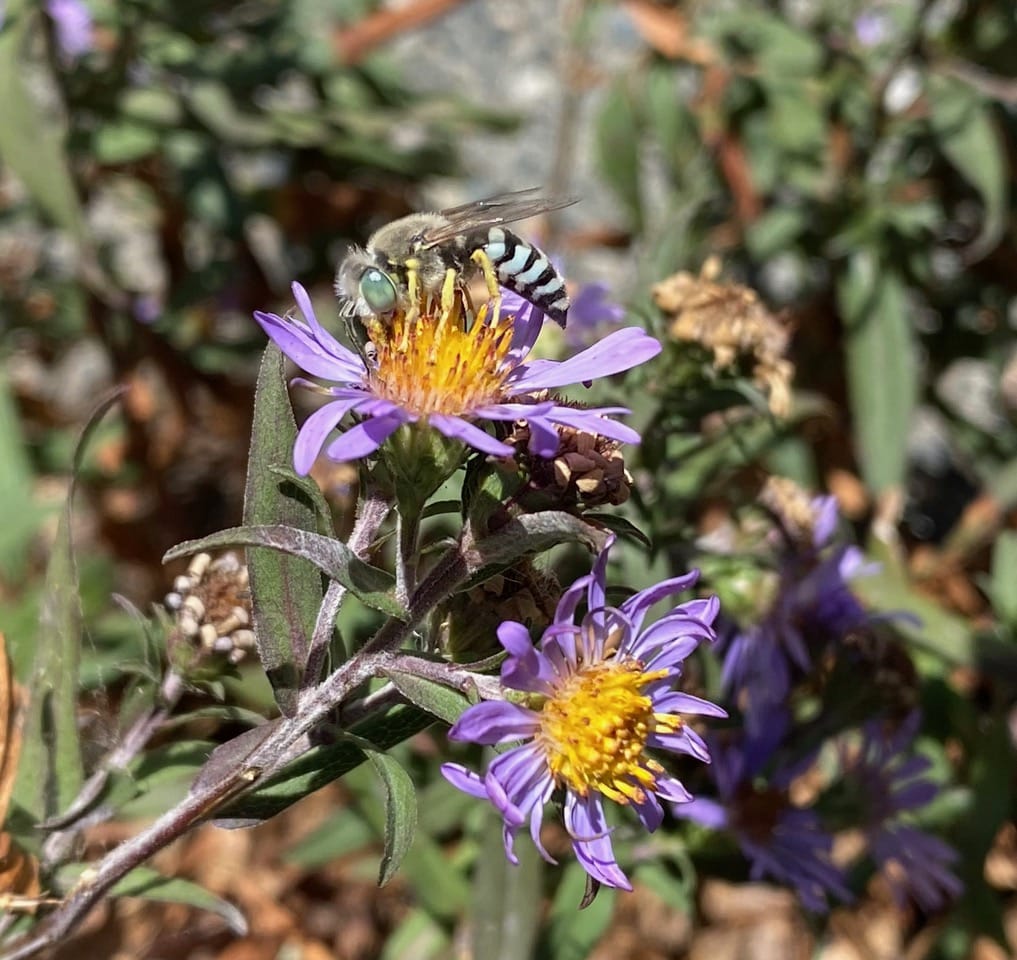
Sand wasps in the genus Bembix are familiar and common throughout North America, digging their burrows in dunes, on beaches, and other habitats with loose, deep sand. The female rapidly kicks out large quantities of sand using a “tarsal rake” of spines on each front leg. The burrow is excavated before the wasp goes hunting. Bembix are generalist, opportunistic hunters. True flies in the order Diptera are the usual prey. A victim is paralyzed or killed by the wasp’s sting, and is then flown back to the nest. Most species will lay an egg on the first victim, while some species lay an egg in the empty cell before starting to hunt. Once the egg hatches, mama wasp brings flies to her larva as needed. This “progressive provisioning” is rare in the insect world. When the larva reaches maturity, mama wasp closes the cell. Inside, the larva spins an oblong cocoon, weaving sand grains into the structure and resulting in a hardened capsule. Overwintering takes place as a prepupa inside this cocoon, but there are usually two generations a year.
Male sand wasps often engage in an elaborate flight ritual called “sun dances”. Males emerge before females, and fly erratically at dizzying speed one or two inches above the ground attempting to detect virgin females about to emerge from their underground nests. Both sexes are often seen taking nectar at flowers, especially from Asteraceae family. Bembix wasps are often victims of other insects such as cuckoo wasps (Chrysididae), velvet ants (Mutillidae), satellite flies (Sarcophagidae), bee flies (Bombyliidae), and thick-headed flies (Conopidae).
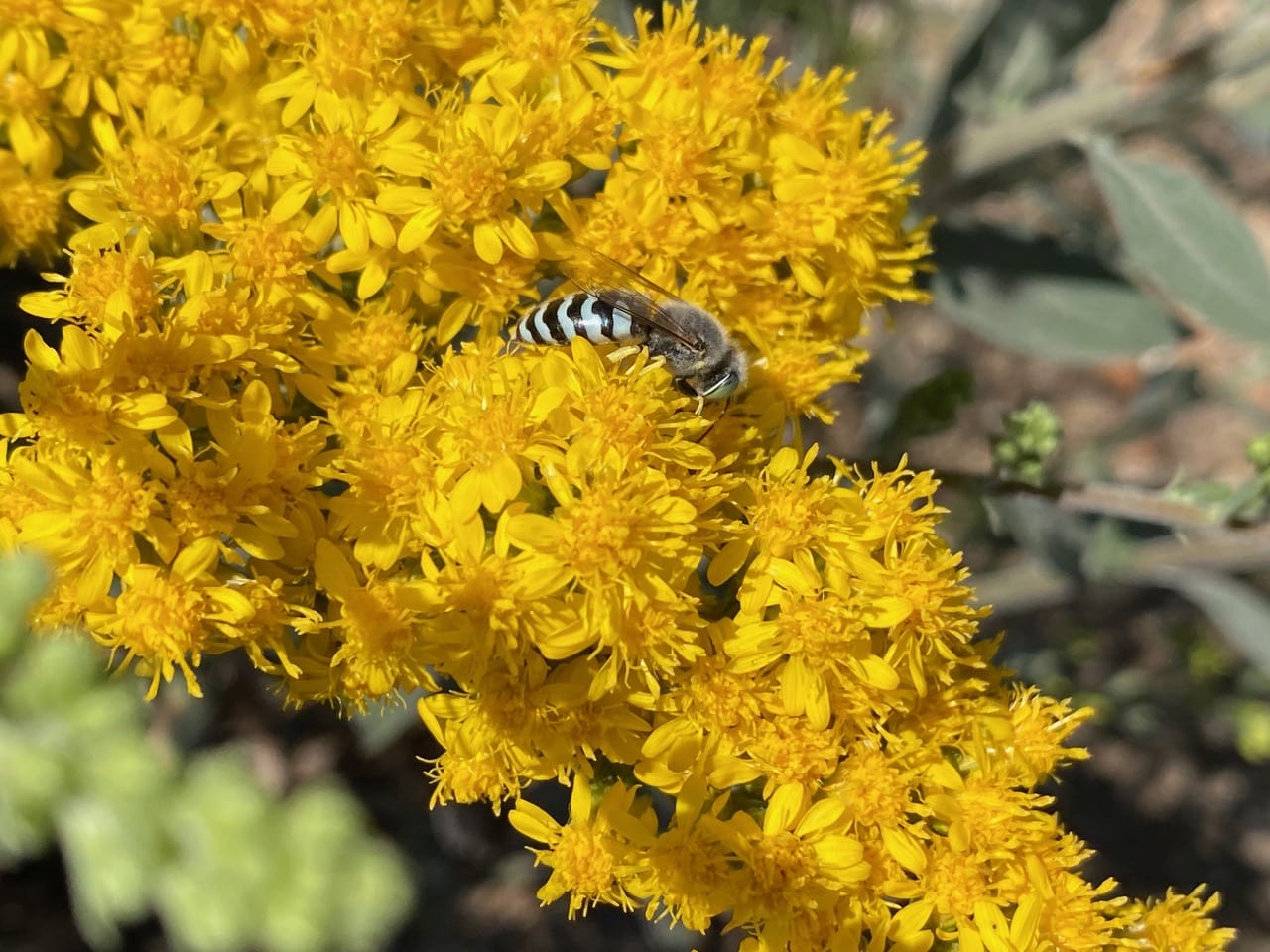
More of the California Goldenrod, Solidago velutina ssp. californica have come into bloom along the curb. An American Sand Wasp, Bembix americana (family Crabronidae) is foraging among dense inflorescences of tiny flowers.

These wasps have perfectly clear, transparent wings through which their abdominal patterns can be seen.

Hey, that’s a male Fine Striped Sweat Bee, Agapostemon subtilior (family Halictidae). His gender is obvious from his yellow-and-black striped abdomen and his extra long antennae. The females of the species are entirely iridescent green.
The genus Agapostemon is widespread and abundant throughout North America. They are most diverse and abundant in temperate regions and southwestern U.S. deserts. Agapostemon are commonly called “sweat bees” because they are closely related to, and resemble bees in the Halictus and Lasioglossum genera. Unlike those bees however, Agapostemon are not attracted to human sweat.
Agapostemon are brightly colored metallic green or blue bees measuring 7 to 14.5 mm long. Most species have a metallic green head and thorax, and black-and-yellow striped abdomen; some females are entirely bright green or blue. Females carry pollen on scopal hairs located on their hind legs. Agapostemon are ground-nesters and generalist foragers. Like other members of the family Halictidae, they are short-tongued and thus have difficulty extracting nectar from deep flowers. Males are often seen flying slowly around flowers looking for females. The bees favor flowers with high densities.
Agapostemon females dig deep vertical burrows in flat or sloping soil, or sometimes in banks. Most species are solitary, but some species nest communally. Up to two dozen females may share a single nest entrance, but each individual builds and provisions its own cluster of brood cells. Where a communal nest gallery shares a single entrance, one bee usually guards the hole, with only her head visible from above ground. Unlike other social bees, in communal bees there is no reproductive division of labor. In cool temperate regions, there is one generation per year, with females active in the early summer and males and pre-diapausing females active in the late summer. Only mated females survive the winter. This is probably because unmated females cannot enter diapause (insect version of hibernation).
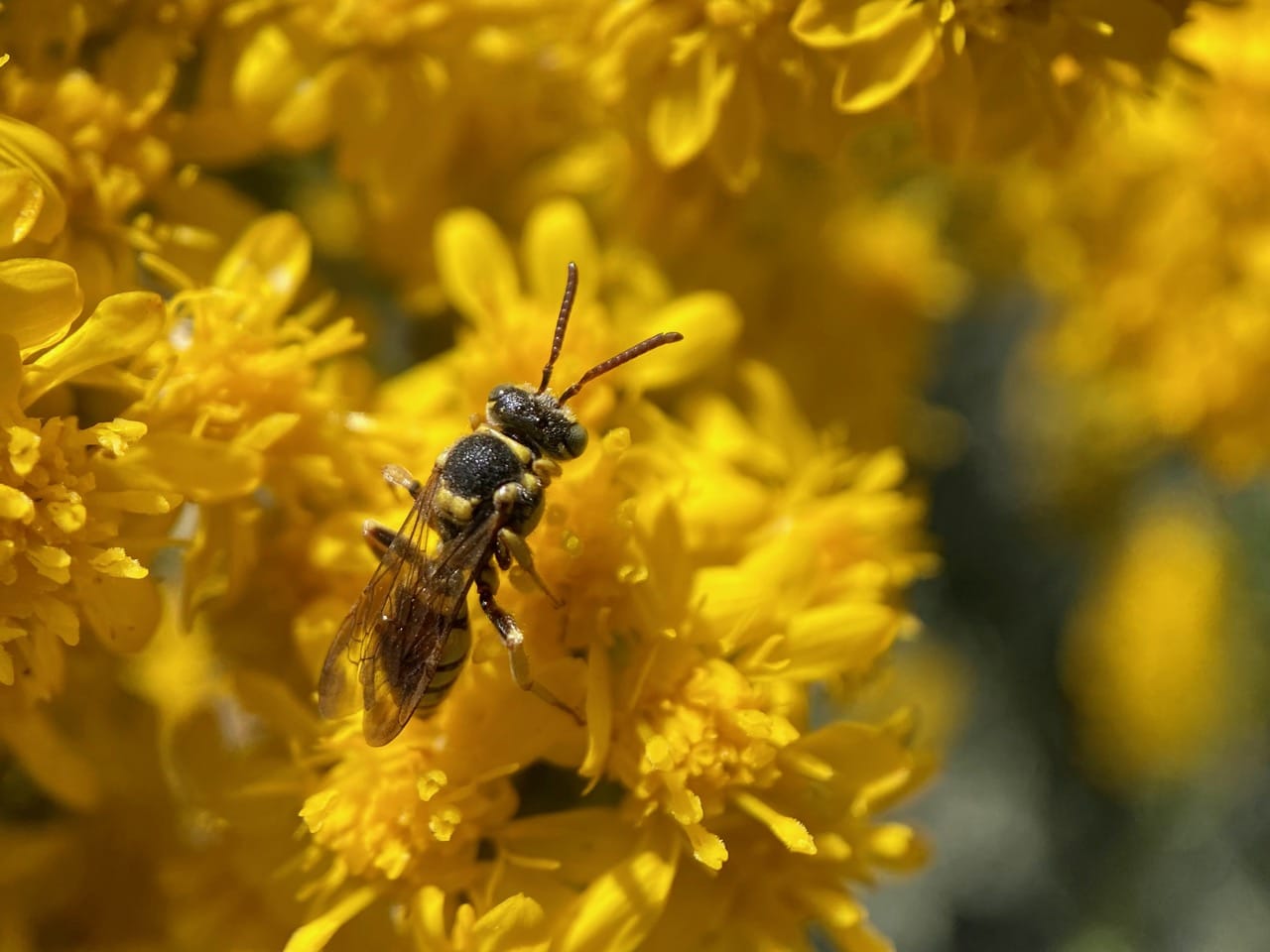
A wasp-like insect has landed on an inflorescence of California Goldenrod, Solidago velutina ssp. californica. It is about the same size as a common Mason Wasp, and is just as hairless.

As it forages, the insect tends to hold its wings up most of the time, just like wasps do.
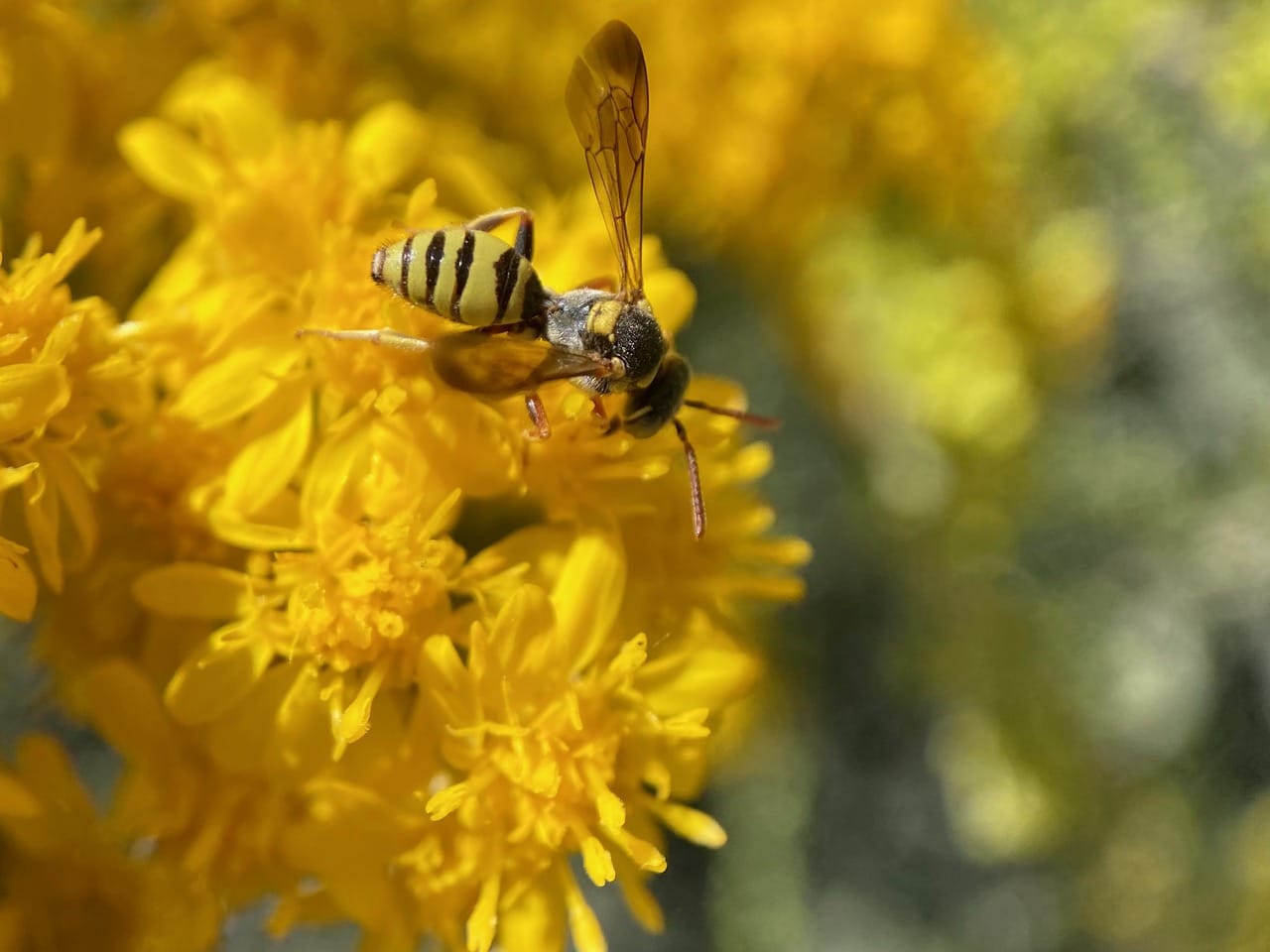
There, that’s the view of the abdomen I am looking for. I don’t know of any local Mason Wasp with that abdominal pattern. It is a Nomad Bee, Nomada sp. (family Apidae).
Nomad Bees in the genus Nomada is one of the largest genera in the family Apidae, and the largest genus of Cuckoo Bees. Nomada are kleptoparasites of many different types of ground-nesting bees as hosts, primarily the genus Andrena. They lack a pollen-carrying scopa, and are mostly hairless, as they do not collect pollen to feed their offspring. Adults visit flowers for nectar. The bees are extraordinarily wasp-like in appearance, often with yellow or white integumental markings on their abdomen.
Nomad Bees occur worldwide. All known species parasitize ground-nesting bees, and their habitats and seasonality correlate closely with their hosts. In early spring, females scout out their hosts, searching for nests to parasitize. The female Nomada sneaks into the host’s nest while the resident female is out foraging, then lays eggs in the nest. The parasite larva that hatches out kills the host offspring and feeds on the host’s provisions. This type of parasitism is termed brood parasitism. The parasites pupate in the host cell and finally emerge as adults the following season along with the hosts.
While we might shudder at the thought of cuckoo bees in our garden, the presence of cuckoo bees actually indicates a healthy population of their host bees, suggesting a diverse and thriving ecosystem. Parasitism is a natural part of many ecosystems, and cuckoo bees play a role in regulating the populations of their host species. Cuckoo bees, while not collecting pollen for their own young, still visit flowers for nectar and inadvertently pollinate plants in the process. Cuckoo bees are also a food source for other animals, further contributing to the food web.
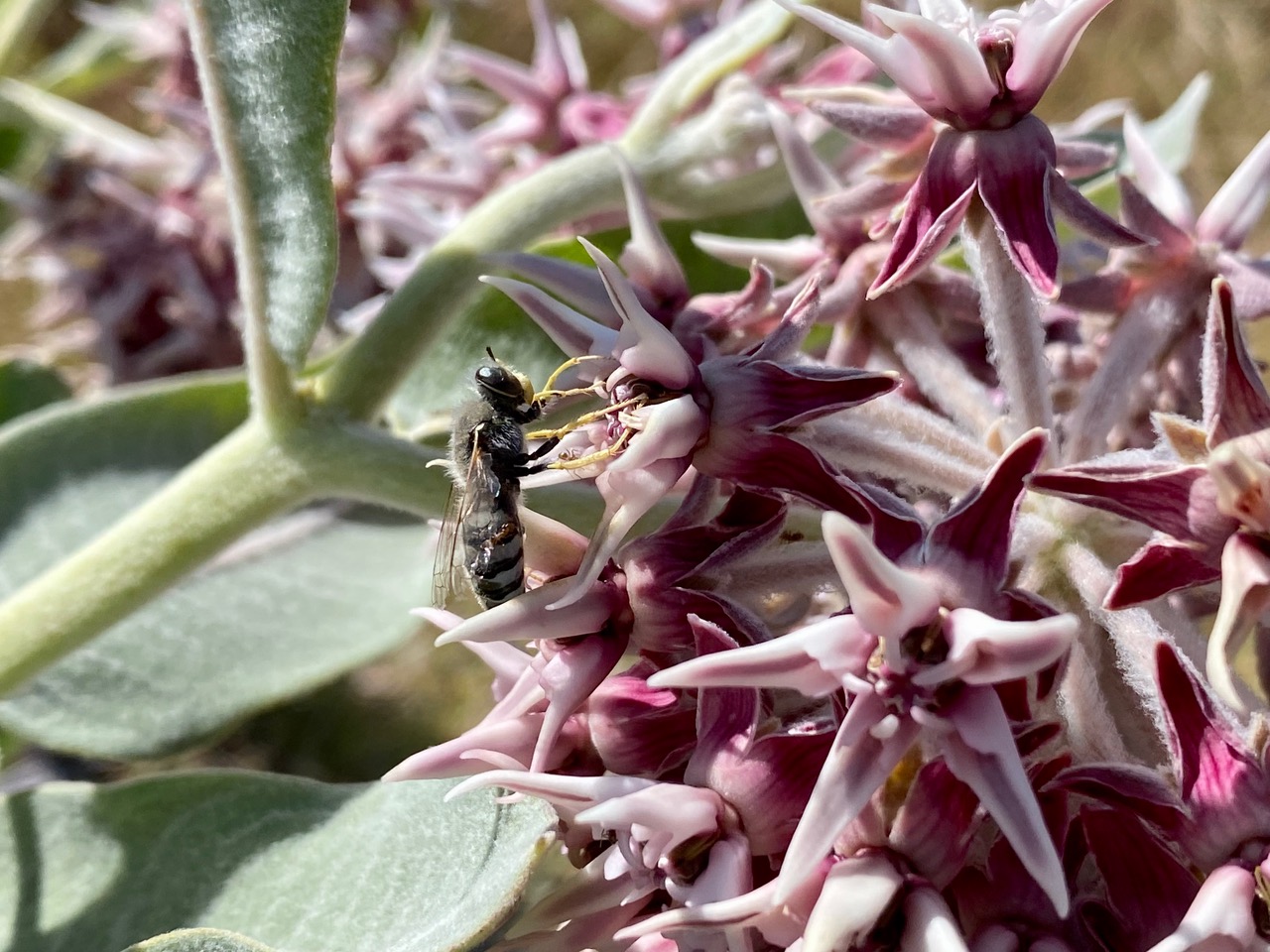
I visit the patch of Showy Milkweed, Asclepias speciosa at the other end of the park, and am surprised that the dead American Sand Wasp that I discovered yesterday is still there, intact. There is only one ant crawling on it. I had thought that the ants would have dismantled it by now. If insects are often trapped on the milkweed flowers, one would expect to see more carcasses and body parts left on the flowers. The fact that I am not seeing any other dead pollinators on the flowers in this patch tells me that trapped insects are probably a rare occurrence. After all, what purpose would it serve a flower to harm its pollinators? Accidents happen.

An American Sand Wasp lands on a milkweed flower that has just opened up. I carefully track the wasp’s movements while it takes nectar from one hood…

… to the next.
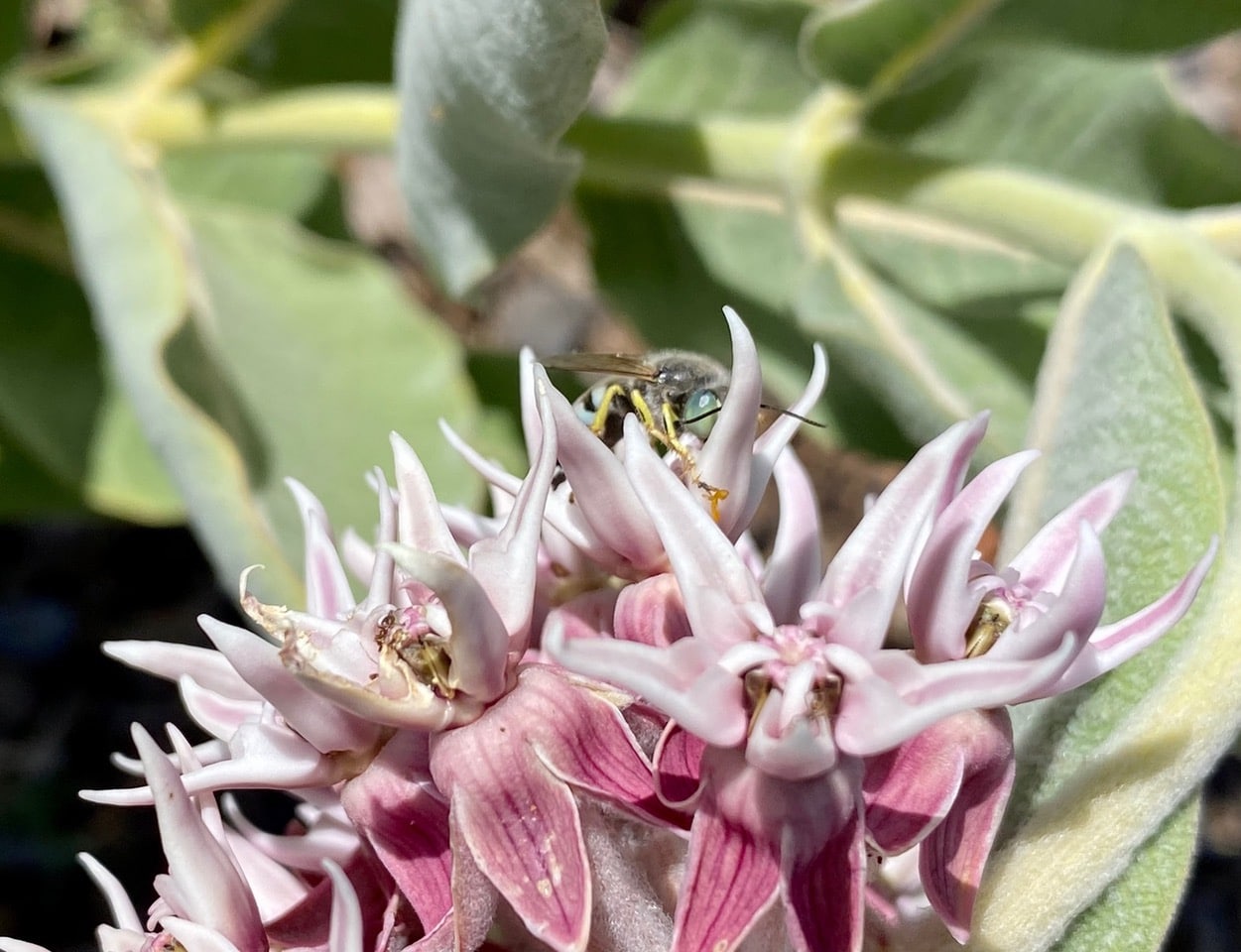
Here’s another Sand Wasp with its head lowered to take nectar from a milkweed flower. What’s that yellow thing at the tip of its front leg?
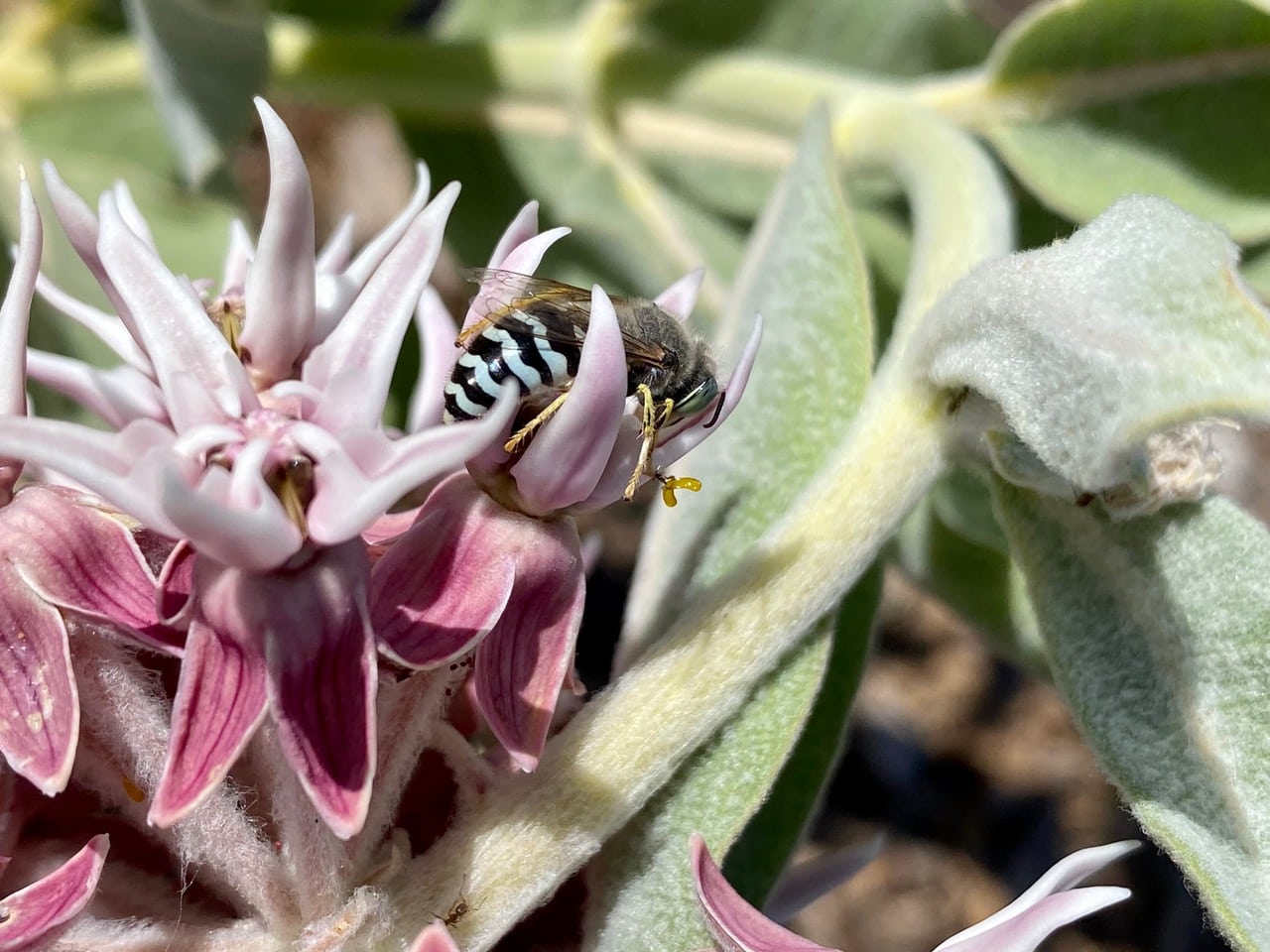
It’s a pair of milkweed pollinia!
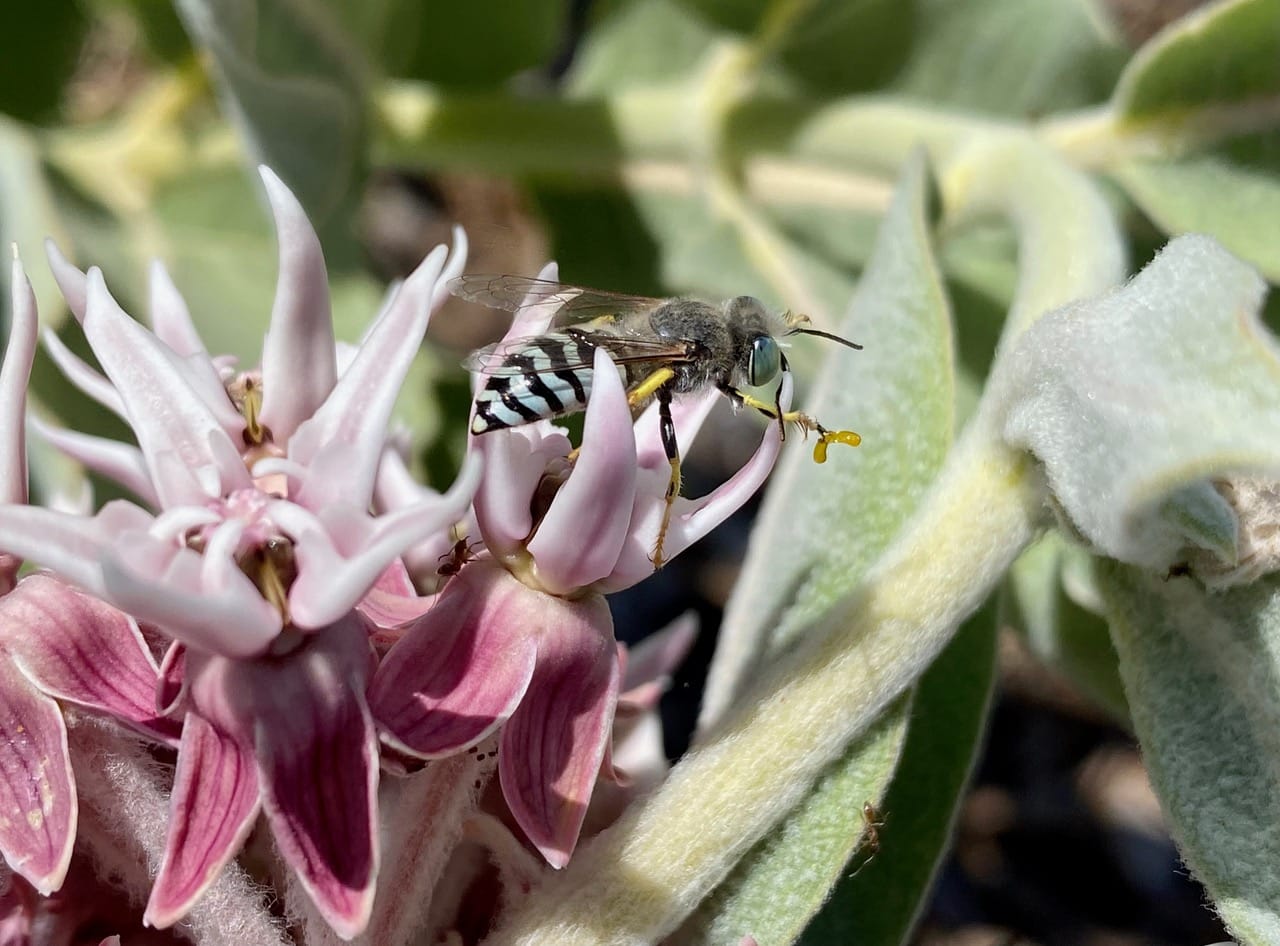
As the wasp straightens its legs before flying away, we get a clear view of the pollinia. Should its right front leg slip into an empty stigmatic slit of another milkweed flower, that pollinia might be transferred to pollinate that next flower. This is the way that the milkweed flower has evolved to be pollinated – by insects of an optimal size and vigor. It is a picky, demanding flower!
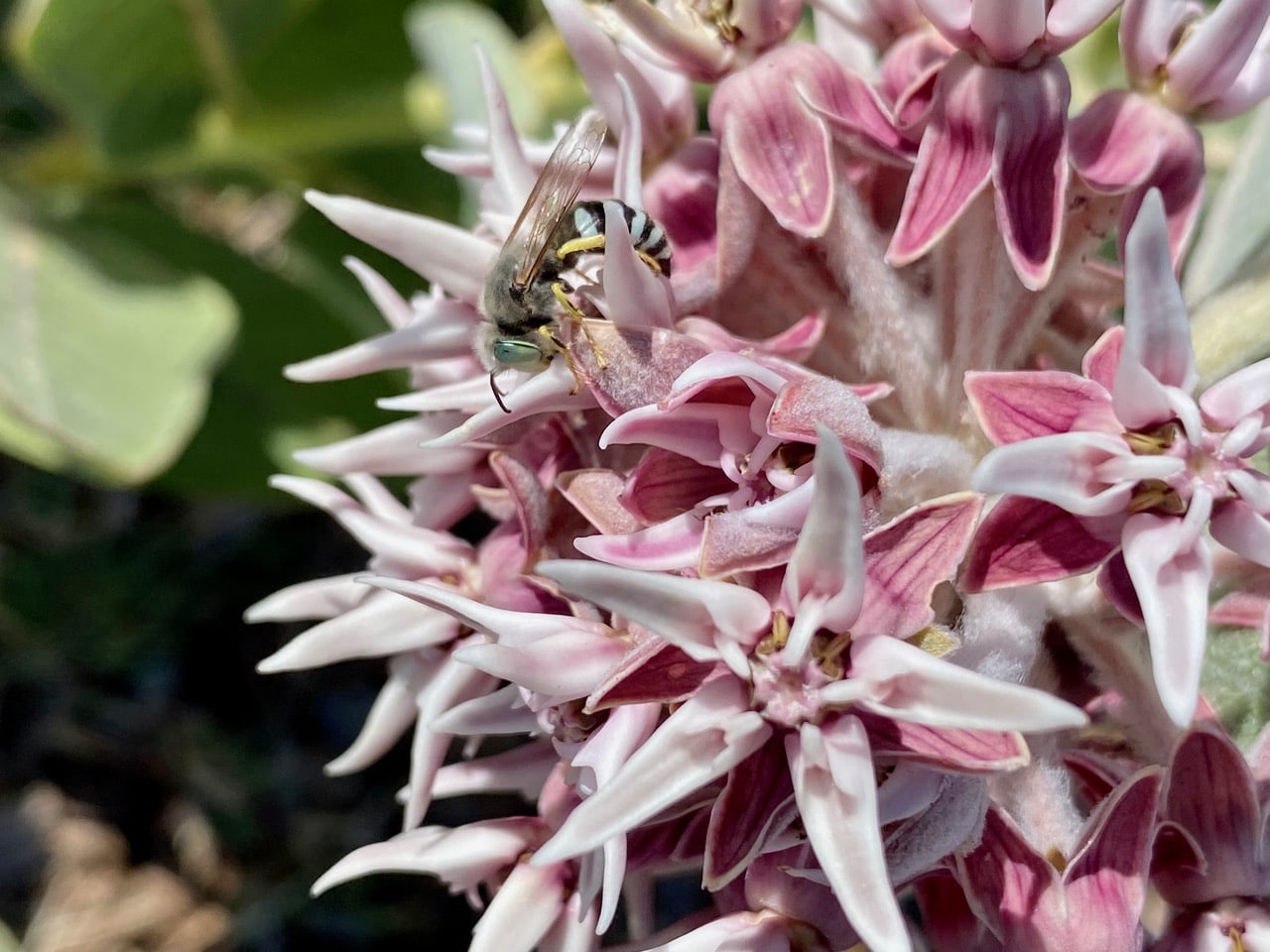
Except for a few Honey Bees, few other insects visit the milkweed flowers for nectar in this patch today.
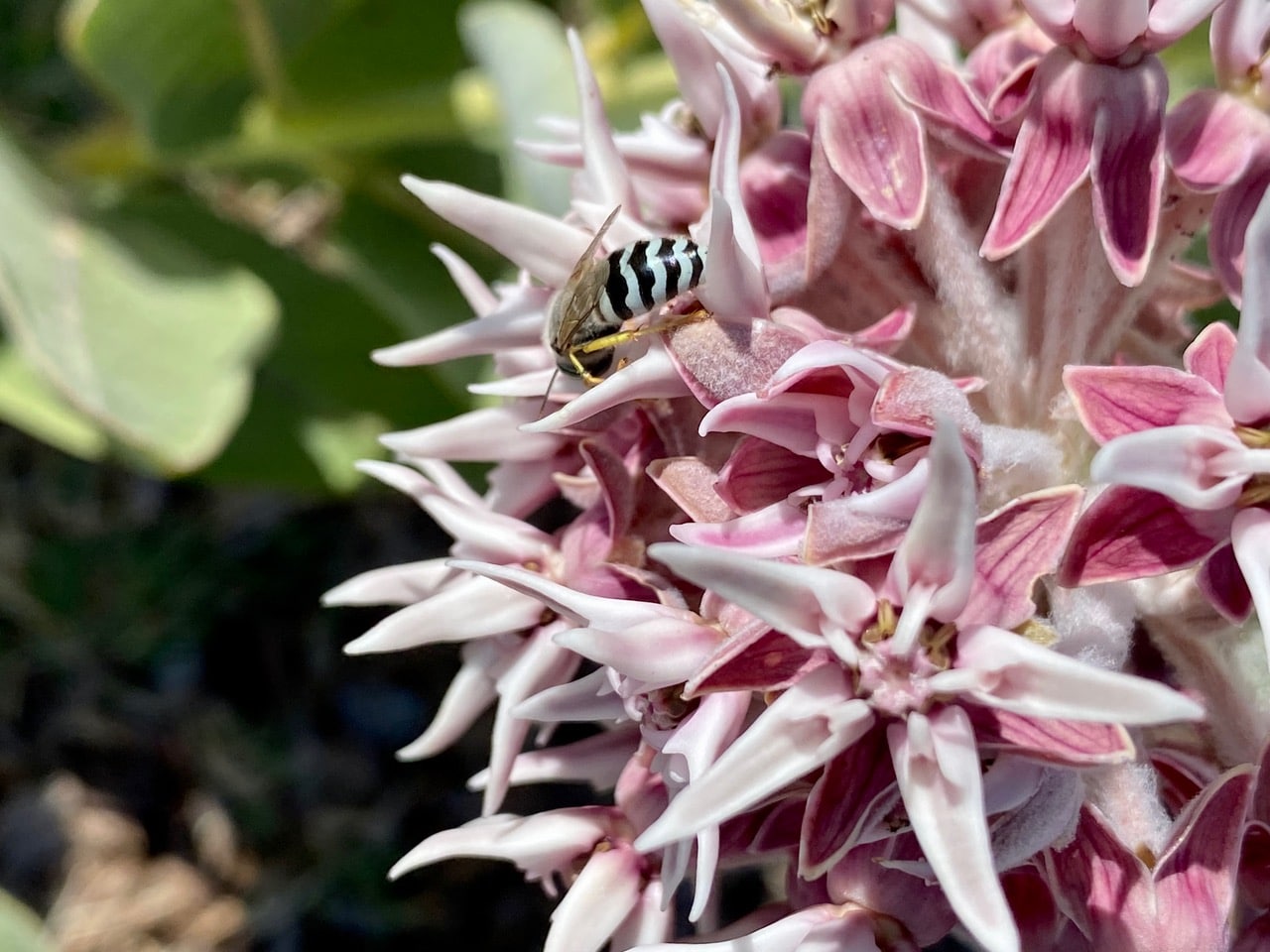
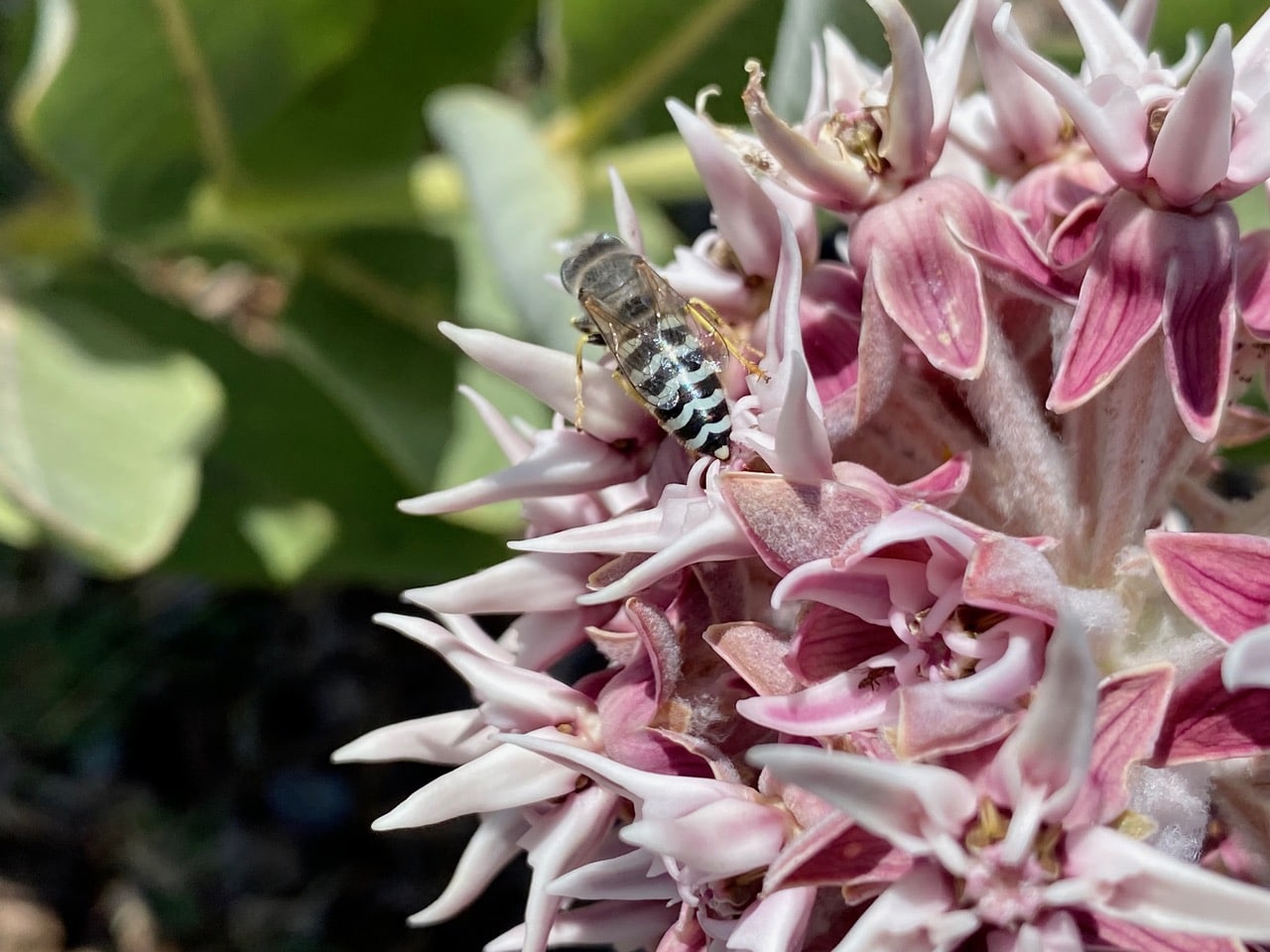
Only the fruit set of the Showy Milkweed at the end of the season will tell us if the American Sand Wasps are good pollinators for the plant in this garden.

Two Argentine Ants are seeking nectar in a hood of a milkweed flower. The insects are so small their limbs do not reach the stigmatic slits. The ants are happy freeloaders, not likely to be tricked into service, or be tragically trapped.
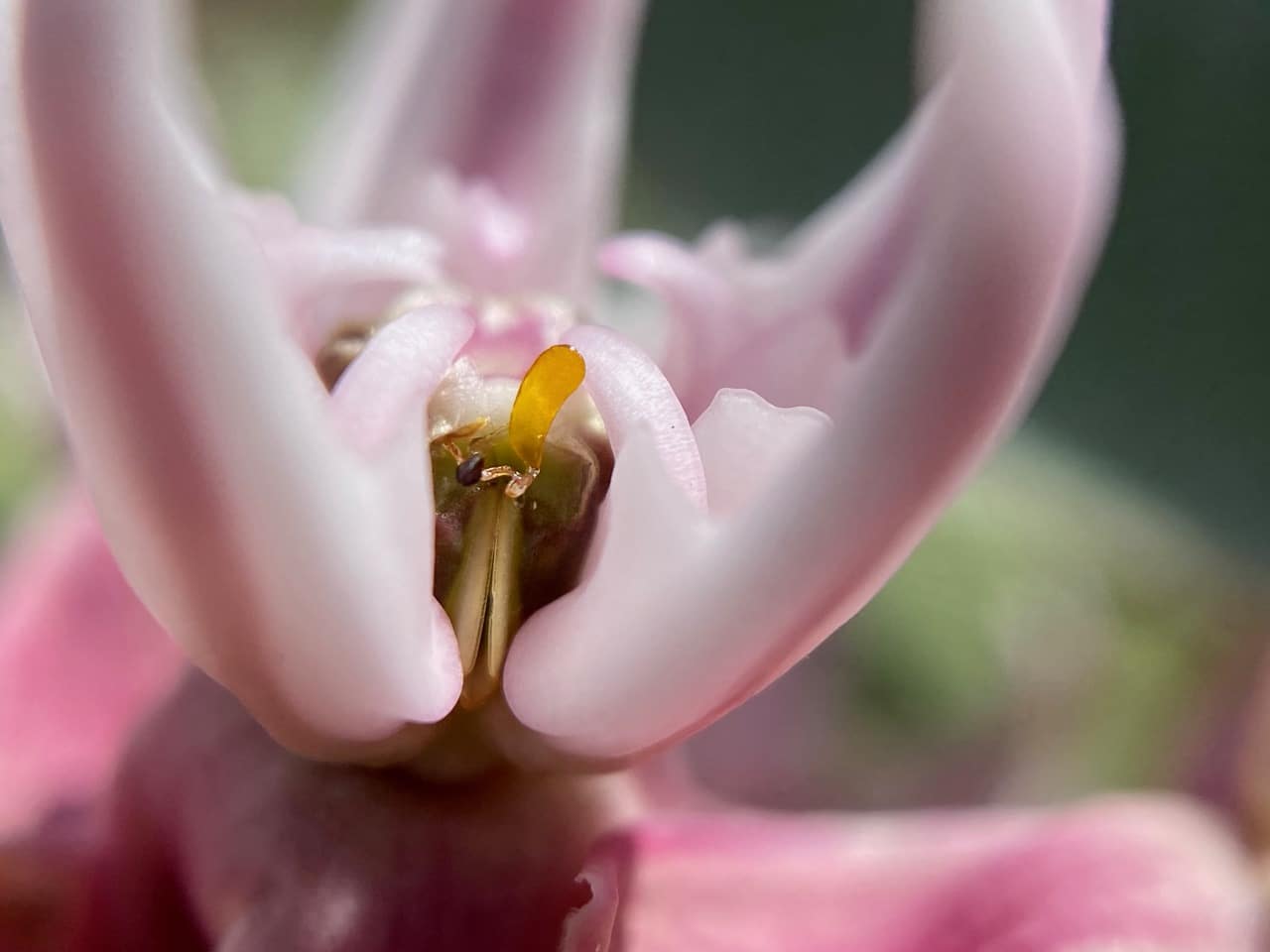
I have brought a pin from by my sewing kit at home. I try to pry a pollinia from a stigmatic slit by lifting the corpusculum up. The slit is so narrow, the move is harder than threading a needle. My clumsy attempt did lift one of the pollinia out, but the other remains hidden. I will need a finer needle for the delicate maneuver, or I’m a dead pollinator!