

Pollinator Post 6/14/23 (2)
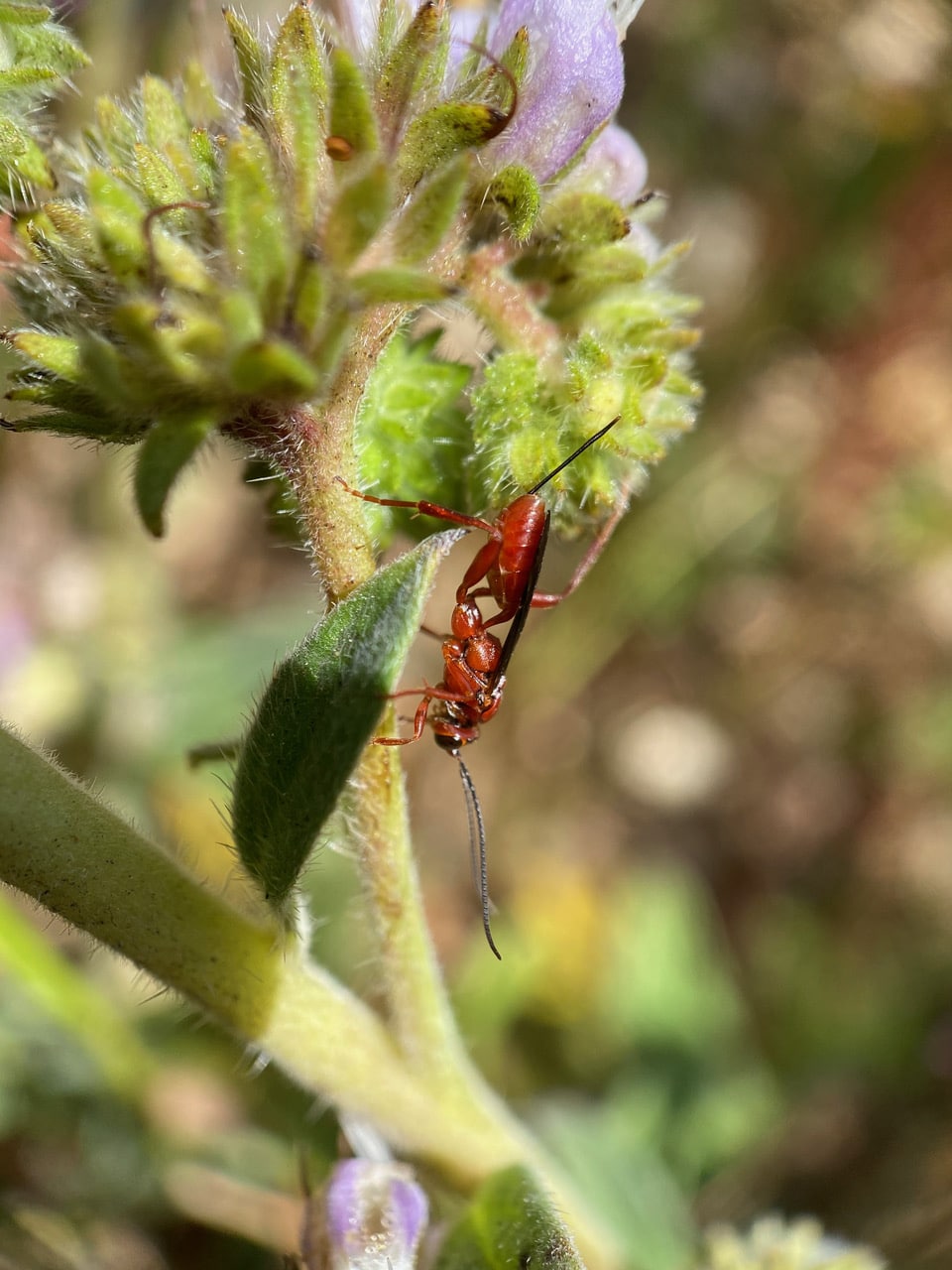
Further up the hill, I find another red-and-black wasp. This one is considerably larger, and colored a deeper red than the Braconid wasps I have been observing earlier. It is a female, as evidenced by the presence of an ovipositor. I have not had any help identifying her.

Aah, a Spotted Cucumber Beetle, Diabrotica undecimpunctata (family Chrysomelidae). I can even pronounce its ridiculous scientific name now! It is reassuring that there are familiar insects out there that I can recognize instantly!

A Bristle Fly, Siphona sp. (family Tachinidae) is feeding on in inflorescence of California Phacelia.
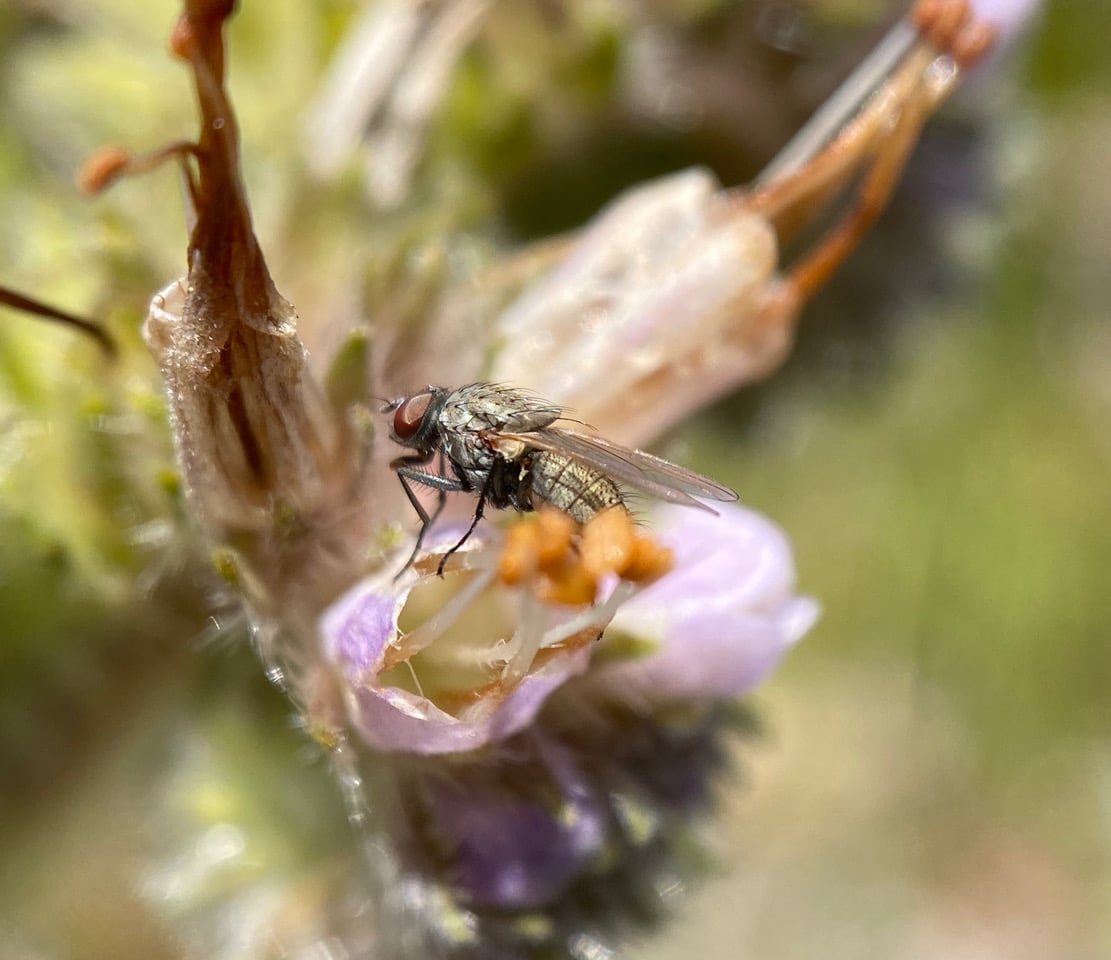
The family Tachinidae is by far the largest and most important group of parasitoid flies, with over 1,300 species in North America. All species are parasitic in the larval stage. The appearance of Tachinid Flies varies considerably, but most have distinct abdominal bristles. Adults feed on liquids such as nectar and the honeydew of aphids and scale insects. They can be found resting on foliage, feeding at flowers or searching for hosts.
Most tachinids attack caterpillars, adult and larval beetles, true bugs, grasshoppers, and other insects. Egg laying varies considerably. In some species, eggs are deposited on foliage near the host insect. After the eggs hatch, the maggots are ingested during feeding by the host, and then develop within the host. In other species, the adult fly glues her eggs to the body of the host. After the eggs hatch, the maggots penetrate into the host body. Some adult female tachinids possess a piercing ovipositor that she uses to inject the eggs into the host body. Tachinid larvae live as internal parasites, consuming their hosts’ less essential tissues first and not finishing off the vital organs until they are ready to pupate. The larvae leave the host and pupate on the ground. Tachinids are very important in natural control of many pests, and many have been used in biological control programs.

Siphona is the only commonly encountered genus of Tachinidae with a long, thin, jointed proboscis. A few other genera have a straight or curved rigid proboscis. Larvae are parasitoids of Lepidoptera (butterflies and moths).

A small bee is collecting pollen from the stamens of a California Phacelia flower.

Hunched over, the bee is working the anthers with its mouthparts and front legs.
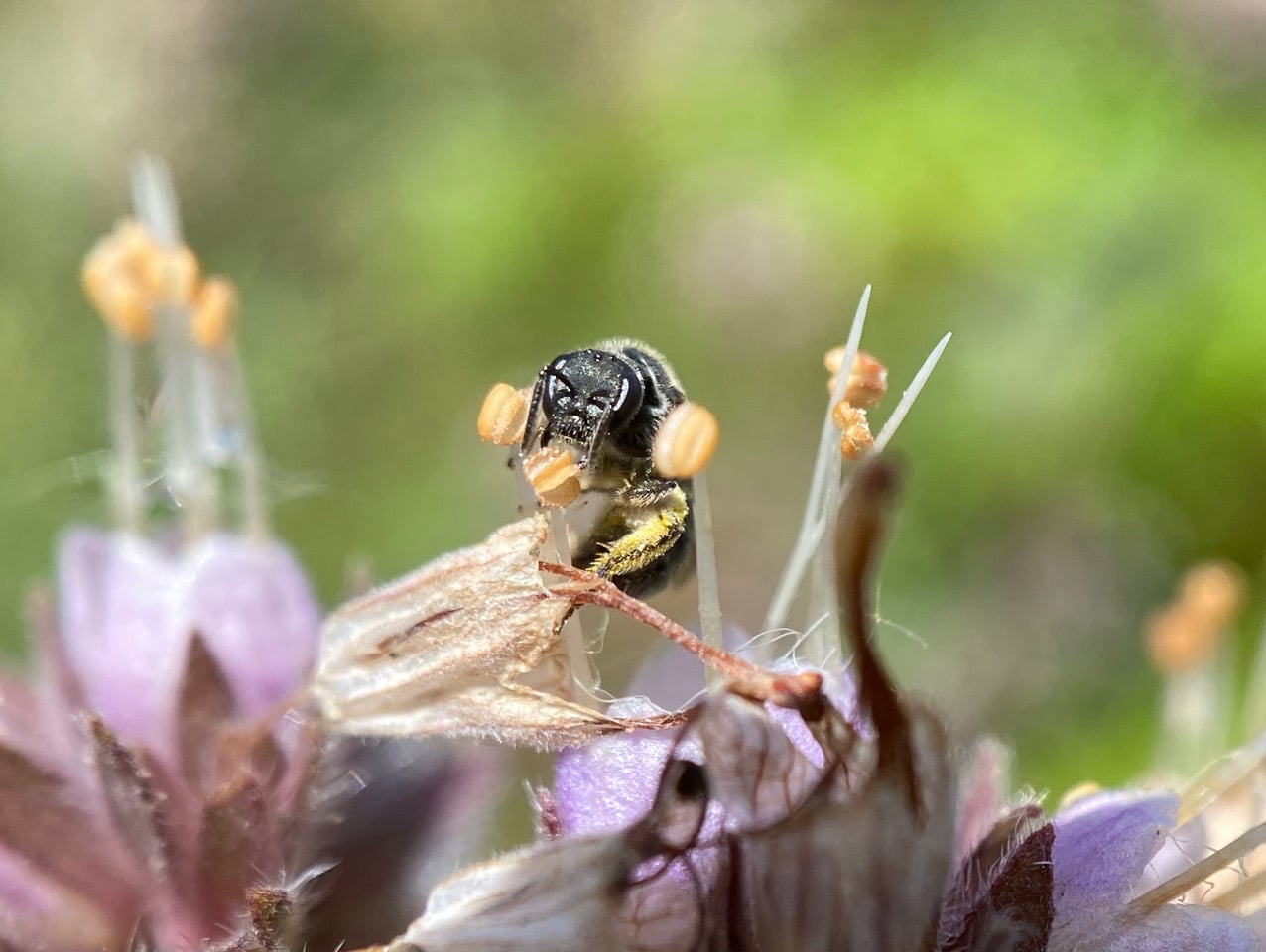
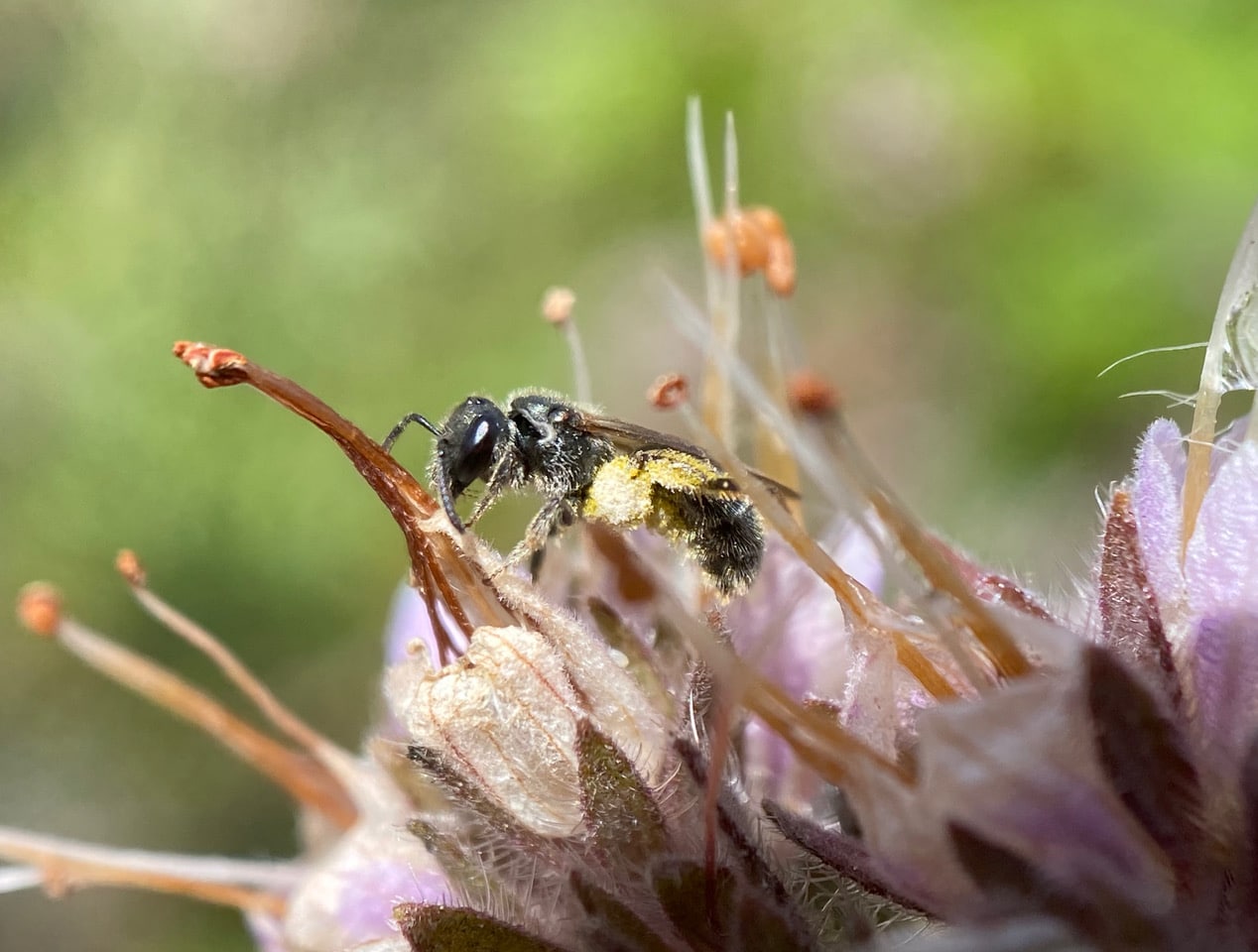
The bee’s scopa spans its entire leg and abdomen. It is a Sweat Bee, probably in the genus Lasioglossum (family Halictidae).
A scopa (plural scopae; Latin for “broom”) is any of a number of different modifications on the body of a bee that form a pollen-carrying apparatus. It is a dense mass of elongated, often branched, hairs (or setae) on the hind leg. When present, it covers the tibia at a minimum, but some bees, depending on the species also have the hairs on the other segments of their leg. The leaf-cutter bees in the family Megachilidae have an extensive scopa on the underside of the abdomen. In the Sweat Bees (family Halictidae), the entire hind leg and abdomen carry pollen. Bumble Bees and Honey Bees have a more highly-developed structure than the scopa: the corbicula, or pollen basket. Some other bees, such as the Masked Bees (family Colletidae), transport pollen internally in the crop, and they lack a scopa. Parasitic bees do not collect pollen; they do not have a scopa.
Halictidae is the second-largest family of bees. They are commonly called Sweat Bees, as they are often attracted to perspiration.
The sweat bee genus Lasioglossum is the largest of all bee genera, containing over 1700 species worldwide. They are highly variable in size, color, and sculpture; among the more unusual variants, some are kleptoparasites, some are nocturnal, and some are oligolectic. Most Lasioglossum species nest in the ground, but some nest in rotten logs.
Social behavior among species of Lasioglossum is extraordinarily variable; species are known to exhibit solitary nesting, primitive eusociality, and social parasitism. Colony sizes vary widely, from small colonies of a single queen and four or fewer workers to large colonies of over 400 workers and perennial life cycles.

A Convergent Ladybeetle, Hippodamia convergens (family Coccinellidae) is feeding with abandon in a California Phacelia flower. I wonder if it is hunting aphids, or sipping nectar? Although Ladybeetles are commonly known as predators of aphids and other soft-bodied insects, they also feed on pollen and nectar when prey is scarce.
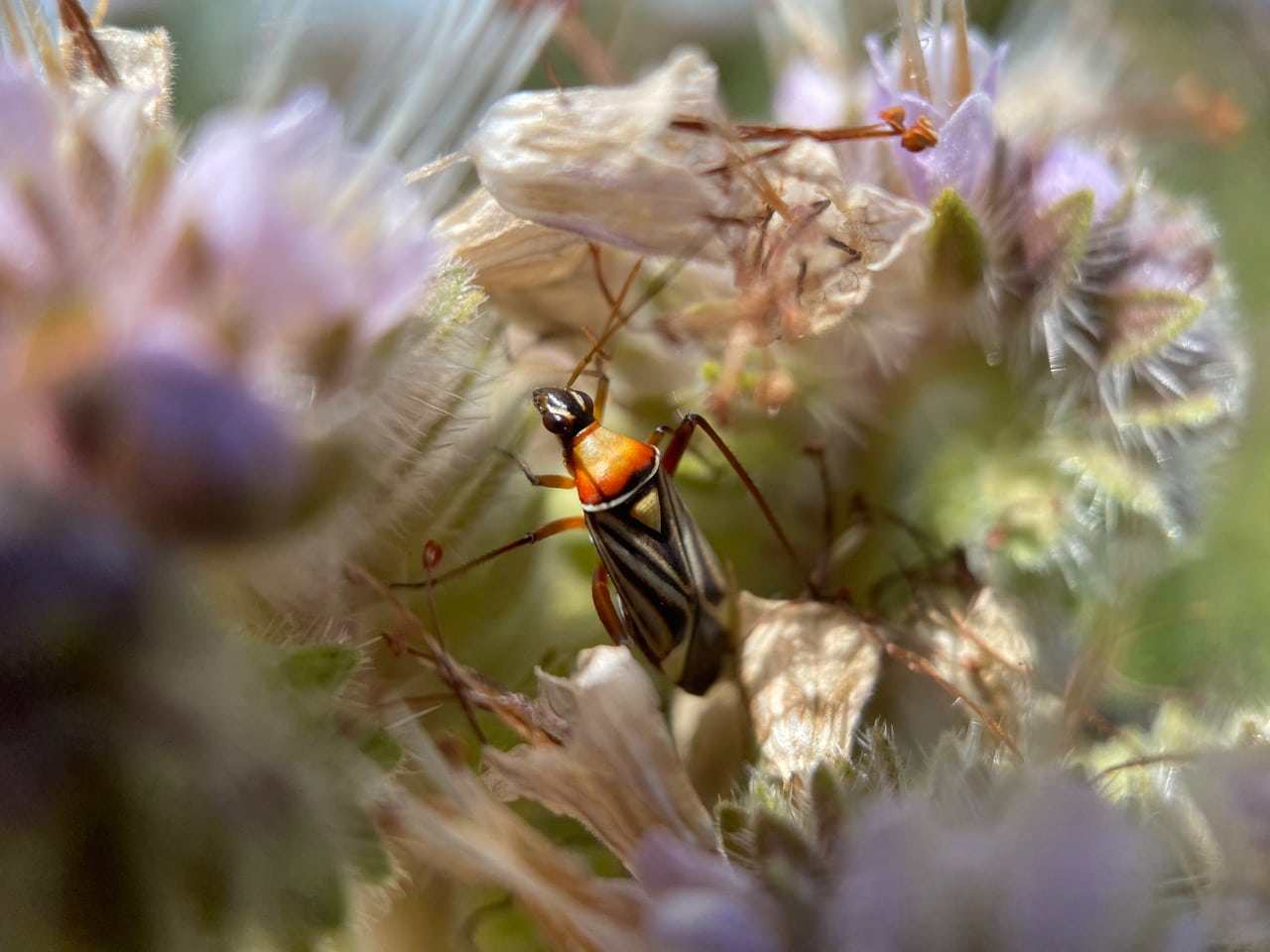
Ooh, I have been anticipating this bug for a while, having seen many of its nymphs lately! It is the adult form of the Plant Bug, Closterocoris amoenus (family Miridae). What a beauty! The nymphs of the species are ant mimics.
Mirid bugs are also referred to as plant bugs or leaf bugs. Miridae is one of the largest family of true bugs in the order Hemiptera. Like other Hemipterans, Mirids have piercing, sucking mouthparts to extract plant sap. Some species are predatory.

The bug actually emerges from the shadows and poses for this picture on an inflorescence of California Phacelia.
One useful feature in identifying members of the family Miridae is the presence of a cuneus; it is the triangular tip of the corium, the firm, horny part of the forewing, the hemielytron. The cuneus is visible in nearly all Miridae.

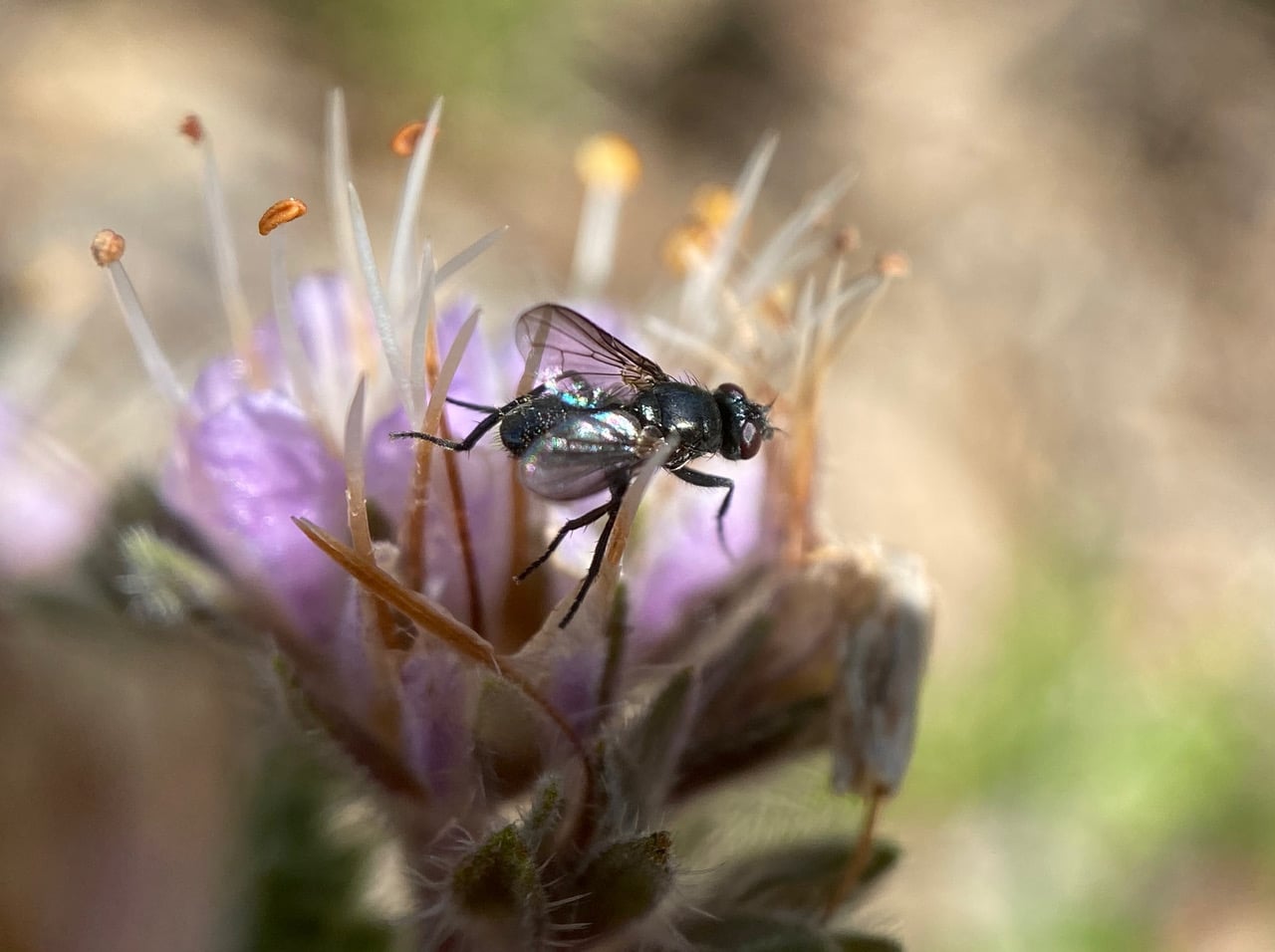
Ooh, it’s that frenetic little black fly again! As usual, it is running around flapping its wings frantically. Such interesting behavior! I am despairing that I might never know who it is and what it does, as I can never get a good enough picture of it.
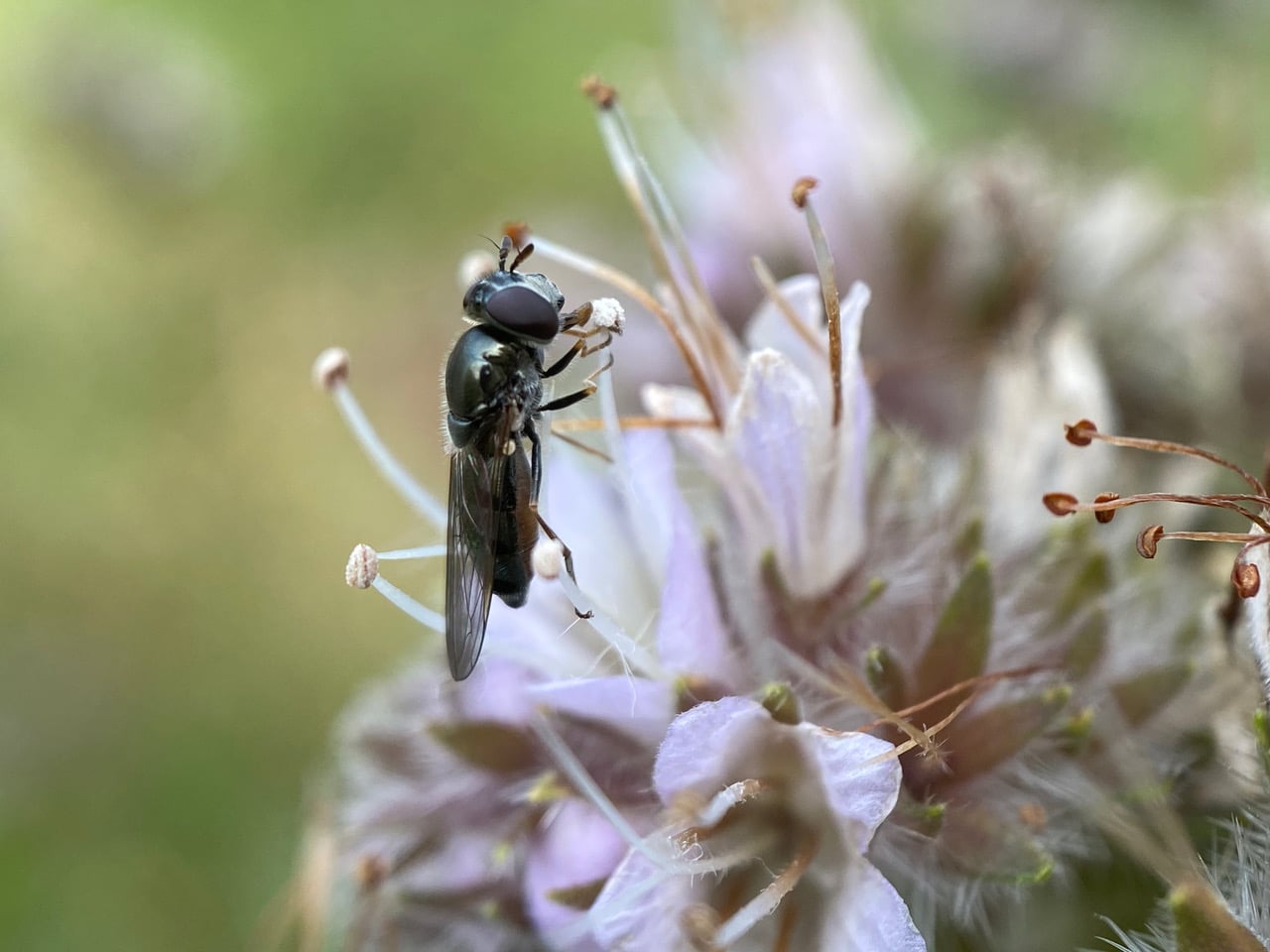
A Sedgesitter Hover Fly, Platycheirus sp. (family Syrphidae) is feeding on the pollen of California Phacelia like a child licking an ice cream cone.
Platycheirus is found in grass and herb vegetation. Adults of many species feed on pollen of wind-pollinated plants, such as Salix, Plantago, Poaceae, Cyperaceae, but they visit other flowers also. Many stay active during cold and rainy weather. Larvae feed on aphids.
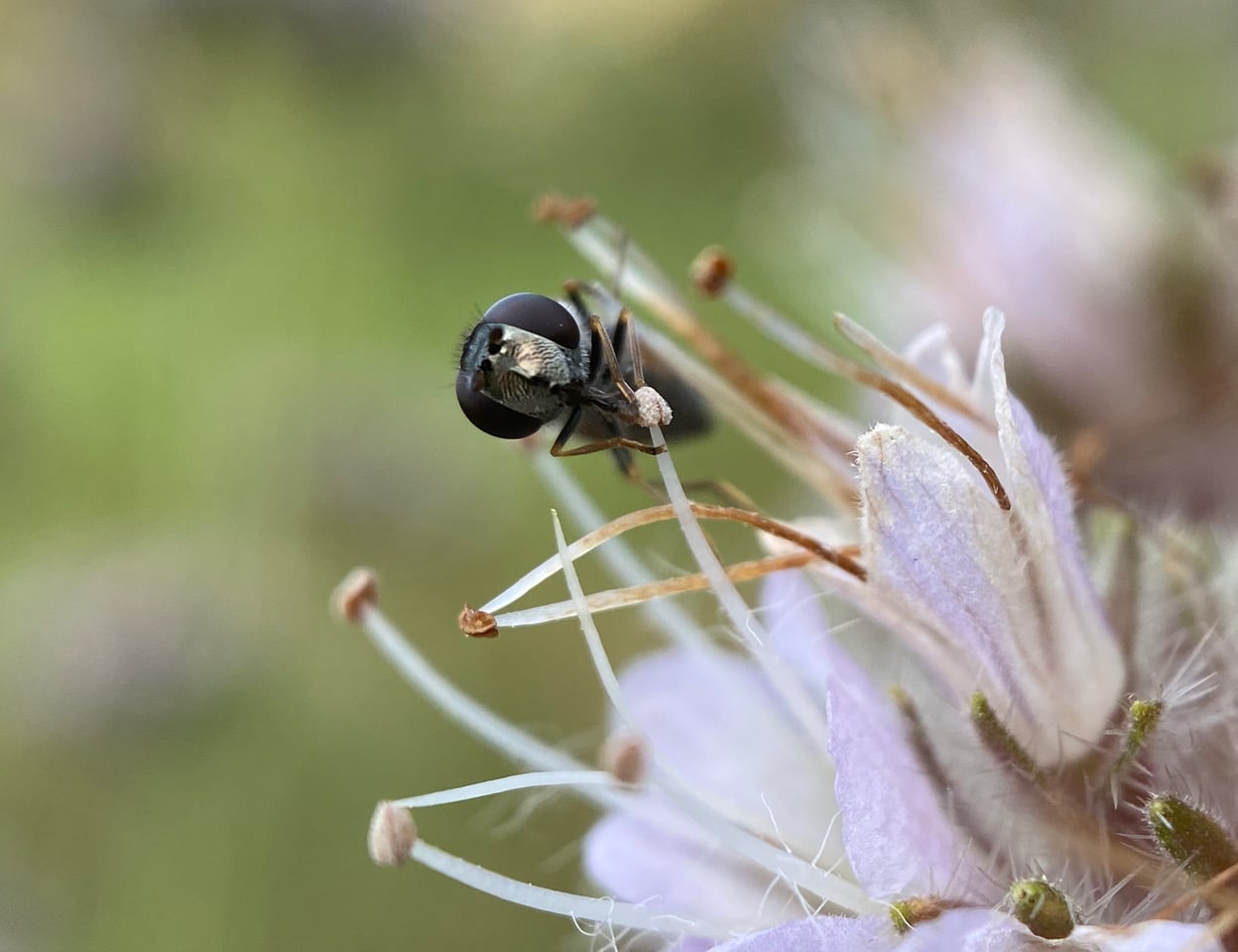
I find the metallic sheen of the Sedgesitter’s exoskeleton rather intriguing.

It is only in certain light that one gets to appreciate that metallic quality of the Sedgesitter.
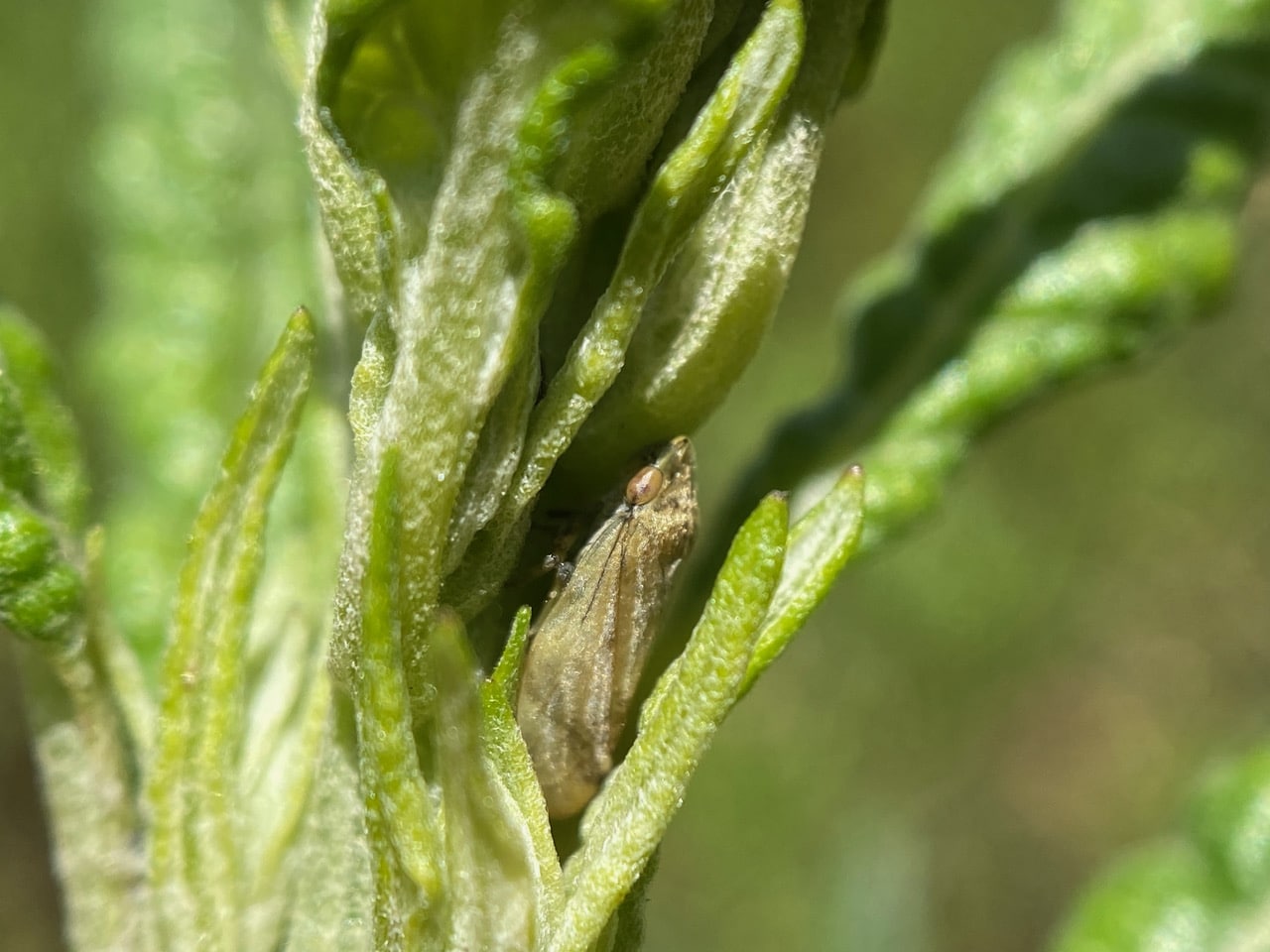 Near the top of a California Mugwort, Artemisia douglasiana, a Froghopper or Spittlebug (family Aphrophoridae) is trying its best to look like a leaf bud, its snout pointing upward.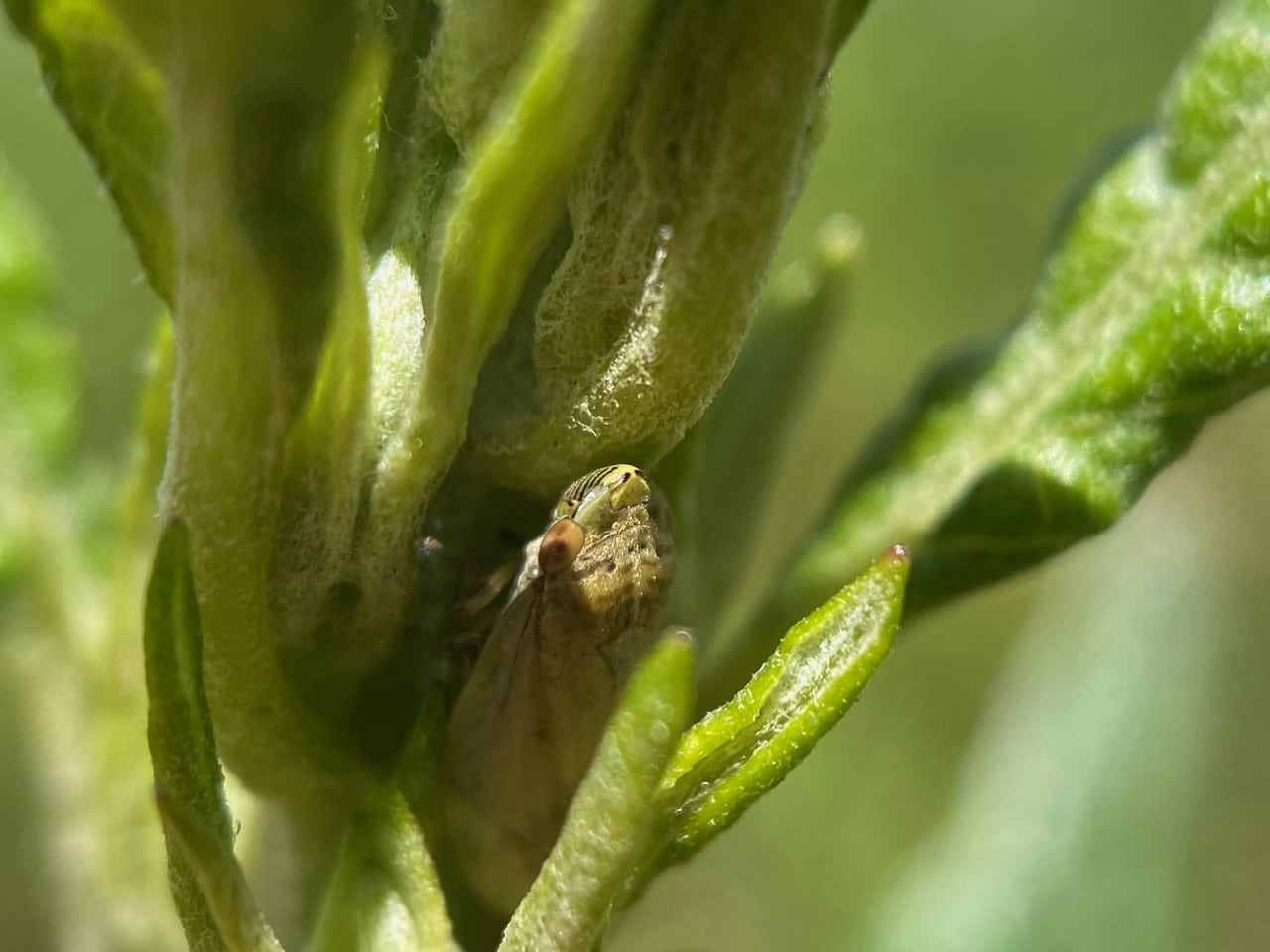
Here’s a close-up look of the little Froghopper, Philaenus sp.(family Aphrophoridae).
The Froghopper is a “true bug” in the order Hemiptera, family Aphrophoridae. Froghoppers are champion jumpers among insects, out-performing even the fleas. The bug can leap the human equivalent of a skyscraper without a running start! The muscles in its hind legs act like a “catapult” to release energy explosively. Its athletic prowess not withstanding, the Froghopper is better known for its young, the “spittle bugs”. The nymphs produce foamy white masses on plants within which they feed on plant sap. Froghoppers have piercing-sucking mouthparts, and feed on plant sap as both nymphs and adults. A recent report claims, “Froghoppers are the super-suckers of the animal world. The tiny insects produce negative pressures equivalent to people sucking a 100-meter-long straw.” So the little bug has two titles under its belt – champion jumper, and super-sucker!

The Small-headed Fly, Eulonchus sp. (family Acroceridae) is still in the same Sticky Monkeyflower, Diplacus aurantiacus that I have marked. I don’t know what to think. I have seen the fly in this position since 6/6/23. Has it moved at all? The flower is looking a little tired now, with some scarring on a lower petal. It has obviously seen some traffic. I have thought that the fly was in torpor, but only warm-blooded animals go into torpor to save energy in inclement weather…
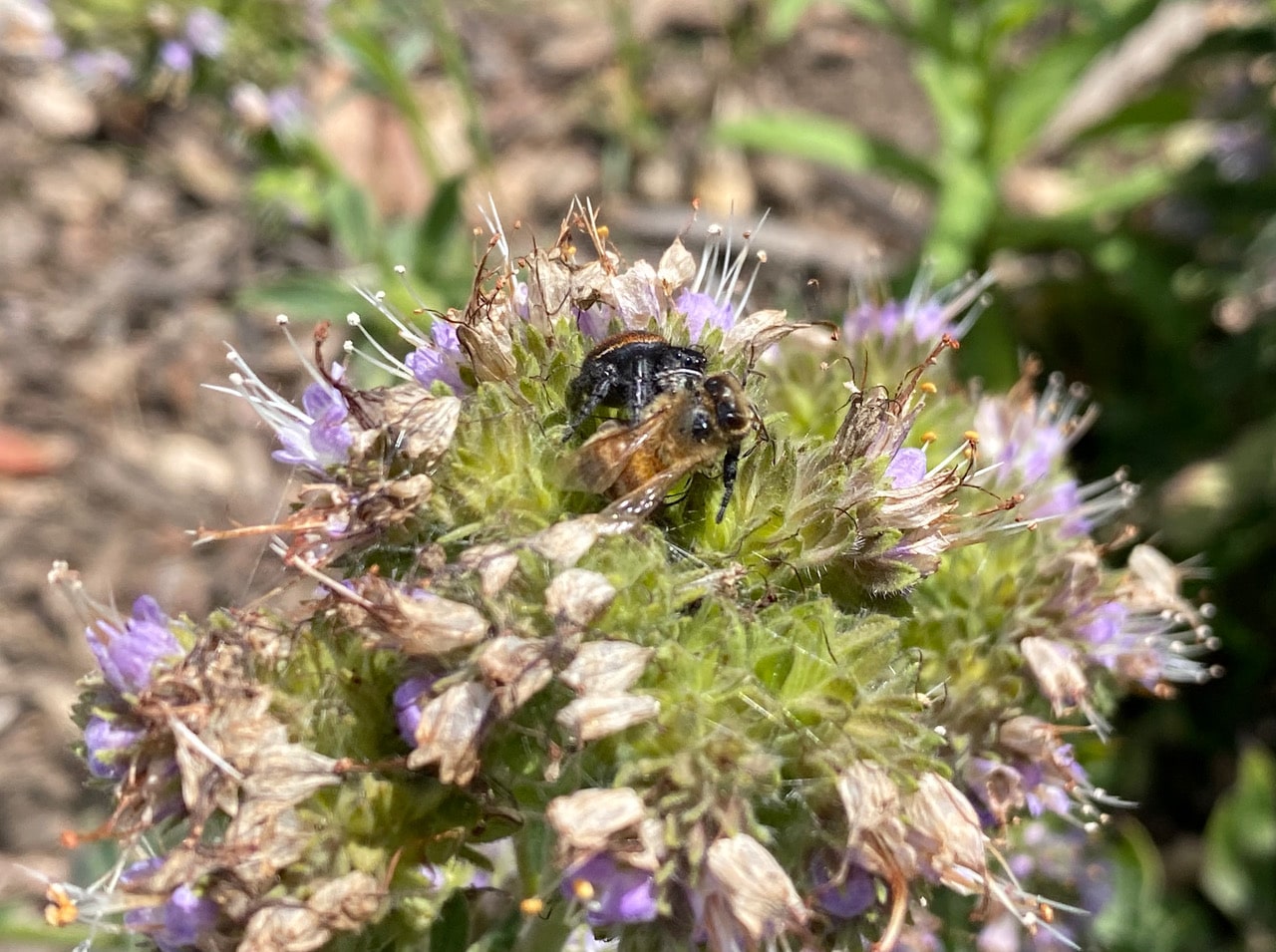 Passing the familiar California Phacelia I have marked, I look for the female Red-backed Jumping Spider, Phidippus johnsoni (family Salticidae). She has caught a Honey Bee!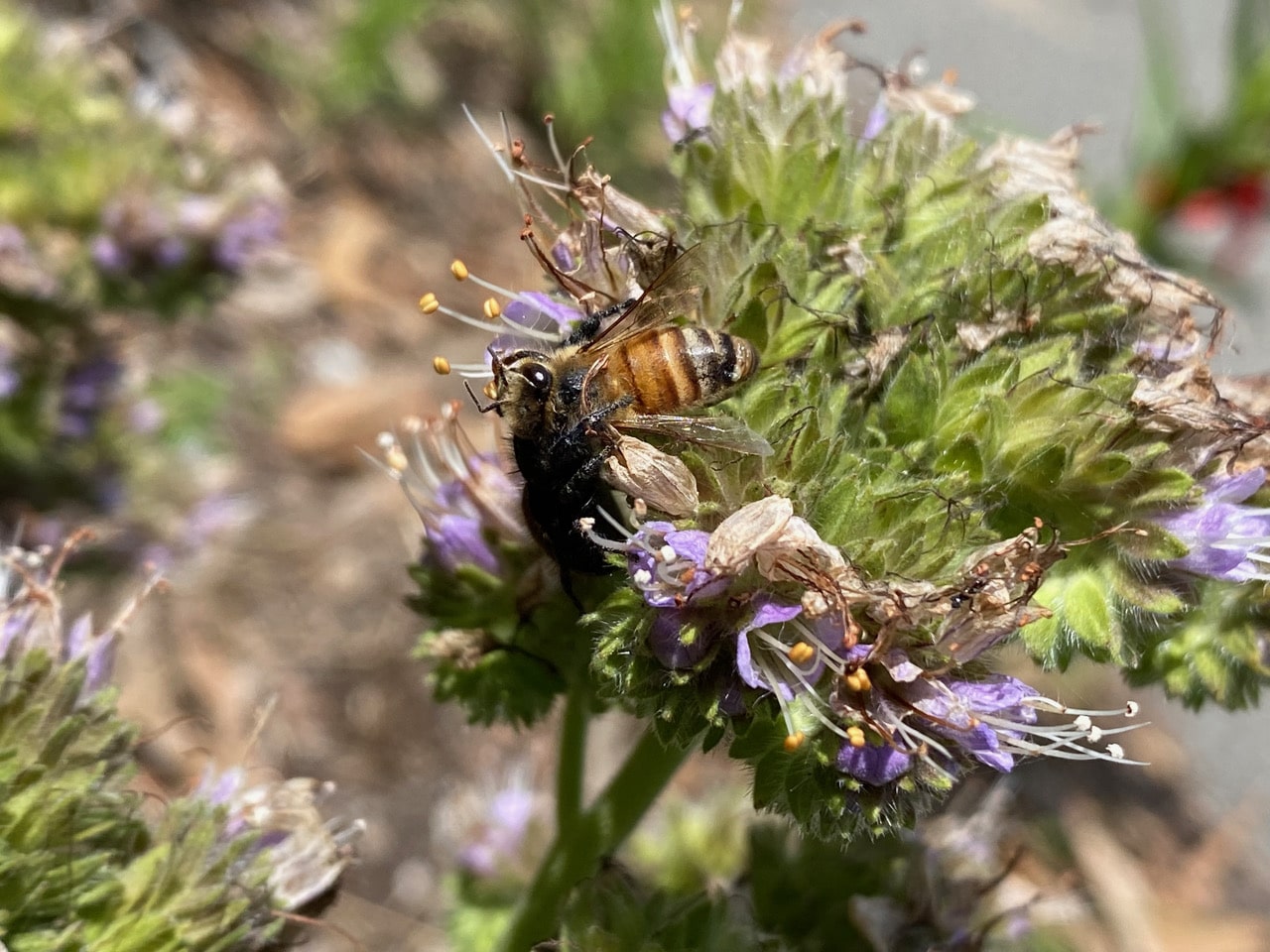
Sensing my approach, the spider quickly runs for the edge of the inflorescence and disappears, dragging her prize meal with her. She is acting very much like a Crab Spider (family Thomisidae).

I find her on the inflorescence below, where she can feed in peace away from prying eyes. Instead of roaming the plant in search of prey, the clever spider has been hunting on the top inflorescence leaping to catch insects from the same spot. Obviously it is a winning strategy – she looks rotund and well-fed. Well done, Spidey (that’s what I called the Red-backed Jumping Spider I once had for a pet)! I have nothing but admiration for these bold and intelligent critters.

When I pass the same plant again on the way back, Spidey is nowhere to be seen. But I find her prey dangling from the side of the inflorescence. Did Spidey toss the bee out after finishing her meal, or did she hang it there for later consumption? See the beige blob next to the bee? It is the pollen load in the poor bee’s pollen basket, located on her hind leg. It is the Phacelia pollen she has collected on the last foraging trip of her life.

I am reminded to pause when I spot the red yarn I have tied to the Phacelia on which I have been observing the ovipositing Braconid wasp earlier this afternoon. No female wasps are around, but a lone male has lingered.

I watch as he goes into a shadowy spot under an inflorescence.
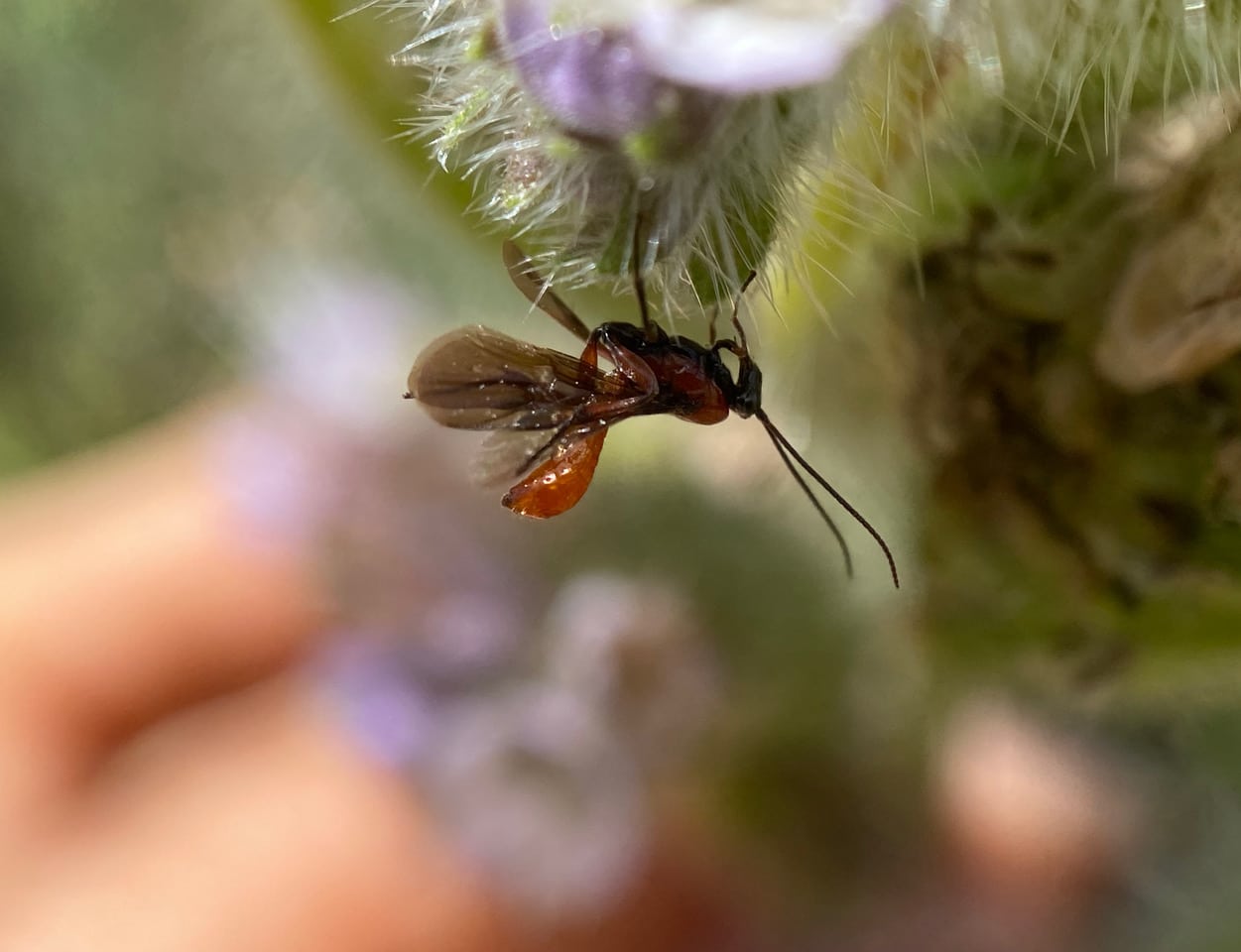
There he begins to groom himself thoroughly. Swinging his abdomen up and down flexibly, he scrubs it with his hind legs. Then he works on the wings. Gotta look good for the girls tomorrow!