

Pollinator Post 6/13/24 (2)
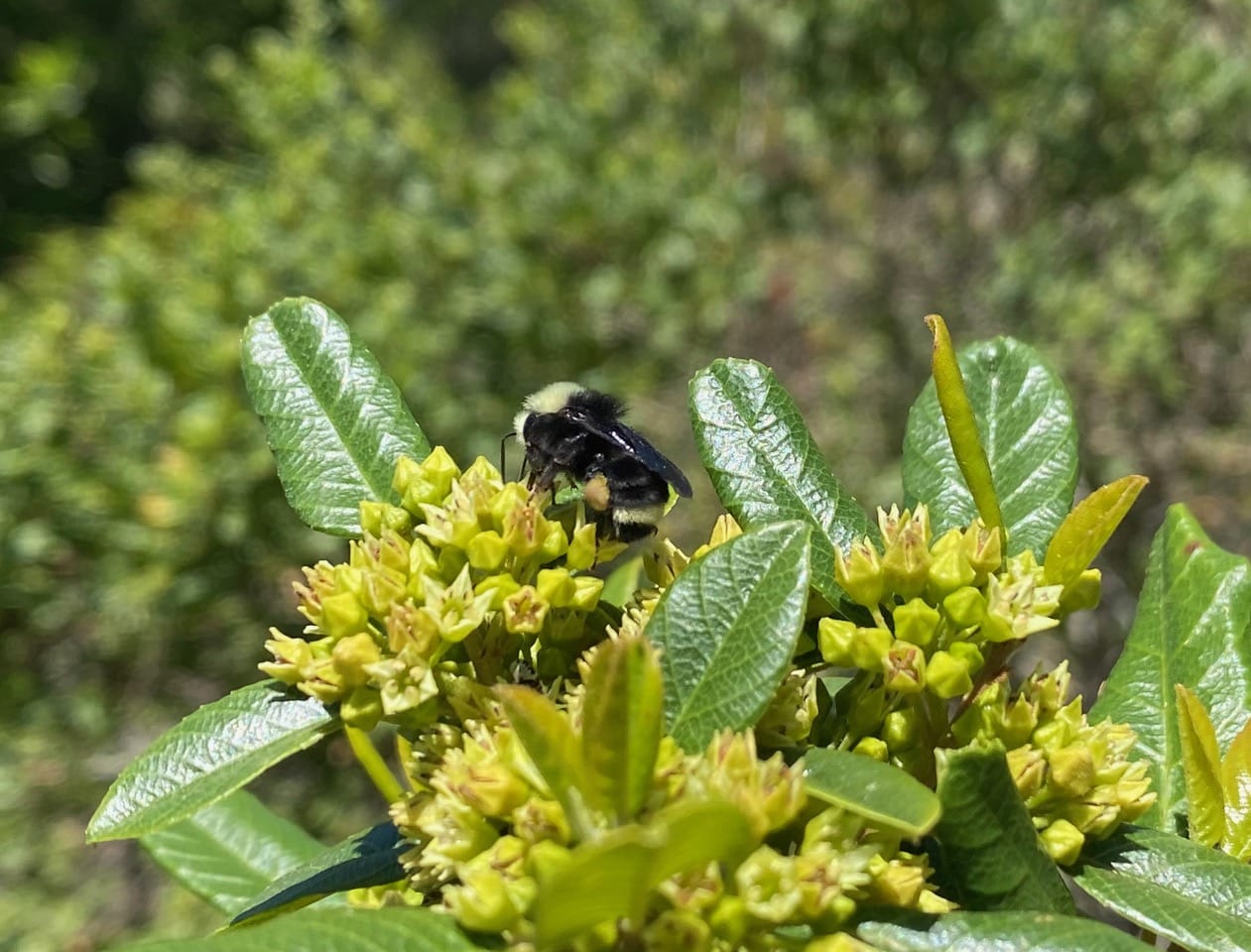
A Yellow-faced Bumble Bee, Bombus vosnesenskii (family Apidae) is foraging on the flowers of Coffeeberry, Frangula californica. I wonder if the pollen in her pollen baskets is from the plant?
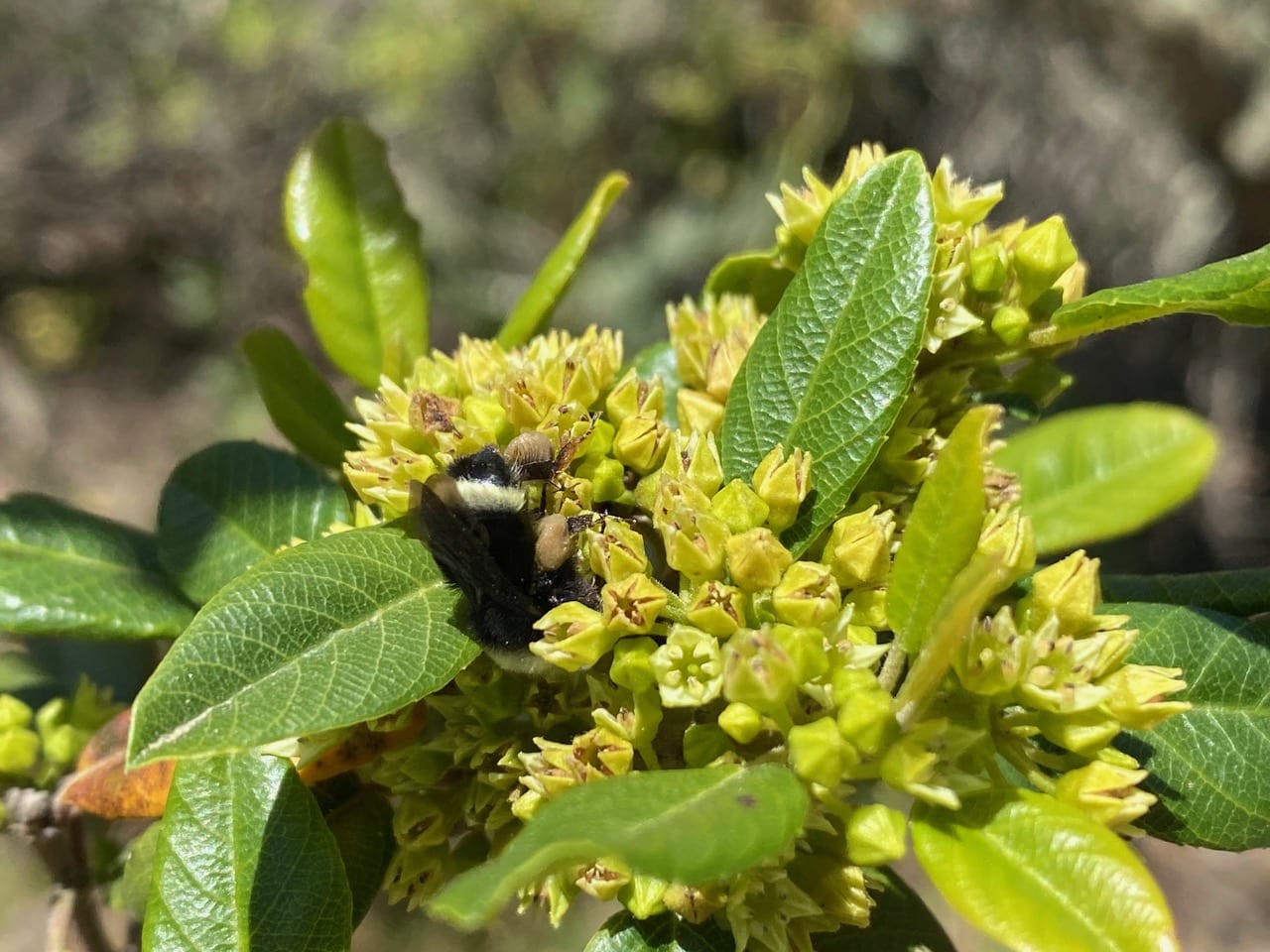

 The fly has a black abdomen.

 A Sweat Bee, Halictus sp. (family Halictidae) is actively collecting pollen from the English Daisy flowers.

The bee is diving deep into the flowers, probably taking nectar.
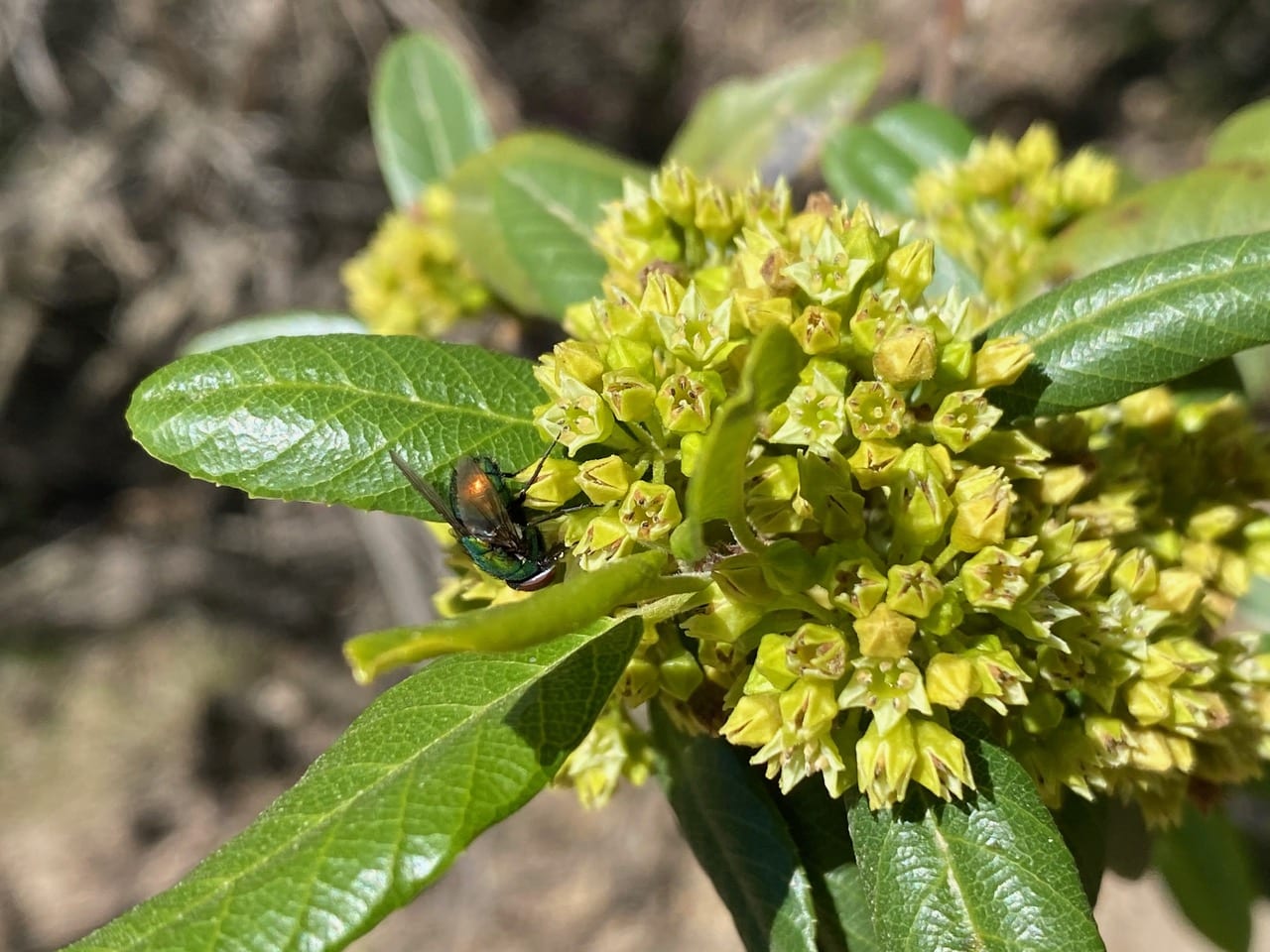
A Blow Fly (family Calliphoridae) is foraging on an inflorescence of California Coffeeberry.
The Calliphoridae are variously known as blow flies, carrion flies, greenbottles, and bluebottles. Adults are usually brilliant with metallic sheen, often with blue, green, or black thoraces and abdomens. There are three cross-grooves on the thorax; calypters are well developed. Females visit carrion both for proteins and egg laying. The larvae that hatch feed on dead or necrotic tissue, passing through three instars before pupation. After the third instar, the larva leaves the corpse and burrows into the ground to pupate. Adult blow flies are occasional pollinators, being attracted to flowers with strong odors resembling rotting meat. The flies use nectar as a source of carbohydrates to fuel flight.
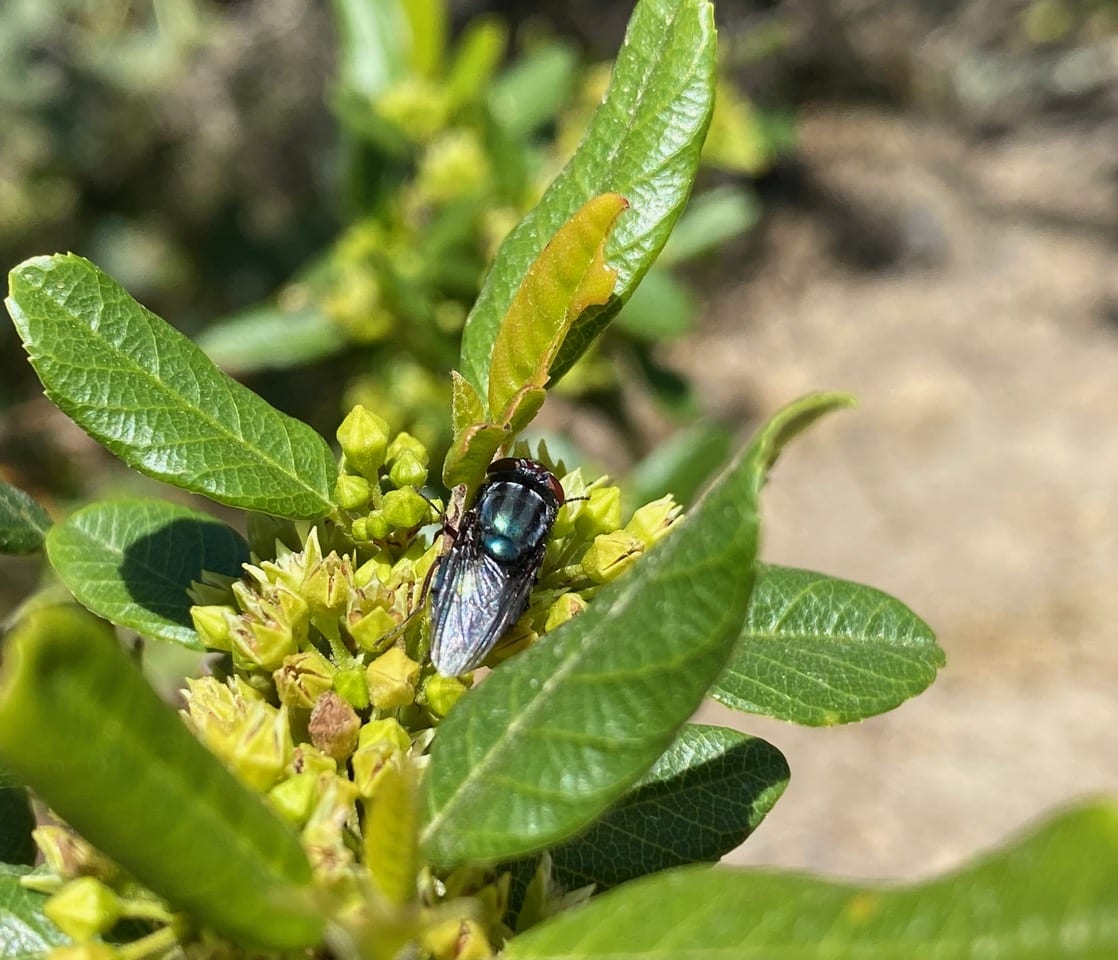
Here’s a different species of Blow Fly – the easily recognizable Secondary Screwworm, Cochliomyia macellaria.
The Secondary Screwworm, Cochliomyia macellaria (family Calliphoridae, commonly known as blow flies) ranges throughout the United States and the American tropics. The body is metallic greenish-blue and characterized by three black longitudinal stripes on the dorsal thorax. Females are attracted to carrion where they lay their eggs. These screwworms are referred to as “secondary” because they typically infest wounds after invasion by primary myiasis-causing flies. While the flies carry various types of Salmonella and viruses, C. macellaria can also serve as important decomposers in the ecosystem. In a lifetime, a female may lay up to 1000 or more eggs. Females may also lay their eggs with other females, leading to an accumulation of thousands of eggs. The larval stage of C. macellaria is referred to by the common name of secondary screwworms; this is due to the presence of small spines on each body segment that resemble parts of a screw. The larvae feed on the decaying flesh of the animal that they have been laid on until they reach maturity. Eventually the larvae fall off the food source to pupate in the top layer of the soil. Adult females will continue to feed on tissues of animals; however, now they preferentially feed off of live tissues and tissue plasma. Adult males will no longer consume tissue, but instead will eat nearby vegetation and take nourishment from floral nectar.
A Bee Fly, Villa lateralis (family Bombyliidae) is foraging on a Coffeeberry flower.
The Bee Flies belong to the family Bombyliidae. Adults generally visit flowers for nectar and pollen, some being important pollinators. Larvae generally are parasitoids of other insects. When at rest, many species of bee flies hold their wings at a characteristic “swept back” angle. The adult females usually deposit eggs in the vicinity of possible hosts, quite often in the burrows of beetles or ground-nesting bees/wasps. Bombyliidae parasitism is not host-specific, but rather opportunistic, using a variety of hosts. Adult females of the genus Villa lay eggs in mid-air and flick them towards the nest entrances of their hosts. They typically have an eversible pouch near the tip of their abdomen known as a sand chamber, which is filled with sand grains gathered before egg laying. These sand grains are used to coat each egg just before their aerial release, presumably to improve the female’s aim by adding weight.
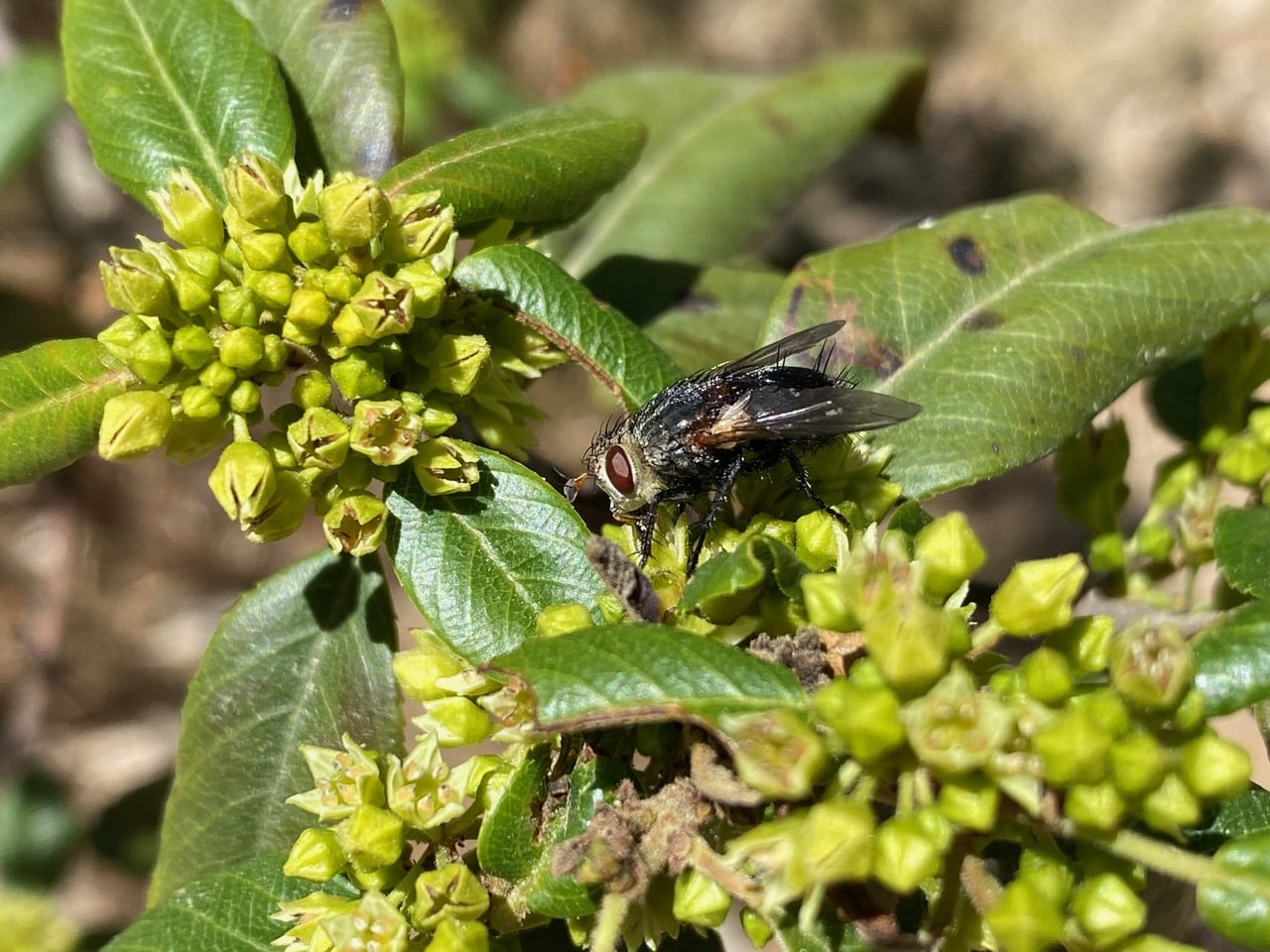
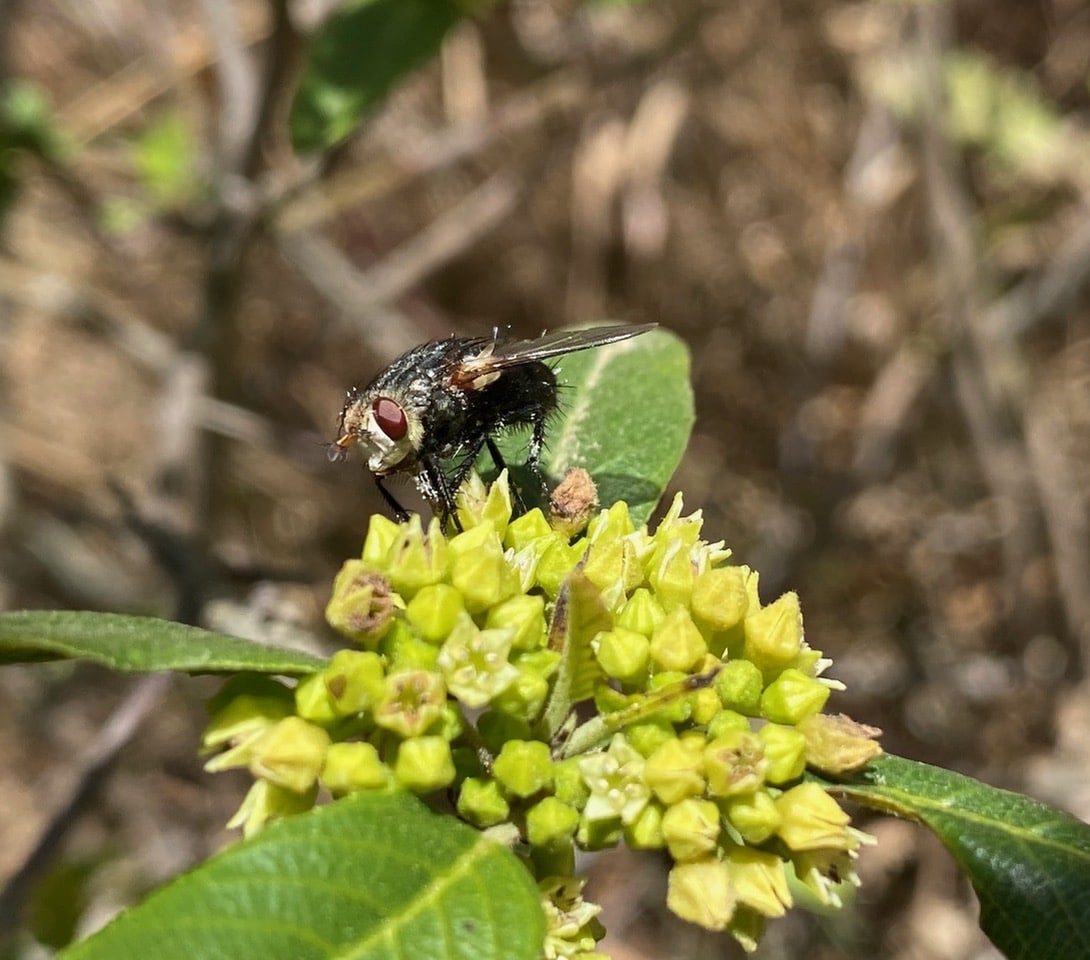
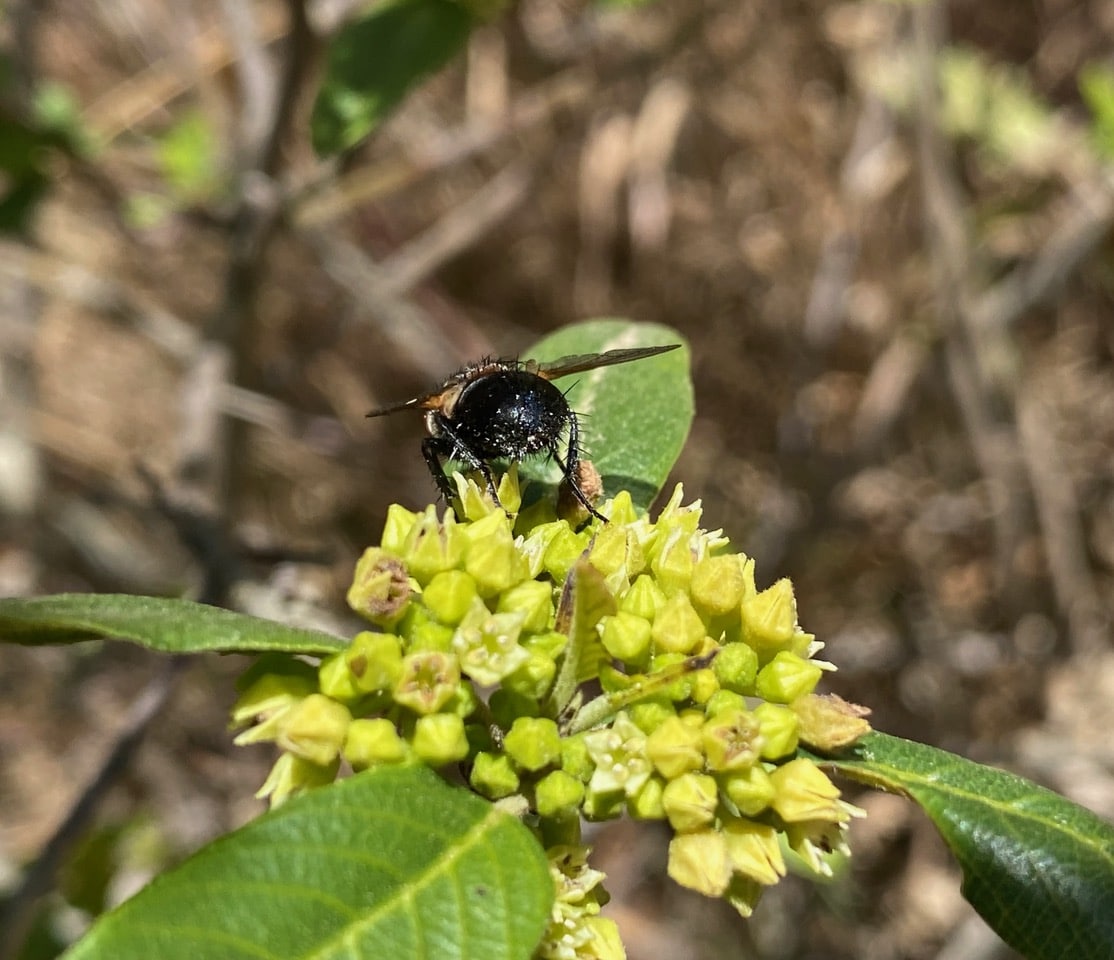
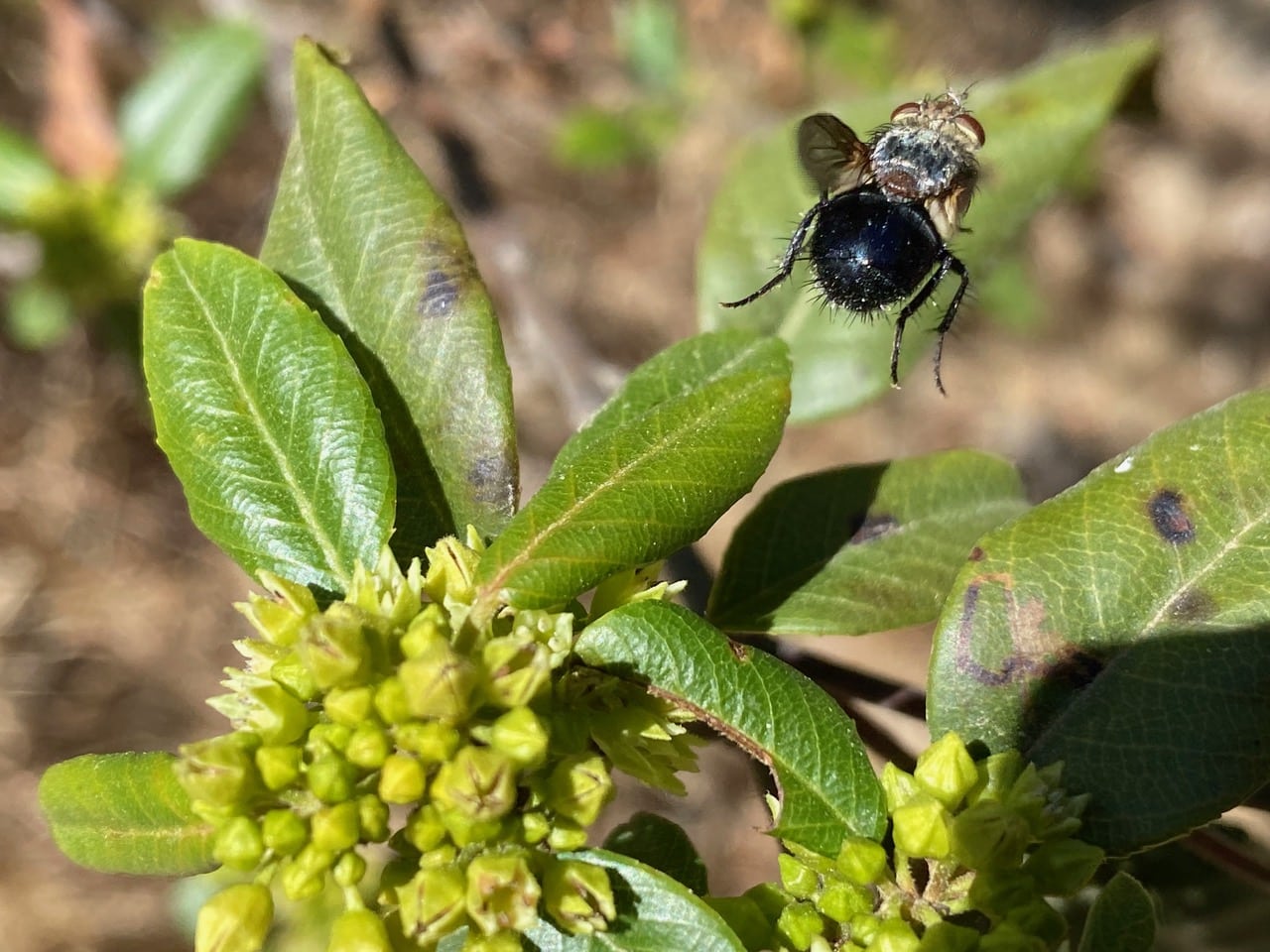
Ooh, a stocky, bristly fly has landed on the flowers of Coffeeberry. A Bristle Fly (family Tachinidae)?
Pollen adheres to the fly as it feeds.
The fly has a black abdomen. iNaturalist has identified the fly as a Hornworm Tachinid Fly, Archytas apicifer (family Tachinidae).
The family Tachinidae is by far the largest and most important group of parasitoid flies. All species are parasitic in the larval stage. Most adults have distinct abdominal bristles, hence the common name. Adults feed on liquids such as nectar and honeydew. They can be found resting on foliage, feeding at flowers or searching for hosts.
Most tachinids attack caterpillars, adult and larval beetles, true bugs, grasshoppers, and other insects. Females lay eggs in or on the host. Tachinid larvae live as internal parasites, consuming their hosts’ less essential tissues first and not finishing off the vital organs until they are ready to pupate. The larvae leave the host and pupate on the ground. Tachinids are very important in natural control of many pests, and many have been used in biological control programs.
Found throughout North America and South America, Archytas apicifer is a medium to large sized (10-15 mm) tachinid fly. Adults feed on flower nectar, and are known to be pollinators of some flowers. Like many other tachinid flies, Archytas apicifer larvae are internal parasitoids of noctuid moths (family Noctuidae).
A Lorquin’s Admiral lands on a dead branch laden with lichens.
Lorquin’s Admiral, Limenitis lorquini (family Nymphalidae) is found in western North America, from British Columbia south to southern California and Baja California. The butterfly resides mostly in forest edges, mountain canyons, parks, stream sides, and orchards. Usually the butterflies feed on California buckeye, yerba santa, privet, bird droppings, and dung. They are extremely territorial and will attack any intruders into their habitat, including large birds. The larvae feed on trees such as willow (Salix), poplar, cherry (Prunus), cottonwood (Populus), and an assortment of orchard trees, including cherry, apple, and plum. In its southern range in California, the butterfly may have multiple broods per year.
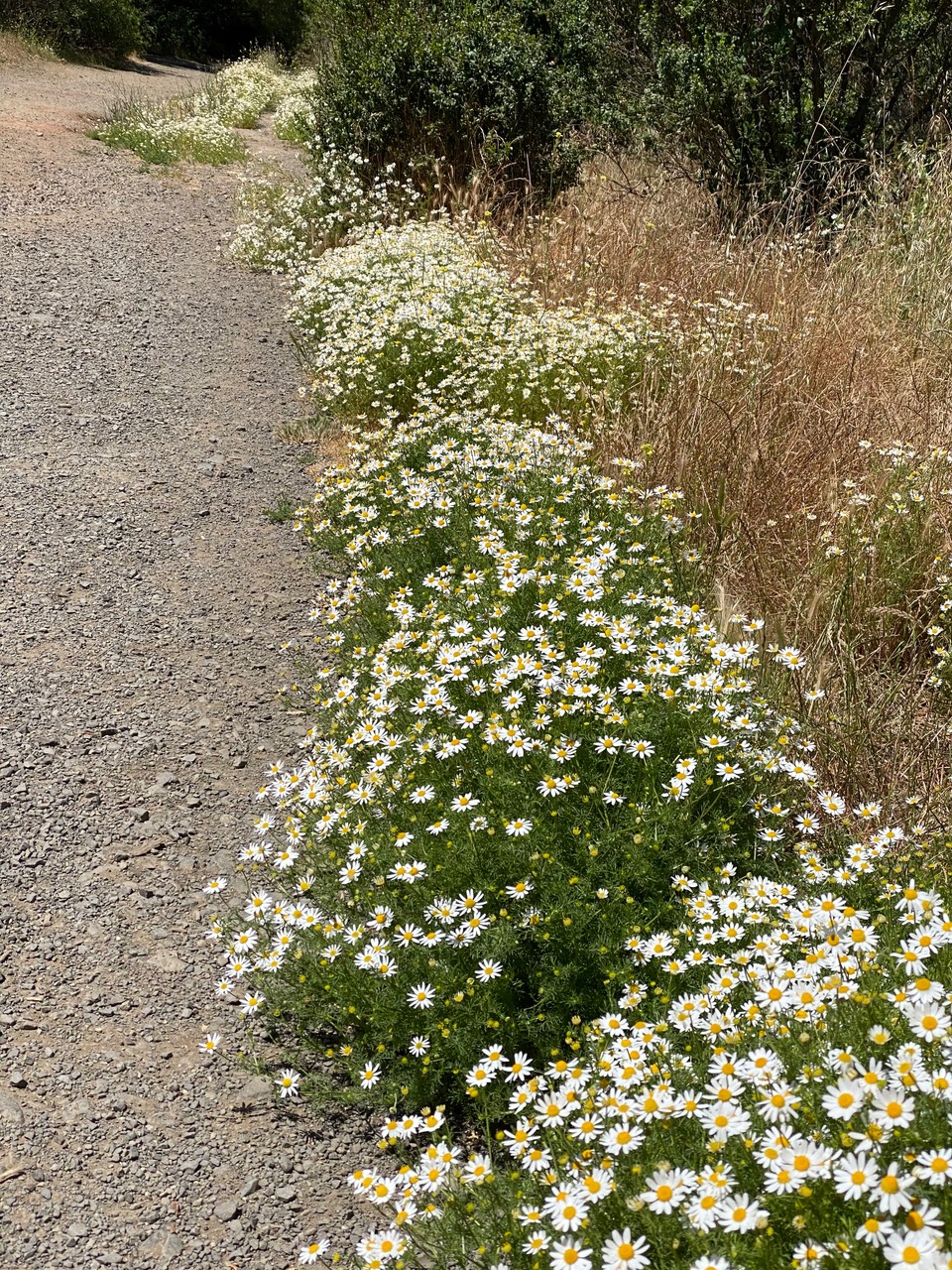
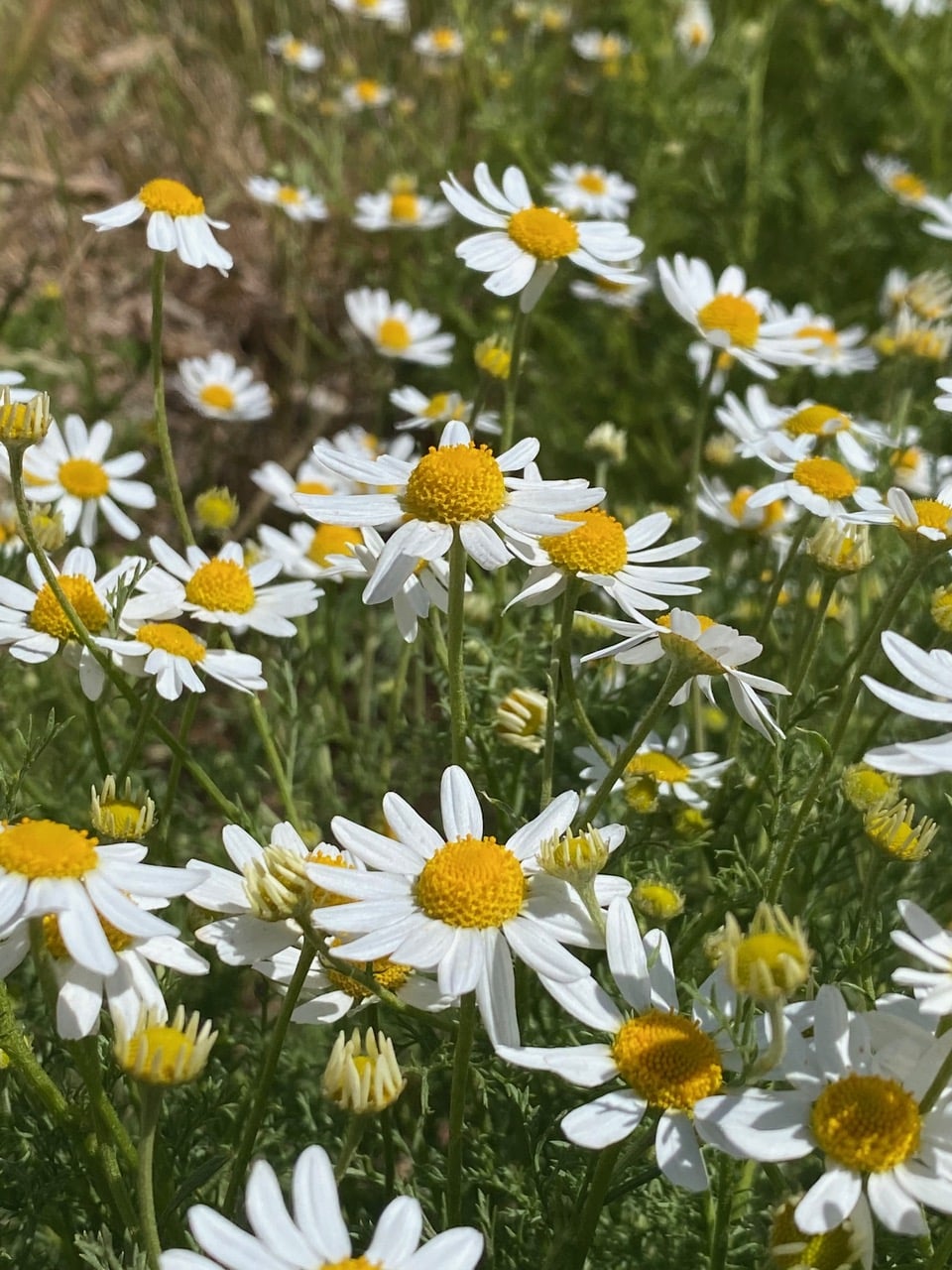
English Daisies are blooming profusely along certain sections of the trail. Were these intentionally seeded to control noxious weeds?
English Daisy, Bellis perennis is native to Europe, but has become widely naturalized in most temperate regions, including the Americas. The perennial herbaceous plant grows flat to the ground, and habitually colonizes lawns. It blooms from March to September, and exhibits the phenomenon of heliotropism, in which the flowerheads track the position of the sun in the sky. Though not native, the species is considered a valuable ground cover in certain garden settings, where low growth and some color is desired in parallel with minimal care and maintenance while helping to crowd out noxious weeds.
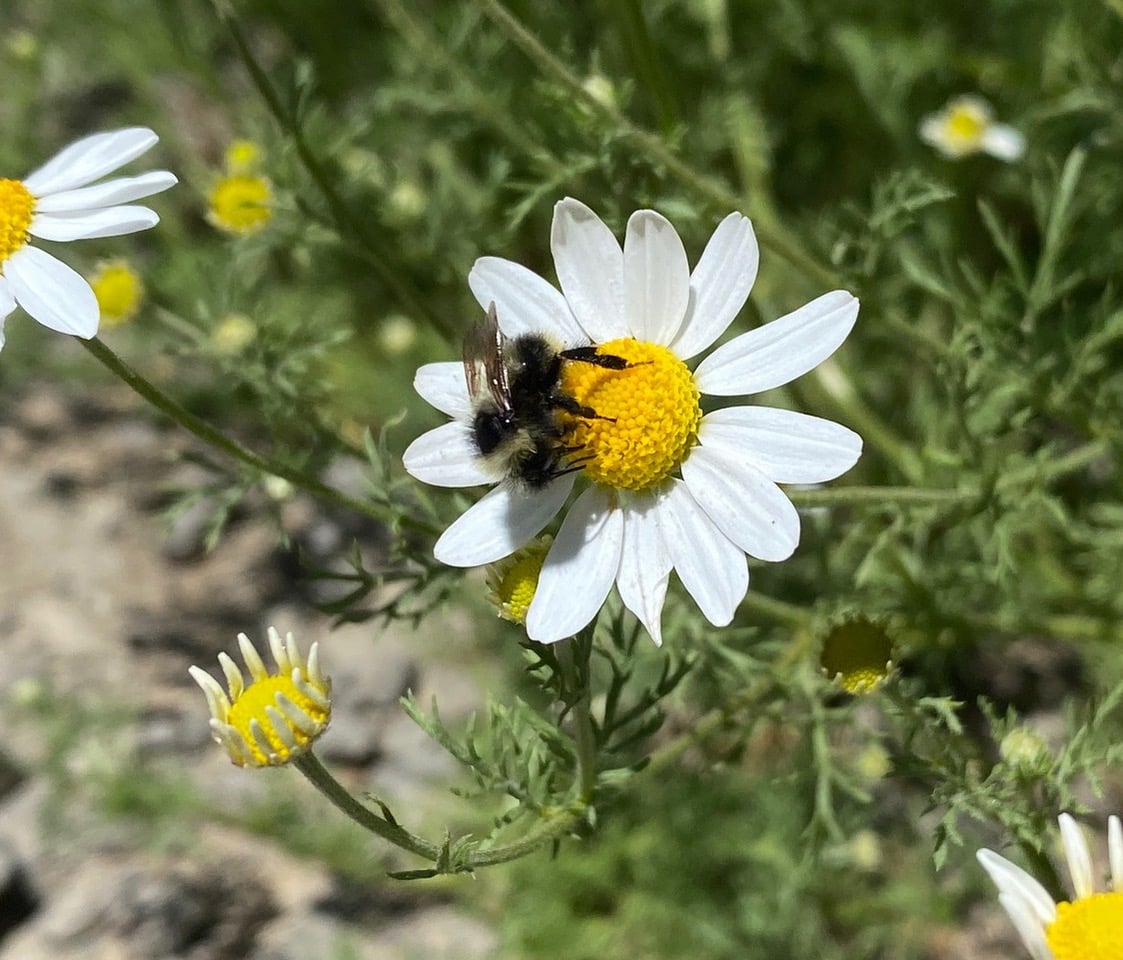
A Black-tailed Bumble Bee, Bombus melanopygus (family Apidae) is taking nectar from a flowerhead of English Daisy.
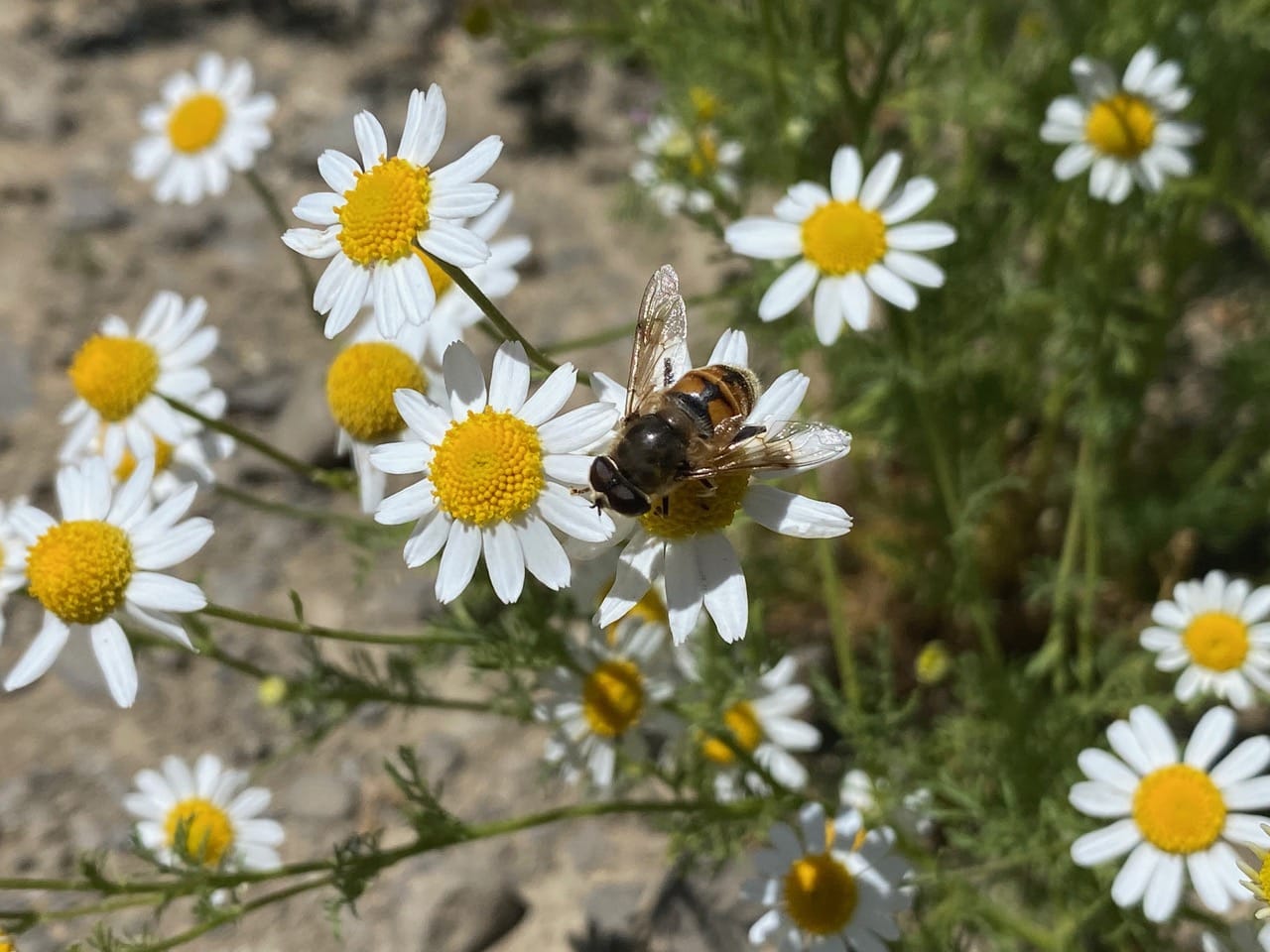
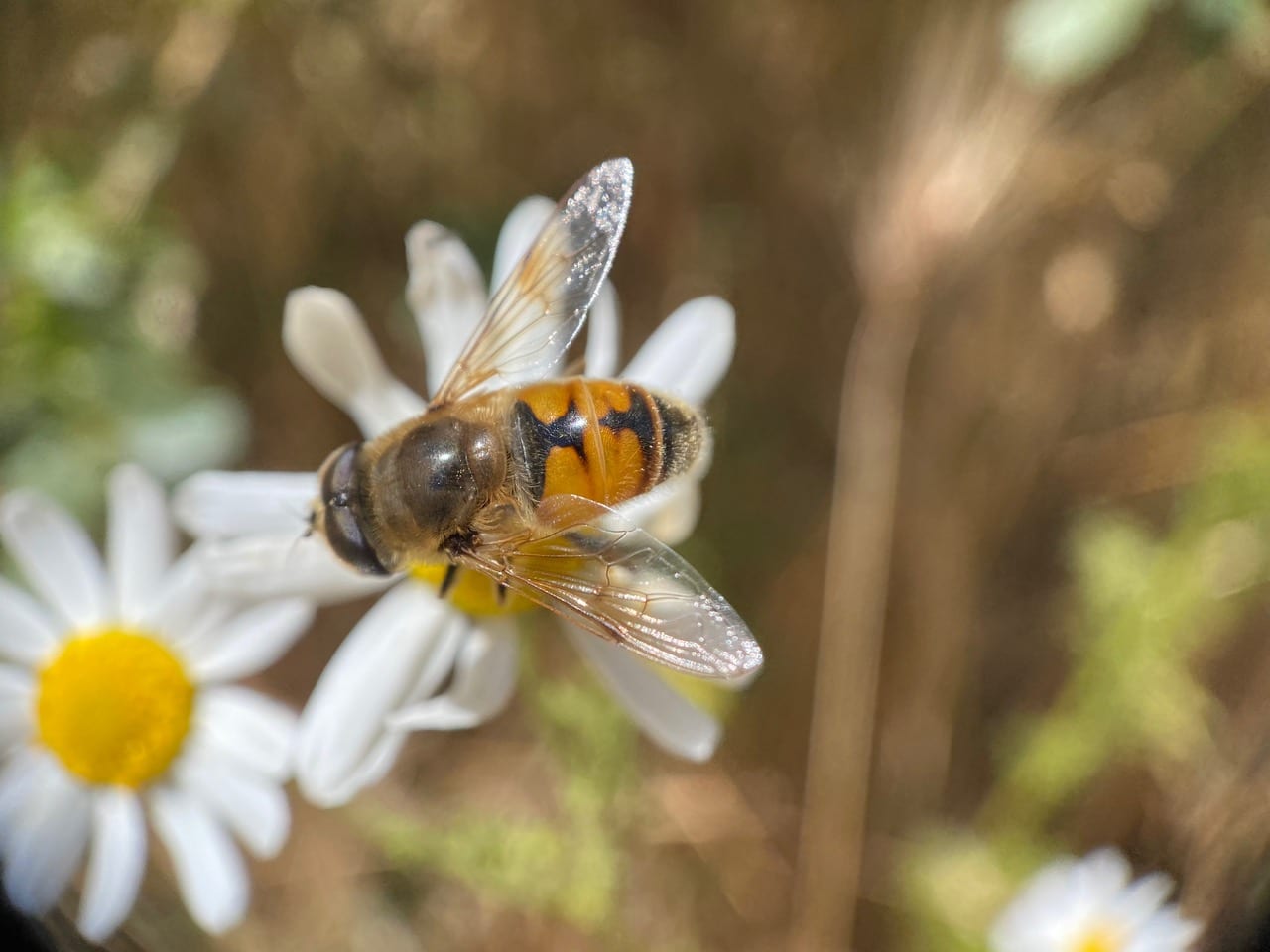
A Common Drone Fly, Eristalis tenax (family Syrphidae) is foraging on English Daisy flowers. This hover fly is commonly mistaken for a Honey Bee, Apis mellifera (family Apidae).
Why would a fly evolve to look like a bee? Any animal will think twice before attacking a bee because the bee can sting, and it can bring the wrath of the whole colony upon a predator. The fly is stingless and otherwise defenseless. This kind of mimicry is called Batesian Mimicry, after the English naturalist, Henry Walter Bates. Both the Honey Bee and the Drone Fly are originally from Europe. It makes sense that both insects evolved in the same place.
The Common Drone Fly, Eristalis tenax (family Syrphidae) is the most widely distributed Syrphid species in the world, occurring in all regions except the Antarctic. It was introduced into North America from Europe and is widely established. Adults visit flowers for nectar and pollen, and are significant pollinators. They are called drone flies because of their resemblance to a drone Honey Bee. The larva is aquatic. It has a siphon on its rear end that acts like a snorkel, helping it breathe under water. The siphon can be several times the length of the larva’s body, hence the common name, rat-tailed maggot. The larvae are saprophagous, feeding on bacteria in stagnant water rich in decomposing organic matter.
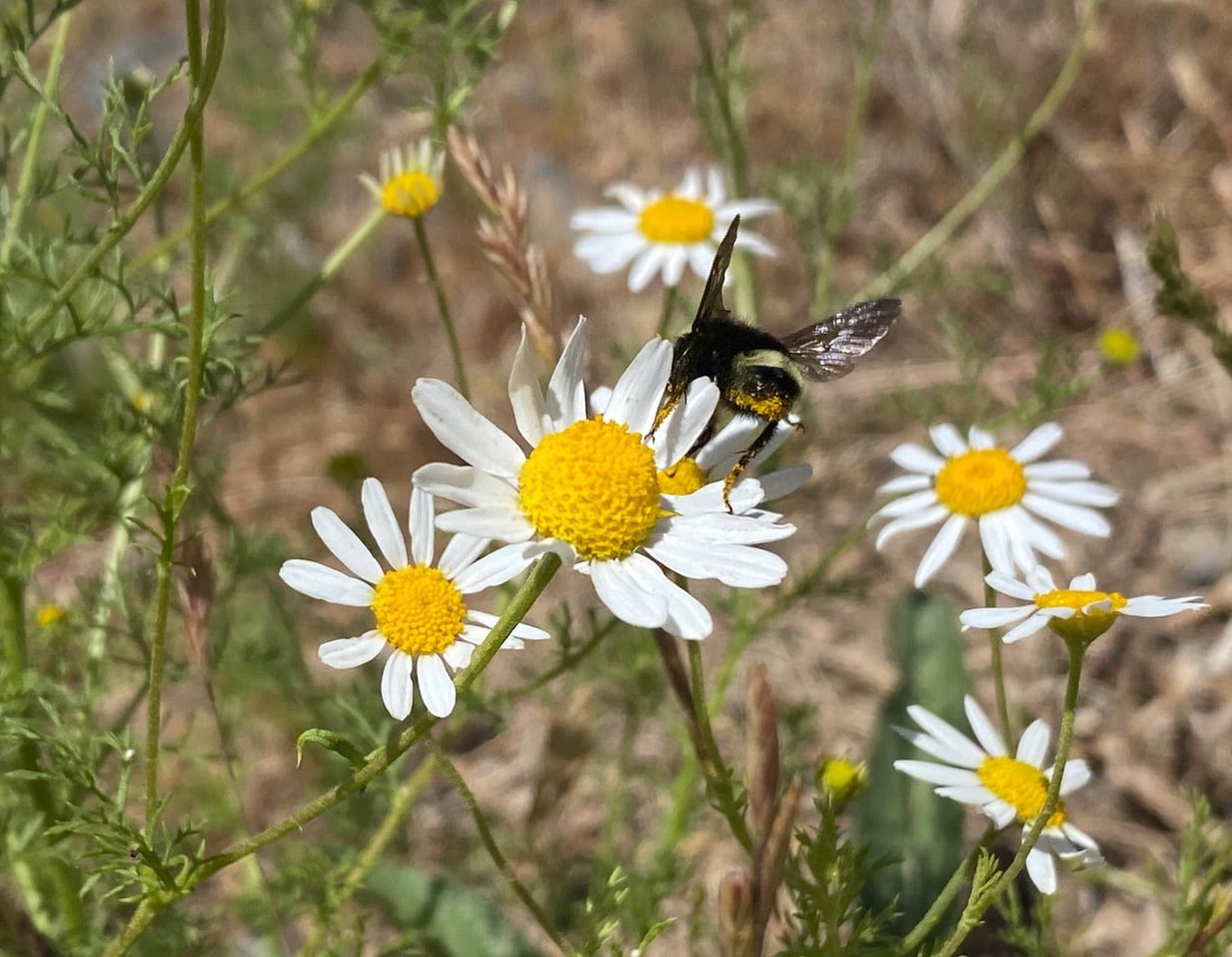
A Yellow-faced Bumble Bee buzzes through several English Daisy flowerheads, its legs and abdomen covered with the sticky pollen from the flowers.
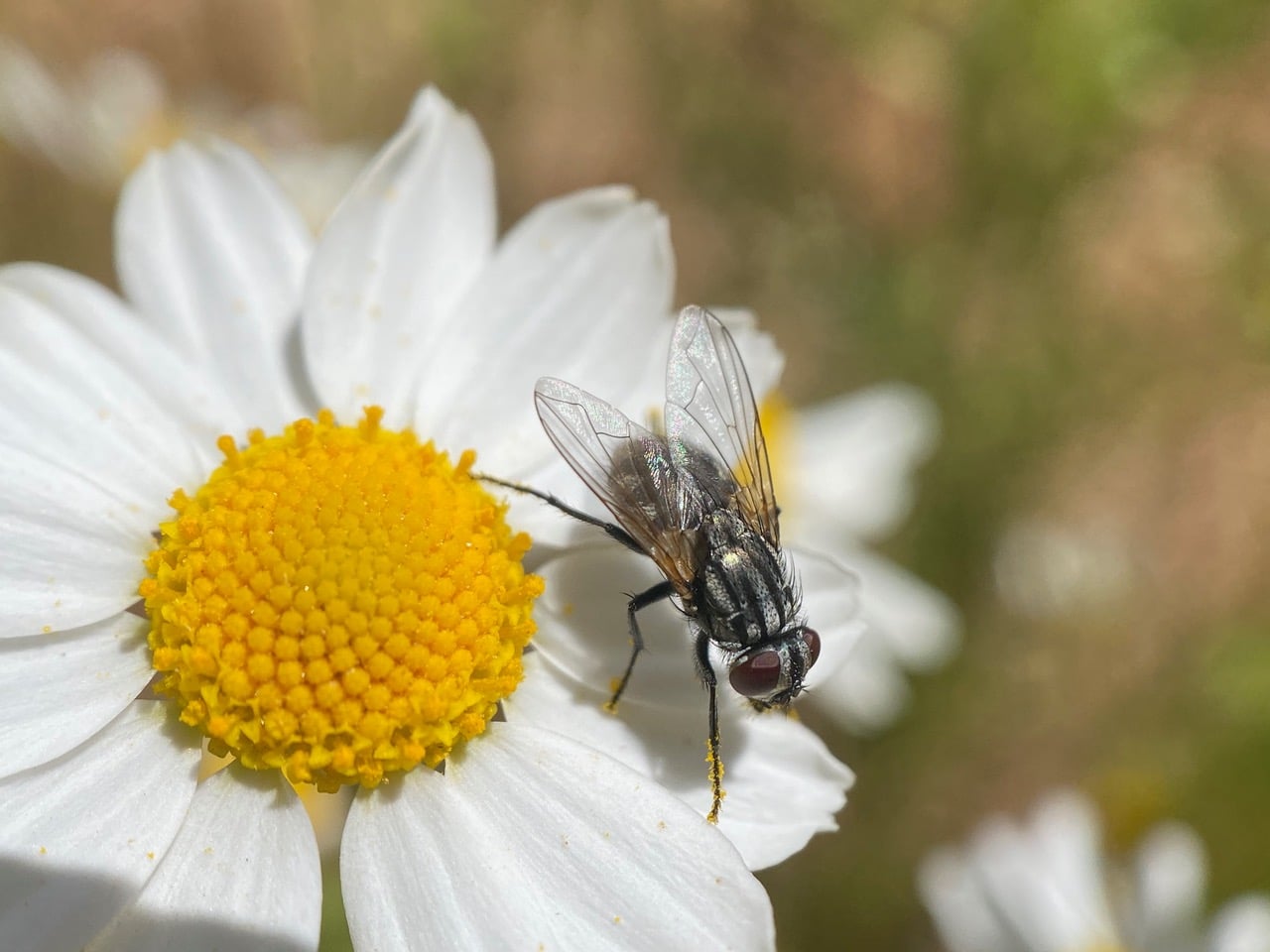
A Flesh Fly (family Sarcophagidae) leaves an English Daisy flowerhead after taking nectar from the flowers. Note the pollen on its legs.
Many Flesh Flies have black and gray longitudinal stripes on the thorax and checkering on the abdomen, red eyes, and a bristled abdomen sometimes with a red tip. They differ from most flies in that they are ovoviviparous, opportunistically depositing hatched or hatching maggots instead of eggs on carrion, dung, decaying material, open wounds of mammals, hence their common name. The adults mostly feed on fluids from animal bodies, nectar, sweet foods, fluids from animal waste and other organic substances. While we may find their habits revolting, Flesh Flies perform important roles in the ecosystem – the larvae as decomposers/recyclers, and the adults as pollinators.
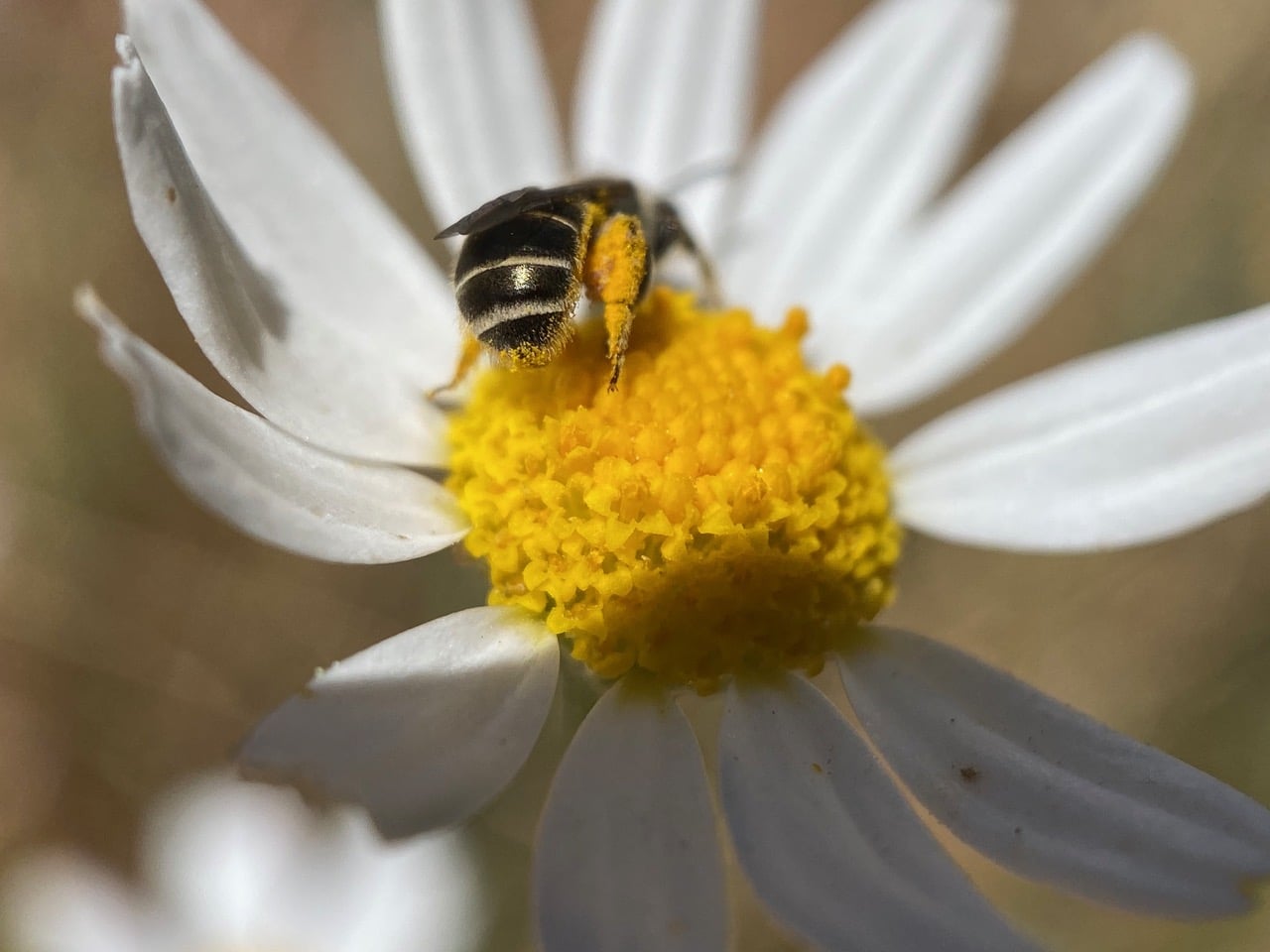
A Sweat Bee, Halictus sp. (family Halictidae) is actively collecting pollen from the English Daisy flowers. With fast footwork, the Sweat Bee is transferring pollen into the scopae on her hind legs and abdomen.
Note that the pollen is stowed on the scopa that occupies the full length of her hind leg, as well as on the underside of her abdomen. This mode of pollen collection is typical of the Sweat Bees (family Halictidae). There is also a hint of a furrow on the last abdominal segment, identifying her as a Furrow Bee, or Sweat Bee in the genus Halictus.
Halictus is found worldwide; they are most common in the Northern Hemisphere. All are generalists, foraging from a wide variety of flowering plants. Many species are social and produce several generations per year. This is not surprising as most blooming plants are season-specific; a bee that requires pollen and nectar across multiple seasons would not thrive as a specialist. All Halictus in North America nest in the ground, often in aggregations; and they may nest in the same area for decades.