

Pollinator Post 6/12/25 (2)
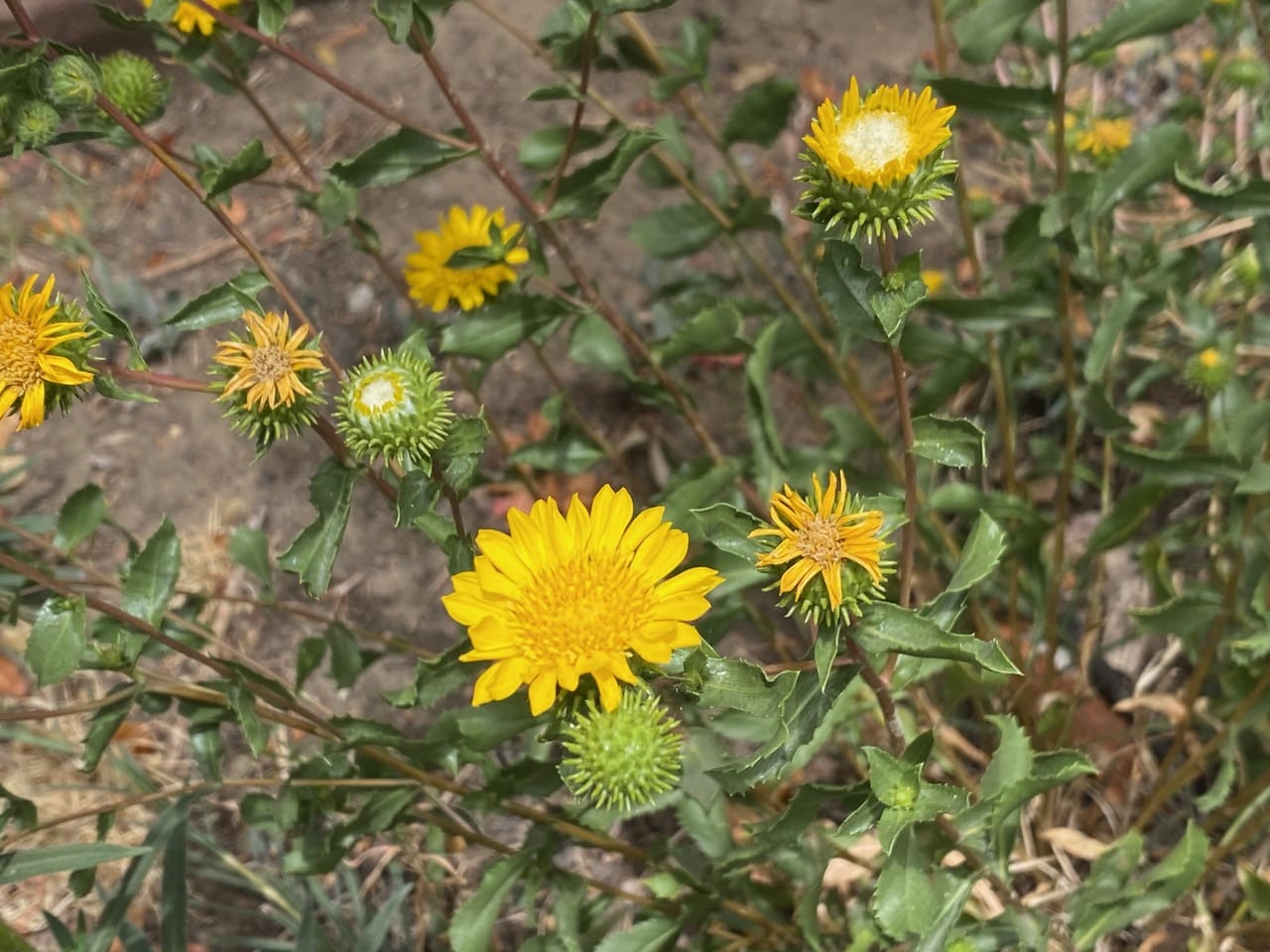
The Great Valley Gumweed, Grindelia camporum that Naomi has included in her native plantings at the sidewalk strip is in glorious bloom now.
A member of the sunflower family Asteraceae, Grindelia camporum is native to California and Baja California. The hardy perennial is found in a wide range of habitats including
chaparral, woodlands, disturbed areas such as ditches and roadsides. The flowerheads, up to 3 cm wide, consist of green clawlike phyllaries that bend downward. The center of the head
is filled with yellow disc florets and there are many yellow ray florets around the circumference. The flowerhead fills with a copious white exudate, especially during the early stages of blooming. The plant blooms in profusion in spring and fall, attracting many species of insects. Its seeds are a food source for many birds.
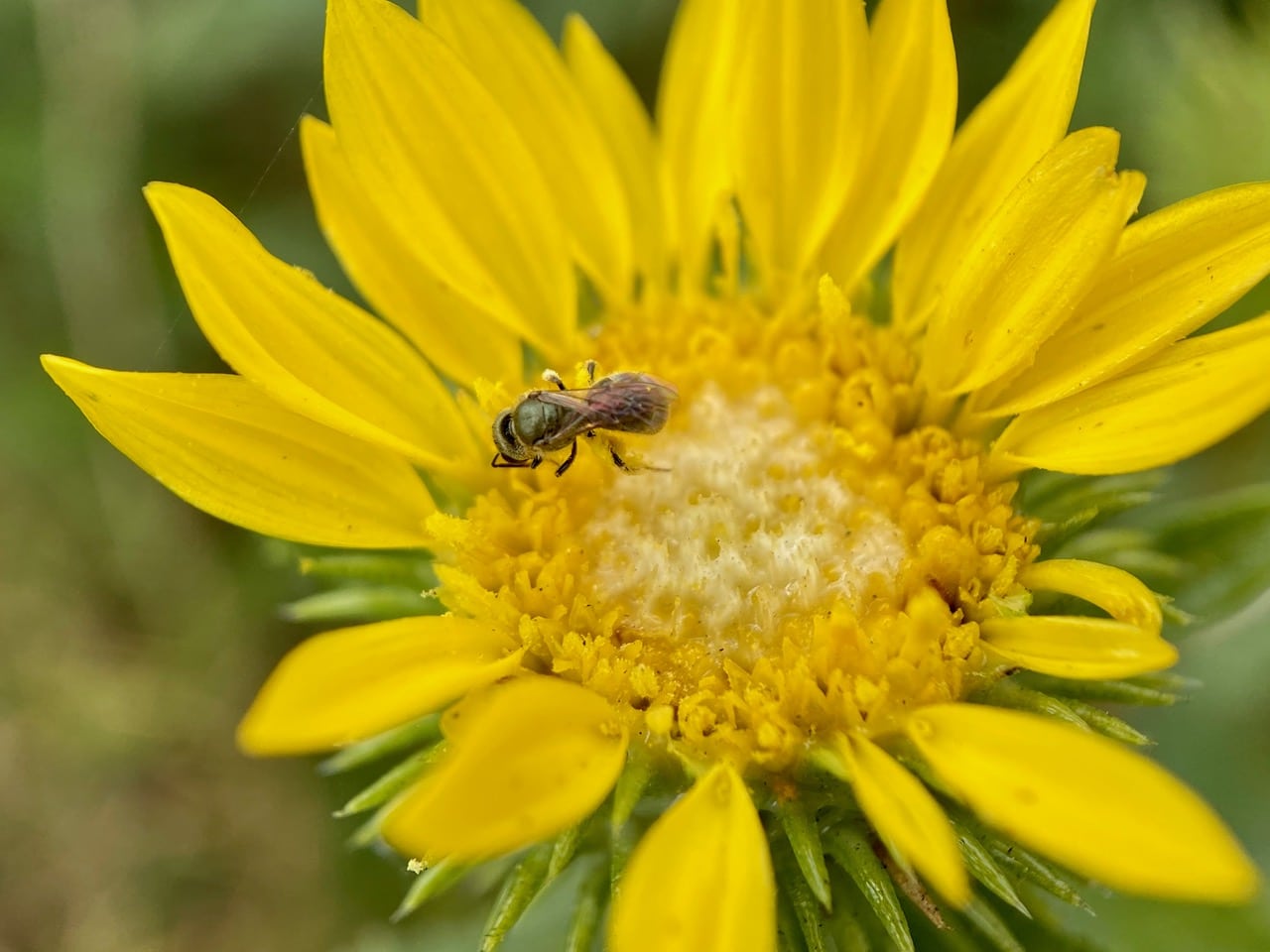


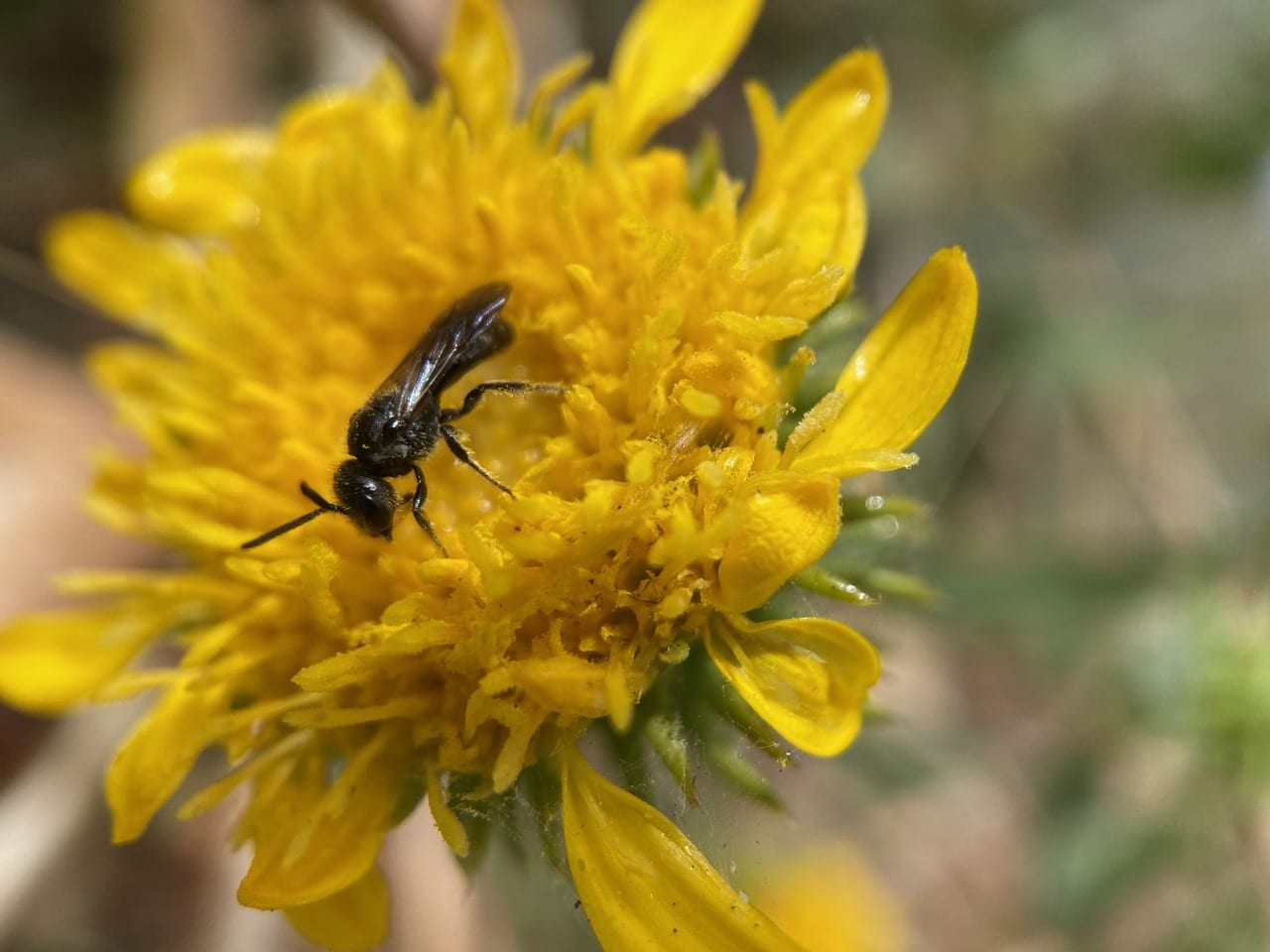
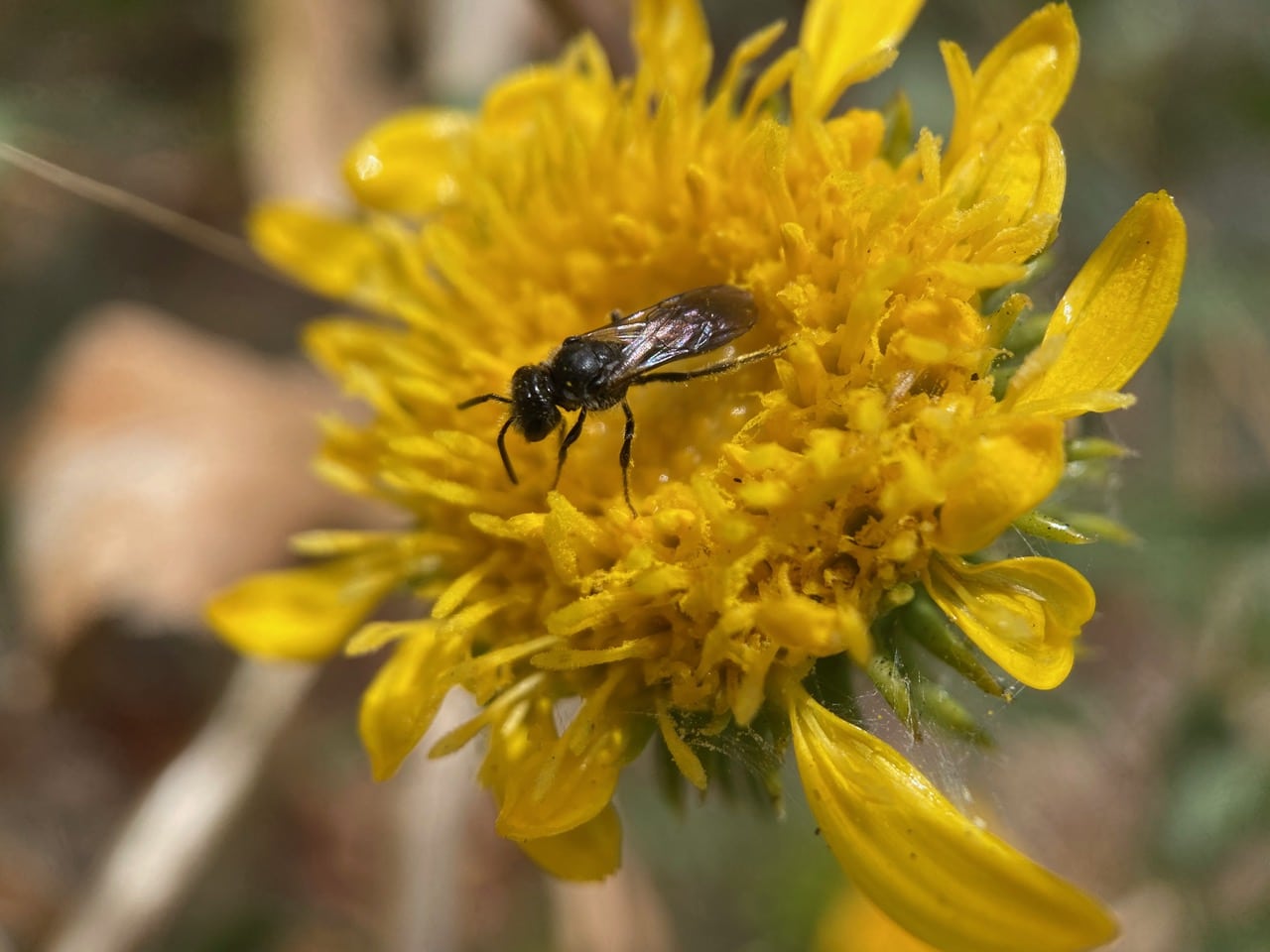
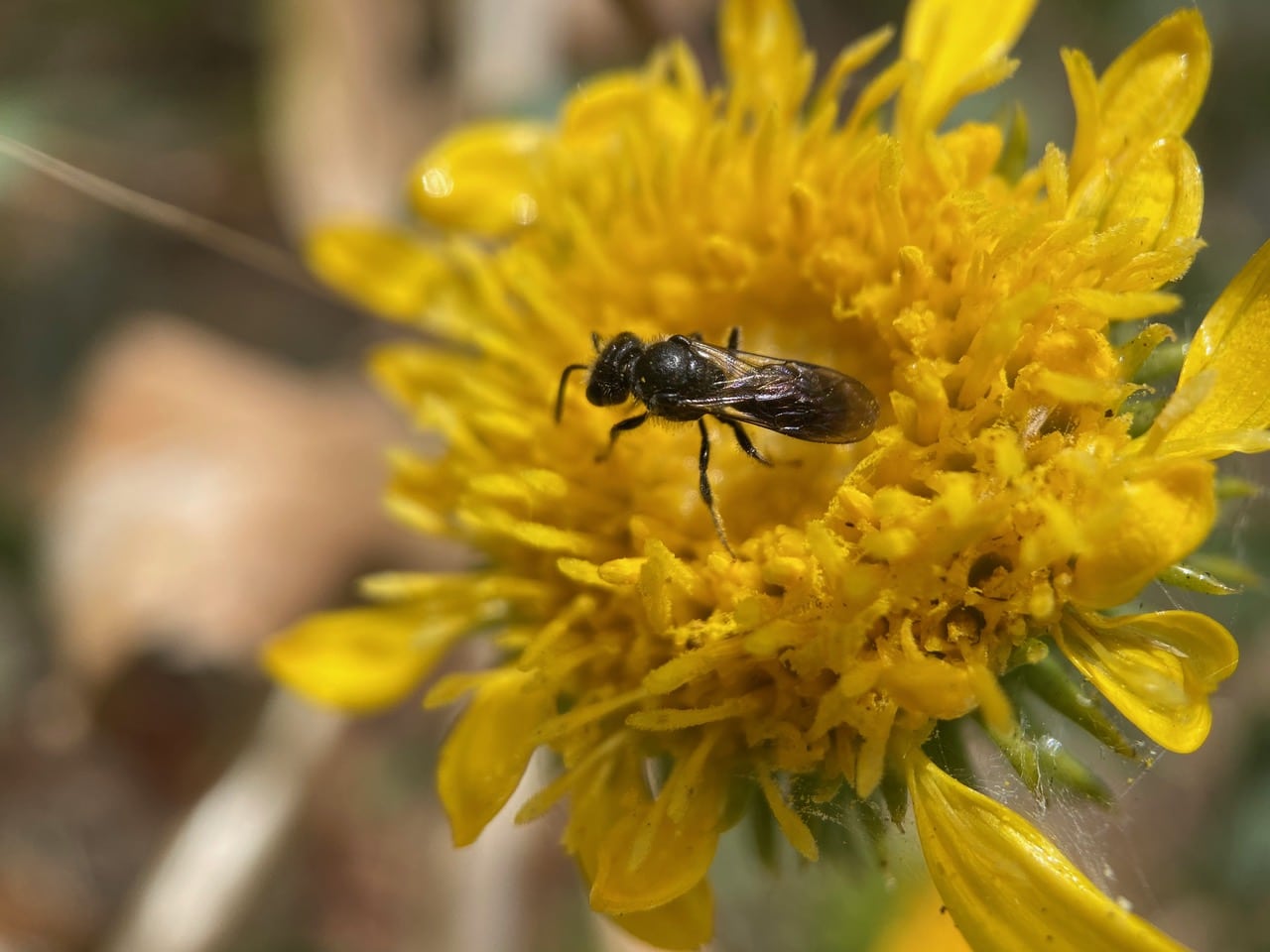
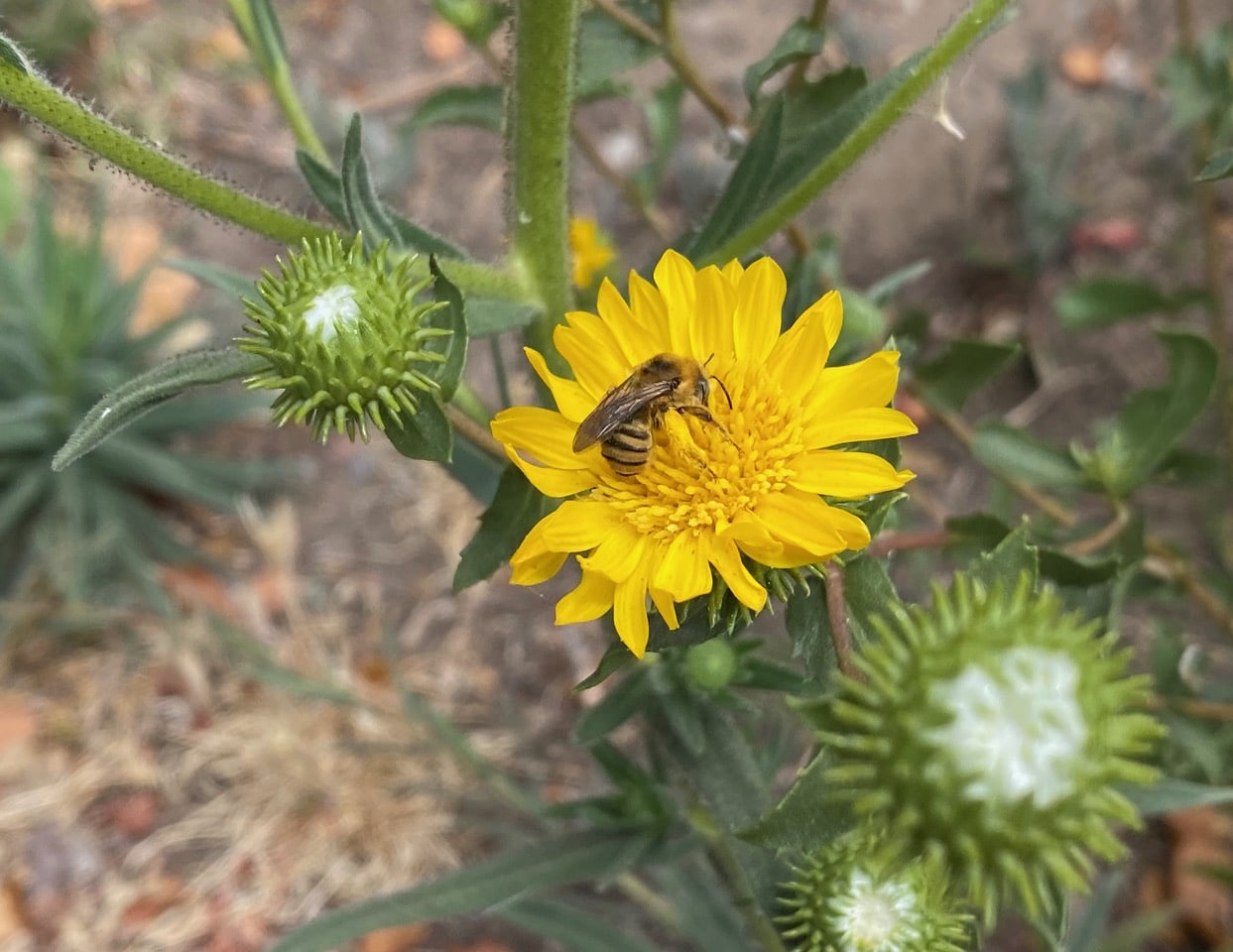
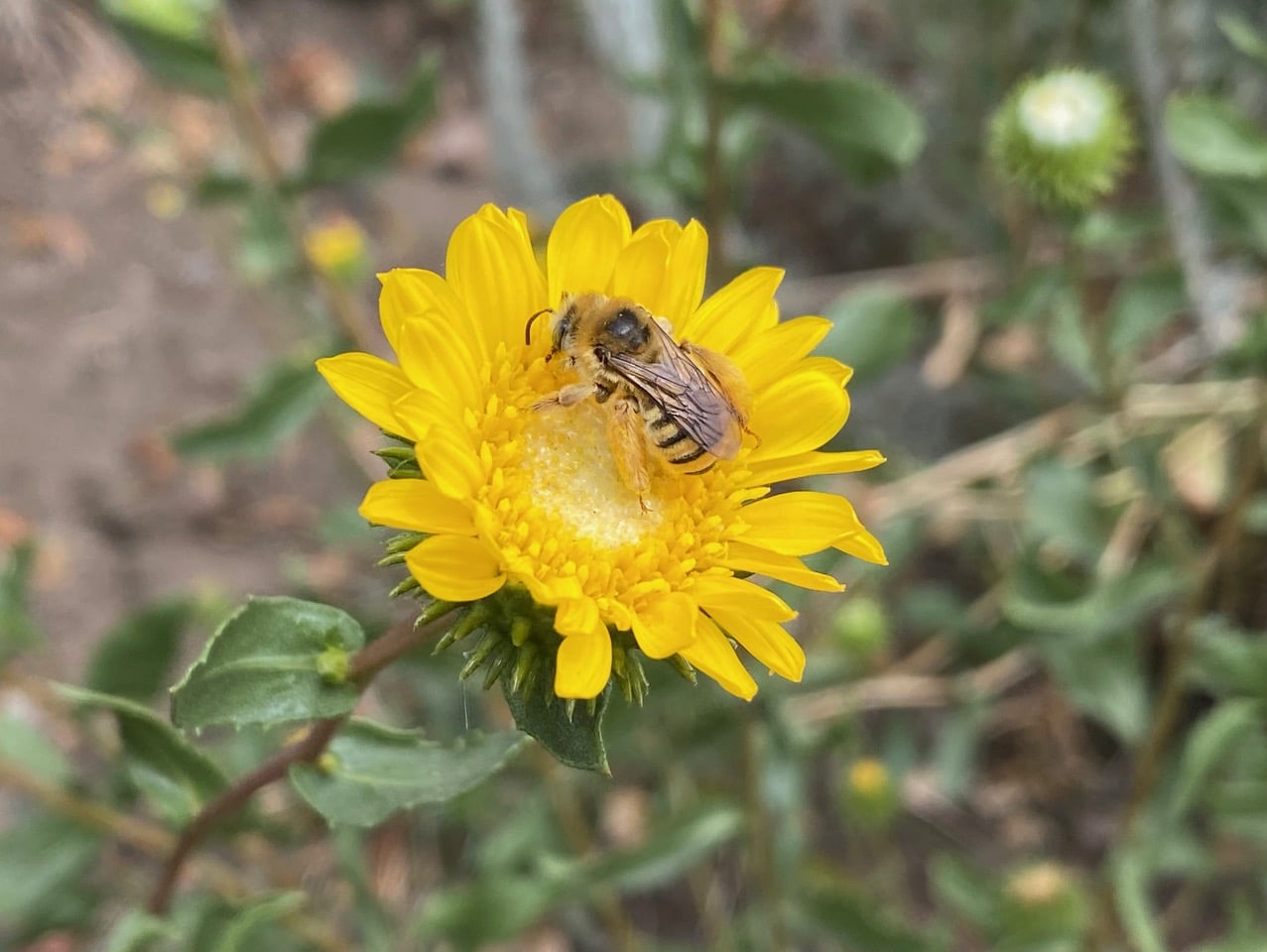
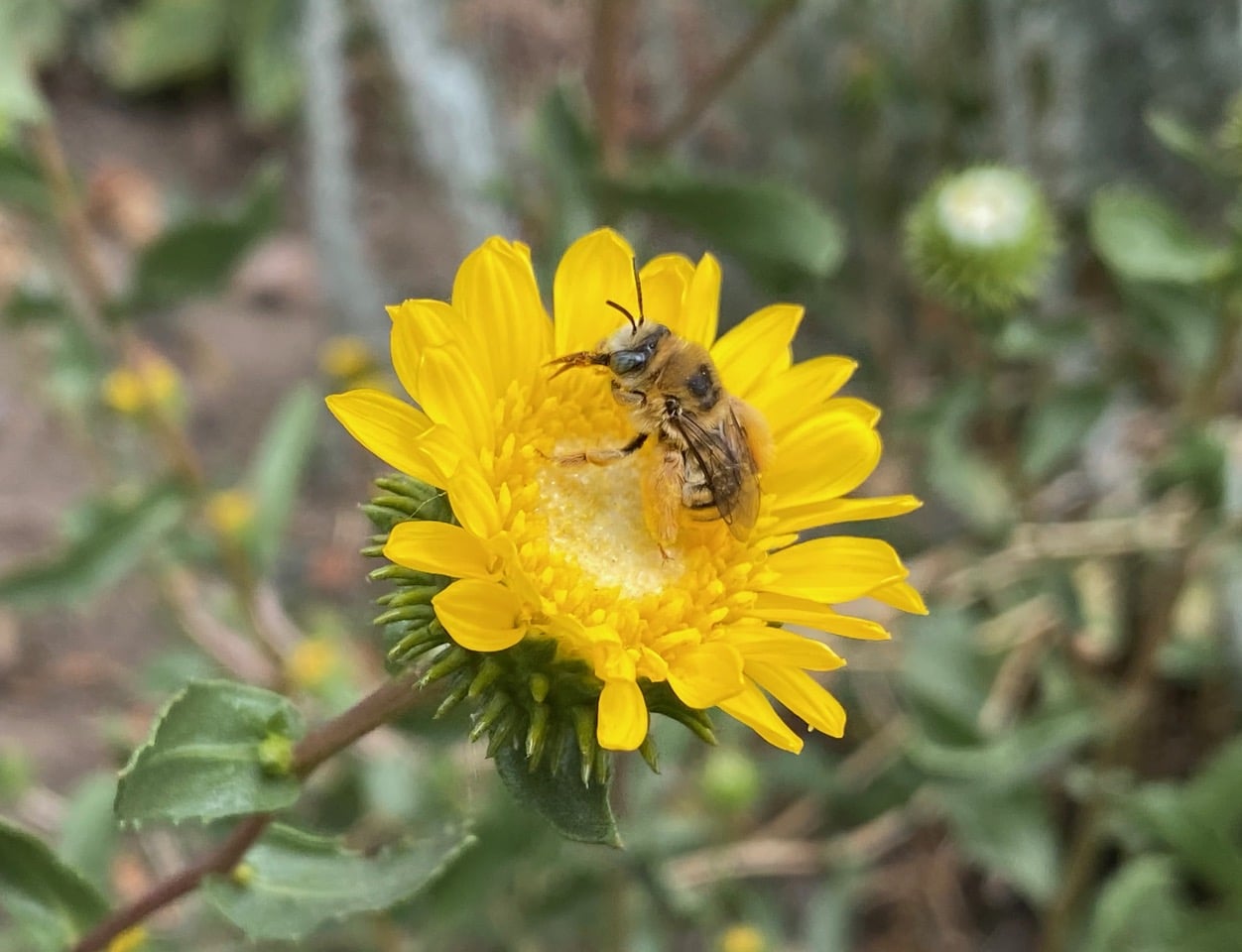

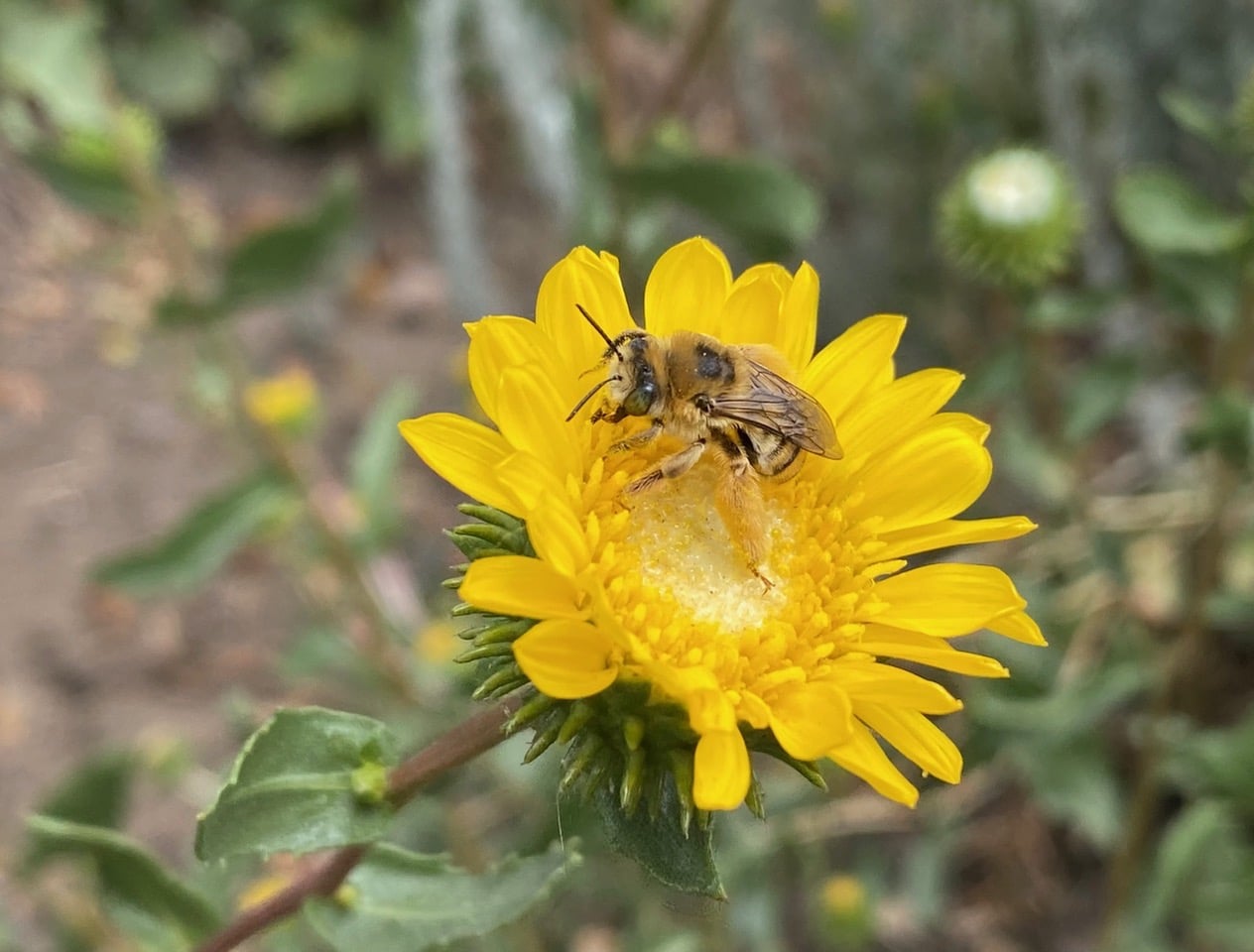


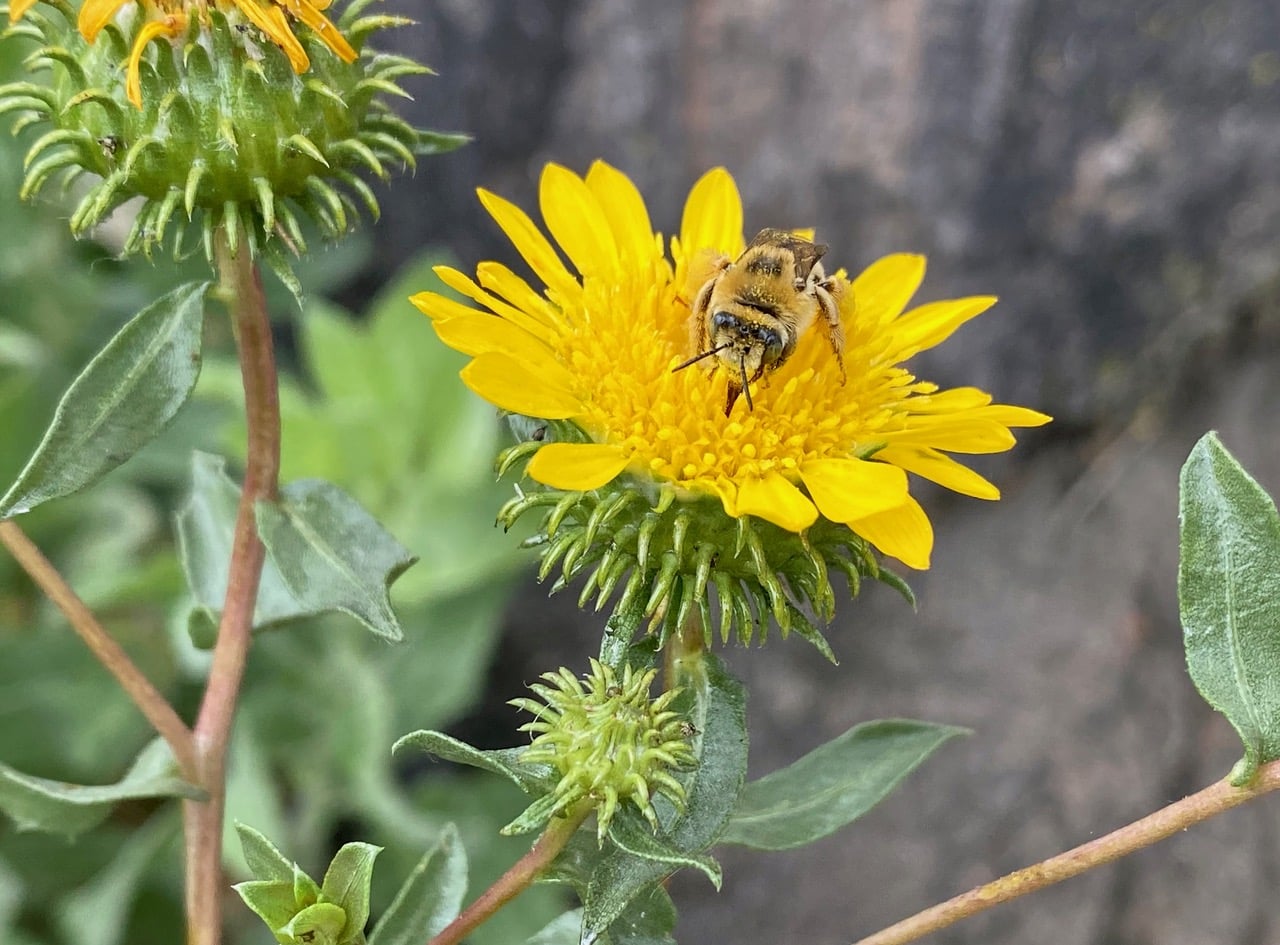


A Metallic Sweat Bee, Lasioglossum (Dialictus) sp. (family Halictidae) is foraging in a freshly opened Grindelia flowerhead.
Lasioglossum species are found worldwide, and they constitute the largest bee genus. The subgenus Dialictus are the most likely to be seen in the U.S., with over 300 species of these tiny metallic bees. The majority of Lasioglossum are generalists. Because they are so abundant throughout the flowering season, the bees are often important pollinators. Their sheer numbers are enough to achieve excellent pollination of many wild flowers, especially of plants in the Asteraceae, which have shallow floral tubes that are easily accessed by these minute bees.
Lasioglossum are closely related to the genera Halictus and Agapostemon. These genera are commonly called “sweat bees” because of their attraction to human sweat, which they drink for its salt content. Lasioglossum are dusky black to brown slender bees with bands of hair on their abdomen. Female Sweat Bees (family Halictidae) carry pollen in the scopae on their entire hind legs and underside of their abdomen.
Lasioglossum exhibit a range of social behaviors; the genus includes solitary, communal, semi social, primitively eusocial, and even parasitic species. Almost all Lasioglossum in the U.S. nest in the ground. Generally these nests are built in the spring by fertilized females (called foundresses) that spent the winter in hibernation. In social species, the foundresses behave much like the queen Bumble Bees – they lay the first batch of eggs that develop into the first generation of female workers. The nest grows with each additional generation of bees. Later broods may consist of both males and females. They mate, and at the end of the season the fertilized females hibernate til the following spring, repeating the life cycle of the colony.
Dialictus is a subgenus of sweat bees belonging to the genus Lasioglossum. Most of the members of this subgenus have a metallic appearance. They are commonly found in the Northern Hemisphere and are found in abundance in North America. Members of this subgenus also have very diverse forms of social structure making them model organisms for studying the social behavior of bees.
I close in on the diligent female as she gathers pollen from the opened florets around the rim of the flowerhead. How does the little bee avoid being trapped in the gooey exudate?
The white exudate we see in the middle of a Grindelia flowerhead is a sticky, white latex or resin. The gummy substance is a distinguishing feature of the Grindelia genus, giving the plants their common name “gumweed”. The resinous exudate is thought to protect the developing flowerheads from herbivores (including insects) and even providing protection from UV-B radiation.
The “gum” is not a true polysaccharide gum, but rather a complex resin primarily composed of diterpene acids, similar to those found in pine resin. This resin is produced in glands on the plant’s surface. The exudate is most copious when the flowerheads are immature or just beginning to bloom. Native Americans historically used this resin as an adhesive, and as a medicinal remedy for various skin and respiratory conditions.
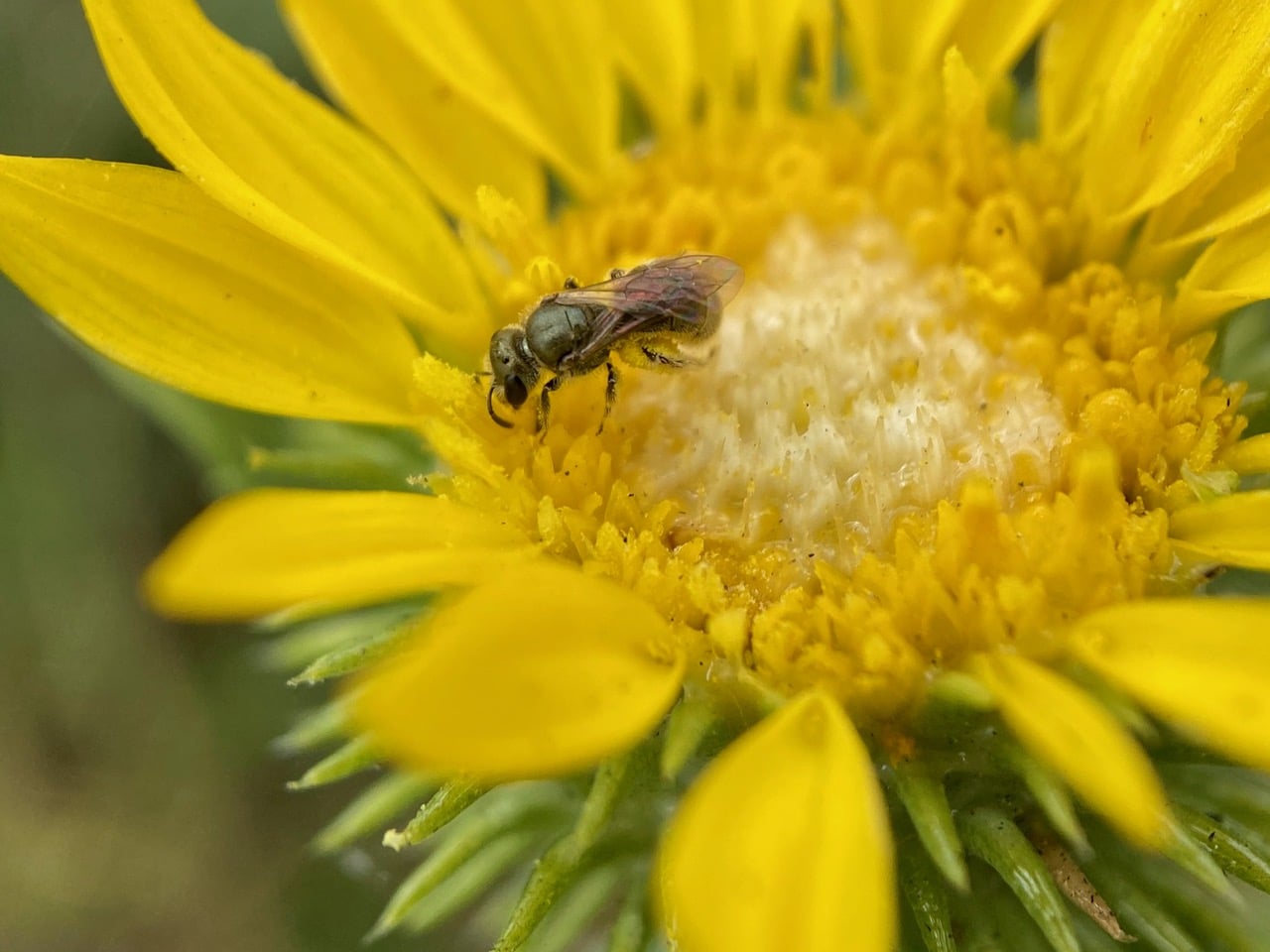
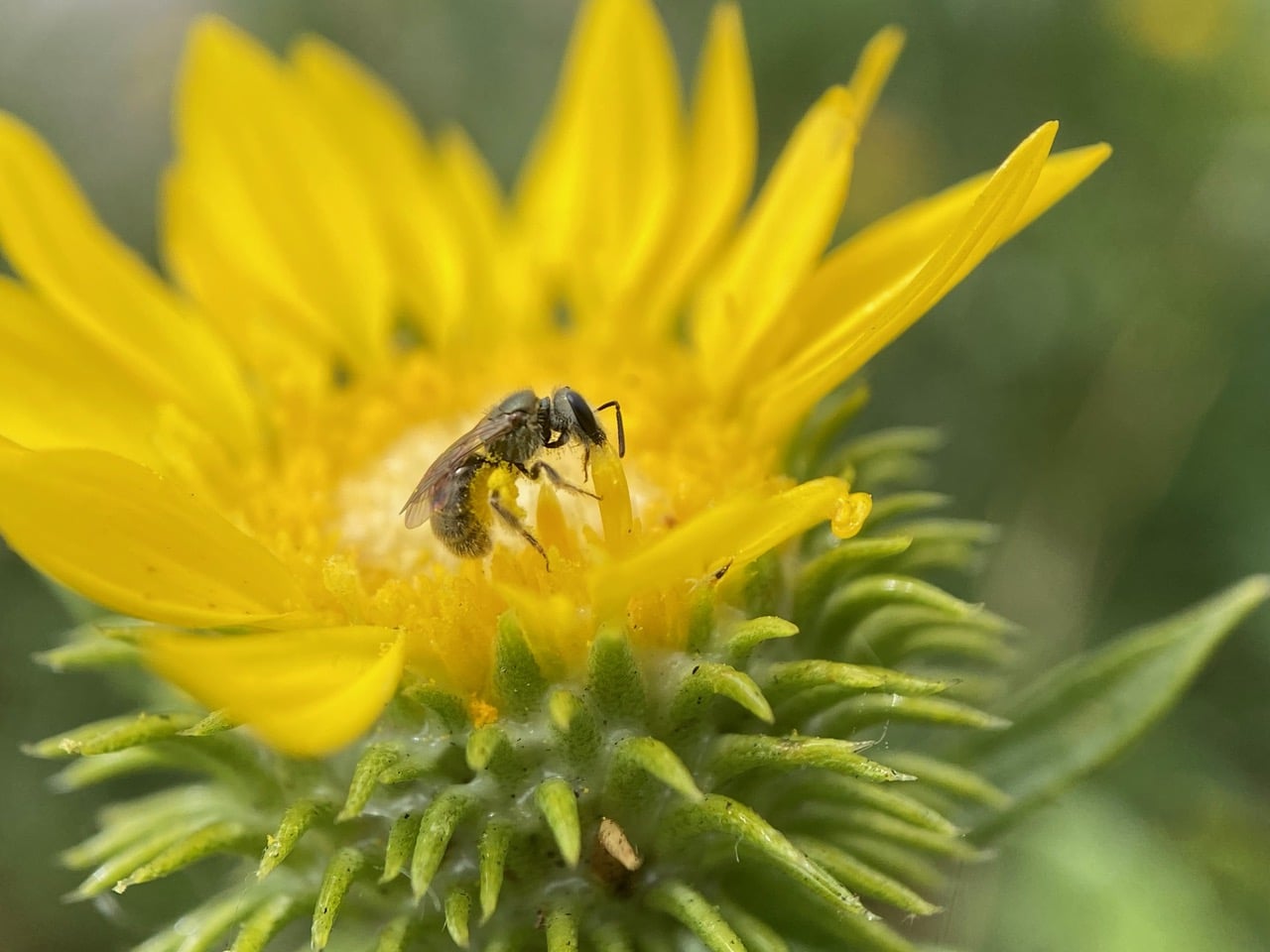
On another fresh Grindelia flowerhead, a foraging Metallic Sweat Bee, Lasioglossum (Dialictus) sp. (family Halictidae) is wisely staying away from the gummy materials in the center of the flowerhead. For now, only the florets around the rim are open, offering nectar and pollen. The florets of Asteraceae mature from the periphery toward the center of the flowerhead.
Holding a stamen tube with her legs, the female sweat bee is extracting pollen with her jaws.
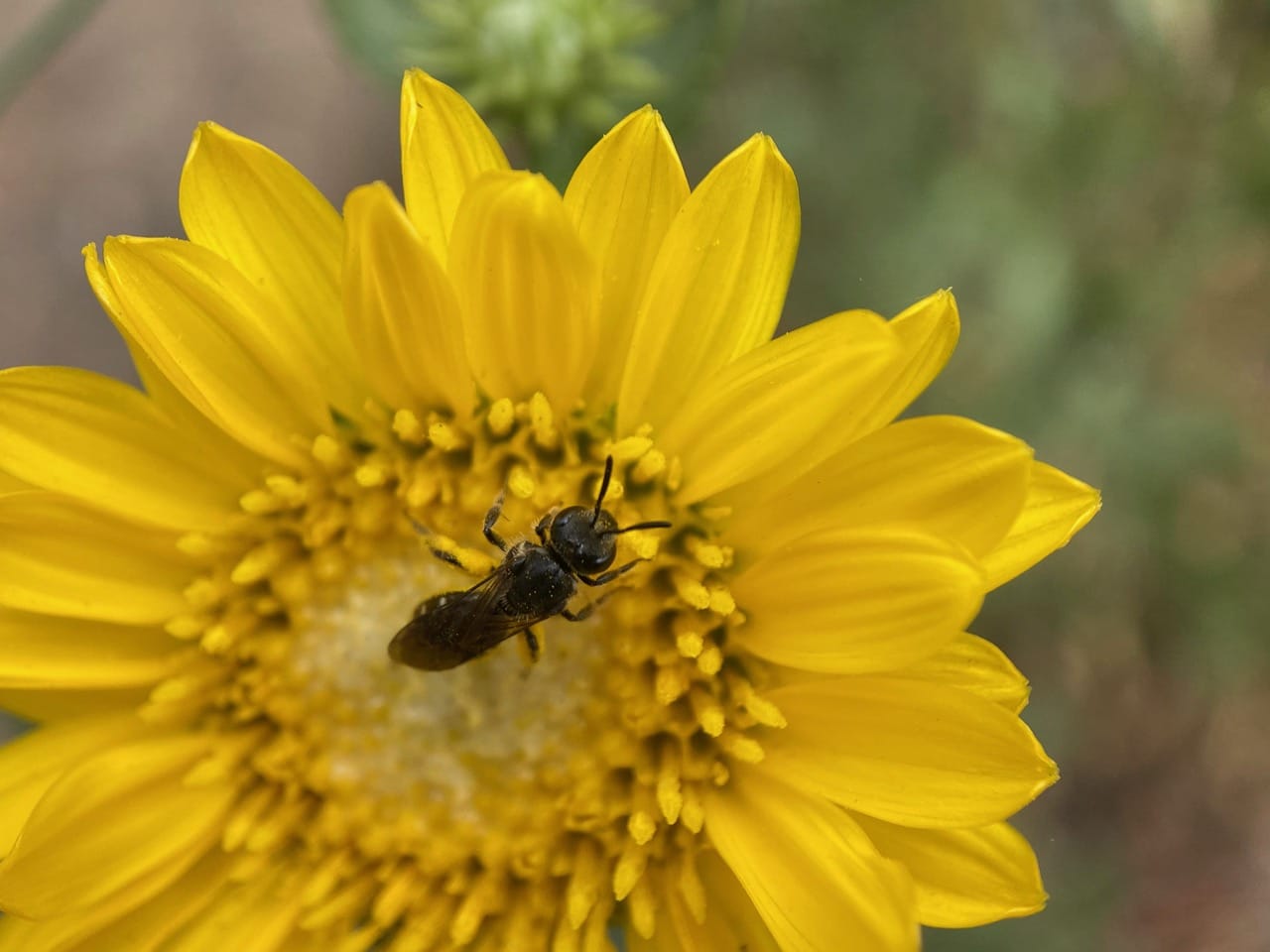
A Kincaid’s Sweat Bee, Lasioglossum kincaidii (family Halictidae) is playing it safe, foraging on a mature Grindelia flowerhead.
Kincaid’s Sweat Bees are jet black except for some faint white bands across its abdomen. They are distinguished from similar species by their large tegula and coarse mesothorax sculpturing. Tegula are scale-like structures located at the base of the forewings, involved in flight control. The species is quite common in Alameda.
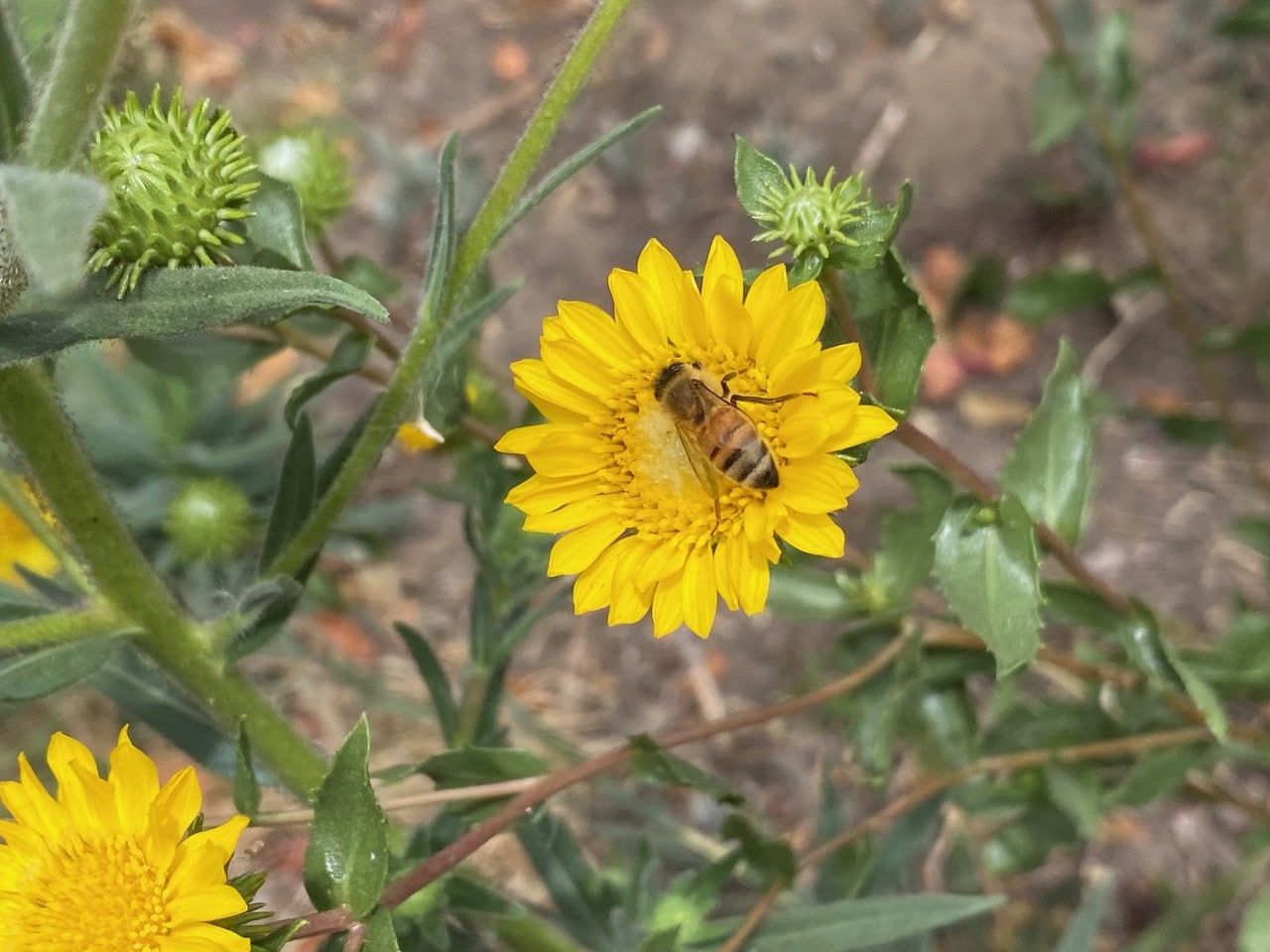
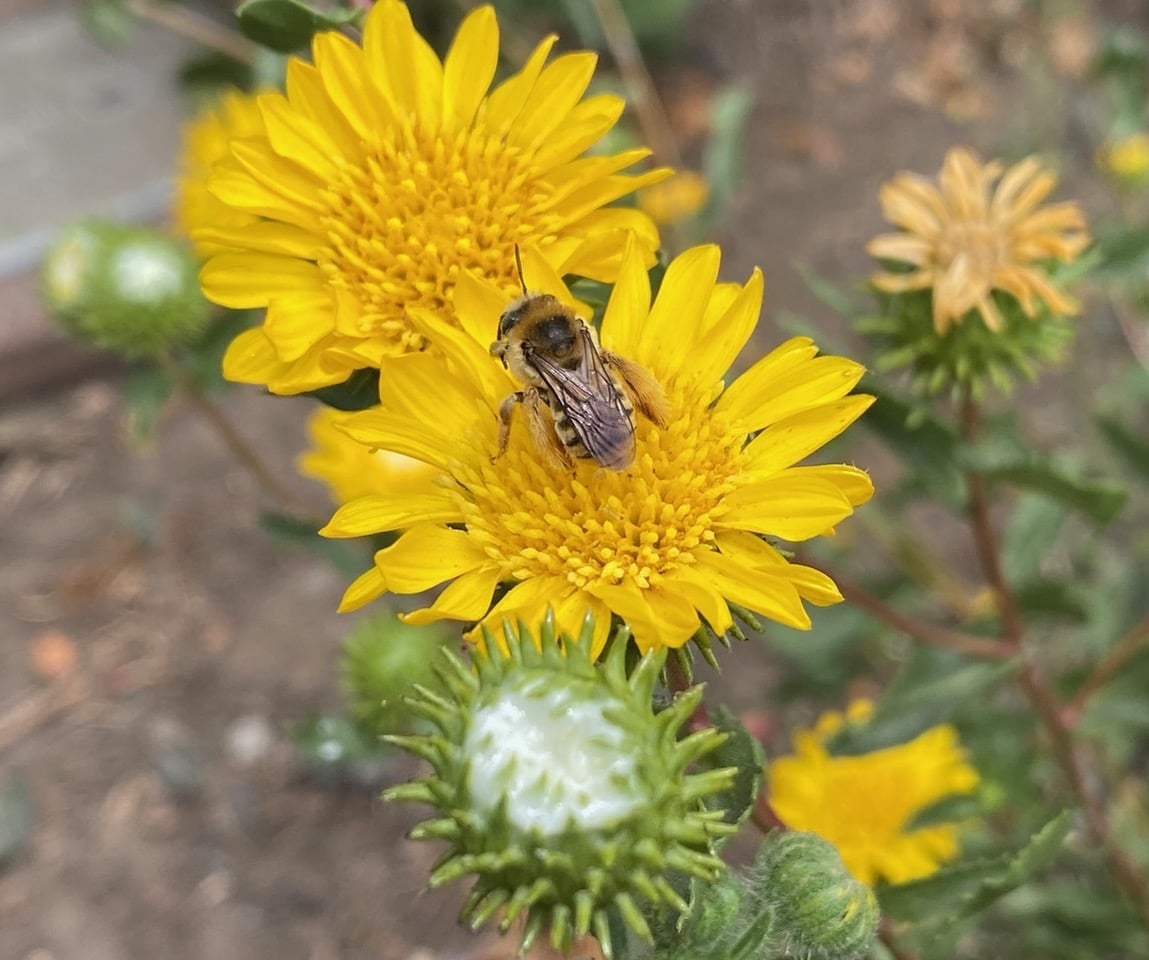
A Honey Bee, Apis mellifera (family Apidae) is enjoying the bounty of the Great Valley Gumweed, Grindelia camporum.
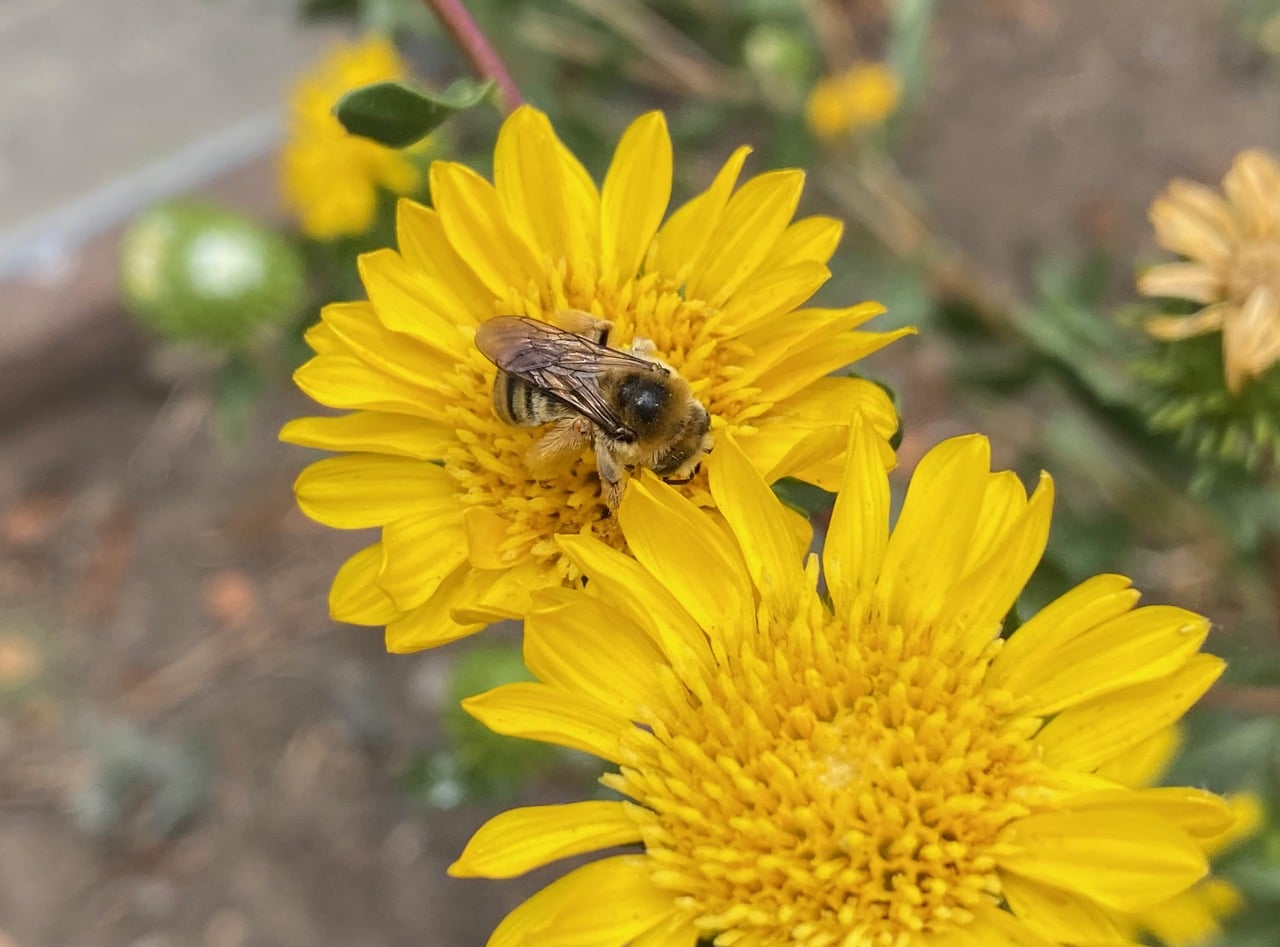
Hey, that’s a female Summer Longhorn Bee, Melissodes sp. (family Apidae) out foraging on the Grindelia!
The Summer Longhorn Bees, Melissodes sp. (family Apidae) are medium to large bees, stout-bodied, usually with gray hair on the thorax and pale hair bands on the abdomen. Males usually have yellow markings on their faces and have very long antennae from which their common name is derived. They are active May to September, with peak flight in late June to early August. The females prefer flat, bare ground for digging their solitary nests, though they sometimes nest in aggregations. Pollen is transported in scopae on the hind legs. Pollen loads are often copious and brightly colored and thus very distinguishable. Melissodes are specialists on Asteraceae – females gather pollen from flowers of Aster, Bidens, Coreopsis, Cosmos, Encelia, Gaillardia, Helianthus, and Rudbeckia ssp.
This Melissodes female hasn’t been collecting pollen. Her scopae (pollen-collecting hairs) are essentially empty. Note the long shaggy hairs on her hind legs that make up her scopae. The Grindelia flowerhead is very fresh, still with gummy buds in the center. The bee is taking nectar from the open florets around the rim, while stepping on the white exudate.
The bees extends her tongue to clean it.
She then proceeds to clean her head and antennae.
Is the agitated bee bothered by the gummy exudate?
This female Summer Longhorn Bee, Melissodes sp. (family Apidae) is foraging on a fully mature Grindelia flowerhead. She can safely step into the center of the flowerhead without getting mired with the gummy exudate, and all the florets are open and accessible at this stage.
The bee does not seem to be collecting pollen – her scopae are essentially empty. You can see the long shaggy hairs on her hind legs. Grabbing her left antenna, the bee is cleaning it by pulling it through the antenna cleaner on her left front leg.
All bees have an antenna cleaner on each of their two forelegs. The antenna cleaners consists of two parts: a notch in the basitarsus, which is fitted with stiff hairs, and a corresponding spur on the tibia. To clean its antenna, the bee raises its foreleg over its antenna and then flexes it tarsus. The action allows the spur to close the notch, forming a ring around the antenna. The bee pulls each antenna through the bristles to clean it of debris such as pollen or dust which might interfere with the many sensory organs within the antenna. A bee’s antennae serve numerous functions: smell, taste, perceive humidity and temperature, feel, monitor gravity and flight speed and even detect sound waves to help guide the bee in its daily activities.
All the Longhorn Bees look pristine, probably newly emerged from their nests in the ground where they grew up. I marvel every year that the bees’ emergence is perfectly timed to the blooming of their favorite flowers – the Tarweeds and the Gumweeds.
Hey, the male Longhorns are visiting the Grindelia flowerheads too! Although the male is not intentionally collecting pollen to provision the nest, and lacks the scopae, his legs are covered with the sticky pollen as he probes the florets for nectar. Males can be good pollinators too.
I am rather surprised to see this Kincaid’s Sweat Bee, Lasioglossum kincaidii (family Halictidae) foraging on a very young Grindelia flowerhead, stepping on the gummy exudate in the center. How does she deal with the sticky goo?
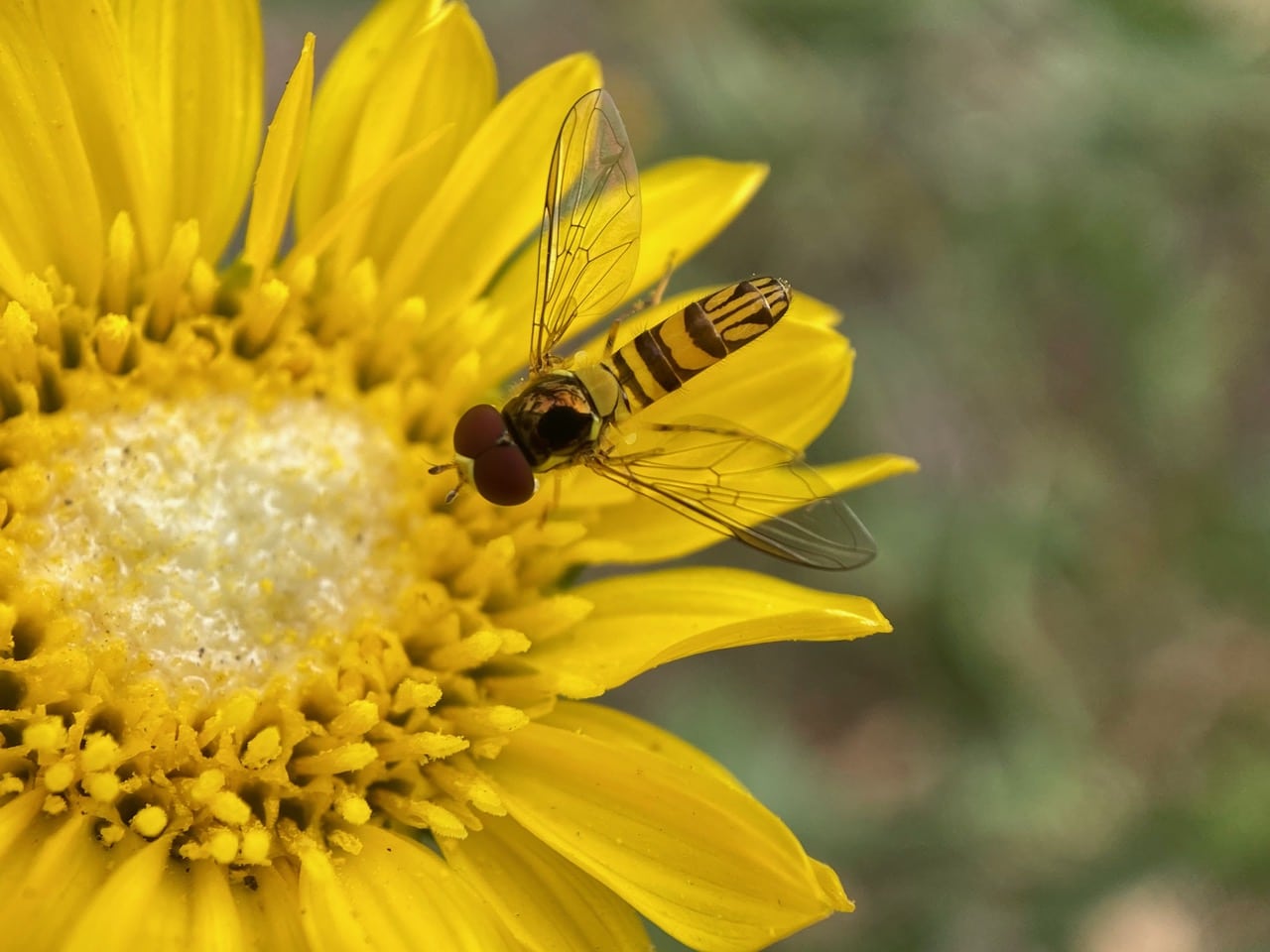
A male Oblique Streaktail, Allograpta obliqua (family Syrphidae) has landed on the rim of a Grindelia flowerhead.
Although small in size (6-7 mm long), the Oblique Streaktail is easily recognizable for the unique pattern on its black-and-yellow abdomen. It is a common North American species of hover fly. Adults visit flowers for nectar and pollen, and are pollinators. Females lay eggs on plant surfaces near aphids. Larvae feed on the aphids.
For the Melissodes bees which are Asteraceae specialists, the Grindelia is a much loved floral resource, rich in both nectar and pollen. Nectar provides the bess with the energy they need to fuel their activities, while the protein-rich pollen is mostly used to feed the young.
Specialist bees, also known as oligolectic bees, are characterized by their specialization on a narrow range of pollen sources. This means that their diet is restricted to pollen from a limited number of plant families or even genera. This specialized foraging behavior allows them to secure larval provisions with optional protein quality for growth. Pollen selectivity is important for specialist bees for a couple of reasons:
– Nutritional needs: Pollen is a crucial source of protein, lipids, vitamins, and minerals for bees, particularly for larval development. Different pollen sources have varying nutritional content, and specializing on specific plants ensures a consistent and high-quality diet for their offspring.
– Efficiency: Limiting foraging to a smaller number of plant species allows bees to become more efficient at collecting and handling the specific pollen from those plants. This can include behavioral specializations like daily timing for floral visits, methods for extracting and packing pollen, and even morphological adaptations like specialized hair for pollen collection.
This pollen specialization, however, can make these oligolectic bees especially vulnerable to habitat changes or a decline in their preferred host plants.
Although this Grindelia flowerhead is small and lacking ray flowers, it is fully mature and free of the gummy exudate. A female Melissodes is actively foraging on the flowerhead.
The female is doing double duty, taking nectar while simultaneously collecting pollen. Here she can be seen kicking up pollen with her middle leg and securing it onto the already bulging scopa on the hind leg.
Ah, that is one impressive pollen load! Note that the scopa appears fluffy – the pollen is not moistened and compacted as in the pollen baskets of Honey Bees and Bumble Bees. The pollen in the scopa is loosely held by electro-static attraction, and comes off readiy, making these bees superior pollinators as they go from flower to flower.
This picture is taken at 12:07 pm just before I leave the sidewalk strip. The Elegant Tarweed, Madia elegans flowerheads are already starting to close, with the ray petals curling inward. The Longhorn Bees seem to be familiar with the routine, and continue to forage on the closing flowerheads, albeit at the more frenzied pace.
Unusual among plants, Madia starts to close its flowerheads at mid-morning when the day heats up. The flowerheads open up again in the cool of the evening through the next morning. Why does Madia do this?
The Madia flowerhead closes on hot days because it lacks a way to prevent moisture loss. While the closing seems to happen by the clock, it’s really because the drought stress is worse at about the same time each day. The leaves and stems have a very efficient way to avoid wilting – they contain a mucilage (gel-like substance) that holds water tightly. But this material is lacking in the flowers. Closing the flowerheads reduces the surface from which water can evaporate, preventing desiccation. From my own observation, each Madia flowerhead can go through the opening/closing cycles for about 5 days before senescing.