

Pollinator Post 6/12/25 (1)

It’s a cool, cloudy morning – perfect time to see male bees that might still be sleeping on flowers! I head for the small sidewalk strip in front of Naomi’s house in Alameda. The narrow strip only spans the length of four parked cars, and contains two street trees. It is not a particularly green neighborhood, and there is constant traffic on the busy street.
Naomi has planted this strip with many late-blooming natives. The Elegant Tarweed, Madia elegans and the Great Valley Gumweed, Grindelia camporum have brightened up the spot with their cheery yellow blooms, while another Asteraceae species, the Telegraphweed is still waiting in the wings.

My footfall flushes up a small brown moth. It finally lands on a Silverleaf Lupine, Lupinus albifrons. I recognize it from the distinctive markings on the hind wings. It is a Crambid Snout Moth, Dicymolomia metalliferalis (family Crambidae). The moth is found in western North America. Wingspan is about 16 mm. The larvae feed on decaying Lupine seed pods.

Naomi has apparently added a new feature to her sidewalk garden – labels fashioned from ice cream stick and old clothes pin. Nice touch educating the public, Naomi!
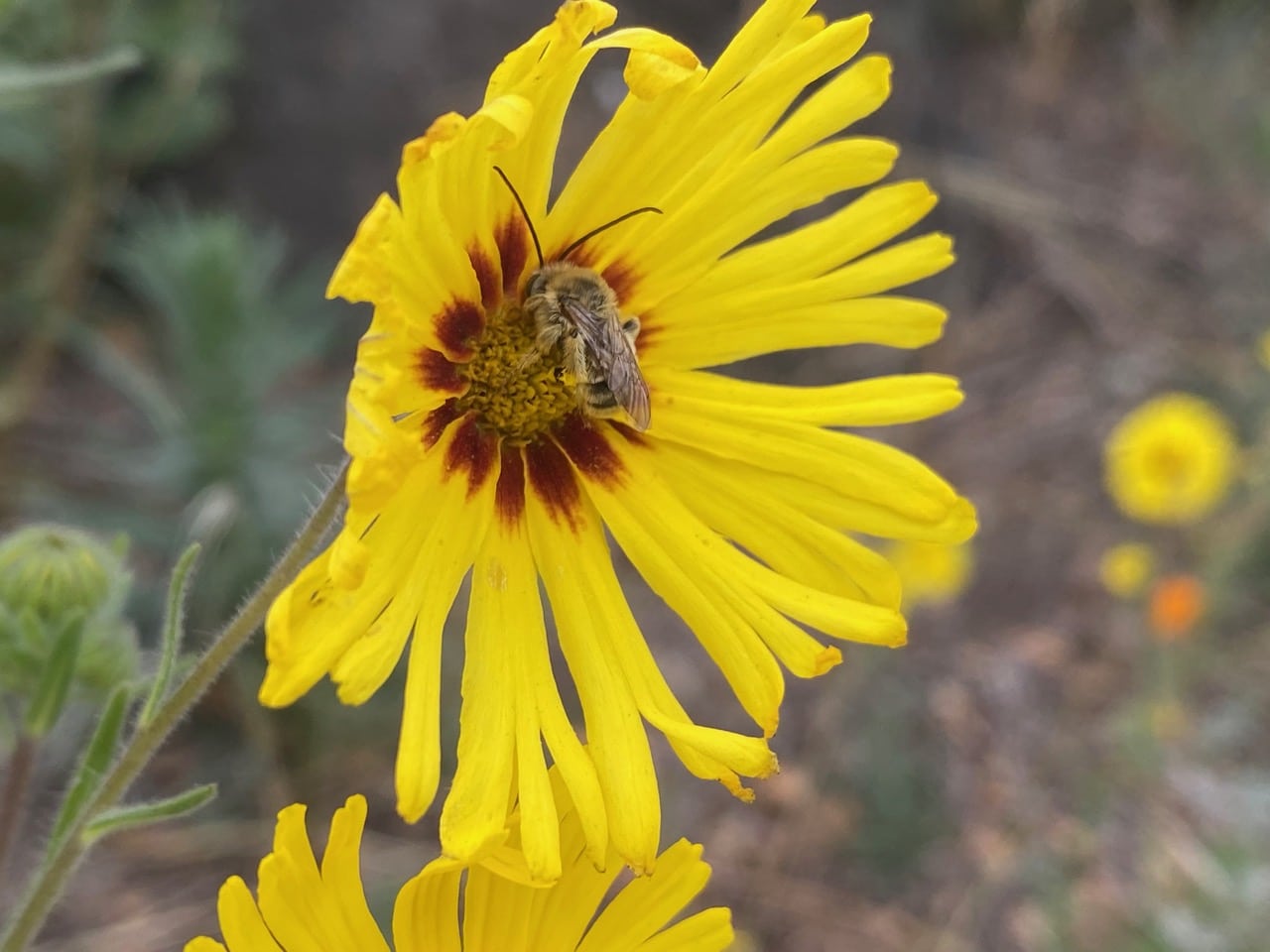
I do a quick check of all the plants on the strip, paying special attention to the Elegant Tarweed. Last summer, if I get here early enough, I have often found male Summer Longhorn Bees, Melissodes sp. (family Apidae) sleeping in aggregations on the tarweed seed heads. It is a heart-warming sight I would travel the world to see. Ah, here’s a male by his lonesome self, still fast asleep on an Elegant Tarweed flowerhead. I guess the season is still young, and the bees are not out in large numbers yet. As it is still cool and overcast, and there’s no insect activity yet, I decide to go for a walk in another neighborhood.
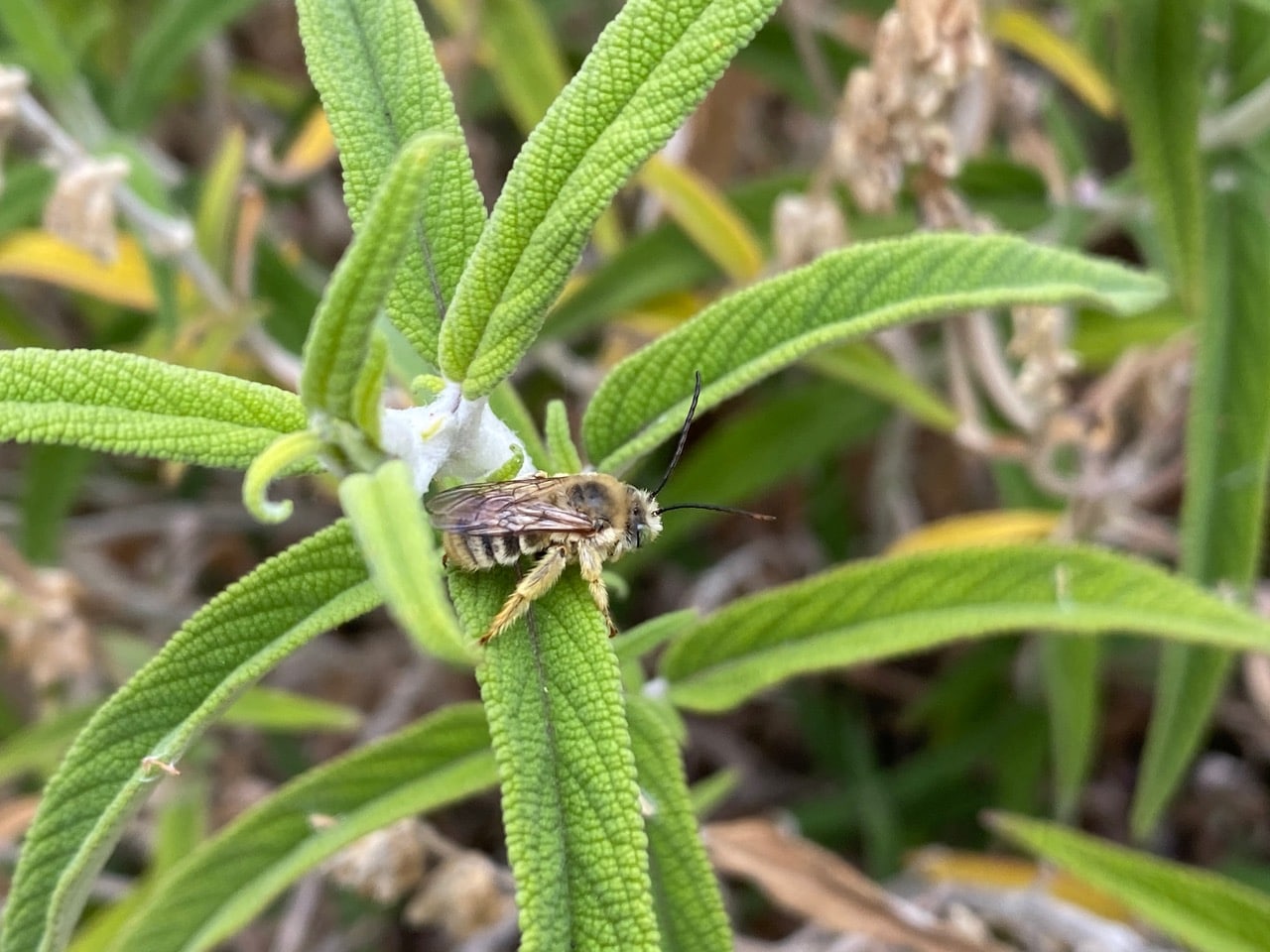
At the leafy residential enclave on Thompson Ave., I spot a male Melissodes flying in one garden. He finally settles on a sage leaf.
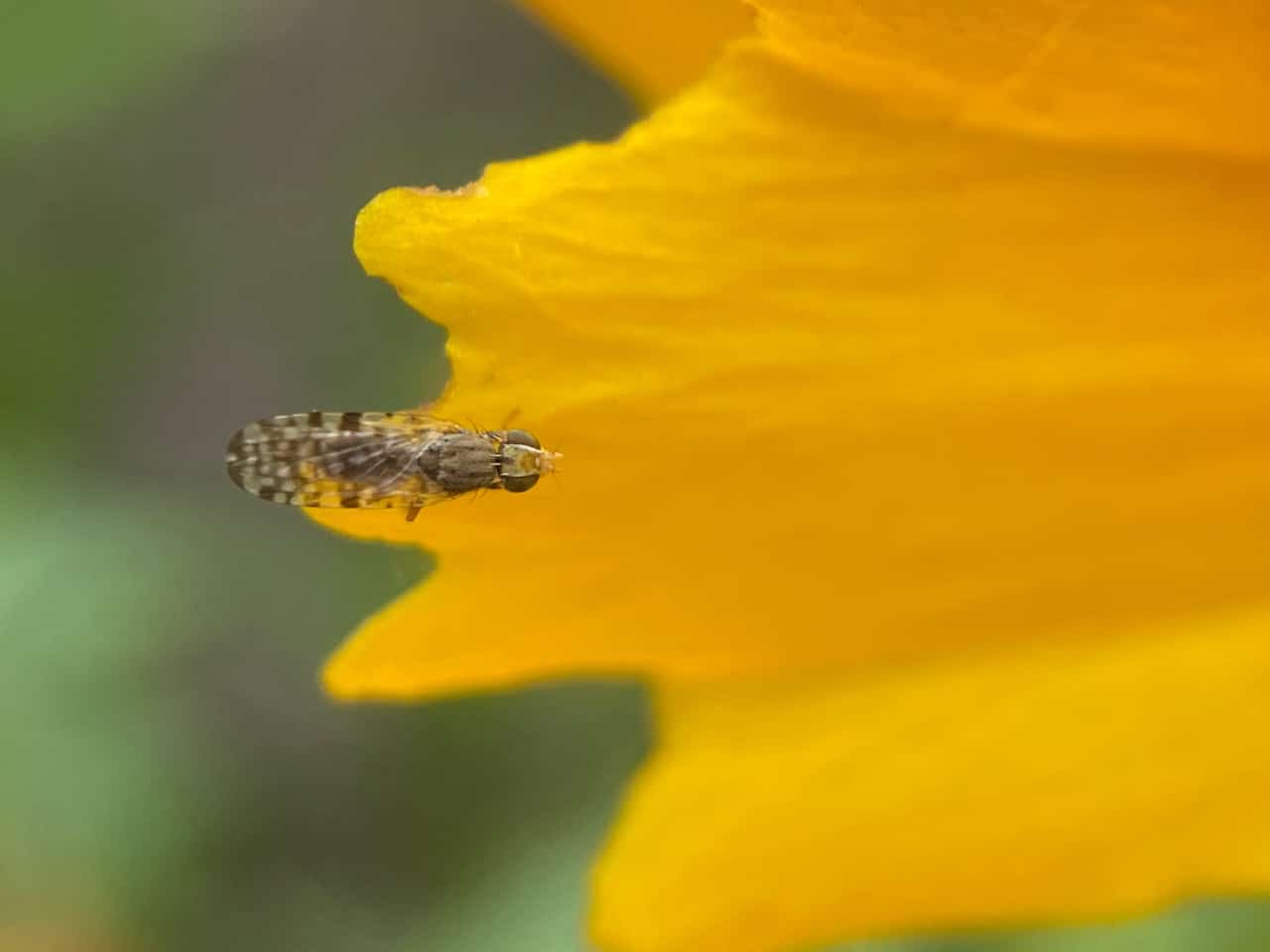
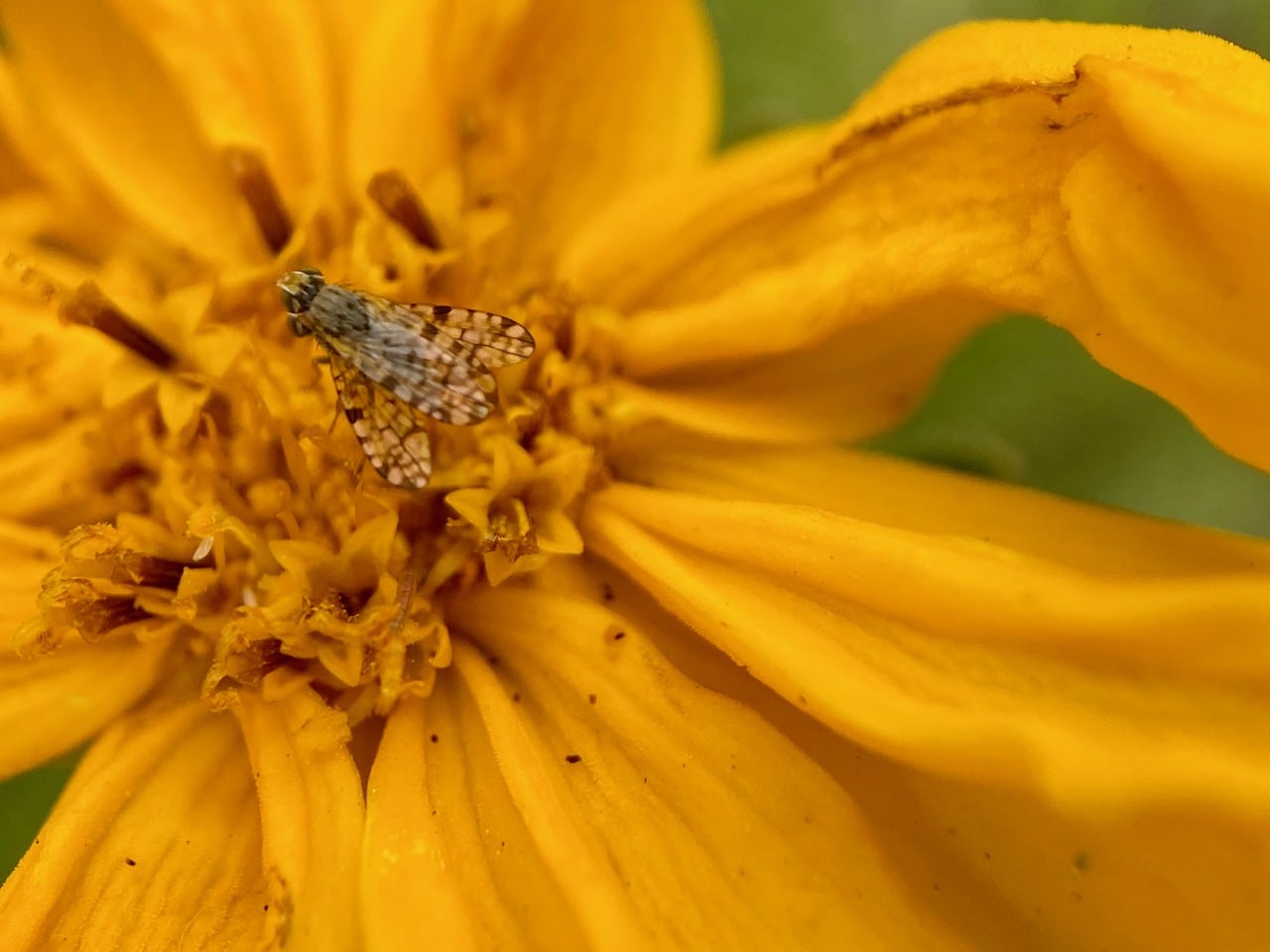
A Fruit Fly (family Tephritidae) is perched on the edge of an ornamental Coreopsis with multiple, ruffled ray petals. iNaturalist has helped identify the insect as a member of the genus Campiglossa (family Tephritidae).
Commonly called Fruit Flies, Tephritids are small to medium-sized flies that are often colorful, and usually with picture wings. The larvae of almost all Tephritidae are phytophagous. Females deposit eggs in living, healthy plant tissues using their telescopic ovipositors. Here the larvae find their food upon emerging. The larvae develop in leaves, stems, flowers, seeds, fruits, and roots of the host plant, depending on the species. Adults are often found on the host plant and feeding on pollen, nectar, rotting plant debris, or honeydew. Tephritid flies are of major economic importance as they can cause damage to fruit and other plant crops. On the other hand, some Tephritids are used as agents of biological control of noxious weeds.
The genus Campiglossa has a worldwide distribution. Adult females lay eggs in flowerheads of Asteraceae. The short, stout larva of Campiglossa live in the ovaries. Many species are monophagous (feeding on a single species), some oligophagous (feeding on a few related species) on Asteraceae.
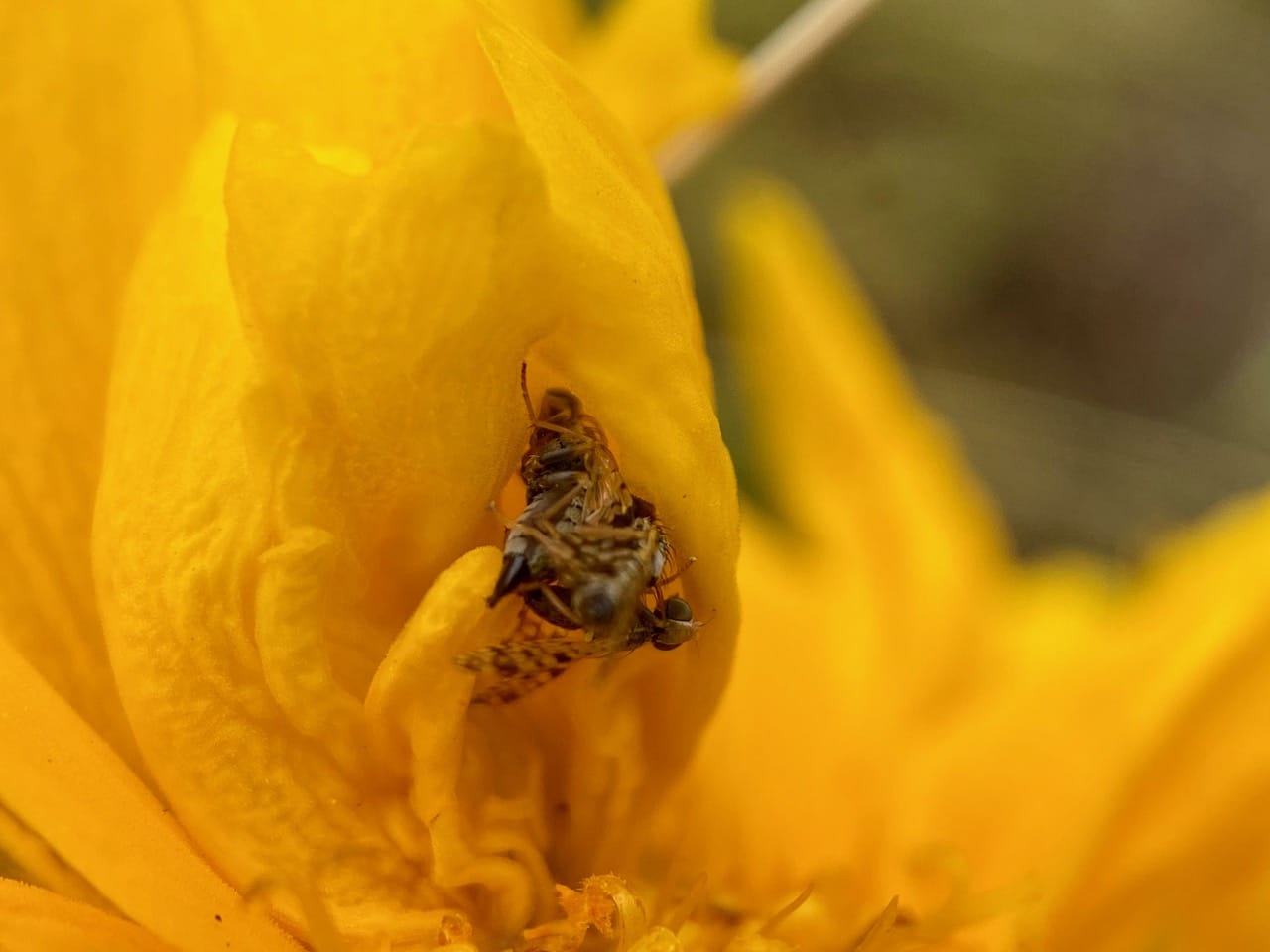
Inside one fading flowerhead, a scuffle is going on involving three Fruit Flies. Apparently two males are tumbling along with a female that they are trying to mate with.
On another flowerhead, I am met with this fruit fly that appears to have four wings! It’s impossible – flies are defined by having only two wings! Closer inspection reveals that it is actually a pair of flies in copula, the male riding atop the female.
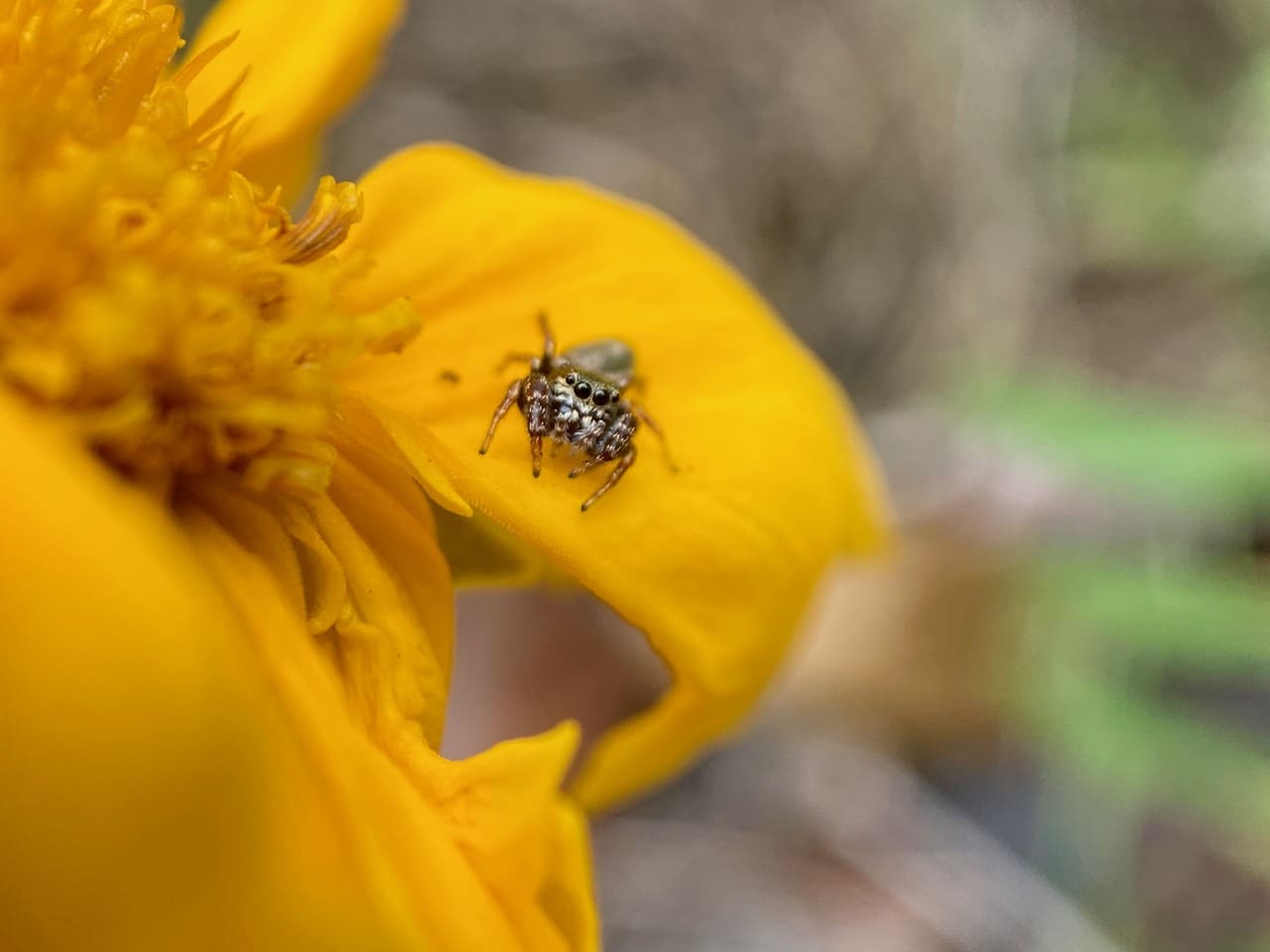
All the insect activity in the Coreopsis has attracted a tiny Jumping Spider.
Jumping spiders (family Salticidae) are free-roaming hunting spiders. They do not weave a web to catch prey. They stalk, then pounce on their prey. Just before jumping, the spider fastens a safety line to the substrate. It can leap 10-20 times their body length to capture prey. Their movement is achieved by rapid changes in hydraulic pressure of the blood. Muscular contractions force fluids into the hind legs, which cause them to extend extremely quickly. Jumping spiders are visual hunters. Their excellent vision has among the highest acuities in invertebrates. Since all their 8 eyes are fixed in place and cannot pivot independently from the body like human eyes can, jumping spiders must turn to face whatever they want to see well. This includes moving their cephalothorax up and down, an endearing behavior.

As the spider turns around, I glimpse an iridescent bronze flash from its abdomen. It is a Buttonhook Leafbeetle Jumping Spider, Sassacus vitis (family Salticidae).
It is often difficult to tell whether a particular spider is an adult or an immature, judging by size alone. In the jumping spiders in the genus Sassacus, the adults are only about 3-5 mm. The genus name Sassacus was the last chief of the Pequot Indians, a Native American tribe of the Connecticut Valley that was vanquished in a war with English settlers in 1637. The iridescent color and very compact appearance of these spiders leads scientists to suspect that they are mimics of certain leaf beetles in the family Chrysomelidae. Many Chrysomelids don’t taste good, as they feed on poisonous plants and sequester those plant toxins for their own defense. They advertise their distastefulness to predators with bold black and white, yellow, orange, or red color patterns, or with brilliant metallic colors. One of the defining characteristics of the genus is the very short legs. The fourth pair of legs is still the thickest, with one or two pairs of spines, used in tackling prey. Like most jumping spiders, Sassacus engages in visual courtship displays. The twitching abdomen also produces an auditory stimulus as the male waves his front legs to garner the female’s attention.
Sassacus vitis is native to North America, with a range spanning from Canada to Panama. It is a small jumping spider with iridescent gold abdomen and white ring around the anterior surface of abdomen. Body is covered with golden scales. Males are 3.5 mm long, females 4.5 mm. The name vitis is Latin for “grapevine”. The spider is commonly found on shrubs and vines and in fields. Best known as a common resident of vineyards.
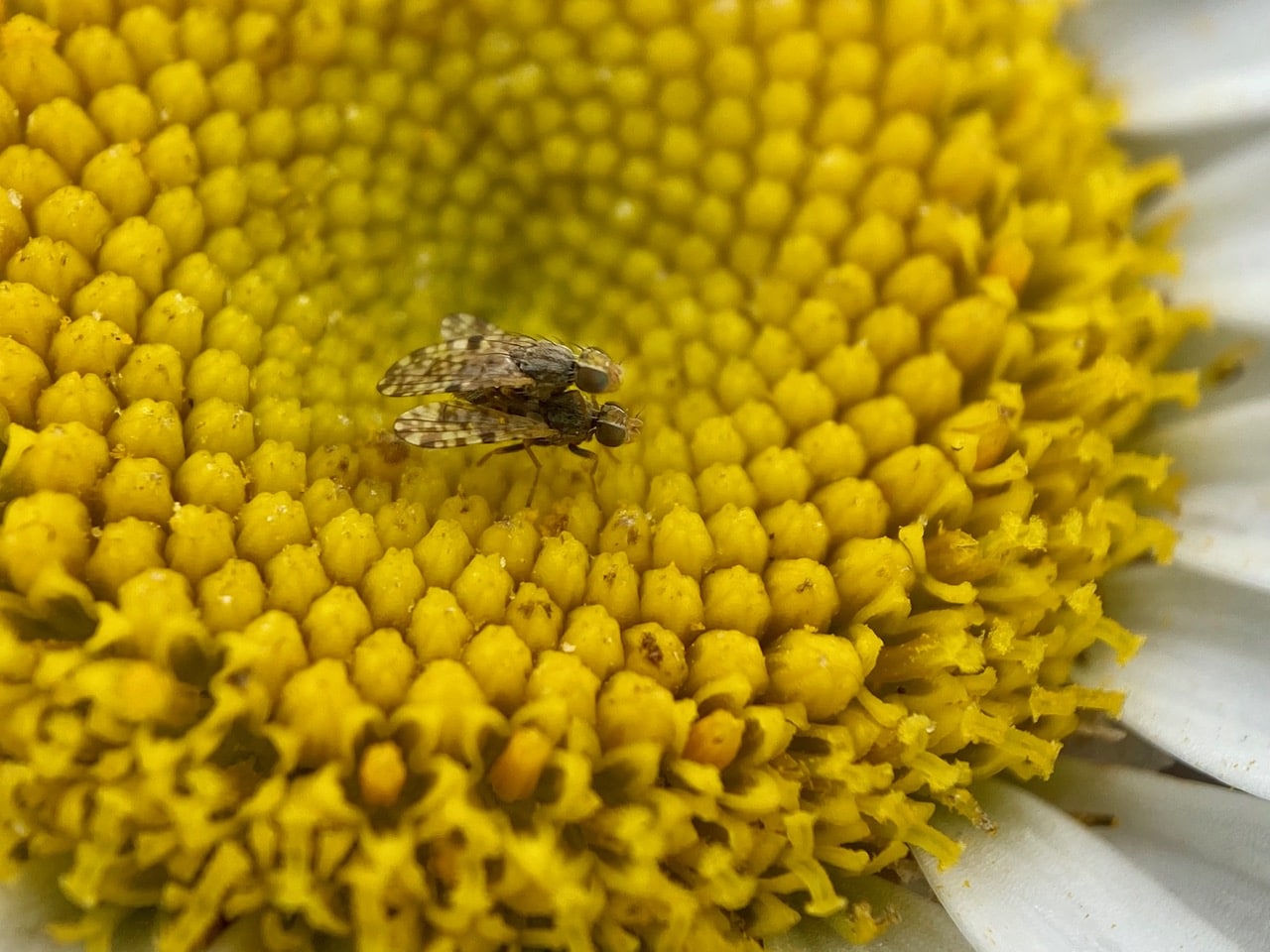
In the same garden, a pair of Fruit Flies are mating on the flower buds in the center of a white Chrysanthemum flowerhead. It must be prime fruit fly mating season!

A tiny nymph of the Mediterranean Katydid, Phaneroptera nana (family Tettigoniidae) is perched on the lower lip of a Hot Lips Sage flower, Salvia microphylla.
Insects in the family Tettigoniidae are commonly called katydids or bush crickets. They are primarily nocturnal in habit with strident mating calls. Many species exhibit mimicry and camouflage, commonly with shapes and colors resembling leaves. The diet of most katydids includes leaves, flowers, bark, and seeds, but many species are predatory, feeding on other insects, snails, or even small vertebrates such as snakes and lizards. Some are considered agricultural pests.
The Mediterranean Katydid is native to Europe, the Near East and North Africa. As an invasive species, it has spread to the San Francisco Bay Area. It mainly inhabits sunny and dry habitats, especially shrubs and low branches of trees. Katydids court acoustically. Phaneroptera nana female sings in response to the male, prompting the male to move towards her. Females chew on the lamina of plants to insert their eggs which usually hatch in summertime. P. nana is commonly found through the summer and fall seasons. The species is known to cause damage in pear orchards, feeding on pears that have not ripened.

A Thick-legged Hover Fly, Syritta pipiens (family Syrphidae) is still fast asleep on an inflorescence of Cedros Island Verbena, Verbena lilacina. Insects do not have eyelids, so it is not always easy to tell if they are asleep. If they don’t fly or run away when I wave my hand over them, I assume they are asleep. Sleeping insects are commonly seen in the early morning, or on cool, cloudy mornings, such as today. Unfortunately, while the sleeping insects might be cooperative, the light levels are usually not optimal for photography.
Syritta pipiens originates from Europe and is currently distributed across Eurasia and North America. They are fast and nimble flyers, and their larvae are found in wet, rotting organic matter such as garden compost, manure, and silage. The flies are important pollinators for a variety of flowering plants.
The Thick-legged Hover Flies are often found on flowers, where the adult males primarily feed on nectar and adult females eat protein-rich pollen to produce eggs. The common name comes from the fly’s distinctively broad femora. The fly is about 6.5 -9 mm long. The species flies at a very low height, rarely more than 1 m above the ground. Males accurately track females, aiming to attempt forced copulation.

A Mediterranean Katydid nymph, Phaneroptera nana (family Tettigoniidae) is perched on a flower of Verbena lilacina.

A Common European Greenbottle Fly, Lucilia sericata (family Calliphoridae) glistens from a dried Lavender seed head.

The Common European Greenbottle Fly is a Blowfly found in most areas of the world and is the most well-known of the numerous green bottle fly species. The lifecycle of Lucilia sericata is typical of blowflies. Females lay masses of eggs in fresh carrion. The flies are extremely prolific – a single female may produce 2,000 to 3,000 eggs in her lifetime. The larvae feed on dead or necrotic tissue, passing through 3 larval instars. Third-instar larvae drop off the host to pupate in the soil. The adults feed opportunistically on nectar, pollen, feces, or carrion; they are important pollinators as well as important agents of decomposition. Pollen is used as an alternative protein source, especially for gravid females who need large amounts of protein and cannot reliably find carrion.

Now that the sun is starting to peer through the clouds, the insects are starting to fly. First to be seen are the cold-tolerant bumble bees. A Yellow-faced Bumble Bee, subgenus Pyrobombus (genus Bombus, family Apidae) is taking nectar from an inflorescence of Spanish Lavender, Lavandula pedunculata.
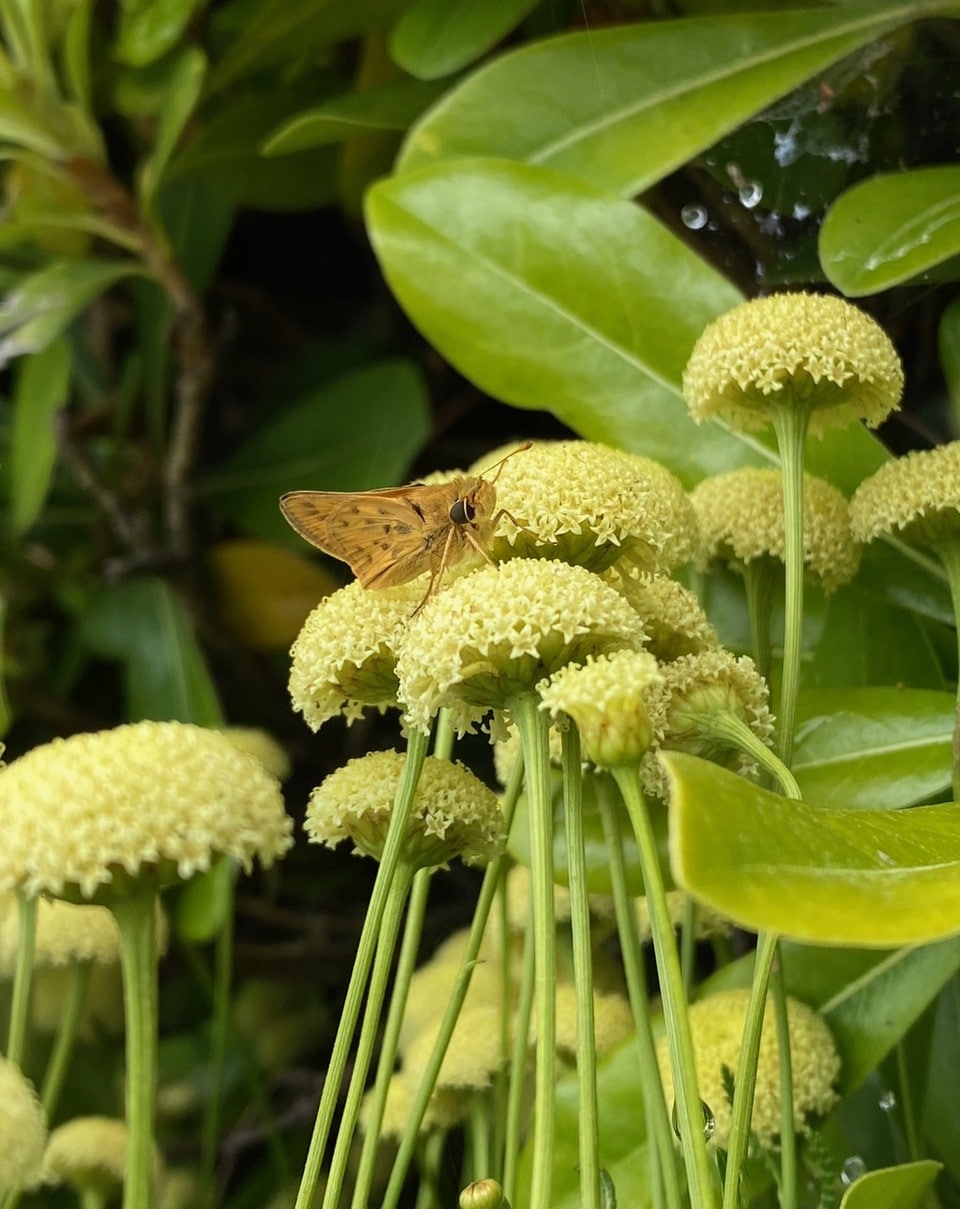
A Fiery Skipper, Hylephila phyleus (family Hesperiidae) lands on a flowerhead of Lavender-Cotton, Santolina chamaecyparissus in glorious bloom in a garden.
Skippers are a family, the Hesperiidae, of the order Lepidoptera (butterflies and moths). They are named for their quick, darting flight habits. Most have the antenna clubs hooked backwards like a crochet hook. They also have generally stockier bodies and larger compound eyes than the other butterflies. Their wings are usually small in proportion to their bodies. When at rest, skippers keep their wings usually angled upwards or spread out, and only rarely fold them up completely. Californian species are mostly brown or tan, with black, orange, or yellow markings.
Skipper caterpillars are usually green or brown, sometimes yellowish, never brightly colored. They have a distinctive “collar”, a narrow ring around the body right behind the head. Caterpillars are camouflaged and often hide during the day. Many species make nests of leaves and silk for additional protection. Most North American species feed on grasses, but some common species eat shrubs and trees, especially in the bean family. Most species are limited to a single group of food plants. Adult skippers are only active during the day, but Skipper caterpillars feed mainly when it is dark or partly light.
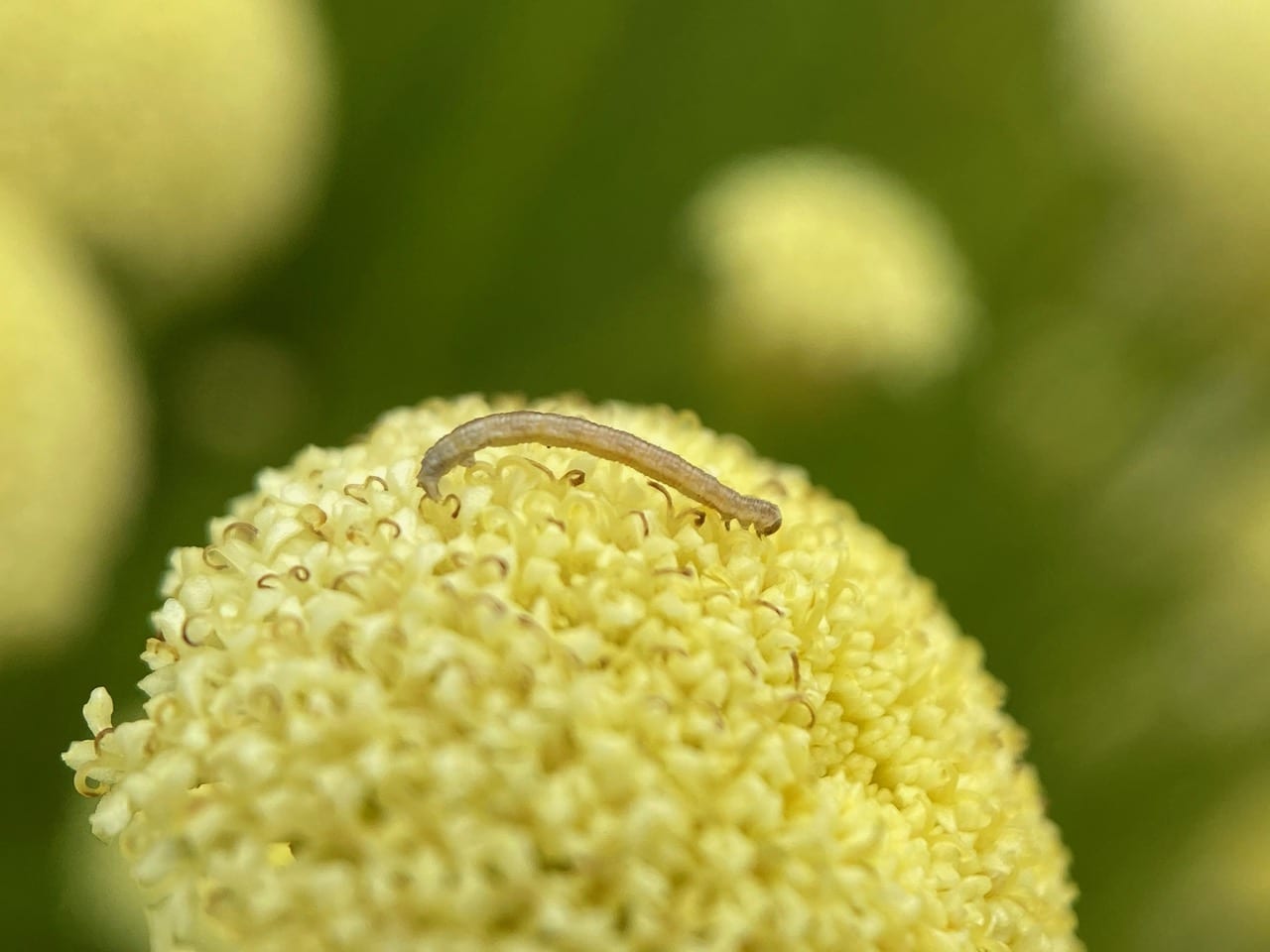
An Inchworm (family Geometridae) is “inching” its way across a Lavender-cotton flowerhead. Note that there are no legs between the three pairs of true legs (behind the head) and the prolegs at the rear end of the caterpillar.
Inchworms are also called loopers and measuring worms. They majority of the inchworms are the larvae of moths in the family Geometridae. The name comes from the Greek “geo” for earth and “metro” from measure, because the caterpillars seem to be measuring the surface on which they are walking.
All caterpillars have three pairs of jointed legs behind their heads. These legs are called true legs because they will become the six legs of the adult butterfly or moth. There are additional appendages, called prolegs, along their bodies. Prolegs are not true legs, they are just outgrowths of the body wall and will be lost at metamorphosis. They have little hooks on their soles to help the caterpillar walk and grip onto things.
Most caterpillars have five sets of prolegs, four in the middle of the body and one pair at the hind end. Inchworms have the normal six true legs but only two or three pairs of prolegs, all located at the tail end of the body, with none in the middle. When an inchworm walks, it moves its tail-end prolegs up behind its true legs, causing the center of its body to loop upward. Then it stretches its front end forward to take another step.
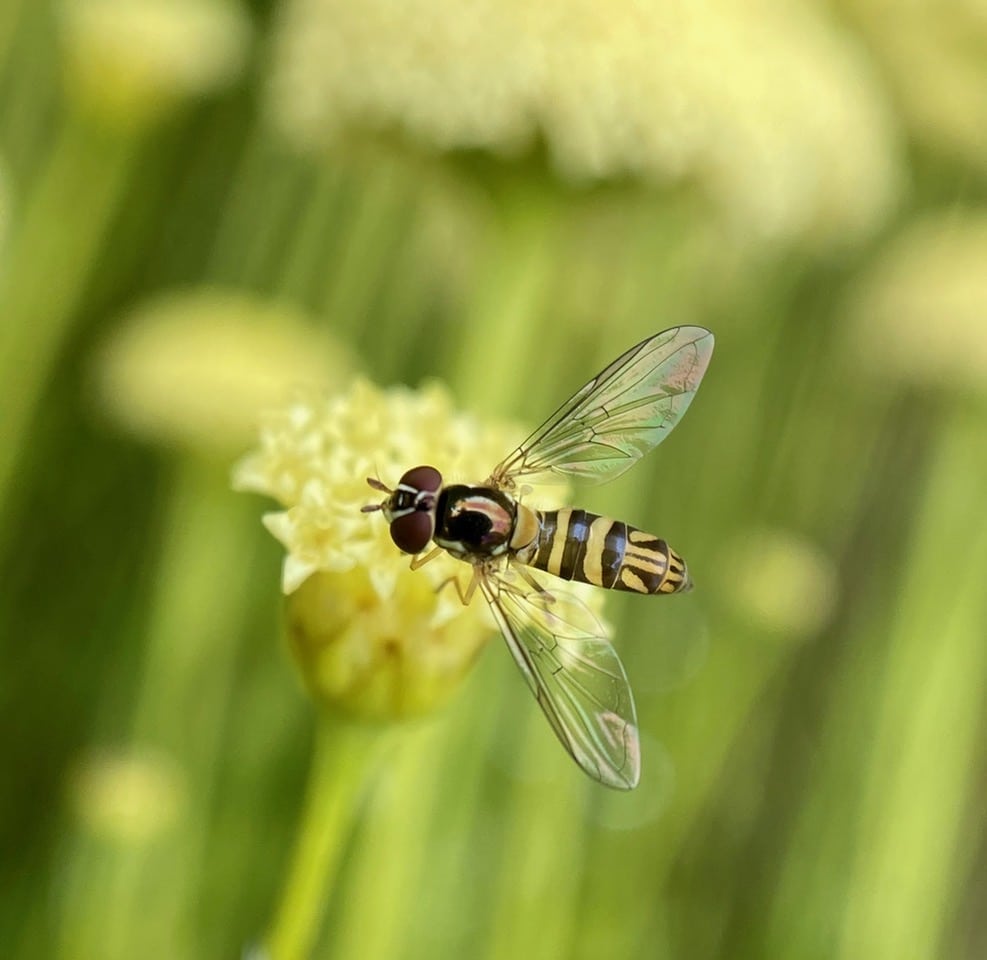
A female Oblique Streaktail, Allograpta obliqua (family Syrphidae) lands on Lavender-cotton flowerhead.
The Oblique Streaktail, Allograpta obliqua is a common North American species of hover fly. Adults, 6-7 mm long, visit flowers for nectar and pollen, and are pollinators. Females lay eggs on plant surfaces near aphids. Larvae feed on the aphids.

It is almost 11:30 am when I get back to the sidewalk strip on Lincoln Ave. The male Summer Longhorn Bee, Melissodes sp. (family Apidae) is still asleep on the same Elegant Tarweed flowerhead.
.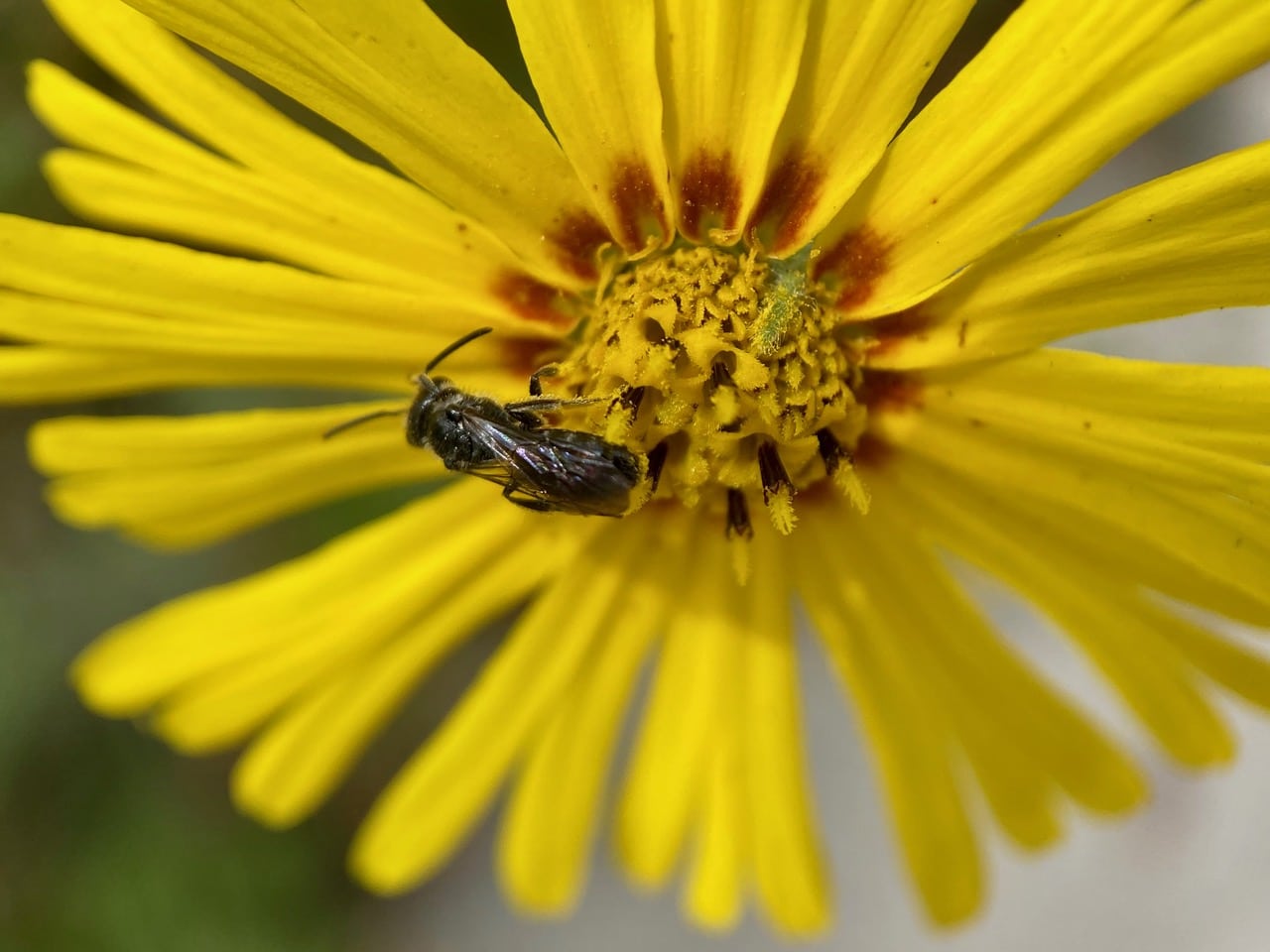
A small black bee is foraging on a Madia flowerhead. It has faint, thin white bands across its abdomen. It is a Kincaid’s Sweat Bee, Lasioglossum kincaidii (family Halictidae).

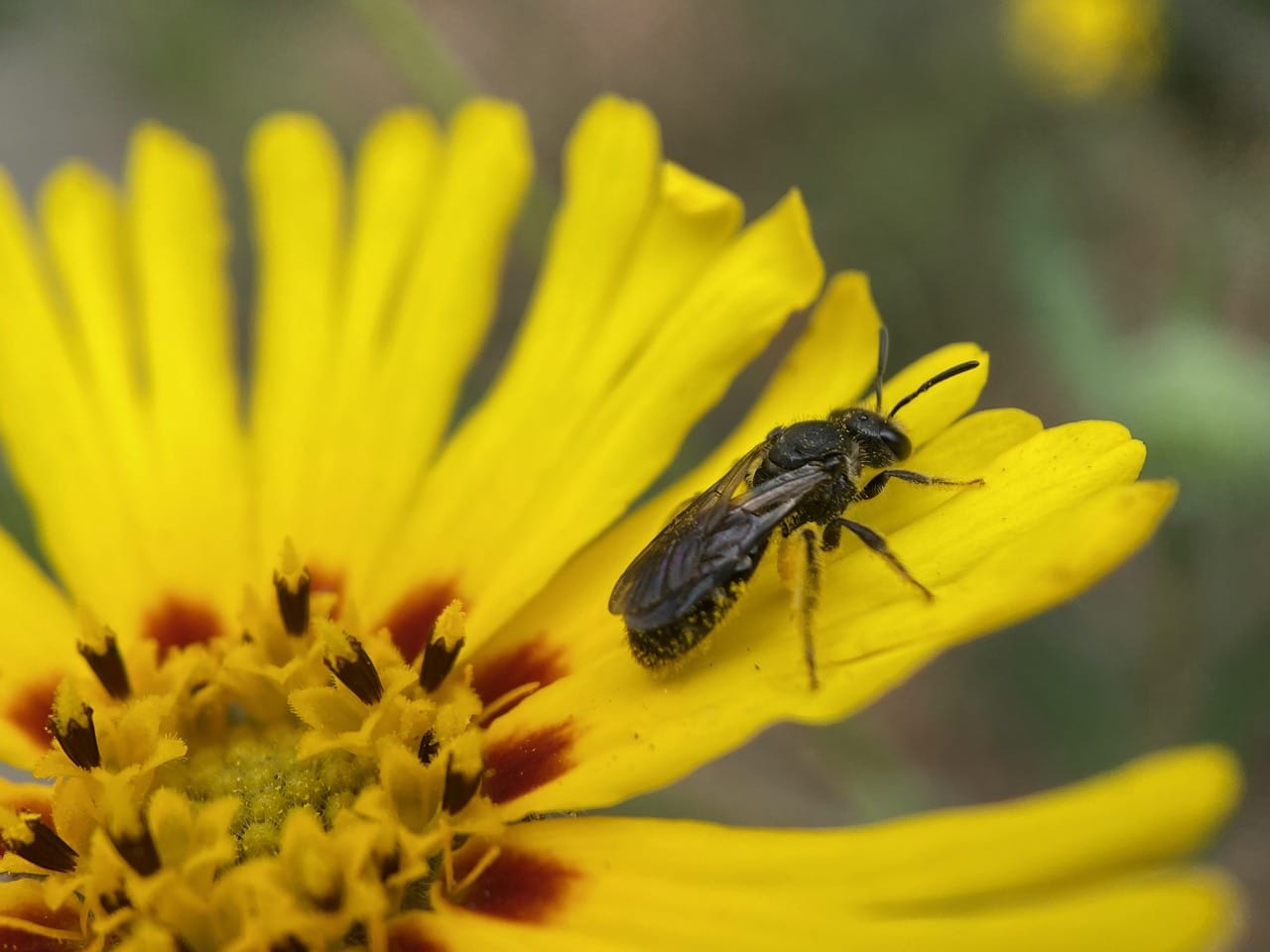
Lasioglossum species are found worldwide, and they constitute the largest bee genus. The subgenus Dialictus are the most likely to be seen in the U.S., with over 300 species of these tiny metallic bees. The majority of Lasioglossum are generalists. Because they are so abundant throughout the flowering season, the bees are often important pollinators. Their sheer numbers are enough to achieve excellent pollination of many wild flowers, especially of plants in the Asteraceae, which have shallow floral tubes that are easily accessed by these minute bees.
Lasioglossum exhibit a range of social behaviors; the genus includes solitary, communal, semi social, primitively eusocial, and even parasitic species. Almost all Lasioglossum in the U.S. nest in the ground. Generally these nests are built in the spring by fertilized females (called foundresses) that spent the winter in hibernation. In social species, the foundresses behave much like the queen Bumble Bees – they lay the first batch of eggs that develop into the first generation of female workers. The nest grows with each additional generation of bees. Later broods may consist of both males and females. They mate, and at the end of the season the fertilized females hibernate til the following spring, repeating the life cycle of the colony.
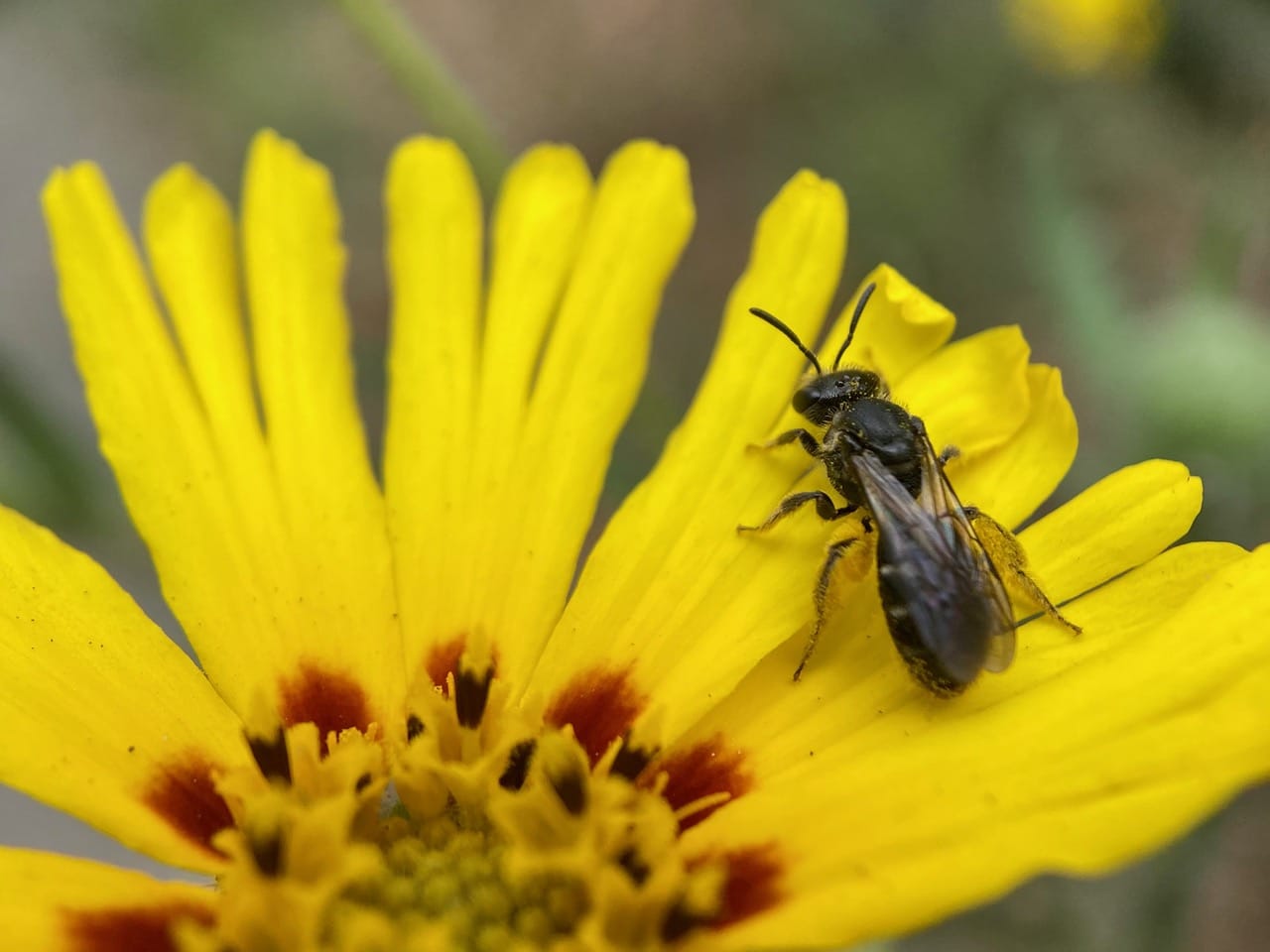
Note that the Kincaid’s Sweat Bee, Lasioglossum kincaidii (family Halictidae) has faint white bands across its abdomen. The bee is otherwise jet black. Even its wings are a smoky black. As in other Sweat Bees, its scopae (pollen-collecting hairs) span the entire length of its hind legs.
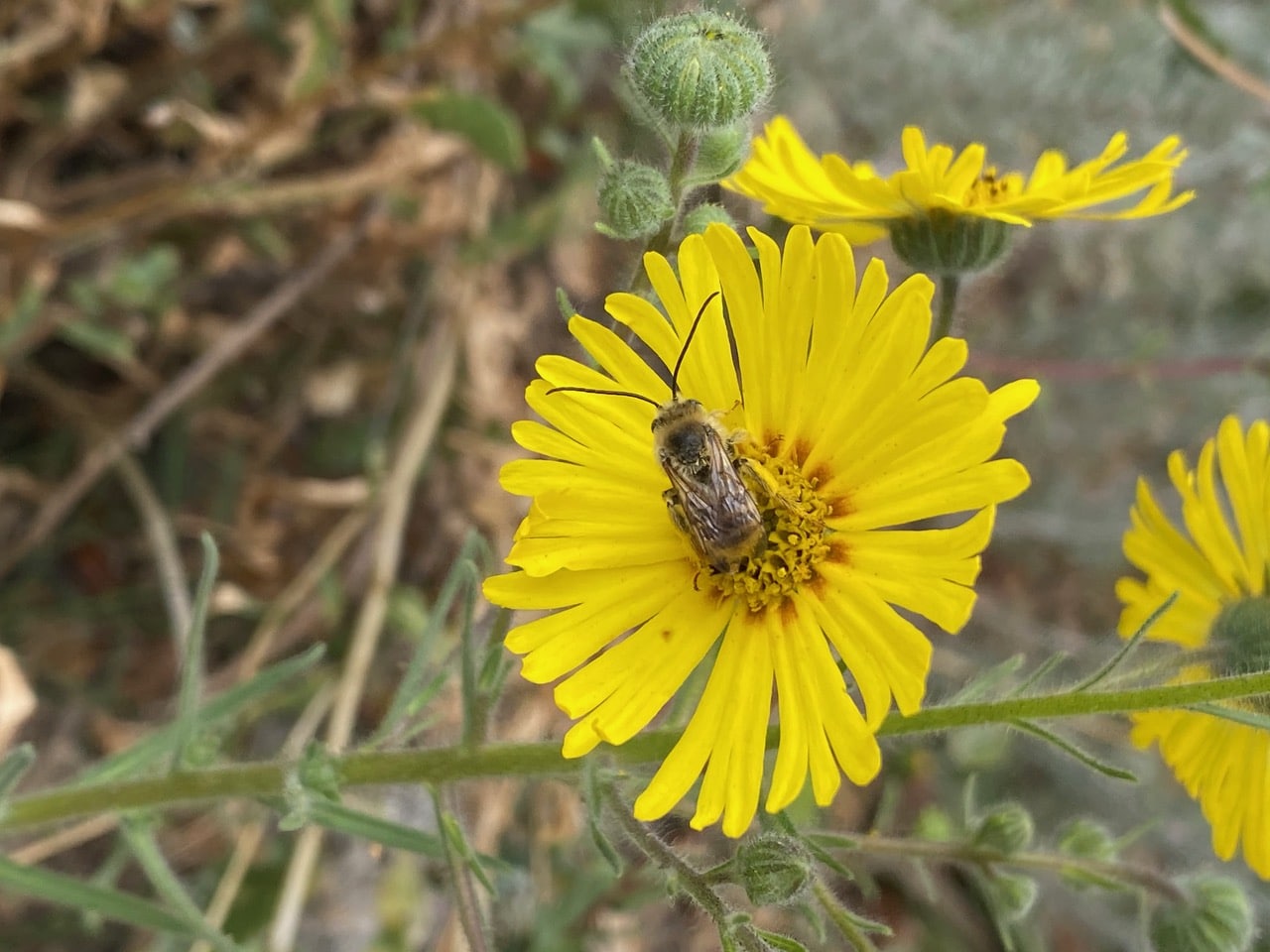
Hey, the male Summer Longhorn Bees are out and about now! They are now actively flying around seeking nectar from the Elegant Tarweed, Madia elegans.


The Summer Longhorn Bees, Melissodes sp. (family Apidae) are medium to large bees, stout-bodied, usually with gray hair on the thorax and pale hair bands on the abdomen. Males usually have yellow markings on their faces and have very long antennae from which their common name is derived. They are active May to September, with peak flight in late June to early August. The females prefer flat, bare ground for digging their solitary nests, though they sometimes nest in aggregations. Pollen is transported in scopae on the hind legs. Pollen loads are often copious and brightly colored and thus very distinguishable. Melissodes are specialists on Asteraceae – females gather pollen from flowers of Aster, Bidens, Coreopsis, Cosmos, Encelia, Gaillardia, Helianthus, and Rudbeckia ssp.

Hey, the female Summer Longhorn Bees, Melissodes sp. (family Apidae) are out foraging too! They are easily recognizable in the field when they are carrying pollen. Their pollen loads can be incredibly large.
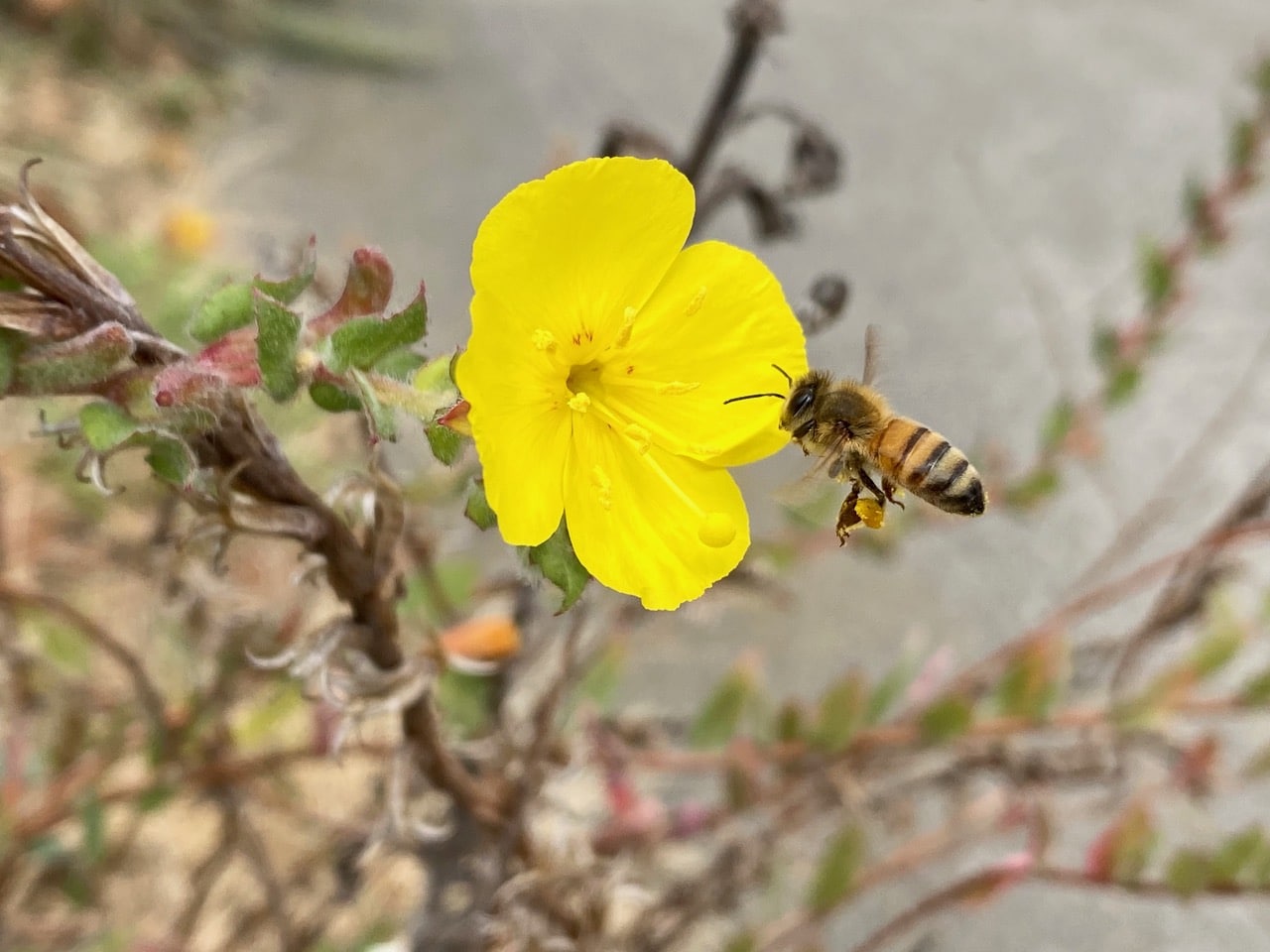
A Honey Bee, Apis mellifera (family Apidae) comes in for landing on a flower of the Beach Evening Primrose, Camissoniopsis cheiranthifolia. The plant is yet another yellow-flowered late bloomer in Naomi’s sidewalk wonderland.