

Pollinator Post 6/12/24 (3)

The flowers on the same Clarkia plant can look distinctly different. Clarkia is a classic example of a protandrous flower, with male reproductive parts maturing before the female parts. The younger flower on the top here has eight fresh anthers about to release their pollen. This is the male phase. Lower down the stem is an older flower in female phase. Its anthers have withered, having split open and curled back to release pollen. The pink style has lengthened beyond the spent stamens, and the white, four-lobed stigma has opened up, ready to receive incoming pollen.
This progression is termed dichogamy, where the male and female parts of the flower are separated in time. The male parts mature before the female parts in the Clarkia, making it a protandrous flower. Less common, some species have female parts that mature before the male parts; these flowers are protogynous. The temporal segregation of the sexes in both cases serves to prevent self-pollination.
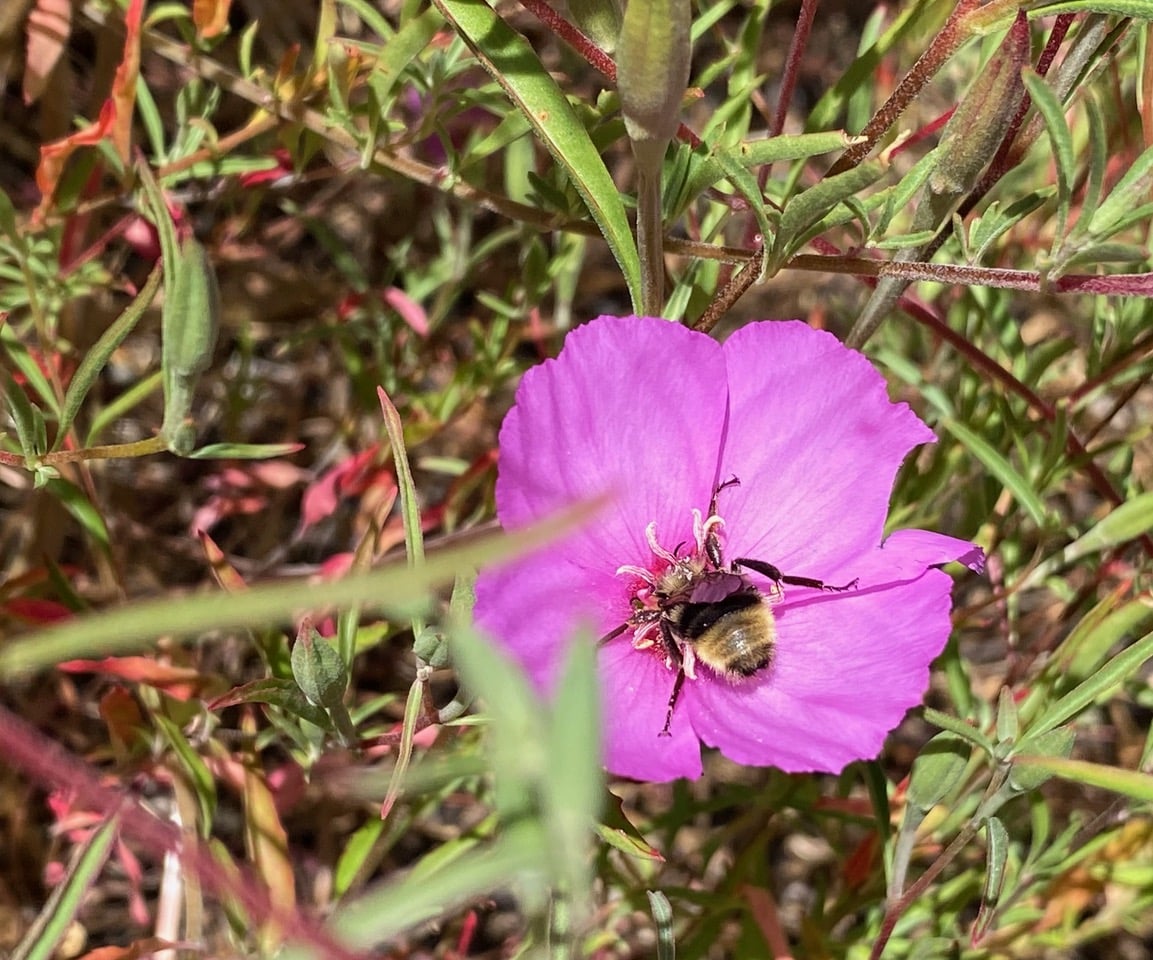
A Yellow-faced Bumble Bee, Bombus vosnesenskii (family Apidae) lands on an older Clarkia flower and immediately dives in for the nectar. Obviously the flowers in the female phase are still producing nectar. This ensures that the stigmas will receive pollen from nectar-seeking insects.
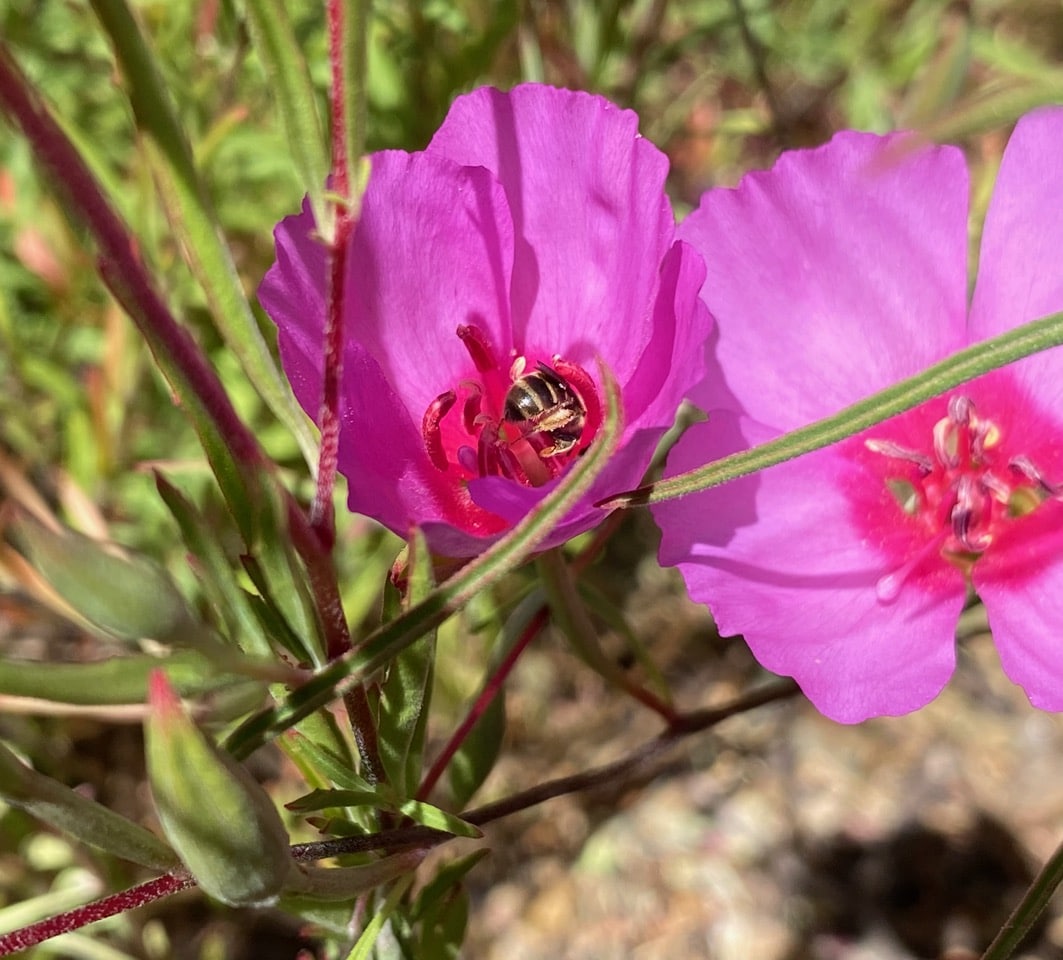
A little Sweat Bee (family Halictidae) is gathering pollen from a fresh Clarkia flower. The bees are capable of opening the fresh anthers to extract pollen.

This Sweat Bee is gathering pollen from a Clarkia flower in a late male phase. The anthers have dehisced to release pollen. Note the club-shaped immature pink style.

Off to the next flower! Note the older flower to the right – the white, four-lobed stigma has opened up to receive incoming pollen.

The young flowers of the Showy Milkweed, Asclepias speciosa look almost waxy when they first open up.

Milkweed is a complicated flower with complex parts. The flower relies on trickery to get pollinated. Each milkweed flower is equipped with a trap door, called a stigmatic slit. When insects land on the flower to feed on nectar, a foot may slip into the stigmatic slit and come in contact with a sticky ball of pollen, called a pollinium. When the insect pulls its foot out of the trap door, it brings the pollinium with it. If the insect moves on to the next flower, and its foot slips into a stigmatic slit again, the pollinium may be transferred and pollination is completed. However, foraging on milkweed flowers is a risky task. Sometimes smaller insects are unable to free their trapped limbs and die on the flower. Others must tear off their own limbs to escape. If too many pollinia have accumulated on their legs, even bumble bees are unable to fly.
.jpg)
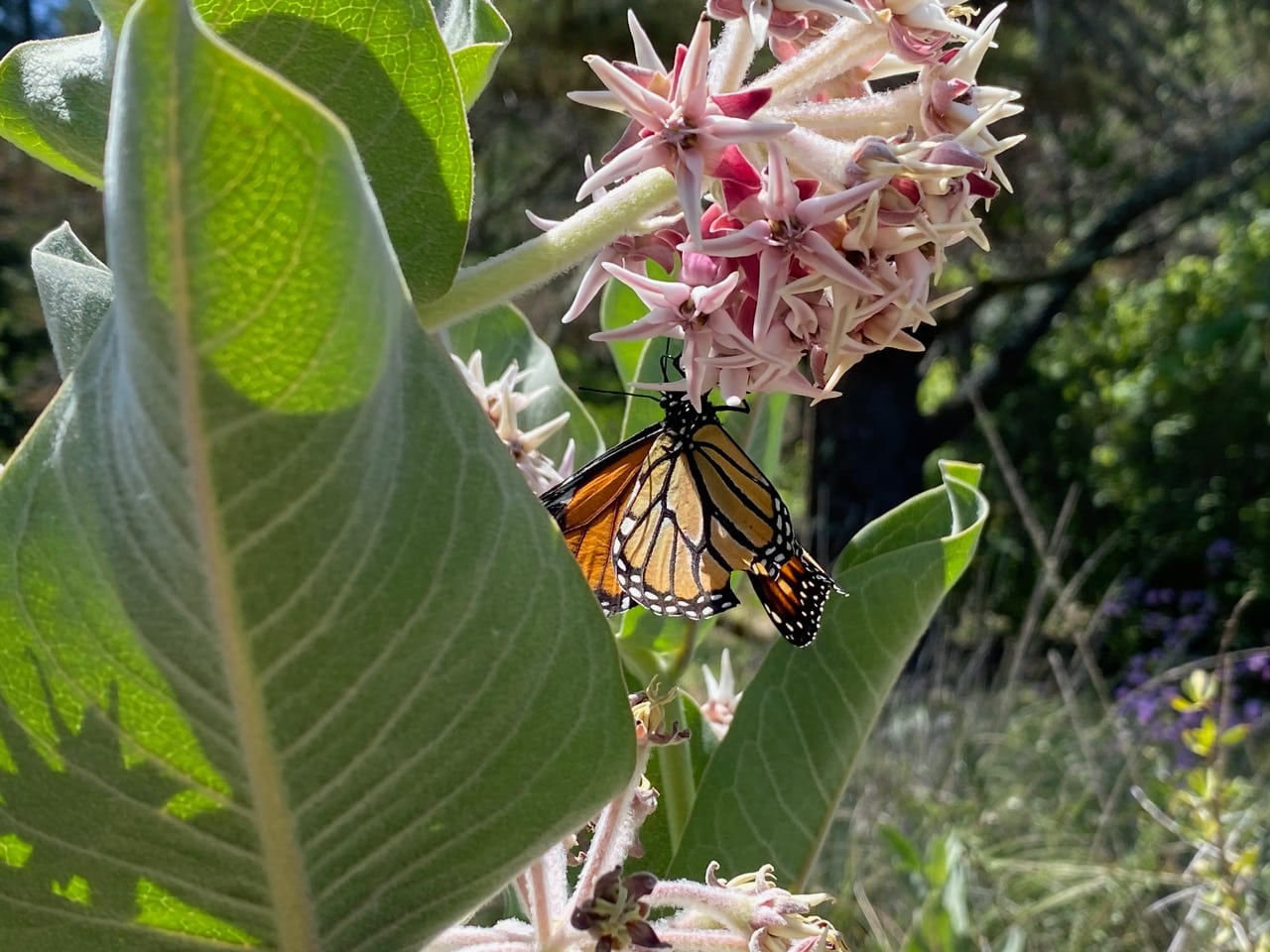
A Monarch Butterfly, Danaus plexippus (family Nymphalidae) stops at a cluster of Showy Milkweed flowers for a sip of nectar. The butterfly is large and strong enough not to be trapped by the flowers.
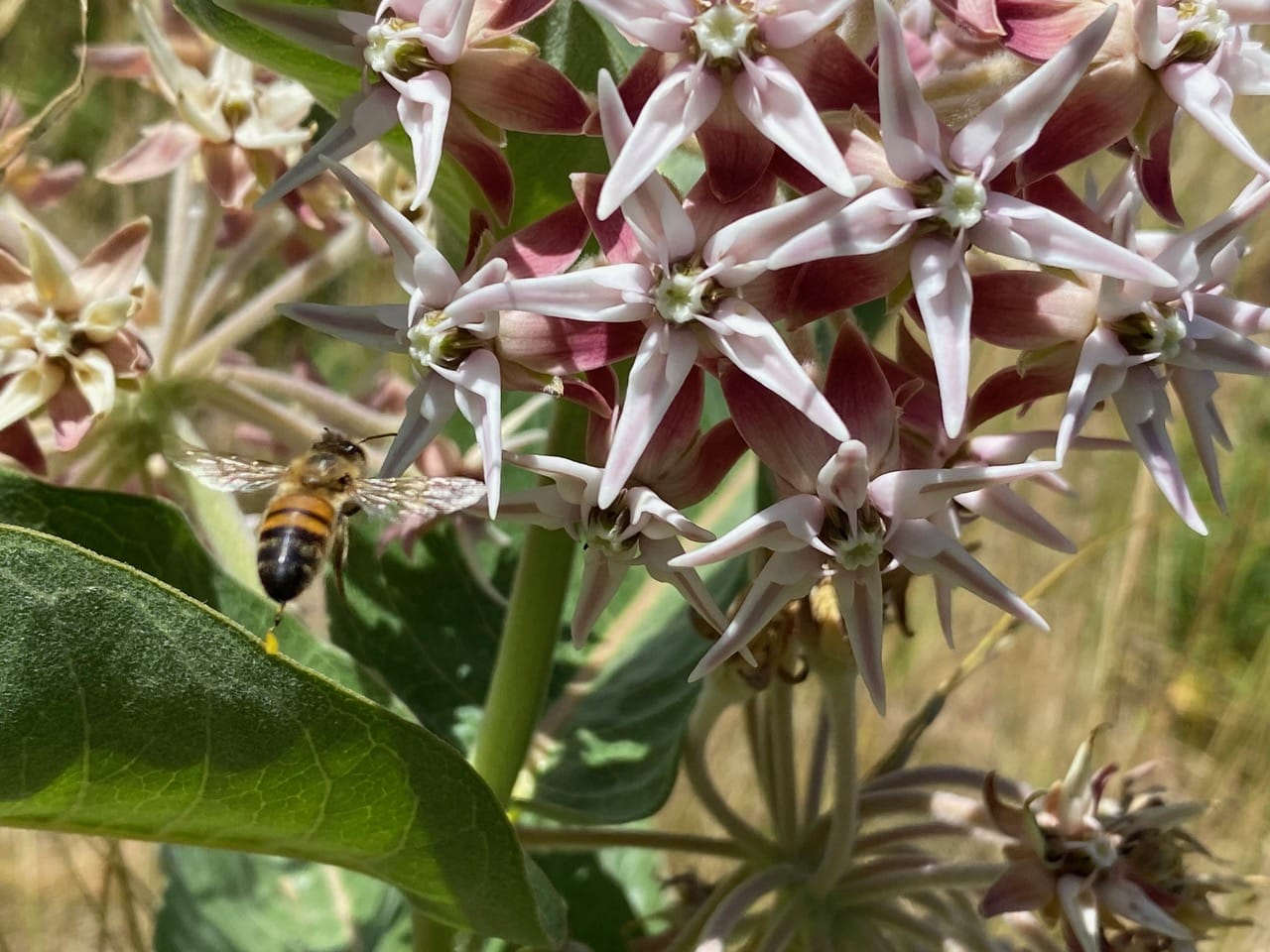
Note the spot of yellow hanging from the left hind leg of the Honey Bee, Apis mellifera. The bee has pulled that pollinium from a previous milkweed flower it visited.

A Sweat Bee (family Halictidae) is foraging on the flowers of Nude Buckwheat, Eriogonum nudum.

A bee lands on a Morning Glory flower.
 It heads down the floral tube…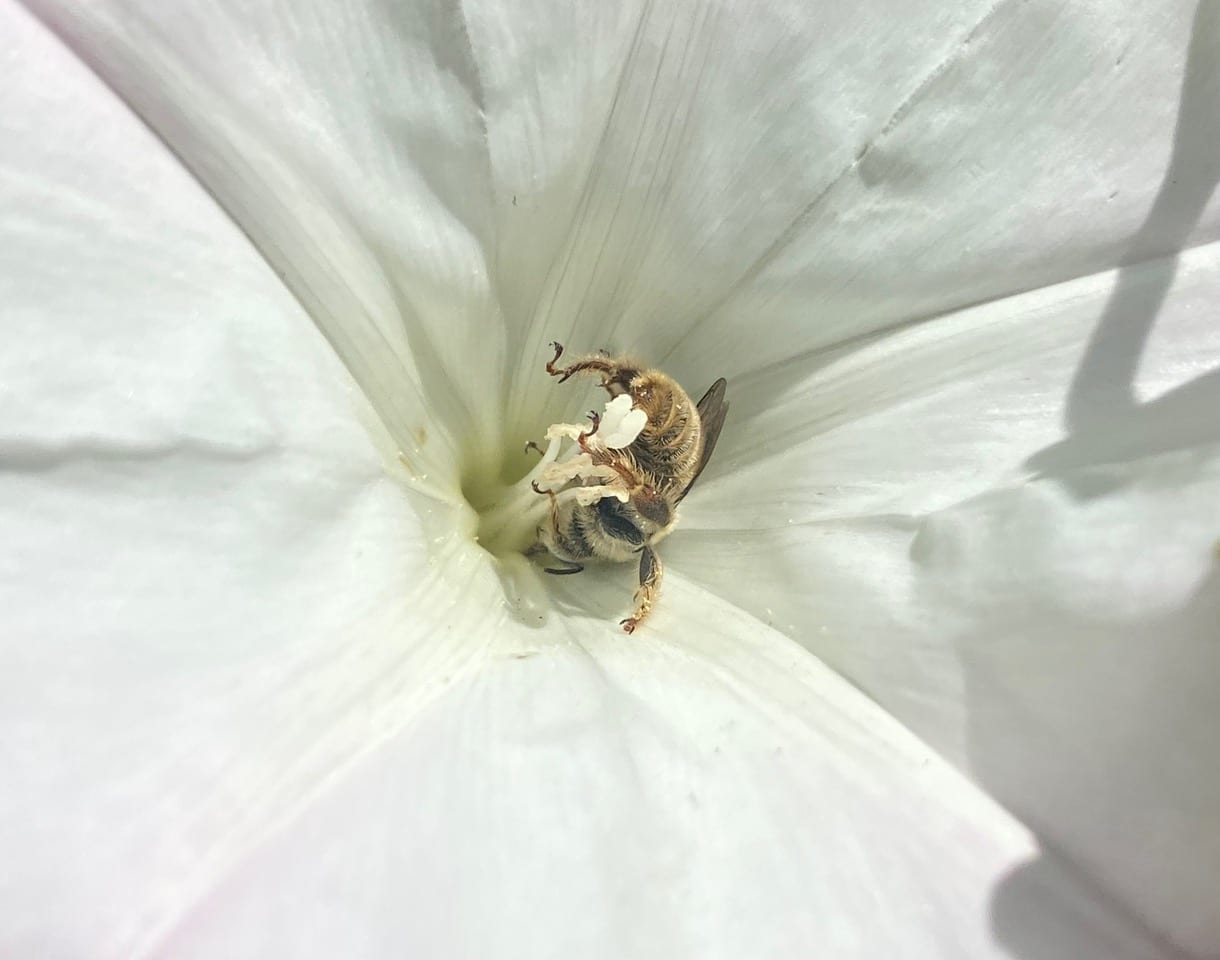
… holding on the reproductive parts of the flower.

As the bee emerges after taking nectar at the base of the flower, I see that it has mottled eyes, and a rather hairy body.

iNaturalist’s AI has identified the bee as a Longhorn Bee in the subgenus Synhalonia, genus Eucera (family Apidae). Males have very long antennae, so what we have here is a female.

The name Eucera is Greek for “well-horned”, a reference to the long antennae of the males. Abundant throughout the United States and Canada, especially in the west, these fast-flying bees are hairy and generally large. Only one subgenus (Synhalonia) occurs in the United States and Canada. Eucera includes both specialists and generalist bees. Specialists often limit themselves to flowers in the pea family (Fabaceae). Eucera are among the first bees to emerge in the spring and are rare by August. They nest in the ground and are mostly solitary. Nest entrances have a mound of excavated soil heaped symmetrically around them. When females emerge they are mobbed by several males who have emerged earlier. Competition among the males is often aggressive, resulting in tumbling “mating balls” of males clustered around a female. Once the female has been mated, however, her scent changes, and males leave her alone.
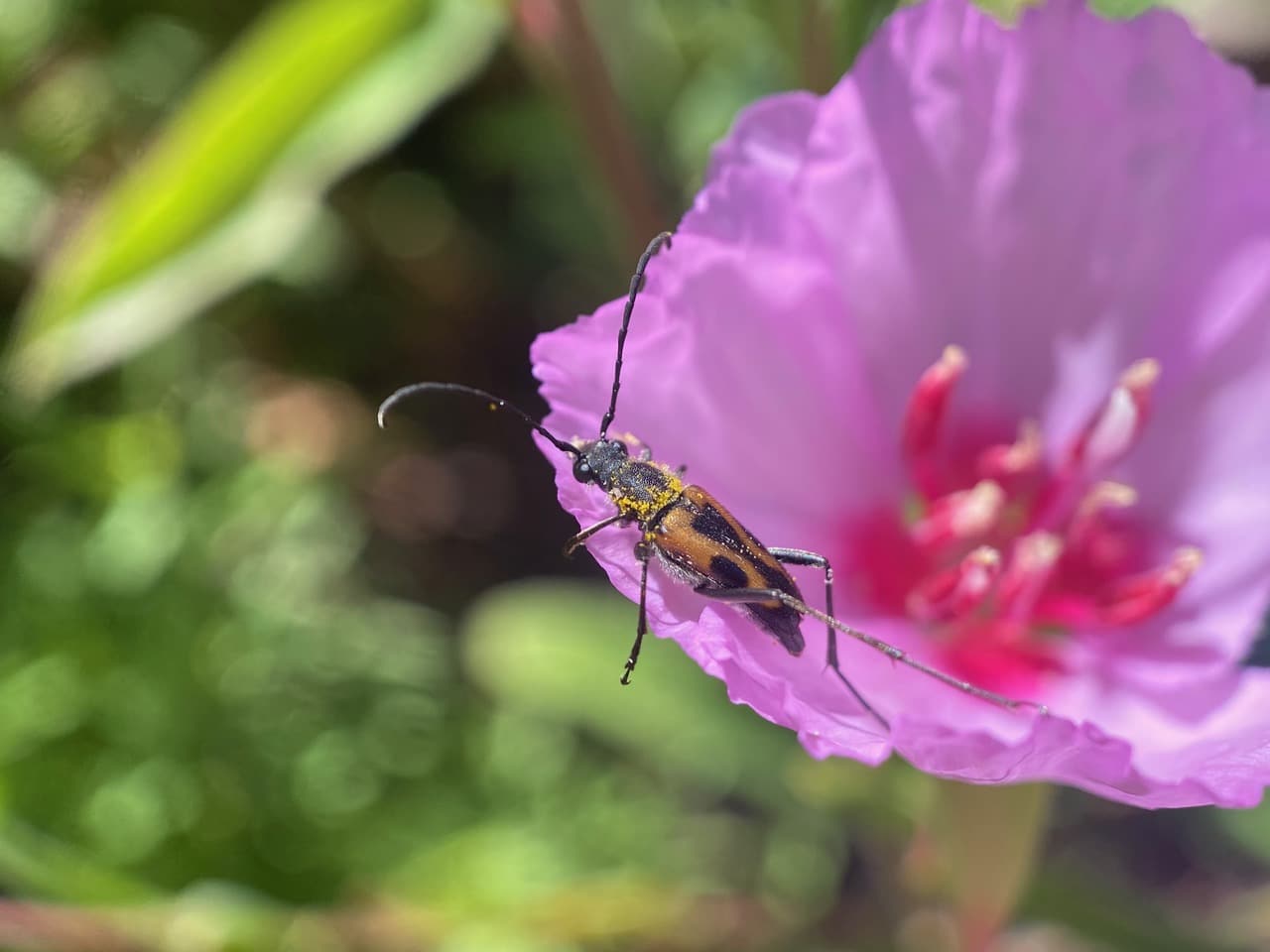
A male Dimorphic Flower Longhorn Beetle, Anastrangalia laetifica has emerged from a Clarkia flower. The yellow pollen adhering to its thorax is obviously not from Clarkia (which has pale purple pollen).
Flower Longhorn Beetles (family Cerambycidae, subfamily Lepturinae) are usually among the smaller members of their family. These beetles have a narrow body and very long legs. The thorax is markedly less wide than the wings, while the elytra tips are often pointed. They also share the family trait with other Cerambycids of having very long antennae. Sexual dimorphism is found in some species. The beetles are found on flowers where they feed on pollen and nectar, and are considered pollinators. They have a particular affinity for the umbel flowers of the carrot family, Apiaceae. The beetles spend their larval days as borers, just like other Cerambycids. However they are not considered pests, as they select trees that are stressed, dying, or dead.
The term “dimorphic” in the common name refers to the obvious visual differences between the sexes. Females are considerably larger, with 4 black spots on the bright red elytra, while the males are black or brown.