

Pollinator Post 6/12/24 (2)
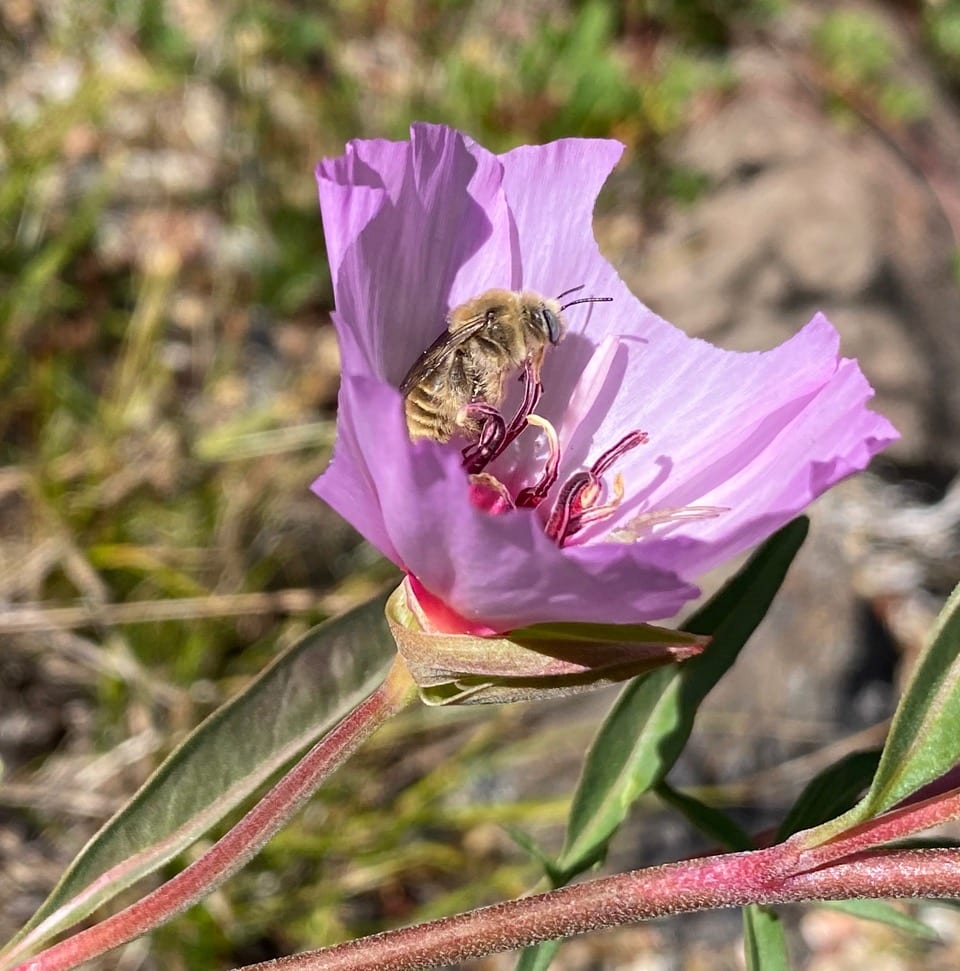
A robustly-built bee is foraging in a flower of Farewell-to-spring, Clarkia rubicunda. iNaturalist has identified the bee as a Chimney or Turret Bee, Diadasia sp. (family Apidae, tribe Emphorini). Note that the flower has had a few round pieces cut from the edges of its petals. The bee is not responsible for cutting the petals. That was done by a Leaf-cutter bee, Megachile sp. (family Megachilidae).
Diadasia is a genus of bees in the family Apidae, tribe Emphorini. The bees are distributed in the New World, confined to the western half the United States. The bees are solitary ground-nesters, although they tend to nest in aggregations. The most unique characteristic of this group is the construction of a prominent turret atop their actual burrow entrance. Species of Diadasia are oligolectic, specialized on a relatively small number of plant species. Their host plants include asters, bindweeds, cacti, mallows, and willow herbs. Females have large scopae on their hind legs that can carry impressive loads of pollen.
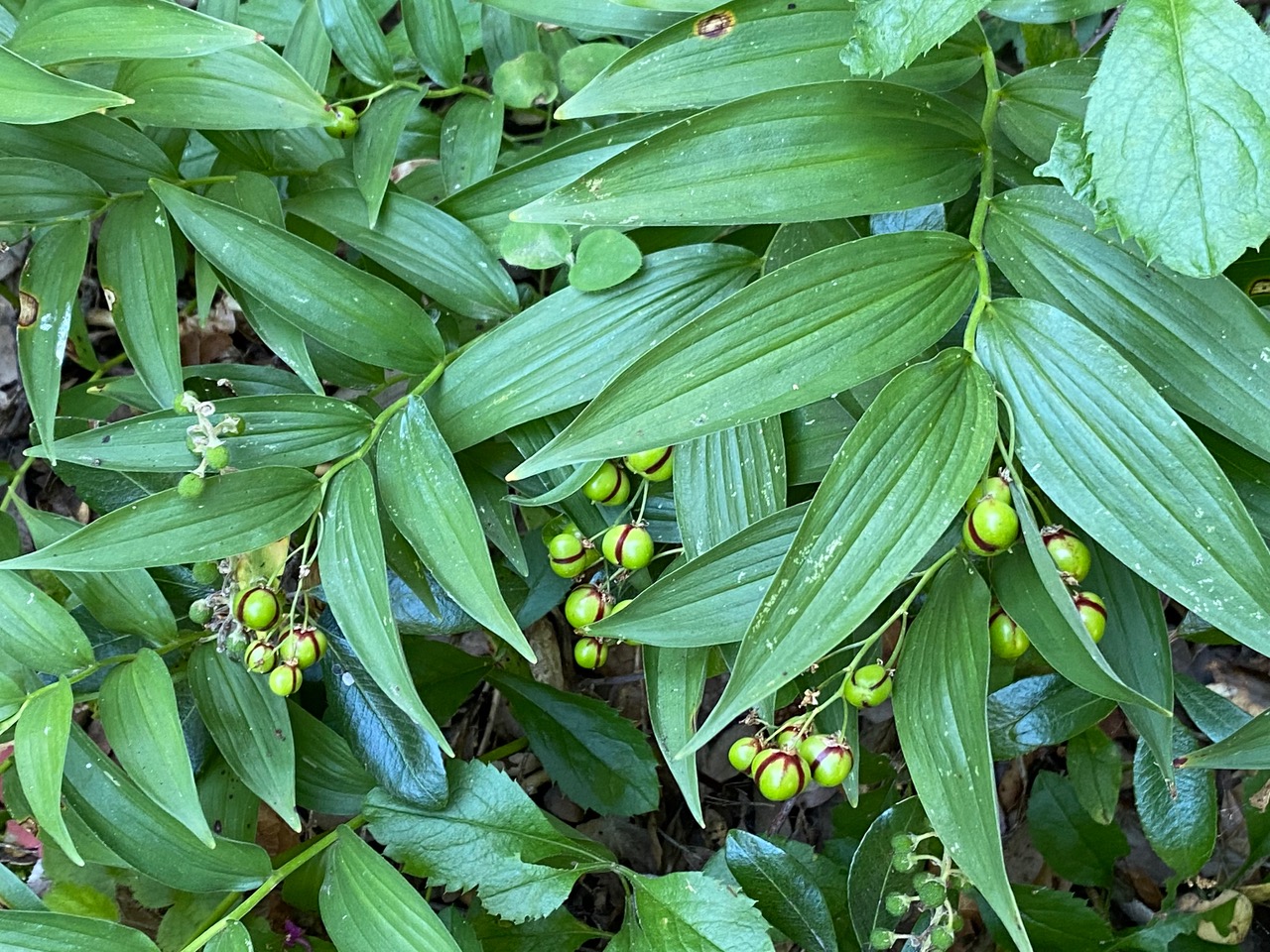
Ooh, the Star-flowered Lily-of-the-Valley (formerly False Solomon Seal), Maianthemum stellatum has gone to fruit!
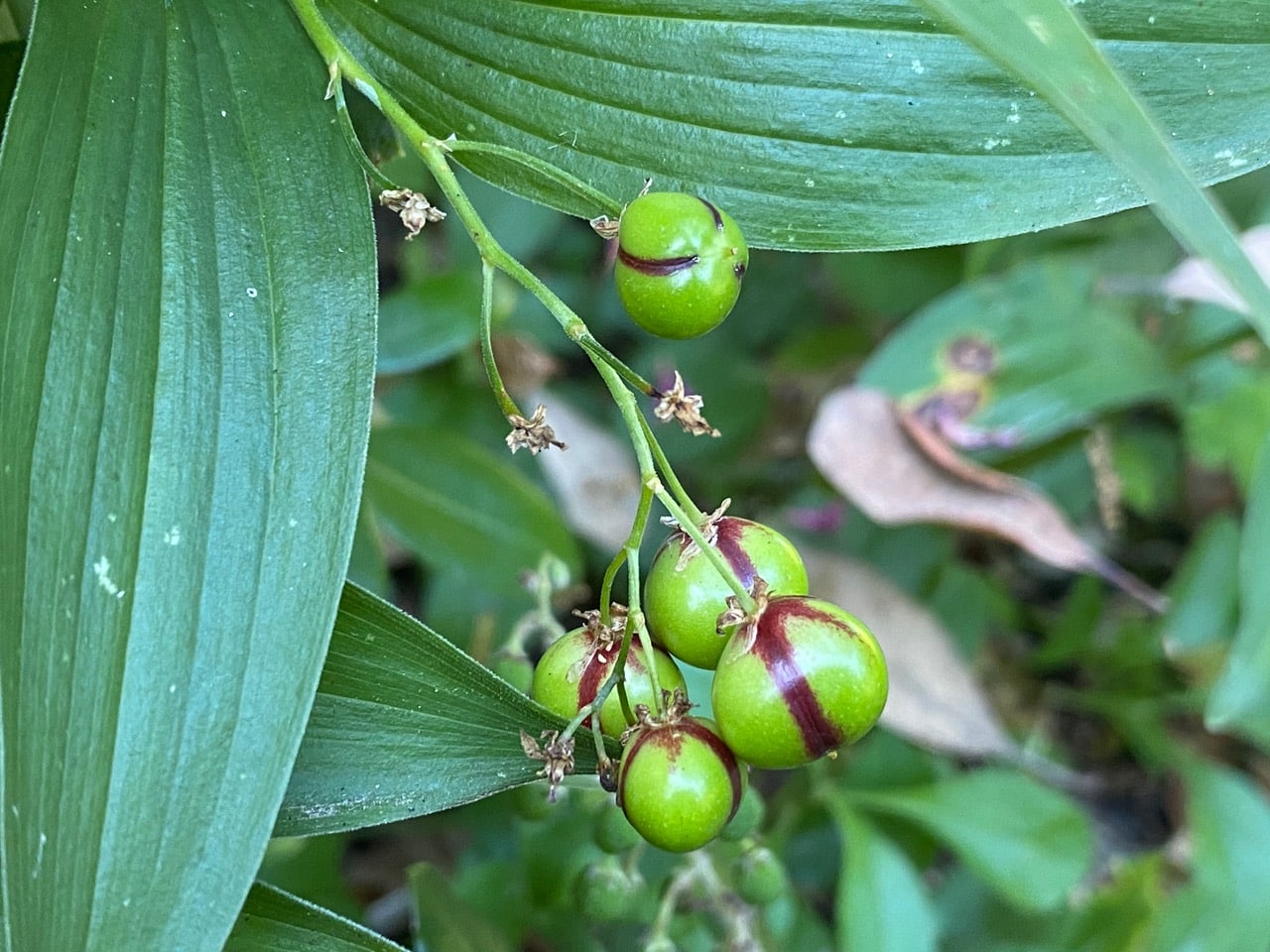
I love these whimsical green berries with vertical maroon stripes. Eventually they turn red-purple to black at maturity. The fruits are eaten by numerous bird species, as well as small rodents.
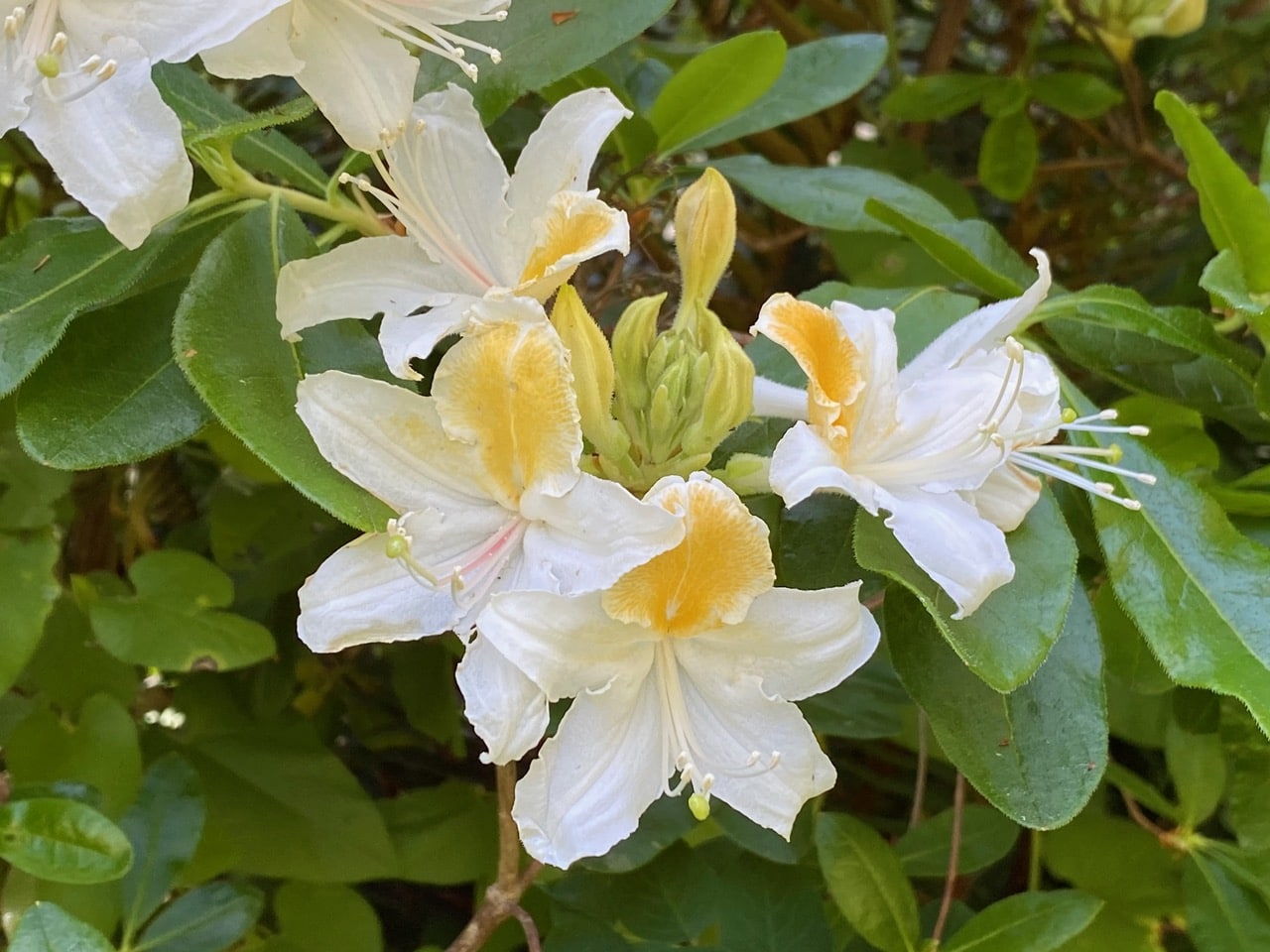
The Western Azalea, Rhododendron occidentale (family Ericaceae) is in peak bloom at the garden. The flowers emit a strong, sweet fragrance that is almost overwhelming.
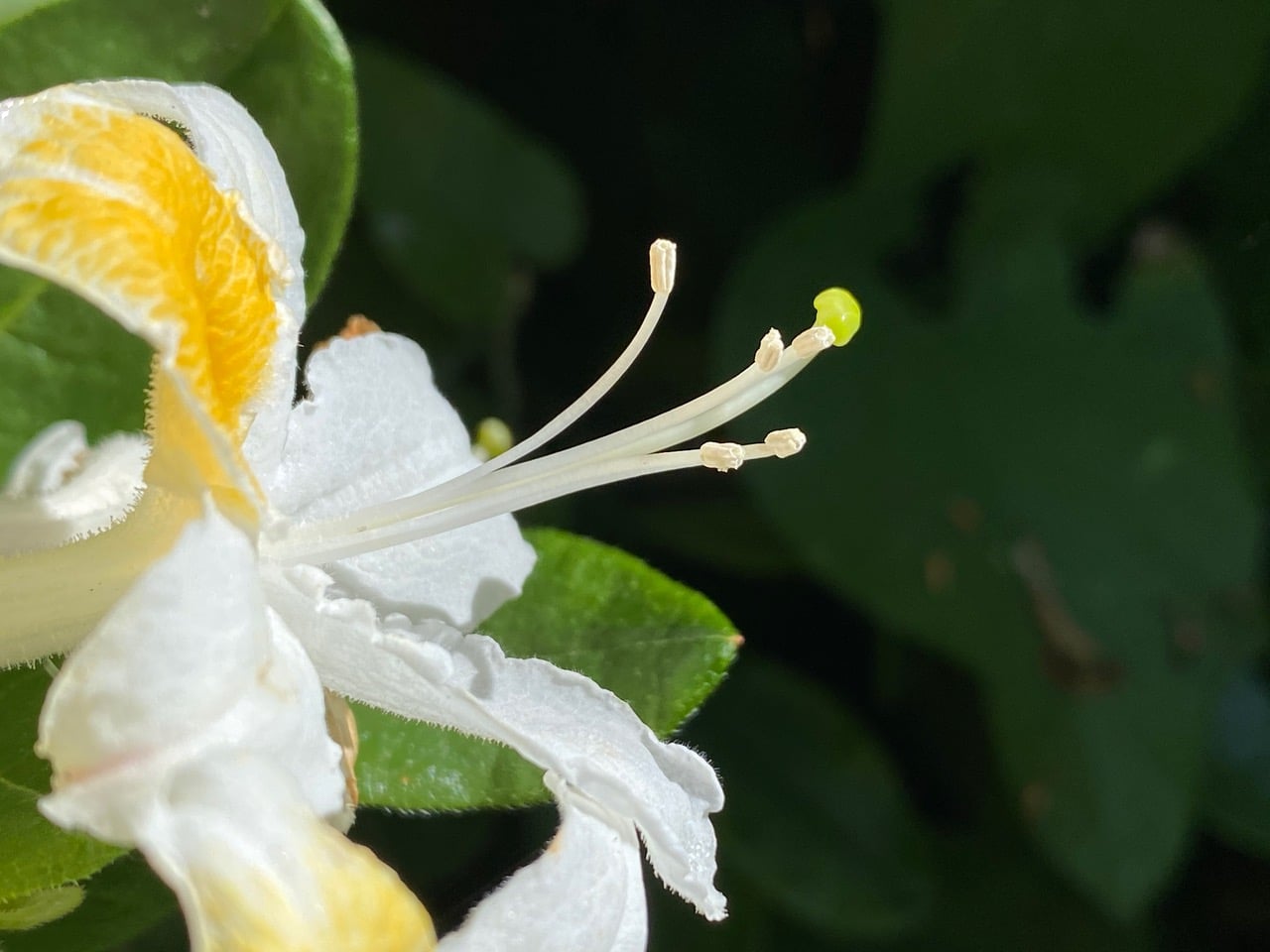
The reproductive structures (both the stamens and pistil) of the large azalea flower are very elongated, protruding a distance from the corolla. The juxtaposition of the parts makes it unlikely for the flower to be pollinated by small insects such as bees. A small insect seeking nectar at the base of the petals is not likely to make contact with the reproductive parts. And a bee collecting pollen on the anthers are not very likely to make contact with the stigma some distance away.
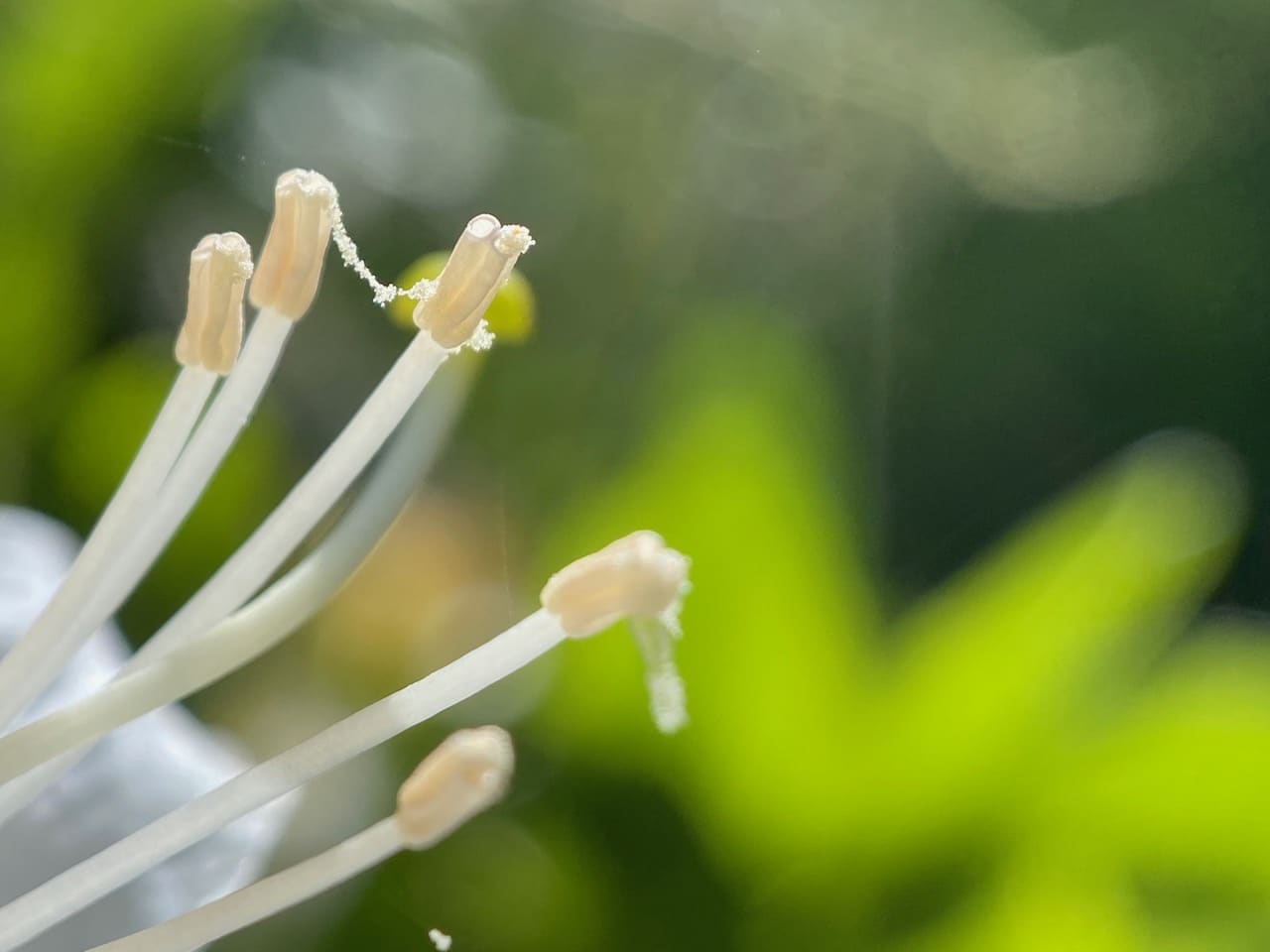
Close-up of the stamens show pollen grains on webby strands (viscin threads) coming off the anthers. Those might have been pulled out of the anthers by the wing of a large butterfly. You can demonstrate this by lightly touching the ends of the mature anthers of the azalea flowers. Strands of viscin thread with pollen grains may come off on your finger.
A limited number of flowering plant families use viscin to link their pollen grains together. Viscin functions, much like pollenkitt, by aiding in the attachment of pollen to visiting insects. Viscin threads are made up of sporopollenin, the same biopolymer that the exine (the outer wall of a pollen grain) is composed of. Viscin threads evolved independently in three plant families – Onagraceae (the evening primrose family), Ericaceae (the heath family) and a subfamily in the pea family known as Caesalpinioideae. It is not surprising that we find viscin threads in the Azalea flower, as the plant belongs to Ericaceae family.
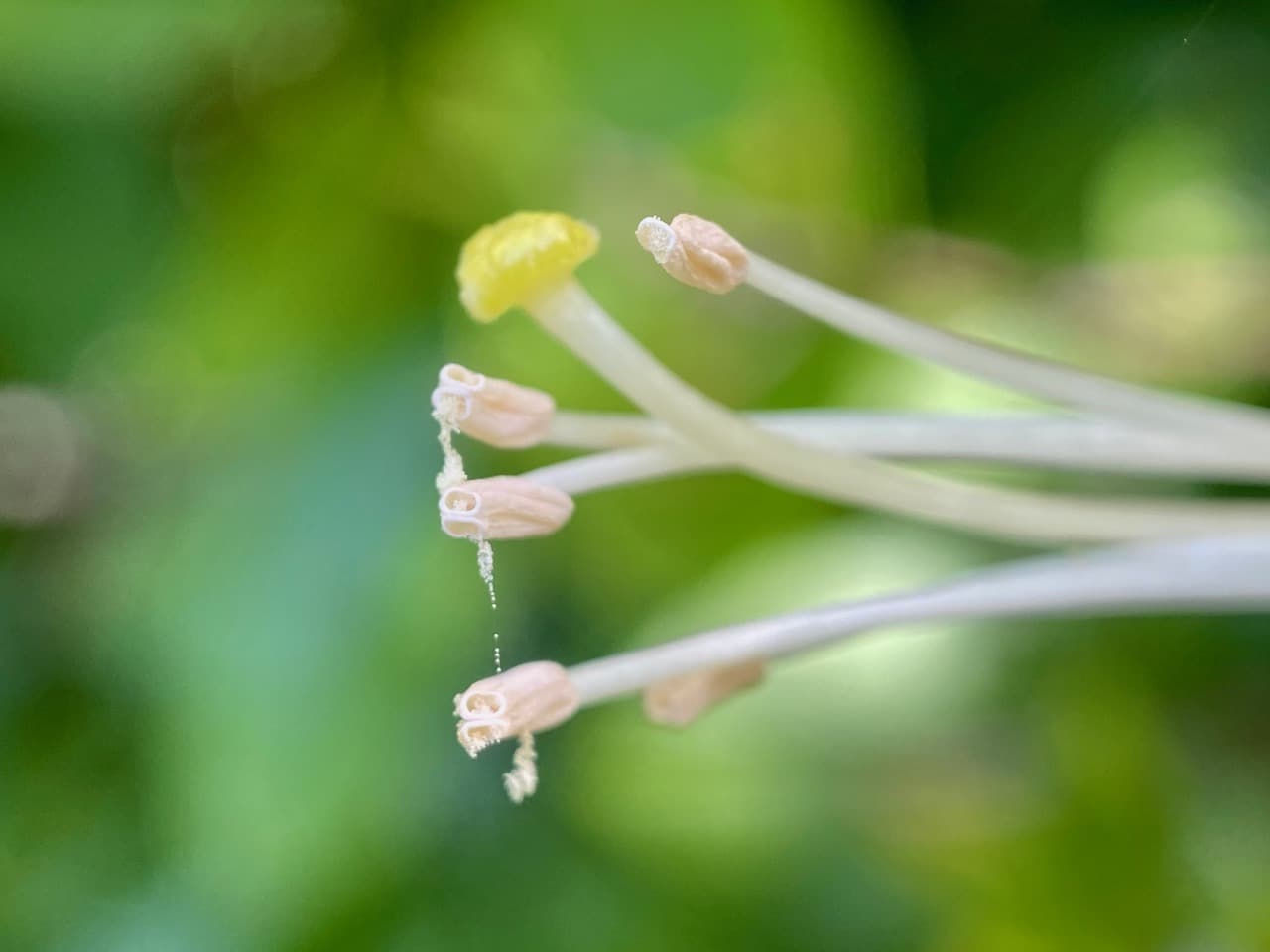 The anthers have terminal pores from which strands of pollen is pulled out.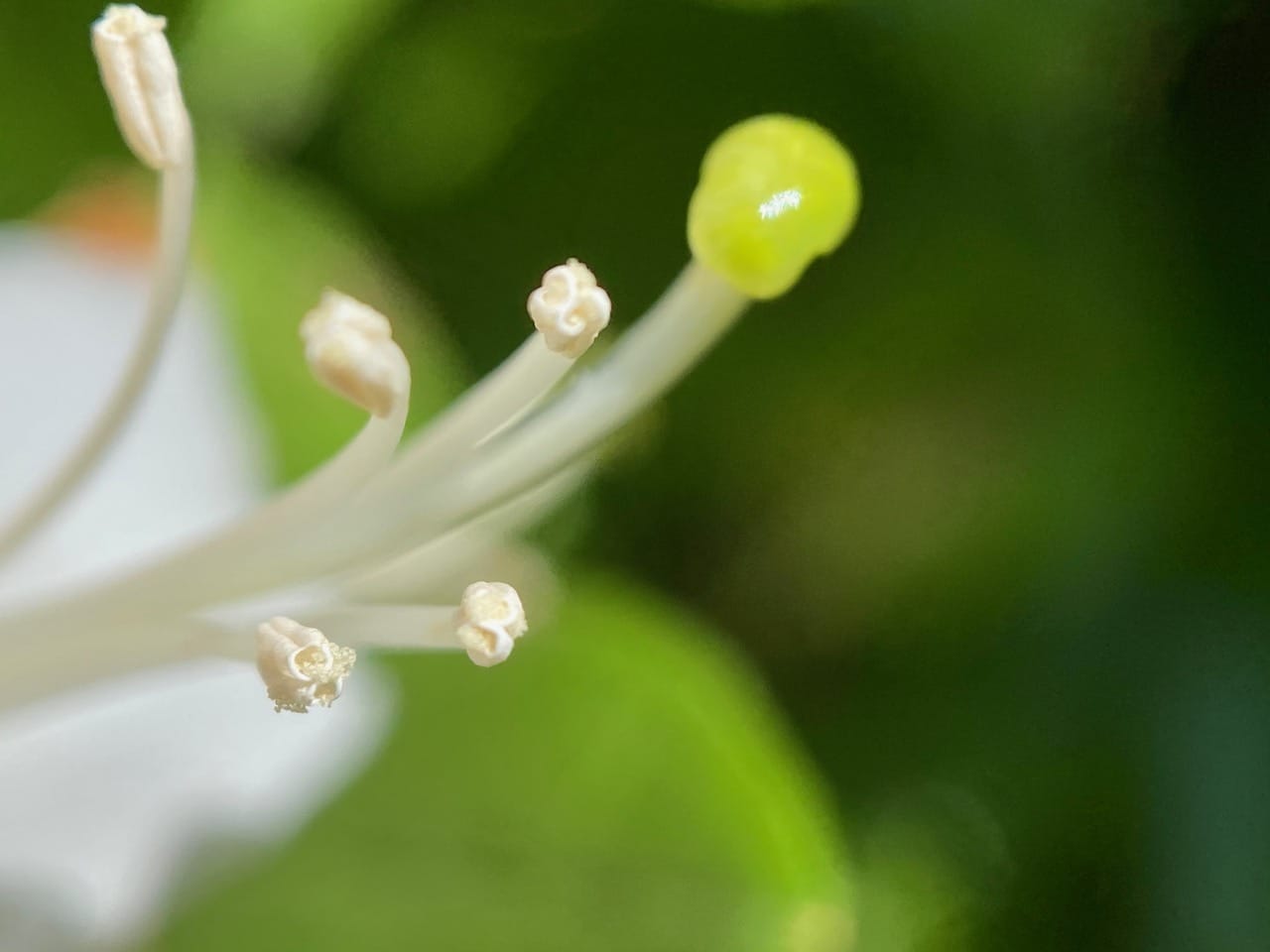
Another view showing the terminal pores of the azalea anthers.
A few years ago, the pollination of the Flame Azalea by the Eastern Swallowtail butterflies was discovered by an astute biologist from North Carolina State University. These large butterflies move their wings continuously as they feed on nectar, and the fanning motion enables the transfer of the stringy pollen from the anthers onto the butterfly’s wing, and eventually to the stigma of another flower. The story of the discovery is covered beautifully in the Nature program “Sex, Lies and Butterflies”.
Given the pale color of the Western Azalea flowers and their strong fragrance, I wonder if they were not pollinated by moths at night. Long-tongued Hawk Moths (family Sphingidae) are capable of hovering in front of flowers to probe for nectar without landing. Their wings can conceivably pull out the stringy pollen from the anthers of Western Azalea and transfer it to the next flower the moths visit. Pollination of Evening Primrose, Oenothera sp. (family Onagraceae) by hawk moths is well documented.
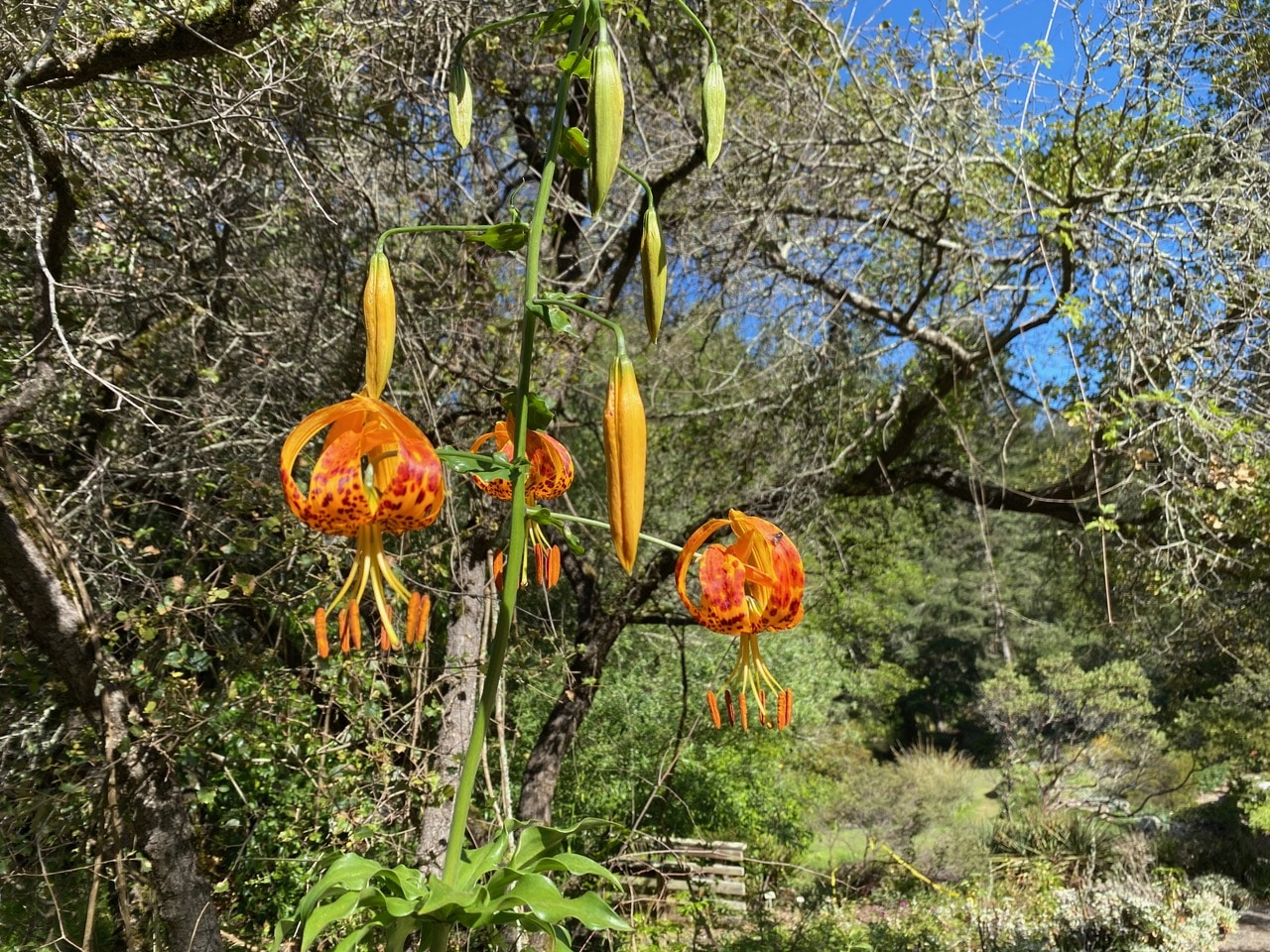
Another large flowered species is blooming profusely at the garden – the striking Leopard Lily, Lilium pardalinum. Like the Western Azalea, the reproductive structures of the flowers are very elongated and extend well beyond the corolla with reflexed tepals. Small insects are not likely to pollinate these flowers. These lilies are pollinated by butterflies, especially the large Swallowtails (family Papilionidae).
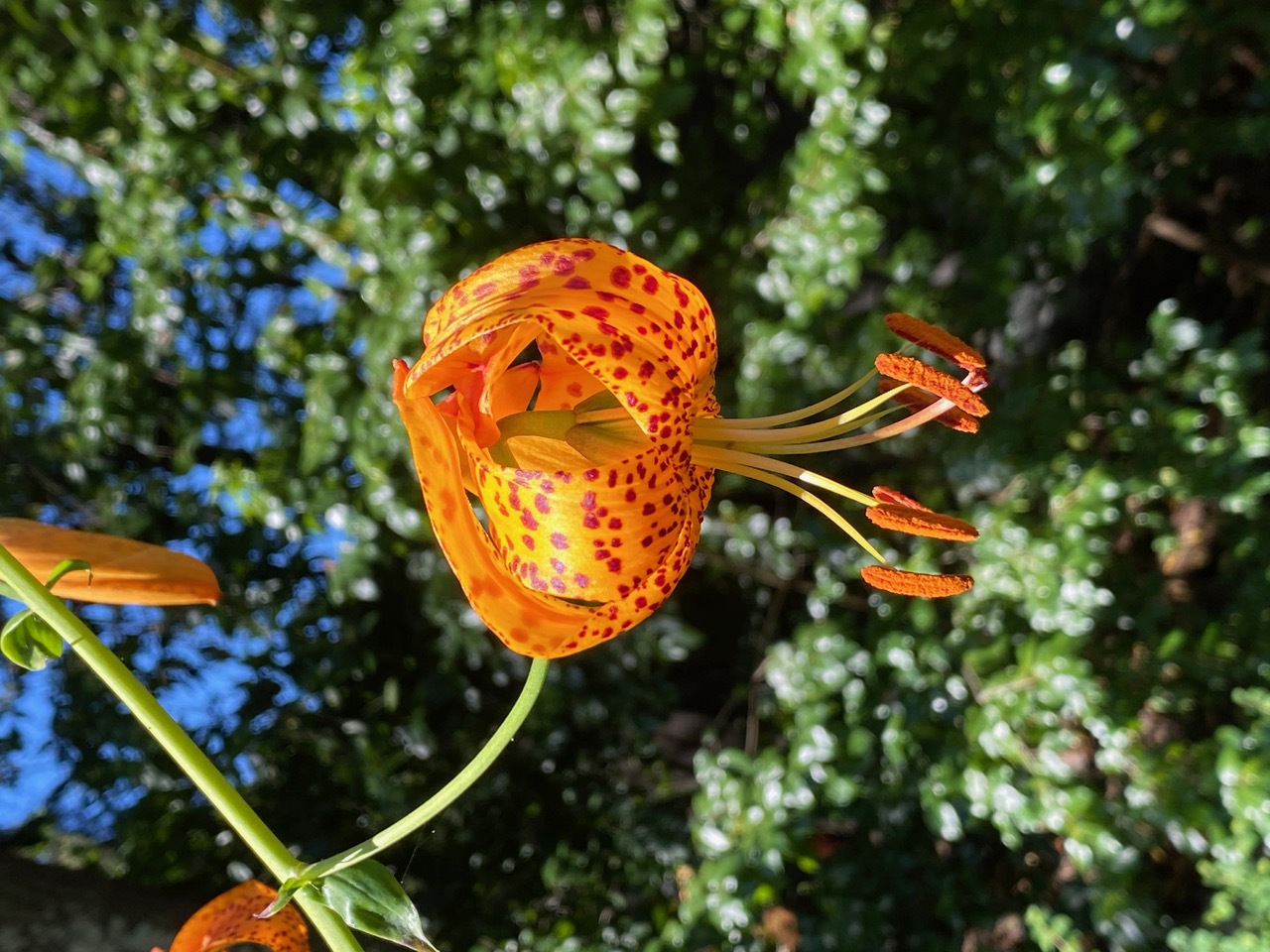
However, the pollen grains of Leopard Lily are loose and not attached to viscin threads. They are rubbed onto the wings or body of the butterfly as it probes for nectar.

Several Yellowjackets are visiting the flowers of California Bee Plant, Scrophularia californica near the large patch of California Pipevine.

While looking for Pipevine Swallowtail caterpillars, I find this Yellowjacket lying motionless on a Pipevine leaf in the shadows.

I part the leaves to shed light on the wasp. It still doesn’t move. Is it dead?
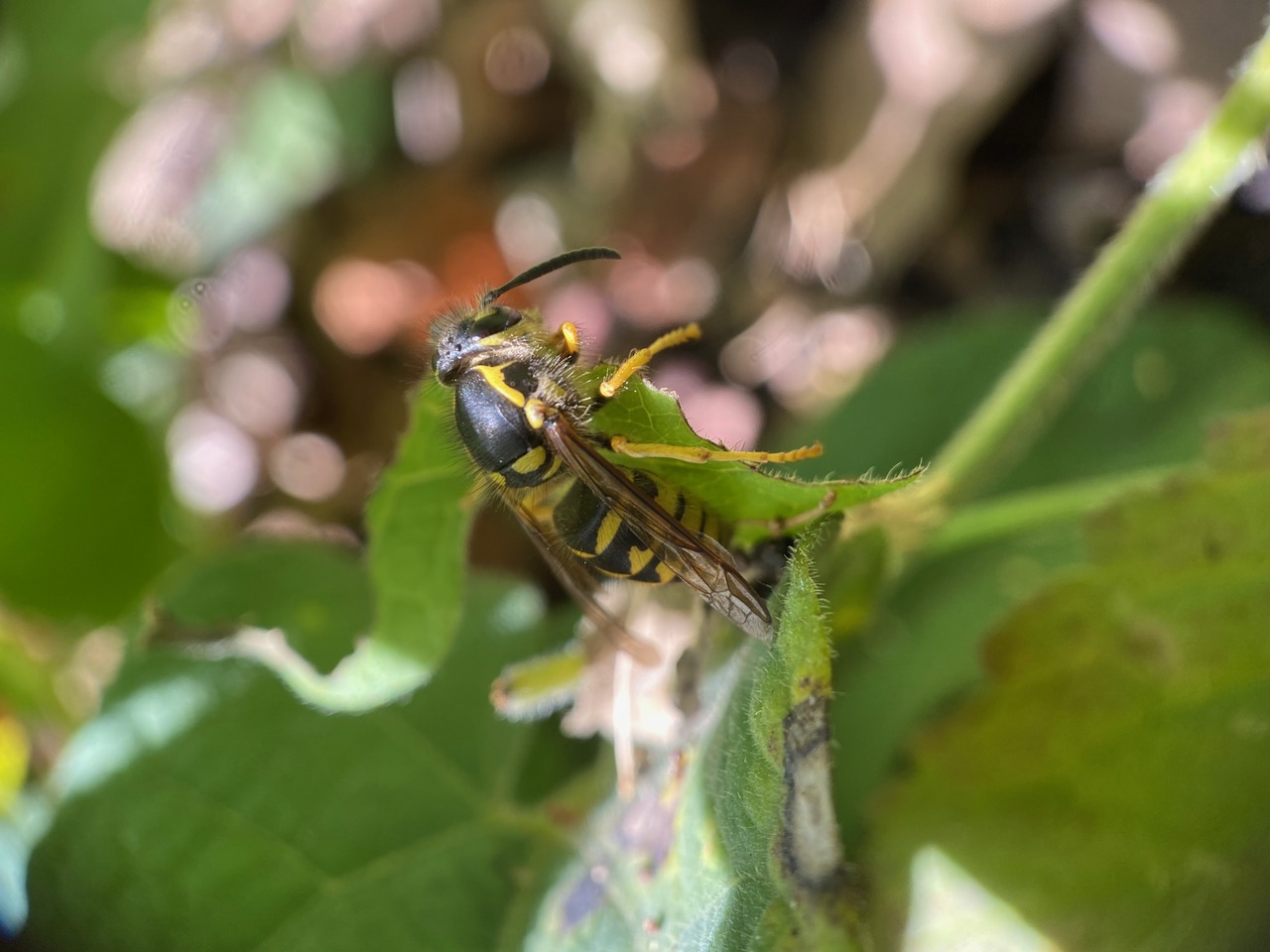
Here’s another dead or moribund Yellowjacket draped over a Pipevine leaf in the undergrowth. I am too afraid to prod the wasp and risk a sting.
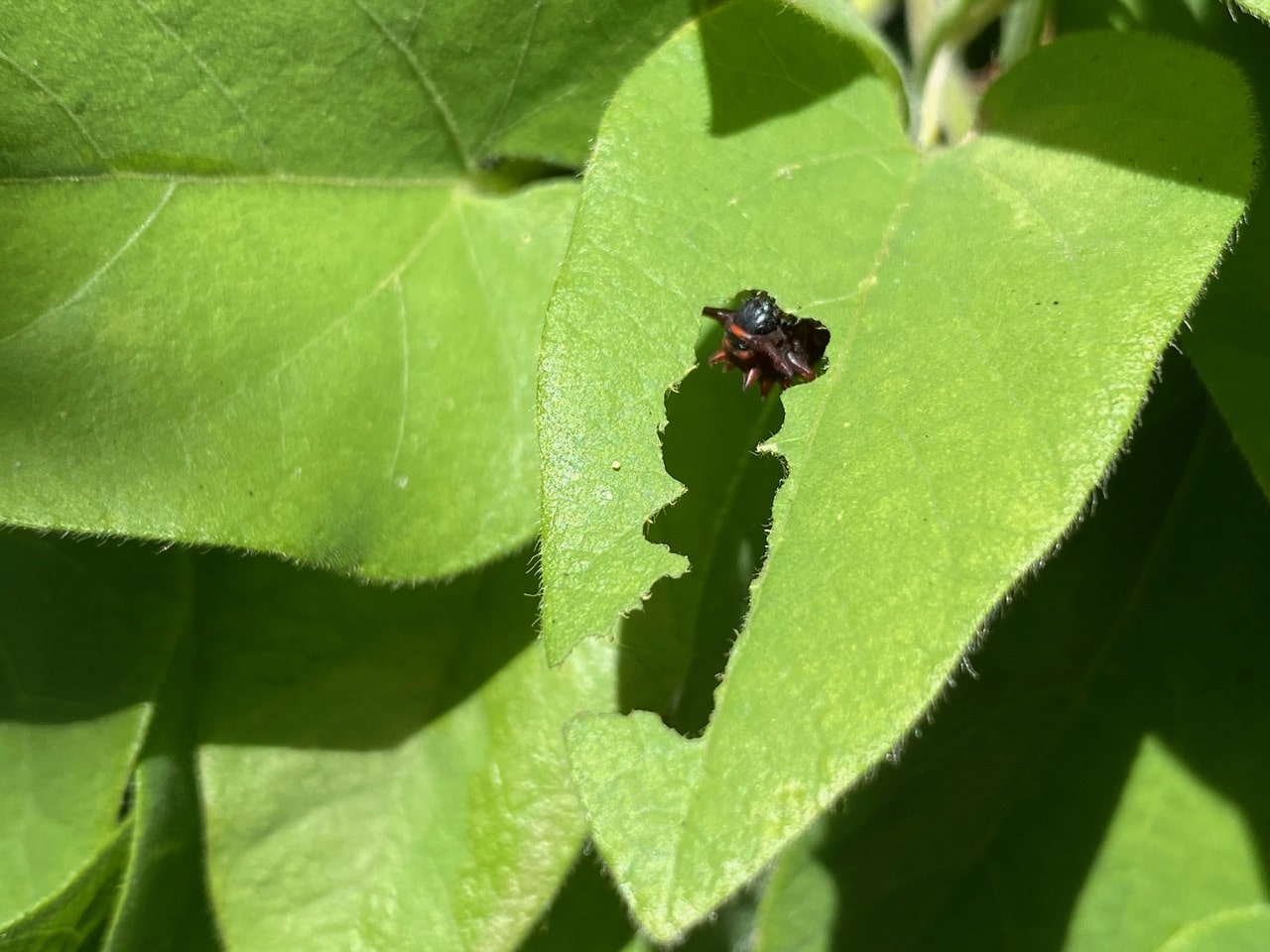
A small Pipevine Swallowtail caterpillar is munching on a leaf of its host plant from the underside.
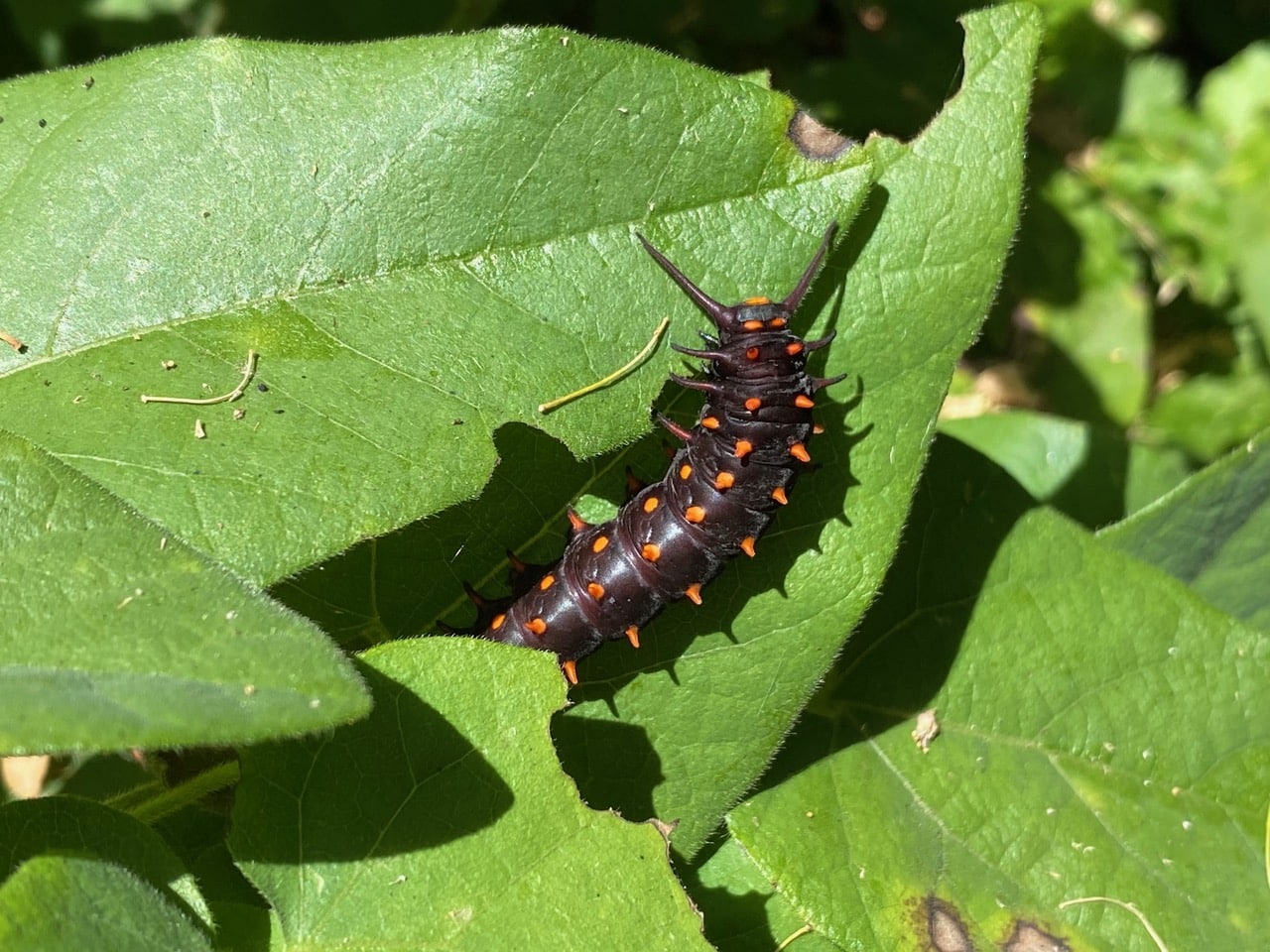
Whoa, this one is about ready to pupate! Pretty soon the large caterpillars will be roaming the surrounding areas in search for good places to hang their chrysalids.

A Yellow-faced Bumble Bee, Bombus vosnesenskii (family Apidae) is foraging on a dense spike of Douglas’ Spiraea, Spiraea douglasii. Gathering pollen on these flowers is an easy shashay across the spike to loosen the pollen from the countless exerted anthers.
 A few rabbits are feeding on the lawn area, oblivious of my approach. Are they eating the clovers growing on the lawn?
A bumper crop of Thimbleberries this year!
 Who’s that black-and-yellow insect that just landed on the Thimbleberry leaf? The light is terrible, but I can tell that it is not a Yellowjacket as I initially thought, but a fly. Look at those large wrap-around eyes, and those are not wasp antennae. A hoverefly? iNaturalist has identified it as a Spotted Soldier Fly, Stratiomys maculosa (family Stratiomyidae). Yay, a new one for me!
Stratiomyidae larvae are found in a wide array of locations, mostly in wetlands, damp places in soil, sod, under bark, in animal excrement, and in decaying organic matter. They may be saprophagous, mycophagous, or predatory. Adults are found near larval habitats. They are diverse in size and shape, ranging from 3 – 20 mm. Some are wasp mimics, marked with black and yellow. The flies have antennae in three segments, with the terminal segment annulated. They are often rather inactive flies which typically rest with their wings placed one above the other over the abdomen. Adults visit flowers to feed on nectar, or else do not feed at all, dedicating their short lives to reproduction.
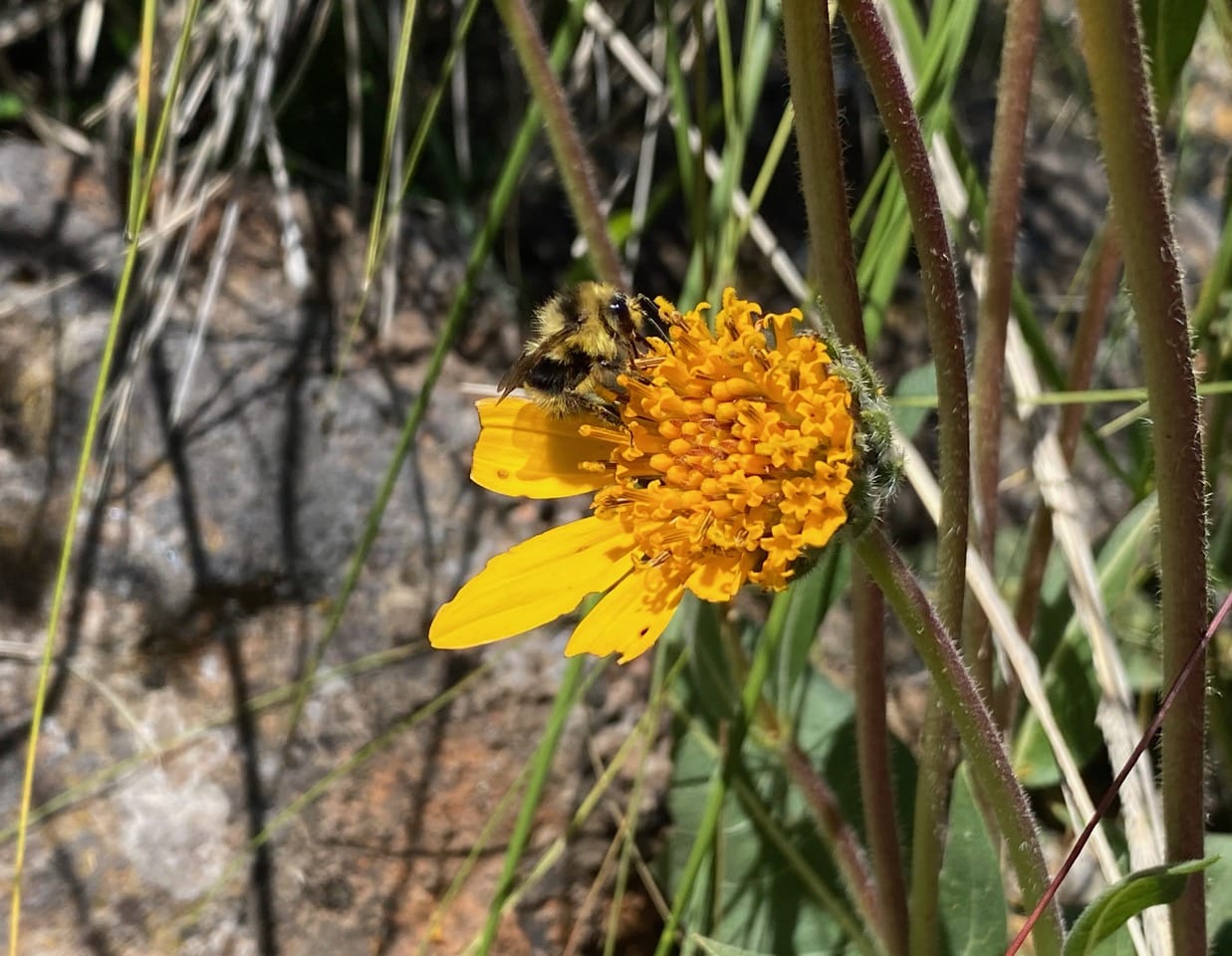
A scruffy Black-tailed Bumble Bee, Bombus melanopygus (family Apidae) is visiting an equally scruffy-looking flowerhead of Narrowleaf Mule’s Ear, Wyethia angustifolia. Why does the bee visit a visually decrepit flowerhead? A closer examination shows that although most of the ray flowers have been lost, there are still fresh disc flowers and buds in the center of the flowerhead. The bee is not fooled by mere appearances.
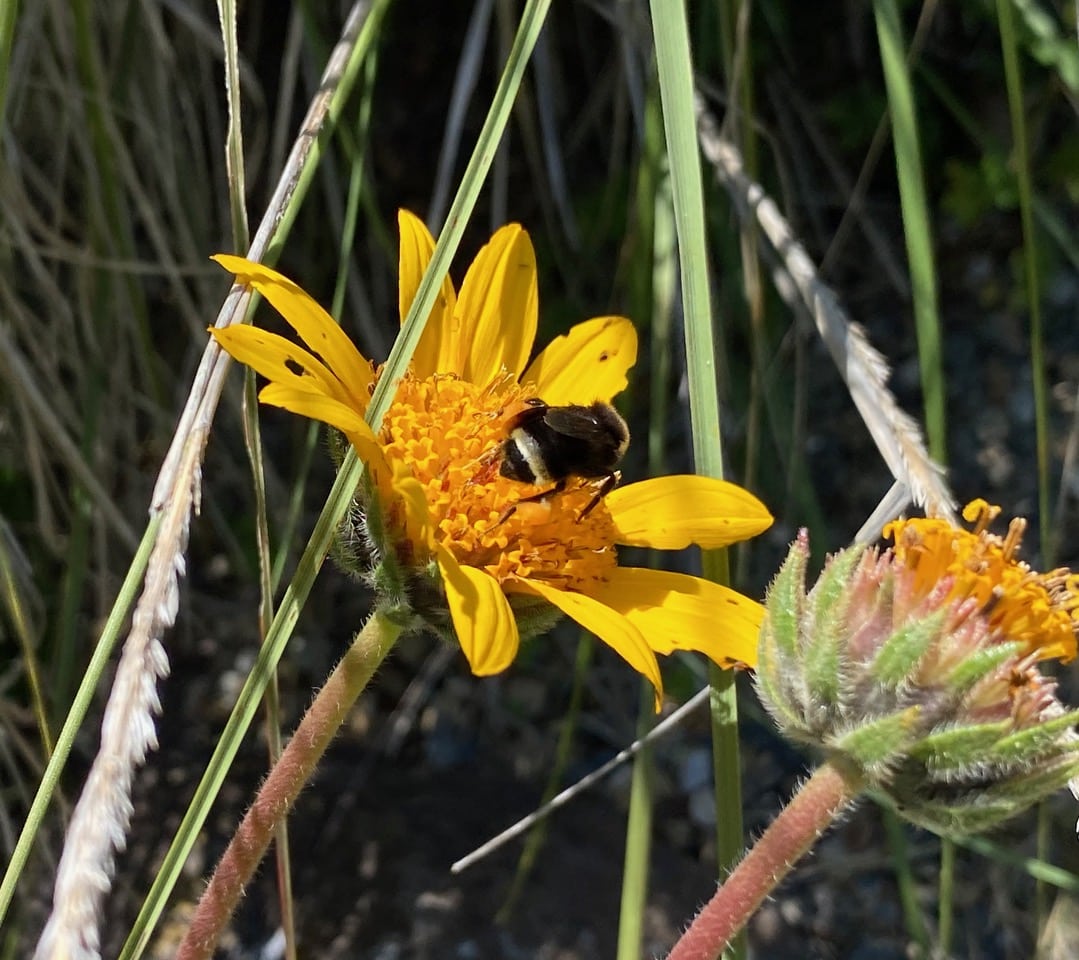
A Yellow-faced Bumble Bee, Bombus vosnesenskii (family Apidae) lands on one of the last intact flowerheads of the Narrowleaf Mule’s Ear.