

Pollinator Post 6/11/25
Carol and I visit Mitchell Canyon at the base of Mt. Diablo this cool, sunny day.
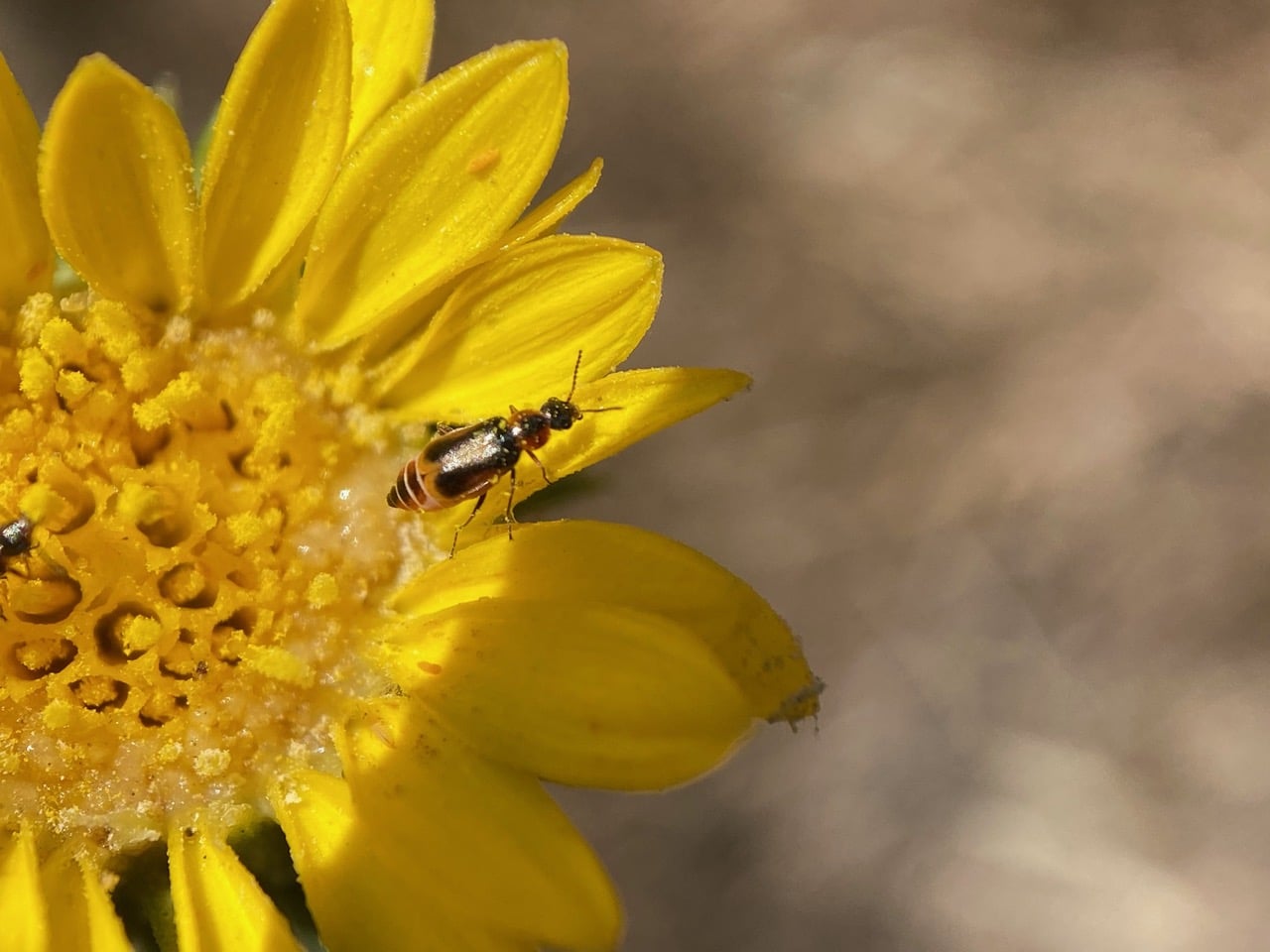
Most of the plants in the demonstration garden next to the visitor center have gone dormant. I pause to check on the Grindelia in bloom. There are a few tiny insects on the flowerheads. They turn out to be Malachite Beetles (subfamily Malachiinae, family Melyridae).
The Malachite Beetle (subfamily Melachiinae) is a member of the family of Soft-winged Flower Beetles (family Melyridae). Most Melyrids are elongate-oval, soft-bodied beetles 10 mm or less in length. Members of the subfamily Malachiinae have peculiar orange structures along the sides of the abdomen which can be everted, but usually kept hidden. Most adults and larvae are predaceous. Omnivorous adult Melyrids are often found on flowers out in the open, where they feed on pollen, insect eggs, and flower-loving insects that land within their grasp. The larvae generally stay concealed under tree bark or leaf litter or soil, where they prey on other invertebrates.

As the morning warms up, we are grateful for the dappled shade provided by the large oak trees flanking the trail.
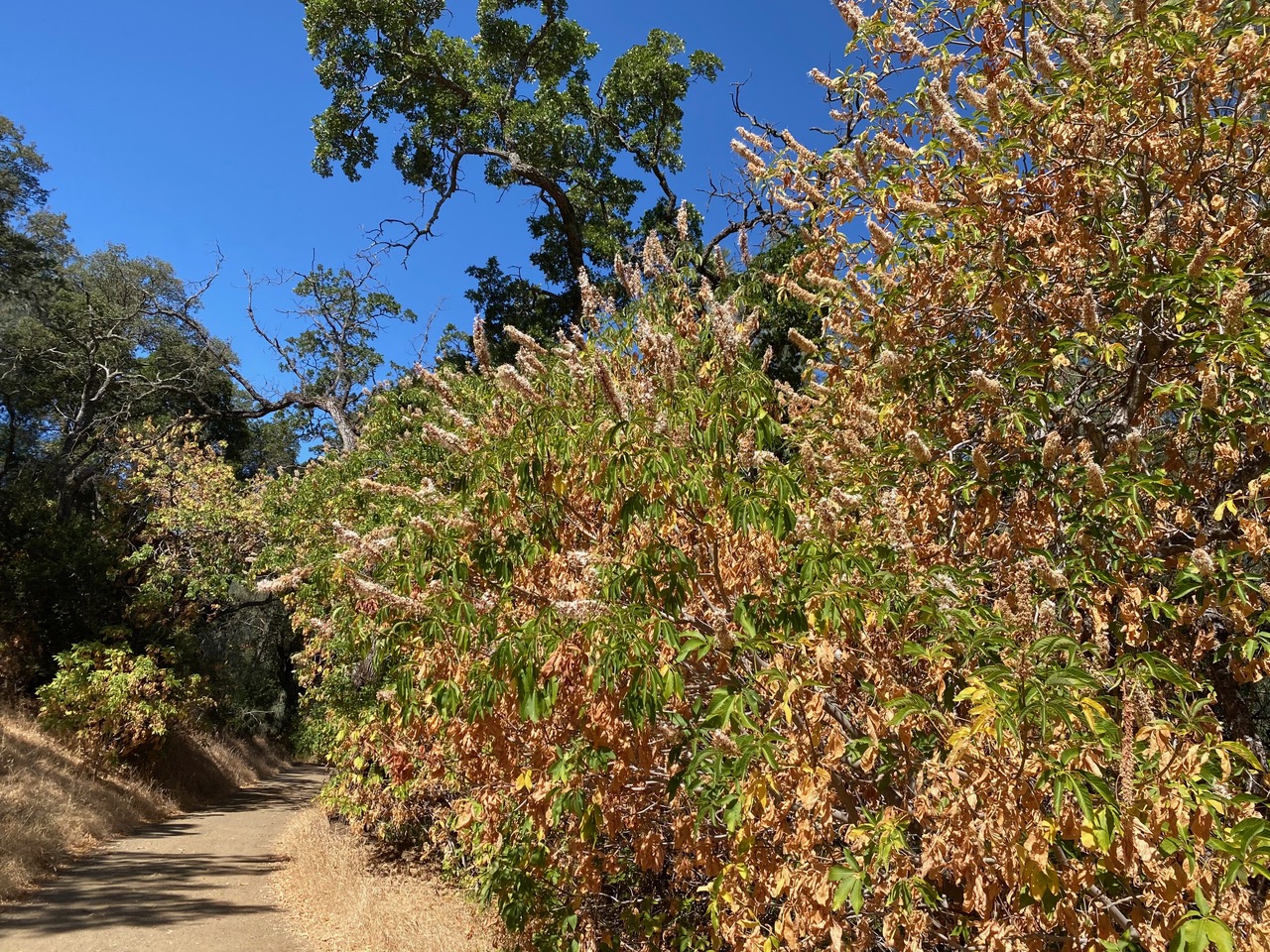
Wow, the Buckeye trees, Aesculus californica along this stretch of the trail are already shedding their leaves. Buckeye trees are drought deciduous.

While the fruit set on the Buckeye trees appear dismal, this particular fading inflorescence bear several developing fruits near the tip. The long, protruding structures on the fruits are the persistent styles of the female flowers. Buckeye trees are monoecious, with separate male and female flowers borne on the same plant. Most inflorescences are composed predominantly of male flowers, while the number of female flowers varies. Hence fruit set in Buckeye trees are inconsistent as well, even if all the female flowers have been pollinated.
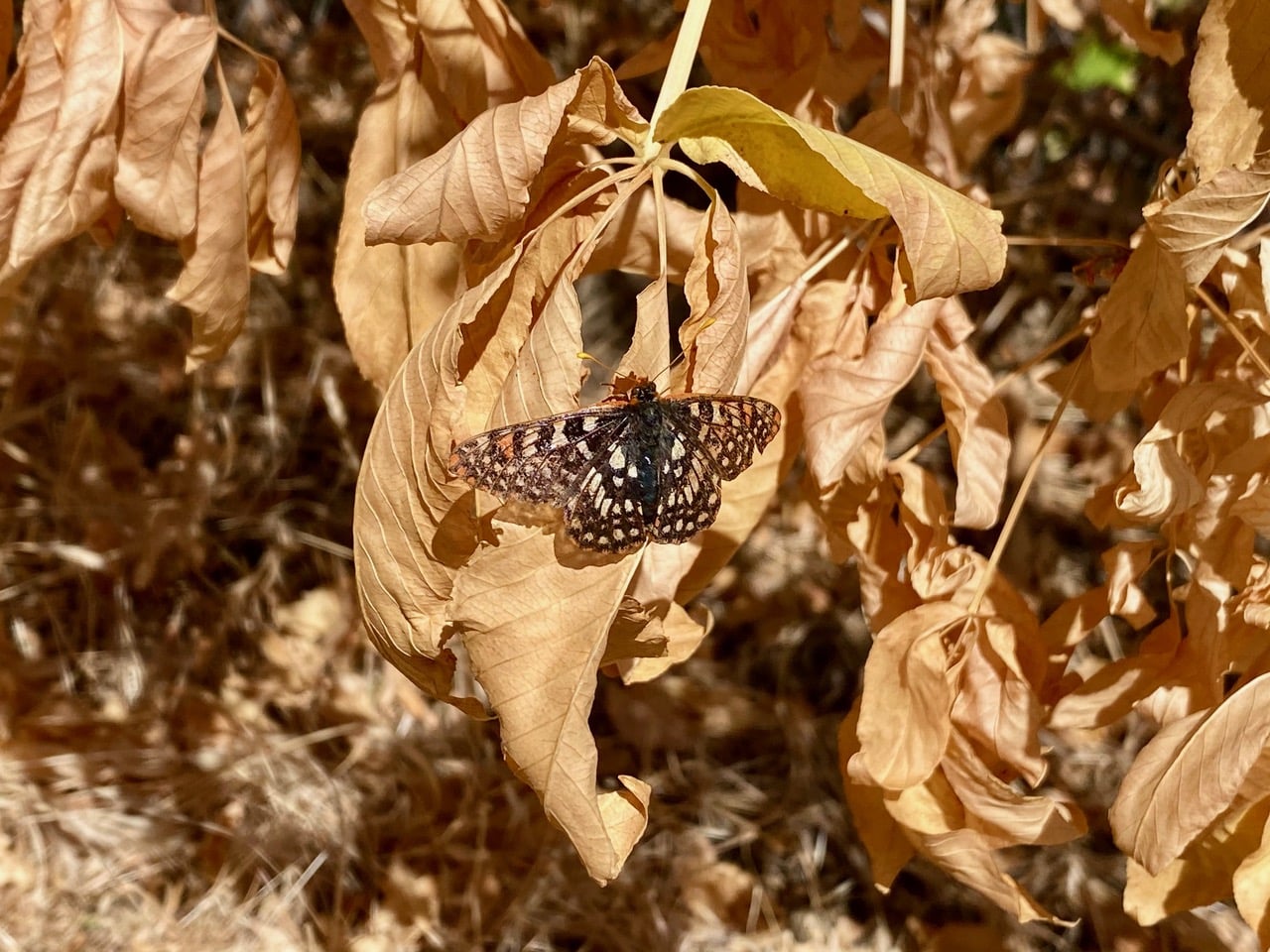
A Variable Checkerspot butterfly flutters by and lands on a dry Buckeye leaf on the tree. The butterfly has seen better days – it has lost much of its scales that its wings look translucent.
The Variable Checkerspot, Euphydryas chalcedona (family Nymphalidae) is found across western North America. The butterfly occupies a wide range of habitats, including sagebrush flats, desert hills, prairies, open forests and alpine tundra. Males perch or patrol around larval host plants to encounter females. Eggs are laid in large groups on underside of leaves of host plants. Host plants include California Bee Plant, Scrophularia californica, and Sticky Monkeyflower, Diplacus aurantiacus. These plants provide the caterpillars with iridoid glycoside, a chemical that imparts unpalatable taste to birds, protecting the caterpillars from predators. Larvae feed in large, loose groups on the host plants. Individuals overwinter (enter diapause or hibernation) as third or fourth instar larvae in sheltered sites under bark or dead branches, in hollow stems and in rock crevices. Pupation begins in early to mid April and the adult flight season begins between mid-April and May and continues into June. The adults feed exclusively on nectar, and have a life span of about 15 days.
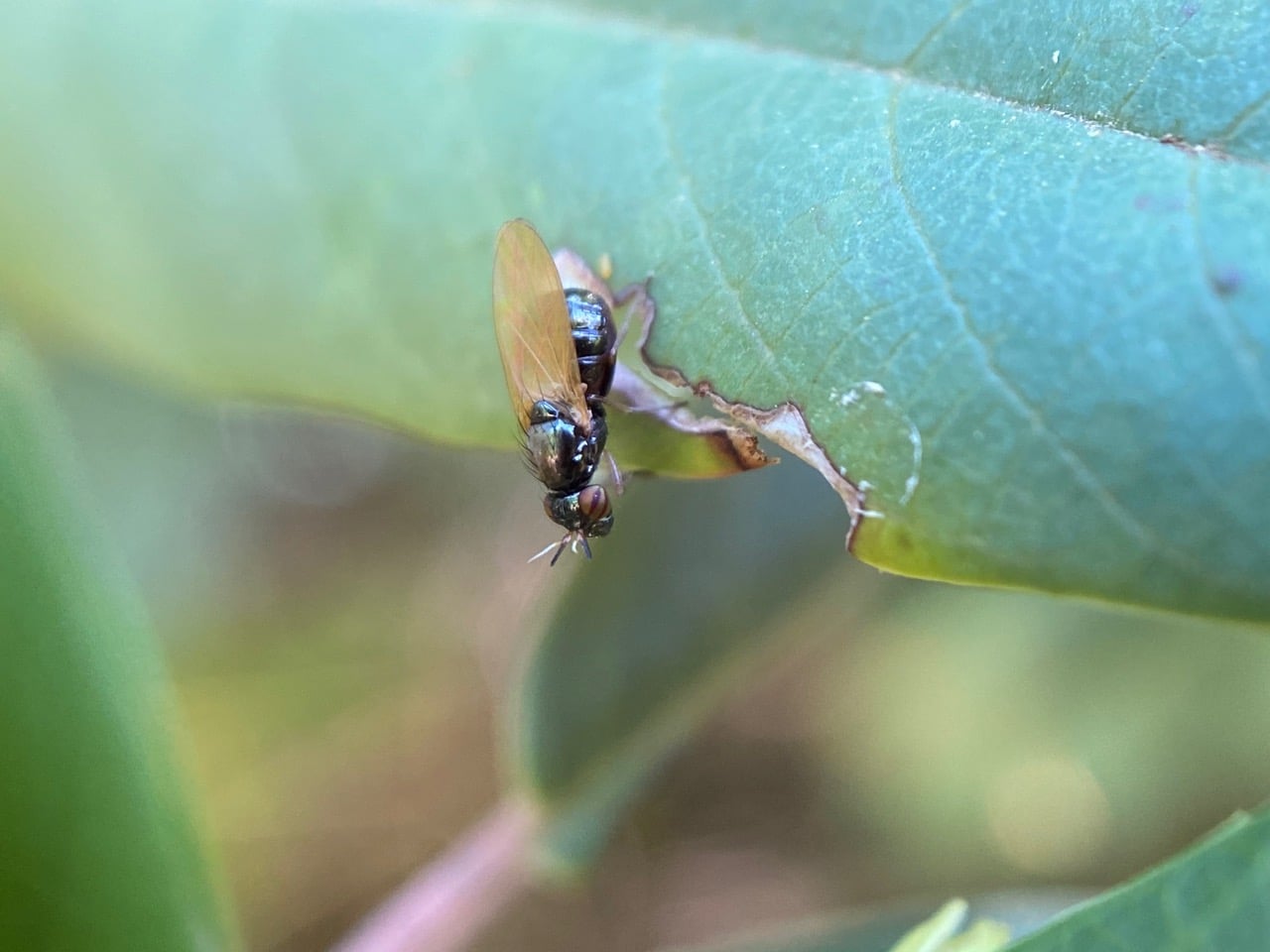
A tiny, glossy black fly is resting on a leaf of Coffeeberry, Frangula californica. I recall seeing these flies on Coffeeberry in Alameda recently – they are Calliopum sp. (family Lauxaniidae).
Some 1800 species of Lauxaniidae have been described. They have a cosmopolitan distribution. Most species inhabit forests, where the adults usually are found sitting on leaves of the moist and shady understory. Lauxaniidae are small flies (2-7 mm in length). They are often rather plump, dull, yellowish-brown or black, or partly lustrous flies. Many species have iridescent reddish/purplish or greenish eyes. Larvae are mostly saprophagous, feeding on decaying vegetation, soil, bird nests, etc. Adults may visit flowers. The North America, the genus Calliopum is only recorded from the West.
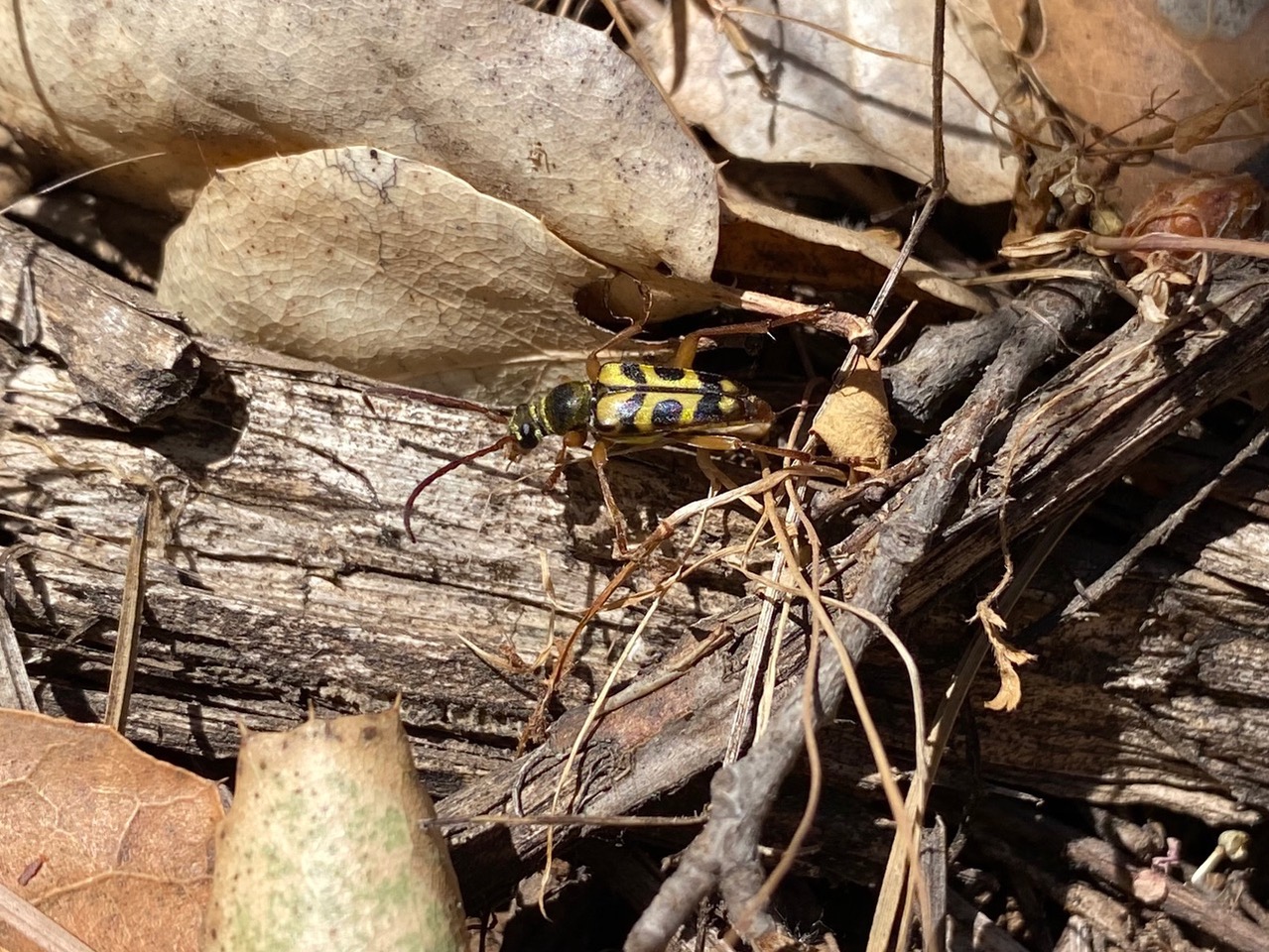
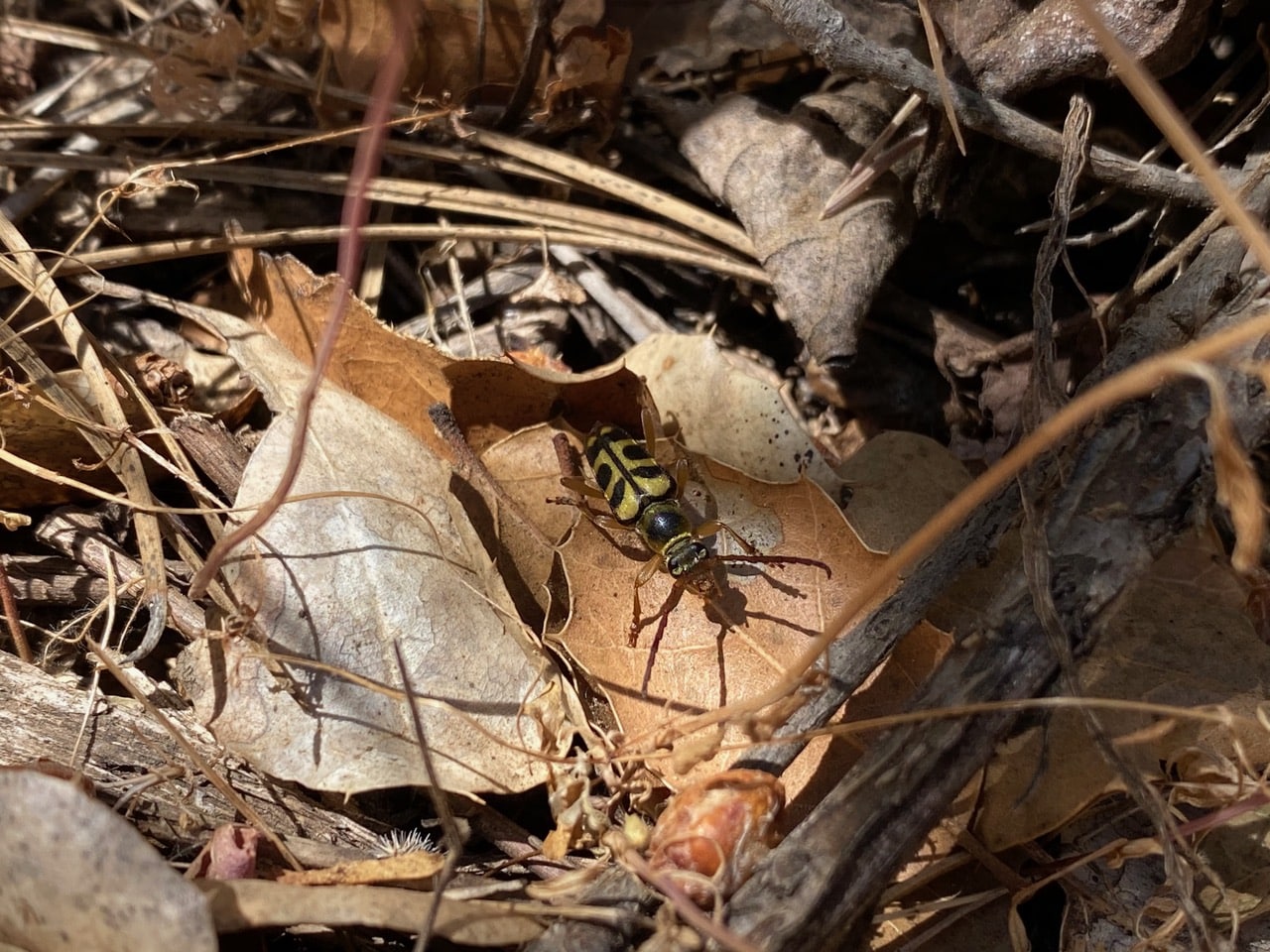
A wasp-like insect flies past me, but its clumsy flight tells me that it’s probably not a wasp. The insect finally lands on the leaf litter. Hah, it’s a Flower Longhorn Beetle, Strophiona tigrina (subfamily Lepturinae, family Cerambycidae).
Flower Longhorn Beetles (family Cerambycidae, subfamily Lepturinae) are usually among the smaller members of their family. These beetles have a narrow body and very long legs. The thorax is markedly less wide than the wings, while the elytra tips are often pointed. They also share the family trait with other Cerambycids of having very long antennae. Sexual dimorphism is found in some species. The beetles are found on flowers where they feed on pollen and nectar, and are considered pollinators. They have a particular affinity for the umbel flowers of the carrot family, Apiaceae. The beetles spend their larval days as borers, just like other Cerambycids. However they are not considered pests, as they select trees that are stressed, dying, or dead.
Flower Longhorn Beetles (family Cerambycidae, subfamily Lepturinae) are usually among the smaller members of their family. These beetles have a narrow body and very long legs. The thorax is markedly less wide than the wings, while the elytra tips are often pointed. They also share the family trait with other Cerambycids of having very long antennae. Sexual dimorphism is found in some species. The beetles are found on flowers where they feed on pollen and nectar, and are considered pollinators. They have a particular affinity for the umbel flowers of the carrot family, Apiaceae. The beetles spend their larval days as borers, just like other Cerambycids. However they are not considered pests, as they select trees that are stressed, dying, or dead.
Strophiona tigrina is a species found in North America. The beetle’s elytra are densely covered with adpressed hairs that lie flat on the wings. The hairs give the elytra a golden sheen in certain incident light.
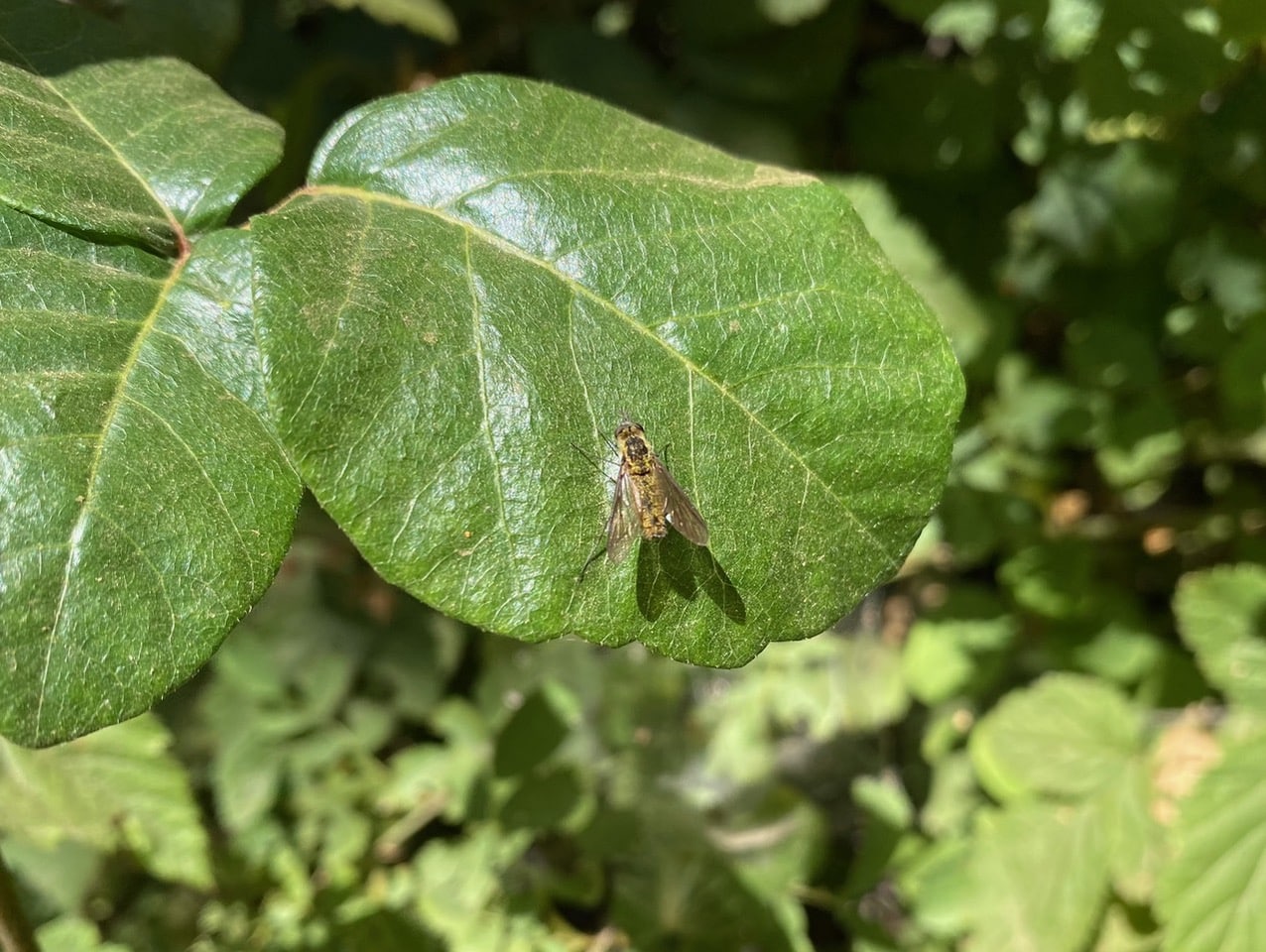
A tiny fly is perched on a leaf of Poison Oak. Not wanting to make contact with the leaf, I refrain from using a macro lens, and instead photograph the fly from a distance. It looks like a Bee Fly (family Bombyliidae) with golden hairs covering its body unevenly. I don’t think I have ever seen this species before. iNaturalist has helped identify it as a Bee Fly in the genus Thevenetimyia (family Bombyliidae).
The Bee Flies belong to the family Bombyliidae. Adults generally visit flowers for nectar and pollen, some being important pollinators. Larvae generally are parasitoids of other insects. When at rest, many species of bee flies hold their wings at a characteristic “swept back” angle. The adult females usually deposit eggs in the vicinity of possible hosts, quite often in the burrows of beetles or ground-nesting bees/wasps. Bombyliidae parasitism is not host-specific, but rather opportunistic, using a variety of hosts.
Thevenetimyia is a genus of bee flies in the family Bombyliidae. There are more than 40 described species in Thevenetimyia found worldwide, mostly in North America. They are parasites of wood-boring beetle larvae.
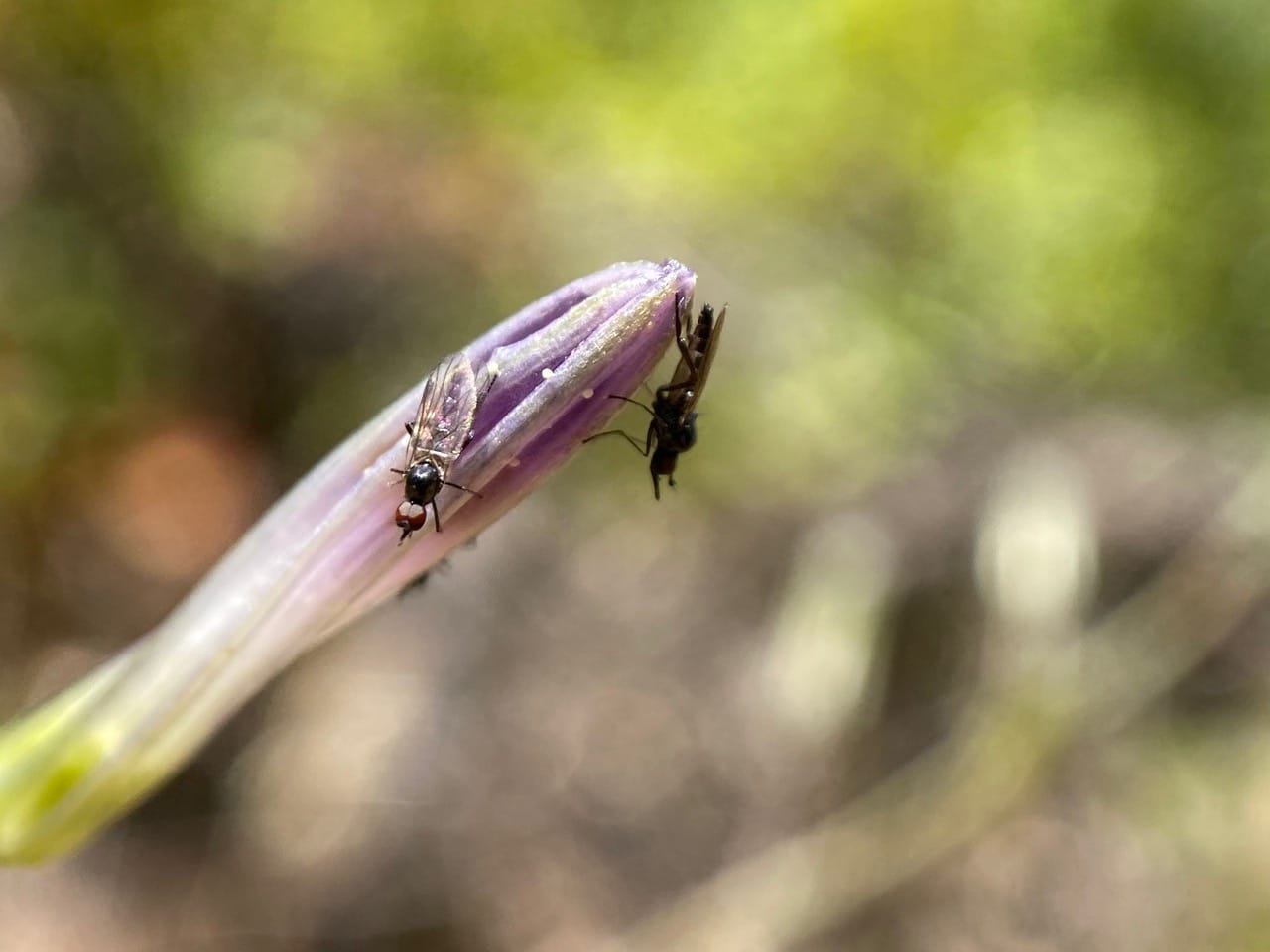
Most of the Soap Plants, Chlorogalum pomeridianum along the trail are done blooming, and many are developing fruits on their airy branches. Since these flowers bloom in the evening, I don’t expect a floral show today. I am surprised to see what look like small flies gathered on the flower buds that are ready to bloom, or flowers that have just finished blooming and have closed up. Hybotid Dance Flies? I have seen those at Skyline Gardens in the past around this time of year, perched on the Soap Plant flowers in the late afternoon waiting for them to open up. I have also photographed the flies taking nectar and pollen at dusk. From those few observations, I have assumed that they were nocturnal or crepuscular. So what are they doing in the middle of the day here?
The flies are frustratingly skittish and fly away at my camera’s approach every time. I manage to snap a picture of these two flies that didn’t flush. Yep, they are Hybotid Dance Flies! What are those round white things in the creases of the closed flower – eggs? Are the flies here to lay eggs?
I will now share some of my previous observations at Skyline Gardens of the blooming Soap Plant and the Hybotid Dance Flies.
Pollinator Post 6/9/23 (2)
I am glad I couldn’t make it to Skyline Gardens until late this afternoon. If I have come earlier, I would’ve missed this special treat – the blooming of Soap Plant along Skyline Trail!
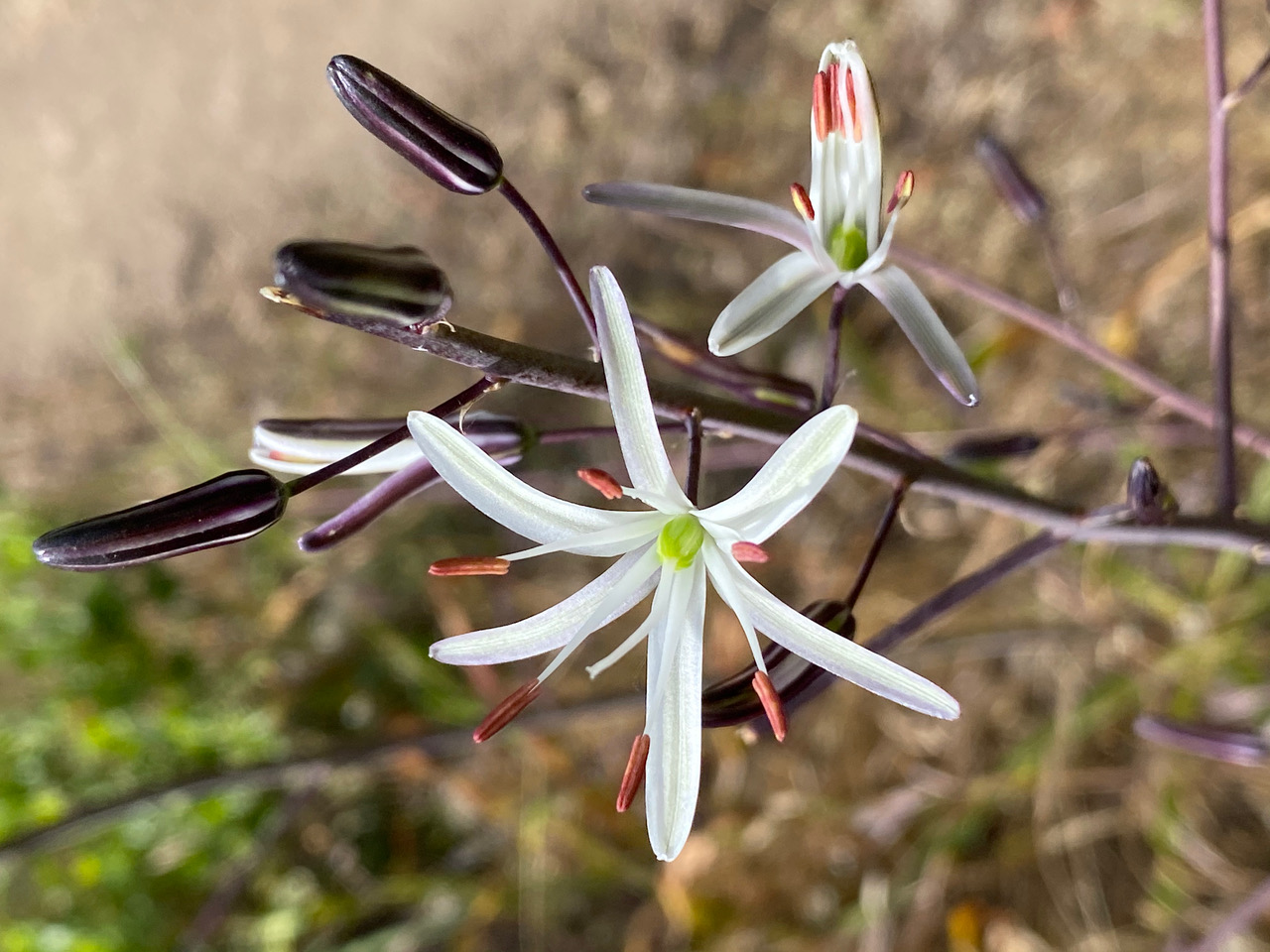
Soap Plant, Chlorogalum pomeridianum is a perennial that grows from a bulb. The plant is easily recognized by its linear, wavy-edged leaves. The generic name Chlorogalum means “green milk”, referring to the green juice exuded by a broken leaf. The specific epithet pomeridianum, or “past mid-day”, is the Latin phrase which gave rise to our abbreviation “p.m.” This refers to the plant’s trait of opening its flowers late in the day.
The white star-like flowers have a very short life – in the late afternoon one row of buds opens, starting from the bottom of the long stalk. Each flower remains open through the night, but twists closed (the wilted tepals twist around the fertilized ovary) by the morning and never opens again.
The flowers are pollinated during the afternoon by large bees (honey bees, carpenter bees, and bumble bees), and, after dark, by sphingid moths.
6/9/23 (2)
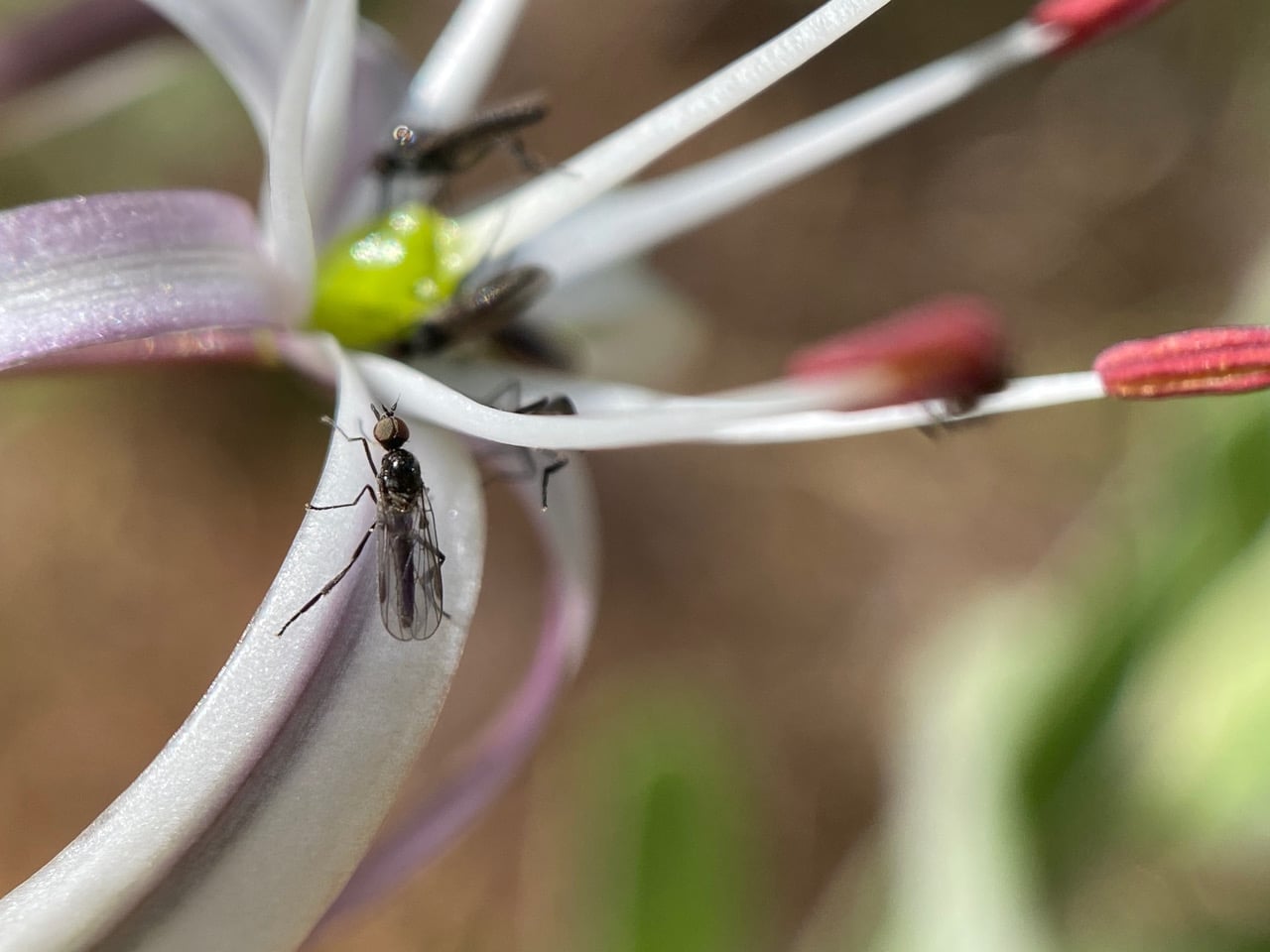
As day bleeds into nightfall, more and more Dance Flies gather on the Soap Plant flowers. Their activities center around the nectar. Are these flies crepuscular/ nocturnal? Or maybe there’s a big hatch of Dance Flies nearby and they happen to come upon the Soap Plant flowers – a coincidence?
6/9/23 (2)
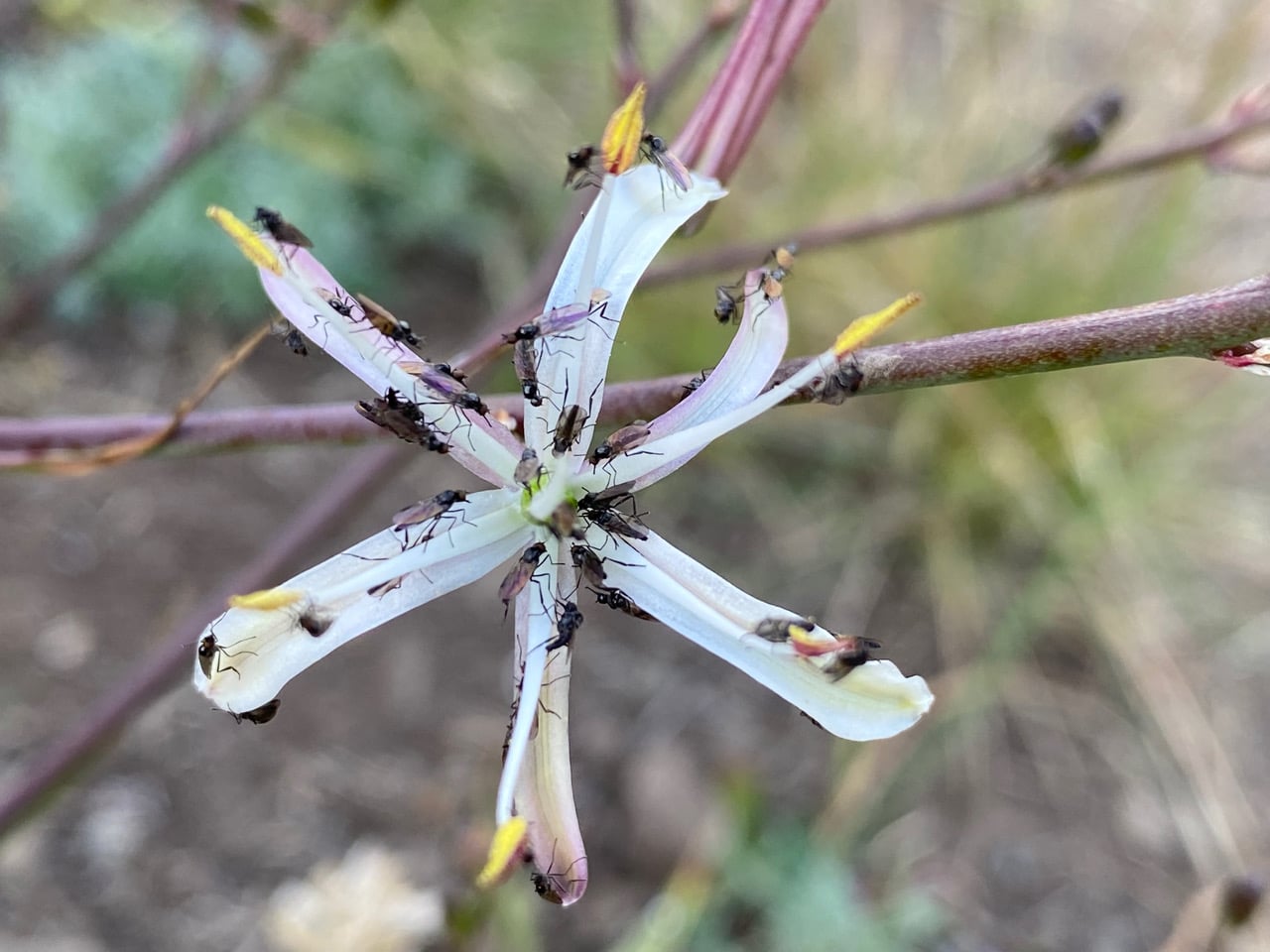
As I walk further along Skyline Trail, I find more Dance Flies on the freshly opened Soap Plant flowers. There must be at least 30 flies at this gathering! Despite the crowd, there are no brawls – the flies all take their turns approaching the nectary at the center of the flower. If only humans can be so civil in our gatherings!
6/9/23 (2)
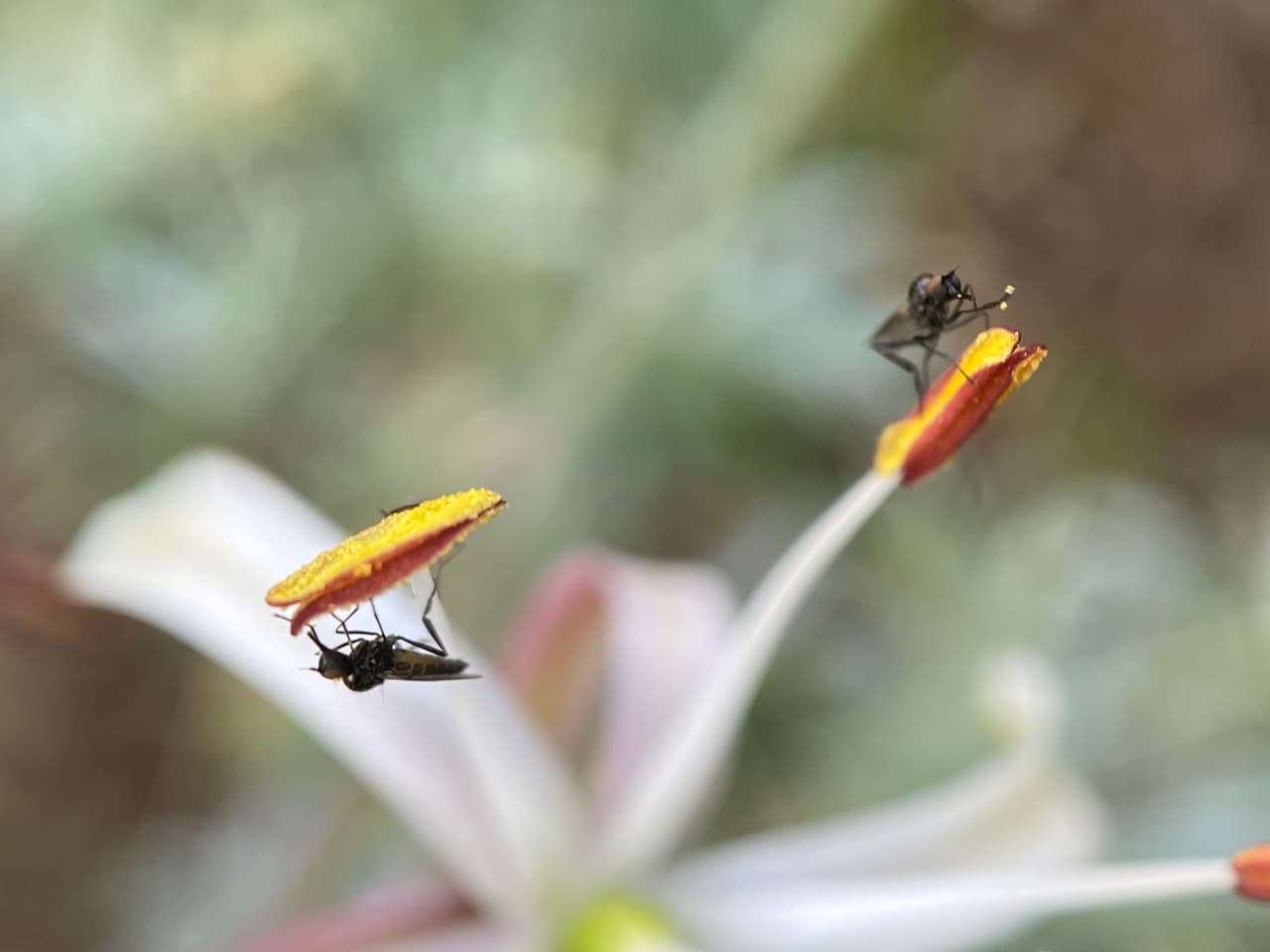
Some flies are actively feeding on the pollen from the ripe anthers.
6/9/23 (2)
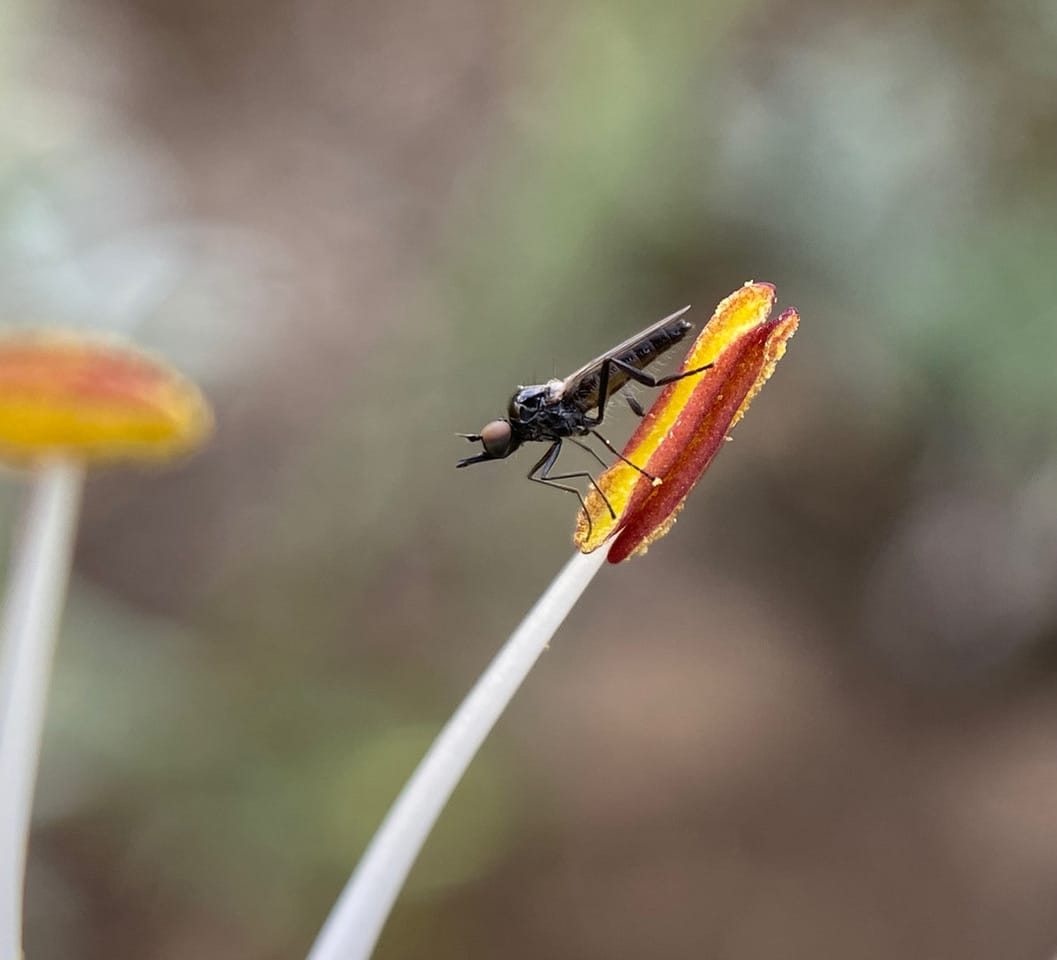
A male Dance Fly stands proud over a ripe anther of Soap Plant. Note the faint hairs under its abdomen. Perhaps these are important for transferring pollen between flowers?

Back to the present. Another aggregation of flies flee from my approach, leaving this very gravid female. Wow, she sure looks like she is ready to lay eggs!
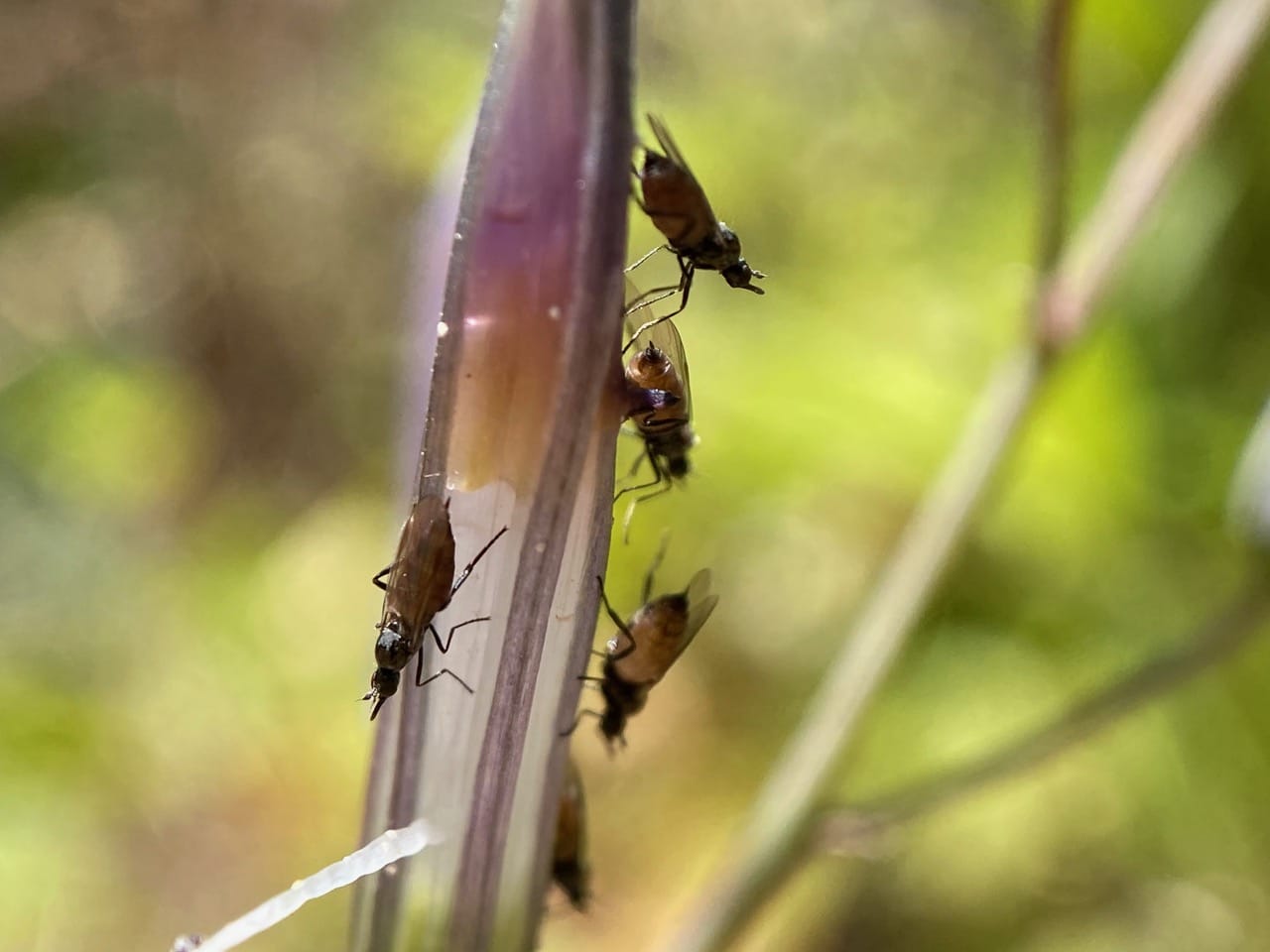
Hah, I manage to get this shot of some flies while the rest scatter to the winds. These all look like gravid females. Have they gathered to lay eggs on the spent Soap Plant flower? Wow, the flies seem to be intimately associated with the plant. Unfortunately the taxonomy of Dance Flies is in a state of flux. Little information is available about many species, including this one. iNaturalist has helped identify the insects as members of the genus Anthalia (family Hybotidae). Bugguide shares that adult Anthalia eat pollen.
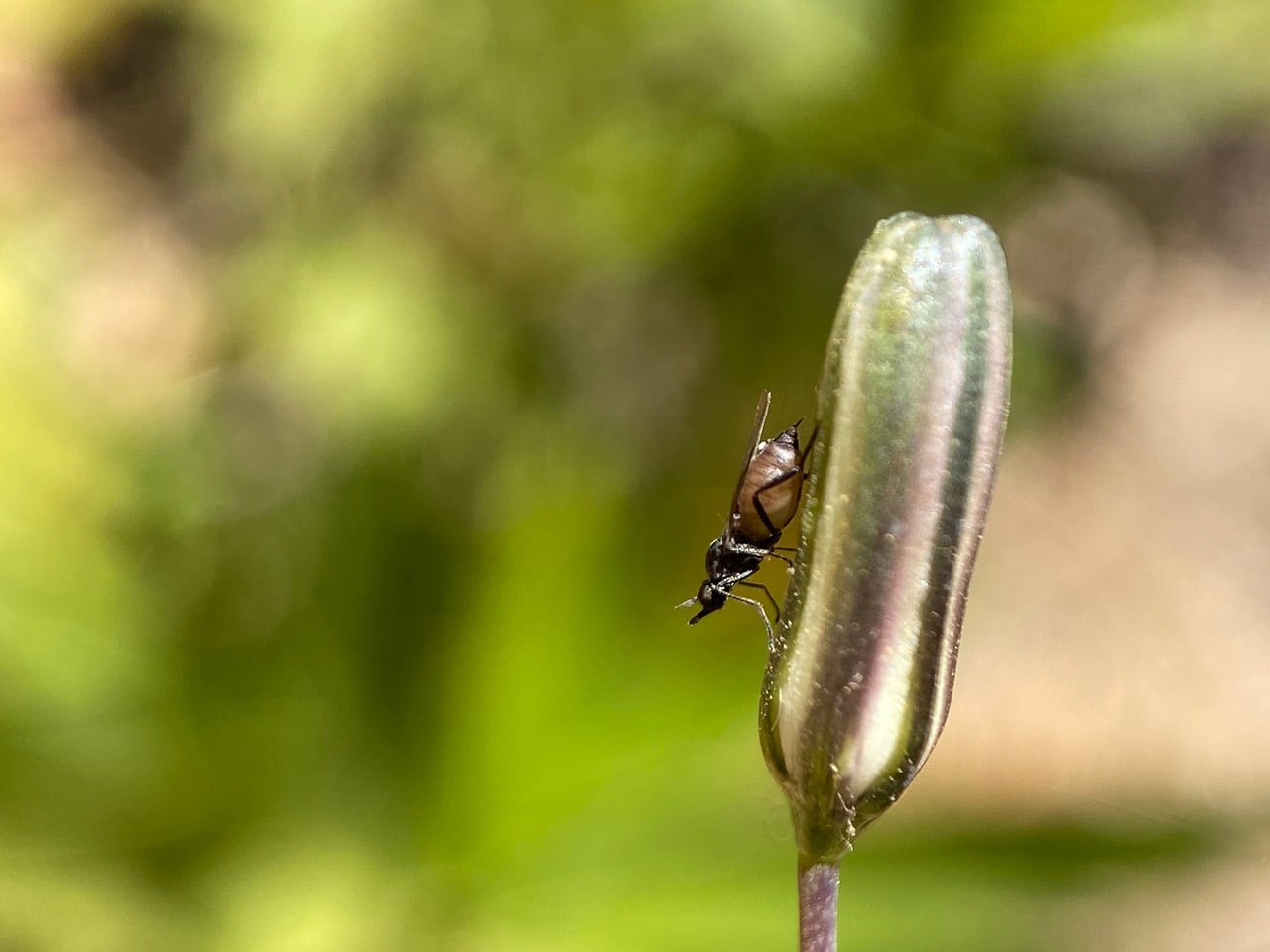
A gravid female Hybotid Dance Fly is perched on a Soap Plant flower bud. The plant is found only in western North America, mainly in California and southern Oregon. It’s a shame that we still know close to nothing about the insects that are closely associated with the plant, and might even serve as important pollinators.
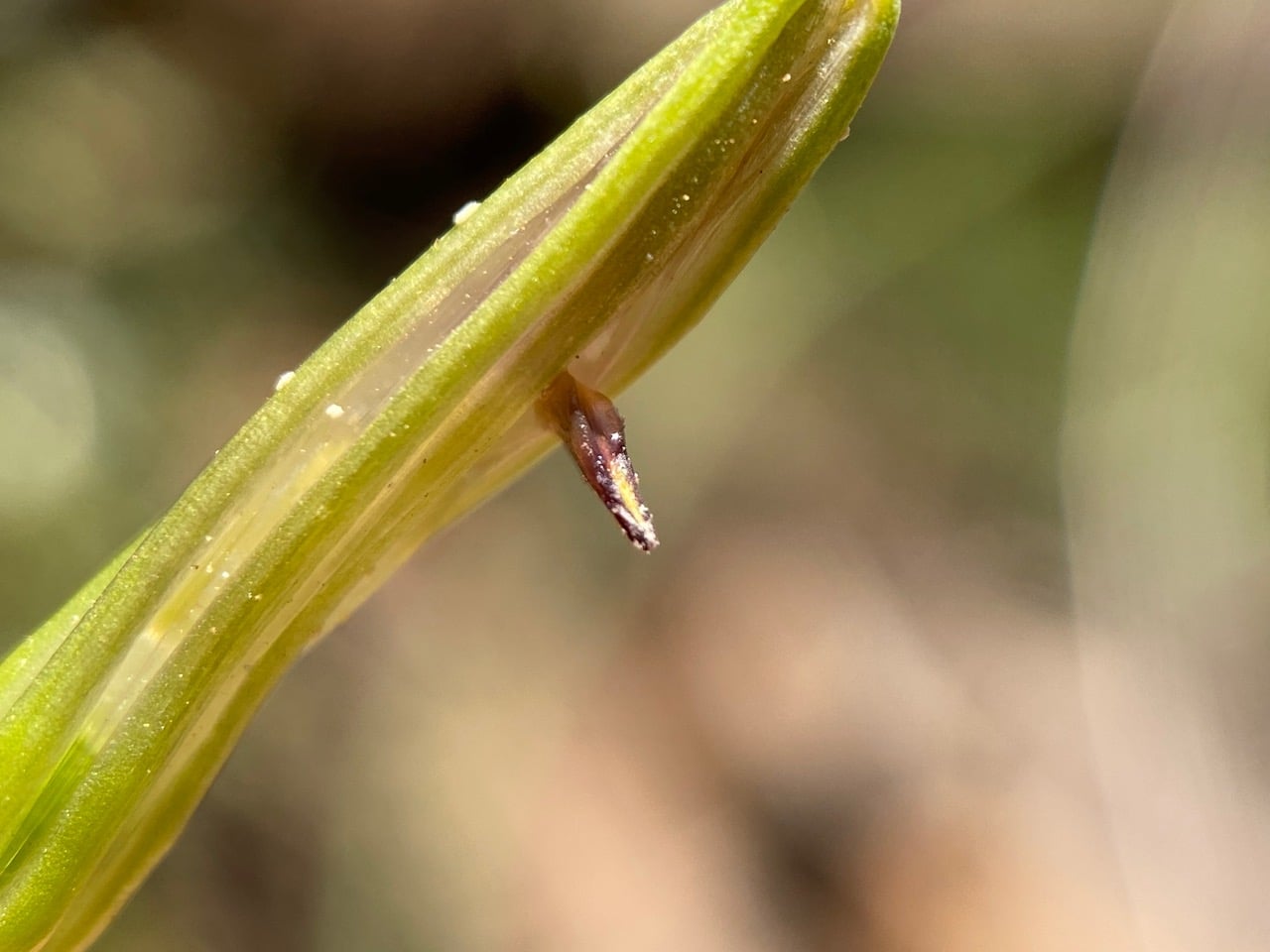
Yet another aggregation of the flies flee from me leaving this stationary object protruding from the flower bud ready to bloom. The best close-up I can muster in this noon day light shows that it might be an eclosing fly, an adult emerging from its pupa! Wow, the mystery lives on…
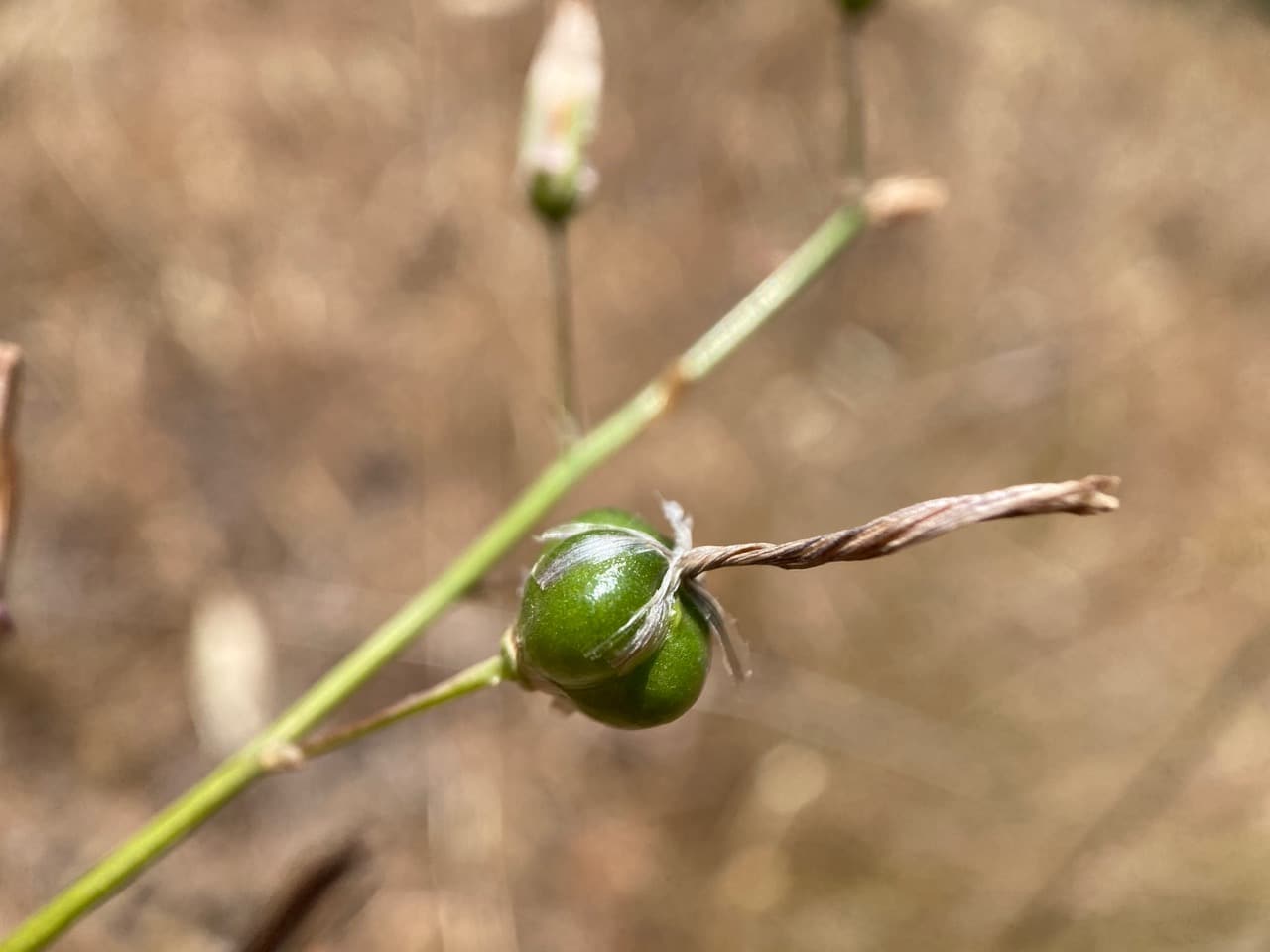
Most of the Soap Plants are done blooming, with developing fruits on the airy branches. The green capsules still bear remnants of the flower with dried twisted petals at the tip.
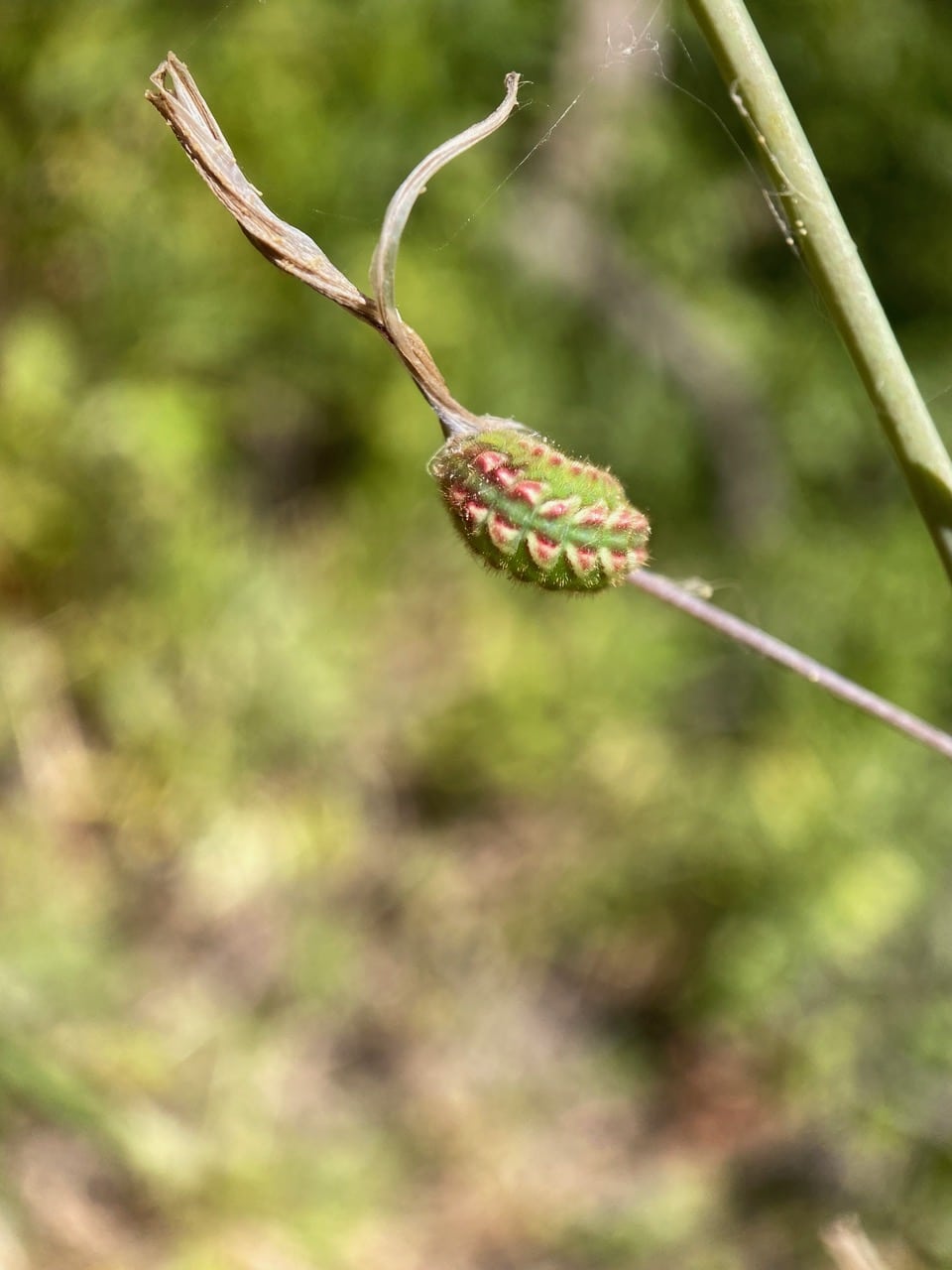
Hey, there’s something on that Soap Plant fruit! It’s an ornate caterpillar of the Western Brown Elfin butterfly!
In contrast to its colorful larva, the Western Brown Elfin, Callophrys augustinus iroides (family Lycaenidae) adult is a drab brown butterfly that mimics dead leaves. It is a small butterfly with an average wingspan of about one inch. An early-season butterfly, it is seen in our area from mid March through June in one generation. Host plants include Manzanita (Arctostaphylos), Madrone (Arbutus), Dodder (Cuscuta), Soap Plant (Chlorogalum) and Ceanothus. Females lay eggs singly on the flower buds of host plants. Caterpillars feed on the flowers and fruits. Pupation takes place in the litter at the base of the host plant. Adults feed on flower nectar from various plant species.

On close inspection, the caterpillar is covered with short, glitery golden hairs.
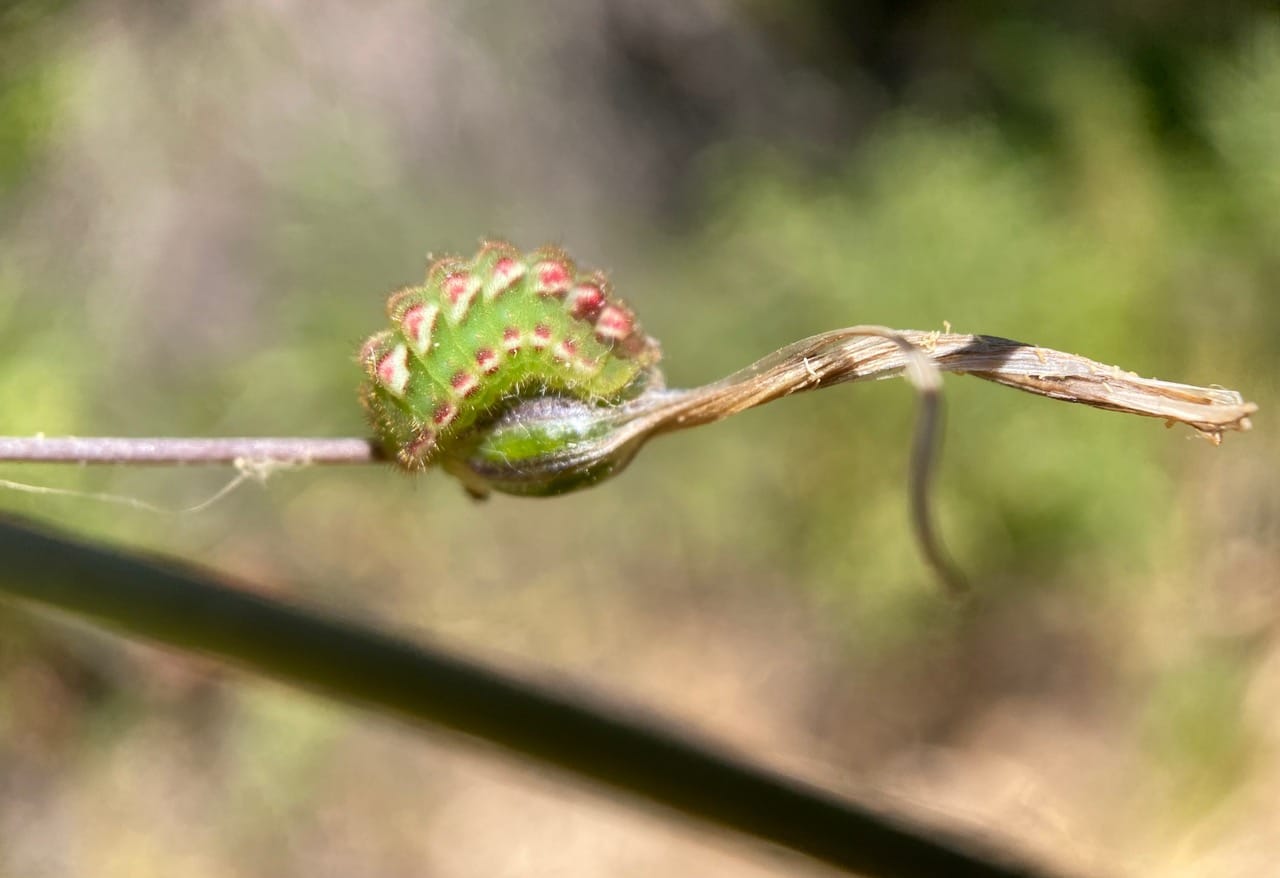
What are those raised, colorful, fleshy scales for? I can’t even tell which end of the caterpillar is the head or tail. What a fascinating creature!
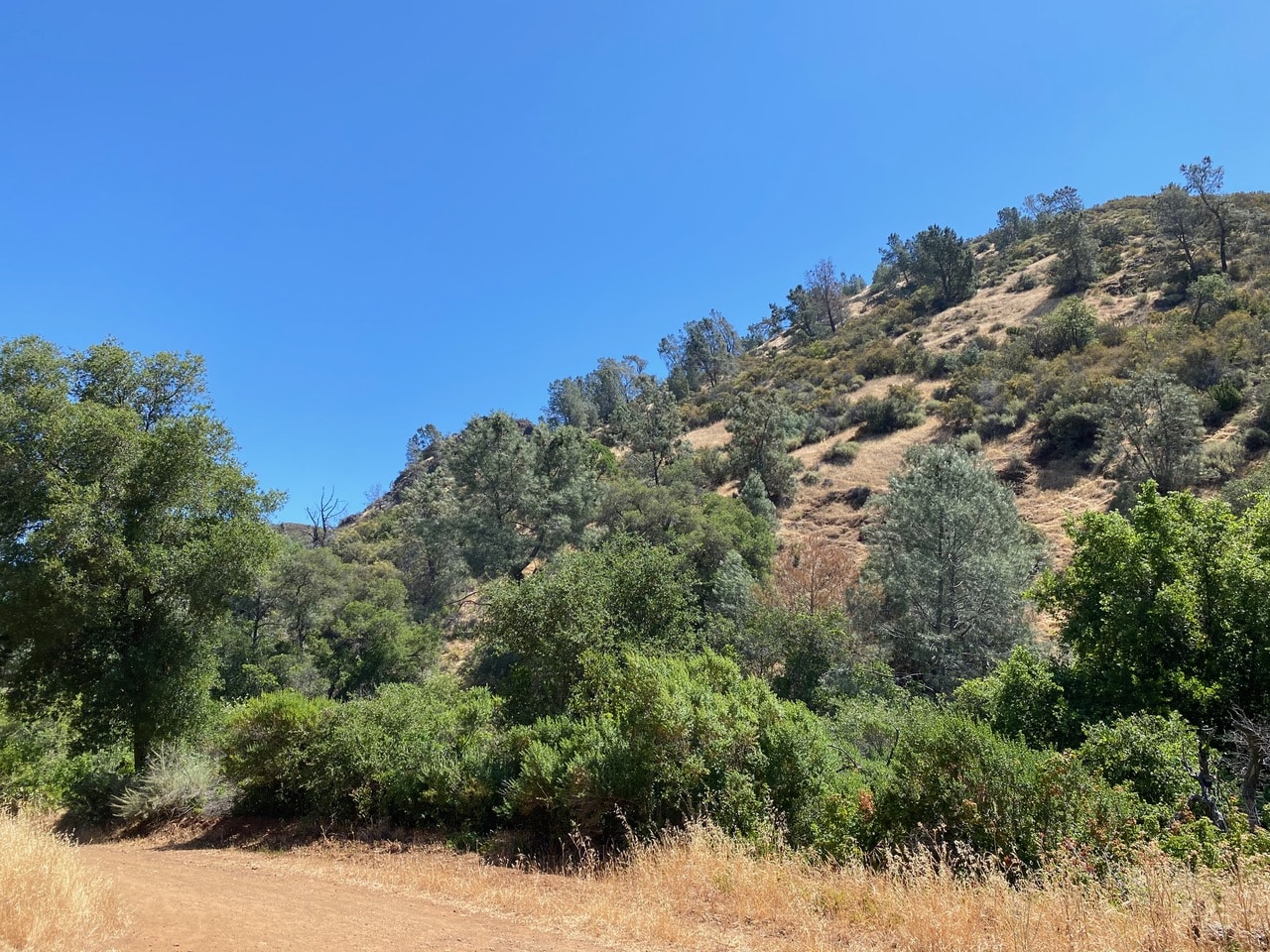
Carol and I sit on a bench to have lunch while a large swarm of dragonflies ply the air around us. They are most likely Blue-eyed Darners that are emerging in large numbers now from nearby creeks. The dragonflies never land, but I can see that not all of them are blue. The paler ones are probably females or new males that have yet to turn blue. Dragonflies are predatory – aquatic larvae feed on anything they can catch, while the adults hunt small insects on the wing.

Hey, another Western Brown Elfin caterpillar draped over a developing fruit of Soap Plant! This one is much paler than the one we saw earlier.

The caterpillar is probably feeding on the fruit, but its head is completely hidden under the body. The slug-like creature is wrapped so tightly on the fruit that it doesn’t break the globular outline, making it hard to detect. I wonder how many fruits it needs to eat before pupation.