

Pollinator Post 6/11/23
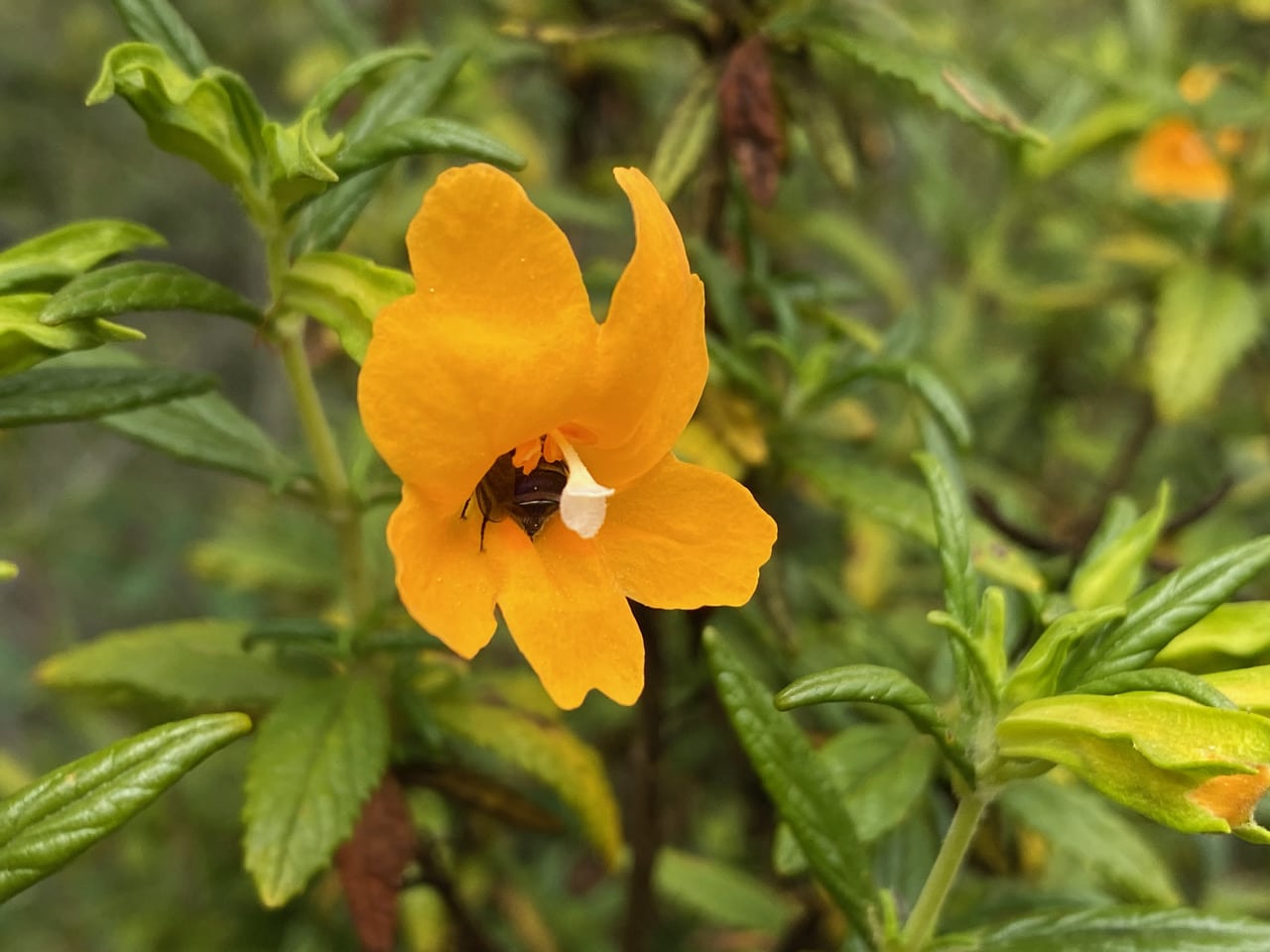
2:30 pm. A Small-headed Fly, Eulonchus sp. (family Acroceridae) is sheltering in a flower of the Sticky Monkeyflower, Diplacus aurantiacus.
As far as is known, all Acroceridae are parasitoids of spiders. Not just any spiders, but the Mygalomorphs of a more ancient lineage. This Acrocerid species, most likely Eulonchus tristis is known to parasitize the California Turret Spiders. Females lay large numbers of eggs near their host nests. After hatching the young larvae, called planidia seek out the spiders. The planidia can move in a looping movement like an inchworm and can leap several millimeters into the air. When a spider contacts an Acrocerid planidium, the planidium grabs hold, crawls up the spider’s legs to its body, and forces its way through the body wall. Often, it lodges near the spider’s book lung, where it may remain for years before completing its development. Mature larvae pupate outside the host. The Acrocerid adults are nectar feeders with exceptionally long probosces which are folded on the underside of the body when not in use. Acrocerids are rare but can be locally abundant. They are believed to be efficient pollinators for some native plants, including the Sticky Monkeyflowers.

The Common Snowberry, Symphorocarpos albus (family Caprifoliaceae) is in peak bloom along the steep shady banks of Skyline Trail.
Common Snowberry is a native shrub found in many parts of California, from the coast to east of the Sierras, primarily in moist, shady locations below 4,000 ft. Moderately fast growing, it spreads by rhizomes to form dense thickets. The plant blooms in the early summer. The nodding flowers are small (1/4”), pink-white, bell-shaped, and found in small clusters at the end of the branch. The flower has 5 partially fused petals that do not spread. The corolla contains 5 stamens and white style with a stigma near the tip. Most of the reproductive structures are concealed behind a thicket of dense white hair.
While it is believed that hummingbirds are the main pollinators, Snowberry flower nectar and pollen are attractive to bees, flies, ants, butterflies, and moths. The plant is also a source of food, cover, and nesting sites for birds and small mammals. The white berries are valued by wildlife but toxic to people.

A few Bumble Bees are visiting the Common Snowberry flowers. This particular Black-tailed Bumble Bee, Bombus melanopygus is persistent and thorough in her foraging, stopping at each cluster of flowers along the bank to sip nectar, then repeating the beat again. Although there’s pollen in her pollen baskets, I am not sure if she is collecting pollen from the Snowberry flowers, since her stops are so brief. She always has her long tongue out for nectar.

Look, an Inch Worm is reaching out from a cluster of Snowberry flower buds.
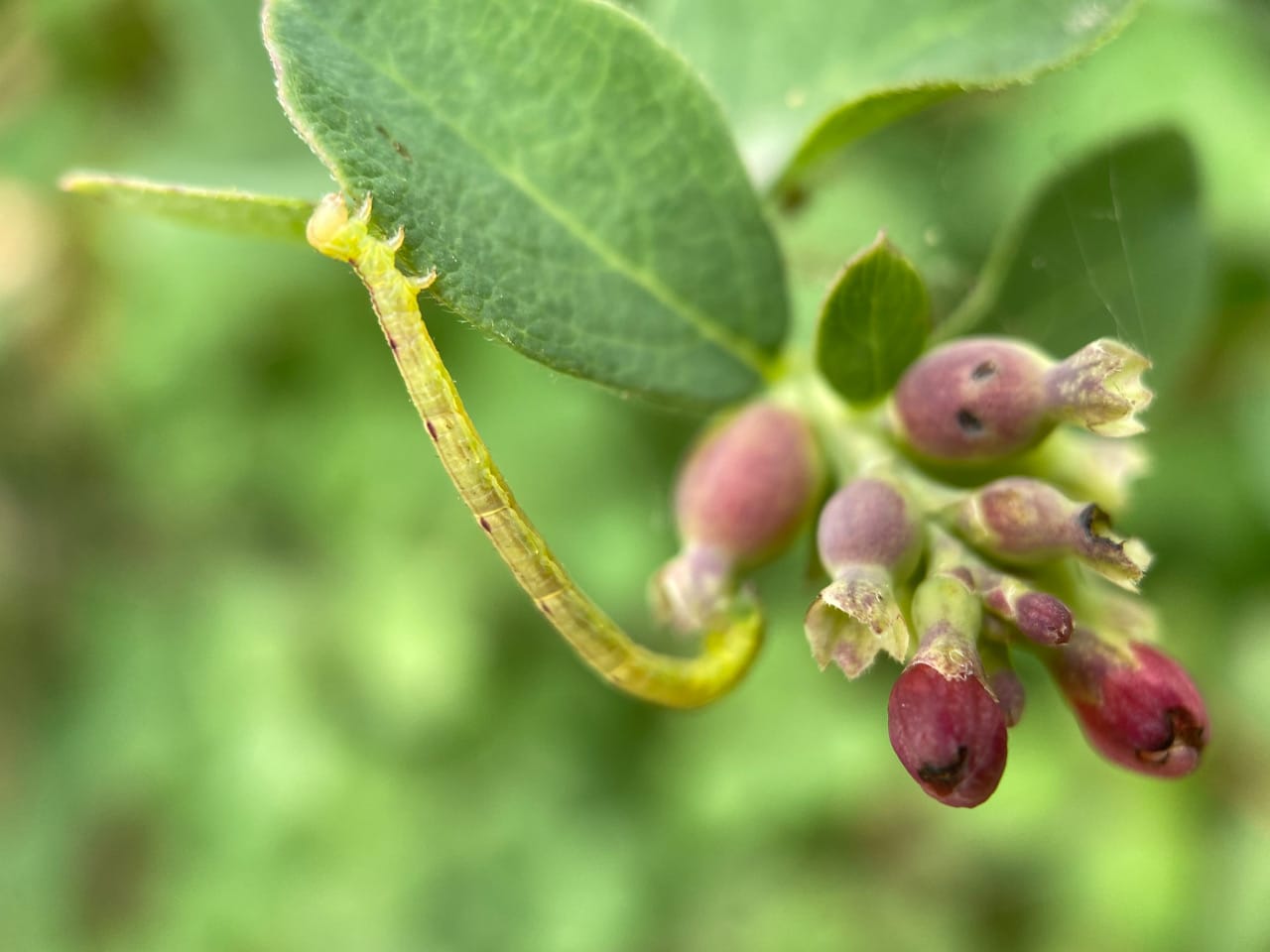
It grabs hold of the leaf above.
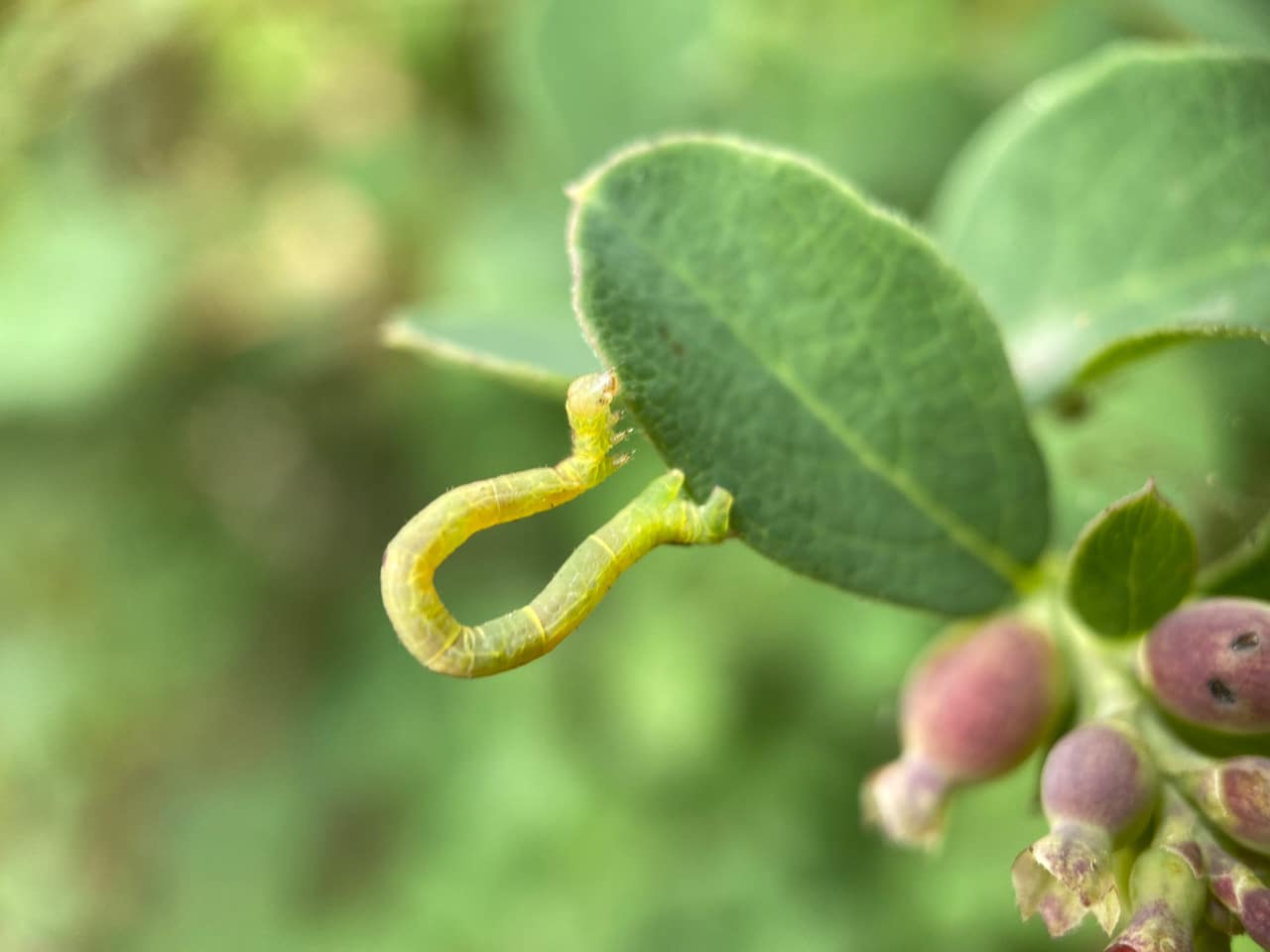
Inchworms are also called loopers and measuring worms. They majority of the inchworms are the larvae of moths in the family Geometridae. The name comes from the Greek “geo” for earth and “metro” from measure, because the caterpillars seem to be measuring the surface on which they are walking.
All caterpillars have three pairs of jointed legs behind their heads. These legs are called true legs because they will become the six legs of the adult butterfly or moth. There are additional appendages, called prolegs, along their bodies. Prolegs are not true legs, they are just outgrowths of the body wall and will be lost at metamorphosis. They have little hooks on their soles to help the caterpillar walk and grip onto things.
Most caterpillars have five sets of prolegs, four in the middle of the body and one pair at the hind end. Inchworms have the normal six true legs but only two or three pairs of prolegs, all located at the tail end of the body, with none in the middle. When an inchworm walks, it moves its tail-end prolegs up behind its true legs, causing the center of its body to loop upward. Then it stretches its front end forward to take another step.
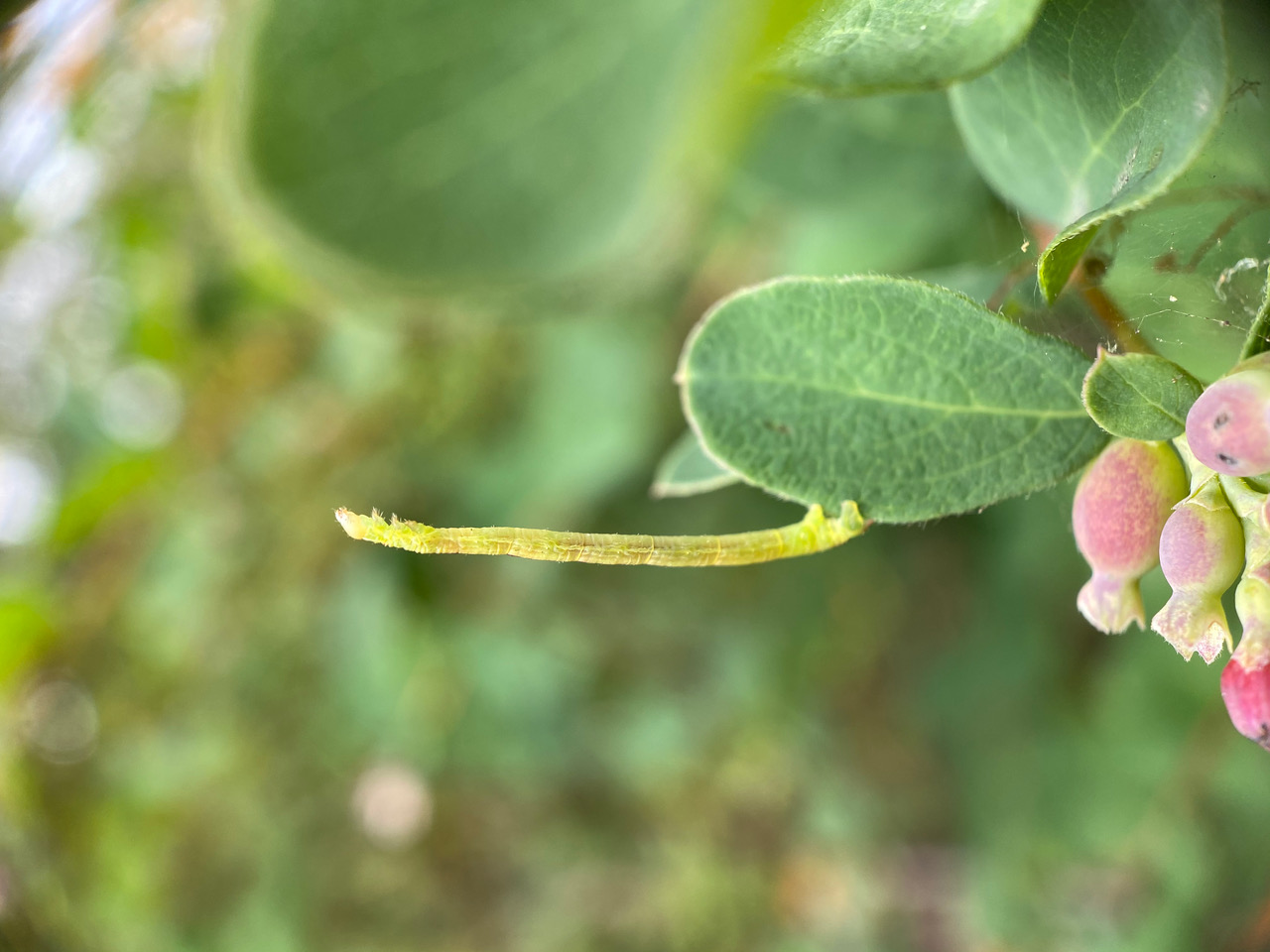
When they are disturbed, inchworms will often stand straight up on their prolegs, mimicking twigs. It’s amazing that the little caterpillar can stay rigid in this position for a long time, supported only by its two pairs of prolegs at the rear end.
Adult Geometer Moths have slender abdomens and broad wings which are usually held flat with the hind wings visible. As such, they appear rather butterfly-like, but in most respects they are typical moths; the majority fly at night. They tend to blend into the background, often with intricate, wavy patterns on their wings.
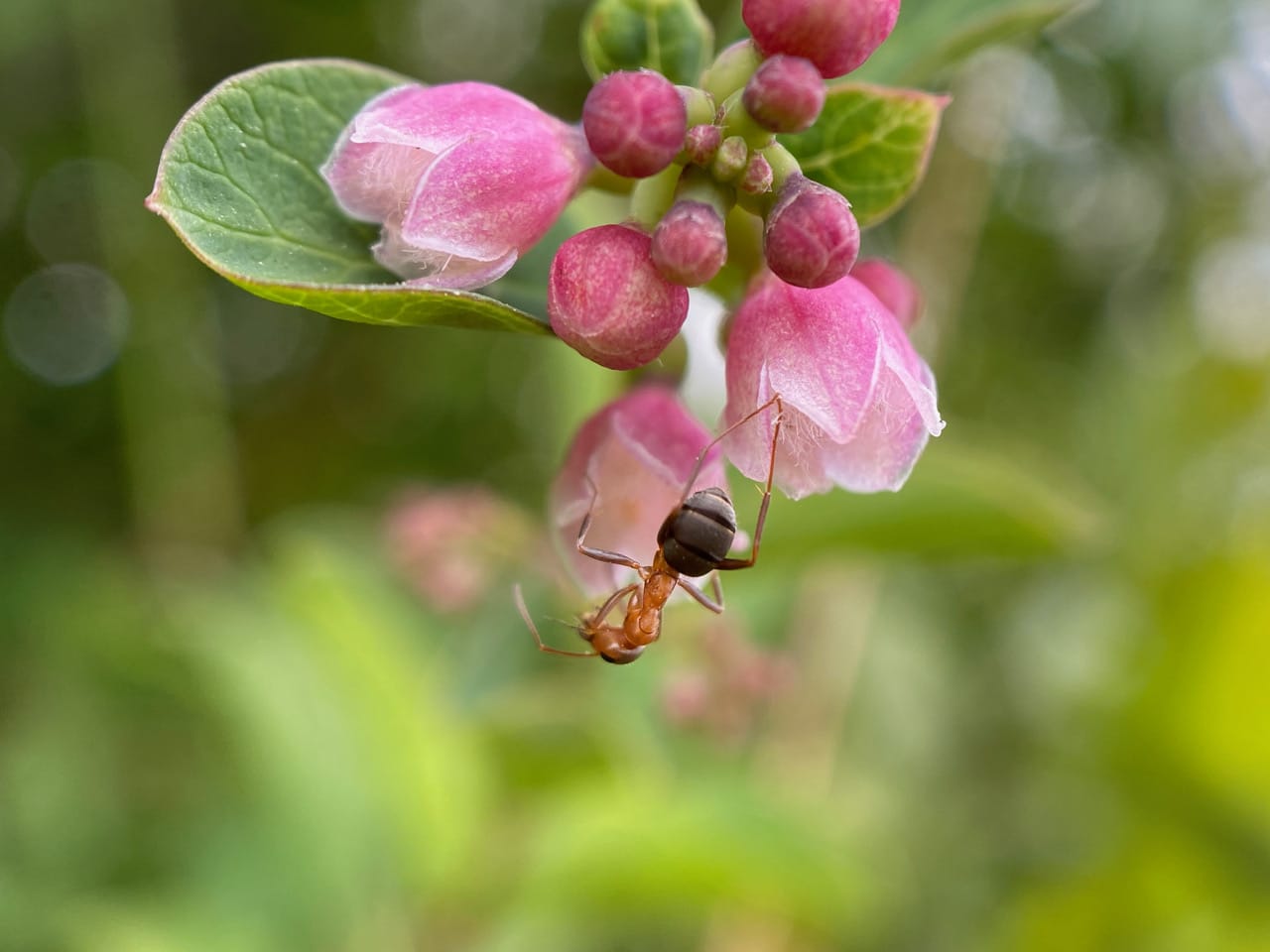
A Field Ant, Formica sp. (family Formicidae) is hanging upside down on a cluster of Snowberry flowers.
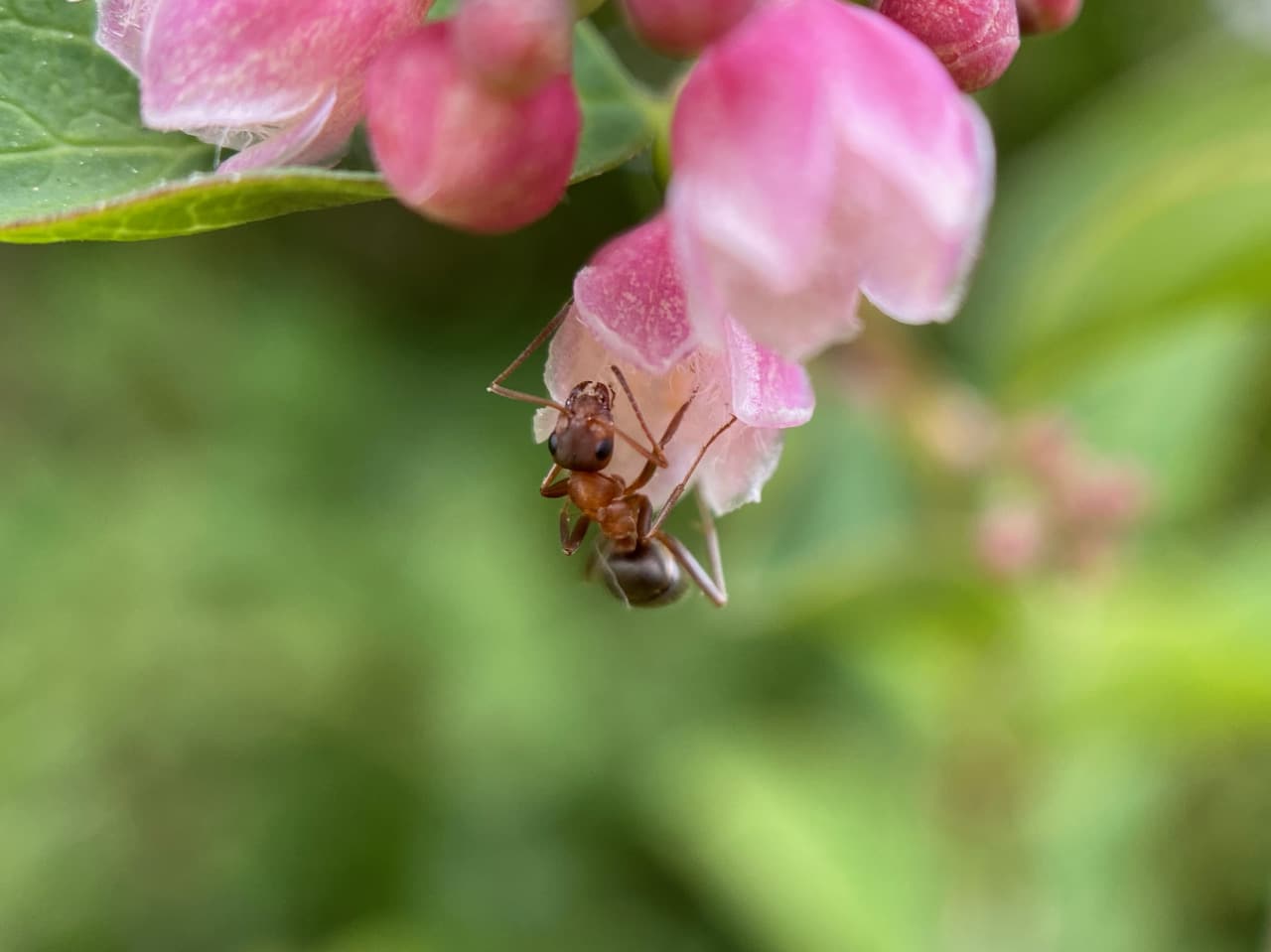
The ant reaches into a flower, its mandibles open.

It’s got some yellow pollen! Apparently the long white hairs in the corolla is no barrier for the ant.

After each bout of feeding, the ant gets into serious antenna cleaning. This it does with ease, hanging upside-down from the flower.
During an antenna cleaning movement, the ants lower their head, insert their antenna into a clamp-like cleaning structure on the front leg of the same side, and pull it through. After the actual grooming movement, the antenna cleaner is then cleaned by the ant’s mouthparts (nibbling) in order to allow reuse. The cleaning structure in most ants consists of a curvature on the front tarsus (called the tarsal notch) that faces a spur originating from the tibia. Each side of the clamp bears hair arrays that can be distinguished as “bristles”, “combs”, and “brushes” for removing particles of various sizes.
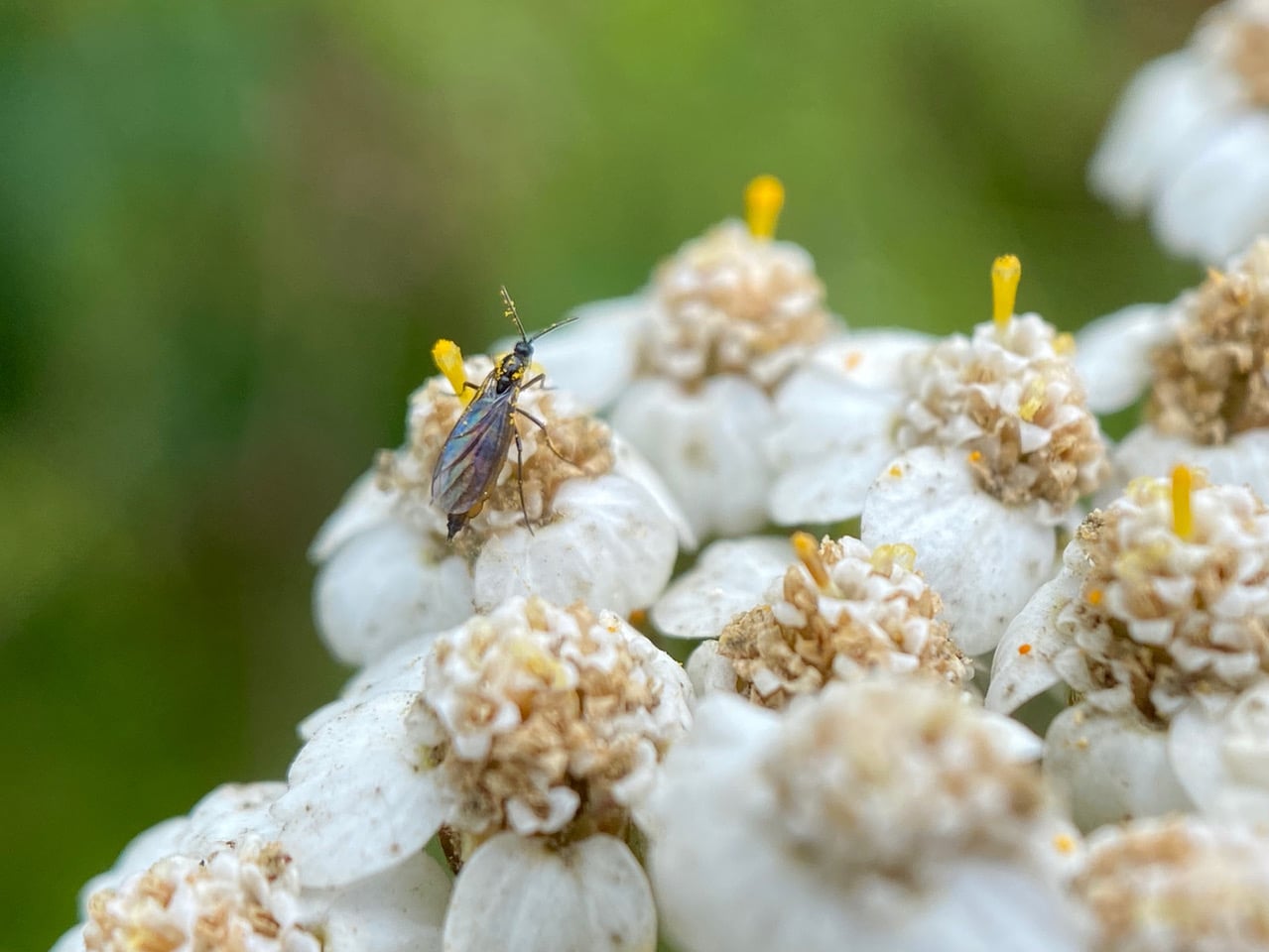
Covered with yellow pollen, a tiny Dark-winged Fungus Gnat (family Sciaridae) is feeding on the flowers of Yarrow, Achillea millefolium.
Occurring worldwide, the Sciaridae are a family of flies, commonly known as Dark-winged Fungus Gnats. Commonly found in moist environments, they are known to be a pest of mushroom farms and are commonly found in household plant pots. In moist, shadowy areas, up to 70% of all dipteran species can be Sciaridae. Adults are small, dark flies, usually less than 5 mm long. They are distributed through wind and drifting, or by humans through transported soil. Sciarid larvae often occur in decaying plant matter such as rotten wood or under the bark of fallen trees. They play an important role in turning forest leaf litter into soil. The adults with their characteristic dancing flight do not bite. They only ingest liquids and only live long enough to mate and produce eggs. They die after about five days.
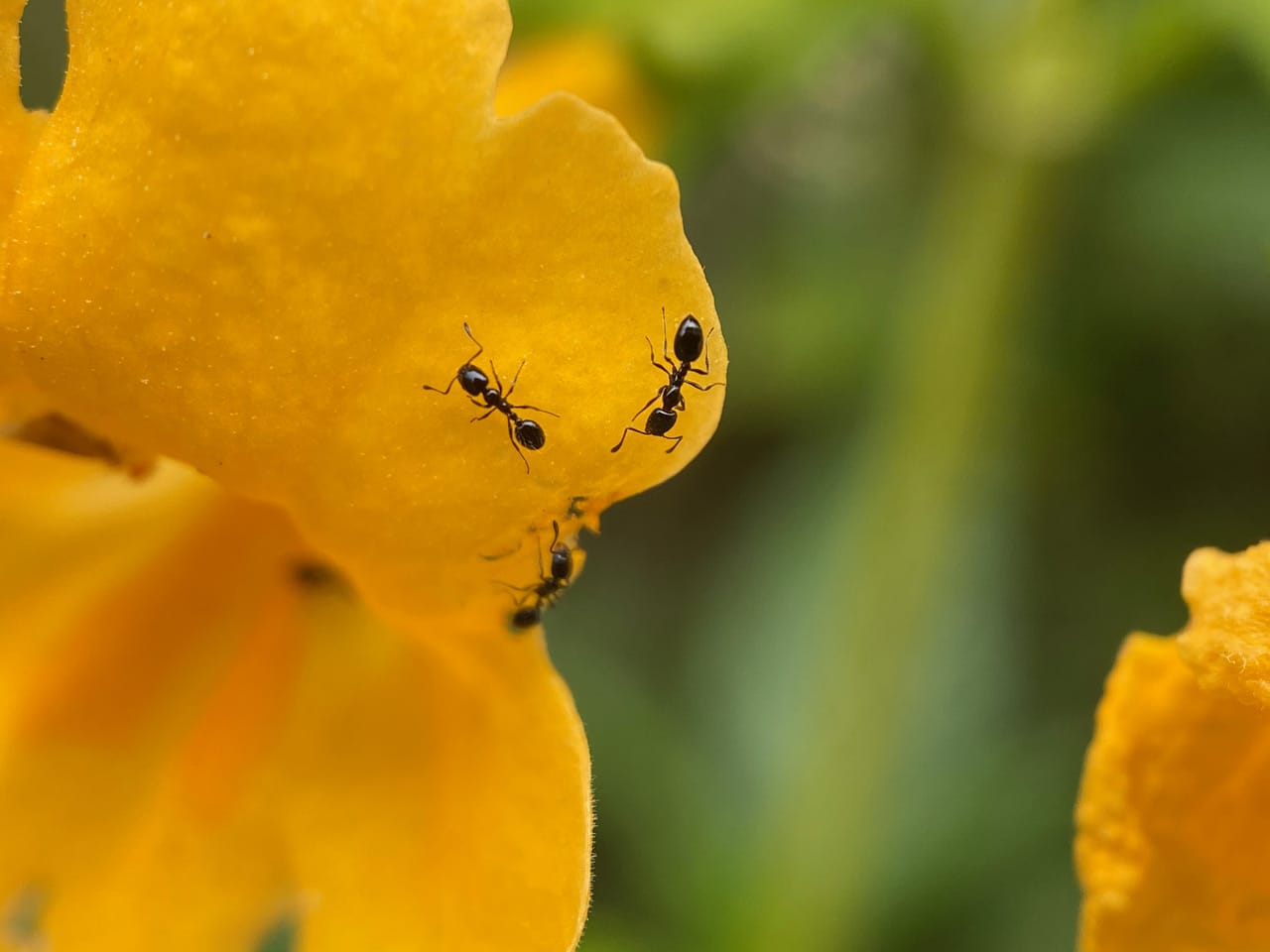
Some Ergatogyne Trailing Ants, Monomorium ergatogyna (family Formicidae) are gathered around some small wounds on the upper petal of a Sticky Monkeyflower. Are they responsible for inflicting the damage, or are they simply scavenging?
The Ergatogyne Trailing Ant, Monomorium ergatogyna (family Formicidae) is native to California, Nevada, and Utah and are usually found in cities or on the coast. The ant is a shiny black color and contains only a single worker caste, making them a monomorphic species. It is also polygyne, meaning a colony contains multiple fertile queens living together. The workers are only 1.5 – 2mm long. The ants are scavengers that consume anything from bird droppings, dead insects to aphid honeydew. Sadly, Argentine Ants have been discovered to be actively pushing this species out of its original territory.

A flower bud of the Sticky Monkeyflower (seen from the top) before the upper and lower lips flare out in their separate ways. The corolla is housed in a long tubular, calyx with sepals fused along most of their length. It takes a pollinator with a long proboscis to reach the nectar at the base of the flower, or an insect small enough to crawl through the narrow tunnel. The Small-headed Flies, Eulonchus sp. (family Acroceridae) satisfy the first criteria, while the little bees fill in the second role. Hummingbirds probing for nectar with their long tongues may also help transfer pollen between flowers.
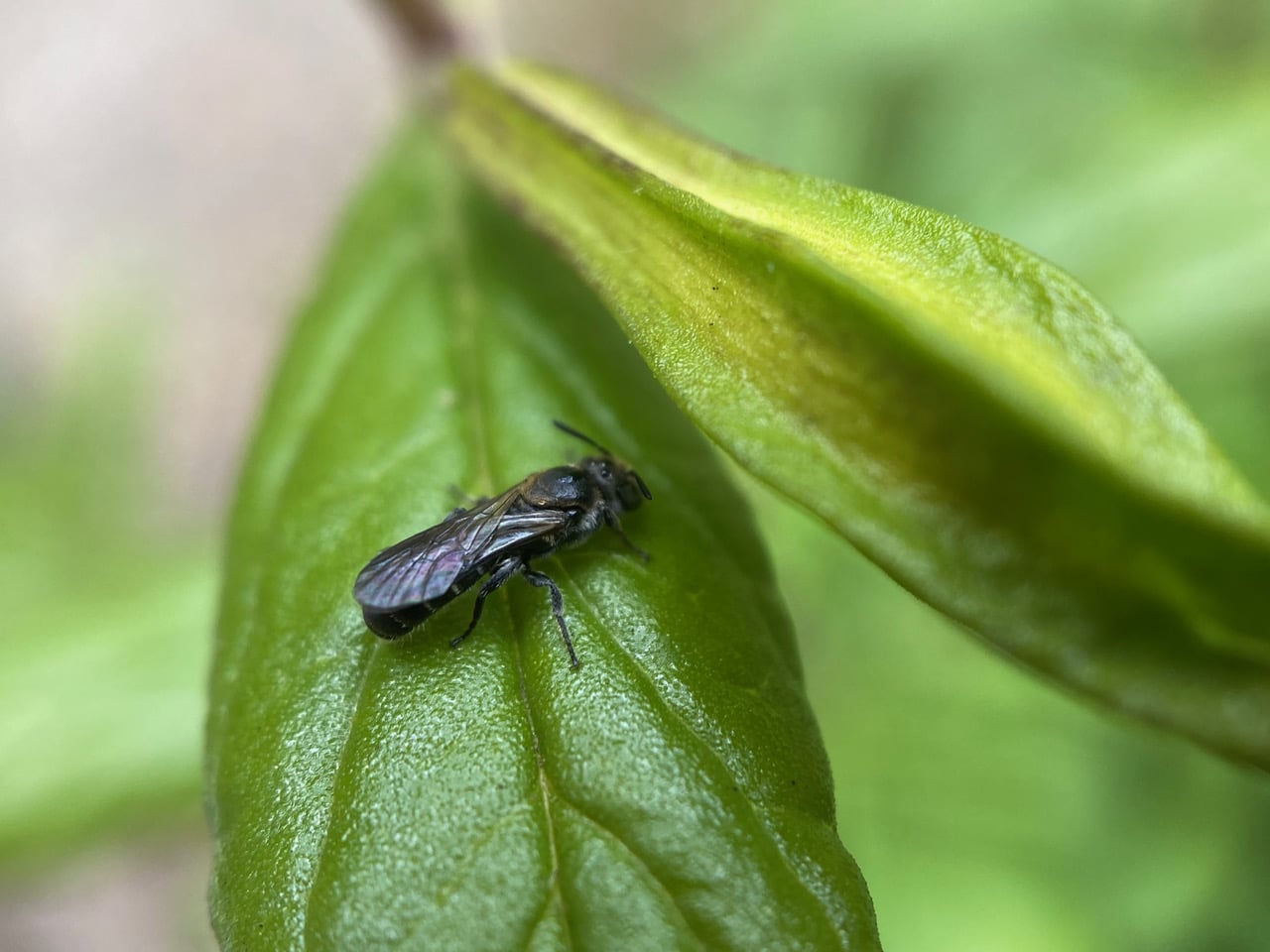
A small, dark bee is resting motionless in the shelter of Sticky Monkeyflower foliage. It has a long, slender, striped abdomen, and no scopa on the hind legs. A male Sweat Bee (family Halictidae)?
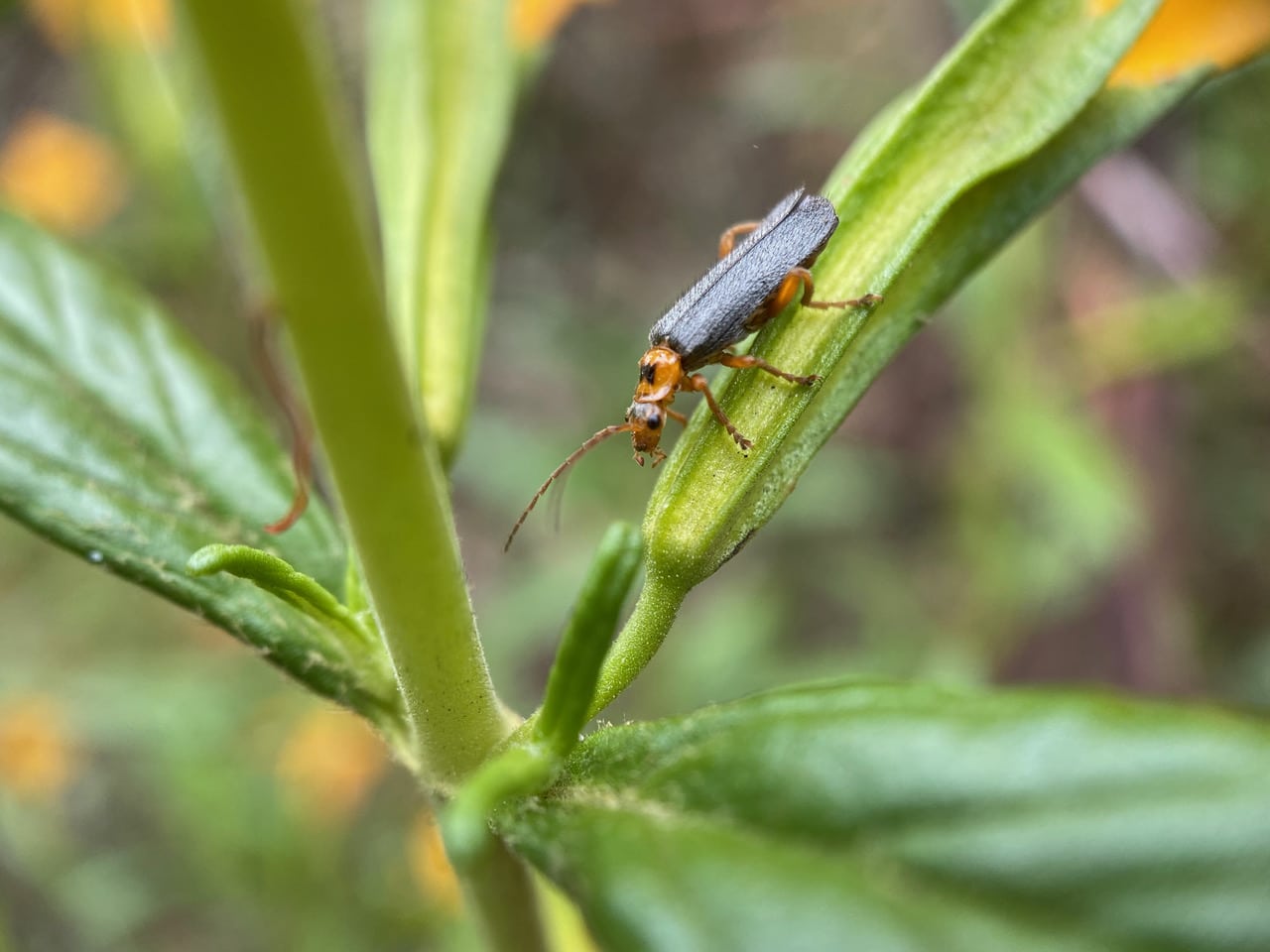
A Soldier Beetle, Cultellunguis americanus (family Cantharidae) is looking dejected on this cold, windy afternoon.
The Soldier Beetles, family Cantharidae are relatively soft-bodied, straight-sided beetles. One of the first described species has a color pattern reminiscent of the red coats of early British soldiers, hence the common name. They are also known commonly as Leatherwings because of their soft elytra.
Soldier beetles often feed on both nectar and pollen as well as predating on other small insects. The larvae are often active, and feed on the ground, hunting snails and other small creatures. Soldier beetles are generally considered beneficial insects by gardeners.

Ooh, it’s that ant-mimicking nymph of the Plant Bug, Closterocoris amoenus (family Miridae) again! This time it fooled me – I approach it thinking it was a Formica ant, and only realize my mistake when I see it through the macro lens. Again, it’s on a Sticky Monkeyflower. The piercing-sucking mouthpart folded under its body is clearly visible – diagnostic of the order of true bugs or Hemiptera. See the green underside of the bug’s abdomen? It creates an illusion of the ant’s narrow waist against a green background.
Mirid bugs are also referred to as plant bugs or leaf bugs. Miridae is one of the largest family of true bugs in the order Hemiptera. Like other Hemipterans, Mirids have piercing, sucking mouthparts to extract plant sap. Some species are predatory.
Ant mimicry or myrmecomorphy is mimicry of ants by other organisms. Ants are abundant all over the world, and potential predators such as birds and wasps normally avoid them as they are either unpalatable or aggressive. Spiders are the most common ant mimics. Additionally, many insects from a wide range of orders and families mimic ants to escape predation (protective mimicry), while others mimic ants anatomically and behaviorally to hunt ants in aggressive mimicry.
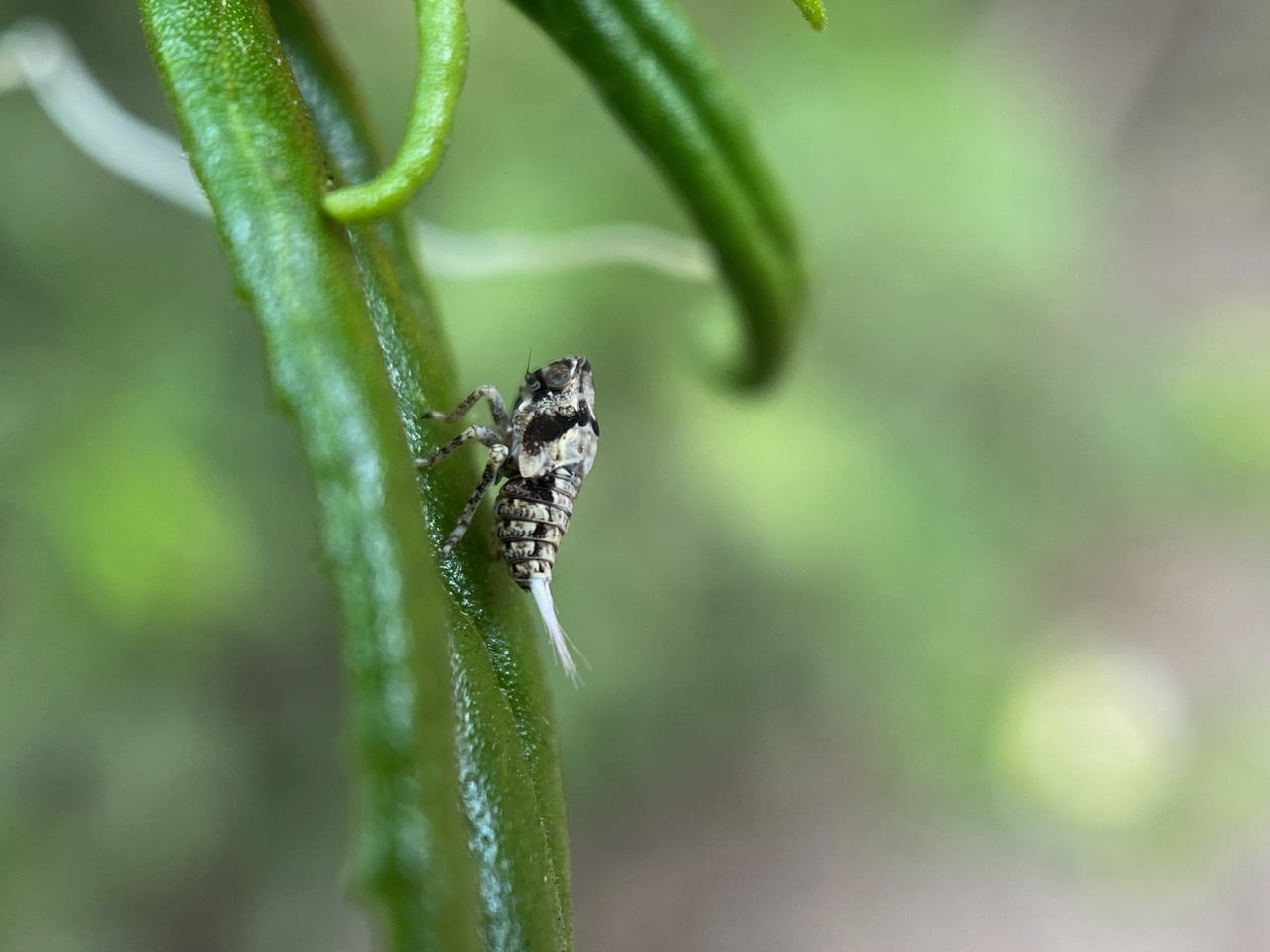
On the same plant I spot this tiny bizarre creature with a comet tail. It is the nymph of a Planthopper!
iNaturalist has helped identify the insect as Danepteryx sp., a member of the Tropiduchid Planthoppers (Tropiduchidae). Most of the genus is endemic to California, but members of the family are more broadly found in southwestern US and extreme northern Mexico.

A nymph is an immature stage of an insect that undergoes incomplete metamorphosis (without a pupa stage) – where what emerges from the egg looks like a small version of the adult, but with undeveloped wings and sexual parts.
Planthoppers (order Hemiptera) are commonly encountered insects that suck plant juices. Their nymphs bear a bewildering variety of tufts and filaments on their rear ends, the arrangement depending on the species. Those with straight, white filaments belong to the family Issidae. These filaments can be spread when alarmed. I learn from Wikipedia that many of the subfamilies of Issidae have recently been moved to separate families, including Tropiduchidae.
With their piercing-sucking mouthparts, both Planthopper adults and nymphs feed on plant sap. Phloem is under pressure and it’s mostly sugary water low in nutrients. The insects have to process a large volume of the material to extract the nutrients they need, and excrete the excess as honeydew. Planthoppers coat themselves in wax to keep honeydew far from their bodies. Some produce waxy “tails” around their anus to encourage the liquid to flow away. Pores around their anal tube produce their beautiful wax filaments. The wax filaments break off easily, so a predator trying to grab one of these bugs is left with a pile of fluff, but no meal. Another proposed function of the waxy filaments is to help the bugs glide as they fall; the bugs can fan the filaments out for an extra boost while it’s in the air. Other forms of waxy tails serve to camouflage the bug.
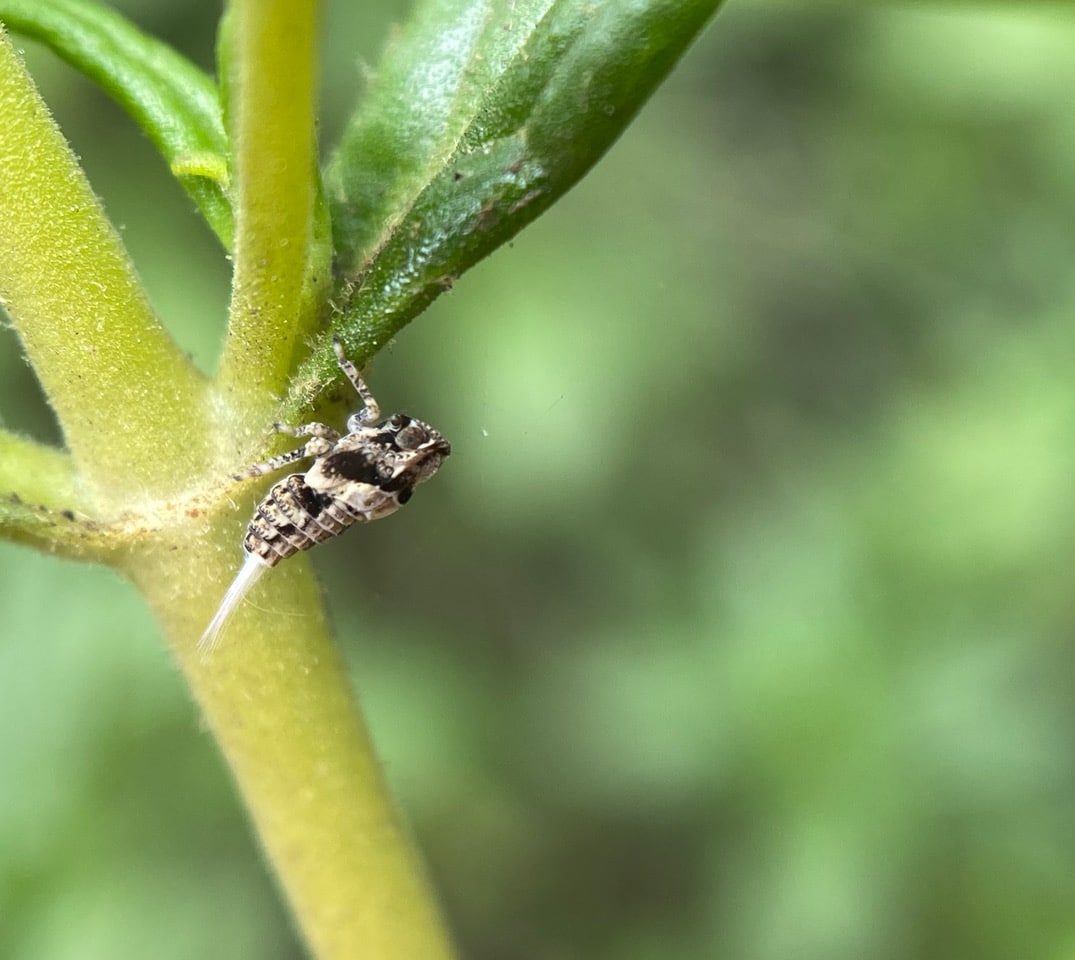
I am surprised that the Planthopper nymph does not hop away as I photograph it within short range. It simply sidles to the other side of the leaf or stem to avoid the camera. Equipped with living gears in its legs, the bug is capable of impressive jumping feats.
Planthoppers may be small, but they attract mates from afar by sending vibrational calls along plant stems and leaves using fast, rhythmic motions of their abdomen. This is accomplished using an elastic ‘snapping organ’. The sound is not audible to the human ear.
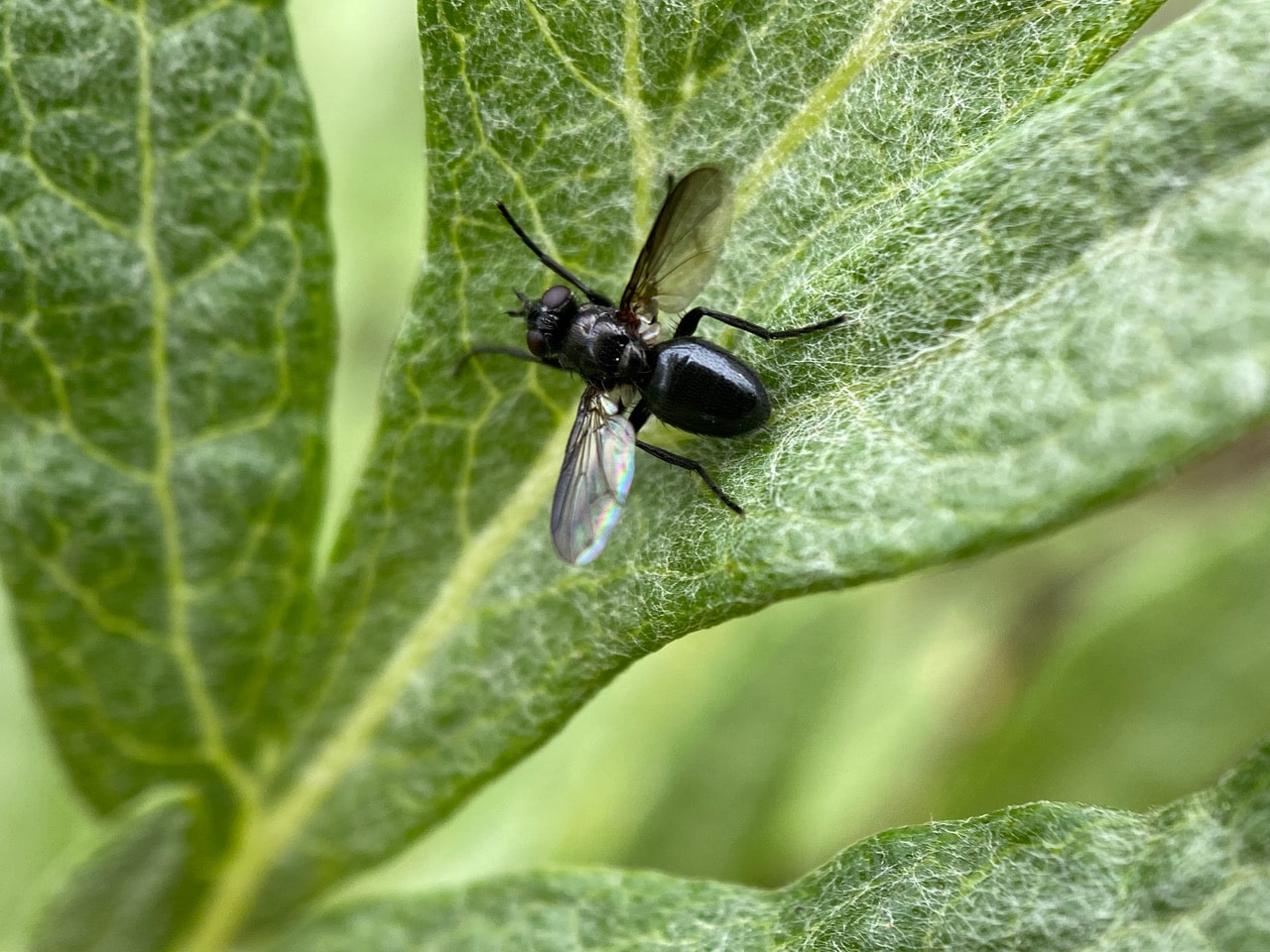
A black fly is running around on the leaves of California Mugwort, frantically fanning its outstretched wings. I have seen this fly with the same behavior on the inflorescence of California Phacelia on 6/6/23. It could only be identified as a Calyptrate Fly then. I take another series of pictures today, hoping that we would be able to narrow down its identity. Why that wing-fanning behavior? Is it trying to disseminate pheromones in the air?
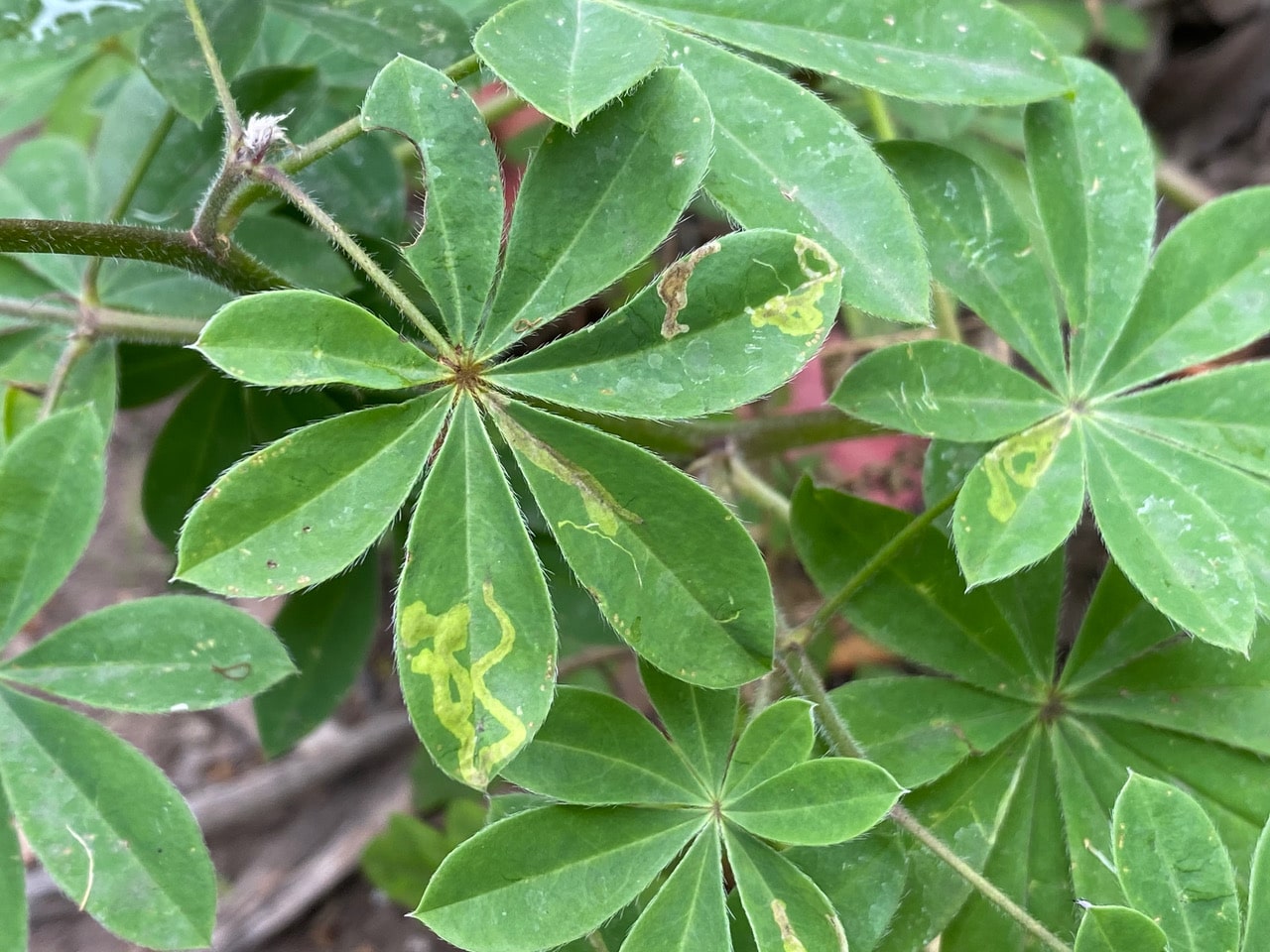
Ooh, lots of squiggles on the leaves of this Broadleaf Lupine, Lupinus latifolius. The leaf miners have been busy!
A leaf miner is any one of numerous species of insects in which the larval stage lives in, and eats, the leaf tissue of plants. The vast majority of leaf-mining insects are moths (Lepidoptera), sawflies (Symphyta), and flies (Diptera). Some beetles also exhibit this behavior. Leaf miners are protected from many predators and plant defenses by feeding within the tissues of the leaves, selectively eating only the layers that have the least amount of cellulose, and lowest levels of defensive chemicals.