

Pollinator Post 6/10/24 (1)
I arrive at the Skyline Gate staging area in late morning to walk the West Ridge Trail. It’s been 10 days since I last saw the weak showing of the Fairy Longhorn Moths on the Ocean Spray flower buds. I am curious if there are more flower buds now, and perhaps more moths that perform their courtship dance over them?
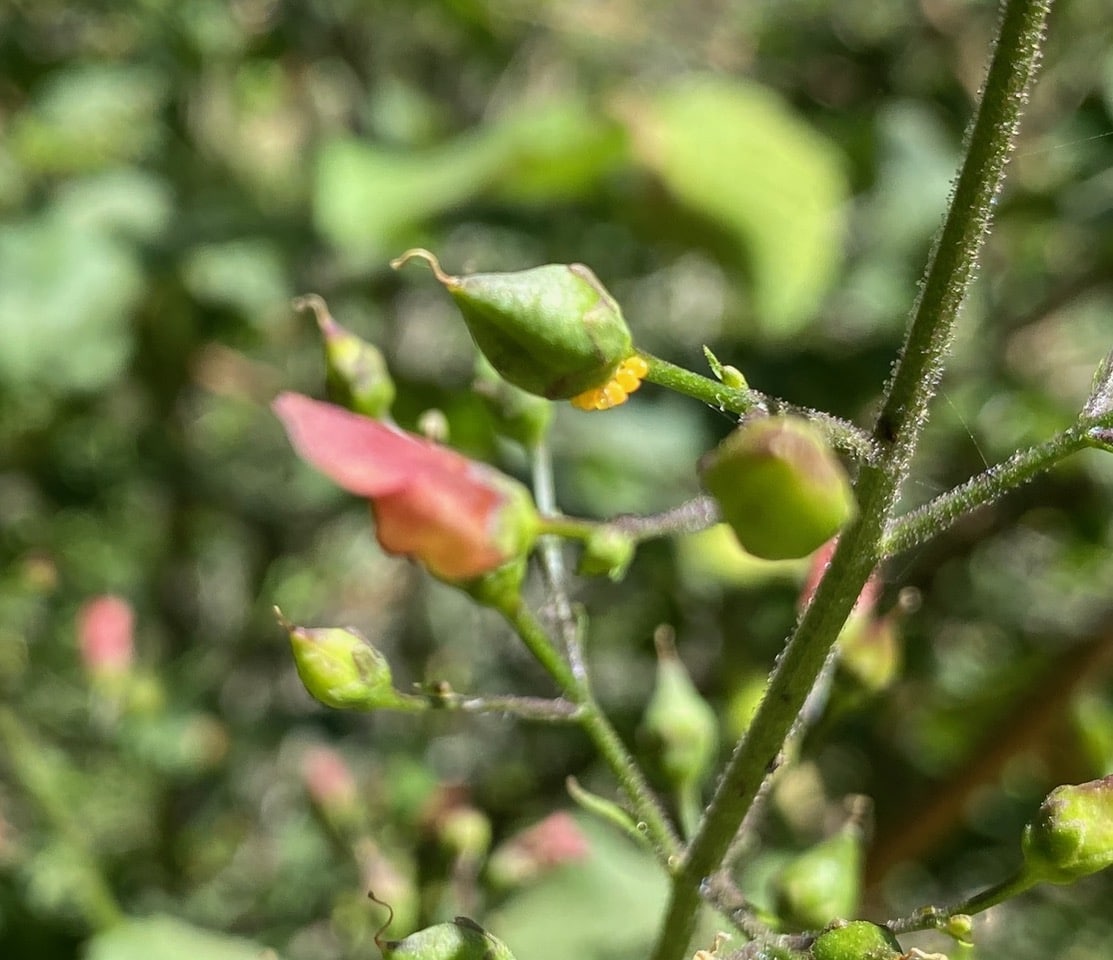
There’s a cluster of yellow insect eggs on the underside of that developing fruit of California Bee Plant, Scrophularia californica. They are probably laid by a small Stink Bug, Cosmopepla uhleri (family Pentatomidae) commonly found on the plant. Pentatomidae is a family of insects belonging to the order Hemiptera or “true bugs”. As hemipterans, the pentatomids have piercing-sucking mouthparts, and most are phytophagous, including several species that are severe pests on agricultural crops. Stink Bugs feed on plant fluids by inserting their needlelike mouthparts into stems, leaves or seed pods. While feeding, they inject materials into the plant to aid in digestion and sap removal. Penetration by the mouthparts can cause physical damage, much like stabbing the plant with a fine needle.

The eggs are white when freshly laid, barrel-shaped with pop tops. These are probably close to hatching.

A few Yellowjacket wasps are visiting the flowers of California Bee Plant for nectar.
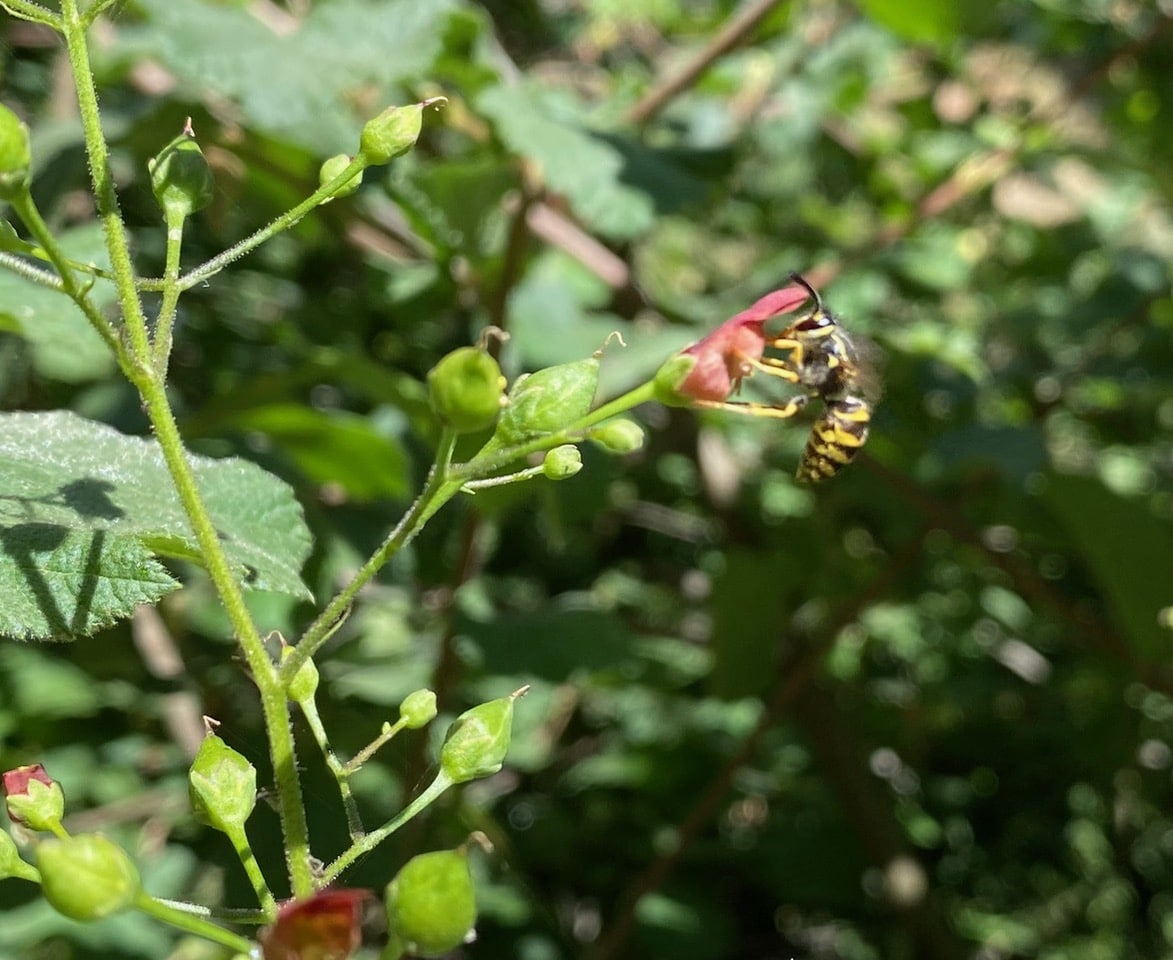
Yellowjacket is the common name for predatory social wasps of the genera Vespula and Dolicovespula (family Vespidae). Yellowjackets are social hunters living in colonies containing workers, queens, and males (drones). Colonies are annual with only inseminated queens overwintering. Queens emerge during the warm days of late spring or early summer, select a nest site, and build a small paper nest in which they lay eggs. They raise the first brood of workers single-handedly. Henceforth the workers take over caring for the larvae and queen, nest expansion, foraging for food, and colony defense. The queen remains in the nest, laying eggs. Later in the summer, males and queens are produced. They leave the parent colony to mate, after which the males quickly die, while fertilized queens seek protected places to overwinter. Parent colony workers dwindle, usually leaving the nest to die, as does the founding queen. In the spring, the cycle is repeated.
Yellowjackets have lance-like stingers with small barbs, and typically sting repeatedly. Their mouthparts are well-developed with strong mandibles for capturing and chewing insects, with probosces for sucking nectar, fruit, and other juices. Yellowjacket adults feed on foods rich in sugars and carbohydrates such as plant nectar and fruit. They also search for foods high in protein such as insects and fish. These are chewed and conditioned in preparation for larval consumption. The larvae secrete a sugary substance that is eaten by the adults.
The Western Yellowjackets typically build nests underground, often using abandoned rodent burrows. The nests are made from wood fiber that the wasps chew into a paper-like pulp. The nests are completely enclosed except for a small entrance at the bottom. The nests contain multiple, horizontal tiers of combs within. Larvae hang within the combs.

A Spotted Cucumber Beetle, Diabrotica undecimpunctata (family Chrysomelidae) is foraging on the flowers of Wild Mustard, Sinapis arvensis.

Members of the family Chrysomelidae are commonly known as Leaf Beetles. Adults and larvae feed on all sorts of plant tissues, and all species are fully herbivorous. Many are serious pests of cultivated plants, including food crops. Others are beneficial due to their use in biocontrol of invasive weeds. Chrysomelids are popular among insect collectors, as many are conspicuously colored, typically in glossy yellow to red or metallic blue-green hues, and some have spectacularly bizarre shapes. Photos of Leaf Beetles (Family Chrysomelidae) · iNaturalist
Native to North America, the Spotted Cucumber Beetle can be a major agricultural pest, causing damage to crops in the larval as well as adult stages of their life cycle. Larvae, sometimes known as rootworms feed on the roots of emerging plants. In the adult stage the beetles cause damage by eating the flowers, leaves, stems and fruits of the plant.
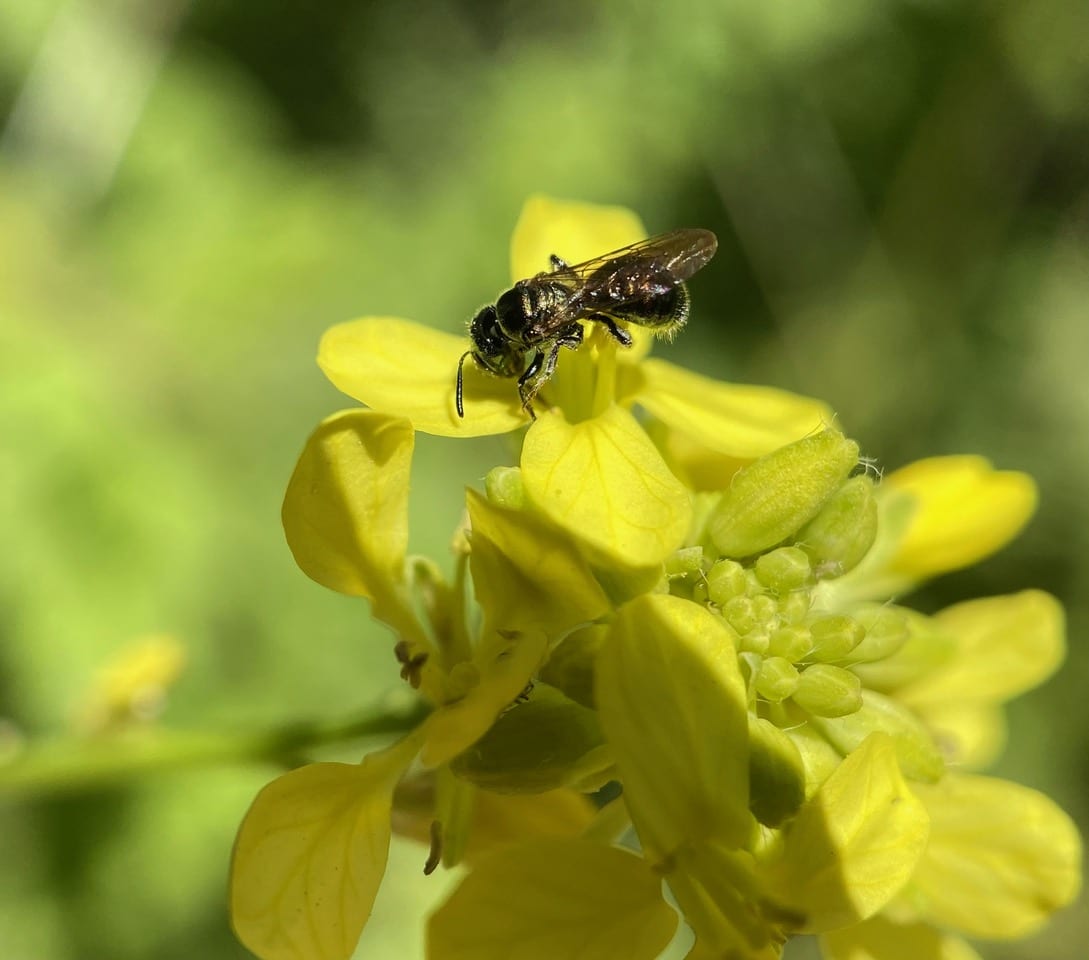
A Small Carpenter Bee, Ceratina sp. (family Apidae) appears to be taking nectar from a Wild Mustard flower.
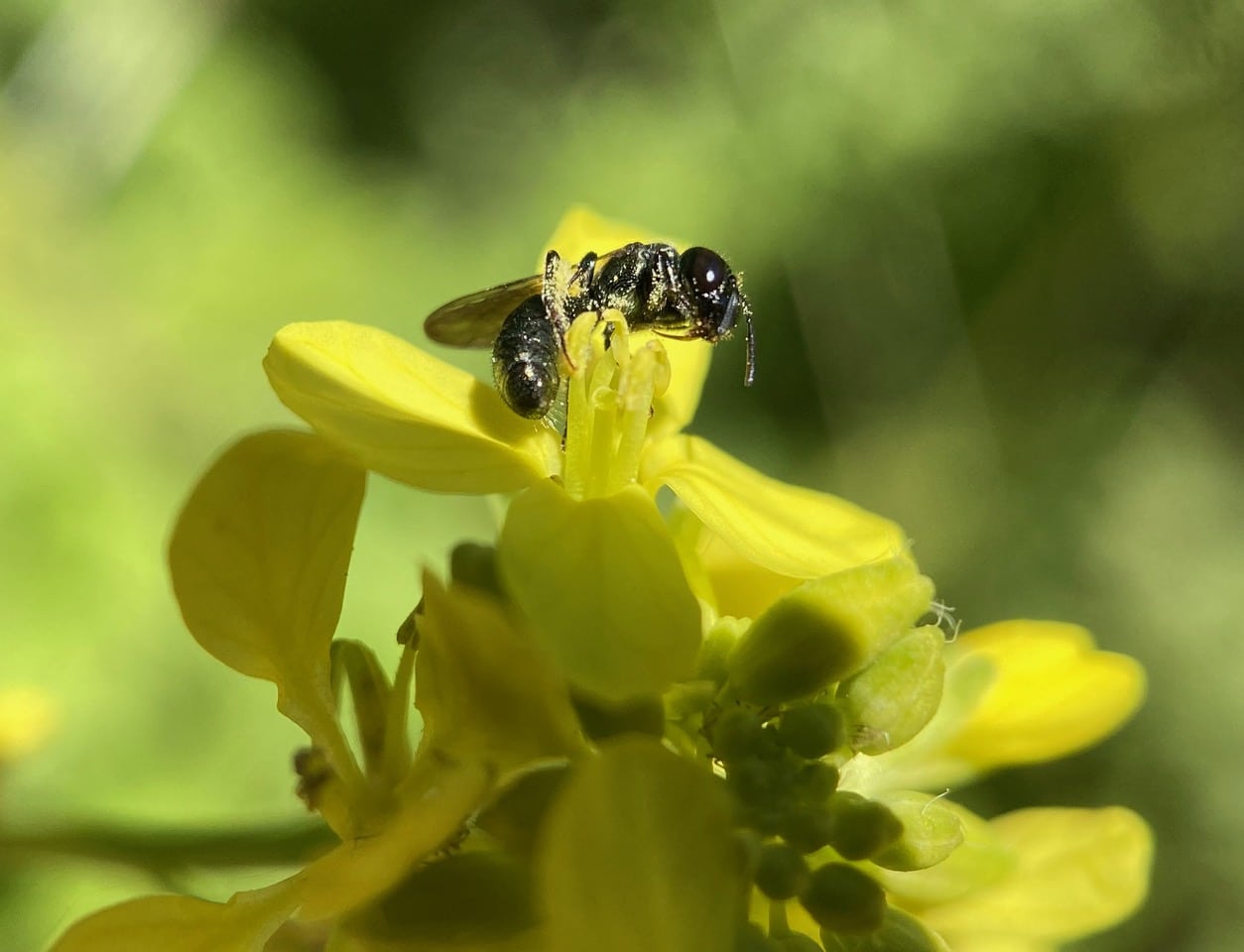
The Small Carpenter Bee genus Ceratina is closely related to the more familiar, and much larger Carpenter Bees (genus Xylocopa). Ceratina are typically dark, shiny, even metallic bees, with fairly sparse body hairs and a weak scopa on the hind leg. The shield-shaped abdomen comes to a point at the tip. Some species have yellow markings, often on the face.
Females excavate nests with their mandibles in the pith of broken or burned plant twigs and stems. While many species are solitary, a number are subsocial. Both male and female carpenter bees overwinter as adults within their old nest tunnels, emerging in the spring to mate. In the spring, this resting place (hibernaculum) is modified into a brood nest by further excavation. The female collects pollen and nectar, places this mixture (called bee bread) inside the cavity, lays an egg on the provision, and then caps off the cell with chewed plant material. Several cells are constructed end to end in each plant stem.

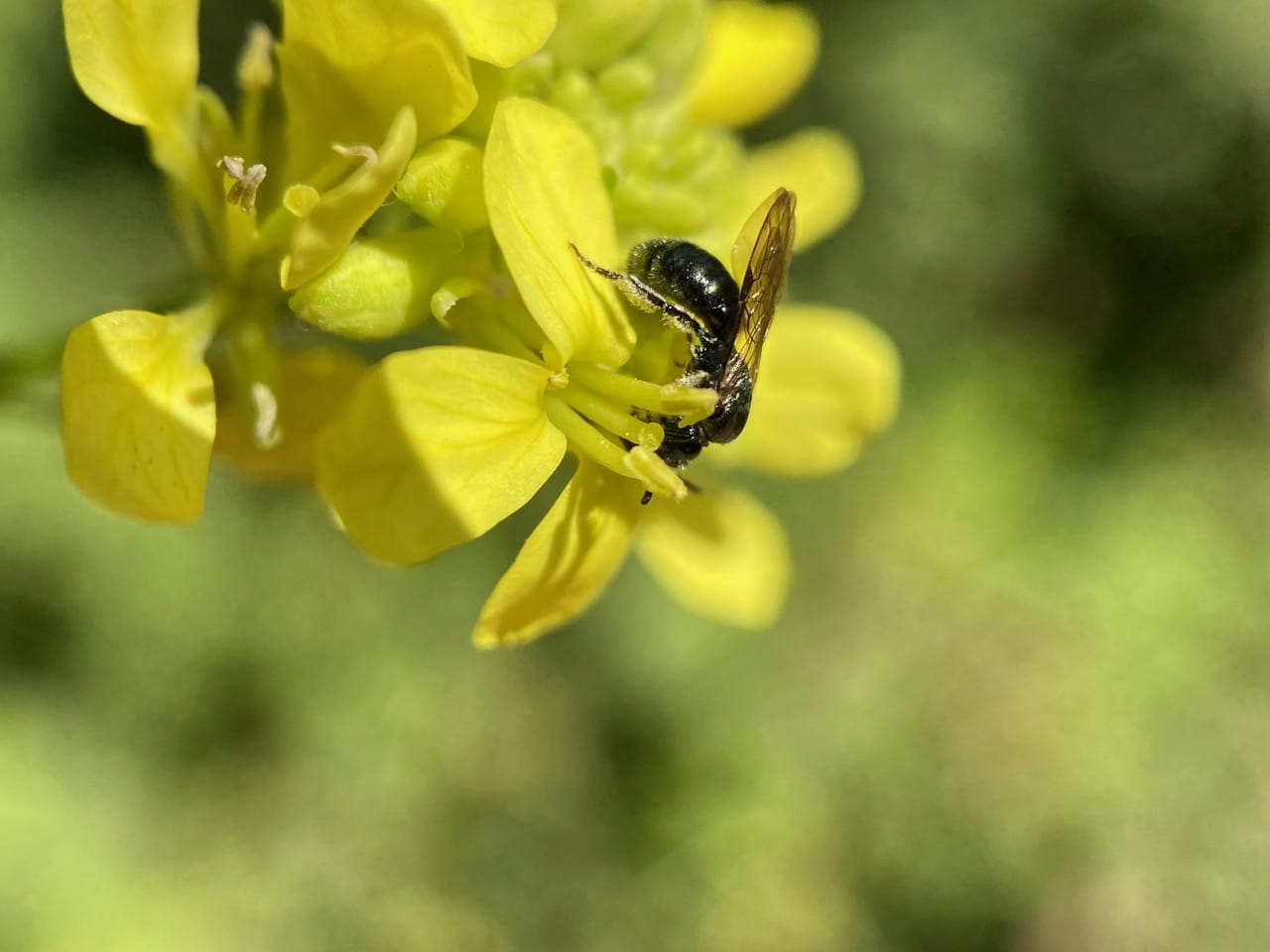
Note the modest scopa on her hind leg. The bee is only taking nectar and has not been collecting pollen from these flowers.

I am happy to see more Ocean Spray, Holodiscus discolor with flower buds today – the plants have finally caught up, about a month late. But where are the Ocean Spray Fairy Longhorn Moths, Adela septentrionella (family Adelidae)? I don’t see any moths dancing over the branches – apparently the courtship season is over. However there are a few females on the flower buds, apparently finishing up their job of laying eggs. The females are recognizable from their shorter antennae, and some orange hairs on their heads.
The Ocean Spray Fairy Longhorn Moth, Adela septentrionella is a day-active moth in the family Adelidae. It is widespread from southern British Columbia and north-western Idaho to southern California. The length of the forewings is 4.5-5.7 mm. The forewings are purplish-black with two incomplete thin white bands. The antennae of the males are at least twice as long as the wings. Adults are on wing from mid April to mid July. The larvae feed on buds of Ocean Spray, Holodiscus discolor. Full-grown larvae overwinter in cases on the ground. Pupation takes place in late March or April.
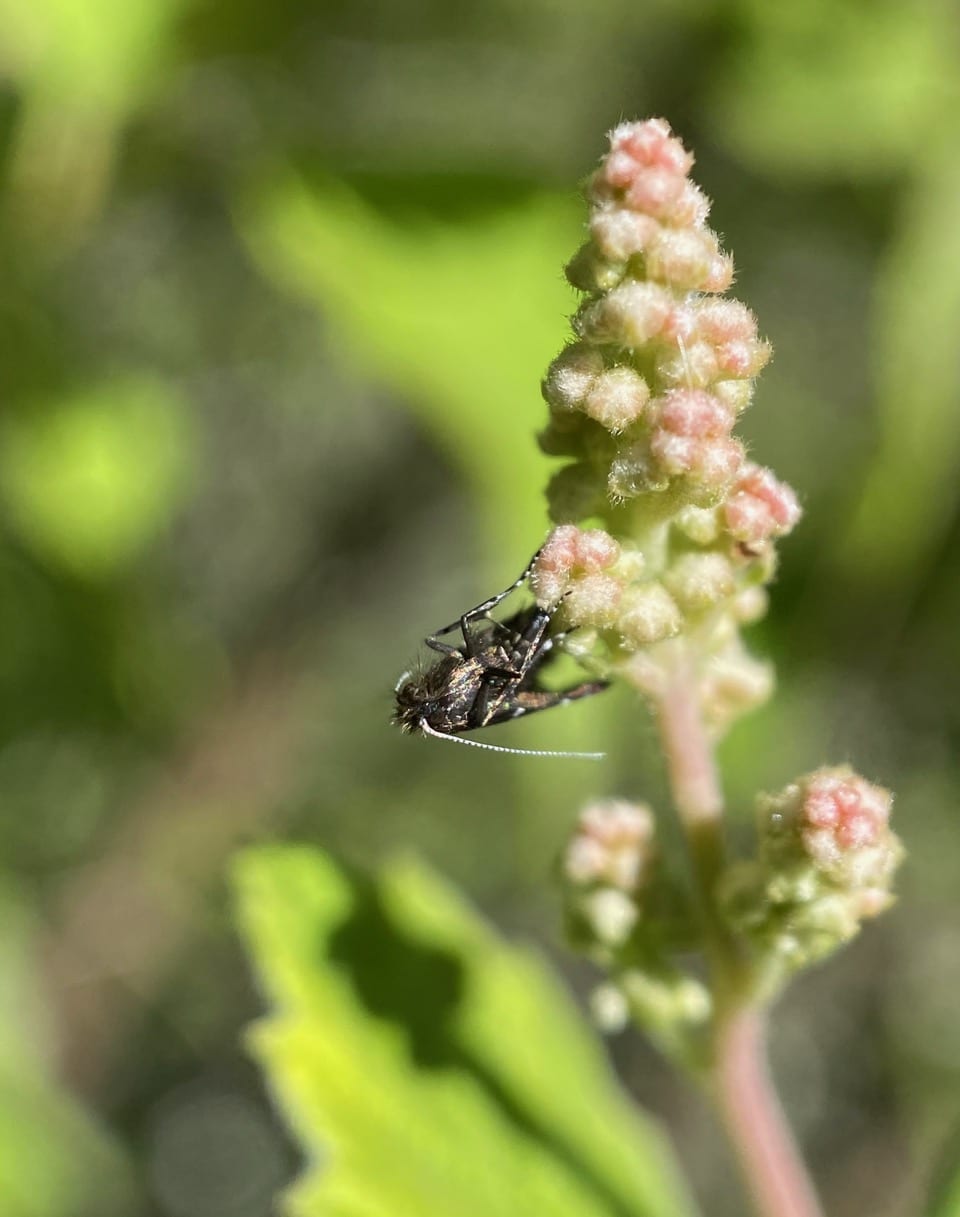
A female Ocean Spray Fairy Longhorn Moth is laying eggs on a cluster of Ocean Spray flower buds.
In Adela septentrionella, males gather to perform courtship dances – bobbing flights above the branches of Ocean Spray about ready to burst into bloom. While the display may appear peaceful and romantic, studies have shown that males actually engage in combat using long tibial spurs during flight displays and while landed on leaves. They apparently attempt to fray one another’s wings and also kill rivals. Females, with orange hairdo and shorter antennae, watch the male displays, often upwind, from 15-20 feet away. Females may be releasing a pheromone that tells the males they are being watched and that intensifies male-male combat. Females eventually fly into the male swarm and engage in evasive flight; the least damaged male would be the most likely to capture her. Mating occurs below the mating swarm, in plain view, without interference. Fertilized females fight over the most sun-exposed Ocean Spray unopened flower inflorescences on which to lay their eggs.
Here are a couple of videos I took last year showing the bobbing flights of the moths over the Ocean Spray:
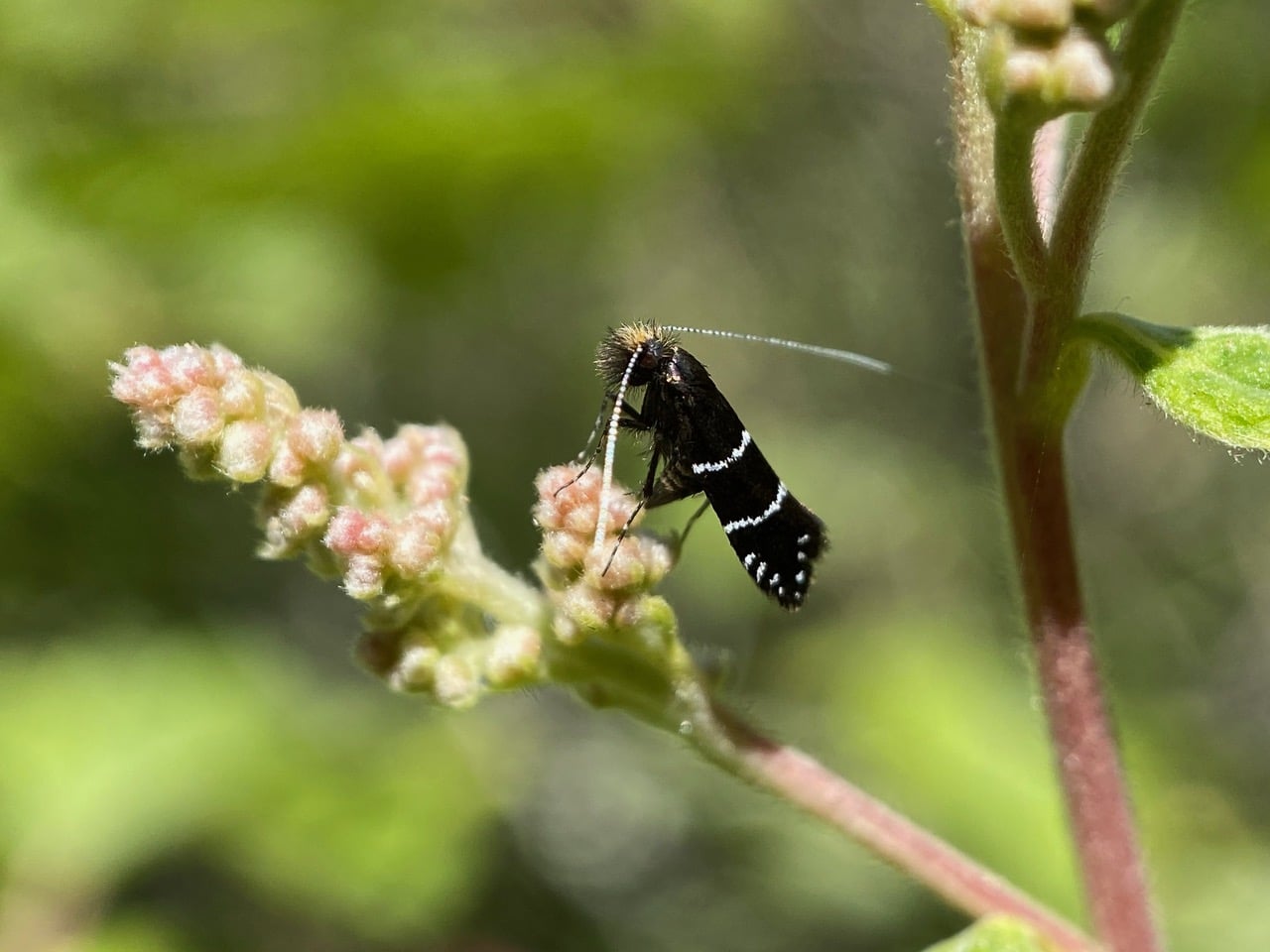
Another female ovipositing on Ocean Spray. Note that she has tipped her abdomen forward to lay eggs on the flower buds.
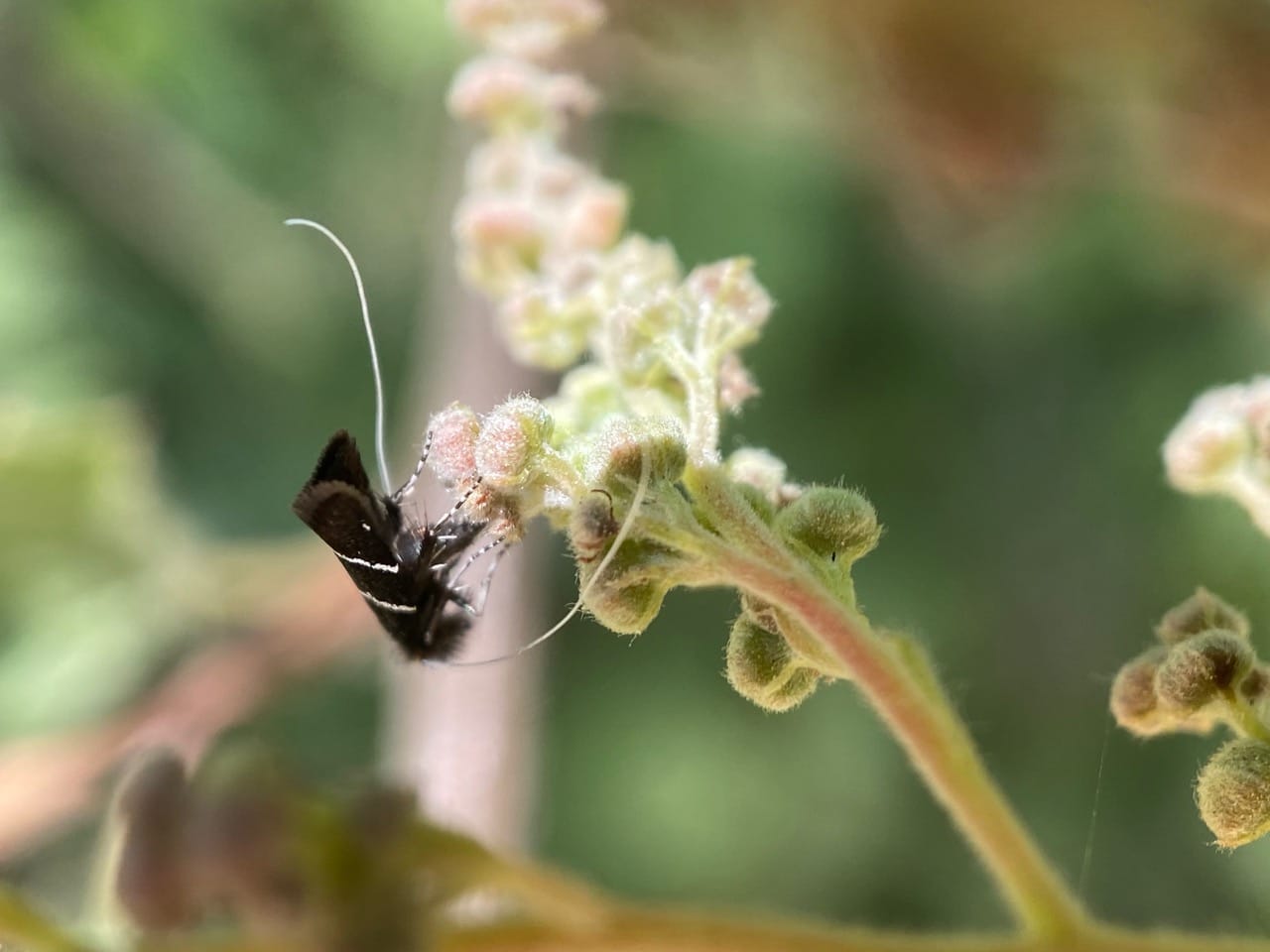
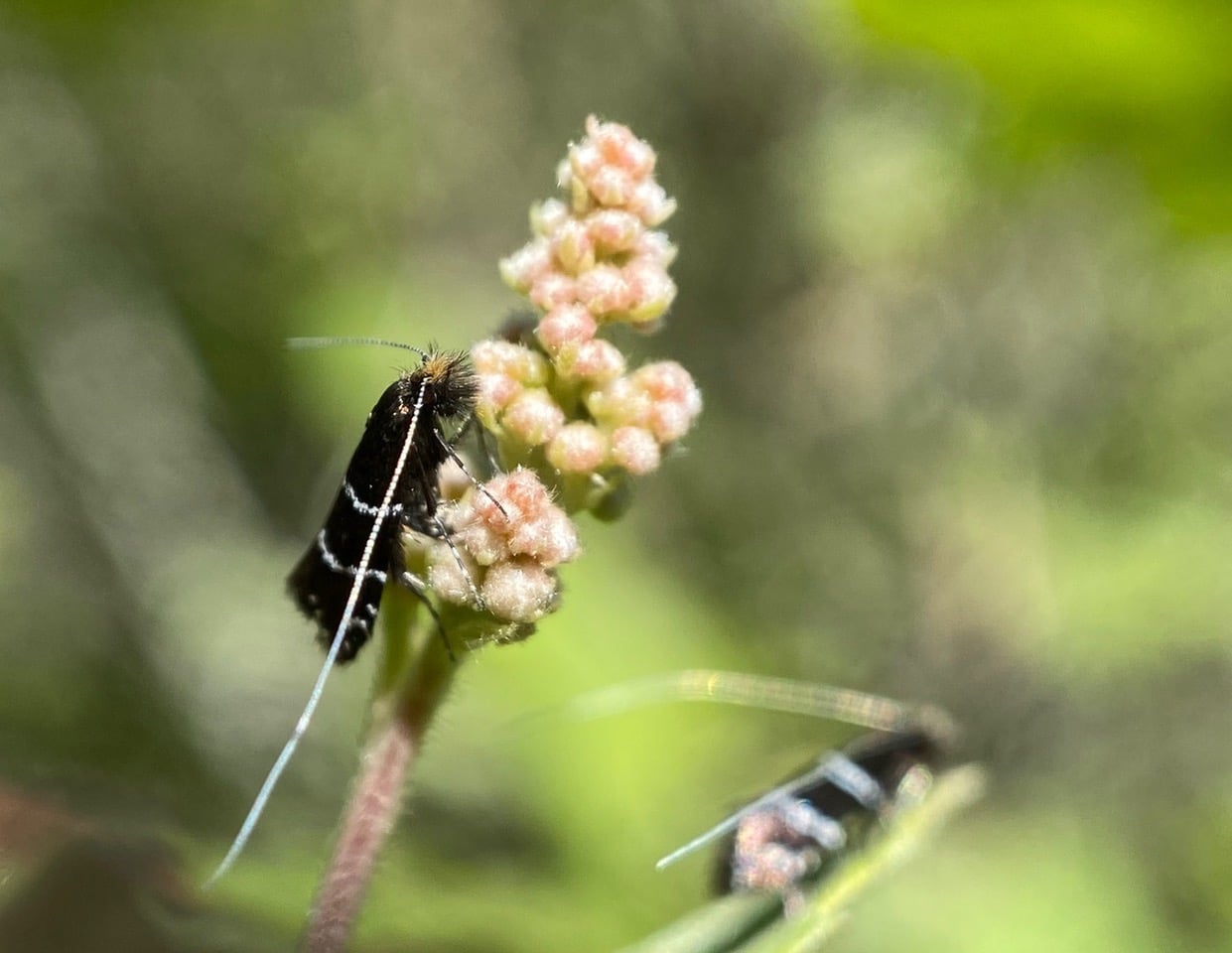
Two more females with their white antennae waving in the wind.
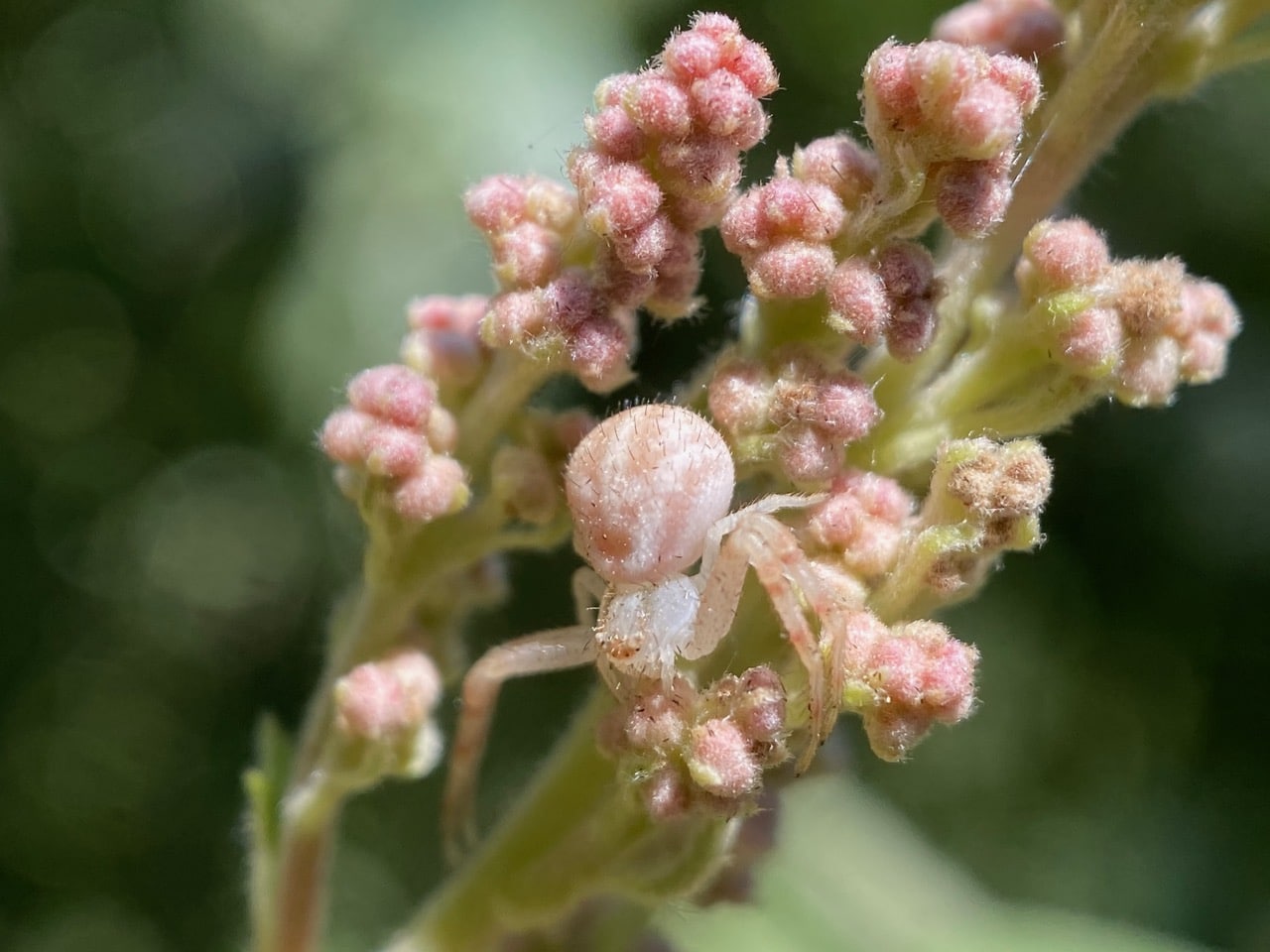
A small, well-camouflaged Crab Spider, Mecaphesa sp. (family Thomisidae) is waiting in ambush among the pink flower buds of an Ocean Spray, Holodiscus discolor.
Crab Spiders (family Thomisidae) do not spin webs to trap prey. They are ambush predators that sit and wait on or near flowers to nab insects that come within reach of their extra long front legs.
Crab Spiders are usually yellow or white. This ultimately depends on the flower on which these ambush predators are hunting (active camouflage). They have the ability to change between these colors based on their surroundings, using visual cues. The color-changing process is not instant and can take up to 25 days to complete. Depending on the color of flower they see around them, the spiders can secrete a liquid yellow pigment into the body’s outer cell layer. The baseline color of the spider is white. In its white state, the yellow pigment is sequestered beneath the outer cell layer so that the inner glands which are filled with white guanine are visible. While the spider is residing on a white flower, it tends to excrete the yellow pigment instead of storing it in its glands. In order to change back to yellow, the spider must first produce enough of the yellow pigment. For this reason it takes these spiders much longer to turn from white to yellow than it does the reverse. The color change from white to yellow can take between 10-25 days while the opposite color change takes only about 6 days.
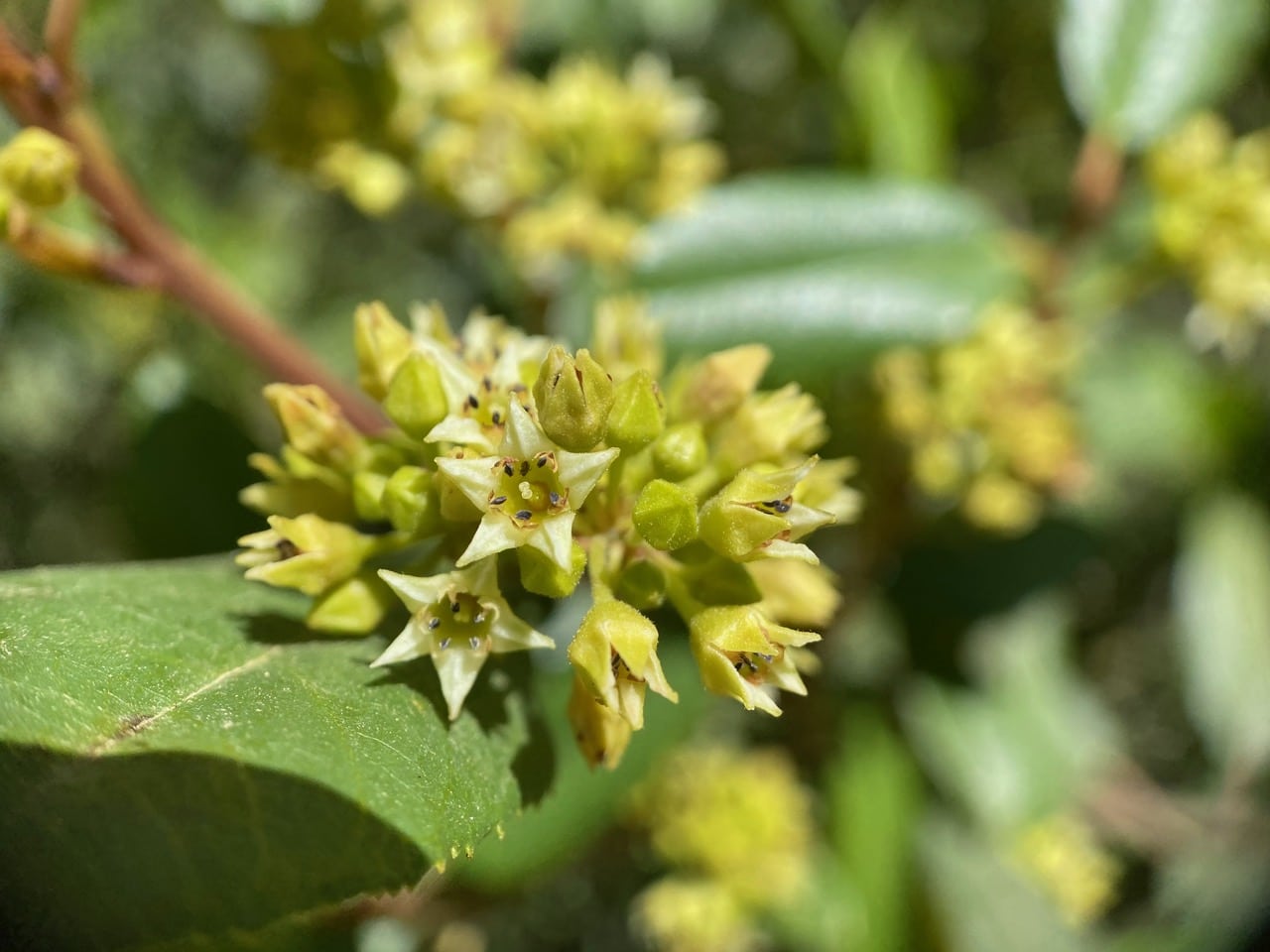
A large shrub of Coffeeberry, Frangula californica is blooming glorious by the trail. The tight clusters of small star-shaped flowers are attracting swarms of midge-like insects that hover over them.
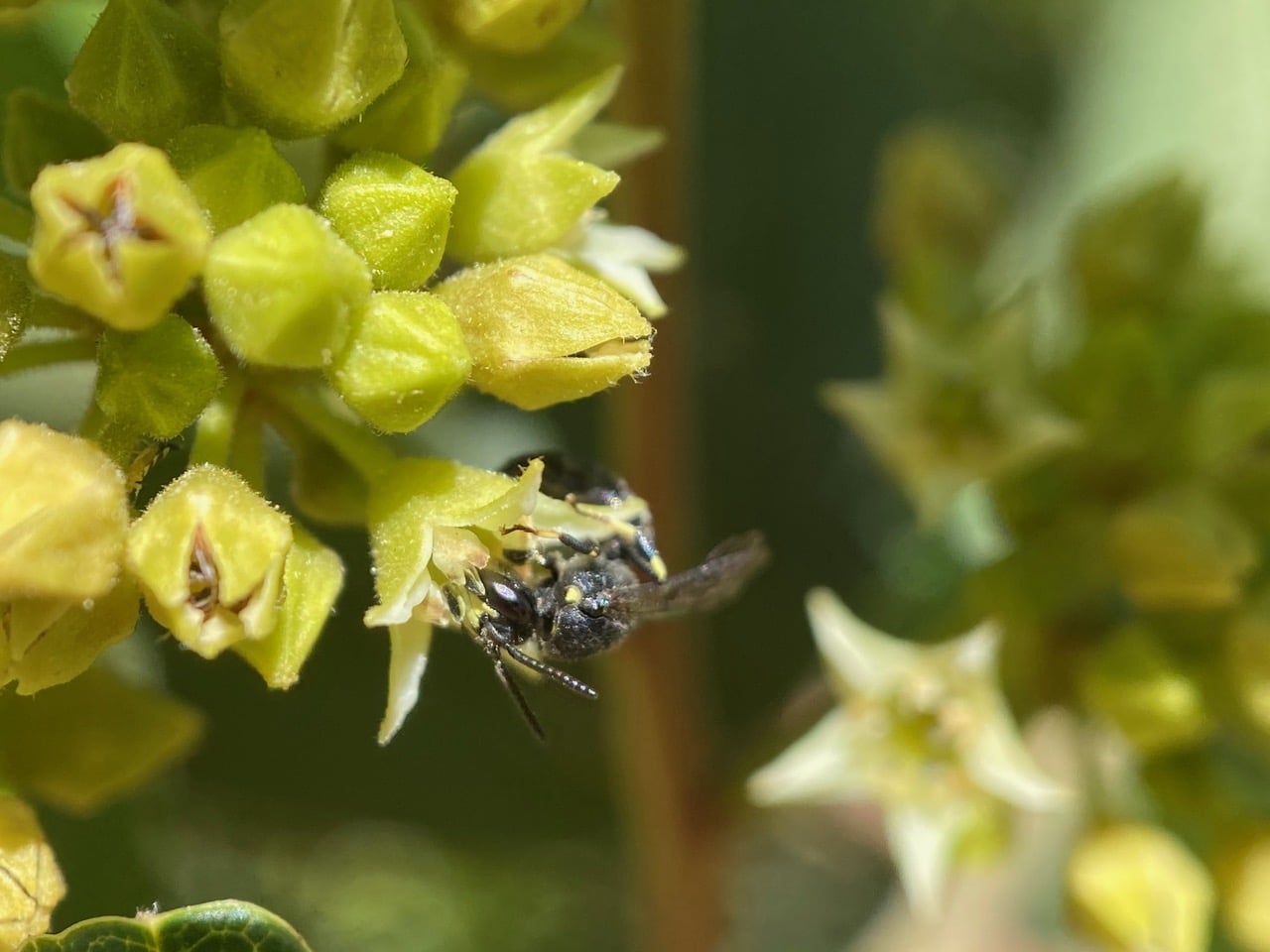
A male Masked Bee, Hylaeus sp. (family Colletidae) has landed to take nectar from a Coffeeberry flower, Frangula californica.

Besides the facial markings, the Masked Bees also have yellow markings on their legs.
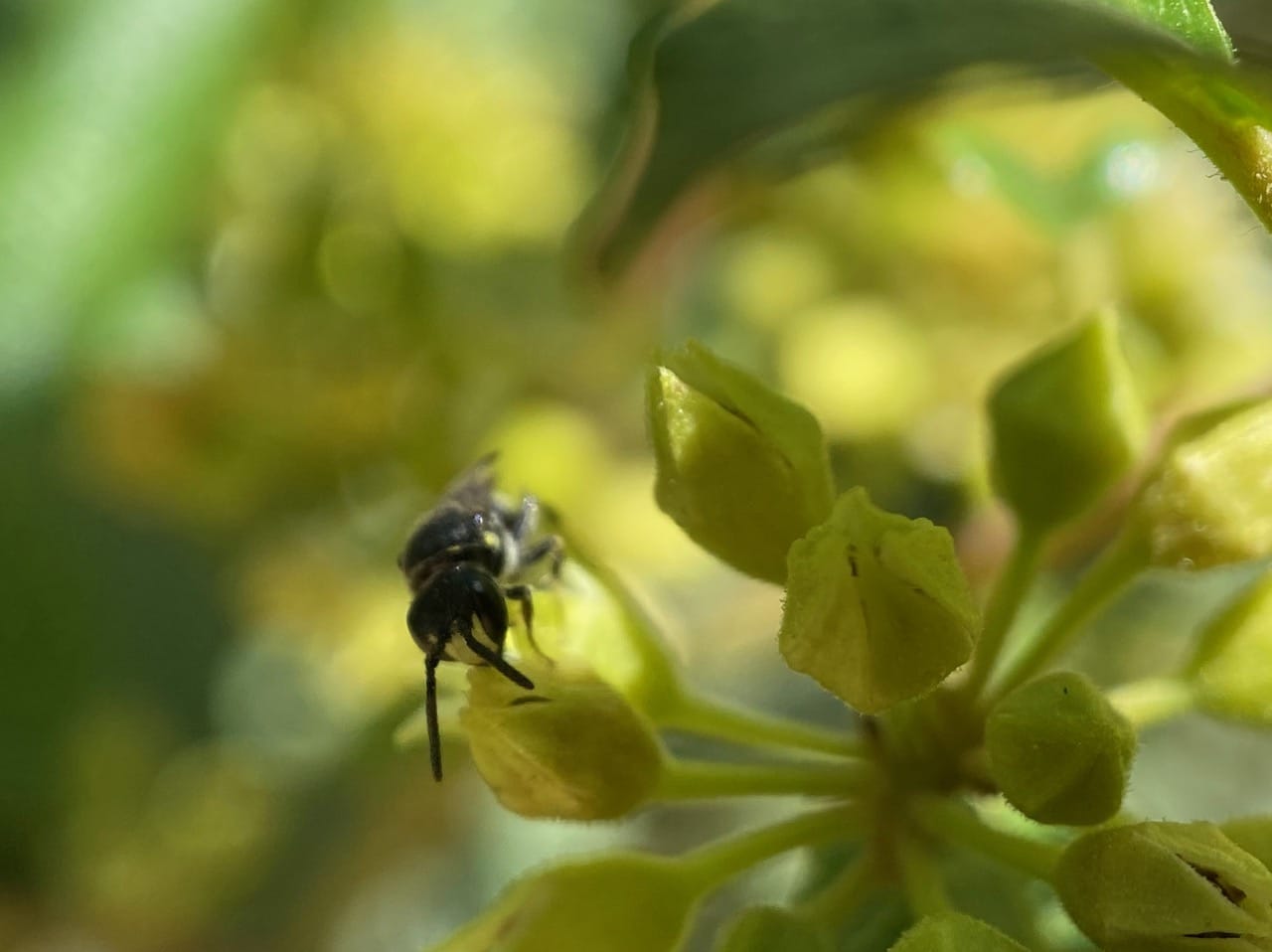
The male Masked Bee, Hylaeus sp. (family Colletidae) is seeking nectar from the young flowers of Coffeeberry in the shade. Note the prominent yellow markings on his face. Male bees do not collect pollen to provision the nest, but do visit flowers for nectar, and to meet with potential mates.
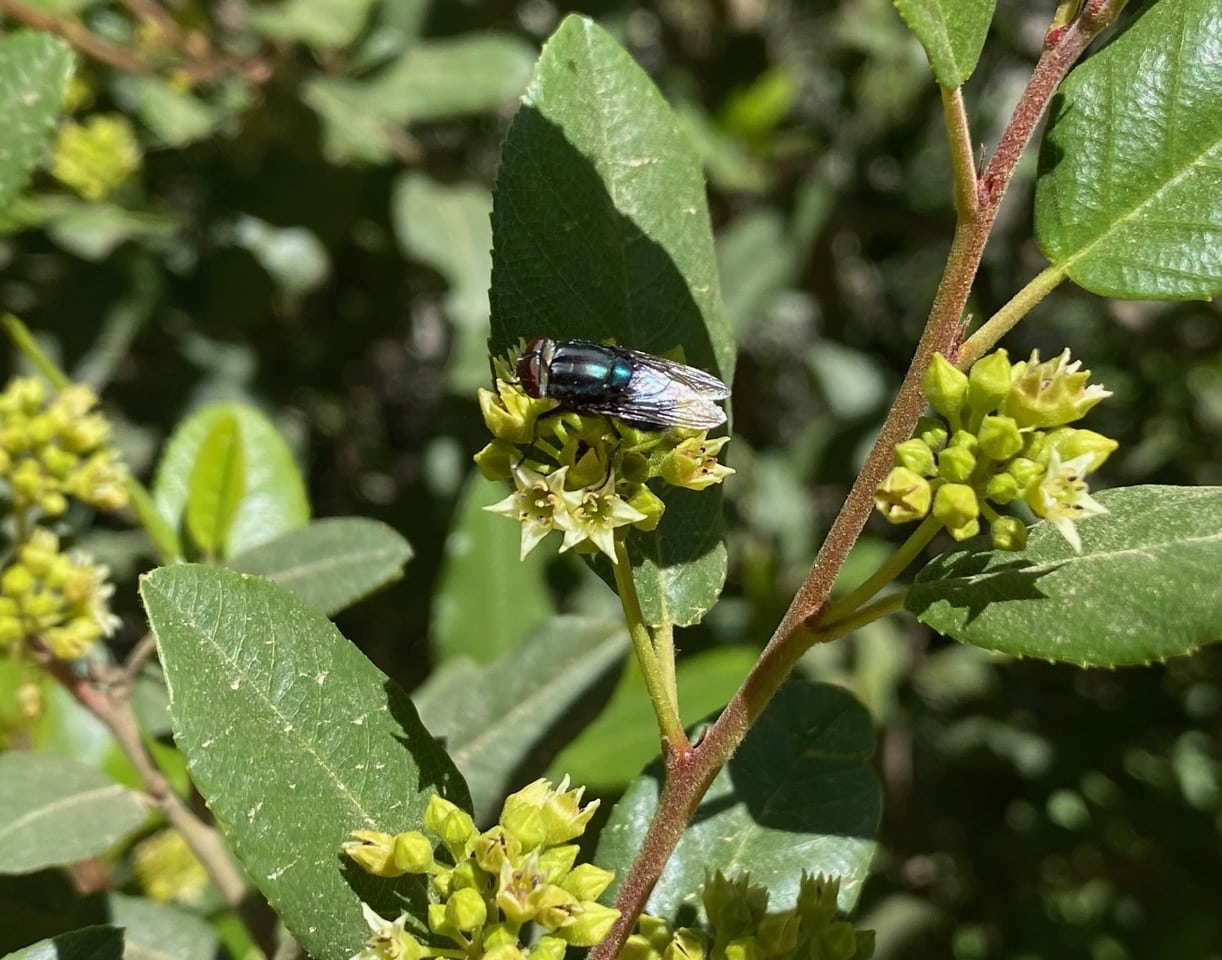
A Secondary Screwworm Fly is foraging on the Coffeeberry flowers.
The Secondary Screwworm, Cochliomyia macellaria (family Calliphoridae, commonly known as blow flies) ranges throughout the United States and the American tropics. The body is metallic greenish-blue and characterized by three black longitudinal stripes on the dorsal thorax. Females are attracted to carrion where they lay their eggs. These screwworms are referred to as “secondary” because they typically infest wounds after invasion by primary myiasis-causing flies. While the flies carry various types of Salmonella and viruses, C. macellaria can also serve as important decomposers in the ecosystem. In a lifetime, a female may lay up to 1000 or more eggs. Females may also lay their eggs with other females, leading to an accumulation of thousands of eggs. The larval stage of C. macellaria is referred to by the common name of secondary screwworms; this is due to the presence of small spines on each body segment that resemble parts of a screw. The larvae feed on the decaying flesh of the animal that they have been laid on until they reach maturity. Eventually the larvae fall off the food source to pupate in the top layer of the soil. Adult females will continue to feed on tissues of animals; however, now they preferentially feed off of live tissues and tissue plasma. Adult males will no longer consume tissue, but instead will eat nearby vegetation and take nourishment from floral nectar.

While photographing the Masked Bees, I notice a different insect. It is a small fly with elongated body and skinny legs.
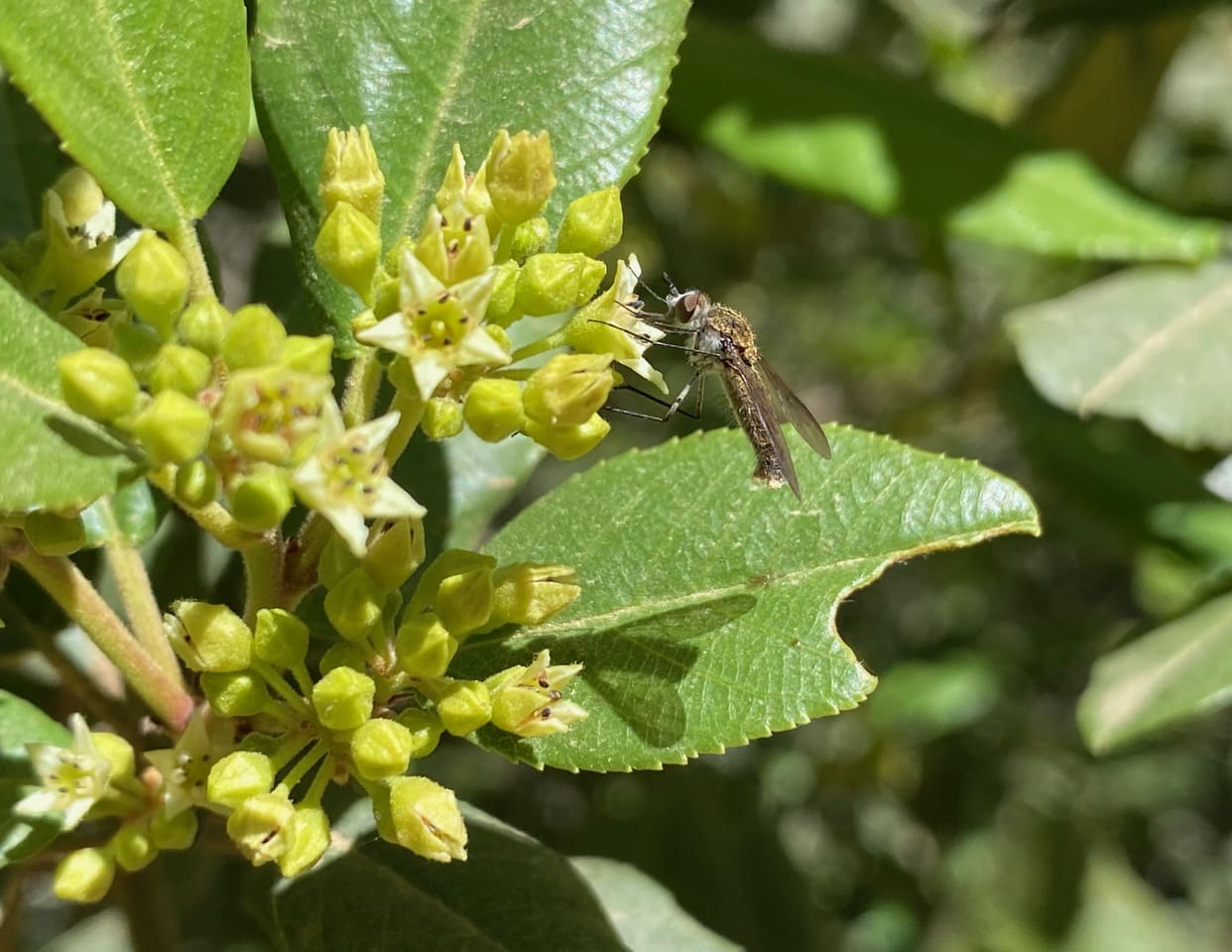
The fly is taking nectar from a Coffeeberry flower. It has shiny scales all over its body, and the white tip of its abdomen flares like those of moths. Is it a Bee Fly (family Bombyliidae)? Someone on iNaturalist has suggested that it might be a member of the genus Thevenetimyia (family Bombyliidae). Yay!
The Bee Flies belong to the family Bombyliidae. Adults generally visit flowers for nectar and pollen, some being important pollinators. Larvae generally are parasitoids of other insects. When at rest, many species of bee flies hold their wings at a characteristic “swept back” angle. The adult females usually deposit eggs in the vicinity of possible hosts, quite often in the burrows of beetles or ground-nesting bees/wasps. Bombyliidae parasitism is not host-specific, but rather opportunistic, using a variety of hosts.
Thevenetimyia is a genus of bee flies in the family Bombyliidae. There are more than 40 described species in Thevenetimyia found worldwide, mostly in North America. They are parasites of wood-boring beetle larvae.
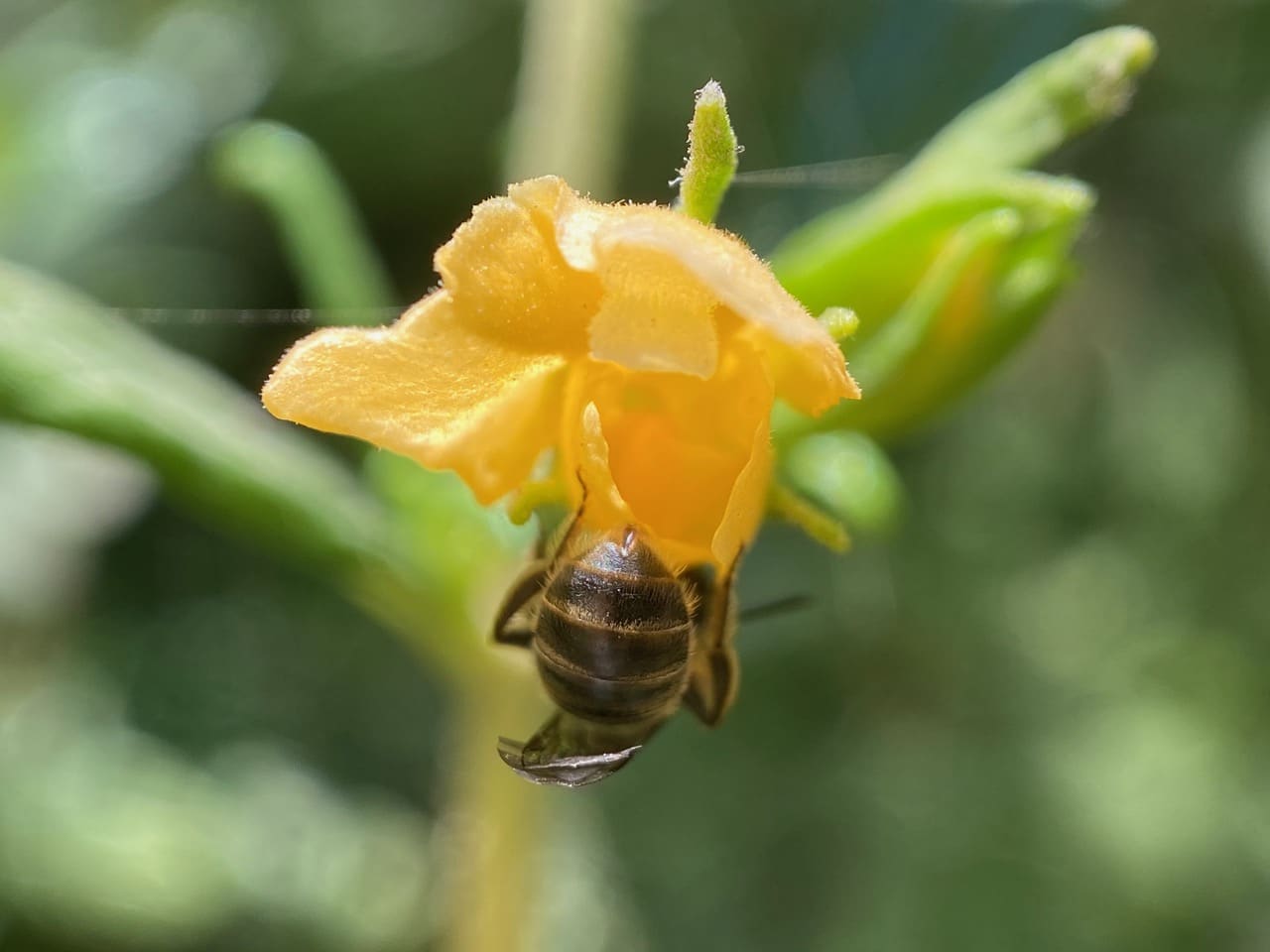
A bee has landed on a Sticky Monkeyflower. There appears to be a “furrow” on the last segment of her abdomen. A Furrow Bee, Halictus sp. (family Halictidae)?
The furrow, only present in females, distinguishes the genus Halictus from the related and similar genus Lasioglossum. This is the reason why Halictus are sometimes called Furrow Bees. The furrow on the last tergite (top segment of the abdomen) is referred to as a ‘rima’. The purpose of this feature is unknown.
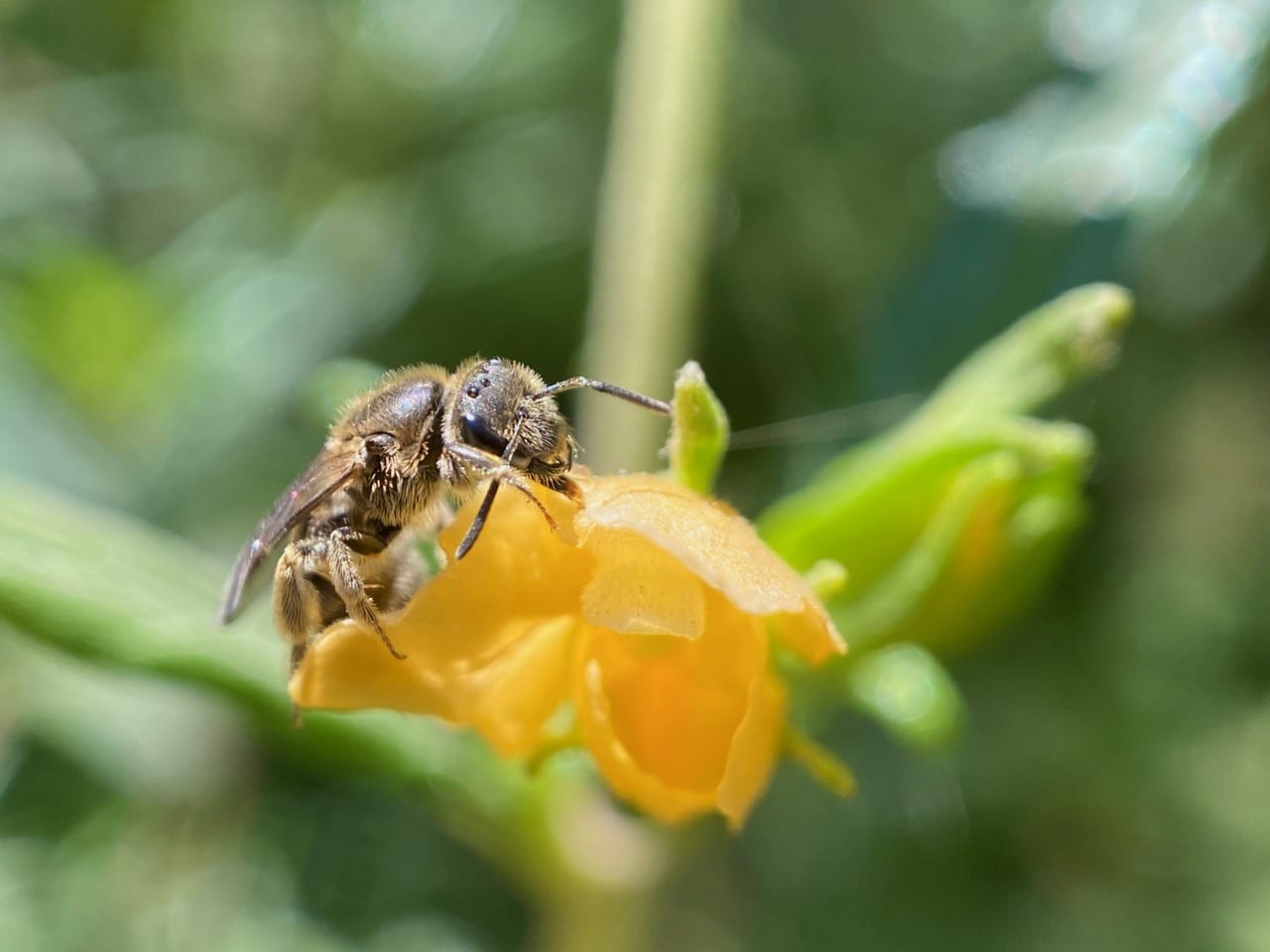
The bee pauses for a second to clean her antenna using the antenna cleaner on her right foreleg.
All bees have an antenna cleaner on each of their two forelegs. The antenna cleaners consists of two parts: a notch in the basitarsus, which is fitted with stiff hairs, and a corresponding spur on the tibia. To clean its antenna, the bee raises its foreleg over its antenna and then flexes it tarsus. The action allows the spur to close the notch, forming a ring around the antenna. The bee pulls each antenna through the bristles to clean it of debris such as pollen or dust which might interfere with the many sensory organs within the antenna. A bee’s antennae serve numerous functions: smell, taste, perceive humidity and temperature, feel, monitor gravity and flight speed and even detect sound waves to help guide the bee in its daily activities.
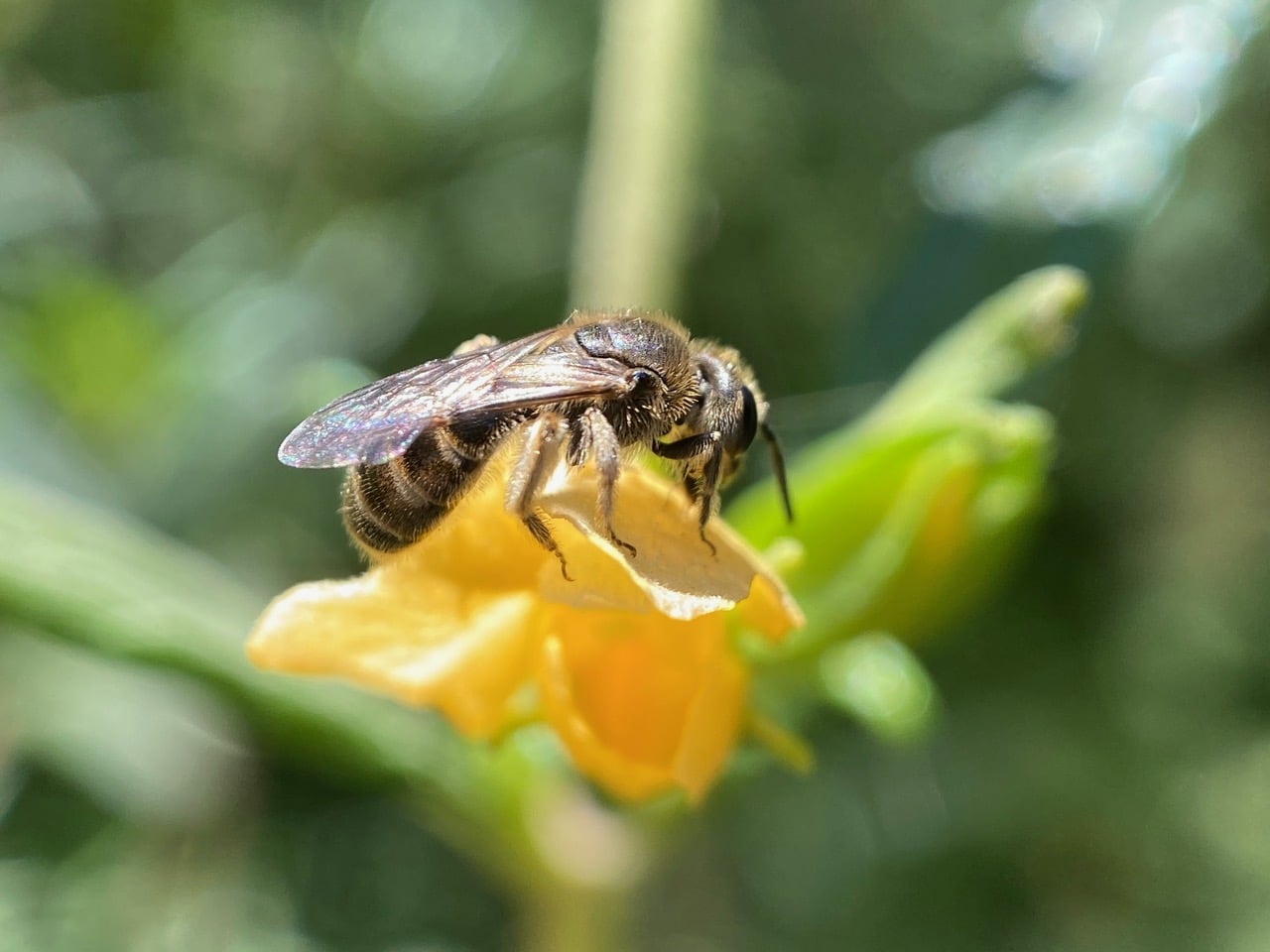
The scopae on her hind legs are empty. She has only been taking nectar from the flower.
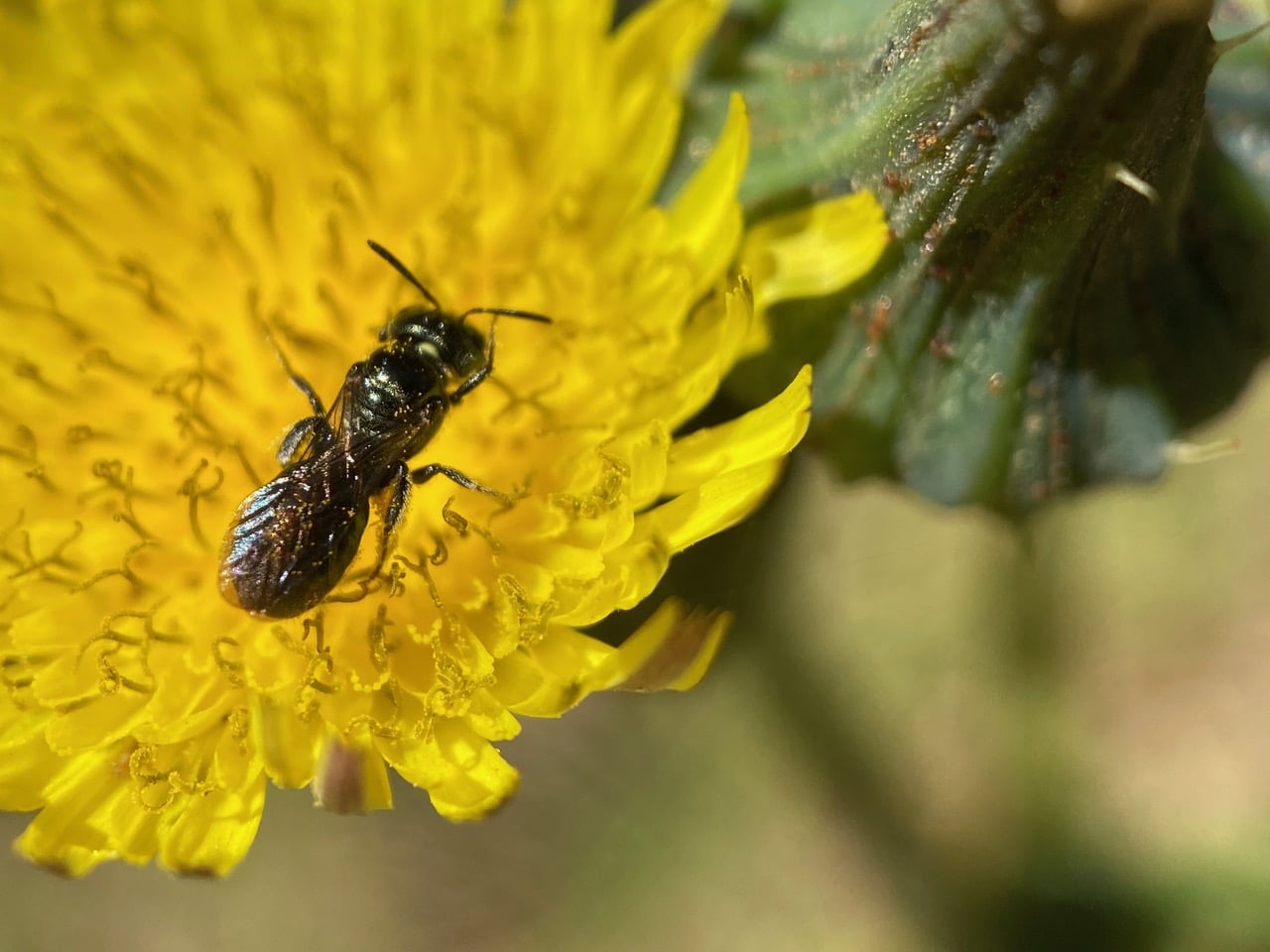
A Small Carpenter Bee, Ceratina sp. (family Apidae) is foraging on a Dandelion flowerhead.
The Small Carpenter Bee genus Ceratina is closely related to the more familiar, and much larger Carpenter Bees (genus Xylocopa). Ceratina are typically dark, shiny, even metallic bees, with fairly sparse body hairs and a weak scopa on the hind leg. The shield-shaped abdomen comes to a point at the tip. Some species have yellow markings, often on the face.
Females excavate nests with their mandibles in the pith of broken or burned plant twigs and stems. While many species are solitary, a number are subsocial. Both male and female carpenter bees overwinter as adults within their old nest tunnels, emerging in the spring to mate. In the spring, this resting place (hibernaculum) is modified into a brood nest by further excavation. The female collects pollen and nectar, places this mixture (called bee bread) inside the cavity, lays an egg on the provision, and then caps off the cell with chewed plant material. Several cells are constructed end to end in each plant stem.
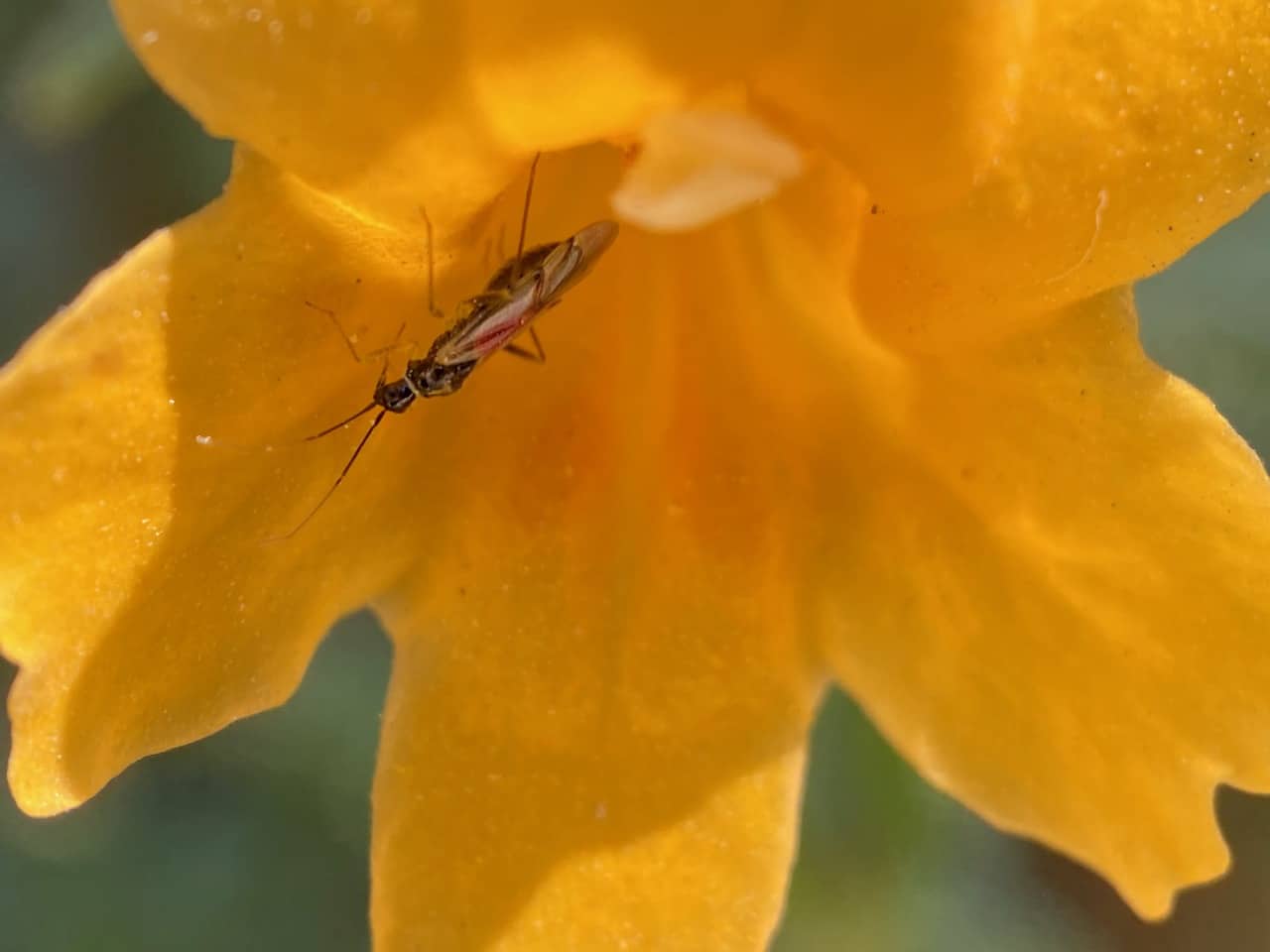
A Phacelia Plant Bug, Tupiocoris californicus (family Miridae) is crawling out of a Sticky Monkeyflower. The genus is mostly found in western North American from California to Baja. Sometimes I wonder if the common name isn’t a misnomer. I have never seen this bug on Phacelia, but have mostly found it on the tarweeds. In fact, it is one of the guild of bugs that are specialized for living on sticky plants. It can navigate the glandular hairs with the greatest of ease.
Mirid bugs are also referred to as plant bugs or leaf bugs. Miridae is one of the largest family of true bugs in the order Hemiptera. Like other Hemipterans, Mirids have piercing, sucking mouthparts to extract plant sap. Some species are predatory. One useful feature in identifying members of the family is the presence of a cuneus; it is the triangular tip of the corium, the firm, horny part of the forewing, the hemielytron. The cuneus is visible in nearly all Miridae.
