

Pollinator Post 6/10/23 (1)
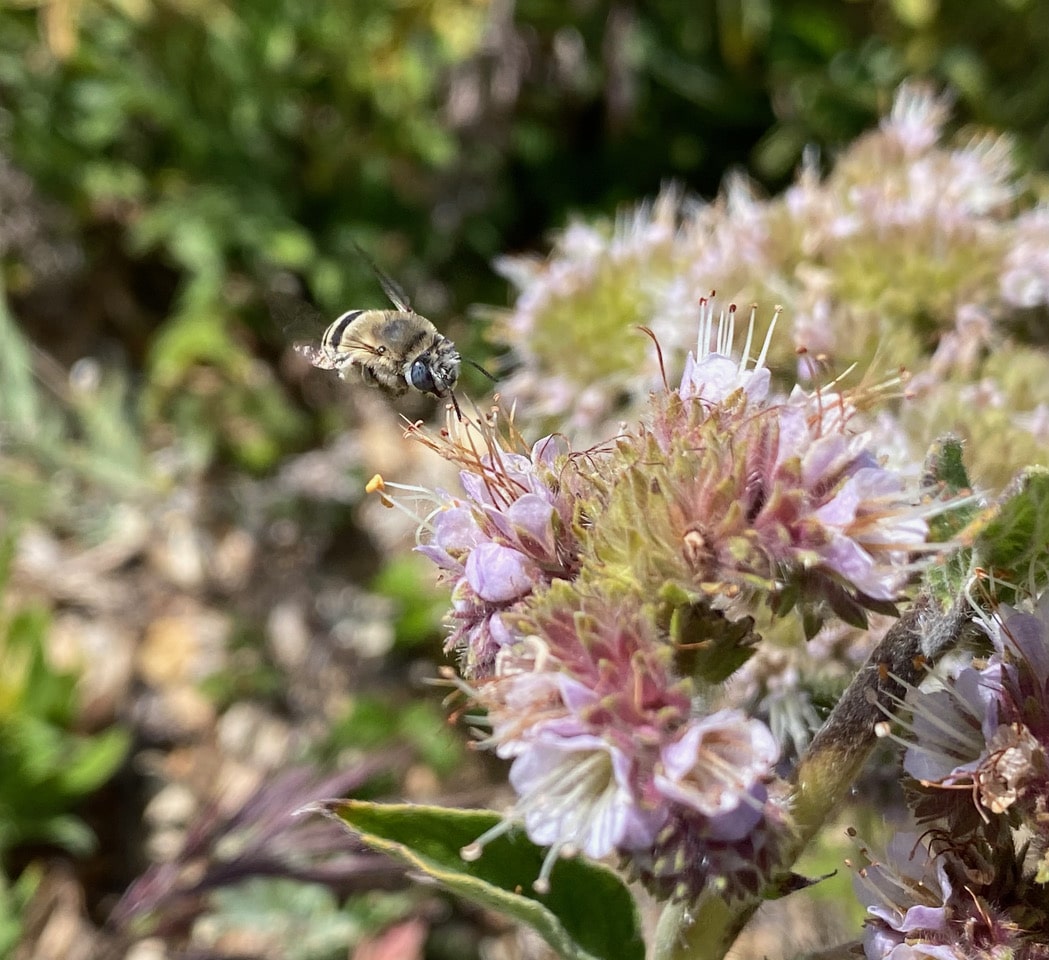
Waiting for the clouds to clear, I don’t get to Siesta Gate until 2:30 pm.
A loud buzzing around a California Phacelia, Phacelia californica alerts me to the presence of a Digger Bee, Anthophora sp. (family Apidae).
Anthophora, commonly called Digger Bees, are entertaining, unusually noisy bees with a distinctive way of flying. They zip speedily around flowers, stopping abruptly to hover in front of a blossom, sometimes angling their long tongues down a flower’s throat without landing. Or they buzz raucously while clinging to the flowers, and thrust their faces so deeply into them that their bodies get coated in pollen.
Anthophora are generally somewhat larger than honey bees and robustly built like bumble bees, but with black or black-and-white-striped abdomens and furry thorax. Typically, digger bees have “roman noses” or concave profiles. Male digger bees of many species have white or yellow markings on their faces. Females have shaggy hairs on their back legs, used to carry pollen.
Anthophora are solitary bees, i.e. each female builds and provisions its own nest. However, digger bees are often gregarious, preferring to build their nests close by one another, sometimes forming large aggregations that number in the hundreds. As their name suggests, digger bees typically nest in the soil, either in level ground or vertical banks. Female Anthophora construct ground nests by digging with their front legs and using their mandibles to loosen dirt. The males often hang around nest entrances, awaiting the emergence of a female for a chance to mate with her. When she appears, the males jump on her en masse, sometimes creating chaotic “mating balls”. It’s a boisterous affair!
Female Anthophora are capable of buzz pollination – i.e. they vibrate their wing muscles to shake pollen from the anthers of some flowers. Digger bees are generalist pollinators that visit an impressively wide range of plants. They are exceptionally effective pollinators and play an important role in maintaining wildflower diversity, in part because their long tongues allow them to pollinate deep-throated and tubular blossoms inaccessible to other bees.
Photos of Pacific Digger Bee (Anthophora pacifica) · iNaturalist United Kingdom
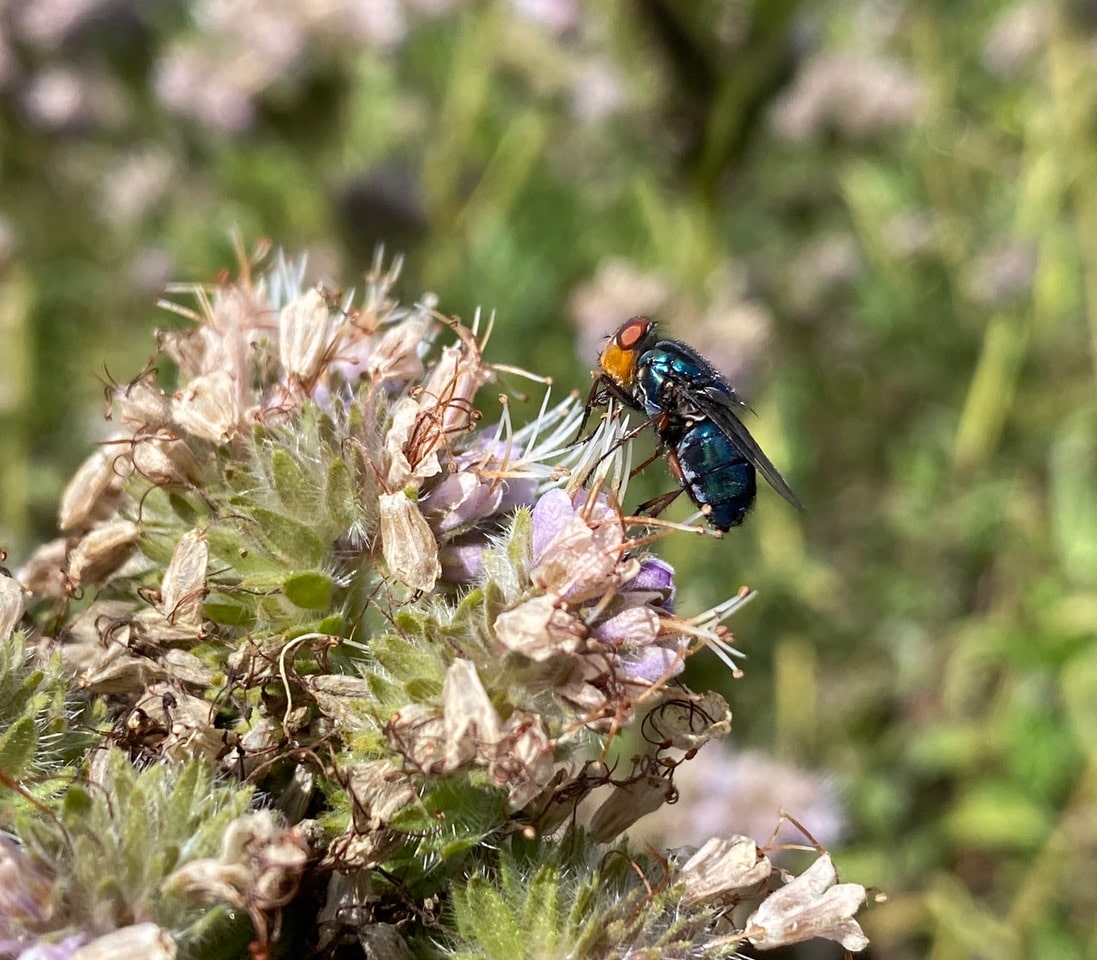

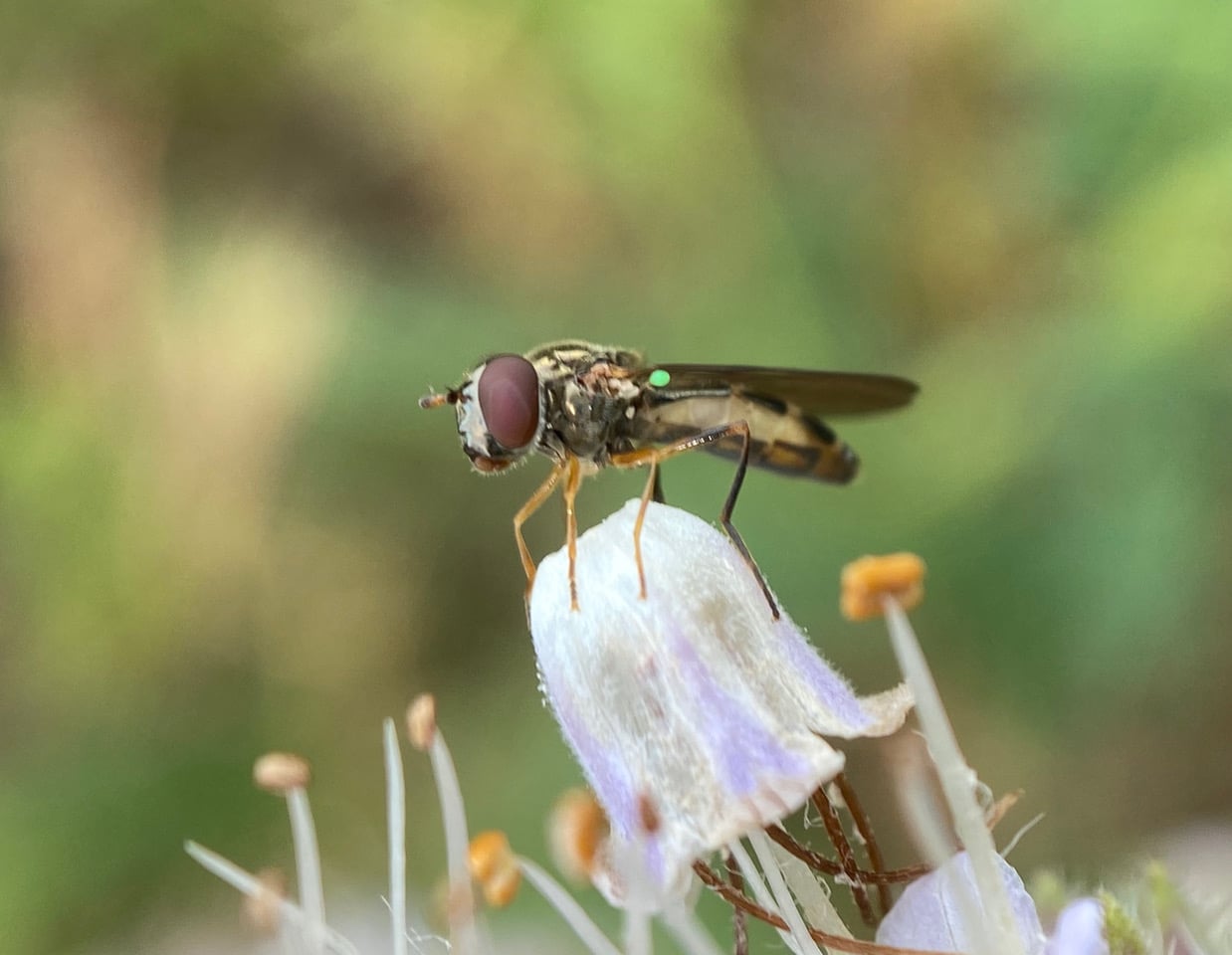
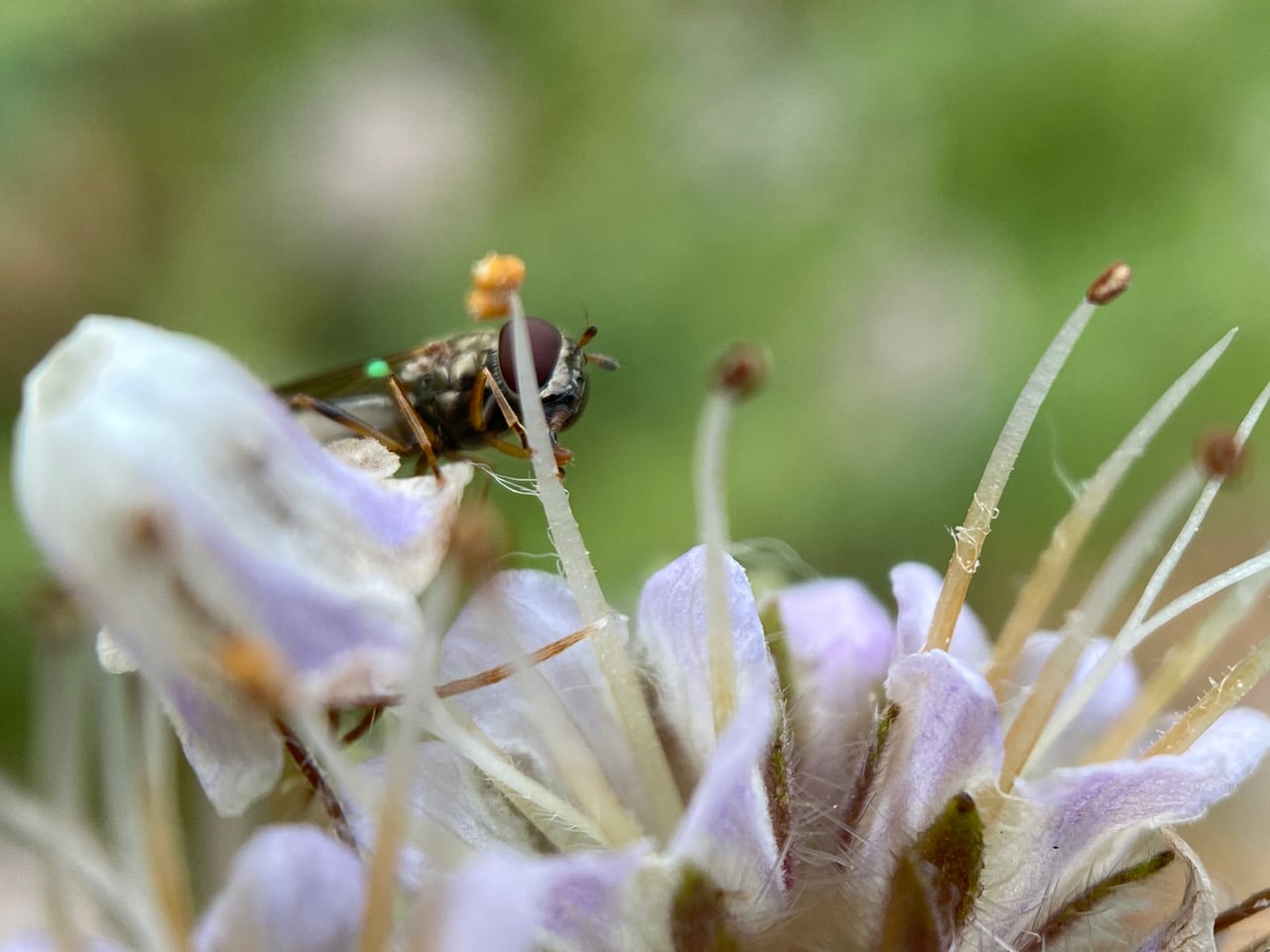
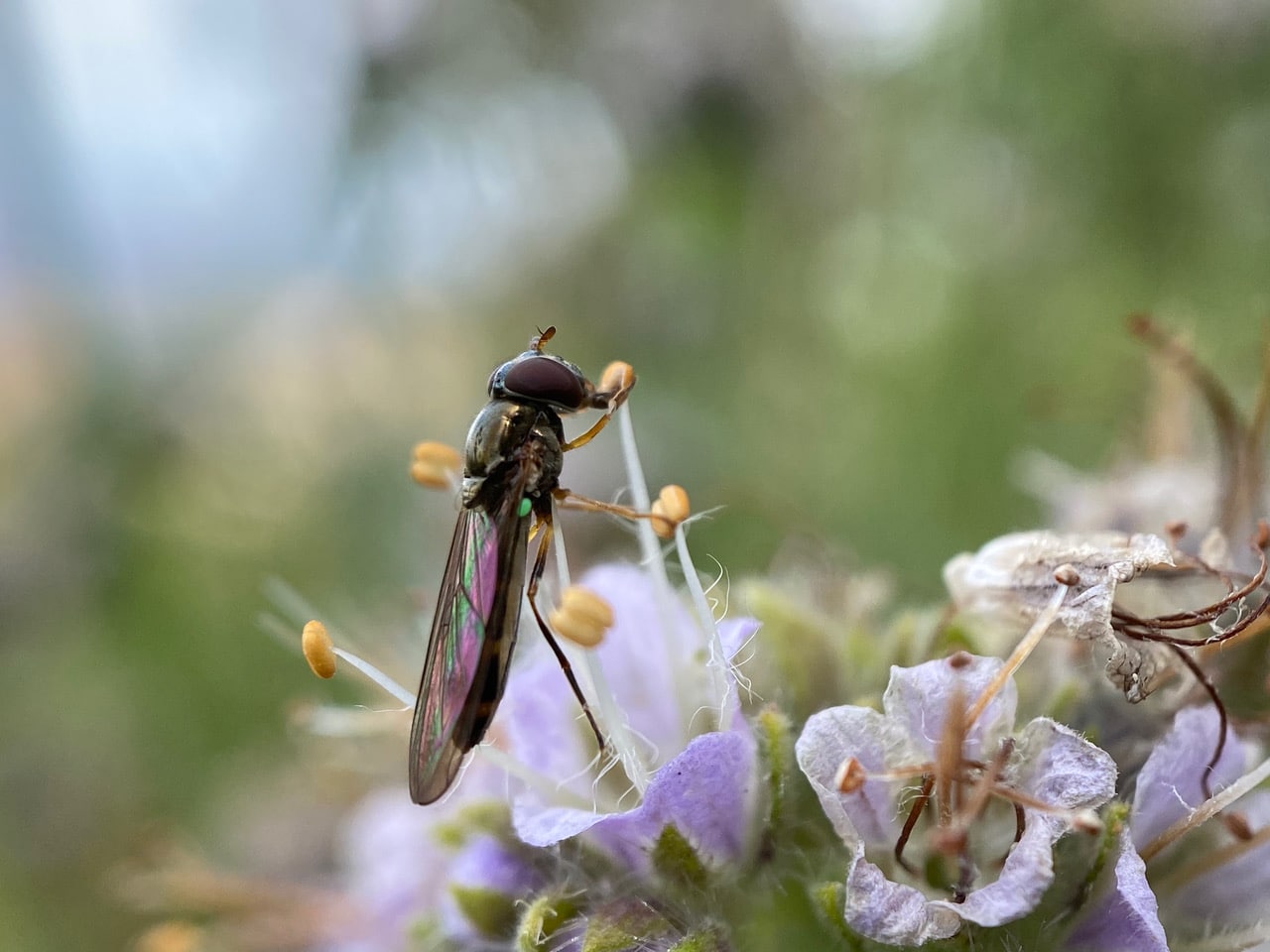 While photographing a dusky, metallic Hover Fly foraging on the Phacelia flowers, I suddenly notice that it has a glowing green spot on its side near the wing. Is this yet another of the Sedgesitter’s optical magic acts? I recall seeing this once before but was not successful in capturing a picture.


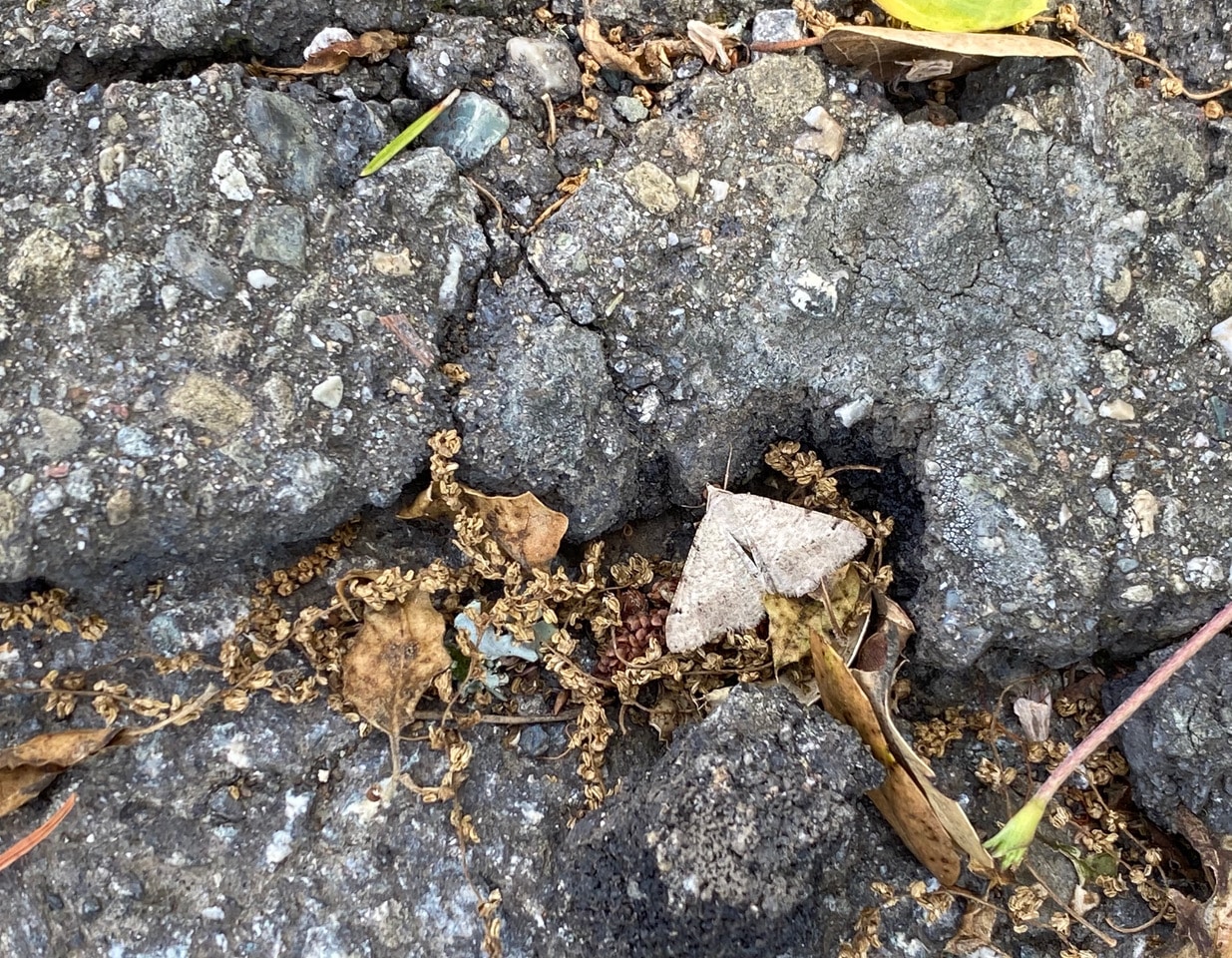
Little moths frequently flutter along the road, then disappear as soon as they land in the vegetation. They are skittish and resist getting their photos taken. This one happens to land in a crevice on the asphalt. I wonder if it could ever be identified?
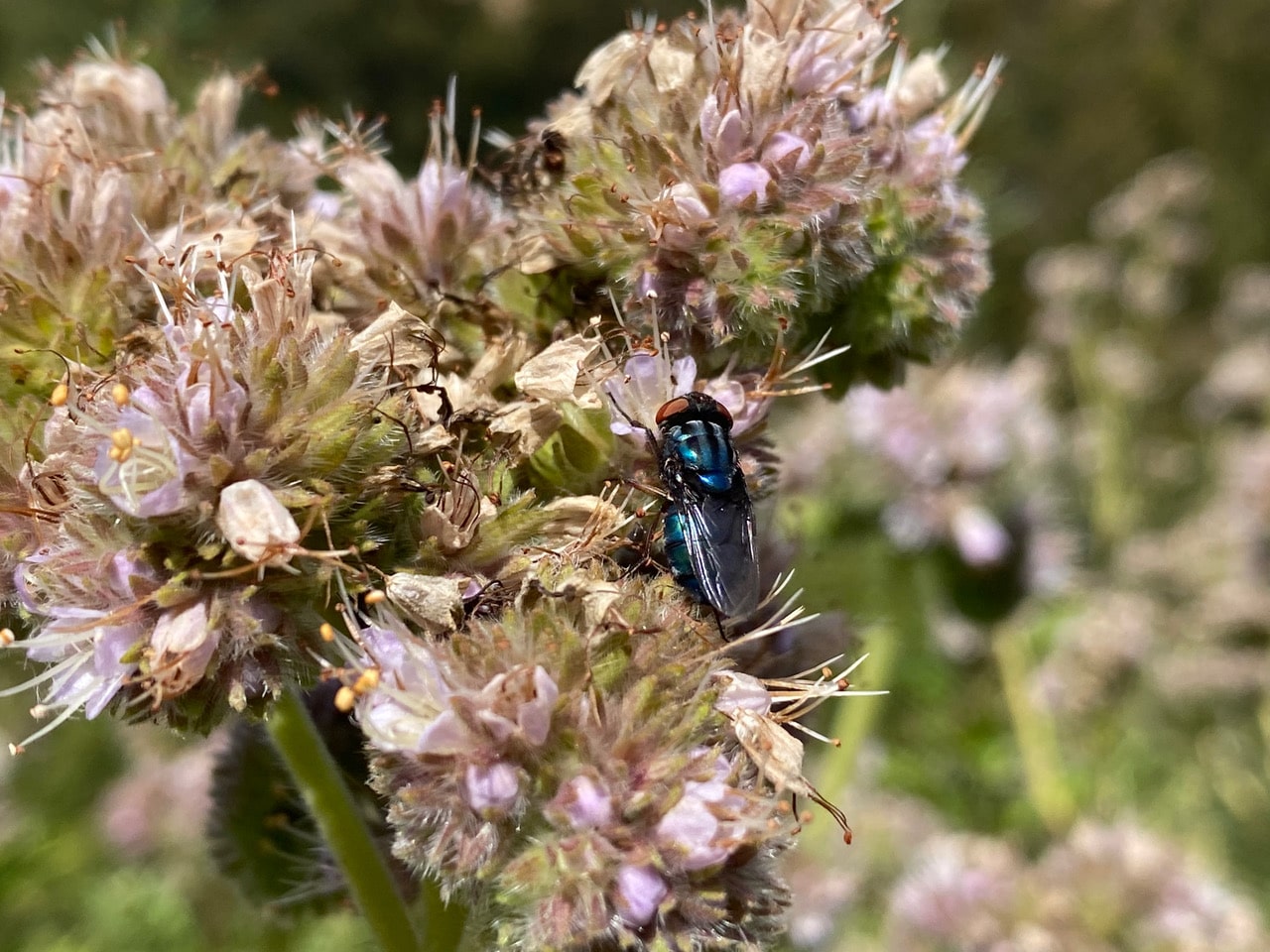
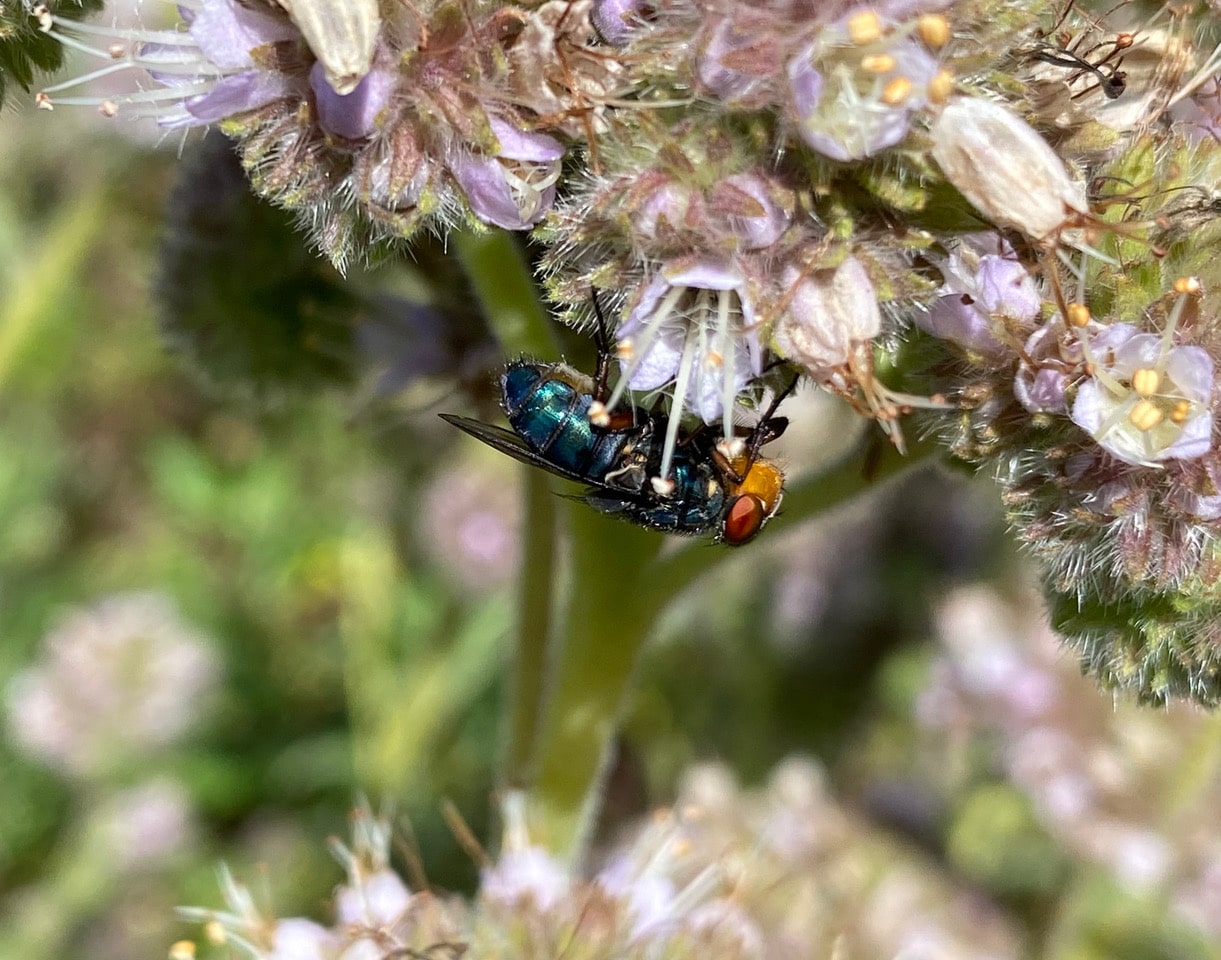
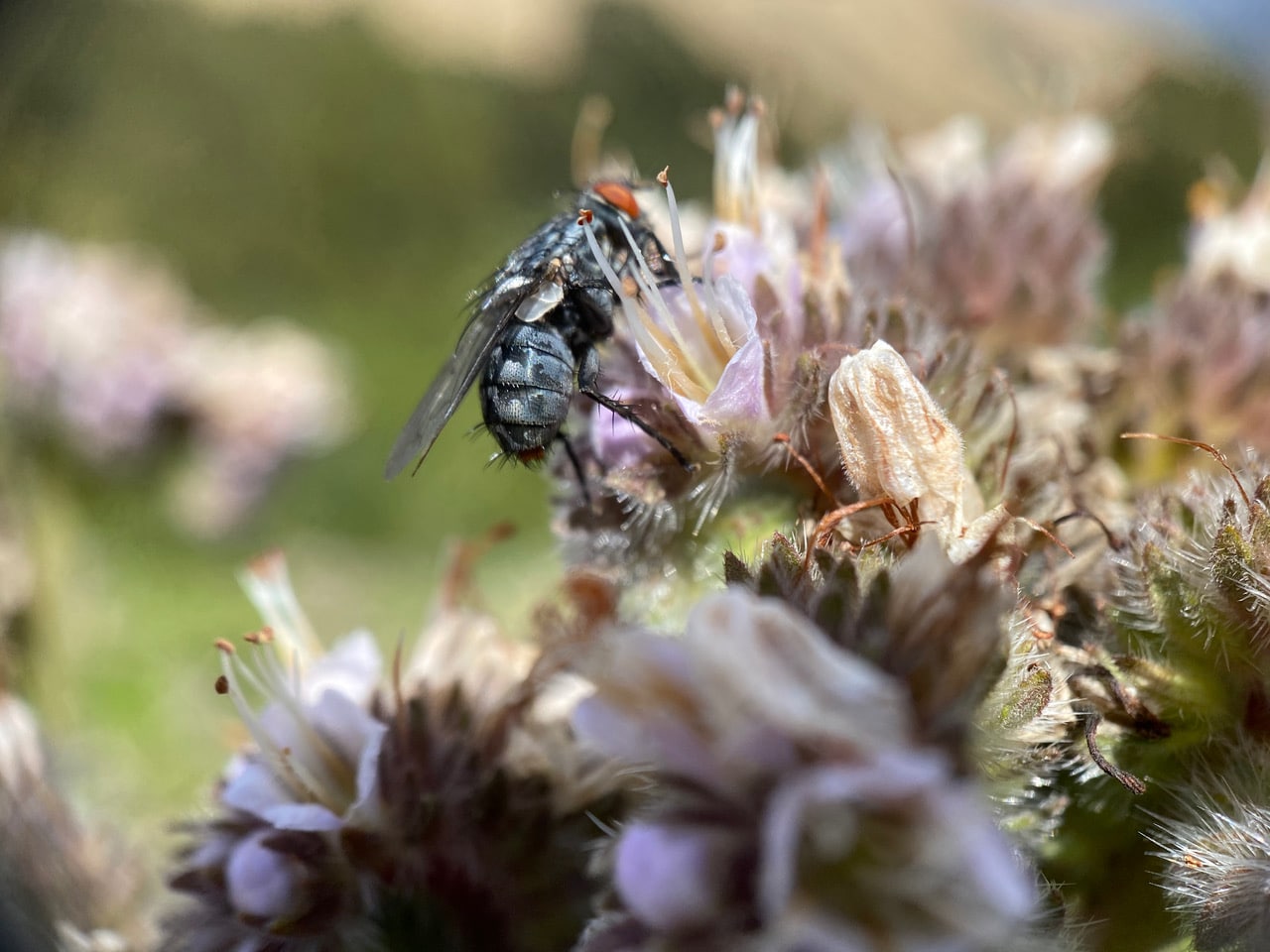
I am seeing more and more of the Secondary Screwworm Flies, Cochliomyia macellaria (family Calliphoridae) lately, foraging on the California Phacelia. They are one of the most beautiful flies around, but are usually ignored because of their abundance.
The Secondary Screwworm, Cochliomyia macellaria (family Calliphoridae, commonly known as blow flies) ranges throughout the United States and the American tropics. The body is metallic greenish-blue and characterized by three black longitudinal stripes on the dorsal thorax. Females are attracted to carrion where they lay their eggs. These screwworms are referred to as “secondary” because they typically infest wounds after invasion by primary myiasis-causing flies. While the flies carry various types of Salmonella and viruses, C. macellaria can also serve as important decomposers in the ecosystem. In a lifetime, a female may lay up to 1000 or more eggs. Females may also lay their eggs with other females, leading to an accumulation of thousands of eggs. The larval stage of C. macellaria is referred to by the common name of secondary screwworms; this is due to the presence of small spines on each body segment that resemble parts of a screw. The larvae feed on the decaying flesh of the animal that they have been laid on until they reach maturity. Eventually the larvae fall off the food source to pupate in the top layer of the soil. Adult females will continue to feed on tissues of animals; however, now they preferentially feed off of live tissues and tissue plasma. Adult males will no longer consume tissue, but instead will eat nearby vegetation and take nourishment from floral nectar.
A sponging mouthpart has been extended between the yellow flaps low on the fly’s face. I wonder what the flaps are about?
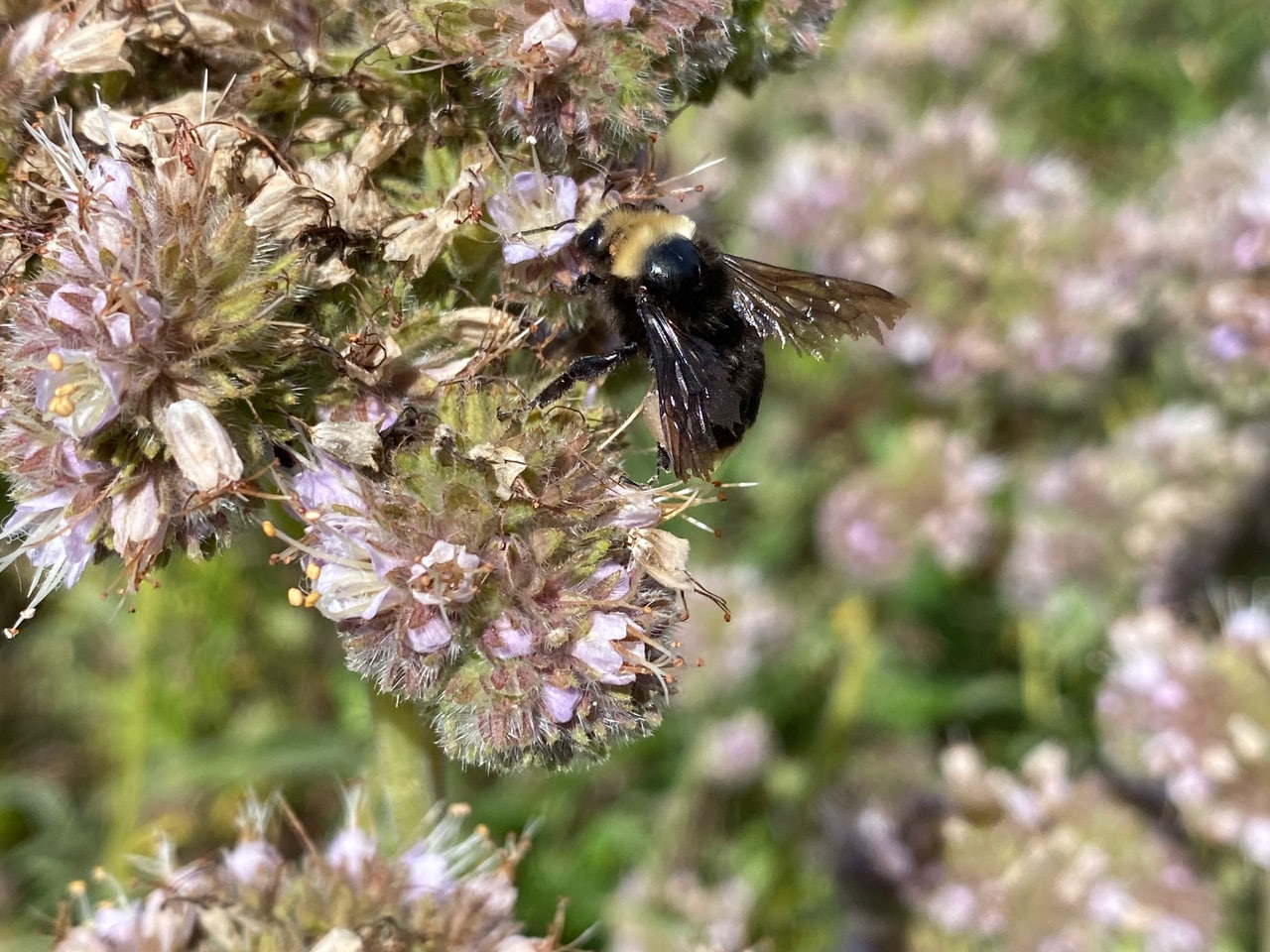
As the season progresses, I see more and more old bumble bees around. Balding thorax and frayed wings not withstanding, they are still foraging with gusto.
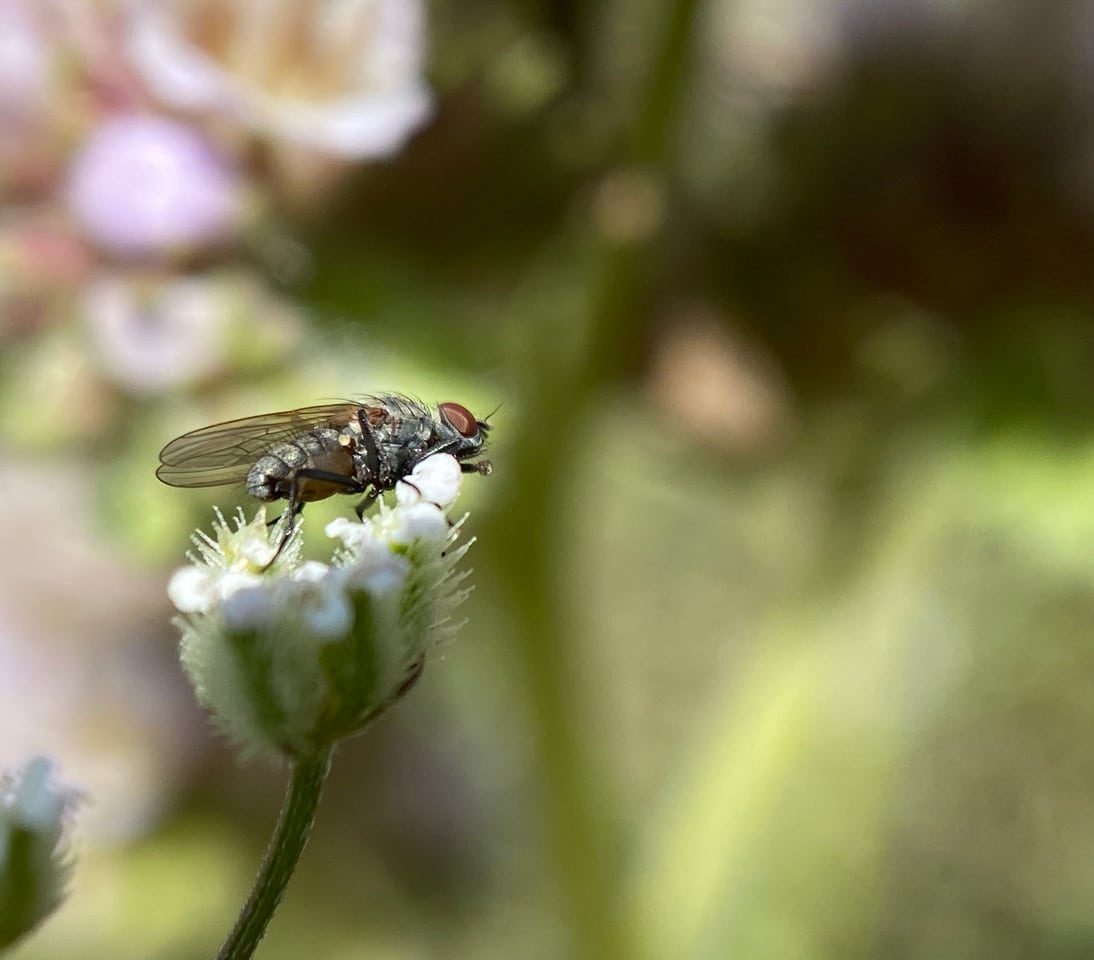
The tiny fly, only about 3 mm long is perched on a Torilis seed head. I will probably never know its identity, but it boggles my mind to think how many varieties of flies are around, and the roles they play in the ecosystem.
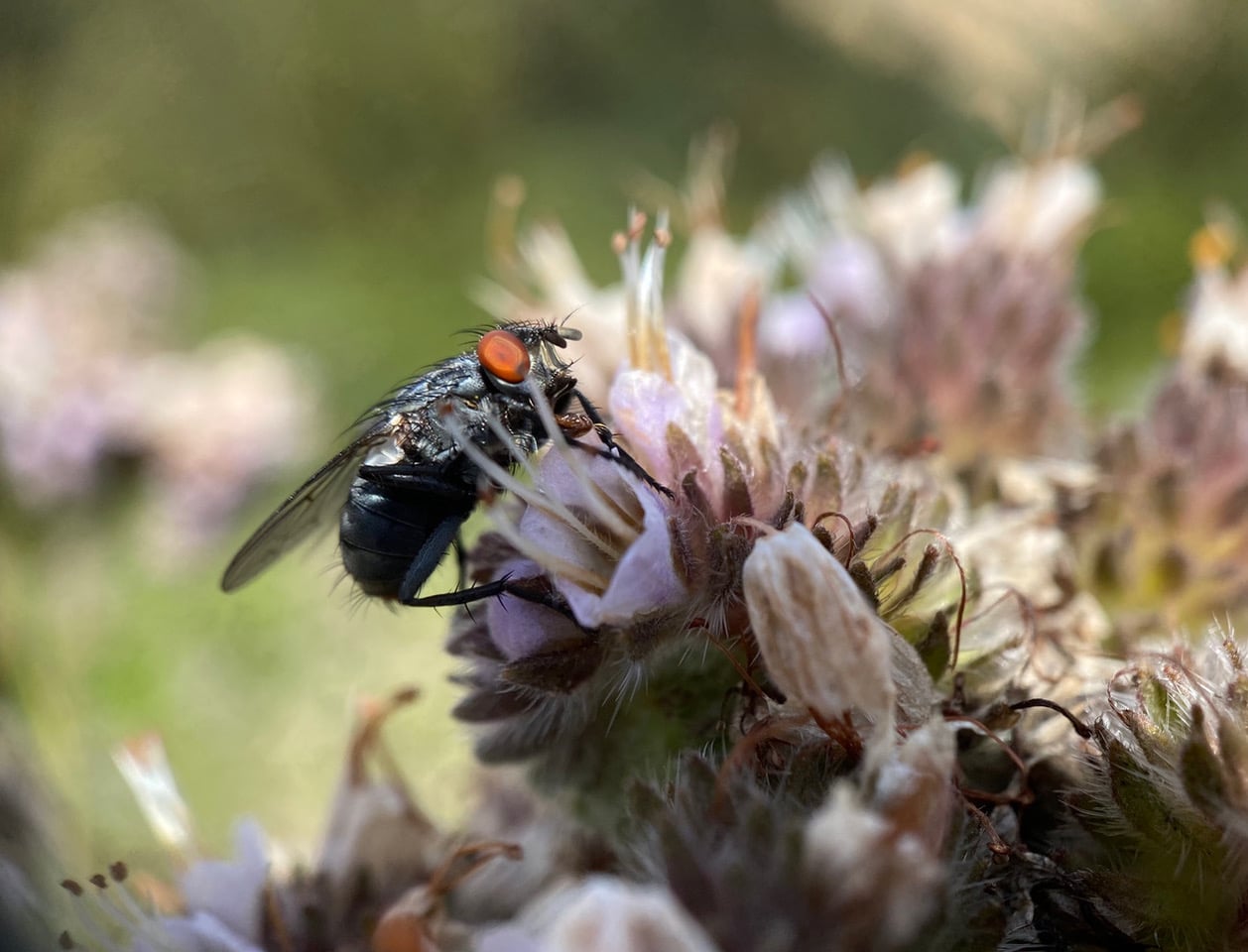
Ooh, I think I am looking into the face of a Flesh Fly (family Sarcophagidae).
Yep, it looks like a Flesh Fly alright – pin-striped thorax and a checkered pattern on the abdomen. Note the small rounded white flap under the wing – the calypter.
Many Flesh Flies have black and gray longitudinal stripes on the thorax and checkering on the abdomen, red eyes, and a bristled abdomen sometimes with a red tip. They differ from most flies in that they are ovoviviparous, opportunistically depositing hatched or hatching maggots instead of eggs on carrion, dung, decaying material, open wounds of mammals, hence their common name. The adults mostly feed on fluids from animal bodies, nectar, sweet foods, fluids from animal waste and other organic substances. While we may find their habits revolting, Flesh Flies perform important roles in the ecosystem – the larvae as decomposers/recyclers, and the adults as incidental pollinators.
Parting shot of the Flesh Fly’s abdomen. Many species have a red-tipped abdomen. I’m not sure what that’s about. One species is actually named Sarcophaga haemorrhoidalis !
Every insect bows to Phacelia. Its nectar must be irresistible.
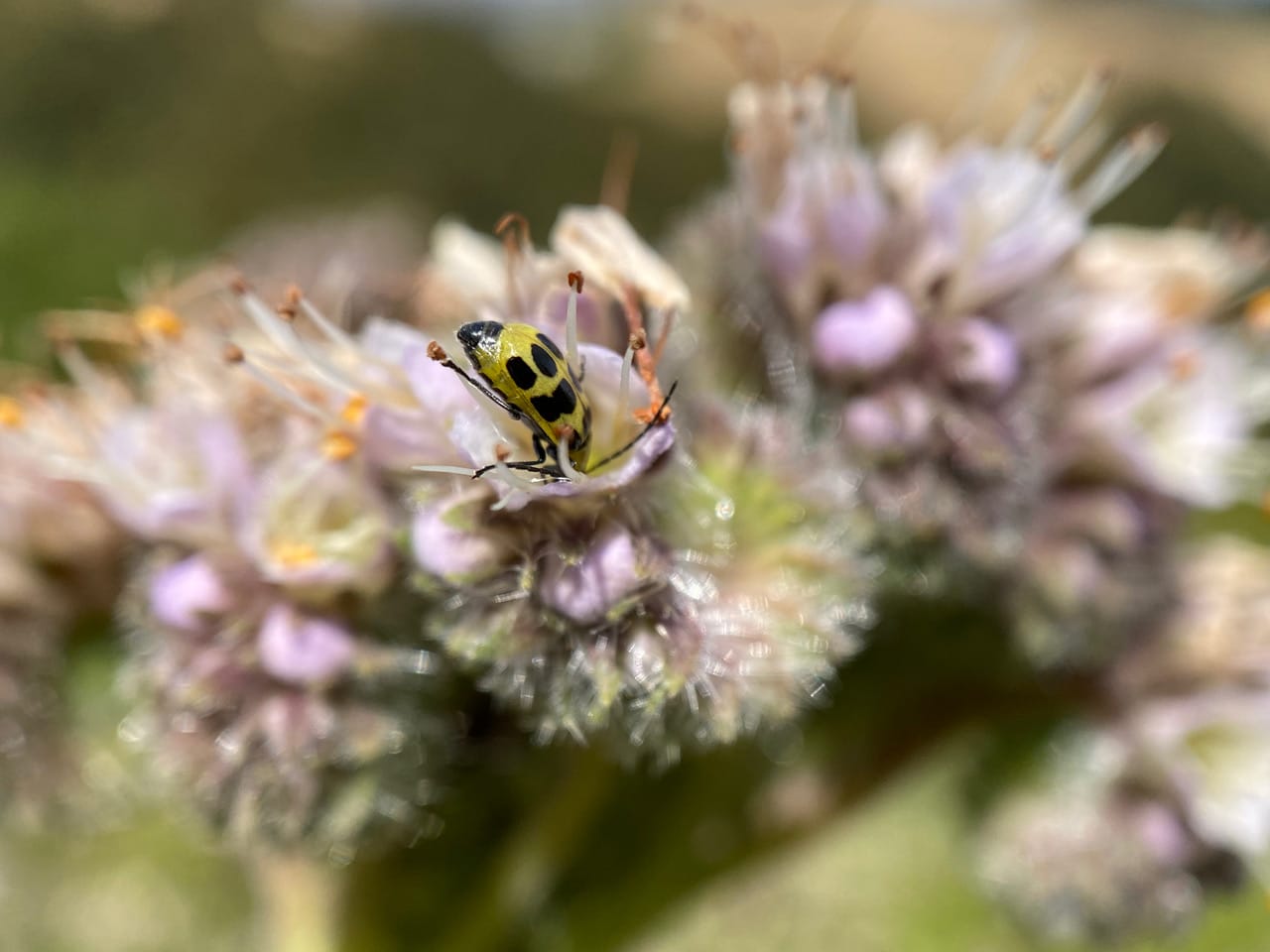
The Spotted Cucumber Beetle, Diabrotica undecimpunctata is a member of the Leaf Beetle family, Chrysomelidae. Chrysomelid adults and larvae feed on all sorts of plant tissues, and all species are fully herbivorous. Many are serious pests of cultivated plants, including food crops. Others are beneficial due to their use in biocontrol of invasive weeds. Chrysomelids are popular among insect collectors, as many are conspicuously colored, typically in glossy yellow to red or metallic blue-green hues, and some have spectacularly bizarre shapes. Photos of Leaf Beetles (Family Chrysomelidae) · iNaturalist
Native to North America, the Spotted Cucumber Beetle can be a major agricultural pest, causing damage to crops in the larval as well as adult stages of their life cycle. Larvae, sometimes known as rootworms feed on the roots of emerging plants. In the adult stage the beetles cause damage by eating the flowers, leaves, stems and fruits of the plant.
While photographing a dusky, metallic Hover Fly foraging on the Phacelia flowers, I suddenly notice that it has a glowing green spot on its side near the wing. Is this yet another of the Sedgesitter’s optical magic acts? I recall seeing this once before but was not successful in capturing a picture. Just then, the sun emerges from the behind the clouds. Still the glowing green spot persists. It’s not an optical illusion after all. Is it the fly’s haltere? Halteres are the modified hind wings in Diptera (flies). They are shaped like ‘drum sticks’ with a slender shaft connected to the thorax. Halteres are highly sophisticated balance organs and they oscillate during flight.
Another view of the same fly moving around. Yes, I am sure the green structure is a haltere!
Yet another view of the green haltere. The fly is female as its eyes do not meet on top of the head. Most male Syrphid Flies have holoptic eyes.
Back at home, I search for information on Syrphid Flies with green halteres. The rabbit hole led me to the genus Melanostoma. So the fly isn’t a Sedgesitter, Platycheirus sp. after all! iNaturalist has since identified it as the Variable Duskyface Fly, Melanostoma mellinum (family Syrphidae). Yay, a new Syrphid species for me, and probably for Skyline Gardens as well!
Melanostoma mellinum is a very common species of hover fly found in many parts of Europe including the Mediterranean basin and North Africa, the East Palearctic, and North America. A small species, their wingspan between 4.7 and 7.0 mm. Very similar to Platycheirus, but can be distinguished by fine details. In M. mellinum, the normally pale halteres turn bright blueish-green in females about to lay eggs.
The species’ preferred habitat include grasslands and moorlands, including those in hilly and mountainous regions. Adults can be found feeding on pollen of grasses and other wind-pollinated plants. Little is known of their biology, but the larvae are suspected to be a general predator of small insects in the leaf litter.
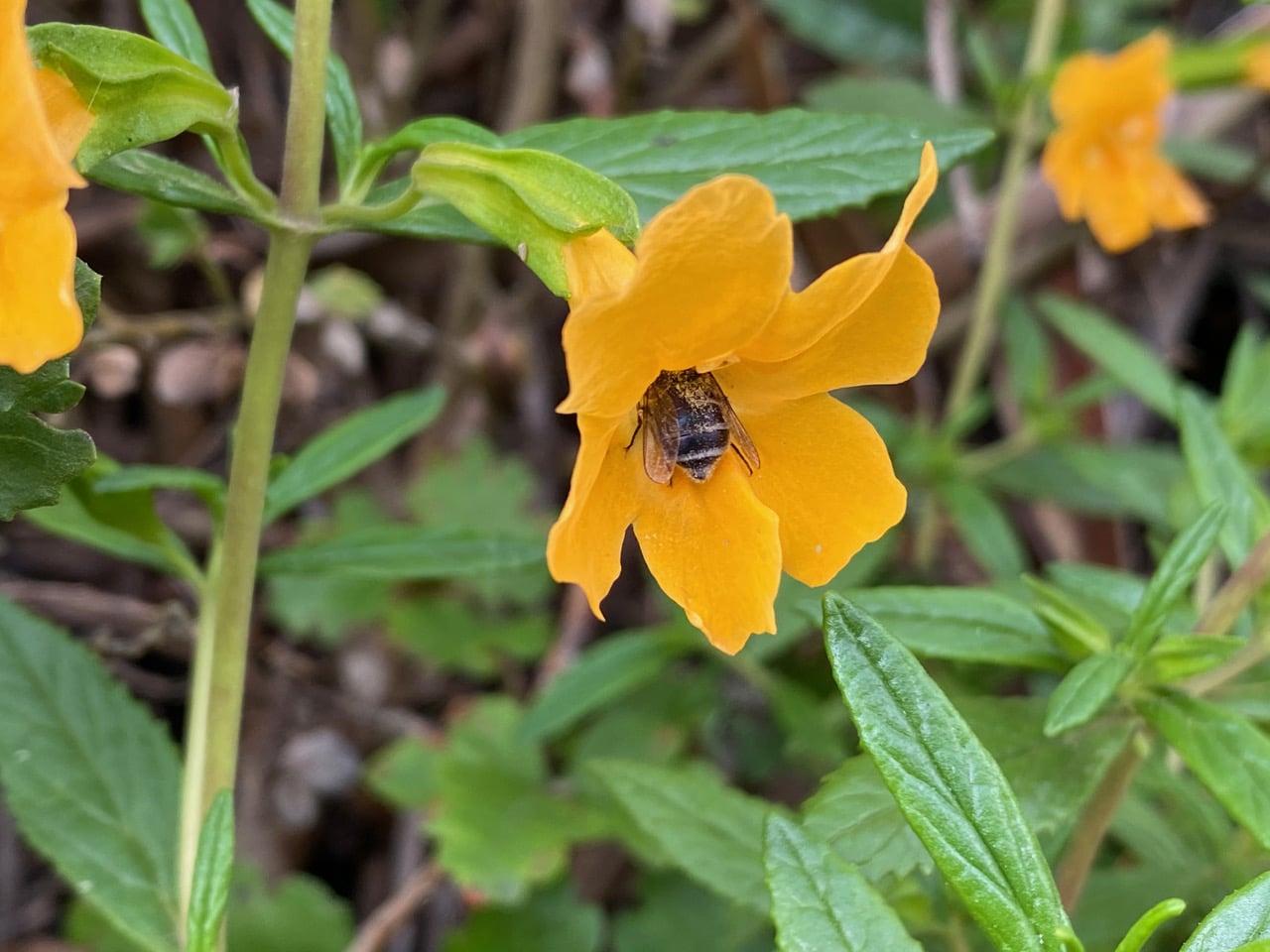
3:30 pm. The Small-headed Fly, Eulonchus sp. (family Acroceridae) is still resting in the same flower of Sticky Monkeyflower! I am absolutely sure it is the very same flower, as I have marked the plant next to it. The fly looks every bit alive and well. If it has died, one would think the ants would have gotten to it. Has the fly been active at all since I found it in the flower on the afternoon of 6/6/23? Do these flies go into extended torpor on cold days?
I stop by to check for the Red-backed Jumping Spider, Phidippus johnsoni (family Salticidae) on the California Phacelia I have marked. Yep, sure enough, she is there on the same inflorescence where I have found her two days ago. Note the mesh of criss-crossing anchor lines she has laid down during her leaps from this spot. Although Jumping Spiders are known to roam and stalk their prey, this old female has found a good hunting spot and has decided to stay put as an ambush predator. Not surprising to see such behavioral flexibility in these highly intelligent spiders!