

Pollinator Post 6/1/23 (1)
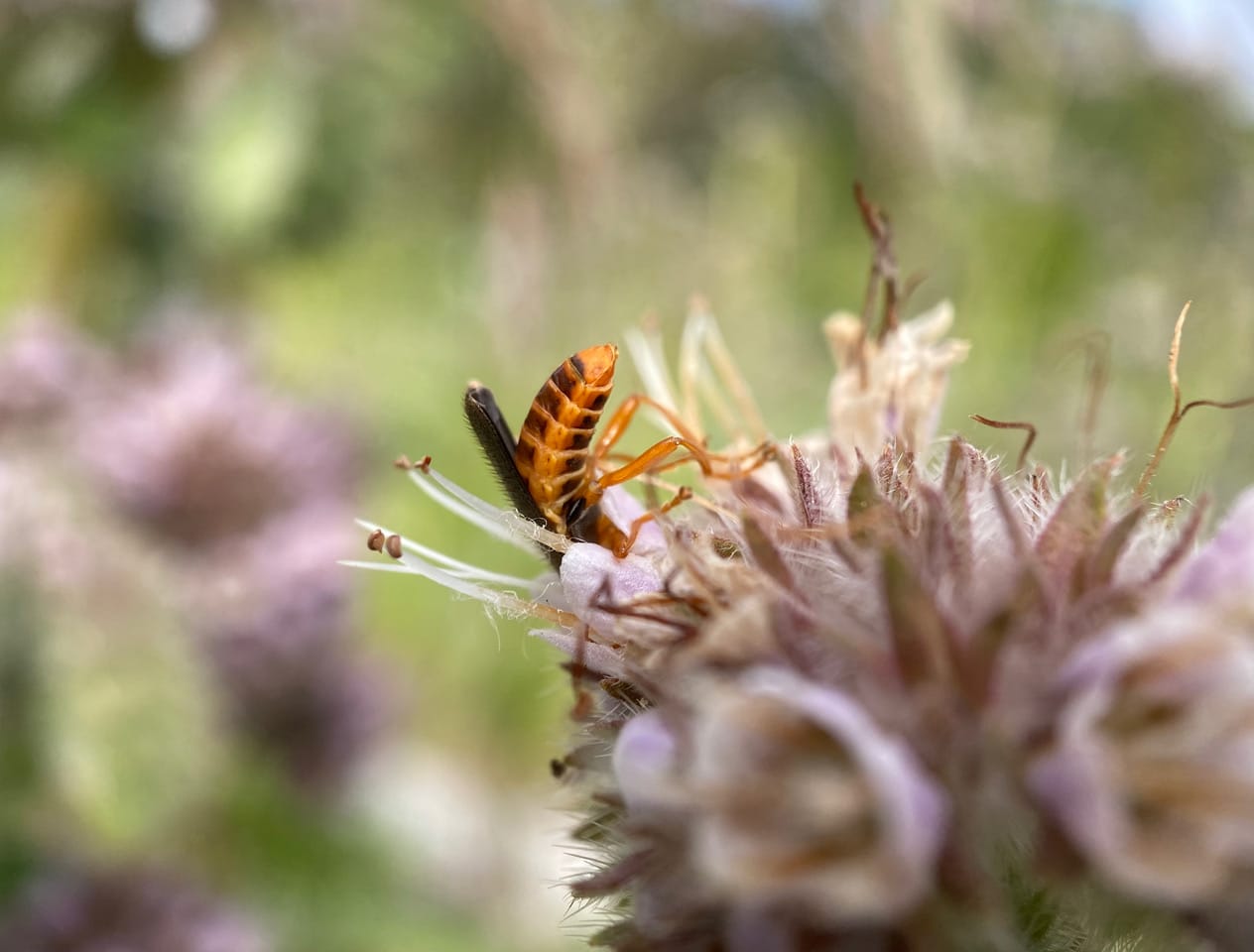
The clearing fog reveals the rear end of an insect with its head buried deep inside a flower of California Phacelia, Phacelia californica.


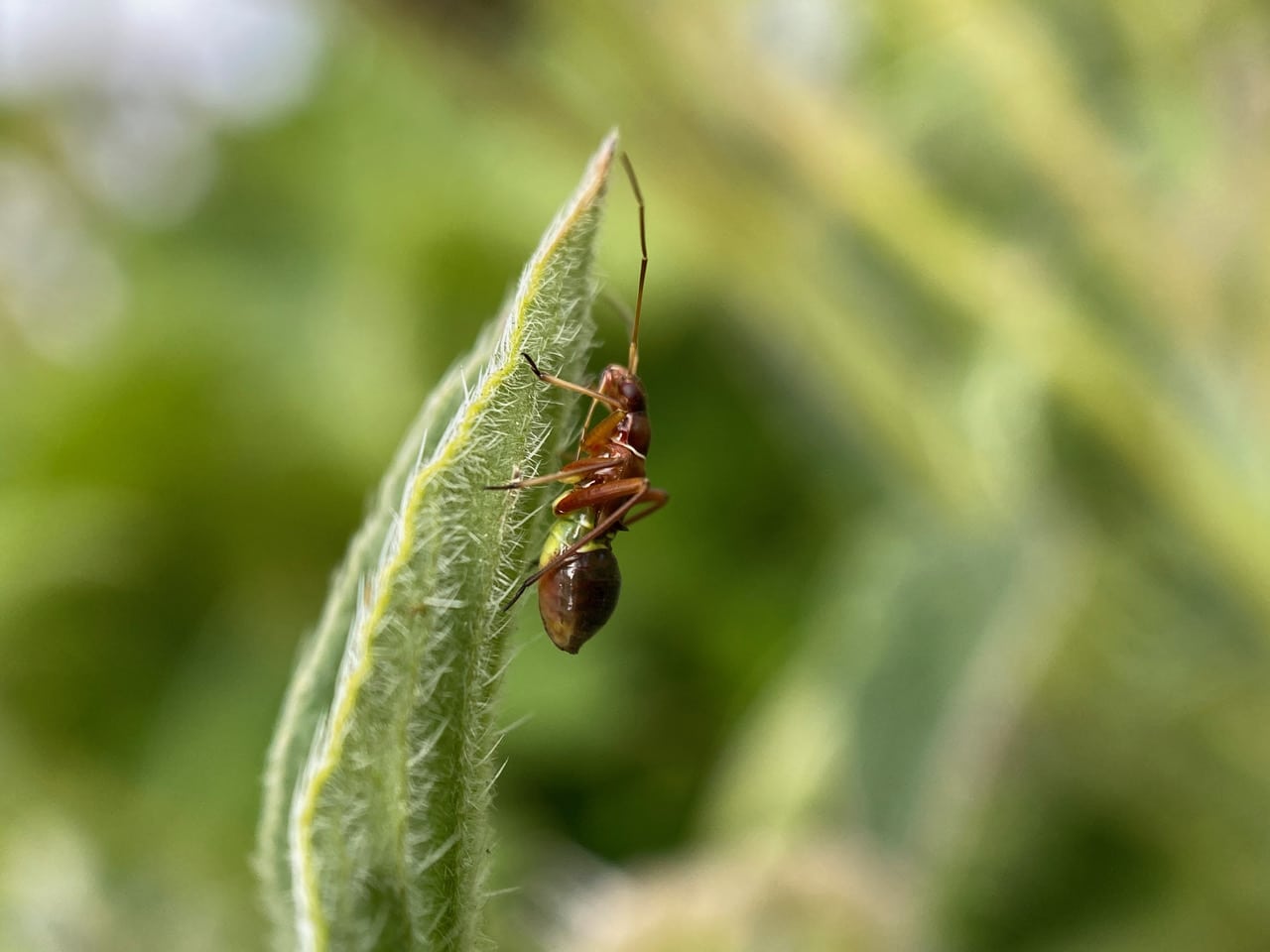 Finally it climbs up a leaf. What an interesting abdomen…. the first few segments behind the thorax are a yellowish green color! Perhaps on a bright green background, this part of the body blends in and disappears visually, simulating a narrow ‘waist’ of an ant?


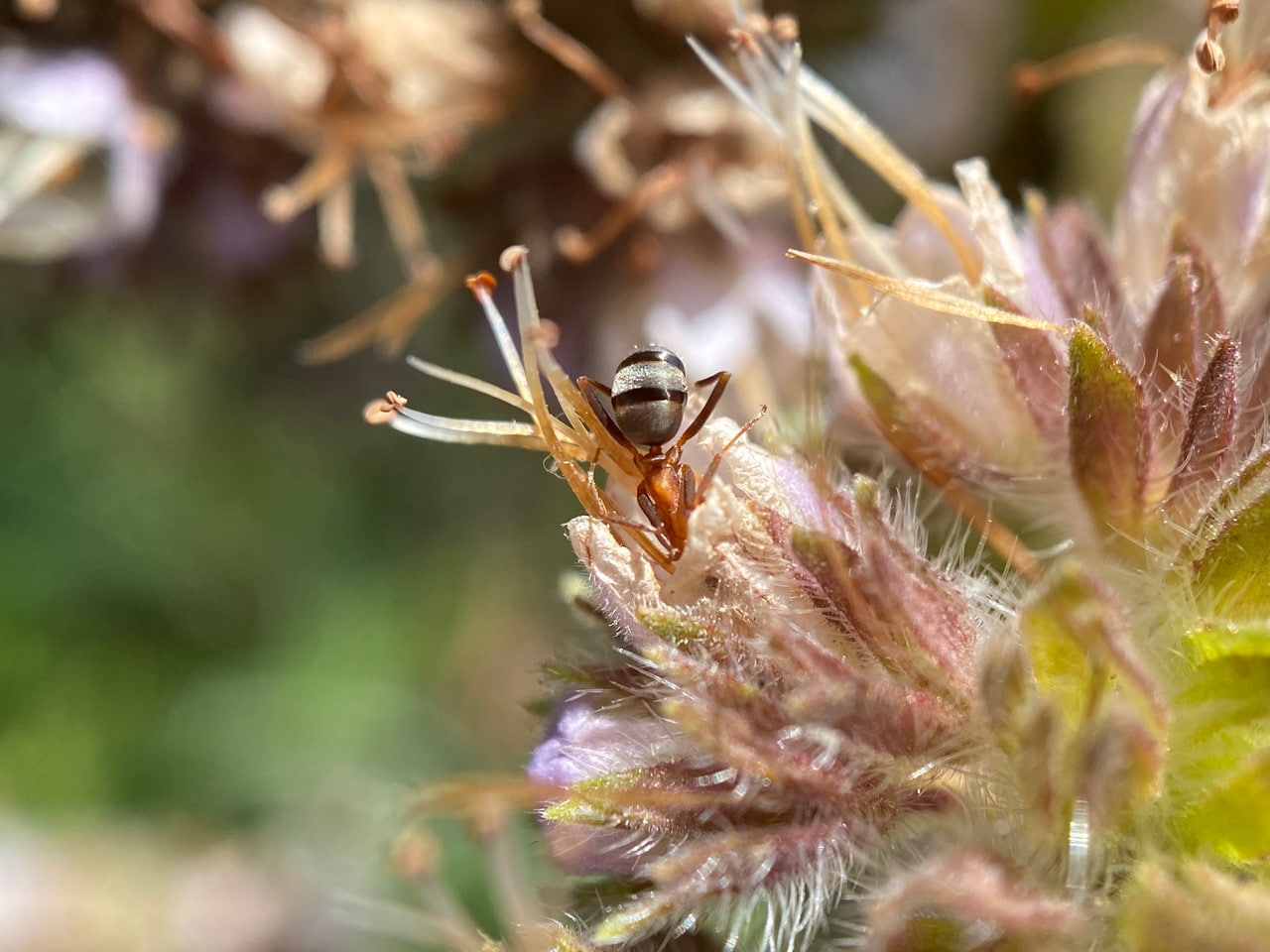 Here’s an insect with the quintessential sweet tooth – an ant! A Fusca-group Field Ant, Complex Formica fusca is upside-down in a phacelia flower, reaching for the nectar.


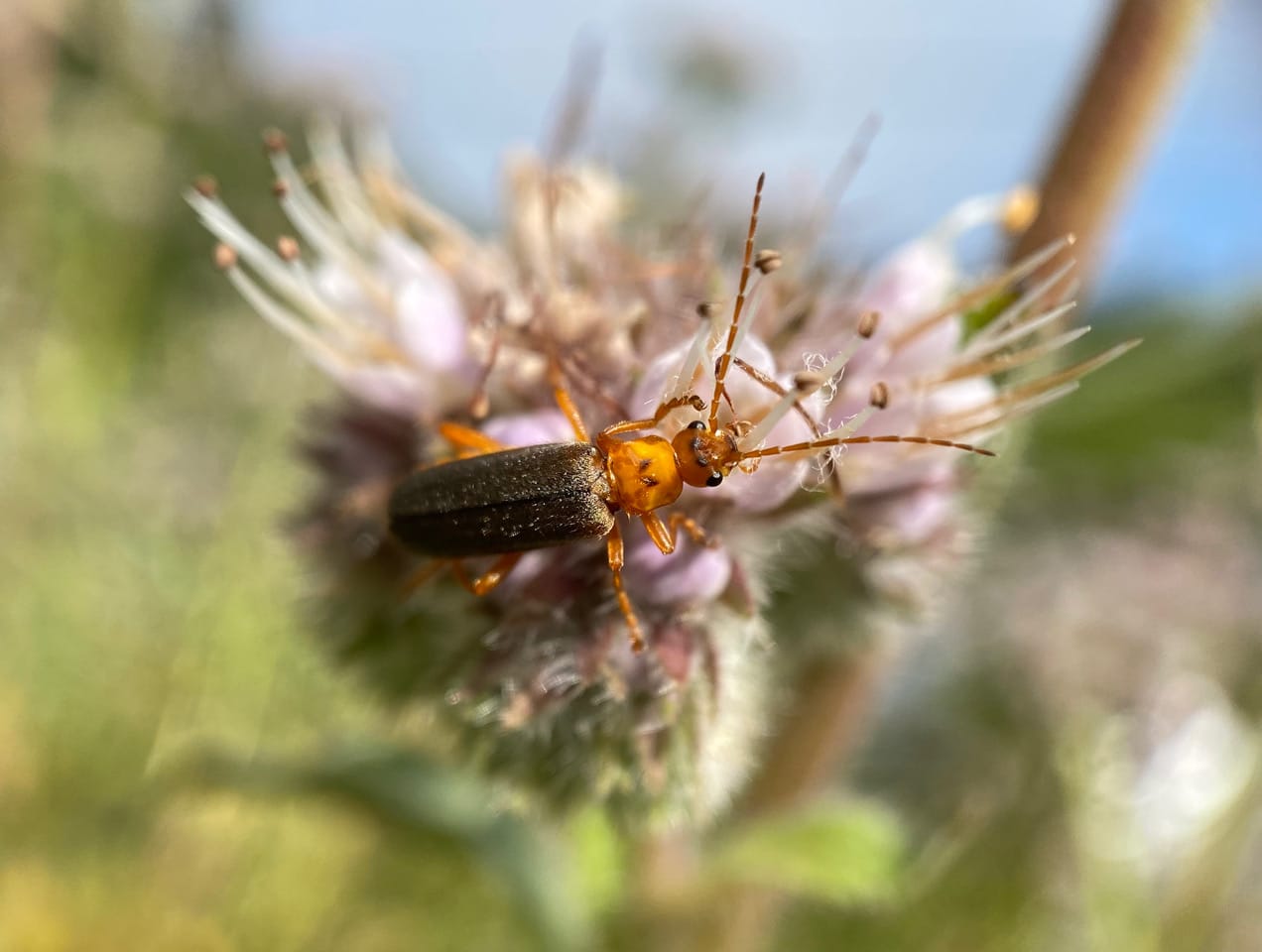
The insect is so enthralled with Phacelia’s nectar, I have to wait a while to see the rest of its body. It is a Soldier Beetle, Cultellunguis Americanus (family Cantharidae).
The Soldier Beetles, family Cantharidae are relatively soft-bodied, straight-sided beetles. One of the first described species has a color pattern reminiscent of the red coats of early British soldiers, hence the common name. They are also known commonly as Leatherwings because of their soft elytra.
Soldier beetles often feed on both nectar and pollen as well as predating on other small insects. The larvae are often active, and feed on the ground, hunting snails and other small creatures. Soldier beetles are generally considered beneficial insects by gardeners.
A small insect basking on a California Phacelia leaf gives me the slip as I approach with the camera. A fleeting look at its mouthparts confirms my suspicions – it is not an ant, but a true bug with a piercing-sucking mouthpart folded under its body.
The immature bug, a nymph, runs up and down and behind the stem in a game of hide-and-seek with me.
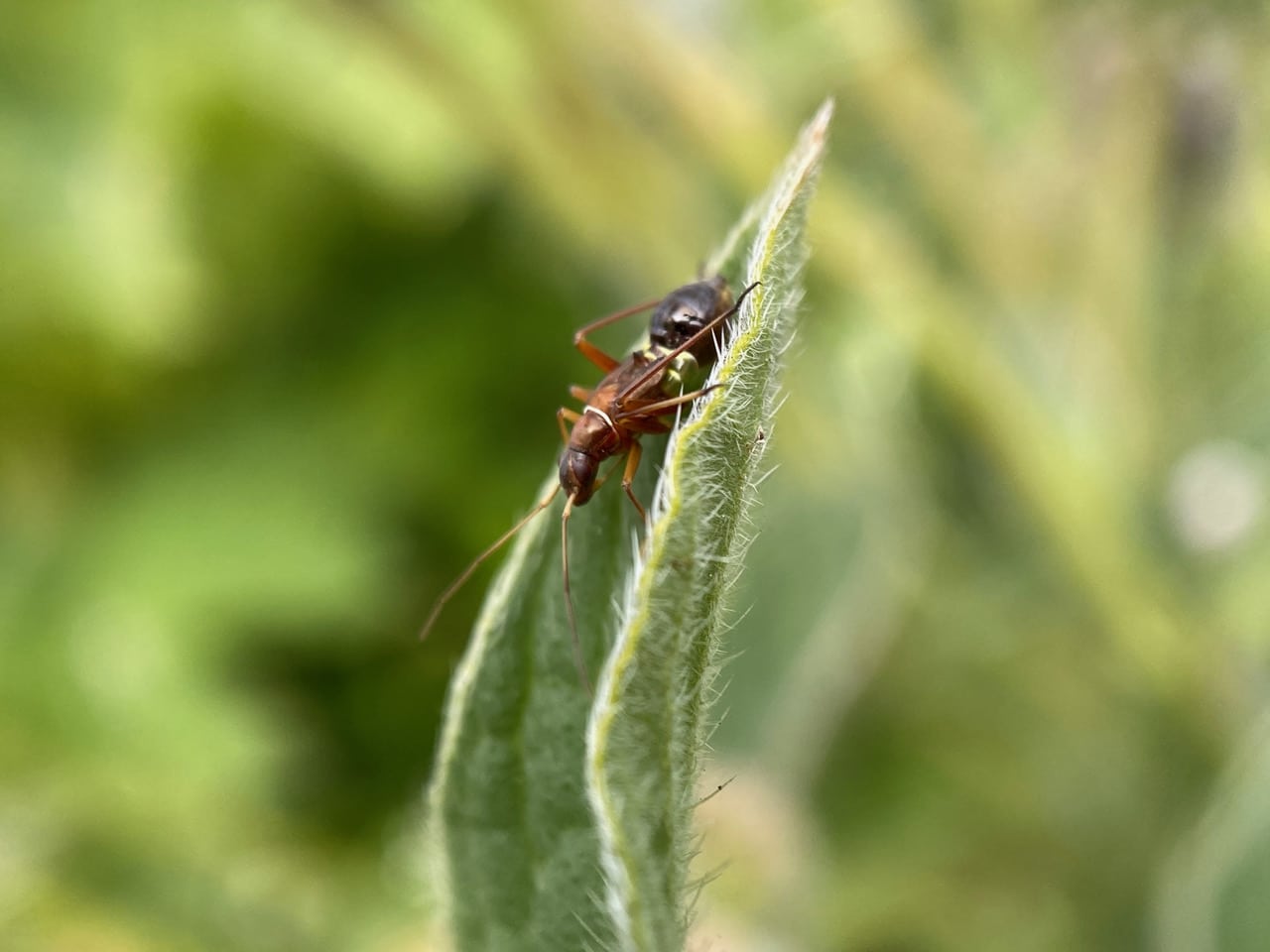
Finally it climbs up a leaf. What an interesting abdomen…. the first few segments behind the thorax are a yellowish green color! Perhaps on a bright green background, this part of the body blends in and disappears visually, simulating a narrow ‘waist’ of an ant?The nymph settles down for a photo. It is indeed the well-known ant-mimicking nymph of the Plant Bug, Closterocoris amoenus (family Miridae)! I have occasionally seen the beautiful adults on the Sticky Monkeyflowers, Diplacus aurantiacus.
Ant mimicry or myrmecomorphy is mimicry of ants by other organisms. Ants are abundant all over the world, and potential predators such as birds and wasps normally avoid them as they are either unpalatable or aggressive. Spiders are the most common ant mimics. Additionally, many insects from a wide range of orders and families mimic ants to escape predation (protective mimicry), while others mimic ants anatomically and behaviorally to hunt ants in aggressive mimicry.
I take a close look at an inflorescence of California Phacelia. Not only are the flowers a good source of nectar, they also offer their pollen generously and freely. The long stamens are fully exserted, making pollen gathering a walk in the park for the pollinators.
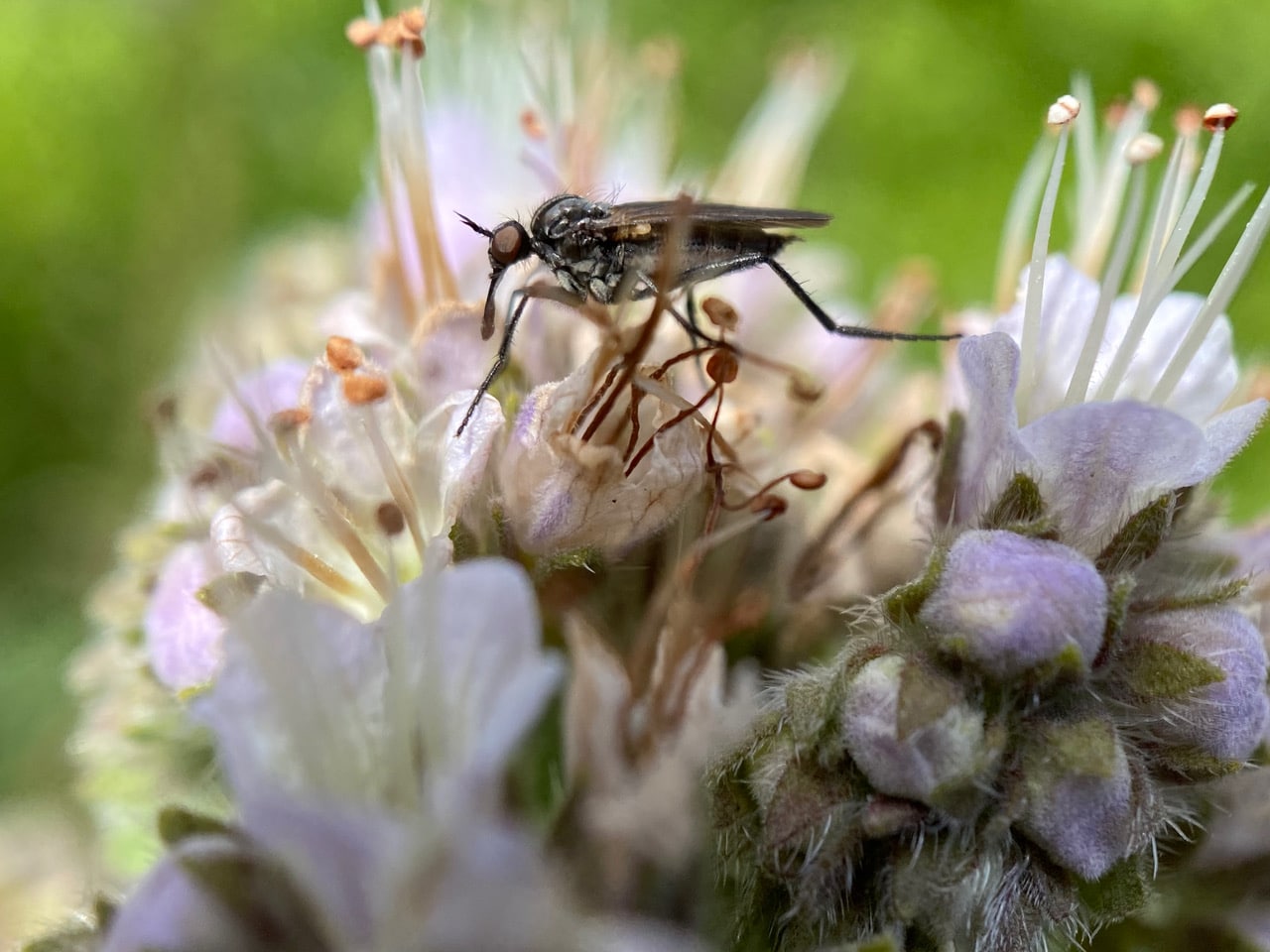
Here comes a Dance Fly (family Empididae) seeking nectar.
Dance Flies, in the family Empididae, get their name from the habit of males of some species to gather in large groups and dance up and down in the air in the hopes of attracting females. They are predominantly predatory and they are often found hunting for small insects on and under vegetation in shady areas. Both genders may also drink nectar. Male dance flies give their sweeties a nuptial gift to eat while they mate. The gift is thought to enable her to complete the development of her eggs. Males may wrap their gifts in balloons of silk or spit, hence the other common name of Balloon Flies.
Dance Flies are generally easy to identify by their straight, long proboscis. Despite the mind-boggling diversity of flies, the insects have been issued with only two types of mouthparts – sponging (as in the house fly) and piercing-sucking (as in the Dance Flies). Because of their predatory habits, and their sharp, piercing mouthparts, the Empididae are also sometimes called Dagger Flies.
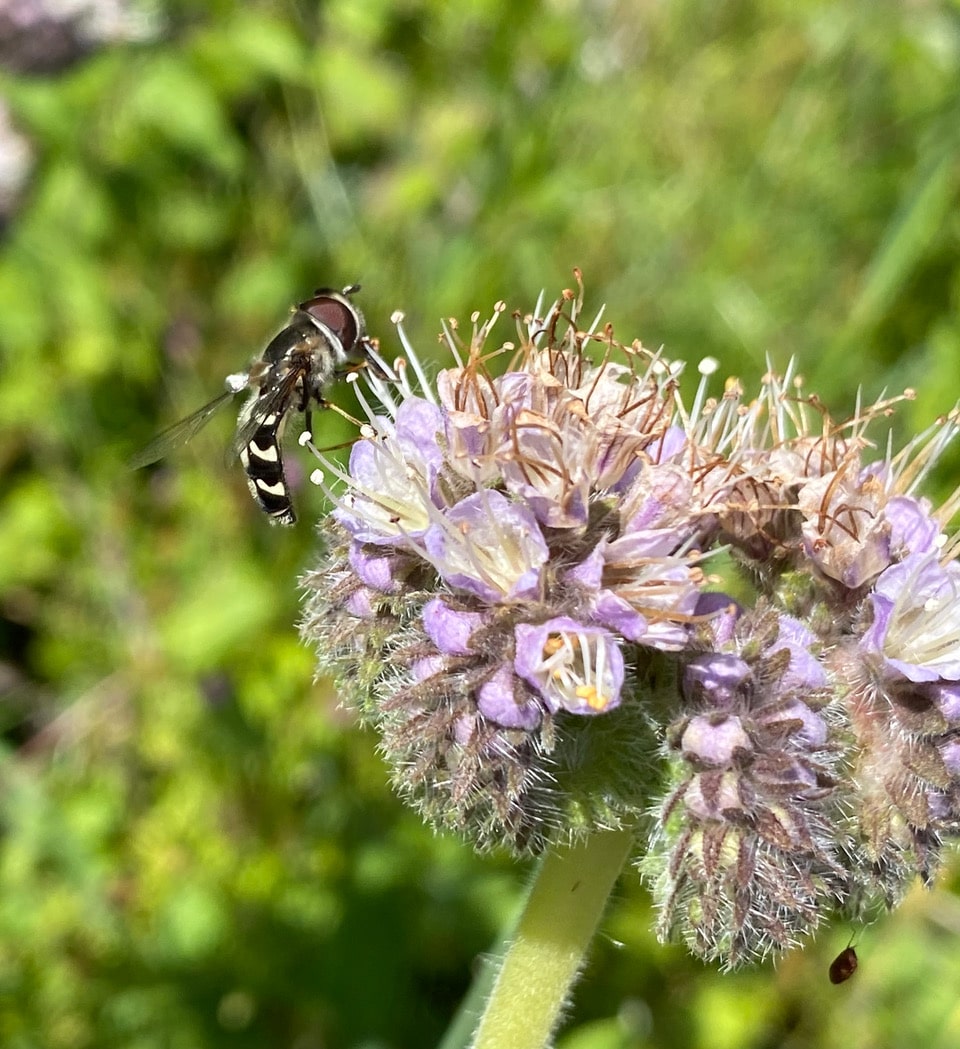
A female Large-tailed Aphideater, Eupeodes volucris (family Syrphidae) lands to feed on the flowers of California Phacelia. The flattened, concave profile of her abdomen is almost laughable. Perhaps there’s aerodynamic advantage to this body structure that enables the fly to hover so skillfully? On the other hand, not all Syrphids have this body profile, and they are able to hover just fine.
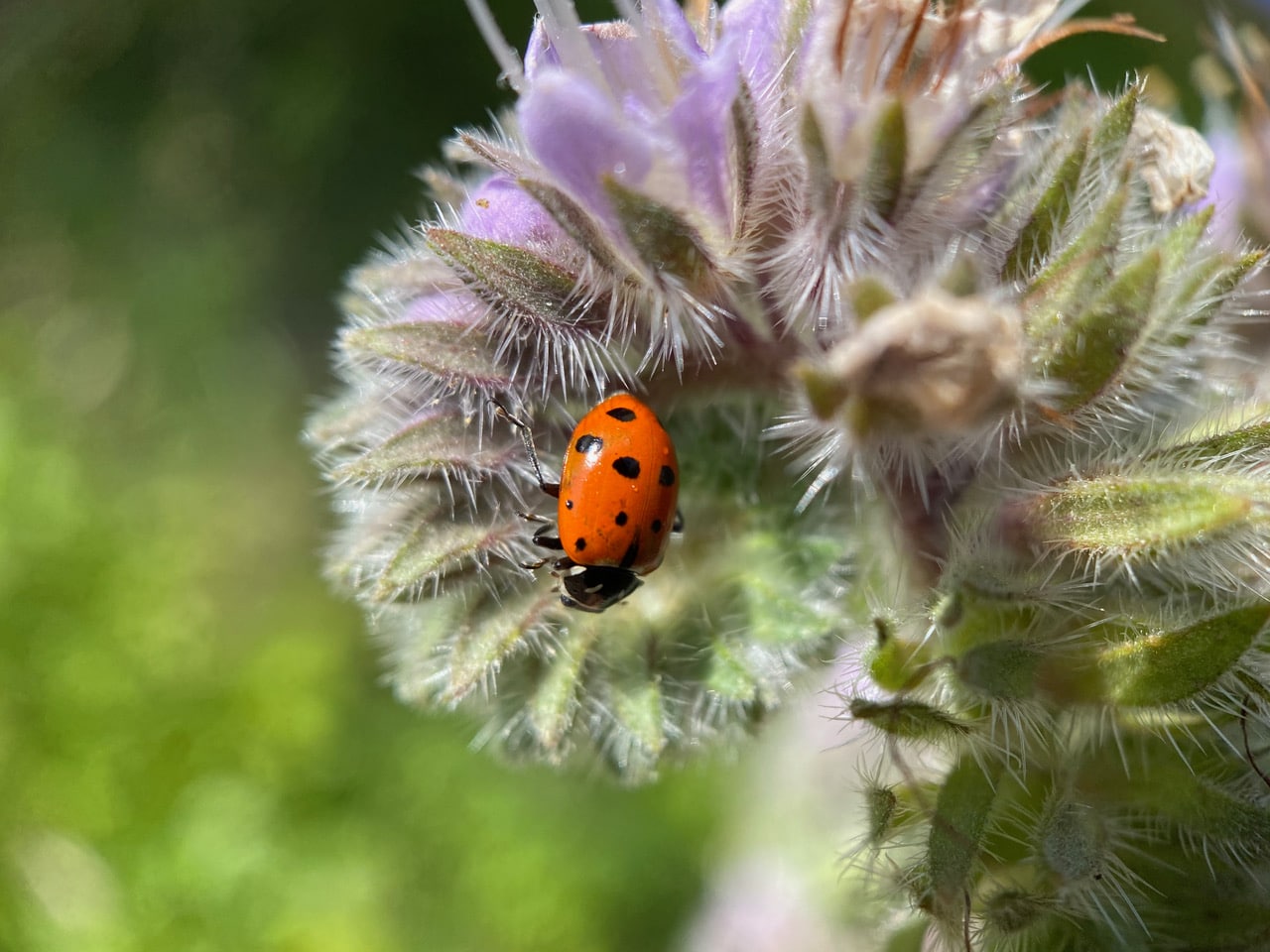
A Ladybeetle can brighten up a gray day instantly.
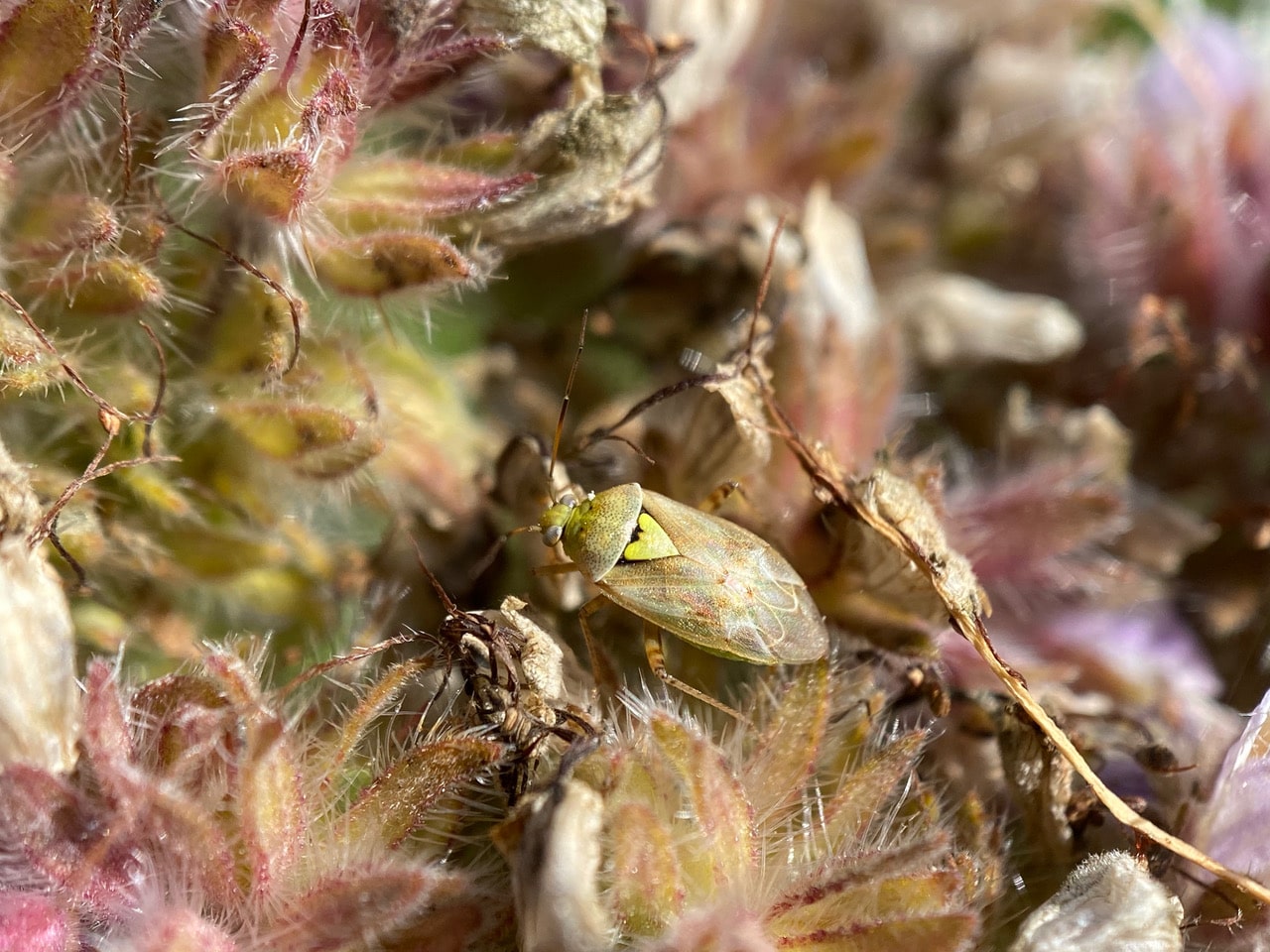
It is much harder to spot a Western Tarnished Plant Bug, Lygus Hesperus (family Miridae) among the debris on a California Phacelia inflorescence.
Commonly referred to a Lygus Bug, the species is a serious pest on strawberry in the Central Coast of California. Adults are about 6 mm long, oval and rather flattened. They are greenish or brownish and have reddish-brown markings on their wings. In the center of their back is a distinct, bur small, yellow or pale green triangle that helps distinguish them from other insects. The cunei (singular cuneus), triangular-shaped areas near the end of the forewings are translucent, blending with the coloration of surrounding body parts. The immature forms are pale green and resemble aphids. They can be distinguished from aphids by their more rapid movements.
In general the Lygus Bug’s abundance is highest after winters of higher rainfall. This causes more lush grows of vegetation such as mustards and other weeds that support a higher abundance and survival of the bugs during the winter and spring. Damage to crops and garden plants are caused by the bugs’ piercing-sucking mouthparts that extract fluids from the plant tissues.
Here’s an insect with the quintessential sweet tooth – an ant! A Fusca-group Field Ant, Complex Formica fusca is upside-down in a phacelia flower, reaching for the nectar. Field Ants belong to the genus Formica (family Formicidae). In North America, the Fusca-group Field Ants, Complex Formica Fusca is the most diverse in western mountain ranges, with partially distinctive Pacific and Rocky Mountain species compositions. The ants occur in grasslands and open woodlands.
They actively gather honeydew from source insects, and extrafloral nectar. They also prey on insects and spiders; also scavenge small dead invertebrates, honeydew on leaf litter and plant surfaces, etc.
Field ants lack a stinger, but instead possess a circlet of hairs around an opening at the tip of their abdomen where formic acid is expelled as a defense mechanism. They can also bite. They may pinch skin with their mouthparts, and then squirt formic acid into the wound, giving the sensation of a sting.
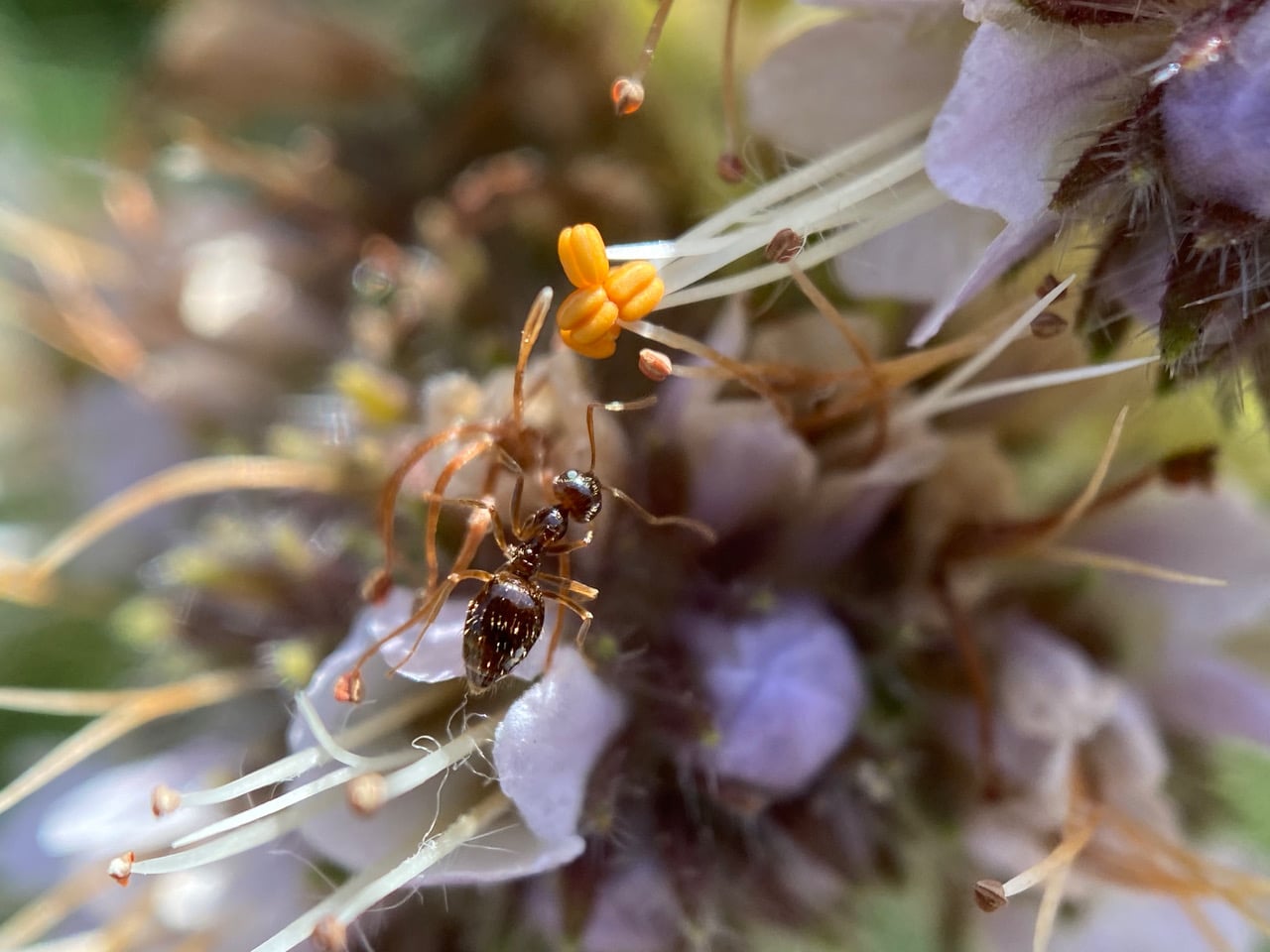
Surprisingly there’s an ant of another species on an adjacent phacelia inflorescence of the same plant. Aren’t ants territorial about their foraging turf? This American Winter Ant, Prenolepis imparis is quite a bit smaller than the Field Ant we just saw.
The American Winter Ant, Prenolepis imparis is a widespread North American ant. A dominant woodland species, it is most active during cool weather, when most other ant species are less likely to forage. This species is one of a few native ants capable of tolerating competition with the invasive Argentine Ant, Linepithema humile. They are also aggressive toward other ants and produce abdominal secretions that are lethal to Argentine Ants. Prenolepis imparis is a generalist omnivore. Foragers are known for tending to aphids or scale insects from which they consume excreted honeydew, aggregating on rotting fruit, and exploiting protein-rich sources such as dead worms. The colony enters estivation (a hibernation-like state) and becomes inactive above ground for the warmer months, during which time eggs are laid and brood are reared. Reproductives overwinter and emerge on the first warm day of spring for their nuptial flight.
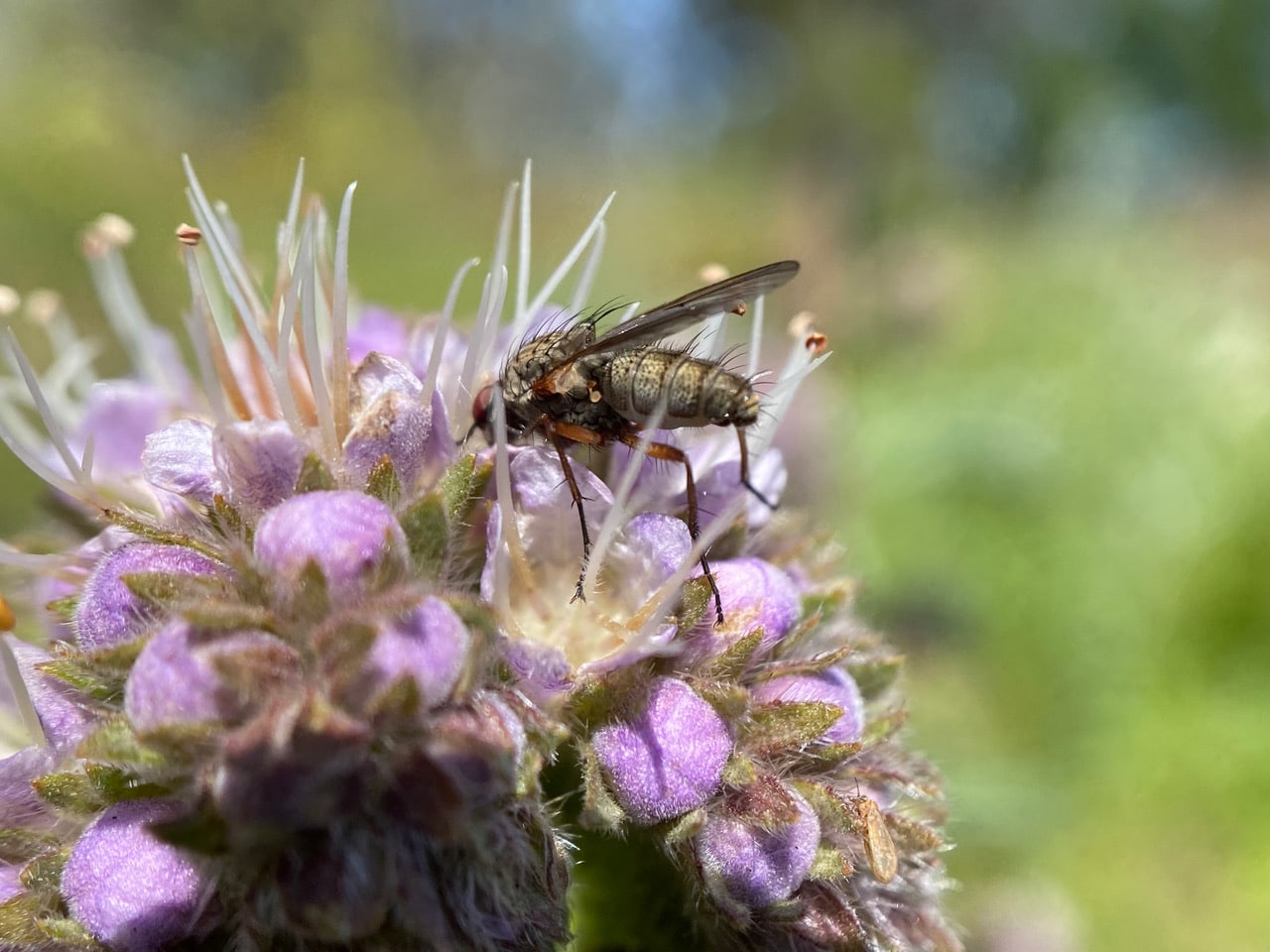
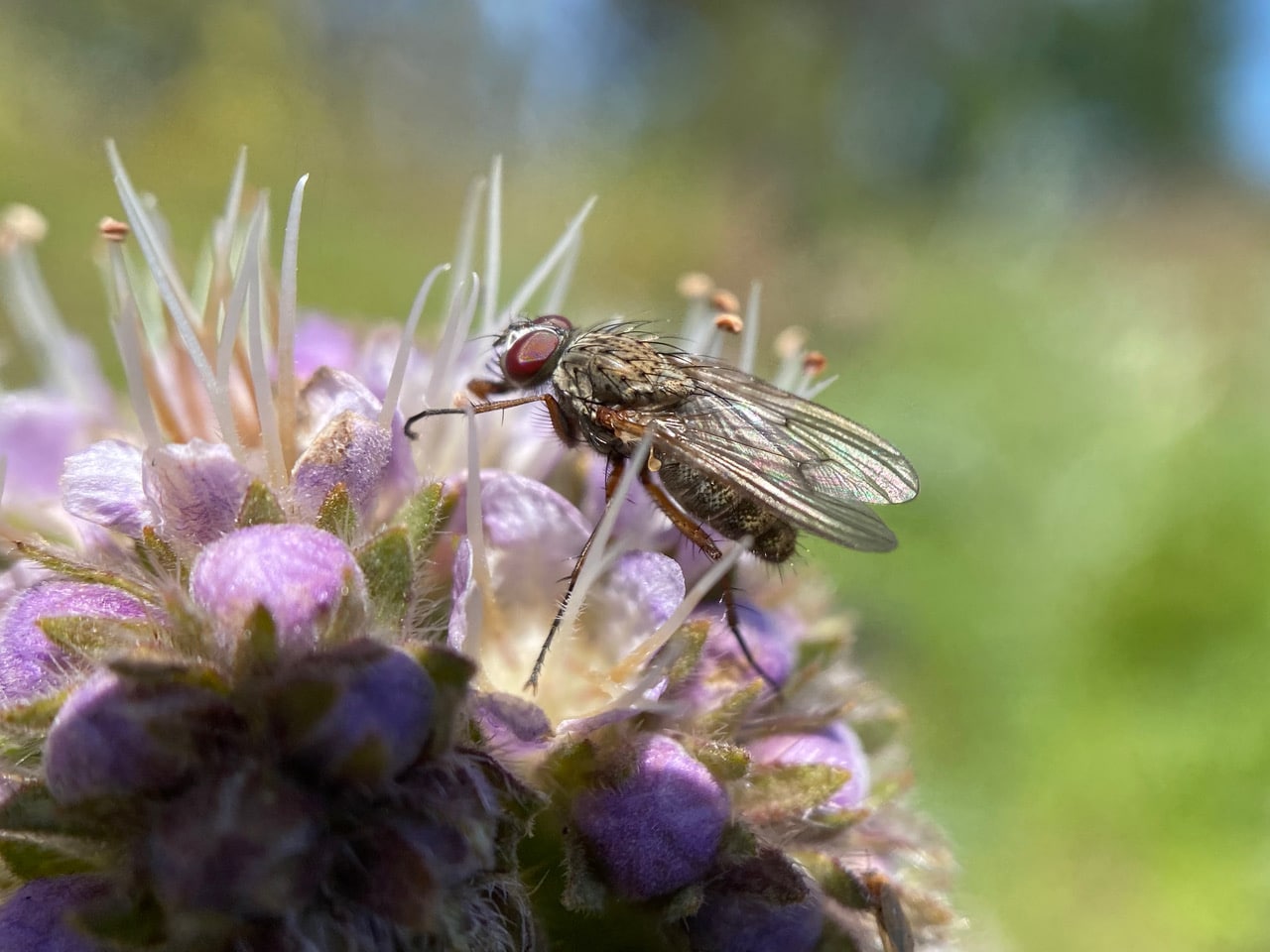
A Bristle Fly (family Tachinidae) is quietly taking nectar from a Phacelia flower.
The family Tachinidae is by far the largest and most important group of parasitoid flies, with over 1,300 species in North America. All species are parasitic in the larval stage. The appearance of Tachinid Flies varies considerably, but most have distinct abdominal bristles. Adults feed on liquids such as nectar and the honeydew of aphids and scale insects. They can be found resting on foliage, feeding at flowers or searching for hosts.
Most tachinids attack caterpillars, adult and larval beetles, true bugs, grasshoppers, and other insects. Egg laying varies considerably. In some species, eggs are deposited on foliage near the host insect. After the eggs hatch, the maggots are ingested during feeding by the host, and then develop within the host. In other species, the adult fly glues her eggs to the body of the host. After the eggs hatch, the maggots penetrate into the host body. Some adult female tachinids possess a piercing ovipositor that she uses to inject the eggs into the host body. Tachinid larvae live as internal parasites, consuming their hosts’ less essential tissues first and not finishing off the vital organs until they are ready to pupate. The larvae leave the host and pupate on the ground. Tachinids are very important in natural control of many pests, and many have been used in biological control programs.
The predominant insect species currently enjoying the California Phacelia’s abundance is the Yellow-faced Bumble Bees, Bombus vosnesenskii. There’s a constant buzz of activity over the flower clusters. The bumble bees are making up for their slow start this year.
The constant Bumble Bee frenzy over the phacelia makes it hard for the smaller bees to access the flowers. Their visits are quick and furtive. It takes all the focus I can muster to photograph them now.
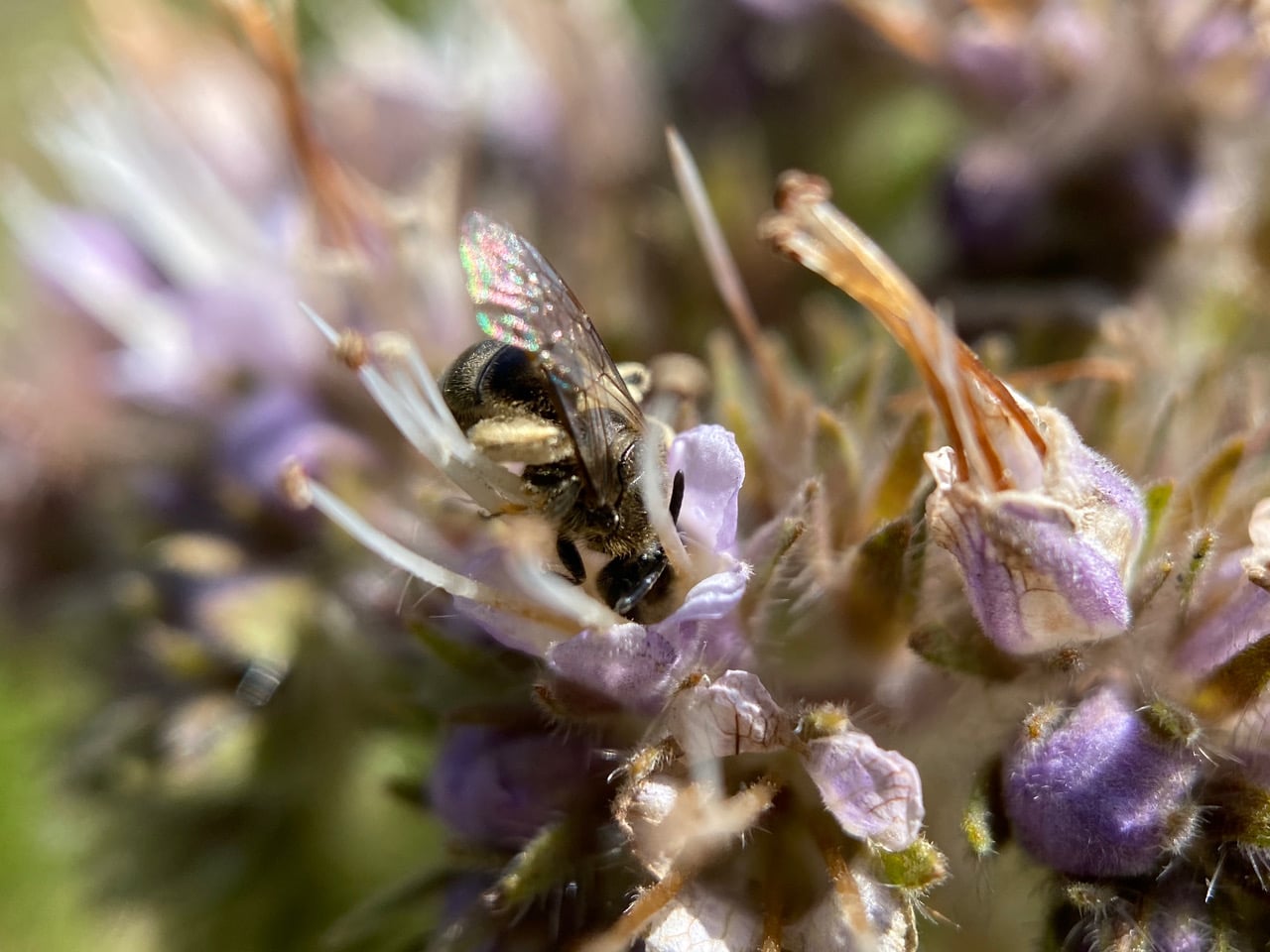
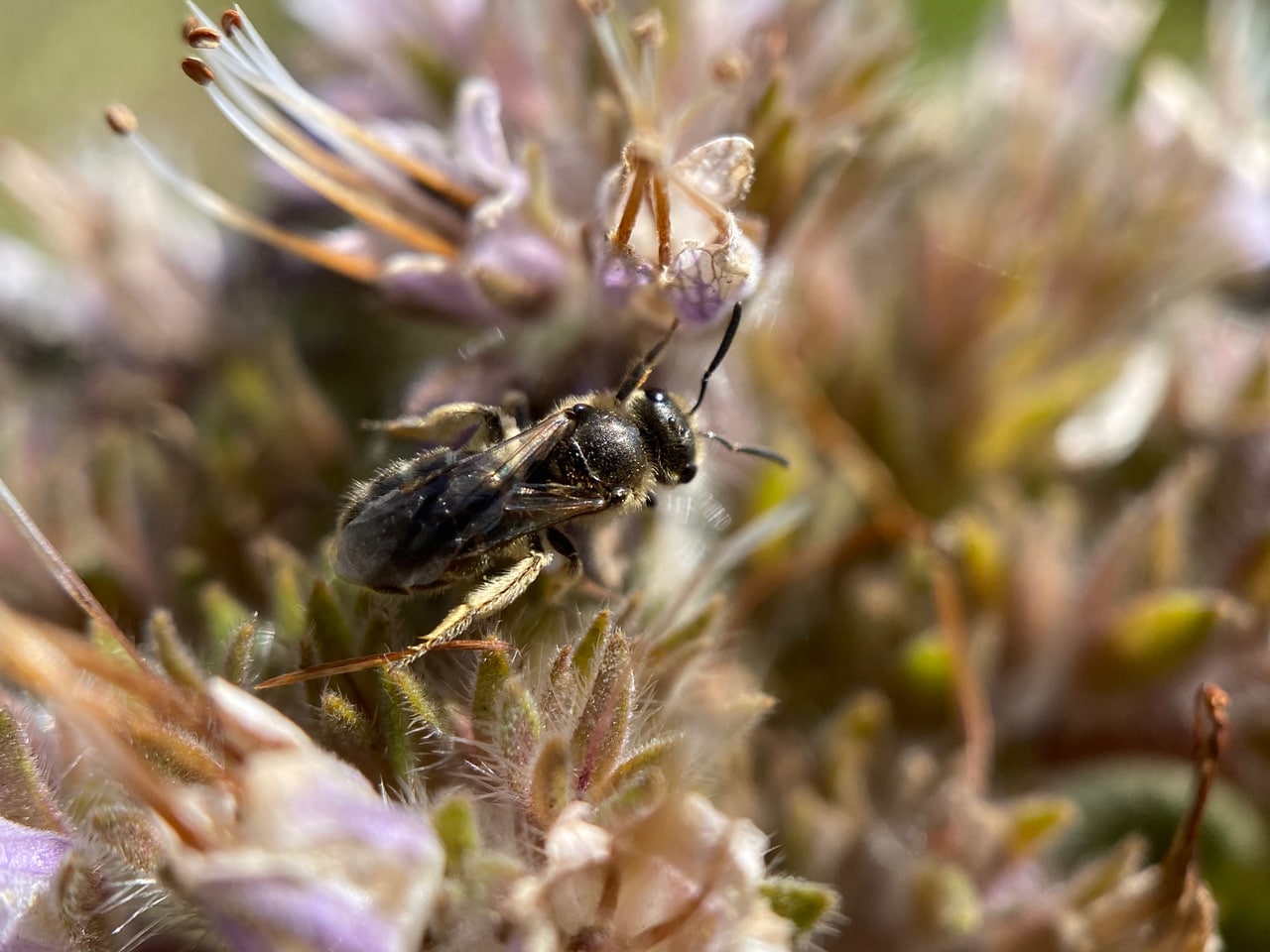
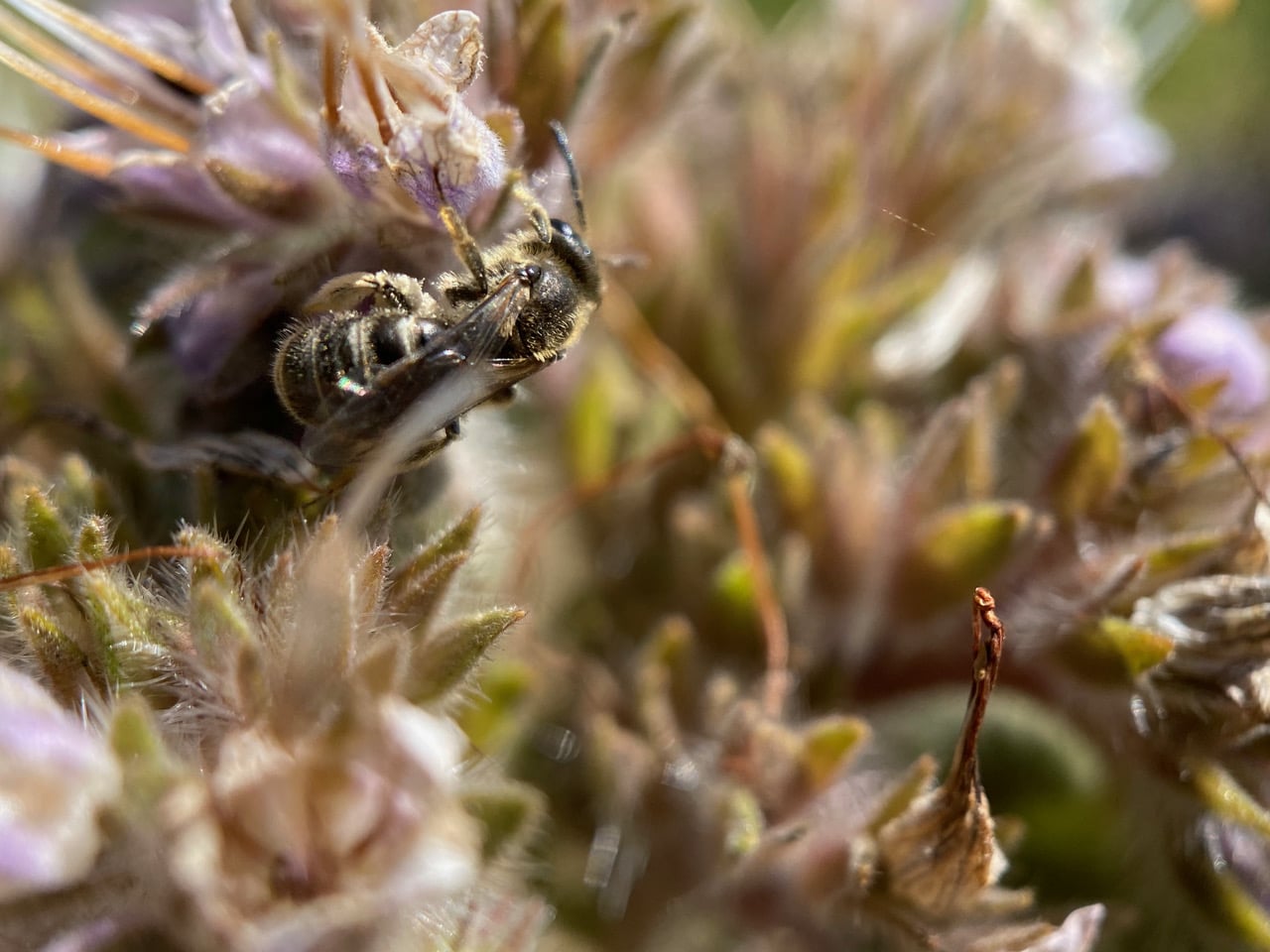
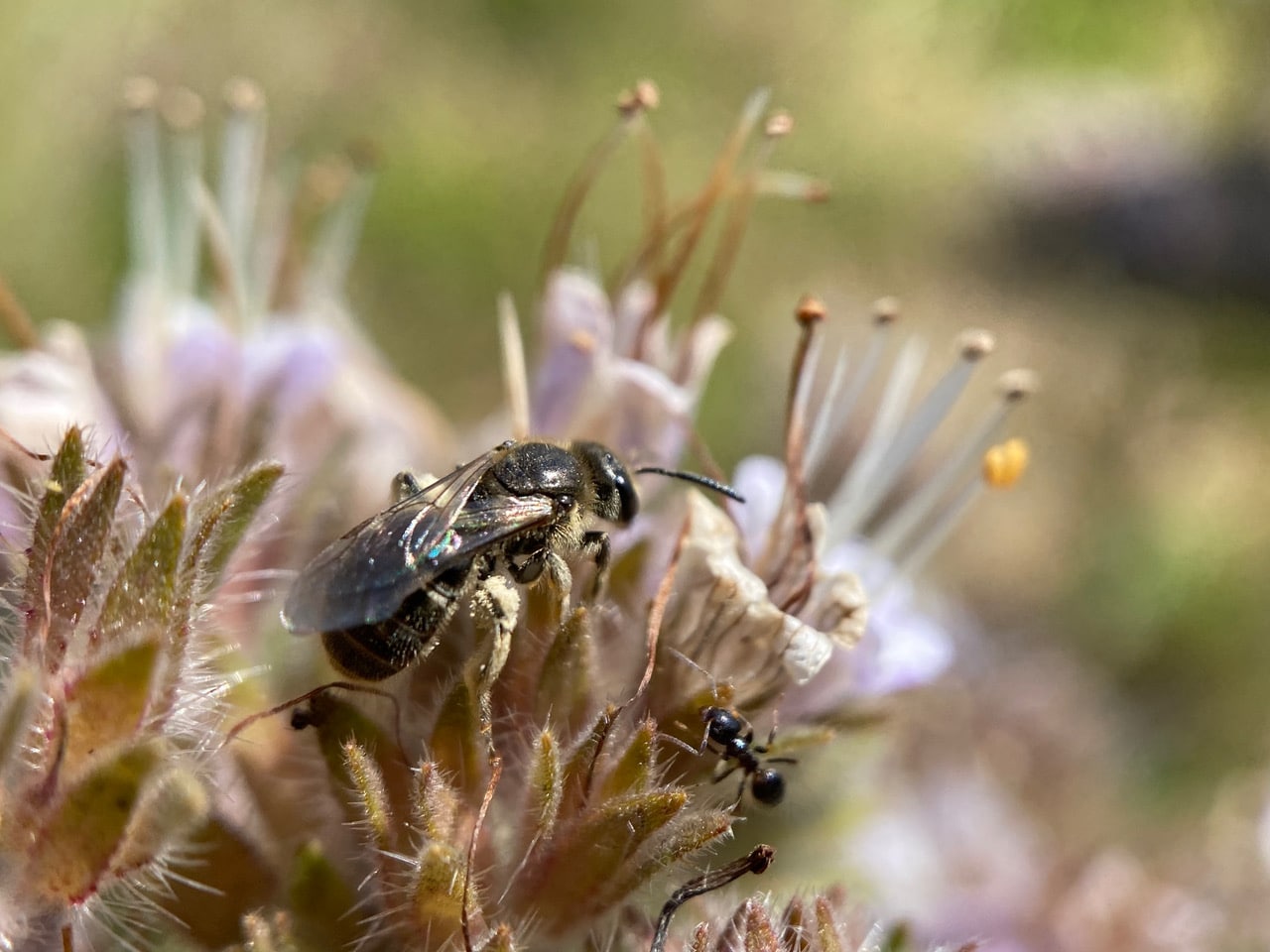
This little bee is not gathering pollen, just seeking nectar. The way that the scopal hairs are distributed on her hind legs is indicative of a Mining Bee, Andrena sp. (family Andrenidae).
She seems to have lost quite a bit of hair on her body. So difficult to identify bees like this!
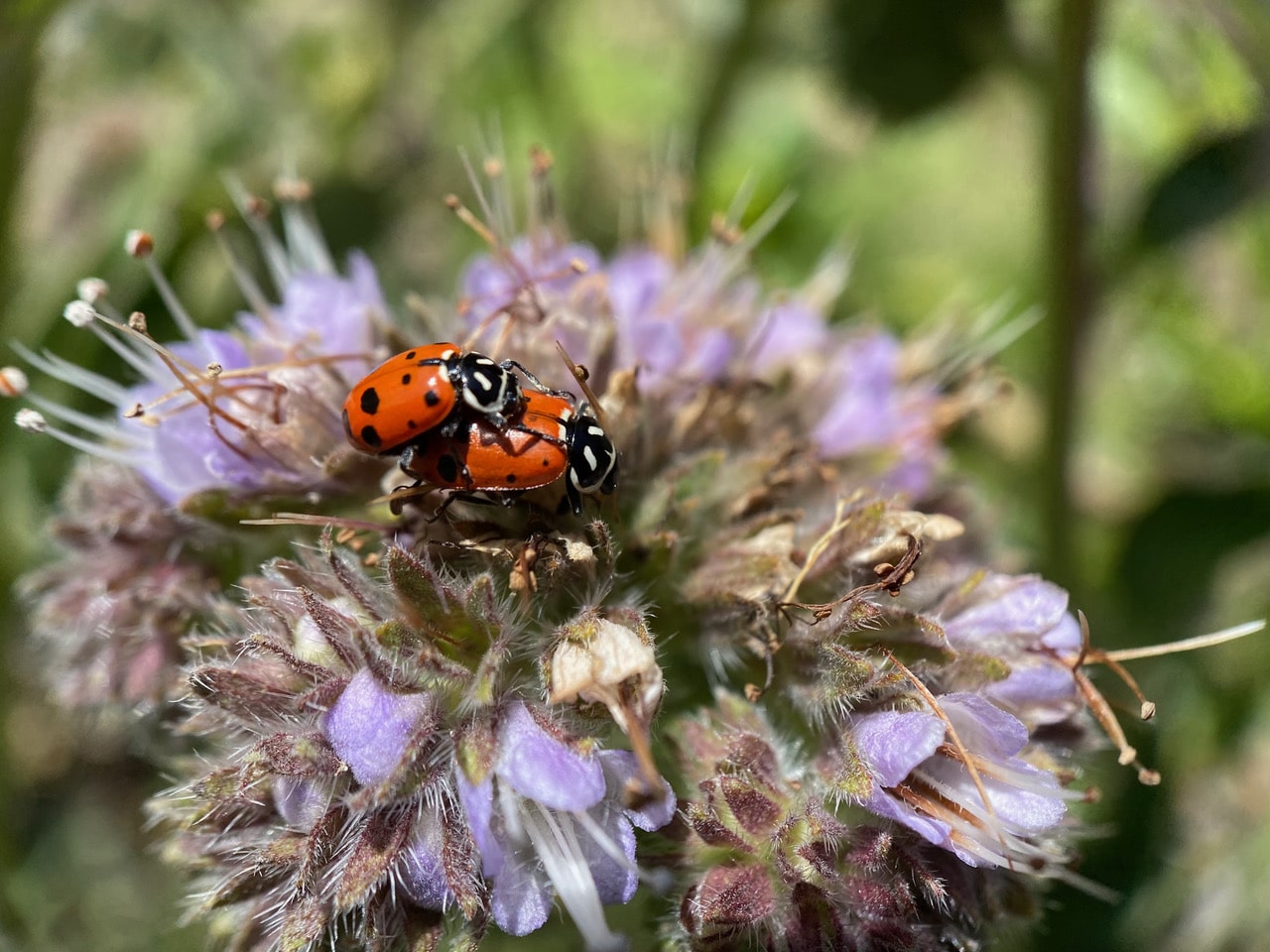
Ahh, something that’s instantly recognizable! A pair of Convergent Ladybeetles, Hippodamia convergens (family Coccinellidae) is mating on top of a phacelia inflorescence.