

Pollinator Post 5/8/24 (1)
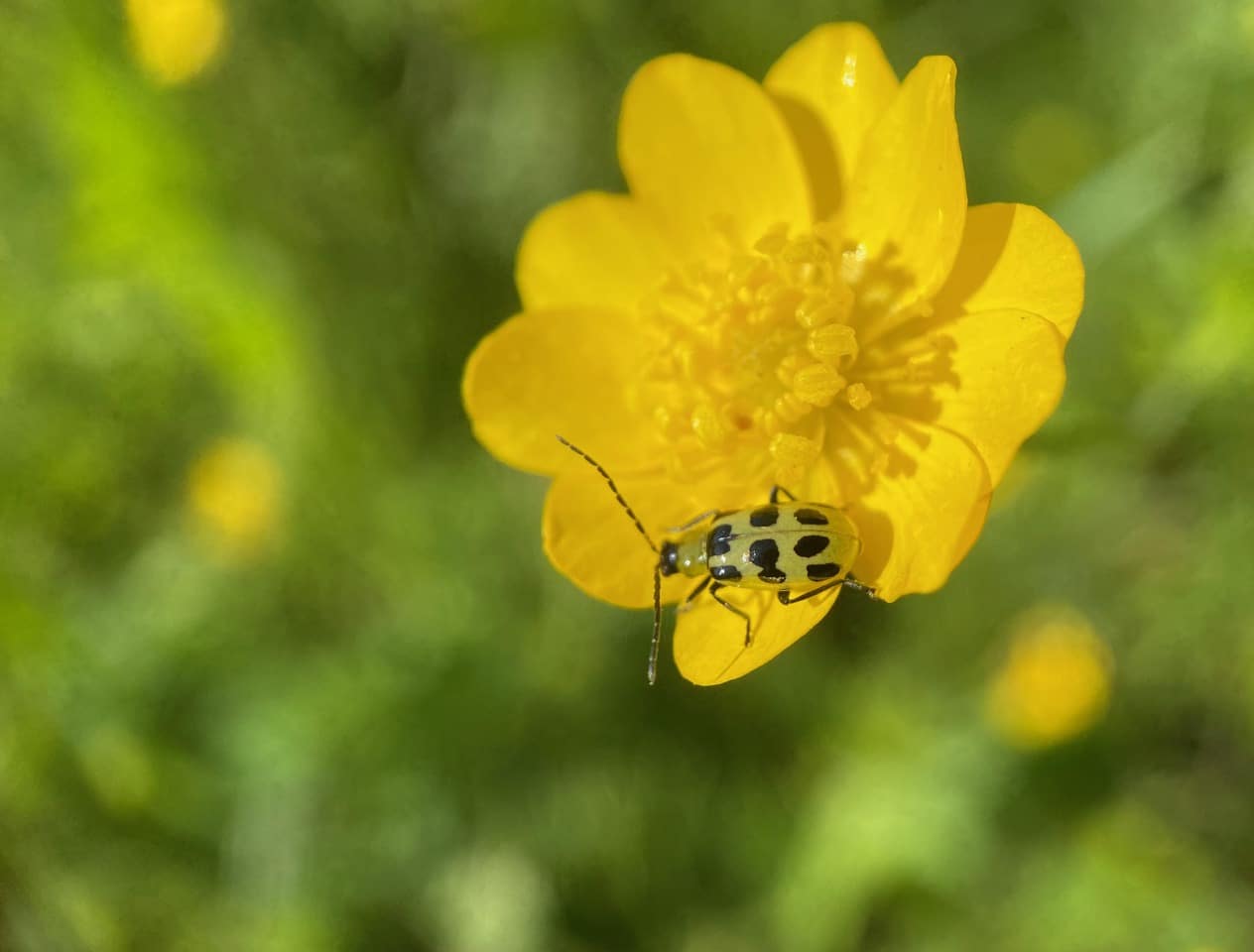
At the Steam Train entrance to Skyline Gardens, the dwindling patch of California Buttercup, Ranunculus californicus is now overgrown with tall grasses. A Spotted Cucumber Beetle, Diabrotica undecimpunctata (family Chrysomelidae) is perched on a buttercup flower. The species feeds on a wide variety of plants.
Members of the family Chrysomelidae are commonly known as Leaf Beetles. Adults and larvae feed on all sorts of plant tissues, and all species are fully herbivorous. Many are serious pests of cultivated plants, including food crops. Others are beneficial due to their use in biocontrol of invasive weeds. Chrysomelids are popular among insect collectors, as many are conspicuously colored, typically in glossy yellow to red or metallic blue-green hues, and some have spectacularly bizarre shapes. Photos of Leaf Beetles (Family Chrysomelidae) · iNaturalist
Native to North America, the Spotted Cucumber Beetle can be a major agricultural pest, causing damage to crops in the larval as well as adult stages of their life cycle. Larvae, sometimes known as rootworms feed on the roots of emerging plants. In the adult stage the beetles cause damage by eating the flowers, leaves, stems and fruits of the plant.
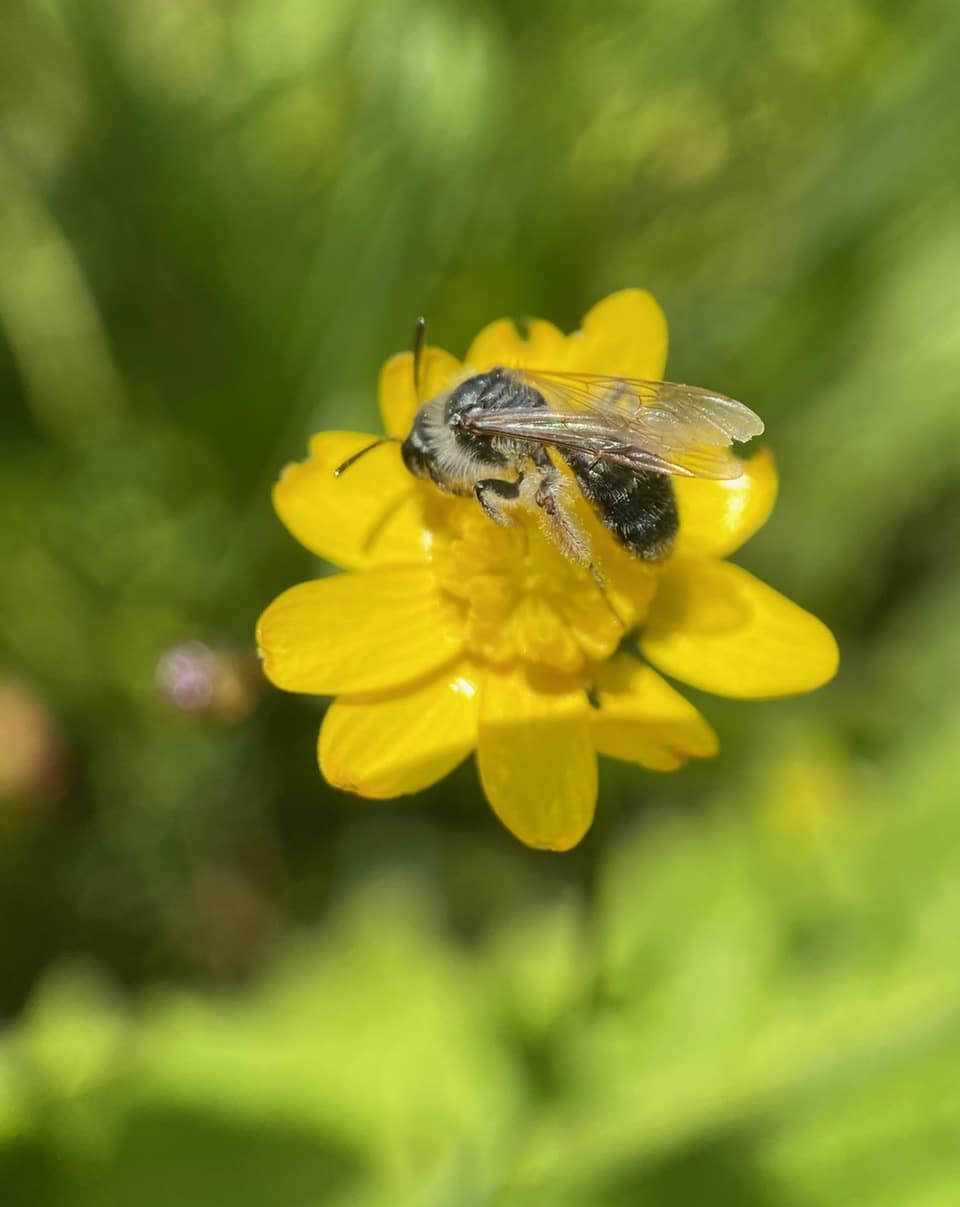
About half a dozen female Mining Bees, Andrena sp. (family Andrenidae) are already out foraging frantically on the buttercup flowers in the early morning hours.
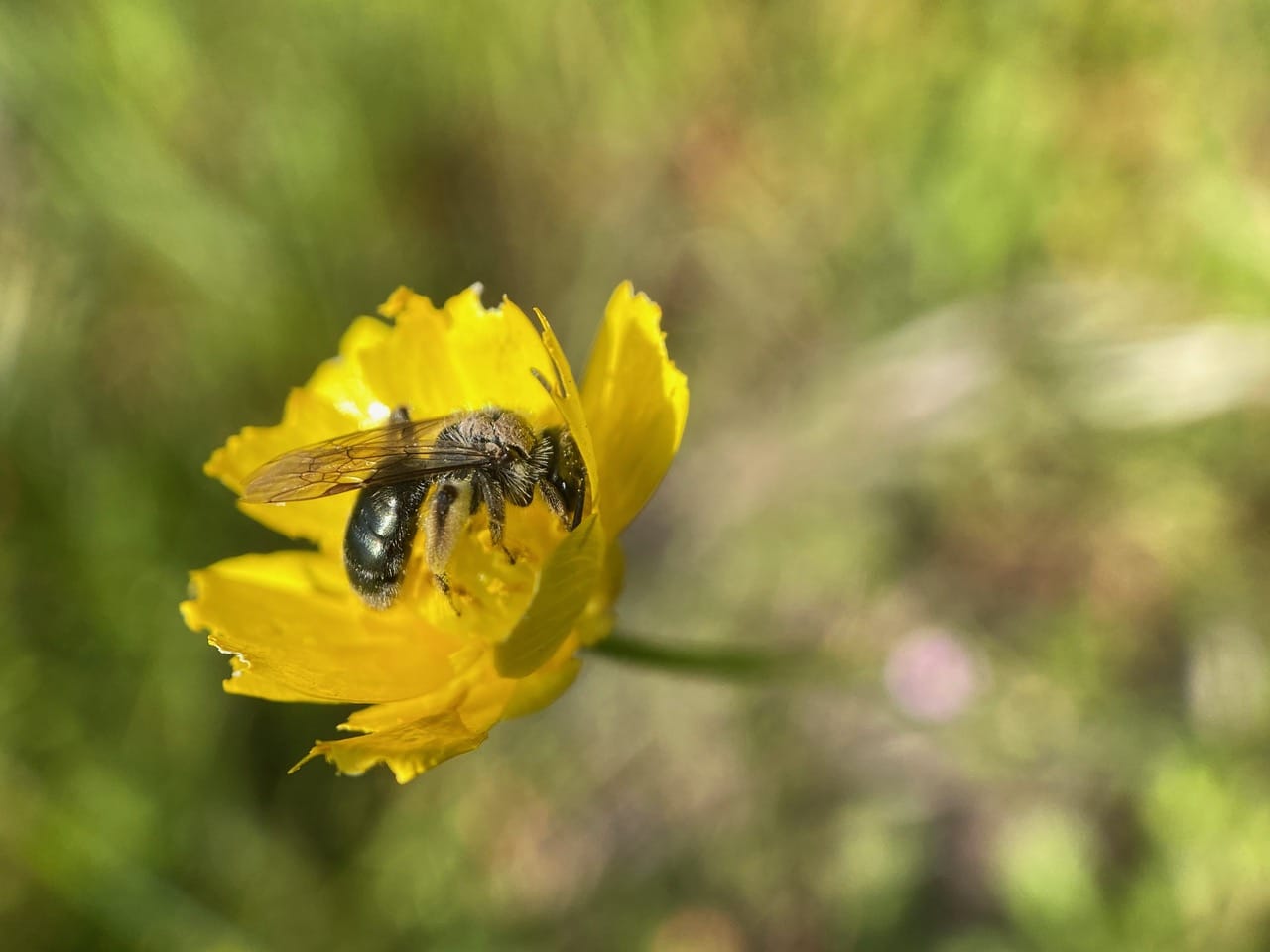
I know that these might be the last of the buttercup mining bees I see this year. Once the season of the buttercup is over, the bees will disappear too. They appear to be oligolectic, depending exclusively on the buttercup blooms. I have not seen them on any other flower in the garden.
The term oligolecty is used in pollination biology to refer to bees that exhibit a narrow, specialized preference for pollen sources, typically to a single family or genus of flowering plants.
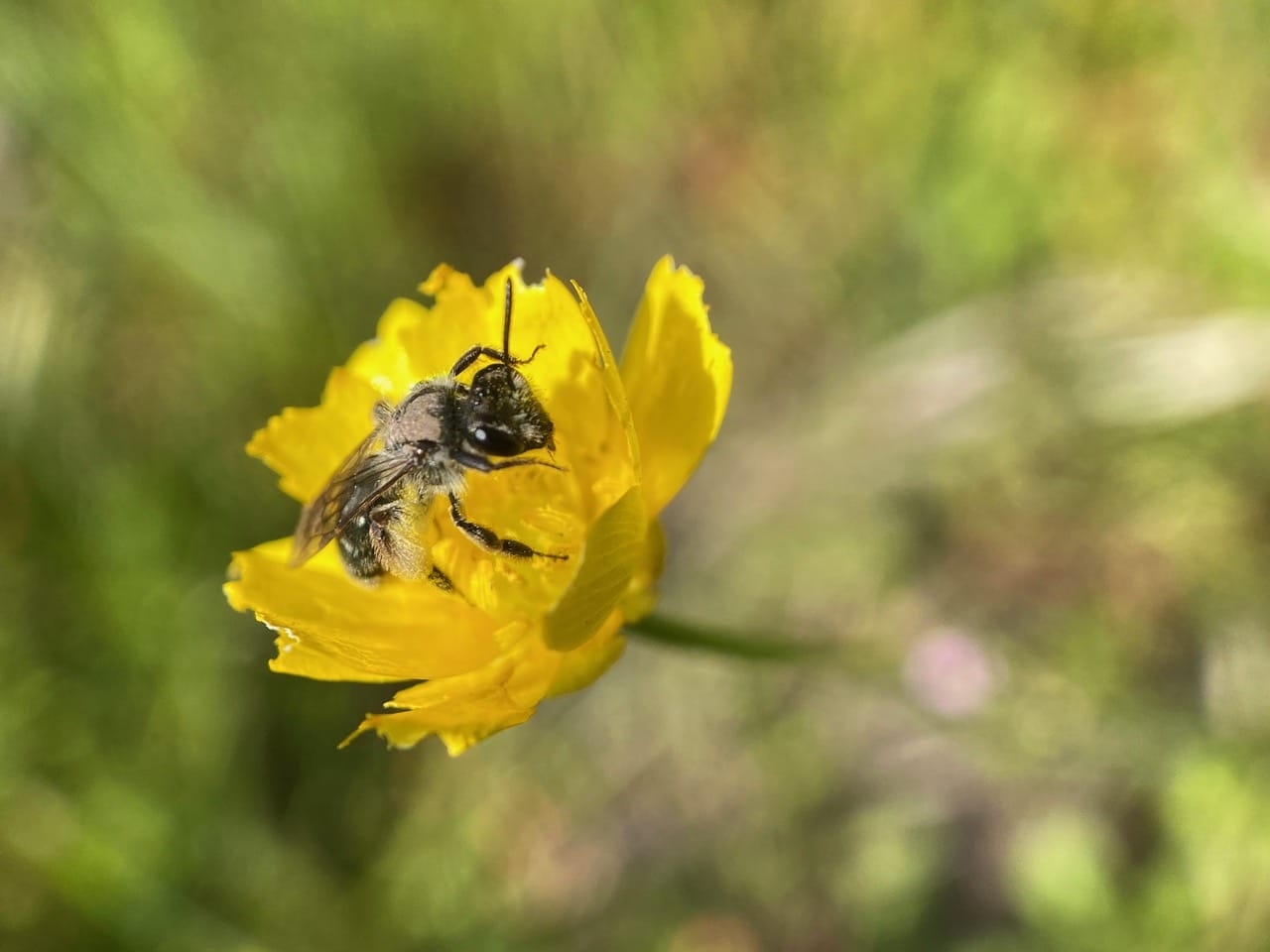
I so admire these little bees’ tenacity and diligence. They are the primary pollinators for the buttercups. Every last flower is precious to them.
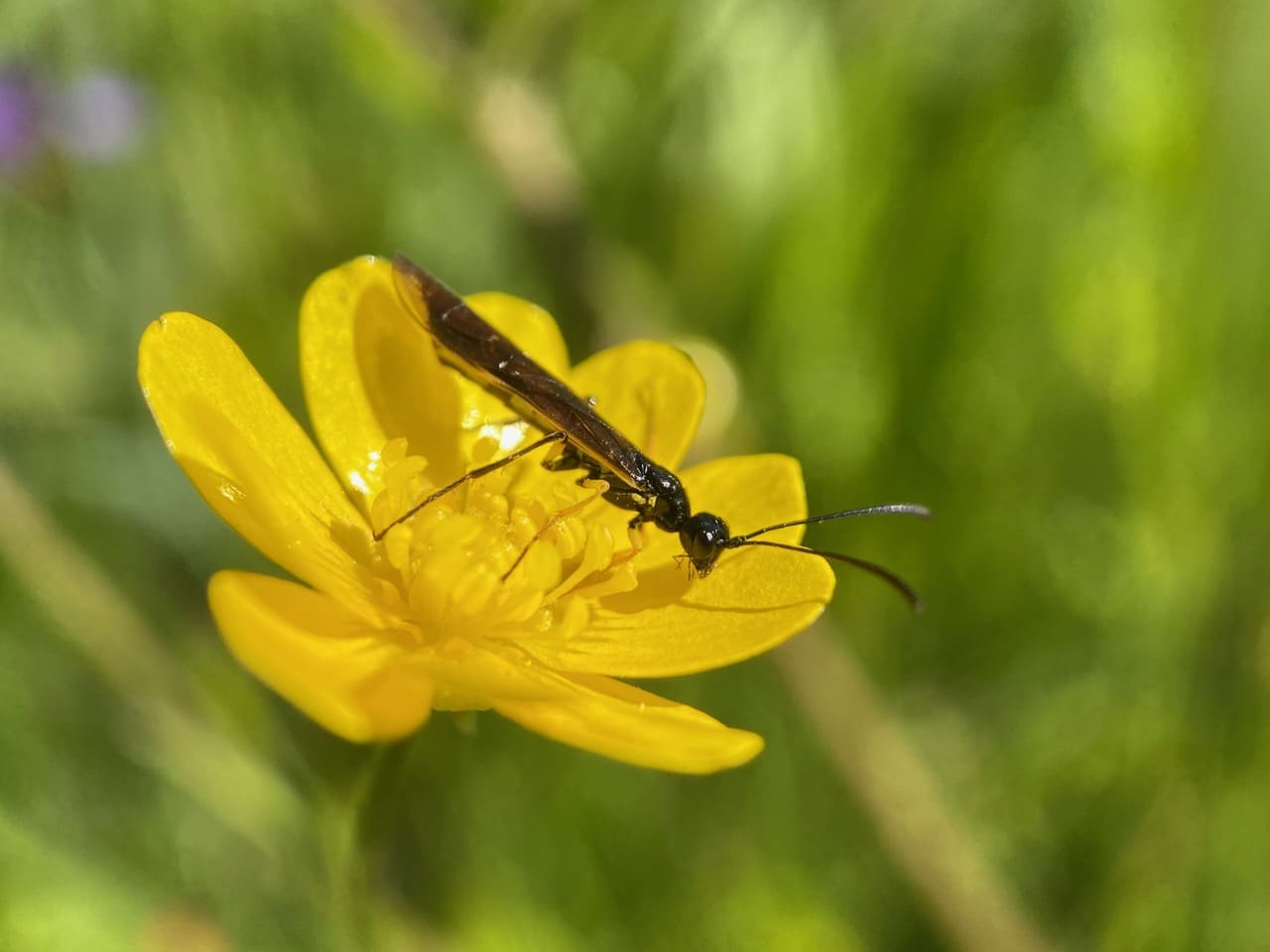
I am glad that the Click Beetles are no longer on the buttercups – their feeding can be quite destructive to the flowers. A Stem Sawfly, Calameuta sp.(family Cephidae) has found itself a nice fresh buttercup flower.
Sawflies are part of the insect order, Hymenoptera, together with bees, wasps and ants. They are considered to be the most primitive group and form the sub-order Symphyta. They differ from the bees, wasps and ants in not having a narrow ‘waist’ and in their wing venation. The common name comes from the saw-like ovipositor that the females use to cut into plant tissues to lay their eggs. Larvae are caterpillar-like and can be distinguished from lepidopteran caterpillars in that all body segments following the three bearing true legs have a pair of fleshy prolegs. Like the lepidopteran caterpillars, sawfly larvae walk about and eat foliage. In many species, the larvae feed in groups.
Stem Sawflies in the family Cephidae feed on grasses (including grain crops) and shrubs (including berries, roses, willows). The larvae bore in the stems. The genus Calameuta is found in western North America. Calameuta larvae are grass stem borers. Adults are commonly attracted to yellow flowers.
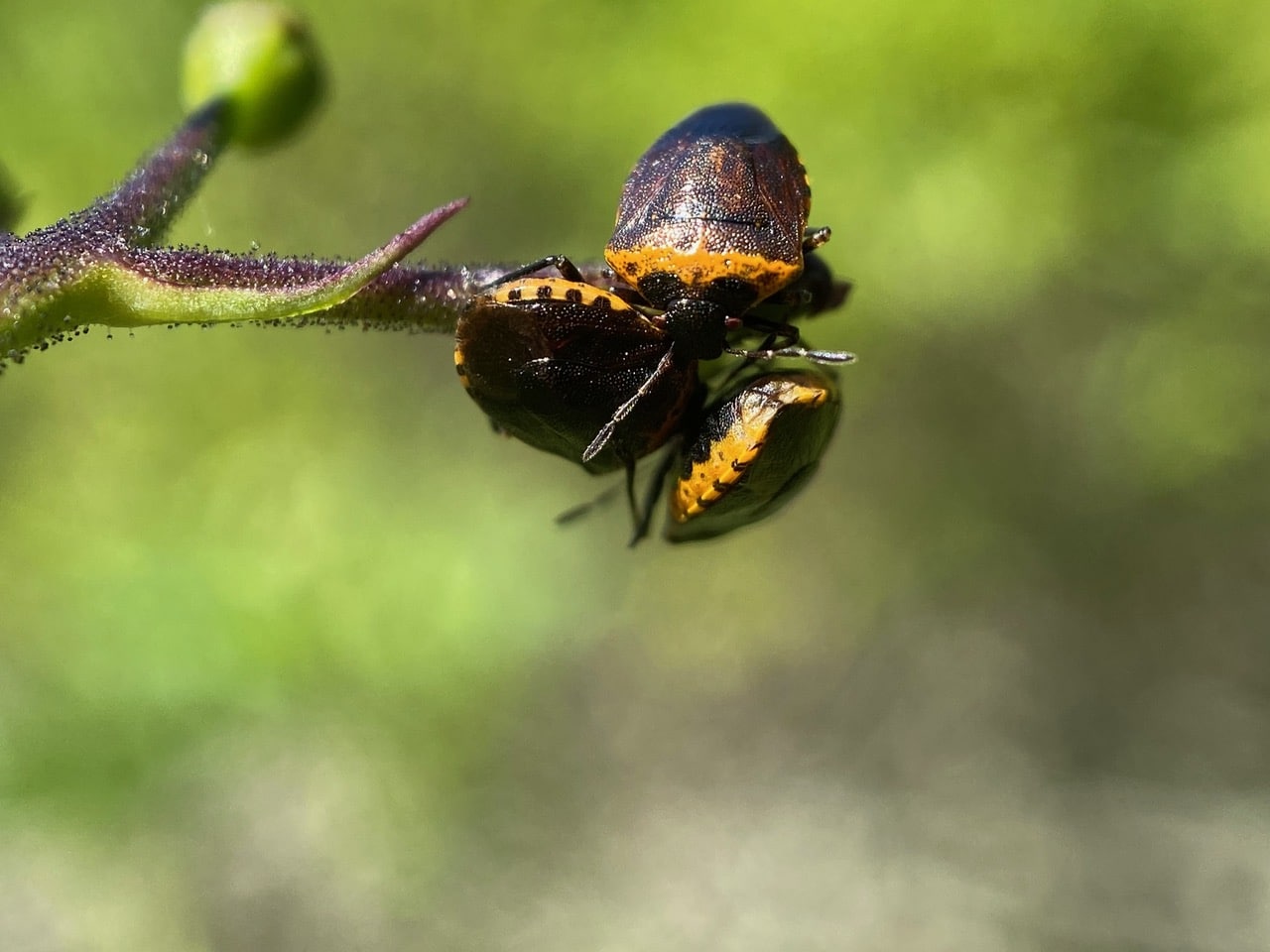
Three little Stink Bugs, Cosmopepla uhleri (family Pentatomidae) are clustered on a flower bud of Bee Plant, Scrophularia californica.
Pentatomidae is a family of insects belonging to the order Hemiptera or “true bugs”. As hemipterans, the pentatomids have piercing-sucking mouthparts, and most are phytophagous, including several species that are severe pests on agricultural crops. Stink Bugs feed on plant fluids by inserting their needlelike mouthparts into stems, leaves or seed pods. While feeding, they inject materials into the plant to aid in digestion and sap removal. Penetration by the mouthparts can cause physical damage, much like stabbing the plant with a fine needle. Cosmopepla uhleri is so small that the damage is generally limited to fine stippling on the leaves of California Bee Plant.
All Pentatomids have 5-segmented antennae (hence their family name, Penta – five and tomos – section.) They generally have a large triangular scutellum in the center of the back. The adult is generally shield-shaped when viewed from above. The common name of Stink Bug refers to their ability to release a pungent defensive spray when threatened, disturbed, or crushed.
#/media/File:Heteroptera_morphology-d.svg)
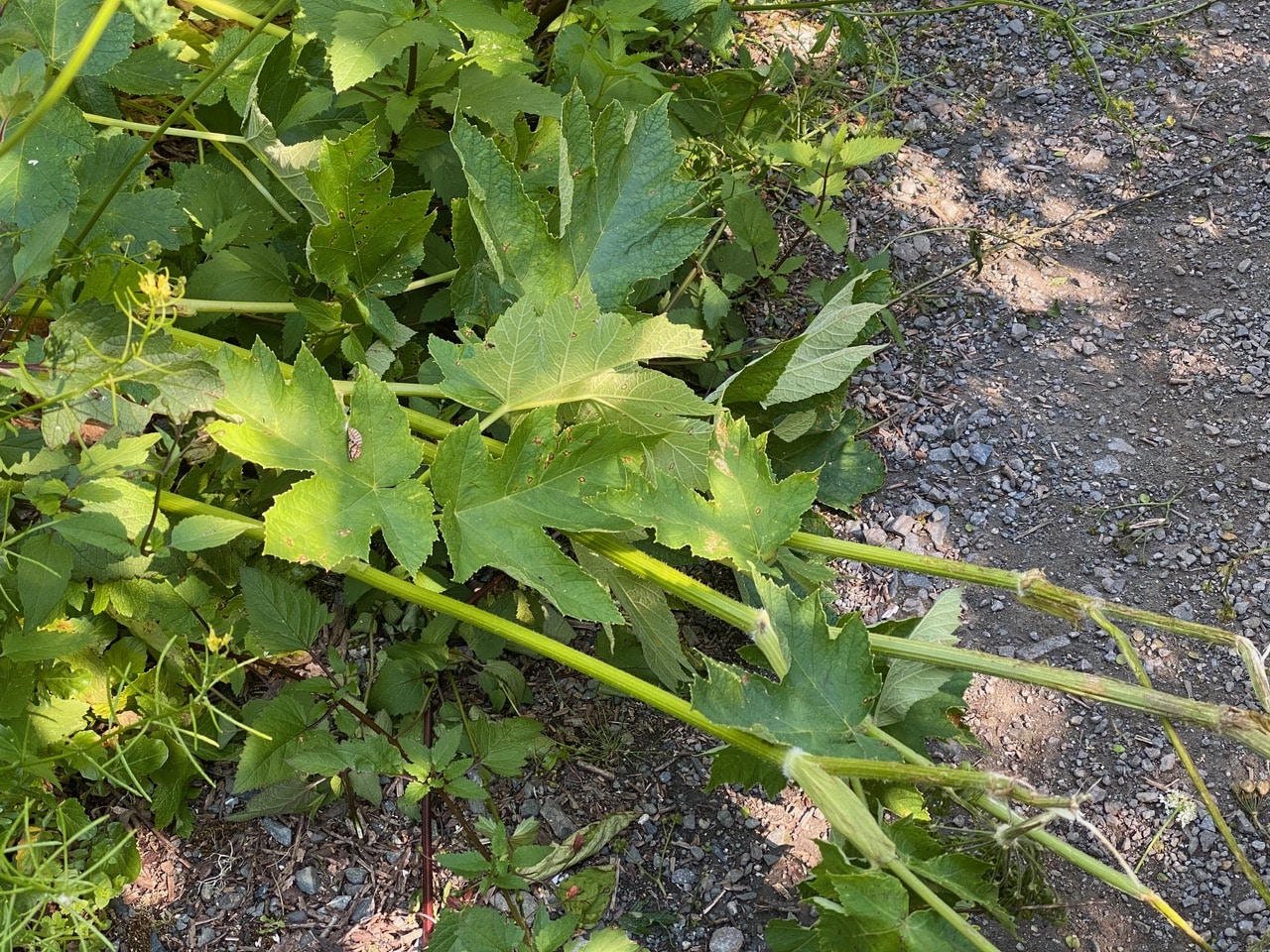 Excited to check on the Variable Checkerspot chrysalis on the Cow Parsnip leaf that I found on 4/30, I am disheartened to find the plant lying prone across the trail. What happened? Of all the Cow Parsnip along the trail, why this one? The chrysalis is still there but if someone comes to clear the trail, it might be removed along with the plant.
 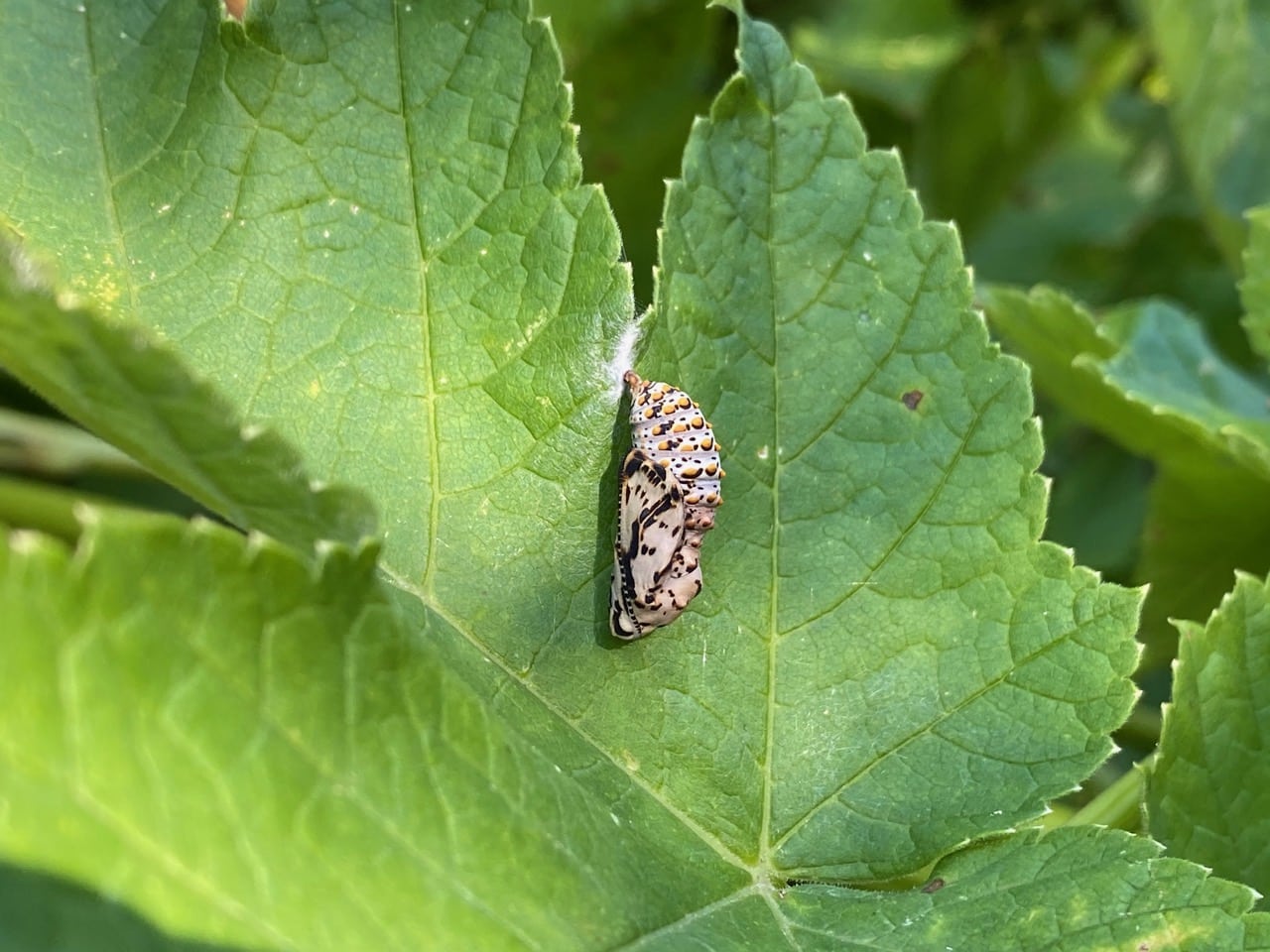 The chrysalis looks OK, getting a little darker around the thorax area. I do my best to prop up the plant against adjacent Cow Parsnips, and wish the butterfly the best of luck. The caterpillar has not chosen well when it went scouting for a pupation site.
It is still cool in the morning, but a hover fly is out flying among the vegetation along the trail. It finally lands on a flower of Poison Oak, Toxicodendron diversilobum. It is an elongate, dusky fly with a metallic sheen. Melanostoma or Platycheirus?

The fly next lands on top of a Bee Plant flower, Scrophularia californica, giving me a side view of its body. Ah, it’s a female Variable Duskyface Fly, Melanostoma mellinum (family Syrphidae). See the blue-green haltere under its wing?
Halteres are the modified hind wings in Diptera (flies). They are shaped like ‘drum sticks’ with a slender shaft connected to the thorax. Halteres are highly sophisticated balance organs and they oscillate during flight.
Melanostoma mellinum is a very common species of hover fly found in many parts of Europe including the Mediterranean basin and North Africa, the East Palearctic, and North America. A small species, their wingspan between 4.7 and 7.0 mm. Very similar to Platycheirus, but can be distinguished by fine details. In M. mellinum, the normally pale halteres turn bright blueish-green in females about to lay eggs.
The species’ preferred habitat include grasslands and moorlands, including those in hilly and mountainous regions. Adults can be found feeding on pollen of grasses and other wind-pollinated plants. Little is known of their biology, but the larvae are suspected to be a general predator of small insects in the leaf litter.
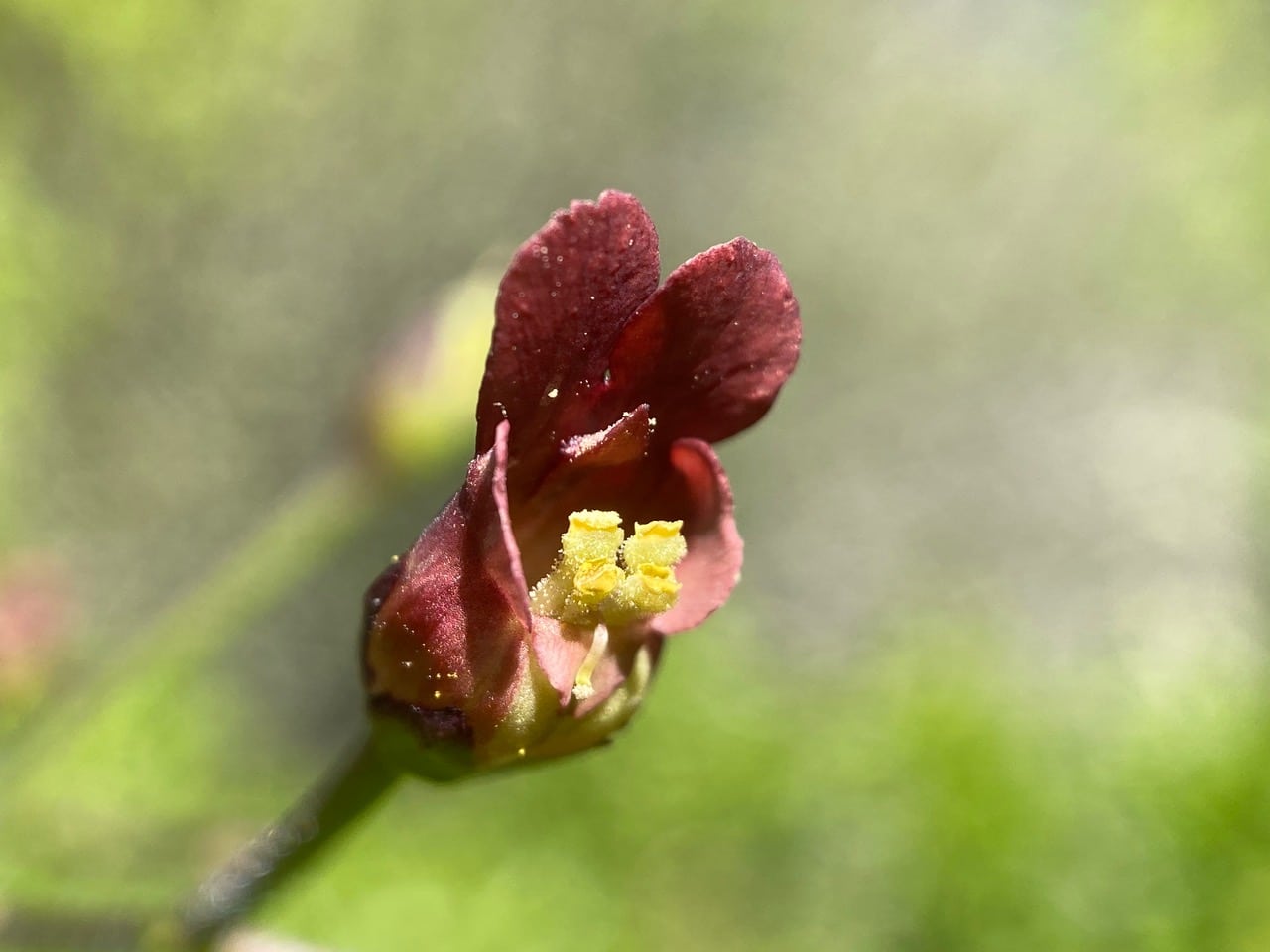
The protogynous flowers of Bee Plant, Scrophularia californica in this northern section of Skyline Trail are finally entering their male phase, with their stamens rolled out of the throat of the flower, offering pollen to any insect that stops by. The style with the stigma has retired out of the way, lying against the lower lip of the flower.
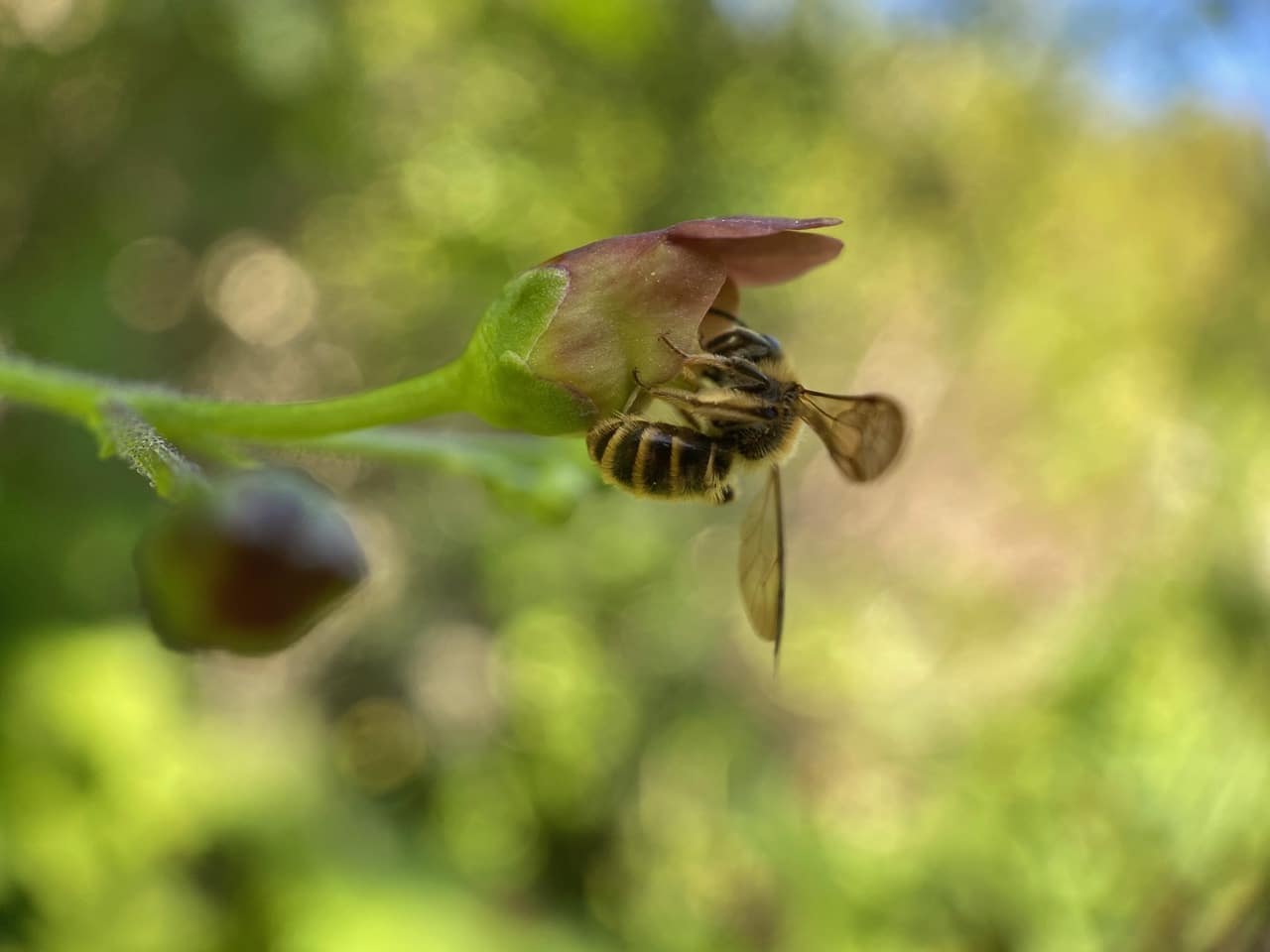
In the shade, a Golden-haired Miner Bee, Andrena auricoma (family Andrenidae) is perched at the entrance of a Bee Plant flower, collecting pollen from the anthers.
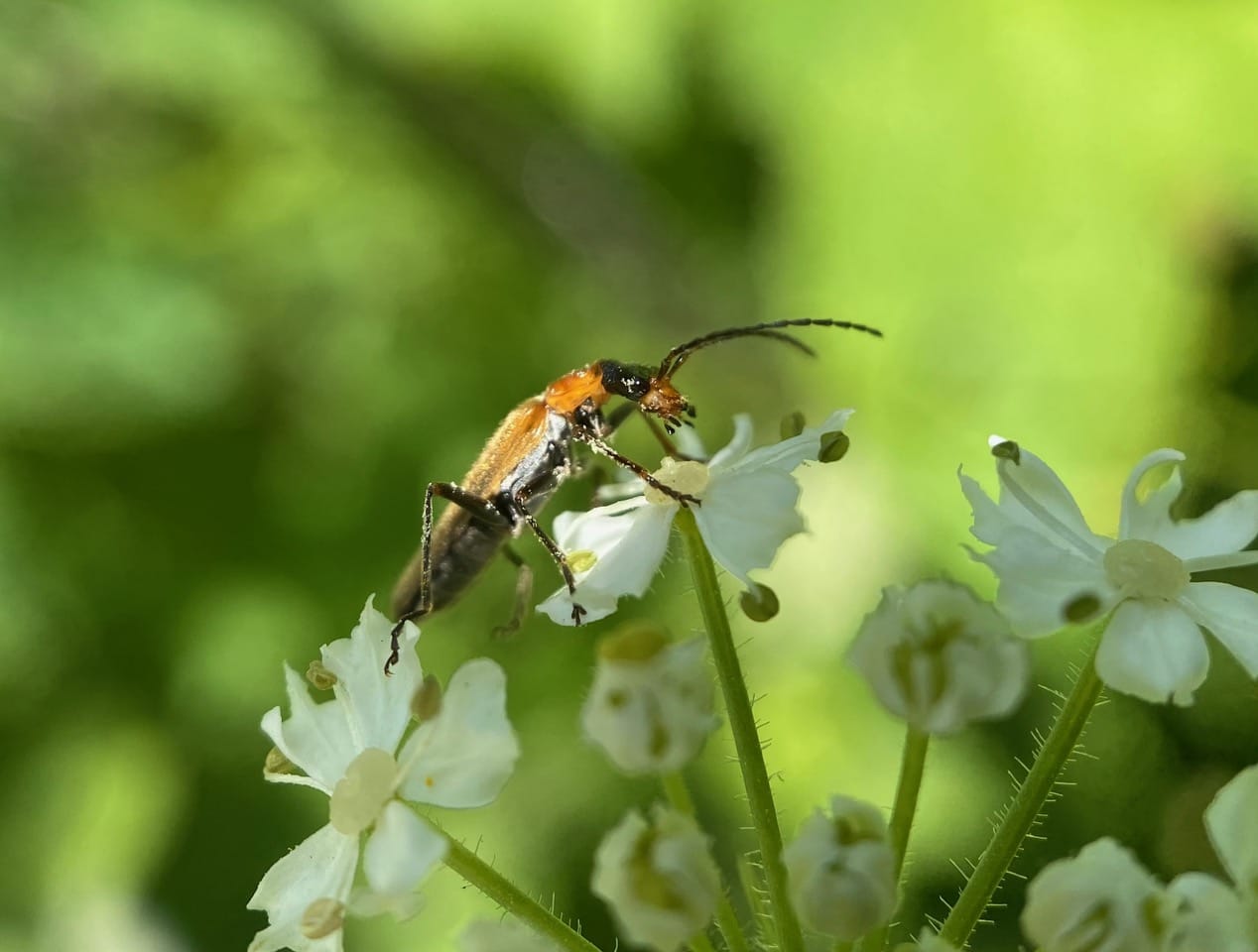
In the dappled shade, a Soldier Beetle, Dichelotarsus cavicollis (family Cantharidae), (formerly Podabrus cavicollis) is feeding on something on an umbel of Cow Parsnip flowers, Heracleum maximum. What interesting mouthparts! Beetles have chewing mouthparts.
The Soldier Beetles, family Cantharidae are relatively soft-bodied, straight-sided beetles. One of the first described species has a color pattern reminiscent of the red coats of early British soldiers, hence the common name. They are also known commonly as Leatherwings because of their soft elytra. Soldier beetles often feed on both nectar and pollen as well as predating on other small insects. The larvae are often active, and feed on the ground, hunting snails and other small creatures. Soldier beetles are generally considered beneficial insects by gardeners.

A male Snakefly, Agulla bicolor (family Raphidiidae) is perched on a leaf of Italian Thistle.
Snakeflies are a group of predatory insects comprising the order Raphidioptera. They are a relict group, having reached their apex of diversity during the Cretaceous before undergoing substantial decline. Adult Snakefly has a notably elongated thorax which, together with the mobile head, gives the group their common name of snakefly. The body is long and slender and the two pairs of long membranous wings are prominently veined. The head is long and flattened and heavily sclerotized. The mouthparts are strong and relatively unspecialized, being modified for biting. The large compound eyes are at the sides of the head. Females have a large and sturdy ovipositor which is used to deposit eggs into crevices or under bark. Snakeflies are holometabolous insects with four-stage life cycle consisting of eggs, larvae, pupae and adults. Both adults and larvae are predators of soft-bodied arthropods such as aphids and mites.
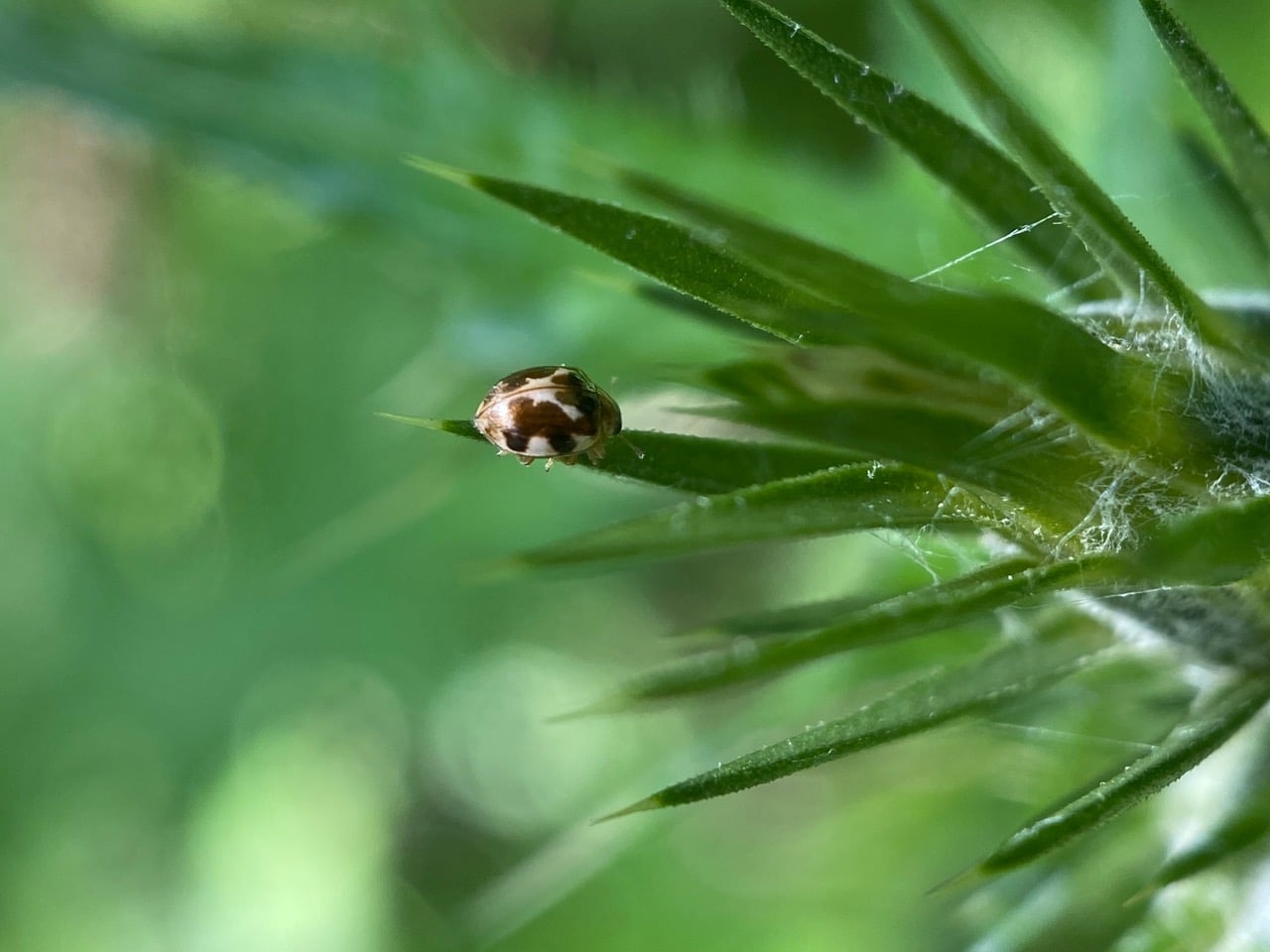
Only 2-3 mm in length, a Twenty-spotted Lady Beetle is resting on a sharp phyllary of an Italian Thistle.
The Twenty-spotted Lady Beetle, Psyllobora vigintimaculata (family Coccinellidae) is found in North America, especially the west coast. The elytra have dark, orange or bicolored spots on a white background. There are four or five distinctive dark spots on the pronotum arranged in an “M” shape. The patterns on the elytra are highly variable.
The species is found in early spring, occurring is numbers on the foliage of various shrubs. In summer and fall, they are often found on plants with powdery mildew on which the beetles feed. It has been proposed that the beetles be used as an alternative to fungicides for the control of the fungus in agricultural settings.

A Yellow-faced Bumble Bee, Bombus vosnesenskii (family Apidae) visits a spike of flowers of Winter Vetch.
Hairy or Winter Vetch, Vicia villosa (family Fabaceae) is native to Europe and western Asia. Although non-native, it is widespread in the United States and is considered invasive by some states. The plant is widely used by organic growers in the US as a winter cover crop and in no-till farming, as it is both winter hardy and a prolific nitrogen fixer. It is also used in organic gardens as companion plants, as an alternative to rotating crops on small growing areas. The vetch provides both nitrogen and an instant mulch that preserves moisture and keeps weeds from sprouting. In wild landscapes it is observed that the vetch is a good pioneer plant in disturbed areas, preserving fertility of the soil for vegetation that follows in plant succession.
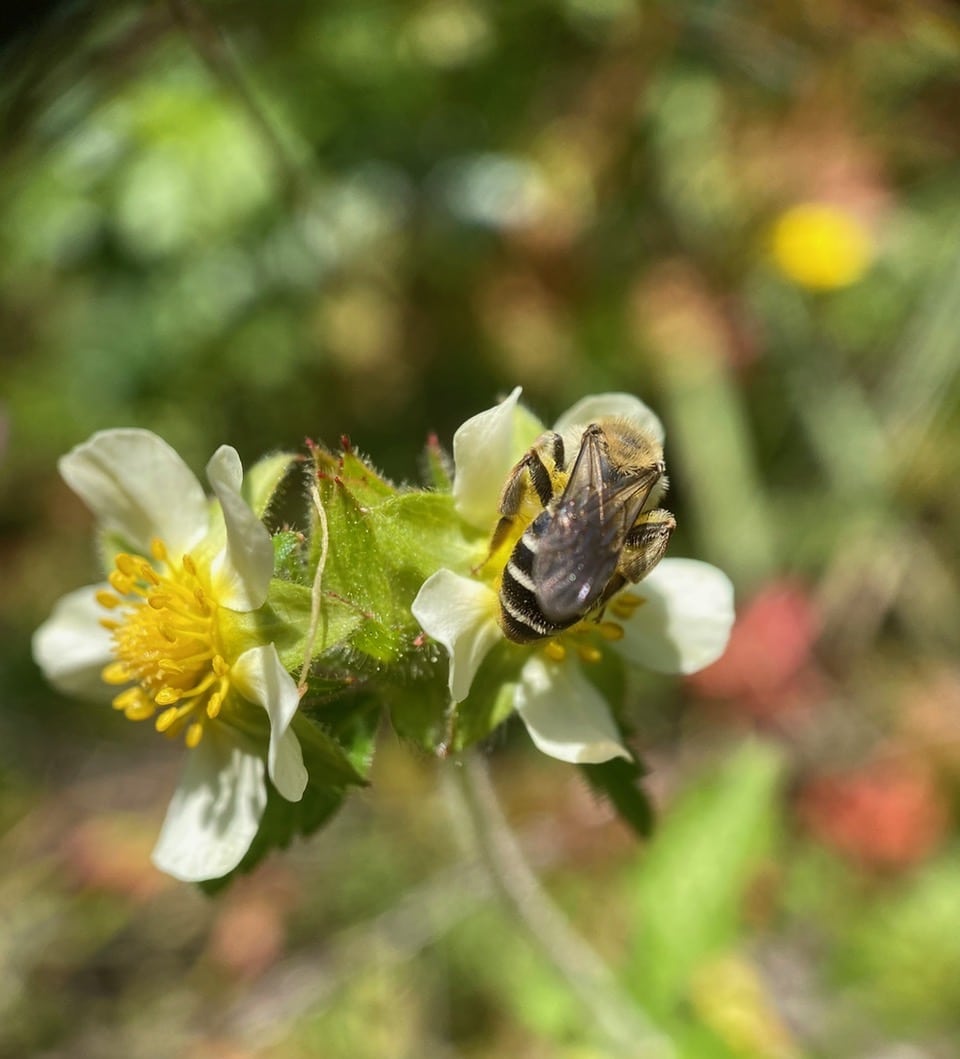
The bee with a long, black-and-white abdomen has empty scopae on her hind legs. She is just beginning to collect pollen on a flower of Sticky Cinquefoil, Drymocallis glandulosa.
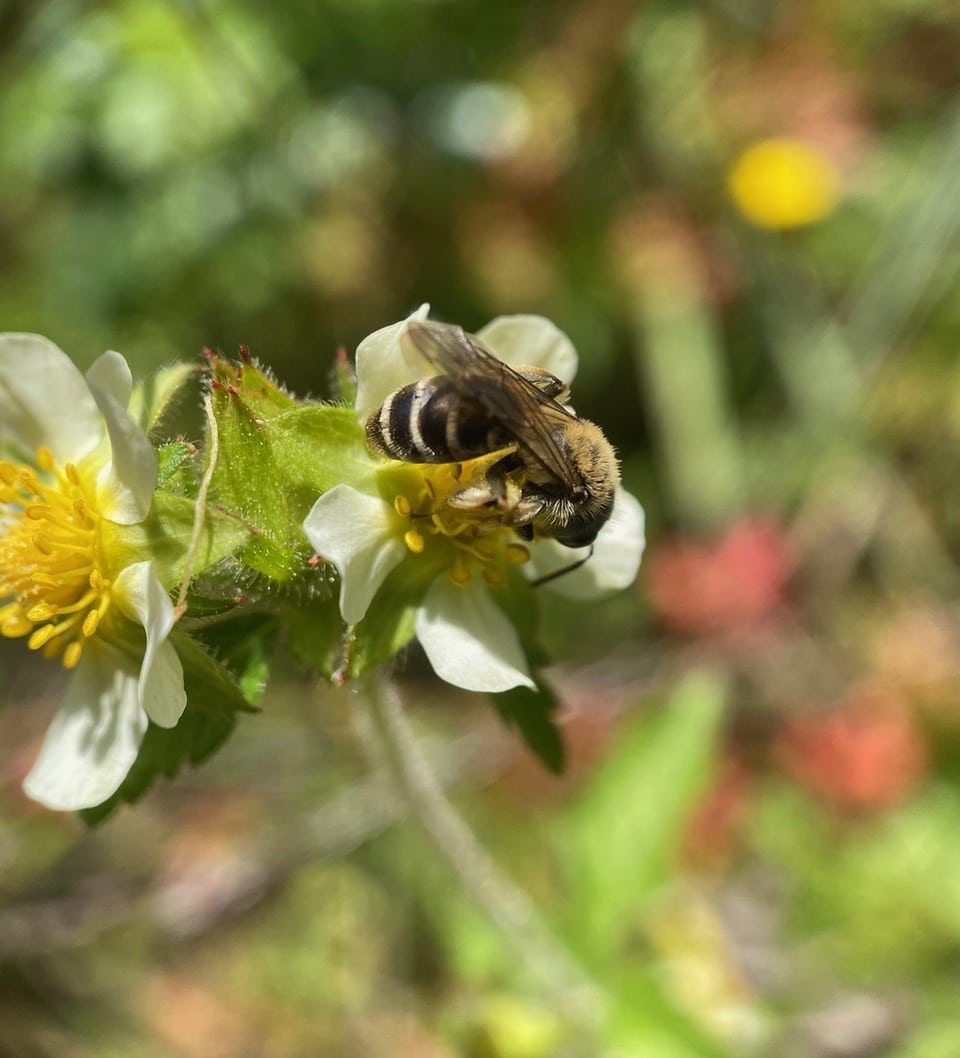
Although I can’t be sure, not having a look at the face, I think she might be a Mining Bee (family Andrenidae).

A tiny bee, about the size of a grain of rice is foraging on a flower of Sticky Cinquefoil.
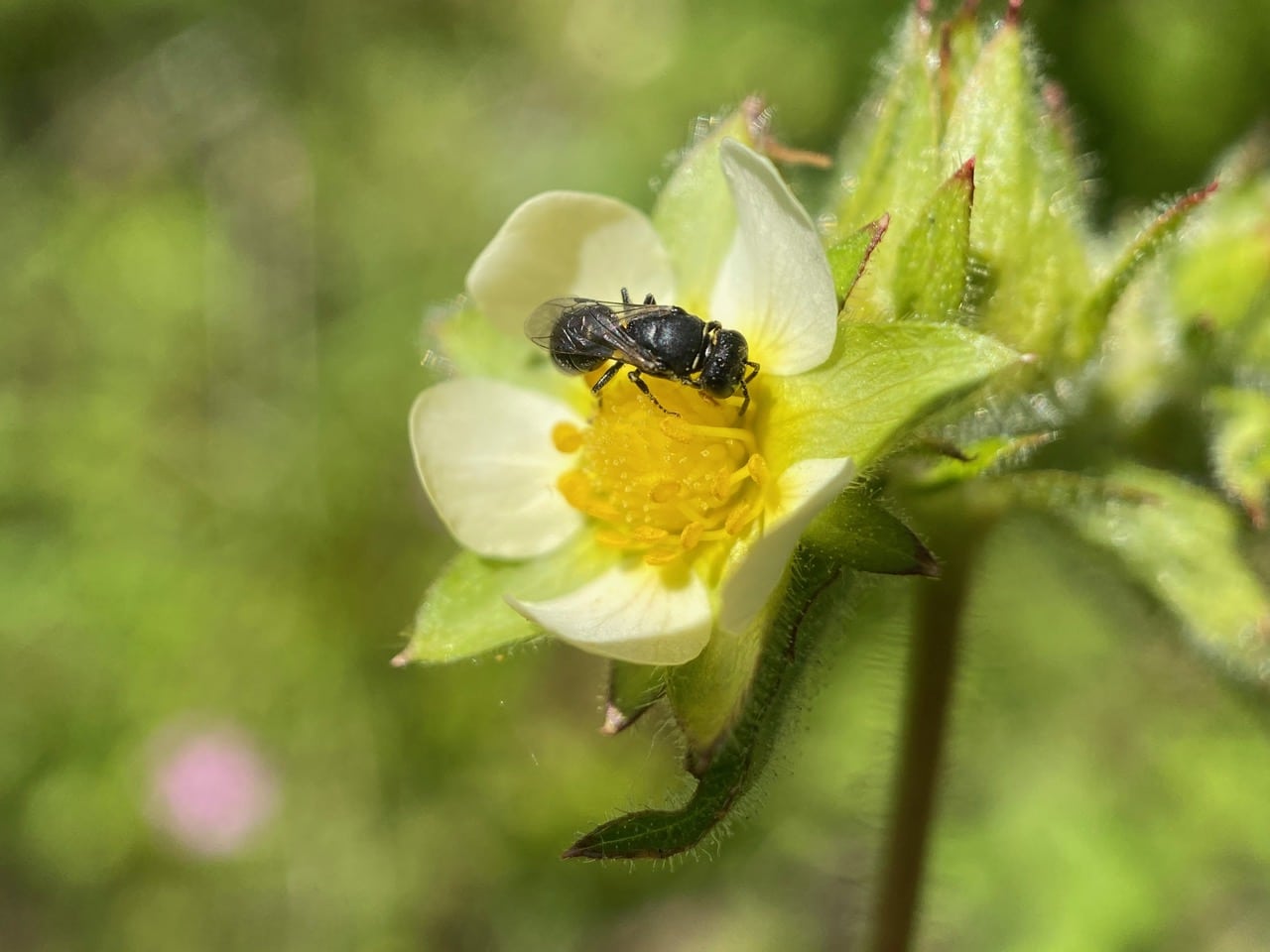
Note the broken yellow band across her “shoulder”. Ooh, I know who she is – a Masked Bee, Hylaeus sp. (family Colletidae)!
Hylaeus (family Colletidae) are shiny, slender, hairless, and superficially wasp-like bees. They are small, 5 to 7 mm long, usually black with bright yellow or white markings on their face and legs. These markings are more pronounced on the males. Hylaeus do not carry pollen and nectar externally, they instead store their food in the crop and regurgitate it upon returning to their nests. They are primarily generalist foragers. Hylaeus are short-tongued, but their small body size enables them to access deep flowers. Hylaeus nest in stems and twigs, lining their brood cells with self-secreted cellophane-like material. They lack strong mandibles and other adaptations for digging, using instead pre-existing cavities made by other insects.

By far the most common bee visiting the Sticky Cinquefoil flowers is the Small Carpenter Bees, Ceratina sp. (family Apidae).

The Small Carpenter Bee genus Ceratina is closely related to the more familiar, and much larger Carpenter Bees (genus Xylocopa). Ceratina are typically dark, shiny, even metallic bees, with fairly sparse body hairs and a weak scopa on the hind leg. The shield-shaped abdomen comes to a point at the tip. Some species have yellow markings, often on the face.
Females excavate nests with their mandibles in the pith of broken or burned plant twigs and stems. While many species are solitary, a number are subsocial. Both male and female carpenter bees overwinter as adults within their old nest tunnels, emerging in the spring to mate. In the spring, this resting place (hibernaculum) is modified into a brood nest by further excavation. The female collects pollen and nectar, places this mixture (called bee bread) inside the cavity, lays an egg on the provision, and then caps off the cell with chewed plant material. Several cells are constructed end to end in each plant stem.


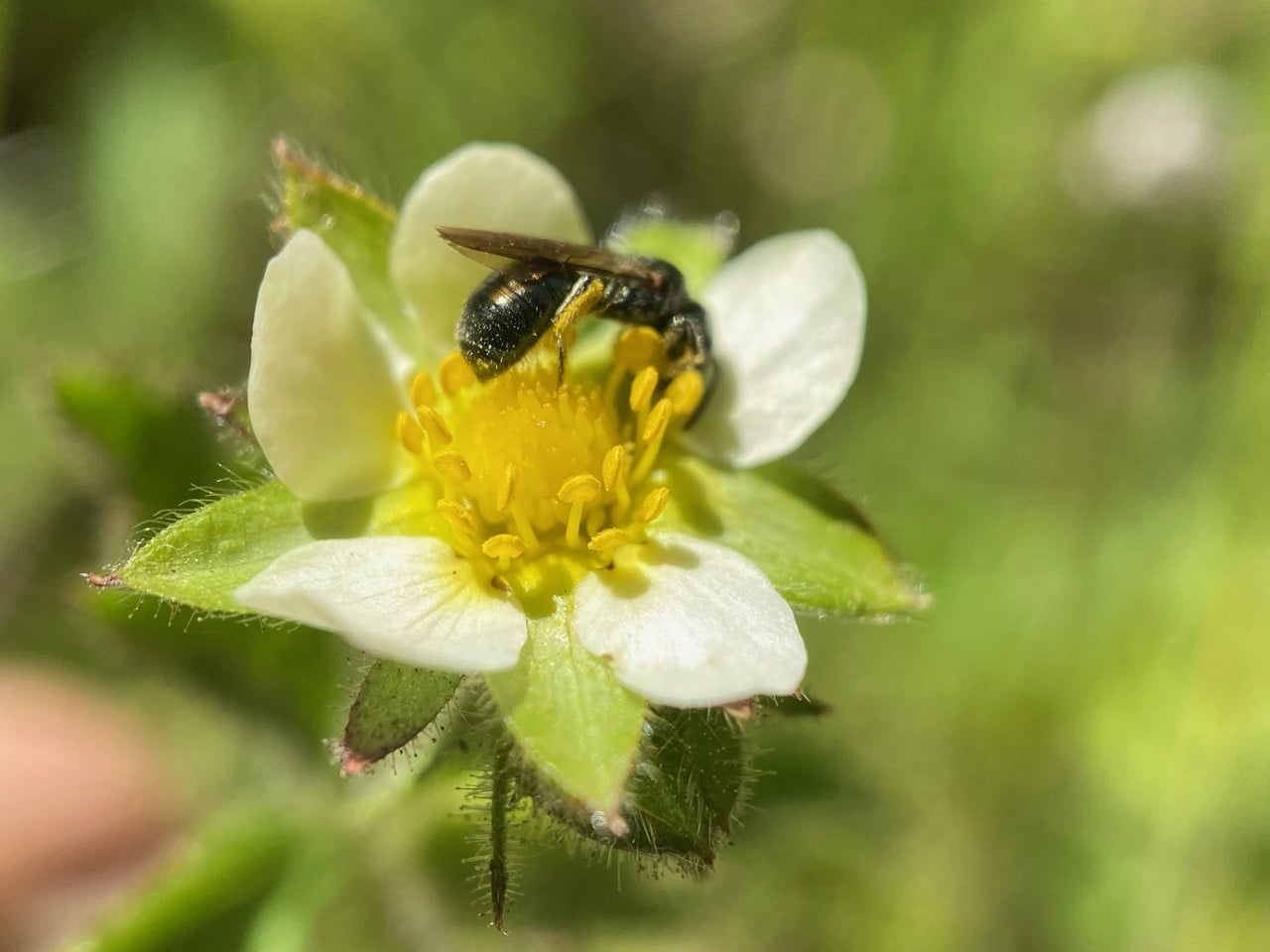
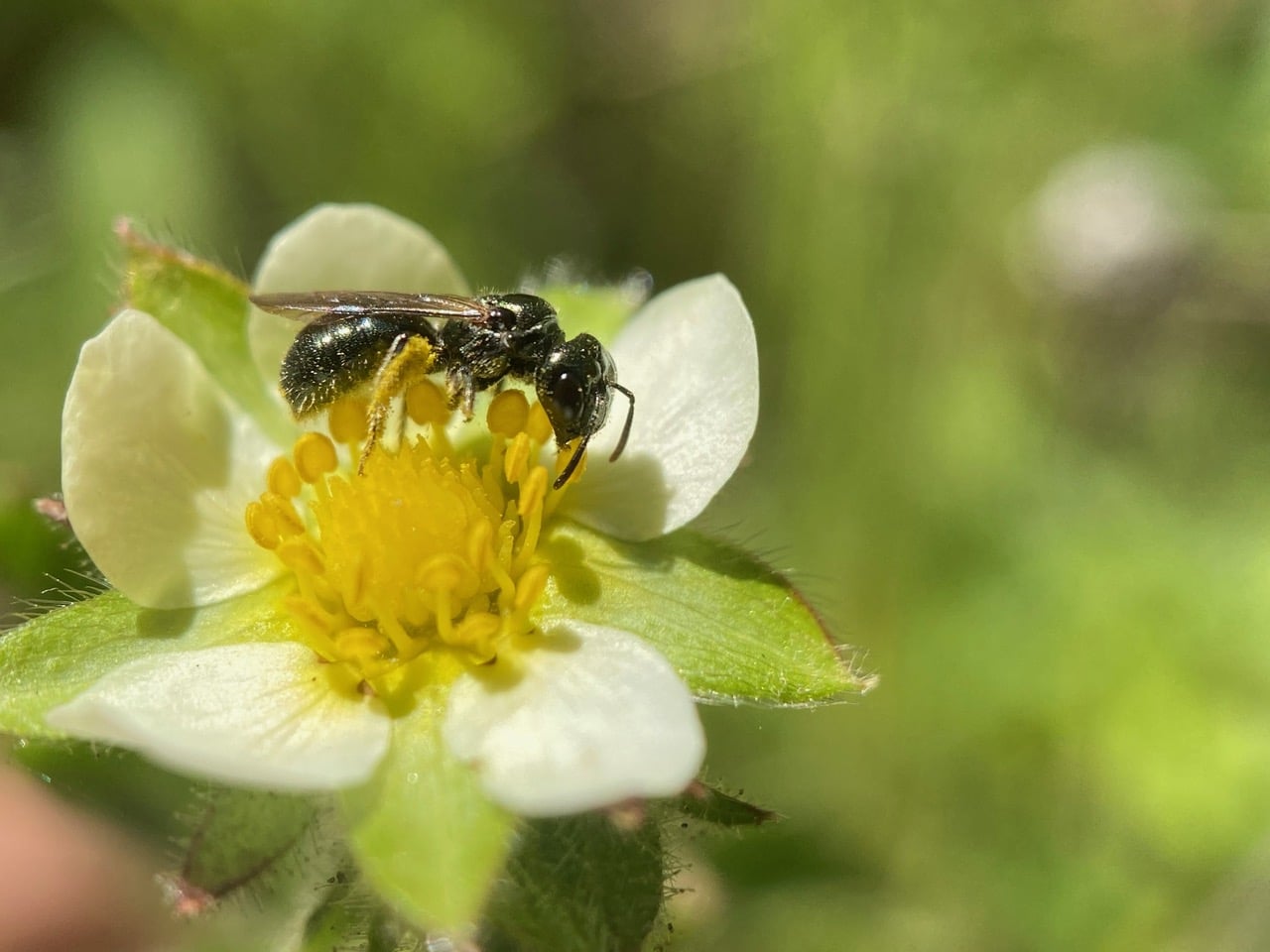
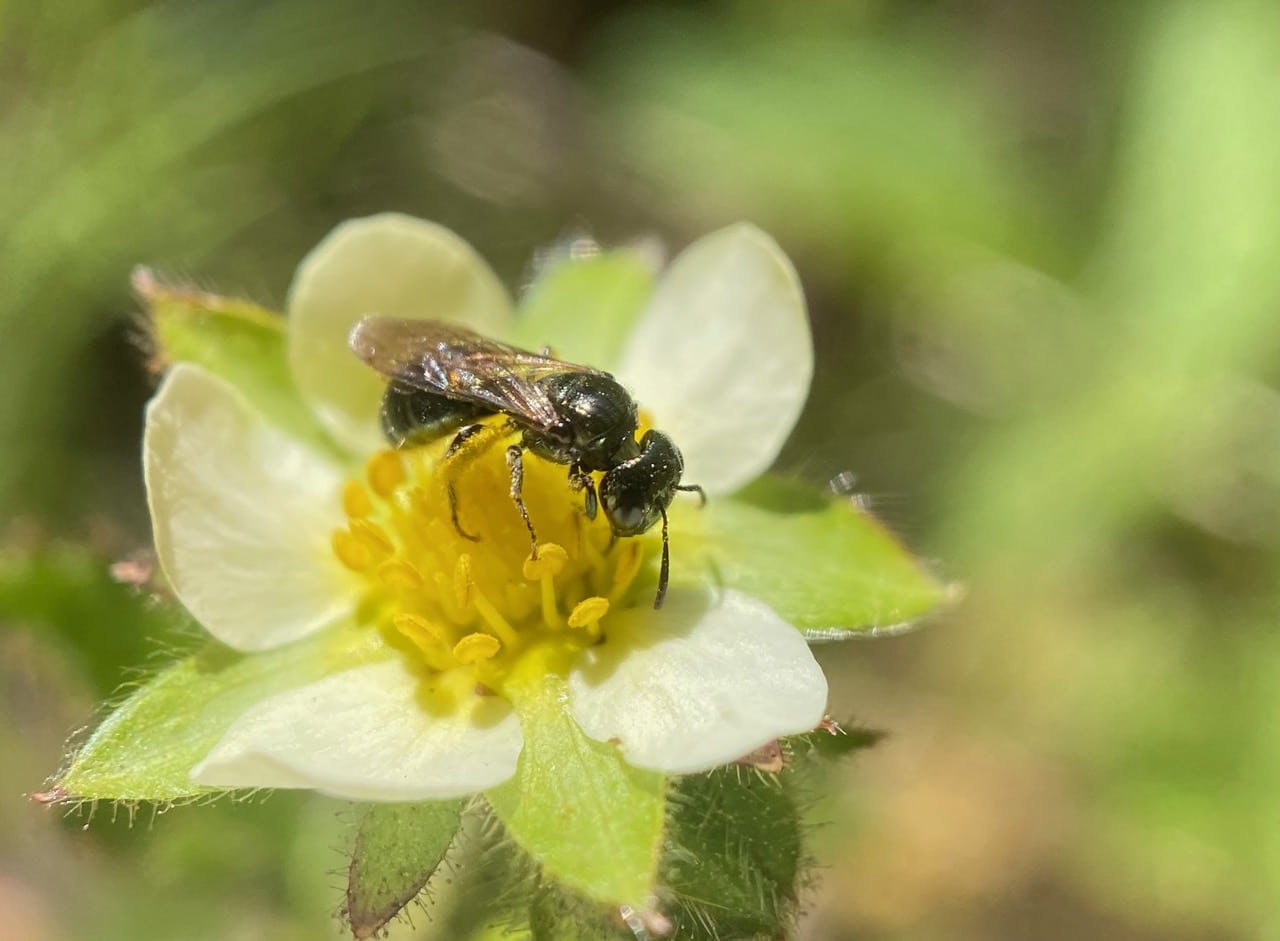
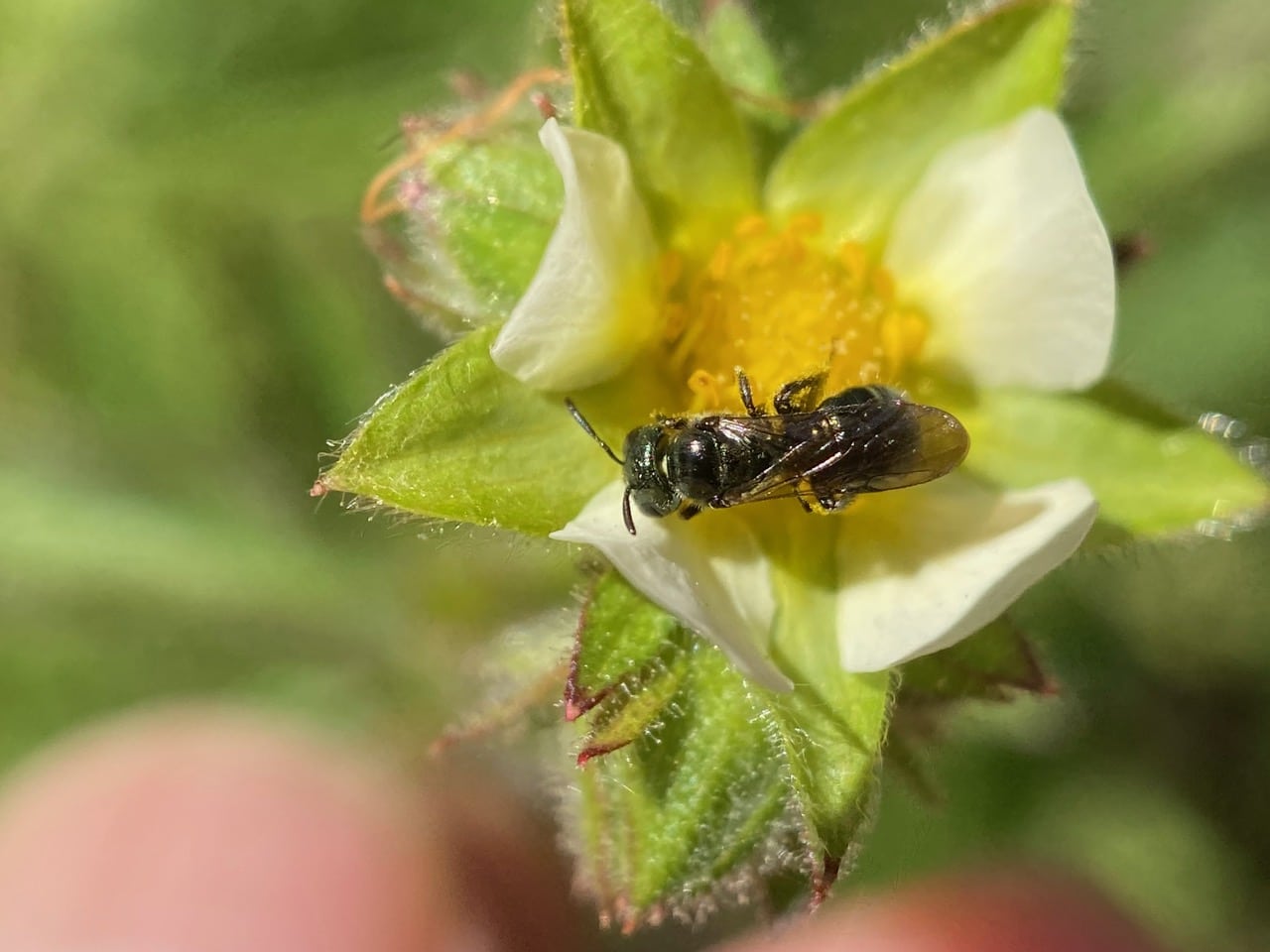
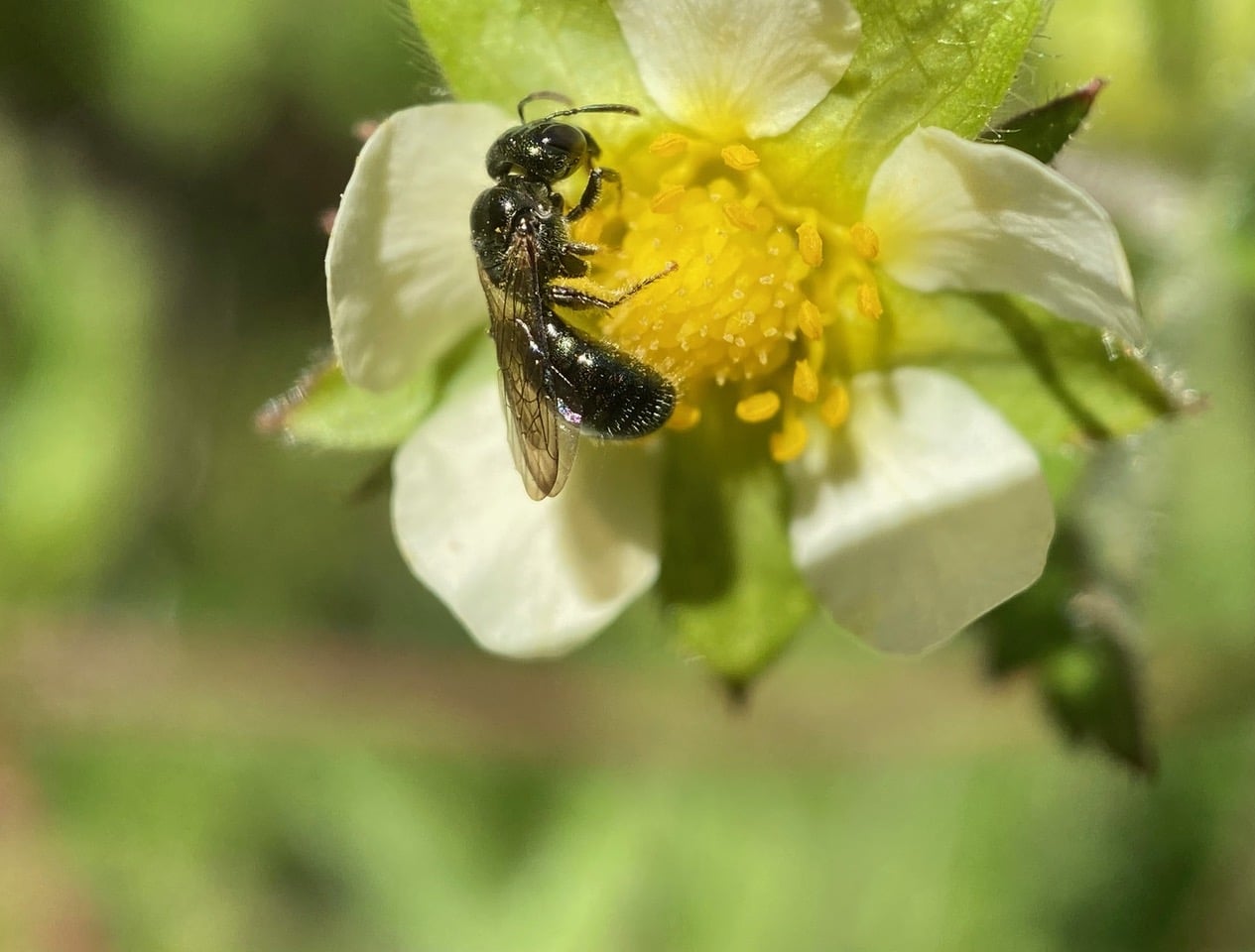
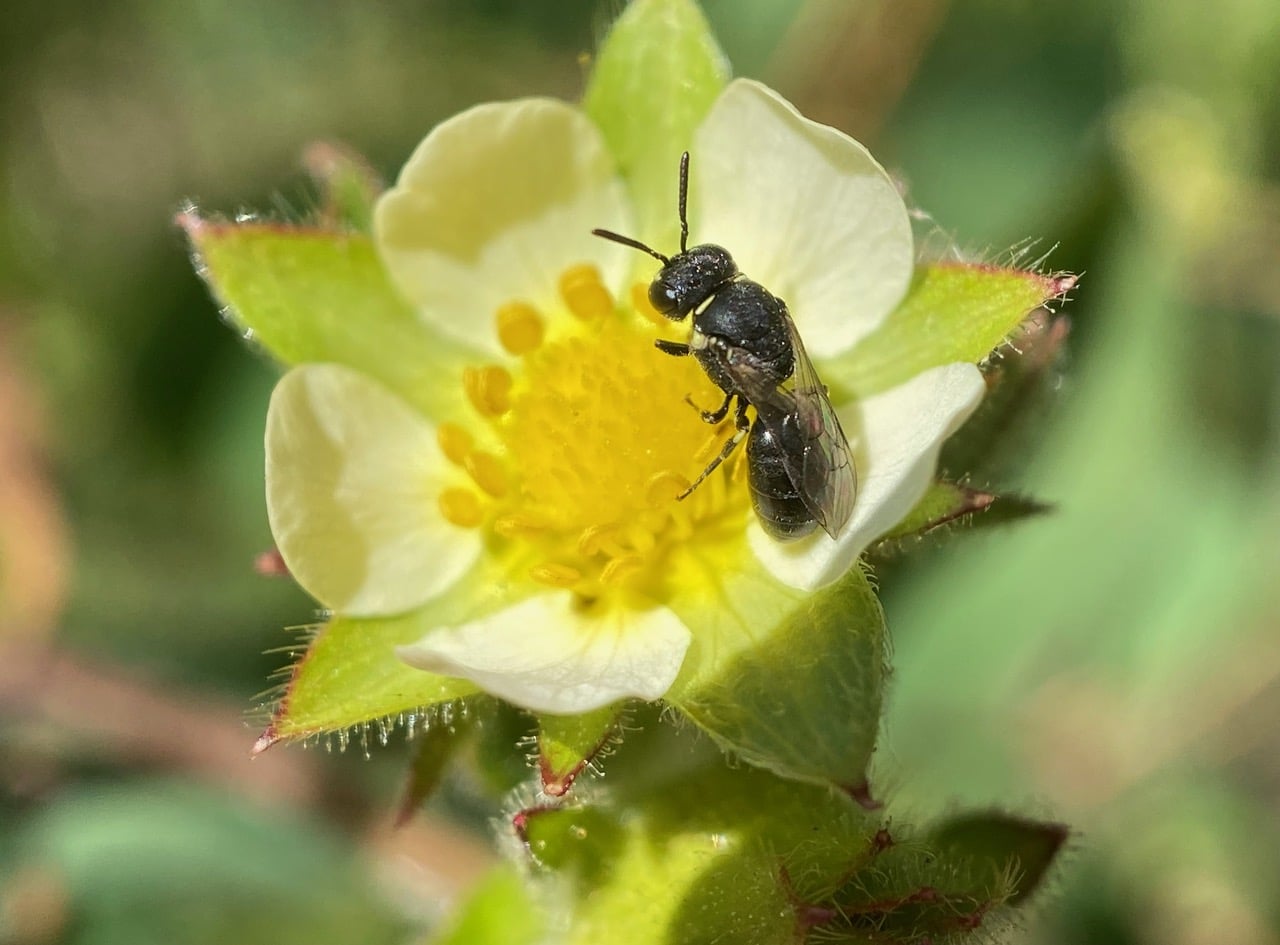
Wow, this is a huge Masked Bee, Hylaeus sp. (family Colletidae). Note that she is not as glossy as the Small Carpenter, and she has the broken yellow band across her “shoulders”, and other yellow markings on her legs. Another significant distinguishing characteristic is that the female has no external anatomy for carrying pollen.