

Pollinator Post 5/7/24 (1)
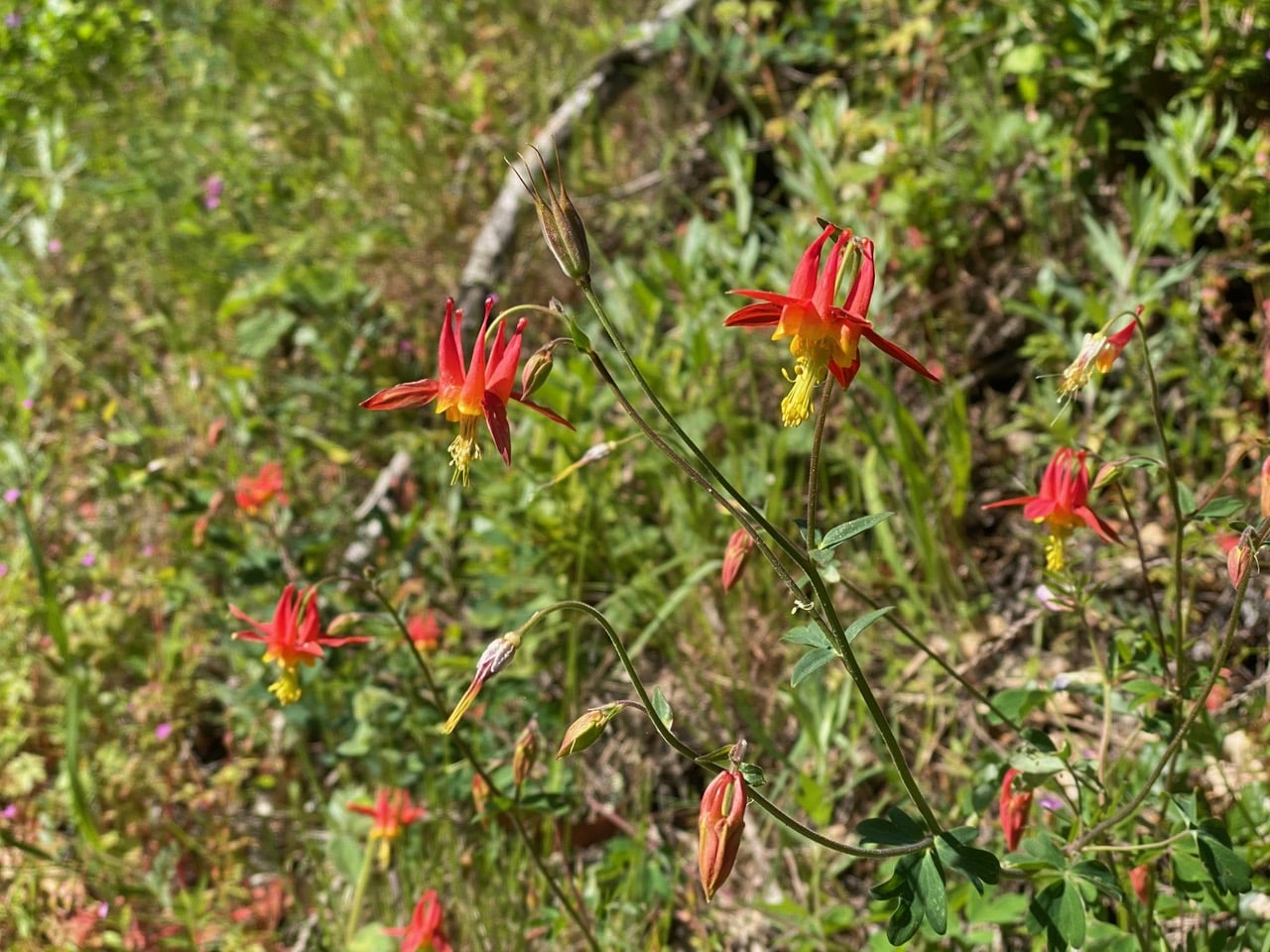 Just south of Siesta Gate, the red nodding flowers of Western Columbine, Aquilegia formosa dot the steep slope along Skyline Trail.
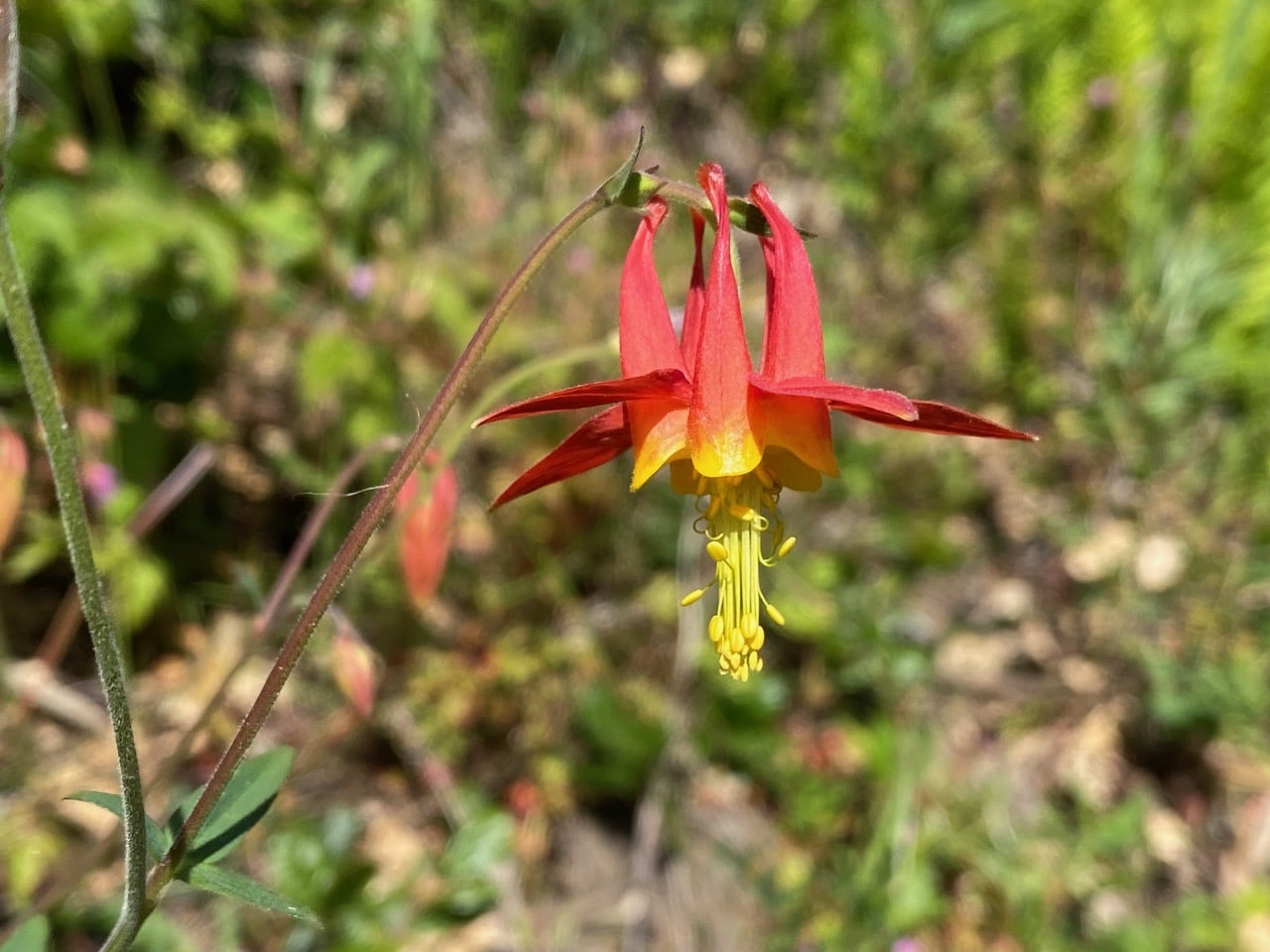
At first glance, a columbine flower looks like a Dr. Seuss creation. Closer inspection reveals it to possess the basic parts of a ‘standard flower’. Like all columbines, this species has a five-petalled flower with unusual “spurs” on the top. Each spur is formed by one of the five petals, curling into a cylinder as it rises. The lower ends of the petals join into a circle, within which are the yellow pollen-bearing stamens protruding beyond the corolla. Instead of being green as in most flowers, the sepals are red, and extend out at right angles when the flower opens. The filaments flex backwards as the anthers ripen to release pollen. The Columbine flower is protandrous, the male parts maturing before the female parts. In older flowers, as the stamens are spent, the pistils lengthen to protrude beyond them, ready to receive incoming pollen.
The knob at the end of each spur contains nectar, the major attraction to pollinators. The principal pollinators are hummingbirds, bees, and hawkmoths. While forcing their way in for a sip of nectar, they make good contact with the stamens and pistils, picking up and depositing pollen.
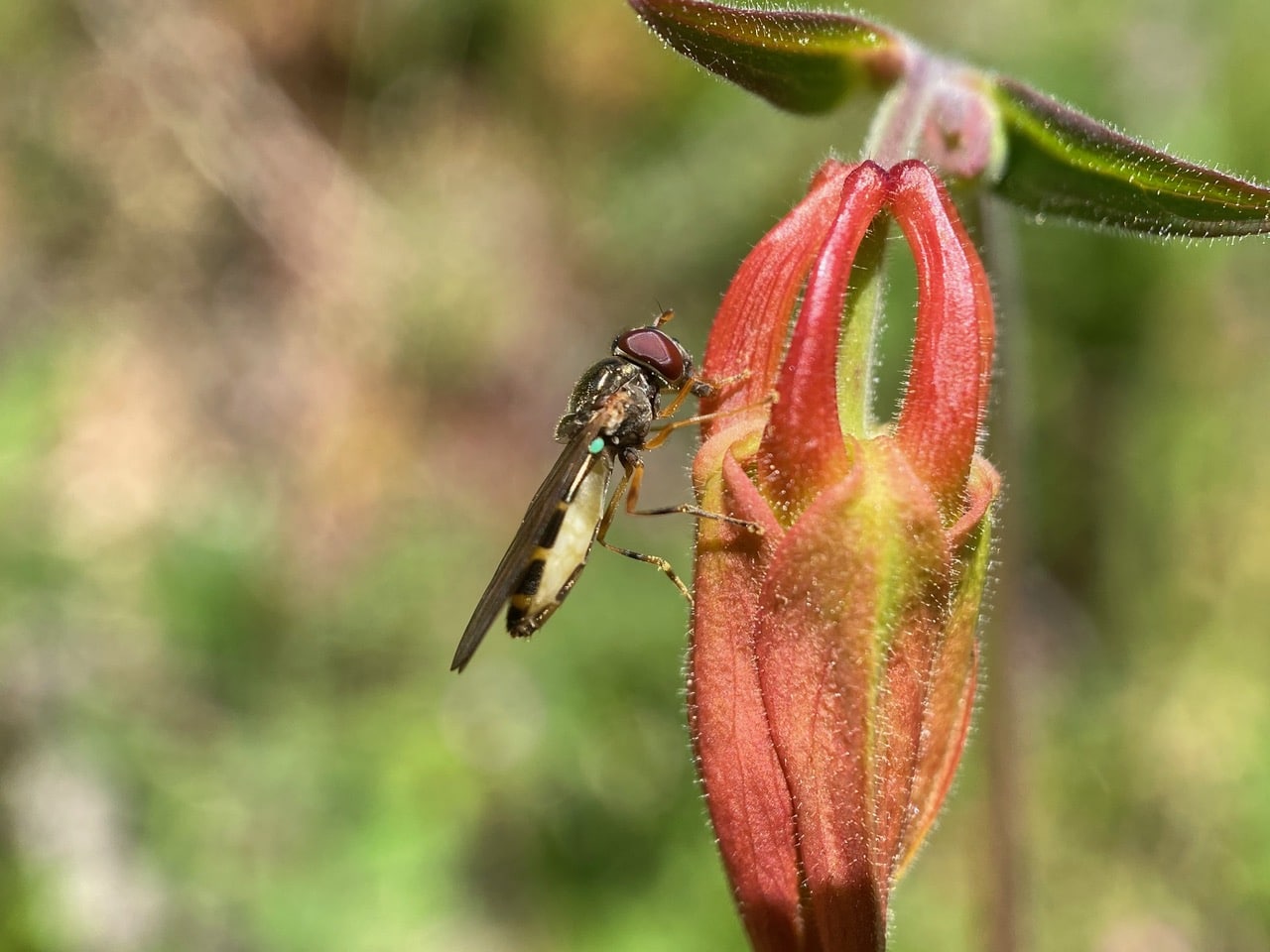 No hummingbird or bumble bee stop by today, but a tiny hover fly lands on a flower bud of Western Columbine. I don’t have to fret about the fly covering up its abdomen, making it difficult to identify. Note the neon green haltere under its wing. Halteres are small ‘drum stick or lollipop” shaped structures found under a fly’s wings. They are modified hind wings and are used for balance when in flight. They are sophisticated gyroscopes that oscillate during flight. The green halteres of the hover fly help identify it as a female Variable Duskyface Fly, Melanostoma mellinum (family Syrphidae).
Melanostoma mellinum is a very common species of hover fly found in many parts of Europe including the Mediterranean basin and North Africa, the East Palearctic, and North America. A small species, their wingspan between 4.7 and 7.0 mm. Very similar to Platycheirus, but can be distinguished by fine details. In M. mellinum, the normally pale halteres turn bright blueish-green in females about to lay eggs.
The species’ preferred habitat include grasslands and moorlands, including those in hilly and mountainous regions. Adults can be found feeding on pollen of grasses and other wind-pollinated plants. Little is known of their biology, but the larvae are suspected to be a general predator of small insects in the leaf litter.

The fly makes its way to the anthers of an open Columbine flower to feed on pollen that has been freshly released.
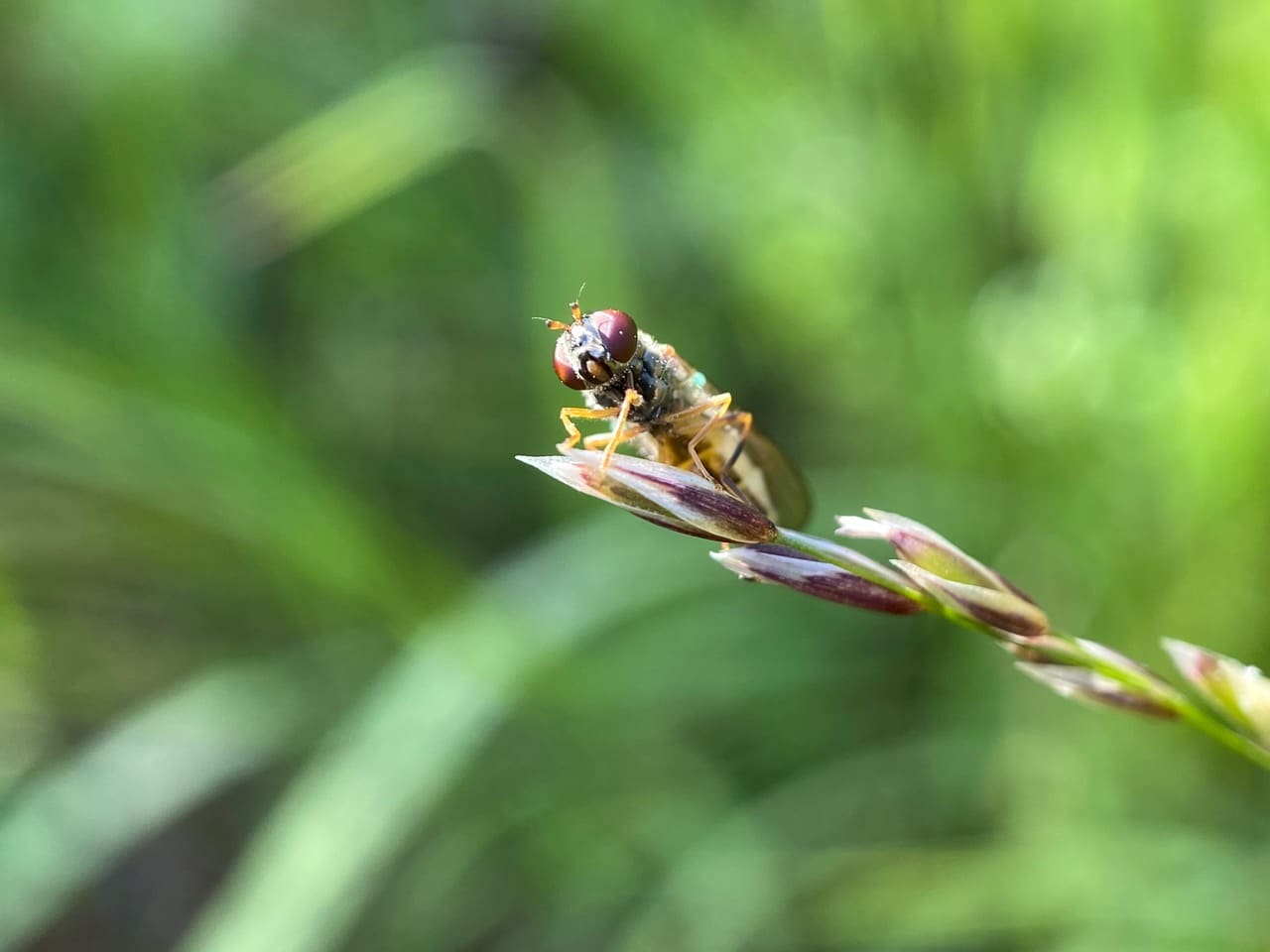
A little bit further on the trail, I encounter another Variable Duskyface female perched on a stalk of Melic Grass seeds.

Flat as pancake, a female Pacific Coast Tick, Dermacentor occidentalis is resting on a leaf of Imbricate Phacelia.
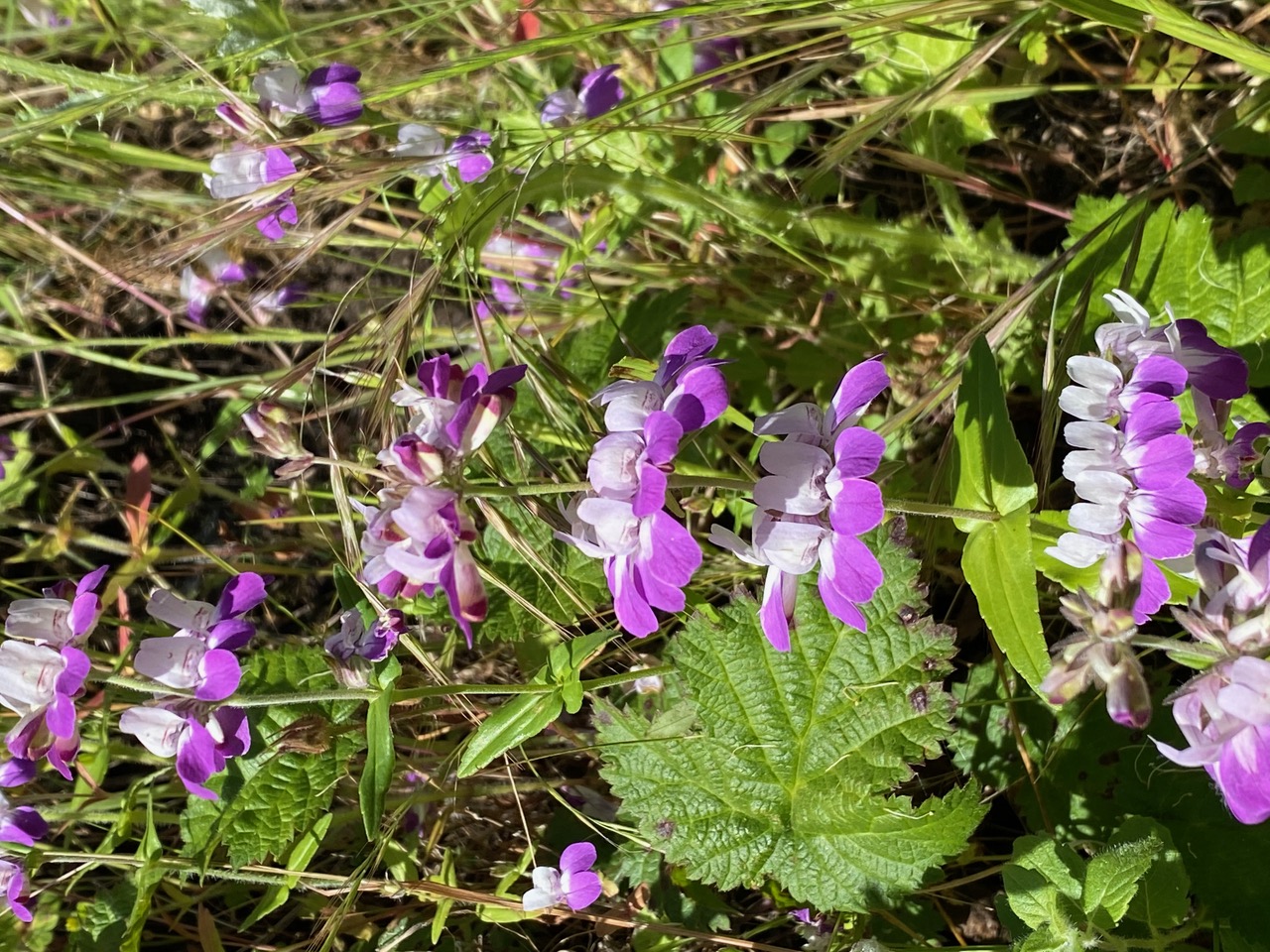
Chinese Houses, Collinsia heterophylla is putting up quite a show on the slopes along Skyline Trail. Occasionally I see a bumble bee visit the flowers, but the flowers far outnumber their pollinators this year.
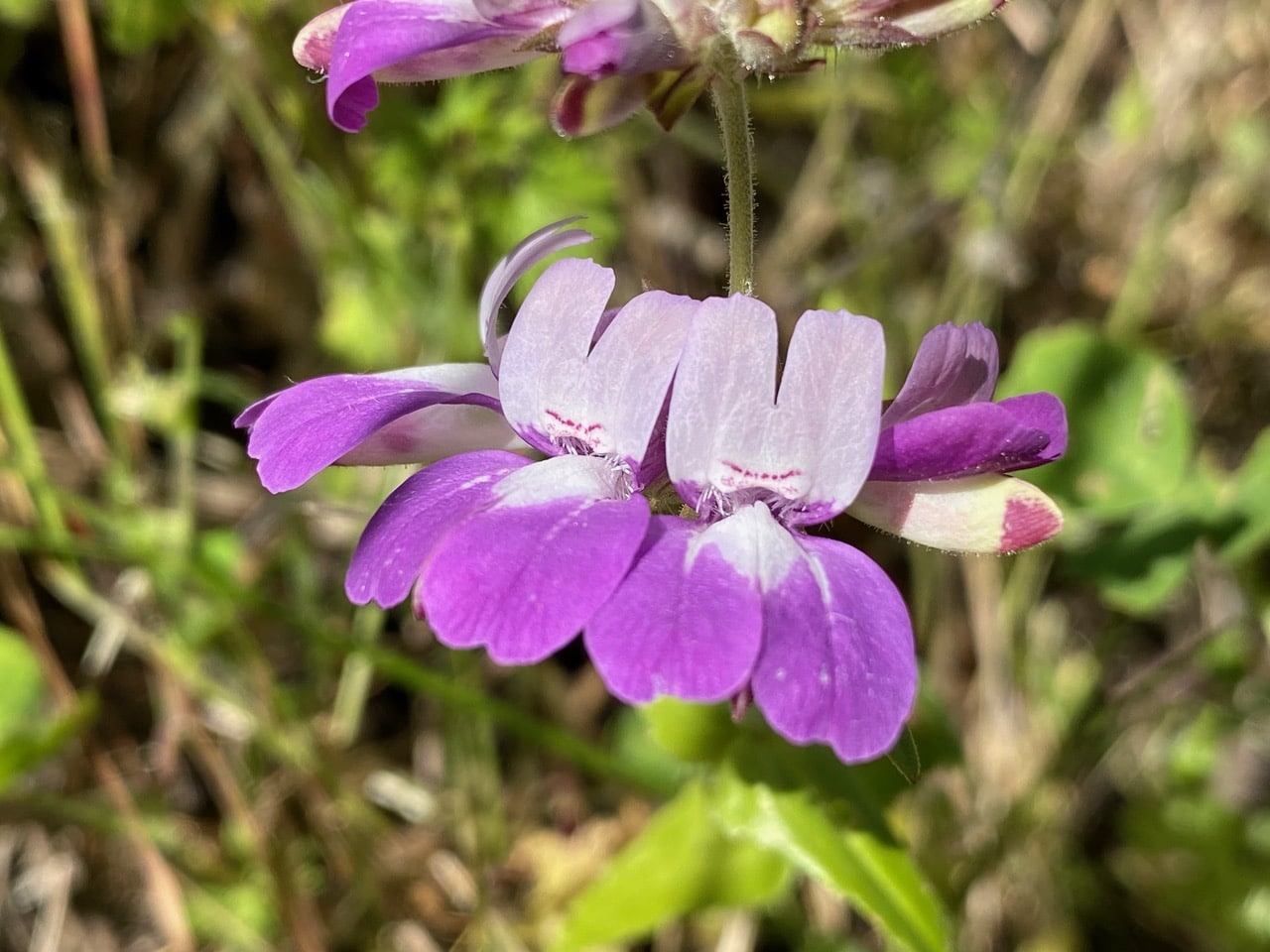
The flowers seem to whisper to the bees in a secret language inscribed like Morse Code on the upper white petals – “Enter here for nectar”? See the flower bud to the right of this cluster of flowers? The red-tipped keel is visible under the other petals at this stage. The reproductive structures are held within the keel, an envelope that is connected to the purple petals that form the landing platform for pollinators.
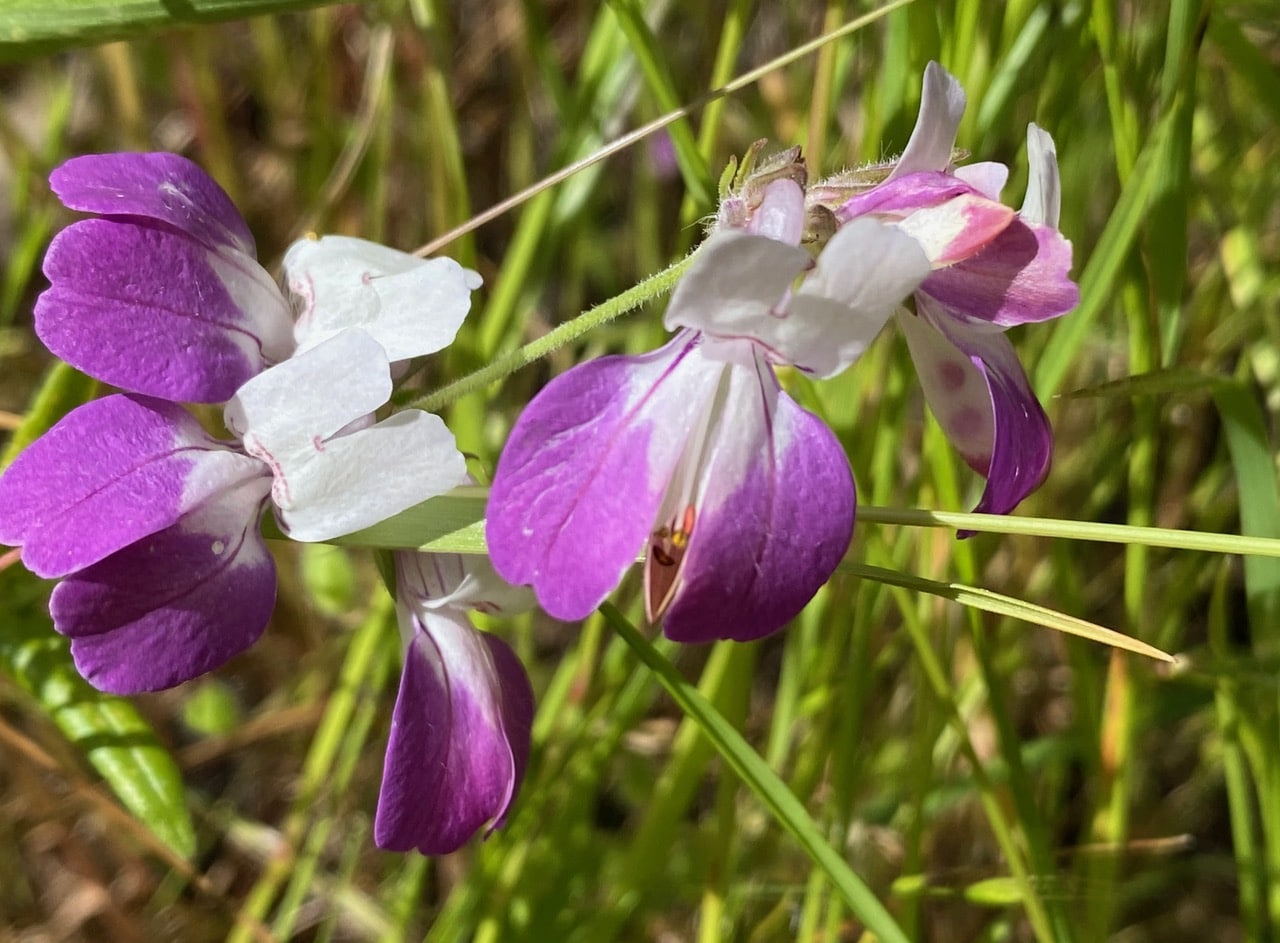
This is a slightly “tripped” flower with the purple petals parted by the bee landing on the flower, pulling the keel apart to let the reproductive structures pop up to coat the bee’s belly with pollen.
Sadly there are very few “tripped” flowers, showing that pollination has been minimal on these flowers. The bumble bees are few and far between this year.
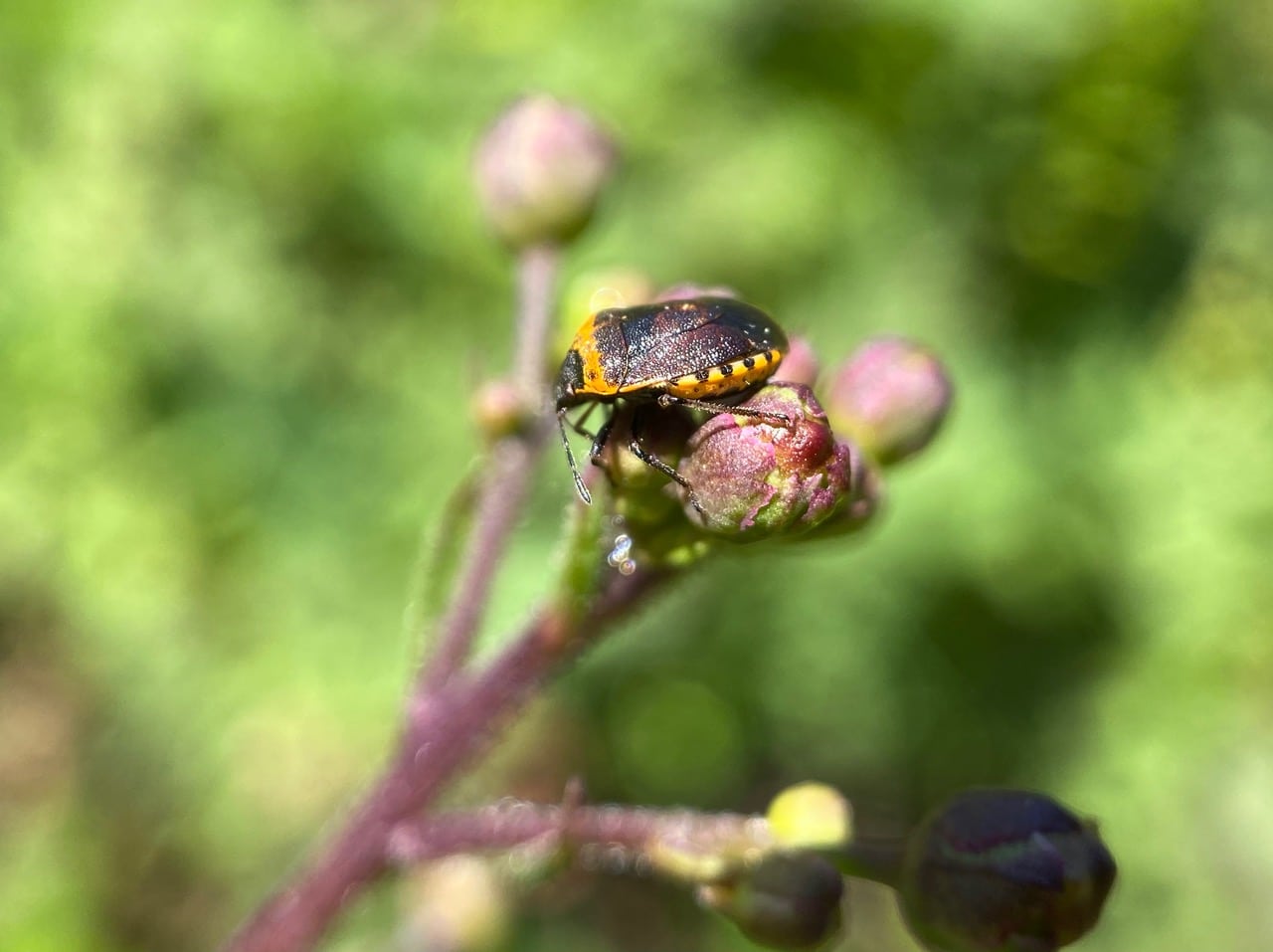
A small Stink Bug, Cosmopepla uhleri (family Pentatomidae) is resting on a flower bud of the Bee Plant, Scrophularia californica along Skyline Trail. It is easily recognizable – black with an orange transhumeral band with black spots. The bug uses Scropularia californica as a host plant.
Pentatomidae is a family of insects belonging to the order Hemiptera or “true bugs”. As hemipterans, the pentatomids have piercing-sucking mouthparts, and most are phytophagous, including several species that are severe pests on agricultural crops. Stink Bugs feed on plant fluids by inserting their needlelike mouthparts into stems, leaves or seed pods. While feeding, they inject materials into the plant to aid in digestion and sap removal. Penetration by the mouthparts can cause physical damage, much like stabbing the plant with a fine needle. Cosmopepla uhleri is so small that the damage is generally limited to fine stippling on the leaves of California Bee Plant.
All Pentatomids have 5-segmented antennae (hence their family name, Penta – five and tomos – section.) They generally have a large triangular scutellum in the center of the back. The adult is generally shield-shaped when viewed from above. The common name of Stink Bug refers to their ability to release a pungent defensive spray when threatened, disturbed, or crushed.

#/media/File:Heteroptera_morphology-d.svg)
The Broadleaf Lupine, Lupinus latifolia is blooming nicely in the shady sections of Skyline Trail. I am delighted to find a Yellow-faced Bumble Bee, Bombus vosnesenskii (family Apidae) foraging on the flowers. Unlike the Silverleaf Lupine, the banners (upper upright petals) of these flowers tend to brown and wilt very quickly, instead of turning maroon. Have these flowers been pollinated? There’s little sign that they have been.
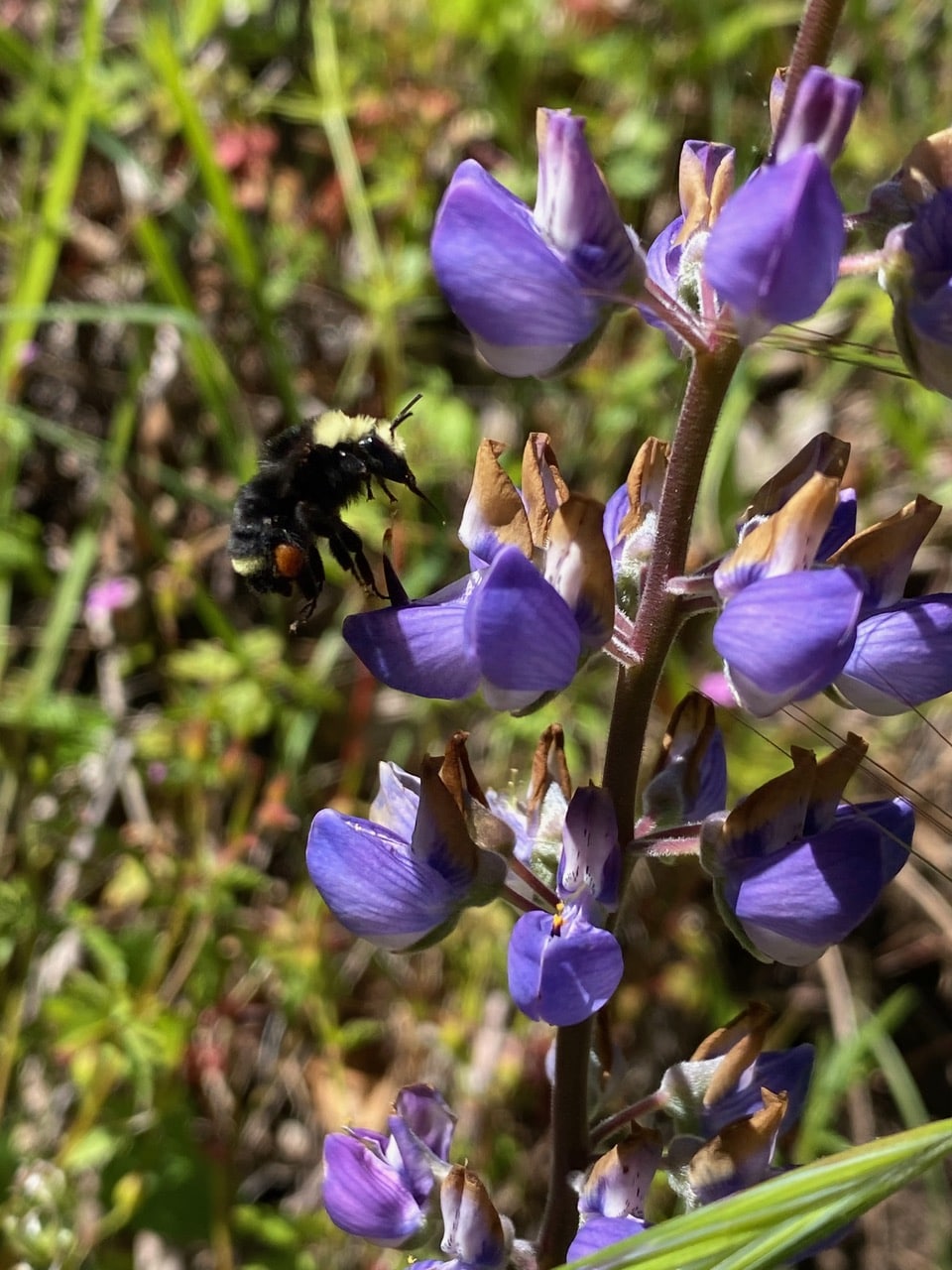
As the bee lifts off from the flower, I can see the dark tip of the keel protrude from between the wing petals. Exposed keels on lupine flowers are a good indicator that the flower has been visited.
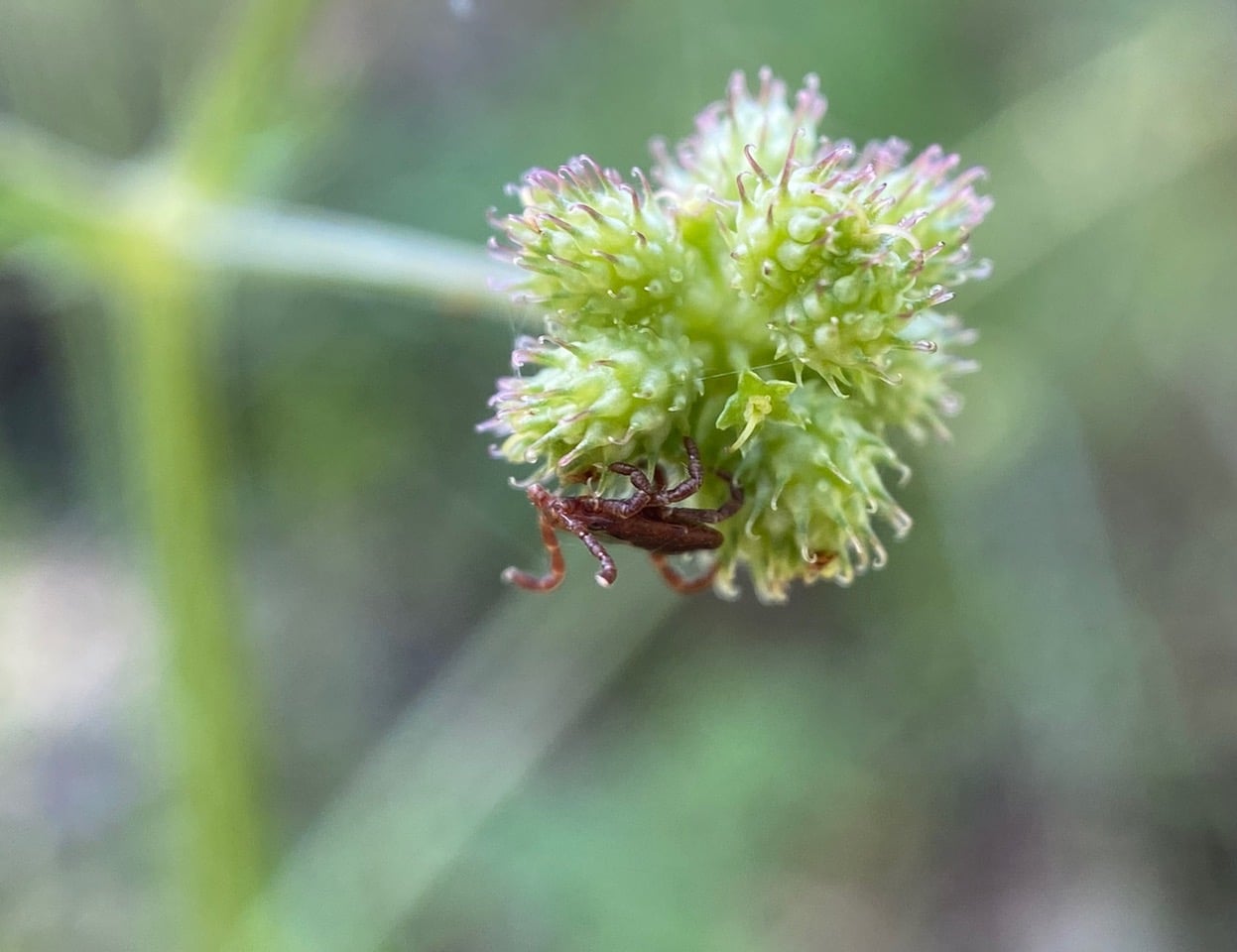
Ooh, a tick questing from the underside of a young cluster of Pacific Sanicle seeds!
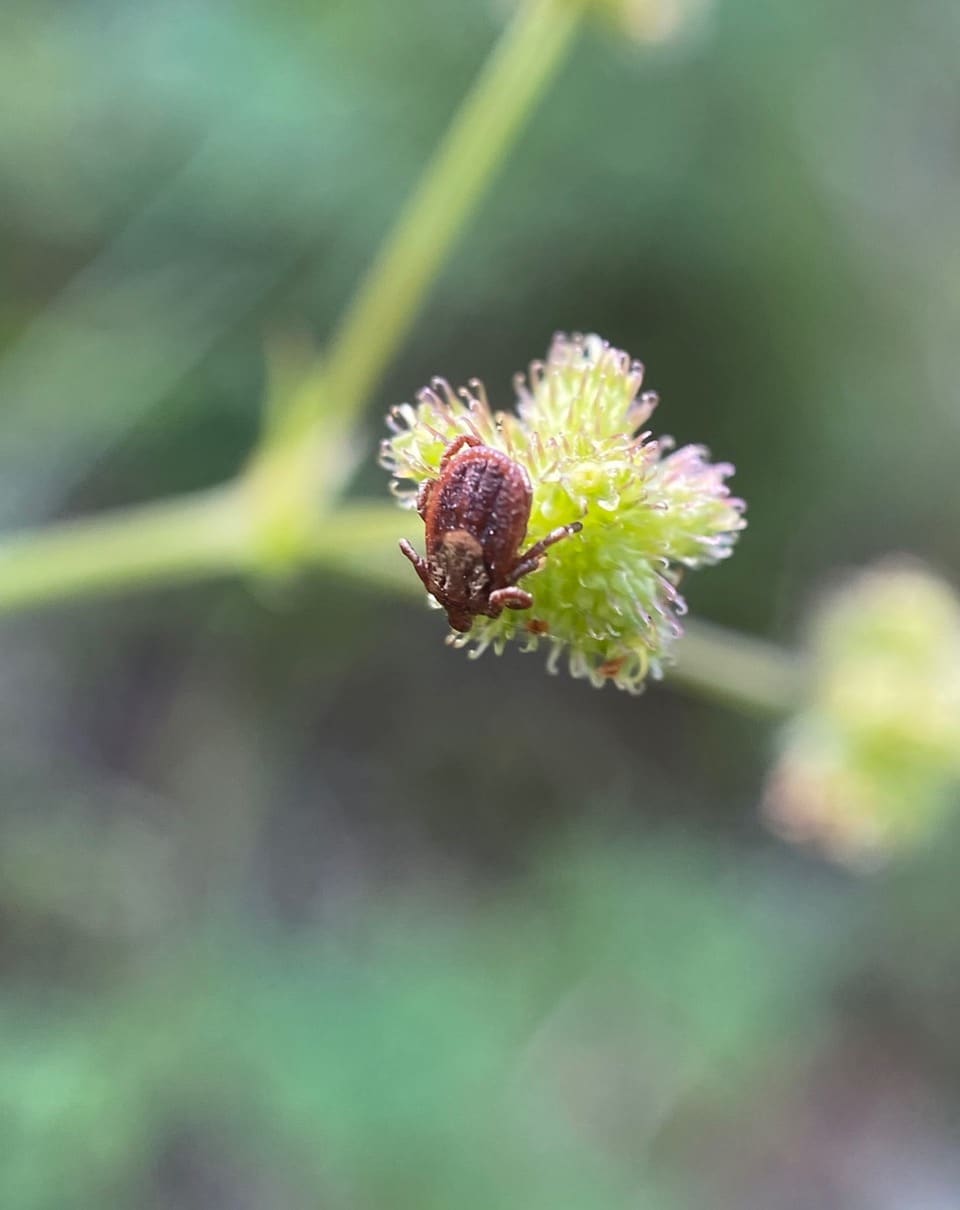
Here’s another one on the same plant!

At Diablo Bend, a Yellow-faced Bumble Bee is “tripping” a Silverleaf Lupine flower, Lupinus albifrons. Note that the bee has chosen a relatively fresh flower with white banners. Most of the other flowers on the spike have maroon banners. The change in color is brought on by pollination, as well as normal senescence, mediated by a gaseous hormone, ethylene. Bees’ eyes are red-blind, but sensitive to white and yellow colors. This is a way that the plant communicates with its pollinators, guiding them to the flowers that still offer good nectar and pollen, ensuring pollination efficiency. A win-win for both plant and bee.
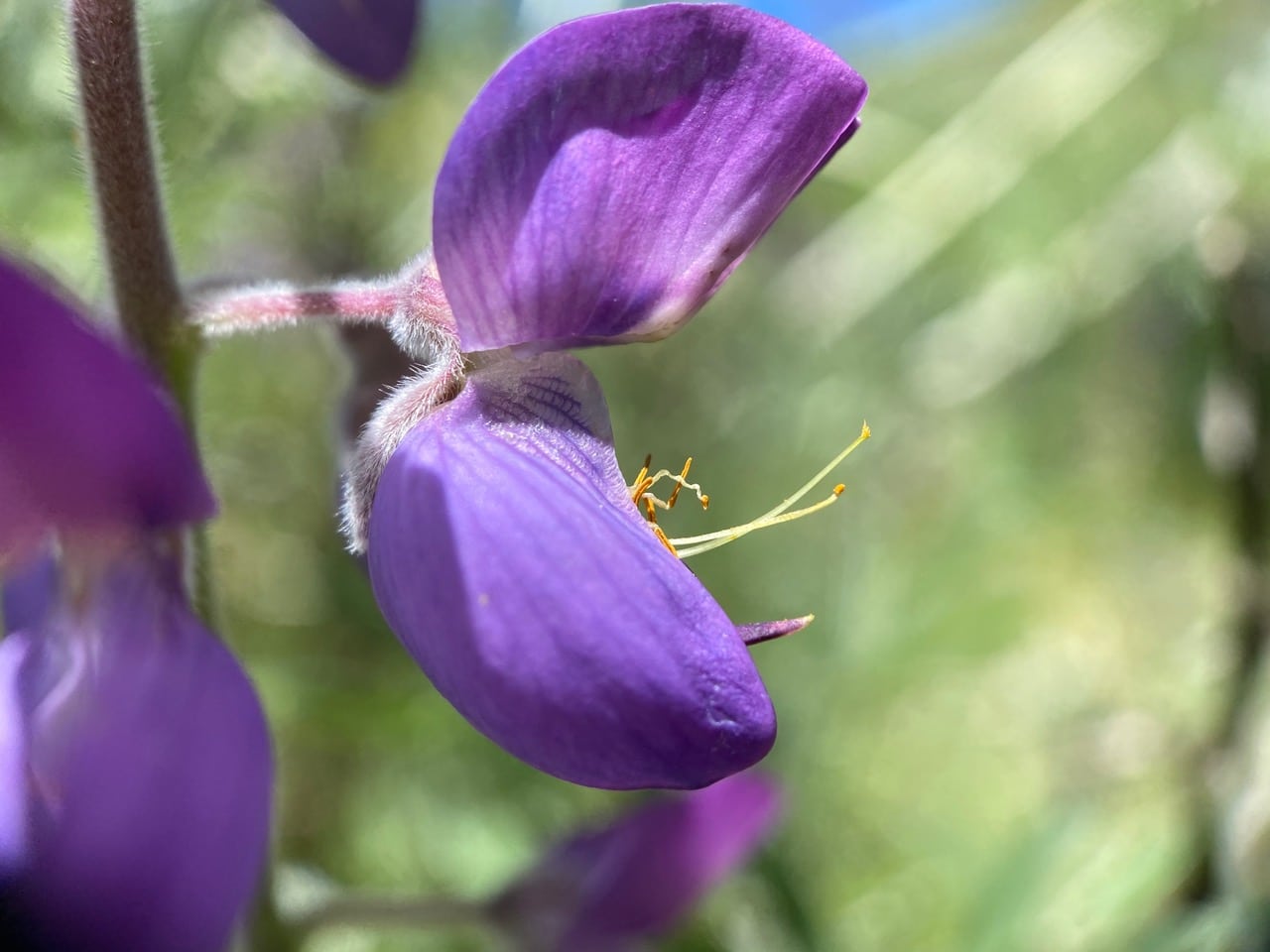 A “tripped” lupine flower, with the dark tip of the keel, the long style and stigma, and stamens extruded from between the wing petals. With luck, the stigmas have received pollen from the bee’s belly from another flower, and the stamens have dabbed pollen of this flower onto the bee’s belly. Pollination accomplished in a split second!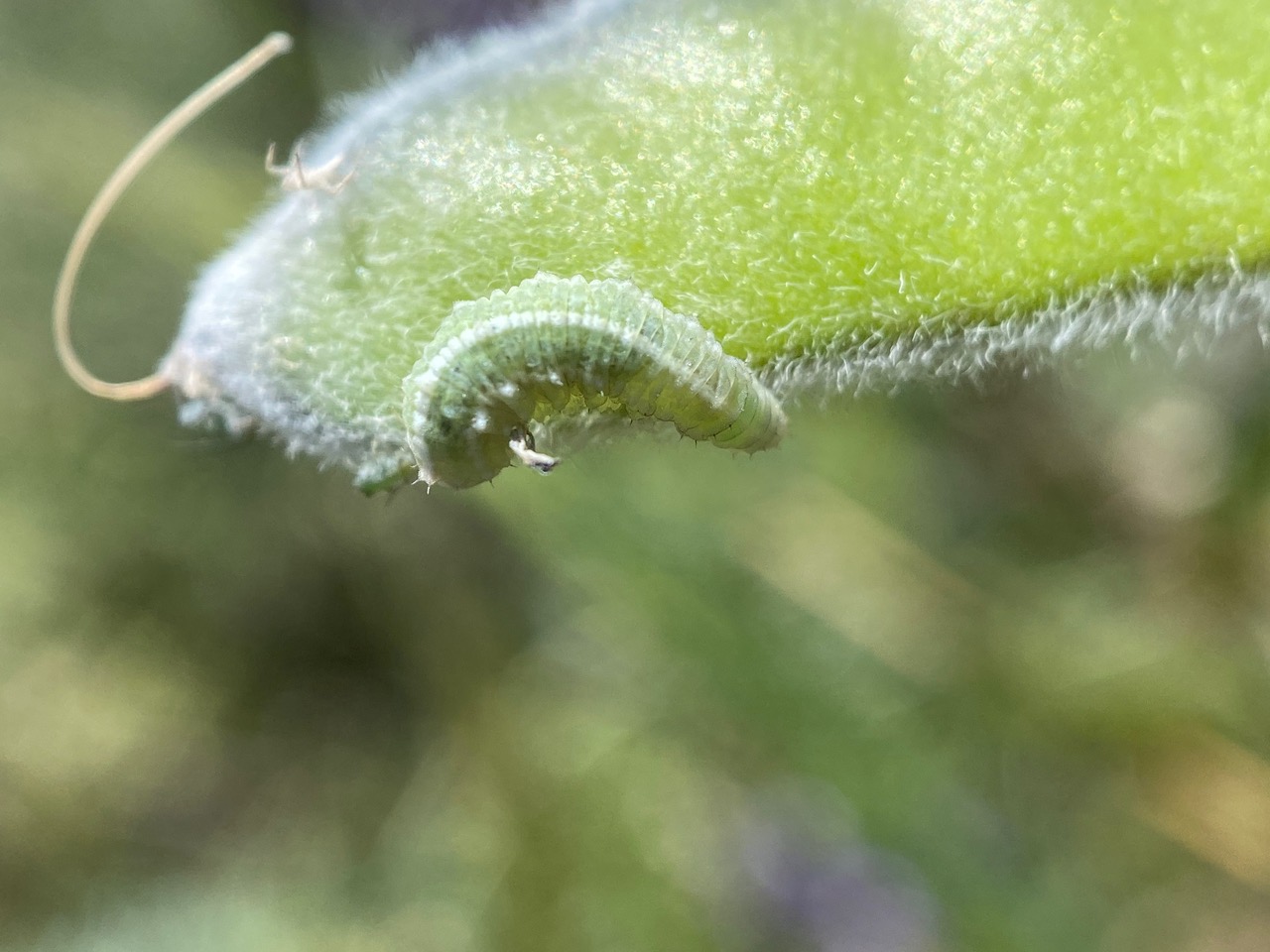
Ooh, a Syrphid larva on a lupine pea pod! The tapered end is its head. No wonder the aphid infestation this year is kept under control. The lupines have help from the hover flies.
Many species of hover flies have larvae that feed on aphids and other soft-bodied insects. The females seek out aphid colonies on plants to lay their eggs among them, to ensure that their offspring will have plenty to eat.
Syrphid larvae have no eyes and no legs. They swing their tapered head from side to side in search of prey. When they make contact with a prey, they grab hold of it with their mouthpart, then suck out the victim’s body contents. Depending on species, a Syrphid larva can feed on 100 to 400 aphids before it pupates.

Here’s another Syrphid larva among the lupine flower buds, surrounded by aphids.
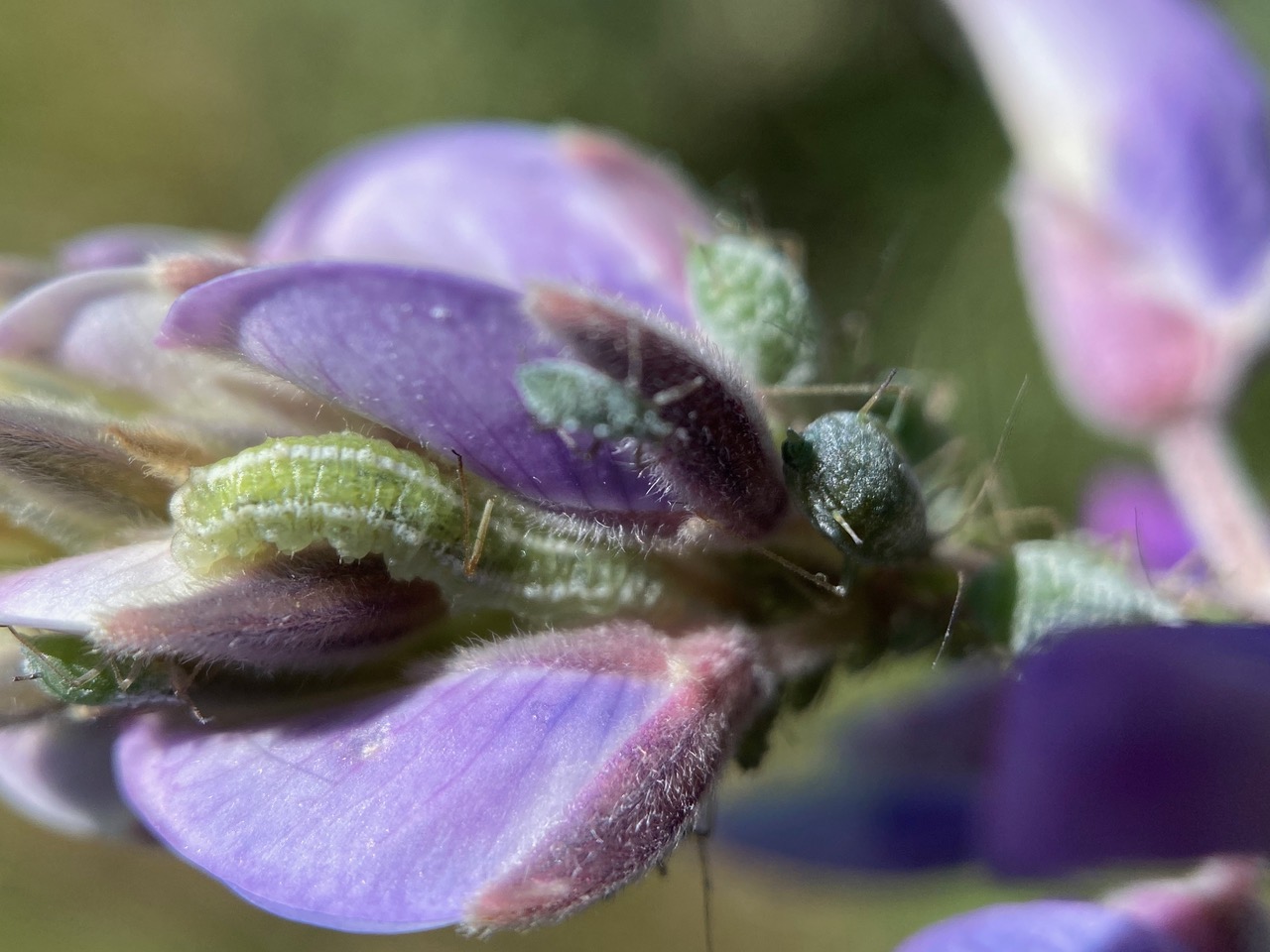
Close-up of the Syrphid larva.
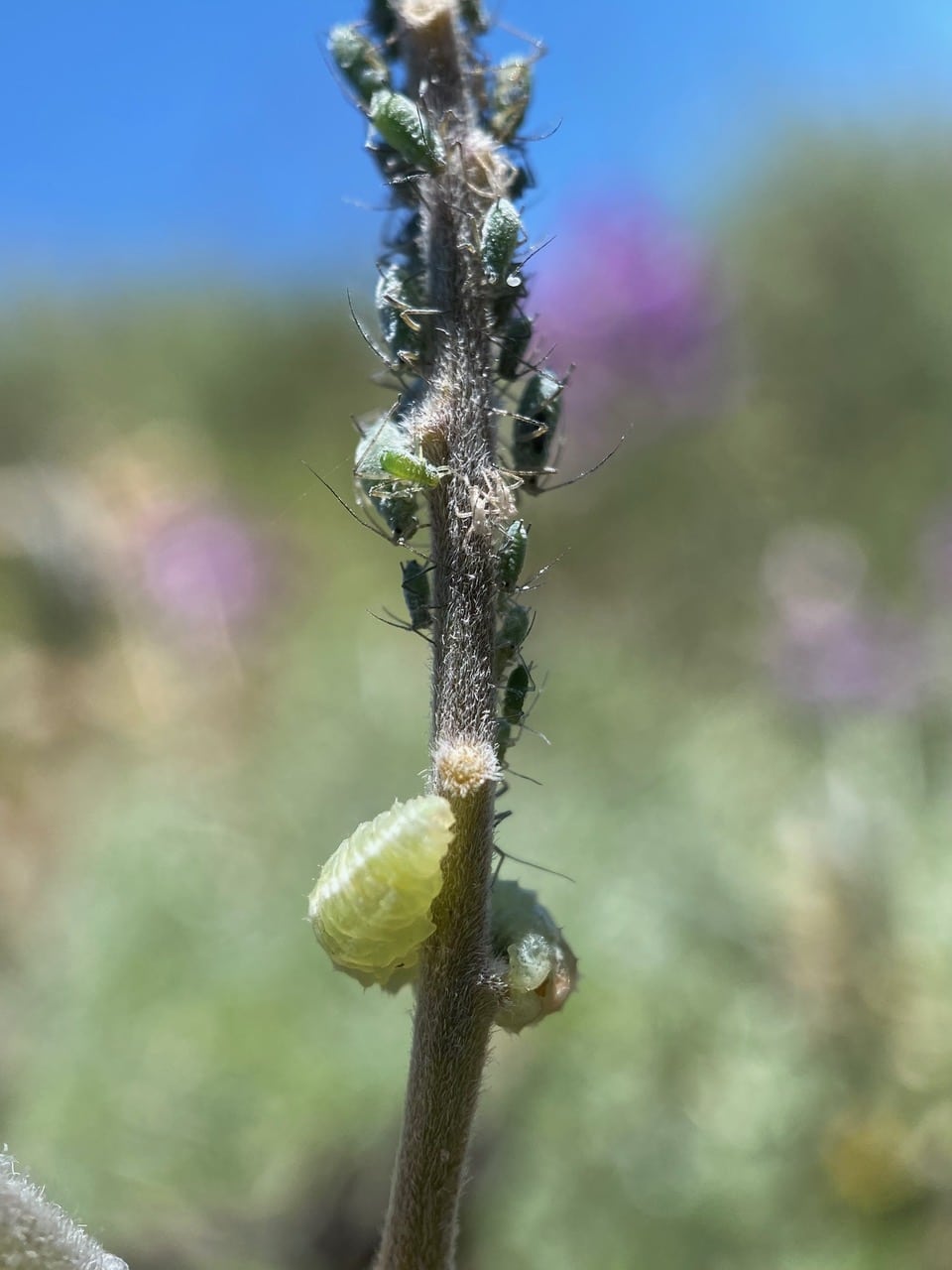
A Syrphid larva is slowly winding its way up an aphid infested stem. It has cleared up all the aphids below.
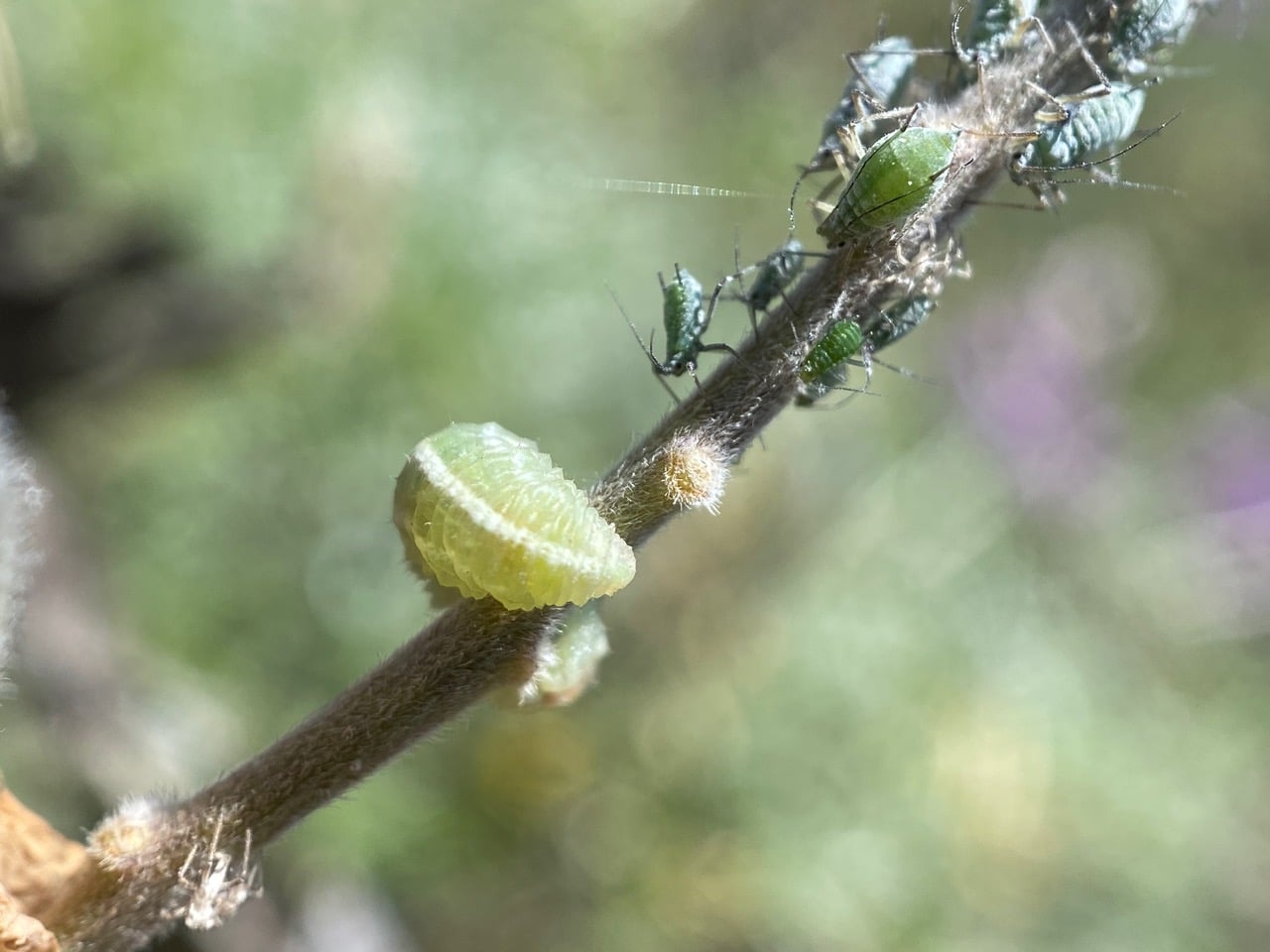
The same Syrphid larva from a different angle. The aphids seem oblivious to the approaching danger.
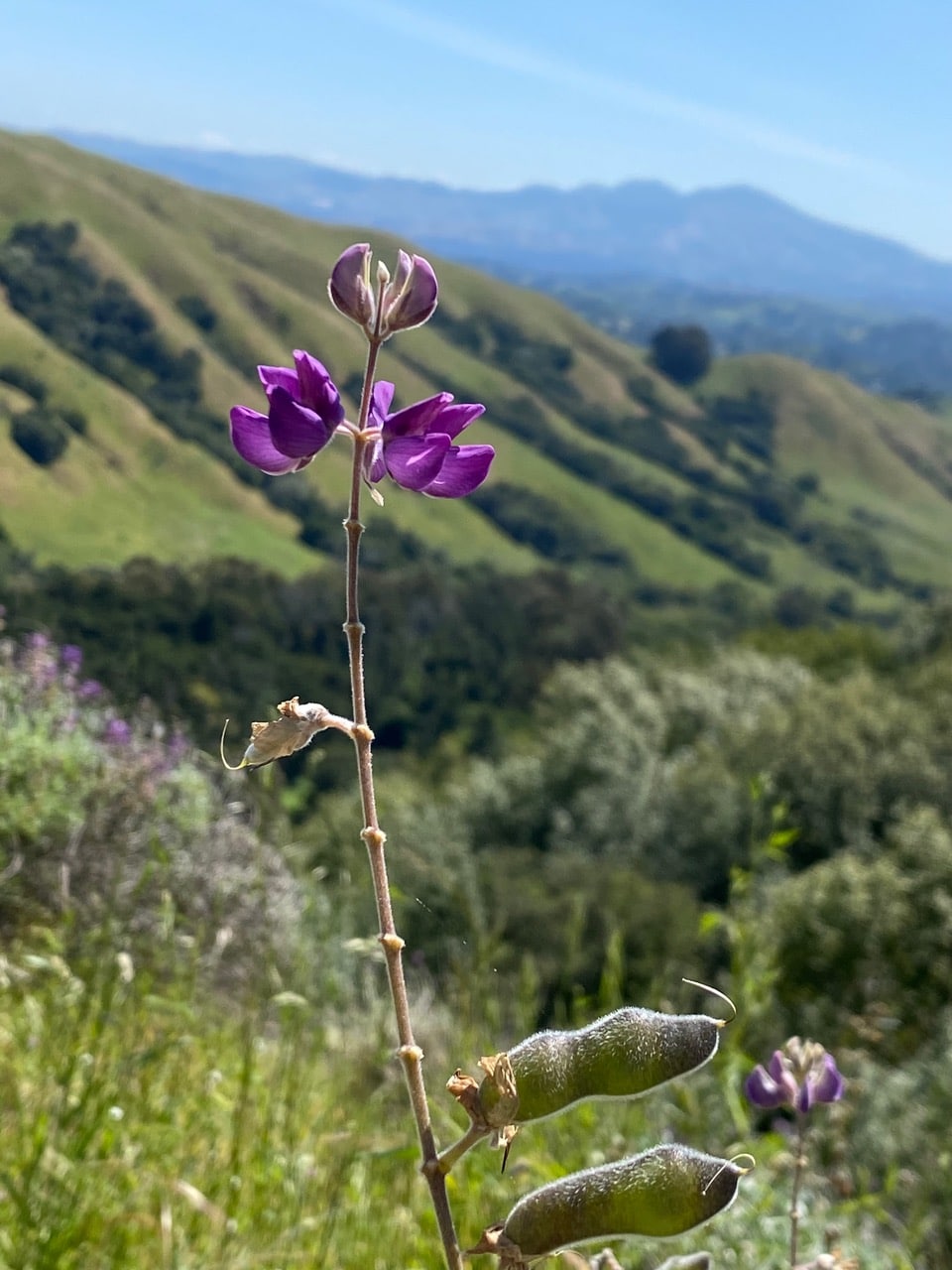
I find many of the lupine flower spikes with long gaps between the pea pods and the terminal flowers at the top. It does not appear to be an aphid problem. Did the paucity of pollinators (bumble bees) during the frequent spring rains cause this failure to set fruit?

A huge female Red-backed Jumping Spider, Phidippus johnsoni (family Salticidae) is resting on a lupine pea pod.
Salticids are free-roaming hunting spiders. They do not weave a web to catch prey. They stalk, then pounce on their prey. Just before jumping, the spider fastens a safety line to the substrate. It can leap 10-20 times their body length to capture prey. Their movement is achieved by rapid changes in hydraulic pressure of the hemolymph (insect version of blood). Muscular contractions force fluids into the hind legs, which cause them to extend extremely quickly.
I once kept a female Red-backed Jumping Spider as a pet for a few weeks, watching her pounce with incredible precision on the live flies I caught for her. I finally had to let her go when she began to display nesting behavior, ready to lay eggs. My love affair with Salticids persists to this day, and the spiders have always been easy to photograph.
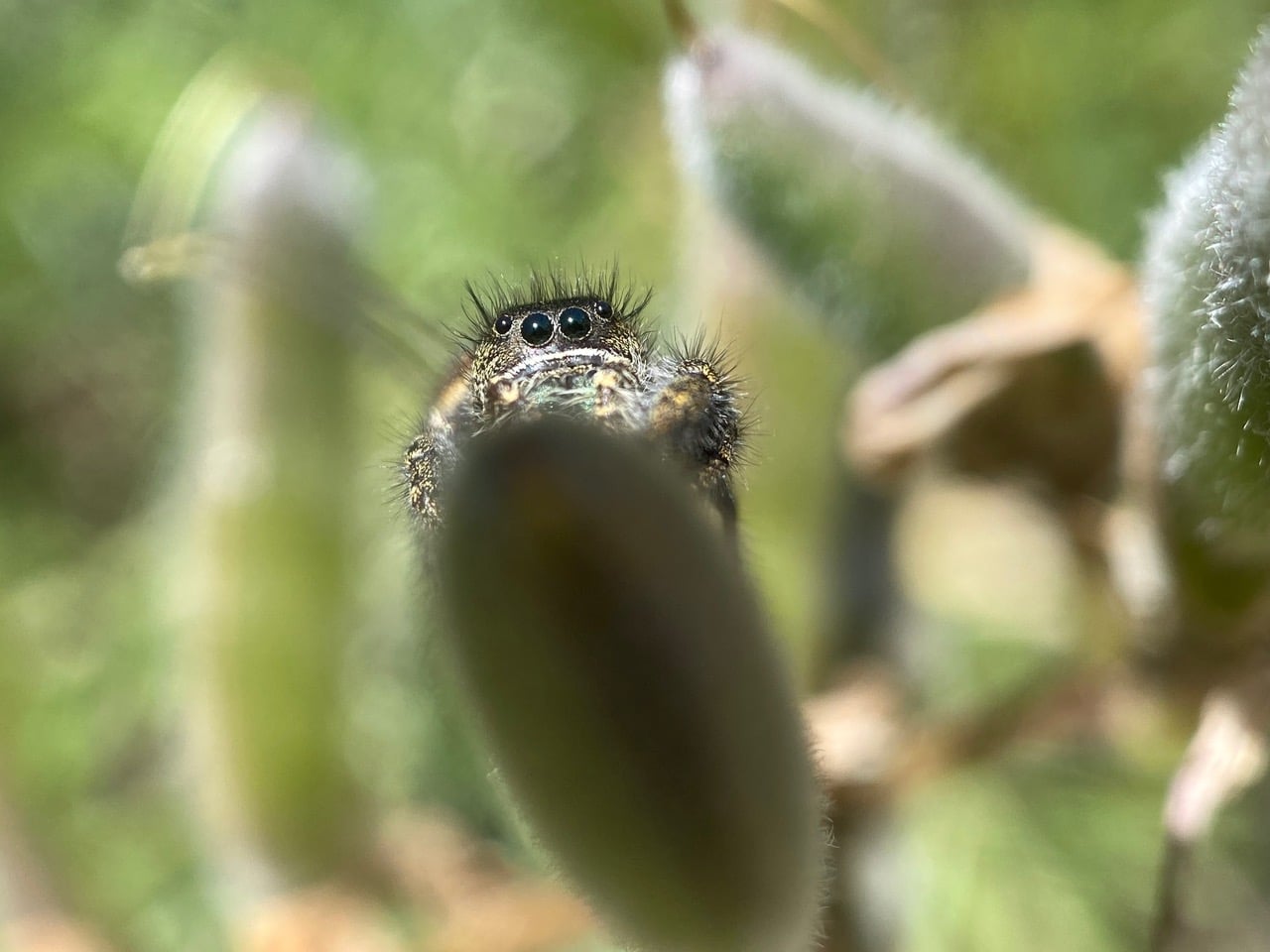
The spider spins around to face me, an endearing behavior typical of these bold and intelligent spiders. The wide-eyed stare and erect hairs on her head together give the illusion of a startled creature.
Jumping spiders have excellent vision, with among the highest acuities in invertebrates. The 8 eyes are grouped four on the face (the two big Anterior Median Eyes in the middle, and two smaller Anterior Lateral eyes to the side), and four on top of the carapace. The anterior median eyes provide high acuity but small field of view, while the other six eyes act like our peripheral vision, with lower resolution but broad field of view. Since all eight eyes are fixed in place and can’t pivot independently from the body like human eyes can, jumping spiders must turn to face whatever they want to see well. This includes moving their cephalothorax up and down, an endearing behavior.

 The spider turns around to show me her beautiful abdomen. Males of the species have an all-red abdomen.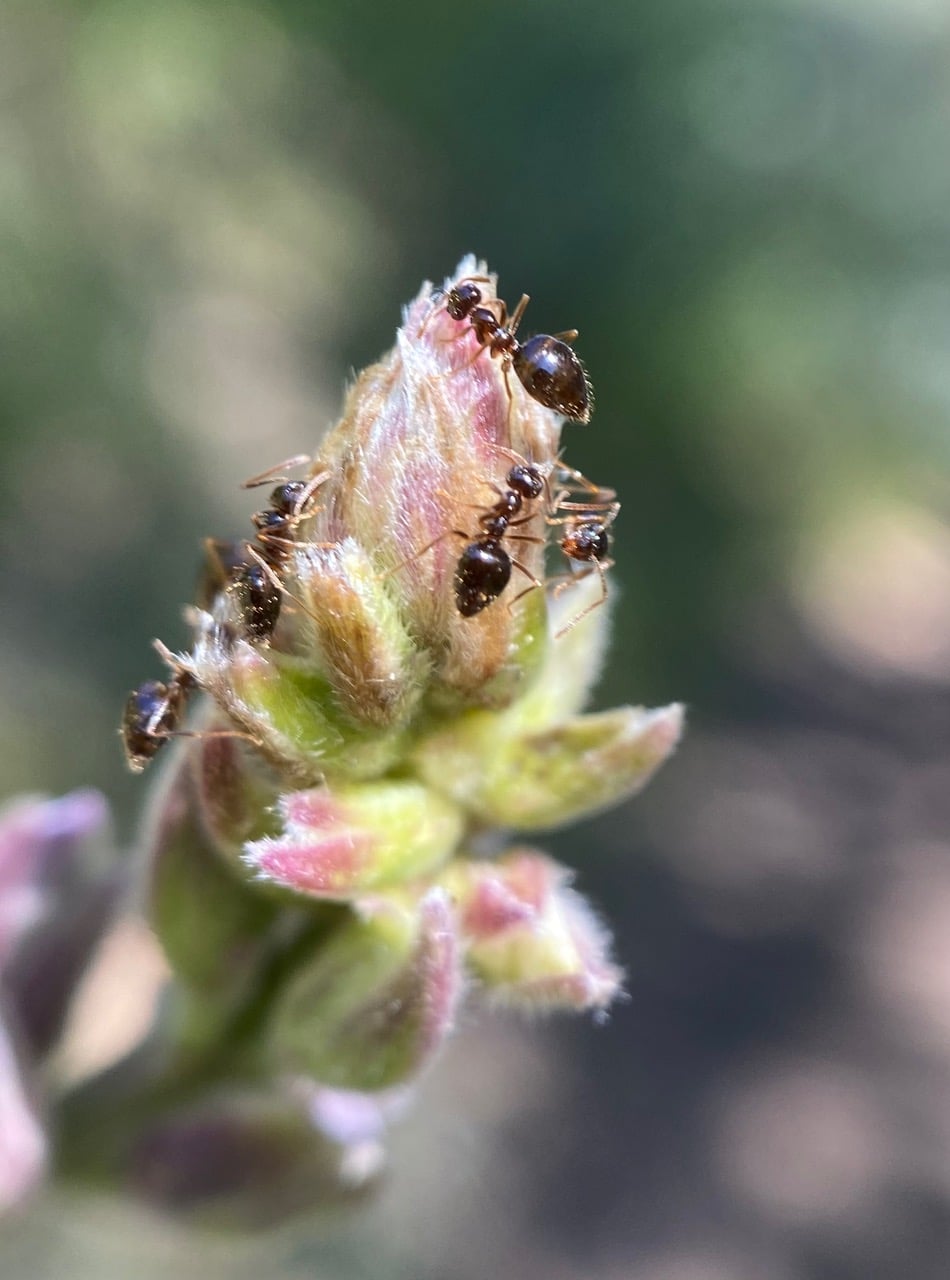
Some American Winter Ants, Prenolepis imparis (family Formicidae) have gathered on the flower buds of a Silverleaf Lupine. I wonder what they are finding. There are no aphids here as far as I can see. Besides, the Lupin Aphids are not tended by ants.
The American Ant, Prenolepis imparis is a widespread North American ant. A dominant woodland species, it is most active during cool weather, when most other ant species are less likely to forage. This species is one of a few native ants capable of tolerating competition with the invasive Argentine Ant, Linepithema humile. They are also aggressive toward other ants and produce abdominal secretions that are lethal to Argentine Ants. Prenolepis imparis is a generalist omnivore. Foragers are known for tending to aphids or scale insects from which they consume excreted honeydew, aggregating on rotting fruit, and exploiting protein-rich sources such as dead worms. The colony enters estivation (a hibernation-like state) and becomes inactive above ground for the warmer months, during which time eggs are laid and brood are reared. Reproductives overwinter and emerge on the first warm day of spring for their nuptial flight.
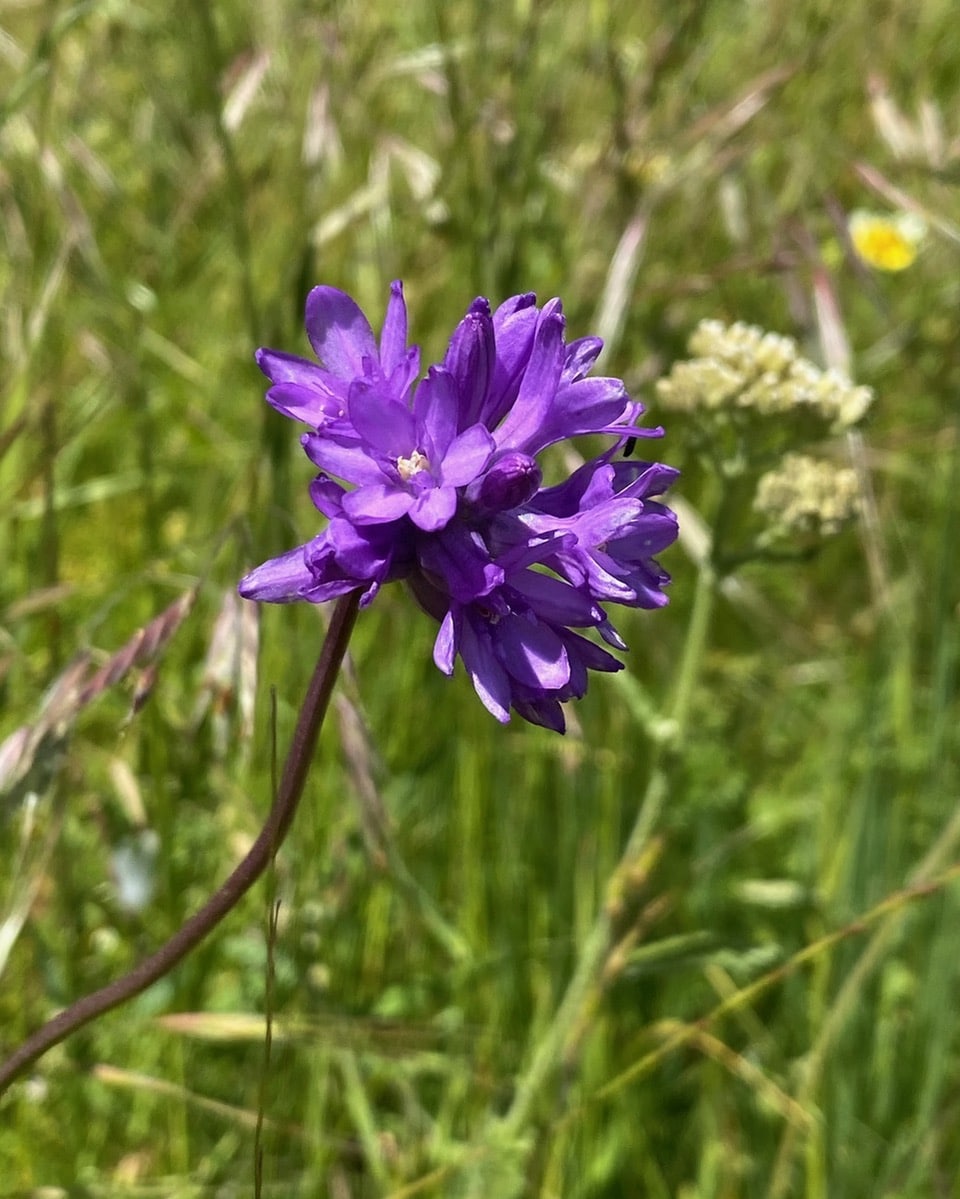
Ookow, Dichelostemma congestum has started to bloom on the slope of Yampah Bowl. The flowers are more violet than the Blue Dicks we have been seeing so far.

Here’s one of the last blooming Blue Dicks, Dipterostemmon capitatus along Skyline Trail. The flowers have a cooler blue hue than Ookow, the clusters are tighter as the individual flowers are sessile, without a stalk. These flowers also bloom earlier in the season than Ookow. Blue Dicks has six stamens, as compared to Ookow’s three. Both species are probably pollinated by the same insects, such as the bee flies that can aim their long probosces through the narrow opening surrounded by the white filament sheaths.