

Pollinator Post 5/7/23 (2)

Rain or shine, the Cow Parsnip, Heracleum maximum greets the sky with upraised floral umbels.
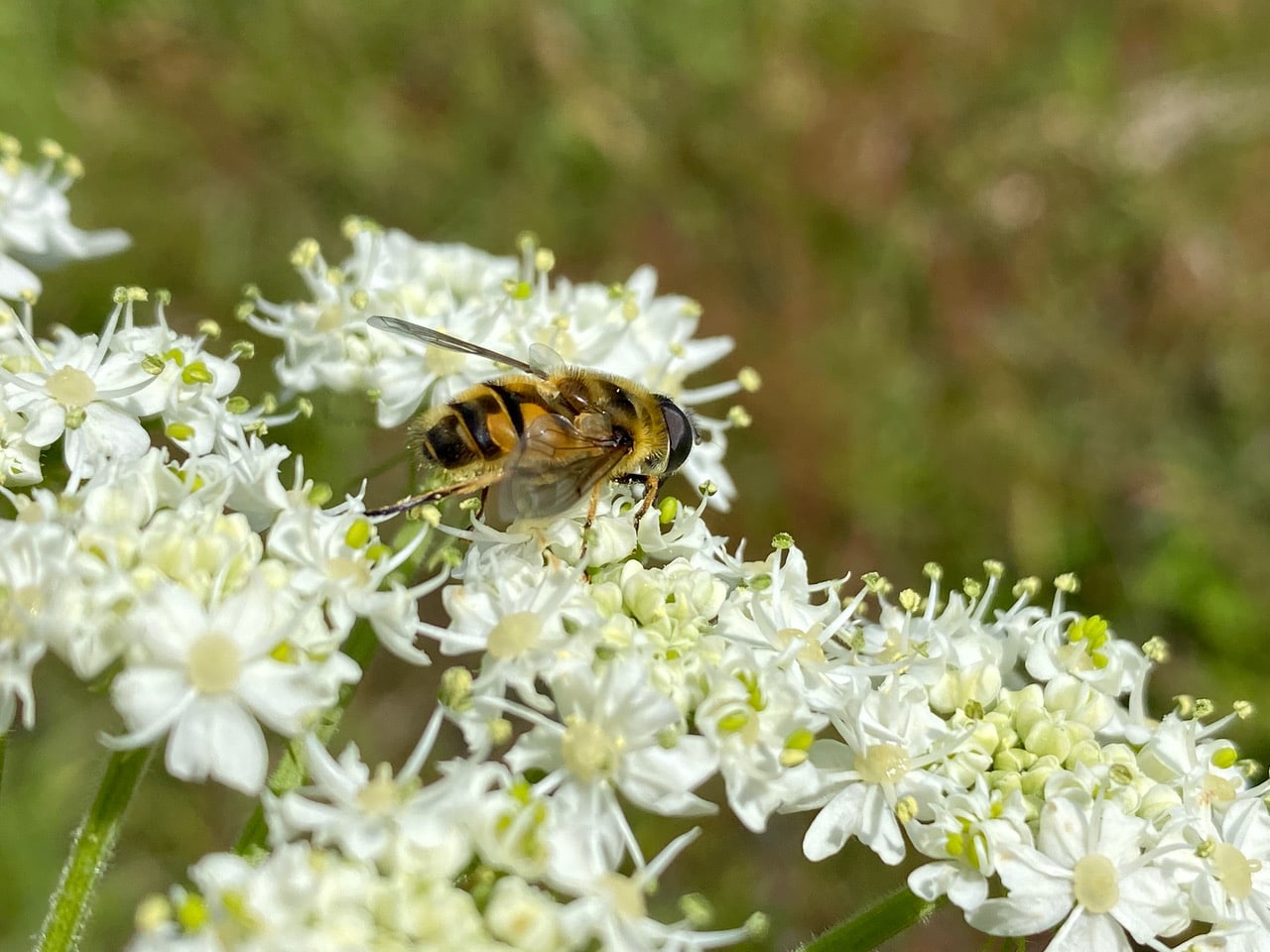
Many insects enjoy the generosity of Cow Parsnip. Numerous flowers are crowded onto each umbel – collecting pollen or nectar is a cake walk for most insects. Who is this brightly colored fly bristling with a halo of golden hairs around its body? It is appropriately named the Yellow-haired Sun Fly, Myathropa florea (family Syrphidae). What we have here is a male. The females appear more black than yellow.


The Yellow-haired Sun Fly is a very common European and North African species of hoverfly. The species is an adventive on the Pacific coast of North America since 2005. (Adventive species are species that have arrived in a new region, either naturally or with the help of human activity.)
The flies occur in deciduous forest, farmlands with trees, parks and gardens, visiting a wide variety of flowers from many families. The flight period is May to October. Larvae are semi-aquatic and feed on bacteria in organic waterlogged detritus, often in the shallow rot holes of tree stumps. The larvae are rat-tailed maggots equipped with a long telescoping breathing siphon located at their rear end that helps the larva breathe underwater. They are detritivores and decomposers/recyclers of organic matter.

Hey, here’s a third and smallest species of March Fly (family Bibionidae) we have encountered this spring! From the colorful thorax, and the shape and size of its head, I can tell that it is a female).
March Flies in the genus Dilophus are distinguished by rings of spines on the fore tibia and two rows of spines anteriorly on the thorax. The genus has a worldwide distribution, with highest diversity in the Neotropics. In some species the sexes are quite different in form and color, the female often brownish or red, the males black.
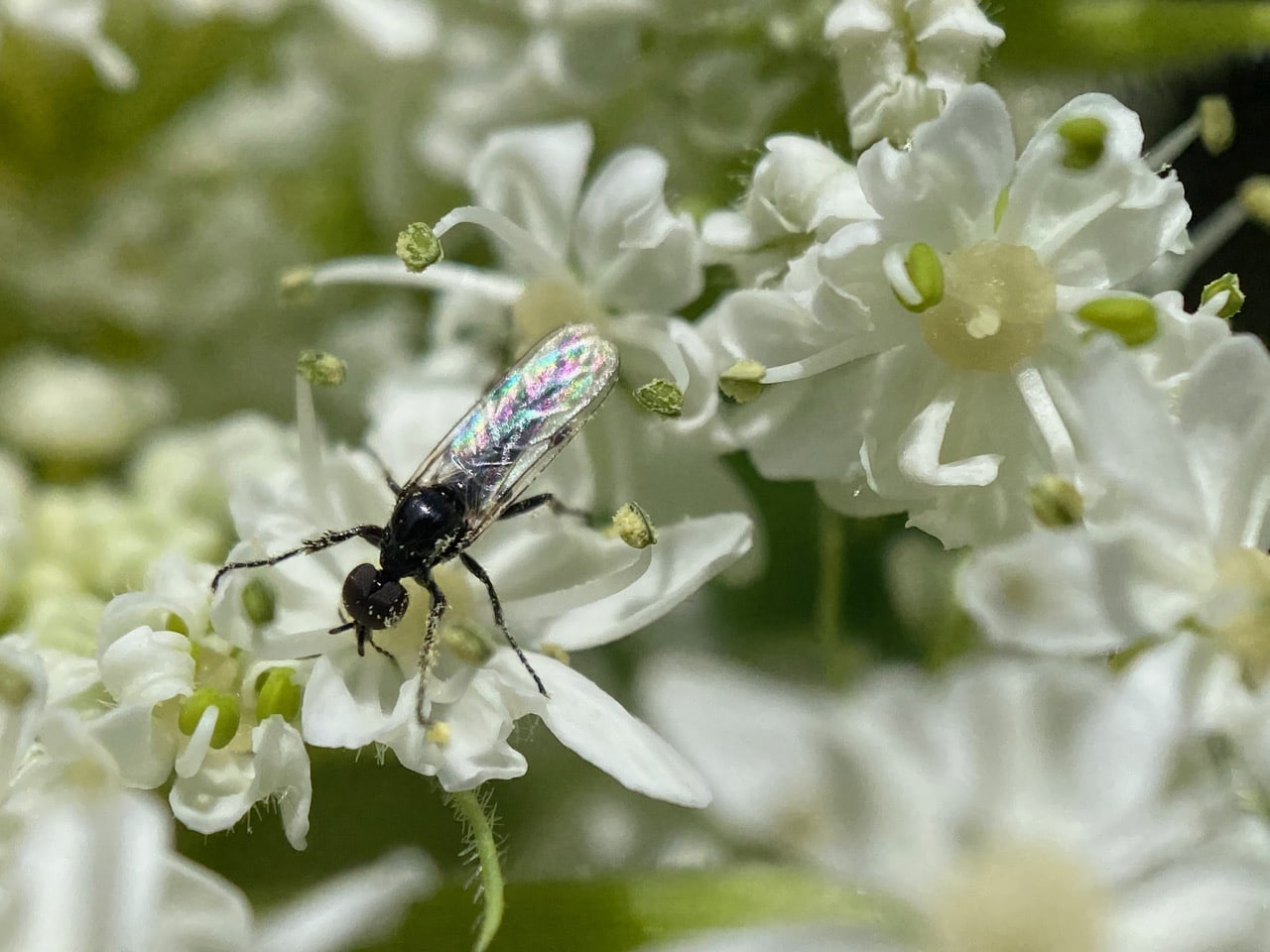
Here’s a male March Fly of the same species, Dilophus sp.
March Flies (family Bibionidae) generally live in wooded areas and are often found on flowers – adults of some species feed on nectar, pollen, and honeydew, while adults of other species don’t feed at all; and in either case, they are very short-lived. They are considered important pollinators. They are also important food for other insects and spiders. The larvae feed en masse on rotting organic materials like leaves, wood, compost, and rich soil.
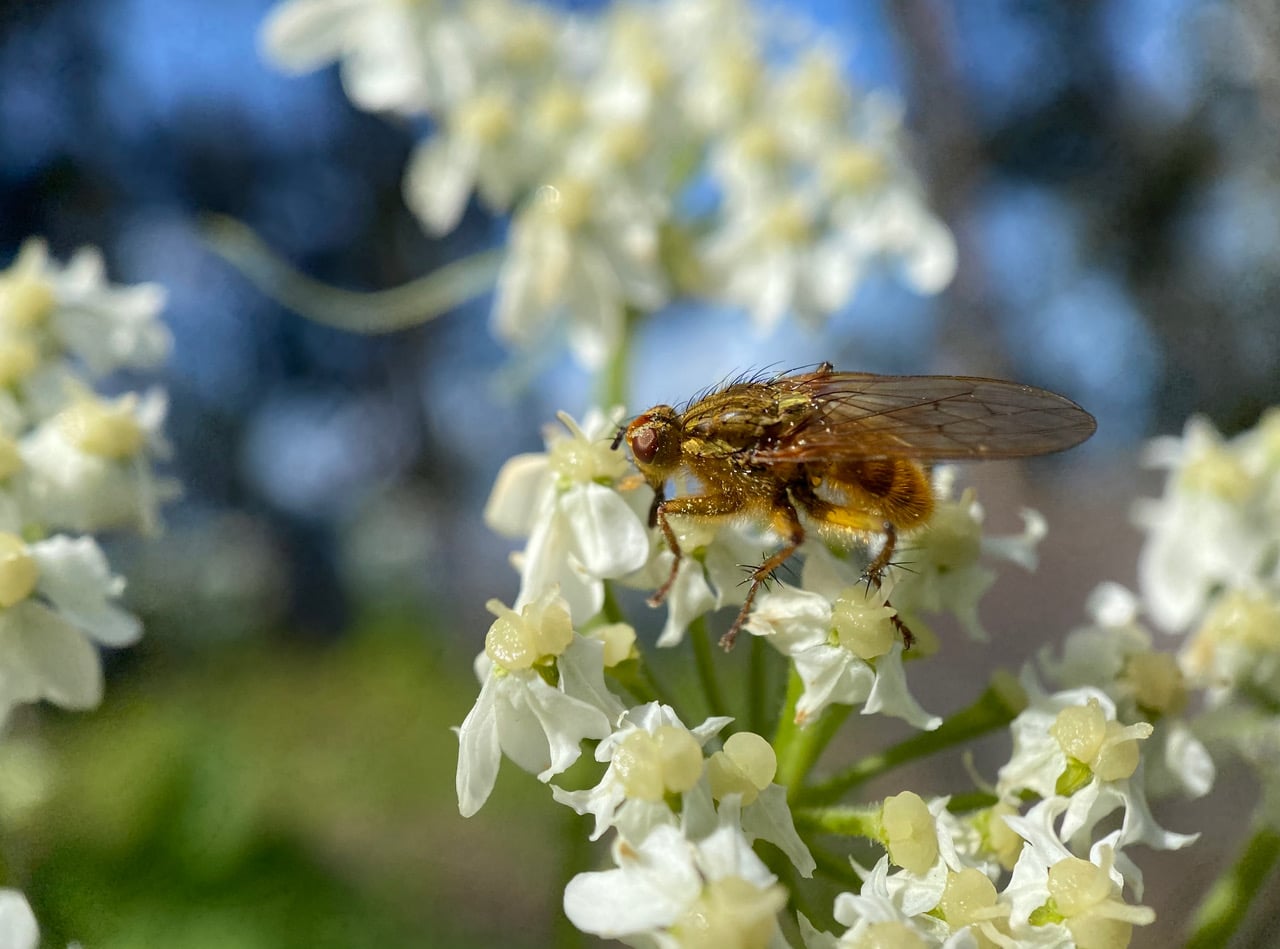
A female Golden Dung Fly, Scathophaga stercoraria (family Scathophagidae) is sipping nectar from the flowers of Cow Parsnip.
The Golden Dung Flies, Scathophaga stercoraria (family Scathophagidae) are small, spiny flies about 3/8 in. long. Males are a little larger than the females; females are not as golden and their front legs are not as fuzzy as the males’ are. As the common name suggests, the flies are commonly found on the droppings of large mammals, such as cattle, horses, sheep, deer, and wild boar. The Scathophaga are integral in the animal kingdom due to their role in the natural decomposition of dung in the fields.
The scientific name, Scathophaga stercoraria, says it all. Scatho from the Greek skatos meaning excrement, and phaga to eat, plus stercoraria from the Latin stercoris, meaning of dung, found in dung. The fly’s life is dung-centered. Adults locate dung by “scenting” it with their antennae and flying upwind to find it. Male and females meet there, mate there, lay eggs there, and take their meals there. They feed on other flies that are attracted to dung, and they also consume nectar (and in a pinch, each other). Larvae hatch in the manure’s warm, moist depths and consume both it and some other small insects they find in there.
Females spend most of their time foraging in vegetation and only visit dung pats to mate and oviposit on the dung surface. Males spend most of their time on the dung, waiting for females and feeding on other insects that visit the dung, such as blow flies. Fights often break out on the cow pat as males vie to mate with a female.
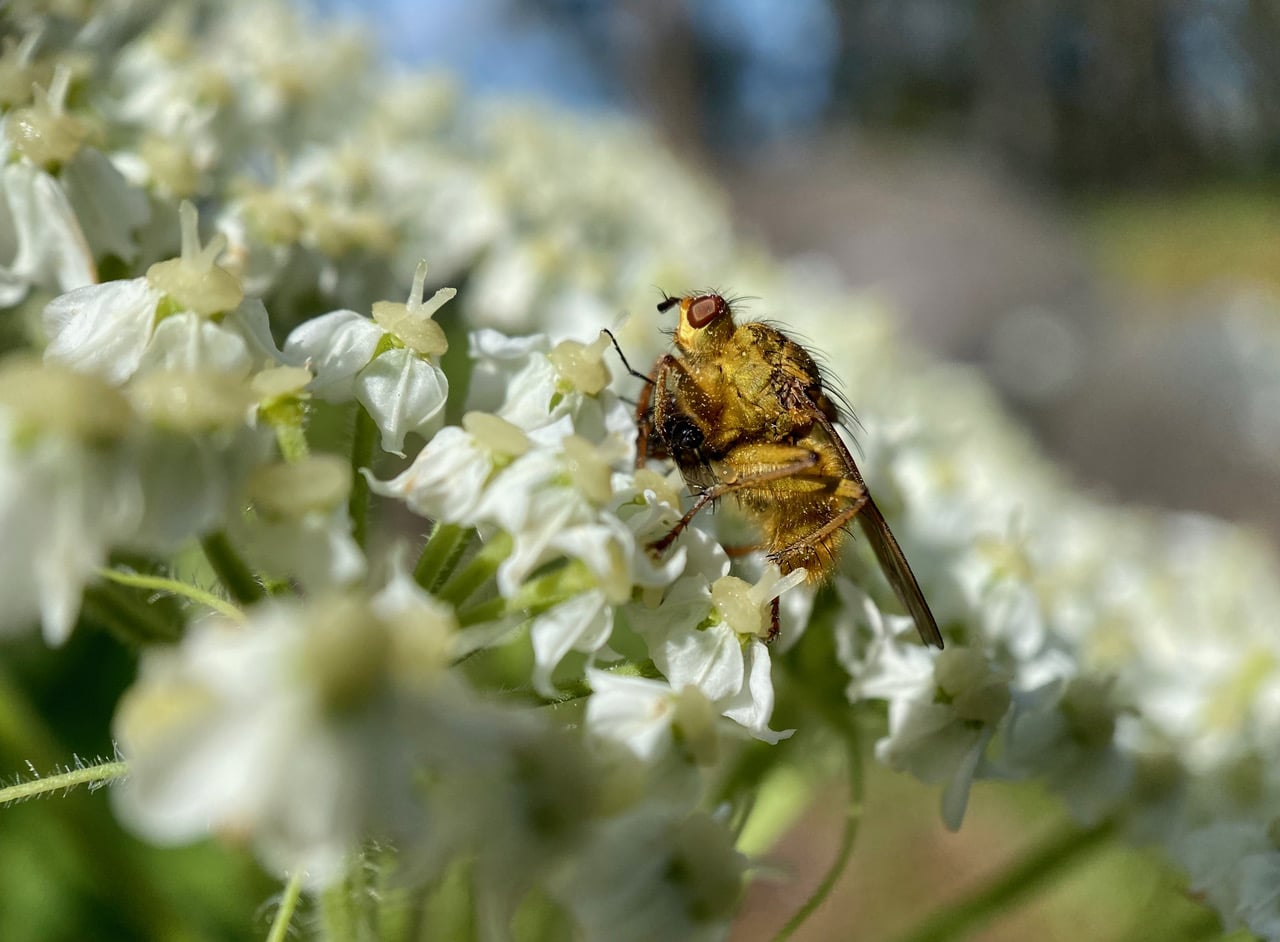
While much attention is paid to the sex life of the Golden Dung Flies, the flies are also interesting in other ways. They are predatory, feeding on other flies that visit dung pats. Apparently some hunting also occurs on flowers. This male dung fly has just nabbed a little black fly with its front legs.

A Flesh Fly (family Sarcophagidae) is feeding on Cow Parsnip.
Many Flesh Flies have black and gray longitudinal stripes on the thorax and checkering on the abdomen, red eyes, and a bristled abdomen sometimes with a red tip. They differ from most flies in that they are ovoviviparous, opportunistically depositing hatched or hatching maggots instead of eggs on carrion, dung, decaying material, open wounds of mammals, hence their common name. The adults mostly feed on fluids from animal bodies, nectar, sweet foods, fluids from animal waste and other organic substances. While we may find their habits revolting, Flesh Flies perform important roles in the ecosystem – the larvae as decomposers/recyclers, and the adults as pollinators.

A small day-active moth, Sulphur Tubic, Esperia sulphurella (family Oecophoridae, or concealer moths) is moving slowly through the Cow Parsnip flowers.
The species is native to Europe, but has been introduced in California. Adults have a body length of 6-8 mm, are black with yellow markings. They are on wing in spring. Larvae are black and feed on dead wood.
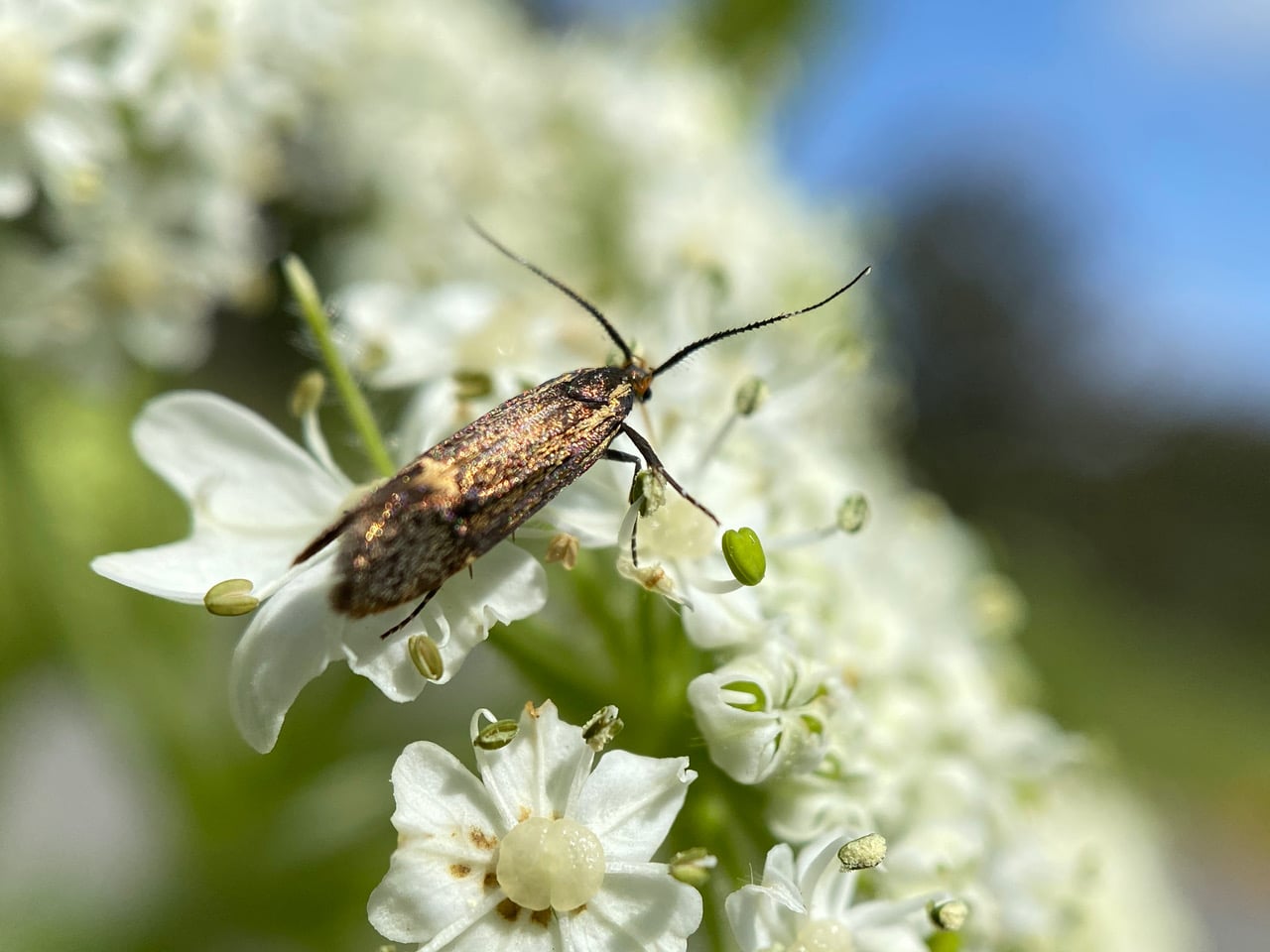
The moth’s iridescent scales shines coppery in the sun.

Dorsal view of the Sulphur Tubic moth.

Side view of Sulphur Tubic in the shade.

Side view of Sulphur Tubic in the sun.
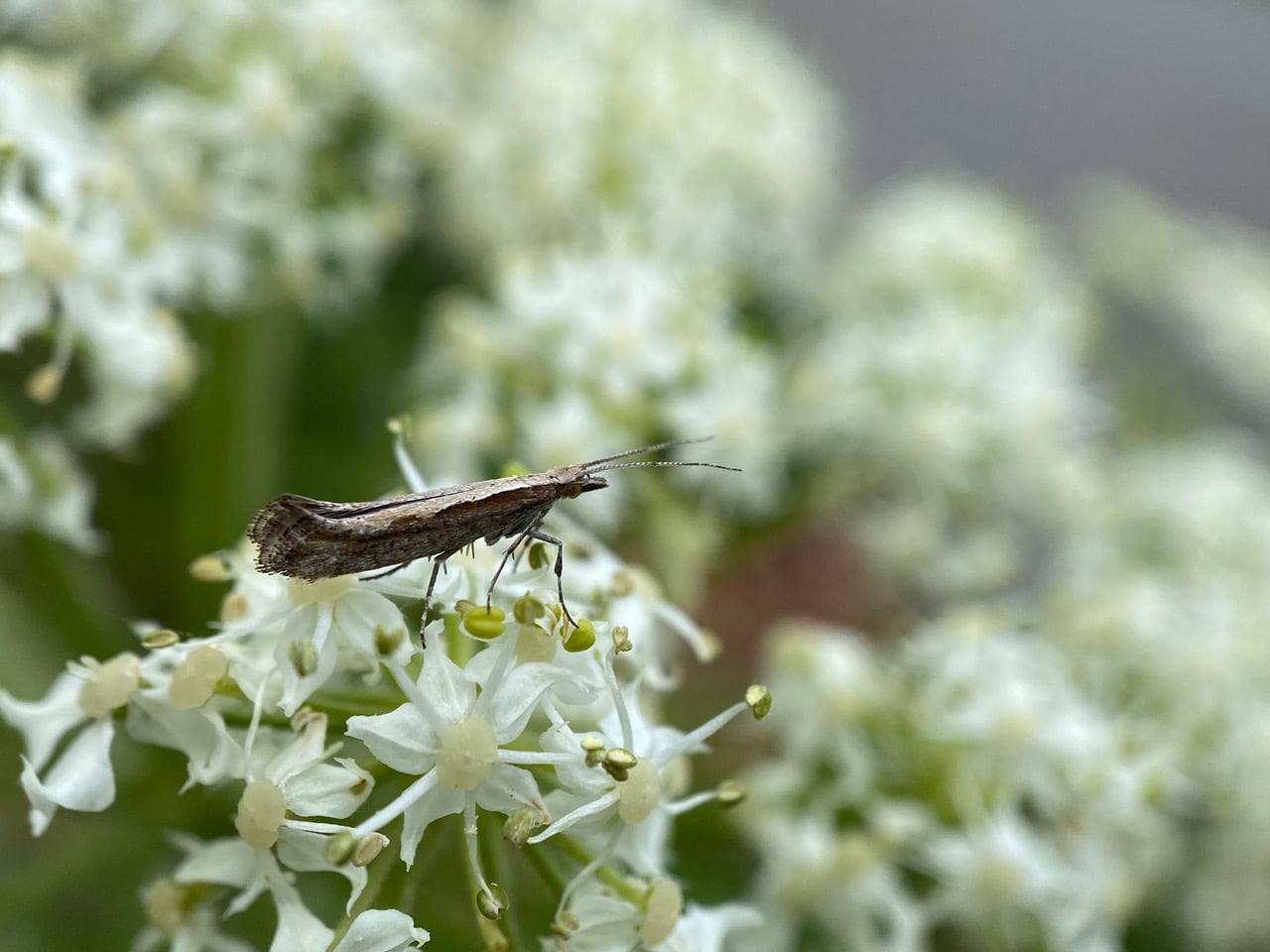
An even smaller moth is found on the same Cow Parsnip plant. It has been identified as the Diamondback Moth, Plutella xylostella (family Plutellidae).
The Diamondback Moth is sometimes called the Cabbage Moth. The small grayish-brown moth sometimes has a cream-colored band that forms a diamond along its back. The species may have originated in the Mediterranean region but it has now spread worldwide. Diamondback Moths are considered pests as they feed on the leaves of cruciferous crops and plants that produce glucosinolates. This moth is well studied because of its pest status. The moth lays its eggs only on plants in the family Brassicaceae. Nearly all cruciferous vegetable crops are attacked. The moths are nocturnal and use their olfactory system to discover host plant odors. Eggs are laid on the surface of leaves. The larvae have 4 instars. They are quite active, and when disturbed, may wriggle violently, move backward, and spin a strand of silk from which to dangle. The feeding habit of the first instar is leaf mining. The larvae emerge from these mines to molt and subsequently feed on the lower surface of the leaf. Their chewing results in irregular patches of damage, though the upper leaf epidermis is often left intact. The irregular patches are called window panes.
Adult moths are weak fliers, seldom rising more than 2 m above the ground and not flying long distances. They are, however easily transferred by wind over long distances. The moths overwinter as adults among field debris of cruciferous crops.
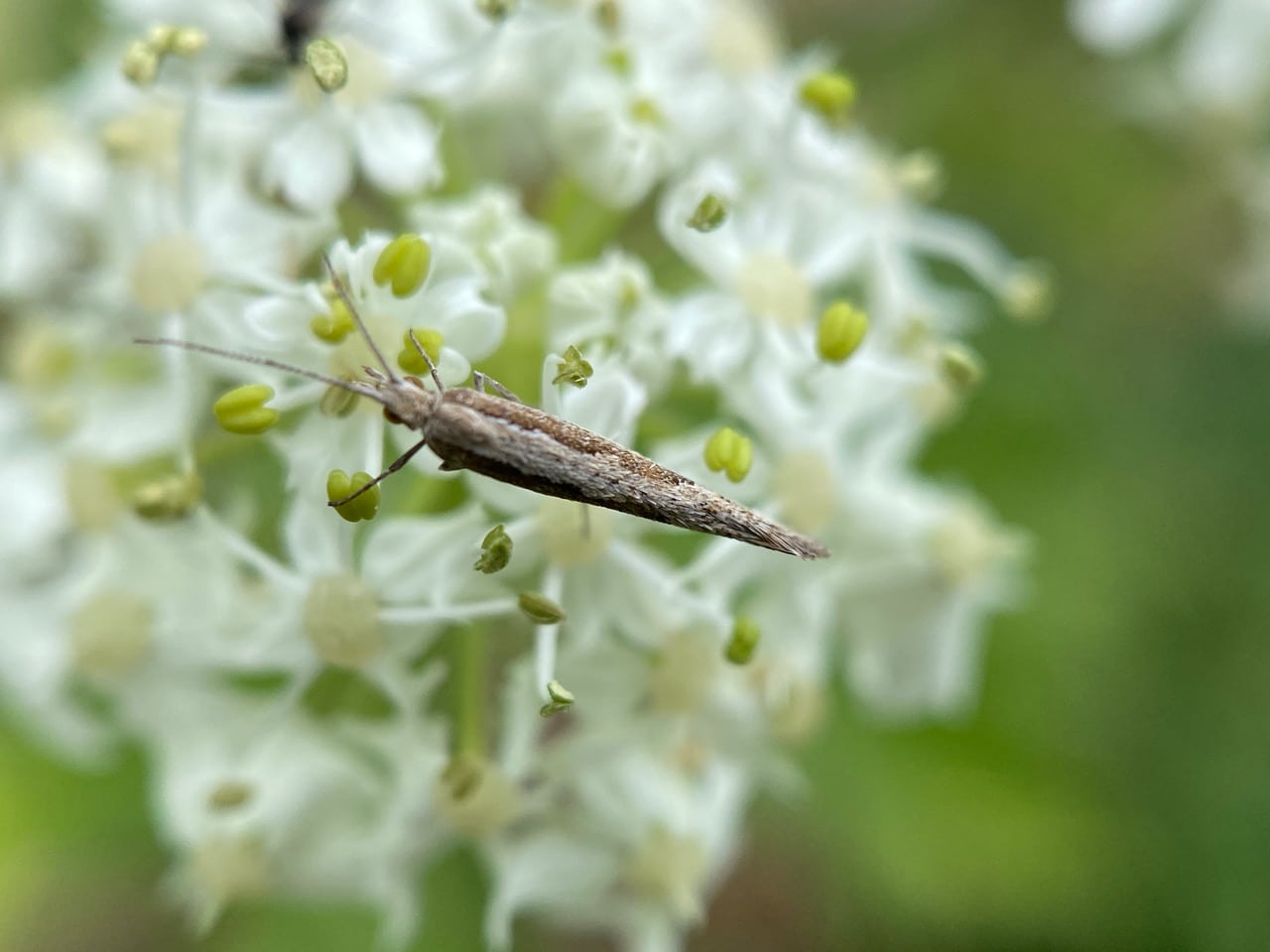
Dorsal view of the Diamondback Moth.

A tiny Crab Spider, Mecaphesa sp. (family Thomisidae), about the size of a Cow Parsnip flower is crouched in ambush at the edge of the floral umbel.
Even at this young age, Mecaphesa is recognizable. It is distinguished from the other genera of Crab Spider by the size and arrangement of the eight eyes (in two curved rows of four). Mecaphesa is also often hairy, with tiny hairs protruding from the head, legs, and body.
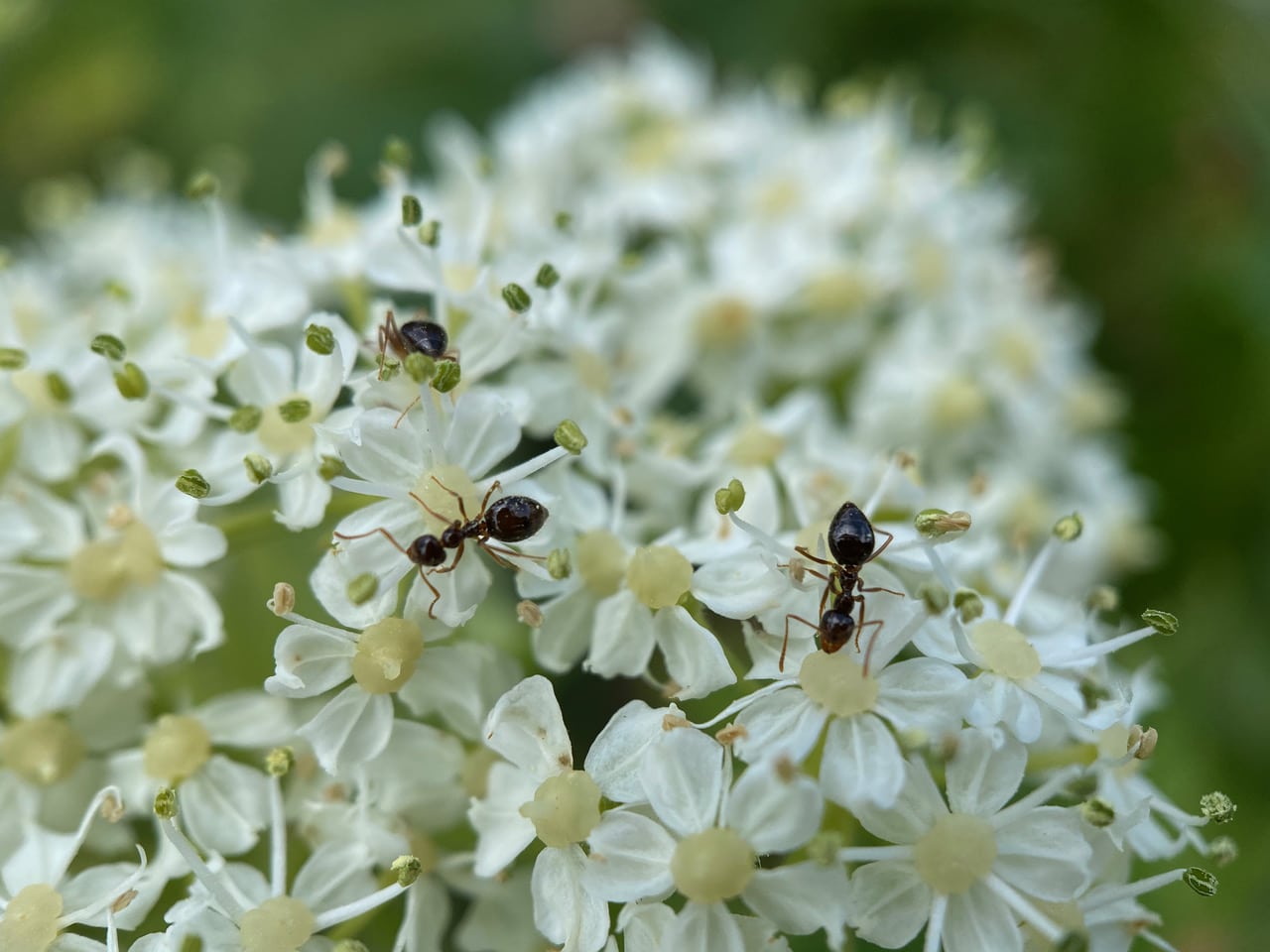
Numerous American Winter Ants, Prenolepis imparis are foraging on the floral umbel of Cow Parsnip.
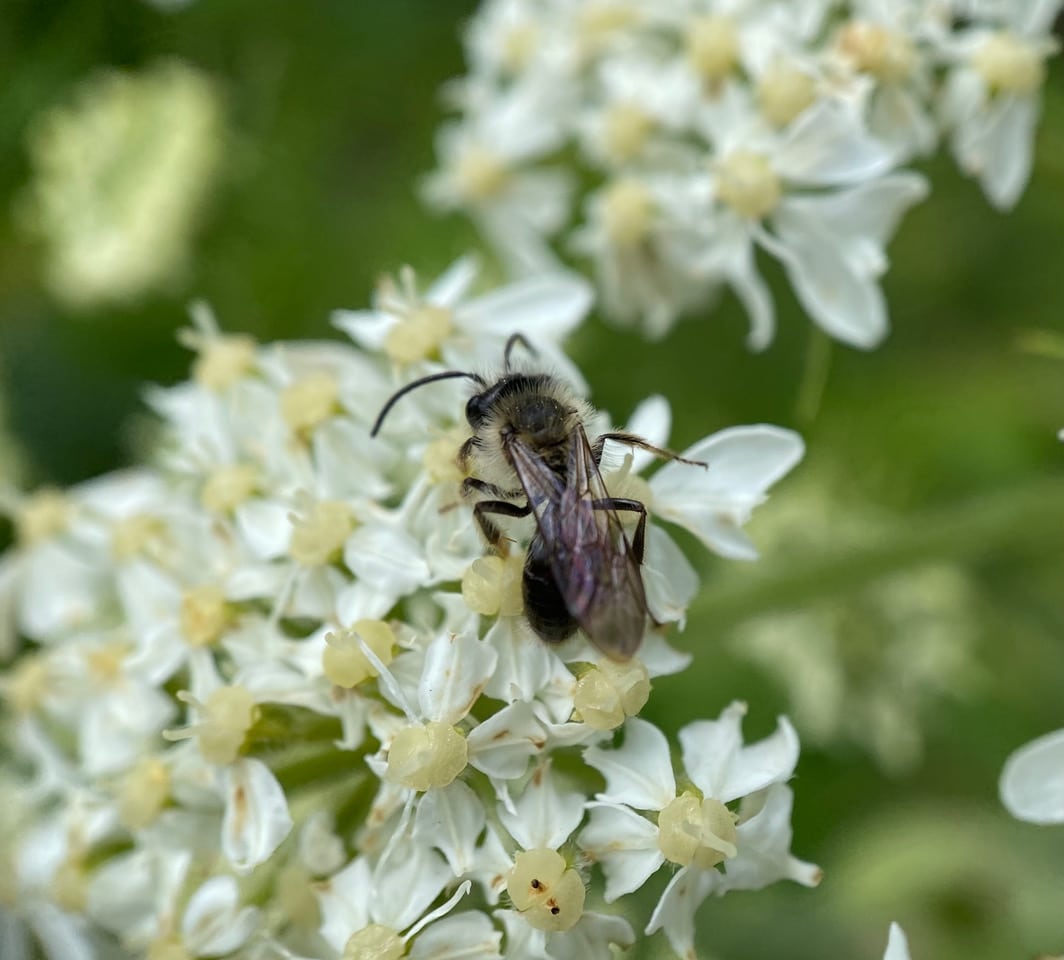
A scruffy looking male Mining Bee, Andrena sp. (family Andrenidae) is taking nectar from Cow Parsnip flowers.

Note the the slender body, long antennae and the absence of scopae on its hind legs – all characteristics of a male bee.

A jet-black hoverfly, the Blacklet, Cheilosia sp. (family Syrphidae) is feeding on Cow Parsnip flowers.
Cheilosia is a rather unusual hoverfly. Most Cheilosia are black or largely un-colored, lacking the bright colors and patterns of many hover fly species. Although it is one of the most species diverse genera of Syrphidae, its biology is little understood. Where known, the larvae of Cheilosia species feed in the stems of plants or in fungi.
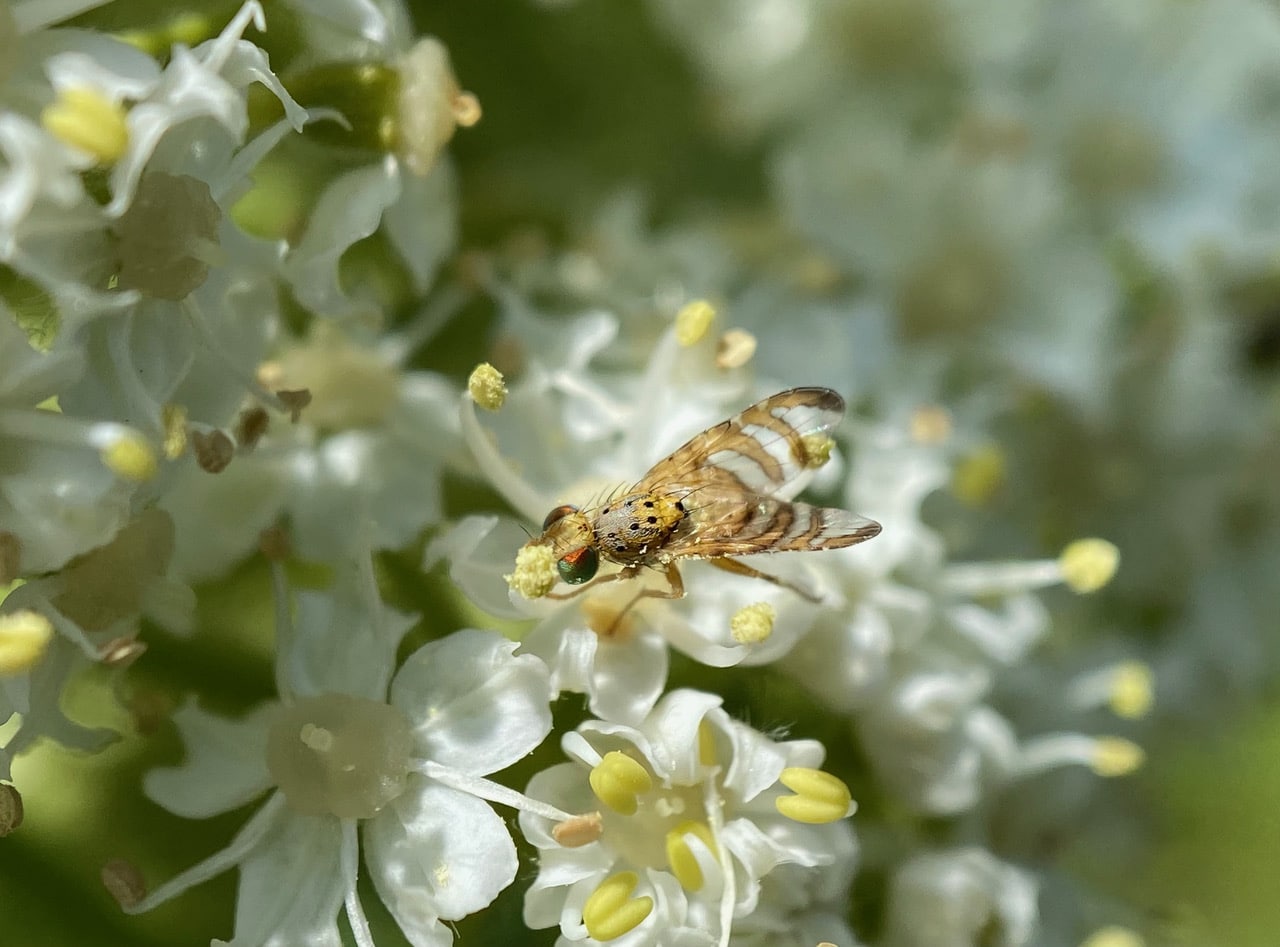
Hello, who is this little beauty? Those lovely picture wings tell me it’s a Fruit Fly in the family Tephritidae.
Tephritids are small to medium-sized flies that are often colorful, and usually with picture wings. Many species of Tephritidae perform an elaborate courtship display using their picture wings. The larvae of almost all Tephritidae are phytophagous. Females deposit eggs in living, healthy plant tissues using their telescopic ovipositors. Here the larvae find their food upon emerging. The larvae develop in leaves, stems, flowers, seeds, fruits, and roots of the host plant, depending on the species. Adults are often found on the host plant and feeding on pollen, nectar, rotting plant debris, or honeydew. Tephritid flies are of major economic importance as they can cause damage to fruit and other plant crops. On the other hand, some Tephritids are used as agents of biological control of noxious weeds.
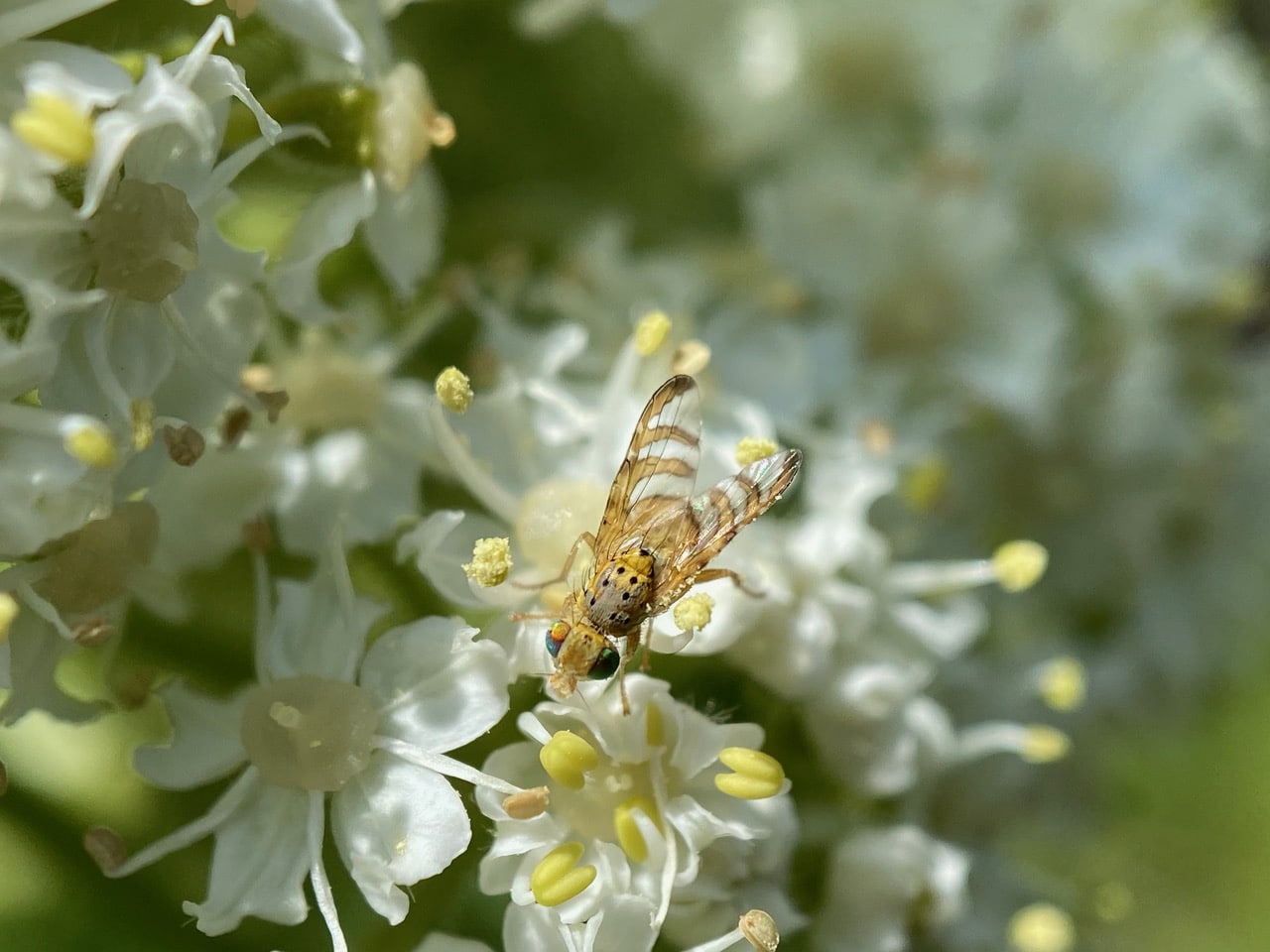
This Fruit Fly has been identified as a member of the genus Chaetorellia (family Tephritidae). Native to Eurasia, it has been introduced in North America to control non-native weeds.
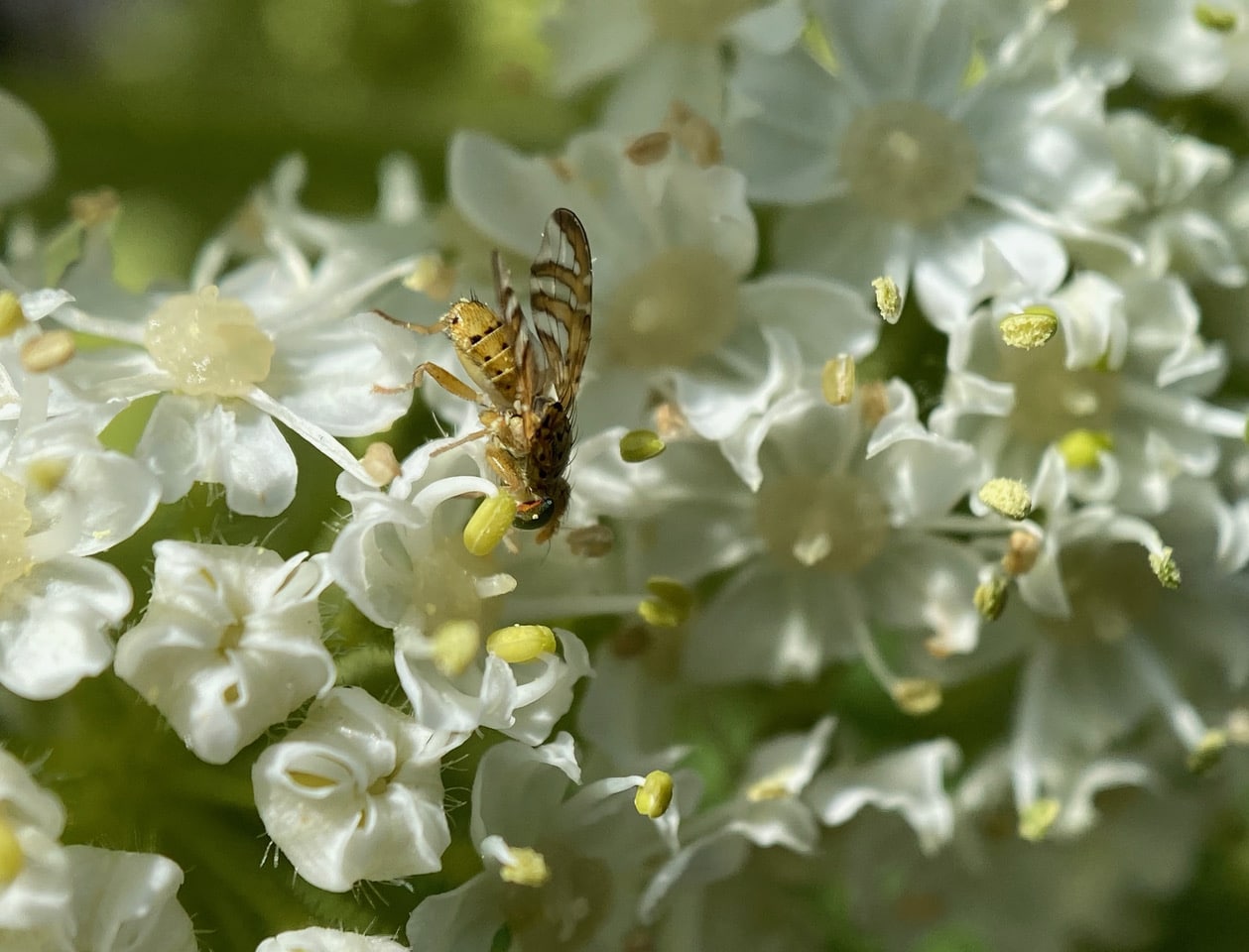
A side view of the Fruit Fly, with a glimpse of its abdomen. It is probably a male. Female Tephritids have a prominent oviscape on the tip of their abdomen. The oviscape is the basal part of the ovipositor of some insects, typically the non-retractile sclerotized sheath that remains exposed when the telescopic ovipositor is withdrawn and not in action. Genus Chaetorellia – BugGuide.Net
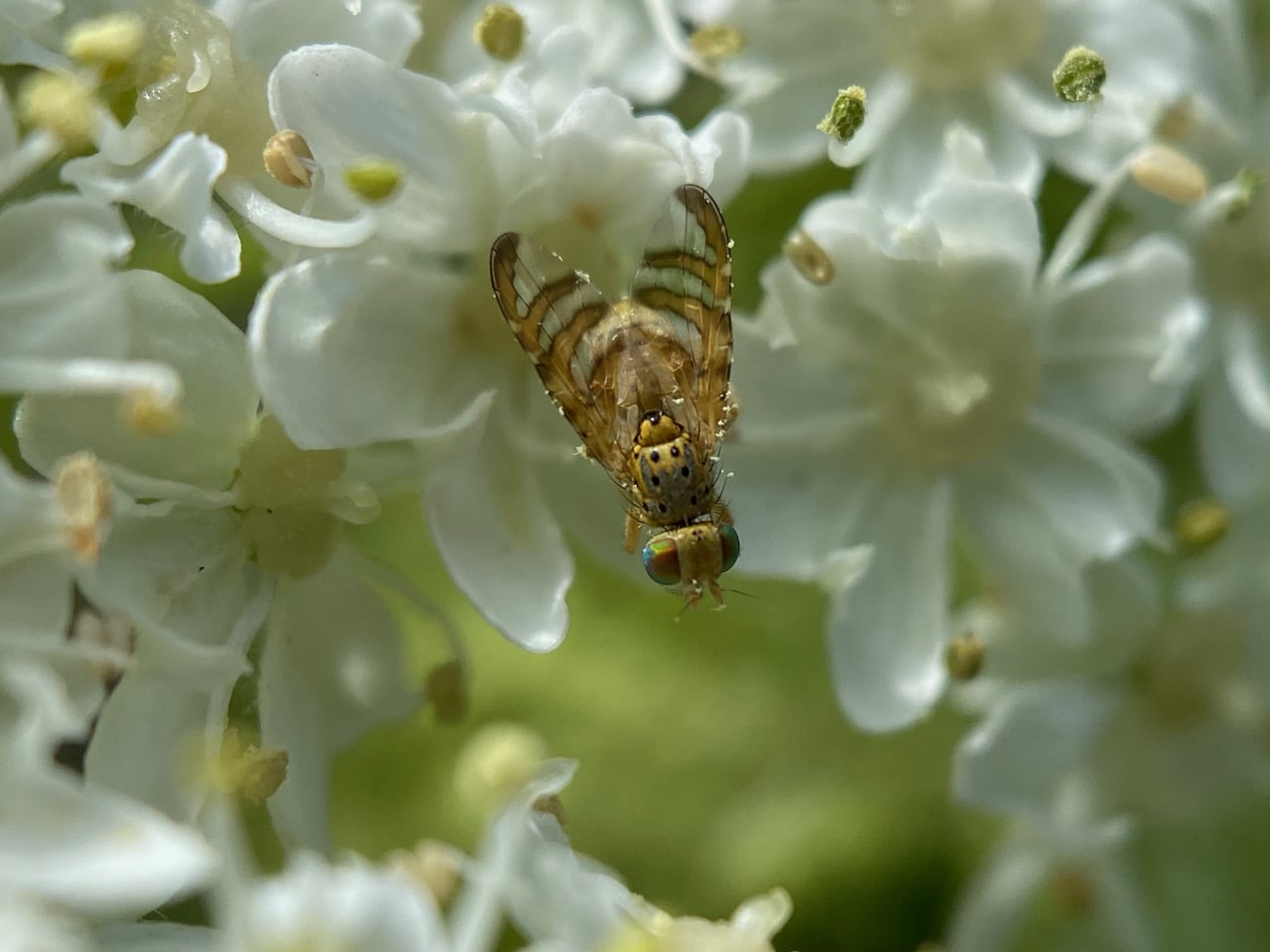
To me the luminous accoutrements on this Fruit Fly rival King Charles’ coronation garb and paraphernalia.