

Pollinator Post 5/7/23 (1)

As has been the norm for this spring, the morning is cloudy and cool.

I am relieved to see that the Black-tailed Bumble Bees, Bombus melanopygus are not deterred by the cool weather. They are still out foraging on the Silverleaf Lupine, Lupinus albifrons.

Numerous American Winter Ants, Prenolepis imparis are tending Thistle Aphids, Brachycaudus cardui on an Italian Thistle.
Ants and aphids share a well-known mutualistic relationship. The aphids produce honeydew, a sugary food for the ants; in exchange, the ants care for and protect the aphids from predators and parasites. Some ants will “milk” the aphids to make them excrete the sugary substance. The ants stroke the aphids with their antennae, stimulating them to release the honeydew. Aphid-herding ants make sure the aphids are well-fed and safe. When the host plant is depleted of nutrients, the ants carry their aphids to a new food source. If predatory insects or parasites attempt to harm the aphids, the ants will defend them aggressively. Some species of ants continue to care for aphids during winter. The ants carry the aphids to their nest for the winter months, and transport them to a host plant to feed the following spring.

There seems to be a commotion around a large green aphid in particular.

I take a closer look, and discover a tiny Hoverfly larva feeding on the aphid! Will the ants remove/kill the predator to protect their herd of aphids?
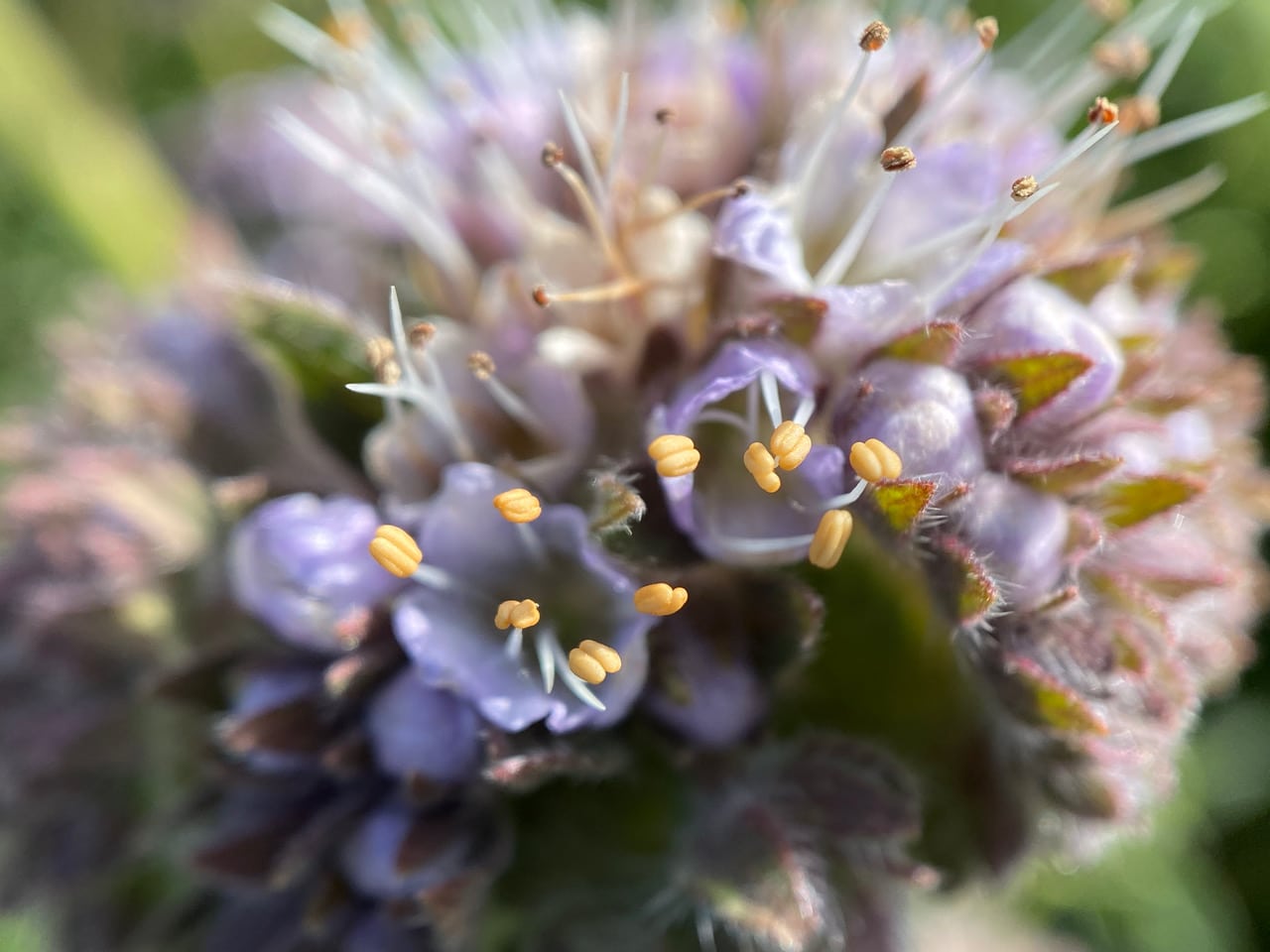
California Phacelia, Phacelia Californica continues to bloom, unfurling their yellow anthers from the corollas.

The flowers of California Phacelia appear to be protandrous, the male parts maturing before the female parts. After the anthers (male) have released their pollen, the white, forked styles/stigmas (female) begin to lengthen, ready to receive incoming pollen. This gives the whole inflorescence a hairy, fuzzy appearance. The temporal separation of the male and female phases (a phenomenon called dichogamy) is one of the strategies plants use to prevent self-pollination.
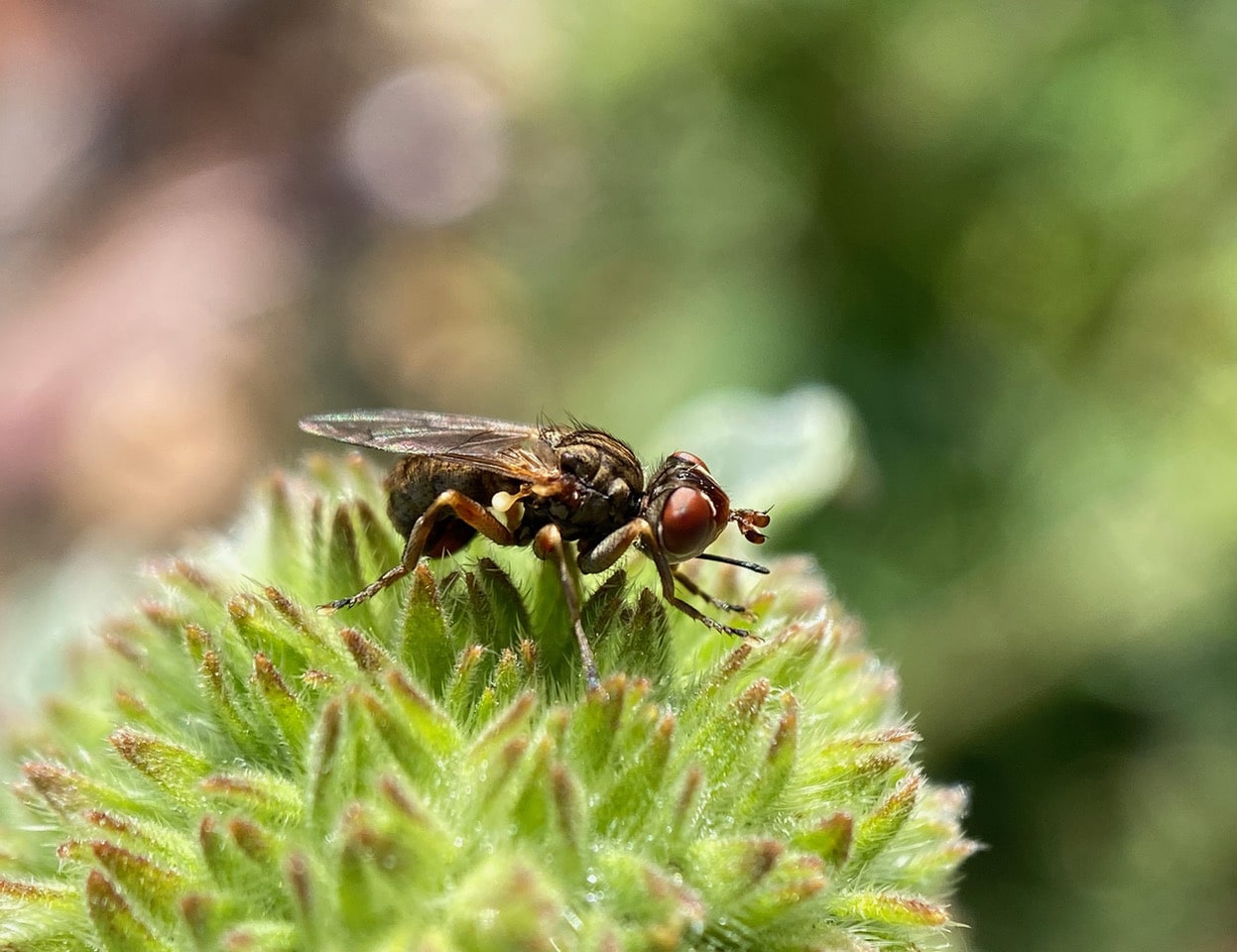
A chubby little fly is resting motionless on an immature inflorescence of California Phacelia. It has an oversized head, a straight proboscis that is angled forward, and an abdomen that is somewhat curled under. Ooh, I think it is a Thick-headed Fly (family Conopidae)!
The small and little-known family of Conopidae, commonly called the Thick-headed Flies, are distributed worldwide. Remarkable mimics of wasps and bees, the flies are frequently found at flowers, feeding on nectar with their long probosces. The head is broad; the oral opening is large and the proboscis is long, slender and often geniculate (elbowed). The larvae of all Conopids are internal parasitoids, mostly of aculeate (stinging) Hymenoptera (wasps, bees). Adult females aggressively intercept their hosts in flight to deposit eggs. Vulnerable foraging bees are likely the most susceptible to parasitism by Conopids. The female’s abdomen is modified to form what amounts to a “can opener” to pry open the segments of the host abdomen as the egg is inserted. The fly larva feeds on the host from the inside out. The vast majority of parasitized bumble bees bury themselves by burrowing into the ground right before they die. This behavior does not matter to the bees – they are doomed. But it is critical for the flies – if the host dies underground, the fly is sheltered from the elements, predators and parasites.
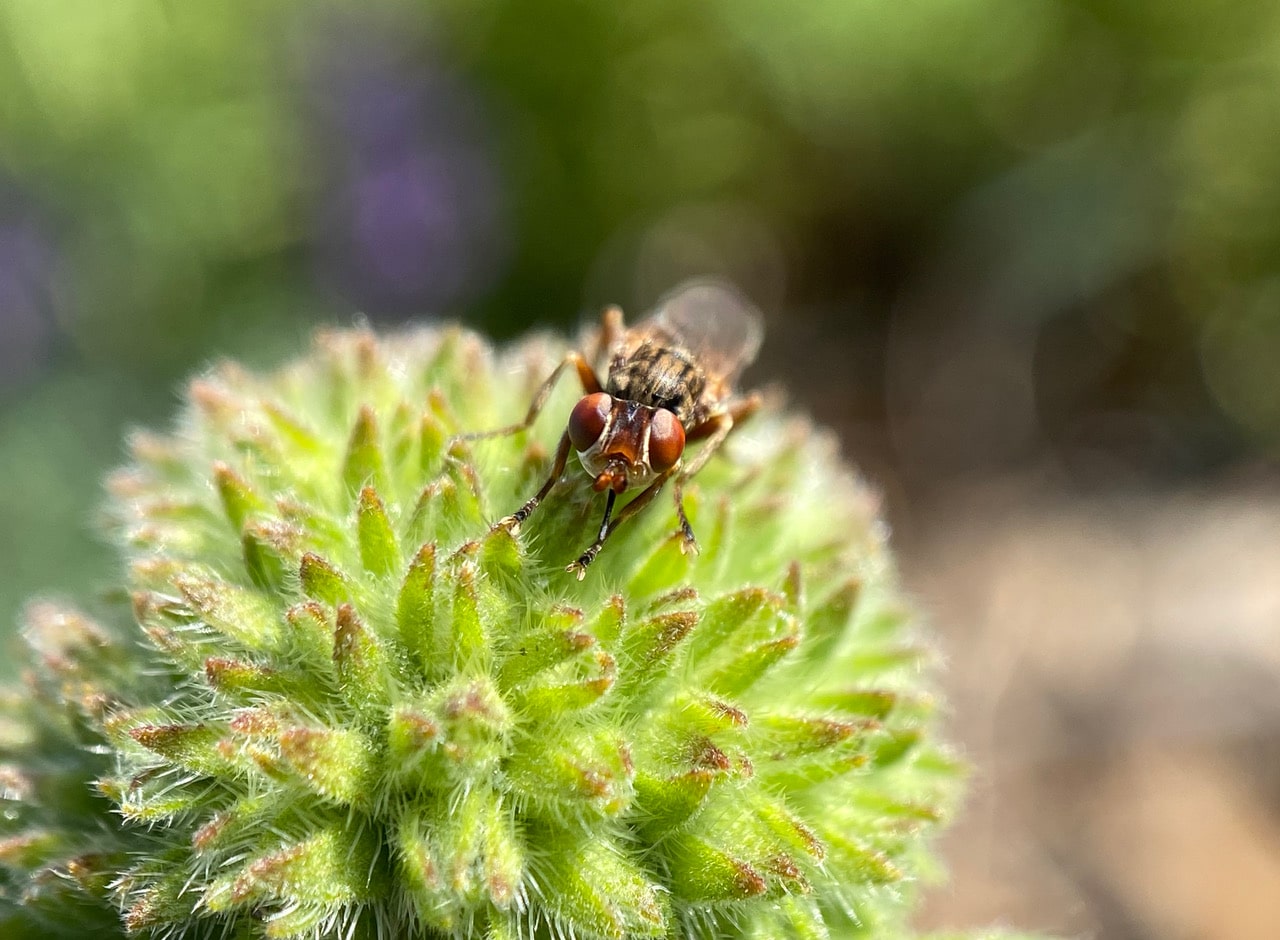
A front view of the Thick-headed Fly, Zodion sp. (family Conopidae).
Zodion species are parasitic on bumble bee workers, honey bees, Andrena, Nomia, and Agapostemon.
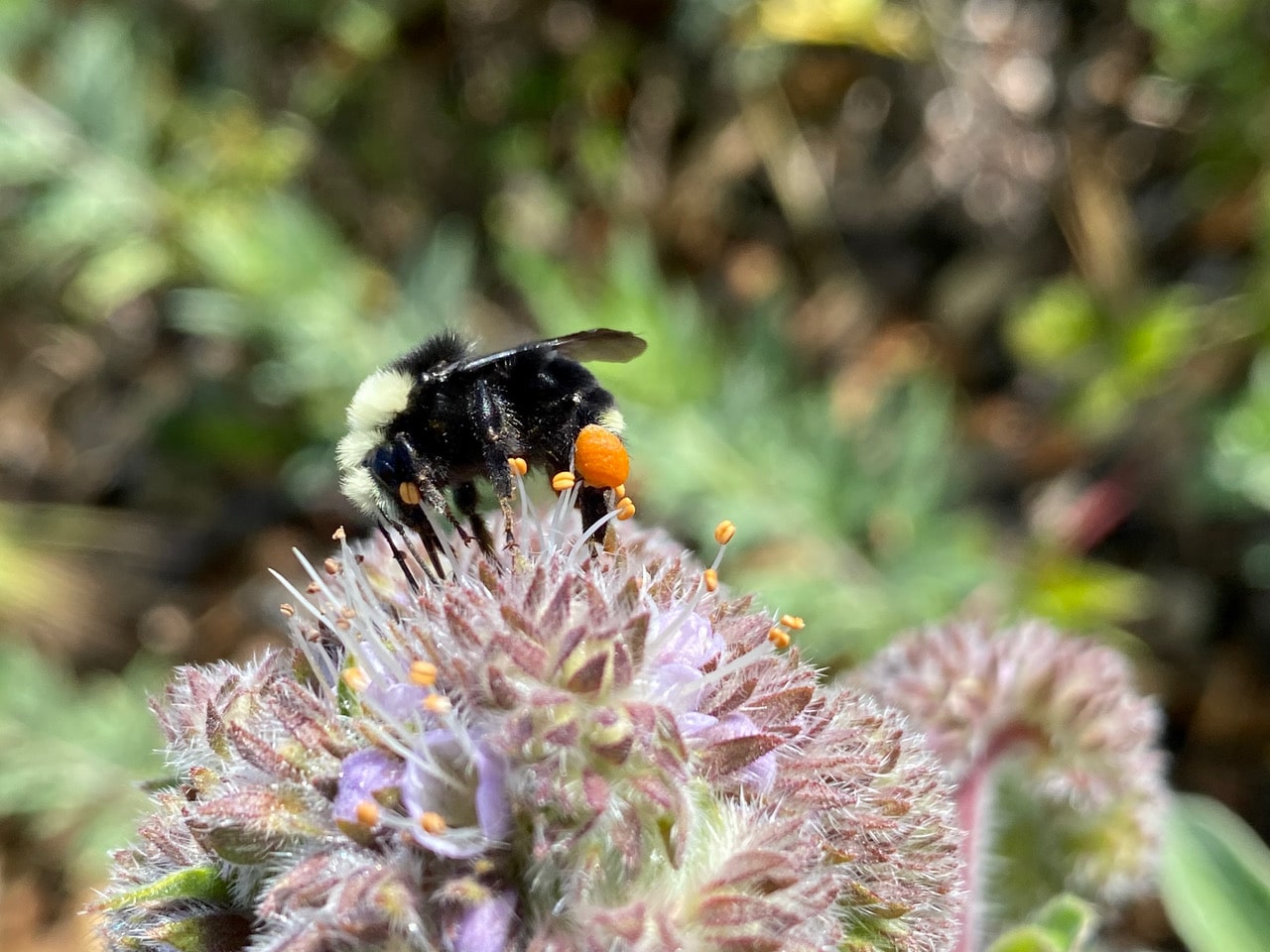
A Yellow-faced Bumble Bee, Bombus vosnesenskii is foraging on an inflorescence of California Phacelia. Compared to last year, these bees are making a weak showing. By the size of her pollen load, this bee is quite a successful forager. What a delight to see!
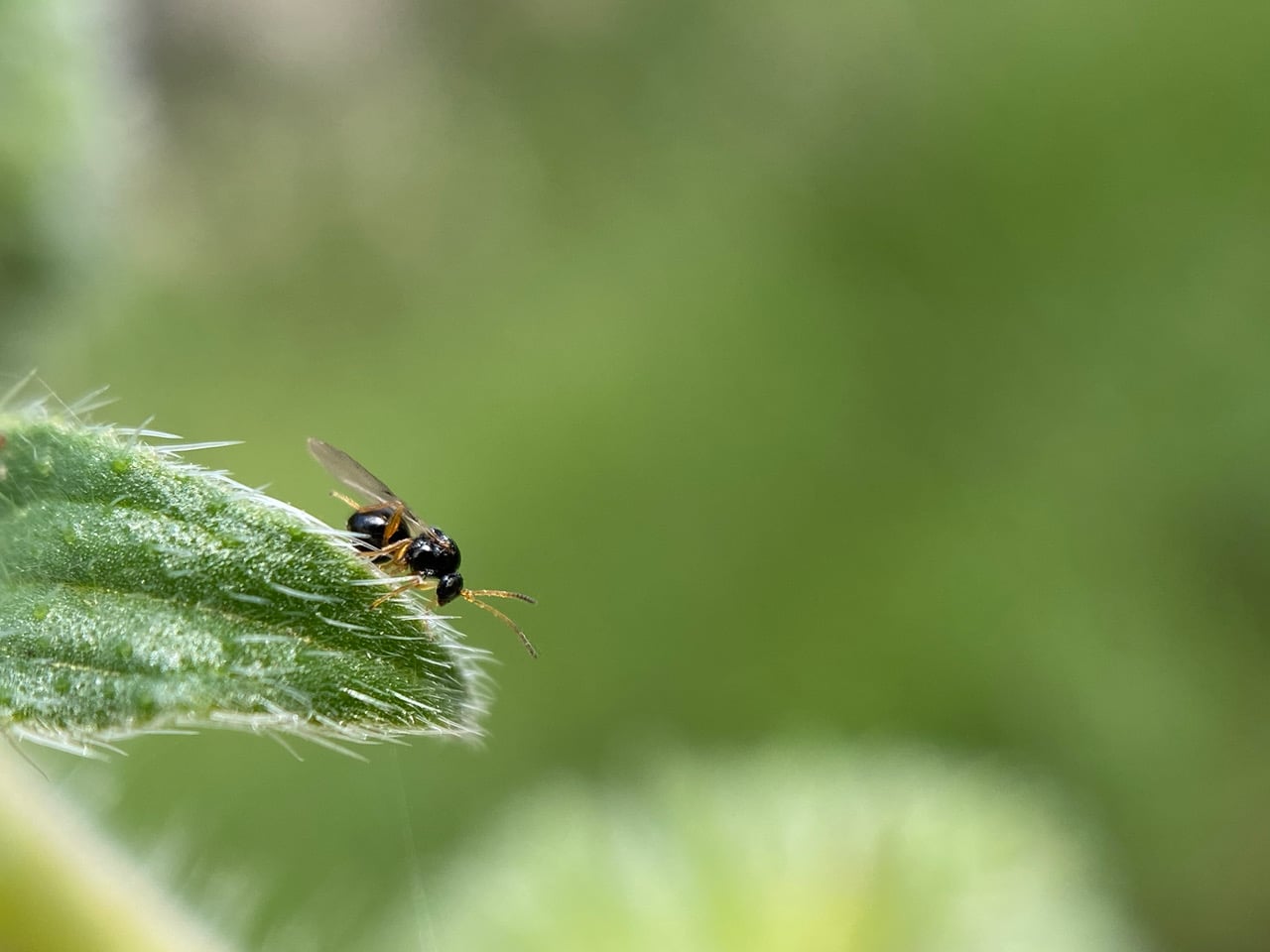
A tiny black wasp, barely 2mm in length, is peering over the tip of a Phacelia leaf. It is probably a Chalcid Wasp in the superfamily Chalcidoidea, composed mostly of parasitoids and a few hyperparasitoids (parasite of parasite) of other insects, attacking the eggs or larval stages of their host.
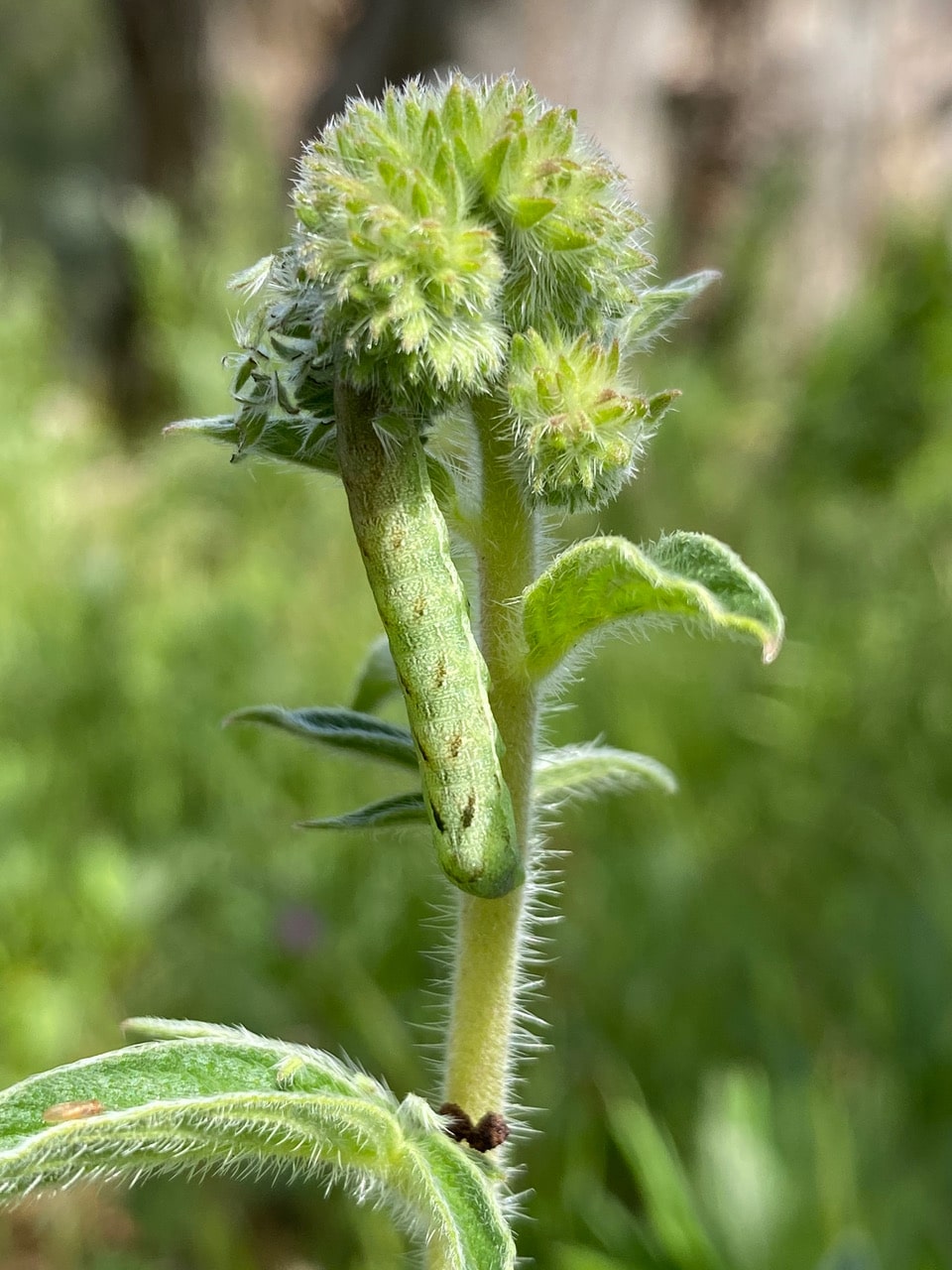
I would never have found this green caterpillar had I not first spotted its frass (insect poop) on the leaf axil below it. It is feeding on the flowers of an immature inflorescence of California Phacelia.
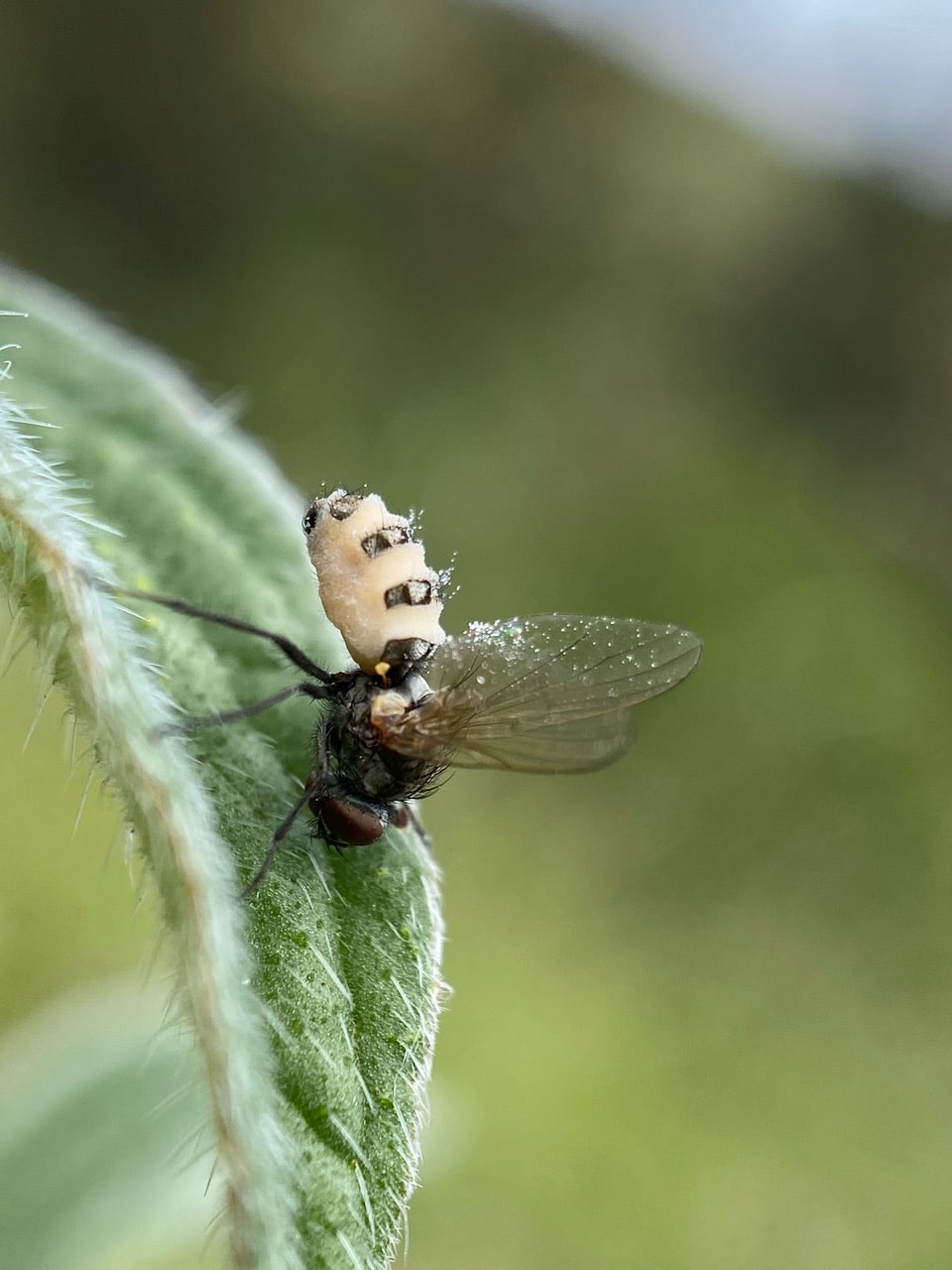
I pause to check a pale fly that seems to be standing motionless on its head on a top leaf of California Phacelia. Wow, it’s a fly that has been infected by a pathogenic fungus, Entomophthora muscae. The fly is dead, and the fungus has started to release spores from its abdomen, some of which has been caught on the fly’s spread wings.
The name Entomophthora means “insect destroyer”. The fungus is transmitted by airborne spores and only affects adult flies. When a spore settles on an appropriate fly’s body, it germinates and penetrates the fly’s exoskeleton. The fungal hyphae grow throughout the body of the fly. As the body is distended, the light colored membranes between the darker hard segments are exposed, giving the fly a characteristic striped appearance. Under the right conditions, the fungus produces numerous sporangia (spore-bearing structures), each with a single spore, that grow out of the cracks in the membrane. When these spores (conidia) are released, they shoot out, leaving a halo of conidia around the dead fly.
Once inside a fly, fungal hyphae grows into the fly’s brain, causing a distinct change in behavior, often called “summit disease”. The fly crawls upwards as high as possible, going to the tip of the branch, flower, stem or leaf it is on. Sometimes the infected fly attaches itself by its extended proboscis to the surface it is on, where it may remain for days or even weeks. Before it dies, it spreads out its legs, stretches open its wings above the thorax and angles the abdomen away from the surface. The elevated location and distinct posture improves the chances that the ejected spores will travel freely to infect new hosts. This fly disease occurs most often in spring and fall in temperate regions, when cool and humid conditions predominate. E. muscae infection has been observed in adult flies in the families Calliphoridae, Culicidae, Drosophilidae, Muscidae, Sarcophagidae, Scathophagidae, Syrphidae and Tachinidae.