

Pollinator Post 5/6/24 (2)

The black insect on the Tidy Tips flowerhead is what first caught my eye. The male March Fly is in a jaws of a well-camouflaged Crab Spider, Mecaphesa sp. (family Thomisidae).
Crab Spiders do not spin webs for trapping prey. They are ambush predators that sit and wait on or by flowers to grab the insect that blunders into the reach of their extra long front legs.
Crab Spiders (family Thomisidae) are usually yellow or white. This ultimately depends on the flower on which these ambush predators are hunting (active camouflage). They have the ability to change between these colors based on their surroundings, using visual cues. The color-changing process is not instant and can take up to 25 days to complete. Depending on the color of flower they see around them, the spiders can secrete a liquid yellow pigment into the body’s outer cell layer. The baseline color of the spider is white. In its white state, the yellow pigment is sequestered beneath the outer cell layer so that the inner glands which are filled with white guanine are visible. While the spider is residing on a white flower, it tends to excrete the yellow pigment instead of storing it in its glands. In order to change back to yellow, the spider must first produce enough of the yellow pigment. For this reason it takes these spiders much longer to turn from white to yellow than it does the reverse. The color change from white to yellow can take between 10-25 days while the opposite color change takes only about 6 days.
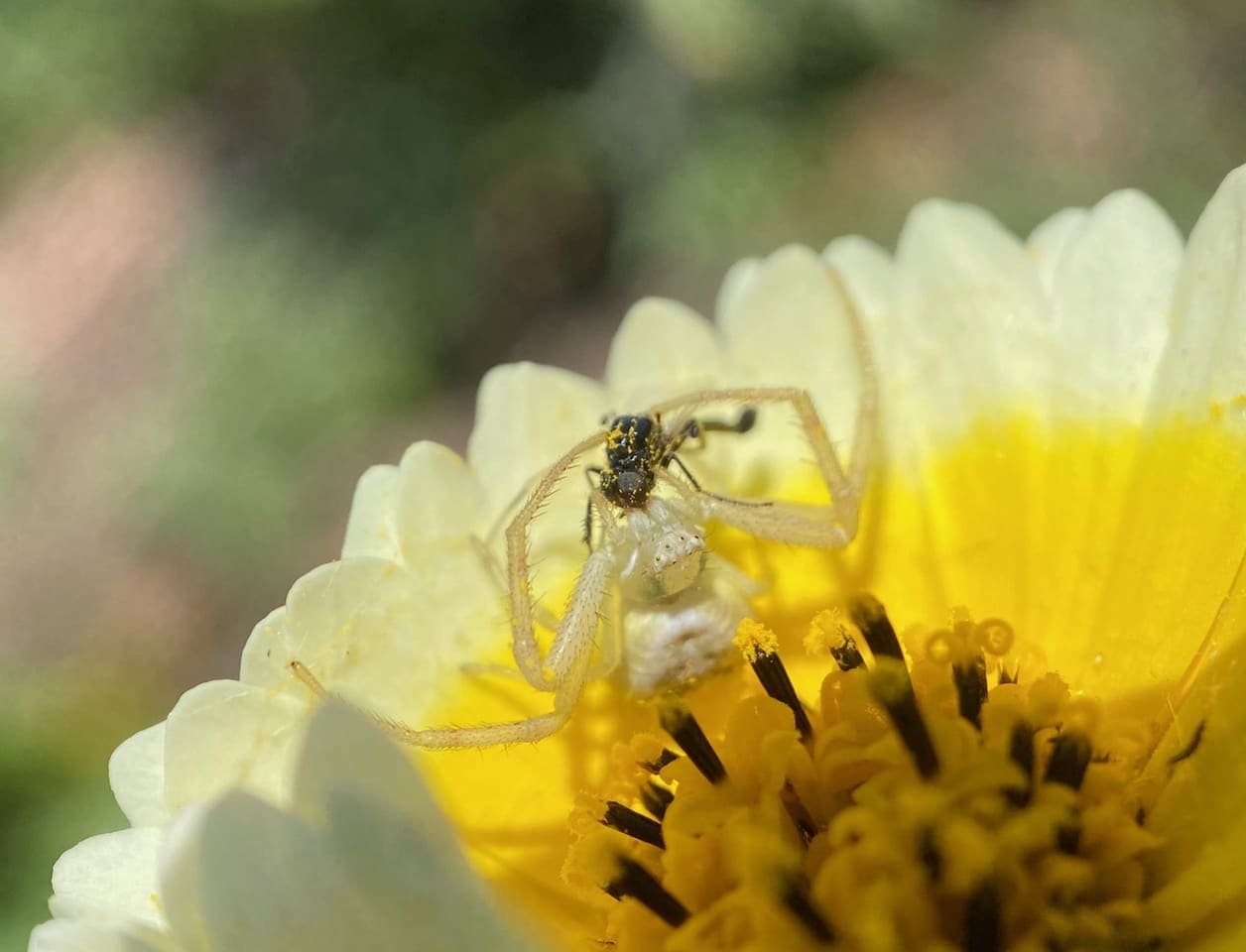
Spiders are generally identified to families by the arrangements of their eyes. Thomisids have two sweeping curves running around the front of the face, with all 8 eyes about the same size and pretty much equally spaced along the curves.
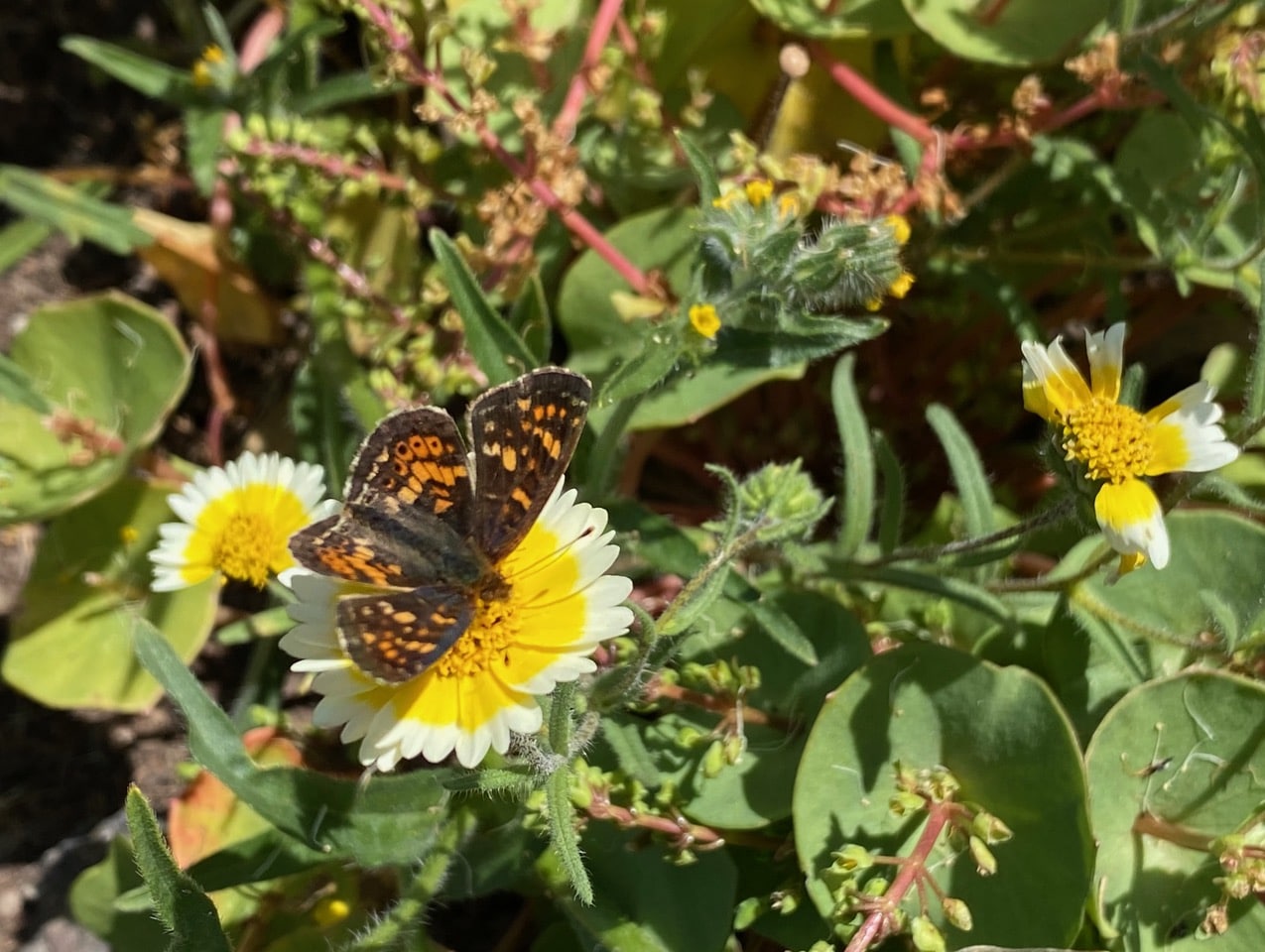 A small butterfly, the Field Crescent, Phyciodes pulchella (family Nymphalidae) lands on a Tidy Tips flowerhead to take nectar.
The caterpillars feed on various asters. Females lay eggs in large clutches on underside of host plant leaves. Young caterpillars often live in a loose web. There are 3-4 flights from April-October in lowland California.
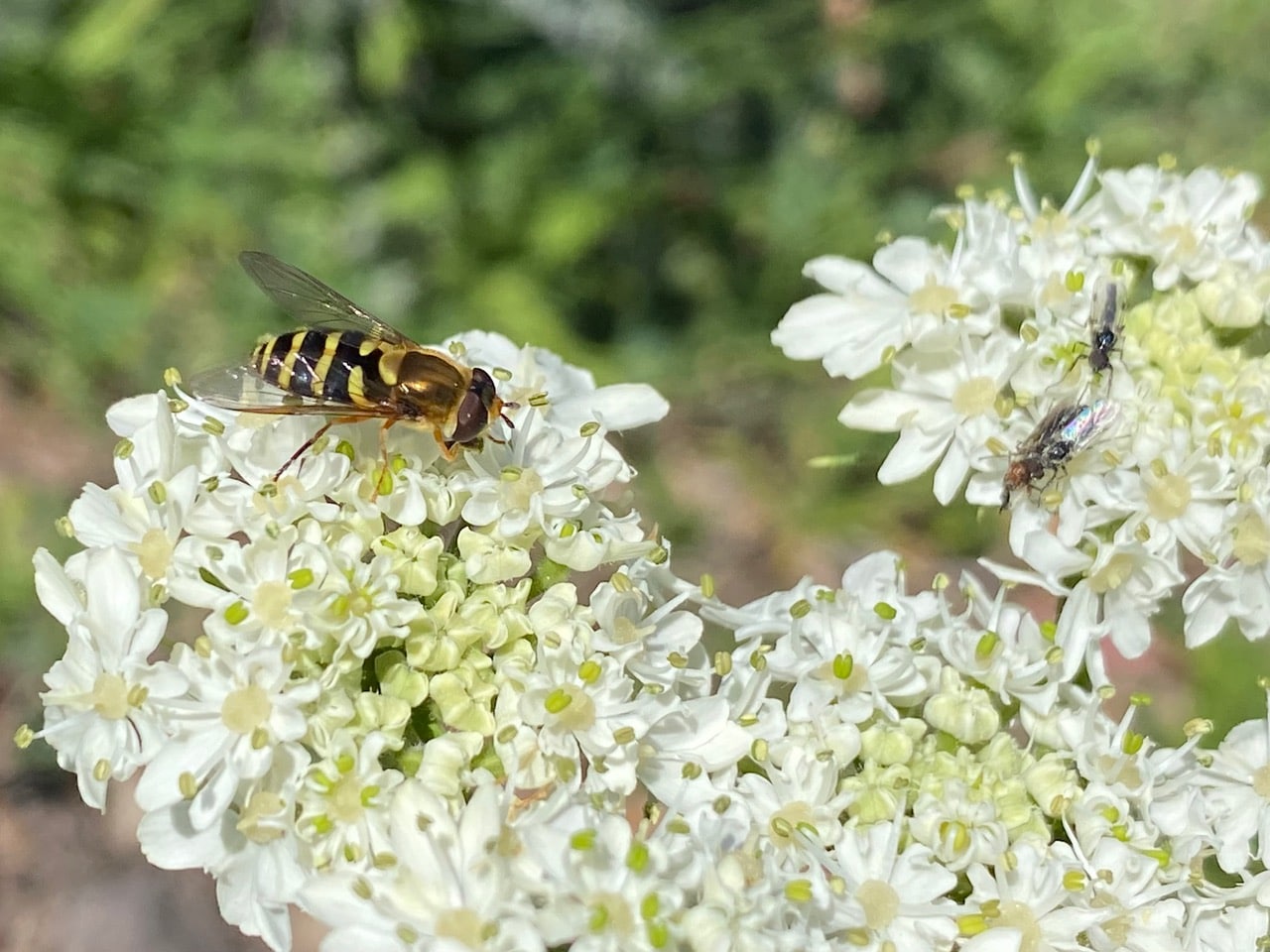
A Black-margined Flower Fly, Syrphus opinator (family Syrphidae) is taking nectar on an umbel of Cow Parsnip flowers, Heracleum maximum. Some of the swarming March Flies, Dilophus sp. (family Bibionidae) have landed to mate on the flat umbels.
The Black-margined Flower Fly, Syrphus opinator is common in central California during winter months. It can be distinguished from similar species by the abdominal fascia restricted to the sides and isolated from the margins. It is the quintessential hover fly that mimics bees or wasps. The black-and-yellow banding on the abdomen serves to ward off potential predators that want to avoid prey with stings – a form of Batesian mimicry.
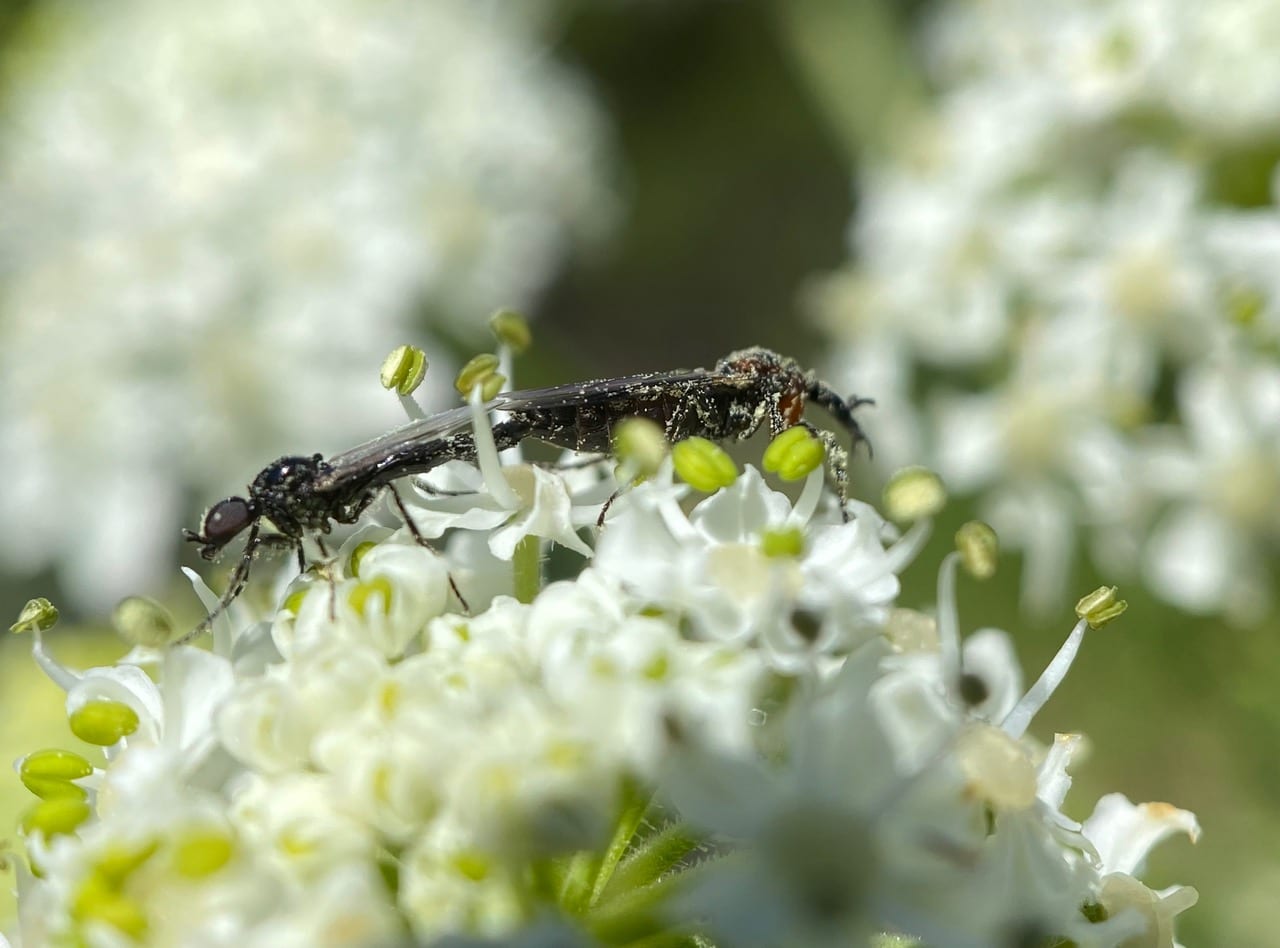
Covered in pollen, a pair of March Flies, Dilophus sp. (family Bibionidae) is mating on Cow Parsnip. The all-black male is on the left, and the bi-colored female on the right.
March Flies (family Bibionidae) generally live in wooded areas and are often found on flowers – adults of some species feed on nectar, pollen, and honeydew, while adults of other species don’t feed at all; and in either case, they are very short-lived. They are considered important pollinators in orchards. They are also important food for other insects and spiders. The larvae feed en masse on rotting organic materials like leaves, wood, compost, and rich soil.
March flies exhibit extreme sexual dimorphism – the sexes are morphologically distinct. The female is usually more colorful, has small eyes on the sides of long, narrow head, while the all-black males have huge eyes that touch in the middle and are split in half horizontally. Scientists speculate that the split makes it easier for them to see the other males that are above and below them in a mating swarm. Males gather in swarms that can blanket the ground and low vegetation. Female are attracted to the party and select mates in the frenzy of fly bodies.

Here’s a different pair in a different mating position. Note the sexual dimorphism. The male has a much bigger head that is occupied mainly by his eyes.
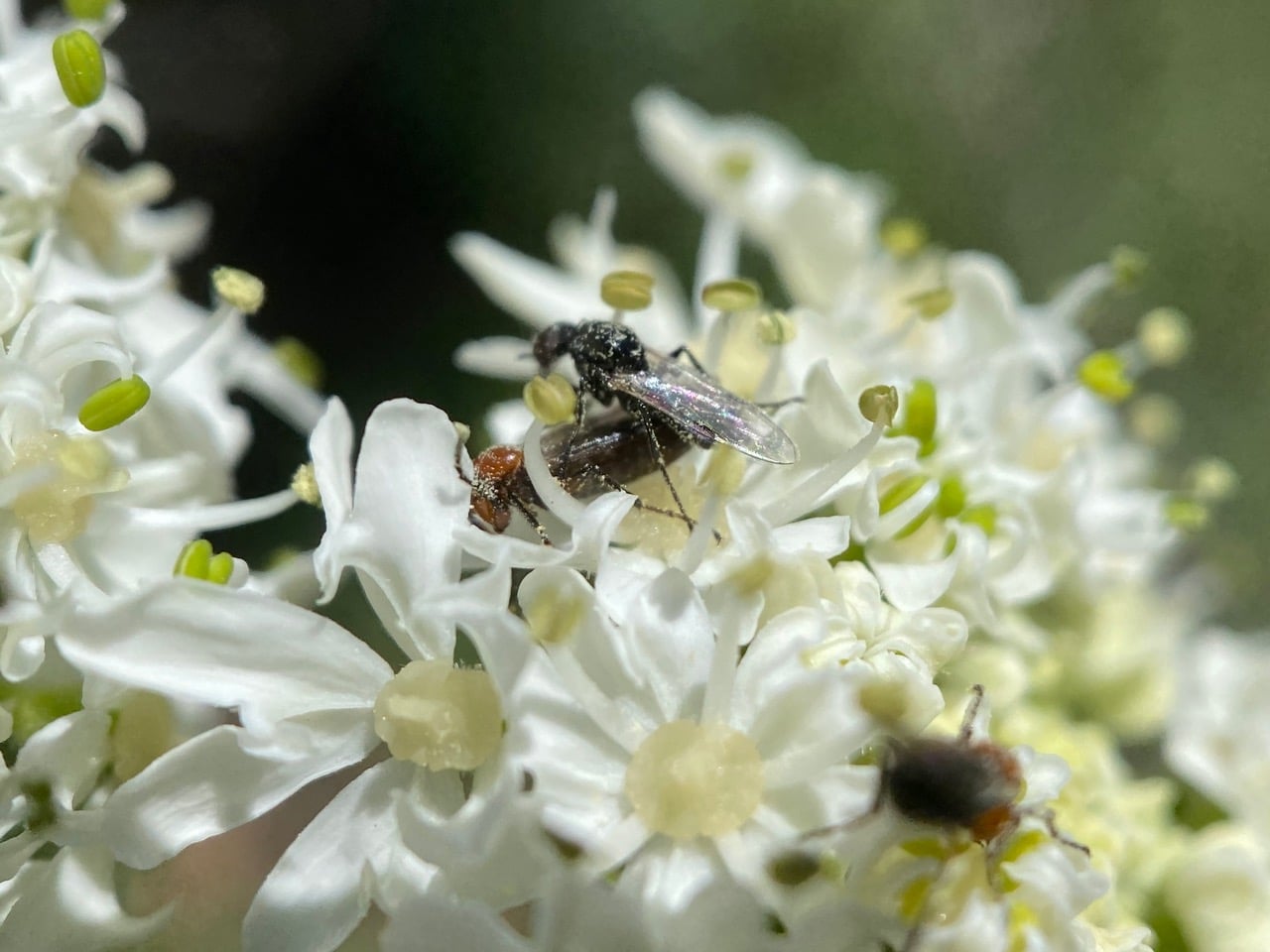
March Flies are mating everywhere, but most conspicuously on the white flowers of Cow Parsnip. The flies are also fond of the easily accessible pollen and nectar offered by these flowers.
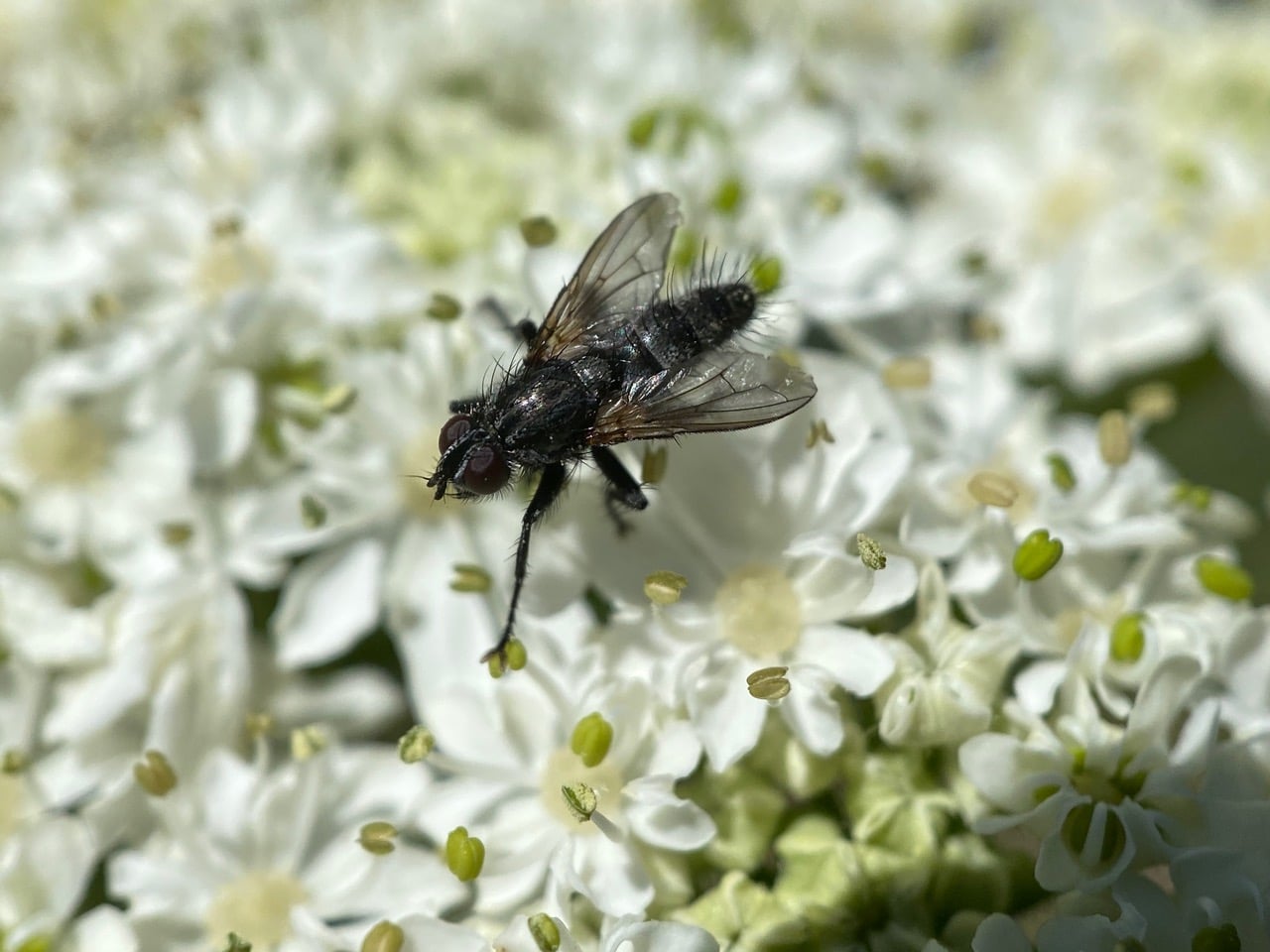 The Woodlouse Fly, Stevenia deceptoria (family Rhinophoridae) is the most common fly visiting the Cow Parsnip flowers these days.
 These small, black, bristly flies are somewhat related to the Tachinidae. The larvae are mostly parasitoids of woodlice (pill bugs), beetles, spiders and other arthropods, and occasionally snails.


A Yellow-faced Bumble Bee, Bombus vosnesenskii (family Apidae) is foraging on a flower of Silverleaf Lupine, Lupinus albifrons. Lupine flowers are dependent on heavy-bodied bees for pollination. At Skyline Gardens, these flowers are frequently visited by the Digger Bees, Anthophora sp. (family Apidae) as well. Like the bumble bees, the digger bees are hefty enough to depress the wing petals of the lupine flowers as they land, making the hidden reproductive structures pop up to hit their bellies with pollen.

A Pasco Cellophane Bee, Colletes consors ssp. pascoensis (family Colletidae) is diving deep into a flower of California Phacelia, Phacelia californica. Because it has a short tongue, the bee struggles to access the sweet stuff.
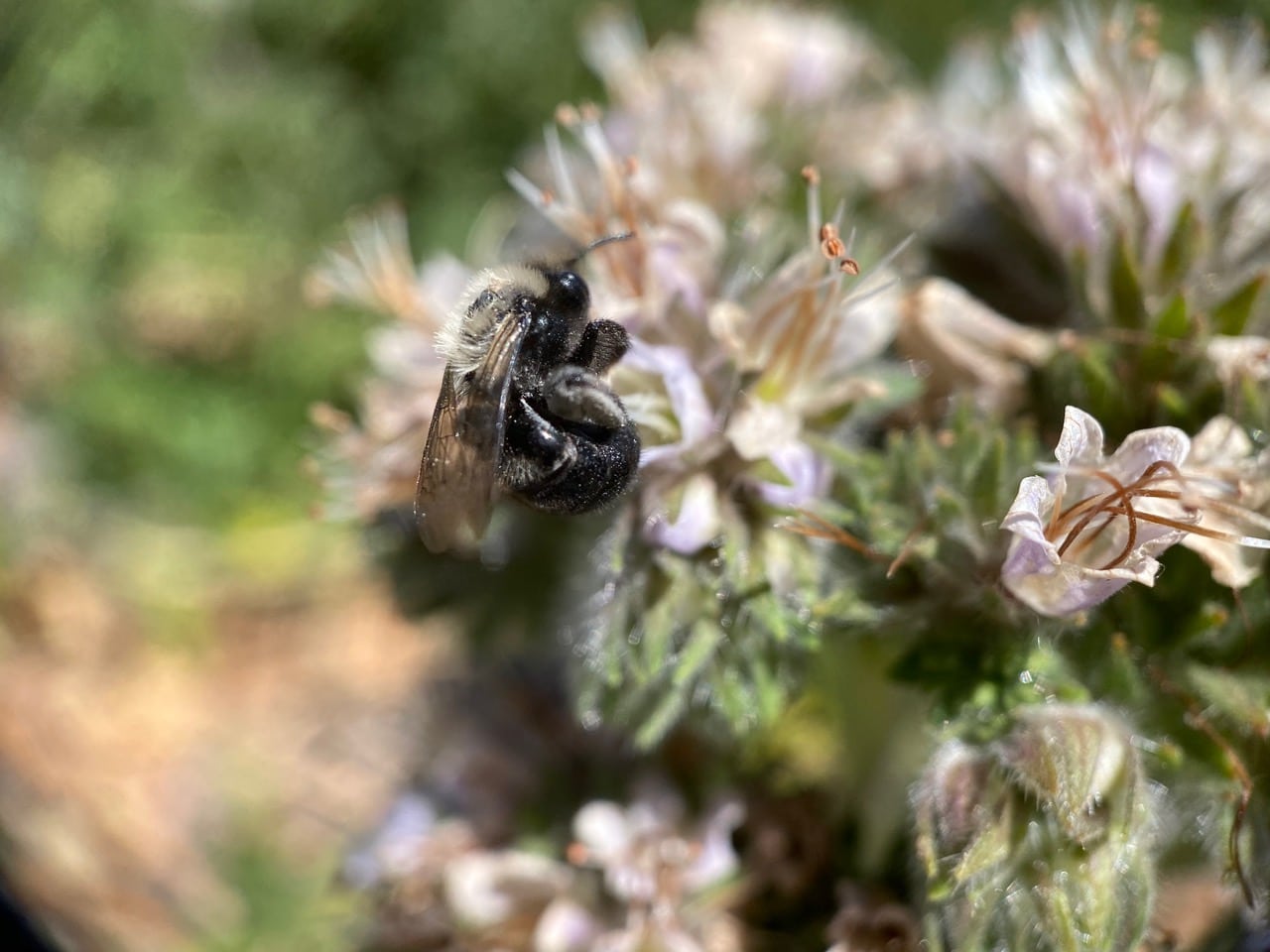
Now the female is collecting phacelia pollen from the anthers. Note that she already has some of the grayish-purple pollen in the scopa on her hind leg.
The bee family Colletidae includes generalists and specialists, and they are likely important pollinators of many wildflowers. All Colletidae in North America are solitary ground nesters, but some species nest in large aggregations. There are two major genera of Colletidae in North America: the Masked Bees (genus Hylaeus) and Cellophane Bees (genus Colletes). The most obvious shared characteristics of Colletidae is also the hardest to see: their short tongue. The eyes of Colletes are angled (rather than being parallel), making the face slightly heart-shaped.
The genus name Colletes means “one who glues”, referring to their habit of applying a glue- or cellophane-like lining to the walls of nest cells, using their specialized tongues. This lining gives rise to their common names: cellophane bees, polyester bees, and plasterer bees. Colletes tongue is unique: short, flat, and forked at the tip. Colletes line their nests with a distinctive cellophane-like substance made from saliva and secretions from the Dufour’s gland on the abdomen. Using their specialized tongue, they paint the walls with saliva, then with secretions from the Dufour’s gland, they add a coat of varnish. This creates a clear covering that is strong, durable, and resistant to mold and water.

A large wasp with orange-red body, dark wings and long antennae is surveying the world from a leaf of California Phacelia. I photographed a similar wasp last year, also on phacelia, but it was never definitively identified, not even to family.
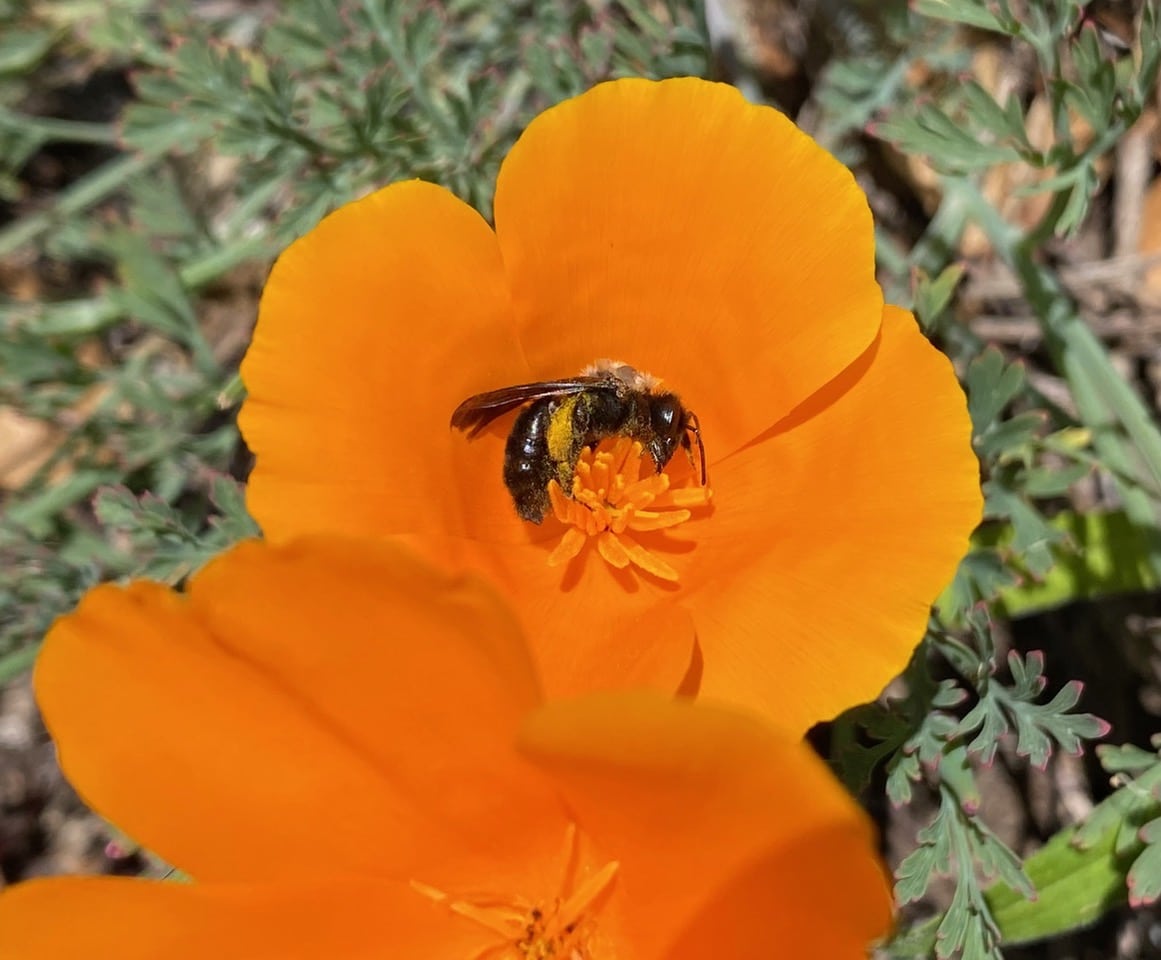
This large Mining Bee, Andrena sp. (family Andrenidae) is often seen collecting pollen on California Poppy, Eschscholzia californica.

Bees in the family Andrenidae, commonly called miner bees or mining bees, are solitary ground-nesters. Andrenids are fairly small bees, usually dark-colored, and often banded. They are identified by the dense bristles (scopae) at the bases of the legs and the shin-like sections (tibias) of the legs, as well as by certain creases and grooves on the face and head and by unique wing venation. Many Andrenids resemble wasps – slender with long abdomen.
Most andrenids are specialist pollinators whose life cycle is timed to correspond precisely to the blooming of specific flowers. Because of this, andrenids are some of the first bees to emerge in spring, and many are active in March and April, as they visit early spring wildflowers.


 A Ladybeetle larva is hunting on an immature inflorescence of California Phacelia.
 Ladybeetles go through complete metamorphosis, which comprises four stages: eggs, larva, pupa and adult. The larva goes through four molts during their development. Often described as miniature alligators with six legs, the larvae are voracious predators of aphids. Each larva can eat about 400 aphids in the three weeks before it pupates. Besides aphids, they also feed on soft scales, whitefly pupae, thrips, and spider mites.
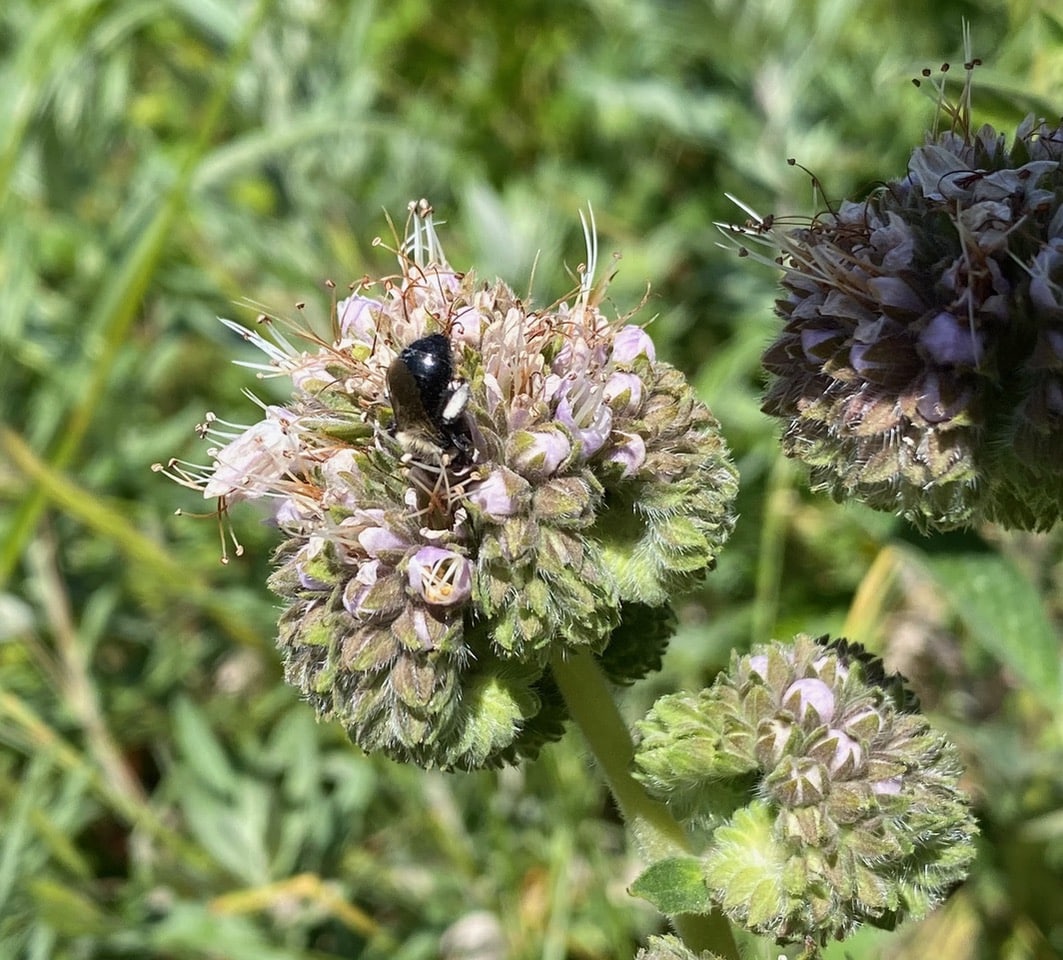
This is how one normally finds the Pasco Cellophane Bee, Colletes consors ssp. pascoensis (family Colletidae) – with her butt sticking out of a phacelia flower. The short-tongued bee has to reach in deep to access the nectar.
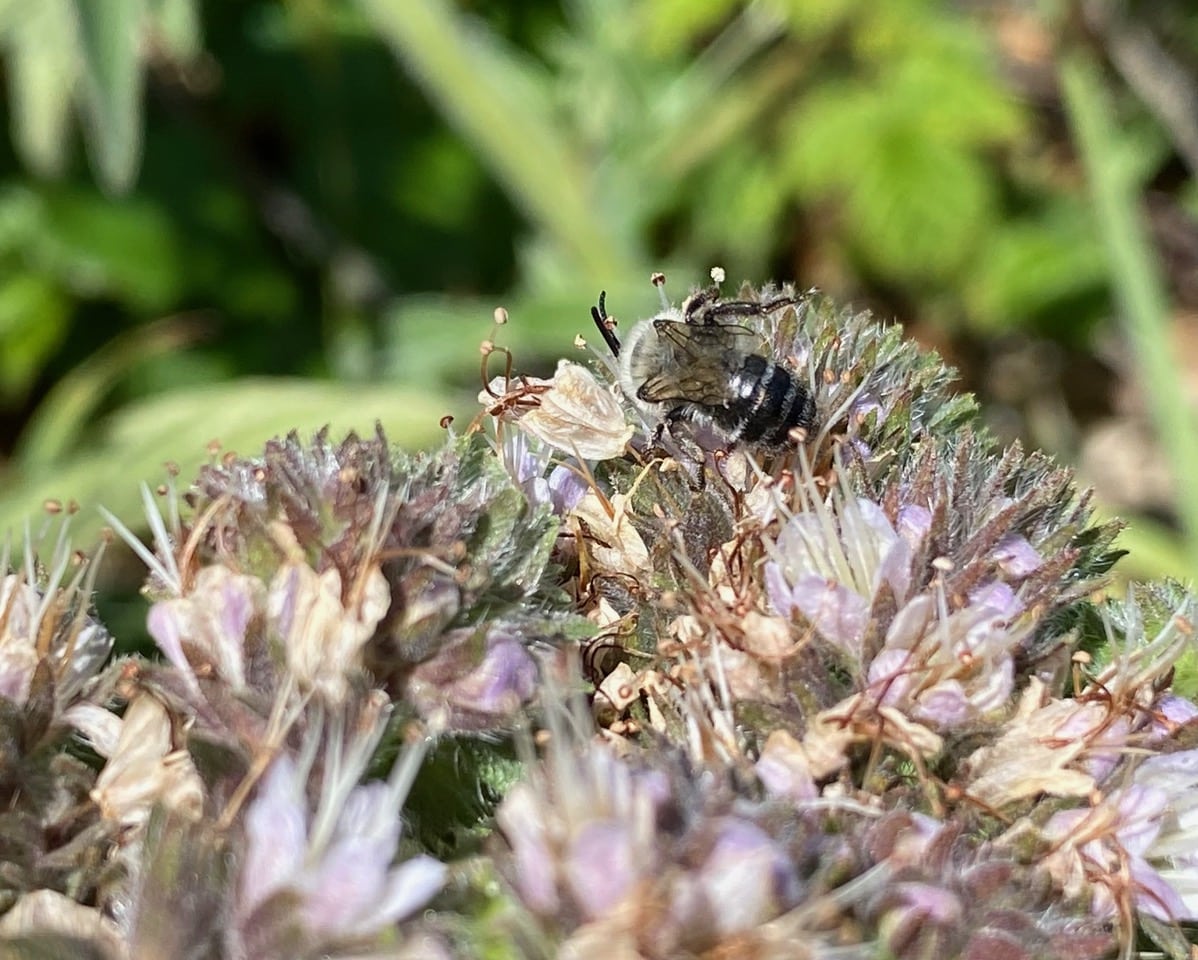
Hey, that’s a male bee with long antennae and no scopa on the hind legs. A male Pasco Cellophane Bee?

The bee is behaving just like the female Pasco Cellophane Bee – diving for nectar. But he has white hairs on his abdomen while the females don’t, and he seems larger in size. Perhaps he is a Mining Bee (family Andrenidae) – those are short-tongued too.
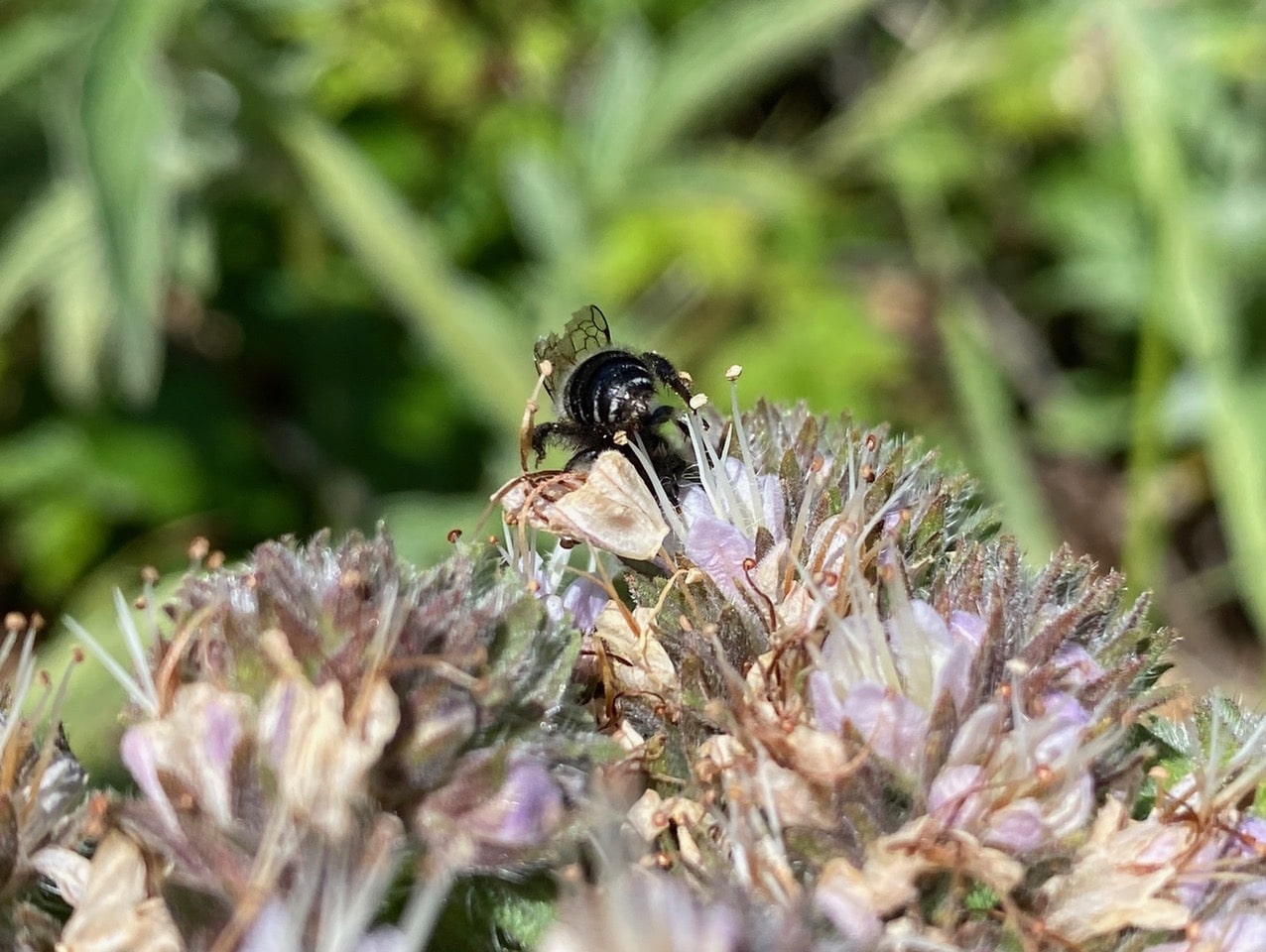
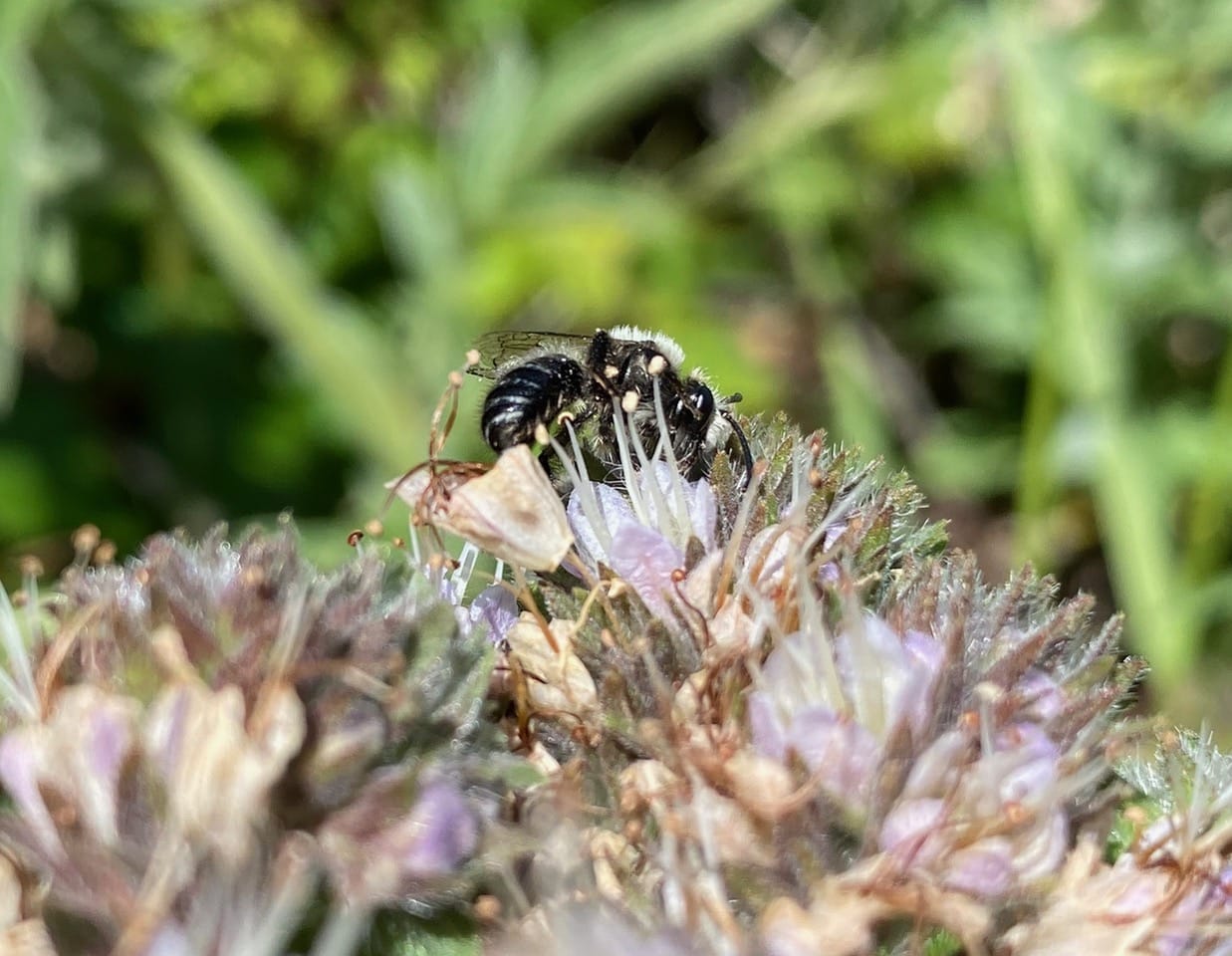
Like many male bees, this one has a big tuft of hair on his face.
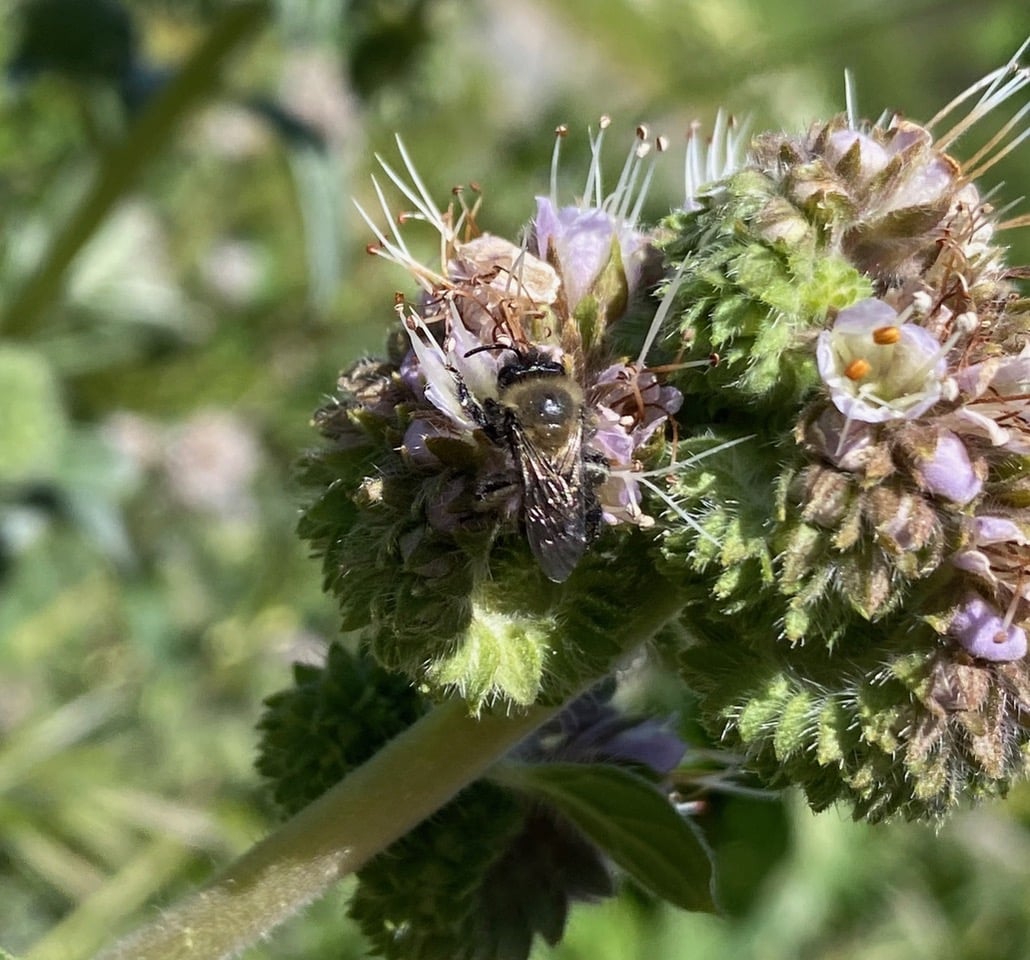
A female Pasco Cellophane Bee, Colletes consors ssp. pascoensis (family Colletidae) lands on an inflorescence of California Phacelia.

The bee dives into a phacelia flower to take nectar with her short tongue.


The Colletes female proceeds to collect pollen from the protruding stamens of phacelia. Note the grayish-purple pollen in the scopa of her hind leg.
 A Secondary Screwworm Fly is seeking nectar on a flower umbel of Cow Parsnip. These beautiful flies are usually ignored, because they are common, and because they are associated with carrion and scat.
 The Secondary Screwworm, Cochliomyia macellaria (family Calliphoridae, commonly known as blow flies) ranges throughout the United States and the American tropics. The body is metallic greenish-blue and characterized by three black longitudinal stripes on the dorsal thorax. Females are attracted to carrion where they lay their eggs. These screwworms are referred to as “secondary” because they typically infest wounds after invasion by primary myiasis-causing flies. While the flies carry various types of Salmonella and viruses, C. macellaria can also serve as important decomposers in the ecosystem. In a lifetime, a female may lay up to 1000 or more eggs. Females may also lay their eggs with other females, leading to an accumulation of thousands of eggs. The larval stage of C. macellaria is referred to by the common name of secondary screwworms; this is due to the presence of small spines on each body segment that resemble parts of a screw. The larvae feed on the decaying flesh of the animal that they have been laid on until they reach maturity. Eventually the larvae fall off the food source to pupate in the top layer of the soil. Adult females will continue to feed on tissues of animals; however, now they preferentially feed off of live tissues and tissue plasma. Adult males will no longer consume tissue, but instead will eat nearby vegetation and take nourishment from floral nectar.
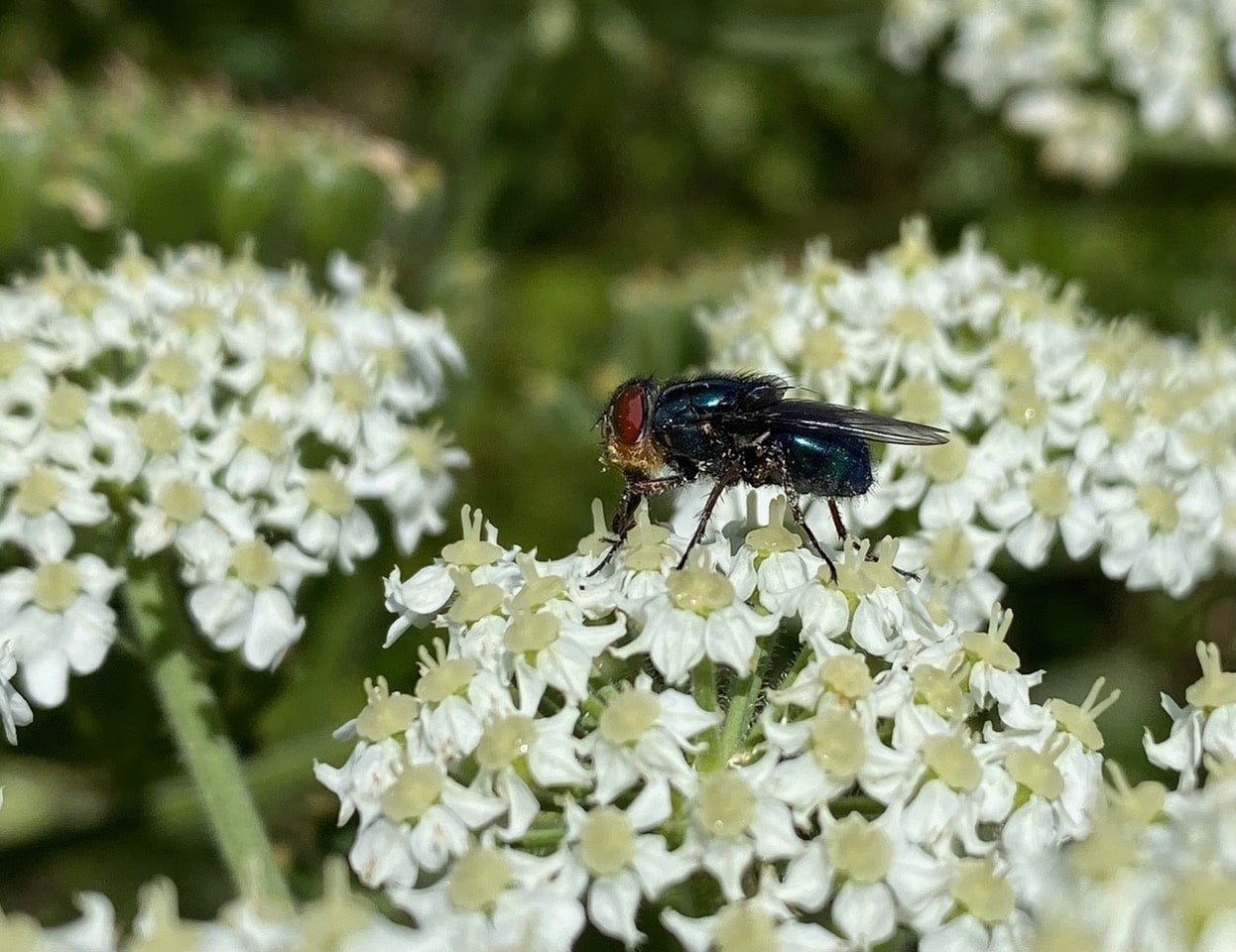
We tend to place insects in neat categories – pollinators, decomposers/recyclers, predators, parasites, etc. The truth of the matter is that many insects, especially flies, serve various ecological functions in a single life time. They may function as a recycler of organic matter as a larva, then as pollinator as an adult, just like this Secondary Screwworm. Insect “pollinators” do not transfer pollen intentionally for the plant. Most pollination happens inadvertently as the insect goes about foraging, taking care of its own needs. The happy “coincidence” persists in evolution because it is beneficial to both plant and insect. Mutualism rocks!