

Pollinator Post 5/6/24 (1)
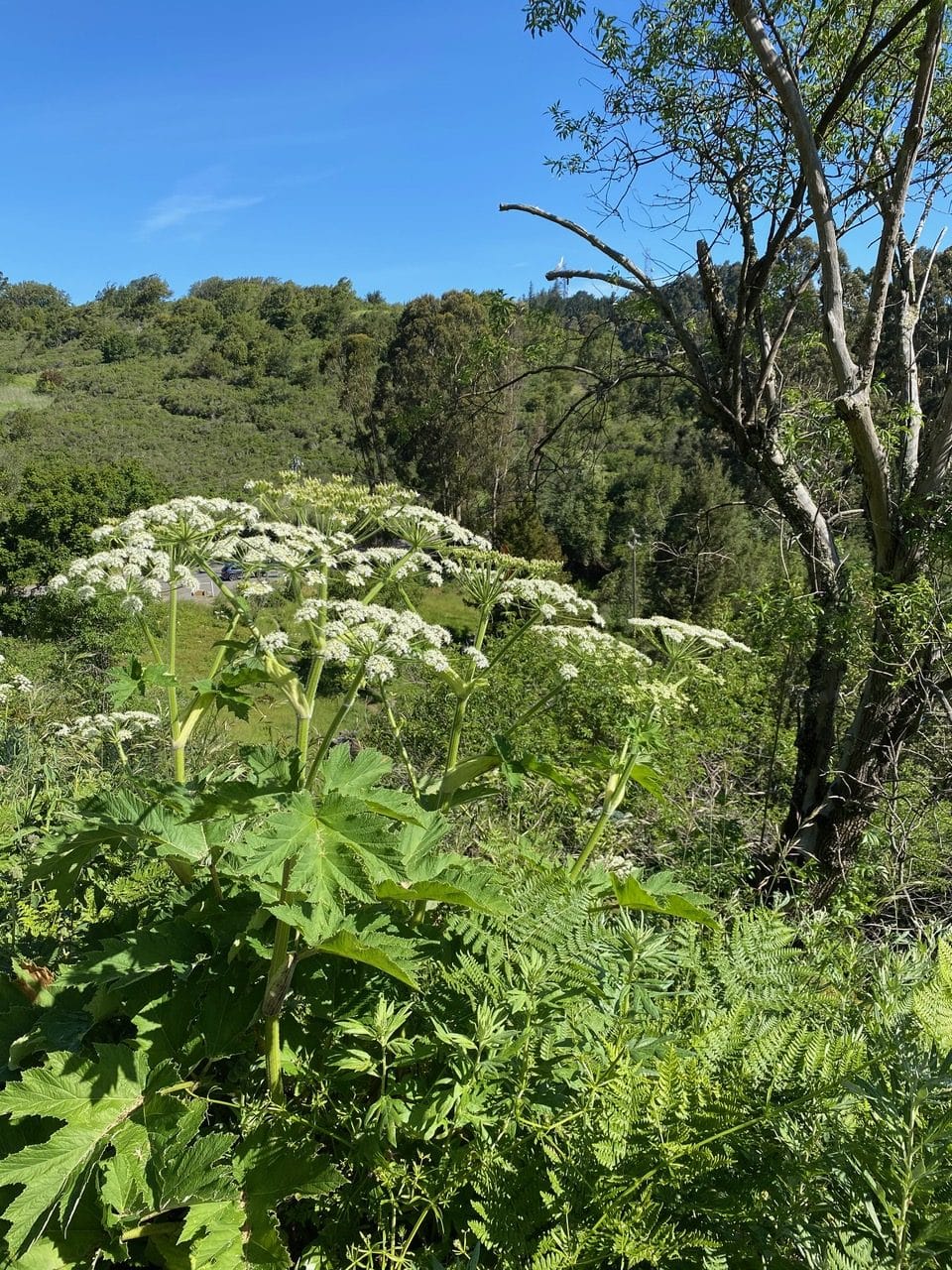
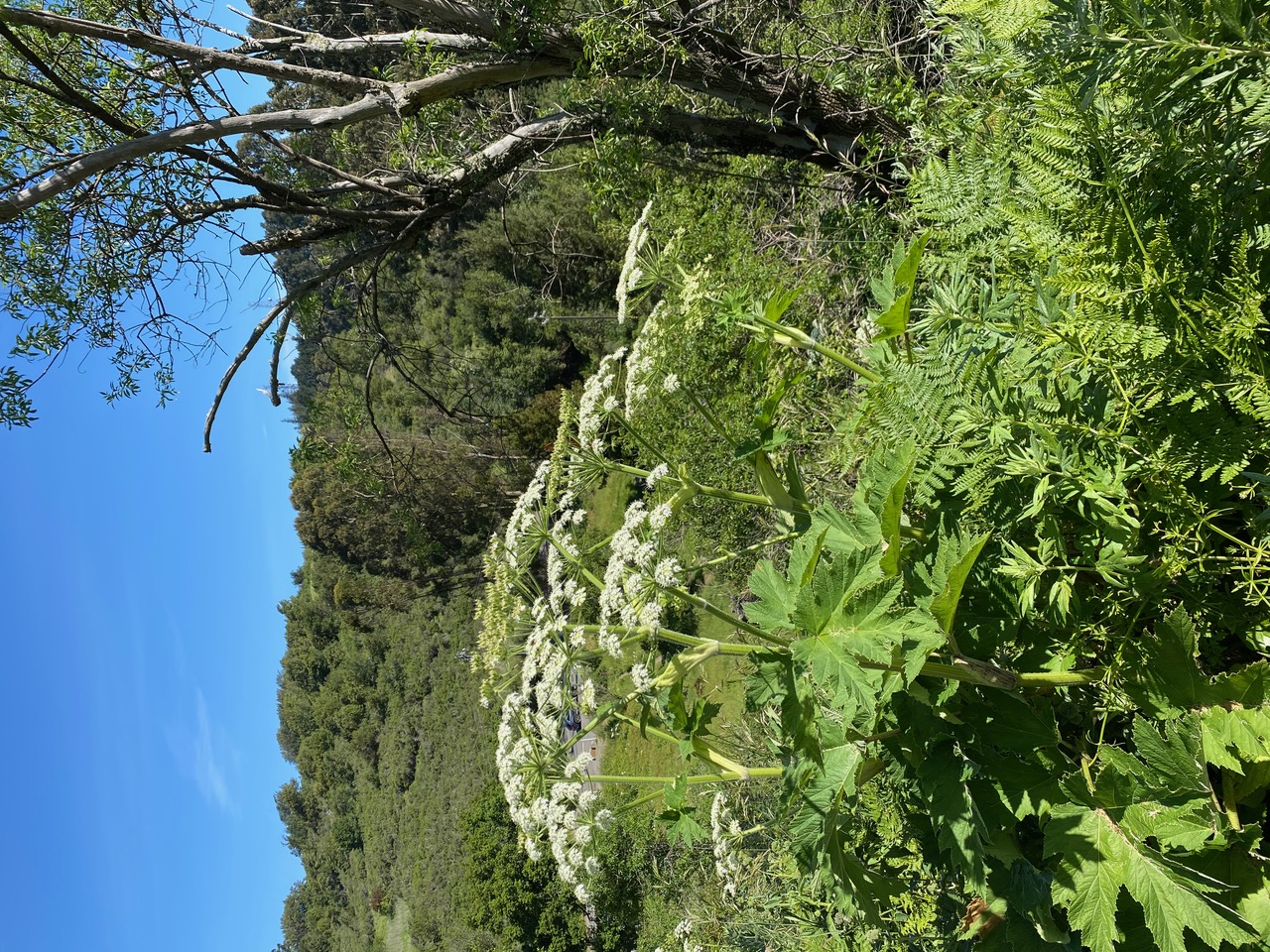
After the rain two days ago, I am ready to explore Skyline Gardens again. The air is cool and fresh, and everything seems to sparkle.
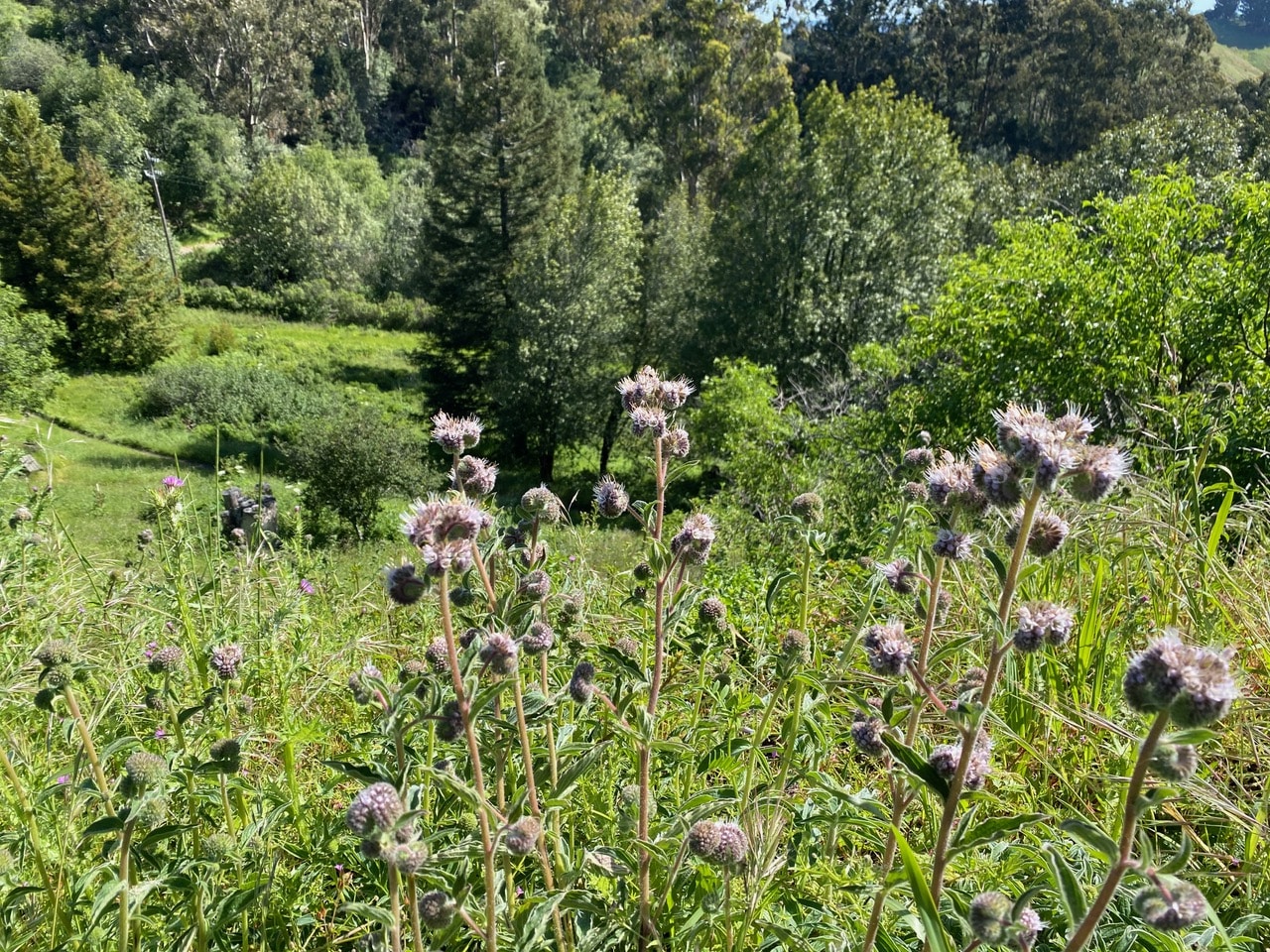
The road up to the Radio Tower from Siesta Gate is lined with blooming California Phacelia, Phacelia californica.

A Fire-colored Beetle, Pedilus sp. (family Pyrochroidea) is perched on a leaf tip of California Mugwort, Artemisia douglasiana, its prominent antennae waving.
Like all beetles, Fire-colored Beetles have chewing mouthparts and hardened front wings (elytra) that meet in a straight line down the back of the abdomen when closed. Most Pyrochroidae have dark elytra and many are marked with orange or red on the head, legs, or thorax. Some species are orange all over their bodies, hence the common name for the family. Both the head and thorax are narrower than the elytra, and there’s a neck-like constriction behind the head. Many males have pectinate (comb-like) or antler-like antennae. Adult Pedilus are found on vegetation or flowers, feeding on nectar and pollen. Larvae live under loose bark and in rotting wood, where they feed on fungi.
The most notable thing about Pedilus is their affinity for cantharidin, a caustic defense chemical produced by Blister Beetles (family Meloidae). Adult Pedilus seek out Blister Beetles, climb onto them and lick off the cantharidin the Blister Beetles exude. The male Pedilus uses the blistering agent to court females. Upon mating, most of the cantharidin is transferred to the female in the form of a sperm packet. The cantharidin-coated eggs that the female subsequently lays are protected from egg predators.
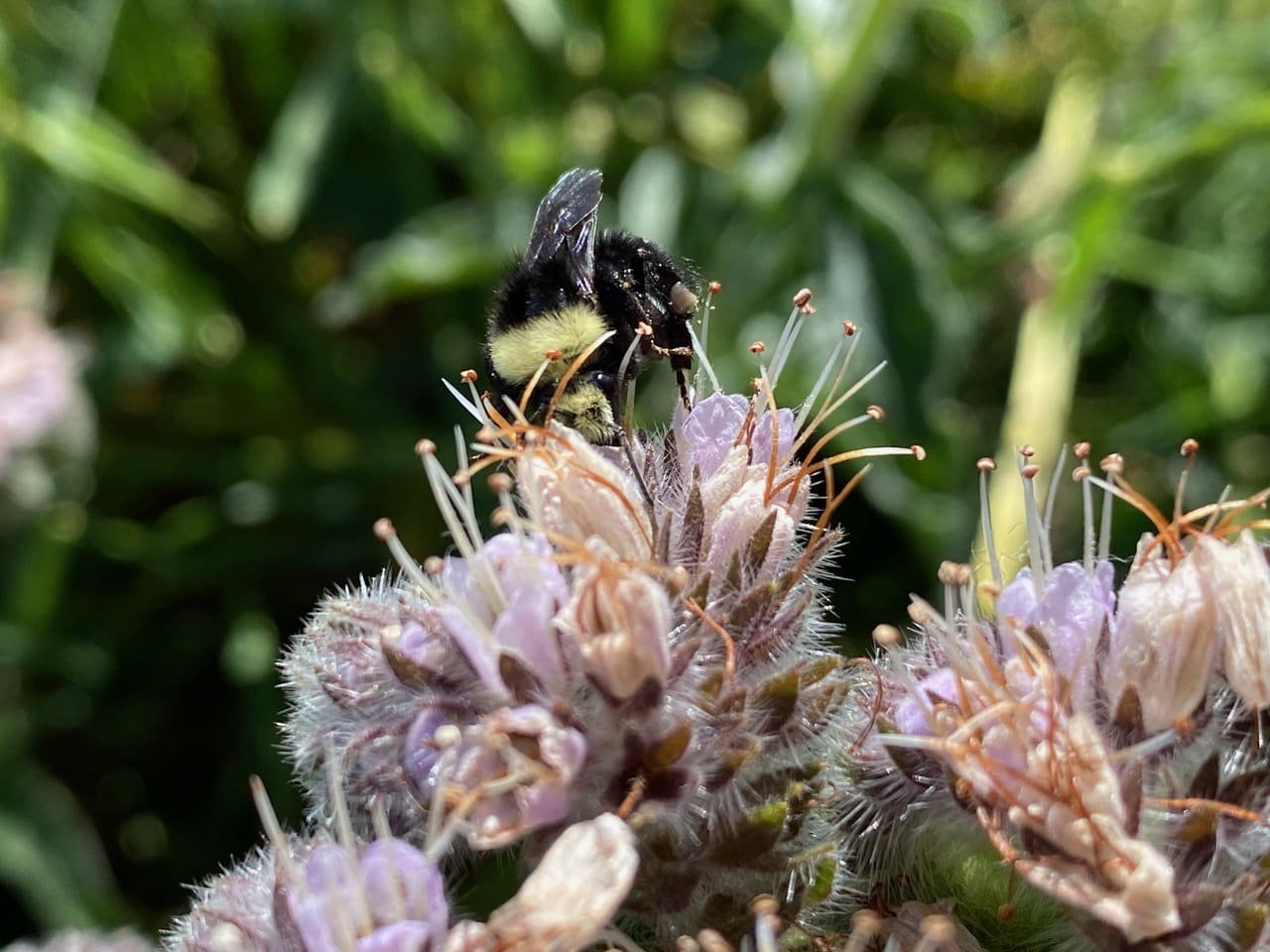
A Yellow-faced Bumble Bee, Bombus vosnesenskii (family Apidae) is taking nectar from a flower of California Phacelia, Phacelia californica. There are many worker bees out today, some of the smallest I have ever seen, all foraging in earnest.
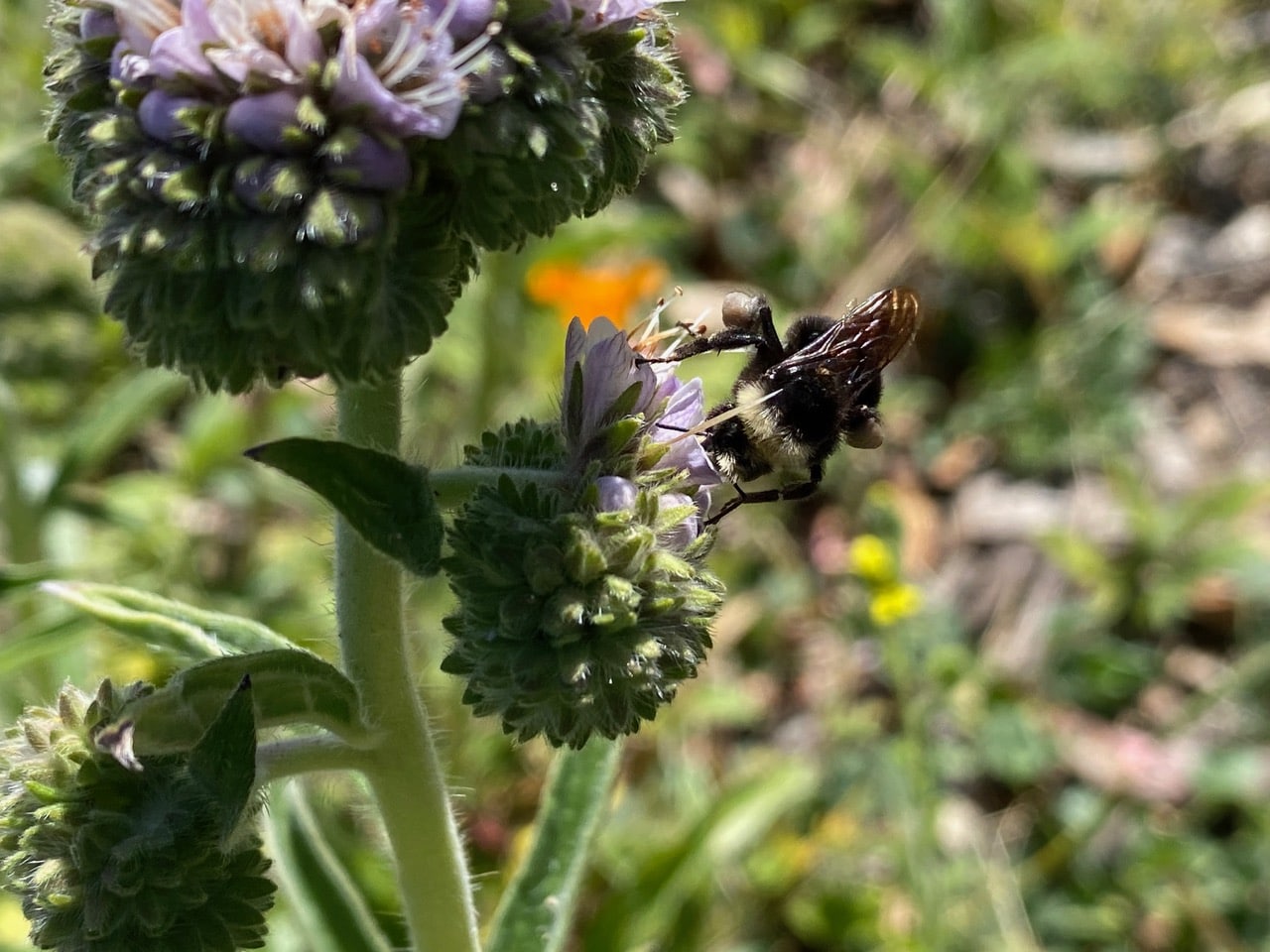
The Bumble Bees are gathering both nectar and pollen from the phacelia flowers. Note that the pollen in this bee’s pollen baskets are a dirty, gray-purple color. It is gathered from the phacelia anthers and mixed with nectar while being packed into the pollen baskets. The content of the pollen baskets has a moist, putty-like consistency, and appears darker than dry pollen. Pollen is rich in proteins, necessary nutrients for growing larvae. Nectar is an energy source for fueling the activities of the bees.
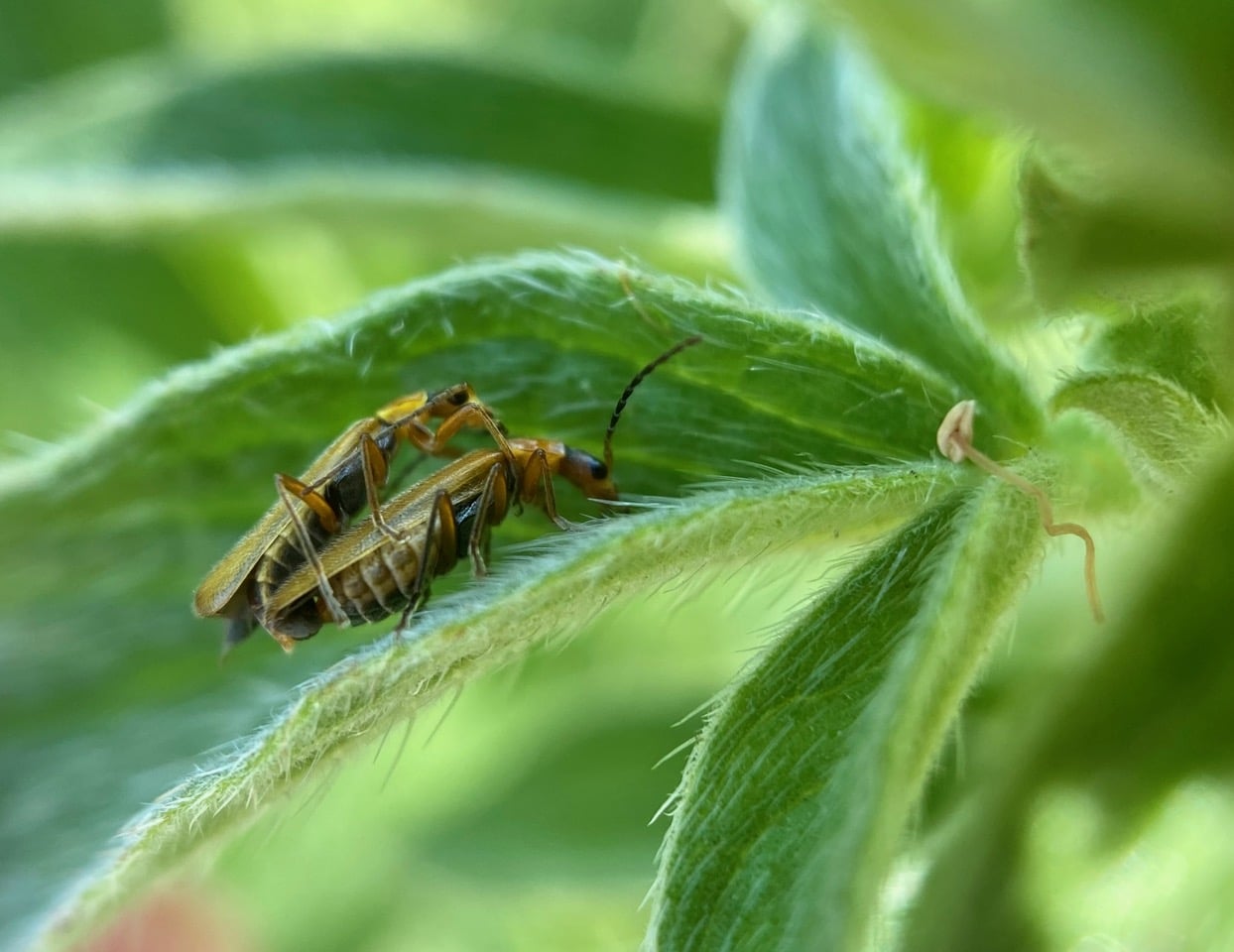
Hidden in the shade, a pair of Soldier Beetles, Dichelotarsus cavicollis (family Cantharidae), (formerly Podabrus cavicollis) are mating on a leaf of California Phacelia. Note that the female is larger. She is also gravid – her abdomen swollen with eggs.
The Soldier Beetles, family Cantharidae are relatively soft-bodied, straight-sided beetles. One of the first described species has a color pattern reminiscent of the red coats of early British soldiers, hence the common name. They are also known commonly as Leatherwings because of their soft elytra. Soldier beetles often feed on both nectar and pollen as well as predating on other small insects. The larvae are often active, and feed on the ground, hunting snails and other small creatures. Soldier beetles are generally considered beneficial insects by gardeners.
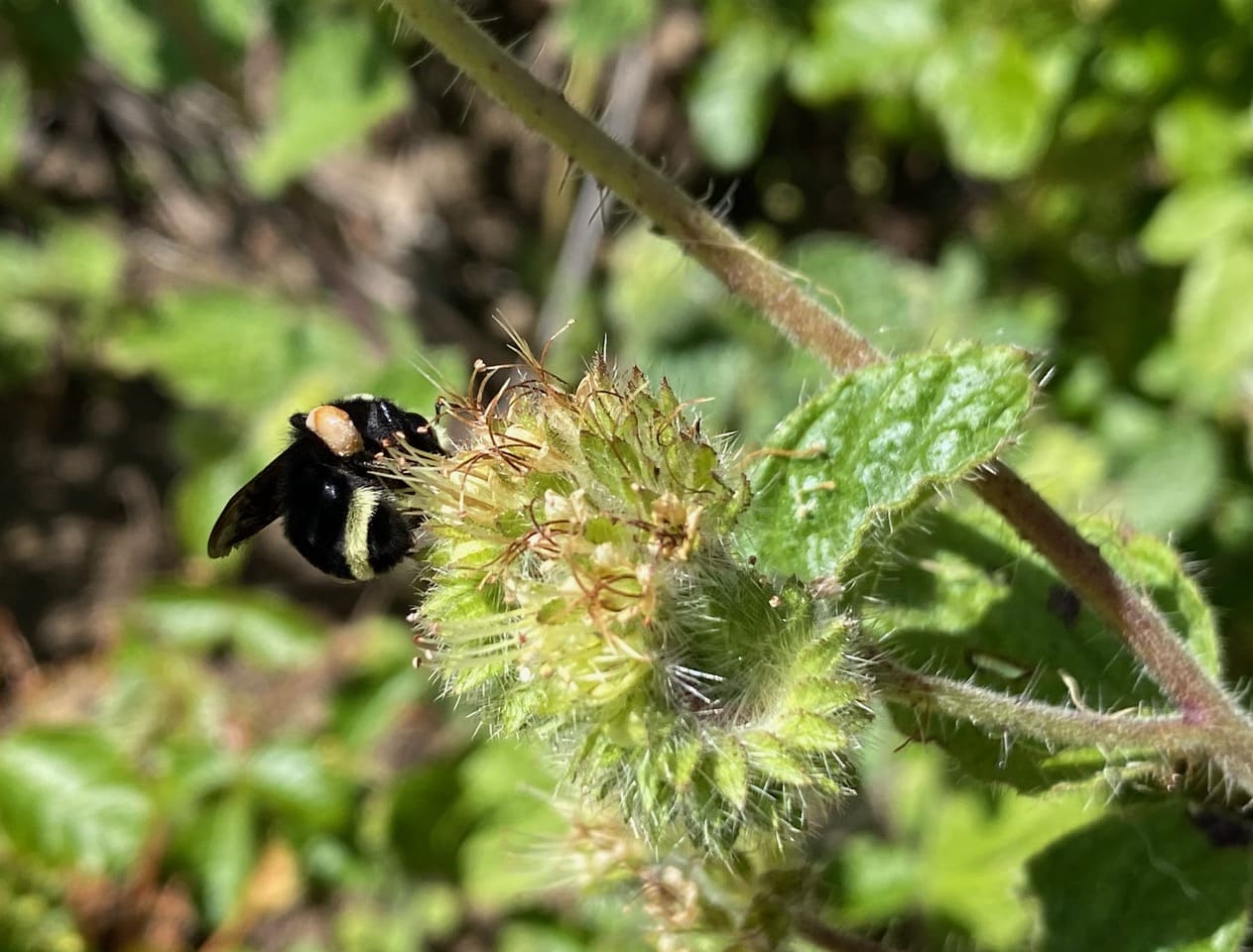
A Yellow-faced Bumble Bee, Bombus vosnesenskii (family Apidae) is foraging on an inflorescence of Imbricate Phacelia, Phacelia imbricata. The cream-colored flowers of Imbricate Phacelia fades soon after opening and the stamens quickly turn brown, but they do not seem to be less attractive to the pollinators.
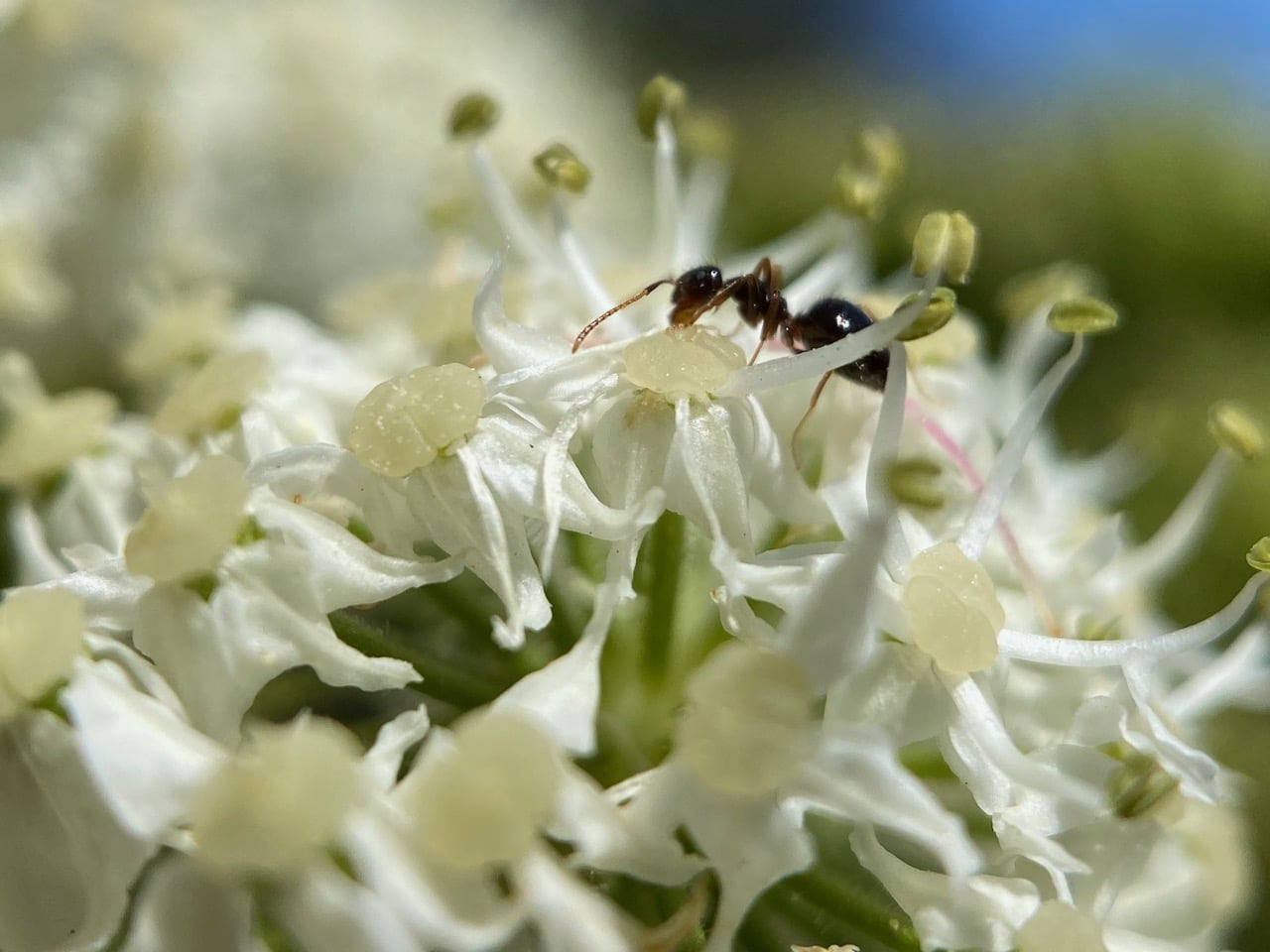
An American Winter Ant, Prenolepis imparis (family Formicidae) is feeding on the succulent style base of a Cow Parsnip flower, Heracleum maximum. The focus of most insect visitors, the white swollen style bases are probably where the nectar is produced. They are often mistaken for ovaries, but Cow Parsnip, like all members of the carrot family, Apiaceae, have inferior ovaries that are located below the perianths (calyx and corolla).
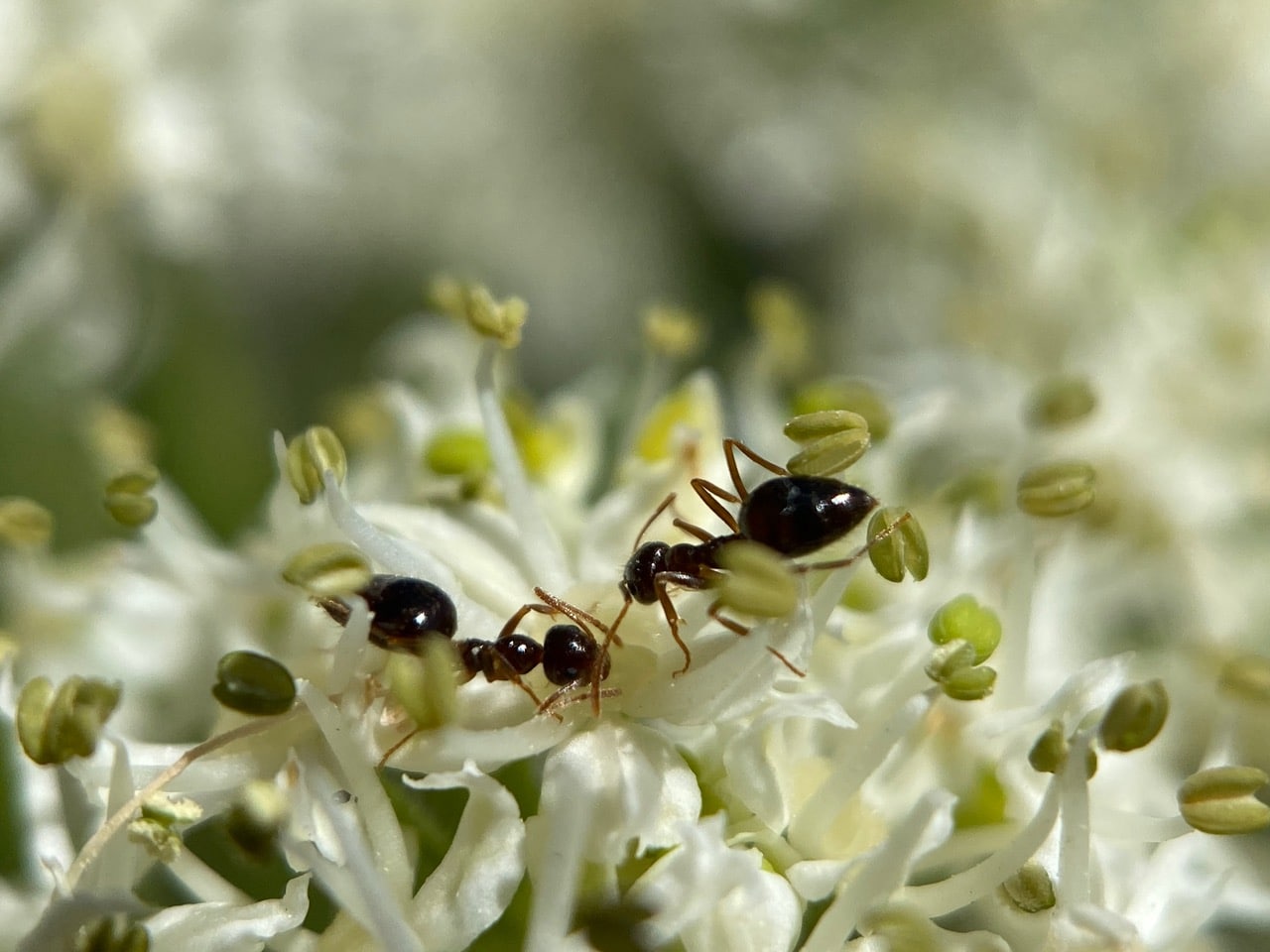
The American Ant, Prenolepis imparis (family Formicidae) is a widespread North American ant. A dominant woodland species, it is most active during cool weather, when most other ant species are less likely to forage. This species is one of a few native ants capable of tolerating competition with the invasive Argentine Ant, Linepithema humile. They are also aggressive toward other ants and produce abdominal secretions that are lethal to Argentine Ants. Prenolepis imparis is a generalist omnivore. Foragers are known for tending to aphids or scale insects from which they consume excreted honeydew, aggregating on rotting fruit, and exploiting protein-rich sources such as dead worms. The colony enters estivation (a hibernation-like state) and becomes inactive above ground for the warmer months, during which time eggs are laid and brood are reared. Reproductives overwinter and emerge on the first warm day of spring for their nuptial flight.
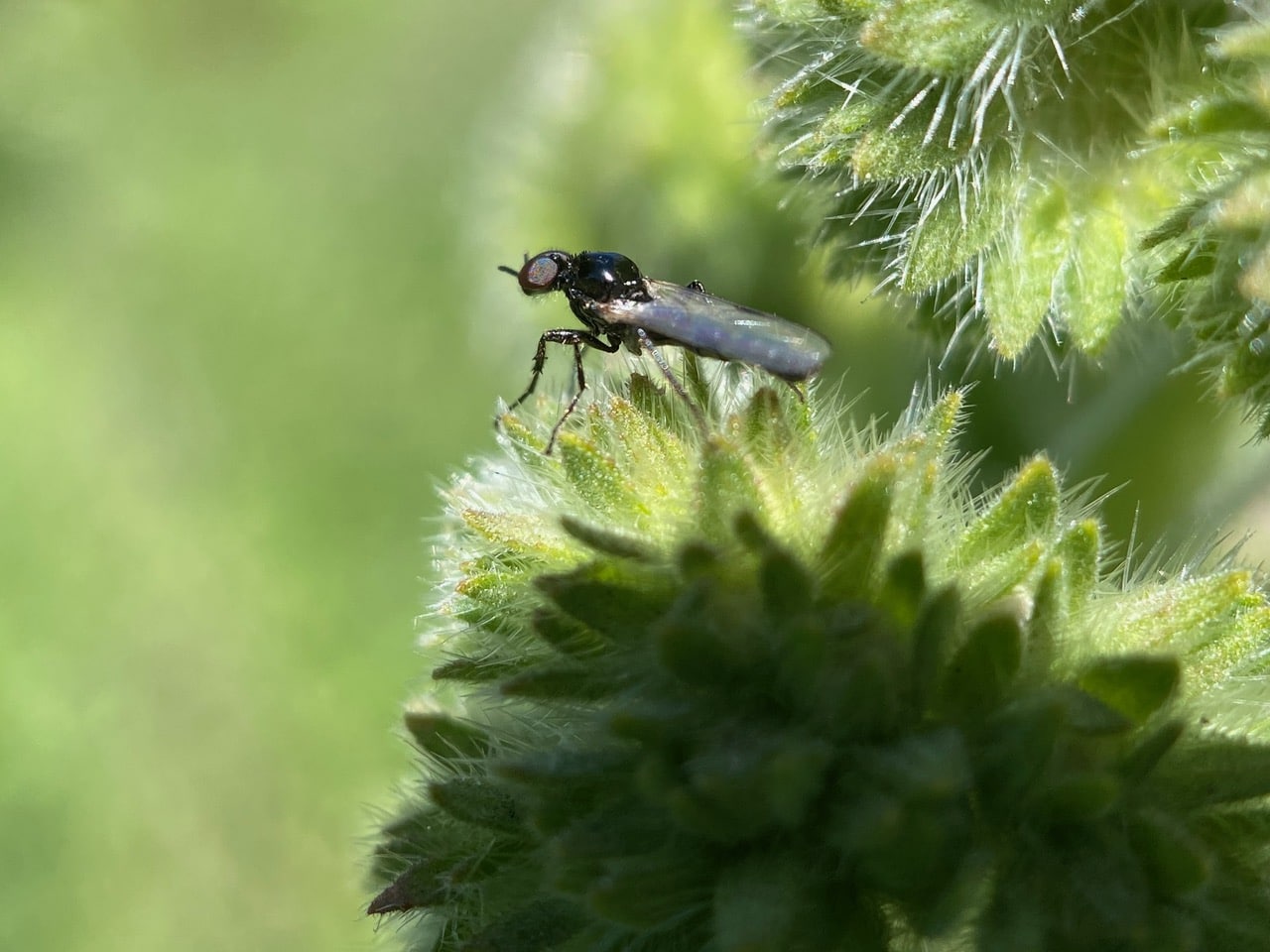
A male March Fly, Dilophus sp. (family Bibionidae) has landed on an immature inflorescence of California Phacelia. Mating swarms of the insects are dancing over all the tall vegetation – the Coyote Brush, the Silverleaf Lupine and the Phacelia.
March Flies (family Bibionidae) generally live in wooded areas and are often found on flowers – adults of some species feed on nectar, pollen, and honeydew, while adults of other species don’t feed at all; and in either case, they are very short-lived. They are considered important pollinators in orchards. They are also important food for other insects and spiders. The larvae feed en masse on rotting organic materials like leaves, wood, compost, and rich soil.
March flies exhibit extreme sexual dimorphism – the sexes are morphologically distinct. The female is usually more colorful, has small eyes on the sides of long, narrow head, while the all-black males have huge eyes that touch in the middle and are split in half horizontally. Scientists speculate that the split makes it easier for them to see the other males that are above and below them in a mating swarm. Males gather in swarms that can blanket the ground and low vegetation. Female are attracted to the party and select mates in the frenzy of fly bodies.
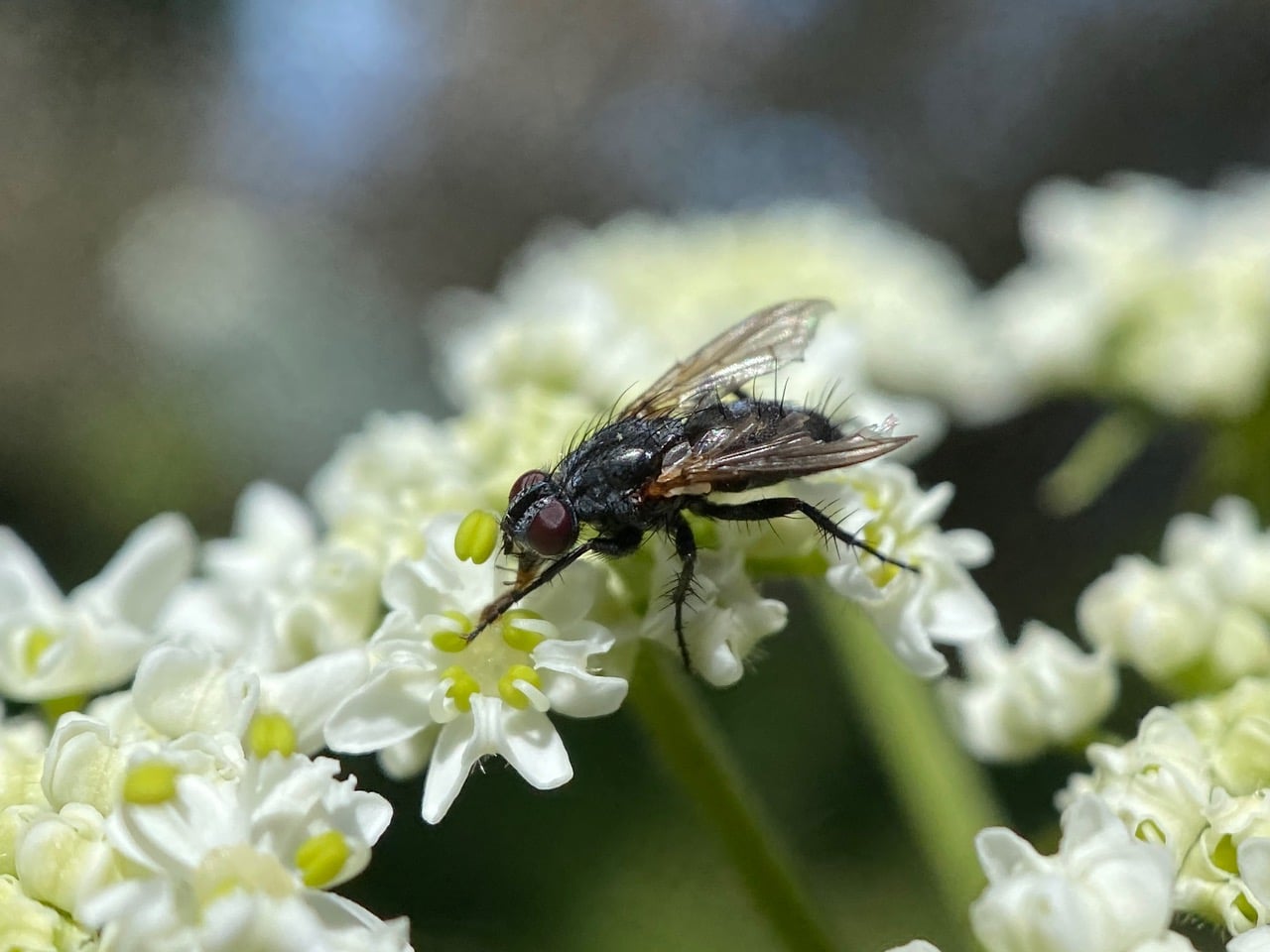
The Woodlouse Flies, Stevenia deceptoria (family Rhinophoridae) are everywhere today, especially on the Cow Parsnip flowers. I guess we have enough pill bugs at the garden to support a large population of their parasitoids.
These small, black, bristly flies are somewhat related to the Tachinidae. The larvae are mostly parasitoids of woodlice (pill bugs), beetles, spiders and other arthropods, and occasionally snails.

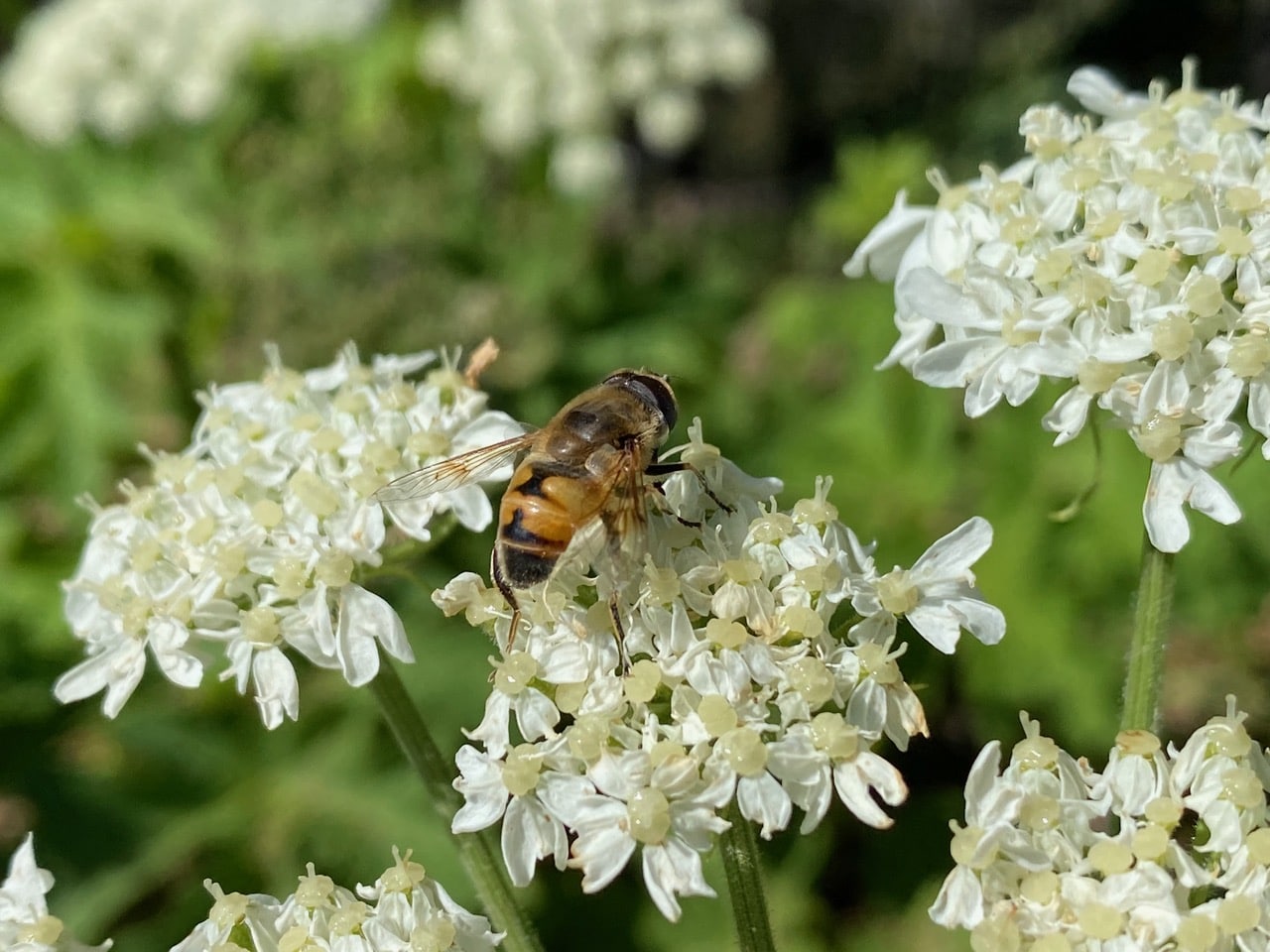 From the back, the Common Drone Fly, Eristalis tenax (family Syrphidae) could easily be mistaken for a Honey Bee. Of all the hover flies, this species best mimics the Honey Bee. Both the bee and its mimic hail from Europe.
 Why would a fly evolve to look like a bee? Any animal will think twice before attacking a bee because the bee can sting, and it can bring the wrath of the whole colony upon a predator. The fly is stingless and otherwise defenseless. This kind of mimicry is called Batesian Mimicry, after the English naturalist, Henry Walter Bates. Both the Honey Bee and the Drone Fly are originally from Europe. It makes sense that both insects evolved in the same place.
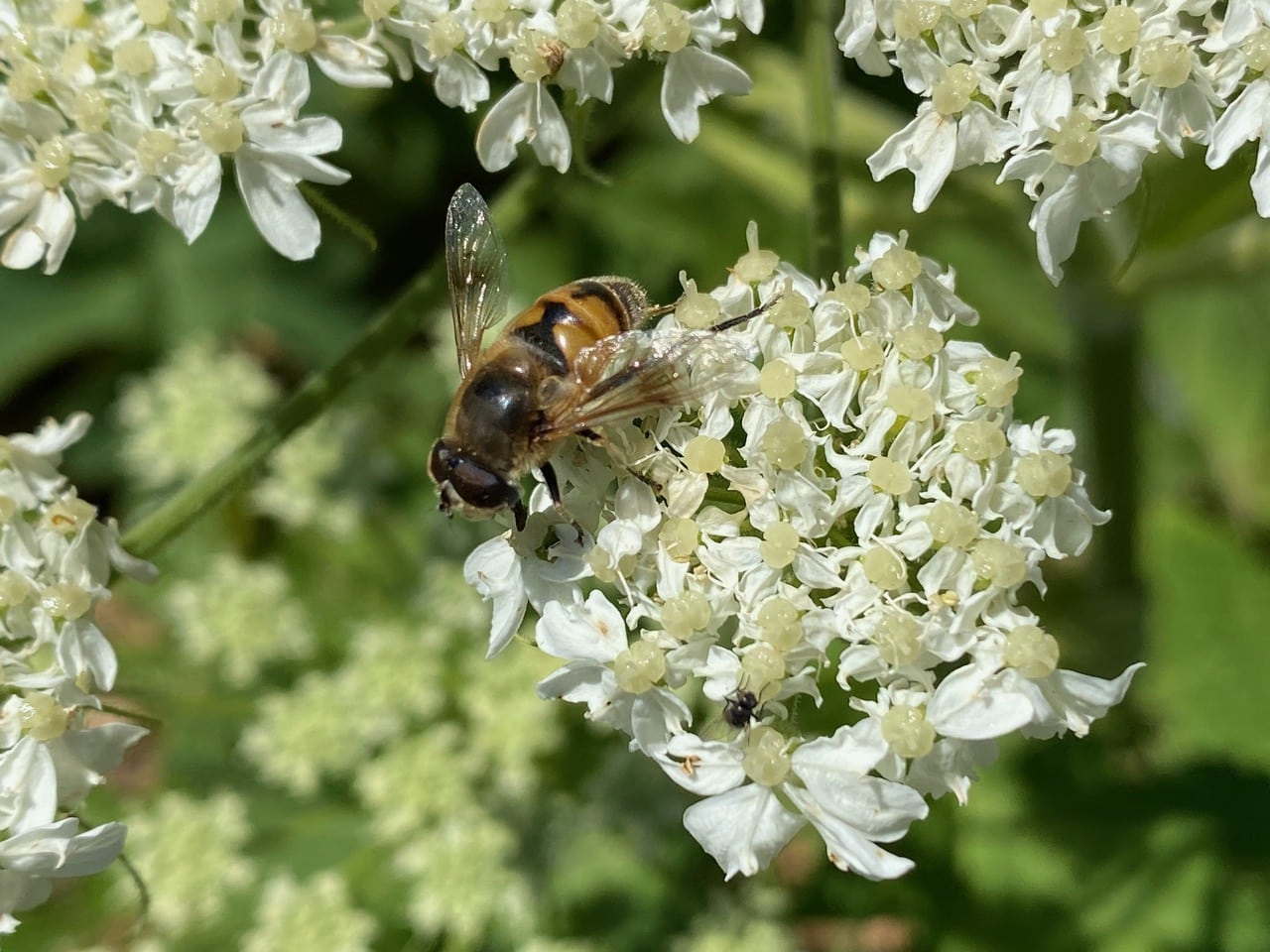
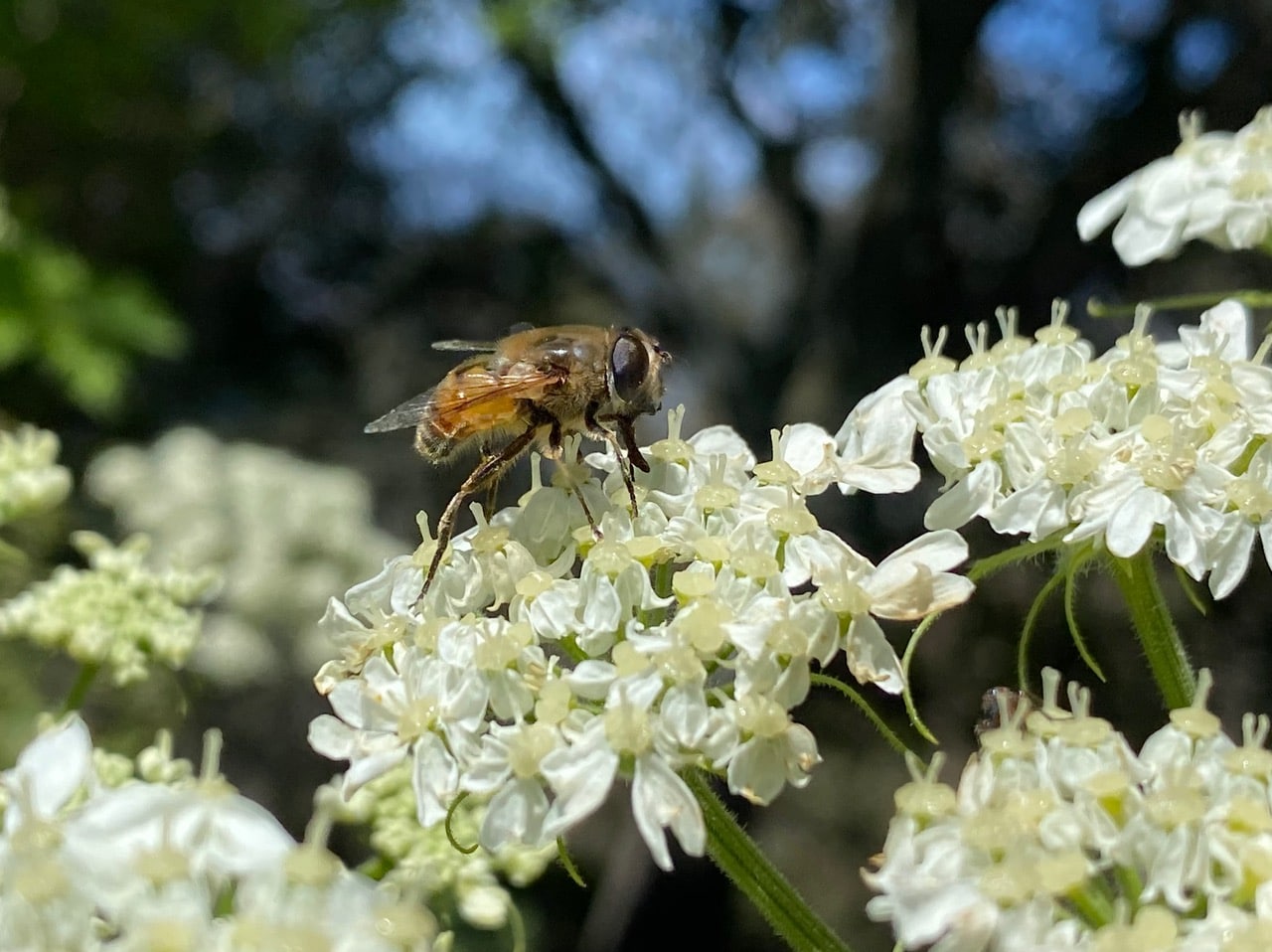
The Common Drone Fly, Eristalis tenax (family Syrphidae) is the most widely distributed Syrphid species in the world, occurring in all regions except the Antarctic. It was introduced into North America from Europe and is widely established. Adults visit flowers for nectar and pollen, and are significant pollinators. They are called drone flies because of their resemblance to a drone Honey Bee. The larva is aquatic. It has a siphon on its rear end that acts like a snorkel, helping it breathe under water. The siphon can be several times the length of the larva’s body, hence the common name, rat-tailed maggot. The larvae are saprophagous, feeding on bacteria in stagnant water rich in decomposing organic matter.
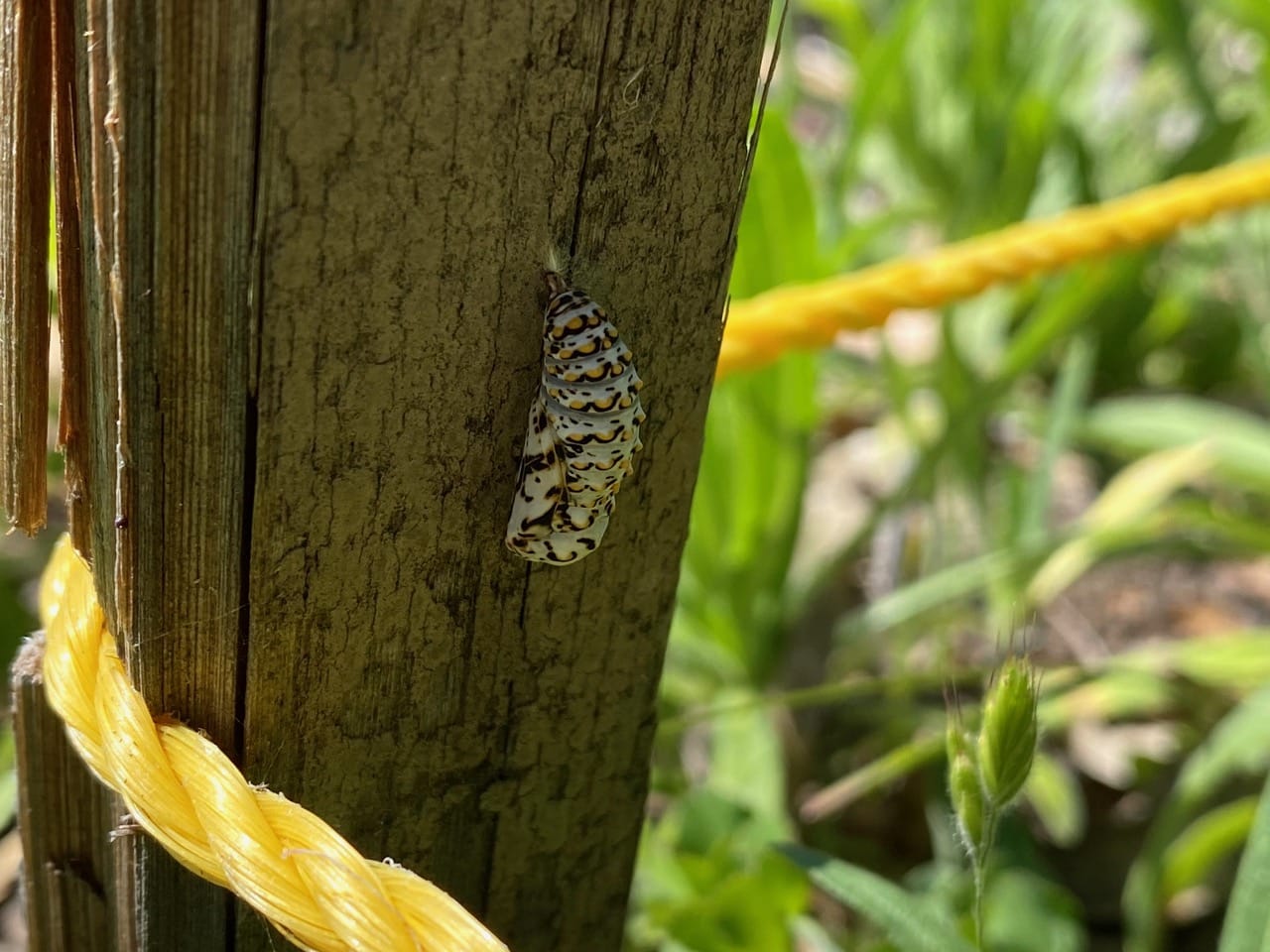
I check on the Variable Checkerspot chrysalis on the wooden peg that I found on 4/22/24. It has not changed. I wonder when the butterfly will emerge.
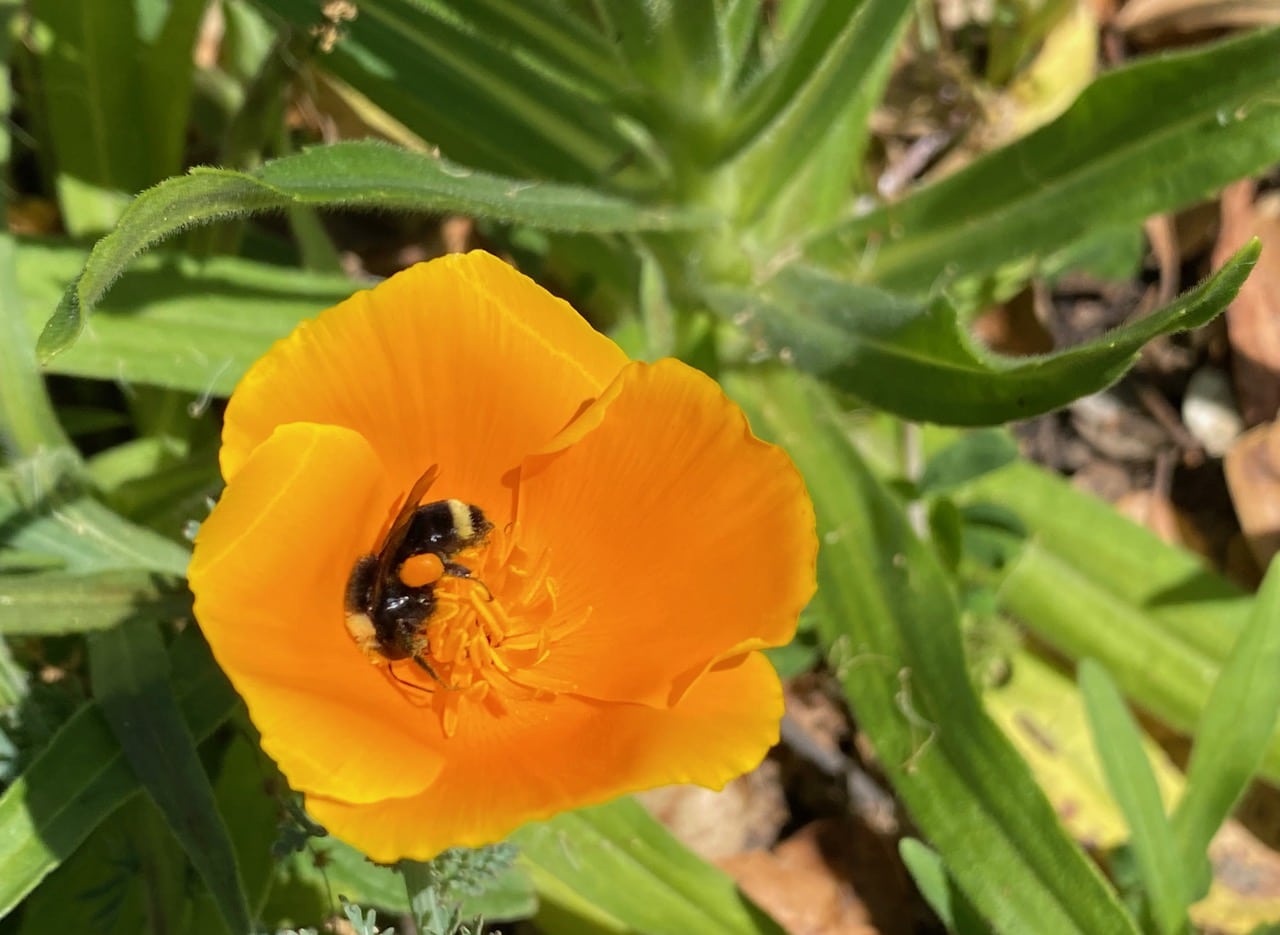
A Yellow-faced Bumble Bee, Bombus vosnesenskii (family Apidae) is collecting pollen from a California Poppy, Eschscholzia californica. The open-faced, bowl-shaped flower is easily accessible to insects small and large. While the flower does not produce nectar, it offers generous amounts of pollen from large, long stamen.

A Field Ant, Formica moki (family Formicidae) is roaming the flowers of California Phacelia.
Formica is a genus of ants in the family Formicidae, commonly known as wood ants, mound ants, and field ants. Many species live in wooded areas. In more suburban landscapes, they tend to nest near structures such as sidewalks, fences, or building foundations. Most Formica species are polygynous (have multiple queens per colony), and some are polydomous (have multiple nests belonging to the same colony). Unlike other ants, the genus Formica does not have separate castes, which are based on an individual’s specialization and morphology.
Formica ants actively gather honeydew from source insects, and extrafloral nectar. They also prey on insects and spiders; also scavenge small dead invertebrates, honeydew on leaf litter and plant surfaces, etc.
Formica ants lack a stinger, but instead formic acid is expelled as a defense mechanism from the tip of their abdomen. They can also bite. They may pinch skin with their mouthparts, and then squirt formic acid into the wound, which may give the sensation of a sting.
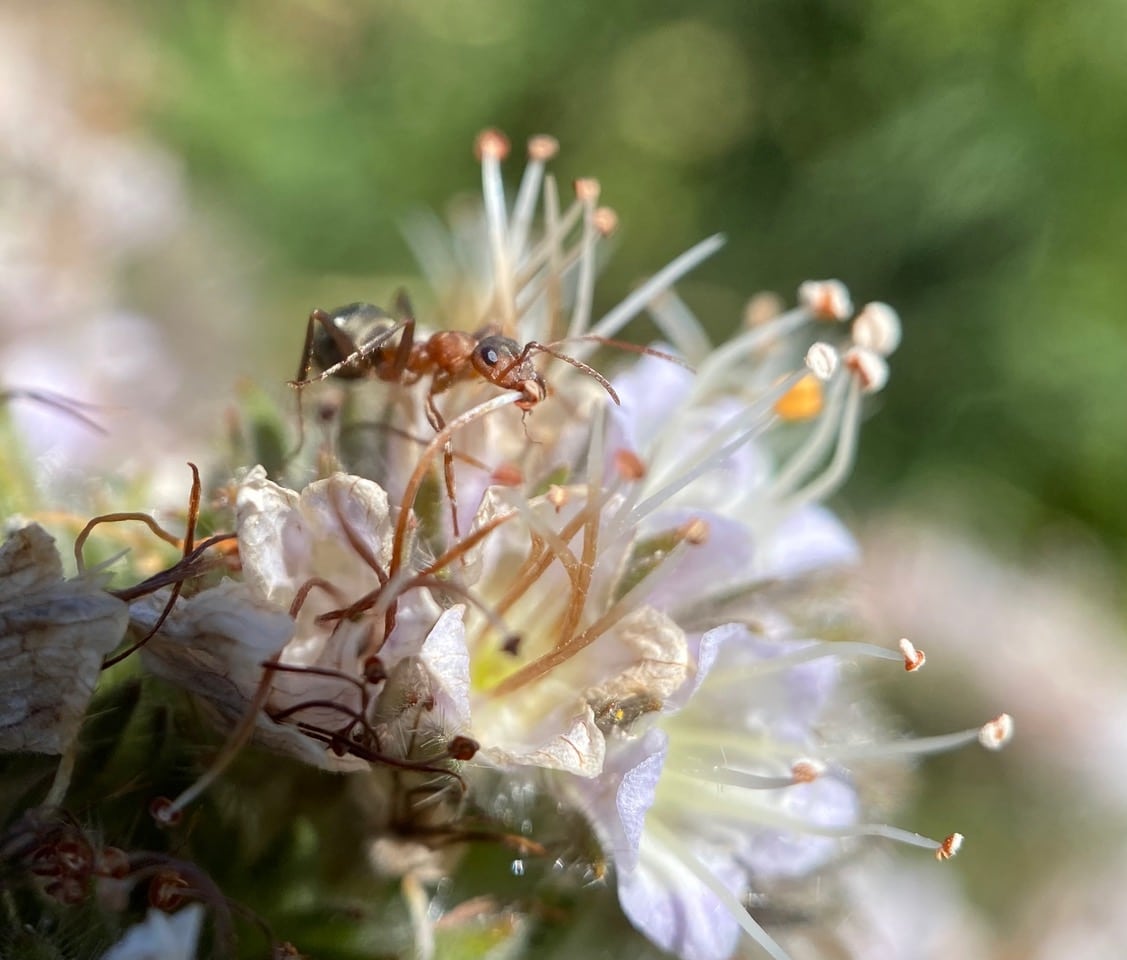
This ant is manipulating a Phacelia anther with its mandibles.

Formica moki is a common field ant at low to mid elevations in California’s coastal range. These ants usually nest under stones in open woods; sometimes under sidewalks or along the sides of buildings. They may become a pest by foraging in houses or by tending aphids on cultivated plants. The workers are fast, fierce and aggressive.
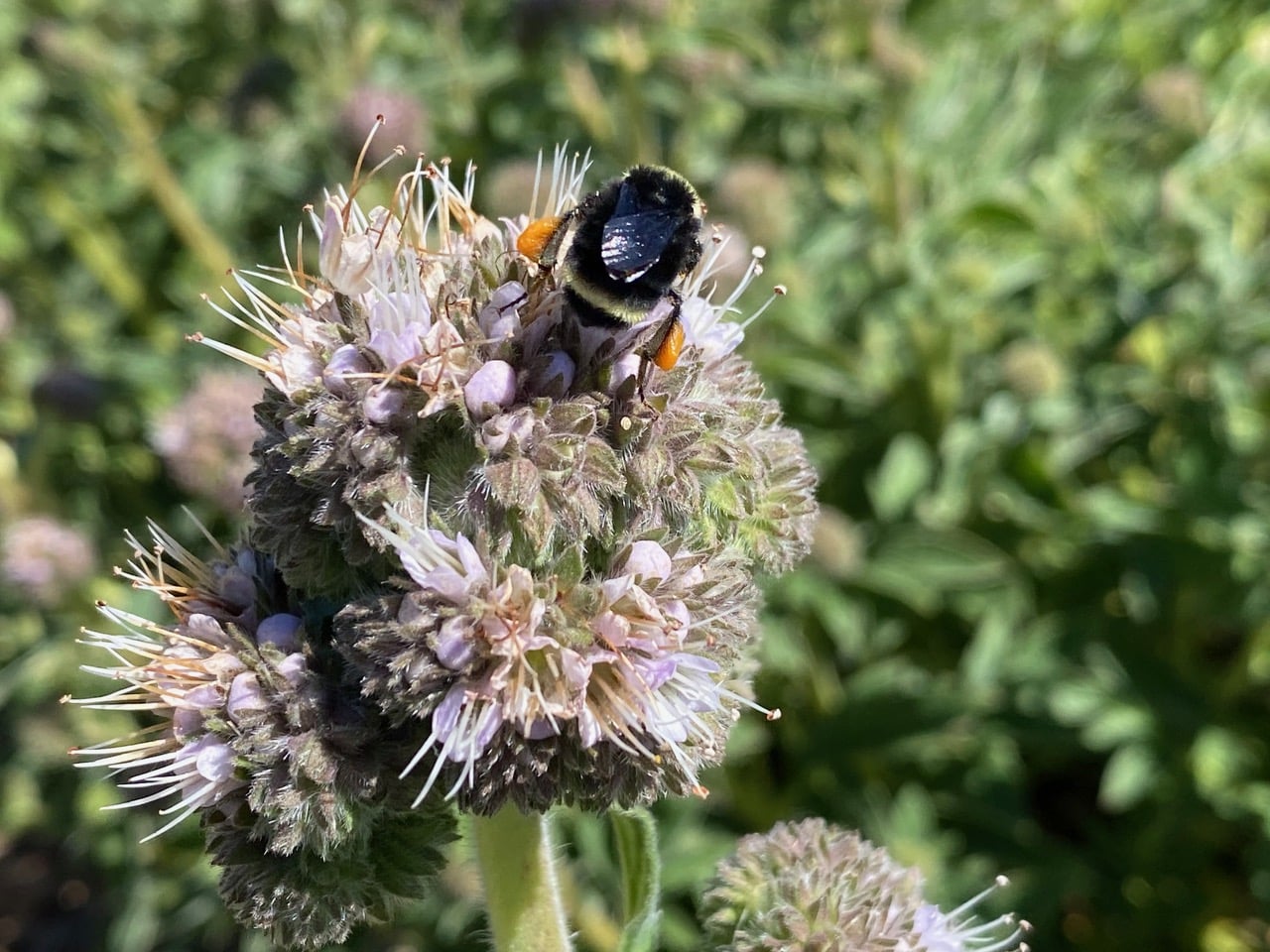
A Yellow-faced Bumble Bee, Bombus vosnesenskii (family Apidae) is foraging on an inflorescence of California Phacelia. Note that she has orange pollen in her pollen baskets, whereas Phacelia pollen is whitish purple. The bee must have gathered the orange pollen from the California Poppies. Unlike the Honey Bees that usually visit only one type of flowers on a single foraging trip, Bumble Bees are not particular in that regard. Sometimes you see pollen of different colors in their pollen baskets.
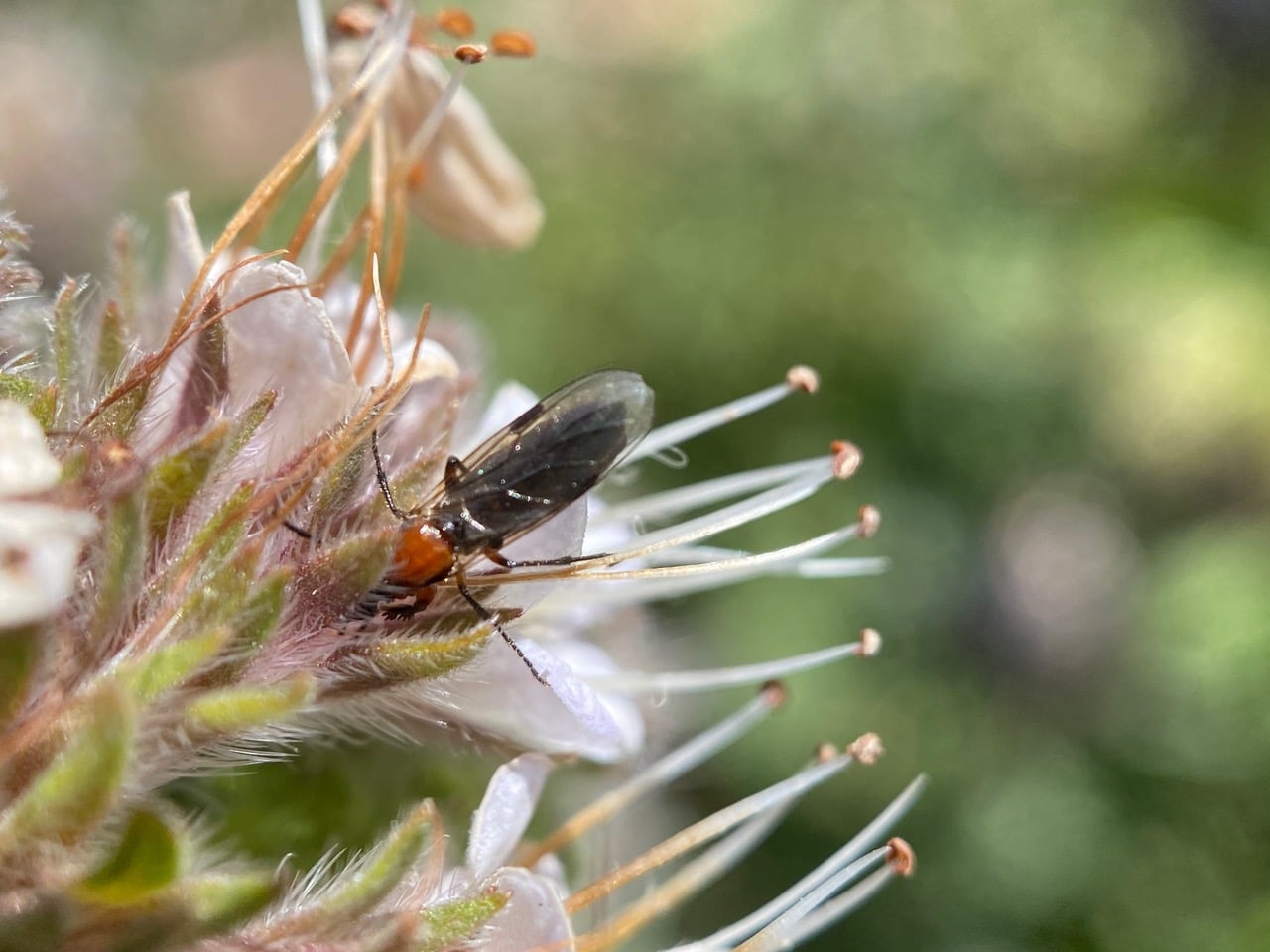
A female March Fly, Dilophus sp.(family Bibionidae) is diving deep to take nectar from a California Phacelia flower.
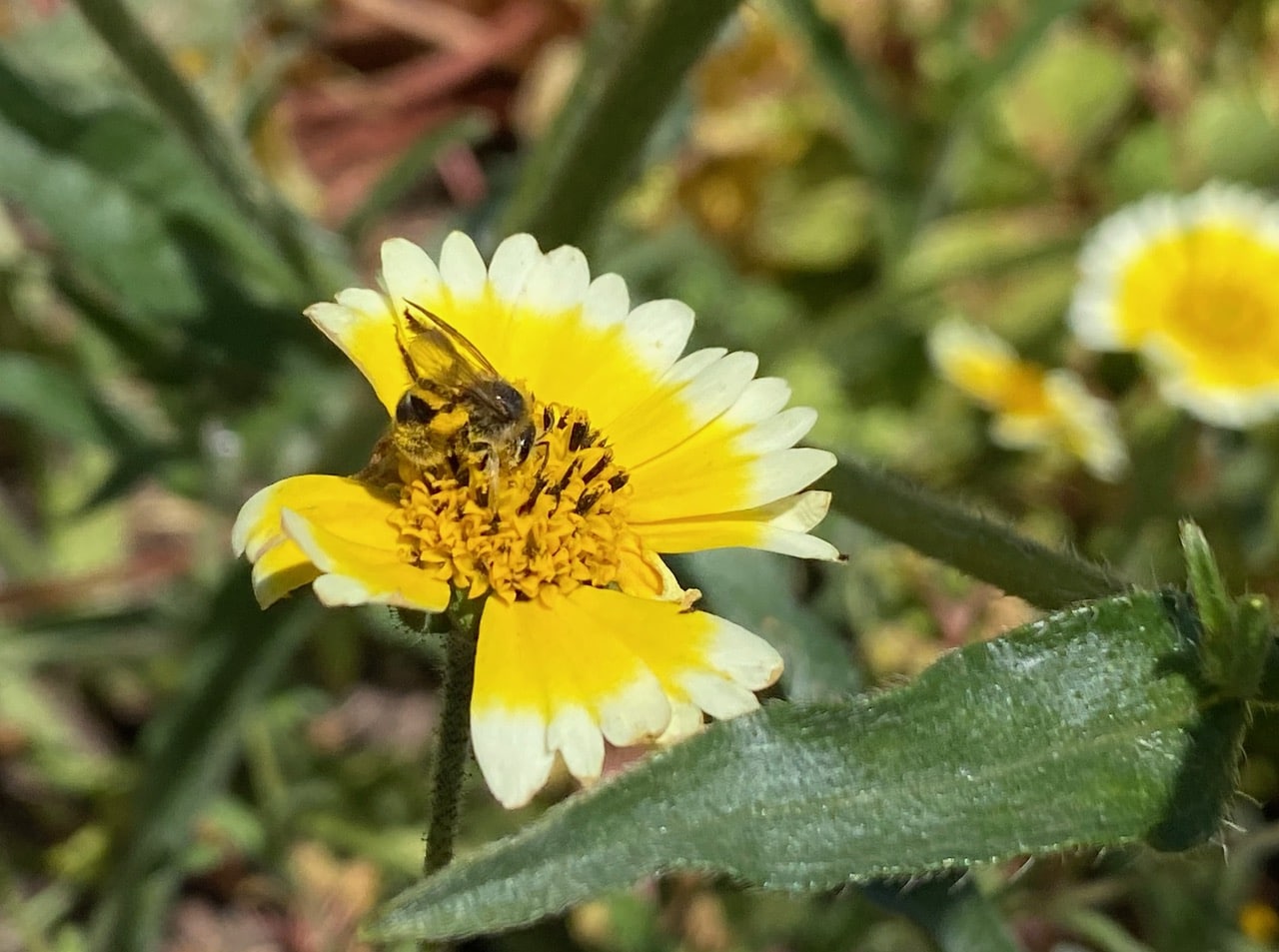
A little bee is busy gathering pollen on a flower of Tidy Tips, Layia platyglossa. She is using her middle legs to move the pollen onto the scopae on her hind legs.

From this distance, I don’t see enough details to identify the bee.

It appears she has pollen on her abdomen as well as her legs. Probably a Sweat Bee (family Halictidae) or a Mining Bee (family Andrenidae)?