

Pollinator Post 5/5/23 (2)
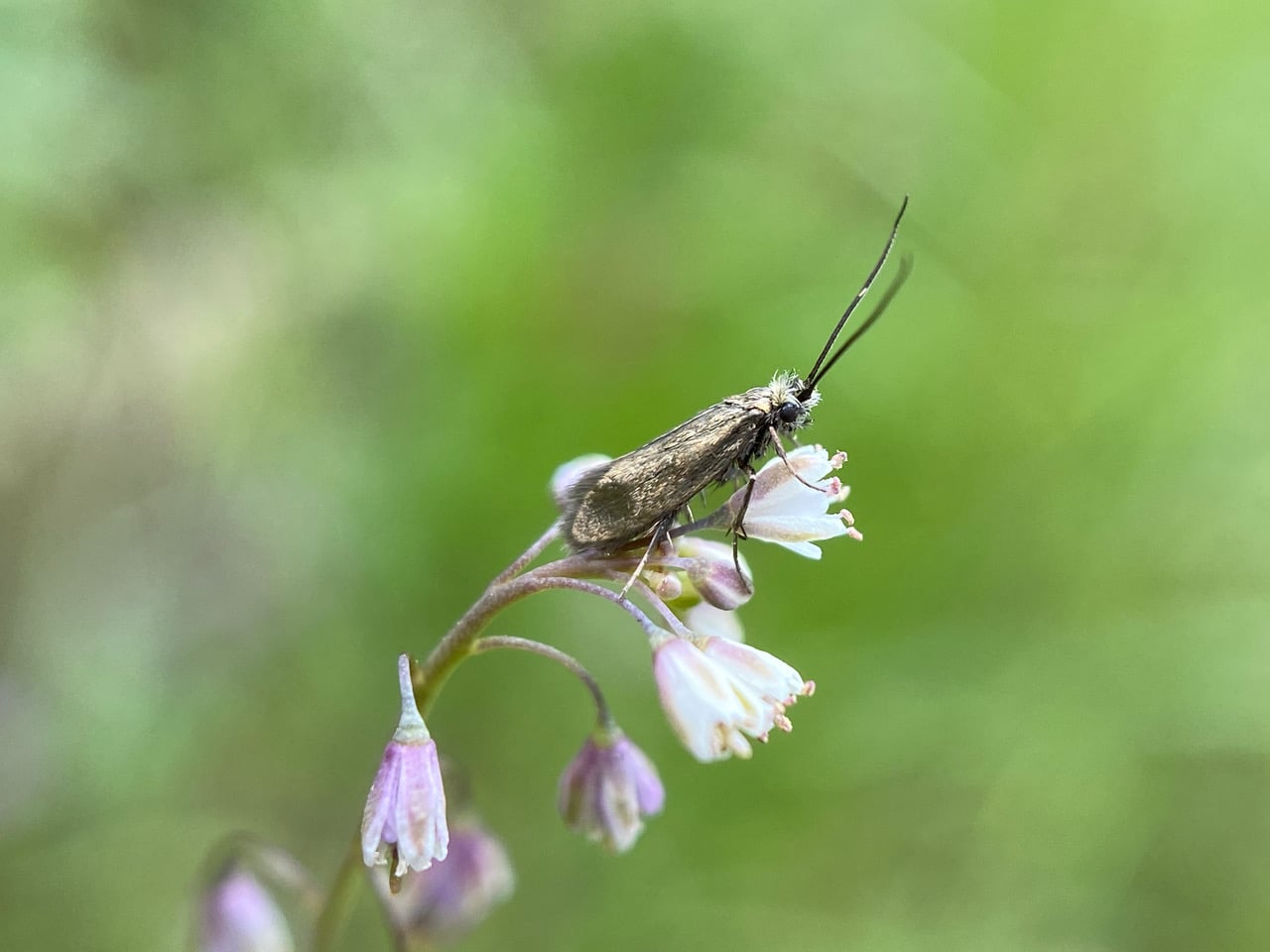
It is a cool, cloudy afternoon. Most of the Fringe Pods, Thysanocarpus curvipes (family Brassicaceae) have finished blooming. Out of habit, my eyes scan the plants along the edges of the trail, hoping to spot a tiny moth. As luck would have it, I find a single Fairy Longhorn Moth, Cauchas simpliciella (family Adelidae) standing on the top of a spike of flowers. Unlike most of the others I have photographed, this one does not have orange hairs on its head. Cauchas species all use plants of the mustard family or Brassicaceae as their larval host plants. I wonder what part of the plant the caterpillars eat, as most of the annual herb will be gone soon.
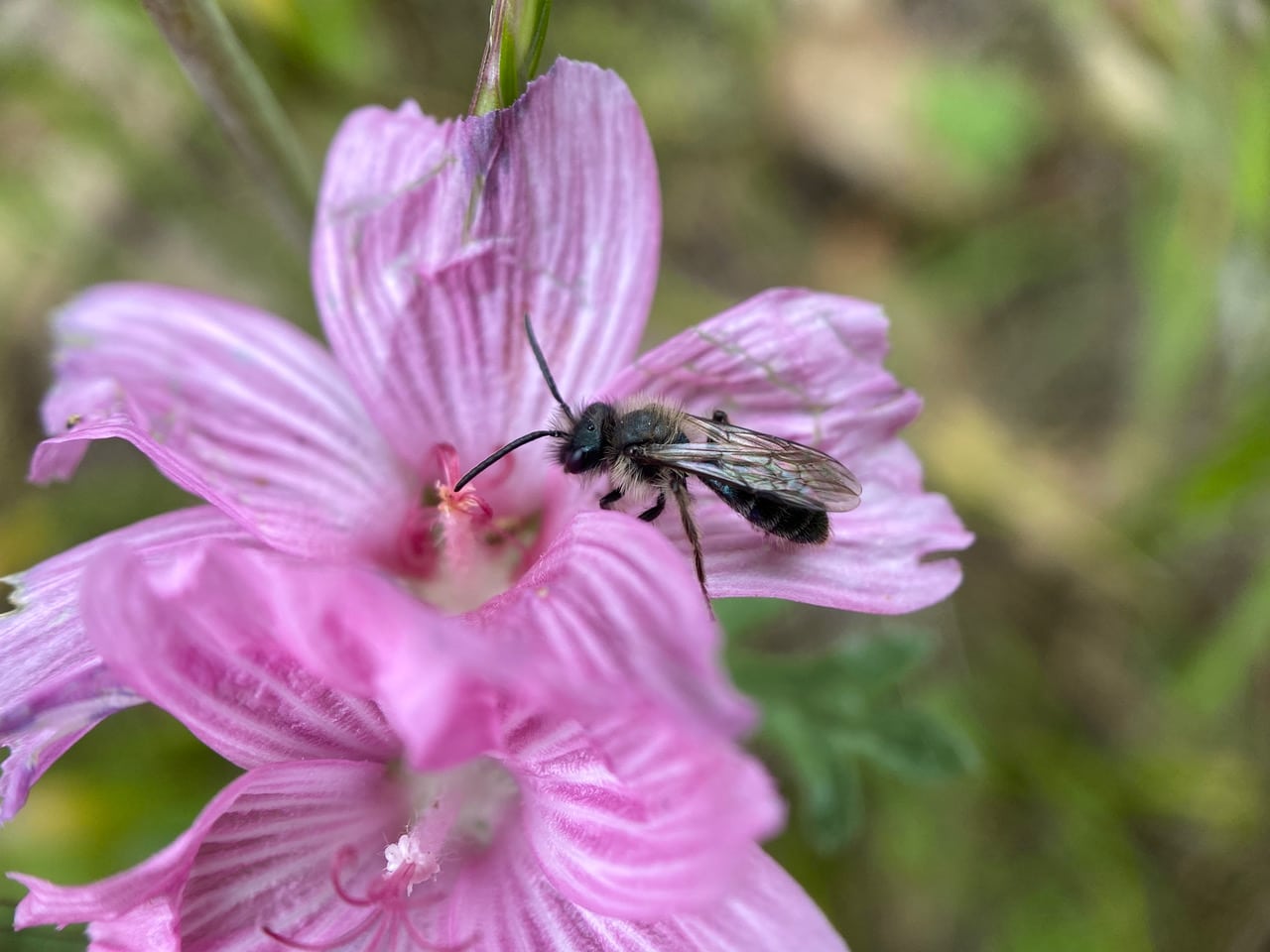



A male Mining Bee, Andrena sp. (family Andrenidae) visits a Checkerbloom flower, Sidalcea malviflora. The scruffy bee looks just as weary as the weather-beaten flower.
Male bees tend to be more slender than the females. They also lack the scopae, pollen collecting hairs the females have. The antennae of male bees are often much longer than their female counterparts. Male antennae have an extra segment and the segments themselves are longer. This is because male antennae are specialized to pick up the subtle scent of female pheromones. Male solitary bees do not collect pollen to provision the nest, but do visit flowers for nectar.
Pancake-flat, heads down and facing each other, two ticks have positioned themselves on the tip of a grass seed head by the trail. The one whose back is visible is an adult male Pacific Coast Tick, Dermacentor occidentalis (family Ixodidae).
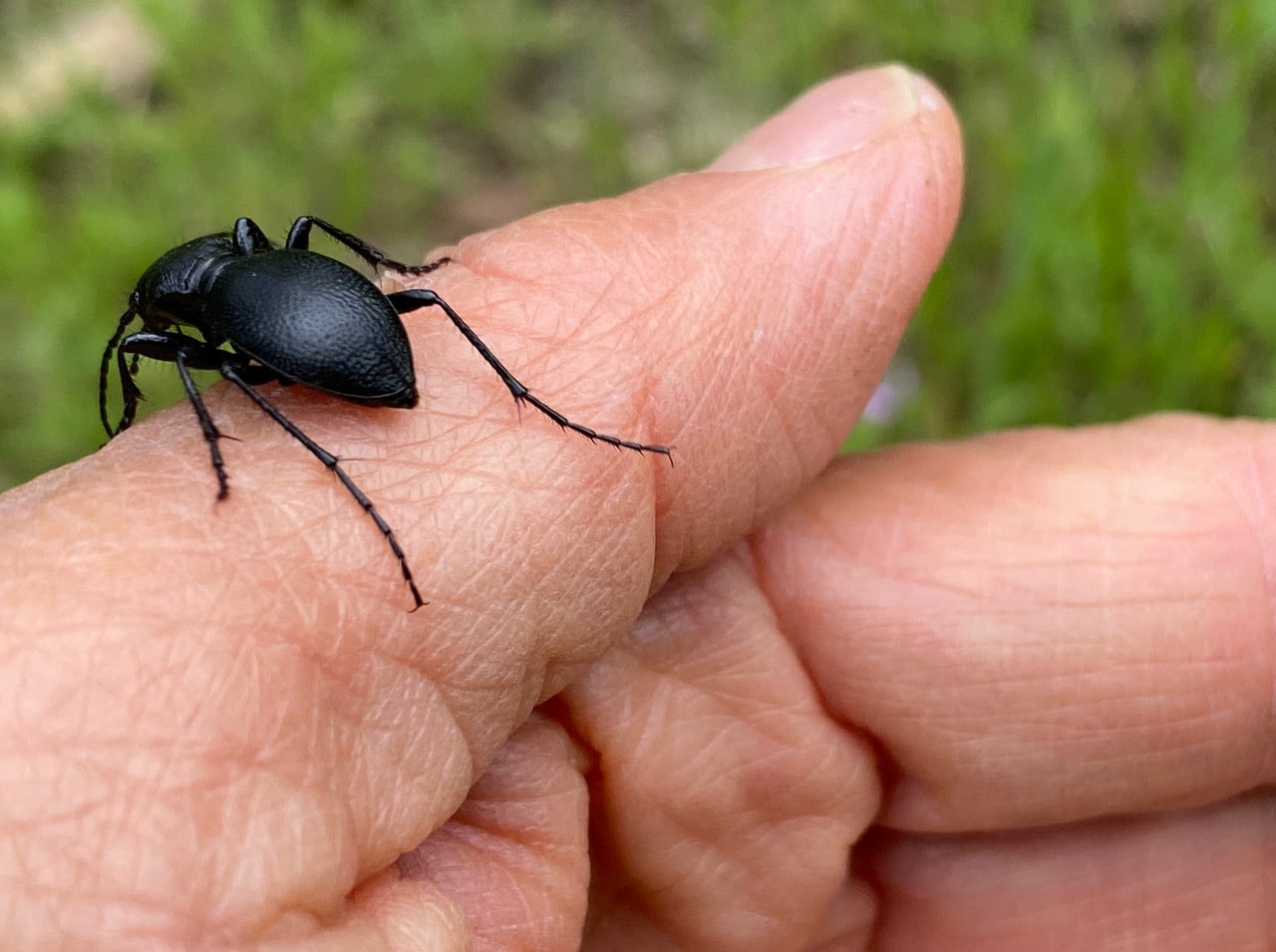
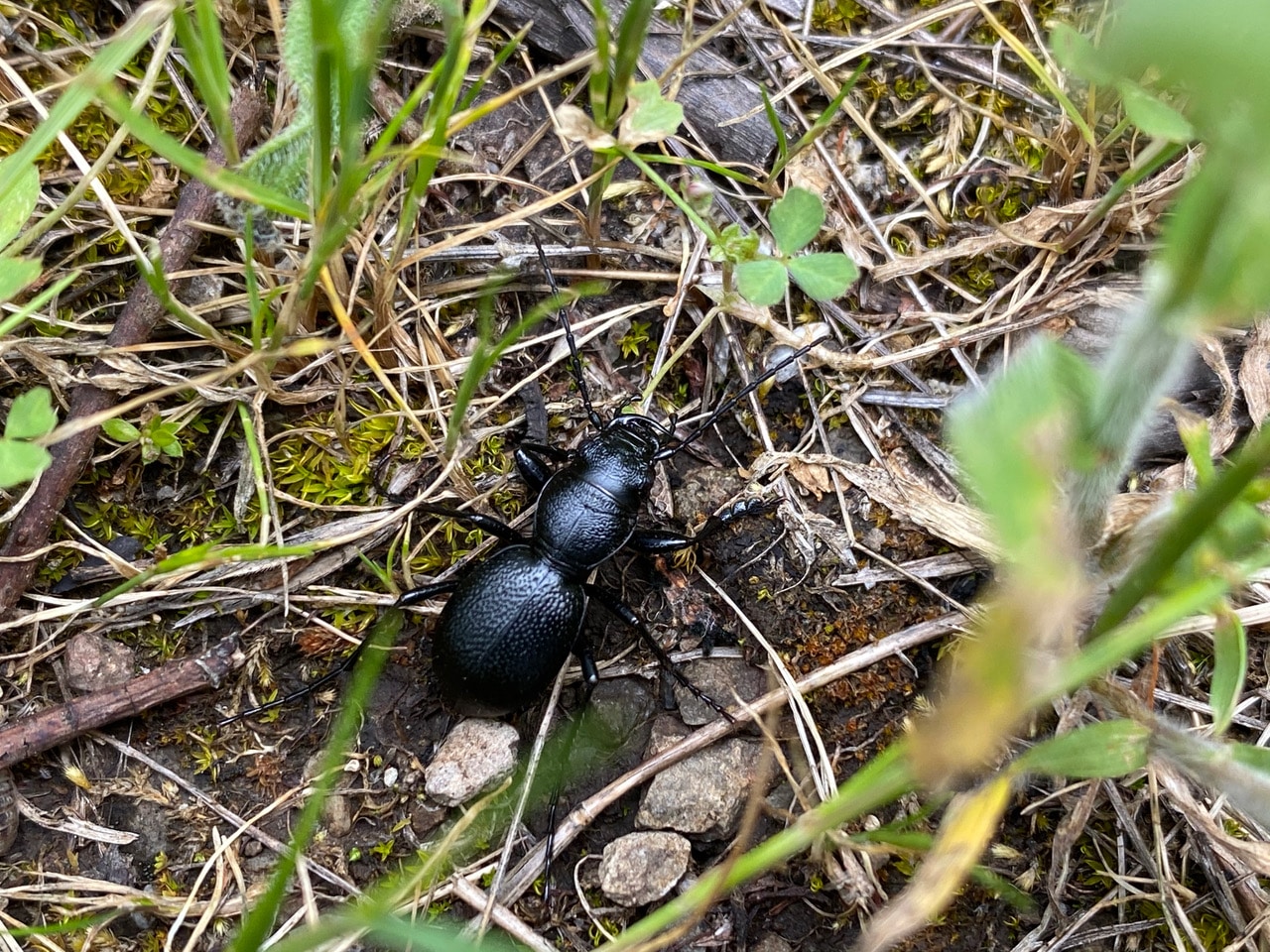
Just as I am about to walk into the shaded section of the trail under the canopy of Eucalyptus/ Bay trees, I spot a large, black beetle on the trail. Sensing my approach, the beetle quickly dodges into the undergrowth on the side of the trail. It has slender legs, and is fast running.
It seems to have formidable large curved mandibles.
I try to block the beetle’s path with my hand before it disappears, and to my delight, it climbs on swiftly. It is too fast and frantic for a photo of its mouthparts though.
The beetle pauses for a split second when I let it down on the ground, then vanishes into the vegetation. Much to my delight, the beetle has been confirmed by iNaturalist as the California Night-stalking Tiger Beetle, Omus californicus (family Cicindelidae) – an insect I have wanted to see since I found their larval burrows last year!
This was posted on 4/4/22, reproduced here with slight modifications:
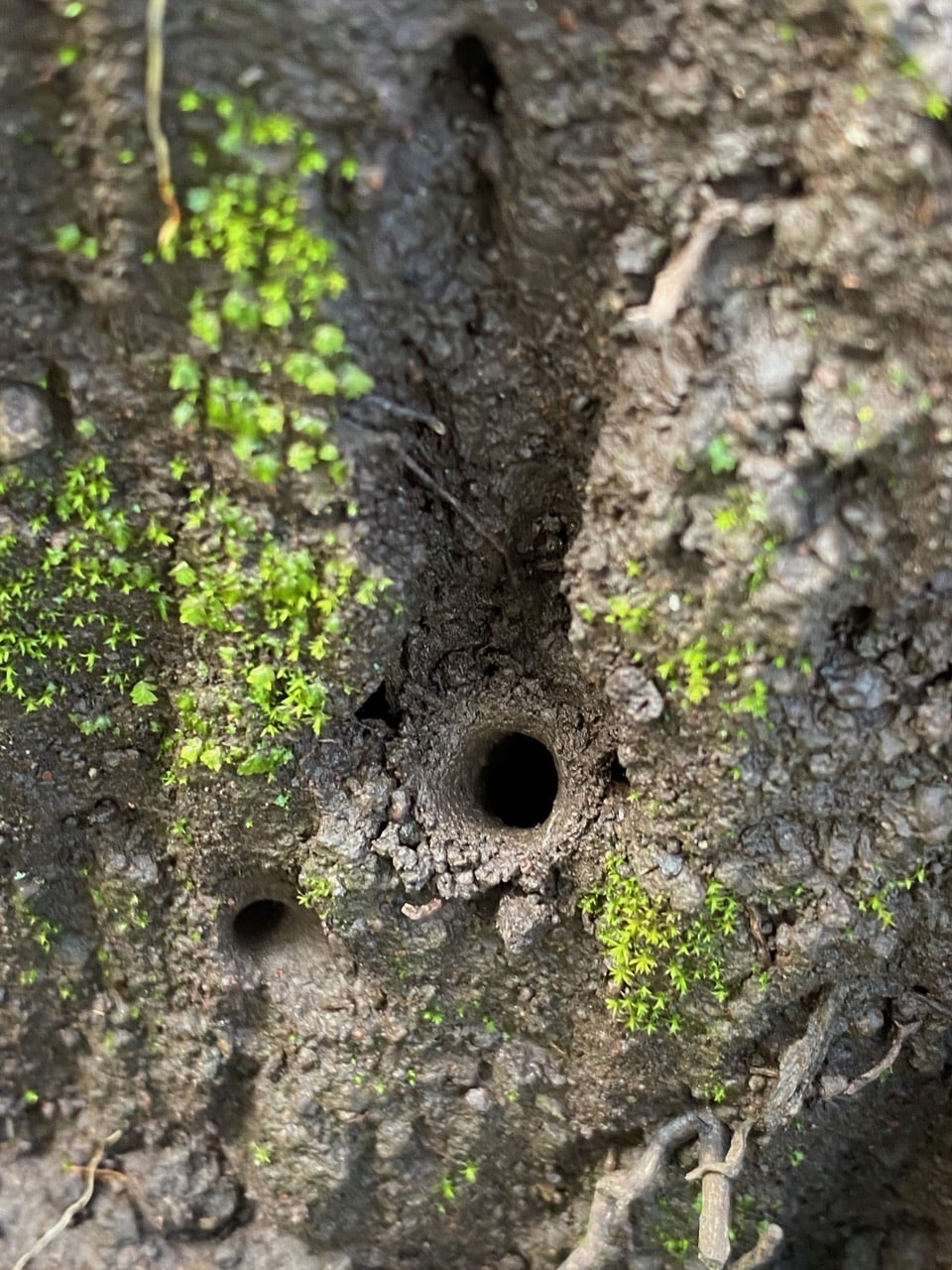
Despite the rains we had, the larval burrows of the Night-stalkingTiger Beetles (Omus sp., family Cicindelidae) on the exposed banks are remarkably clean, showing no signs of debris or erosion. These babies maintain their burrows meticulously!
Omus species are distributed in Western North America. The nocturnal flightless beetles are usually found in the transition zone between forests and meadows. During the day they hide under leaf litter or under fallen tree trunks.
Both the larval and adult stages of the Tiger Beetle are predacious. Females lay single eggs in burrows in the soil. Omus californicus typically lives 3 years and matures through 3 instars, or growth phases, during larval development. The pale colored larvae have large hooks at the bottom mid-rear to help anchor themselves when catching prey; the large head is capped with a black plate used to cover their burrow entrance. The larva waits near the entrance of the burrow for passing prey during day and night time, and quickly snatches and drags the prey back into the burrow. Prey includes small arthropods. The adult tiger beetles are nocturnal and are sometimes found on the ground during cloudy days or night when out hunting. The tiger beetle grasps its prey with the large, powerful mandibles protruding from the head. The mandibles contain glands that secretes enzymes that digest prey, and also serve as defense against predators. Adult Omus californicus is highly agile and quick, active primarily from May to June.
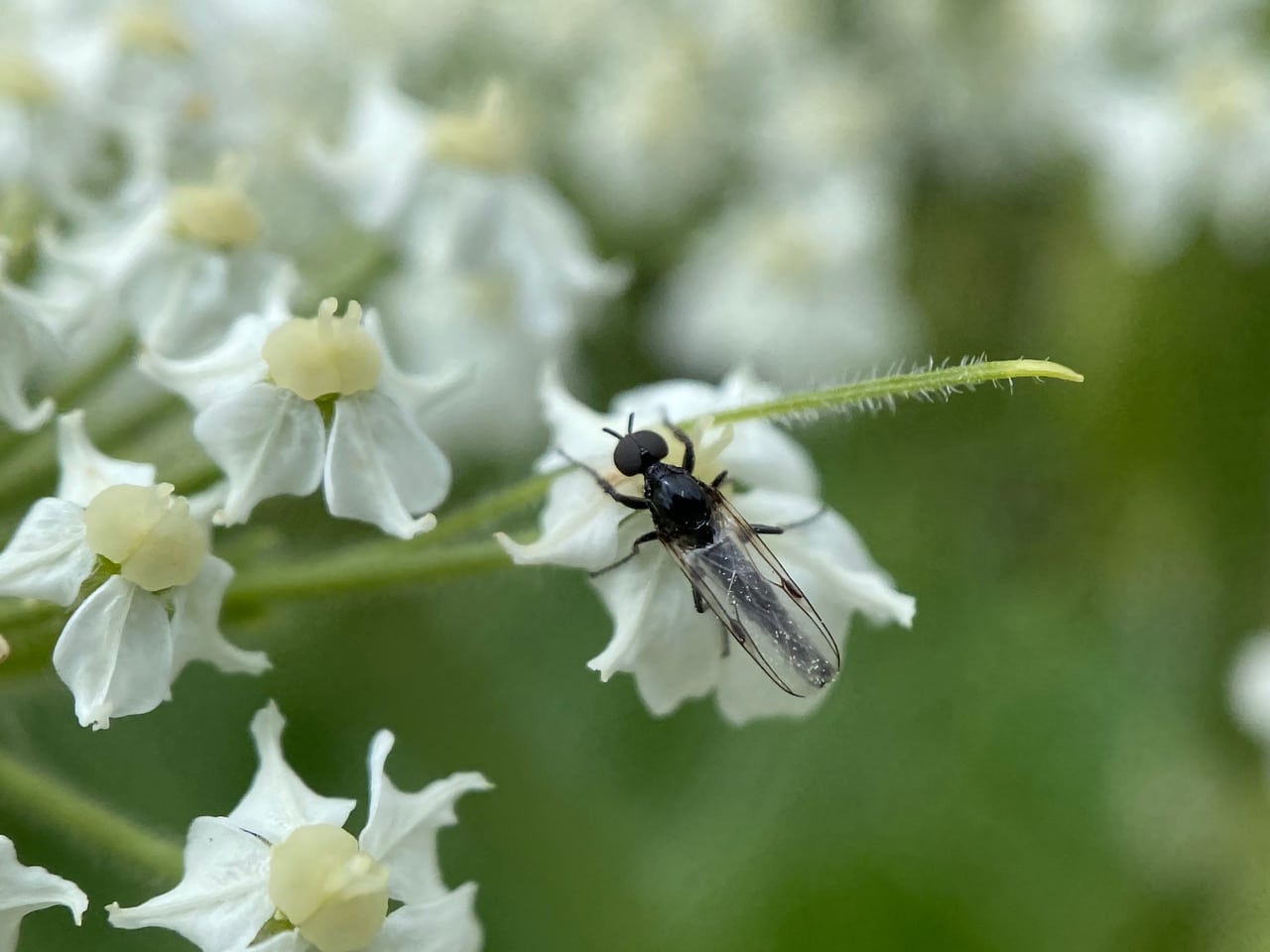
A male White-winged March Fly, Bibio albipennis (family Bibionidae) lands on a flower of Cow Parsnip, Heracleum maximum.
March Flies (family Bibionidae) generally live in wooded areas and are often found on flowers – adults of some species feed on nectar, pollen, and honeydew, while adults of other species don’t feed at all; and in either case, they are very short-lived. They are considered important pollinators. They are also important food for other insects and spiders. The larvae feed en masse on rotting organic materials like leaves, wood, compost, and rich soil. These tiny maggots are recyclers helping to unlock the nutrients in decomposing plants and returning them to the food web.
March flies exhibit extreme sexual dimorphism – the sexes are morphologically distinct. The female is usually more colorful, has small eyes on the sides of long, narrow head, while the all-black males have huge eyes that touch in the middle and are split in half horizontally. Scientists speculate that the split makes it easier for them to see the other males that are above and below them in a mating swarm. Males gather in swarms that can blanket the ground and low vegetation. Female are attracted to the party and select mates in the frenzy of fly bodies.
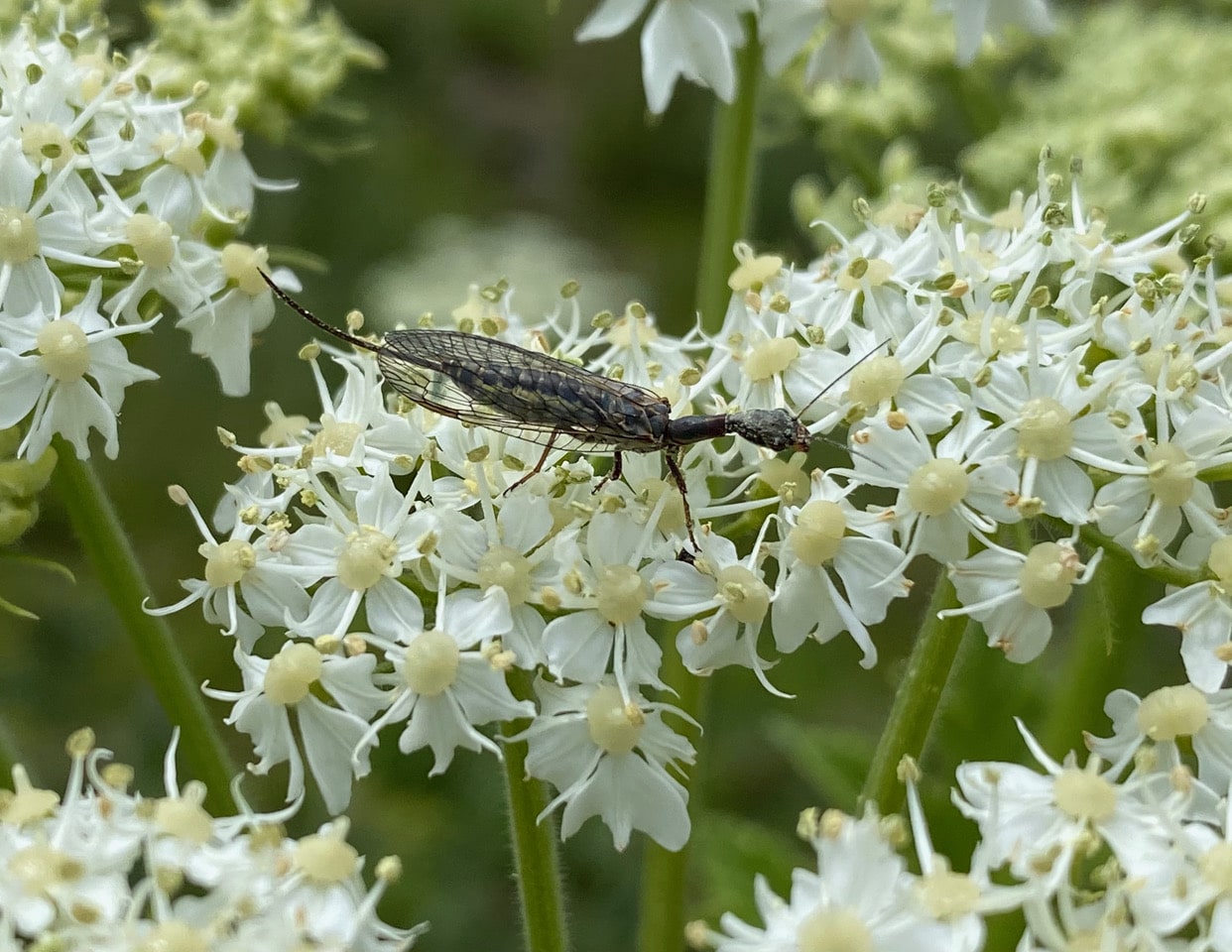
A female Snakefly (order Raphidioptera) is hunting on the Cow Parsnip flowers.
Snakeflies are a group of predatory insects comprising the order Raphidioptera. They are a relict group, having reached their apex of diversity during the Cretaceous before undergoing substantial decline. Adult Snakefly has a notably elongated thorax which, together with the mobile head, gives the group their common name of snakefly. The body is long and slender and the two pairs of long membranous wings are prominently veined. The head is long and flattened and heavily sclerotized. The mouthparts are strong and relatively unspecialized, being modified for biting. The large compound eyes are at the sides of the head. Females have a large and sturdy ovipositor which is used to deposit eggs into crevices or under bark. Snakeflies are holometabolous insects with four-stage life cycle consisting of eggs, larvae, pupae and adults. Both adults and larvae are predators of soft-bodied arthropods such as aphids and mites.
The lower part of its body covered in pollen, a Black-footed Drone Fly, Eristalis hirta (family Syrphidae) is foraging on the flowers of Cow Parsnip.
Eristalis hirta is a common Western North American species of hoverfly. Hoverflies get their name from the ability to remain motionless while in flight. The adults are also known as flower flies for they are commonly found around and on flowers, feeding on nectar and pollen. They are effective pollinators of a wide range of plants. The larvae of E. hirta are aquatic filter feeders of the rat-tailed type. They are important decomposers/recyclers of organic matter.