

Pollinator Post 5/5/23 (1)
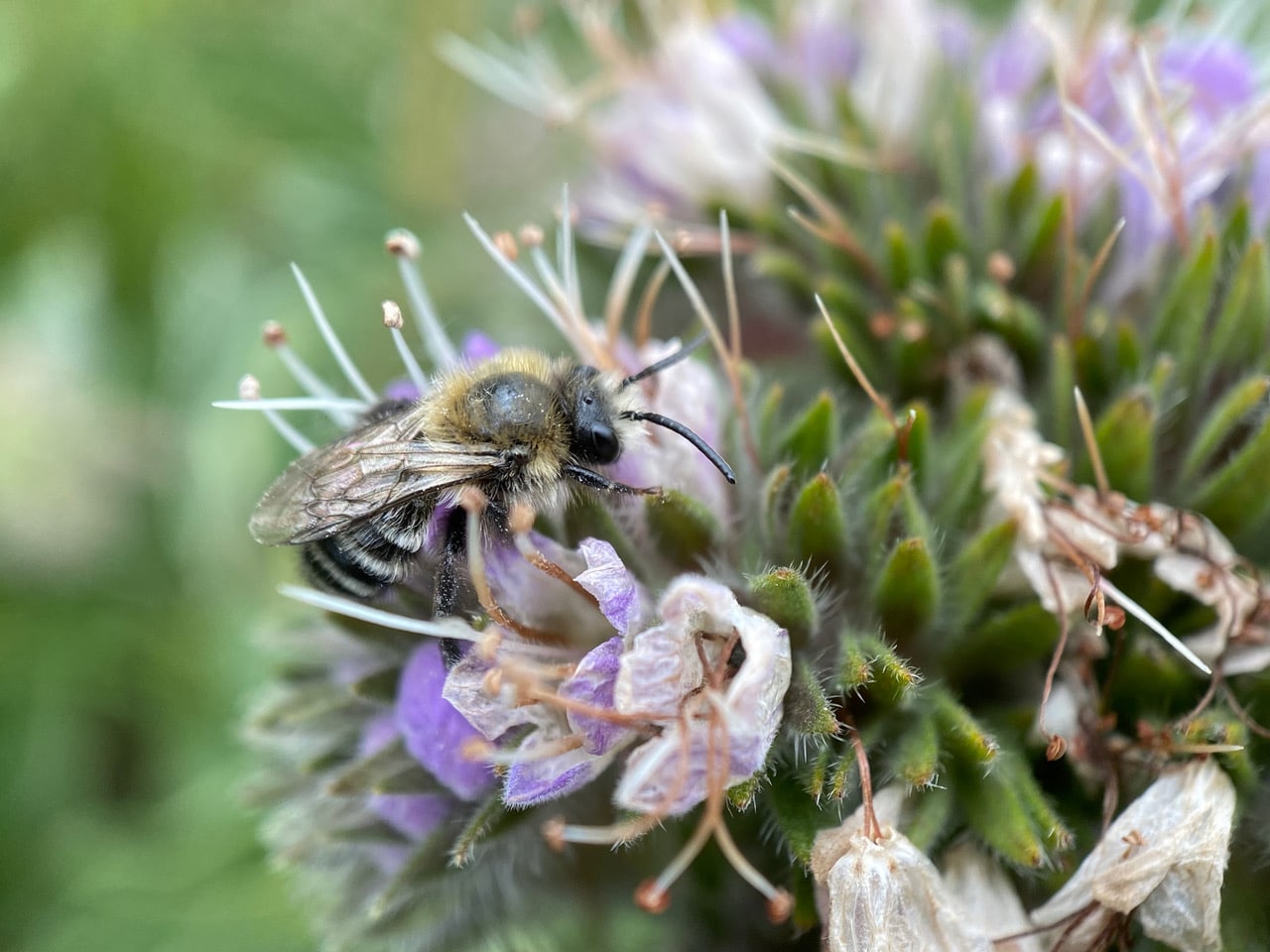
A Cellophane Bee, Colletes sp. (family Colletidae) is foraging on the flowers of California Phacelia, Phacelia californica. Its antennae are rather long, and no scopae on the hind legs, so it is likely a male.
The bee family Colletidae includes generalists and specialists, and they are likely important pollinators of many wildflowers. All Colletidae in North America are solitary ground nesters, but some species nest in large groups, called aggregations. There are two major genera of Colletidae in North America: the Masked Bees (genus Hylaeus) and Cellophane Bees (genus Colletes). The most obvious shared characteristics of Colletidae is also the hardest to see: their short tongue. The eyes of Colletes are angled (rather than being parallel), making the face slightly heart-shaped.
The genus name Colletes means “one who glues”, referring to their habit of applying a glue- or cellophane-like lining to the walls of nest cells, using their specialized tongues. This lining gives rise to their common names: cellophane bees, polyester bees, and plasterer bees. Colletes tongue is unique: short, flat, and forked at the tip. Colletes line their nests with a distinctive cellophane-like substance made from saliva and secretions from the Dufour’s gland on the abdomen. Using their specialized tongue, they paint the walls with saliva, then with secretions from the Dufour’s gland, they add a coat of varnish. This creates a clear covering that is strong, durable, and resistant to mold and water.
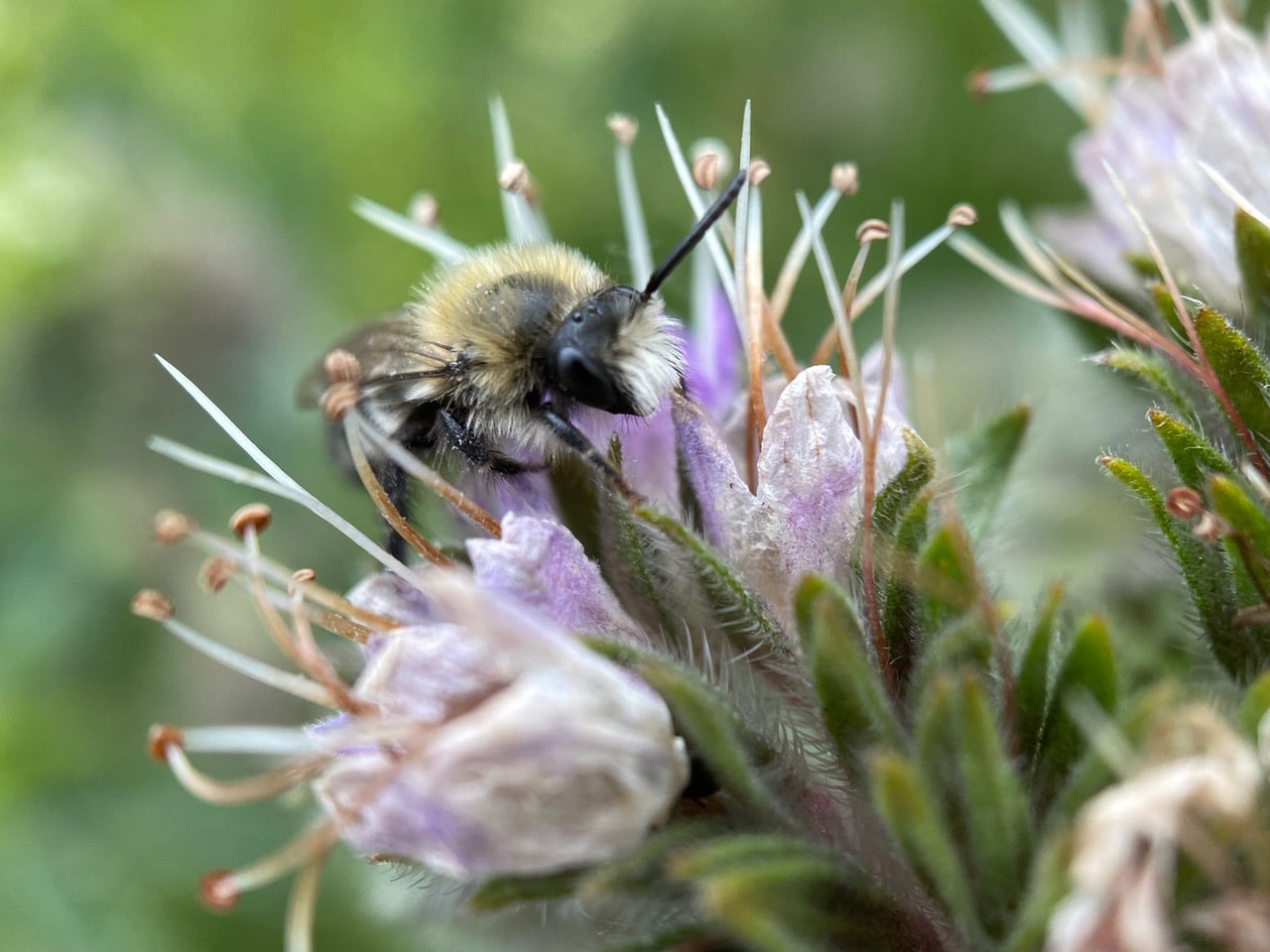
The bee has a big tuft of yellow hairs on its face – what a cutie!
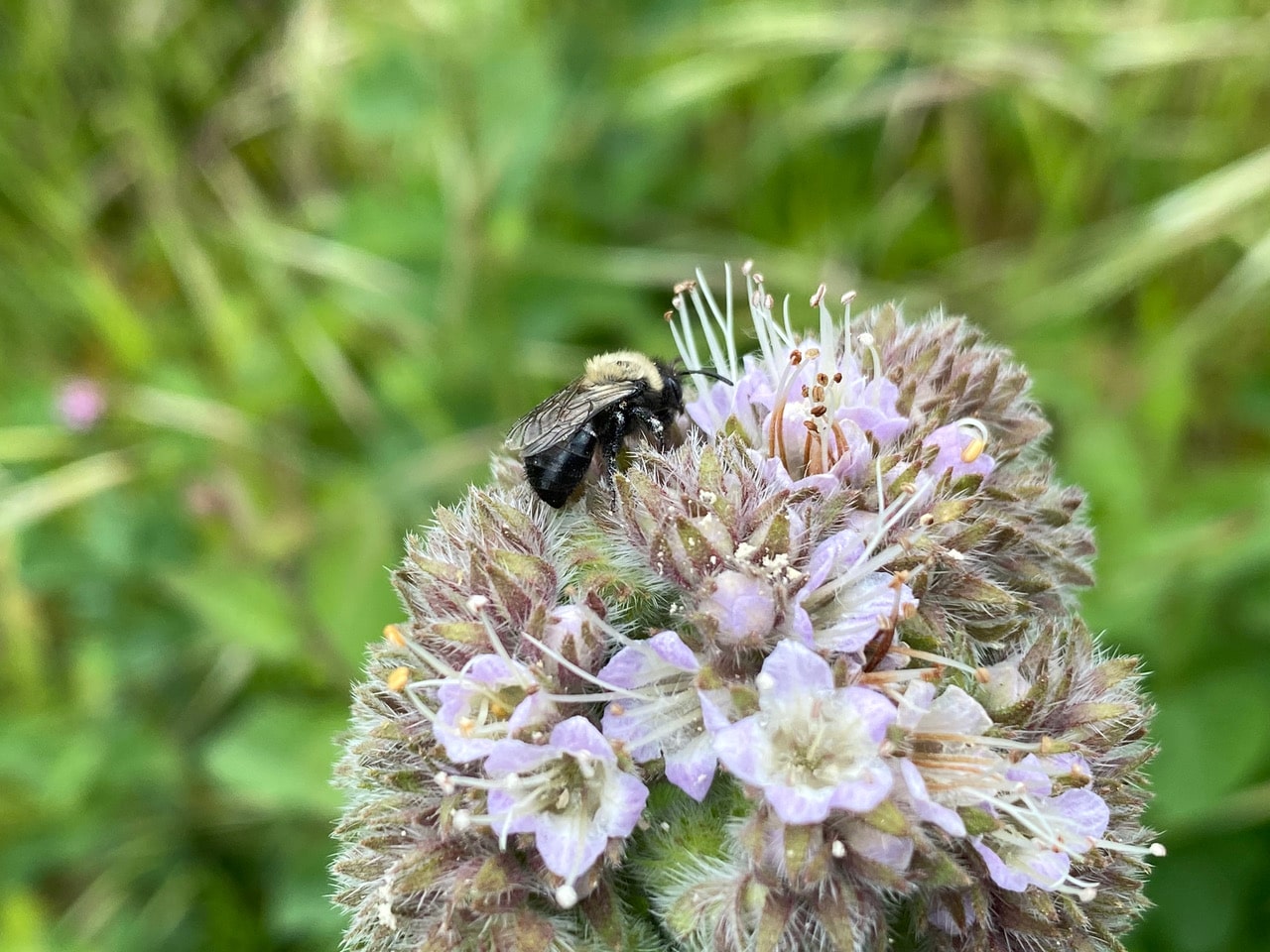
Another medium-sized bee is foraging on an inflorescence of California Phacelia, Phacelia californica.

A Yellow-faced Bumble Bee, Bombus vosnesenskii lands on the same inflorescence, and for a while the two bees feed side by side peaceably, giving me a convenient size comparison.
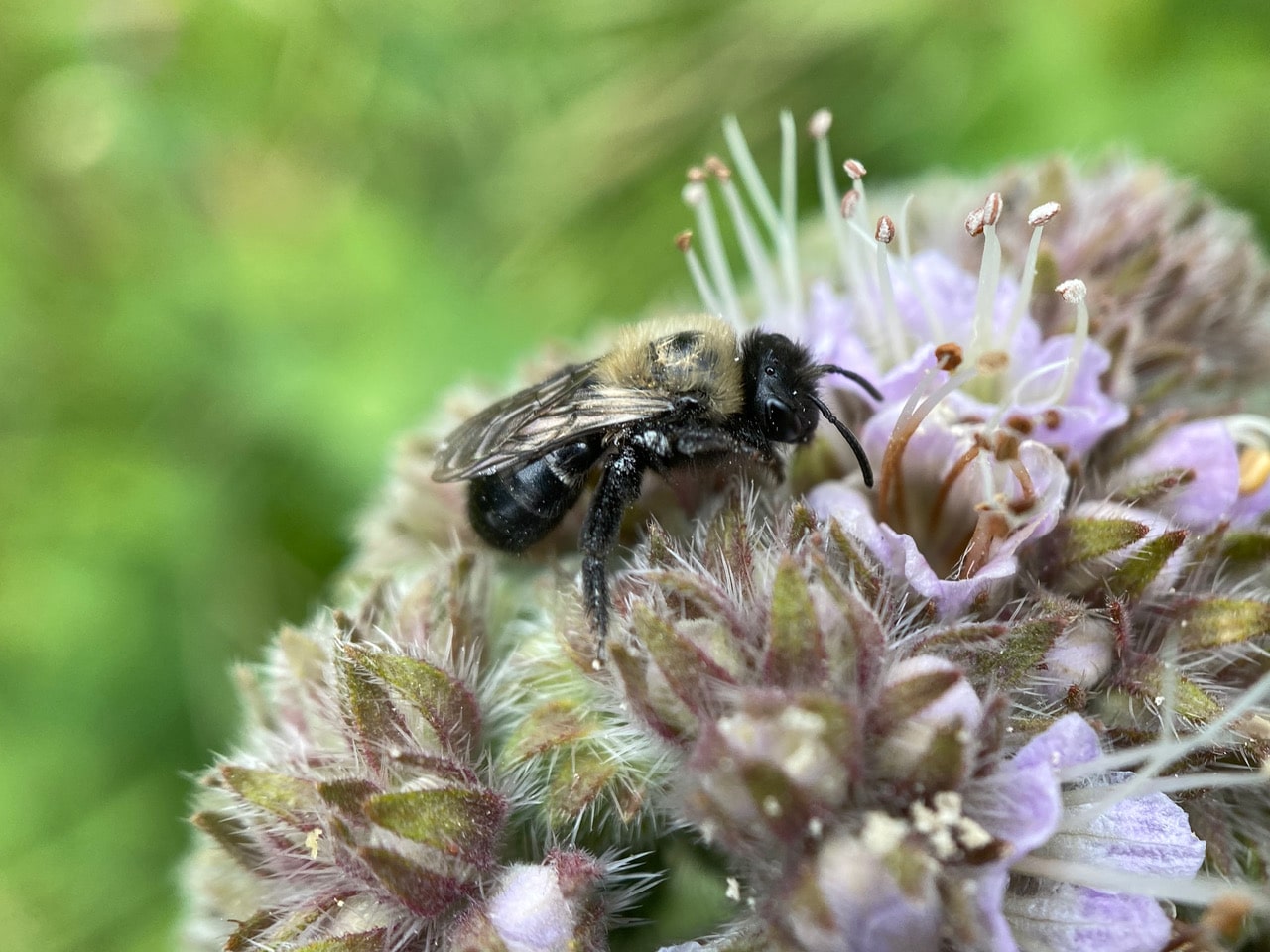
The smaller bee is a Cellophane Bee in the genus Colletes (family Colletidae). It is a female, yet she does not have a scopa on her hind legs for collecting pollen.
While a number of Colletes are specialists, foraging for pollen on only one group of plants, a few will visit a taxonomic smorgasbord of blooming flowers. Colletes usually nest in the ground in areas with little vegetation. Females gather pollen, water, and nectar (which is stored for transport in their crop) to provide food for their young. Rather than the harder ball of pollen that most bees leave for their offspring, Colletes leave a soupy mass for them to eat. This is one of the reasons why their nest cells need to be waterproof.
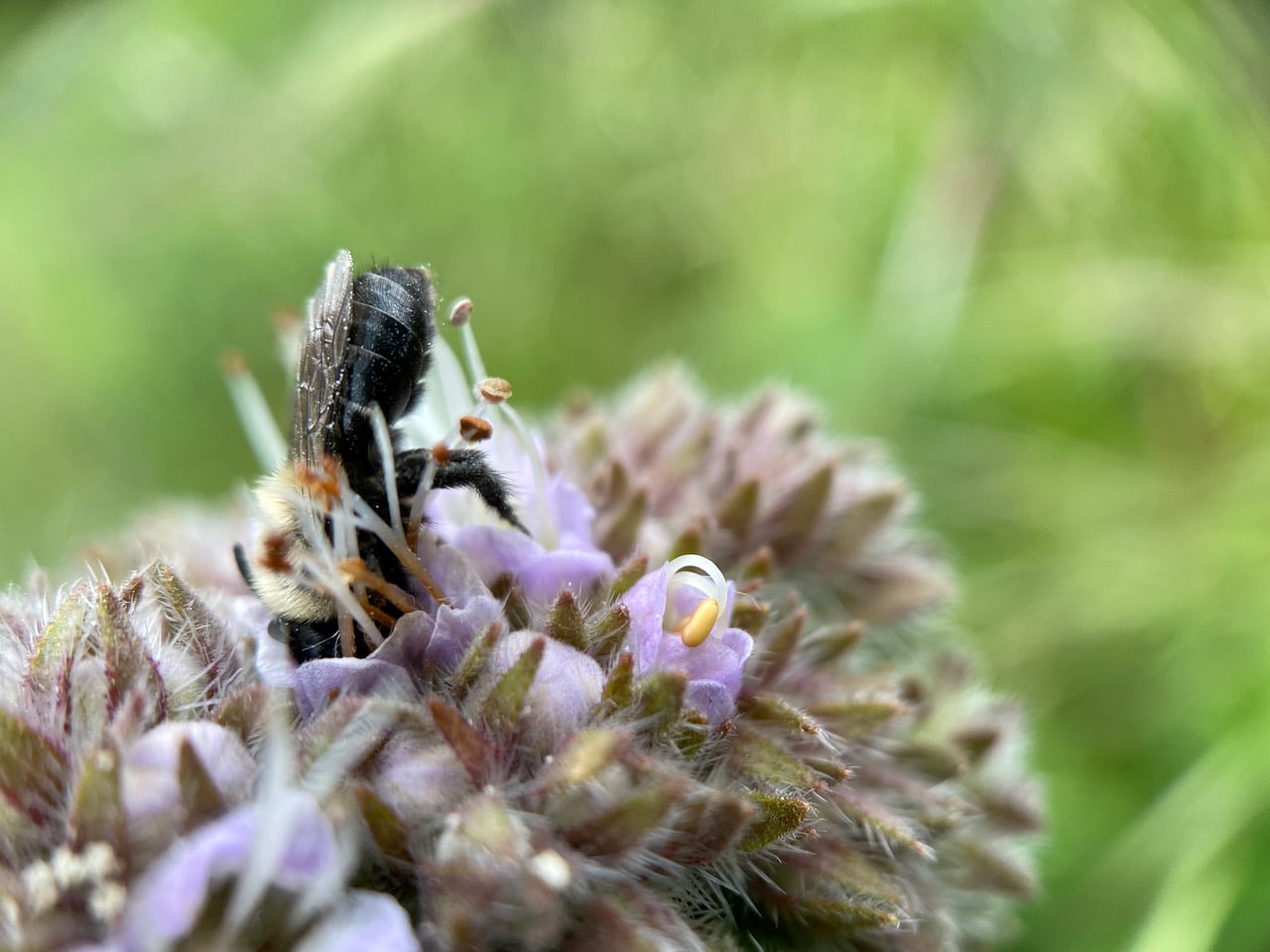
With a short tongue, the Colletes bee needs to reach deep into the corolla of the Phacelia flower for nectar.

Close to Siesta Gate, the scarlet flowers of Western Columbine, Aquilegia formosa has brightened up the steep slopes along Skyline Trail.
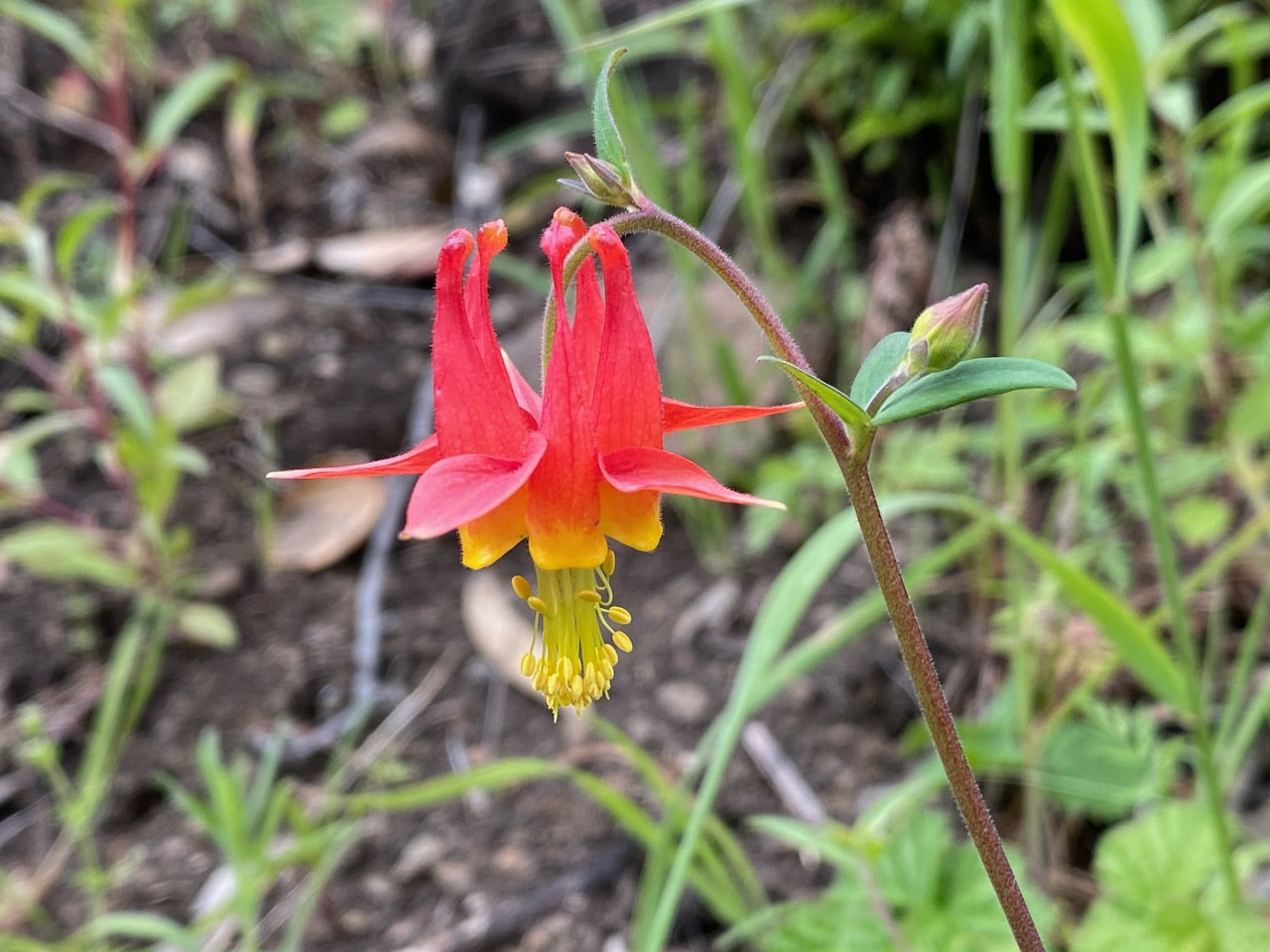
With both red and yellow parts, and a generous supply of nectar, the Columbine flower attracts both hummingbirds and bees (Red attracts hummingbirds, and yellow attracts the bees). Since the nectar is stored in the nectar spurs at the very tip of the nodding flower, the birds and bees have to reach up to access it from the bottom. In doing so, their body is likely to come into contact with the reproductive structures that hang down below the corolla, depositing pollen onto the stigma, or picking up pollen from the anthers. A clever floral design for pollination!

A Diamond Spottail hoverfly, Fazia micrura (family Syrphidae) stops to refuel from a flower of Sticky Cinquefoil, Drymocallis glandulosa. There are four diamond-shaped yellow markings near the tip of the abdomen. It is a female as its eyes do not meet on top of the head.
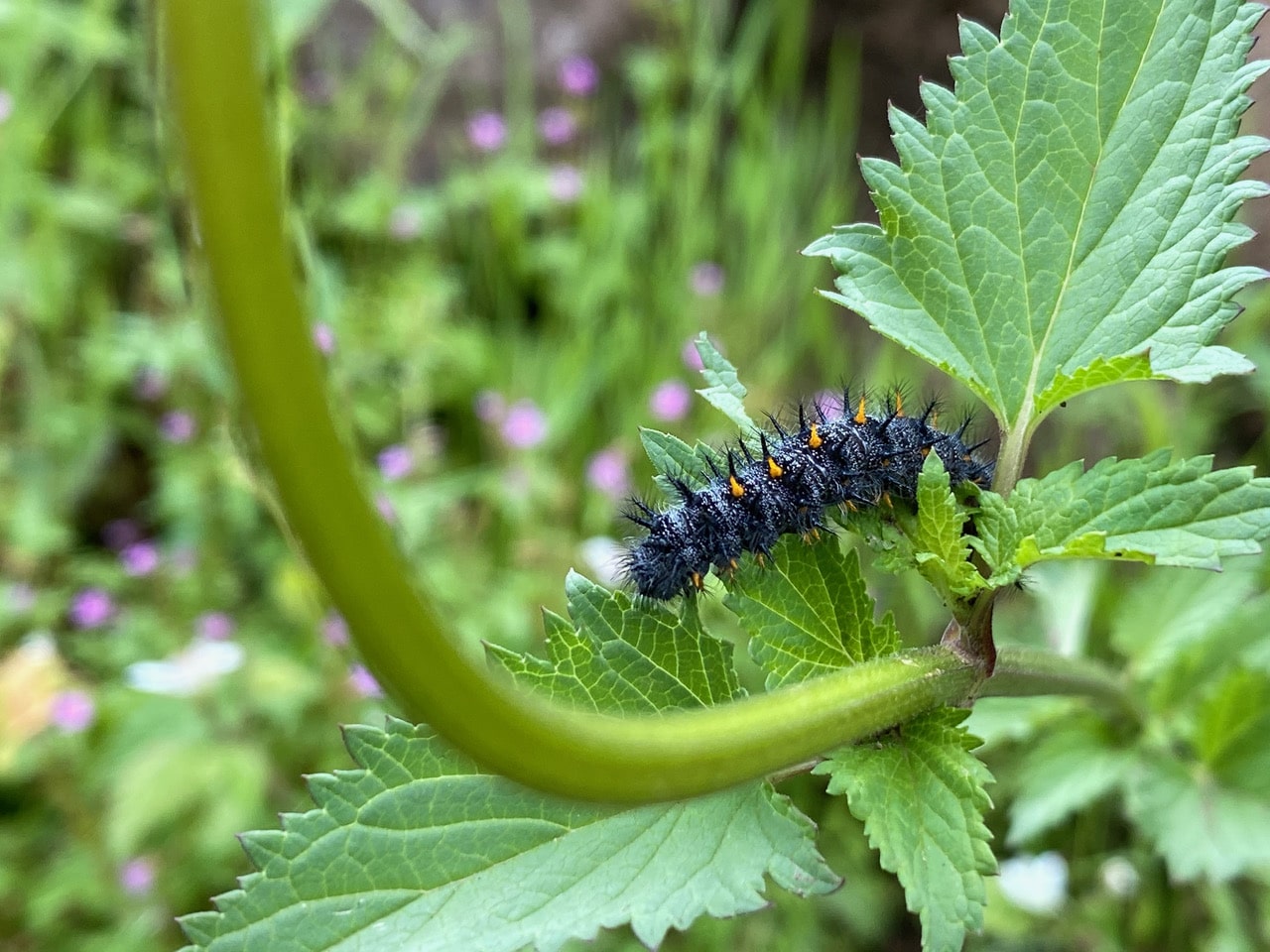
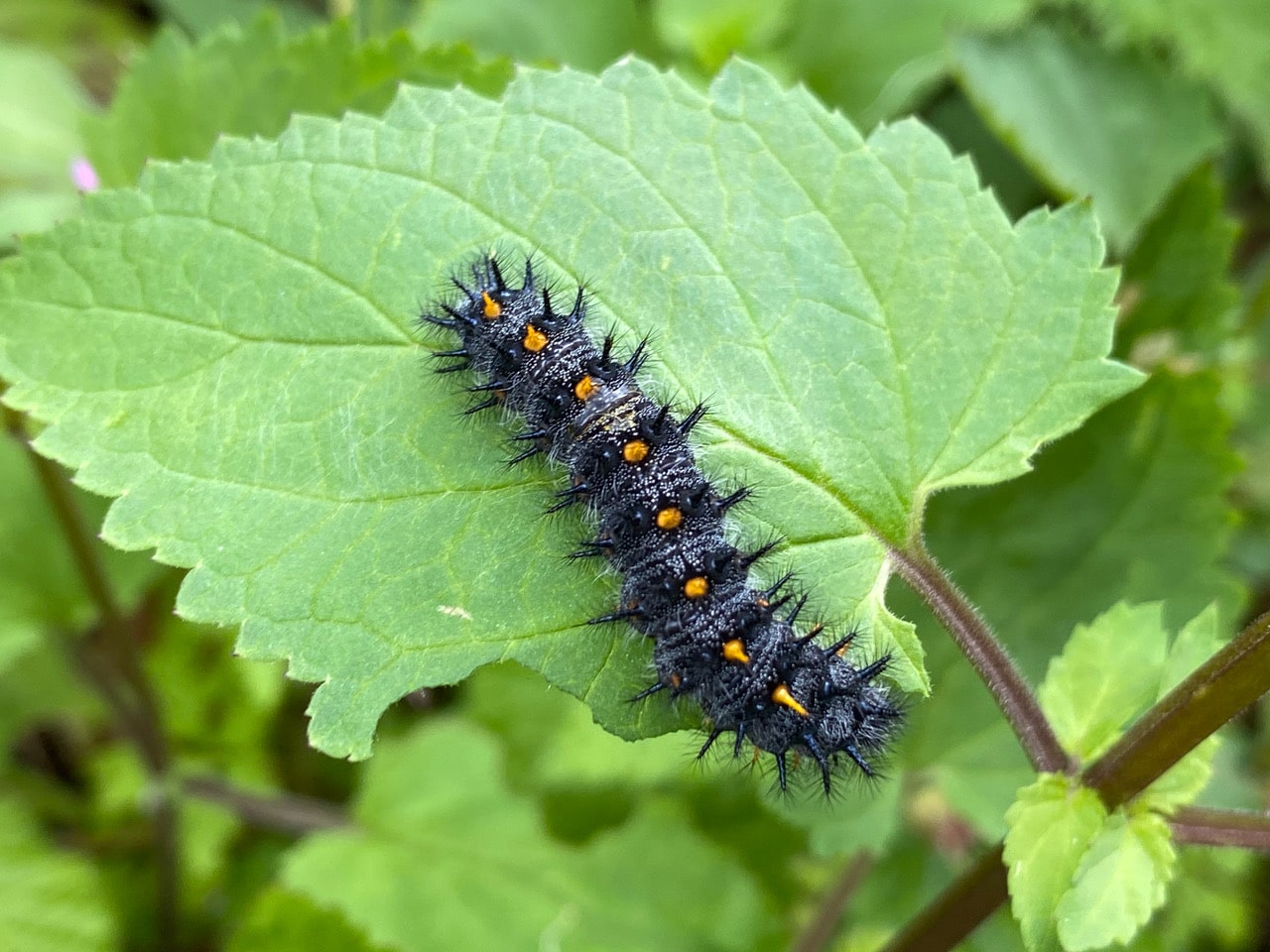
The Variable Checkerspot caterpillars, Euphydryas chalcedona (family Nymphalidae) on the California Bee Plants are getting big, but they are still feeding…

The Chinese Houses, Collinsia heterophylla (family Plantaginaceae) is blooming nicely along the trail. The plant gets its common name from its towers of flower clusters arranged in tiers of decreasing diameter reminiscent of a Chinese pagoda. Although not related to the lupines (family Fabaceae), the flowers are amazingly similar in structure, in an uncanny case of convergent evolution. The flowers exhibit bilateral symmetry; there’s an upper lip and a lower lip. The upper lip is comprised of a pair of fused petals reminiscent of the banner of lupine flowers. The colorful lower lip is made up of a pair of adjacent “wing” petals. Hidden under the wings is a keel that encloses the reproductive structures. Like the lupine flowers, Chinese Houses are also pollinated by heavy-bodied bees, notably bumble bees. The bee lands on the wing petals, lowering and spreading them apart, and allowing the keel and reproductive structures to be exposed.
None of the flowers on this flower spike has been “tripped”. Few pollinators are out on such cold, cloudy days.
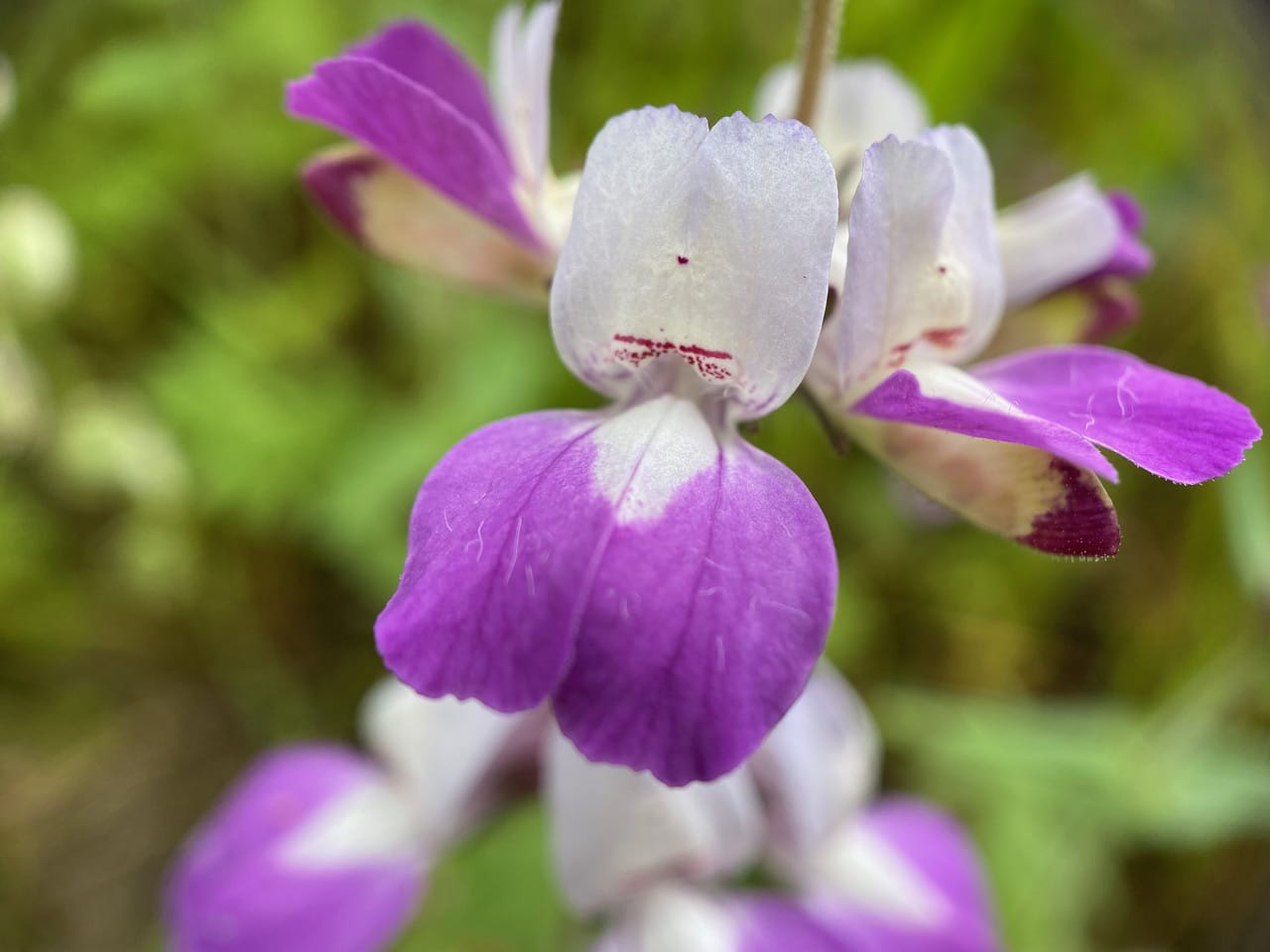
I take a closer look at the Chinese Houses flower and wonder what those red dots and dashes on the banners might be saying to the insect visitor. Flowers and bees have a secret language all their own. In the back, to the right is a side view of a flower showing the red-tipped keel under the wing petals. Dark blobs of anthers are visible through the translucent keel petal.
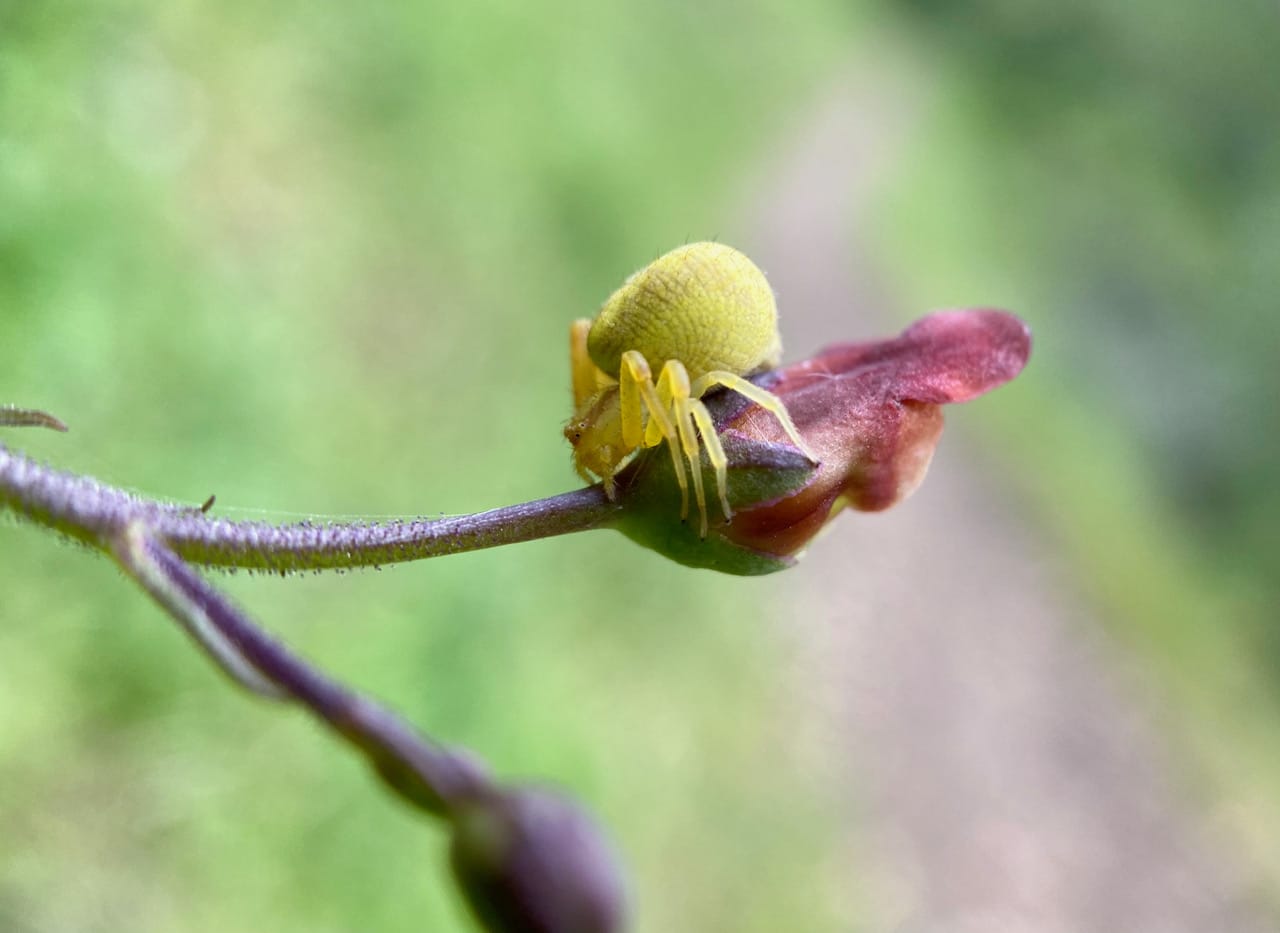
A yellow Crab Spider (family Thomisidae) can be seen from a distance sitting on a flower of California Bee Plant, Scrophularia californica. Why is the spider facing away from the entrance of the flower? How does she expect to catch any visiting insect?
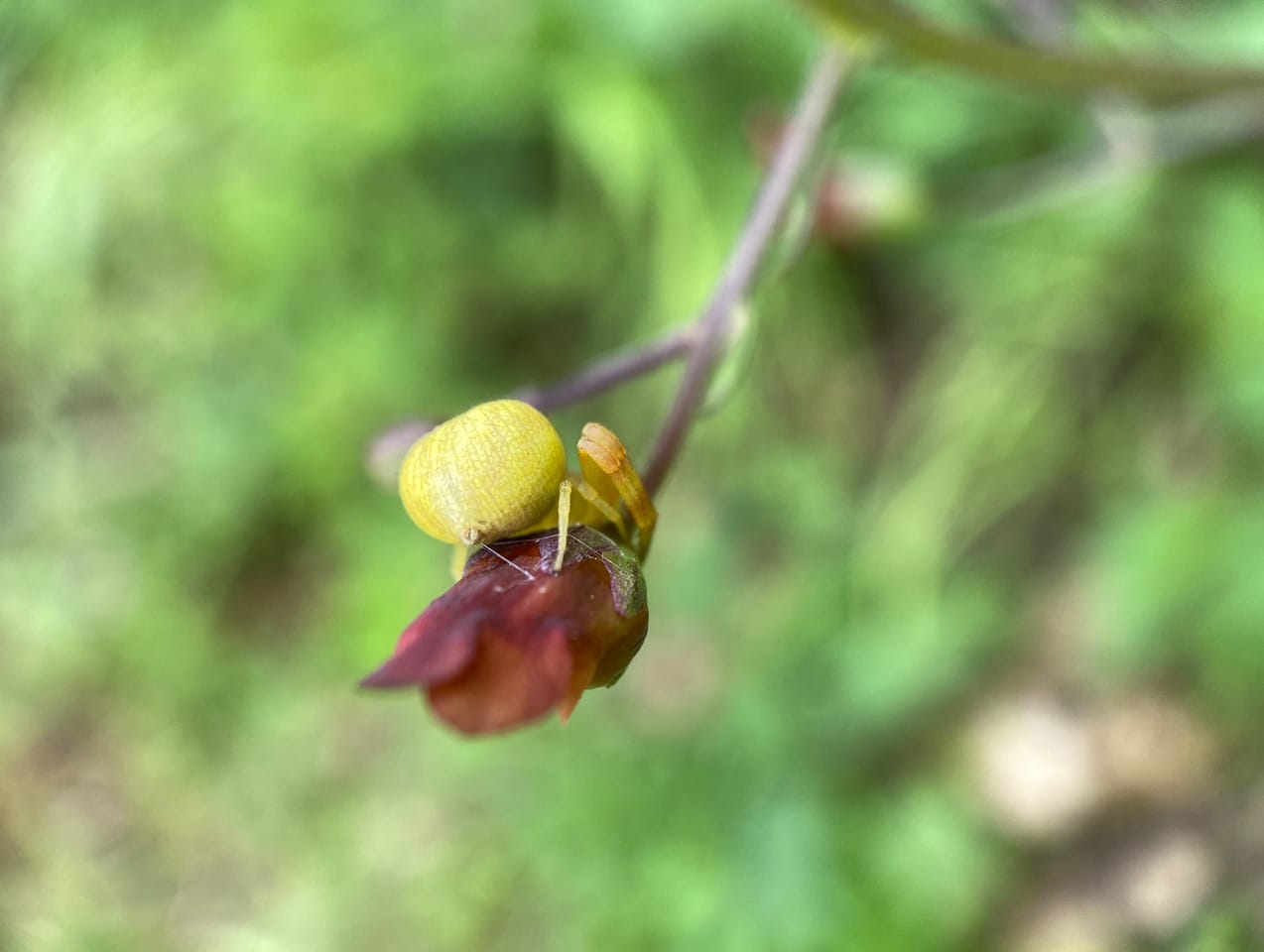
Looking closer at her rear end, I realize what she’s doing. See the strand of silk extruding from her spinneret? The spider is securing a safety or anchor line for herself, so that should she fall off the perch trying to catch a prey, she could easily get back on. It is hard to believe that a thin strand of silk could hold her weight.
We have all heard that spider silk is strong as steel. Spider silk is as strong as steel or in some cases even stronger when it comes to tensile strength, which measures the amount of stress a material is able to withstand before breaking. A strand of spider silk is made up of many smaller strands – thousands to be exact, each 1,000 times thinner than a strand of human hair. These nanostrands are only 20 millionths of a millimeter in diameter. Another key feature of spider silk is its elasticity. Some silk can be stretched up to four times its original length without breaking.
Not all spider silk is the same, however, and some types of silk are stronger than others. Different spiders produce different kinds of silk – as many as 7 kinds – for different purposes. The most well-known use of spider silk is making intricately designed webs for trapping prey. Spiders also use silk to build nests and cocoons, wrap up their prey, and as anchor lines or drag lines, which they leave trailing behind them as they move around. Some spiders even eat the silk from their old webs to recycle the proteins for making new silk.


Safety line secured, the Crab Spider turns around to face the front of the flower, ready to catch any insect that comes within reach.